1. Introduction
In January 1757, the heavily pregnant Anna Maria De Laet took legal recourse at the Antwerp church court against Jacobus Clement over paternity, demanding that he keep his promise of marrying her.Footnote 1 De Laet, born in Antwerp in 1724, had become an orphan at age 17, after her mother died and her father went abroad without returning. Since then, the Antwerp Masters of the Poor had accommodated her in about a dozen foster families. At the time of her professed romance with Jacobus Clement, she was 33 and living as a servant in Niel, a hamlet of around 600 people approximately 15 kilometres from Antwerp. Her foster family received 18 guilders annually from the Antwerp Masters of the Poor for keeping her, and profited from her labour as a servant. It was uncommon for an adult woman to continue living in foster families supported by the Masters of the Poor; De Laet, however, had been labelled ‘half silly’, and this entitled her to lifelong support from the Masters of the Poor, who would accommodate her in foster families until her death in 1794, at age 70.Footnote 2 The Masters of the Poor were anxious about the additional charge of her newborn, and assisted De Laet's legal case against Clement. On 12 February 1757 – two days before the baby boy was born – Clement pledged an oath that he had never been involved with De Laet, who thus lost the case.Footnote 3 A month later, the baby died.
The fact that Anna Maria De Laet, an illiterate and likely mentally handicapped woman who would never be able to live independently, took the expensive and dauntingly complicated steps of legal action accords with historiographical strands that emphasise the striking ‘participation of groups traditionally regarded as marginal’ in early modern litigation.Footnote 4 In line with these insights, it has been asserted that the many paternity suits traceable in early modern judicial archives reflect the surprising leverage that single mothers could wield over their children's fathers. Jeremy Hayhoe has, for instance, shown how local tribunals in eighteenth-century Burgundy acted as allies of single mothers by straightforwardly imposing alimony payments on putative fathers.Footnote 5 Garthine Walker has stressed how single mothers mastered legal concepts and language in such judicial dealings in early modern England.Footnote 6 Tanya Evans has also shown how many lone mothers in eighteenth-century London were ‘neither abandoned and alone nor ostracised and infanticidal’.Footnote 7 They used a wide range of institutional support, and many could count on empathy and compassion. For early modern Germany and the Dutch Republic, Ariadne Schmidt and Jeannette Kamp have recently emphasised the ability of early modern unwed mothers to strategically use legal forums and instruments of social control in spite of their vulnerability.Footnote 8 These historians go against older views that emphasised the liability and social isolation of unwed mothers, and the ways in which an illegitimate birth aggravated their sad situation.Footnote 9 In the 1970s, publications by Louise Tilly, Joan Scott and Miriam Cohen and by Cissie Fairchilds explained rising illegitimacy levels in nineteenth-century western Europe by women's lack of leverage in the sexual relations with men whom they expected to marry.Footnote 10 In 1990, Rachel G. Fuchs and Leslie Page Moch, for instance, discussed the social isolation of migrant women who were ‘pregnant, single and far from home’ in nineteenth-century Paris.Footnote 11 The more recent historiography, then, argues for the pauper agency of lone mothers, the fact that they tactically used opportunities offered by institutions and local communities to negotiate single motherhood.Footnote 12 All in all, both a ‘pessimistic’ and a more recent ‘optimistic’ reading of the fates of unwed motherhood are discernible in the historiography.
Anna Maria De Laet's case somewhat qualifies the recent ‘optimistic’ reading of the experiences of single mothers. For one, it illustrates how, for the humblest in society, legal recourse was feasible only when sustained by more powerful allies. In her case, the Antwerp Masters of the Poor pursued, albeit unsuccessfully, all necessary judicial measures to compel Jacobus Clement to assume his paternal duties. On the other hand, their involvement also confirms that De Laet could draw upon resources to negotiate single motherhood, and did not necessarily lose communal and institutional support, despite having trespassed moral codes. De Laet remained in Niel throughout her pregnancy, not bothering to hide her condition. Even though Clement avowed not to have fathered the child, his sister assisted in the baptism as the godmother, indicating the intricacy of the relations involving the illegitimate birth.Footnote 13 De Laet's foster family was supportive as well, allowing her to keep the baby at their home, and advancing no less than 24 guilders for the costs involving the infant's birth and burial. De Laet remained in Niel for four more years, after which the Masters of the Poor accommodated her in a family in another community.Footnote 14 In other words, De Laet's case illustrates how unwed motherhood did indeed not necessarily involve lack of social protection. However, it also indicates that legal recourse was not a straightforward undertaking for some of these women, and that such instances should be contextualised to fully appreciate their significance.
De Laet's experiences are illustrative, though not necessarily representative, of the myriad ways that single mothers confronted illegitimacy in the eighteenth-century Southern Low Countries (present-day Belgium). As will be demonstrated, many inhabitants of the small communities around Antwerp did experience social isolation and left their villages in order to give birth in secret. Many failed to engage the support of family and neighbours, or abandoned the baby, and some faced sanctions from officials for trespassing moral codes. Others, conversely, were successful in engaging the parental support of the natural father, received financial compensation, and ended up either living in consensual unions or marrying the father after the baby's birth. This article seeks to emphasise the range of experiences faced by poor women with illegitimate pregnancies during the eighteenth century. ‘Experience’ is roughly conceptualised as the actions, attitudes, and strategies that poor women adopted or were subjected to by other parties involved in the illegitimate pregnancy and birth, such as the alleged father, his and/or her parents, neighbours, and church and secular officials.
The article has two aims. The first section discusses the wide range of possible experiences of illegitimacy, and argues that these experiences differed in the extent to which they involved conflict between the single mother and the alleged father or other parties concerned, and the extent to which mothers succeeded in engaging the support of natural fathers. It will appear that institutional settings, and especially parish administration and poor relief administration, were of critical importance in eighteenth-century experiences of single motherhood, for instance, by systematically and formally registering putative fathers’ names. The second section then shows how such administrative settings changed in the final quarter of the eighteenth century, a development that had an impact upon the choices and strategies that single mothers could adopt in their relations with natural fathers. It will be argued that the role of natural fathers diminished in favour of increased burden on the mothers for their illegitimate children. This article seeks to contribute to the assessment of how the institutional contexts in which single mothers lived brought about opportunities and constraints in the choices they made in navigating illegitimacy.
Eighteenth-century Antwerp, a regional textile centre of about 50,000 inhabitants, and its surroundings was selected for several reasons. The period under study immediately preceded the dramatic rise in illegitimacy rates after 1800, which climbed from 4.4 per cent in the eighteenth century to 11.5 per cent and higher by 1850, a period when Antwerp underwent profound changes, including massive demographic growth, economic conversion, and pauperisation.Footnote 15 In this article, the examination of changing institutional contexts of illegitimacy in the late eighteenth century sheds light on the varying ways in which single motherhood was addressed in the early modern and modern eras. The Antwerp city archives offer exceptional sources for such a study, notably three registers containing the names, occupations and addresses of almost 2,800 women who gave birth out of wedlock between 1730 and 1798. These sources shed light on a wide cross-section of experiences of illegitimacy. As will be explained, the names and circumstances of these women were dutifully reported by midwives to the Masters of the Poor, who, accordingly, sought to monitor pauper parenthood, discourage child abandonment, and increase the likelihood of tracing the parents of foundlings.Footnote 16 Additional information on illegitimacy was obtained from parish registers, church litigation records, criminal prosecution records, and a broad array of documents pertaining to poor relief. Together, these sources expose the wide-ranging variety of experiences of illegitimacy for eighteenth-century women, and allow for partial reconstruction of the women's circumstances and fates.
2. The Masters of the Poor's registers
The fact that the Masters of the Poor carefully maintained registers with the assistance of sworn midwives is revealing as to civic responses to illegitimacy. The use of midwives to police women's reproductive behaviour mirrors similar uses in nineteenth-century Italy.Footnote 17 The city government and the Masters of the Poor were especially concerned about women who were not from Antwerp coming to the city and abandoning their newborns there, who would then come under their charge.Footnote 18 To increase the likelihood of tracing such parents and at the same time trying to dissuade them from resorting to child abandonment, only sworn midwives were allowed to assist at childbirths; these midwives were forbidden to admit ‘alien’ pregnant women into their homes, unless they reported the names and whereabouts of both parents within 24 hours after delivery.Footnote 19 Child abandonment by locals was also a concern. As was common in the Habsburg Low Countries, local hospitals refused to accept ailing pregnant women, out of fear of being burdened with the newborn if the mother died in childbed, as fathers were often known to abscond in such cases.Footnote 20 From 1701, a register was kept of pauper childbirths, including illegitimate ones. From 1730, separate registers were maintained for illegitimate births. These registers included Antwerp-born single mothers and those born elsewhere. Comparing the illegitimate births in the Masters of the Poor's registers to the baptismal records shows that the former are hardly exhaustive. In 1787, for instance, the baptismal registers show 67 illegitimate births, compared to the Masters of the Poor's 45.Footnote 21 Many illegitimate births were not recorded by the Masters of the Poor, in particular because the mother had failed to mention the illicitness of her pregnancy, because she had delivered her baby without the assistance of a sworn midwife, or because a sworn midwife had assisted but neglected to report the birth. The 2,800 illegitimate births found in the Masters of the Poor's registers between 1730 and 1798 can therefore safely be augmented by 50 per cent. However, I opted against the time-intensive expansion of this data with evidence from the baptismal records, as it offered limited added value. All entries in the Masters of the Poor's registers have been perused for qualitative information. One in ten entries in the Masters of the Poor's registers of illegitimate births was entered into a database, in order to quantify a limited number of characteristics of mothers and natural fathers.
The Masters of the Poor engaged about a dozen midwives to assist with pauper childbirths and barred other midwives from doing so. By engaging their assistance, the Masters of the Poor secured the help of potent allies in mapping the births of illegitimate children in a city of around 50,000 inhabitants. These midwives were typically women of humble status, who had themselves lived through many of the circumstances and misfortunes facing their clients. For instance, Catharina Stips, who worked as a midwife between 1739 and 1767, was an orphan who had been raised at the expense of the Masters of the Poor.Footnote 22 Maria van den Broeck, who worked as a midwife during the 1730s, had been abandoned by her husband and burdened with the sole care of their three children. She also looked after an illegitimate child of her stepson, a soldier who had absconded. The Masters of the Poor accepted the four children after her untimely death in 1742.Footnote 23 In April 1732, after her husband had been absent for eight years, midwife Joanna Rego gave birth to an illegitimate child; the father was a widower who lived around the corner.Footnote 24 She remained active as a sworn midwife notwithstanding her unwed motherhood.Footnote 25 To be sure, a 1777 regulation did stipulate that an aspiring midwife needed a declaration from a priest affirming her good conduct and morals.Footnote 26 Belonging to the same social groups as the pregnant women conceivably helped midwives in building relations of trust with them, which would be especially useful in performing their duty of ascertaining the name and whereabouts of the natural father. To such purposes, the regulations instructed midwives to interrogate the future mother, under oath, during labour.
About 2,800 illegitimate births were registered in the years 1730 to 1798. For 117 of the 279 births in the 10 per cent sample, the mother's place of birth was recorded. Birthplace was perhaps underreported primarily for mothers born in Antwerp, as only eighteen of these 117 mothers were recorded as having been born in Antwerp. Others came largely from the known migrant recruitment areas east of Antwerp, and some from more distant centres.Footnote 27 Occupations were recorded for only 92 mothers. Unsurprisingly, most of these mothers worked either as servants or in textile manufacturing, notably in the vastly underpaid occupations of embroidery and cotton spinning. The fact that so many appeared to work as servants mirrors the profiles of unwed mothers found in other early modern towns, as well as those of young, unmarried women in Antwerp in general.Footnote 28 It is unlikely that the 187 unwed mothers in the sample for whom no profession was registered did not work. In all likelihood, the midwives failed to report the relevant information or the Masters of the Poor's assistants did not make a note of it. The occupation of the alleged father was recorded more consistently, at least until 1780. An occupation was identified for 121 of the 279 fathers.Footnote 29 More than a quarter of them were soldiers; a third worked in one of the trade guilds or in retailing; only a minority worked as domestic servants. A small number of fathers worked in elite professions.
3. A mixed bag of experiences
The registers contain indications of the ways in which the Masters of the Poor utilised the information provided by the midwives and how they influenced women's experiences of single motherhood. Information about the whereabouts of the new mother and of the alleged father was sometimes used in order to visit and interrogate them. These interrogations were undertaken either by the Masters of the Poor themselves or by one of their four assistants (cnapen), and served to correct or complement the information proffered during childbirth.Footnote 30 For instance, the widow Anna Maria Soutwy, when pressured by the Masters of the Poor to name the father of her newborn in October 1743, claimed not to know his identity, as she had prostituted herself to him. The midwife had failed to interrogate her, since Soutwy had not mentioned the illegitimate nature of her pregnancy. Further enquiries by the Masters of the Poor, however, revealed that the child's godfather, who hosted Soutwy, was in fact the father.Footnote 31 Some mothers refused to swear to the identity of the father. For example, in June 1737 Petronella Meulensteens refused to confirm that her employer was the father of her child. The employer may have pressured her not to identify him, and perhaps promised to arrange for a wet nurse; he was reported to have made these arrangements.Footnote 32
It is unlikely that the Masters of the Poor visited every unwed mother reported by the sworn midwives. The detailed notes on the parents’ whereabouts, however, demonstrate that they wanted to be able to trace and cross-examine the parents if such need arose, for instance, in the event of child abandonment or if the mother died. Accommodating a child in a foster family cost the Masters of the Poor between 6 and 24 guilders per year, depending on the age of the child. Caring for a child from birth until adulthood incurred a total cost of far more than the yearly wages of an unskilled worker.Footnote 33 This was incentive enough for the Masters of the Poor to try to ascertain and locate the natural fathers. On 12 September 1758, the cotton-spinster Helena Merckx abandoned her one-month-old baby and absconded. The Masters of the Poor swiftly confronted the man she had named as the father, Georgius Dussaert; on 14 September he admitted his paternity and was consequently ordered to look after the baby (who died two months later).Footnote 34 At times, the Masters of the Poor waged judicial cases against alleged fathers, as they did (unsuccessfully) in the summer of 1757 against the alleged father of one-year-old Guillielmus Josephus, whose mother had just passed away.Footnote 35 In November 1745, they were successful in obtaining a written guarantee from the son of schoolmaster Reinier Coelmont to maintain the child he had fathered with his father's servant.Footnote 36 The Masters of the Poor also succeeded in compelling Joannes Koeymans, a shoemaker's assistant, to care for his two-year-old son in October 1762.Footnote 37 For some fathers, the Masters of the Poor recorded information about resources that could be used in case of need, as was done in 1733 for Josephus Janssens, a baker's assistant who was – according to the midwife – to come into an inheritance from his aunt who lived in Antwerp.Footnote 38 Other fathers, when their illegitimate child threatened their marriage, were allowed to pay compensation to the Masters of the Poor for accepting the child into their orphanage. Such arrangements were made for the child of a man who remained anonymous in the Masters of the Poor's records, in exchange for 12 guilders per year. The deal was to be renegotiated when the child reached the age of eight.Footnote 39 Conceivably, only the relatively more moneyed fathers were addressed in such cases. For instance, the widower Ignatius Lenaers, who fathered an illegitimate child with Joanna Theresia Franck in the winter of 1743, was not asked to guarantee care for the baby. He appears earlier in the poor law records as being too poor to care for his three legitimate children, who were therefore under the care of the Masters of the Poor.Footnote 40
The ways in which the Masters of the Poor traced fathers and held them accountable for care of their illegitimate children echo how officials in eighteenth-century England and France systematically registered illegitimate pregnancies and enquired into the name of the natural father. In England, from 1733, unwed soon-to-be mothers were required to present themselves to local officials and affirm, under oath, the father's name. The justices of the peace then forced the alleged father to provide a bond to cover any costs the parish might incur for maintaining the child. Thomas Nutt has shown that parishes managed to recover on average half of their expenditures on illegitimate children from alleged fathers.Footnote 41 In eighteenth-century France, all unwed pregnant women were required to make a ‘declaration de grossesse’, in order to counteract the potential for infanticide. Failing to report an illegitimate pregnancy was considered suspicious. Recently, these declarations have been revealed as also a means of pressuring alleged fathers to maintain illegitimate children.Footnote 42 Jeremy Hayhoe has uncovered for eighteenth-century Burgundy how local courts unswervingly commanded the fathers mentioned in these declarations to pay compensation and child support to the unwed mother. Their presumed paternity became subject to closer verification only when the mother also claimed payment of damages.Footnote 43 In short, examinations of illegitimate births and ‘declarations de grossesse’ constituted administrative dealings that, at first glance, appear to have targeted unwed mothers; closer scrutiny, however, shows that they could also bolster the women in their negotiations over paternity obligations.
There are no explicit indications that Antwerp single mothers calculatingly employed the registers for such purposes, yet it is conceivable that for some of them it would have been helpful to declare the father's name under oath and have their statement formally registered. Numerous mothers, for instance, had their midwife bring the newborn to the home of the alleged father; the midwife would then include this in her report to the Masters of the Poor.Footnote 44 Baptismal registers were another administrative resource that was instrumentally used, as, until 1780, they included the name of the alleged father. Servant Anna Tamboir, for instance, had her newborn child delivered to Joannes Moortgat in June 1774 together with the infant's birth certificate, which mentioned Moortgat's name. He dutifully accepted the child.Footnote 45 Numerous single mothers appeared to have been effective in having the identified father assume care of their illegitimate children; some of these women were helped by administrative resources such as parish registers. Servant Helena Genaer, for instance, in July 1750 secured assistance from her employer to care for their child, as had been guaranteed in a written statement made at the notary a month before the birth.Footnote 46 Barber surgeon Anthonius Carpentier also stated to the Masters of the Poor that he would be willing to accept the child he had fathered with his servant Maria Awaeters.Footnote 47 Some fathers kept their illegitimate offspring when marrying someone else. In 1754, the widow of the recently deceased Josephus Hermans appealed to the Masters of the Poor to be awarded custody of her husband's illegitimate son, for whom she had been caring for nine years.Footnote 48 In January 1774 the wife of Joannes Storms was prepared to accept the newborn child her husband had fathered with his former servant.Footnote 49 To be sure, success at securing paternal care does not imply that the single mother lived ‘happily ever after’. More often than not, poverty-stricken mothers who by necessity handed over their children hoped to resume maternal care when their circumstances would allow them to do so.Footnote 50
Paternal care could be an indicator of concubinage or marital postponement. In July 1776, Doctor Munickhausen, for instance, entreated the Masters of the Poor to temporarily keep the son he had fathered with his servant, in exchange for a sizeable sum of money. Munckhausen's wife was gravely ill and he planned to marry his servant upon his wife's death and take back the child; the child, however, died within the year.Footnote 51 Both the baptismal registers and the Masters of the Poor's registers contain several rectifications of the by then legal status of the child, owing to the parents having married in the interim.Footnote 52 Some couples were recorded multiple times in the Masters of the Poor's registers, apparently living in consensual unions.Footnote 53 Estimating the proportion of consensual unions is not possible, yet at least eight of the sixty-seven illegitimate children recorded in the 1787 baptismal registers subsequently became legitimate due to their parents’ marriage. Some women mentioned marriage plans when interviewed as to the circumstances of their illegitimate pregnancy.Footnote 54 Others planned to marry but never did, due to parental opposition, as was the case with the Dutch Reformed Catharina Jansseneck and the Catholic Nicholas Van Waut. Jansseneck hoped to convert to Catholicism and marry Van Waut, but the priest of the Saint Andries church refused to marry them without her parents’ consent.Footnote 55 These examples corroborate how unwed motherhood did not always involve conflict with the natural father and often involved consensual unions. Couples often postponed marriage due to poverty, and many never followed through with marriage. For nineteenth-century Antwerp, an increase in concubinage has been uncovered, which decisively contributed to rising illegitimacy levels.Footnote 56
Even if there was conflict with the father, some women showed marked resourcefulness, for instance, by mobilising the local community to pressure the putative father. The practice of giving a child the same first name as the alleged father and having the child registered as such in the baptismal register involved such public pressure. This strategy has been described for several towns in the Dutch Republic. In eighteenth-century Leiden, for example, more than half of illegitimate baby boys received the first name of their natural father, in contrast to only a third of legitimate baby boys. About a quarter of illegitimate baby girls received a female rendering of their father's first name – Anthoon became Anthonia for instance – while the same naming practice was uncommon for legitimate baby girls.Footnote 57 A limited analysis of naming practices based on the baptismal registers in the Sint-Andries parish between 1730 and 1780 reveals that naming was also a strategy to pressure fathers in Antwerp. Whereas legitimate children without exception adopted the name of their godparents (occasionally combined with the name of their father or mother), almost a quarter of the illegitimate babies received their father's first name. To be sure, the strategy was less often used in Antwerp than in Leiden, and rarely for the naming of illegitimate baby girls.Footnote 58
Single mothers pursuing civil legal action against natural fathers also confirm their resourcefulness. In the Habsburg Low Countries, moral issues regarding marriage, including illegitimate parenthood, mainly pertained to the jurisdiction of church courts.Footnote 59 In theory, the court was to punish men and women who had entertained non-marital sexual relations. However, in actual practice, judicial procedures did not involve criminal prosecution, and instead related to civil actions between parties, with the church court as arbitrator or adjudicator. A woman taking legal action required relative inclusion within the local community. As legal spokesmen were indispensable in judicial procedures, most litigating mothers needed free legal assistance to defend their claims; this kind of relief was accessible only for the deserving poor.Footnote 60 Support by the Masters of the Poor and one's own relatives could be decisive for undertaking legal steps as well. For eighteenth-century Leiden, it has been shown that only a limited share of the large group of unwed mothers undertook such action. Those who belonged to the prevailing Dutch Reformed church, who were beneficiaries of poor relief, and whose own fathers were still alive were especially inclined to take judicial steps. These various contextual factors indicate their relative inclusion within the community, and help to explain why these women felt confident in opting to bring matters to a head.Footnote 61 It appears, however, that in the case of eighteenth-century Antwerp, it was predominantly the putative fathers who took legal action against mothers, as revealed by the church court records. Antwerp single mothers were much more liable to appear in the church court as defendants, and far less likely to act as plaintiff than in Leiden. As explained in the following section, by the eighteenth century, paternity cases increasingly involved men pursuing judicial remedies to legally forbid women from having their name recorded as father in the baptismal records. The Masters of the Poor's registers contain several references to litigating fathers, but none to litigating mothers.Footnote 62 The case of Anna Maria De Laet, from the beginning of this article, appears to have been exceptional.
This brings us to discussion of several examples of experiences of unwed motherhood that support a ‘pessimistic’ reading of these women's fates. A number of testimonies show how coping with single motherhood was challenging for women who earned meagre incomes and could draw upon little communal support or support from the natural father. On 1 July 1757, the Masters of the Poor accepted the three-month-old child of Magdalena Lauwens, a servant who had gravely neglected the child. Such intervention was overdue, and the infant died 12 days afterwards.Footnote 63 More frequently, the Masters of the Poor were compelled to accept illegitimate children because the mothers had abandoned them (and occasionally absconded). Sometimes, the midwives helped prevent child abandonment, as did Barbara Vleeshouwers, who, in the summer of 1742, claimed to have persuaded Catharina Moens not to abandon her child (whom she had conceived with a married man).Footnote 64 They also signalled cases where they suspected risks of abandonment. When midwife Catharina Stips assisted in delivering the child of servant Joanna Colom, she mentioned her suspicions to the Masters of the Poor, who thereby set out to gather more information about the mother's whereabouts and connections.Footnote 65
To be sure, abandonment of children or the inability to care for them was not restricted to parents of illegitimate children. The Masters of the Poor's records abound with examples of fathers and (less often) mothers who absconded from their legitimate children. However, the Masters of the Poor often accepted illegitimate children as well, after verifying that the child could not be supported by kin or ‘friends’. For example, the two-year-old child Norbertus Chardon was abandoned in 1751, after living with his natural father and his (the father's) wife; the father and stepmother kept only their legitimate son.Footnote 66 Maria Beres was accepted at the age of eight by the Masters of the Poor. She had been with a foster family in the countryside since birth; however, the foster father returned her to her poverty-stricken grandmother in Antwerp, after her natural mother had absconded and stopped payment.Footnote 67 Especially from the last quarter of the eighteenth century, the number of foundlings and abandoned children increased, mirroring changes elsewhere in Europe.Footnote 68 In 1784, the Masters of the Poor noted that they had accepted no fewer than 529 children in the past five years, almost double the number accepted for the years 1775–1779.Footnote 69 Until 1779, they had recorded an average of seven foundlings per year, in addition to an average of thirty-nine other children who entered their care because the parents had died, were unable to care for them, or had absconded. After 1779 (the year a new poor law administration was installed), they repeatedly accepted more than one hundred children per year, including on average 20 foundlings and illegitimate children, categories they conflated.Footnote 70 In 1794, no fewer than 25 foundlings and 31 illegitimate children were accepted into the care of the Antwerp Masters of the Poor.Footnote 71
In cases of foundlings, the Masters of the Poor typically sought to trace the parents. Formal regulations dating from 1725 stipulated harsh punishment for child abandonment, including public shaming and banishment for 12 years.Footnote 72 Sometimes, the Masters of the Poor published advertisements calling upon inhabitants for useful information regarding parents who had absconded, in exchange for rewards of 25 guilders.Footnote 73 Abandoning a newborn was considered an especially hideous crime, as leaving a child in the open air gravely endangered it. On 4 December 1700, such fears were realised: a newborn baby girl was found dead on a bench in the Vleminckxtreet; she had died due to neglect. The city government promised a reward of one hundred guilders for help in tracking the mother.Footnote 74 However, the severe punishments for child abandonment stipulated in the by-law of 1725 were rarely meted out. In April 1758, the mother of a foundling was quickly identified as the wife of an innkeeper in a village near Bergen op Zoom, some 50 kilometres from Antwerp. The Masters of the Poor did not return the baby, yet demanded the parents pay 30 guilders a year to cover the expenses of keeping the child in a foster family.Footnote 75 In 1729, when the Masters of the Poor successfully tracked Anna Maria Janssens as the mother of a foundling, they simply returned the baby to her, and also provided aid.Footnote 76 Laceworker Maria Walraven also received support instead of punishment when her baby was returned to her in 1732.Footnote 77 As elsewhere in the Southern Low Countries, authorities refrained from vigorous execution of the law, for fear of provoking cases of infanticide.Footnote 78
However, not all identified mothers came away lightly from child abandonment. When servant Anna Wissel was traced in 1741, after her baby had been left near the Saint Jacob cemetery earlier that year, the Masters of the Poor duly informed the city government of her offence.Footnote 79 Maria Cosemans was interrogated in June 1781 after being arrested for child abandonment and debauchery. She clarified how her husband had left seven years before with the wife of a certain Johannes Bastiaensen, abandoning her with their newborn son. After many entreaties by Bastiaensen, Cosemans had begun seeing him, and became pregnant twice. The first baby was stillborn; after the second was born, Bastiaensen refused to contribute to its upbringing. Cosemans explained that her lacework paid too little for maintaining herself and two small children. She therefore had her illegitimate baby delivered at Bastiaensen's house and absconded, ostensibly to increase her chances that he would accept paternal responsibility. He refused, however, and the baby was ultimately accommodated with a wet nurse by the Masters of the Poor. After Cosemans's return to Antwerp, the city government sentenced her to six months in the Vilvoorde prison, for debauchery. The child remained with a foster family in the countryside and was never reunited with his mother.Footnote 80 Cosemans's testimony and experiences were far from unique. In April 1779, Maria Feyers was committed for two years to the newly built Vilvoorde house of correction, because of debauchery and deserting her children. She similarly testified to having been abandoned by her husband, who had emigrated to the Dutch Republic, and to working as a cotton spinner, work that barely allowed her and her three small children to survive. After a while she had begun seeing Jacobus Sas, a married man. When she became pregnant, they both left Antwerp, professedly out of shame, leaving her children with her mother, who later solicited the Masters of the Poor to accept them. Feyers gave birth in Malines, where she had her baby baptised under her husband's name, which indicates somewhat the feeling of shame that illegitimate motherhood may have brought upon her. Possibly, she also tried to improve the legal status of the child.Footnote 81 She was never reunited with her children, each of whom remained with families in the countryside.Footnote 82 The fact that Cosemans and Feyers had absconded provoked a harsher response from the authorities. In 1782, the city authorities remarked, in a letter to their Brussels counterparts, that they applied the full rigour of the 1725 law only against accomplices in child abandonment and against parents who absconded.Footnote 83
Some women were punished for debauchery even when they had not abandoned their newborn. In 1783, Maria Smeerpont was sternly admonished by alderman Della Faille and lawyer and visitor of the poor Nantueil because she, a married woman, had children by a different married man. In December, she was incarcerated in Vilvoorde for three years, for debauchery. Her openly troubled relation with her much older husband possibly gave offence.Footnote 84 The Masters of the Poor also removed children from mothers because of their suspected bad influence. Elisabeth Mijnen gave birth in April 1755 and told the midwife she did not know the father's name, as she had been involved with numerous men. By August, Mijnen had caused such scandal as to be confined to the house of corrections and to lose custody of her daughter. The Masters of the Poor noted that the child was never to be returned, even after her mother was released from prison. The child remained in the village of Oelegem, 20 kilometres from Antwerp.Footnote 85 Maria Catharina Driessens was well known to the Masters of the Poor, having been raised under their supervision. After she gave birth to an illegitimate daughter in 1757, the Masters of the Poor noted that she was a known scoundrel and should be incarcerated in the Antwerp house of corrections for half a year. Her daughter was taken from her and placed with a family in the countryside, where she died three years later.Footnote 86
The Masters of the Poor's registers contain several examples of women from outside Antwerp who came to the city to give birth, a strong indicator that an illegitimate pregnancy would entail troubles for them in their home town or village. In 1742 Maria van Doef came from Deurne to give birth at the house of midwife Kettermans because her local priest had threatened not to baptise the illegitimate child.Footnote 87 In 1751, when Maria Marien, a servant working in Merksem, a few kilometres from Antwerp, became visibly pregnant, the local priest drove her away, possibly fearing the prospective burden on the local relief fund. She gave birth in Antwerp, in a rented room, in early February 1752.Footnote 88 On 2 May 1766, Adriana van Velthoven, a servant at a farm in Berendrecht, 20 kilometres from Antwerp, arrived on a cart at an inn, accompanied by another woman. She quickly gave birth, and departed the city on the same cart. She had been made pregnant by her employer, a married man. After its baptism, the baby was collected at the midwife's house and lodged with a foster family in the countryside, reportedly paid for by the natural father.Footnote 89 Clearly, some of these women, lacking any support from a local network, opted to hide their illegitimate pregnancies from their local communities, while others could count on support from the father.
It is impossible to derive exact figures from the Masters of the Poor's registers to assess the extent to which the single mothers were already living in Antwerp or had come from outside the city to give birth. For 96 of the 279 mothers in the 10 per cent sample, a residential address in Antwerp was noted. For the others, no such address was recorded, though this does not mean they did not live there. The Masters of the Poor recorded more meticulously the address where the mother was lying-in. Twenty-eight of the 279 mothers gave birth at a midwife's house, possibly denoting non-residence in Antwerp. Yet many more were lying-in at houses, inns, and rooms they may have rented only temporarily. It appears that some venues were regularly used by mothers to give birth. The house of a certain Jacobus Bogaert, in the Boeksteeg, for instance, appears several times in the sample. He acted as godfather for multiple illegitimate children, sometimes in the name of an absent family member of the mother.Footnote 90
Infanticide and abortion, lastly, generally reflected the social isolation of the unwed mothers, such acts usually being perpetrated in secret and when the mother was alone. In Antwerp, ten cases from the eighteenth century could be found that were subject to criminal investigation for child murder.Footnote 91 In four cases the mother could be traced, leading to a conviction. The women's testimonies reveal their isolation. Servant Maria Simons gave birth in secret at her employer's house in 1701; she suffocated her baby in an attempt to quieten it. She was convicted in June 1701 to be scaffolded, whipped, brandished, and banned from the Duchy of Brabant.Footnote 92 In 1774 cotton-spinner Anna Catharina van de Rijn was whipped and banned for 25 years, having been found guilty of suffocating her child and throwing it into the cesspool of her lover, a married man, whom she had been seeing for seven years and who had also fathered her other children.Footnote 93 Elisabeth van de Putte, a kitchen maid, allegedly suffocated her child and fled; an effigy of her body was broken on the wheel in January 1751.Footnote 94 By these public ritual punishments, the city government hoped to set an example, and to discourage the many single mothers who gave birth in Antwerp but did not have the means and connections to care for their newborns.
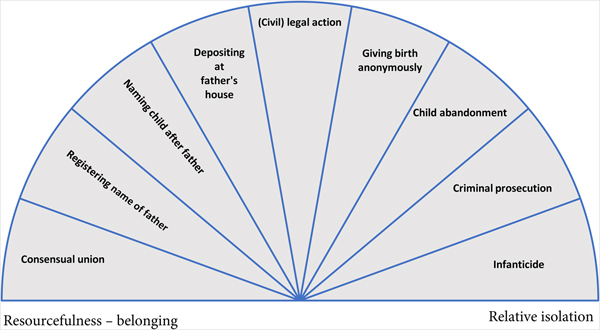
All in all, the examined sources reveal the wide range of possible experiences of illegitimacy. This range has been schematically visualised in Figure 1. On the left-hand side, experiences are listed that reflect the relative resourcefulness of single mothers to engage paternal support. Consensual unions are, of course, the most outspoken form of securing paternal care. Experiences such as depositing the child at the father's home, having his name registered or naming a child after its putative father also show actions by women to engage such support. The label ‘belonging’ on the left-hand side shows how many of these experiences involved some support from the local community or from urban institutions. Mothers who placed their child in the father's home, for instance, actively pressured the father to accept the child and invited the local community to witness this and thereby assist them. This is evident from the fierce retorts against such practices made by alleged fathers, who worried about their reputations. The involvement of the Masters of the Poor in pursuing paternal support for illegitimate children also demonstrates the way some mothers could use communal resources in their negotiations with their children's natural fathers. Registering the father's name in baptismal registers could involve conflict and also denote consensual parenthood. On the right-hand side, experiences are listed that reflect a lack of local belonging and failure to share the burden of an illegitimate child with the father. Infanticide is the most extreme form of such isolation, yet child abandonment and giving birth in secret similarly denote a lack of communal support.
Range of outcomes associated with single motherhood.

4. Shifting institutional contexts
The above elaboration on the varied experiences of illegitimate pregnancy and motherhood for eighteenth-century women offers several clues as to the contextual factors affecting those experiences. On the individual level, having a supportive network of family and neighbours, or an intimate relationship that was expected to lead to marriage, improved a woman's chances of preserving her inclusion within the community and of having the father assume responsibility. Conversely, having an illegitimate child with a married man, especially a social better, or frequently and too publicly having ‘loose’ relationships provoked instances of exclusion. However, no fixed rules applied. For example, there are various cases of women bearing the child of a married man yet still being able to rely upon his paternal support. Furthermore, we have seen that certain administrative settings played a role in women's experiences of illegitimacy. In the eighteenth century, the names of natural fathers were formally registered, both in the parish registers and in the Masters of the Poor's registers. The fact that a woman named a man as father, under oath and during labour, was by default accepted by religious and secular officials, and the identification could be used in the negotiations over paternal responsibilities.
These administrative settings, however, changed in the last quarter of the eighteenth century. I will argue that this brought about a gradual and adverse shift in the radius of action accessible to unwed mothers. A first change developed progressively over the eighteenth century. Unwed mothers became relatively less successful in civil cases against alleged fathers, as the latter were increasingly more inclined to swear an oath that they had not been involved with the mother. Judicial procedure had always unambiguously disadvantaged the unwed mother, as her oath of paternity was considered less weighty than one pledged by the alleged father. The Antwerp church court records are incomplete, so counting proves delicate. Jozef De Brouwer, however, has ascertained that from 1650 to 1700 alleged fathers recognised paternity in 152 of the preserved 160 cases (95 per cent). In the years 1701 to 1750 only 58 of 93 alleged fathers acknowledged paternity (62 per cent), while in the years 1751 to 1790 no more than 2 of the 34 fathers whose case files were preserved accepted paternity.Footnote 95 The church court archives contain a sizeable yet incomplete collection of petitions regarding the initiation of paternity cases in the church province of Antwerp. From the 78 such petitions I found for the years 1750 to 1760, only four related to cases instigated by an unwed mother.Footnote 96 In the eighteenth century, paternity cases thus typically appear to have been initiated by men who hoped to silence the women with whom they had allegedly been involved.
This contrasts starkly with the situation in Leiden, where paternity cases were as a rule initiated by mothers who were seeking child support and compensation for the costs of giving birth; these cases were often successful.Footnote 97 To be sure, a man's oath was similarly weightier in eighteenth-century Leiden, yet here alleged fathers were markedly more reluctant to deny paternity under oath.Footnote 98 In the Antwerp church court, conversely, most men involved in paternity suits were willing to pledge that they had not been involved with the opposing party. This is fairly unsurprising, since they were nearly always the initiator of the lawsuit. The Masters of the Poor, for their part, did not necessarily always believe an alleged father's oath to be truthful. In the summer of 1755, for example, they recorded the name of Nicolaes Netser as the father of Maria Lucas, despite the church court's verdict, and added a remark that in 1750 he had fathered another illegitimate child, whom he had hastened to pay support for, as ‘the church officials came too near’.Footnote 99 There thus appears to have been a downgrading of the oath at the eighteenth-century Antwerp church court, a shift not discernible for eighteenth-century Leiden.
In Antwerp, unwed mothers faced several hazards when dealing with a summons from a church court to respond to charges from an aggrieved alleged father. In March 1751, Catharina Coetermans received such a writ instigated by Adrianus Troubeneers, two days after the birth of her baby. He was incensed that she had had registered his name in the baptismal register of Deurne, a village near Antwerp, and that she had threatened to deliver the baby at his house. She was to answer the summons within three days and provide proof of his paternity. If she failed to do so, she was to be silent on the matter everlastingly. After failing to answer his request in time, she petitioned the church court ten days later. Answering his demand, she explained, had been unmanageable, as she had been unable to leave her bedstead so soon after giving birth. Moreover, starting a case required the hiring of a proctor (procureur) and a full discussion of her defence with a lawyer (advocaat). Too poor to pay for such legal counsel, she now petitioned for free legal aid. It is unclear how this case ended.Footnote 100 In view of the modest circumstances of the large majority of single mothers, the hazards Coetermans would have confronted in answering the judicial actions of her child's alleged father were, in all probability, insurmountable for many in her situation.
The Antwerp church court archives offer other examples that illustrate the obstacles facing potential litigants. In the summer of 1762, Cornelia Josepha De Clerck defended her paternity claims against Petrus Henricus Zumallo, the captain of the Antwerp civil guard. In a later case, she testified how she had fallen victim to the machinations of a certain Verbeeck, a marshal of the church court, when he was prosecuted for deceiving a number of litigants and witnesses, in all likelihood to increase his income. She testified that Verbeeck's persuasive talk – after bringing her a summons – convinced her to share all the details of her case and pay him for his advice, without the knowledge of her proctor.Footnote 101 Another woman, Anna Catharina Lemmens, also fell victim to Verbeeck, believing him when he stated that her proctor and lawyer were unsuitable and that he could help her more successfully, and that her opponent had confided to him that her claims of marriage were indeed truthful.Footnote 102 De Clerck's and Lemmens's testimonies show how unfamiliarity with judicial practices and procedures added additional obstacles to one's dealings with the legal system. In view of the growing sense of inconsequence with which alleged fathers tended to pledge oaths not to have fathered illegitimate children, and the various encumbrances that judicial recourse involved, it is hardly surprising that so few unwed mothers pursued such recourse. In the event of conflict, holding the father accountable for an illegitimate child via judicial means was challenging on multiple fronts.
As it appears from the judicial cases, the growing aversion among men to accept paternity claims against them appears to have been sensed by those in power as well. This is indicated by the second important change, in parish administration, that ensued in the summer of 1778. As part of a broader initiative to improve the quality of parish registers, the Brussels central government decreed that priests or their clerks were henceforth strictly forbidden to include the name of alleged fathers in the baptismal recordings of illegitimate children, unless the fathers were willing to sign his name.Footnote 103 Observing the 1778 ordinance, Antwerp priests, in 1780, effectively and abruptly stopped noting the names of natural fathers in baptismal registers, consequently eliminating a potential means by which women could apply pressure when negotiating paternal support for their illegitimate children. Of the 67 illegitimate births found in the baptismal registers of 1787, just six fathers signed their names to the entry and thereby formally acknowledged paternity. Five of these fathers subsequently legitimatised the child in question, by marrying the mother.
The relevant article in the 1778 ordinance originated in applications from the provinces of Gueldres, Luxembourg, and Brabant to the central authorities. The Council of Gueldres stated that it had been local practice since 1769 to note the father's name only when he himself agreed or if it had been ordered by a judge. The Council of Luxembourg declared that the practice of recording the names of fathers who had been identified by women via midwife interrogation during labour was a form of abuse.Footnote 104 Additional research into provincial decision-making may further clarify why the longstanding practice of registering natural fathers’ names became unacceptable in the last quarter of the eighteenth century. However, the way the Council of Luxembourg summarily expressed its views hints at one possible explanation. The fact that they specifically questioned the validity of a mother's oath made while she was in labour is revealing. For at least two centuries, such an oath had been considered valid, as a dishonest future mother faced eternal damnation in the not unlikely event that she died in childbed. Conceivably, such religiously inspired reasoning lost credibility in the Age of Reason. In this respect, men may have become less reluctant to pledge an oath denying paternity as they became less fearful of eternal damnation. The contrast with Dutch-Reformed Leiden men, who generally still exhibited marked hesitancy to pledge such oaths, perhaps reflects differences in how they practised and experienced their faith. Another possible explanation for changing attitudes towards paternity claims in eighteenth-century Antwerp, as opposed to Leiden, may be derived from the history of sexuality. Research for eighteenth-century England has indicated a changing culture of ‘masculinity’ and ‘femininity’ that moved away from the negotiated sexual relationships that had dominated the seventeenth century towards a more intemperate ‘phallocentric culture’.Footnote 105 In a context of economic difficulties and delayed and difficult marriage, this ‘sexual crisis’ was accompanied among some plebeian groups by growing misogyny and gender disharmony, that also resounded in middle-class and elite perceptions of ‘respectable’ sexual relations, considering women who had sex outside marriage as prostitutes.Footnote 106 Whether such changes in ideas on sexual relations, masculinity and femininity were perceptible in cities of the Low Countries as well, and whether there were significant differences between Antwerp and Leiden, remains to be established. However, middle- and elite-class rebuttal of plebeian sexual morality certainly resounds in the regulations that put an end to age-old practices of swearing to paternity during labour.
The prohibition against registering natural fathers’ names in baptismal registers also had consequences for how the Masters of the Poor maintained their records of illegitimate births. In 1780, they similarly stopped registering fathers’ names, and correspondingly discontinued their efforts to identify fathers and compel them to assume paternal responsibilities. This may seem surprising, as the Masters of the Poor continued to have a firm stake in alleviating their limited relief funds from the expenses of maintaining growing numbers of illegitimate children. After all, the shift of responsibility for illegitimate children, from fathers to mothers, must often have led to increased reliance on poor relief funds. The archives contain no traces of how the Masters of the Poor regarded these issues. Yet their apparent readiness to forego the tracing of fathers foreshadows the way they would stop tracing parents of foundlings altogether in 1804, by installing a foundling wheel. This measure was taken in the context of the French regime, which acclaimed late eighteenth-century theories of ‘populationism’ that considered a growing population (and the upkeep of children) as beneficial to the strength of the state.Footnote 107 No sources exist that allow us to reconstruct the ideas and convictions of the Antwerp local elites on the matter, but these ideas surely reigned in the 1770s and 1780s among Brussels central elites.Footnote 108 However, regardless of how prevalent such thinking may have been, the fact that the Masters of the Poor no longer sought to trace fathers after 1780 eliminated them as powerful allies in a single mother's negotiations for paternal support. Some strategies depicted on the left-hand side of Figure 1 ebbed due to these administrative changes.
Together, these two contextual changes amounted to an increased emphasis on maternal responsibility for the upkeep of illegitimate children. This change echoes similar transformations in how English and Welsh authorities treated illegitimacy after the New Poor Law was installed in 1834. Thomas Nutt has elucidated how the New Poor Law included suppression of the bastardy clauses of the Old Poor Law, which had, since the sixteenth century, entitled unmarried mothers to relief, sponsored by the natural father. This part of the poor law reform was informed by fears that the law had, in effect, stimulated immoral sexual behaviour and by the (mistaken) conviction that parishes had generally failed to reclaim their expenses for illegitimate children from the fathers. Moreover, alleged fathers became increasingly viewed as victims of a system in which women frequently pledged false oaths of paternity. Under the New Poor Law, a mother's oath of paternity had to be supplemented with additional evidence before it was considered valid. The new regulations regarding illegitimacy sparked widespread disapproval among local governments and the general population, and were thoroughly revised in 1844.Footnote 109 Nonetheless, they indicates the way illegitimacy and single motherhood became perceived among certain segments of the elites in the late eighteenth and early nineteenth centuries, and how the care for illegitimate children increasingly came to rest solely upon the mother. Such changes had an adverse impact on the choices and negotiating position of single mothers.
5. Conclusions
The wide array of experiences among women dealing with illegitimacy in eighteenth-century Antwerp is striking. The examined sources reveal many instances of pauper agency, yet the despair indicated by the stark reality that so many women gave birth anonymously or abandoned their newborns cautions against straightforwardly assuming that all single mothers were similarly forceful in their dealings with illegitimacy. Social, economic, cultural, and political contexts affected their radius of action. In eighteenth-century Antwerp, a number of contextual circumstances can be identified that had a critical impact on single motherhood. The way poor relief was organised was of importance to many women who gave birth out of wedlock. As in England and France, local poor relief administrators in the Habsburg Low Countries, and notably in the city of Antwerp, could be powerful allies in women's negotiations over claims of paternity. These administrators, hoping to relieve their own financial burdens, had a firm stake in fathers assuming paternal responsibility. While paternity claims were not as straightforwardly acknowledged in Antwerp as they were in eighteenth-century Burgundy or England, the names of alleged fathers were routinely registered in baptismal records and in the records of the Masters of the Poor. Until 1780, alleged fathers who wished to remove their names from such records were required to take legal recourse and pledge an oath. Thus, until the final quarter of the eighteenth century, women's claims of paternity were by default considered valid. They could correspondingly often rely on communal pressure on alleged fathers, such as by naming their child after him or by having the midwife bring the newborn child to his home.
By the final quarter of the eighteenth century, however, women's claims of paternity became less convincing. Alleged fathers as a rule won their cases, and from 1778 it was prohibited to register their names in baptismal registers. As the phrasing of the 1778 prohibition on entering putative father's names in baptismal registers suggests, they were increasingly considered to be victims of women who pledged false oaths. Although further research is needed, my hypothesis is that changing mindsets led to women's oaths becoming less weighty in the Age of Reason. It is striking that after 1780 the Masters of the Poor simply discontinued their longstanding practice of trying to trace fathers. This was followed, in the early nineteenth century, by a growing disinclination to trace mothers. The institutional changes around 1780, therefore, already foreshadowed the growing willingness of officials to accept unwanted children, out of fear of infanticide and out of conviction that care for such children was ultimately beneficial to the state.
In short, four key factors affected the options a single mother had at her disposal in dealing with illegitimate pregnancy: the way poor relief was organised, the relative accessibility of judicial processes, the administrative settings, and the prevailing ideas about illegitimacy and morality among the general community. These factors, combined with a woman's own particular personal circumstances, led women to experience illegitimacy in a wide range of ways.
Acknowledgements
The research for this article was carried out during a postdoctoral fellowship granted by the Research Foundation-Flanders, Belgium. The author expresses gratitude to the anonymous reviewers for their valuable comments on an earlier version of the article.