Introduction
In the 1990s, a number of studies on the public's help-seeking and treatment preferences with regard to mental disorders in general, and depression, in particular, have been conducted. They all concurred with the conclusion that psychotherapy is being held in high esteem while psychotropic medication is rather met with rejection (Angermeyer & Matschinger, Reference Angermeyer and Matschinger1996; Jorm et al. Reference Jorm, Korten, Rodgers, Pollitt, Jacomb, Christensen and Jiao1997a, Reference Jorm, Korten, Jacomb, Christensen, Rodgers and Pollittb; Lauber et al. Reference Lauber, Nordt, Falcato and Rössler2001). However, there are indications that in the meantime medication has been able to gain ground and that the public may now be less opposed to it (Angermeyer & Matschinger, Reference Angermeyer and Matschinger2004, Reference Angermeyer and Matschinger2005; Goldney et al. Reference Goldney, Fisher, Del Grande and Taylor2005, Reference Goldney, Dunn, Del Grande, Crabb and Taylor2009; Jorm, Christensen & Griffiths, Reference Jorm, Christensen and Griffiths2006; Angermeyer, Holzinger & Matschinger, Reference Angermeyer, Holzinger and Matschinger2009; Blumner & Marcus, Reference Blumner and Marcus2009). Results from recently published trend analyses also suggest that the readiness to seek help from mental health professionals may have increased (Angermeyer & Matschinger, Reference Angermeyer and Matschinger2005; Mojtabai, Reference Mojtabai2007; Angermeyer, Holzinger & Matschinger, Reference Angermeyer, Holzinger and Matschinger2009). The question arises as to how the situation presents at the end of the first decade of this century. What are the public's preferences as regards the treatment of depression? By whom should it be treated? And what treatment modalities should be used?
In addition, we wanted to know how people who had been treated for depression themselves or who knew such a person in their family or among their friends think about help-seeking and treatment. According to the contact hypothesis, people who have been in contact with mentally ill persons are likely to hold more favorable attitudes toward the mentally ill (Angermeyer, Matschinger & Corrigan, Reference Angermeyer, Matschinger and Corrigan2004). In parallel, one might expect that those who had already been in treatment are more inclined to accept established forms of psychiatric treatment, particularly medication. They may have become more knowledgeable, and less prejudiced, about the different treatment options and may have learned to appreciate their beneficial effect. Through contact with mental health services the fear of stigma may also have become less pronounced and people may now be more ready to seek help from mental health professionals (Schomerus, Matschinger & Angermeyer, Reference Schomerus, Matschinger and Angermeyer2009).
Methods
Sample
From the middle of April until the end of June 2009 a population-based survey was conducted by phone in the City of Vienna, involving persons aged 16 and older. A quota sample was used with stratification according to gender, age, educational attainment and residency. Using multistage stratified random sampling, the sample was drawn from all registered private telephone numbers and additionally generated numbers, allowing for extra-directory households as well. By means of a random digit generator the last two numbers were generated at random. Target persons within households were selected using the last birthday procedure, seeking an interview with the person who most recently had his or her anniversary. One thousand two hundred and five interviews were conducted. Informed consent was considered to have been given when people agreed to the interview. The fieldwork was carried out by the Institute for Market- and Social Analyses (IMAS) International in Linz (Austria). The study had been approved by the ethical committee of the Medical University of Vienna.
Interview
A fully structured interview was carried out which began with the presentation of a vignette describing a diagnostically unlabelled case of depression fulfilling the criteria of DSM-IV for moderate major depressive disorder. Prior to its use in the study, the vignette had been presented to five experts in the field of psychopathology who had all been able to provide the correct diagnosis. Independently drawn subsamples of ca. 300 persons were presented with one of four different versions of the case history. One version contained a pure description of depressive symptoms plus information on duration and impairment of functioning. The other three versions provided additional information about life events that had preceded the depressive episode: death of husband or wife, unfaithful partner, loss of work. The gender of the person in the vignette was varied at random. For maximum standardization of the stimulus, the case vignettes were pre-recorded with a male and a female voice, and for each interview one of the two recordings was chosen at random to be played to the respondent.
Following the presentation of the vignette, respondents were asked what they would recommend: to do nothing and wait, to try to overcome the problem without professional help, or to seek professional help. In the first two cases, respondents were then asked a second time, what they would recommend if the condition remained unchanged. All together, 1061 of those questioned endorsed to seek professional help. They were asked to indicate from whom they would seek help and what kind of treatment they would recommend. When compiling the catalogue of sources of professional help we aimed at including all major psychosocial services available in the City of Vienna: Office-based psychiatrists and psychologists, general practitioners, the Psycho-Social Service (PSD) of the City of Vienna, hospital outpatient services, inpatient treatment in psychiatric or in other hospitals, health cures, pharmacists and priests. Apart from who might help in case of depression, it was also assessed what might help in the eyes of the respondents. Therefore, a list of treatment modalities was developed after consultation of a number of mental health professionals in Vienna. Seven different treatment options have been included: psychotherapy, antidepressant medication, autogenic training, tranquilizers such as Valium, acupuncture, homoeopathic medicines and electro-convulsive therapy. Responses were registered with a 5-point Likert scale with the anchors ‘would strongly recommend’ and ‘would not recommend at all’. For statistical analysis, respondents who endorsed either of the two points on the 5-point scale on the side if the mid-point with the anchor ‘strongly recommend’ were grouped together to the category ‘recommend’, those who endorsed either of the two points on the side of the mid-point with the anchor ‘would not recommend at all’ were grouped together to the category ‘advice against’. Respondents who endorsed the mid-point of the scale were considered as ‘undecided’. To avoid order effects, the sequence of items representing various forms of lay help has been randomly rotated.
Apart from that, information on socio-demographic characteristics and treatment of respondent or family members/friends because of depression was gathered. In addition, depressive symptoms during the past 2 weeks were elicited using the mood subscale of the Patient Health Questionnaire (PHQ-9, German version), which has been validated for a representative sample of the German population (Martin et al. Reference Martin, Rief, Klaiberg and Brähler2006). Respondents indicate for each of nine depressive symptoms (corresponding to the criteria of DSM-IV) whether, during the previous 2 weeks, the symptom has not bothered them at all (0), several days (1), more than half of the day (2) or nearly every day (3).
Before starting fieldwork, the interview was pilot tested with 30 randomly chosen lay persons.
Statistical analysis
In order to examine the association of respondents' treatment recommendations with their socio-demographic characteristics and familiarity with the treatment of depression multinomial logit models were estimated, with current depressive symptoms and type of vignette as control variables. This model was chosen as the three response categories (‘recommend’, ‘undecided’ and ‘advice against’) not necessarily can be treated as ordinal. Instead of presenting relative risk ratios plus confidence intervals, we present probability changes for each category conditioned on a particular characteristic of the independent variable. This is a straightforward approach, as the probability of a category is the actual dependent variable of this latent probability model. The advantage of probability changes is that they give an idea of the magnitude of the effect and can serve as an effect size of the model parameters. Additionally, the presentation as well as the interpretation of the results is independent of which category of the criterion is used as reference category (Liao, Reference Liao1994; Long, Reference Long1997; Long & Freese, Reference Long and Freese2003). The calculation of probability changes and the testing for differences in probabilities between two categories were carried out by means of the modules prchange and listcoef of STATA (StataCorp, 2007).
Results
Sample
With a slight overrepresentation of women (53%) the sex composition of our sample is very similar to that of the general population (Statistik Austria, 2009). The same applies to age, with 21% being under 30 years and 26% over 60 years old. 55% of the respondents were married, 27% single, 10% divorced or separated and 8% widowed. 56% of the respondents were employed, 29% retired, 8% students, 4% housewives and 3% unemployed. 14.9% had already been in treatment themselves because of depression, 47.2% had someone in the family or among their close friends with a history of treatment for depression. The mean PHQ score was 2.6 (s.d. 2.5).
Recommendations with regard to professional help-seeking
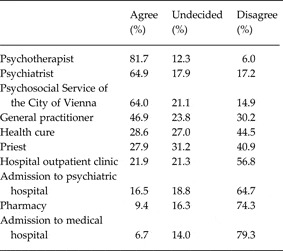
The psychotherapist was the uncontested favorite among the proposed sources of help. Four out of five respondents recommended to turn to him and only very few advised against seeking help from him. Next came the office-based psychiatrist and the PSD of the City of Vienna, which both were recommended by almost two-thirds of the respondents. Almost half of the respondents advised to see a general practitioner. All other sources of help were met with more disapproval than approval (Table 1).
Recommendations of the public as concerns professional help-seeking (n = 1061)

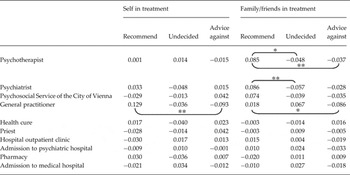
Among women, the probability that a psychotherapist was recommended as helping source was even higher than among men (probability change 0.056). Same applied to seeking help from a G.P. (probability change 0.066). By contrast, women were more likely to advice against the admission to inpatient treatment, psychiatric or other (probability changes 0.095 and 0.056, respectively). With increasing age, respondents were more in favor of turning to a G.P. (probability change 0.196) and more opposed to seeking help from mental health services (probability changes psychotherapist 0.136; psychiatrist 0.137; PSD of the City of Vienna 0.165; psychiatric hospital 0.118). The higher the educational level, the higher was the probability that respondents advised against a health cure or against outpatient or inpatient treatment in a hospital (probability changes 0.204, 0.104 and 0.196, respectively).
Multinomial logit analysis revealed that the probability of recommending seeing a general practitioner was higher among respondents who had been in treatment for depression themselves or who had such a person in their family or among their friends. The latter also tended to recommend more frequently turning to a mental health professional. Apart from that, no statistically significant associations were observed (Table 2).
Association between professional help-seeking recommendations and familiarity with the treatment of depression (multinomial logit analysis, figures indicate probability changes of ‘self in treatment’ or ‘family/friends in treatment’ v. ‘no-one in treatment’)

*p ≤ 0.05; **p ≤ 0.01.
Treatment recommendations
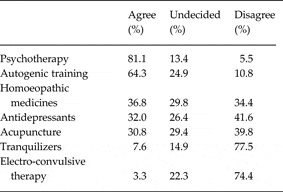
Only three out of seven different treatment options that had been proposed were more frequently recommended than advised against: Four-fifth of the respondents endorsed psychotherapy, two-thirds autogenic training and slightly over one-third homoeopathic medicines. Antidepressant medication was recommended by only 32% of the respondents while it was advised against by 42%. The use of tranquilizers and electroconvulsive treatment was met with almost complete rejection (Table 3).
Treatment recommendations of the public (n = 1061)

Women were more likely to recommend ‘alternative’ treatment modalities such as autogenic training, acupuncture or homeopathic medicines (probability changes 0.105, 0.101 and 0.210, respectively). With increasing age, respondents tended to advise against psychotherapy, acupuncture and homeopathic medicines more frequently (probability changes 0.098, 0.158 and 0.116, respectively). Respondents were less undecided and recommended or advised against antidepressant medication more frequently (probability changes 0.067 and 0.118, respectively). Higher- educated respondents recommended psychotherapy even more frequently (probability change 0.093) and advised against medication less frequently (probability change −0.116).
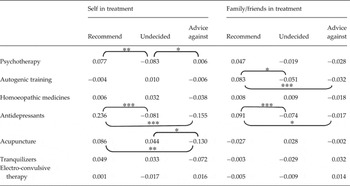
As concerns the association with personal treatment experiences, the most pronounced probability changes occurred with antidepressant medication. This applied particularly to respondents who had been in treatment themselves where the probability that medication was recommended increased by 24%, which was mainly due to a decrease of the probability that medication was advised against. A similar effect was found among those with someone in their family or among their friends being treated for depression, which also was statistically significant, but less pronounced (probability change 9%). This group of respondents was also less likely to be undecided with regard to psychotherapy, resulting in being more ready to recommend it for treatment. Interestingly, they were also less opposed to the use of acupuncture. Among those with someone in their family or among their friends having been treated for depression there was also a stronger tendency to recommend autogenic training (Table 4).
Association between treatment recommendations and familiarity with the treatment of depression (multinomial logit analysis; figures indicate probability changes of ‘self in treatment’ or ‘family/friends in treatment’ v. ‘no-one in treatment’)

*p ≤ 0.05, **p ≤ 0.01, ***p ≤ 0.001.
Discussion
In Vienna, psychotherapists were the most frequently endorsed source of professional help in case of moderate major depressive disorder. The percentage of respondents recommending turning to a psychotherapist was even higher than that reported from more recent surveys in Germany and Australia (Jorm, Christensen & Griffiths, Reference Jorm, Christensen and Griffiths2006; Angermeyer, Holzinger & Matschinger, Reference Angermeyer, Holzinger and Matschinger2009). One reason for the preference for psychotherapists may be that people tend to avoid seeing a psychiatrist because they are ashamed of being in need for psychiatric help, also because they share discriminating attitudes toward those suffering from mental illness (Schomerus & Angermeyer, Reference Schomerus and Angermeyer2008; Thornicroft, Reference Thornicroft2008; Schomerus, Matschinger & Angermeyer, Reference Schomerus, Matschinger and Angermeyer2009). As psychiatrists are more likely to treat the severely mentally ill than psychotherapists, people may also feel at a higher risk that the stigma attached to these patients may also be attached to themselves (Goffman, Reference Goffman1963). Apart from that, psychotherapists seem to enjoy a better image among the public, at least in Vienna. In the same survey, the work being done by psychotherapists was more favorably evaluated than the work of psychiatrists (Holzinger et al. Reference Holzinger, Matschinger, Drexler and Angermeyer2010). Finally, with about ten times as many psychotherapists than psychiatrists offering their services in Vienna, the supply of psychotherapy, and therefore its accessibility, seems much greater, which also may have played a role (Hagleitner & Willinger, Reference Hagleitner and Willinger2008; Ärztekammer Wien, Reference Ärztekammer2010). That general practitioners have been chosen much less frequently than in other countries may reflect differences in the organization of health care (Angermeyer & Matschinger, Reference Angermeyer and Matschinger2005; Jorm, Christensen & Griffiths, Reference Jorm, Christensen and Griffiths2006; Blumner & Marcus, Reference Blumner and Marcus2009; Goldney et al. Reference Goldney, Dunn, Del Grande, Crabb and Taylor2009).
What the recommendations for professional help-seeking already have suggested, namely that there is a preference for psychotherapy, becomes even more evident when it comes to the recommendation of particular treatment modalities. Here, psychotherapy is the clear favorite. Its use has been recommended more than twice as frequently as the use of antidepressants. The public's reservation against antidepressant medication is also underlined by the result that autogenic training and homoeopathic medicines have been endorsed more frequently. The preference for psychotherapy is even more pronounced than it has been reported from Germany (Angermeyer et al. Reference Angermeyer, Holzinger and Matschinger2009), nothing to say about Australia where antidepressants and psychotherapy have been considered as equally helpful (Jorm, Christensen & Griffiths, Reference Jorm, Christensen and Griffiths2006). One can only speculate about why psychotherapy enjoys such popularity among the Viennese population. One reason might be that it was Vienna where psychoanalysis started. In this context, it might be of interest that in the same survey not less than 85% of respondents claimed to already have heard of psychoanalysis (Holzinger et al. Reference Holzinger, Matschinger, Drexler and Angermeyer2010). Unfortunately, no previous survey has been carried out in Vienna that would allow a direct comparison. Interestingly enough, in a survey exploring public beliefs about depression that has been conducted in the whole of Austria in 1991 the percentage of people endorsing psychotherapy was, despite all methodological differences, exactly the same (80%). And only a small minority of respondents believed that depression responds ‘exclusively’ or ‘mainly’ to pharmacotherapy (Jorm, Angermeyer & Katschnig, Reference Jorm, Angermeyer, Katschnig, Andrews and Henderson2000).
The reasons for the aversion to antidepressant medication are certainly manifold. One may be that medication still tends to be seen by the public less frequently as causal treatment than psychotherapy (Angermeyer, Held & Görtler, Reference Angermeyer, Held and Görtler1993). Another reason may be the widespread fear of getting addicted to medication, as the public is not able to sufficiently distinguish between drugs that have this unwanted effect and others, such as antidepressants, which do not have it (Angermeyer, Held & Görtler, Reference Angermeyer, Held and Görtler1993). It remains an open question as to what extent the criticism may have played a part that has been raised only recently concerning the effectiveness of modern antidepressant medication (Kirsch et al. Reference Kirsch, Deacon, Huedo-Medina, Scoboria, Moore and Johnson2009), which found considerable coverage in the media.
Our findings suggest that there might be a possibility for a change of the public's treatment beliefs. As we have seen, respondents who directly or indirectly had come in touch with the treatment of depression and who, therefore, may have become more familiar with it, were more ready to recommend seeking help from mental health professionals and to recommend evidence-based treatment modalities. This applies particularly to medication that showed the largest change of the probability to be recommended. People may have become better able to judge its wanted as well as unwanted effects and less reluctant to recommend it for treatment. So far, our results seem to support the modified contact hypothesis. However, respondents familiar with the treatment of depression also tended to opt more frequently for ‘alternative’ methods such as autogenic training or acupuncture. About the reasons for this unexpected finding one can only speculate. Was it disappointment about the effect of previous treatment? In any case, more efforts to increase the public's mental health literacy (Jorm, Reference Jorm2000) seem necessary. They may result in a higher acceptance of the treatment offered by mental health professionals. Also interventions aimed at reducing the stigma attached to psychiatric treatment may prove helpful, as they may help lower the barrier to seek help from a psychiatrist (Sartorius, Reference Sartorius2007; Warner, Reference Warner2008).
Finally, a word of caution seems necessary. First, as we assessed the respondents' attitudes toward help-seeking and treatment we cannot be sure how they would behave in reality. Second, a qualification applies to the use of vignettes. The response to the hypothetical situation described in a vignette does not necessarily translate into everyday life. Third, being a cross-sectional study we are not able to analyze causal relationships. The association between treatment experience and help-seeking and treatment recommendations may as well work the other way around, i.e. those who originally had been more favorable to psychiatric treatment may have already been in treatment. Only with a longitudinal design, the direction of the relationship could be clarified. Fourth, our findings refer to the situation in Vienna in the year 2009 and may not be representative for the whole of Austria, nothing to say about other countries.
Acknowledgement
The study was funded by the ‘Medizinisch- Wissenschaftlicher Fonds des Bürgermeisters der Bundeshauptstadt Wien’ (Nr. 08016).
Declaration of interest
None.