Introduction
Use of psychotropic drugs is associated with a number of important adverse effects in elderly people. Specifically, antipsychotics, antidepressants, benzodiazepines and benzodiazepine-related drugs have been identified as risk factors for falls (Wang et al., Reference Wang, Bohn, Glynn, Mogun and Avorn2001; Hartikainen et al., Reference Hartikainen, Lönnroos and Louhivuori2007; Woolcott et al., Reference Woolcott2009). Furthermore, use of antipsychotics may increase mortality in patients with dementia (Gill et al., Reference Gill2007; Trifiró et al., Reference Trifirò, Verhamme, Ziere, Caputi, Stricker and Sturkenboom2007). Despite unfavorable effects, psychotropic drugs are frequently prescribed for the elderly (Fourrier et al., Reference Fourrier, Letenneur, Dartigues, Moore and Bégaud2001; Aparasu et al., Reference Aparasu, Mort and Brandt2003), with more than one-third of community-dwelling people aged ≥75 years using them in Finland (Hartikainen et al., Reference Hartikainen, Rahkonen, Kautiainen and Sulkava2003). Besides being frequently prescribed, psychotropic drugs are often used inappropriately. For instance, use of long-acting benzodiazepines (Hartikainen et al., Reference Hartikainen, Rahkonen, Kautiainen and Sulkava2003; Johnell and Fastbom, Reference Johnell and Fastbom2009) and long-term use of benzodiazepines (Jorm et al., Reference Jorm, Grayson, Creasey, Waite and Broe2000; Fourrier et al., Reference Fourrier, Letenneur, Dartigues, Moore and Bégaud2001) is prevalent in the community-dwelling elderly. In addition, concerns have been raised regarding psychotropic drug prescribing without a specific indication (Hartikainen et al., Reference Hartikainen, Rahkonen, Kautiainen and Sulkava2003). Accordingly, prescribing guidelines suggest regular attempts to reduce or withdraw benzodiazepine use (Ashton, Reference Ashton2005), as well as antipsychotic use in people with dementia (American Psychiatric Association, 2007).
Medication review services have been suggested as a potential strategy to reduce frequent and inappropriate use of psychotropic drugs in the elderly (Nishtala et al., Reference Nishtala, McLachlan, Bell and Chen2008). Studies among nursing home patients have reported a reduction in benzodiazepine and antipsychotic prescribing after a medication review by a multidisciplinary team (Schmidt et al., Reference Schmidt, Claesson, Westerholm, Nilsson and Svarstad1998; Roberts et al., Reference Roberts2001). However, a medication review by a general practitioner did not result in decreased use of benzodiazepines among community-dwelling people aged ≥65 years (Pit et al., Reference Pit, Byles, Henry, Holt, Hansen and Bowman2007). Therefore, new strategies to reduce inappropriate use of psychotropic drugs among community-dwelling elderly people are needed. The current study evaluated the effects of an annual medication assessment conducted as part of a Comprehensive Geriatric Assessment (CGA) on the prevalence of psychotropic drug use over a three-year period in community-dwelling people aged ≥75 years. The study also describes which types of changes the medication assessments implemented and whether these changes persisted over time.
Methods
Study design and participants
The current study was based on data from the population-based GeMS (Geriatric Multidisciplinary Strategy for the Good Care for the Elderly) intervention study. A random sample of 1000 persons aged ≥75 years (born before 1 November 1928) living in the city of Kuopio, Finland was drawn from the census data of the city of Kuopio (Figure 1). These persons were randomly assigned to intervention (n = 500) and control (n = 500) groups. The baseline was conducted in 2004, with follow-ups performed in 2005, 2006 and 2007. Of those invited to participate in the study, 162 refused, two had moved, 81 lived in an institution and 55 died before baseline. The remaining community-dwelling participants of the intervention (n = 361) and control groups (n = 339) were included in the analysis. At the final follow-up in 2007, there were 281 community-dwelling participants in the intervention group and 257 community-dwelling participants in the control group. The loss during the follow-up mainly resulted from deaths and institutionalizations both in the intervention (n = 45 and n = 27, respectively) and control groups (n = 47 and n = 24, respectively).
The flow chart of the GeMS study including community-dwelling participants

The intervention group underwent a CGA at baseline (2004) and at the 1-year (2005) and 2-year (2006) follow-ups. The CGA included a clinical examination, medication assessment and interventions to improve nutritional state and functional capacity. The CGA was performed by a team of two physicians (trainees in geriatrics), three study nurses, two physiotherapists and a nutritionist. However, one of the original physicians discontinued shortly after the first baseline assessments and was substituted by another physician. In addition to the CGA, the participants of the intervention and control groups were interviewed annually (2004–2007) by three study nurses to assess demographic characteristics, health status, functional capacity and drug use. All interviews and examinations were performed either in a municipal health center or in the participants’ homes. Participants of the intervention and control groups continued to receive usual care during the study period. In Finland, primary healthcare is provided by municipal health centers and secondary healthcare is provided by hospitals (five of which are university hospitals) (Ministry of Social Affairs and Health, 2004). Private healthcare services, which are partially reimbursed by the Finnish National Health Insurance Scheme, may be utilized in addition to public services.
Study nurses' interviews
Study nurses interviewed the participants of the intervention and control groups using a structured questionnaire. The Mini-mental State Examination (MMSE) was employed to screen cognitive performance (Folstein et al., Reference Folstein, Folstein and McHugh1975). The short form of the Geriatric Depression Scale (GDS) was used as a screening instrument for depressive symptoms (Sheikh and Yesavage, Reference Sheikh and Yesavage1986). Limitations in instrumental activities of daily living (IADL) were assessed using the scale developed by Lawton and Brody (Reference Lawton and Brody1969). In the current study, a threshold of ≤24 MMSE score was used to define cognitive decline, a threshold of ≥5 GDS score to suggest presence of depressive symptoms, and a threshold of ≤6 IADL score to indicate impairment. Self-rated health (good, fairly good, moderate, fairly poor, or poor), loneliness, and ability to walk 400 meters independently without difficulty were self-reported by the participants. If the participant was unable to answer (e.g. due to dementia), the response was obtained from a caregiver or a member of the home nursing team. Information on the history of psychosis was based on the medical records (municipal health center, university hospital, and home nursing service) and participants’ self-reports. Dementia was diagnosed according to DSM-IV criteria (American Psychiatric Association, 1994).
The study nurses asked the participants to specify all the prescription and over-the-counter drugs they were currently taking. Drugs used daily, several times a week or at regular intervals (e.g. long-acting injectable antipsychotics) were defined as regular drugs, while other drugs were considered to be “as needed” drugs. To reduce recall error, information was confirmed from the prescriptions, drug packages and medical records of the municipal health center. All drugs were coded according to the Anatomical Therapeutic Chemical (ATC) classification system recommended by World Health Organization (WHO Collaborating Centre for Drug Statistics Methodology, 2009).
Medication assessment as part of a CGA
The physicians conducted a structured clinical examination and medication assessment within two weeks of the study nurses’ interviews. They diagnosed previously unobserved diseases and evaluated the indication for each drug taken by the intervention participants. They also aimed to identify inappropriate drugs, inappropriate utilization patterns, adverse effects and interactions. However, computerized software to check interactions was not available. With regard to psychotropic drugs, the physicians paid particular attention to the following issues:
• psychotropic drug use without a specific indication
• use of antipsychotics in demented patients without current psychotic symptoms or aggression
• sub-optimal use of antidepressants in depressed patients
• regular and long-term use of benzodiazepines and benzodiazepine related drugs
• concomitant use of at least two psychotropic drugs
• use of tricyclic antidepressants for depression
• use of long-acting benzodiazepines
• inappropriate doses.
The clinical examinations and medication assessments were performed once a year, with a duration of one to two hours. Medication changes resulting from the medication assessments were implemented and recorded (study forms and computerized medical records of municipal health center) by the study physicians.
Classification of psychotropic drugs
Psychotropic drugs were grouped into three categories, antipsychotics (N05A), anxiolytics/hypnotics (N05B, N05C excluding buspirone, hydroxizin, valerian and melatonin), and antidepressants (N06A, N06AC01), according to the ATC classification (WHO Collaborating Centre for Drug Statistics Methodology, 2009). These categories were further divided into subcategories: typical antipsychotics (chlorpromazine, levomepromazine, dixyrazine, fluphenazine, perphenazine, prochlorperazine, periciazine, thioridazine haloperidol, melperone, flupentixol, chlorprothixene, zuclopenthixol, sulpiride), atypical antipsychotics (sertindole, ziprasidone, clozapine, olanzapine, quetiapine, risperidone, aripiprazole), long-acting benzodiazepines (diazepam, chlordiazepoxide, clobazam, alprazolam, nitrazepam), medium-acting benzodiazepines (oxazepam, lorazepam, temazepam), short-acting benzodiazepines (triazolam, midazolam), benzodiazepine-related drugs (zopiclone, zolpidem, zaleplon), tricyclic antidepressants (clomipramine, trimipramine, amitriptyline, nortriptyline, doxepin, tricyclic antidepressants in combinations with antipsychotic or benzodiazepine), SSRIs (fluoxetine, citalopram, paroxetine, sertraline, fluvoxamine, escitalopram) and other antidepressants (moklobemide, mianserin, trazodone, mirtazapine, venlafaxine, milnacipran, reboxetine, duloxetine). The participants were defined as users of a certain category or subcategory if they were using the drug either regularly or “as needed”.
Data analysis
Changes in psychotropic drug regimens implemented by the study physicians were categorized into five classes: initiations, discontinuations, switches within therapeutic category (e.g. from melperone to risperidone), changes from regular to “as needed” use, and dose modifications (increase or reduction). If the participant had the same change in different years (n = 4) (e.g. participant had discontinuation of oxazepam in 2004 and 2005), they were both considered. The study physicians did not implement changes from “as needed” use to regular use. The changes focusing on timing of administration, dosing intervals or drug form are not reported here. The persistence of the psychotropic drug related changes was assessed against the medication data collected by the study nurses one year later. For example, the persistence of the changes performed in 2004 was assessed based on data collected in 2005. A change was defined as persistent according to following principles:
• Initiations → The initiated drug was in use
• Discontinuations → The discontinued drug was not in use
• Switches within therapeutic category → The original drug was not in use and a new drug was in use
• Changes from regular to “as needed” use → The drug was not in regular use
• Dose modifications → Increased dose was in use/Reduced dose was in use or drug was not in use
The baseline characteristics and drug use among the intervention and control groups were compared using the Pearson χ2-test for categorical variables and the Mann-Whitney U test for continuous variables. The number of participants with a psychotropic drug related change (including changes made by the study physicians and changes made by other physicians or participants themselves) were measured using data collected by the study nurses. Between-group differences (intervention vs. control group) in the number of participants with psychotropic drug related change were analyzed using the Fisher's exact test.
The prevalence of psychotropic drug use during the study period in the intervention and control groups was also measured using the data collected by the study nurses. Generalized estimating equations (GEEs) with an auto-regressive (AR1) working correlation were applied to explore (a) whether the prevalence of psychotropic drug use changed over time within the intervention and control groups, and (b) whether the prevalence of psychotropic drug use differed between the groups over time (interaction between the time and group). The “missing completely at random” assumption could not be verified, but non-randomness was not considered problematic since the attrition was similar in both groups (Figure 1) and the baseline use of psychotropic drugs did not differ between the participants who were lost to follow-up in the intervention and control groups. GEEs were adjusted for IADL and GDS scores because the baseline scores differed between the groups. Data management and statistical analyses were performed using Statistical Package for Social Sciences (SPSS), version 17.0.
Ethical issues
Written informed consent was obtained from the participants, their family members or their caregivers. The study protocol was approved by the Research Ethics Committee of the Hospital District of Northern Savo as required by Finnish legislation.
Results
Baseline characteristics and drug use
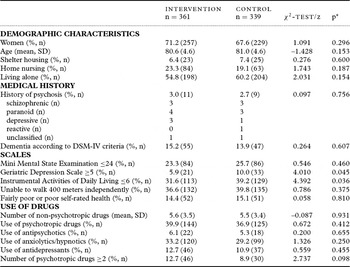
At baseline, the intervention and control groups were similar with regard to demographic characteristics, medical history, health status and cognitive performance (Table 1). However, the participants of the control group were more likely to have GDS scores ≥5 and IADL scores ≤6. The baseline use of psychotropic drugs, antipsychotics, anxiolytics/hypnotics and antidepressants, as well as the prevalence of concomitant use of psychotropic drugs, was slightly higher in the intervention group, but the differences were not statistically significant.
Baseline characteristics of the community-dwelling participants of the intervention and control groups based on the data collected by the study nurses

*χ2 test for categorical variables and the Mann-Whitney U test for continuous variables
Missing data: self-rated health (Intervention = 1, Control = 1), home nursing (Control = 10), IADL (Intervention = 3, Control = 10), MMSE (Intervention = 1, Control = 5), GDS (Intervention = 3, Control = 8).
Types of changes implemented by the study physicians
In the period 2004–2006, the study physicians implemented psychotropic drug related changes for every fifth (n = 76) community-dwelling participant of the intervention group (n = 361). In 2004 and 2005, psychotropic drug related changes were performed for every tenth intervention participant (39 out of 361 and 38 out of 331, respectively), while in 2006 for every twentieth (14 out of 304) intervention participant. Of the users of psychotropic drugs, 26% had a psychotropic drug related change in 2004 (38 out of 144), 21% had a change in 2005 (29 out of 135), and 10% had a change in 2006 (13 out of 125).
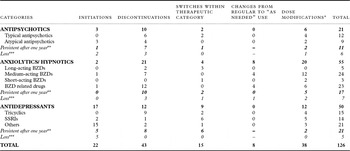
The overall number of psychotropic drug related changes implemented by the study physicians during 2004–2006 was 126 (Table 2). The majority of these changes related to anxilolytic/hypnotics (n = 55) or antidepressants (n = 50). Of the anxiolytic/hypnotic and antipsychotic related changes, the majority were discontinuations (n = 21 and n = 10, respectively) and dose reductions (n = 20 and n = 6, respectively). Of the anxiolytics/hypnotics discontinued, about half (n = 11) were regularly taken drugs. The most common antidepressant related change was an initiation (n = 17), the majority of them being initiations of mirtazapine (n = 15). Of the 12 discontinuations of antidepressants, nine were targeted at tricyclic antidepressants. Of the 12 dose modifications of antidepressants, ten were reductions.
The number and one-year persistence of the psychotropic drug related changes implemented by the study physicians during 2004–2006 in the community-dwelling participants of the intervention group

BZD = Benzodiazepines, SSRI = selective serotonin re-uptake inhibitors.
*Dose modifications were reductions with the exception of two dose increases of antidepressants (SSRI and other antidepressant).
**The persistence of the psychotropic drug related changes was assessed against the data collected by the study nurses one year later.
***Loss to follow-up because of death, institutionalization, moving or refusal.
The reasons for the discontinuations of psychotropic drugs were adverse drug reactions (n = 26), lack of indication (n = 14) and therapeutic duplication (n = 3). The switches within the therapeutic category were performed because of the risk of drug-drug interactions (n = 5), lack of efficacy (n = 2) and adverse drug reactions (n = 8). All changes from regular to “as needed” use were performed because of adverse drug reactions (n = 8).
Among the community-dwelling participants of the intervention group with MMSE scores ≤24 (n = 84 in 2004; n = 74 in 2005; n = 74 in 2006), 12% (n = 10) had a psychotropic drug related change in 2004, 22% (n = 16) had a change in 2005, and 5% (n = 4) had a change in 2006. Of the 126 psychotropic drug related changes implemented by the study physicians during 2004–2006, every third (n = 44) was targeted at participants with MMSE scores ≤24. The proportion was highest for antipsychotic related changes (57%), followed by anxiolytic/hypnotic related changes (33%) and antidepressant related changes (28%).
Persistence of the changes implemented by the study physicians
Of the psychotropic drug related changes implemented by the study physicians, 39% (n = 49) were defined as persistent and 47% (n = 59) as non-persistent after one year (Table 2). The persistence of the change could not be assessed in 18 cases (14%) because 12 participants were lost to follow-up. The proportion of persistent changes varied between types of changes, being highest for switches within therapeutic category (60%; n = 9). Besides these persistent switches, in four cases participants used neither of the switched drugs. Nearly 60% (n = 25) of the discontinuations of psychotropic drugs were defined as persistent, but in three cases the participant had initiated some other drug from the same therapeutic category. None of the changes from regular to “as needed” use was defined as persistent.
Psychotropic drug related changes in the intervention and control groups
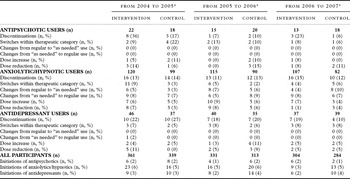
During the study period, a total of 308 psychotropic drug-related changes occurred in the intervention group and 270 in the control group (includes changes made by the study physicians and changes made by other physicians or participants themselves). The study physicians were responsible for 13% of all changes that occurred in the intervention group. Table 3 compares the number of participants with different types of psychotropic drug related change between the intervention and control groups. None of the observed differences between the groups was statistically significant.
The number of community-dwelling participants with psychotropic drug related change in the intervention and control groups based on the data collected by the study nurses

Includes changes made by the study physicians and changes made by other physicians or patients themselves.
*Fisher's exact test. None of the differences between the groups were statistically significant (p-value >0.05).
The prevalence of psychotropic drug use in the intervention and control groups
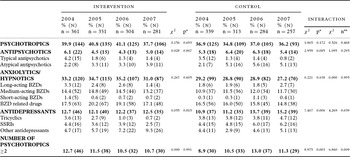
The prevalence of use of psychotropic drugs, antipsychotics and anxiolytics/hypnotics did not differ significantly within the groups or between the groups over time (Table 4). The same held true for the prevalence of regularly taken anxiolytics/hypnotics. The prevalence of antidepressant use remained constant in the intervention group (p = 0.815), but increased in the control group (p = 0.006), with the interaction being statistically significant (p = 0.039). Furthermore, the prevalence of concomitant use of psychotropic drugs decreased non-significantly in the intervention group (p = 0.991), whereas it increased in the control group (p = 0.003), with the interaction being statistically significant (p = 0.009). In addition, the prevalence of long-acting benzodiazepine use and tricyclic antidepressant use decreased in the intervention group, but increased in the control group (Table 4).
The prevalence of psychotropic drug use (regular or “as needed”) during the study period in the community-dwelling participants of the intervention and control groups based on the data collected by the study nurses

BZD = benzodiazepines, SSRI = selective serotonin re-uptake inhibitors.
* p-value for change within the groups from Generalized Estimating Equations (adjusted for age, gender, IADL scores and GDS scores).
** p-value for interaction between the time and group from Generalized Estimating Equations (adjusted for age, gender, IADL scores and GDS scores).
Discussion
The current study demonstrated that the medication assessment conducted as part of a CGA resulted in numerous changes to the psychotropic drug regimens of intervention participants. However, the number of participants with psychotropic drug related change did not differ significantly between the intervention and control groups. Moreover, the medication assessment did not reduce the prevalence of psychotropic drug use. The findings are consistent with those of Pit et al. (Reference Pit, Byles, Henry, Holt, Hansen and Bowman2007) who did not detect a decrease in the prevalence of benzodiazepine use in the community-dwelling elderly after a medication review by a general practitioner.
Medication reviews by an interdisciplinary team have been proven to be effective in reducing benzodiazepine and antipsychotic prescribing in nursing homes (Schmidt et al., Reference Schmidt, Claesson, Westerholm, Nilsson and Svarstad1998; Roberts et al., Reference Roberts2001). A recent study by Westbury et al. (Reference Westbury, Jackson, Gee and Peterson2010) supported these findings by showing a decrease in benzodiazepine and antipsychotic use after a combined intervention involving staff education and sedative review by an interdisciplinary team. Conflicting findings between community and nursing-home settings are likely to arise from the fact that community-dwelling elderly people are not treated by a limited number of physicians. In our study population, for example, the community-dwelling participants received prescriptions on average from four different physicians during calendar year 2003 (based on information retrieved from the Finnish Prescription Register, data not shown). In addition, community-dwelling people may alter their medication regimens on their own (Dolovich et al., Reference Dolovich, Nair, Sellors, Lohfeld, Lee and Levine2008). In fact, changes initiated by other physicians and patients themselves seem to be common, since the study physicians implemented only 13% of all psychotropic drug related changes that occurred in the intervention group during the study period. For instance, the intervention group had a substantial number of dose increases of anxiolytics/hypnotics, but the study physicians were not responsible for any of them.
The high number of prescribing physicians in primary and secondary health care is not the only potential explanation why the prevalence of psychotropic drug use did not decrease. Another reason is that the medication assessment implemented only 21 discontinuations of anxiolytics/hypnotics, although every third intervention participant used these drugs. The low number of anxiolytic/hypnotic discontinuations may arise from participants’ reluctance, since elderly people are often unwilling to taper and discontinue benzodiazepine use (Cook et al., Reference Cook, Biyanova, Masci and Coyne2007). Performing the medication assessments outside the usual health care system could further increase the reluctance of the participants, because they were not familiar with the study physicians. Therefore, future medication assessments may need to include an additional focus on hypnotic discontinuation, for example by educating the physicians about the principles of gradual dose tapering and strategies to encourage and motivate patients. Medication assessments could also benefit from predefined criteria for anxiolytic/hypnotic discontinuation.
About 40% of the changes implemented in the medication assessments were persistent after one year, the proportion varying between 0% and 60% for different types of changes. The non-persistence is likely to result from the lack of follow-up meetings since the participants only visited the physicians once a year. Follow-up meetings might have been particularly advantageous with hypnotic discontinuation considering that gradual benzodiazepine tapering during weekly meetings with a physician has been shown to achieve substantially higher discontinuation rates than a letter sent by a physician advising discontinuation (Voshaar et al., Reference Voshaar2003). Despite the lack of follow-up meetings, nearly 50% of the discontinuations of hypnotics were persistent one year later. Similar proportions (24–52%) have been reported one year after programs involving gradual benzodiazepine tapering and weekly meetings with a physician (Baillargeon et al., Reference Baillargeon, Landreville, Verreault, Beauchemin, Grégoire and Morin2003; Morin et al., Reference Morin, Bastien, Guay, Radouco-Thomas, Leblanc and Vallières2004). However, both of these programs included only chronic users of benzodiazepines and thus the results may not be directly comparable with the current findings.
A recent study by Salonoja et al. (Reference Salonoja, Salminen, Aarnio, Vahlberg and Kivelä2010) managed to decrease the prevalence of benzodiazepine use in community-dwelling people aged ≥65 years with at least one fall during the past 12 months. The intervention was part of a multidimensional fall prevention strategy and it included a medication list review by a geriatrician, followed by individual counseling and written instructions on how to reduce the use of psychotropic and other fall-increasing drugs. Later on, the participants received a 1-hour lecture about adverse effects of these drugs. In the current study, the medication assessments were performed in the context of a clinical examination lasting between 1 and 2 hours. The duration may have been insufficient to permit proper discussion and counseling, especially if the study physician implemented multiple changes. However, this type of medication assessment could be a valuable tool for identifying people who need a psychotropic drug related change, followed by separate counseling.
The prevalence of concomitant use of psychotropic drugs differed between the intervention and control groups over time, which may be associated with increased prevalence of antidepressant use in the control group. In the intervention group, by contrast, the prevalence of antidepressant use remained constant. However, the between-group difference in the prevalence of antidepressant use over time may not be solely caused by the medication assessment but other interventions of the CGA. These interventions may have included those to improve functional capacity, since exercise training has been associated with reduced depression and depressive symptoms (Blake et al., Reference Blake, Mo, Malik and Thomas2009). In addition, a possibility of undertreatment should be taken into account when interpreting the results. Nevertheless, undertreatment was not considered likely since the proportion of intervention participants with GDS scores ≥5 remained relatively constant over time (5.9% in 2004 and 7.1% in 2007). Moreover, the difference in the prevalence of antidepressant use between the groups was largely accounted for by decreased use of tricyclic antidepressants, which are not the first line choice for old age depression because of strong anticholinergic and sedative properties (Fick et al., Reference Fick, Cooper, Wade, Waller, Maclean and Beers2003).
The current study has some limitations. First, the control group had higher GDS scores at baseline, which may have created between-group differences in the prevalence of antidepressant use over time. Nevertheless, the time-group interactions were adjusted for GDS scores, suggesting that this was a minor consideration. A further limitation of the study was the small number of users of psychotropic subcategories, which precluded statistical analysis of the time-group interactions.
Conclusions
The findings suggest that conducting an annual medication assessment outside the usual primary health care system does not reduce the prevalence of psychotropic drug use in community-dwelling elderly people. However, medication assessment may prevent concomitant use of psychotropic drugs. Future medication assessment may need to include a continuous relationship between the patient and physician.
Conflict of interest
None.
Description of authors' roles
Sirpa Hartikainen and Raimo Sulkava designed the GeMS study, and Sirpa Hartikainen coordinated the study protocol and supervised the data collection. Maria Rikala, Sirpa Hartikainen and Maarit Jaana Korhonen designed the analyses for the current paper. Maria Rikala performed the analyses and prepared the paper. All authors reviewed and commented on the paper and approved the final version.
Acknowledgments
The GeMS Study was funded by the Social Insurance Institution of Finland and city of Kuopio, Finland. In addition, financial support was obtained from the Graduate School of Ageing, Well-being and Technology, University of Jyväskylä, Jyväskylä, Finland. The sponsors played no role in the design of the GeMS Study or the preparation of this manuscript. All the authors declare that they have no conflicts of interest. The authors thank research secretary Päivi Heikura and statistician Piia Lavikainen for their assistance with data management. In addition, the authors are grateful to Dr. Simon Bell for proofreading the manuscript.
Editor's note
The randomized controlled trial (RCT) reported in this article by Rikala et al. was not registered in a publicly accessible trials database at the time of acceptance for publication. The decision to accept the paper for publication despite this fact represents an oversight on the part of the editorial team, but the paper has been published in good faith because the editorial team, not the authors, were at fault. It is the policy of International Psychogeriatrics not to publish papers reporting results of RCTs that were not registered in a publicly accessible trials database at the time the trial was conducted or after late 2006. This policy will be adhered to in future. Please see the journal's instruction to contributors, available as a PDF under the journal information icon at www.journals.cambridge.org/IPG for more information. These instructions should be consulted by all authors planning to submit papers to International Psychogeriatrics.