Two major complications may follow kidney transplantation. First, graft rejection, which can be prevented by the use of immunosuppressive drugs. In recent years, new immunosuppressive agents have significantly decreased the incidence and severity of acute rejection episodes (Reference Magee and Pascual12;Reference Offermann18). Second, and to a large extent due to the use of immunosuppressive drugs, infections among which cytomegalovirus (CMV) remains the most important (Reference Alangaden, Thyagarajan and Gruber1). However, there is still no consensus on how best to prevent infections, particularly CMV (Reference Snydman20). Currently, two main strategies are advocated: preemptive therapy, which consists in monitoring patients and administering antiviral therapy only when needed (Reference Hart and Paya7;Reference Koetz, Delbruck and Furtwangler9), or universal prophylaxis for a period of 3 to 6 months (Reference Gane, Saliba and Valdecasas4;Reference Paya, Humar and Dominguez19). Due to the high price of these drugs, prophylaxis would theoretically increase treatment costs.
If more expensive drugs lead to better clinical results and decrease overall follow-up costs (in particular hospital readmissions), their use would certainly be recommended. In April 2003, we introduced at our transplantation center a new universal antiviral prophylaxis regimen (a 3-month course of oral valganciclovir, in all at-risk patients) together with a new immunosuppressive strategy, consisting in induction therapy with basiliximab (or thymoglobulin in immunologically high-risk patients) associated with tacrolimus, mycophenolate, and prednisone. Efficacy and safety of this intervention were recently published (Reference Manuel, Venetz and Fellay13). The objective of this study was to compare the cost-effectiveness of these two different drug regimens throughout the first year after kidney transplantation.
PATIENTS AND METHODS
This retrospective observational study included all kidney transplant recipients treated at the University Hospital of Lausanne (CHUV) between January 2000 and July 2005.
Between January 2000 and March 2003, the standard immunosuppressive regimen consisted of basiliximab induction, cyclosporine, corticosteroids and mycophenolate mofetil or azathioprine. Antiviral prophylaxis with valacyclovir was administered only for CMV-positive donor/CMV-negative recipients. Otherwise, a preemptive antiviral strategy was used (Reference Muheim, Vogel and Seydoux16).
Between April 2003 and July 2005, a new combined immunosuppressive regimen was introduced, including universal CMV prophylaxis. It consisted of basiliximab induction, tacrolimus, corticosteroids and mycophenolate mofetil, with 450 mg daily valganciclovir prophylaxis for 3 months after transplantation in all patients at risk for CMV infection. Transplant patients with CMV-negative donor/negative recipient status received valacyclovir for 3 months. Children under the age of 18 years, patients with incomplete documentation or lost to follow-up, and patients with early graft loss while still hospitalized after transplantation were excluded from the analysis.
Outcome Measurement
Outcome measurement singled out acute rejection, CMV asymptomatic infection, and CMV syndrome or disease (grouped as CMV infection), and other transplant-associated complications. Hospital resource use, such as number of hospitalizations, length of stay, and type of diagnostic and therapeutic procedures, were extracted from the hospital information system. For hospital stays, attribution to rejection, infection, or surgically related complication of transplantation was carried out on the basis of diagnostic and therapeutic codes along the International Classification of Disease (ICD), versions 10 and 9, respectively. Outpatient resource use, such as number of visits as well as number and type of diagnostic and therapeutic procedures were extracted from individual patient charts.
Cost Measurement
Only direct medical costs were considered in a payer's perspective. Hospital costs were extracted from the information system of the hospital. Outpatient costs were computed using the Swiss official tariffs for the year 2006 (22) and drug prices were extracted from the 2006 Swiss Drug Compendium (21).
Costs were grouped into different sections: Immunosuppression and anti-infectious prophylaxis, acute rejection treatment, CMV-associated treatment, outpatient care, other hospital costs, and other medication not related to transplantation. Costs were expressed in 2006 Swiss francs (1 CHF = €0.67 = US$0.70).
Statistical Analysis
Comparison between groups was carried out with Chi-squared tests or Fisher exact tests for categorical variables, Wilcoxon rank-sum test (Mann-Whitney two-sample statistics) for ordinal variables, and Student t-test for continuous and normally distributed variables. Statistical significance was assumed at p < .05. Due to different prices of healthcare resources in different countries, drug and hospital prices were varied by ± 50 percent in sensitivity analysis.
RESULTS
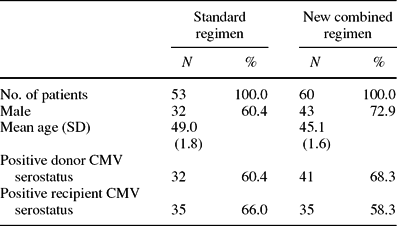
Of the 143 kidney transplant recipients treated at the Lausanne University Hospital between January 2000 and July 2005, 73 were treated with the standard immunosuppressive regimen (January 2000 to March 2003) and 70 with the new combined regimen (April 2003 to July 2005). Twenty patients in Group A and 10 patients in Group B were excluded for the reasons given above. As a consequence, 113 patients were included in the current analysis. Their baseline characteristics are displayed in Table 1. There were no statistically significant differences between the two groups.
Patient Baseline Characteristics

Outcome at 1 Year After Transplantation
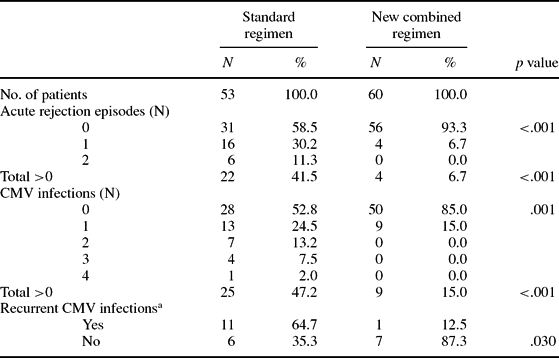
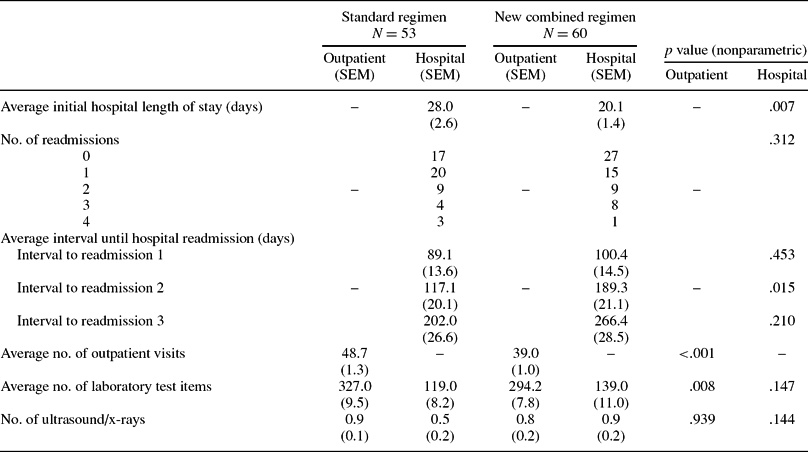
As shown in Table 2, the number of acute rejection episodes significantly decreased in Group B as compared with Group A. Similarly, the number of CMV infections (and in particular recurrent CMV infections) significantly decreased in Group B as well. The percentage of patients with no readmission increased from 32 percent (Group A) to 45 percent (Group B). Similarly, for the patients needing one or more readmissions, the average time until the first, second, or third readmission also increased (Table 3), and reached statistical significance for the second admission.
Patient Outcome over 1 Year Posttransplantation: Number and Distribution of Rejection and Infection Episodes

a With the same serotype, when analysis was carried out.
CMV, cytomegalovirus.
Resource Use over 1 Year after Transplantation

Resource Use Over 1 Year After Transplantation
Patients in Group B had significantly less outpatient visits, outpatient laboratory tests, and had shorter duration of initial hospitals stay, than the patients in Group A (Table 3). There was also a trend to less inpatient (hospital) laboratory tests and US/X-rays; however, this did not reach statistical significance.
Costs Over 1 Year
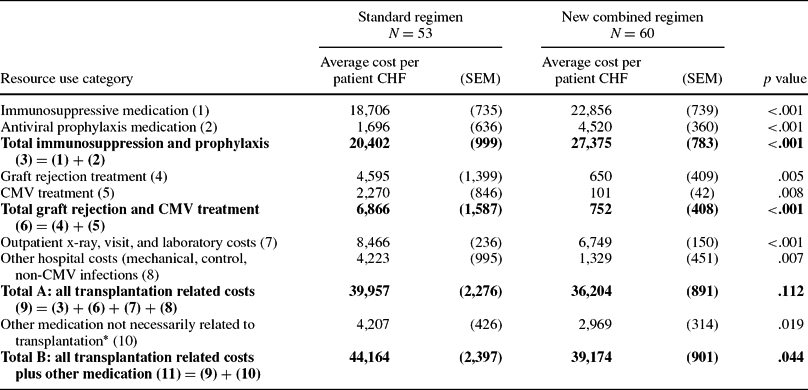
The costs associated with immunosuppressive and antiviral prophylaxis drugs were higher in Group B than in Group A (p < .001). Conversely, statistically significant savings were observed in graft rejection treatment (p = .005), CMV treatment (p = .008), outpatient costs (p < .001), and other hospital costs (p = .007; Table 4). Altogether, 1-year transplantation-related costs were slightly lower with the new combined regimen, but the difference was not statistically significant (p = .112). Of interest, when other medications not related to transplantation (e.g., cardiac or antihypertensive drugs) were taken into account as well, this difference reached statistical significance (p = .044). Sensitivity analysis varying drug and hospitalization cost by ± 50 percent did not change the results (data not reported).
Costs over 1 Year after Transplantation

DISCUSSION
The results of the present study indicate that the new combined immunosuppressive and anti-infectious regimen used in Group B was more effective than the standard regimen used previously in Group A. It reduced the number of readmissions for both acute rejection and infectious complications by six- and threefold, respectively, and outpatient resource use over 1 year to a smaller extent. Overall, the savings associated with this increased efficacy were greater than the increased costs due to the use of new drugs, although the difference was not statistically significant. Of note, a significant decrease in the resource use associated with other medications not related to transplantation was observed, so that in total, the savings were statistically significant.
Previous studies have compared the effectiveness of tacrolimus with cyclosporine. A meta-analysis of 30 randomized trials showed that tacrolimus use was more effective in preventing acute rejection and improving graft survival, but it increased posttransplant diabetes, and neurological and gastrointestinal side effects (Reference Webster, Woodroffe, Taylor, Chapman and Craig23). Two studies assessed the cost-effectiveness over 6 months after kidney transplantation of replacing cyclosporine by tacrolimus (Reference Craig, McKechnie and McKenna2;Reference Lazzaro, McKechnie and McKenna10). They found a significant decrease in the acute rejection rate, resulting in overall savings, while two other studies did not find any difference in acute rejection episodes or costs between the two calcineurin inhibitors (Reference Hardinger, Bohl and Schnitzler6;Reference Morris-Stiff, Richards and Singh15). These differences are difficult to reconcile, but they clearly emphasize that there is a continuing need for analyzing drug-related costs in transplantation.
There is still no consensus in the medical literature on how to best prevent CMV infections, but some recent studies have argued in favor of universal prophylaxis rather than using preemptive strategies (Reference Hart and Paya7;Reference Snydman20). CMV prophylaxis has been associated not only with a decrease in CMV infection episodes, but also with a positive impact on preventing acute rejection episodes (Reference Fishman and Rubin3;Reference Nett, Heisey and Fernandez17). Some economic analyses have also showed that CMV prophylaxis may save money as compared with preemptive therapy, at both 6 months (Reference Legendre, Norman and Keating11), and 12 months (Reference Mauskopf, Richter and Annemans14), while another study showed no difference in costs over 12 months (Reference Khoury, Storch and Bohl8).
These discrepancies may be reconciled if both rejection and CMV infection are considered simultaneously. In a “real-life” setting in Germany assessing outcomes, resource use, and treatment costs over the first 2 years after kidney transplantation, complications were shown to be important cost drivers, with rejection amounting to €9,638, and CMV infection to €4,149. Events in year 1 added significantly to the costs in year 2, suggesting that careful selection of the most appropriate immunosuppressive and anti-infectious regimen is essential (Reference Hagenmeyer, Häussler and Hempel5). Thus, the results of our current study confirm their findings in a second European university hospital.
As far as treatment of comorbidities not related to transplantation is concerned, other studies showed that tacrolimus use was associated with lower levels of cholesterol, and better control of hypertension, but a higher incidence of posttransplant diabetes than cyclosporine (Reference Magee and Pascual12;Reference Webster, Woodroffe, Taylor, Chapman and Craig23). This may explain in part the observed difference in the resource use of these other medications.
The current study carries several limitations. The first one is that some patients were excluded from the analysis due to missing costs information or loss of follow-up. These patients did not have different baseline characteristics, and the overall outcome (e.g., acute rejection, and CMV infections) of all patients in the study period (Reference Manuel, Venetz and Fellay13) was similar to the outcome of the patients analyzed in this economic study.
Second, we report on the experience of a single university hospital. Therefore, these results should be further verified on a larger, multicenter, scale. Generalization of our results to other hospitals or healthcare settings should be carried out with caution. Moreover, changes in immunosuppressive regimens over time may indeed further modify our results.
Third, a prospective study including the analysis of the use of other medications not related to transplantation could better delineate the impact of this new combined immunosuppressive and anti-infectious regimen on overall outcome and costs of patients’ comorbidities.
In conclusion, the higher effectiveness over 1 year of the new combined immunosuppressive and anti-infectious regimen administered in Group B appears to justify the higher costs of the new drugs used; therefore, it represents an attractive modern medical management strategy in kidney transplantation.
POLICY IMPLICATIONS
Adoption or rejection of a new therapeutic strategy should be based on an adequate documentation of costs and effectiveness. In some cases, especially if the new strategy is aimed at preventing complications, the period of observation should extend beyond its immediate implementation to encompass various durations of follow-up. This might complicate the assessment of the new strategy, as other events, not necessarily linked with the initial condition and its treatment, can occur during follow-up. Our analysis of a new combined regimen for kidney transplantation is a good illustration of this point, as assessment at the end of the initial hospital stay for transplantation showed only additional costs and no benefit, nearly leading to rejection of the strategy by the hospital direction. Health technology assessment units within university hospitals have an important role to address these issues, to launch adequate assessment, and correctly inform decision makers.
CONTACT INFORMATION
Jean-Blaise Wasserfallen, MD, MPP (jbw@chuv.ch) Privat docent, Institute of Health Economics and Management, Lausanne University; Medical Director, Department of Medical Direction, Lausanne University Hospital Center (CHUV), Bugnon 21, CH-1011 Lausanne, Switzerland
Mira Kast-Brückner, MS (mira@kast.net), Student, Institute of Health Economics and Management, University of Lausanne, 21; Student, Transplantation Center, Lausanne University Hospital Center (CHUV), Bugnon 46, Lausanne CH-1011, Switzerland
Oriol Manuel, MD (o.manuel@porvlab.ab.ca), Department of Infectious Diseases, University of Lausanne; Chef de Clinique, Department of Infectious Diseases, University Hospital Centre (CHUV), Bugnon 46, CH- 1011 Lausanne, Switzerland
Jean-Pierre Venetz, MD (Jean-Pierre.Venetz@chuv.ch), University of Lausanne; Associate Physician, Transplantation Center, Lausanne University Hospital Center (CHUV), Bugnon 46, CH-1011 Lausanne, Switzerland
Pascal R. A. Meylan, MD (pascal.meylan@chuv.ch), Associate Professor, Department of Microbiology, Faculté de Biol et Med, Lausanne, Bugnon 48, CH-1011 Lausanne, Switzerland; Head, Department of Virology Diagnostics, University Hospital Centre (CHUV), Bugnon 46, CH-1011 Lausanne, Switzerland
Manuel Pascual, MD (manuel.pascual@chuv.ch), Professor, Chief, Department of Transplantation, University Hospital Center (CHUV), Rue du Bugnon, Lausanne CH-1011, Switzerland