Introduction
With a rapidly aging population worldwide and potentially disease-modifying treatments on their way, the early diagnosis of Alzheimer's disease (AD), as well as other cognitive disorders, is of ever greater importance. The single greatest risk factor for cognitive impairment and dementia is old age. About 6% of the population over the established retirement age of 65 years in Sweden is affected by dementia, with AD constituting at least half of those affected (Wimo et al., Reference Wimo, Winblad and Jonsson2007). In Sweden, the number of dementia patients is estimated to be 180,000 and is expected to increase to 200,000 by 2012 (according to the Swedish Alzheimer Association).
Patients today seek help for their cognitive symptoms earlier than they did ten years ago. Mild cognitive impairment (MCI) has become the most common diagnosis at Swedish memory clinics (Palmer et al., Reference Palmer, Backman, Winblad and Fratiglioni2008). “MCI” has been used to describe the transitional stage between normal cognitive function and mild dementia, before dementia is manifest (Petersen et al., Reference Petersen, Smith, Waring, Ivnik, Tangalos and Kokmen1999). It is, however, a heterogeneous condition – some MCI subjects have more benign forms of cognitive impairment and do not progress to dementia, or even improve over time (Mitchell et al., Reference Mitchell, Arnold, Dawson, Nestor and Hodges2009). MCI was originally considered to be incipient AD and defined as memory impairment, with other cognitive domains relatively spared (Petersen et al., Reference Petersen, Smith, Waring, Ivnik, Kokmen and Tangelos1997). The criteria for MCI have, however, been modified; studies have shown that impairment in multiple cognitive domains (language and executive functions) increases the risk of AD, whereas MCI with only memory impairment has a more benign prognosis (Tabert et al., Reference Tabert2006; Taler and Phillips, Reference Taler and Phillips2008; Nordlund et al., Reference Nordlund, Rolstad, Klang, Edman, Hansen and Wallin2010). Concurrently, studies on the second most common dementia disorder, vascular dementia (VaD), have been conducted. Some of these studies concluded that VaD caused by subcortical disease may be preceded by progressive cognitive impairment, not unlike the form of MCI preceding AD (Frisoni et al., Reference Frisoni, Galluzzi, Bresciani, Zanetti and Geroldi2002; Meyer et al., Reference Meyer, Xu, Thornby, Chowdhury and Quach2002). There is still no consensus on which type of MCI most typically precedes dementia, but according to the majority of recent studies MCI with memory and other impairment seems to be the type that most frequently converts to dementia (Alexopoulos et al., Reference Alexopoulos, Grimmer, Perneczky, Domes and Kurz2006; Nordlund et al., Reference Nordlund, Rolstad, Klang, Edman, Hansen and Wallin2010).
In the industrialized (developed) world, most large cities offer highly specialized cognitive examinations at memory clinics. However, these clinics do not have the resources to offer all patients qualified and comprehensive examinations; in particular, older persons are often examined at their primary care facilities. Even though most primary care centers today have specially trained dementia nurses, their resources in terms of instruments for reasonably thorough cognitive examinations are limited. Usually patients are tested with the Mini-mental State Examination (MMSE; Folstein et al., Reference Folstein, Folstein and McHugh1975), the clock test (Libon et al., Reference Libon, Swenson, Barnoski and Sands1993), and sometimes A Quick Test (AQT) (Nielsen et al., Reference Nielsen, Wiig, Warkentin and Minthon2004). In addition, the Montreal Cognitive Assessment (MoCA; Nasreddine et al., Reference Nasreddine2005) has in recent years been used in primary care to detect MCI and early dementia. MoCA resembles MMSE in that it has a total score of 30, but some of the items in it are more demanding.
In specialist settings there are some reasonably brief cognitive batteries in use, e.g. Alzheimers's Disease Assessment Scale (ADAS) (Talwalker et al., Reference Talwalker, Overall, Srirama and Gracon1996) and the Consortium to Establish a Registry for Alzheimer's Disease (CERAD) battery (Welsh et al., Reference Welsh1994). These, however, were constructed to assess manifest AD, not the more subtle deficits of different types of MCI. The objective of this study was to evaluate the Cognitive Assessment Battery (CAB) in a specialist clinic setting. The hypothesis was that CAB would be able to distinguish between healthy controls, MCI and dementia, as well as MCI of different degrees of severity.
Methods
Subjects and diagnostic procedure
The Göteborg MCI study, of which this is a substudy, was approved by the local ethics committee and the research was conducted according to the Helsinki Declaration. Between March 2006 and March 2009, 83 subjects were diagnosed with MCI and 28 with dementia. The majority (about 75%) of the subjects were referred by their general practitioners or a specialist to our clinic, while about 25% came to our clinic as self-referrals, i.e. they contacted our memory clinic for an examination. Subjects with major depressive and other severe psychiatric disorders were excluded, whereas subjects with minor depressive symptoms and mild anxiety were not. The diagnosis of MCI was made according to the most recent recommendations (Winblad et al., Reference Winblad2004). MCI was diagnosed by means of medical history and checklists for cognitive symptoms – not traditional cognitive testing – in order to avoid circular reasoning: Stepwise Comparative Status Analysis (STEP) for basic cognitive symptoms, cognitive variables 13–20 (memory disturbance; disorientation; reduced abstract thinking; visuospatial disturbance; poverty of language; sensory aphasia; visual agnosia; apraxia) (Wallin et al., Reference Wallin1996); I-Flex, which is a short form of the Executive Interview (EXIT) (Royall et al., Reference Royall, Mahurin and Gray1992), for frontal lobe symptoms (items number-letter task, word fluency, anomalous sentence repetition, interference task, Luria hand sequences, counting task); MMSE (Folstein et al., Reference Folstein, Folstein and McHugh1975); and Clinical Dementia Rating (CDR; Morris, Reference Morris1997), a global measure of functioning. The information for CDR was gathered from both the subject and an informant. For inclusion, subjective and objective (verified by an informant) evidence for progressive cognitive impairment for more than six months was required. Furthermore, objective cognitive symptoms according to STEP, I-Flex, MMSE and/or CDR were required. Subjects without symptoms according to the checklists were not included, since their cognitive impairment was considered too benign. Neither were subjects with more than two symptoms on STEP and/or a score below 25 on MMSE, as they were considered to fulfil criteria for dementia. The 83 MCI subjects were also rated according to the Global Deterioration Scale (GDS; Reisberg et al., Reference Reisberg, Ferris, de Leon and Crook1988). A GDS score of 2 indicates very mild cognitive impairment with minimal clinically objective evidence of cognitive decline, and a score of 3 indicates mild cognitive impairment, clinically objective evidence of cognitive decline. For GDS 2, the patient was not to have any symptoms on STEP, no more than one box checked on CDR, not more than 2 symptoms on I-flex or a score below 27 on MMSE. For GDS 3 the general MCI criteria above apply. A symptom diagnosis of dementia was based on the DSM-III-R criteria (American Psychiatric Association, 1987). In addition, the above-mentioned cut-off for dementia based on STEP, I-Flex, CDR and MMSE had to be fulfilled, which makes mild dementia equivalent to GDS 4.
Cognitive assessment procedure and instruments
The composition of the cognitive battery was based on a cognitive model comprising the domains speed and attention (Symbol Digit Modalities Test), learning and episodic memory (text recall), visuospatial functions (Clox and draw a cube), language (Token Test and naming 30 items) and executive functions (Stroop). The tests were always administered in the same standardized order: the text recall test, immediate recall, Symbol Digit Modalities Test (SDMT), the 30-item naming test, Clox and drawing a cube, Token Test short version, Stroop color word test and delayed recall of the text. The testing was done by experienced nurses, who were trained to use and interpret the battery. The battery was administered prior to diagnosis and the testing was done blindly. Two psychologists tested the controls. A test session lasted 15–25 minutes.
The speed and attention test Symbol Digit Modalities Test (SDMT) has been shown to be a sensitive tool for detecting incipient dementia (Fleisher et al., Reference Fleisher, Sowell, Taylor, Gamst, Petersen and Thal2007). The memory test is easy and quick to administer and is based on the principle presented previously (Kluger et al., Reference Kluger, Ferris, Golomb, Mittelman and Reisberg1999) of repeating the text after immediate recall, thus making the test especially sensitive to incipient AD. The naming test consists of 30 objects from the original Boston Naming Test (Kaplan and Weintraub, Reference Kaplan and Weintraub1983) which were redrawn. The two clock drawing tests – one command condition and one copying – have been shown not only to differentiate between dementia and healthy controls but also between different dementia disorders (Libon et al., Reference Libon, Swenson, Barnoski and Sands1993). Short versions of the language comprehension Token Test have previously been reported to be sensitive measures of dementia (Taylor, Reference Taylor1998). In the executive Stroop color word test the patient is to name the colors of dots, words and color words written in various colors, and inhibit the automated response to read the words. The short Victoria version, which is presented in Spreen and Strauss (Reference Spreen and Strauss1998), was used. For every test there was a table with normative values (means and standard deviations for various ages) and a matrix with two or three boxes for each test (below mean, mean or above mean) into which the assessor entered the score of each test for a quick overview of the patient's cognitive profile. The norms are based on the most recent normative studies for each test.
Statistical analysis
Several variables (Naming, Token Test, Clox and cube) were found to be skewed and were rescaled as appropriate to approximate normality before being entered in the statistical calculations. The data are presented as means ± standard deviation of the raw data. Due to differences in age and education between the groups, those variables were entered as covariates in the analyses and group comparisons were made with ANCOVA (SPSS). Multiple comparisons were adjusted for with Sidak correction. Group comparisons for demographic data were made with ANOVA. In addition, Partial Least Squares Discriminant Analysis (PLS-DA) was used to analyze the data, employing SIMCA-P 10.0 software (Umetrics AB, Umeå, Sweden). The PLS-DA, which can be regarded as a form of logistic regression, was used to separate subjects of different GDS groups based on their results on the test battery. The technique creates one or several principal components, which summarize the original cognitive variables on the basis of their covariances. The components are rotated in such a way as to separate the specified groups as much as possible. The parameter variable influence on projection (VIP) succinctly summarizes the important independent variables.
Results
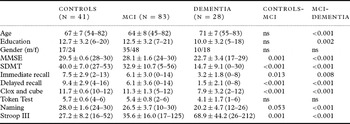
Data from 83 MCI patients, 28 patients with dementia and 41 healthy controls were analyzed. As seen in Table 1, dementia patients were older and had less education than the controls and MCI patients.
Demographic and cognitive data for controls, MCI and dementia patients

MCI = mild cognitive impairment; MMSE = mini mental state examination; SDMT = symbol digit modalities test; Clox = draw a clock on command and copy one; Token Test = language comprehension
Dementia patients performed worse than MCI on every test in the battery. In addition to MMSE, there were very highly significant differences between controls and MCI on SDMT, delayed recall, Clox and cube and Stroop. There was also a significant difference on immediate recall and a trend towards significance on Naming.
For the next analysis, the MCI subjects were rated according to the Global Deterioration Scale (GDS) scale as GDS 2 (= very mild cognitive impairment, minimal clinically objective evidence of cognitive decline) and GDS 3 (= mild cognitive impairment, clinically objective evidence of cognitive decline), according to the algorithm described above.
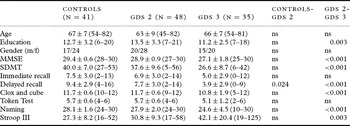
As seen in Table 2, GDS 2 tended to be younger than the controls (although not significantly) and had a higher mean education than GDS 3. When controlling for education, the only significant difference between controls and GDS 2 was on delayed recall. GDS 3 performed quite consistently worse than GDS 2. Immediate recall and Token Test were the variables for which there were no significant differences between GDS 2 and GDS 3. Controls and GDS 2 both improved their performance between immediate and delayed recall, whereas GDS 3 performed worse on delayed than on immediate recall. The clearest differences between GDS 2 and GDS 3 were on SDMT, delayed recall and naming. Although the mean difference on Clox and cube was not large between GDS 2 and GDS 3, it reached significance in the statistical analysis.
Demographic and cognitive data for controls, GDS 2 and GDS 3

MCI = mild cognitive impairment; MMSE = mini mental state examination; SDMT = symbol digit modalities test: Clox = draw a clock on command and copy one; Token Test = language comprehension
Since controls and GDS 2 performed similarly, a Partial Least Squares Discriminant Analysis (PLS-DA) was performed in order to find out which tests most clearly distinguished controls and GDS 2, grouped together, from GDS 3. The PLS-DA resulted in one significant component explaining 46% of the variance in the model. The tests with the highest variable influence on projection (VIPs) were delayed recall and SDMT (1,3) followed by Naming (1,2) and Stroop (1,0). Token Test and Clox and cube had a VIP of 0,8, and immediate recall 0,7. Variables with a VIP ≥ 1 are considered very influential for the model as a whole (Eriksson et al., Reference Eriksson, Johansson, Kettaneh-Wold, Wikström and Wold2002).
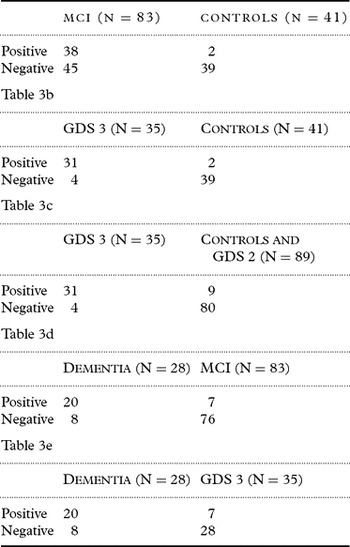
In order to further evaluate CAB, we calculated the sensitivities and specificities for identifying MCI, and also MCI defined as GDS 3. This was done by comparing the outcomes of controls, the whole MCI group and MCI defined as GDS 3. Positive outcome for MCI was defined as impaired results on two or more tests. The cut-off for impaired results was set at approximately two standard deviations below the mean of controls on each test, with the exception of the memory test. For memory, an impaired result on delayed recall was that performance worsened between immediate and delayed recall, regardless of the actual score. For SDMT cut-off was <26, for Clox and cube <11 for Token Test <5, for Naming <25 and for Stroop >43. A negative outcome was when the patient was diagnosed as MCI or GDS 3 without having impaired results on at least two tests. For the control group, similarly, a positive outcome was impaired results on at least two tests, negative outcome an impaired result on one or no test. We also calculated sensitivities and specificities for CAB, distinguishing between the whole MCI group and dementia, and GDS 3 and dementia. A positive outcome for dementia was defined as impaired results on at least four tests on CAB.
Based on the results in Tables 3a–e, sensitivities, specificities and positive likelihood ratios (+LR) were calculated.
Number of subjects with positive and negative outcomes on CAB

Sensitivity and specificity are measures of accuracy. Sensitivity is the proportion of GDS 3 patients who had a positive outcome; specificity is the proportion of controls that did not have a positive outcome. The positive likelihood ratio (LR+) is calculated (sensitivity/1-specificity).
The sensitivity of CAB for MCI was 46%, specificity 95% and positive likelihood ratio (+LR) 9,2. The sensitivity of CAB for GDS 3 was 89%, specificity 95% and positive +LR 17,8. Specificity against controls and GDS 2 subjects grouped together was 90% and +LR 8,9.
CAB did not distinguish as accurately between dementia and MCI and dementia and GDS 3 as between GDS 2 and 3. The sensitivity of CAB for dementia against MCI was 71%, specificity 92% and +LR 8,9. For dementia, specificity against GDS 3 was 80% and +LR 3,6.
Discussion
Our objective was to evaluate the Cognitive Assessment Battery (CAB) in a specialist clinic setting with the hypothesis that CAB would be able to distinguish between healthy controls, MCI and dementia, as well as MCI of different severities. We consider that the hypothesis is essentially fulfilled, and that CAB indeed is a useful screening instrument for identifying MCI. The sensitivity figure for identifying very mild MCI was, however, low. For a more pronounced stage of MCI (defined as GDS 3), CAB was a very sensitive screening instrument.
When CAB was composed, our intention was never to start from scratch and create new tests. Rather, the tests – or the principles on which the tests are based – are well known and validated, for example in the Gothenburg MCI study (Nordlund et al., Reference Nordlund, Rolstad, Hellstrom, Sjogren, Hansen and Wallin2005; Reference Nordlund, Rolstad, Klang, Lind, Hansen and Wallin2007). Thus, it is the composition – which is essentially based on results from the Göteborg MCI study – that is unique. We had two aims: (i) to choose simple tests that assess functions that are relevant in early dementia, i.e. symptoms typical for early AD or VaD; and (ii) to choose tests that are simple and quick to administer, score and interpret. Since our ambition was that CAB could be used both as a first screening in specialist settings as well as a supplement for MMSE in primary care, the administration and scoring should be simple enough to be carried out by persons who have only limited experience of cognitive testing.
CAB also differs from most cognitive instruments in that the end result is not a score (as for MMSE, MoCA, AQT and ADAS-Cog) but a profile, as described above in the Methods section. This gives an overview of the patient's cognitive status with immediate information about which domains are affected. MoCA has been used with some success to detect MCI (Nasreddine et al., Reference Nasreddine2005). In the study by Nasreddine et al., however, the participants were all amnestic MCI patients, who were older than the GDS 3 subjects in our study. This leads us to believe that they were more impaired than the subjects in this study, thus easier to identify. The subjects in our study were both amnestic and non-amnestic, both single and multiple domain MCI. Hence we believe that CAB is more sensitive for a heterogeneous MCI population. Another advantage of CAB is that ceiling effects, which are a problem for most simple screening instruments in the early stages of MCI, can be avoided; some tests in CAB (SDMT, Stroop) have no maximum scores, on others (memory, naming) there are no ceiling effects.
We consider the profile to be perhaps the greatest advantage of CAB. The avoidance of ceiling effects is especially important for patients with high cognitive capacity, or cognitive reserve, as it has been called (Stern, Reference Stern2003). One study (Rolstad et al., Reference Rolstad, Nordlund, Eckerstrom, Gustavsson, Zetterberg and Wallin2009) has shown that these patients are able to compensate for their decline and thus obtain “normal” total scores on screening instruments, such as MMSE, and perform reasonably well on neuropsychological tests despite disease progressing in their brain. We believe that these patients need a more extensive screening, while patients with lower cognitive reserve are more easily detected with MMSE and MoCA. With a profile, even minor discrepancies in the results can be detected and a decision made on whether a result reflects the patient's actual capacity. Also, if the patient is followed over time, even minor deterioration can be detected when the raw scores of the tests are compared.
Dementia, according to the literature, may start with symptoms in any domain (Tabert et al., Reference Tabert2006). Furthermore, according to the latest literature, amnestic MCI with multiple domains impaired is the group with the highest risk of conversion to dementia (Alexopoulos et al., Reference Alexopoulos, Grimmer, Perneczky, Domes and Kurz2006; Nordlund et al., Reference Nordlund, Rolstad, Klang, Edman, Hansen and Wallin2010). These findings speak in favor of CAB: it is balanced and covers all cognitive domains reasonably well, which was reflected in the PLS-DA VIP scores; all tests contributed well to the model. Screening instruments such as MMSE are very memory oriented (given that orientation is an aspect of memory) and AQT only measures speed and attention (Nielsen et al., Reference Nielsen, Wiig, Warkentin and Minthon2004). CAB provides a more global cognitive status of the patient. Furthermore, as previously mentioned, CAB does not have ceiling effects since the outcome is not a total score, but a profile. Another advantage is the construction of the memory test. As the results clearly show, dementia patients and GDS 3 subjects performed worse on delayed than immediate recall (considered typical for AD), whereas controls and GDS 2 performed better. In memory assessment the subject can be used as his/her own control; comparing immediate to delayed recall provides sufficient information, even without norms.
The sensitivity for MCI in general was rather poor, but the specificity was good, which resulted in a good likelihood ratio and a reasonable separation between MCI and controls. The reason for the poor sensitivity figures was that CAB did not distinguish GDS 2 subjects from controls. That, however, was not the objective. Rather, CAB is intended to be a tool that captures more pronounced cognitive symptoms, not the very subtle, almost subjective symptoms of GDS 2. The definition of GDS 2, as mentioned previously, is “very mild cognitive impairment, minimal clinically objective evidence of cognitive decline”; many GDS 2 subjects probably have more benign forms of MCI or are very highly educated. Thus, GDS 2 subjects need more extensive neuropsychological assessment of the kind provided in specialist settings. A possible use for CAB is to distinguish subjects in need of a more comprehensive assessment from those for whom a limited screening is sufficient. The information in Table 3 clearly indicates that CAB can be used for identifying subjects with more pronounced MCI. The sensitivity and specificity figures for GDS 3 are good and the likelihood ratio (17,8) is quite high. The sensitivity and specificity figures for dementia were not as good as for GDS 3. That, however, is not surprising since MCI (defined as GDS 3) is considered a transitional stage towards dementia; thus some overlap is to be expected.
There seems to be a clear association between degree of cognitive impairment and number of cognitive domains affected on CAB; two or more for GDS 3, four or more for dementia. Hence CAB also could be used to assess degree of cognitive impairment by looking at the number of tests with impaired results. By using CAB as a screening tool, not all patients need be subjected to a strenuous testing and the resources of the clinics could be utilized more efficiently. Also, in primary care, CAB could be used to identify MCI and dementia when MMSE does not provide sufficient information.
Finally, a few weaknesses of this study must be mentioned. First, the sample size is relatively small, which limits the validity of the interpretations. We do not as yet have any data on inter-rater reliability and CAB has so far mainly been used in specialist clinics; we cannot state anything about its actual utility in a primary care setting. Also, so far we have only presented cross-sectional data and cannot yet state anything about the accuracy of CAB in identifying patients with incipient dementia. Considering how clearly CAB differentiated between GDS 2 and 3, and the reasonably high sensitivity and specificity figures, we do believe that CAB will be a useful addition as a screening for cognitive symptoms. Our ambition was to fill the gap between a simple cognitive screening, consisting of MMSE with some additional test, and a full neuropsychological assessment. We consider the first results in that ambition to be promising.
Conflict of interest
None.
Description of authors' roles
Arto Nordlund developed CAB, designed the study, did all statistical calculations and wrote the paper. Lisbeth Påhlsson participated in designing the study, undertook the data collection and tested most patients. Christina Holmberg assisted with the data collection, monitored the study and did some of the patient testing. Karin Lind helped with the development of CAB and was responsible for all diagnoses. Anders Wallin supervised the study, assisted with the development of CAB and participated in writing the paper.
Acknowledgments
This work was supported by grants from Axel Linders Stiftelse; Pfannenstills stiftelse; Stiftelsen för Gamla Tjänarinnor; Alzheimerfonden; Swedish Brain Power; Swedish Medical Research Council. Pfizer Sweden AB supported the work by distributing the test material.