1 Introduction
Improving energy efficiency is important for every country. It is a critical way to reduce environmental damages while ensuring economic growth (Gerarden et al., Reference Gerarden, Newell and Stavins2015). However, the problem of energy inefficiency is increasingly prominent in developing countries (Imbruno and Ketterer, Reference Imbruno and Ketterer2018; Brucal et al., Reference Brucal, Javorcik and Love2019; Montalbano and Nenci, Reference Montalbano and Nenci2019). As the largest developing country, China has dramatically increased energy consumption as a result of rapid and sustained economic growth (Wang et al., Reference Wang, Zhou and Zhou2013; Zhao and Wu, Reference Zhao and Wu2016). At present, China is the largest energy consumer in the world. According to data from the China Statistical Yearbook, from 1990 to 2019, China's annual energy consumption increased by 393.4 per cent, from 987 million to 4870 million tons of standard coal. In 2019, the total amounts of coal, fuel oil and clean gas consumption were 2810, 920 and 394 million tons of standard coal, respectively. In particular, coal was the most important energy consumed in China. From 1990 to 2019, coal consumption accounted for 57.7–76.2 per cent of total energy consumption, according to the China Statistical Yearbook. In addition, energy consumption (especially coal consumption) leads to a large number of environmental damages, such as environmental pollution and climate warming (Lyubich et al., Reference Lyubich, Shapiro and Walker2018; Brucal et al., Reference Brucal, Javorcik and Love2019). Thus, it is necessary to take measures to improve energy efficiency in developing countries (especially China).
As suggested by Copeland and Taylor (Reference Copeland and Taylor1994), outward economic activities significantly affect energy consumption of different countries. Both foreign trade and foreign investment are the main outward economic activities. With the emergence of the “deglobalization” trend and trade friction between China and the US, the uncertainty of China's foreign trade has increased (He et al., Reference He, Wang and Zhang2020c; Lin et al., Reference Lin, Huang and He2024). Outward foreign direct investment (OFDI) is increasingly important and has become the key task of economic development in China, which potentially affects domestic energy efficiency. Relying on the support of national policies, China's OFDI has rapidly grown since 2005 (Huang and Zhang, Reference Huang and Zhang2017; Fan et al., Reference Fan, Lin and Tang2018). More specifically, from 2004 to 2018, annual OFDI value increased by 2486.6 per cent and from 5.5 billion to 143.04 billion dollars, ranking second in the world in 2018, according to data from the Statistical Bulletin of China’ Outward Foreign Direct Investment. And, from 2004 to 2015, the number of new OFDI firms increased by 4579.37 per cent, from 223 to 10,435, based on data from the Chinese Overseas Investment Firm List issued by the Ministry of Commerce of China. In addition, international investment not only leads to transnational transfers of industrial production and energy consumption (Copeland and Taylor, Reference Copeland and Taylor1994), but also brings reverse technology spillover to the home country and improves production technology (Huang and Zhang, Reference Huang and Zhang2017; Fu et al., Reference Fu, Hou and Liu2018). In summary, OFDI inevitably has a profound impact on energy efficiency. How can we understand the relationship between OFDI and energy efficiency? This is an important practical problem for environmental protection and sustainable development.
The existing literature about international investment and the environment focuses mainly on foreign direct investment (FDI). There is not much literature on the environmental effect of OFDI, and relevant works are based on the regional perspective (Hao et al., Reference Hao, Guo, Guo, Wu and Ren2019). As we know, firms are OFDI participants and the main energy consumers. We study the relationship between OFDI and energy efficiency at the firm level, which is different from the literature. Firm-level research can better reveal the impact of OFDI on energy efficiency relative to region-level research. According to Helpman et al. (Reference Helpman, Melitz and Yeaple2004), firms with higher productivity are more likely to invest in foreign countries. As a result, OFDI firms have higher productivity relative to non-OFDI firms in the same sector. Energy efficiency is regarded as a special kind of productivity (Lyubich et al., Reference Lyubich, Shapiro and Walker2018). Do OFDI firms still have higher energy efficiency in the same sector? The existing literature does not give an answer. In addition, there is another path to make OFDI firms have higher productivity. OFDI causes reverse technology spillover, which improves firms’ productivity (Huang and Zhang, Reference Huang and Zhang2017; Fu et al., Reference Fu, Hou and Liu2018). However, this effect is restricted by OFDI motivation and destination (Li et al., Reference Li, Liu, Yuan and Yu2017). For example, local production and technology R&D OFDI as well as OFDI to high-income countries is more likely to lead to reverse technology spillover (Li et al., Reference Li, Liu, Yuan and Yu2017). In conclusion, firms’ energy efficiency is potentially influenced by the reverse technology spillover of OFDI. After OFDI, how does firms’ energy efficiency change? This is an important problem which is not covered in the literature.
This study focuses on two questions: Do OFDI firms have higher energy efficiency relative to non-OFDI firms in the same sector? After OFDI, how does firms’ energy efficiency change? We not only provide evidence for the relationship between OFDI and energy efficiency, but also provide important implications for foreign investment and improving energy efficiency in developing countries.
To answer the two questions above, we employ a dataset constructed from firm-level databases from China. We employ three types of fossil energy to measure firm-level energy efficiency and total factor energy efficiency (TFEE), which is a comprehensive efficiency containing various production factors (labor, capital and energy). We depict the trend of change in Chinese firms’ energy efficiency and TFEE from 2005–2012. We find that the changes in energy efficiency and TFEE follow upward trends, and OFDI firms have higher efficiency relative to non-OFDI firms.
We empirically investigate the difference in energy efficiency and TFEE between OFDI and non-OFDI firms in the same sector. Employing coal as the energy, the result shows that OFDI firms have higher energy efficiency and TFEE relative to non-OFDI firms. Then, we focus on following the empirical design from Huang et al. (Reference Huang, He and Lin2022, Reference Huang, He and Lin2023) and Lin and He (Reference Lin and He2023), and combining propensity score matching (PSM) with the difference-in-difference (DID) approach to identify the causal effect of OFDI on firm-level energy efficiency and TFEE. This method effectively solves the endogeneity caused by self-selection. We find that after OFDI, firms improve energy efficiency and TFEE mainly by reverse technology spillover and thereby expanding output scale. The effect for improving TFEE persists in subsequent periods. Given that different types of firms have differentiated characteristics, we undertake heterogeneous analyses in term of energy types as well as OFDI motivations and destinations. The impacts of OFDI on energy efficiency are found to be heterogeneous. In particular, local production and technology R&D OFDI as well as OFDI to high-income countries are more conducive to improving energy efficiency. Given that local production OFDI, technology R&D OFDI and OFDI to high-income countries are more likely to cause reverse technology spillover (Huang and Zhang, Reference Huang and Zhang2017; Fu et al., Reference Fu, Hou and Liu2018), these results indicate that OFDI leads to reverse technology spillover and improves energy efficiency.
Overall, this study enriches the literature regarding international investment and environment. In this context, we make contributions in two aspects. First, we provide some initial evidence for the relationship between OFDI and energy performance at the firm level. We not only analyze own energy efficiency of OFDI firms in the same sector, but also reveal the causal effect of OFDI on energy efficiency. Compared with region-level studies (Hao et al., Reference Hao, Guo, Guo, Wu and Ren2019), our study can better explain how OFDI affects energy performance. Moreover, we reveal heterogeneous relationships between OFDI and energy efficiency from the perspectives of energy type as well as OFDI motivation and destination. Our findings provide important implications for outward investment and improving energy efficiency (especially in developing countries).
Second, we employ three types of energy (coal, fuel oil and clean gas) to measure firm-level energy efficiency and TFEE in China. He and Huang (Reference He and Huang2020) calculate the TFEE of Chinese firms, but their sample period covers only two years (2006–2007) and they follow only the method of Levinsohn and Petrin (Reference Levinsohn and Petrin2003) to calculate TFEE. In contrast, our study measures both energy efficiency and TFEE of Chinese firms from 2005–2012, using a variety of methods.
2 Literature review
This study is related to the literature in three aspects. First, the existing literature investigates the impacts of OFDI on firms’ performances and behaviors. With the emergence of trade theory with heterogeneous firms (Melitz, Reference Melitz2003), the research on international investment began to focus on individual firms. Helpman et al. (Reference Helpman, Melitz and Yeaple2004) constructed a model with heterogeneous firms to illustrate that investing in foreign countries requires paying more fixed costs, so firms with higher productivity are more likely to directly invest in foreign markets. As a result, compared with non-OFDI firms, OFDI firms have higher productivity in the same sector. Some empirical works have confirmed this prediction. For example, Yan et al. (Reference Yan, Zhang, Shen and Han2018) show that more productive firms self-select to undertake OFDI. Other literature empirically analyzes the causal effects of OFDI. Huang and Zhang (Reference Huang and Zhang2017), Fu et al. (Reference Fu, Hou and Liu2018) and Ali et al. (Reference Ali, Li, Wang, Yue and Chang2021) indicate that OFDI leads to reverse technology spillover, and thereby improves firms’ productivity. But, Li et al. (Reference Li, Liu, Yuan and Yu2017) show that this effect is restricted by OFDI motivation and destination. For example, local production and technology R&D OFDI are more likely to cause reverse technology spillover (Li et al., Reference Li, Liu, Yuan and Yu2017). In addition, OFDI affects domestic employment (Liao et al., Reference Liao, Yang, Dai and Van Assche2021), reduces domestic investment (You and Solomon, Reference You and Solomon2015) and mitigates the negative effect of factor price distortions (Cheng et al., Reference Cheng, Wang, Peng and Kong2020). However, as an important kind of firm performance, energy efficiency is closely related to a country's energy consumption and other environmental damages. Limited by the difficulty of obtaining firm-level energy data, existing literature does not cover the relationship between OFDI and firms’ energy efficiency.
Second, the existing literature investigates the environmental effect of international investment. According to Copeland and Taylor (Reference Copeland and Taylor1994), high-income countries have stricter environmental regulation, which causes energy-intensive production and energy consumption transfer to low-income countries with looser regulation. As a result, international investment increases energy consumption in low-income countries. Most of the literature focuses on the environmental effect of FDI (Hubler and Keller, Reference Hubler and Keller2010; Brucal et al., Reference Brucal, Javorcik and Love2019; Demena and Afesorgbor, Reference Demena and Afesorgbor2020; Balaguer et al., Reference Balaguer, Cuadros and Garcia-Quevedo2023). There are few studies on the relationship between OFDI and the environment. Hao et al. (Reference Hao, Guo, Guo, Wu and Ren2019) employ provincial data from China and find that OFDI improves environmental quality. However, these works focus on the impact of OFDI on the regional environment. Given that firms are OFDI participants and energy consumers, firm-level study can better reveal the relationship between OFDI and energy performance.
Third, the existing literature has beun to focus on firm-level energy efficiency and other environmental performance. Roy and Yasar (Reference Roy and Yasar2015); Holladay (Reference Holladay2016); Forslid et al. (Reference Forslid, Okubo and Ulltveit-Moe2018); Rodrigue et al. (Reference Rodrigue, Sheng and Tan2022) and Kwon et al. (Reference Kwon, Zhao and Zhao2023) find that, compared to non-exporting firms, exporting firms are cleaner. In particular, Roy and Yasar (Reference Roy and Yasar2015) show that exporters have higher energy efficiency. Lin and He (Reference Lin and He2023) indicate that increasing export intensity by only a small degree can improve firm-level environmental performance. Imbruno and Ketterer (Reference Imbruno and Ketterer2018) and Huang et al. (Reference Huang, He and Lin2023) point out that importing intermediate products can lead to improvement in firms’ environmental performance. Cherniwchan (Reference Cherniwchan2017), Gutierrez and Teshima (Reference Gutierrez and Teshima2018) and He et al. (Reference He, Lin and Liu2020a) investigate the impact of trade liberalization. Cherniwchan (Reference Cherniwchan2017) indicates that decreasing import tariffs on intermediate products and external tariffs reduce firms’ pollution emissions, while Gutierrez and Teshima (Reference Gutierrez and Teshima2018) find that decreasing import tariffs on final products improves firms’ energy efficiency and reduces surrounding pollution. He and Lin (Reference He and Lin2021) indicate that trade surplus leads to an increase in firms’ emission levels in China. Huang et al. (Reference Huang, He and Lin2022) show that robot application improves firms’ energy efficiency, while Lin et al. (Reference Lin, Huang and He2024) find that decreasing trade policy uncertainty reduces firms’ emission intensity. In addition, Brucal et al. (Reference Brucal, Javorcik and Love2019) find that foreign acquisition reduces firms’ energy intensity by expanding production. However, OFDI is becoming more and more important in developing countries (especially in China). The existing literature does not explore the impact of OFDI on firms’ energy efficiency.
3 Measurement of firm-level energy efficiency
3.1 Energy efficiency
Energy efficiency is the output value per unit of energy consumption, representing the production technology related to energy utilization (Imbruno and Ketterer, Reference Imbruno and Ketterer2018; Brucal et al., Reference Brucal, Javorcik and Love2019). Different firms have enormous heterogeneity in energy efficiency (Lyubich et al., Reference Lyubich, Shapiro and Walker2018). In particular, firms with advanced production technology have higher energy efficiency. In the case of equal output, these firms consume less energy. Following Imbruno and Ketterer (Reference Imbruno and Ketterer2018), Brucal et al. (Reference Brucal, Javorcik and Love2019) and Lin et al. (Reference Lin, Huang and He2024), we measure firm-level energy efficiency by the ratio of output value to energy consumption,

where subscripts $i$ , $s$
 , $p$
 and $t$
 denote individual firm, sector, province and time, respectively. $EE_{ispt}$
 is firm $i$
 's energy efficiency. $Output_{ispt}$
 and $Energy_{ispt}$
 are output value and energy consumption, respectively.
We employ the dataset merged from three databases of Chinese firms to measure energy efficiency. These databases include the Chinese Industrial Firm Database, the Chinese Environmental Statistics Firm Database and the Chinese Overseas Investment Firm List. In particular, our dataset provides information on firm-level energy consumption of coal, fuel oil and clean gas.Footnote 1 In this study, we mainly employ coal as energy input. The reasons are as follows: First, from 1990 to 2019, coal consumption accounted for 57.7–76.2 per cent of total energy consumption in China, according to data from the China Statistical Yearbook. As the most important energy input, coal can better reflect the energy consumption of industrial firms in China. Second, compared with other types of energy, such as fuel oil and clean gas, coal consumption produces more pollutants and greenhouse gases. This suggests that coal consumption is more closely related to environmental damages. Third, from our dataset, firms mainly employ coal as the energy input. The observations of firms using other types of energy are few in number. Specifically, the observations of firms consuming coal are 139324 (1,066 OFDI firms), while for fuel oil and clean gas they are 18754 (237 OFDI firms) and 11,786 (202 OFDI firms), respectively.
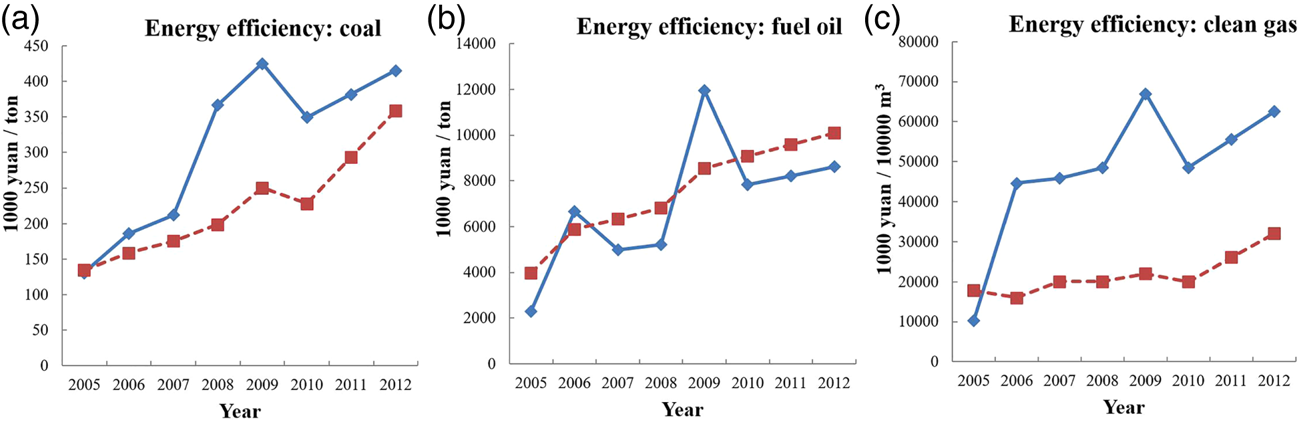
After calculating energy efficiency, we depict the evolution of firm-level energy efficiency in China. We compare the changes in energy efficiency between OFDI and non-OFDI firms. Before 2005, Chinese firms did not carry out large-scale OFDI,Footnote 2 so we employ firm samples from 2005 to 2012 for analysis. Figure 1 shows the average energy efficiency of OFDI and non-OFDI firms. Panel (a), which employs coal as the energy input, indicates that on average both OFDI and non-OFDI firms’ energy efficiency show upward trends. Except in 2005, the average energy efficiency of OFDI firms is higher than that of non-OFDI firms, implying that OFDI firms have more advanced production technology related to energy utilization. We find a similar result in panel (c) which employs clean gas as the energy input. However, in panel (b), we cannot find evidence that OFDI firms have higher energy efficiency of fuel oil, which suggests that for different energy types, the differences in energy efficiency between OFDI and non-OFDI firms are differentiated.
Average energy efficiency of Chinese industrial firms, 2005–2012. Data sources: Calculation using data from the Chinese Industrial Firm Database, the Chinese Environmental Statistics Firm Database and the Chinese Overseas Investment Firm List.
Note: Panels (a)–(c) employ coal, fuel oil and clean gas respectively as the energy.

3.2 Total factor energy efficiency
Given that there are big differences in factor input composition among firms and many firms mainly input other production factors rather than energy in production, using the ratio of output value to energy consumption to represent production technology related to energy utilization may be biased. In the literature, labor and capital are basic factors in production, and they are the important foundation for calculating firm-level productivity (Levinsohn and Petrin, Reference Levinsohn and Petrin2003). Total factor productivity (TFP) reflects the average output of various production factors. However, in the literature on TFP calculation, the energy factor is often ignored. Energy is an important production factor and has a close relationship with environmental damages (Brucal et al., Reference Brucal, Javorcik and Love2019). He and Huang (Reference He and Huang2020) employ the method of Levinsohn and Petrin (Reference Levinsohn and Petrin2003) – hereafter referred to as the LP method – and use energy consumption instead of intermediate input to calculate TFEE from firm-level data. In this study, to reflect the comprehensive efficiency containing energy factor, we employ a variety of methods to calculate TFEE at the firm level.
Before estimating TFEE, we set the form of the production function. We employ the Cobb-Douglas production function which contains labor, capital and energy as follows:

where $Output_{ispt}$ is output value; $Labor_{ispt}$
 , $Capital_{ispt}$
 and $Energy_{ispt}$
 are the amount of labor employment, the value of fixed assets and the level of energy consumption, respectively; and $TFEE_{ispt}$
 is firm-level comprehensive efficiency (i.e., TFEE), reflecting the marginal output level of various production factors. We take the logarithm of the variables in equation (2) and then convert this equation into a linear form,

where $\ln TFEE_{ispt}$ is a part of the residual term and $\varepsilon _{ispt}$
 is a stochastic error term.
We use a variety of methods to estimate equation (3). First, we estimate this equation using the ordinary least square (OLS) method. Based on this estimation, we calculate TFEE (OLS). Second, it is difficult to directly compare firms’ TFEE in different sectors, regions and periods. To this end, we estimate TFEE by controlling sector, province and year fixed effects to capture sector-level, region-level and time-level characteristics and shocks. We define this kind of TFEE as TFEE (OLS2). Third, we re-estimate TFEE by controlling individual fixed effects as well as year fixed effects (FE), and define this TFEE as TFEE (FE). This method controls firm-level characteristics, which makes our estimation more accurate. Finally, according to Levinsohn and Petrin (Reference Levinsohn and Petrin2003), using linear methods to estimate firms’ productivity would lead to inevitable problems of measurement, such as simultaneity bias and selectivity bias. To solve these problems, Olley and Pakes (Reference Olley and Pakes1996) introduce current investment as a proxy variable of unobservable productivity shocks. Because many firms do not have investments every year, and because of the entry and exit of firms as well, using the Olley and Pakes method means that many samples are lost in the estimation. Levinsohn and Petrin (Reference Levinsohn and Petrin2003) provide a new method and use intermediate input instead of investment. He and Huang (Reference He and Huang2020) employ the Levinsohn and Petrin (LP) method to calculate TFEE of Chinese firms. In this study, we employ the LP method and use energy consumption instead of intermediate input to calculate firm-level TFEE, i.e., TFEE (LP). As we know, energy is a special kind of intermediate input. In the subsequent sections, we mainly employ TFEE (LP) to reflect comprehensive production technology and then use TFEE (OLS), TFEE (OLS2) and TFEE (FE) for robustness checks.
We employ our dataset to depict the evolution of firms’ TFEE in China. Figure 2 shows the average TFEE of OFDI and non-OFDI firms from 2005 to 2012. Panels (a)–(c) measure TFEE by OLS, OLS2 and FE methods, while panels (d)–(f) measure TFEE by the LP method. From panels (a)–(d) employing coal as energy input, regardless of whether the OLS, OLS2, FE or LP method is used, the TFEE of both OFDI and non-OFDI firms increases during the period of this study. On average, OFDI firms have higher TFEE relative to non-OFDI firms, implying that OFDI firms have more advanced comprehensive production technology. In addition, we can see similar results in panels (e) and (f) when we employ fuel oil and clean gas as the energy input.
Average TFEE of Chinese industrial firms, 2005–2012. Data sources: Calculation using data from the Chinese Industrial Firm Database, the Chinese Environmental Statistics Firm Database and the Chinese Overseas Investment Firm List.
Note: Panels (a)–(c) measure TFEE by OLS, OLS2 and FE, while panels (d)–(f) measure TFEE by the LP method and employ coal, fuel oil and clean gas respectively as the energy.

4 Empirical model and data
4.1 Empirical model
4.1.1 OFDI and firm-level energy efficiency: the correlation
To compare the difference in energy efficiency between OFDI and non-OFDI firms in the same sector, we employ the following empirical models:


where $EE_{ispt}$ is energy efficiency which is measured by the output-to-energy ratio and $TFEE_{ispt}$
 is comprehensive efficiency containing labor, capital and energy.Footnote 3 We mainly employ TFEE calculated by the LP method for analysis, and employ TFEE (OLS), TFEE (OLS2) and TFEE (FE) for robustness checks. $OFDI_{ispt}$
 is the dummy of OFDI. If the firm is an OFDI firm, $OFDI_{ispt}=1$
 ; otherwise, $OFDI_{ispt}=0$
 . $X'$
 is control variables which capture time-varying characteristics of the firm; $\mu _{spt}$
 is sector-province-year fixed effects, which capture sector-level and province-level characteristics and policy shocks, time-varying trend of energy efficiency and TFEE as well as the impacts of macroeconomic factors; and $\varepsilon _{ispt}$
 is a stochastic error term. We focus on coefficients $\beta _{1}$
 in equations (4) and (5), which measure the differences, on average, in energy efficiency and TFEE between OFDI and non-OFDI firms in the same sector.
We employ the following firm characteristics as control variables:

where $KL_{ispt}$ is capital intensity measured by the ratio of fixed assets to employees; $Constraint_{ispt}$
 is the financial constraint measured by the ratio of interest expenditure to fixed assets; $Profit_{ispt}$
 is the profit rate measured by the ratio of profit to output value; and $SOE_{ispt}$
 and $Foreign_{ispt}$
 are dummies of ownership types. If the firm is state-owned, $SOE_{ispt}=1$
 ; otherwise, $SOE_{ispt}=0$
 . If the firm is foreign-funded, $Foreign_{ispt}=1$
 ; otherwise, $Foreign_{ispt}=0$
 .
4.1.2 The impact of OFDI on firm-level energy efficiency: the causality
As suggested by Helpman et al. (Reference Helpman, Melitz and Yeaple2004), firms may self-select to engage in OFDI according to their characteristics. For this reason, the models in equations (4) and (5) only examine the correlation between OFDI and energy efficiency, rather than the impact of OFDI. Our goal is to identify the causal effect of OFDI on firm-level energy efficiency, so we need to solve the endogeneity caused by self-selection. Thus, we employ the empirical method from Huang et al. (Reference Huang, He and Lin2022, Reference Huang, He and Lin2023) and Lin and He (Reference Lin and He2023), and combine PSM with the DID approach to examine the causal effect of OFDI on energy efficiency.Footnote 4
According to Lin and He (Reference Lin and He2023), we re-adjust the time using subscript $k$ . $k=0$
 indicates the first year that firms engage in OFDI; $k$
 equals $-1$
 and $-2$
 indicates the first and the second years before OFDI, respectively; $k$
 equals 1–4 indicates the second to the fifth years after OFDI, respectively. Then, we regard firms which were non-OFDI firms in the previous year and started engaging in OFDI in the current year as the treatment group. Namely, these firms were not engaged in OFDI before $k=0$
 and started engaging in it in $k=0$
 . The firms which are non-OFDI firms in previous, current and future years are the control group. Namely, these firms are not engaged in OFDI before and after $k=0$
 . In addition, we employ the change rates of energy efficiency and TFEE of firms in the specific years ($k$
 equals 0–4) relative to those in the year before OFDI ($k=-1$
 ) as outcome variables.
The detailed empirical design is as follows. First, given that the outcome variables are the change rates of energy efficiency and TFEE, we take the difference for two-year data by taking the logarithm for outcome variables. By taking the difference for energy efficiency and TFEE between the specific year and the year before OFDI, we mitigate the interferences of unobservable and time-invariant factors that affect both OFDI and efficiency (Huang et al., Reference Huang, He and Lin2022, Reference Huang, He and Lin2023; Lin and He, Reference Lin and He2023).
Second, we compare the change rates of energy efficiency and TFEE between treatment and control groups. However, there are big differences between firms which start OFDI and non-OFDI firms. These differences affect whether firms start OFDI and their efficiency. To this end, we employ a series of firm characteristics to control for the impacts of observable and time-varying factors. We refer to Lin and He (Reference Lin and He2023) and employ the PSM method to select the sample firms which have similar characteristics to firms starting to engage in OFDI as the control group.
Third, when employing the PSM method for matching, we use firms’ energy efficiency and TFEE in the year before OFDI ($k=-1$ ) as covariates. This can control ex-ante the difference in energy efficiency and TFEE as well as the self-selection of firms (Brucal et al., Reference Brucal, Javorcik and Love2019; Lin and He, Reference Lin and He2023). Although we control for observable and time-varying factors, there are still unobservable and time-varying omitted factors that make energy efficiency related to the OFDI decision. This leads to firms with different efficiencies self-selecting to start engaging in OFDI. In this study, we cannot directly control for unobservable and time-varying factors. But, if we control for ex-ante energy efficiency and TFEE, we can ensure that firms have the same ex-ante efficiency (Imbruno and Ketterer, Reference Imbruno and Ketterer2018; Brucal et al., Reference Brucal, Javorcik and Love2019). In this case, we address the problem of firms with different efficiency self-selecting to engage in OFDI.
Fourth, firms from different sectors and periods cannot be directly compared, and they are influenced by different external shocks. We follow Imbruno and Ketterer (Reference Imbruno and Ketterer2018), and employ sector-year fixed effects in PSM to control for the interferences of unobservable and time-varying factors at the sector level, such as sector-level characteristics and external shocks. This can also ensure that we compare treatment and control groups in the same sector and period (Lin and He, Reference Lin and He2023).
Fifth, based on the PSM-DID design, we mitigate the interference of reverse causality (Huang et al., Reference Huang, He and Lin2022, Reference Huang, He and Lin2023; Lin and He, Reference Lin and He2023). The logic is that the reverse causality implies that firms with higher energy efficiency and TFEE are more likely to engage in OFDI (Helpman et al., Reference Helpman, Melitz and Yeaple2004). After PSM, we can compare firms that start to engage in OFDI and non-OFDI firms with the same ex-ante energy efficiency and TFEE. After taking the difference between different years, the outcome variables are the change rates of energy efficiency and TFEE. We control for ex-ante efficiency, and then the change rates of energy efficiency and TFEE are the outcomes of starting to engage in OFDI.
Referring to Lin and He (Reference Lin and He2023), we estimate the average treatment effect to analyze the impacts of OFDI on energy efficiency and TFEE as


where $ATT_{k}^{EE}$ and $ATT_{k}^{TFEE}$
 are average treatment effects which measure the impacts of OFDI on energy efficiency and TFEE; $\Delta \ln EE^{1}_{ik}$
 and $\Delta \ln TFEE^{1}_{ik}$
 are the change rates of firms’ energy efficiency and TFEE in period $k$
 ($k$
 equals 0–4) relative to the period before starting OFDI ($k=-1$
 ); $\Delta \ln EE^{0}_{ik}$
 and $\Delta \ln TFEE^{0}_{ik}$
 are those change rates of non-OFDI firms; and $StartOFDI_{i,0}$
 is a dummy for whether firms start to engage in OFDI. If the firm starts engaging in OFDI, $StartOFDI_{i,0}=1$
 ; otherwise, $StartOFDI_{i,0}=0$
 . $E(\Delta \ln EE^{1}_{ik}|StartOFDI_{i,0}=1 )$
 and $E(\Delta \ln TFEE^{1}_{ik}|StartOFDI_{i,0}=1 )$
 are the mean of change rates of OFDI firms’ energy efficiency and TFEE, while $E(\Delta \ln EE^{0}_{ik}|StartOFDI_{i,0}=1 )$
 and $E(\Delta \ln TFEE^{0}_{ik}|StartOFDI_{i,0}=1 )$
 are the mean of those firms that should start to engage in OFDI but do not. However, it is noted that $E(\Delta \ln EE^{0}_{ik}|StartOFDI_{i,0}=1 )$
 and $E(\Delta \ln TFEE^{0}_{ik}|StartOFDI_{i,0}=1 )$
 are unobservable counterfactuals. We refer to Huang et al. (Reference Huang, He and Lin2022, Reference Huang, He and Lin2023) and Lin and He (Reference Lin and He2023) and use the PSM method to construct the control group as alternatives.
We employ the PSM method to construct the control group. We use a Probit model to estimate the propensity score, and this model also examines the self-selection according to firms’ energy efficiency and other characteristics:

where $Pr( StartOFDI_{i,0}=1)$ is the possibility that firms start to engage in OFDI; $EE_{isp,-1}$
 , $TFEE_{isp,-1}$
 , $X_{isp,-1}^{'}$
 , and $\delta _{st}$
 are covariates for matching; and $EE_{isp,-1}$
 and $TFEE_{isp,-1}$
 are firms’ energy efficiency and TFEE in the year before OFDI ($k=-1$
 ). They are used to control the ex-ante difference of energy efficiency and TFEE as well as the self-selection of firms, so that we can compare OFDI firms with non-OFDI firms in the case of equal ex-ante energy efficiency and TFEE (Huang et al., Reference Huang, He and Lin2022, Reference Huang, He and Lin2023; Lin and He, Reference Lin and He2023). In other words, firms’ efficiency in the previous year affects the OFDI decision in the current year, so this Probit model also examines the self-selection of OFDI. $X_{isp,-1}^{'}$
 is firm characteristics in the year before OFDI, including all variables in equation (6), and $\delta _{st}$
 is fixed effects at the sector-year level, which ensures that we can compare treatment and control groups in the same sector and period and eliminate the interferences of external shocks. Then, we employ $Pr( StartOFDI_{i,0}=1)$
 as the propensity score and 1:1 nearest neighbor matching with replacement to match firms from the treatment and control groups.
After this matching, we examine the changes in firms’ energy efficiency and TFEE after starting to engage in OFDI, i.e., the causal effect of OFDI, as follows:


where $n$ is the number of matching firms from the treatment group; and $g(\cdot )$
 is the weight given to $\Delta \ln EE_{jk}^{0}$
 and $\Delta \ln TFEE_{jk}^{0}$
 when we use them to replace $\Delta \ln EE_{ik}^{0}$
 and $\Delta \ln TFEE_{ik}^{0}$
 .
4.2 Data
In this study, we employ three firm-level databases from China. First, our basic data for firms are derived from the Chinese Industrial Firm Database. Second, the information on firm-level energy consumption comes from the Chinese Environmental Statistics Firm Database. Third, OFDI information is from the Chinese Overseas Investment Firm List. Given that Chinese firms did not carry out large-scale OFDI before 2005, we selected firm-level data from 2005 to 2012 for empirical analysis. In addition, considering that we need to control for firm characteristics in the year before OFDI in the matching model, we also employ the data for Chinese firms in 2004. We merged the three firm-level databases to construct a dataset covering the information on firms’ energy efficiency, OFDI and other characteristics. A detailed description of the data and how it was processed is provided below.
First, the Chinese Industrial Firm Database provided by the National Bureau of Statistics of China has been widely used in existing literature (Brandt et al., Reference Brandt, Biesebroeck, Wang and Zhang2017; Fan et al., Reference Fan, Lin and Tang2018). It contains all state-owned firms and non-state-owned firms of large size in China, and provides basic information as well as production and financial data for the firms. According to our study design, we processed this database as follows. Considering that the output value of non-state-owned firms is more than 5 million yuan, we exclude any firms with output value of less than 5 million yuan. To clean the abnormal data, we delete any firms with the value of fixed assets of less than or equal to 0, any firms with interest expenditure and profit of less than 0 as well as any firms with fewer than 10 employees. To eliminate the interference of price change, we deflate output value, interest expenditure and profit using the price index of industrial producer in 2004, and deflate the value of fixed assets using the price index of fixed asset investment in 2004.
Second, energy data is from the Chinese Environmental Statistics Firm Database provided by the Ministry of Ecology and Environment of China. This database has begun to be used in the literature and is considered to be comprehensive, reliable and authoritative environment data (Liu et al., Reference Liu, Shadbegian and Zhang2017; Zhang et al., Reference Zhang, Chen and Guo2018; He et al., Reference He, Lin and Zhang2020b). This data comes from the annual report of environmental statistics of China and covers the firms monitored by the Ministry of Ecology and Environment. These firms are major energy consumers. Monitored firms are required to report various environmental information, such as energy consumption which covers coal, fuel oil and clean gas. We match this database with the Chinese Industrial Firm Database through firm code, name and former name.
Third, our data on firm-level OFDI is from the Chinese Overseas Investment Firm List provided by the Ministry of Commerce of China. This database is used in existing literature (Huang and Zhang, Reference Huang and Zhang2017; Li et al., Reference Li, Liu, Yuan and Yu2017; Fan et al., Reference Fan, Lin and Tang2018). The database records the information on OFDI in China, including investment firms’ name, approval date, the scope of overseas business and investment destination. We match this database with the above merged dataset through firm name.
After merging the three databases, we obtain 275,472 observations, including 158045 observations which consume energy. About 31.3 per cent of observations of the initial environmental database are successfully matched. These matched samples account for 53.9 per cent of total output value, 44.7 per cent of total coal consumption, 29.9 per cent of total fuel oil consumption and 48.0 per cent of total clean gas consumption. In particular, there are 2,443 OFDI firms, 1091 new-OFDI firms and 273029 non-OFDI firms. Furthermore, 139324 observations employ coal as the energy input; 18754 observations consume fuel oil; and 11,786 observations consume clean gas. In online appendix A, we show descriptive statistics of the variables and initially compare the differences between OFDI, new-OFDI and non-OFDI firms. Then, we provide sector distribution for samples of OFDI and new-OFDI firms in online appendix B.
5 Empirical results: the correlation
5.1 OLS results: energy efficiency
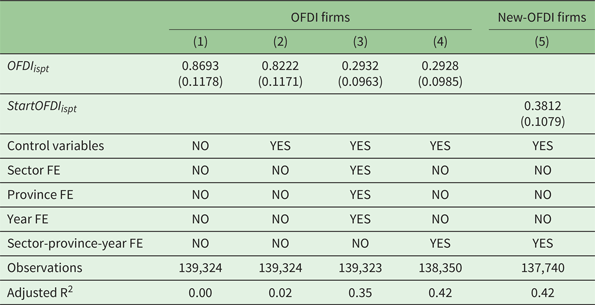
We empirically examine the difference in energy efficiency (output-to-energy ratio) between OFDI and non-OFDI firms in the same sector. Table 1 reports the results according to equation (4). First, we employ the OFDI dummy as core variables. From columns (1)–(4), the estimated coefficients of the OFDI dummy are positive and significant at the 1 per cent level. The results show that compared with non-OFDI firms, OFDI firms on average have higher energy efficiency in the same sector. In other words, OFDI firms consume equal energy to achieve more output values. This finding supports the theoretical prediction from Helpman et al. (Reference Helpman, Melitz and Yeaple2004) from an energy perspective. OFDI firms have higher energy efficiency which is a special kind of productivity related to energy utilization. Using column (4) as the main result, the energy efficiency of OFDI firms is 29.28 per cent higher on average than that of non-OFDI firms in the same sector. Then, we replace the core variable by the dummy of starting to engage in OFDI. From column (5), the coefficient on this dummy is positive and statistically significant. This indicates that new-OFDI firms also have higher energy efficiency relative to non-OFDI firms in the same sector.
OFDI and firm-level energy efficiency

Notes: In columns (1)–(4), we use the OFDI dummy as core variables, and in column (5), we use the dummy of starting to engage in OFDI as the core variable. The figures in parentheses are robust standard errors clustered by sectors and provinces.
5.2 OLS results: total factor energy efficiency
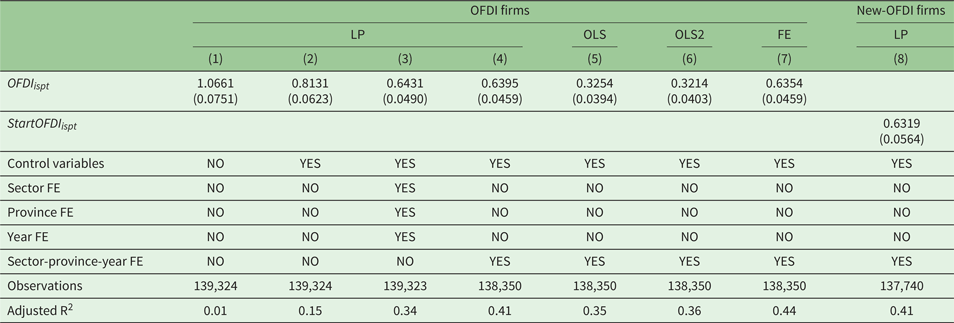
There are big differences in production factor composition among firms. Many firms input less energy relative to labor and capital. To this end, we employ TFEE as the dependent variable to estimate the result. Table 2 shows the result according to equation (5). First, we employ an OFDI dummy as core variables and the LP method to calculate TFEE. From columns (1)–(4), the estimated coefficients of the OFDI dummy are positive and significant at the 1 per cent level. The results suggest that OFDI firms have higher TFEE relative to non-OFDI firms in the same sector. This supports the theoretical prediction of Helpman et al. (Reference Helpman, Melitz and Yeaple2004) using TFEE as comprehensive productivity. Employing column (4) as the main result, the TFEE of OFDI firms is 63.95 per cent higher on average than that of non-OFDI firms in the same sector. Then, we use other methods to calculate TFEE. Columns (5)–(7) show that, regardless of whether TFEE is measured by OLS, OLS2 or FE, the coefficients on the OFDI dummy are positive and significant. Our results are robust when we employ different methods to measure TFEE. Next, we employ the dummy of starting to engage in OFDI as the core variable. From column (8), the coefficient on this dummy is significantly positive, suggesting that the TFEE of new-OFDI firms is higher than that of non-OFDI firms in the same sector. Compared to table 1, the gap in TFEE between OFDI and non-OFDI firms is greater than the gap in energy efficiency.
OFDI and firm-level TFEE

Notes: In columns (1)–(7), core variables are the OFDI dummy, and in column (8), the core variable is the dummy of starting to engage in OFDI. In columns (1)–(4) and (8), we employ TFEE measured by the LP method as dependent variables, while in the other columns, we employ TFEE measured by other methods for the robustness check. The figures in parentheses are robust standard errors clustered by sectors and provinces.
Combining the results of tables 1 and 2, both the energy efficiency and TFEE of OFDI firms are higher than those of non-OFDI firms in the same sector. Our finding is related to the literature in two aspects. First, Helpman et al. (Reference Helpman, Melitz and Yeaple2004) construct a theoretical framework to point out that OFDI firms have higher productivity relative to non-OFDI firms. Subsequent works employ firm-level data to prove this prediction (Huang and Zhang, Reference Huang and Zhang2017). In contrast to these works, we provide evidence that OFDI firms have higher energy efficiency and TFEE which are special kinds of productivity related to energy utilization. Second, the literature indicates that firms serving the international market are more environmentally friendly. The literature also shows that exporting firms and firms acquired by foreign capital are cleaner (Roy and Yasar, Reference Roy and Yasar2015; Forslid et al., Reference Forslid, Okubo and Ulltveit-Moe2018; Brucal et al., Reference Brucal, Javorcik and Love2019). In this study, we are the first to prove that OFDI firms have better energy performance, which is not covered in previous literature.
To ensure the robustness of our result, we do robustness checks in online appendix C. Next, in online appendix D, we analyze why OFDI firms are more energy efficient. We compare the differences in output value and factor inputs between OFDI and non-OFDI firms. Furthermore, we construct sub-samples to investigate heterogeneous relationships between OFDI and energy efficiency in online appendix E.
6 Empirical results: the causality
6.1 PSM-DID results
The results above reveal the difference in energy efficiency between OFDI and non-OFDI firms in the same sector. However, because efficient firms usually self-select to engage in OFDI (Helpman et al., Reference Helpman, Melitz and Yeaple2004), the OLS result cannot reveal the causal effect of OFDI. We combine PSM with the DID approach to identify the causal effect of OFDI on energy efficiency and TFEE.
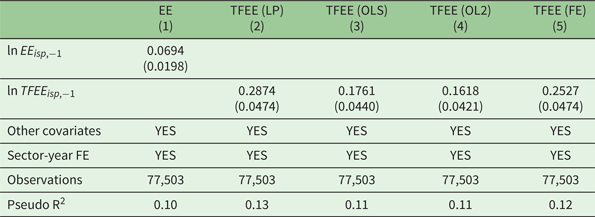
First, we employ equation (9) to estimate the propensity score, and examine whether firms self-select to engage in OFDI according to energy efficiency. Table 3 reports the relationship between covariates and starting to engage in OFDI. The coefficients on energy efficiency and TFEE in the year before OFDI are positive and significant at the 1 per cent level, that is, firms with higher ex-ante energy efficiency and TFEE self-select to engage in OFDI. These results are consistent with Helpman et al., Reference Helpman, Melitz and Yeaple2004, which suggests that more productive firms are more likely to invest in foreign countries. Thus, OFDI firms have higher energy efficiency and TFEE in the same sector, partly because of the self-selection to engage in OFDI. According to the propensity score, we employ 1:1 nearest neighbor matching with replacement to match the firms in the treatment and control groups. After matching, we compare the difference in firm characteristics between treatment and control groups, shown in online appendix F.
Probit estimation: the factors influencing the OFDI decision

Notes: Columns (1)–(5) employ energy efficiency as well as TFEE calculated by the LP, OLS, OLS2 and FE methods to represent firm efficiency. The figures in parentheses are robust standard errors clustered by sectors.
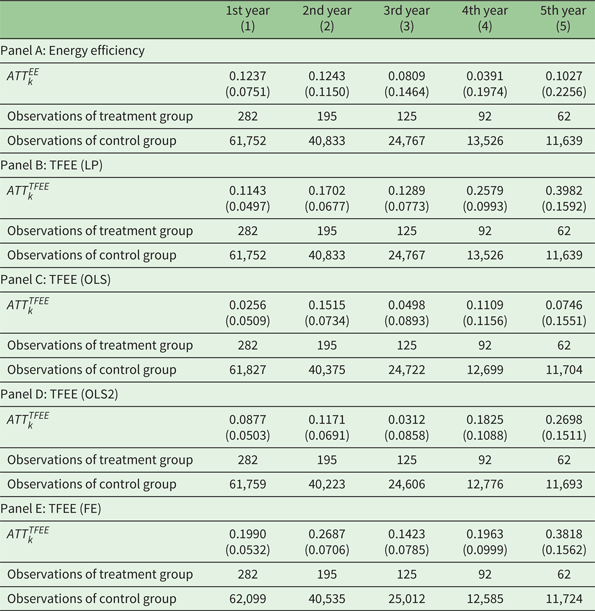
Then, we estimate the average treatment effects ($ATT_{k}^{EE}$ and $ATT_{k}^{TFEE}$
 ) to examine the change in firms’ energy efficiency and TFEE after starting to engage in OFDI. Table 4 reports the results based on the PSM-DID approach. We firstly employ energy efficiency as the outcome variable. From panel A, the estimated coefficient is significantly positive only in column (1), whereas the coefficients in the other columns are not significant. Although the coefficients in columns (2)–(5) are not significant, they are positive. This result suggests that OFDI has a short-term and significant effect on improving firms’ energy efficiency. In the long term, this effect caused by OFDI is weakened. This finding supports the reverse technology spillover of OFDI from the perspective of energy efficiency. Namely, OFDI leads to reverse technology spillover, and it thereby improves firms’ energy efficiency which is a special kind of productivity related to energy utilization.
The causal effect of OFDI on energy efficiency and TFEE

Notes: Columns (1)–(5) employ the change rates of energy efficiency and TFEE in the first to the fifth year after starting OFDI relative to the year before OFDI as outcome variables. In panel A, the outcome variable is the change rate of energy efficiency, and in panels B–E, outcome variables are the change rate of TFEE calculated by different methods. The figures in parentheses are standard errors.
Next, we employ TFEE as the outcome variable. From panel B, when we measure TFEE by the LP method, all coefficients are positive and statistically significant. These results suggest that OFDI improves firms’ TFEE, and this is a long-term effect and persists in subsequent periods. This effect on TFEE tends to increase gradually. We employ TFEE measured by the OLS, OLS2 and FE methods to re-estimate the results, which are shown in panels C–E. The results also indicate that after OFDI, firms’ TFEE increases and this effect persists in subsequent periods. Although some coefficients in panel C are not statistically significant, they are still positive. These results support the findings of Huang and Zhang (Reference Huang and Zhang2017); Li et al. (Reference Li, Liu, Yuan and Yu2017) and Fu et al. (Reference Fu, Hou and Liu2018) using a comprehensive efficiency containing labor, capital and energy. Namely, OFDI leads to reverse technology spillover and improving TFEE. An interesting result is that this effect for improving TFEE is gradually increasing in subsequent periods. The potential reason is that upgrading production technology is a complex process that requires a long period. There are time lags in reverse technology spillover caused by OFDI, and this spillover plays a more important role in subsequent years (Fu et al., Reference Fu, Hou and Liu2018).
Combining the results of panel A in table 4 with those of panels B-E, OFDI can generate higher energy efficiency and TFEE. This finding is important in both practice and theory. First, improving energy efficiency is a critical way to reduce environmental damages (Gerarden et al., Reference Gerarden, Newell and Stavins2015). However, many developing countries (especially China) have the problem of energy inefficiency (Brucal et al., Reference Brucal, Javorcik and Love2019). Our result suggests that OFDI is a good way for developing countries to improve energy efficiency. This result can provide important implications for foreign investment and sustainable development. Second, the literature indicates that OFDI leads to reverse technology spillover, and thereby improves firms’ productivity (Huang and Zhang, Reference Huang and Zhang2017; Fu et al., Reference Fu, Hou and Liu2018). Both energy efficiency and TFEE are special kinds of productivity. We provide evidence that the reverse technology spillover of OFDI can also improve firms’ energy efficiency and TFEE. In addition, the literature indicates that OFDI significantly affects region-level environmental quality (Hao et al., Reference Hao, Guo, Guo, Wu and Ren2019). In this study, we are the first to reveal the causal effect of OFDI on energy efficiency at the firm level, which is different from the literature.
6.2 Pre-trend test
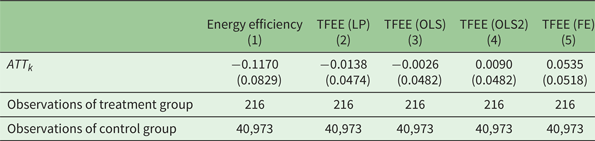
The prerequisite for the DID approach is that the firms from the treatment and control groups have common pre-trends. We follow Huang et al. (Reference Huang, He and Lin2022) and Lin and He (Reference Lin and He2023) and replace outcome variables with the change rates of energy efficiency and TFEE in the first year before OFDI ($k=-1$ ) relative to the second year before OFDI ($k=-2$
 ). These change rates can reflect the pre-trend of outcome variables (Brucal et al., Reference Brucal, Javorcik and Love2019). Then, we estimate the average treatment effect to examine the pre-trend. If these outcome variables have no significant change during these two periods, firms’ energy efficiency and TFEE have common pre-trends (Lin and He, Reference Lin and He2023). Table 5 reports the results for the pre-trend test. The estimated coefficients are not significant, which proves that the firms from the treatment and control groups have common pre-trends in energy efficiency and TFEE.
Pre-trend test

Notes: This table employs the change rates of energy efficiency and TFEE in the first year before starting to engage in OFDI relative to the second year before OFDI as outcome variables. The figures in parentheses are standard errors.
6.3 Robustness check
We perform robustness checks for the PSM-DID and report the results in online appendix G. First, this study matches the firms in the treatment and control groups using 1:1 nearest neighbor matching with replacement. We employ other proportions (1:2, 1:3 and 1:4) for robustness checks. Second, there are a large number of firms entering and exiting the industry in China. Firms’ entry and exit may affect their efficiency (Melitz, Reference Melitz2003). We employ the firms that survived at least 5 years after OFDI for the robustness check. Third, this study uses Chinese industrial firms for analysis. Manufacturing firms are more closely related to OFDI. We only employ firms from manufacturing sectors for the robustness check. Fourth, some Chinese firms have OFDI motivations of speculation and tax avoidance. We remove the firms which invest in Hong Kong, Macao and “tax havens” for the robustness check. Fifth, our data are from 2005 to 2012. The global economic crisis in 2008 occurred in this period, which affects OFDI and energy efficiency. We thus remove any observations which started to engage in OFDI in 2008 for the robustness check. All of the above results are robust.
6.4 Mechanism
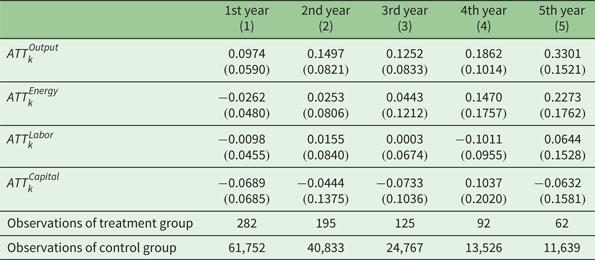
We examine the mechanisms by which OFDI affects energy efficiency and TFEE. According to Brucal et al. (Reference Brucal, Javorcik and Love2019), there are two potential mechanisms. Namely, OFDI may improve energy efficiency and TFEE by expanding output scale or reducing factor inputs. We analyze the impacts of OFDI on output value, energy consumption, labor employment and fixed assets, which are reported in table 6.
Mechanism

Notes: The figures in parentheses are standard errors.
First, OFDI may lead to increases in energy efficiency and TFEE by expanding output scale. We examine the impacts of OFDI on output value, and find that those coefficients are positive and, except for column (3), the coefficients are significant at the 5 or 10 per cent level. These results suggest that OFDI can expand firms’ output scale. The possible reason is that OFDI leads to reverse technology spillover, and this spillover can enhance productivity and thereby expand output scale (Huang and Zhang, Reference Huang and Zhang2017; Brucal et al., Reference Brucal, Javorcik and Love2019). Also, OFDI firms serve both domestic and foreign markets, which helps to expand production scale (Helpman et al., Reference Helpman, Melitz and Yeaple2004). These effects on output scale are increasing in subsequent periods, which is consistent with the results for TFEE. Thus, expanding output scale is an important mechanism by which OFDI improves energy efficiency and TFEE.
Second, OFDI probably generates higher energy efficiency and TFEE by reducing factor inputs. We examine the impacts of OFDI on energy consumption, labor employment and fixed assets. For three kinds of production factors, all estimated coefficients are not significant, suggesting that OFDI has no significant impact on energy consumption, labor employment and fixed assets. Although the coefficients are not significant for energy consumption, these coefficients in columns (2)–(5) are positive and gradually increasing. This partially offsets the effect of expanding output scale, which explains why OFDI leads to a short-term effect for improving energy efficiency. In addition, for fixed assets, the coefficients (except for column (4)) are negative but not significant, indicating that OFDI slightly reduces capital investment. After OFDI, firms pay attention to foreign subsidiaries, so they reduce capital investment in domestic firms (You and Solomon, Reference You and Solomon2015). However, this effect is weak and is not the main reason why OFDI improves TFEE. Overall, OFDI improves firms’ energy efficiency and TFEE mainly through expanding output scale rather than reducing energy consumption and other factor inputs.
6.5 Heterogeneous test
6.5.1 Other types of the energy
In the baseline result, we employ coal as the energy. Coal is the most important energy input in China, and it is more closely related to environmental damages. We employ other types of fossil energy (fuel oil and clean gas) to re-estimate the result. Compared with coal, fuel oil and clean gas are cleaner (Lin et al., Reference Lin, Huang and He2024). However, in the past, fuel oil and clean gas were not the most important types of energy being consumed in China. From 2005 to 2012, fuel oil consumption accounted for 16.4–17.8 per cent of total energy consumption. This proportion of clean gas was lower (2.4–4.8 per cent), according to data from the China Statistical Yearbook. From our dataset, the firms consuming fuel oil and clean gas are far fewer than those consuming coal. Only 11.9 per cent of the observations consume fuel oil and 7.5 per cent of the observations consume clean gas.
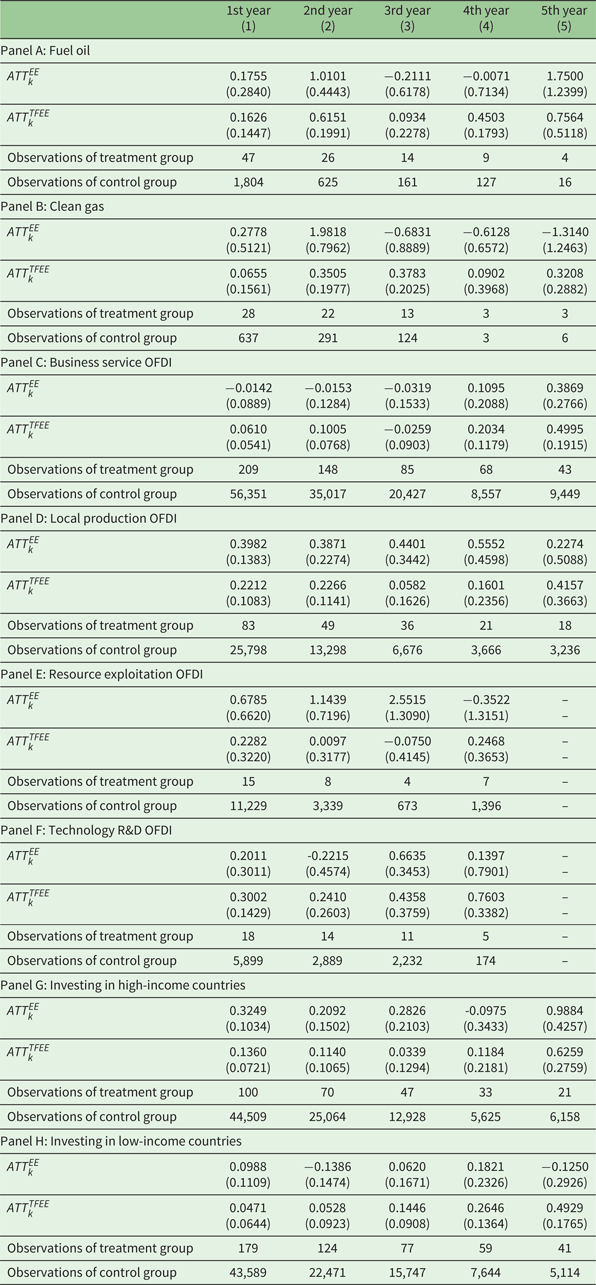
Panels A and B of table 7 report heterogeneous results according to different energy types. For fuel oil and clean gas, OFDI improves energy efficiency and TFEE, although some coefficients are not significant. In particular, firms only significantly improve energy efficiency of fuel oil and clean gas in the second year after OFDI. These results show that the impacts of OFDI on energy efficiency and TFEE are heterogeneous in term of energy types. However, when we employ fuel oil and clean gas for estimation, our observations are extremely few. We only use this estimation as a reference and use the estimation based on coal as the baseline result.
Heterogeneous test

Notes: TFEE is measured by the LP method. The figures in parentheses are standard errors.
6.5.2 Different OFDI motivations
Chinese firms’ OFDI motivations can be divided into four categories: business service, local production, resource exploitation and technology R&D. Business service OFDI is when firms invest in foreign countries to serve foreign sales. Foreign affiliates import products from the home country and sell products in the host market, which is helpful for expanding the foreign market. Local production OFDI means that firms establish foreign subsidiaries to produce in the host country, which helps to make use of local labor and other production factors. Resource exploitation OFDI is when firms invest in foreign countries with rich energy and mineral resources, and exploit resources in the host countries. Technology R&D OFDI refers to domestic firms that establish R&D centers or acquire high-tech firms in foreign countries in order to utilize advanced technology from abroad. In particular, local production and technology R&D OFDI can make use of local production factors and advanced technology in host countries, so these types of OFDI are more likely to cause reverse technology spillover (Li et al., Reference Li, Liu, Yuan and Yu2017). If local production OFDI and technology R&D OFDI are more likely to generate higher energy efficiency and TFEE, the results would indicate that OFDI improves energy efficiency and TFEE by reverse technology spillover. Given that OFDI with different motivations may cause differentiated effects, we distinguish OFDI motivations by the scope of OFDI provided by the Chinese Overseas Investment Firm List and re-estimate the result. In our dataset, the proportion of OFDI observations of business service, local production, resource exploitation and technology R&D are 73.8, 27.8, 4.0 and 6.3 per cent respectively.Footnote 5 In our research period, Chinese OFDI firms are mainly servicing foreign sales. There are only a few OFDI of resource exploitation and technology R&D.
Panels C–F in table 7 report heterogeneous results according to different OFDI motivations. First, for business service OFDI, OFDI firms have no significant change in energy efficiency. These firms only have significant improvements in TFEE in the fourth and fifth years after OFDI. The possible reason is that business service OFDI entails establishing foreign affiliates to serve foreign sales, which is difficult to cause reverse technology spillover (Li et al., Reference Li, Liu, Yuan and Yu2017). Second, for local production OFDI, OFDI generates higher energy efficiency and TFEE. This result supports our inference that local production OFDI can make use of local production factors of host countries, and it is more likely to cause reverse technology spillover (Li et al., Reference Li, Liu, Yuan and Yu2017). Third, for resource exploitation OFDI, OFDI has no significant impact on energy efficiency and TFEE (except for the impact on energy efficiency in the third year after OFDI). This result illustrates that resource exploitation OFDI mainly exploits resources in host countries, which is not conducive to causing reverse technology spillover (Li et al., Reference Li, Liu, Yuan and Yu2017). Fourth, for technology R&D OFDI, OFDI can improve both energy efficiency and TFEE of firms. The possible explanation is that this type of OFDI makes use of advanced technology in foreign countries, and leads to greater reverse technology spillover (Li et al., Reference Li, Liu, Yuan and Yu2017; Fu et al., Reference Fu, Hou and Liu2018). In summary, the above results indicate that local production and technology R&D OFDI are more conducive to improving energy efficiency and TFEE. Given that local production and technology R&D OFDI are more likely to cause reverse technology spillover (Li et al., Reference Li, Liu, Yuan and Yu2017), these results indicate that OFDI improves energy efficiency and TFEE mainly by reverse technology spillover.
6.5.3 Different OFDI destinations
In China, different OFDI firms invest in different countries (Huang and Zhang, Reference Huang and Zhang2017; Li et al., Reference Li, Liu, Yuan and Yu2017). Some OFDI firms invest in high-income countries, while others invest in low-income countries. In particular, high-income countries have more technical barriers and fierce market competition, and firms located in these countries have more advanced technology. OFDI to high-income countries is more likely to cause reverse technology spillover (Li et al., Reference Li, Liu, Yuan and Yu2017). If OFDI to high-income countries has greater effects for improving energy efficiency and TFEE, the result would indicate that OFDI generates higher energy efficiency and TFEE by reverse technology spillover. Given that OFDI with different destinations may affect energy efficiency and TFEE differently, we divide OFDI destinations into OECD and non-OECD countries and investigate the heterogeneous impacts of OFDI. OECD countries are equivalent to high-income countries, while non-OECD countries are equivalent to low-income countries. In our samples, the proportion of firms investing in OECD and non-OECD countries is 40.0 and 67.1 per cent respectively.Footnote 6 By comparison, Chinese firms invest more in low-income countries.
Panels G and H of table 7 report heterogeneous results according to different destinations. For OFDI to high-income countries, firms improve energy efficiency and TFEE after OFDI. This result suggests that high-income countries have more technical barriers and fierce market competition, and firms located in these countries have advanced technology. As a result, the investment in these countries is more conducive to generating reverse technology spillover and improving efficiency (Huang and Zhang, Reference Huang and Zhang2017). For OFDI to low-income countries, OFDI has no significant impact on energy efficiency, and it only improves TFEE in the fourth and fifth years. This result indicates that firms do not immediately change efficiency after OFDI to low-income countries. Namely, this kind of OFDI is difficult to cause reverse technology spillover (Li et al., Reference Li, Liu, Yuan and Yu2017). In summary, the above results show that OFDI to high-income countries is more conducive to improving energy efficiency and TFEE. Given that OFDI to high-income countries is more likely to cause reverse technology spillover (Li et al., Reference Li, Liu, Yuan and Yu2017), our results provide support that OFDI improves energy efficiency and TFEE by reverse technology spillover.
7 Conclusion
The relationship between international investment and the environment is a concern all around the world. This study focuses on the relationship between OFDI and energy efficiency at the firm level. First, we employ the data of Chinese industrial firms to measure energy efficiency and TFEE. Then, we empirically investigate the differences in energy efficiency between OFDI and non-OFDI firms in the same sector. The results show that, employing coal as the energy, OFDI firms have higher energy efficiency and TFEE relative to non-OFDI firms. Next, we employ the empirical method from Huang et al. (Reference Huang, He and Lin2022, Reference Huang, He and Lin2023) and Lin and He (Reference Lin and He2023), and combine PSM with the DID approach to examine the causal effect of OFDI on energy efficiency. We find that OFDI improves both energy efficiency and TFEE by reverse technology spillover and thereby expanding output scale, and the effect for improving TFEE persists in subsequent periods. The impacts of OFDI on energy consumption and other factor inputs are not significant. In addition, for other energy types as well as different OFDI motivations and destinations, the impacts of OFDI on energy efficiency are heterogeneous. Local production and technology R&D OFDI as well as OFDI to high-income countries are more conducive to improving efficiency. In general, we initially provide micro evidence for the relationship between OFDI and energy performance.
Moreover, energy inefficiency and environmental damages caused by this inefficiency are increasingly prominent in developing countries. As the largest developing country, China is experiencing a rapid growth in OFDI. In this context, our finding provides important implications for foreign investment and improving energy efficiency in developing countries. First, under the guidance of national policies, more and more firms in developing countries (especially in China) are beginning to engage in OFDI. Foreign investment has a profound impact on the environment of different countries. OFDI firms have higher energy efficiency and TFEE relative to non-OFDI firms in the same sector and, after OFDI, firms further improve energy efficiency and TFEE by the reverse technology spillover. Therefore, for developing countries, it is important to promote OFDI. Specifically, governments need to guide capable firms to invest in foreign countries and make use of reverse technology spillover to improve energy performance.
Second, when promoting OFDI, the governments in developing countries should fully consider the differences among different types of firms, including the types of energy inputs as well as OFDI motivations and destinations. From the perspective of improving energy efficiency, governments should focus on the OFDI types which cause reverse technology spillover and thereby improve energy performance. Local production OFDI, technology R&D OFDI and OFDI to high-income countries are conducive to improving energy efficiency and TFEE. To achieve energy efficiency improvement, it is necessary to encourage the OFDI with the motivations of local production and technology R&D as well as OFDI to high-income countries.
Supplementary material
The supplementary material for this article can be found at https://doi.org/10.1017/S1355770X24000275
Acknowledgements
This project is supported by the National Major Project of the National Social Science Foundation of China (Grant No. 20&ZD109), the National Natural Science Foundation of China (Grant No. 72403062) and the Guangdong Basic and Applied Basic Research Foundation (Grant No. 2023A1515110218).
Competing interests
The authors declare none.