Introduction
Negative affect (e.g., depression) is associated with accelerated age-related cognitive decline and heightened dementia risk (Ownby, Crocco, Acevedo, John, & Loewenstein, Reference Ownby, Crocco, Acevedo, John and Loewenstein2006; Royall, Palmer, Chiodo, & Polk, Reference Royall, Palmer, Chiodo and Polk2012). Fewer studies have examined the role of positive psychosocial factors in cognitive aging. Positive psychosocial factors include eudaimonic and hedonic well-being, social support, and self-efficacy. While these factors are often related to negative affect, they represent independent aspects of an individual’s psychosocial experience (Diener, Reference Diener2000; Watson & Tellegen, Reference Watson and Tellegen1985). For example, both depression and self-rated life satisfaction independently predict mortality in older adults (Collins, Glei, & Goldman, Reference Collins, Glei and Goldman2009). Similarly, positive affect is observed to decline among older adults in the absence of a corresponding increase in negative affect (Charles, Reynolds, & Gatz, Reference Charles, Reynolds and Gatz2001). In fact, negative affect also declines with age (Charles et al., Reference Charles, Reynolds and Gatz2001; Costa et al., Reference Costa, Zonderman, McCrae, Cornoni-Huntley, Locke and Barbano1987; Rossi & Rossi, Reference Rossi and Rossi1990).
Preliminary reports suggest that certain positive psychosocial variables are associated with better cognitive performance among older adults, independent of negative affect. For example, positive affect was related to better performance on a composite of verbal fluency, perceptual speed, and verbal knowledge (Lang & Heckhausen, Reference Lang and Heckhausen2001). Perceived control (i.e., self efficacy) was related to better memory, speed, and verbal intelligence (Windsor & Anstey, Reference Windsor and Anstey2008). Even more compelling is longitudinal evidence for associations between positive psychosocial variables and cognitive aging. For example, baseline positive affect independently predicted risk of cognitive decline in the Victoria Longitudinal Study (Dolcos, MacDonald, Braslavsky, Camicioli, & Dixon, Reference Dolcos, MacDonald, Braslavsky, Camicioli and Dixon2012). Similarly, greater well-being and social participation predicted less subsequent decline in perceptual speed, but not vice versa, in the Berlin Aging Study (Gerstorf, Lövdén, Röcke, Smith, & Lindenberger, Reference Gerstorf, Lövdén, Rӧcke, Smith and Lindenberger2007; Lӧvdén, Ghisletta, & Lindenberger, Reference Lӧvdén, Ghisletta and Lindenberger2005). Finally, both social support and self-efficacy beliefs at baseline predicted better subsequent cognitive performance among participants in the MacArthur Studies of Successful Aging (Seeman, McAvay, Merrill, Albert, & Rodin, Reference Seeman, McAvay, Merrill, Albert and Rodin1996; Seeman, Lusignolo, Albert, & Berkman, Reference Seeman, Lusignolo, Albert and Berkman2001).
Together, these studies suggest that positive psychosocial factors may represent independent modifiers of cognitive risk in late life. Because previous studies typically examined only one or two of these positive psychosocial variables, it is unclear which are most strongly related to cognition. Furthermore, most previous research has focused on a single cognitive domain, or only on global cognitive status. Therefore, which specific cognitive domains are most strongly related to different positive psychosocial variables is unknown. Awareness of these relationships will inform our understanding of the manifold contributors to late-life cognitive decline.
The present study sought to address both of these lingering issues using normative data that was collected for the NIH Toolbox, a standardized set of Web-based neurobehavioral measures. The first aim was to statistically verify the conceptual separation of negative affect and positive psychosocial factors in the NIH Toolbox Emotion module using confirmatory factor analysis. We hypothesized that a two-factor model of negative affect and positive psychosocial factors would fit significantly better than a one-factor model in which all variables were forced to load on a single factor. The second aim was to characterize the pattern of independent associations between positive psychosocial variables and cognitive domains using structural equation modeling. Based on previous research summarized above, we hypothesized that well-being, social support, and self-efficacy would each be associated with better cognition.
Methods
Participants and Procedures
The 482 individuals in this sample were participants in the NIH Toolbox norming study (Beaumont et al., Reference Beaumont, Havlik, Cook, Hays, Wallner-Allen and Gershon2013). In brief, study participants were randomly selected from existing databases maintained by several market research companies following a sampling strategy defined by age, sex, and primary language (English or Spanish). Inclusion criteria for the NIH Toolbox norming study were: (1) community-dwelling and non-institutionalized; (2) ages 3–85 years; (3) capable of following test instructions (English or Spanish); and (4) able to give informed consent. It should be noted that participants were not excluded for the presence of an Axis I disorder or cognitive impairment.
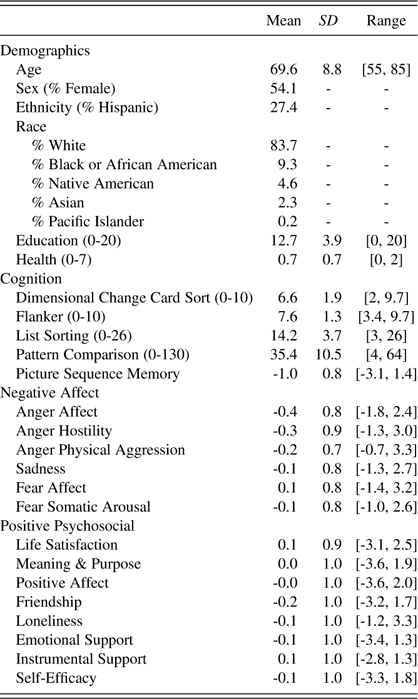
Participants in the NIH Toolbox norming study travelled to a research site to participate in the study and were supervised by a trained administrator. Of the 487 individuals over age 55 with available data on Emotion and Cognition modules at the time of the current study, 5 were excluded for the self-reported presence of a neurological condition (dementia, seizures, multiple sclerosis, or stroke/TIA). This study complied with the ethical rules for human experimentation that are stated in the Declaration of Helsinki, including approval of the local institutional review boards and informed consent. Characteristics of this community-dwelling, older adult sample are shown in Table 1.
Characteristics of the sample

Note. Picture Sequence Memory, negative affect, and positive psychosocial variables reflect Item Response Theory-based theta scores, similar to z-scores, derived from the entire NIH Toolbox adult normative sample (ages 18-85). Possible ranges for other cognitive tests and covariates are provided next to the variable name. None of the scores in this table are age-corrected.
Primary Measures
Negative affect, positive psychosocial variables, and cognition were assessed with the NIH Toolbox. The NIH Toolbox for the Assessment of Neurological and Behavioral Function (www.nihtoolbox.org) is a standardized set of Web-based measures developed through a contract initiated by the NIH Blueprint for Neuroscience Research (Gershon et al., Reference Gershon, Wagster, Hendrie, Fox, Cook and Nowinski2013). It contains four modules: Motor, Sensation, Cognition, and Emotion. Emotion and Cognition modules were the focus of the present study.
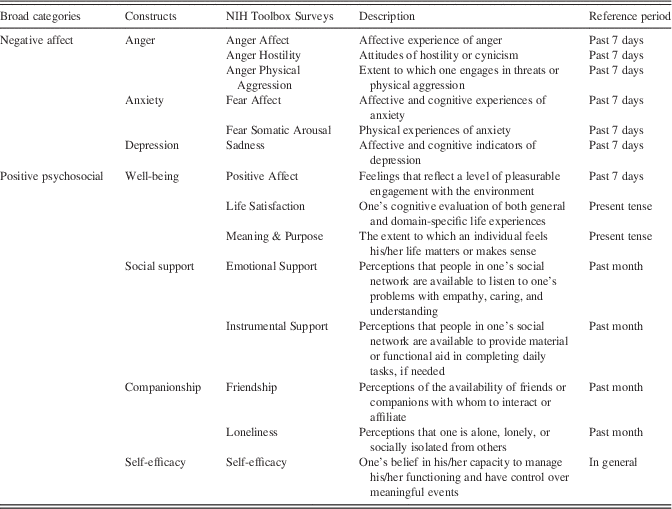
Table 2 summarizes measures from the Emotion module used in the present study. As shown, the NIH Toolbox surveys of anger, anxiety, depression, and positive affect query a period of 7 days, suggesting that these measures target more chronic, rather than acute, emotional states. The NIH Toolbox surveys comprise Likert-type items presented using computerized adaptive testing based on item response theory (Salsman et al., Reference Salsman, Butt, Pilkonis, Cyranowski, Zill and Cella2013). These items are completed by the participant, under the supervision of a trained administrator. This module takes approximately 12–20 min to complete for ages 18–85. Reliability (Cronbach α) for surveys included in the present study has been reported to range from 0.83 (Anger Physical Aggression) to 0.97 (Sadness and Emotional Support), and convergent validity (absolute values of associations with gold-standard measures) ranges from 0.61 (Anger Affect) to 0.92 (Positive Affect) in adults (Salsman et al., Reference Salsman, Butt, Pilkonis, Cyranowski, Zill and Cella2013).
Study measures from the NIH Toolbox Emotion module
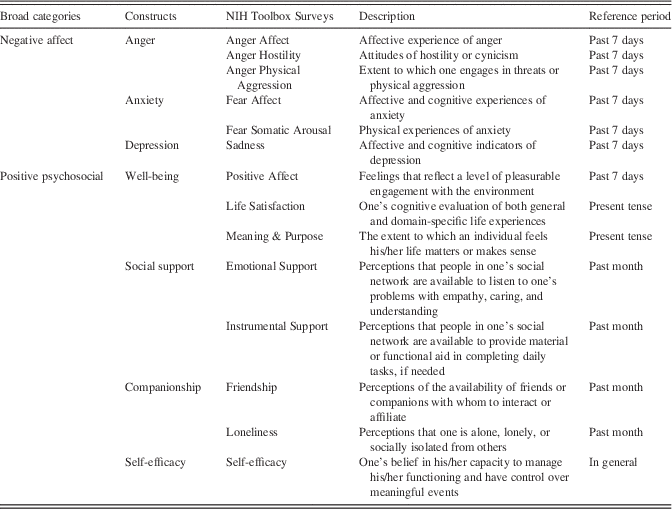
Note. Used with permission © 2012 The National Institutes of Health and Northwestern University.
The Cognition module comprises computerized tests of executive function, working memory, processing speed, episodic memory, vocabulary and reading, and it takes approximately 30 min to complete (Weintraub et al., Reference Weintraub, Dikmen, Heaton, Tulsky, Zelazo and Gershon2013). The present study analyzed data from tests of executive functioning (Flanker Inhibitory Control & Attention, Dimensional Change Card Sort), working memory (List Sorting), processing speed (Pattern Comparison), and episodic memory (Picture Sequence Memory) due to the known sensitivity of these cognitive domains to age-related cognitive differences (e.g., Salthouse, Reference Salthouse2010). Specific details of the NIH Toolbox Cognition module, including evaluation of its psychometric properties, are available elsewhere (Weintraub et al., Reference Weintraub, Dikmen, Heaton, Tulsky, Zelazo and Gershon2013). In brief, test–retest reliability of each instrument is good, with intraclass correlation coefficients ranging from 0.72 (Pattern Comparison) to 0.94 (Flanker) in adults. Convergent validity for each instrument was demonstrated through significant, moderately-sized correlations with gold-standard measures, ranging from 0.48 (Flanker) to 0.69 (Picture Sequence Memory).
Trained research personnel administered the cognitive measures using a dual-monitor set-up. The Flanker test requires participants to indicate the direction of a central arrow that is flanked by arrows pointing in the same or different direction. The Dimensional Change Card Sort test (DCCS) requires participants to alternately choose which of two pictures matches a central picture based on shape or color. The Pattern Comparison test requires participants to indicate whether as many pairs of pictures are the same or different in 90 s. The Picture Sequence Memory test requires participants to view a series of related scenes presented in an arbitrary order, and then to reproduce this order.
Covariates
The structural equation model controlled for education, negative affect, and illness burden. Years of education was measured via self report. Negative affect was modeled as a latent variable with six indicators from the NIH Toolbox Emotion module: Sadness, Fear Affect, Fear Somatic Arousal, Anger Affect, Anger Hostility, and Anger Physical Aggression. To index overall illness burden, one point was assigned for the self-reported presence of each of the following conditions: hypertension, peripheral vascular disease, other heart problem, diabetes, thyroid problems, joint problems, and breathing problems. These points were summed to create an index of illness burden with a minimum value of 0 and a maximum value of 7.
Statistical Analysis
Descriptive statistics were computed using SPSS version 19 (IBM Corp., Armonk, NY). Bivariate associations between the variables of interest were computed using product-moment correlation coefficients (Pearson’s r). Confirmatory Factor Analysis (CFA) and Structural Equation Modeling (SEM) were conducted in Mplus version 7.11 (Muthén & Muthén, Los Angeles, CA) using maximum likelihood estimation.
A CFA tested the a priori hypothesis that negative affect and positive psychosocial variables are conceptually distinct. Changes in fit between one- and two-factor models were evaluated statistically with the chi square test.
A SEM tested for relationships between the positive psychosocial and cognitive variables, independent of negative affect. In the SEM, five observed cognitive variables were regressed on the eight observed positive psychosocial factors and three covariates (i.e., latent negative affect, observed health, and observed education) in a single model. Importantly, regression estimates in this model represent independent effects, controlling for all other structural relations in the model and covariates. Correlations were allowed among cognitive variables, among positive psychosocial variables, among covariates, and between positive psychosocial variables and covariates. Given the large number of parameters estimated by the model, a false discovery rate of 0.05 was used to control for multiple comparisons (Benjamini & Hochberg, Reference Benjamini and Hochberg1995). This approach is more appropriate in SEM than controlling family-wise error rate for multiple, independent comparisons (e.g., Bonferroni correction) because the parameters in SEM are not independent. The model’s correlation matrix was examined to identify potential issues of multicollinearity, which can lead to Type II errors in SEM when above 0.6 (Grewal, Cote, & Baumgartner, Reference Grewal, Cote and Baumgartner2004). If a potential issue of multicollinearity was identified, parameter estimates were interrogated using univariate regression. Model fit was evaluated with the following commonly-used criteria: RMSEA<0.08; SRMR<0.05; CFI>0.95.
A path analysis tested for relationships between all psychosocial variables (both positive and negative) and cognition. This analysis explored the possibility that associations between individual indicators of negative affect and cognition were being obscured by their inclusion only as a latent factor in the SEM. The difference between this path analysis and the SEM described above is that the indicators of negative affect were modeled as separate, observed variables rather than a latent factor. In the path analysis, the five observed cognitive variables were regressed on the eight positive psychosocial variables, the six negative affect variables, and two observed covariates (i.e., health and education). Importantly, regression estimates in this model represent independent effects, controlling for all other structural relations in the model and covariates. Correlations were allowed among cognitive variables, among and between positive psychosocial and negative affect variables, and among and between the covariates and the positive psychosocial and negative affect variables. Procedures for managing multiple comparisons and multicollinearity were identical to those used for the SEM described above. By definition, the fit of this path analysis model was perfect.
Results
Separating Negative Affect and Positive Psychosocial Factors
A CFA modeled negative and positive variables as separate latent factors. Specifically, a two-factor CFA was run in which scores purported to measure negative affect were forced to load exclusively onto one factor, and scores purported to measure positive psychosocial variables were forced to load exclusively onto a separate factor. All residual variances were freely estimated and independent in this initial model. Model fit was marginal (RMSEA=0.10; SRMR=0.06; CFI = 0.89). A subsequent model was run in which residual variances were allowed to correlate within lowest-order subdomains, as defined by the NIH Toolbox manual. Specifically, residual correlations were allowed among anger scores (Anger Affect, Anger Hostility, Anger Physical Aggression), fear scores (Fear Affect, Fear Somatic Arousal), social support scores (Emotional Support, Instrumental Support), companionship scores (Friendship, Loneliness), and well-being scores (Positive Affect, Life Satisfaction, Meaning and Purpose). This slightly modified model fit well (RMSEA=0.07; SRMR=0.04; CFI = 0.95).
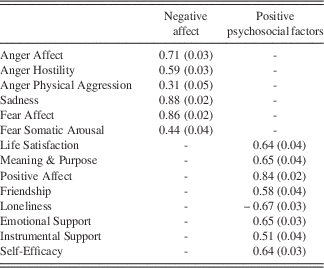
In the slightly modified model, factors corresponding to negative affect and positive psychosocial factors were negatively correlated (r=-0.75; p <.001). Standardized factor loadings are shown in Table 3. As shown, all indicators loaded onto their hypothesized factor with an absolute value above 0.4, with the exception of Anger Physical Aggression, which exhibited a standardized loading onto the negative affect factor of 0.31. Sadness exhibited the largest standardized loading onto the negative affect factor (0.88), followed by Fear Affect (0.86). With regard to positive psychosocial factors, Positive Affect exhibited the largest standardized loading (0.84), and Instrumental Support exhibited the smallest standardized loading (0.51).
Standardized factor loadings in the final confirmatory factor analysis model
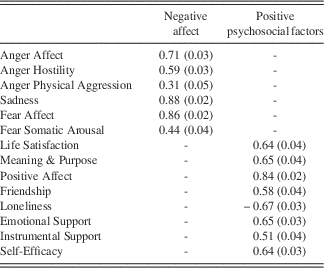
This final, two-factor model fit significantly better than a one-factor model in which all variables were forced to load onto a single factor, and residual variances were allowed to correlate within lowest-order subdomains as described above (Δχ2(1)=-235.83; p<.001).
Associations between Positive Psychosocial Variables and Cognition
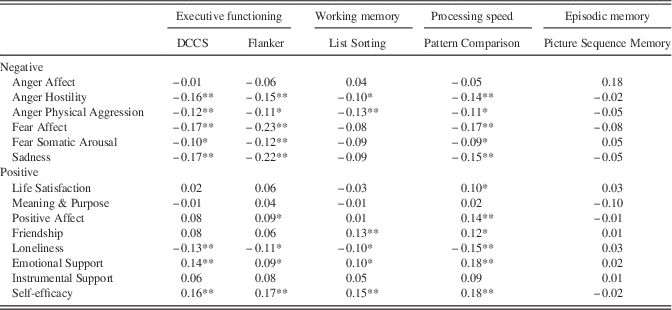
A SEM, in which negative affect variables were modeled as a single latent factor and positive psychosocial variables were modeled as separate observed variables, tested for relations between the cognitive variables and the positive psychosocial variables. The negative affect factor from the best-fitting CFA described above was retained as a covariate in the SEM. Because a primary aim of this study was to determine which positive psychosocial variable(s) best predicted performance within different cognitive domains, positive psychosocial and cognitive variables were included as separate observed variables, rather than single latent factors. For reference, unadjusted bivariate associations between the variables of interest are provided in Table 4.
Bivariate correlations between cognitive and psychosocial variables
* p<.05; ** p<.01.
A single model estimating associations between the positive psychosocial variables, cognitive variables, and covariates (i.e., negative affect, health, education) fit very well (RMSEA=0.04; SRMR=0.03; CFI=0.97). Examination of the resultant correlation matrix identified multicollinearity issues (i.e., correlations above 0.6) involving only the variables Meaning & Purpose and Life Satisfaction. Specifically, these variables were highly correlated with each other (r=.71; p<.001) and with Positive Affect (Meaning & Purpose r=.64; p<.001; Life Satisfaction r=.68; p<.001).
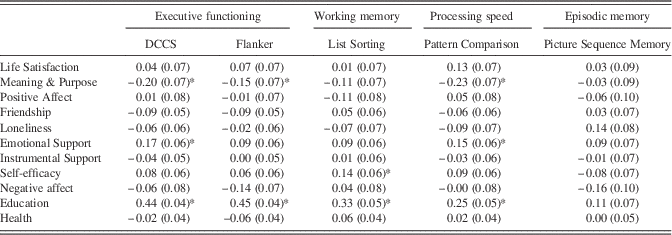
Table 5 presents standardized regression path estimates involving the five cognitive variables of interest, estimated simultaneously in a single model. Significant associations maintained their significance after correction for a false discovery rate of 0.05. As shown, greater emotional support was independently associated with better performance on DCCS and Pattern Comparison. Greater self-efficacy was independently associated with better performance on List Sorting. Greater meaning and purpose was associated with lower performance on DCCS, Flanker, and Pattern Comparison. Given the multicollinearity issues involving the Meaning & Purpose variable described above, these associations were interrogated with follow-up univariate regression. In these follow-up analyses, Meaning & Purpose was not associated with DCCS (B=-0.02; SE=0.08; p=.78), Flanker (B=0.06; SE=0.08; p=.42) or Pattern Comparison (B=0.03; SE=0.08; p=.68), suggesting that the significance of those parameter estimates in the SEM reflected type II error due to multicollinearity.
Standardized regression path estimates in the structural equation model
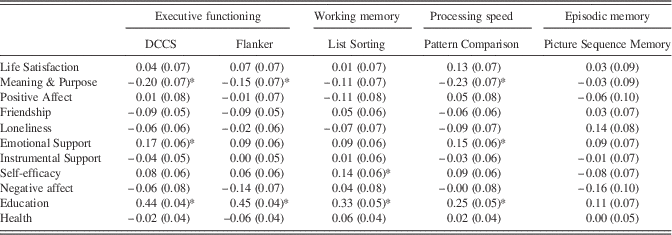
*Significant after adjustment for multiple comparisons using the false discovery rate procedure.
With regard to covariate effects, education was positively associated with all cognitive variables except Picture Sequence Memory. Neither health nor negative affect was uniquely associated with any cognitive variables. Negative affect was negatively correlated with education and all positive psychosocial variables except Loneliness, with which it was positively correlated. Education was positively correlated with Friendship and Self-Efficacy and negatively correlated with Loneliness. Health was not significantly correlated with any positive psychosocial variables.
To determine whether results would differ if individuals suspected of having cognitive impairment were excluded from the sample, we re-ran the above-described SEM excluding the 29 individuals who scored more than two standard deviations below the age-corrected mean on the Flanker test, which exhibited virtually no missing data. The pattern of significant results was unchanged at p<.05. To determine whether results would differ if a more commonly used definition of “older adults” had been used, we re-ran the above-described SEM including only the 309 individuals aged 65 or older. The pattern of significant results was unchanged at p <.05.
Associations between All Psychosocial Variables and Cognition
A path analysis, in which all negative affect and positive psychosocial variables were modeled as separate observed variables, tested for relations between these variables and cognition. After controlling for multiple comparisons using the false discovery rate method, the results of this model were similar. Specifically, higher emotional support was independently associated with higher scores on DCCS (β=.17; p=.003) and Pattern Comparison (β=.15; p=.015), and higher self-efficacy was independently associated with higher scores on List Sorting (β=.13; p=.028). In addition, higher scores on Fear Affect were independently associated with worse performance on Flanker Inhibitory Control & Attention (β=-.17; p=.017). There were no other significant associations between the cognitive variables and indicators of negative affect. The pattern of results did not change when cognitively impaired participants (as defined by Flanker task performance) were excluded or when analyses were limited to only those 65 or older.
Discussion
This study supports the conceptual distinctness of negative affect and positive psychosocial factors in older adults. In this sample, the negative affect factor was best indicated by sadness and least indicated by anger/physical aggression. The positive psychosocial factor was best indicated by positive affect and least indicated by instrumental support. Results also showed that positive psychosocial indicators of emotional support and self-efficacy were positively associated with cognitive performance independent of other psychosocial variables, education, and general health status. Specifically, greater emotional support was associated with better executive functioning (i.e., task switching) and processing speed, while greater self-efficacy was associated with better working memory. With regard to negative affect, only psychic anxiety was independently associated with cognitive performance.
This study confirms prior work demonstrating positive associations between social support and self-efficacy and cognition (Windsor & Anstey, Reference Windsor and Anstey2008; Seeman et al., Reference Seeman, McAvay, Merrill, Albert and Rodin1996, Reference Seeman, Lusignolo, Albert and Berkman2001). It extends this prior work by showing that these associations were independent of other positive psychosocial variables and relevant covariates. In addition, this study demonstrated that associations between psychosocial factors and cognition may be unique to specific cognitive domains of task switching, processing speed and/or working memory, as opposed to episodic memory or inhibition. While the associations identified in the present study were purely cross-sectional, results could reflect a positive influence of emotional support and self-efficacy on cognitive performance. Alternatively, specific cognitive abilities may facilitate the creation and use of emotional supports and self-efficacy strategies, or merely enhance the perception of emotional support and self-efficacy beliefs.
Emotional support may contribute to cognitive reserve (Stern, Reference Stern2012). For example, only 10 min of social interaction has been shown to facilitate cognitive performance in an experimental setting (Ybarra et al., 2008). Furthermore, situational emotional support was found to increase activity in the left lateral/medial prefrontal cortices and temporal regions, which in turn reduced maladaptive affective responses (Onoda et al., Reference Onoda, Okamoto, Nakashima, Nittono, Ura and Yamawaki2009). Of interest, multiple studies have shown the left lateral/medial prefrontal cortex to also underlie task-switching, one of the cognitive domains found to relate to emotional support in the present study (Bunge, Kahn, Wallis, Miller, & Wagner, Reference Bunge, Kahn, Wallis, Miller and Wagner2003; Rushworth, Hadland, Paus, & Sipila, Reference Rushworth, Hadland, Paus and Sipila2002; Shi, Zhou, Muller, & Schubert, Reference Shi, Zhou, Muller and Schubert2011). That social support may confer resilience against cognitive impairment is supported by data from the Rush Memory and Aging project showing that social network size modified the association between Alzheimer’s disease pathology and cognitive function among 89 older adults without dementia, independent of depressive symptoms, activity participation, and chronic diseases (Bennett, Schneider, Tanag, Arnold, & Wilson, Reference Bennett, Schneider, Tang, Arnold and Wilson2006).
Self-efficacy may also contribute to cognitive reserve. According to Bandura’s self-efficacy theory for research on cognitive aging, self-beliefs of efficacy can enhance performance via cognitive, affective, or motivational processes (Bandura, Reference Bandura1989). For example, stronger beliefs in one’s abilities may have improved motivation and attention during the working memory task of the present study. Indeed, greater self-efficacy beliefs have been shown to predict cognitive improvement following a training program (Carretti, Borella, Zavagnin, & De Beni, Reference Carretti, Borella, Zavagnin and De Beni2011). Thus, self-efficacy may be associated not only with better cognitive performance in the moment, but also increased motivation to learn strategies that could result in further improvements in performance.
Alternatively, the cross-sectional associations identified in the current study may reflect deleterious effects of lower cognitive abilities on certain positive psychosocial factors. For example, older adults with poorer executive functioning and processing speed may be more likely to withdraw from social interactions, resulting in reduced opportunities to create emotional bonds. Declining cognition has been associated with reduced subsequent leisure activity participation, but also vice versa (Small, Dixon, McArdle, & Grimm, Reference Small, Dixon, McArdle and Grimm2012). With regard to self-efficacy, poorer working memory performance may reduce one’s experience of success, thereby reducing the perception of control over one’s environment. Conversely, better working memory may enhance the quantity and/or quality of social interactions and increase the perception that one has control over one’s environment. While possible given the present results, these explanations seem less likely given substantial longitudinal evidence that social participation/support and self-efficacy precede cognitive changes in late life (Lövdén et al, Reference Lӧvdén, Ghisletta and Lindenberger2005; Seeman et al., Reference Seeman, McAvay, Merrill, Albert and Rodin1996, Reference Seeman, Lusignolo, Albert and Berkman2001).
Within the domain of social support, results indicated that emotional support, as opposed to instrumental support or companionship, is most related to cognition. These findings mirror those reported for physical functioning, which was similarly found to relate directly to emotional but not instrumental support in the MacArthur Studies of Successful Aging (Seeman et al., Reference Seeman, Berkman, Charpentier, Blazer, Albert and Tinetti1995). Similarly, Glymour, Weuve, Fay, Glass, and Berkman (Reference Glymour, Weuve, Fay, Glass and Berkman2008) reported that emotional support, but not social ties or instrumental support, predicted 6-month cognitive improvement following stroke in the Families in Recovery from Stroke Trial. Thus, emotional support, but not instrumental support or mere social network size, may provide benefit to cognitive functioning.
In the current study, psychic anxiety (i.e., cognitive and affective aspects of anxiety, as opposed to somatic aspects) was the only negative affect variable that was independently associated with cognitive performance. This association was limited to a test of inhibition and attention. This result is in line with previous studies showing a link between greater anxiety and worse attention (Hogan, Reference Hogan2003) and executive functioning (Yochim, Mueller, & Segal, Reference Yochim, Mueller and Segal2013) among older adults. The relationship between anxiety and cognitive difficulties in older adults appears to be bi-directional. Specifically, reduced inhibitory abilities may reduce older adults’ ability to suppress anxious thoughts and feelings. The perception of cognitive decline may also increase anxiety (Seignourel, Kunik, Snow, Wilson, & Stanley, Reference Seignourel, Kunik, Snow, Wilson and Stanley2008). Conversely, anxiety has been shown to increase subsequent cognitive impairments (Sinoff & Werner, Reference Sinoff and Werner2003), perhaps because the high cognitive load associated with the subjective experience of anxiety reduces available cognitive resources.
While depressive symptoms were associated with worse executive functioning and processing speed in bivariate analyses, these relationships were no longer significant in a larger model that considered all other positive and negative psychosocial factors. While a large number of studies report an association between depressive symptoms and cognitive performance among older adults (e.g., Zakzanis, Leach, & Kaplan, 1998; McDermott & Ebmeier, 2009; Rock, Roiser, Riedel, & Blackwell, Reference Rock, Roiser, Riedel and Blackwell2013), very few of these studies simultaneously examined other, related psychosocial variables. The current findings are consistent with other studies that have examined multiple psychosocial variables in a single model. For example, anxiety, but not depression, was associated with cognitive impairment in a sample of homebound older adults (Petkus, Gum, & Wetherell, Reference Petkus, Gum and Wetherell2013). Furthermore, positive affect, but not negative affect, was independently associated with a composite score reflecting verbal fluency, verbal knowledge, and perceptual speed in a sample of 160 older adults (Lang & Heckhausen, Reference Lang and Heckhausen2001). In the current study, other variables in the model that were related to depressive symptoms (e.g., anxiety, emotional support, self-efficacy) were stronger predictors of cognition than depressive symptoms.
This pattern of results provides support for positive psychosocial factors as potential modifiers of cognitive aging that are distinct from negative affect, but longitudinal studies are needed to confirm this possibility. A limitation of this study was the lack of objective measures of health and dementia status. However, omission of the poorest-performing participants did not alter the pattern of relationships between the psychosocial factors and cognitive domains. The novelty and significance of this study lies in its comprehensive evaluation of multiple psychosocial factors (both positive and negative) and multiple cognitive domains in a single model, in which all estimated structural relations controlled for all other variables in the model. This unique and rigorous approach allowed for the conclusion that emotional support and self-efficacy are more influential in cognitive aging than other psychosocial factors (e.g., well-being, instrumental support, depressive symptoms), above and beyond education and health status. In addition, certain cognitive domains (i.e., task switching, processing speed, working memory) appeared to be more sensitive to positive psychosocial factors than others (i.e., episodic memory, inhibition).
Acknowledgments
This work was supported by Federal funds from the Blueprint for Neuroscience Research, National Institutes of Health, under Contract No. HHS-N-260-2006-00007-C and by the National Institute on Aging (grant number T32 AG000261). The authors report no conflicts of interest.