Significant outcomes
∙ People with stroke were the most disabled, with 62.9% having moderate or severe disability. Levels of moderate or severe disability were 41.2% in people with dementia and 50.0% in people with Parkinson’s disease (PD).
∙ Although stroke cases were generally more disabled than people with dementia and PD, the relatively high prevalence of dementia means that, at a population level, disability rates are as high as for other conditions such as PD and stroke.
∙ Innovative, community-based strategies to reduce this burden should be investigated.
Limitations
∙ Although our findings are limited by the relatively small numbers involved, they support similar findings from other world regions and suggest that dementia, and dementia-related disability, is a major health concern in low- and middle-income countries as well as high income countries.
∙ The two-phase design of the dementia prevalence study did not allow direct comparison of disability levels between people with dementia, stroke and PD. As a consequence our results regarding disability in those with dementia are based on extrapolation.
Introduction
There are few data on the prevalence of disability and its association with chronic disease in sub-Saharan Africa (SSA), particularly among the elderly (Reference Sousa, Ferri and Acosta1). This is despite the correlation between greater levels of disability, increasing age and increasing poverty. Disability levels are strongly associated with the ability to work, and in societies where little formal provision is made for retirement, the elderly are a substantial part of the workforce (Reference Payne, Mkandawire and Kohler2). The burden of disability on carers can be substantial. It can be disruptive to family life, with loss of income for the person with disability, and their carers, and increased psychosocial strain (Reference Dotchin, Paddick and Longdon3). In 2006, the United Nations highlighted the global importance of recognising and treating disability (Reference Mont4). The availability of high quality, internationally comparable and up-to-date data on disability is integral for the planning, implementation, monitoring and evaluation of inclusive healthcare policies.
Non-communicable diseases (NCDs) are becoming an increasing burden on health services in SSA (Reference Dalal, Beunza and Volmink5–Reference Phaswana-Mafuya, Peltzer and Chirinda6). Yet health services in SSA are ill-equipped to deal with this increased burden, with few clinicians trained to identify NCDs in the community or in specialities such as neurology and geriatric medicine (Reference Dotchin, Akinyemi, Gray and Walker7–Reference Bower and Zenebe8). In rural Tanzania, people with Parkinson’s disease (PD) and dementia are largely undiagnosed and untreated (Reference Longdon, Paddick and Kisoli9–Reference Dotchin, Msuya and Kissima10). Furthermore, most stroke cases do not attend hospital (Reference Walker, Whiting and Unwin11), resulting in high early case-fatality and long-term disability in survivors (Reference Howitt, Jones and Jusabani12–Reference Walker, Jusabani and Aris13).
We have recently reported on levels of disability in basic activities of daily living (ADLs) in a cohort of community-dwelling elderly people living in Tanzania (Reference Dewhurst, Dewhurst and Gray14). Here we report on the disability levels associated with individual chronic neurological, NCDs within this population. We were specifically interested in comparing disability levels in people with stroke, PD and dementia. We chose these conditions because they are relatively common neurological conditions and have recently been the subject of prevalence studies in Hai district (Reference Longdon, Paddick and Kisoli9,Reference Dewhurst, Dewhurst and Gray14).
Methods
Setting and subjects
Ethical approval for the study was obtained locally from Tumaini University ethics committee and nationally from the Tanzanian National Institute of Medical Research. This community-based study was conducted in a population living within a demographic surveillance site (DSS) in Hai district, northern Tanzania. The DSS was established in the 1990s as part of the Adult Morbidity and Mortality Project and is one of the longest established and best described DSSs in SSA (15). The site had a census population of 161 119 in June 2009, of whom 8869 were aged 70 years or over. The DSS covers 52 widely spread villages and is almost exclusively rural, with most adults working as subsistence farmers. Most elderly people continue to work on the farm until they are unable and few people are able to make financial provision for retirement.
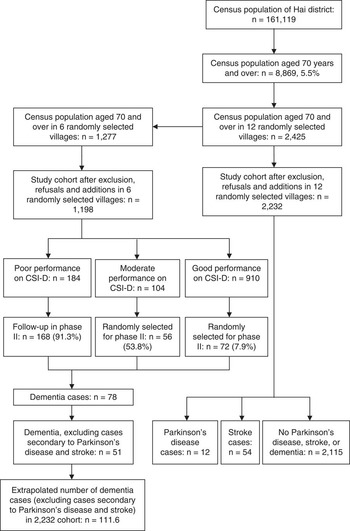
The data presented here were collected as part of two concurrent prevalence studies conducted in the Hai district DSS, one focusing on neurological disorders in 12 randomly selected villages and the other on dementia in six randomly selected villages from within the 12. Both studies assessed people aged 70 years and over living in the villages. The method of case ascertainment and numbers of people identified and assessed is summarised graphically in Fig. 1. Data were collected between 1 November 2009 and 30 September 2010. All assessments were conducted in peoples’ homes or a local meeting place (e.g. village hall or health facility), if more convenient for the participant. Assessments were carried out by a UK-based doctor employed by the study (F.D., S-M.P., A.L. or M.D.), assisted by a Tanzanian nurse (G.O. or A.K.) who also acted as translator.
Case ascertainment methods.

The demographic characteristics of the randomly selected villages were broadly similar to those of the entire DSS. Of the background population of those aged 70 years and above (n=8869), 4844 (54.6%) were females and 5690 (64.2%) were aged 70–79 years. In the 12 villages, 1256 (56.3%) were female and 1502 (67.3%) were aged 70–79 years. In the sub-set of six villages, 673 (56.2%) were females and 799 (66.7%) were aged 70–79 years.
Assessment and diagnosis for stroke and PD
Data on those who had had a previous stroke or who had PD were collected as part of the neurological disorders prevalence study (Reference Dewhurst, Dewhurst and Gray14). The study assessed all people aged 70 years and over living in the 12 villages, giving a study population of 2232 (25.1% of all people aged 70 years and over living in the DSS). The prevalence of stroke and PD was 24.2 per 1000 (95% CI 17.8–30.6) and 5.4 per 1000 (95% CI 2.3–8.4), respectively. Stroke was diagnosed according to the Bamford classification (Reference Bamford, Sandercock, Dennis, Burn and Warlow16). PD was diagnosed according to the UK PD Society Brain Bank criteria (Reference Hughes, Daniel, Kilford and Lees17).
Assessment and diagnosis of dementia
Dementia prevalence was studied in six villages randomly selected from the 12 villages in the neurological disorders study, giving a study population of 1198 people aged 70 years and over (Reference Longdon, Paddick and Kisoli9). Dementia was diagnosed according to the Diagnostic and Statistical Manual of Mental Disorders, fourth edition criteria (18). The dementia study had a two-phase design, with a stratified sample of 296 of the 1198 screened in phase I, fully assessed for dementia by a doctor in phase II. The two-phase design of the dementia prevalence study is in line with most other dementia prevalence studies in SSA conducted to date. Stratification was based on performance on cognitive screening (using the Community Screening Instrument for Dementia (CSI-D)) in phase I. We aimed to assess 100% of those with poor performance, 50% of those with moderate performance and 5% of those with good performance identified during the screening process. Seventy-eight cases of dementia were identified. After adjusting for the effects of stratification, the crude prevalence was 74.5 per 1000 (95% CI 60.1–89.7).
Background population
Data on disability rates in all 2232 people aged 70 years and over assessed as part of the neurological disorders prevalence study have already been published and are used here as a comparison group. Data for those with PD, stroke and dementia were removed to avoid double counting.
Assessment of disability
As part of both of these studies, data were collected regarding disability in basic ADLs, as measured by the Barthel Index (Reference Mahoney and Barthel19). It has been assessed for validity and reliability in a wide range of populations and is used extensively to evaluate post-stroke function (Reference Duffy, Gajree, Langhorne, Stott and Quinn20). It has previously been used to assess disability in Tanzania (Reference Howitt, Jones and Jusabani12,Reference Miller, Gray and Howitt21–Reference Dewhurst, Dewhurst and Gray23). For the purpose of this study we categorised scores according to the system proposed by Heslin et al. (Reference Heslin, Soveri and Winoy24). A score of <15 indicated severe disability, 15–18 moderate disability and 19 or 20 mild/no disability. The climbing stairs item was replaced by climbing a steep hill, since most people living in Hai district do not climb stairs as part of their normal daily activities.
Statistical methods
In the dementia study, the phase II cohort was a stratified sample of the phase I cohort. Stratification was based on CSI-D cognitive screening performance, with over-sampling for those with poorer performance. The number of dementia cases in the six villages (the crude prevalence) was calculated by adjusting for the effects of stratification using the inverse of the sampling fraction. The crude prevalence was then used to estimate the number of dementia cases in the larger neurological disorders study cohort. Given the similarity in the demographic profile of the neurological disorders and dementia cohorts, no attempt was made to adjust for the effects of age and sex.
Chi-square tests were used to compare levels of moderate and severe disability to the background population. Since this involved multiple comparisons, the significance level was set at 1% to allow for inflation in the Type I error rate. Confidence intervals (CIs) for prevalence were calculated based on the assumptions of the binomial distribution. A lack of overlap in 95% CIs was taken as an indication of statistical significance.
Results
Disability levels in those with stroke and PD
We have previously reported that of the cohort of 2232 people aged 70 years and over studied in the neurological disorders prevalence study, 54 people (2.4%, 95% CI 1.8–3.1) were identified as having had a previous stroke and 12 people (0.5%, 95% CI 0.2–0.8) were diagnosed with PD (Reference Dewhurst, Dewhurst and Gray14). The recruitment process is summarised in Fig. 1. Disability levels for stroke and PD are shown in Table 1.
Disability levels of cases of stroke, dementia, Parkinson’s disease and the background population

Disability levels in those with dementia
The recruitment process for the two-phase dementia prevalence study is summarised in Fig. 1. The dementia prevalence study identified 78 people with dementia from 1198 people screened in phase I and 296 people fully assessed in phase II. Twenty-four people who had dementia secondary to stroke and three people who had dementia secondary to PD were excluded from the group of people with dementia, since PD or stroke were likely to be the underlying condition, and a major factor in the development of dementia (Reference Paddick, Longdon and Kisoli25). Of the remaining 51 cases, 13 (25.5%) had severe disability and eight (15.7%) moderate disability, see Table 1. Of the 24 subjects with dementia secondary to stroke, 11 (45.8%) had severe disability and seven (29.2%) moderate disability. Those with dementia secondary to stroke were significantly more likely to have moderate or severe disability than those with dementia in the absence of stroke (χ2 (1)=7.48, p=0.006).
Disability levels in the background population
From the background population of 2232 people, 2115 did not have a diagnosis of stroke, dementia or PD (see Fig. 1). Disability levels in the background population are shown in Table 1.
Comparison of disability levels
Levels of moderate and severe disability are compared between the three disease groups and the background population in Table 1. All three groups had significantly higher rates of disability than the background population. The highest proportion of cases with moderate or severe disability was in those with stroke, followed by PD and dementia.
The two-phase design and smaller sample size for the dementia study does not allow a direct comparison with the data obtained from the neurological disorders study. However, it is possible to extrapolate from the available data to the larger study population of 2232 (see statistical methods section). Thus, we estimate that there were 111.6 dementia cases in the cohort of 2232 (see Fig. 1), with 28.5 (25.5%) having severe disability and 17.5 (15.7%) having moderate disability.
Within the cohort of 2322 people, 95 (4.3%) had severe disability, 154 (6.9%) had moderate disability and 1983 (88.8%) had mild or no disability (Reference Dewhurst, Dewhurst and Gray23). Of the 249 people who had moderate or severe disability, 34 (13.7%, 95% CI 9.4–17.9) had stroke, six (2.4%, 95% CI 0.5–4.3) had PD and we estimate that 46 (18.5%, 95% CI 13.7–23.3) had dementia. Thus, at a population level, the higher prevalence of dementia meant that it was associated with similar levels of disability in basic ADLs as stroke.
Discussion
This is the first published study to compare the role of specific neurological conditions on disability levels in an elderly population from SSA. Our results suggest that in Hai district, although community-dwelling people who have had a stroke are more likely to be moderately or severely disabled than those with dementia, the higher prevalence of dementia means that, at a population level, disability rates are similar for both conditions. Our findings in relation to dementia-related disability are in agreement with those of authors from other world regions (Reference Sousa, Ferri and Acosta1,Reference Thomas26–Reference Gaugler, Duval, Anderson and Kane29). In the United States and Canada, dementia has been noted as strongly associated with the onset of functional dependency and the need for care home placement (Reference Thomas26,Reference Wolff, Boult, Boyd and Anderson28–Reference Gaugler, Duval, Anderson and Kane29). Sousa et al. (Reference Sousa, Ferri and Acosta1) found dementia to have the highest population-attributable prevalence fraction of a range of chronic diseases in people aged 65 years and over living in India, China and Latin America. Stroke had the next highest population-attributable prevalence fraction. Although there were 15 022 people from 11 sites in low- and middle-income countries included in the study, Africa was not represented. A study from Hong Kong (Reference Woo, Ho, Lau, Lau and Yuen27) found dementia, stroke and PD to be the three most common sources of functional limitation.
We chose to focus our study on the prevalence of functional disability, rather than conduct assessments within a wider definition of disability that considered aspects such as social, psychological and mental health problems. The physical symptoms experienced by people with PD and people recovering from stroke are often obviously functionally disabling (Reference Howitt, Jones and Jusabani12,Reference Mshana, Dotchin and Walker30). In contrast, the functional disability associated with dementia can be less obvious. Dementia is often seen as a normal part of the ageing process in Tanzania and care is usually provided by younger family members within the home, a situation common in many low- and middle-income countries (Reference Mushi, Rongai, Paddick, Dotchin, Mtuya and Walker31–Reference Shaji, Arun Kishore, Lal and Prince32). In our experience, the level of care provided is generally good, despite limited resources. Our results suggest that, although this may be the case, functional disability attributable to dementia is common.
The low levels of disability seen in people with PD may be partly attributable to a programme of treatment for known cases of PD that had been recently initiated in Hai at the time of data collection (Reference Dotchin, Jusabani and Walker33). Before the treatment programme, historically high levels of mortality in those most disabled by PD, in part due to a lack of diagnosis and treatment, may also account for the low rates of disability. Furthermore, high rates of stroke mortality may mean that stroke survivors have generally had less severe, and less disabling, strokes than the general population of incident stroke cases (Reference Walker, Jusabani and Aris13). Stroke risk factor awareness may also have increased following a stroke incidence study conducted in Hai from 2003 to 2006 (Reference Walker, Whiting and Unwin11). However, in the short- to medium-term, this is unlikely to have had a substantial impact on stroke incidence and rates of post-stroke disability and case-fatality. At a population level, the profile of disability is likely to change as healthcare systems develop.
The main limitation of our study is that the design of the dementia prevalence study does not allow direct comparison of disability levels between people with dementia, stroke and PD. Those identified as having dementia were a stratified sample of those screened for the presence of dementia in phase I of the study and our results regarding disability are based on extrapolation. However, we have no reason to believe that those with dementia were unrepresentative of the wider population of people from Hai with dementia. Therefore, the extrapolation of disability data for those with dementia should not have resulted in any significant bias. We also recognise that the number of cases in each disease group is small. Finally, although functional impairment must be present for a diagnosis of dementia to be made, the levels of disability reported here are in excess of those required to make a diagnosis, thus any bias resulting from this is likely to be minimal.
Interventions to help reduce rates of disability-related dementia on communities in SSA are needed. However, before this can happen, those with dementia must be identified and diagnosed. Most people with dementia in SSA are living undiagnosed in the community and none of those identified in this study had been previously diagnosed. The burden of disability due to dementia can be high in this setting, not just for patients, but also for caregivers (Reference Dotchin, Paddick and Longdon3). The majority of people with dementia have no pension, and therefore no income, to contribute to the day-to-day running of the household. A further financial blow can occur where caregivers lose vital days at work to care for older relatives. Patients with dementia are unable to contribute financially but are also unable to contribute to the function of the family unit – not just an economic burden, a social burden. In this resource-poor setting, where government health budgets are already stretched, innovative ideas to improve rates of diagnosis of dementia together with effective intervention strategies to reduce disability levels should be sought (Reference Collins, Patel and Joestl34).
Tackling risk factors, such as hypertension, may have an impact on the incidence of stroke and dementia. Interventions from allied healthcare professionals, such as support and education for patients and carers, may impact on disability levels, particularly in relation to stroke and PD.
Acknowledgements
The authors wish to acknowledge the help of all healthcare workers, officials, carers, and family members who assisted in examination, assessment, data collection and input.
Authors’ Contribution: Design/conception – Aloyce Kisoli, William Gray. Literature search – Richard Walker, Stella-Maria Paddick, William Gray, Aloyce Kisoli. Data collection – Golda Orega, Aloyce Kisoli, Anna Longdon, Stella-Maria Paddick, Felicity Dewhurst, Matthew Dewhurst. Data analysis – William K. Gray. Interpretation of results – Richard Walker, William K. Gray, Catherine Dotchin, Aloyce Kisoli. Writing of paper and review – Richard Walker, William K. Gray, Felicity Dewhurst, Golda Orega, Aloyce Kisoli, Paul Chaote, Anna Longdon, Catherine Dotchin, Stella-Maria Paddick, Matthew Dewhurst.
Financial Support
This work was supported by a research fellowship from the Dunhill Foundation, the Royal College of Physicians, the Peel Medical Research Trust, a British Geriatric Society SpR start up grant, an Academy of Medical Sciences (UK) Clinical Lecturer start up grant and Northumbria Healthcare NHS Foundation Trust. The sponsors of this study had no role in designing the study; in the collection, analysis, and interpretation of data; in the writing of the report; or in the decision to submit the paper for publication.
Conflicts of Interest
None.