Introduction
Understanding contributing factors to improving Indigenous children's academic ability and success is important to formulate measures to advance their educational development (Anderson et al., Reference Anderson, Lyons, Luke, Reich, Walter, Martin and Bodkin-Andrews2017, p. 278; Walter et al., Reference Walter, Martin and Bodkin-Andrews2017b, pp. 3–4). This is particularly the case for Indigenous children born into structural disadvantage (Craven and Marsh, Reference Craven and Marsh2008, p. 113; Walter et al., Reference Walter, Dodson, Barnes, Walter, Martin and Bodkin-Andrews2017a, pp. 19–20). In recent years, educational and psychological research has utilised self-concept to examine academic and psycho-social factors shaping child development and wellbeing (Craven and Marsh, Reference Craven and Marsh2008, p. 104; Bodkin-Andrews et al., Reference Bodkin-Andrews, Whittaker, Cooper, Parada, Denson, Bansel, Walter, Martin and Bodkin-Andrews2017, p. 159). Research has shown the causal relationship between an individual's self-perception (identity and abilities) and a series of variables such as family, social networks and teachers (Craven and Marsh, Reference Craven and Marsh2008, pp. 109, 14–15; Marsh and O'Mara, Reference Marsh and O'Mara2008, pp. 547–548; Yeung et al., Reference Yeung, Craven and Ali2013, p. 405).
Several Australian studies have examined the academic self-concept of school-aged children through comparative analyses of Indigenous and non-Indigenous children (Pedersen and Walker, Reference Pedersen and Walker2000; Purdie and McCrindle, Reference Purdie and McCrindle2004; Yeung et al., Reference Yeung, Craven and Ali2013). These have shown that Indigenous students may possess weaker self-concepts than non-Indigenous Australian students (Purdie and McCrindle, Reference Purdie and McCrindle2004, pp. 57–58; Yeung et al., Reference Yeung, Craven and Ali2013, p. 405). Degrees of connection with family, social relationships, culture and Country (land) are seen as integral to a healthy self-concept for Indigenous children (Yeung et al., Reference Yeung, Craven and Ali2013, p. 405; Martin, Reference Martin, Walter, Martin and Bodkin-Andrews2017, pp. 93–95).
This paper draws from Wave 7 data of the Longitudinal Study of Indigenous Children (LSIC), an ongoing mainland Australian study led by the Department of Social Services with a sample of 1670 children since 2008; ‘Wave 7’ being the name assigned to the information gathered in the seventh consecutive year of data collection. It comprises two cohorts, the ‘Baby Cohort’ (B Cohort n = 968) and the ‘Kid Cohort’ (K Cohort n = 709); when research started children in the former category were aged 6–18 months and those in the latter aged 3.5–5 years (Department of Social Services, 2018). Interviews are conducted with primary caregivers (usually mothers), children and teachers. The dataset is of national importance considering the rarity of longitudinal studies of this nature (Walter et al., Reference Walter, Martin and Bodkin-Andrews2017b, p. 4). The LSIC aims to collect high-quality quantitative and qualitative data to inform policy and thus improve outcomes for Indigenous children (Walter et al., Reference Walter, Dodson, Barnes, Walter, Martin and Bodkin-Andrews2017a, p. 22). The project comprises an Indigenous advisory group and numerous Indigenous Researcher Assistant Officers (RAOs).
This paper utilises data from the K Cohort of Wave 7, adopting the self-concept framework, to answer the following question: How do Indigenous Children's perception of their teachers, peers, parents and Elders/leaders impact on their mathematics and reading self-concept? A brief review of the literature on self-concept is discussed. Thereafter, the methodological approach here adopted is explained; a quantitative analysis of mathematic and reading self-concept measured against 10 dependant variables (DVs). The article concludes with a discussion of results and recommendations.
Self-concept
An increasing number of studies are demonstrating the interconnection between student self-perception and their academic success (Marsh and Craven, Reference Marsh and Craven2006, p. 133). Within this research, several similar-yet-different terms are used (at times interchangeably) to examine these phenomena: self-efficacy (Frawley et al., Reference Frawley, Ober, Olcay and Smith2017; Louth and Jamieson-Proctor, Reference Louth and Jamieson-Proctor2018); self-esteem (Bodkin-Andrews et al., Reference Bodkin-Andrews, O'Rourke and Craven2010a, Reference Bodkin-Andrews, Seaton, Nelson, Craven and Yeung2010c); and self-concept (Marsh et al., Reference Marsh, Yeung, Craven, Elliot, Dweck and Yeager2018). Though these concepts are useful in highlighting nuances in the role of confidence in shaping educational performance, it also creates confusion and an unnecessary duplication of scholarship (Marsh et al., Reference Marsh, Yeung, Craven, Elliot, Dweck and Yeager2018). Notwithstanding this, self-concept is favoured in the study of Indigenous students' self-perception and academic results given its more sophisticated predictive capabilities (Bodkin-Andrews et al., Reference Bodkin-Andrews, O'Rourke and Craven2010a, Reference Bodkin-Andrews, Seaton, Nelson, Craven and Yeung2010c).
Self-concept incorporates an individual's evaluation of their overall abilities in a particular domain, for instance criminology or sport (De Bortoli and Thomson, Reference De Bortoli and Thomson2010, p. 51; Marsh et al., Reference Marsh, Yeung, Craven, Elliot, Dweck and Yeager2018, pp. 86–87). It is constructed through reflection on historical successes, encompassing and shaping one's beliefs and practices regarding the specific domain under examination (Marsh et al., Reference Marsh, Yeung, Craven, Elliot, Dweck and Yeager2018, pp. 86–87). For example, when sociology is seen as a personal area of strength, it compels an individual to further study (Marsh and Craven, Reference Marsh and Craven2006, pp. 137, 139; Yeung et al., Reference Yeung, Craven and Ali2013, pp. 406–407).
The self-concept is malleable to one's surrounding environment (Whitley, Reference Whitley2014, p. 157). Cultural identity and diversity are demonstrated to be strongly valued by Indigenous students, nurtured through cultural integration and familiarity (Kickett-Tucker and Coffin, Reference Kickett-Tucker and Coffin2011; Whitley et al., Reference Whitley, Rawana and Brownlee2014, p. 29). Some argue embodied Indigeneity as an area of strength and crucial to student wellbeing and development (Kickett-Tucker and Coffin, Reference Kickett-Tucker and Coffin2011; Mooney et al., Reference Mooney, Seaton, Kaur, Marsh and Yeung2016, p. 11).
In education, the term ‘academic self-concept’ is used to simultaneously ascertain student evaluation of their schooling competency in toto and ability subject-by-subject; for example, ‘mathematics self-concept’ (Yeung, Reference Yeung2005, p. 237; Yeung et al., Reference Yeung, Craven and Ali2013, p. 408). Disciplinary dissimilarity prompts scholars to examine the self-concept of students on a discipline-by-discipline basis rather than analysing an academic self-concept more broadly (Bodkin-Andrews et al., Reference Bodkin-Andrews, O'Rourke and Craven2010a, p. 280; Yeung, Reference Yeung2005, pp. 233–234).
A positive self-concept has been linked to favourable educational and life outcomes for students. A welcomed finding has been the interconnection between a positive academic self-concept and greater degrees of enjoyment/interest, engagement/motivation, attendance and competency amongst school students (Marsh and Craven, Reference Marsh and Craven2006, p. 158; Yeung et al., Reference Yeung, Craven and Ali2013, p. 414; Whitley, Reference Whitley2014, pp. 163–164; Mooney et al., Reference Mooney, Seaton, Kaur, Marsh and Yeung2016, p. 11; Gore et al., Reference Gore, Patfield, Holmes, Lloyd, Gruppetta, Weaver and Fray2017, pp. 178–179). A strong self-concept is also recognised as conducive to the achievement of favourable grades and success later in life (Bodkin-Andrews et al., Reference Bodkin-Andrews, O'Rourke and Craven2010a, pp. 281–282; Whitley, Reference Whitley2014, p. 146). Besides these scholarly attributes, school children who enjoy higher degrees of self-concept have also been found to have lower rates of engagement with substance use, anxiety and depression (Craven and Marsh, Reference Craven and Marsh2008, p. 111; Whitley et al., Reference Whitley, Rawana and Brownlee2014, p. 25).
A group of studies have examined the self-concept of Indigenous school children, often comparatively to that of non-Indigenous students, with a focus on the ‘necessary academic skills’ of mathematics, verbal skills, reading and English and other variables such as peer relationships (Whitley et al., Reference Whitley, Rawana and Brownlee2014, p. 28). Indigenous students are comparatively disadvantaged to their non-Indigenous peers in their academic self-concept overall, reading, speech and arithmetic (Yeung et al., Reference Yeung, Craven and Ali2013, p. 421). The lower scoring by Indigenous students has been thus argued to be contributors to their disengagement and lower levels of academic achievement and attendance (Bodkin-Andrews et al., Reference Bodkin-Andrews, Dillon and Craven2010b, p. 24; Arens et al., Reference Arens, Bodkin-Andrews, Craven and Teung2014).
Teachers, peers, parents and Elders and child self-concept
The role played by teachers (Bodkin-Andrews et al., Reference Bodkin-Andrews, O'Rourke and Craven2010a, p. 297; Kickett-Tucker and Coffin, Reference Kickett-Tucker and Coffin2011; Arens et al., Reference Arens, Bodkin-Andrews, Craven and Teung2014, p. 96; Dunstan et al., Reference Dunstan, Hewitt and Tomaszewski2017, p. 265), friends/peers (Dunstan et al., Reference Dunstan, Hewitt and Tomaszewski2017, p. 265) and parents/family (Purdie and McCrindle, Reference Purdie and McCrindle2004, p. 50) is crucial to shaping self-concept. Studies have shown the profound impact (or absence) of affirmation and sanction from community, teachers and peers in the academic self-concept of students, their attendance and school results (Whitley, Reference Whitley2014, p. 157).
Teachers are known contributors to the development of student relationships with adults and overall student development (Henricsson and Rydell, Reference Henricsson and Rydell2004, p. 112). Positive relationships with teachers are important in healthy self-image formation, whilst conversely teacher criticism or racism can cause student stress, and negative self-esteem (Henricsson and Rydell, Reference Henricsson and Rydell2004, p. 113). Previous research positively correlates teacher–child relationships and child self-concept, fostered through managing a healthy, supportive and culturally safe classroom environment (Yeung et al., Reference Yeung, Craven and Ali2013, p. 442; Mooney et al., Reference Mooney, Seaton, Kaur, Marsh and Yeung2016, p. 11; Dunstan et al., Reference Dunstan, Hewitt and Tomaszewski2017, p. 265). It is important therefore to monitor (and where necessary correct) teacher attitudes and practices through professional development, and thereby ameliorate demoralising or racist beliefs and behaviours (Henk and Melnick, Reference Henk and Melnick1995; Mooney, Reference Mooney2012, p. 20; Stronger Smarter Institute, 2014, p. 3).
As with teachers, peers are influential on the self-concept of Indigenous children (Purdie and McCrindle, Reference Purdie and McCrindle2004, p. 58; Kickett-Tucker, Reference Kickett-Tucker2009; Whitley, Reference Whitley2014, pp. 157, 166; Dunstan et al., Reference Dunstan, Hewitt and Tomaszewski2017, p. 264). Children who feel accepted and supported by peers are more likely to engage in school, whilst conversely students who feel isolated or racially stereotyped are shown to hold a weakened self-concept (Whitley, Reference Whitley2014, p. 166; Dunstan et al., Reference Dunstan, Hewitt and Tomaszewski2017, p. 265). Focus-group interviews have shown that Indigenous secondary school students recognised peer pressure as the motivating factor of their counterparts leaving school (Parente et al., Reference Parente, Craven, Munns and Marder2003, p. 9). It has too been suggested that the collectivist nature of Aboriginal society, placing greater emphasis on peer and family self-concepts, explains why Indigenous student susceptibility to perceptions of their peers and community than non-Indigenous people (Purdie and McCrindle, Reference Purdie and McCrindle2004, p. 58).
The relationship Indigenous children have with their parents/caregivers plays a significant role in the development of their self-concept and resilience (Craven and Marsh, Reference Craven and Marsh2008, pp. 109, 112; Yeung et al., Reference Yeung, Craven and Ali2013, p. 420; Dunstan et al., Reference Dunstan, Hewitt and Tomaszewski2017, p. 265). This support is necessary for Indigenous children in considering their likelihood of experiencing racism throughout their lifetime (Habibis et al., Reference Habibis, Taylor, Walter and Elder2016, pp. 13–14; Priest et al., Reference Priest, Paradies, Stewart and Luke2011, p. 568). However, there are complexities experienced by Indigenous parents that can hinder their ability to maintain a positive relationship with their children including but not limited to: racism (Priest et al., Reference Priest, Paradies, Stewart and Luke2011, p. 568; Habibis et al., Reference Habibis, Taylor, Walter and Elder2016, pp. 13–14); poorer health (Dudgeon et al., Reference Dudgeon, Milroy and Walker2014a); intergenerational trauma (Silburn et al., Reference Silburn, Zubrick, Lawrence, Mitrou, DeMaio, Blair, Cox, Dalby, Griffin and Pearson2006); and the negative ramifications of historical governmental policies such as the Stolen Generation (Dudgeon et al., Reference Dudgeon, Wright, Paradies, Garvey and Walker2014b, pp. 12–13) and the Northern Territory National Emergency Response (Wilkes et al., Reference Wilkes, Gray, Casey, Stearne, Dadd, Dudgeon, Milroy and Walker2014, p. 131). These and other adverse factors impede Aboriginal parents, who themselves require ongoing support, from providing holistic and undivided care to their children's self-concept and mitigate structural disadvantage.
With most Indigenous children spending at least a few days a week with Elders and leaders, these figures evidently influence Indigenous children and are valuable for Indigenous children in providing care, and instilling important cultural values, traditions and responsibilities to Indigenous children (Lohoar et al., Reference Lohoar, Butera and Kennedy2014, p. 11; Walter, Reference Walter, Walter, Martin and Bodkin-Andrews2017, p. 138). Research also suggests that Elders can have a positive impact within schools to favourably position Aboriginal knowledge and perspectives into the classroom and wider schooling environment and reinforce traditional cultural values and practices (Harrison and Greenfield, Reference Harrison and Greenfield2011, pp. 70–73). Given the suggested positive influence Elders have on Indigenous children, it is necessary to analyse the extent to which cultural factors impact Aboriginal children's schooling self-concept.
Methodology and method
Whilst recognising their belonging to other social structures and contexts may impact their held worldviews, in each hailing from different Australian Aboriginal nations, the researchers adopt an Indigenous quantitative methodology to prioritise an Aboriginal epistemology in undertaking this research (Walter and Andersen, Reference Walter and Andersen2013; Walter et al., Reference Walter, Martin and Bodkin-Andrews2017b, p. 3). They are each sociologists employed within the Australian university system. The notion of Indigenous children ‘growing up strong’ is a multidimensional concept used in this paper, we adopt the definition from Walter et al. (Reference Walter, Dodson, Barnes, Walter, Martin and Bodkin-Andrews2017a, p. 3):
‘To grow up strong, Aboriginal and Torres Strait Islander children need to be strong in health, in education, in family, in culture, in their identity and in how they see their own place within Australian society’.
Factor analysis, bivariate correlation analysis and Ordinary Least Squared (OLS) regression analysis are conducted in this study using Wave 7 K Cohort (children aged 9.5–11 years, n = 508) LSIC data to investigate the predictive factors positively associated with Indigenous children's mathematics and reading self-concept. All procedures are undertaken using SPSS (version 24).
The analysed dependent variables were the child's reading and mathematics self-concept, a point of inquiry within Wave 7. These factors were created through the construction of composite scores of three original factors relating to reading self-concept and mathematics self-concept. The mathematics self-concept composite factor comprises three original factors from Wave 7 of LSIC: ‘SC likes mathematics’ (item gcsc37a); ‘SC is good at mathematics’ (item gcsc39a); and ‘learns quickly in mathematics (item gcsc38a)’. The reading self-concept composite factor also comprises three factors: ‘SC likes reading’ (item gcsc33a); ‘SC is good at reading’ (item gcsc34a); and ‘SC learns quickly in reading’ (item gcsc35a). These original factors were asked of the child on a six-point Likert scale, where [1] Yes: Always; [2] Yes: Most of the time; [3] Sometimes: Fair bit; [4] Sometimes: Little bit; [5] No: Not much; and [6] No: Never. These factors were then inverted so No: Never equates to [1] and Yes: Always equates to [6]. The authors did this to equate higher number with high self-concept and make interpretation easier.
To test whether the reading and mathematics composite factors are reliable and internally consistent for analysis, a number of statistical techniques were employed. First, principal components analysis (PCA) which reported several important statistics: the Eigenvalue, the Kaiser–Meyer–Olkin Measure of sampling adequacy (KMO) and Bartlett's Test of Sphericity (BTS). Eigenvalue is used to determine the number of factors that can be extracted for analysis, with eigenvalues over 1 generally accepted (Cliff, Reference Cliff1988). KMO measures the proportion of variance within variables that might be explained by an underlying factor/s; KMO ranges between 0 and 1, with scores over 0.6 being acceptable (Cerny and Kaiser, Reference Cerny and Kaiser1977).BTS compares each of the selected factors on a correlation matrix to test the adequacy to be summarised into composite factor/s. BTS tests the null hypothesis that correlations between selected factors are unrelated and therefore unsuitable for factor analysis, with a rejection of the null hypothesis indicating suitability for factor analysis and is the desired outcome. Accordingly, p values over 0.05 for the BTS would indicate that selected factors are unsuitable for analysis, whereas p values below 0.05 would indicate suitability (Snedecor and Cochran, Reference Snedecor and Cochran1989).
Alongside KMO and BTS, Cronbach's α (CA) testing is also employed to test for internal consistency and reliability within both the reading self-concept and mathematics self-concept composite factors. The aim is to test whether the reading self-concept items (gcsc33a + gcsc34a + gcsc35a) and mathematics self-concept items (gcsc37a + gcsc38a + gcsc39a) are internally consistent when used as composite factors. Much like KMO, CA ranges from 0 to 1, where 0 indicates no consistency in the composite factor measurement, and 1 indicates perfect consistency in measurement. Scores over 0.7 for CA are acceptable (Tavakol and Dennick, Reference Tavakol and Dennick2011).
For the three mathematics self-concept factors, these loaded onto one composite factor satifiactorily [eigenvalue 2.11, account of variance 70.2%, the KMO (0.67), BTS (χ 2 = 470.45, p ≤ 0.001) and the CA (α = 0.79)]. The reading factors also loaded onto one factor [eigenvalue 2.0, account of variance 65.2%, KMO (0.68), Bartlett's test (χ 2 = 318.34, p ≤ 0.001) and the CA (α = 0.73)]. This shows that the factors are acceptable for conversion into composite factors to be utilised for further analysis (Cerny and Kaiser, Reference Cerny and Kaiser1977, pp. 43–47). The newly formulated composite reading self-concept (items csc33a + csc34a + csc35a) and composite mathematics self-concept (items csc37a + csc38a + csc39a), when computed using SPSS create a 16-point scale, wherein ‘1’ equates to lowest self-concept and ‘16’ equates to highest self-concept.
Independent predictor factors
The 10 independent variables (IVs) were chosen because of their relevance within the literature, four of which are related specifically to the research question regarding the DVs:
• Child's perception of their teacher—where 1 is lowest and 20 is highest. PCA was undertaken to create the IV, this composite factor comprises five variables, including: ‘Teacher is nice to SC’ (item gcsc10a); ‘Teacher listens to SC’ (item gcsc24a); ‘SC's teacher cares about SC’ (item gcsc25a); ‘Teacher is fair to SC’ (item gcsc26a); and ‘SC's teacher makes sure class is fun’ (item gcsc28a). These original items were asked on a five-point Likert scale, wherein 5 = strongly agree, and 1 = strongly disagree. The KMO and BTS (0.75), BTS (p ≤ 0.001) and CA (α = 0.79) indicate that these five factors are suitable for combination into one composite factor named ‘SC's perception of their teacher’;
• Does child believe peers are nice to them (item gcsc12)—where ‘1’ is disagree most and ‘6’ is agree most;
• Does child believe mum is supportive of them? i.e. ‘Does p1 tell you when you are doing well’ (gcff13_3)—where ‘1’ is disagree most and ‘6’ is agree most;
• Culture—The time child with Elders and leaders (item gacp25)—where ‘1’ is never and ‘6’ is every day.
A further six variables are included as mediating factors within the analysis given their universal importance regarding educational success for Indigenous children:
• Level of Relative Isolation (LORI) (item galori)—where ‘1’ is no isolation and ‘4’ is high/extreme isolation;
• Socio-Economic Indexes for Area (SEIFA) (item gada10)—where ‘1’ is lowest status and ‘10’ is highest status;
• Child global health rating according to the child's primary caregiver (item gahc1)—where ‘1’ is poor/fair health and ‘4’ is excellent health, according to parent;
• Gender (item gxgender)—where ‘0’ is male and ‘1’ is female;
• School absenteeism according to the child's primary care giver (item gace78)—where ‘0’ = no days missed and ‘5’ = 15 or more days missed; and
• PAT Mathematics (item gcpmscal)—with scores ranging from 60.1 to 145.1.
Correlation analysis is used to test the associations between the DVs and 10 selected IVs and Spearman's ρ is employed for bivariate analysis. Much like Pearson's correlation, when using Spearman's ρ, a correlation of 1 or −1 is a perfect positive or negative correlation, wherein 0 equates to no correlation. However, as at least one variable needs to be non-parametric to use Spearman's ρ, this study's correlations all use at least one ordinal non-parametric variable; hence Spearman's ρ is adopted throughout the correlation analysis (Corder and Foreman, Reference Corder and Foreman2014, p. 124).
For the multivariate analysis, variables that yield significance on a bivariate level for the child's maths and reading self-concept are utilised within two separate OLS regression models where the reading and mathematics self-concept measures are again used as the DVs. IVs that yield no significance on a bivariate level are omitted from the multiple regression analysis. Ordinal-level factors such as the DVs used in this paper can sometimes be inappropriate for OLS regression, yet in practice are used often in OLS because of their practicality and ease of interpretation (Allison, Reference Allison1999, p. 10). Further, because of the DVs being on a 16-point scale, the researchers find it most useful to use OLS modelling and interpret appropriately. Due to the sample size in excess of 200 cases, the assumption of normality for OLS can be dispensed entirely (Allison, Reference Allison1999, p. 130), meaning OLS modelling is an adequate statistical procedure to employ.
Results
Univariate DVs
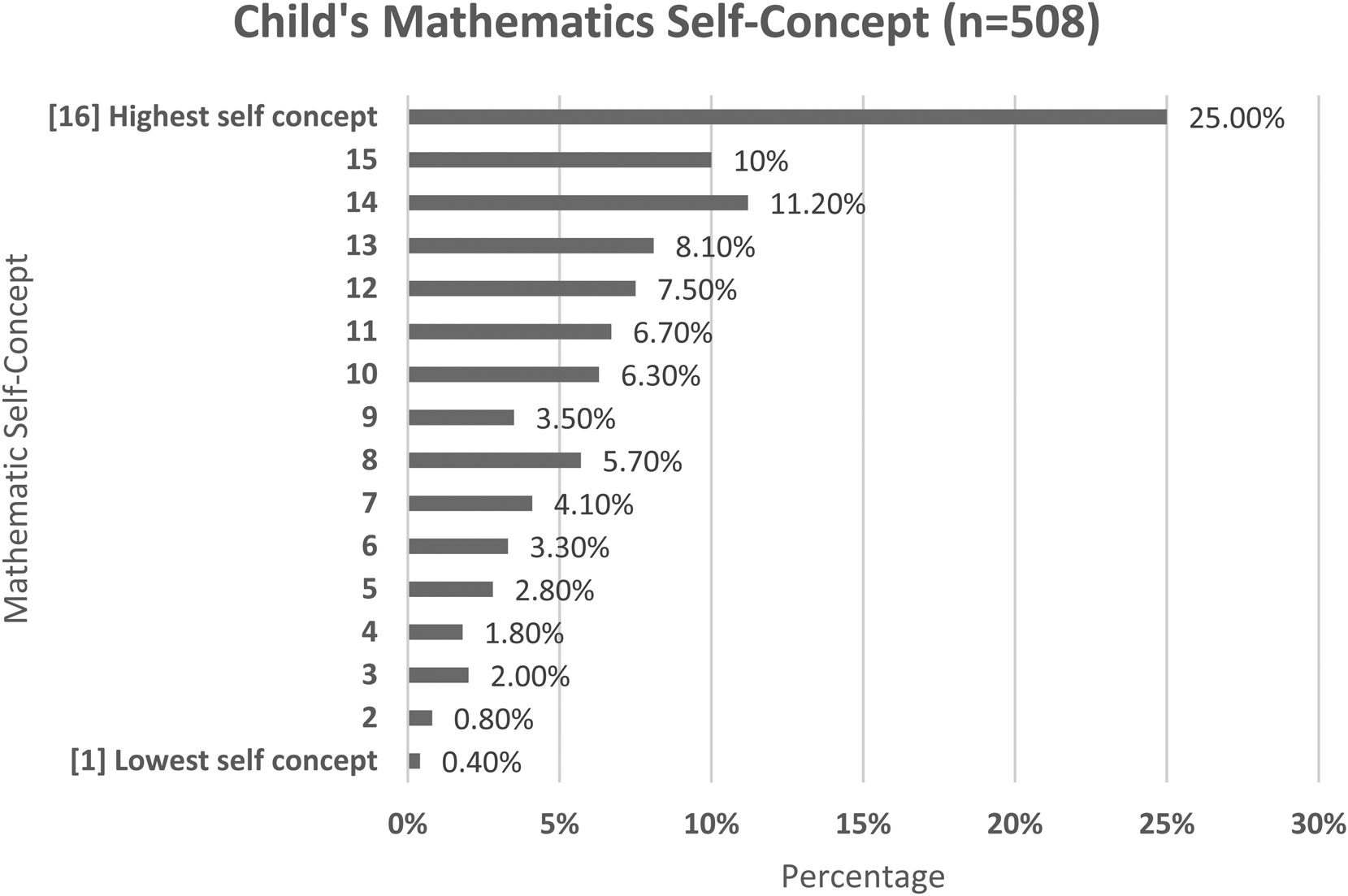
Child's mathematics self-concept (n = 508).

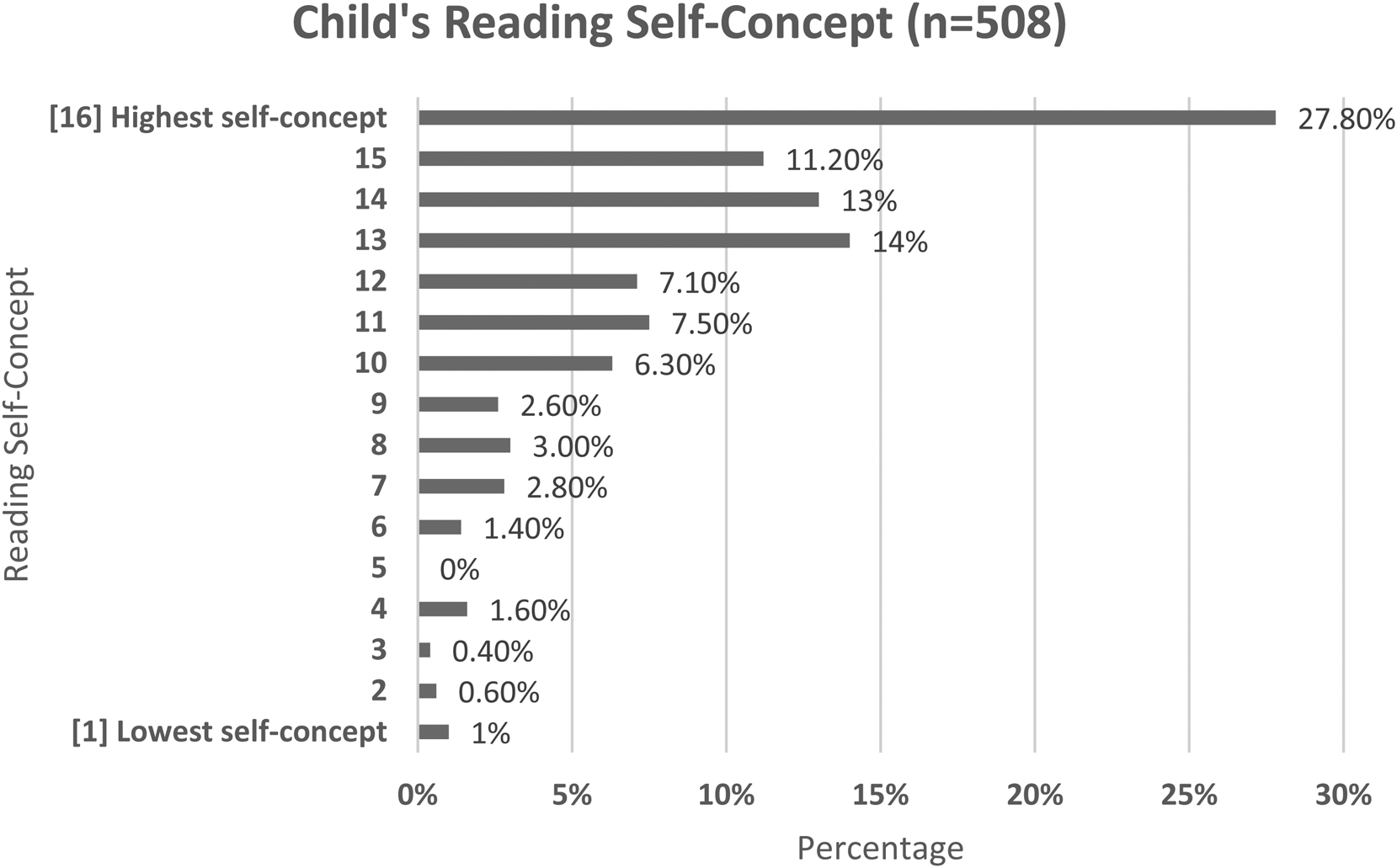
Child's reading self-concept (n = 508).

Key finding

Bivariate
Mathematics self-concept × selected independent variables

*Significant at p ≤ 0.05 level; **p ≤ 0.01 level.
Reading self-concept × selected independent variables

*Significant at p ≤ 0.05 level; **p ≤ 0.01 level.
Key finding

OLS multivariate regression analysis
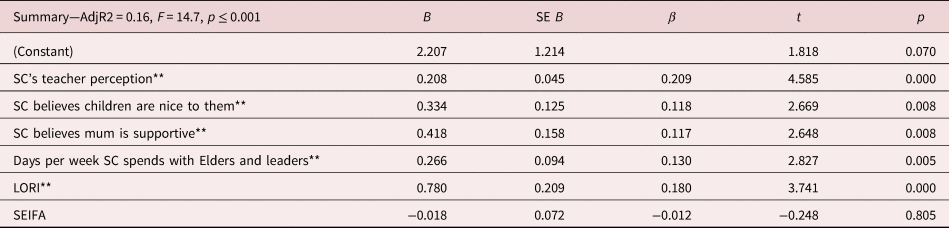
See Table 3.
Mathematics self-concept × selected independent variables

*Significant at the 0.05 level; **Significant at the 0.01 level.
Key finding

Multiple OLS regression analysis results from Table 3 indicated that the six predictor factors explained 16% of the variance in the child's mathematics self-concept (AdjR 2 = 0.16, F = 14.7, p ≤ 0.001). Five of the factors in the model were significant predictors of the child's mathematics self-concept. For each additional unit increase in the child's teacher perception, there is an average increase of 0.21 in their mathematics self-concept (p ≤ 0.001). For a unit increase in the child's rating on item: ‘children are nice to SC’, there is an average increase of 0.12 in the child's mathematics self-concept (p = 0.008). For each additional unit increase in the child's rating on item ‘mum tells SC men they are doing well’, there is an average increase of 0.12 in their mathematics self-concept (p ≤ 0.08). For each additional unit increase in ‘days per week spent with Elders and leaders’, there is an associated increase of 0.13 in the child's mathematics self-concept (p = 0.005). Lastly, for a one unit increase in LORI, there is an associated increase of 0.18 in the child's mathematics self-concept (p ≤ 0.001) (Table 4).
Reading self-concept × selected independent variables

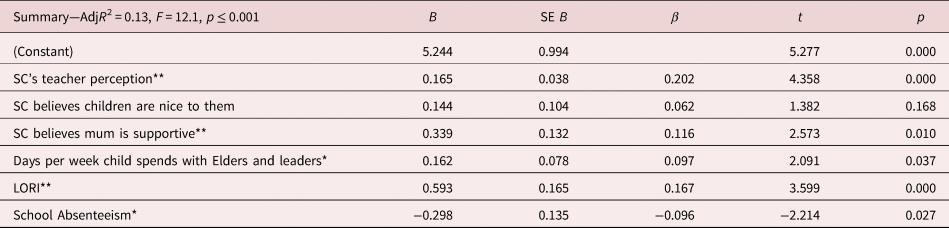
*Significant at the 0.05 level; **Significant at the 0.01 level.
Key finding

Multiple OLS regression analysis results from Table 4 indicated that the six predictor factors explained 13% of the variance in the child's reading self-concept (AdjR 2 = 0.13, F = 12.1, p ≤ 0.001). Five of the factors in the model were significant predictors for the child's reading self-concept. For each additional unit increase in the child's teacher perception, there is an average increase of 0.20 in their reading self-concept (p ≤ 0.001). For each additional unit increase in the child's rating on item ‘mum tells SC when they are doing well’, there is an average increase of 0.12 in their reading self-concept (p = 0.008). For each additional unit increase in ‘days per week spent with Elders and leaders’, there is an associated increase of 0.10 in the child's reading self-concept (p = 0.038). For a one unit increase in LORI, there is an associated increase of 0.18 in the child's reading self-concept (p ≤ 0.001). Finally, for a one unit increase in the child's school absenteeism, there is an associated decrease in the child's reading self-concept of 0.1 (p = 0.027).
Discussion
The aim of this paper was to understand how Indigenous children's perceptions of their teachers, peers, parents and Elders/leaders impact on their mathematics and reading self-concepts. Our findings confirm and align with the existing Indigenous youth self-concept research in demonstrating a connection between the child's perceptions of key persons in their lives (teachers, parents, peers and Elders/leaders) and the strengthening of their mathematic and reading self-concepts. The theme of a perceived receiving of favour and support from these key persons was observed within the dataset, both explicitly (i.e. SC believes other children at school are nice to them) and implicitly (i.e. time spent with Elders and leaders, suggesting bestowment of attention, support of affection). Collectively, these suggest the importance of the role of external affirmation (teachers, peers, parents, Elders) in the crystallisation in a recognition of, and belief in, individual competencies in reading and mathematics (self-concepts).
The data indicate a significant association between Indigenous children's perceptions of their teacher and their mathematics and reading self-concept. This is an expected but not unwelcomed finding; teachers have a profound influence on the development of children in having a not insignificant number of hours each week with the children as loco parentis. We know that the child's perceived rapport with their teacher is in-part linked to the teacher's perceived temperament (i.e. kind, harsh) and favour towards them (i.e. Mrs Smith doesn't like me); which can trickle over into self-perceptions of one's abilities (Henricsson and Rydell, Reference Henricsson and Rydell2004). This confirms the importance of strong teacher–student relationships for Indigenous children (Dunstan et al., Reference Dunstan, Hewitt and Tomaszewski2017, p. 265).
Teachers need to be mindful of the impact they can have on the academic and personal development of Indigenous students through both the manner in which they relate and teach students (Whitley et al., Reference Whitley, Rawana and Brownlee2014, p. 37). Teachers should be frequently spurred to encourage and help develop a favourable rapport with their students across the school year, alongside valuing their students' culture (Stronger Smarter Institute, 2014, p. 4; Mooney et al., Reference Mooney, Seaton, Kaur, Marsh and Yeung2016, p. 20). This should be instilled through training, both within their tertiary education and accreditation courses, but also in on-going professional development with an emphasis towards cultural awareness and unconscious bias training (Durey, Reference Durey2010, p. 87; Moreton-Robinson et al., Reference Moreton-Robinson, Singh, Kolopenuk, Robinson and Walter2012, pp. 1–2).
Aligning with previous research, our findings express a correlative link between the student's perception of their peers' favour and the possession of a higher self-concept. We found that the variable ‘children are nice to the child’ is significantly associated with mathematics and reading self-concepts at the bivariate level, yet interestingly, multivariate modelling indicates significance only for mathematics self-concept; it is not clear why this is the case. Nonetheless, we can argue that this supports the notion that Indigenous children with kind peers (Whitley, Reference Whitley2014, p. 166) and who feel accepted by others are more likely to have positive experiences within school, further engage in their studies and subsequently feel more positive about their own abilities overall. Conversely, Indigenous children who are unaccepted by peers can experience a negative impact on self-concept signifcantly, a finding suggested to be because of the communal nature of Aboriginal society (Purdie and McCrindle, Reference Purdie and McCrindle2004, p. 58). This highlights the need for teachers, principals and parents to ensure that Indigenous children are integrated within their cohort and schooling community overall to address known cases of isolation and bullying, and in recognising the importance of Indigenous culture in the development of a healthy academic self-concept for Indigenous students, formulate a culturally safe pedagogy (Harrison and Greenfield, Reference Harrison and Greenfield2011, p. 65) and address discrimination (Priest et al., Reference Priest, Paradies, Stewart and Luke2011, p. 1).
The second arm of received support was shown in the results which indicate that receiving positive feedback from one's primary caregiver is significantly associated with the child's academic self-concept. In our data, the primary caregiver was mostly one's mother, rather than one's father, step-parent or guardian (e.g. grandmother). This finding complements existing research demonstrating the vital role played by parents regarding the formulation of their children's self-concept in the provision of affirmation and warmth (Craven and Marsh, Reference Craven and Marsh2008, p. 109; Yeung et al., Reference Yeung, Craven and Ali2013, p. 420). The affirmation of one's mother can be said to be a key mitigating factor where the child is not otherwise receiving support from their peers and teachers. Notwithstanding this, though Indigenous parents know the importance of having healthy positive relationships with their children, we acknowledge they can be hindered in their ability to establish and provide such relationships consequent to their experience of structural disadvantage (Dudgeon et al., Reference Dudgeon, Milroy and Walker2014a; Trudgett et al., Reference Trudgett, Page, Bodkin-Andrews, Franklin, Whittaker, Walter, Martin and Bodkin-Andrews2017, pp. 235–236; Walter, Reference Walter, Walter, Martin and Bodkin-Andrews2017, p. 127). It is important that Indigenous parents continue to receive support and empowerment to overcome and break the cycle of disadvantage. Community-wide support initiatives are highly valued in this regard.
Our data also revealed that the cultural practice of spending time with Elders/community leaders is significantly associated with Indigenous child's self-concept on both a bivariate and a multivariate level for mathematics and reading. This is not surprising in recognising that Indigenous community Elders and leaders have a positive influence on Indigenous children's personal formation in providing nurturing care and counsel, and the importance of cultural engagement and practice in the development of Indigenous youth (Lohoar et al., Reference Lohoar, Butera and Kennedy2014, p. 11; Walter, Reference Walter, Walter, Martin and Bodkin-Andrews2017, p. 138). Considering this, it is encouraging that Indigenous children learning from Elders is identified by Indigenous parents as an important and worthwhile endeavour (Martin, Reference Martin, Walter, Martin and Bodkin-Andrews2017, pp. 94–95).
We found five puzzling findings within our data pertaining to LORI, socio-economic status, global health rating, gender and school attendance which do not neatly align with the findings of existing studies or sociological theory. Regarding each finding, discretion and further research are advised. These were ascertained from the analysis of a set of factors yielding significance on a bivariate and a multivariate level.
The variable LORI is significantly associated on a bivariate level for Indigenous children aged 9.5–11 years in their mathematics and reading self-concepts, as well as in both multivariate models, i.e. in taking all other variables in the models into consideration, higher levels of geographical isolation experienced by an Indigenous child significantly increased their self-perception of mathematics and reading ability. This is a puzzling finding, contrary to previous literature indicating how disadvantage experienced by remote students negatively contributes to their educative formation and results (Department of the Prime Minister and Cabinet, 2015). Some suggest this may be explained by an increased focus and funding of remote schools assisting the improvement in student academic engagement and outcomes in these places (Dunstan et al., Reference Dunstan, Hewitt and Tomaszewski2017, pp. 265–266). An alternative explanation to our finding may be that in rural areas, there is greater participation in culture and cultural practices (Dockery, Reference Dockery2010, pp. 2, 23) and less degrees of individualism (Beck, Reference Beck2002), positively impacting on the self-concept of Indigenous children. Overall, this finding highlights the complexity of urban, rural and remote differences (Yeung et al., Reference Yeung, Craven and Ali2013, p. 405) and the diversity which exists amongst Indigenous people (Gee et al., Reference Gee, Dudgeon, Schultz, Hart, Kelly, Dudgeon, Milroy and Walker2014, p. 55).
Socio-economic status (SEIFA measurement used) was significantly associated at a bivariate level with mathematics self-concept, but not reading self-concept, with no association in the multivariate models. This contrasts previous findings where Indigenous students from a higher socio-economic background were more likely to perform (Mooney et al., Reference Mooney, Seaton, Kaur, Marsh and Yeung2016, p. 11) and score higher on mathematics assessment (De Bortoli and Thomson, Reference De Bortoli and Thomson2010, p. 10). Furthermore, a lowered socio-economic status is shown to reduce achievement expectations (Stronger Smarter Institute, 2014, p. 2). In both instances, this can be explained in that those from higher economic positions have greater access to resources and support networks that further wellbeing and development. This is a notable finding considering the high levels of socio-economic disadvantage experienced by Indigenous Australian's compared to the non-Indigenous population and the known role of socio-economic disadvantage in diminishing the likelihood of academic success (De Bortoli and Thomson, Reference De Bortoli and Thomson2010, p. i; Australian Department of Health and Ageing, 2013; Yeung et al., Reference Yeung, Craven and Ali2013, p. 407). Yet, again, it must be noted that the significance of SEIFA is small and is greatly diminished when other factors are considered on a multivariate level.
Similarly curious, the global health rating of Indigenous children was shown not to impact on academic self-concept. This is surprising given the overall levels of lowered health experienced by Indigenous people and the established role of health in both cognitive development, mental health and educative outcomes (Australian Department of Health and Ageing, 2013; Dudgeon et al., Reference Dudgeon, Milroy and Walker2014a). Though it could be said to highlight the resilience of Indigenous children within the Wave 7 sample cohorts, we suggest further analysis is required. Gender is not significantly associated with mathematics or reading self-concept for children within LSIC. This is in line with previous research regarding Indigenous students that identified no association between gender characteristics and self-concept (Mooney et al., Reference Mooney, Seaton, Kaur, Marsh and Yeung2016, p. 18).
School attendance for Indigenous children was shown not to be significantly associated with the mathematics self-concept but only for reading. Although non-significant for child mathematics self-concept, this finding supports discoveries in previous research where when less attendance was reported, the lower the student's reading self-concept became (Craven and Marsh, Reference Craven, Marsh, Marsh, Craven and McInerney2005, p. 228). This highlights the impact that school attendance can have but contributes little to the complex debate (Biddle, Reference Biddle2014; Ladwig and Luke, Reference Ladwig and Luke2014; Department of the Prime Minister and Cabinet, 2015) regarding its importance for Indigenous students within Western education systems.
Limitations
A limitation of this study is the number of Waves which included questions pertaining to child academic self-concept: questions were only asked of the K Cohort in Waves 6 and 7 while the B Cohort was asked in Wave 9 (Department of Social Services, 2018, p. 1). Consequently, longitudinal analysis could not be undertaken to measure child self-concept. The study would have benefited from additional factors regarding culture in Wave 7 as cultural elements have been shown to have a positive impact on academic self-concept (Pedersen and Walker, Reference Pedersen and Walker2000, p. 185; Bodkin-Andrews et al., Reference Bodkin-Andrews, O'Rourke and Craven2010a, p. 299; Martin, Reference Martin, Walter, Martin and Bodkin-Andrews2017, pp. 94–95). Other related variables in Wave 7 which could be of interest to this study which were unfortunately unavailable include PAT Reading scores, perceived racism and family variables (e.g. family size, parental arrangements).
Another limitation of the LSIC study is generalisability to the broader Aboriginal and Torres Strait Islander population as it is not a randomly selected sample (Gobo, Reference Gobo2004, p. 405; Walter et al., Reference Walter, Martin and Bodkin-Andrews2017b, p. 2). Notwithstanding this, the study does in practice reflect the wider Australian Indigenous population. This means that the data and subsequent analysis are each relevant and valuable for improving the lives of Aboriginal and Torres Strait Islander children, their families and communities.
Conclusion
Drawing on data from Wave 7 of LSIC, this paper contributes to understandings of academic self-concepts for Indigenous children aged 9.5–11 years. Overall, this cohort of children had positive levels of self-concept regarding their reading and mathematical abilities. At a bivariate level, results indicate significant correlations between self-concept and a series of IVs and when accounting for variables on a multivariate level, with several prominent factors of teachers, parents, peers and Elders remaining significant for both mathematics and reading self-concept. It can be said that ensuring Indigenous students are integrated within the community, accustomed with and practitioners of their culture, and are recognised and supported by teachers, peers and parents, can mitigate the negative effects of structural inequalities to self-concept and assist them to hone their scholarly abilities and grow up strong.
Acknowledgements
We would like to thank Professor Maggie Walter for her ongoing support. This article is developed from the research funded by the Australian Research Council through the ARC Discovery Indigenous Program: Project Number IN 160100024.
Financial support
This article is developed from the research funded by the Australian Research Council through the ARC Discovery Indigenous Program: Project Number IN 160100024.
Conflict of interest
There are no financial interests or benefits that have arisen from the direct applications of this research. This manuscript is original work and has not been submitted for publication elsewhere.
Jacob Prehn is a proud Worimi (Australian Aboriginal) man. Jacob works for the Office of the Pro Vice-Chancellor Aboriginal Research and Leadership at the University of Tasmania. He is undertaking a PhD on the wellbeing of Aboriginal men. Jacob is a director of the National Aboriginal and Torres Strait Islander Health Worker Association (NATSHIWA). He is also a qualified Social Worker and Aboriginal Health Worker.
Huw Peacock is a proud palawa (Tasmanian Aboriginal) man. He currently works in the Office of the Pro Vice-Chancellor of Aboriginal Research and Leadership at the University of Tasmania. He is involved with two research projects regarding Aboriginal and Torres Strait Islander education and health. Huw is also undertaking a Higher Degree by Research examining the factors influencing Aboriginal and Torres Strait Islander children's sport and physical activity participation.
Michael Andre Guerzoni (PhD, University of Tasmania) is a Criminologist at the School of Social Sciences, University of Tasmania, Australia. His research investigates ‘clerical collar crime’, specifically the study of clerical attitudes, practices and cultures towards child sexual abuse and child protection within Anglicanism and Roman Catholicism.