Introduction
Current and lifetime stress are widely acknowledged to contribute to risk for, and variation in, symptom severity in mental health disorders. In psychosis spectrum disorders, the contribution of stress and adversity during childhood and adolescence is now also considered to contribute to clinical presentation. However, despite progress in identifying some of the genetic architecture of these disorders, modelling the interaction between genetic risk and environmental factors is still at an early stage. Towards this end, understanding the biological mechanisms by which both current and lifetime stress exposures exert an effect represents an important research goal. Borrowing from recent research in affective disorders (Ciufolini et al. Reference Ciufolini, Dazzan, Kempton, Pariante and Mondelli2014; Zorn et al. Reference Zorn, Schur, Boks, Kahn, Joels and Vinkers2017), one potential mechanism is the effect of acute psychosocial stressors on cortisol response in psychosis.
The neural diathesis–stress model of schizophrenia has been proposed as a framework for the development of schizophrenia as the consequence of an interaction between a genetic susceptibility and stress triggered by stressful or traumatic experiences (Walker & Diforio, Reference Walker and Diforio1997; Walker et al. Reference Walker, Mittal and Tessner2008; Pruessner et al. Reference Pruessner, Cullen, Aas and Walker2017). Briefly, this theory is based on findings that the hypothalamus–pituitary–adrenal (HPA) axis is activated after stress exposure and that cortisol as one of many secretagogues and glucocorticoids released throughout the brain. Importantly, this model posits that hippocampal structure and function as well as the activation of the subcortical dopamine system are altered by HPA activation or resulting cortisol release which affects behavioural outcome, including cognitive deficits in psychosis.
One of the principal means of assessing the effects of stress exposure on the HPA axis is via laboratory-induced psychosocial stress tasks, which, as a proxy to psychosocial stress in daily life, have the advantage of experimental control (Allen et al. Reference Allen, Kennedy, Cryan, Dinan and Clarke2014). The purpose of these stress tasks, such as the Trier Social Stress Task (TSST), is to study the individual stress response which is known to induce the HPA axis (Kirschbaum et al. Reference Kirschbaum, Pirke and Hellhammer1993) among other neurobiological systems (Joels & Baram, Reference Joels and Baram2009). The TSST is the most widely established laboratory-induced psychosocial stress task, which consists of an anticipation period (10 minutes) and a test period (10 minutes) (Kirschbaum et al. Reference Kirschbaum, Pirke and Hellhammer1993). During the test period, participants are asked to give a free talk (5 minutes) and to perform a mental arithmetic task (5 minutes) in front of jury members. At the same time, participants’ verbal and non-verbal behaviours are video recorded.
Cortisol is one of the most commonly investigated HPA axis hormones in the field of psychosocial stress due to its ease of being assayed in blood, saliva, urine and hair. Out of these, the measurement of cortisol in saliva is the most frequently reported HPA axis biological stress response measure. To date, only a limited number of reviews have been conducted to examine the role of stress and its effects on the HPA axis in schizophrenia over the course of the illness (Walker et al. Reference Walker, Mittal and Tessner2008; Pruessner et al. Reference Pruessner, Cullen, Aas and Walker2017) and patients with first-episode psychosis (Borges et al. Reference Borges, Gayer-Anderson and Mondelli2013). Two systematic reviews and meta-analyses have been carried out to compare differences between schizophrenia and depression in TSST-induced cortisol stress response based on chronic schizophrenia patients (Ciufolini et al. Reference Ciufolini, Dazzan, Kempton, Pariante and Mondelli2014, Zorn et al. Reference Zorn, Schur, Boks, Kahn, Joels and Vinkers2017). Finally, one systematic review focused on the effects of the TSST on heart rate and cortisol stress responses across schizophrenia spectrum disorders at the first-episode and chronic stages of the illness (Lange et al. Reference Lange, Deutschenbaur, Borgwardt, Lang, Walter and Huber2017 a).
These previous systematic reviews and meta-analyses have variously proposed that the HPA axis response to psychosocial stress is blunted at the first episode of schizophrenia based on one included study (Lange et al. Reference Lange, Deutschenbaur, Borgwardt, Lang, Walter and Huber2017 a) and in chronic schizophrenia (Ciufolini et al. Reference Ciufolini, Dazzan, Kempton, Pariante and Mondelli2014; Lange et al. Reference Lange, Deutschenbaur, Borgwardt, Lang, Walter and Huber2017 a; Zorn et al. Reference Zorn, Schur, Boks, Kahn, Joels and Vinkers2017). However, given the small numbers available at the time for these reviews, these conclusions should be considered as preliminary. Furthermore, no studies at the high-risk stage of schizophrenia were included due to a lack of literature in the previous reviews. The purpose of the present review was to carry out the most comprehensive systematic review undertaken to date of acute psychosocial stress exposure effects on cortisol levels across psychotic disorders. In particular, this systematic review expands the scope of the previous reviews by including studies on the high-risk stage in psychotic disorders beyond schizophrenia spectrum disorders. In doing so, we hoped to clarify whether changes in cortisol response are observed already at the high-risk stage and if so, whether these changes are relevant for patient groups with psychosis or only with schizophrenia.
Methods
Literature search strategy
We conducted a systematic literature search using PubMed and PsycINFO for original papers that studied cortisol stress response around the time of a laboratory-induced psychosocial stress task (or an equivalent stress task) in patients with schizophrenia, bipolar disorder and psychosis, which were published between 1993 and February 2019. We used combinations of the following key terms: [(cortisol OR cortisol reactivity OR cortisol response OR hypothalamus–pituitary–adrenal OR HPA OR hypothalamus–pituitary–adrenal axis OR HPA axis OR HPA axis reactivity OR HPA axis response) AND (stress OR social stress OR social trauma OR psychosocial OR TSST OR Trier OR Trier Social Stress Task) AND (schizophrenia OR bipolar disorder OR psychosis OR psychotic)]. We included only studies that used a psychosocial stress task that included laboratory-induced stress manipulation in the form of uncontrollability (e.g. time pressure or impossible task to solve) and/or social evaluation (e.g. speech in front of a jury or video recording) in adult individuals at high risk of developing schizophrenia, bipolar disorder or psychosis or in patients with schizophrenia, bipolar disorder and psychosis. Studies that investigated the effect of chronic stress, long-term stress exposure, recent stress level, exam stress, studies that investigated the HPA axis reactivity after pharmacological challenges (e.g. the dexamethasone suppression test and the corticotropin-releasing hormone stimulation test), studies reporting adrenocorticotropic hormones only as well as systematic reviews were excluded. Studies were also searched through references of selected articles.
Inclusion criteria
Identified studies were screened and selected for inclusion using the following criteria: (1) original and peer-reviewed articles published in an English language journal; (2) adult individuals at high risk of developing schizophrenia, bipolar disorder or psychosis were included; (3) adult patients with schizophrenia, bipolar disorder or psychosis, and/or healthy participants were included; (4) data on laboratory-induced acute psychosocial stress were reported; (4) data on plasma cortisol, salivary cortisol or free cortisol assayed with an established hormone assay were reported; and (5) data on HPA axis activity after the laboratory-induced psychosocial stress task were reported.
Study characteristics
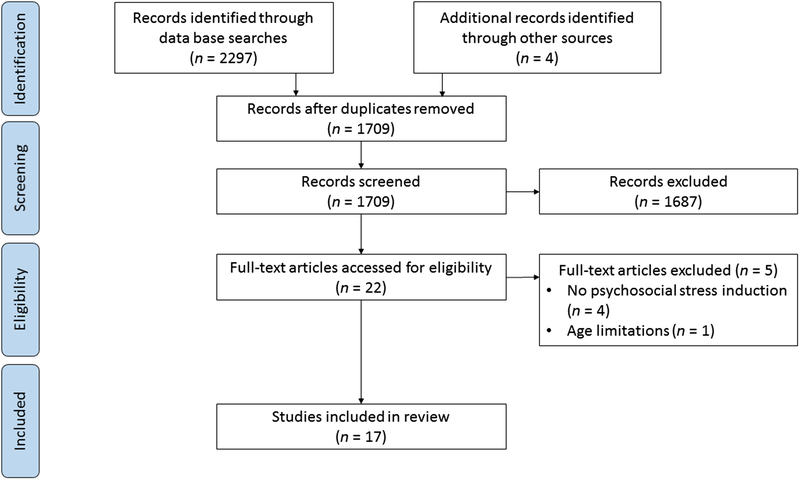
The literature search identified 2297 studies in total, of which 13 studies were original studies that matched the study criteria. Four additional studies were identified through review of references of these papers. The PRISMA flow diagram is presented in Fig. 1 which displays the number of included and excluded studies as well as the reasons for exclusion. Therefore, in total, 17 studies were included.
Flow diagram selection of study process.

Results
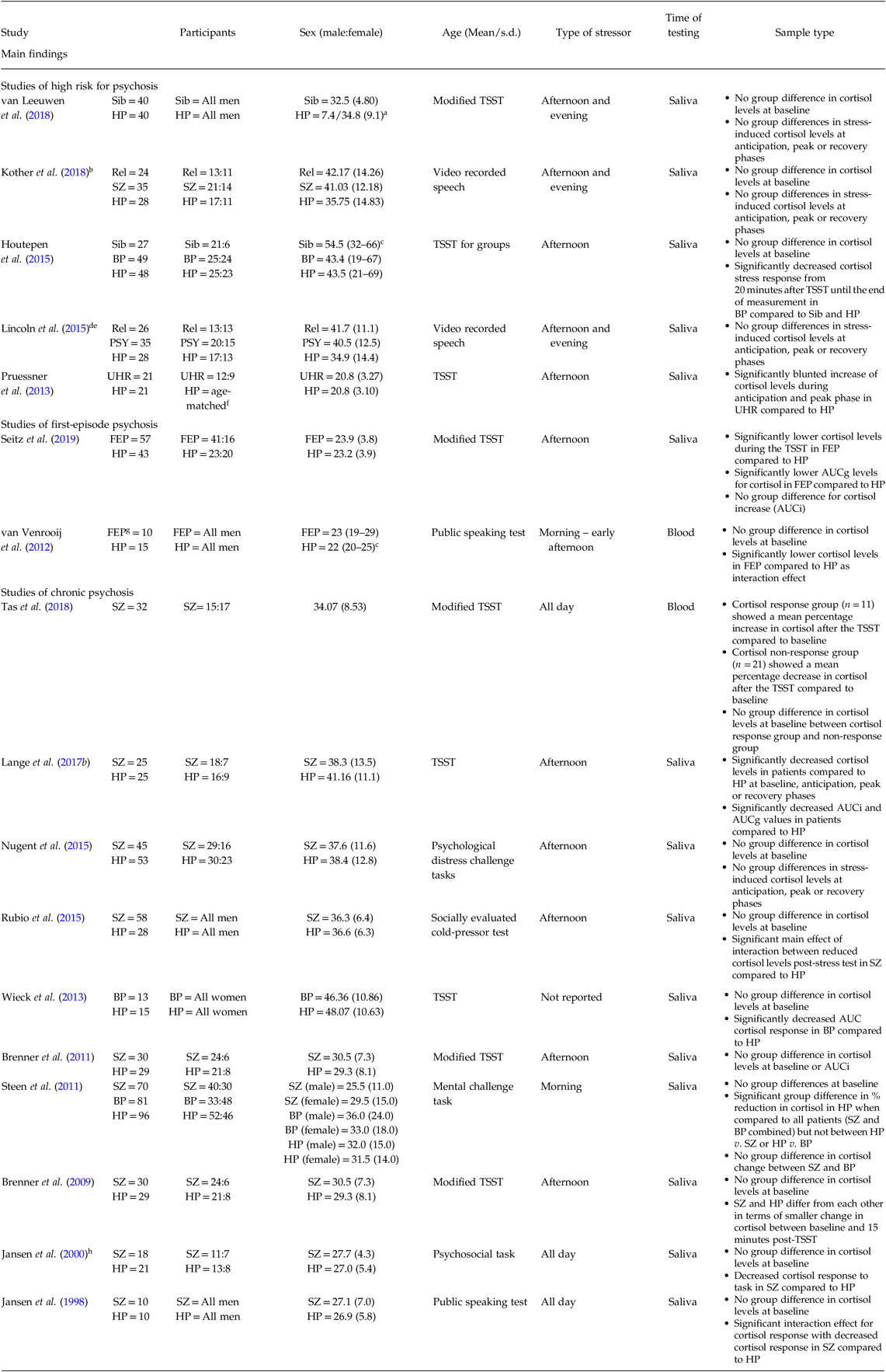
The included studies were grouped based on the illness stage, diagnosis and study characteristics. The main findings are reported in Table 1.
Study characteristics and main findings

AUC, area under the curve; AUCg, area under the curve with respect to ground; AUCi, area under the curve with respect to increase; BP, bipolar disorder; FEP, patients with first-episode psychosis; HP, healthy participants; PSY, patients with psychosis; Rel, first-degree relatives; Sib, first-degree siblings; SZ, patients with schizophrenia; TSST, Trier Social Stress Task; UHR, ultra-high-risk subjects.
a Data reported for subjects in experimental group.
b Data reported for patients with schizophrenia, first-degree relatives and healthy participants and the social stress condition only.
c Median and range reported.
d Data reported for patients with psychosis, first-degree relatives and healthy participants and the social stress condition only.
e Means/SD for cortisol not reported.
f Not reported.
g Diagnosis of schizophrenia (7 patients) and psychotic disorder in the schizophrenia spectrum (3 patients).
h Data reported only for psychosocial task.
Five high risk for psychosis studies were included. Out of these, two studies examined the cortisol stress response in siblings and relatives of individuals with schizophrenia (van Leeuwen et al. Reference van Leeuwen, Vink, Fernandez, Hermans, Joels, Kahn and Vinkers2018) and in individuals at ultra-high risk of psychosis (Pruessner et al. Reference Pruessner, Bechard-Evans, Boekestyn, Iyer, Pruessner and Malla2013). Two other studies recruited and tested siblings and patients with chronic schizophrenia (Kother et al. Reference Kother, Lincoln and Moritz2018) and patients with chronic psychosis (Lincoln et al. Reference Lincoln, Kother, Hartmann, Kempkensteffen and Moritz2015). In the fifth study, siblings and patients with bipolar disorder were studied (Houtepen et al. Reference Houtepen, Boks, Kahn, Joels and Vinkers2015).
Two studies investigated the effect of the psychosocial stress task on cortisol levels in first-episode patients (van Venrooij et al. Reference Van Venrooij, Fluitman, Lijmer, Kavelaars, Heijnen, Westenberg, Kahn and Gispen-de Wied2012; Seitz et al. Reference Seitz, Vracotas, Bechard-Evans, King, Abadi, Joober, Shah, Malla and Pruessner2019).
Ten studies were included for the group of studies in patients with chronic psychosis (Jansen et al. Reference Jansen, Gispen-de Wied, Gademan, De Jonge, van der Linden and Kahn1998; Jansen et al. Reference Jansen, Gispen-de Wied and Kahn2000; Brenner et al. Reference Brenner, Liu, Laplante, Lupien, Pruessner, Ciampi, Joober and King2009; Brenner et al. Reference Brenner, St-Hilaire, Liu, Laplante and King2011; Steen et al. Reference Steen, Lorentzen, Barrett, Lagerberg, Hope, Larsson, Berg, Agartz, Melle, Berg and Andreassen2011; Wieck et al. Reference Wieck, Grassi-Oliveira, Do Prado, Rizzo, de Oliveira, Kommers-Molina, Viola, Teixeira and Bauer2013; Nugent et al. Reference Nugent, Chiappelli, Sampath, Rowland, Thangavelu, Davis, Du, Muellerklein, Daughters, Kochunov and Hong2015; Rubio et al. Reference Rubio, Lopez-Munoz, Jurado-Barba, Martinez-Gras, Rodriguez-Jimenez, Espinosa, Perez-Nieto, Moratti, Jimenez-Arriero and Carlos Leza2015; Lange et al. Reference Lange, Huber, Frohlich, Borgwardt, Lang and Walter2017 b; Tas et al. Reference Tas, Brown, Eskikurt, Irmak, Aydin, Esen-Danaci and Brune2018). Among these studies, study overlap was observed between Brenner et al. (Reference Brenner, Liu, Laplante, Lupien, Pruessner, Ciampi, Joober and King2009) and Brenner et al. (Reference Brenner, St-Hilaire, Liu, Laplante and King2011); however, different outcome measures for the cortisol stress reactivity were reported.
Studies of high risk for psychosis
To date, only two studies have investigated cortisol stress reactivity in first-degree siblings of patients with schizophrenia (van Leeuwen et al. Reference van Leeuwen, Vink, Fernandez, Hermans, Joels, Kahn and Vinkers2018) and individuals at ultra-high risk of psychosis (Pruessner et al. Reference Pruessner, Bechard-Evans, Boekestyn, Iyer, Pruessner and Malla2013). A mixed pattern of results was observed in both studies. While the salivary cortisol levels were not significantly different between siblings and healthy control subjects (van Leeuwen et al. Reference van Leeuwen, Vink, Fernandez, Hermans, Joels, Kahn and Vinkers2018), individuals at ultra-high risk of psychosis showed significantly blunted increase of cortisol levels during the anticipation and phases around the time of the modified TSST in contrast to healthy participants (Pruessner et al. Reference Pruessner, Bechard-Evans, Boekestyn, Iyer, Pruessner and Malla2013). Furthermore, Pruessner et al. (Reference Pruessner, Bechard-Evans, Boekestyn, Iyer, Pruessner and Malla2013) reported a post-hoc finding of a significant negative correlation between reduced cortisol levels and higher perceived recent stress levels as assessed with retrospective self-report in ultra-high risk individuals of psychosis (Pruessner et al. Reference Pruessner, Bechard-Evans, Boekestyn, Iyer, Pruessner and Malla2013). The lack of a group difference in a cortisol stress response between siblings and healthy controls contrasts to the observed stress response as measured with brain functional activity in regions implicated in the default-mode network and salience network after the stress exposure in the at-risk individuals versus healthy controls (van Leeuwen et al. Reference van Leeuwen, Vink, Fernandez, Hermans, Joels, Kahn and Vinkers2018).
When comparing the findings between siblings and patients with schizophrenia or psychosis, Kother et al. (2018)found no differences between the groups at either the anticipation, peak or recovery phases around the time of the stress challenge (Kother et al. Reference Kother, Lincoln and Moritz2018). This finding is in keeping with the Lincoln et al. (Reference Lincoln, Kother, Hartmann, Kempkensteffen and Moritz2015) study in which first-degree relatives of patients with psychosis did not display any significantly different stress-induced cortisol levels around the time of a video-recorded speech when compared to patients with chronic psychosis and control subjects (Lincoln et al. Reference Lincoln, Kother, Hartmann, Kempkensteffen and Moritz2015).
In the fifth study, patients with bipolar disorder showed a reduced cortisol stress response when compared to healthy participants and first-degree siblings (Houtepen et al. Reference Houtepen, Boks, Kahn, Joels and Vinkers2015). In this study, the modified TSST version, the group version of the TSST, was utilised (Houtepen et al. Reference Houtepen, Boks, Kahn, Joels and Vinkers2015) which makes a direct comparison difficult.
Studies of first-episode psychosis
Two studies examined the cortisol stress response to a laboratory-induced stress challenge in patients with first-episode schizophrenia (van Venrooij et al. Reference Van Venrooij, Fluitman, Lijmer, Kavelaars, Heijnen, Westenberg, Kahn and Gispen-de Wied2012) and first-episode psychosis (Seitz et al. Reference Seitz, Vracotas, Bechard-Evans, King, Abadi, Joober, Shah, Malla and Pruessner2019). Both studies reported significantly reduced plasma cortisol levels in patients when compared to healthy participants. Moreover, Seitz et al. (2019)reported significant positive correlations between lower area under the curve with respect to ground (AUCg) cortisol levels and reduced self-esteem, lower active coping in addition to a significant negative correlation between these reduced AUCg cortisol levels and increased levels of perceived stress levels around the time of the modified TSST (Seitz et al. Reference Seitz, Vracotas, Bechard-Evans, King, Abadi, Joober, Shah, Malla and Pruessner2019). Furthermore, cortisol no-responders in the first-episode patient group reported significantly higher levels of physical neglect as measured with the Childhood Trauma Questionnaire (CTQ) (Seitz et al. Reference Seitz, Vracotas, Bechard-Evans, King, Abadi, Joober, Shah, Malla and Pruessner2019).
Studies of chronic psychosis
A mixed pattern of cortisol stress responses was found when patients with chronic psychosis were compared: out of eight studies with a healthy control group, seven studies reported a blunted cortisol response in patients with schizophrenia when compared to healthy participants (Jansen et al. Reference Jansen, Gispen-de Wied, Gademan, De Jonge, van der Linden and Kahn1998; Jansen et al. Reference Jansen, Gispen-de Wied and Kahn2000; Brenner et al. Reference Brenner, Liu, Laplante, Lupien, Pruessner, Ciampi, Joober and King2009; Steen et al. Reference Steen, Lorentzen, Barrett, Lagerberg, Hope, Larsson, Berg, Agartz, Melle, Berg and Andreassen2011; Wieck et al. Reference Wieck, Grassi-Oliveira, Do Prado, Rizzo, de Oliveira, Kommers-Molina, Viola, Teixeira and Bauer2013; Rubio et al. Reference Rubio, Lopez-Munoz, Jurado-Barba, Martinez-Gras, Rodriguez-Jimenez, Espinosa, Perez-Nieto, Moratti, Jimenez-Arriero and Carlos Leza2015; Lange et al. Reference Lange, Huber, Frohlich, Borgwardt, Lang and Walter2017 b), whereas two studies observed no group differences (Brenner et al. Reference Brenner, St-Hilaire, Liu, Laplante and King2011; Nugent et al. Reference Nugent, Chiappelli, Sampath, Rowland, Thangavelu, Davis, Du, Muellerklein, Daughters, Kochunov and Hong2015). Three out of the five studies suggesting a blunted cortisol stress response in patients are early studies from the same group after using a modification of the TSST that did not include video recording during the speech. Two more recent studies reported reduced cortisol levels in patients when contrasted to healthy participants, in which the modified TSST (Lange et al. Reference Lange, Huber, Frohlich, Borgwardt, Lang and Walter2017 b) and the socially evaluated cold-pressor task were used (Rubio et al. Reference Rubio, Lopez-Munoz, Jurado-Barba, Martinez-Gras, Rodriguez-Jimenez, Espinosa, Perez-Nieto, Moratti, Jimenez-Arriero and Carlos Leza2015), in contrast to the traditional TSST. In addition, Lange et al. (2017b)observed a significant positive correlation between greater severity of positive symptoms measured with the Positive and Negative Symptom Scale and lower cortisol values as measured with area under the curve with respect to increase (AUCi) (Lange et al. Reference Lange, Huber, Frohlich, Borgwardt, Lang and Walter2017 b). From the same study, the authors also reported findings of significantly higher levels of exposure to emotional abuse as retrospectively assessed with the CTQ in patients who showed a cortisol stress response after the TSST only.
Brenner et al. (Reference Brenner, St-Hilaire, Liu, Laplante and King2011) re-analysed their findings from the previous publication (Brenner et al. Reference Brenner, Liu, Laplante, Lupien, Pruessner, Ciampi, Joober and King2009) on a proposedly blunted cortisol stress response and reinterpreted their findings with no significant group differences referring to the AUCi findings (Brenner et al. Reference Brenner, St-Hilaire, Liu, Laplante and King2011). These findings of lack of group differences from the Brenner et al. (Reference Brenner, St-Hilaire, Liu, Laplante and King2011) study are in keeping with Kother et al. (Reference Kother, Lincoln and Moritz2018) and Nugent et al. (Reference Nugent, Chiappelli, Sampath, Rowland, Thangavelu, Davis, Du, Muellerklein, Daughters, Kochunov and Hong2015) despite the fact that these studies did not utilise comparable psychosocial stress tasks (these differed in terms of the levels of task controllability and social evaluation). Furthermore, Nugent et al. (Reference Nugent, Chiappelli, Sampath, Rowland, Thangavelu, Davis, Du, Muellerklein, Daughters, Kochunov and Hong2015) observed a significant diagnosis by distress intolerance interaction based on aborting the stress task in patients only in addition to a significant negative association between increased post-stress cortisol level change and decreased white matter integrity as measured with Diffusion Tensor Imaging (Nugent et al. Reference Nugent, Chiappelli, Sampath, Rowland, Thangavelu, Davis, Du, Muellerklein, Daughters, Kochunov and Hong2015).
One study examined the cortisol stress response among 32 patients with schizophrenia without a control group and observed a blunted stress response in a subgroup of patients (n = 21) after the TSST (Tas et al. Reference Tas, Brown, Eskikurt, Irmak, Aydin, Esen-Danaci and Brune2018).
Finally, a study by Steen et al. (2011)examined cortisol stress reactivity in patients with schizophrenia and bipolar disorder when compared to healthy participants (Steen et al. Reference Steen, Lorentzen, Barrett, Lagerberg, Hope, Larsson, Berg, Agartz, Melle, Berg and Andreassen2011). A significant group difference in percentage reduction of cortisol levels was found when healthy participants were compared to a combined schizophrenia/bipolar group. This difference disappeared when healthy participants were compared to either patients with schizophrenia or bipolar disorder separately, presumably because of the resulting lower sample sizes and power. The authors did not observe any significant differences in the cortisol stress response to the mental challenge task between patients with schizophrenia and bipolar disorder. In addition, significant negative associations were reported between reduced cortisol levels and increased number of psychotic episodes and depressive episodes when patients were considered as one psychosis patient group (Steen et al. Reference Steen, Lorentzen, Barrett, Lagerberg, Hope, Larsson, Berg, Agartz, Melle, Berg and Andreassen2011). We note that the used mental challenge task was a neuropsychological task under time pressure in front of the testers, and two cortisol samples around the time of this task were collected.
Discussion
In this review, we focused on the cortisol stress reactivity in psychotic disorders across all illness stages, including the high-risk stage of psychosis after psychosocial stress. This is the first systematic review to show that there is a high degree of heterogeneity in study findings, which encompass all three illness stages – the high-risk stage, the first-episode stage and the chronic stage – in psychosis. This finding is in line with the systematic review from Lange et al. (Reference Lange, Deutschenbaur, Borgwardt, Lang, Walter and Huber2017 a) for the first-episode and chronic stages of schizophrenia. First, our general findings were that across the 17 studies reviewed, ten showed evidence of reduced cortisol levels (blunted response) following acute stress exposure. Second, when studies are subdivided on the basis of illness and course, we observed reasonably consistent findings of blunted response in patients with chronic schizophrenia (seven of eight studies). The pattern of findings is more variable in individuals at high risk of psychosis with two of three studies reporting a blunted cortisol stress response. Two studies in patients with first-episode psychosis also observed reduced cortisol levels after the psychosocial stress task. Of note, however, many more studies of patients with chronic psychosis were available for inclusion in the study than for patients with either early stages of illness or bipolar disorder. We note that the high-risk state does not reflect a clinical diagnosis of psychosis.
Different factors for the variability of cortisol stress response to the psychosocial stressor or the lack of significant group differences have been discussed previously (Ciufolini et al. Reference Ciufolini, Dazzan, Kempton, Pariante and Mondelli2014; Lange et al. Reference Lange, Deutschenbaur, Borgwardt, Lang, Walter and Huber2017 a; Zorn et al. Reference Zorn, Schur, Boks, Kahn, Joels and Vinkers2017), such as age, sex (Back et al. Reference Back, Waldrop, Saladin, Yeatts, Simpson, Mcrae, Upadhyaya, Contini Sisson, Spratt, Allen, Kreek and Brady2008; Allen et al. Reference Allen, Kennedy, Cryan, Dinan and Clarke2014), time of day and time of assessment (Dickerson & Kemeny, Reference Dickerson and Kemeny2004), body mass index, status of menstrual cycle and use of contraception (Goldstein et al. Reference Goldstein, Lancaster, Longenecker, Abbs, Holsen, Cherkerzian, Whitfield-Gabrieli, Makris, Tsuang, Buka, Seidman and Klibanski2015), lack of adherence to instructions for the cortisol sample collection, medication effect (in particular of antipsychotic medication), different patient characteristics, variety of cortisol analysis techniques and publication bias of early studies (Ciufolini et al. Reference Ciufolini, Dazzan, Kempton, Pariante and Mondelli2014; Lange et al. Reference Lange, Deutschenbaur, Borgwardt, Lang, Walter and Huber2017 a; Zorn et al. Reference Zorn, Schur, Boks, Kahn, Joels and Vinkers2017). It has also been proposed that a variety of different experimental paradigms of the psychosocial stress task may affect the variability of cortisol stress reactivity findings, for example, the majority of studies that used the TSST (both in the original or modified versions) found a reduced cortisol stress response, whereas the majority of studies that used an alternative but the comparable psychosocial stress task observed no group differences (Lange et al. Reference Lange, Deutschenbaur, Borgwardt, Lang, Walter and Huber2017 a). Previous reviews only included TSST studies (Ciufolini et al. Reference Ciufolini, Dazzan, Kempton, Pariante and Mondelli2014; Zorn et al. Reference Zorn, Schur, Boks, Kahn, Joels and Vinkers2017). However, in our review with a greater number of included studies than the previous systematic reviews, this potential effect of psychosocial stress task type seems to be irrelevant as the number of studies reporting no group differences versus reduced cortisol levels is balanced (i.e. No group difference: two studies using the TSST v. three studies using an alternative stress task; reduced cortisol levels: six studies using the TSST v. five studies using an alternative stress task).
In more recent years, studies used the analysis of the area under the curve (AUC) as part of the receiver operating characteristic (ROC) curve. This analysis allows researchers to consider inherent variability among data when, at this early stage of research, it is still unknown what constitutes defined threshold levels for presence or absence of a cortisol stress response to a psychosocial stress response in psychosis. Briefly, an ROC curve is defined as a graph plotting sensitivity and specificity in order to evaluate the quality or performance of a given test (Park et al. Reference Park, Goo and Jo2004). We found that 5 of 17 studies reported AUCi and AUCg as standardised cortisol outcome measures to interpret the influence of the psychosocial stress exposure on cortisol stress reactivity in contrast to the traditional statistical analyses of t-tests and χ2-tests. Since 2015, five of nine studies used this analysis (Brenner et al. Reference Brenner, St-Hilaire, Liu, Laplante and King2011; Wieck et al. Reference Wieck, Grassi-Oliveira, Do Prado, Rizzo, de Oliveira, Kommers-Molina, Viola, Teixeira and Bauer2013; Lange et al. Reference Lange, Huber, Frohlich, Borgwardt, Lang and Walter2017 b; van Leeuwen et al. Reference van Leeuwen, Vink, Fernandez, Hermans, Joels, Kahn and Vinkers2018; Seitz et al. Reference Seitz, Vracotas, Bechard-Evans, King, Abadi, Joober, Shah, Malla and Pruessner2019), which reflects the growing interest. We also observed another trend in the use of statistical analyses. Five of 17 studies ran correlational post-hoc analyses between cortisol levels and outcome measures, such as psychotic symptom severity, depressive symptom severity, frequency and severity of early-life adversity during childhood, subjectively perceived stress around the time of the psychosocial stress task, subjectively perceived recent stress levels, cognitive function or brain imaging measures (Pruessner et al. Reference Pruessner, Bechard-Evans, Boekestyn, Iyer, Pruessner and Malla2013; Nugent et al. Reference Nugent, Chiappelli, Sampath, Rowland, Thangavelu, Davis, Du, Muellerklein, Daughters, Kochunov and Hong2015; Lange et al. Reference Lange, Huber, Frohlich, Borgwardt, Lang and Walter2017 b; van Leeuwen et al. Reference van Leeuwen, Vink, Fernandez, Hermans, Joels, Kahn and Vinkers2018; Seitz et al. Reference Seitz, Vracotas, Bechard-Evans, King, Abadi, Joober, Shah, Malla and Pruessner2019). These findings may add to the interpretation of the cortisol levels despite the lack of causal interpretation.
Limitations of current studies
From a clinical perspective, there is a difficulty in interpreting correlations between cortisol levels and clinical outcome measures, such as severity of psychotic symptoms. This is the most commonly used outcome measure in psychosis research. However, the acute stress exposure during a psychosocial task is challenging to complete when patients suffer from current delusions, hallucinations and bizarre behaviour why the majority of included patients are clinically stable with relatively low symptom severity. Furthermore, the severity of psychotic symptoms varies considerably during the course of the illness and is, therefore, an unreliable outcome measure (Tohen et al. Reference Tohen, Khalsa, Salvatore, Zarate, Strakowski, Sanchez-Toledo and Baldessarini2016). In addition, subjective coping strategies are known to be implicated in daily life functioning of patients with psychosis, such as psychosis as a stressful condition (Myin-Germeys et al. Reference Myin-Germeys, Krabbendam, Jolles, Delespaul and van Os2002). The role of recent stress in an individual’s life (Allott et al. Reference Allott, Rapado-Castro, Proffitt, Bendall, Garner, Butselaar, Markulev, Phassouliotis, Mcgorry, Wood, Cotton and Phillips2015; Reininghaus et al. Reference Reininghaus, Gayer-Anderson, Valmaggia, Kempton, Calem, Onyejiaka, Hubbard, Dazzan, Beards, Fisher, Mills, Mcguire, Craig, Garety, van Os, Murray, Wykes, Myin-Germeys and Morgan2016) has also been reported to impact on participant’s coping in patients with psychosis and healthy participants alike when early-life adversity is existent. It is also relevant to consider the higher frequency and severity levels of early-life adversity seen in patients with psychosis as it has been reported that these patients have increased hyperactivity of the HPA axis when compared to patients with no prior experience of childhood trauma (Braehler et al. Reference Braehler, Holowka, Brunet, Beaulieu, Baptista, Debruille, Walker and King2005; Peng et al. Reference Peng, Long, Li, Guo, Wu, Yang, Ding, He and Ning2014). These findings are in keeping with a significantly increased frequency of emotional abuse in patients with schizophrenia who were cortisol responders (Lange et al. Reference Lange, Huber, Frohlich, Borgwardt, Lang and Walter2017b).
Some future directions
While clinicians are often focused on variables associated with changes in clinical symptom severity, the last 10 years have seen a growing appreciation of cognitive function as a more accurate predictor of social and occupational functioning (Green Reference Green2016). Deficits in cognitive function have a more stable course than clinical symptoms, often predating and then outlasting fluctuating symptoms. Variation in these deficits, which include the domains of general cognitive function, memory function, and social cognition, is associated both with genetic variation associated with psychosis risk (Blokland et al. Reference Blokland, Mesholam-Gately, Toulopoulou, Del Re, Lam, Delisi, Donohoe, Walters, Consortium, Seidman and Petryshen2017) and with exposure to early-life adversity (Rokita et al. Reference Rokita, Dauvermann and Donohoe2018; Dauvermann and Donohoe, Reference Dauvermann and Donohoe2019). Although studies of the effects of changes in cortisol on cognitive performance following stress exposure are currently limited, the ‘Immune Response and Social Cognition in Schizophrenia’ (iRELATE) project is an example of this direction. In this study, the influence of genetic markers, early-life adversity and both the immune and cortisol responses on cognition are examined in patients with schizophrenia and healthy controls. Specifically, we are testing the inter-relationships between the cortisol stress response following the TSST and performance on measures of higher cognitive function (e.g. general cognitive ability, working memory and verbal memory) and social cognitive function (e.g. emotion recognition and Theory of Mind). In particular, the social cognitive deficits are predictive of social and occupational function in schizophrenia (McGlade et al. Reference Mcglade, Behan, Hayden, O’donoghue, Peel, Haq, Gill, Corvin, O’callaghan and Donohoe2008; Green et al. Reference Green, Bearden, Cannon, Fiske, Hellemann, Horan, Kee, Kern, Lee, Sergi, Subotnik, Sugar, Ventura, Yee and Nuechterlein2012; Horan et al. Reference Horan, Green, Degroot, Fiske, Hellemann, Kee, Kern, Lee, Sergi, Subotnik, Sugar, Ventura and Nuechterlein2012; Green, Reference Green2016), bipolar disorder (Vlad et al. Reference Vlad, Raucher-Chene, Henry and Kaladjian2018) and psychosis (Lysaker et al. Reference Lysaker, Hamm, Hasson-Ohayon, Pattison and Leonhardt2018). In addition, social cognitive aspects may predict social functioning better than general cognitive ability (McGlade et al. Reference Mcglade, Behan, Hayden, O’donoghue, Peel, Haq, Gill, Corvin, O’callaghan and Donohoe2008). Given the evidence that these deficits typically do not improve with antipsychotic treatment (Kucharska-Pietura & Mortimer, Reference Kucharska-Pietura and Mortimer2013; Daros et al. Reference Daros, Ruocco, Reilly, Harris and Sweeney2014), understanding the role of both HPA and immune responses to stress is pivotal in identifying targets for new treatments.
Conclusion
This review highlights recent evidence of blunting of cortisol response following experimentally induced psychosocial stress across all stages of psychosis. While there was some evidence of this blunted response across illness types and stages, the strongest evidence was observed for those with chronic schizophrenia. Due to the low number of studies, in particular in bipolar disorder, much work is still needed to accurately characterise the biological effects of stress in psychosis.
Conflict of interest
MRD and GD have no conflicts of interest to disclose.
Ethical standards
The authors assert that all procedures contributing to this work comply with the ethical standards of the relevant national and institutional committee on human experimentation with the Helsinki Declaration of 1975, as revised in 2008. The authors assert that ethical approval for publication of this review was not required by their local Ethics Committee.
Financial support
This work was supported by the European Research Council (GD, ERC-2015-STG-677467) and Science Foundation Ireland (GD, SFI-16/ERCS/3787).