INTRODUCTION
The pelagic deep-sea fish family Cyematidae, or bobtail snipe eels, includes only two species; Neocyema erythrosoma (Castle, Reference Castle1977) and Cyema atrum (Günther, Reference Günther1878). The former is known only from four Atlantic adult specimens, whereas, the latter is distributed throughout all major oceans. However, cyematid fishes are rarely observed at subarctic latitudes north of the Sub Polar Front (SPF), a topographic and oceanographic barrier between temperate and subarctic waters important to fish species distributions and migrations (Vecchione et al., Reference Vecchione, Bergstad, Byrkjedal, Falkenhaug, Gebruk, Godø, Gislason, Heino, Høines, Menezes, Piatkowski, Priede, Skov, Søiland, Sutton, Wenneck and McIntyre2010; Sutton et al., Reference Sutton, Letessier and Bardarson2013). Only three specimens of C. atrum have been observed in this area; one specimen (ISH 346-1973) caught off south-west Greenland in 1973 (Nielsen & Bertelsen, Reference Nielsen and Bertelsen1992; Møller et al., Reference Møller, Nielsen, Knudsen, Poulsen, Sünksen and Jørgensen2010) and two specimens caught at the southern boundary of the Irminger Sea (ISH 502-1973 and ISH 469-1973), also in 1973. No specimens of Neocyema have been observed north of the SPF until this study. A combination of deep-sea pelagic habitats, non-gregariousness, fragility, rarity and taxonomic uncertainty for both adults and larvae makes these fish difficult to study. They are, however, easily recognized from other anguilliform and saccopharyngiform fishes by their short body, combined with a posterior position of the confluent dorsal, caudal and anal fins (Castle, Reference Castle1977). Prominent morphological differences between the two taxa, especially for body colour, eyes, jaws, pectoral bones and the caudal region, raises questions about the phylogenetic affinity of the two cyematid taxa. Neocyema shows some peculiar features, reminiscent of a paedomorphic trajectory (neoteny), as suggested by several authors having mistaken this taxon for red anguilliform leptocephali larvae (Castle, Reference Castle1977; DeVaney et al., Reference DeVaney, Hartel and Themelis2009). In this paper, I describe the fifth and largest confirmed specimen of Neocyema, caught off the coast of south-east Greenland in 2013, and tentatively assign it to N. erythrosoma, following comparison to the other four Neocyema specimens.
MATERIALS, METHODS AND RESULTS
Materials
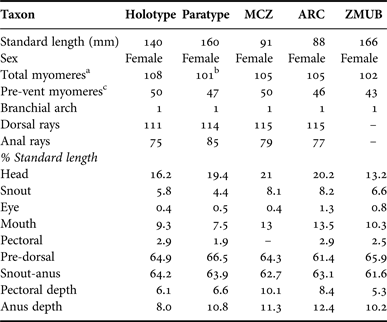
One 166 mm (standard length (SL)) specimen of Neocyema was caught by R/V Pâmiut, Greenland Institute of Natural Resources, leg 4, haul 68, 5 August 2013, in the Denmark Strait, south-east Greenland, at 64.43°N 34.05°W and deposited at the Zoological Museum University of Bergen as ZMUB 21865 (tissue JYP#997), coll./ID by J.Y. Poulsen. The specimen was caught during a routine survey with a non-closing Alfredo III trawl, probing Greenland halibut abundances. The bottom and fishing depth was between 1178 and 1182 m, with a bottom temperature of 2.13°C, although the actual catch depth is uncertain. The specimen was frozen until preserved in ethanol. The specimen was barcoded (GLF121) as part of the Greenland Fishes (GLF) barcoding project (http://www.barcodinglife.org) (Ratnasingham & Hebert, Reference Ratnasingham and Hebert2007), digitally x-rayed at the Australian Museum and examined under a stereomicroscope. One 102 mm SL adult female specimen of Cyema atrum (AMS I.18570-001) from the tropical Atlantic was included for comparison of the vertebral column in cyematid fishes. The morphological measurements were taken using a digital calliper to the nearest 0.1 mm and compared to previous work by Castle (Reference Castle1977) and DeVaney et al. (Reference DeVaney, Hartel and Themelis2009) (Table 1). I have chosen to identify the specimen as Neocyema cf. erythrosoma, as described by Castle (Reference Castle1977), however, osteology is included as a reference for future study of species diversity within Neocyema.
Data of all five confirmed specimens of Neocyema known to date. Holotype and paratype (Castle, Reference Castle1977), MCZ and ARC specimens (DeVaney et al., Reference DeVaney, Hartel and Themelis2009) and ZMUB from this study.

aMyomeres and vertebrae interchangeable as the number is identical in adults.
bThe caudal tip is missing and some vertebrae likely lost.
cThis count must be conducted on external myomeres only, as the number of pre-caudal vertebrae is different from the count of pre-vent myomeres.
Diagnosis of Neocyema specimen ZMUB 21865
Neocyema with small dark eyes, oval-shaped and visible, although covered over with integument and, therefore, appearing reduced; one oval-shaped nostril, discernible distally on upper jaw; both jaws showing teeth along their entire length with anterior tip of upper jaw terminating with a protruding tooth-covered vomerine plate/bulb, as described for the holotype by Castle (Reference Castle1977); teeth present in 1–3 rows on maxillaries and dentaries, in addition to the vomer. Approximately 70 small teeth in one row on maxillary along its entire length, approximately 75 teeth on dentary along its entire length and approximately 25 minute teeth on vomer, some curved. Vomer intact, situated distally on antero-ventral tip of upper jaws; lower jaws seem to reach further anterior than upper jaws. The specimen is lightly damaged, as the outer semi-transparent integument is torn, and anterior relocation of the lower jaws must be mentioned as a possibility; frontals fused, large, connected to slender and large ethmovomer; no opercular skeleton present; pectoral skeleton apparently not present, although, distinct pectoral lobes situated ventro-laterally, demarcated with both red-coloured base and distal transparent part. Two pectoral lobes, somewhat different on left and right sides, likely due to preservation: left-side lobe rounded, similar to type materials (Castle, Reference Castle1977), right-side lobe elongated; no pelvics present; myomeres readily visible along body; dorsal and anal fin rays weakly ossified, albeit discernible, although, as transparent integument torn, difficult to confidently establish fin ray count (Table 1); vertebral column large and ossified with vertebrae showing strong neural spines; multiple neural spines directed anteriorly, as described by Castle for type materials; haemapophyses present with strong haemal spines developing on caudal vertebrae; ribs, epipleurals and epineurals absent; lateral bony structures visible on vertebral centra, possibly parapophyses (denoted, as such, by Castle, Reference Castle1977), although, these are usually attachment sites for ribs, ribs are absent in Neocyema; elongated haemal spines, including haemal arch, occur far anterior to vent and pre-vent myomere count adopted in previous studies, therefore, not interchangeable with abdominal vertebrae; pre-caudal (abdominal) vertebrae 33 and caudal vertebrae 69 (Figure 1E); caudal fin much reduced, confluent with dorsal and anal fins; no scales present; no lateral-line pores present; large 80 mm length (48.2% SL) ovaries present, most eggs range 0.2–0.4 mm, with smaller eggs <0.1 mm present dorsal to the larger eggs in some sections of ovaries; body colour deep red when newly caught, gradually losing its red pigments and showing a tan-creamy colour when preserved in ethanol (Figure 1A–D).
Neocyema cf. erythrosoma (ZMUB 21865): (A) Neocyema from south-east Greenland in 2013, showing deep red colour fresh out of the water; (B) after 30 min in salt water, with red pigments leaking from the dead specimen; (C) specimen free suspended in salt water showing long dentaries and free-floating, semi-transparent torn integument; (D) alcohol preserved; (E) digital radiograph image of Neocyema showing completely ossified vertebral column, including neural and haemal spines. Arrows show the abrupt elongation of the haemal spines at the origin of the caudal vertebrae, and posterior pre-vent myomere; (F) illustration of Neocyema based on the new Greenland specimen. (G) Cyema atrum (AMS I.18570-001): digital radiograph image of C. atrum, showing weakly ossified vertebral column including the outgrowths; (H) illustration of C. atrum.
DISCUSSION
Osteology
Castle (Reference Castle1977) noted that Neocyema erythrosoma is neotenous based on several characters also defining the genus. Loss of multiple bones in Neocyema is evident, as for example opercular, pectoral and bones associated with the cranium, a feature observed also in other saccopharyngiforms (Smith, Reference Smith and Böhlke1989a). The vertebral column and associated outgrowths are large and completely ossified in the newly found 166 mm SL specimen from off the coast of Greenland. This vertebral ossification was not observed in the 91 mm SL specimen (MCZ 165900) described by DeVaney et al. (Reference DeVaney, Hartel and Themelis2009), which showed a non-ossified vertebral column, possibly indicating a juvenile specimen. However, eggs were observed in the 91 mm specimen (discussed below), suggesting either early reproductive maturity or a separate neotenous species. Reduction of multiple bones, especially in the cranium, and retention of a well-ossified backbone is a peculiar trait for Neocyema, possibly suggesting neoteny or a trade-off between reduction of some bony structures and retention of a large vertebral column for strong muscle attachment along the entire body. Not surprisingly, although somewhat different to Cyema, this suggests Neocyema employs anguilliform locomotion. The vertebral columns in large specimens of Neocyema (Figure 1E), and possibly Cyema, are ossified (Trewavas, Reference Trewavas1933), although, many more vertebrae are present in the former, including parapophyses, and neural and haemal spines. The 102 mm SL mature specimen of Cyema atrum shows a non-ossified vertebral column (Figure 1G). Vertebral morphology in some pelagic deep-sea anguilliforms does not seem to follow a canonical transformation in development and ossification in relation to reproductive maturity. The closely related Monognathidae also show no standard vertebral pattern between juveniles and adults across species (Bertelsen & Nielsen, Reference Bertelsen and Nielsen1987). Multiple characters separate the two known cyematid species, as, for example, the ‘beak-like’ non-occlusible jaws of Cyema, reminiscent of Nemichthyidae (Nielsen & Smith, Reference Nielsen and Smith1978), with Neocyema showing shorter occlusible jaws that are more similar to Serrivomeridae. The similarities between these taxa are, however, superficial and not supported by molecular data (Santini et al., Reference Santini, Kong, Sorenson, Carnevale, Mehta and Alfaro2013). This is further complicated by some confusion as to whether the upper jaw actually has a maxillary bone in Neocyema, as noted by Castle (Reference Castle1977), or alternatively, both maxillary and premaxillary bones have been lost with only the tooth-bearing vomer present (Smith, Reference Smith and Böhlke1989a). The latter result and deep-bodied cyematid leptocephali suggest a phylogenetic affinity with saccopharyngiforms (Robins, Reference Robins and Böhlke1989; Nelson, Reference Nelson2006). However, convergent evolution is likely and the evolution of deep-sea pelagic anguilliforms is an outstanding ichthyological conundrum.
The long dentaries (Figure 1C) and small head of the subarctic specimen (ZMUB 21865) indicate morphological differences compared to previous records (Table 1), although, more materials for morphological and molecular comparisons are needed to confidently establish the status of the genus Neocyema. I remain conservative concerning species delimitation, even though none of the previous four Neocyema specimens exhibit extended lower jaws compared to the upper jaw. On the contrary, Castle noted the upper jaw slightly in advance of the lower. Post-mortem relocation of the lower jaw or not, the vomerine tooth plate on the symphysis of the upper jaw is intact, showing teeth and bulb identical to type materials by Castle (Reference Castle1977), although fewer vomerine teeth are present on the Greenland specimen.
Distribution and larvae
Neocyema erythrosoma is one of the most elusive and mysterious deep-sea pelagic fishes known, concerning both the larval and adult life stages (Smith, Reference Smith and Böhlke1989a, Reference Smith and Böhlkeb). The Neocyema specimen presented in this study is the fifth confirmed adult specimen to be found in the Denmark Strait off south-east Greenland, with two specimens from the south Atlantic off South Africa (Castle, Reference Castle1977) and another two from Bear Seamount in the western Atlantic (Hartel et al., Reference Hartel, Kenaley, Galbraith and Sutton2008; DeVaney et al., Reference DeVaney, Hartel and Themelis2009). DeVaney et al. (Reference DeVaney, Hartel and Themelis2009) noted that thousands of trawl hauls have been conducted in the western North Atlantic before the capture of two specimens in 2006 and 2008. The same can be said for the south-west and south-east Greenland exclusive economic zone sectors, although, primarily crude ground trawl fishing is being done on depths above 1500 m. Therefore, the occurrence of Neocyema off Greenland must be considered an incidental catch and it is not presently possible to conclude anything reasonable concerning the true distribution of Neocyema in the North Atlantic or other localities. Mead (Reference Mead1964) noted a specimen that appears to be Neocyema from the Indian Ocean, although this record has never been confirmed. Problems concerning the true distribution ranges and general taxonomy of pelagic fishes off southern parts of Greenland, an important transition area related to changing ocean temperatures between temperate and subarctic latitudes, constitute major unknowns at present and are part of ongoing research.
Smith (Reference Smith and Böhlke1989b) and DeVaney et al. (Reference DeVaney, Hartel and Themelis2009) discussed the likelihood of Leptocephalus holti (Schmidt, Reference Schmidt1909) being the larvae of Neocyema. They noted the possibility of several other yet unknown species in the genus Neocyema, as the larval material can be divided into three groups reflecting three possible species (Smith & Miller, Reference Smith and Miller1996; Miller & Tsukamoto, Reference Miller and Tsukamoto2004). Leptocephalus holti could, therefore, refer to three putative Neocyema species. Raju (Reference Raju1974) similarly noted that a leptocephalus from the northern Pacific Ocean showed many similar features to the leptocephalus of the only known cyematid species at that time, Cyema atrum, and concluded that, since the specimen was practically identical to L. holti from the north-eastern Atlantic as described by Schmidt (Reference Schmidt1909), it would come to represent a new species and genus within the Cyematidae. Although all five confirmed adult specimens of Neocyema are from the Atlantic, it is possible that Neocyema is circumglobally rare or present at depths infrequently surveyed, and despite there being no confirmed adults from the Pacific Ocean. Fortuño & Olivar (Reference Fortuño and Olivar1986) described a single specimen of L. holti from the Benguela current, fairly close to where the first described specimens of N. erythrosoma were caught off the Atlantic coast of South Africa (Castle, Reference Castle1977). The ‘proximity’ between one adult specimen of Neocyema from this study, off the coast of Greenland, two specimens from the north-western Atlantic (DeVaney et al., Reference DeVaney, Hartel and Themelis2009) and leptocephali (L. holti) from the pelagic fishery in the Sargasso Sea area (Smith & Miller, Reference Smith and Miller1996) is noteworthy, and suggests that the North Atlantic Drift is a factor in the dispersal of Neocyema. However, we need more than five adult Neocyema specimens from the Atlantic Ocean, scattered Pacific larval material, an unconfirmed specimen from the Indian Ocean and the three leptocephali ‘species’ (Smith & Miller, Reference Smith and Miller1996) to resolve the diversity within Neocyema, and species delimitation should be conservative at this point. The low number of pre-vent myomeres and total vertebrae shows that the Greenland specimen is most similar to L. holti, ‘species 1’ of Smith & Miller (Reference Smith and Miller1996). Future molecular comparisons between the different forms of ‘L. holti’ and adult Neocyema specimens will most certainly resolve several of the taxonomic issues currently present. The Cox1 barcode (GLF121) of Neocyema off Greenland is available from http://www.barcodinglife.org. DeVaney et al. (Reference DeVaney, Hartel and Themelis2009) summarized possible nomenclature changes. It must be noted that neither larvae nor adults of Cyema and Neocyema, both taxa observed off the coast of Greenland, have been caught off the south-west coast of Iceland (Jónsson & Pálsson, Reference Jónsson and Pálsson2013), an area usually considered more diverse and better sampled than southern Greenland's surrounding waters.
Reproductive maturity, depth and temperature distribution
The 166 mm SL Greenland specimen is the largest of the five confirmed specimens and is also a female (Table 1). Castle (Reference Castle1977) found minute ova in the 140 mm holotype and 0.3 mm ova in the 160 mm paratype. DeVaney et al. (Reference DeVaney, Hartel and Themelis2009) also found small eggs in defined ovaries, although in much smaller specimens (88–91 mm SL). These observations are noteworthy considering that the vertebral column is not ossified in MCZ 165900 (only 91 mm SL, data not shown). The Greenland specimen has large egg-containing ovaries, extending almost half the body length. Most eggs are in the range of 0.2–0.4 mm, similar to the observations for the 160 mm SL paratype, although additional smaller eggs <0.1 mm are present in some sections of the ovaries. The smaller eggs appear somewhat separated from the larger eggs within the ovaries, indicating a hiatus in the egg production. Despite freezing and potential damage to eggs, all eggs are intact and clearly immature in the Greenland specimen. Saccopharyngiform fish are one-time spawners, releasing mature eggs from ruptured ovaries (Bertelsen & Nielsen, Reference Bertelsen and Nielsen1987). This indicates that the Greenland Neocyema specimen is outside the normal range for breeding populations and is, therefore, an expatriate specimen likely not to reproduce.
The depth of capture for the Greenland Neocyema specimen presented here is also the shallowest record to date. The specimen was caught during bottom trawling at depths of 1178–1182 m; however, the specimen was found on deck, not in the trawl catch and, therefore, was likely hooked by its small jaw teeth in the roped mesh, or fell through the net mesh. It is possible that the specimen was caught during the upward haul in the meso- or even epipelagic layers, contradicting previous reports noting Neocyema as strictly bathypelagic. Castle (Reference Castle1977) reported depths of 2000–2200 m for the holotype and paratype, with no mention of fishing gear, and DeVaney et al. (Reference DeVaney, Hartel and Themelis2009) noted a similar depth for the third north-west Atlantic specimen and 1620 m for the fourth. However, non-closing nets were used and the western Atlantic specimens could potentially also have been caught during the upward haul. The true depth range remains largely unknown. The sea bottom water temperature off the south-east coast of Greenland was only 2.13°C during the trawl haul, although the temperature in the mesopelagic column is usually 2–4°C higher than this at this time of year. Therefore, several parameters related to morphology, geography, depth, temperature and maximum size are hereby updated for Neocyema cf. erythrosoma, although much of this species' biology is still shrouded in uncertainty.
ACKNOWLEDGEMENTS
I am grateful to P. Binzer, J. Stenholdt, H.M. Birk, B. Hansen and J. Hjorth (GINR) for taking care of the specimens onboard the R/V Pâmiut, including the large sampling effort off the south-east coast of Greenland, H. Siegstad and N.A. Hammeken (GINR) for logistics, S. DeVaney (LACM), K.E. Hartel (MCZ), E. Kenchington and T. Kenchington (CMB), D.G. Smith (USNM) and R. Thiel (ZMH) for the catch and specimen information, K. Graham, A. Hay, J. King, M. Lockett, M. McGrouther and S. Reader (AMS) for their help with x-rays, photography and logistics, K. Hjørne and E. Hjørne for their help with illustrations, I. Byrkjedal and G. Langhelle (ZMUB) for the curating and shipping of materials, anonymous reviewers for their comments and a special thanks to J.R. Paxton (AMS) for his advice and many discussions on deep-sea fishes. This research received no specific grant from any funding agency, commercial or not-for-profit sectors.