Mastitis is the most prevalent and costly disease in dairy herds, where it is associated with high somatic cell count (SCC) and decreased milk production. While many studies have tried to calculate economic losses caused by mastitis, the conclusions vary widely, as reviewed by Halasa et al. (Reference Halasa, Huijps, Østerås and Hogeveen2007). A study using national US data from 1996 found that the decrease in milk production associated with high bulk milk SCC caused a total loss of up to $810±480 million to the US economy when consumer supply and demand were taken into account (Losinger, Reference Losinger2005). In the UK, the annual value of output losses or resource wastage due to mastitis was estimated to have a direct cost of £121 million (Bennett et al. Reference Bennett, Christiansen and Clifton-Hadley1999). The same study also estimated annual treatment costs at an average of £61·5 million.
With respect to teat disinfection, teat dipping plays a crucial role in protection against invading mastitis pathogens and consists of treating teats pre- and/or post milking. It has been estimated that the implementation of teat dipping costs £1·40 per cow per year. The same study calculated that herds using three different preventive measures for mastitis, including teat dipping, could save an average of £35 per cow per year on disease costs, which would be a yearly saving of £3500 in a cow herd averaging 100 animals (Yalcin et al. Reference Yalcin, Stott, Logue and Gunn1999). Teat dips commonly contain diluted disinfectants, teat-skin conditioners or emollients as well as surfactants (Pankey et al. Reference Pankey, Eberhart, Cuming, Daggett, Farnsworth and McDuff1984). The antibacterial active ingredients used in teat dips are diluted disinfectants such as iodine or chlorhexidine. Use of a post-milking teat dip containing 1% iodine led to residues of 336 μg of iodine/l of milk marking a significant rise when compared with the corresponding value of 292 μg/l resulting from using 0·1% iodine in dips (Galton et al. Reference Galton, Petersson and Erb1986). In the 1970s concerns were raised in the USA over high iodine residues in foods, as some daily intakes exceeded the ‘safe-levels’ set by the National Research Council, as found in surveys by Vanderveen (Reference Vanderveen1979). High iodine levels in milk and dairy products were suggested to be the major source of dietary iodine intake of the US population and the percentage of iodine provided by dairy products for adults and young children was 38–56% and 56–85%, respectively (Park et al. Reference Park, Harland, Vanderveen, Shank and Prosky1981). Use of iodine products, through either feed supplements or disinfectant usage in the dairy was subsequently monitored carefully in dairy herds and has fallen since the 1980s (Pennington et al. Reference Pennington, Young and Wilson1989). In recent years, further controversy over iodine residues arose when dermatologists linked the levels of iodine in dairy products to the development of teenage acne, with some clinicians advising their acne-affected patients to avoid the intake of dairy products (Arbesman, Reference Arbesman2005; Danby, Reference Danby2007). Consequently, there is a need to develop more natural antimicrobials as alternatives for incorporation into teat dips.
To date, little research has been undertaken to develop alternative formulations that would reduce the risk of disinfectant residues in milk and few attempts have been made to replace chemical teat dips with more ‘natural’ substances. Previously, an alternative commercial teat dip containing the bacteriocin nisin was investigated (Sears et al. Reference Sears, Smith, Stewart, Gonzalez, Rubino, Gusik, Kulisek, Projan and Blackburn1992; Serieys & Poutrel, Reference Serieys and Poutrel1996). Additionally, experimental teat dips made from a Lactobacillus acidophilus preparation, from a sour milk product and a teat dip based on an Aloe Vera gel have all been examined (Oliver & Mitchell, Reference Oliver and Mitchell1985; Koskinen et al. Reference Koskinen, Rantala and Saloniemi1996; Leon et al. Reference Leon, Beer, Wacken, Nurnberg and Andersson2004). The rate of new infections was insignificant compared with the diverse control groups (in most trials iodine-dipped control groups were included).
Lc. lactis DPC 3147 was originally isolated from an Irish kefir grain (Rea & Cogan, Reference Rea and Cogan1994) and produces the bacteriocin lacticin 3147. Bacteriocins are peptides produced by many bacteria for the purpose of destroying their competitors. Lacticin 3147 is a two-component bacteriocin classified as a lantibiotic (Class I bacteriocins) owing to its unusual lanthionine and β-methyllanthionine groups which result from post-translational modifications. These unusual groups assist the bacteriocin in forming a certain three-dimensional structure which is necessary for its binding to lipid II, a general cell wall component in Gram-positive bacteria. The binding of lacticin 3147 to lipid II leads to potassium leakage to the extracellular space, dissipating the membrane potential, and is followed by cell apoptosis (McAuliffe et al. Reference McAuliffe, Ryan, Ross, Hill, Breeuwer and Abee1998; Sit & Vederas, Reference Sit and Vederas2008). Lacticin 3147 is active against a wide range of Gram-positive bacteria including mastitic pathogens such as Staph. aureus and Str. dysgalactiae (Ryan et al. Reference Ryan, Meaney, Ross and Hill1998). In previous trials, we showed that incorporation of lacticin 3147 into teat seals improved the protection of animals against both these organisms (Ryan et al. Reference Ryan, Flynn, Hill, Ross and Meaney1999; Twomey et al. Reference Twomey, Wheelock, Flynn, Meaney, Hill and Ross2000; Crispie et al. Reference Crispie, Twomey, Flynn, Hill, Ross and Meaney2005). Subsequent trials have shown that preparations of the live producing culture were as effective as commonly used antibiotics for the treatment of intramammary infections (Crispie et al. Reference Crispie, Alonso-Gomez, O'Loughlin, Klostermann, Flynn, Arkins, Meaney, Ross and Hill2008; Klostermann et al. Reference Klostermann, Crispie, Flynn, Ross, Hill and Meaney2008). In the present study, we evaluated the ability of a milk-based lacticin-containing fermentate to eliminate the mastitis pathogens Str. uberis, Str. dysgalactiae and Staph. aureus both in vitro and in vivo on the teat surface. Staph. aureus and Str. dysgalactiae are predominant udder specific pathogens especially in Northern European countries (Barrett et al. Reference Barrett, Healy, Leonard and Doherty2005; Persson Waller et al. Reference Persson Waller, Bengtsson, Lindberg, Nyman and Ericsson2009) and the incidence rates of mastitis caused by such specific pathogens can be significantly reduced by the use of teat dipping (Whist et al. Reference Whist, Østerås and Solverod2007). Str. uberis belongs to the group of environmental pathogens and is another important Gram-positive mastitis pathogen which can enter the teat canal after milking when the closure of the teat orifice is not yet established and the teat end is contaminated. The aim of the present study was to examine the bactericidal activity of a lacticin-containing fermentate against three important mastitis pathogens as a basis for the development of an effective teat dip in the future.
Materials and Methods
Bacterial strains
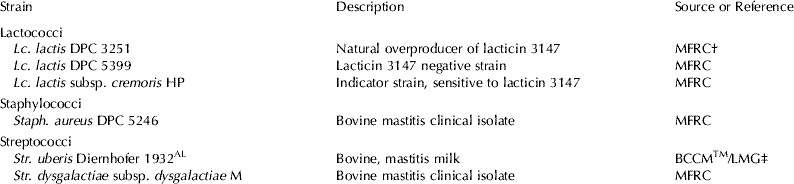
All bacterial strains were either selected from the culture collection at the Moorepark Food Research Centre, Teagasc, Moorepark, Fermoy, Co. Cork, Ireland or from the Bacteria Collection of the Laboratorium voor Microbiologie, Universiteit Gent, Belgium (Table 1). The lactococcal strains used in the study were Lc. lactis DPC 3147, the original strain found to produce the bacteriocin lacticin 3147 and Lc. lactis DPC 3251, another isolate which naturally overproduces the bacteriocin. Lc. lactis DPC 5399, a derivative of Lc. lactis DPC 3147 which does not contain the lacticin 3147-encoding plasmid pMRC01, was used as a lacticin negative control (Bac−). Lc. lactis subsp. cremoris HP was used as a lacticin 3147-sensitive indicator strain. All lactococcal strains were maintained on M17 Agar or Broth (Becton Dickinson and Company, Sparks MD, USA) supplemented with 0·5% (w/v) Lactose (LM17 Agar and LM17 Broth). The lactococcal strains were grown overnight at 30°C.
Summary of bacterial strains
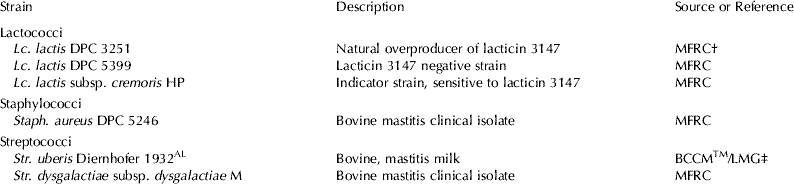
† Moorepark Food Research Centre
‡ Bacteria Collection of the Laboratorium voor Microbiologie, Universiteit Gent, Belgium
The mastitis pathogen Staph. aureus DPC 5246 was isolated from a naturally occurring mastitis case and was used in previous studies as a challenge organism (Twomey et al. Reference Twomey, Wheelock, Flynn, Meaney, Hill and Ross2000; Crispie et al. Reference Crispie, Twomey, Flynn, Hill, Ross and Meaney2005). Str. uberis Diernhofer 1932 and Str. dysgalactiae M were also isolates from mastitic milk and the latter was used as a challenge strain in experiments both in vivo and in vitro (Ryan et al. Reference Ryan, Flynn, Hill, Ross and Meaney1999). All mastitis pathogens were routinely grown in TSB (Tryptic Soy Broth, B.D. and Co., 38800 Le Pont de Claix, France) and on Blood Agar Base No. 2 (Merck, Darmstadt, Germany) supplemented with 0·1% aesculin (w/v, Sigma Chemical Company, St. Louis MO, USA) and 5–7% (v/v) whole calf blood (Aesculin Blood Agar, ABA) (IDF, 1981). Staphylococci were enumerated on Mannitol Salt Agar (Merck, Darmstadt, Germany) while streptococci were grown on Modified Edwards Medium (Oxoid Ltd., Hampshire, England) supplemented with 5–7% (v/v) whole calf blood (IDF, 1981).
Preparation of the teat dip
The teat dip was prepared by growing Lc. lactis DPC 3251 in 10% (w/v) reconstituted skim milk (10% RSM). An overnight broth culture of the above strain was used to inoculate 10% RSM and was subsequently grown for 20 h at 30°C. The resulting fermentate was then stored at 4°C and used as the 3251 teat dip in bactericidal assays and in experiments in vivo. For the experiments in vitro, a control fermentate produced by the bacteriocin negative strain Lc. lactis DPC 5399 was prepared using identical conditions to the 3251 fermentate. The fermentate of the strain Lc. lactis DPC 5399 (Bac− fermentate) was chosen because it is a bacteriocin-negative derivative of the original lacticin producer Lc. lactis DPC 3147. The pH and the consistency of the 5399 fermentate were similar to fermentates produced by the lacticin-overproducing strain Lc. lactis DPC 3251. Both dips were always used within 24 h of production.
Lacticin production and storage stability
To assess the storage stability of the bacteriocin in the Lc. lactis 3251-fermentate at 4°C, the lacticin activity of a 3251 fermentate, prepared in duplicate, was assayed over a 3-week period on days 1, 4, 7, 14 and 21. Bacteriocin activity was measured by an agar well diffusion assay, with the lacticin 3147-sensitive strain Lc. lactis subspecies cremoris HP (Table 1) as the indicator strain. Activity was measured and expressed as arbitrary units (AU/ml) as described by Ryan et al. (Reference Ryan, Rea, Hill and Ross1996).
Preparation of challenge bacteria for bactericidal assays and teat challenges
The challenge bacteria were prepared by inoculating overnight cultures of Staph. aureus DPC 5246, Str. uberis Diernhofer 1932 or Str. dysgalactiae M to 1% (v/v) in TSB and incubating at 37°C for 16 h. Resulting cultures were then diluted to a concentration of 105 cfu/ml using TSB and these dilutions were immediately used as the challenge in bactericidal assays. Initially, challenge concentrations of 105 cfu/ml were also used for experiments in vivo. To ensure sufficient recoveries to allow accurate assessment of effectiveness for experiments in vivo, the concentration of challenge organisms had to be increased to >107 cfu/ml.
Bactericidal assays measuring the effect of teat dips on Gram-positive mastitis pathogens
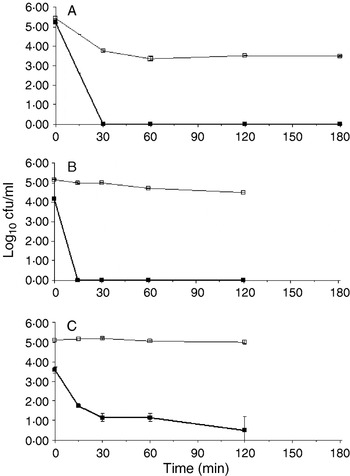
The teat dip was assessed for its ability to kill Gram-positive mastitis pathogens in vitro. The Bac− fermentate served as the control dip. In each assay, 1 ml of the diluted challenge pathogen was mixed with 10 ml of the teat dip. Immediately after the addition of the challenge to the dip solution, dips were mixed thoroughly. An aliquot of the challenge strain was taken immediately (time zero, T0) for viability counts and the mixture of teat dip and challenge pathogen was incubated at 37°C, similarly to experiments by Koskinen et al. (Reference Koskinen, Rantala and Saloniemi1996). Ryan et al. (Reference Ryan, Meaney, Ross and Hill1998) previously showed that lacticin 3147 was generally more potent against streptococci than staphylococci and thus, as staphylococcal challenges were expected to be more resilient than streptococci, aliquots in such challenges were taken after 30, 60, 120 and 180 min (T30, T60, T120 and T180). To examine expectedly quicker changes, aliquots for streptococcal challenges were taken after 15, 30, 60 and 120 min (T15, T30, T60 and T120). Each aliquot was immediately diluted and 100 μl of each dilution as well as 100 μl of the original aliquot were plated in duplicate using standard microbiological procedures as described by Twomey et al. (Reference Twomey, Wheelock, Flynn, Meaney, Hill and Ross2000). Plates were incubated overnight at 37°C and viable challenge pathogens were counted. The detection of pathogen activity was very sensitive and pathogens ⩾10 cfu/ml could be detected. If no growth was detected on any of the plates (numbers of pathogens <10 cfu/ml) then a value of zero was applied (Twomey et al. Reference Twomey, Wheelock, Flynn, Meaney, Hill and Ross2000), represented as 0 log10 cfu/ml (Fig. 3).
Selection of animals, sampling procedures and microbiological methods for trials in vivo
For the trials in vivo, live teats rather than excised teats were used to mimic field conditions, as the Bac+ fermentate, and the challenge pathogens may be affected by the changing temperatures of the teat surface after milking (Isaksson & Lind, Reference Isaksson and Lind1994) or by other conditions found on live teats, which can be overlooked using an excised teat model. Eighteen teats of eight lactating Holstein-Friesian cows were used for the teat dip trials. Of these, five teats were assigned to the trial with the staphylococcal challenge. Seven teats and a further six teats were assigned to the trials with Str. dysgalactiae M and Str. uberis Diernhofer 1932, respectively. One teat in each of the three trials served as an undipped control. To identify teats suitable for the experiments, quarter milk samples of cows were collected aseptically from all trial cows before the morning (AM) milking. For the latter sample collection, teats were cleaned by washing with water and then dried with service-paper towels. Immediately before sampling, teats were then disinfected with cotton wool swabs containing Methylated Spirits (Blackhall Pharmaceutical Distributors Ltd., Swords, Co. Dublin, Ireland). Twenty-five ml of milk were collected from each quarter. SCC of milk samples was determined using the Somacount 300® (Bentley Instruments Incorporated, USA). Pathogens in milk samples were detected by plating 10 μl of each sample on ABA and incubating overnight at 37°C. As only teats of healthy quarters were used for the live challenge trials, teats were enrolled if quarter milk samples taken before the trial had a SCC of <400×103 cells/ml and were free of pathogens. Additionally, the selected teats were free from warts, lesions, crusts or abrasions, showed a uniform size, with smooth teat skin and no signs of inflammation (redness, tenderness or swelling).
Challenge, teat dipping procedure and recovery of challenge bacteria used in trials in vivo
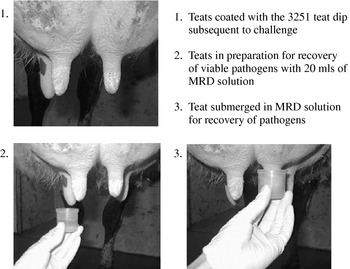
Following the AM milking, the selected teats and the surrounding skin were prepared for the trial by washing with lukewarm water. Teats and udder were subsequently dried with service paper towels. Washed teats were then disinfected twice from teat base to tip with cotton wool swabs containing Methylated Spirits® (Blackhall Pharmaceutical Distributors Ltd). The challenge and teat dipping procedures were essentially a modified version of the procedure described by Philpot et al. Reference Philpot, Boddie and Pankey1978. The principal dipping technique is shown in Fig. 1. In brief, the washed and disinfected teats (including control teats) were dipped once in 25-ml beakers containing 12-ml volumes of the challenge culture. The teat tip had to touch the bottom of the beaker to ensure equal coating of each teat with the challenge organism. Following a 5-min drainage time, each of the teats selected for dipping with the DPC 3251 teat dip was submerged into a beaker containing 20 ml of the experimental dip, while one teat per organism type remained undipped as a negative control. The contact time for the teat dip was 10 min. Following the contact of the challenge organisms with the dip, the surviving organisms were recovered by submerging the teats (control and dipped teats) into sterile beakers containing 20 ml MRD (Maximum Recovery Diluent, Oxoid Ltd., Hampshire, England). The final recovery suspension from each teat was then stored in Sterilin® bottles and immediately transported to the laboratory to enumerate the surviving bacterial cells. The recovery solutions were diluted and plated in duplicate within 2 h of collection. Plates were incubated overnight at 37°C and viable challenge pathogens were counted.
Technique for challenge, teat dip, wash off and recovery on live teats

Aftercare of the animals
To remove any remaining bacteria from the teat surface, all teats were disinfected with cotton wool swabs soaked in Methylated Spirits® after the final recoveries were taken. The teats were then washed with lukewarm water to remove any teat-dip residues. Teats were subsequently dried with service paper towels. Finally, the teats were sprayed with a commercial teat dip, Deosan Summer Teatcare Plus® (RTU, Diversey Lever) which was used routinely in the herd.
Results
Preparation of the fermented teat dip and lacticin content throughout storage
Teat dips used in all the experiments consisted of the described fermentate of Lc. lactis DPC 3251 grown in 10% RSM (Bac+ fermentate). Generally, teat dips produced by growing Lc. lactis DPC 3251 contained bacterial counts of 109 cfu/ml after 20-h incubation at 30°C. The lacticin activity for each Bac+ fermentate used in bactericidal assays or live teat challenges was ⩾10 240 AU/ml at a pH value of approx. 4·4. No lacticin activity was detected in Bac− fermentates and the pH value of the control fermentates was always similar to that of the lacticin-containing fermentate at approx. 4·4.
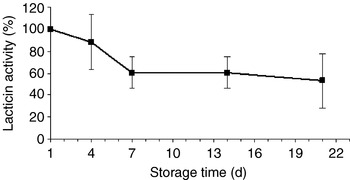
The lacticin stability of two dips was assessed during storage of the dip at 4°C for up to 21 d. The mean lacticin activity in the dips declined to 60% in the first 7 d of storage (Fig. 2) but the bacteriocin still retained 53% of its activity until the final sampling day.
Mean percentage of lacticin activities of two Lactococcus lactis DPC 3251 fermentates over a storage period of 3 weeks at 4°C. Errors indicate ±1sd.

Bactericidal assays against Gram-positive mastitis pathogens
The anti-bacterial efficacy of the fermented teat dip was first evaluated ex vivo against Staph. aureus DPC 5246, Str. dysgalactiae M and Str. uberis Diernhofer 1932. A control fermentate produced by the Bac− strain Lc. lactis DPC 5399 was included in the assays. When exposed to the Bac+ fermentate, Staph. aureus DPC 5246 was rapidly killed and no live cells were recovered after 30 min of incubation (a reduction of 5·2 log10 cfu/ml). In contrast, the Bac− fermentate resulted in a decrease in viability of only 1·6 log10 cfu/ml (Fig. 3). The Bac+ fermentate therefore resulted in a reduction of staphylococci of 3·6 log10 cfu/ml compared with the Bac− fermentate. Similarly, when Str. dysgalactiae M was incubated with the Bac+ teat dip, no viable pathogens could be detected after 15 min (a reduction of at least 5 log10 cfu/ml; Fig. 3). Given that the Bac− fermentate resulted in a reduction of only 0·7 log10 cfu/ml we conclude that the majority of the bactericidal action of the dip is due to the lacticin content. In contrast, Str. uberis Diernhofer 1932 seemed to survive better in the Bac+ dip, where numbers were reduced by approximately 2 log10 cfu/ml in the first 15 min (T0–T15). After 120 min some live cells were still present albeit at a very low numbers (approx. 60 cfu/ml). Again, Str. uberis Diernhofer 1932 was only slightly reduced in the Bac− control solution (Fig. 3).
Bactericidal efficacy of the fermentate of Lactococcus lactis DPC 3251 (black squares, ▪) and a Bac− fermentate as a control (white squares, □) on Staphylococcus aureus DPC 5246 (A), Streptococcus dysgalactiae M (B) and Streptococcus uberis Diernhofer 1932AL (C). Errors indicate ±1sd

Efficacy of the lacticin-based teat dip in vivo
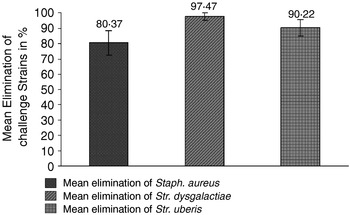
To evaluate the potential value of performing large scale animal trials, we examined the short-term effect of the Bac+ fermentate on live teats of lactating dairy cows. For this purpose three separate, small scale teat dip trials were performed in which five teats were challenged with staphylococci, seven with Str. dysgalactiae and a further six with Str. uberis. To gain sufficient bacterial recoveries for monitoring purposes, challenge concentrations for these trials were set greater than 107 cfu/ml. When Staph. aureus DPC 5246 was used as the challenge organism, mean recoveries of viable staphylococci on the teats dipped with the DPC 3251 dip were 4·68 log10 cfu/ml. Compared with the recoveries from the untreated control teat, this represented an 80±8% elimination of the challenge organism on the teat surface (Fig. 4). The mean streptococcal recovery after dipping with the DPC 3251 teat dip was 2·68 log10 cfu/ml for Str. dysgalactiae M and the mean elimination was found to be 97·5±2·5% (Fig. 4). Mean recoveries from teats challenged with Str. uberis Diernhofer 1932 were 3·8 log10 cfu/ml, representing an elimination of 90·2±5·3% (Fig. 4). No animal or quarter enrolled showed any signs of infection with the pathogens used for the challenge procedure after the trial.
Mean percent elimination of Staphylococcus aureus DPC 5246 (four teats), Streptococcus dysgalactiae M (six teats) and Streptococcus uberis Diernhofer 1932 (five teats) on teats of cows dipped with 3251 teat dip compared to one undipped control teat each. Errors indicate ±1sd

Discussion
The use of teat dips is considered to be an essential element of on-farm practice and contributes to both good milk quality and improved animal health. However, most dips are based on disinfectants of a synthetic nature, which can lead to residues in milk. Such residues may lead to quality problems in later processing such as the presence of high amounts of iodine in infant formula as discussed by Fisher (Reference Fisher1989). Only a few studies have addressed the application of more natural products with antimicrobial properties for use as teat dips (Oliver & Mitchell, Reference Oliver and Mitchell1985; Sears et al. Reference Sears, Smith, Stewart, Gonzalez, Rubino, Gusik, Kulisek, Projan and Blackburn1992; Koskinen et al. Reference Koskinen, Rantala and Saloniemi1996; Serieys & Poutrel, Reference Serieys and Poutrel1996; Leon et al. Reference Leon, Beer, Wacken, Nurnberg and Andersson2004).
In the present study, we generated a fermented teat dip containing a bacteriocin-producing live culture and evaluated its efficacy at killing mastitic pathogens. Importantly, the resultant dip was shown to be highly effective in killing both Staph. aureus and Str. dysgalactiae as well as reducing numbers of Str. uberis by approx. 3 log10 cfu/ml (Fig. 3). The effects observed in vitro were more than likely due to the bacteriocin lacticin, since initial controls using acidified RSM (data not shown) and controls using the Bac− fermentate demonstrated that neither acid nor a non-producing strain could result in the reduction of >1 log10 cfu/ml for acidified 10% RSM (data not shown) or >1·6 log10 cfu/ml for the Bac− fermentate in a staphylococcal challenge (Fig. 3). The incomplete elimination of Str. uberis by the Bac+ fermentate in the experiments ex vivo might have been due to its slower growth rates in milk. Indeed, we have previously shown that the lacticin peptides have a dual mechanism involving both cell wall inhibition (binding to lipid II) and pore formation, the latter of which is associated with the energy state of the cell (McAuliffe et al. Reference McAuliffe, Ryan, Ross, Hill, Breeuwer and Abee1998; Wiedemann et al. Reference Wiedemann, Bottiger, Bonelli, Wiese, Hagge, Gutsmann, Seydel, Deegan, Hill, Ross and Sahl2006). It has been shown previously that the specific udder pathogens Staph. aureus and Str. dysgalactiae are highly adapted to a milk-based environment and therefore growth rates of these two mastitis pathogens in milk can be higher than growth rates of the environmental pathogen Str. uberis (Oz et al. Reference Oz, Farnsworth and Cox1986). Thus, as lacticin activity depends on the energy status of the target cell, this may explain why Staph. aureus and Str. dysgalactiae are killed more effectively than the slow-growing Str. uberis in the milk-based environment of the fermented dip. A longer incubation period might have resulted in a more complete elimination of Str. uberis. However, as Staph. aureus is the most frequently isolated strain in Irish dairy cows with high SCC (Barrett et al. Reference Barrett, Healy, Leonard and Doherty2005) we want to emphasize that the effects of the teat dip resulted in a complete elimination of Staph. aureus.
Teat dips containing nisin have been investigated previously (Sears et al. Reference Sears, Smith, Stewart, Gonzalez, Rubino, Gusik, Kulisek, Projan and Blackburn1992; Serieys & Poutrel, Reference Serieys and Poutrel1996). Lacticin, however, has an advantage over nisin for such applications as it is more active at physiological pH. Indeed, we have previously shown that nisin was unable to inhibit the growth of Str. dysgalactiae at neutral pH when incorporated into a teat seal formulation, whereas lacticin was able to show a clear zone of inhibition (Ryan et al. Reference Ryan, Meaney, Ross and Hill1998). Similarly, nisin was unable to reduce numbers of staphylococci in skim milk at neutral pH only showing best effects against Staph. aureus under low-pH conditions (Sobrino-Lopez & Martin-Belloso, Reference Sobrino-Lopez and Martin-Belloso2006). These results might suggest that a lacticin-based teat dip would be more effective on the teat surface than a similarly manufactured nisin-based dip, although this would need to be tested experimentally.
In a study by Oliver & Mitchell (Reference Oliver and Mitchell1985), a natural preparation made from Lactobacillus acidophilus reduced numbers of Gram-positive mastitis pathogens on challenged teats when compared with an iodine solution. On excised teats, the Lb. acidophilus preparation reduced levels of Staph. aureus and streptococcal species by 72% and >95%, respectively. These numbers are comparable to the efficacy of the 3251 fermentate in the present study, as staphylococci were reduced by approx. 80% and average streptococcal reductions were approx. 96%. Sears et al. (Reference Sears, Smith, Stewart, Gonzalez, Rubino, Gusik, Kulisek, Projan and Blackburn1992) found that purified nisin reduced Staph. aureus on the teat skin of live cows by 3·9 log10 cfu/ml after an exposure of 1 min compared with a reduction of 0·7 log10 cfu/ml for staphylococci in the present study after a contact time of 10 min. It should be emphasised, however, that a preparation based on purified or highly concentrated nisin may prove expensive for such applications. Additionally, it should be noted that as Staph. aureus strains can vary significantly in virulence potential (Dingwell et al. Reference Dingwell, Leslie, Sabour, Lepp and Pacan2006) and indeed in susceptibility to lacticin 3147 itself (Ryan et al. Reference Ryan, Meaney, Ross and Hill1998), our results cannot be compared directly with the results with nisin as different isolates of Staph. aureus were used.
Another factor which should be considered in the analysis of our results is the absence of any surfactants or emollients in the dips described in this study. Surfactants and emollients are used in commercial teat disinfectants in order to ensure proper coating of the teat surface and to keep the teat skin smooth and moisturized. One such surfactant and one emollient have been integrated into the 3251 dip in other assays. Addition of the surfactant Texapon® (TEA Lauryl Sulphate, courtesy of Cross Vet, Research Laboratories, Ireland) at a concentration of 1% (v/v) or the emollient Glycerol® (Sigma Aldrich Ireland Ltd., Dublin, Ireland) at a concentration of 5% (v/v) to the lacticin teat dip did not increase the average antibacterial effectiveness in these assays when compared with results of the teat dip without additives (data not shown). However, more studies should be undertaken to determine whether other surfactants could enhance the activity of the lacticin-based dip.
It was previously found that under varying natural conditions streptococcal and staphylococcal counts on teats never exceeded approx. 3 or 4 log10 cfu/ml respectively (Hogan et al. Reference Hogan, Smith, Todhunter and Schoenberger1990). Therefore, artificial teat challenge models present a much higher bacterial count to any experimental teat dip than in conditions found under natural exposure. Therefore under natural conditions, the dip may be even more effective. Another parameter which may have influenced the results of the activity of the dips was the incubation temperature of 37°C used when recovering pathogens. Although the resting skin surface temperature of the teat in a housed cow averages 30°C, it has been shown that during milking, the temperature of the teat surface can be subject to change and can range from 29°C to 38°C (Isaksson & Lind, Reference Isaksson and Lind1994). The surface temperature is also higher after milking when the milk flow has warmed the teat surface (Isaksson & Lind, Reference Isaksson and Lind1994). Therefore, as teat dips are applied immediately post milking, when the milk flow has warmed the teat surface, it was decided that similarly to Koskinen et al. (Reference Koskinen, Rantala and Saloniemi1996), for the bactericidal assays in vitro, an incubation temperature of 37°C should be used. This may also have positively selected for pathogens as this temperature is recommended by National Mastitis Council for optimal recovery of pathogens and is also substantially higher than the optimum growth temperature for Lc. lactis DPC 3251 of 30°C (S Morgan, personal communication). To examine the 3251 dip on a larger scale, a natural exposure trial, also evaluating the effectiveness of the dip at varying temperatures, would therefore be recommended. In the natural exposure trial by Koskinen et al. (Reference Koskinen, Rantala and Saloniemi1996) fewer isolates of Staph. aureus (2·09%) or coagulase-negative staphylococci (2·52%) were found in milk from udder quarters dipped with sour milk compared with the results of undipped controls (3·09% and 4·07% of total isolates, respectively). The group dipped with an iodine-containing dip had the least number of Staph. aureus isolates (0·83% total isolates); however, there were no statistical significant differences between treatments. Following their natural exposure trial, Oliver & Mitchell (Reference Oliver and Mitchell1985) concluded that their Lb. acidophilus preparation was effective in preventing intramammary infections by 57% when compared with the number of infections in the undipped control group. Additionally, no teat irritations were noticed. In a field trial evaluation by Sérieys & Poutrel (Reference Serieys and Poutrel1996) a commercial dip formulation containing nisin was compared with a 0·5% iodine dip. No significant difference in new infection rates was found. Another non-chemical teat dip based on an Aloe Vera gel was also compared with an iodine dip in a field trial. Results showed that the mastitis occurrence in both groups was not significantly different (Leon et al. Reference Leon, Beer, Wacken, Nurnberg and Andersson2004). These results have therefore shown that to date, alternative (‘non-chemical’) teat dips have proven efficient in preventing mastitis.
From a food perspective, consumers are becoming more aware of the sources, contents and the production of food, which is evident from the rising demands for organic and natural dairy products (McElroy, Reference McElroy2008). In this respect, a natural, non-chemical teat dip containing food grade bacteria would certainly be of benefit for the dairy industry. Additionally, given that chemical teat dips can cause severe irritation of the skin (Sears et al. Reference Sears, Smith, Stewart, Gonzalez, Rubino, Gusik, Kulisek, Projan and Blackburn1992), the search for milder agents with antimicrobial action seems to be a sensible approach. In the present study, the teat skin effect of an application of the 3251 dip was not examined, though in the long term trials by Koskinen et al. (Reference Koskinen, Rantala and Saloniemi1996) and Oliver & Mitchell (Reference Oliver and Mitchell1985) using similar products, no adverse effects on the teat skin with either teat dip were mentioned.
If teat dips containing food grade bacteria were to be commercialized, problems with increases in total bacteria count (TBC) might arise as levels of, in this case, Lc. lactis DPC 3251 in the milk might lead to a rise in the resulting bacterial count. Dairy co-operatives, however, could use differential counting of TBC for dairy farms using such a teat dip. The effect of milk containing LAB on processing would also require investigation, though the process of pasteurization, which would eliminate any remaining lactococci, is used in most dairy processing plants and raw milks are rarely used.
In conclusion, the lacticin-containing 3251 teat dip used in this study decreased Gram-positive mastitis pathogens under laboratory conditions as well as on the teats of live cows. Further investigations in accordance with National Mastitis Council recommendations (Nickerson et al. Reference Nickerson, Saxon, Fox, Hemling, Hogan, Morelli, Oliver, Owens, Pawlak and Petersson2004) would be required in order to produce a commercially viable product.