


INTRODUCTION
Until recently, scientists have hesitated to associate the global warming phenomenon with anthropogenic greenhouse gas emissions. However, a strong correlation has been demonstrated along with other supporting evidence and it is now generally accepted that greenhouse gas emissions are responsible for global warming (e.g. Tett et al., Reference Tett, Jones, Stott, Hill, Mitchell, Allen, Ingram, Johns, Johnson, Jones, Roberts, Sexton and Woodage2000; Smith et al., Reference Smith, Sheng, MacDonald and Hinzman2005; IPCC, 2007a). We know that our carbon dioxide emissions, which represent ~7 gigatons (Gt) of carbon per year (Bopp et al., Reference Bopp, Legendre and Monfray2002), are responsible for disastrous ecological disorders. Each year, 2 Gt of carbon is absorbed by the oceans through physical and biological processes but, this ‘carbon pump’ could be saturated by 2020–2030 (Orr et al., Reference Orr, Maier-Reimer, Mikolajewicz, Monfray, Sarmiento, Toggweiler, Taylor, Palmer, Gruber, Sabine, Le Quere, Key and Boutin2001). A significant reduction in the efficiency of the Southern Ocean sink of CO2 has recently been observed (Le Quéré et al., Reference Le Quéré, Rödenbeck, Buitenhuis, Conway, Langenfelds, Gomez, Labuschagne, Ramonet, Nakazawa, Metzl, Gillett and Heimann2007). Studies indicate that climate/carbon cycle feedbacks could be responsible for an additional increase of the partial pressure of CO2 in the atmosphere of 10% to 50% (Cox et al., Reference Cox, Betts, Jones, Spall and Totterdell2000). Working Group 1 of the Intergovernmental on Climate Change (IPCC) shows that, according to different scenarios, the average warming of the planet will be between 1.8 and 4°C by 2100 (IPCC, 2007b). Such an increase of temperature in a very short time period represents a real ‘climatic shock’ for which no solution has yet been considered by our society (Jancovici, Reference Jancovici2005).
Positive feedback processes would tend to accelerate the rate of global warming (Woodwell & Mackenzie, Reference Woodwell and Mackenzie1995). The amount of methane sequestered as methane hydrates in the oceanic sediments of continental plates, as well as in permafrost regions, could be 3000 times larger than the amount of methane present in the atmosphere (Blunier, Reference Blunier2000). With an increase of water temperatures, methane hydrates could become unstable and release vast quantities of methane into the atmosphere. Given that methane is 20 times more efficient than carbon dioxide at trapping infrared radiation, this could have catastrophic climatic consequences. Such an event, known as a ‘methane burp’, occurred about 200 million years ago. By increasing the atmospheric temperature by 4 to 8 degrees, and reducing the amount of oxygen, this phenomenon may have been responsible for the extinction of 80% of the oceanic fauna at that time (Hesselbo et al., Reference Hesselbo, Grocke, Jenkyns, Bjerrum, Farrimond, Morgans Bell and Green2000; Kennett et al., Reference Kennett, Cannariato, Hendy and Behl2000).
Atmospheric carbon dioxide is also known to be absorbed by the oceans, leading to ocean acidification. This process is already affecting surface waters (Royal Society, 2005) and future increases in atmospheric carbon dioxide via the combustion of fossil fuels are expected to profoundly affect ocean chemistry and marine life (Caldeira & Wickett, Reference Caldeira and Wickett2003; Feely et al., Reference Feely, Sabine, Lee, Berelson, Kleypas, Fabry and Millero2004; Royal Society, 2005; Orr et al., Reference Orr, Fabry, Aumont, Bopp, Doney, Feely, Gnanadesikan, Gruber, Ishida, Joos, Key, Lindsay, Maier-Reimer, Matear, Monfray, Mouchet, Najjar, Plattner, Rodgers, Sabine, Sarmiento, Schlitzer, Slater, Totterdell, Weirig, Yamanaka and Yool2005; Bass et al., 2006).
Global warming is already affecting marine ecosystems (CBD, 2003; Parmesan & Yohe, Reference Parmesan and Yohe2003). According to Thomas et al. (Reference Thomas, Cameron, Green, Bakkenes, Beaumont, Collingham, Erasmus, Ferreira de Siqueira, Grainger, Hannah, Hughes, Huntley, Van Jaarsveld, Midgley, Miles, Ortega-Huerta, Peterson, Phillips and Williams2004), climate change is today one of the most serious threats to biodiversity and ‘on the basis of mid-range climate warming scenarios for 2050, 15–37% of species in our sample of regions and taxa will be “committed to extinction”’.
As a miniature ocean (0.82% of the world's ocean surface) with fast turnover time (40–50 years) the semi-enclosed Mediterranean, which accounts for 8% to 9% of global marine biodiversity and contains numerous endemic species (Bianchi & Morri, Reference Bianchi and Morri2000), is likely to rapidly respond to external forcing like climate change (Béthoux & Gentili, Reference Béthoux and Gentili1996; Monaco, Reference Monaco1998; Béthoux et al., Reference Béthoux, Gentili, Morin, Nicolas, Pierre and Ruiz-Pino1999; Turley, Reference Turley1999; Simmonds & Nunny, Reference Simmonds, Nunny and Notarbartolo di Sciara2002; Giorgi, Reference Giorgi2006).
The aim of this review is to illustrate the links existing between biodiversity and climate and demonstrate how anthropogenic greenhouse warming can affect the Mediterranean marine ecosystems including large predators such as cetaceans. It illustrates the impacts of global warming on abiotic and biotic systems in the Mediterranean Sea and stresses the necessity to consider climate change as a major issue.
DISCUSSION
Influence of climate change on Mediterranean abiotic parameters
By influencing climatic features (e.g. atmospheric temperature, precipitation budget and extreme meteorological events), global warming is likely to affect the chemical and physical properties of Mediterranean waters.
Present and future trends of Mediterranean climate and hydrology
At the beginning of the 20th Century, the temperature and salinity of the Western Mediterranean Deep Water (WMDW) was practically constant (Lacombe et al., Reference Lacombe, Tchernia and Gamberoni1985; Béthoux et al., Reference Béthoux, Gentili, Raunet and Tailliez1990). Over the last few decades, numerous studies have indicated a correlation between climate patterns and changes in seawater properties, with general increases in both temperature and salinity over the entire Mediterranean (Lacombe et al., Reference Lacombe, Tchernia and Gamberoni1985; Béthoux et al., Reference Béthoux, Gentili, Raunet and Tailliez1990; Leaman & Schott, Reference Leaman and Schott1991; Rohling & Bryden, Reference Rohling and Bryden1992; Francour et al., Reference Francour, Boudouresque, Harmelin, Harmelin-Vivien and Quignard1994; Sparnocchia et al., 1994; Astraldi et al., Reference Astraldi, Bianchi, Gasparini and Morri1995; Graham, Reference Graham1995; Béthoux & Gentili, Reference Béthoux and Gentili1996; Béthoux et al., Reference Béthoux, Gentili and Tailliez1998, Krahmann & Schott, Reference Krahmann and Schott1998; Duarte et al., Reference Duarte, Agustí, Kennedy and Vaqué1999; Danovaro et al., Reference Danovaro, Dell'Anno, Fabiano, Pusceddu and Tselepides2001; Astraldi et al., Reference Astraldi, Gasparini, Ribera D'Alcala, Conversano and Lavezza2002; Fuda & Millot, Reference Fuda and Millot2002; Gertman & Hecht, Reference Gertman and Hecht2002; Goffart et al., Reference Goffart, Hecq and Legendre2002; Lascaratos et al., Reference Lascaratos, Sofianos and Korres2002; Lopez-Jurado, Reference Lopez-Jurado2002; Manca et al., Reference Manca, Klein, Kress and Ribera D'Alcala2002; Prieur, Reference Prieur2002; Salat & Pascual, Reference Salat and Pascual2002; Vargas-Yanes et al., Reference Vargas-Yanes, Ramirez, Cortes, De Puelles, Lavin, Lopez-Jurado, Gonzales-Pola, Vidal and Sebastian2002; Vilibic, Reference Vilibic2002; Walther et al., Reference Walther, Post, Convey, Menzel, Parmesan, Beebe, Fromentin, Hoegh-Guldberg and Bairlein2002; Rixen et al., Reference Rixen, Beckers, Levitus, Antonov, Boyer, Maillard, Fichaut, Balopoulos, Iona, Dooley, Garcia, Manca, Giorgetti, Manzella, Mikhailov, Pinardi and Zavatatrelli2005; Li et al., Reference Li, Bozec, Somot and Crépon2006; Millot et al., Reference Millot, Candela, Fuda and Tber2006; Somot et al., Reference Somot, Sevault and Déqué2006). It is now assumed that the WMDW has become warmer and saltier in response to anthropogenic greenhouse effects and changes in the freshwater budget (Béthoux et al., Reference Béthoux, Gentili, Raunet and Tailliez1990; Rohling & Bryden, Reference Rohling and Bryden1992; Graham, Reference Graham1995; Béthoux et al., Reference Béthoux, Gentili and Tailliez1998).
Furthermore, from 1900 to 2000, the Mediterranean experienced a 10% decrease in summer rainfall (IPCC, 2001a). These trends are expected to persist and intensify over time, and extreme meteorological events such as droughts (e.g. in the summers of 1995 and 2003) and flooding will become more frequent in the future (e.g. Parry, Reference Parry2000; IPCC, 2001b; Li, Reference Li2003; EEA, 2004; Giannakopoulos et al., Reference Giannakopoulos, Bindi, Moriondo, LeSager and Tin2005; Xoplaki et al., Reference Xoplaki, Luterbacher, Paeth, Dietrich, Steiner, Grosjean and Wanner2005; Luterbacher et al., Reference Luterbacher, Liniger, Menzel, Estrella, Della-Marta, Pfister, Rutishauser and Xoplaki2007). By the 2020s, under high CO2 scenarios, summer in southern Europe will be as hot as or hotter than the 2003 summer (Luterbacher et al., Reference Luterbacher, Dietrich, Xoplaki, Grosjean and Wanner2004).
Font et al. (Reference Font, Puig, Salat, Palanques and Emelianov2007) have documented that the exceptional winter of 2005 affected the deep-water thermohaline properties of the north-western Mediterranean. Similarly, in the Aegean Sea, it is likely that changes in the freshwater budget could have modified seawater salinity and altered water-mass circulation (Roether et al., Reference Roether, Manca, Klein, Bregant, Georgopoulos, Beitzel, Kovacevic and Luchetta1996; Theocharis et al., Reference Theocharis, Nittis, Kontoyiannis, Papageorgiou and Balopoulos1999). Climate variation—including extreme events—is not necessarily a result of directional climate change. However, climate change is likely to create more extreme meteorological events (e.g. storms and drought), and these can alter the bio-chemical and physical properties of seawater (Poumadère et al., Reference Poumadère, Mays, Le Mer and Blong2005; Olita et al., Reference Olita, Sorgente, Natale, Gabersek, Ribotti, Bonanno and Patti2007).
SEA LEVEL RISE
Ecologically and socio-economically rich coastal marine systems are under threat from anthropogenic global warming (IPCC, 2001a; Roessig et al., Reference Roessig, Woodley, Cech and Hansen2004). Sea level rise resulting from climate change-related processes such as seawater thermal expansion or glacier melt will trigger coastal flooding (Paskoff, Reference Paskoff2001). According to Tsimplis & Rixen (Reference Tsimplis and Rixen2002) from 1993 onwards, the warming of surface waters in the Eastern Mediterranean has caused sea level rise. In the last century, sea level has risen by 0.10 to 0.20 m around Europe (IPCC, 2001a) and an increase of sea level of 3.3 cm in 11 years (0.3 cm per year) was recorded at the oceanographic and meteorological station at l'Estartit in north-east Spain (Salat & Pascual, Reference Salat and Pascual2002). Between 1990 and 2100, the predicted trend for sea level rise is 2.2 to 4.4 times higher than the rate recorded in the 20th Century (IPCC, 2001a). Consequently, some Mediterranean coastal areas and wetlands, such as the Camargue, are threatened (Nicholls & Hoozemans, Reference Nicholls and Hoozemans1996; Pfeifle et al., Reference Pfeifle, Mays, Poumadère, Scarwell and Franchomme2004).
ATMOSPHERIC CHANGE AND CLIMATE IMPACTS IN THE MEDITERRANEAN
Anthropogenic climate change tends to influence large atmospheric patterns like the North Atlantic Oscillation (NAO) and the El Niño Southern Oscillation (ENSO) (Timmermann et al., Reference Timmermann, Oberhuber, Bacher, Esch, Latif and Roeckner1999; Visbeck et al., Reference Visbeck, Hurrell, Polvani and Cullen2001; Würsig et al., Reference Würsig, Reeves, Ortega-Ortiz, Evans and Raga2002; Cohen & Barlow, Reference Cohen and Barlow2005). Global warming is likely to contribute to the positive phase of the NAO, which was responsible for warmer winters in Europe in the last 10–20 years (Hurrell, Reference Hurrell1996; Visbeck et al., Reference Visbeck, Hurrell, Polvani and Cullen2001; Gillet et al., Reference Gillet, Graf and Osborn2003; Cohen & Barlow, Reference Cohen and Barlow2005) and El Niño conditions may be more frequent with global warming (Timmermann et al., Reference Timmermann, Oberhuber, Bacher, Esch, Latif and Roeckner1999; Würsig et al., Reference Würsig, Reeves, Ortega-Ortiz, Evans and Raga2002).
The Mediterranean climate is influenced by large-scale atmospheric circulation systems including the inter-decadal NAO and ENSO (Hurrell, Reference Hurrell1995; Raicich et al., Reference Raicich, Pinardi and Navarra2001; Mariotti et al., Reference Mariotti, Zeng and Lau2002; Lionello & Sanna, Reference Lionello and Sanna2005). Changes in Mediterranean seawater temperature and salinity have been associated with the NAO (e.g. Béthoux & Gentili 1999; Béthoux et al., Reference Béthoux, Gentili, Morin, Nicolas, Pierre and Ruiz-Pino1999; Tsimplis et al., Reference Tsimplis, Zervakis, Josey, Peneva, Struglia, Stanev, Lionello, Artale, Theocharis, Tragou, Rennell, Lionello, Malanotte-Rizzoli and Boscolo2006). In fact, the NAO influences Mediterranean precipitation and river discharges (nutrient inputs), which tend to be lower during positive NAO episodes (Lloret et al., Reference Lloret, Lleonart, Solé and Fromentin2001; Struglia et al., Reference Struglia, Mariotti and Filograsso2004; Xoplaki et al., Reference Xoplaki, Gonzalez-Rouco, Luterbacher and Wanner2004, Reference Xoplaki, Luterbacher and Gonzalez-Rouco2006). According to Tsimplis & Josey (Reference Tsimplis and Josey2001), NAO is also influencing sea level change in the Mediterranean Sea. Mariotti et al. (Reference Mariotti, Zeng and Lau2002) have also identified a link between ENSO and Mediterranean autumn rainfall anomalies. The relationship between NAO, ENSO and climate change is an important issue and requires further study.
Climate change impacts on Mediterranean marine biodiversity and ecosystems
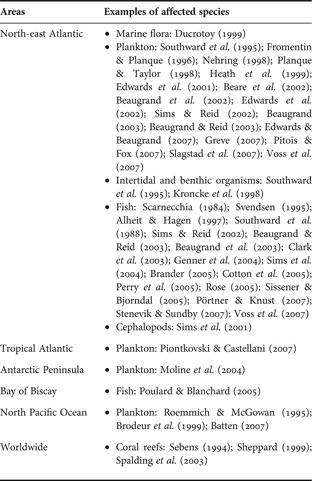
Evidence has demonstrated that climate variation and changes in the properties of ecological systems are strongly correlated (e.g. Orr et al., Reference Orr, Maier-Reimer, Mikolajewicz, Monfray, Ray, Hayden, Bulger, McCormick-Ray, Peters and Lovejoy1992; Astraldi et al., Reference Astraldi, Bianchi, Gasparini and Morri1995; Bombace, Reference Bombace2001; Hannah et al., Reference Hannah, Midgley, Lovejoy, Bond, Bush, Lovett, Scott and Woodward2002; Walther et al., Reference Walther, Post, Convey, Menzel, Parmesan, Beebe, Fromentin, Hoegh-Guldberg and Bairlein2002; Duffy, Reference Duffy2003; Root et al., Reference Root, Price, Hall, Schneider, Rosenzweig and Pounds2003; Roessig et al., Reference Roessig, Woodley, Cech and Hansen2004) and that global warming is already affecting numerous marine species throughout the world (Table 1). In the Mediterranean, it is now acknowledged that climate change-induced temperature variations have altered biological patterns and biodiversity (e.g. Francour et al., Reference Francour, Boudouresque, Harmelin, Harmelin-Vivien and Quignard1994; Turley, Reference Turley1999; Bianchi & Morri, Reference Bianchi and Morri2000).
Examples of species affected by climate change induced-factors around the world (Mediterranean Sea excluded).
POTENTIAL EFFECTS OF CLIMATE CHANGE-INDUCED ENVIRONMENTAL VARIATIONS ON MEDITERRANEAN MARINE SPECIES
1. Climate impacts on marine fauna
The global warming-induced alteration of precipitation, temperature, CO2 concentration and wind patterns will result in a cascade of changes in the physical (e.g. vertical stability of the water column, upwelling regimes, water mass formation and circulation, current patterns), chemical (e.g. seawater pH, salinity, nutrient ratios) and biological (e.g. species phenology, recruitment, physiology, distribution, abundance, diversity, productivity) properties of marine systems (Figure 1) (e.g. Bianchi, Reference Bianchi1997; Walther et al., Reference Walther, Post, Convey, Menzel, Parmesan, Beebe, Fromentin, Hoegh-Guldberg and Bairlein2002). Temperature anomalies, even over a short period of time, can significantly affect Mediterranean ecosystems and biological diversity (Walther et al., Reference Walther, Post, Convey, Menzel, Parmesan, Beebe, Fromentin, Hoegh-Guldberg and Bairlein2002; Anadón et al., Reference Anadón, Danovaro, Dippner, Drinkwater, Hawkins, O'Sullivan, Oguz and Reid2007). When a keystone species is affected, even by a slight change in climate, the composition and diversity of marine communities can be disrupted (Sanford, Reference Sanford1999). The structure, distribution and phenology of Mediterranean plankton communities, which are at the base of the food chain and which strongly depend on hydroclimatic factors and nutrient ratios, are experiencing change (Velsch, Reference Velsch1997; Turley, Reference Turley1999; Licandro & Ibanez, Reference Licandro and Ibanez2000; Béthoux et al., Reference Béthoux, Morin and Ruiz-Pino2002; Fernandez de Puelles et al., Reference Fernandez de Puelles, Valencia and Vicente2004; Mercado et al., Reference Mercado, Ramirez, Cortes, Sebastian and Vargas-Yanez2005; Molinero et al., Reference Molinero, Ibanez, Nival, Buecher and Souissi2005a, Reference Molinero, Ibanez, Souissi, Chifflet and Nivalb; Molinero et al., Reference Molinero, Ibanez, Souissi, Licandro, Buecher, Dallot and Nival2007; Voarino, Reference Voarino2006). For instance, high positive anomalies in water temperature during the 1980s resulted in jellyfish and a drop in abundance of copepods (Molinero et al., Reference Molinero, Ibanez, Nival, Buecher and Souissi2005a).
Main greenhouse gases-related factors influencing marine organisms.

Climate has long been recognized as one of the most critical factors influencing Mediterranean resource variability (Garcia & Palomera, Reference Garcia and Palomera1996). For instance, the most essential environmental mechanisms controlling the growth, abundance, distribution, composition, diversity and recruitment success of Mediterranean species, such as anchovy (Engraulis encrasicolus) or sardine (Sardinella aurita and Sardina pilchardus), include: regional temperature variations, riverine inputs and wind-induced mixing, which influence sea surface temperature and salinity; hydrographical features (e.g. oceanic fronts, water column stability, upwelling zones, sea state); and nutrient enrichment and planktonic production (e.g. Cury & Roy, Reference Cury and Roy1989; Sabates & Gili, Reference Sabates and Gili1991; Garcia & Palomera, Reference Garcia and Palomera1996; Regner, Reference Regner1996; Agostini & Bakun, Reference Agostini and Bakun2002; Lafuente et al., Reference Lafuente, Mazzola, Quintanilla, Delgado, Cuttita and Patti2002; LLoret et al., Reference Lloret, Palomera, Salat and Sole2004; Lafuente et al., Reference Lafuente, Vargas, Criado, Garcia, Delgado and Mazzola2005; Basilone et al., Reference Basilone, Guisande, Patti, Mazzola, Cuttitta, Bonanno, Vergara and Maneiro2006; Sabates et al., Reference Sabates, Martin, Loret and Raya2006).
The Mediterranean Sea is considered oligotrophic because of its low nutrient input from rivers and the nutrient depleted Atlantic water inflow through the Strait of Gibraltar (e.g. Estrada, Reference Estrada1996; Turley, Reference Turley1999; Zenetos et al., Reference Zenetos, Siokou-Frangou, Gotsis-Skretas and Groom2002). Winter vertical mixing, coastal upwelling and river runoff are the mechanisms of nutrient input into the euphotic zone, on which marine productivity is dependent. Ocean physical processes such as upwelling phenomena have a major influence on the distribution of primary production, through ascending movements of nutrient-rich deep water into the euphotic zone. Therefore, by altering oceanic features, climate change may affect nutrient availability.
Increasing temperatures are likely to trigger stronger thermal stratification and deepen the thermocline, which could prevent or modify the mixing of water-masses, and cold and nutrient-rich deep waters upwelling (Roemmich & McGowan, Reference Roemmich and McGowan1995). Some areas like the southern Adriatic Sea, where local winter climatic conditions (e.g. winter heat losses and precipitation) strongly influence nutrient availability and plankton production (Gacic, Reference Gacic2002), may be especially vulnerable to climate change.
Extreme meteorological events (e.g. storms and flooding episodes) and sea level rise will release abundant terrestrial suspended solids and pollutants into the marine environment, which may negatively affect coastal biocenoses. Fragile biotopes of the endemic Posidonia oceanica have been shown to be vulnerable to physical and chemical damage from meteorological events such as these (Orr et al., Reference Orr, Maier-Reimer, Mikolajewicz, Monfray, Ray, Hayden, Bulger, McCormick-Ray, Peters and Lovejoy1992; Bombace, Reference Bombace2001). As these sea grass meadows represent a spawning and nursery habitat for numerous species and play a major ecological role, their disappearance would to expected to have significant consequences for coastal ecosystems (Francour, Reference Francour1997).
By influencing the north-western Mediterranean climate variability (Pozo-Vasquez et al., Reference Pozo-Vasquez, Esteban-Parra, Rodrigo and Castro-Diez2001; Gasparini & Astraldi, Reference Gasparini and Astraldi2002; Rixen et al., Reference Rixen, Beckers, Levitus, Antonov, Boyer, Maillard, Fichaut, Balopoulos, Iona, Dooley, Garcia, Manca, Giorgetti, Manzella, Mikhailov, Pinardi and Zavatatrelli2005), the NAO affects the local species composition of planktonic copepods, such as the two dominant copepods of the north-west Meditarranean, Centropages typicus and Temora stylifera (Molinero et al., Reference Molinero, Ibanez, Nival, Buecher and Souissi2005a, Reference Molinero, Ibanez, Souissi, Chifflet and Nivalb).
The high positive NAO episode that caused positive temperature anomalies in the 1980s in the western Mediterranean Sea induced a jellyfish bloom and resulted in a significant diminishment of copepod abundance (Molinero et al., Reference Molinero, Ibanez, Nival, Buecher and Souissi2005a). This event, which is likely to have been encouraged by global warming, led to high abundance of Centropages typicus at the expense of Temora stylifera (Molinero et al., Reference Molinero, Ibanez, Souissi, Chifflet and Nival2005b). Jellyfish, which feed on fish larvae, eggs and copepods, can strongly affect plankton communities (Mills, Reference Mills1995). Changes in planktonic copepods, which affect the fluxes of matter and energy in the marine ecosystem, supply a biological pump of carbon into the deep ocean and strongly influence fish recruitment could alter the ecosystem functioning (Ohman & Hirche, Reference Ohman and Hirche2001; Molinero et al., Reference Molinero, Ibanez, Souissi, Chifflet and Nival2005b).
Nutrient inputs from the Rhône and Ebre rivers, combined with strong wind mixing, make the north-western Mediterranean highly productive (Lloret et al., Reference Lloret, Lleonart, Solé and Fromentin2001). As previously noted, climate change is expected to induce positive NAO episodes with less precipitation and runoff. Consequently, the recruitment of north-western Mediterranean fish, which strongly depend on riverine nutrient supply, may be negatively affected by climate change (Lloret et al., Reference Lloret, Lleonart, Solé and Fromentin2001).
In certain areas some organisms survive under specific temperature conditions and cannot adapt themselves or move when the environmental conditions change (e.g. Kenney, Reference Kenney1990; MacGarvin & Simmonds, Reference MacGarvin, Simmonds, Simmonds and Hutchinson1996; Hughes, Reference Hughes2000). Dispersal limitation can limit the response of marine animals such as benthic organisms that could sometimes be unable to successfully migrate toward more suitable environments (problems would include long distances or travelling against strong currents) (Hiscock et al., Reference Hiscock, Southward, Tittley and Hawkins2004).
By affecting the physiology of marine organisms, global warming could impact the performance and survival of those organisms that live close to their thermal tolerance or situated at the northern or southern limit of their distribution (Laubier, Reference Laubier2001; Hochachka & Somero, Reference Hochachka and Somero2002; Somero, Reference Somero2002; Poulard & Blanchard, Reference Poulard and Blanchard2005). Similarly, some larval and young benthic stages of some organisms are more sensitive to temperature than adults (Foster, Reference Foster1971; Pechenik, Reference Pechenik, Giese, Pearse and Pearse1989). According to Bella Galil in Cheviron (Reference Cheviron2007), deep-water organisms that live in constant temperatures (~13°C) and that are not used to seasonal temperature variation will be vulnerable to climate change.
2. Climate impacts on marine flora
Climate change is likely to affect phytoplankton composition by affecting nutrient concentrations and ratios. Over the last two decades, in the north-western Mediterranean, meteorological anomalies (e.g. warmer water, decreased salinity, longer periods of sunshine and lower wind stress) have affected water column stability and reduced nutrient replenishment into the euphotic zone (Goffart et al., Reference Goffart, Hecq and Legendre2002). This event decreased silicon availability, which in turn triggered a reduction of diatom abundance and a shift toward non-siliceous species, such as flagellates and dinoflagellates (Turley, Reference Turley1999; Béthoux et al., Reference Béthoux, Morin and Ruiz-Pino2002; Goffart et al., Reference Goffart, Hecq and Legendre2002). By modifying the composition of phytoplankton communities, climate change could then seriously alter nutrient cycling and food web dynamics (Litchman et al., Reference Litchman, Klausmeier, Miller, Schofield and Falkowski2006).
Warmer temperatures trigger changes in the timing of plankton blooms, resulting in a temporal mismatch between primary production and higher trophic levels of the food web (Edwards & Richardson, Reference Edwards and Richardson2004; Hiscock et al., Reference Hiscock, Southward, Tittley and Hawkins2004). In north-western European estuaries, for example, a long-term data set (1973–2001), showed an increase of spring temperatures of 0.07°C yr−1, which resulted in the earlier spawning of a bivalve, Macoma balthica, but did not affect phytoplankton blooms, causing a divergence in timing between larval bivalve production and prey (Philippart et al., Reference Philippart, Van Aken, Beukema, Bos, Cadee and Dekker2003). In addition, rising seawater temperatures advance the onset of crustacean reproduction and enhance shrimp predation pressure on vulnerable juvenile spat that leads to low recruitment success of the spat (Philippart et al., Reference Philippart, Van Aken, Beukema, Bos, Cadee and Dekker2003).
MIGRATION OF SPECIES AND INCREASED NUMBER OF EXOTIC THERMOPHILIC SPECIES IN THE MEDITERRANEAN SEA
The presence of exotic species in the Mediterranean has resulted from the combination of environmental factors and human activities like the opening of the Suez Canal in 1869. Today, more than 500 alien species are recorded in the Mediterranean Sea and their geographical ranges are increasing, as is the rate of increase of new alien species being identified (Galil & Zenetos, Reference Galil, Zenetos, Leppakoski, Gollasch and Olenin2002; Zenetos et al., Reference Zenetos, Todorova and Alexandrov2003; Harmelin-Vivien et al., Reference Harmelin-Vivien, Bitar, Harmelin and Monestiez2005; CIESM, 2005; Galil, Reference Galil2007). Climate change, combined with the establishment of exotic species has led to the ‘tropicalization’ of the Mediterranean (Bianchi, Reference Bianchi2007). The increase of alien species can cause endemic species to rapidly decline in abundance and be displaced (Galil & Zenetos, Reference Galil, Zenetos, Leppakoski, Gollasch and Olenin2002; Zenetos et al., Reference Zenetos, Siokou-Frangou, Gotsis-Skretas and Groom2002; Galil, Reference Galil2007). Such phenomena can alter the infra-littoral communities and induce ecological impacts such as local population decline and extirpation, reduction of genetic diversity in native species, foodweb alterations, loss of habitat functions, processes and structure, increase in the risk of extinction and biotic homogenization (Ricciardi, Reference Ricciardi2004; Galil, Reference Galil2007).
In the North Atlantic Ocean, the observed northward migration of species (250 km per decade), resulting from a minor increase in temperature, is likely to be linked to global warming (Parmesan & Yohe, Reference Parmesan and Yohe2003; EEA, 2004; Oviatt, Reference Oviatt2004). Perry et al. (Reference Perry, Low, Ellis and Reynolds2005) have also demonstrated that, in the North Sea, recent increases in sea temperature have led to nearly two-thirds of fish species (exploited and non-exploited) shifting in mean latitude or depth or both over 25 years. For species with northerly or southerly range margins in the North Sea, half showed boundary shifts with warming, and all but one species shifted northward.
In the Mediterranean, over the past three decades, increasing water temperature has been observed in the Ligurian Sea (Béthoux et al., Reference Béthoux, Gentili, Raunet and Tailliez1990; Astraldi et al., Reference Astraldi, Bianchi, Gasparini and Morri1995), which is one of the coldest zones of the Mediterranean. This phenomenon encouraged warm-water species to shift their ranges northward and settle in the Ligurian waters where they were formerly rare or absent (Bianchi & Morri, Reference Bianchi and Morri1993, Reference Bianchi and Morri1994; Francour et al., Reference Francour, Boudouresque, Harmelin, Harmelin-Vivien and Quignard1994; Astraldi et al., Reference Astraldi, Bianchi, Gasparini and Morri1995; Morri & Bianchi, Reference Morri, Bianchi, Faranda, Guglielmo and Spezie2001).
Consequently, warm-water species like the ornate wrasse (Thalassoma pavo) colonized and established large and stable populations in the north-western Mediterranean (Bianchi & Morri, Reference Bianchi and Morri1994; Bombace, Reference Bombace2001; Vacchi et al., Reference Vacchi, Morri, Modena, La Mesa and Bianchi2001). Other thermophilic species like the grey triggerfish (Balistes carolinensis), Mediterranean parrotfish (Sparisoma cretense), round sardine (Sardinella aurita), bluefish (Pomatomus saltatrix), Senegalese sole (Solea senegalensis), dusky grouper (Epinephelus marginatus), bastard grunt (Pomadasys incisus), European barracuda (Sphyraena sphyraena), slackskin blaasop (Sphoeroides cutaneus), the coral Astroides calycularis and groupers of the genus Epinephelus have been frequently recorded amongst the ‘cold biota’ of the northern Mediterranean (Vacchi & Cau, Reference Vacchi and Cau1986; Serena & Silvestri, Reference Serena and Silvestri1996; Relini & Orsi Relini, Reference Relini and Orsi Relini1997; Dulcic et al., Reference Dulcic, Grbec and Lipej1999; Louisy & Culioli, Reference Louisy and Culioli1999; Dulcic & Grbec, Reference Dulcic and Grbec2000; Guidetti & Boero, Reference Guidetti and Boero2001; Dulcic et al., Reference Dulcic, Kraljevic, Pallaoro and Glamuzina2005, Reference Dulcic, Tutman and Caleta2006; Athanassios & Antonopoulou, Reference Athanassios and Antonopoulou2006).
The recent northward expansion of tropical groupers, like the white grouper (Epinephelus aeneus) and dusky grouper (Epinephelus marginatus), may result from the warming of Mediterranean waters (Francour et al., Reference Francour, Boudouresque, Harmelin, Harmelin-Vivien and Quignard1994; Dulcic & Lipej, Reference Dulcic and Lipej1997; Zabala et al., Reference Zabala, Garcia-Rubies, Louisy and Sala1997). Since groupers are top carnivores and among the bigger coastal fish species, their successful colonization is likely to affect the ecology of endemic species and influence local fisheries (Glamuzina, Reference Glamuzina1999).
Similarly, in the Adriatic Sea, the presence of thermophilic species of fish and zooplankton, that were formerly uncommon or absent in this zone, has increased in the past 30 years (Dulcic & Grbec, Reference Dulcic and Grbec2000; Kamburska & Fonda-Umani, Reference Kamburska and Fonda-Umani2006). These observations have been correlated with seawater warming and salinity changes occurring since 1988 (Francour et al., Reference Francour, Boudouresque, Harmelin, Harmelin-Vivien and Quignard1994; Russo et al., Reference Russo, Rabitti and Bastianini2002) and, thus, global warming is thought to be responsible for the observed faunal changes in this region (Dulcic et al., Reference Dulcic, Grbec and Lipej1999; Dulcic & Grbec, Reference Dulcic and Grbec2000; Parenti & Bressi, Reference Parenti and Bressi2001).
The northward migration of warm water species will induce species competition for existing niches (IPCC, 2001a) and thermophilic species are likely to increase in abundance at the expense of cold-water species (Beaugrand et al., Reference Beaugrand, Reid, Ibanez, Lindley and Edwards2002; Galil & Zenetos, Reference Galil, Zenetos, Leppakoski, Gollasch and Olenin2002; Hiscock et al., Reference Hiscock, Southward, Tittley and Hawkins2004). Marine bioinvasions, which are considered to be ‘biological pollution' (Bouderesque & Verlaque, Reference Bouderesque and Verlaque2002; Elliot, Reference Elliot2003) have altered marine ecosystems (e.g. competition with indigenous species, food web shifts) and are considered as one of the most intense and damaging anthropogenic impacts (Harris & Tyrrell, Reference Harris and Tyrrell2001; Frank et al., Reference Frank, Petrie, Choi and Leggete2005; Galil et al., Reference Galil, Nehring, Panov and Nentwig2007). The Mediterranean Sea is one of the most impacted seas of the world in terms of biological invasion (Galil, Reference Galil2007) and climate change is likely to facilitate invasion of thermophilic alien species causing irreversible impacts on native populations (Carlton, Reference Carlton, Mooney and Hobbs2000; Stachowicz et al., Reference Stachowicz, Terwin, Whitlatch and Osman2002b; Gritti et al., Reference Gritti, Smith and Sykes2006; Galil et al., Reference Galil, Nehring, Panov and Nentwig2007; Occhipinti-Ambrogi, Reference Occhipinti-Ambrogi2007). According to Bella Galil (in Cheviron, Reference Cheviron2007) alien species like the bivalve Brachidontes pharaonis or the jellyfish Rhopilema nomadica, both belonging to the 100 ‘worst invasives’ species, could lead to the extinction of numerous native Mediterranean species. Photophilic subtidal macrophyte assemblages appear particularly vulnerable to invasions of exotic algal species such as Caulerpa taxifolia (Streftaris & Zenetos, Reference Streftaris and Zenetos2006).
In addition to northward migration, bathymetric displacements occur among populations of invasive and endemic species (Galil & Zenetos, Reference Galil, Zenetos, Leppakoski, Gollasch and Olenin2002). This is the case for the indigenous red mullet (Mullus barbatus) and hake (Merluccius merluccius) with both moving into deeper and cooler waters due to their respective warm-water competitors: the goldband goatfish (Upeneus moluccensis) and brushtooth lizardfish (Saurida undosquamis) (Oren, Reference Oren1957). Similarly, in the north-western Mediterranean, the endemic spottail mantis shrimp (Squilla mantis) is usually observed in deeper waters (70–80 m) rather than the thermophilic Red Sea mantis shrimp (Oratosquilla massavensis) (10–25 m) (Galil & Zenetos, Reference Galil, Zenetos, Leppakoski, Gollasch and Olenin2002).
The warming of the Mediterranean waters may modify species' migration periods causing changes in the trophic webs. For example, Bombace (Reference Bombace2001), has documented that in the last few decades, the amberjack (Seriola dumerilii) and bluefin tuna (Thunnnus thynnus) appear to stay longer (until mid-winter instead of autumn) in the northern and central Mediterranean before migrating toward their winter territories.
Although there are presently no marine species extinctions that have been correlated with global warming, today, species such as the Mediterranean mysid Hemimysis speluncola are regarded as threatened (Chevaldonné & Lejeusne, Reference Chevaldonné and Lejeusne2003; Lejeusne, Reference Lejeusne2005; Lejeusne & Chevaldonné, Reference Lejeusne and Chevaldonné2005; Harley et al., Reference Harley, Hughes, Hultgren, Miner, Sorte, Thornber, Rodriguez, Tomanek and Williams2006). Furthermore, Chevaldonné & Lejeusne (Reference Chevaldonné and Lejeusne2003) showed that the endemic cave-dwelling invertebrate Hemimysis speluncola which was previously abundant in the north-western Mediterranean, has been replaced by a warm-water species (Hemimysis margalefi).
Areas of high endemic biodiversity are likely to be less subject to non-indigenous species invasion (Kennedy et al., Reference Kennedy, Naemm, Howe, Knops, Tilman and Reich2002; Stachowicz et al., Reference Stachowicz, Fried, Osman and Whitlatch2002a; Duffy, Reference Duffy2003). Therefore, sparse and declining populations such as Posidonia meadows are more vulnerable to be overgrown and replaced by invasive macroalgae like Caulerpa taxifolia and Caulerpa racemosa (Meinesz et al., Reference Meinesz, Belsher, Thibaut, Antolic, Mustapha, Boudouresque, Chiaverini, Cinelli, Cottalorda, Djellouli, El Abed, Orestano, Grau, Ivesa, Jaklin, Langar, Massuti-Pascual, Peirano, Tunesi, de Vaugelas, Zavodnik and Zuljevic2001; Bouderesque & Verlaque, Reference Bouderesque and Verlaque2002; Peirano et al., Reference Peirano, Damasso, Montefalcone, Morri and Bianchi2005). Climate change could be one of the factors responsible for the decline of Posidonia and for the expansion of Caulerpa (Komatsu et al., Reference Komatsu, Meinesz and Buckles1997; Raniello et al., Reference Raniello, Lorenti, Brunet and Buia2004; Peirano et al., Reference Peirano, Damasso, Montefalcone, Morri and Bianchi2005; Ruitton et al., Reference Ruitton, Javel, Culioli, Meinesz, Pergent and Verlaque2005).
Furthermore, some cold-water species like the small euphausid species Meganyctiphanes norvegica, which is situated at the northern limit of its ecological tolerance, would be more vulnerable to invasion. This is especially true for many taxa in the eastern Mediterranean, leaving this region more exposed to invasion (Galil & Zenetos, Reference Galil, Zenetos, Leppakoski, Gollasch and Olenin2002).
LARGE MASS-MORTALITY EVENTS AND DECLINE IN SPECIES ABUNDANCE AND DIVERSITY ASSOCIATED WITH TEMPERATURE ANOMALIES
Temperature anomalies have led to several mass-mortality episodes in the Mediterranean Sea. In 1999, successive heat waves with consequent peaks in water temperature and a deepening of the thermocline caused a mass-mortality event of 28 invertebrate species in the north-western Mediterranean (Cerrano et al., Reference Cerrano, Bavestrello, Bianchi, Cattaneo-Vietti, Bava, Morganti, Morri, Picco, Sara, Schiaparelli, Siccardi and Sponga2000; Perez et al., Reference Perez, Garrabou, Sartoretto, Harmelin, Francour and Vacelet2000; Romano et al., Reference Romano, Bensoussan, Younes and Arlhac2000; Laubier et al., Reference Laubier, Pérez and Garrabou2003). This event affected benthic organisms such as gorgonians, sponges, cnidarians, bivalves, ascidians, bryozoans, scleractinian corals and zoanthids (Cerrano et al., Reference Cerrano, Bavestrello, Bianchi, Cattaneo-Vietti, Bava, Morganti, Morri, Picco, Sara, Schiaparelli, Siccardi and Sponga2000; Perez et al., Reference Perez, Garrabou, Sartoretto, Harmelin, Francour and Vacelet2000; Romano et al., Reference Romano, Bensoussan, Younes and Arlhac2000; Garrabou et al., Reference Garrabou, Perez, Sartoretto and Harmelin2001). According to Occhipinti-Ambrogi (Reference Occhipinti-Ambrogi2007), niches resulting from mass mortality events become available for new invasive colonizers.
Variations of the nutrient load and seawater properties (e.g. temperature increase) can lead to coastal eutrophication and algal bloom (Degobbis et al., Reference Degobbis, Precali, Ivancic, Smodlaka, Fuks and Kveder2000). This phenomenon particularly concerns the shallow northern Adriatic waters (UNEP, 1996; Degobbis et al., Reference Degobbis, Precali, Ivancic, Smodlaka, Fuks and Kveder2000). By increasing seawater stratification, meteorological anomalies regularly cause bottom water anoxia and red tide events in this region, provoking mass mortality episodes of fish and benthic organisms (Degobbis et al., Reference Degobbis, Precali, Ivancic, Smodlaka, Fuks and Kveder2000; Anadón et al., Reference Anadón, Danovaro, Dippner, Drinkwater, Hawkins, O'Sullivan, Oguz and Reid2007). Eutrophication events occurred frequently during the second half of the 20th Century (Degobbis et al., Reference Degobbis, Precali, Ivancic, Smodlaka, Fuks and Kveder2000) and the intensity, frequency and geographical expansion of algal blooms became a growing concern since the 1970s in this area (Justic, Reference Justic1987). According to Boero (Reference Boero1996), increases in jellyfish (Pelagia noctiluca and Aurelia aurita), salps (Thaliacea), harmful algal blooms and red tides were all promoted by abnormal meteorological and oceanographic changes occurring since 1988 in the Adriatic Sea.
During the last decades, the collapse of sprat (Sprattus sprattus) and anchovy (Engraulis encrasicolus) stocks in the Adriatic affected the species stocks of the entire Mediterranean and was associated with the decrease of surface temperature resulting from climatic anomalies (Regner, Reference Regner1996; Salat, Reference Salat1996; Bombace, Reference Bombace2001; Azzali et al., Reference Azzali, De Felice, Cosimi, Luna and Parmiggiani2002). Similarly, during the 2001 winter, climate-induced low surface temperatures led to the decline of sardines (Sardinella aurita) and phytoplankton blooms (Guidetti et al., Reference Guidetti, Boero and Dulcic2002).
By altering oceanographic properties like seawater temperature, salinity, water transparency and deep water oxygen saturation, climate change could impact the entire Adriatic Sea ecosystem (Zore-Armanda et al., Reference Zore-Armanda, Stojanoski and Vukadin1987; Zore-Armanda, Reference Zore-Armanda1991; Russo et al., Reference Russo, Rabitti and Bastianini2002).
Global warming may promote the development of toxic dinoflagellates like Gymnodinium catenatum which is responsible for frequent Mediterranean toxic events, causes paralytic shellfish poisoning (PSP) and may alter the marine ecosystem (Garcés et al., Reference Garcés, Maso, Vila and Camp2000; Taleb et al., Reference Taleb, Vale, Jaime and Blaghen2001; Vila et al., Reference Vila, Garcés, Maso and Camp2001; Calbet et al., Reference Calbet, Broglio, Saiz and Alcaraz2002; Gomez, Reference Gomez2003). According to Calbet et al. (Reference Calbet, Broglio, Saiz and Alcaraz2002), the occurrence of Gymnodinium catenatum (toxic dinoflagellate) in the Alboran Sea reduced the grazing impact of mesozooplankton on the microbial communities and may have altered the Mediterranean pelagic food web.
Gomez & Claustre (Reference Gomez and Claustre2003) and Polat (Reference Polat2004) suggest that the presence of new warm-water dinoflagellate species in the Mediterranean Sea, like Asterodinium libanum, Asterodinium gracile and Citharistes regius is likely to be associated with the warming of Mediterranean waters. A species of a similar genus, Ostreopsis armata, was recently observed (summer 2005 and 2006) in the Ligurian Sea where it repeatedly bloomed and apparently triggered respiratory diseases in humans (details in Occhipinti-Ambrogi, Reference Occhipinti-Ambrogi2007).
Meteorological anomalies can significantly alter ecosystems and cause mass mortality episodes. In the eastern Mediterranean Sea, a climatic event, called the Eastern Mediterranean Transient (EMT), was correlated with local meteorological anomalies (reduced precipitation, change in wind patterns and cold winters) (Klein et al., Reference Klein, Roether, Manca, Bregant, Beitzel, Kovacevic and Luchetta1999) and resulted in a drastic alteration of faunal abundance and diversity (Danovaro et al., Reference Danovaro, Dell'Anno, Fabiano, Pusceddu and Tselepides2001). By modifying the physico-chemical characteristics of the deep waters, this temperature shift significantly and rapidly affected deep-sea nematode diversity (Danovaro et al., Reference Danovaro, Dell'Anno, Fabiano and Pusceddu2004). Following the 1994–1995 period, when the temperature recovered, only some marine faunal species recovered (Danovaro et al., Reference Danovaro, Dell'Anno, Fabiano and Pusceddu2004). These observations give us a better vision of the potential large-scale consequences of global warming.
INCREASE OF DISEASES AND PATHOGENS
Since warmer temperatures are known to favour the presence of pathogens, epidemiological outbreaks are likely to become more severe and frequent with the warming of Mediterranean waters (Gantzer et al., Reference Gantzer, Dubois, Crance, Billaudel, Kopecka, Schwartzbrod, Pommepuy and Le Guyader1998; Harvell et al., Reference Harvell, Kim, Burkholder, Colwell, Epstein, Grimes, Hofmann, Lipp, Osterhaus, Overstreet, Porter, Smith and Vasta1999, Reference Harvell, Mitchell, Ward, Altizer, Dobson, Ostfeld and Samuel2002; Marcogliese, Reference Marcogliese2001; Drake et al., Reference Drake, Doblin and Dobbs2007). According to CIESM (2004) global warming could lead to the development of tropical and subtropical pathogens across the Mediterranean Sea. Along the Ligurian Sea, the massive development of a cyanobacterium combined with warm water, caused several populations of the zoanthid Parazoanthus axinellae to decline since 2000 (Cerrano et al., Reference Cerrano, Totti, Sponga and Bavestrello2006). This species has been replaced by an incrusting thermophilic sponge (Crambe crambe) which quickly colonized the niche deserted by Parazoanthus (Cerrano et al., Reference Cerrano, Totti, Sponga and Bavestrello2006).
Similarly, the thermophilic bacteria Vibrio shiloi, was involved in the mortality episode of the Mediterranean coral Oculina patagonica (Kushmaro et al., Reference Kushmaro, Rosenberg, Fine, Ben Haim and Loya1998) and the 1999 mass mortality event in the Ligurian Sea was induced by the combination of a temperature shift with the growth of opportunistic warm-water pathogens (Cerrano et al., Reference Cerrano, Bavestrello, Bianchi, Cattaneo-Vietti, Bava, Morganti, Morri, Picco, Sara, Schiaparelli, Siccardi and Sponga2000).
Simmonds & Mayer (Reference Simmonds and Mayer1997) provided a tentative link between reduced nutrient input to the western Mediterranean basin (resulting from reduced rain fall) and the initiation of the striped dolphin (Stenella coeruleoalba) mass mortality in 1990. This is discussed further below.
OTHER EXPECTED CHANGES
Increased concentration of atmospheric anthropogenic CO2 and climate change is likely to alter marine ecosystems in several other ways. As temperature increases, the oxygen solubility decreases and fish metabolism accelerates (Green & Carritt, Reference Green and Carritt1967; Pörtner & Knust, Reference Pörtner and Knust2007). Since the demand for oxygen and food will be enhanced in order to support higher metabolic rates, the decreased concentration of dissolved oxygen will thus affect fish growth and breeding capacity, and could lead to the extinction or migration (to cooler waters) of some fish species (Pörtner & Knust, Reference Pörtner and Knust2007). Furthermore, enhanced fish metabolic rates and food consumption resulting from higher seawater temperatures may increase fish pollutant uptake (e.g. mercury) which will then be transferred into higher levels of the food chain (Harris & Bodaly, Reference Harris and Bodaly1998).
In addition, the rise of atmospheric CO2 could increase the acidity of seawater and therefore reduce the saturation state of CaCO3 species in the oceans, namely calcite and aragonite (Caldeira & Wickett, Reference Caldeira and Wickett2003; Orr et al., Reference Orr, Fabry, Aumont, Bopp, Doney, Feely, Gnanadesikan, Gruber, Ishida, Joos, Key, Lindsay, Maier-Reimer, Matear, Monfray, Mouchet, Najjar, Plattner, Rodgers, Sabine, Sarmiento, Schlitzer, Slater, Totterdell, Weirig, Yamanaka and Yool2005). The marine species most likely to be affected by this acidification will be small and thin-shelled organisms that use CaCO3 such as calcifying plankton (e.g. coccolithophores), coralline algae, pteropod molluscs and coral polyps (e.g. reef-building scleractinian corals) (Kleypas et al., Reference Kleypas, Buddemeier, Archer, Gattuso, Langdon and Opdyke1999; Riebesell et al., Reference Riebesell, Zondervan, Rost, Tortell, Zeebe and Morel2000; Feely et al., Reference Feely, Sabine, Lee, Berelson, Kleypas, Fabry and Millero2004). By reducing the level of calcium carbonate saturation, ocean acidification will affect the process of calcification of some marine key organisms. Feely et al. (Reference Feely, Sabine, Lee, Berelson, Kleypas, Fabry and Millero2004) argue that the calcification rate of multiple taxa will be affected, from single celled protists to reef-building corals—and across all CaCO mineral phases. Cephalopods may also be particularly sensitive and this is described in Table 2 at the end of this paper. According to a study recently carried out by The Royal Society (2005), the plankton calcification process could become very limited and a large portion of marine life could then disappear by 2100.
Impact of climate changes on cetaceans around the world.

The seawater acidification phenomenon, which is responsible for nanism (a genetic anomaly resulting in short stature) and malformation symptoms in several phytoplankton species (Feely et al., Reference Feely, Sabine, Lee, Berelson, Kleypas, Fabry and Millero2004), can also have an impact on the reproductive patterns of fish (Stanley, Reference Stanley and Nitecki1984).
According to Caldeira & Wickett (Reference Caldeira and Wickett2003) and Feely et al. (Reference Feely, Sabine, Lee, Berelson, Kleypas, Fabry and Millero2004), the expected change in pH will be greater than any other pH variations observed in the fossil record over the last 200–300 million years. Manipulative experiments showed that a three-month reduction of pH by 0.7-unit reduced mussel metabolism and growth (Michaelidis et al., Reference Michaelidis, Ouzounis, Paleras and Portner2005). Similarly, a six-month, 0.03-unit pH reduction, which corresponds to a 200-ppm increase in atmospheric CO2, lowered gastropod and sea urchin growth and survival (Shirayama & Thornton, Reference Shirayama and Thornton2005). A study by Alvarez et al. (Reference Álvarez, Perez, Shoosmith and Bryden2005) shows that, although ocean uptake of carbon dioxide for the Mediterranean appears small in terms of global ocean uptake, ‘the impact on local carbonate chemistry will be large.’
In addition to this process of ocean acidification, changes in marine ecosystems due to global warming (e.g. water temperature, algal bloom enhancement and water colour) might affect the visual sensitivity of fish (spectral sensitivity) (Archer et al., Reference Archer, Hirano and Vallerga2001).
Several points discussed in this section are likely to be relevant to a broad variety of marine species including key species in Mediterranean ecosystems, with significant consequences for foodweb structures, marine system functions and ecosystem equilibrium (Petchey et al., Reference Petchey, McPhearson, Casey and Morin1999; Sanford, Reference Sanford1999; Schiel et al., Reference Schiel, Steinbeck and Foster2004). Such foodweb alterations are likely to produce significant cascade effects on marine biodiversity including impacts on species of higher trophic levels, such as cetaceans.
Climate change impacts on cetaceans
The distribution of cetaceans, which have a major influence on marine community function and structure (e.g. Katona & Whitehead, Reference Katona and Whitehead1988; Bowen, Reference Bowen1997; Jones et al., Reference Jones, Collins, Bagley, Addison and Priede1998), is closely related to environmental parameters such as oceanographic features and food availability (Millot & Taupier-Letage, Reference Millot and Taupier-Letage2004). According to MacGarvin & Simmonds (Reference MacGarvin, Simmonds, Simmonds and Hutchinson1996), they are not likely to be able to adapt to rapid shifts in temperatures and environmental conditions, and climate change may represent the most serious long-term threat to cetaceans (Burns, Reference Burns2001). Although lower trophic levels are the most likely to be altered, cetaceans could be affected by global warming in a variety of ways (Figure 2; Table 2) (e.g. Reeves, Reference Reeves and Taylor1991; Fisher et al., Reference Fisher, Hanley, Lonsdale, Nelson and Thornton1994; Agardy, Reference Agardy1996; IWC, 1997; European Community, 1999; Hardwood, Reference Hardwood2001; Simmonds & Nunny, Reference Simmonds, Nunny and Notarbartolo di Sciara2002; Gambaiani et al., Reference Gambaiani, Mayol and Isaac2005; Learmonth et al., Reference Learmonth, Macleod, Santos, Pierce, Crick and Robinson2006; Simmonds & Isaac, Reference Simmonds and Isaac2007).
Overview of the potential impacts of global warming on marine life, including cetaceans (from Gambaiani et al., Reference Gambaiani, Mayol and Isaac2005).

CHANGE IN FOOD SUPPLY
The distribution, abundance and migration of cetaceans is strongly influenced by prey availability (e.g. Kenney et al., Reference Kenney, Payne, Heinemann, Winn, Sherman, Jaworski and Smada1996) and cetaceans which are confined in restricted habitat, with limited ranges, are likely to be most vulnerable to climate change (e.g. Learmonth et al., Reference Learmonth, Macleod, Santos, Pierce, Crick and Robinson2006; Simmonds & Isaac, Reference Simmonds and Isaac2007).
Change in key prey species distribution is the main driving factor defining geographical range and habitat preference in cetaceans (e.g. Evans, Reference Evans1971; Wells et al., Reference Wells, Hansen, Baldridge, Dohl, Kelly, Defran, Leatherwood and Reeves1990; Hanson & Defran, Reference Hanson and Defran1993; Simmonds, Reference Simmonds1994; Agardy, Reference Agardy1996; Maze & Würsig, Reference Maze and Würsig1999).
For instance, in the eastern North Pacific Ocean, an increase in seawater temperature combined with a change in oceanographic conditions is thought to have led to the death of hundreds of grey whales (Eschrichtius robustus) as the result of a decline in their prey species (Grebmeier & Dunton, Reference Grebmeier, Dunton and Huntington2000; Moore et al., Reference Moore, Grebmeier and Davies2003; Gulland et al., Reference Gulland, Perez-Cortes, Urban, Rojas-Bracho, Ylitalo, Weir, Norman, Muto, Rugh, Kreuder and Rowles2005). In the Mediterranean Sea, the decline of several cetacean populations has been associated with the reduction of prey resources (Perrin, Reference Perrin1989; UNEP/IUCN, 1994; Reeves et al., Reference Reeves, Smith, Crespo and Notarbartolo di Sciara2003; Reeves & Notarbartolo di Sciara, Reference Reeves and Notarbartolo di Sciara2006).
Odontocete prey species such as pilchard (Sardina pilchardus) are affected by climate change (Southward et al., Reference Southward, Boalch and Mattock1988; Garcia & Palomera, Reference Garcia and Palomera1996; Regner, Reference Regner1996; Bearzi et al., Reference Bearzi, Reeves, Notarbartolo di Sciara, Politi, Cañadas, Frantzis and Mussi2003). Pilchards have been shown to be a key prey species for common dolphins off the Portuguese coast (Silva, Reference Silva1999). In addition, cephalopods, which represent the main food supply for numerous Mediterranean cetacean species (Wurtz & Marrale, Reference Wurtz and Marrale1991; Bompar, Reference Bompar2000; Bearzi et al., Reference Bearzi, Reeves, Notarbartolo di Sciara, Politi, Cañadas, Frantzis and Mussi2003) seem to be particularly vulnerable to environmental changes including pH and temperature (Sims et al., Reference Sims, Genner, Southward and Hawkins2001; Pierce & Boyle Reference Pierce and Boyle2003; Arkhipkin et al., Reference Arkhipkin, Grzebielec, Sirota, Remeslo, Polishchuk and Middleton2004) (Table 2).
In the Adriatic Sea, climatic shifts are suggested to have altered the distribution of the key prey species of common dolphins (Delphinus delphis) and bottlenose dolphins (Tursiops truncatus) (Blanco et al., Reference Blanco, Salomon and Raga2001; Bearzi et al., Reference Bearzi, Reeves, Notarbartolo di Sciara, Politi, Cañadas, Frantzis and Mussi2003). In particular, the climate-induced increase in abundance of thermophilic species such as round sardinella and jellyfish may have caused the European anchovy (Engraulis encrasicolus) population to decrease (Regner, Reference Regner1996).
Shifts in prey species availability may force cetaceans to change their feeding strategies and spend more time and energy foraging, which could have drastic consequences on their health and could affect their immune systems (Northridge, Reference Northridge1984; Shane, Reference Shane, Leatherwood and Reeves1990; Bräger, Reference Bräger1993; Smith & Whitehead, Reference Smith and Whitehead1993; Agardy, Reference Agardy1996; Stern, Reference Stern1996; Bearzi, Reference Bearzi and Notarbartolo di Sciara2002). A high proportion of time and effort devoted to feeding-related activities was recorded in Mediterranean bottlenose dolphins in the northern Adriatic Sea as a response to environmental changes and reduced prey availability (Politi, Reference Politi1998; Bearzi et al., Reference Bearzi, Politi and Notarbartolo di Sciara1999). Consequently, the time dedicated to socializing and breeding is reduced, with negative consequences on cetacean reproductive success (Valiela, Reference Valiela1995; Bearzi, Reference Bearzi and Notarbartolo di Sciara2002). The fact that climate change impacts can lead to reduced prey availability and subsequently affect the health, physical strength and abundance of cetacean populations, has been observed in bottlenose dolphins in the eastern Ionian Sea (Politi et al., Reference Politi, Bearzi and Airoldi2000; Politi & Bearzi, Reference Politi and Bearzi2004).
Aguilar & Raga (Reference Aguilar and Raga1993) and Simmonds & Mayer (Reference Simmonds and Mayer1997) have suggested that the mass mortality of thousands of striped dolphins (Stenella coeruleoalba) during the 1990–1992 morbillivirus epizootic might have been caused by the unusual warm and dry winter of 1989–1990 that led to abnormally warm water temperatures and low rainfall. This phenomenon resulted in reduced nutrient input into the eastern Mediterranean and thus low productivity (Simmonds & Mayer, Reference Simmonds and Mayer1997). This led to the decline of the dolphin's common prey and explains why many of the dolphin carcasses showed depleted body fat reserves (Aguilar et al., Reference Aguilar, Borrel, Calzada, Grau, Pastor and Simmonds1991).
Similarly, during a survey carried out in Corsica, Dhermain (Reference Dhermain2003) observed fewer bottlenose dolphins in coastal waters than usual. The excessively hot 2003 summer, which resulted in abnormally high coastal water temperatures, could explain the migration of bottlenose dolphins toward the open sea. Such exceptional meteorological events may illustrate how an increase of temperature could impact on cetaceans.
Moreover, global warming is likely to encourage the spreading of viruses and pathogens and may promote epizootic events like morbillivirus infections (Agardy, Reference Agardy1996), which have also been identified in the endangered Mediterranean monk seal (Monachus monachus) (Van de Bildt et al., Reference Van de Bildt, Vedder, Martina, Abou-Sidib, Jiddou, Barham, Androukaki, Komnenou, Niesters and Osterhaus1999). A worldwide increase in mass mortality events in marine mammals has been reported by Simmonds & Mayer (Reference Simmonds and Mayer1997).
It is interesting to note that, as cetaceans are long-lived, slow-reproducing animals (generally producing one offspring per female every 2–3 years), when a population is severely diminished by a virus or other agents, recovery may be slow and such species can relatively easily become endangered (Dhermain et al., Reference Dhermain, Soulier, Bompar and Notarbartolo di Sciara2002; Reeves et al., Reference Reeves, Smith, Crespo and Notarbartolo di Sciara2003).
According to Greene & Pershing (Reference Greene and Pershing2004), in the North Atlantic Ocean, the effects of global warming on the abundance of C. finmarchicus strongly influence right whale (Eubalaena glacialis) calving rates. A similar situation is likely to take place in the Mediterranean. For instance, Meganyctiphanes norvegica, which constitutes the only known food supply of the fin whales (Balaenoptera physalus) in this region, is at the northern limit of its distribution (Besson et al., Reference Besson, Duguy and Tardy1982; Viale, Reference Viale1985; Orsi Relini & Giordano, Reference Orsi Relini and Giordano1992; Orsi Relini et al., Reference Orsi Relini, Relini, Cima, Palandri, Relini and Torchia1994; Gannier, Reference Gannier1995, Reference Gannier1997; Forcada et al., Reference Forcada, Aguilar, Hammond, Pastor and Aguilar1996; Astruc & Beaubrun, Reference Astruc and Beaubrun2001; Notarbartolo di Sciara et al., Reference Notarbartolo di Sciara, Zanardelli, Jahoda, Panigada and Airoldi2003) and thus, in case of unsuitable environmental properties, will not be able to move northward because of the physical land barrier.
The distribution and abundance of this euphausid are correlated with specific hydrobiological parameters (e.g. seawater temperature, salinity, food availability and current patterns) (Pustelnik, Reference Pustelnik1976; De la Bigne, Reference De la Bigne1985; Macquart-Moulin & Patriti, Reference Macquart-Moulin and Patriti1996; Velsch, Reference Velsch1997). Climate change-induced alteration of ocean circulation is likely to modify larval transport processes, species dispersal and recruitment, and impact krill population dynamics (Harley et al., Reference Harley, Hughes, Hultgren, Miner, Sorte, Thornber, Rodriguez, Tomanek and Williams2006).
According to Einarsson (Reference Einarsson1945), in the north Atlantic, the optimal temperature range of Meganyctiphanes norvegica is between 2 and 15°C with a high mortality rate above 15°C (Buchholz et al., Reference Buchholz, Buchholz, Reppin and Fisher1995). This thermal limit is 18°C for the Mediterranean population (Fowler et al., Reference Fowler, Small and Keckes1971). Salinity change is also likely to affect this species which has its tolerance limit at 20–24 ppm (Forward & Fyhn, Reference Forward and Fyhn1983).
Whereas, temperature warming in the north-east Atlantic has led to the migration of several marine organisms to northern latitudes (e.g. Beaugrand et al., Reference Beaugrand, Reid, Ibanez, Lindley and Edwards2002), in the Mediterranean Sea, Meganyctiphanes norvegica will not be able to extend its range northward because of the land barrier and is likely to share its environment with more thermophilic invasive species in the future.
Furthermore, calcifying organisms including some phyto- and zooplankton species are likely to be affected by acidification (Royal Society, 2005) and a possible temporal mismatch may result between Meganyctyphanes norvegica and phytoplankton blooms, its food supply, with protential consequences for predators including the endangered bluefin tuna (Thunnus thynnus), albacore tuna (Thunnus alalunga) (Quynh, Reference Quynh1978), squid (Illex coindetii) (Sanchez, Reference Sanchez1982) and the Mediterranean fin whale population.
Mediterranean fin whale distribution can be expected to be affected by food availability (Littaye et al., Reference Littaye, Gannier, Laran and Wilson2004) and since Mediterranean fin whales are genetically and reproductively isolated from those of the Atlantic (Bérubé et al., 1998), they are regarded as more vulnerable to environmental pressures, including global warming (Dhermain et al., Reference Dhermain, Soulier, Bompar and Notarbartolo di Sciara2002).
By affecting the distribution and abundance of cetacean prey species, climate change is likely to trigger dietary competition between species, and could then cause inter- and intra-species competition between Mediterranean cetaceans. This is particularly true for striped dolphins and common dolphins (Aguilar, Reference Aguilar2000), whose food web dynamics have been affected by recent temperature changes (Bearzi et al., Reference Bearzi, Reeves, Notarbartolo di Sciara, Politi, Cañadas, Frantzis and Mussi2003).
In addition, a decrease of prey species may increase cetacean mortality rates and vulnerability to diseases as a consequence of reduced immune function, as in the Mediterranean striped dolphin epizootic outbreak in the 1990s (Aguilar & Raga, Reference Aguilar and Raga1993; Bearzi, Reference Bearzi and Notarbartolo di Sciara2002).
CLIMATE CHANGE COMBINED WITH FISHERIES PRESSURE
The combination of climate-induced impacts with other anthropogenic impacts like overfishing is likely to impact cetaceans (CIESM 2000; Bearzi, Reference Bearzi and Notarbartolo di Sciara2002). Several cetacean species such as coastal bottlenose dolphins and common dolphins are already competing with fishermen for prey species exploited by fisheries (Bearzi, Reference Bearzi and Notarbartolo di Sciara2002; Abad et al., in press). As previously observed prey species distribution and abundance could be severely affected by global warming. The diminution of fish stocks is likely to result in a stronger competition with fishermen and in higher risks of harassment of dolphins by fishermen (Northridge, Reference Northridge1984; UNEP/IUCN, 1994; Fertl & Leatherwood, Reference Fertl and Leatherwood1997; Bearzi, Reference Bearzi and Notarbartolo di Sciara2002).
According to Bearzi et al. (Reference Bearzi, Notarbartolo di Sciara, Reeves, Canadas and Frantzis2004), global warming is today a major concern for Mediterranean common dolphin which feed on species that are targets of fisheries, such as European anchovy, European pilchard (Sardina pilchardus), round sardinella (Sardinella aurita) and sprat (Sprattus sprattus) (Orsi Relini & Relini, Reference Orsi Relini and Relini1993; Boutiba & Abdelghani, Reference Boutiba and Abdelghani1995; Birkun, Reference Birkun and Notarbartolo di Sciara2002; Bearzi et al., Reference Bearzi, Reeves, Notarbartolo di Sciara, Politi, Cañadas, Frantzis and Mussi2003) and that could be affected by global warming. For instance, in the Black Sea, the two mass mortality events involving common dolphins (Delphinus delphis), in 1990 and 1994, coincided with the decline of European sprat and anchovy stocks, their main prey species (Krivokhizhin & Birkun, Reference Krivokhizhin and Birkun1999; Birkun, Reference Birkun and Notarbartolo di Sciara2002). The combination of several factors, including seawater eutrophication, which is likely to be encouraged with global warming, and over-fishing, were responsible for the rapid decline of sprats and anchovies (Zaitsey & Mamaev, Reference Zaitsey and Mamaev1997).
OTHER POSSIBLE CLIMATE CHANGE-INDUCED IMPACTS ON CETACEANS
Climate change is likely to affect cetacean populations in several other ways (Figure 2). For instance, species that breed, feed and calve in coastal areas are more likely to be impacted by climate change which is likely to generate coastal inundations and reduce water quality by releasing pollutants into the marine environment (Orr et al., Reference Orr, Maier-Reimer, Mikolajewicz, Monfray, Ray, Hayden, Bulger, McCormick-Ray, Peters and Lovejoy1992; Agardy, Reference Agardy1996; Simmonds & Nunny, Reference Simmonds, Nunny and Notarbartolo di Sciara2002).
Changes in current patterns could alter cetacean migration routes and affect the transmission of sound and therefore the cetaceans' communication capacity (Agardy, Reference Agardy1996; MacGarvin & Simmonds, Reference MacGarvin, Simmonds, Simmonds and Hutchinson1996; IWC, 1997).
Moreover, a change in environmental parameters like salinity might trigger more physiological stress (possibly presenting as skin lesions) and make cetaceans more susceptible to diseases or anthropogenic pressures (Wilson et al., Reference Wilson, Arnold, Bearzi, Fortuna, Gaspar, Ingram, Liret, Pribanic, Read, Ridoux, Schneider, Urian, Wells, Wood, Thompson and Hammond1999; Learmonth et al., Reference Learmonth, Macleod, Santos, Pierce, Crick and Robinson2006). These pressures, including incidental capture in fishing nets, noise and chemical pollution could have synergistic or cumulative impacts with climate change.
Finally, the increased frequency of poisonous algal blooms, like dinoflagellates, which often generate brevetoxins, has been correlated with the collapse of several marine species including cetaceans like striped dolphins in the Mediterranean Sea (Geraci et al., Reference Geraci, Andersen, Timperi, St Aubin, Early, Prescott and Mayo1989; Fitzgerald, Reference Fitzgerald1991; Burns, Reference Burns1998, Reference Burns2001, Reference Burns, Burns and Gillespie2002; Balmer-Hanchey et al., Reference Balmer-Hanchey, Jaykus, Green and McClellan-Green2003; Danovaro, Reference Danovaro2003). Global warming, which is likely to encourage this phenomenon, could indirectly, yet profoundly affect cetaceans.
CONCLUSION
This review illustrates the different linkages existing between climate and biodiversity. It illustrates the urgent necessity for more integrated regulations for the protection of marine biodiversity. Similarly, the development of exemplary and reproducible projects aiming to reduce greenhouse gas emissions should be supported.
By influencing seawater properties, climate change can alter ecological interactions between trophic levels and is likely to disrupt overall ecosystem function. Climate change is affecting and will continue to affect marine ecosystems. Although recent climatic anomalies represent only a small part of the forecasted changes, they have already generated important responses in marine ecosystems. Marine biodiversity, including cetaceans, is highly vulnerable to environmental alteration, and can be significantly and irremediably affected by even small temperature changes. Combined with other anthropogenic pressures, climate change is likely to impact the survival of some rare and endangered marine flora and fauna, and may also threaten many other species. For example, some cetacean species that inhabit restricted geographical zones, with no option to shift their range, or those unable to effectively switch prey species if necessary may be adversely affected by climate change. As well as impacts on populations of marine biota, the physiology of individual organisms may also be severely affected, either directly or indirectly, by climate change, for example through ocean acidification.
Today, the International Whaling Commission considers global warming as a major issue (IWC, 1997) and is in the process of establishing a special workshop to examine its impacts and as Baker (in Burns, Reference Burns2001) said: ‘While we debate the limits that should be placed on whaling in order to protect the status of the stocks, a silent menace threatens to destroy the populations we strive to protect’. Climate change must be considered as a priority and uncertainties concerning its future impacts on biodiversity depend on the social and economic response of our societies to global warming.



