Strategies for controlling the spread of New Delhi metallo-β-lactamase (NDM)–producing Enterobacteriaceae can be either proactive, aimed at identifying and isolating asymptomatic carriers, or reactive, focusing on investigation of clusters by screening epidemiologically linked contacts (ELC) after an index case has been identified.Reference Bilavsky, Schwaber and Carmeli 1 Most international guidelines recommend a mixture of both depending on the prevalence of carbapenem-resistant Enterobacteriaceae (CRE). 2 In this pilot study, we assessed the impact of a reactive infection control strategy on the control of NDM-producing Enterobacteriaceae using high-resolution whole-genome sequencing (WGS).
METHODS
We conducted this retrospective study at Tan Tock Seng Hospital (TTSH), a 1,600 bed public teaching hospital in Singapore comprising acute, subacute, and long-term acute-care wards with patients in single- or double-occupancy rooms or bays of 4–6 beds. Whenever an NDM-producing Enterobacteriaceae was identified from clinical cultures (ie, the index case), the patient was isolated in a single room with contact precautions, and only dedicated equipment was used for routine medical and nursing care. The index patient’s movements from admission until the date of positive CRE culture (time at risk) were retraced using an electronic Infection Control and Epidemiology Surveillance System (ICESS). All patients who had shared a ward with the index patient during time at risk (ie, epidemiologically linked contacts, ELCs) were pre-emptively placed on contact precautions and screened for CRE with 1 rectal swab sample. Movement to and from the ward of index patients was restricted. After screening, the ward was terminally cleaned with bleach before being occupied by new patients. All patients identified as CRE carriers or unscreened ELCs were tagged electronically and were either seen in dedicated rooms in outpatient clinics or were placed in isolation rooms on contact precautions if they required admission. These measures took place on a background of horizontal infection control strategies including hand hygiene enhancement, antimicrobial stewardship, and staff education.
Microbiological Methods
Species identification of Enterobacteriaceae isolates from clinical samples was done using matrix-assisted laser desorption ionization-time of flight-mass spectrometry (MALDI-ToF-MS, Bruker Daltonics GmHB, Bremen, Germany). Antimicrobial susceptibility testing was performed using VITEK-2 (bioMérieux Vitek, Hazelwood, MO) or using the disc-diffusion method. Susceptibility was defined according to break points established by the Clinical and Laboratory Standard Institute (CLSI). Minimum inhibitory concentration (MIC) testing using E-test gradient strips (AB bioMérieux, Solna, Sweden) was performed on all Enterobacteriaceae isolates that were not susceptible to ertapenem, imipenem or meropenem on routine susceptibility testing. The genotype of each isolate was determined using a multiplex real-time polymerase chain reaction (PCR) assay targeting carbapenemases of class A (KPC, IMI, GES, SME), class B (NDM, IMP, VIM), and class D (OXA-48-like).
For CRE surveillance, patients were initially screened for fecal carriage in the first part of the study with a single rectal swab or stool sample processed using the tryptic soy broth enrichment method following the guidelines of the Centers for Disease Control and Prevention. 3 Using the method adopted in January 2011, these samples were plated onto chromogenic agar (chromID CARBA, bioMérieux)Reference Samra, Bahar and Madar-Shapiro 4 and after overnight incubation, colonies with characteristic colors according to the manufacturer’s instructions, were considered as presumptive CRE colonies. Phenotypic identification and confirmation of CRE genotype was done as described for clinical samples.
DNA Sequencing and Genome Assembly of Clinical Isolates
Whole-genome sequencing was performed on the Illumina MiSeq platform (Illumina, San Diego, CA). 5 De novo assembly was performed using Velvet algorithms,Reference Zerbino and Birney 6 and contigs were searched against the National Center for Biotechnology Information (NCBI) nt database using basic local alignment search tool (BLAST) to identify bacteria species and multilocus sequence types.
Bacterial Core Genome Analysis
Using a core genome approach for each isolate, the most probable bacteria strain was identified and the consensus sequence was constructed against its most probable strain using Novoalign for alignment and SAMtoolsReference Li, Handsaker and Wysoker 7 for consensus base calling. A set of common genes present in all isolates was identified. Gubbins was used to exclude SNPs arising from recombination.Reference Croucher, Page and Connor 8 Core genome sequences were concatenated and used to create a neighbor-joining phylogenetic tree with MEGA.Reference Tamura, Stecher, Peterson, Filipski and Kumar 9
WGS Transmission Classification
To determine NDM-positive bacterial spread between patients, phylogenetic transmission clusters were defined by the following criteria: (1) at least 99% nucleotide-level identity of bla NDM-positive plasmid and >90% mutual coverage or (2) >99% bootstrap confidence for host bacterial chromosomal core-genome cluster assignment.
Clinical Data Collection and Analysis
Clinical information collected from case records included age, sex, ethnicity, travel history, hospitalization history, and clinical outcome. For each patient with NDM-producing Enterobacteriaceae, we charted movements during hospitalization and outpatient visits, from 6 months before the first case until the date of isolation of the last case, as a cross-tabulation diagram to identify temporal overlap of wards, clinical care team, and discipline. A clinical transmission model was constructed and compared with molecular transmission model from WGS.
RESULTS
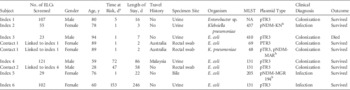
Our analysis included 443 patients: 6 bla NDM carriers (index 1–6) identified from clinical cultures and 437 contacts. Contact 1 and contact 2, identified via contact tracing for index 1 and index 4 respectively, tested positive for bla NDM. Baseline characteristics of the bla NDM carriers are described in Table 1.
Characteristics of Recruited Patients, Isolates, and Clinical Outcome

NOTE. ELC, epidemiologically linked contacts; MLST, multilocus sequence typing; NA, not available.
a Time at risk, time from admission to carbapenem-resistant Enterobacteriaceae isolation.
b Closest references plasmid identified based on minimum 75% sequence coverage.
Of the 10 bla NDM-positive plasmids identified, 7 (70%) were pTR3, with 1 each of pNDM-MAR, pNDM-KN and pNDM_MGR194. Among the pTR3 (total length, 41,187 bp) plasmids, there was only 1 unique SNV among 8 isolates from 6 patients. Patient pairs including index 1, index 3, index 4, index 6, contact 1, and contact 2 (isolates with pTR3) could potentially form phylogenetic transmission clusters based upon plasmid homology criteria.
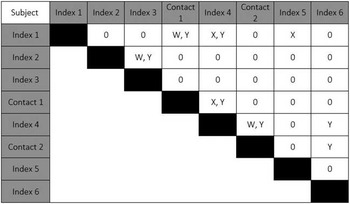
Core chromosomal analysis was performed separately for E. coli and K. pneumoniae. Among the E. coli isolates, only index 4, contact 2, and index 6 met criteria for phylogenetic transmission clustering, while none of the K. pneumoniae pairs fulfilled the criteria. Taken together, index 4 and contact 2 met the criteria for direct transmission. There was evidence of indirect transmission between index 6 and either index 4 or contact 2. This finding was supported by clinical epidemiological investigation (Figure 1).
Opportunities for horizontal transmission of bla NDM among index carriers and contacts during overlapping period of time in the hospital. Sharing the same ward (W) was associated with the most opportunities for horizontal transmission through sharing of medical equipment and common facilities (eg, toilets, shower, wash basin, and lounge), intraward cross coverage by nursing and medical teams, and direct interaction between ambulant patients. Sharing of daytime clinical care team (X) and/or night duty team (Y) was associated with opportunities for interward transmission of bla NDM because these teams covered patients across different wards.

DISCUSSION
This study highlights an important limitation of reactive infection control strategy. We have identified some horizontal transmissions but may have missed others, especially those that predate the NDM-producing Enterobacteriaceae identification from clinical cultures.
In this study, we screened 437 ELCs and found 2 asymptomatic carriers; 1 of these ELCs (contact 2) was directly related to E. coli ST131 from index 4. Index 4 had been admitted to our hospital for more than 2 months before the urinary colonization of NDM-producing E. coli was discovered, providing ample opportunity for horizontal transmission. Indeed, genomic analysis suggested the presence of intermediary NDM carriers; E. coli isolated from index 6 almost a year later was indirectly related to the cluster involving index 4 and contact 2. It is disconcerting that most of the NDM-producing Enterobacteriaceae were identified from clinical cultures (all were polyclonal); for every patient with CRE from clinical culture, there could be at least 1 silent carrier.Reference Ben-David, Maor and Keller 10
The increasing number of patients with NDM-producing Enterobacteriaceae necessitated implementation of active surveillance cultures for high-risk patients on admission in addition to screening of ELCs (starting November 2011), thereby reducing the study period of reactive infection control strategy to a year. This limited our sample size. Additionally, due to the limited sample size, time-of-most-recent-common-ancestor (TMRCA) analysis could not be performed on this cohort.
In conclusion, we found that a reactive infection control strategy on its own was able to identify some horizontal transmissions of bla NDM but may have missed others that pre-dated the NDM-producing Enterobacteriaceae identification from clinical cultures. Our study supports international guidelines which recommend a multimodal strategy for control of CRE.
ACKNOWLEDGMENTS
Financial support: No financial support was provided relevant to this article.
Potential conflicts of interest: All authors report no conflicts of interest relevant to this article.