Up to one-third of youth in the general population report subclinical psychotic experiences such as hearing voices, having visions, being extremely paranoid, and other unusual thoughts and beliefs (Horwood et al., Reference Horwood, Salvi, Thomas, Duffy, Gunnell, Hollis and Wolke2008; Kelleher, Connor, et al., Reference Kelleher, Connor, Clarke, Devlin, Harley and Cannon2012; Newbury, Arseneault, Caspi, et al., Reference Newbury, Arseneault, Caspi, Moffitt, Odgers and Fisher2017; Spauwen, Krabbendam, Lieb, Wittchen, & van Os, Reference Spauwen, Krabbendam, Lieb, Wittchen and van Os2004; Yoshizumi, Muase, Honjo, Kanesko, & Murakami, Reference Yoshizumi, Murase, Honjo, Kaneko and Murakami2004). Though early psychotic phenomena are usually transitory (Kelleher, Connor, et al., Reference Kelleher, Connor, Clarke, Devlin, Harley and Cannon2012; Scott, Chant, Andrews, & McGrath, Reference Scott, Chant, Andrews and McGrath2006), adolescents who report these experiences have a significantly elevated adulthood risk for schizophrenia (Fisher et al., Reference Fisher, Caspi, Poulton, Meier, Houts, Harrington and Moffitt2013; Poulton et al., Reference Poulton, Caspi, Moffitt, Cannon, Murray and Harrington2000) and other serious psychiatric problems such as depression, substance dependence, and suicide attempts (Dhossche, Ferdinand, van der Ende, Hofstra, & Verhulst, Reference Dhossche, Ferdinand, van der Ende, Hofstra and Verhulst2002; Fisher et al., Reference Fisher, Caspi, Poulton, Meier, Houts, Harrington and Moffitt2013; Kelleher, Lynch, et al., Reference Kelleher, Lynch, Harley, Molloy, Roddy, Fitzpatrick and Cannon2012). Late adolescence heralds the peak age of risk for a first episode of psychosis (Häfner, Maurer, Löffler, & Fätkenheuer, Reference Häfner, Maurer, Löffler and Fätkenheuer1994), a diagnosis that increases young people's risk of death within a year by over 20-fold (Schoenbaum et al., Reference Schoenbaum, Sutherland, Chappel, Azrin, Goldstein, Rupp and Heinssen2017). Subclinical psychotic experiences during this period have also been shown to be more clinically relevant than at earlier ages (Kelleher, Keeley, et al., Reference Kelleher, Keeley, Corcoran, Lynch, Devlin, Molloy and Cannon2012). It is therefore crucial to improve our understanding of the mechanisms leading to psychotic experiences during adolescence, from genetic influences through to the wider built and social environment, in order to develop more targeted and effective preventative interventions (Millan et al., Reference Millan, Andrieux, Bartzokis, Cadenhead, Dazzan, Fusar-Poli and Weinberger2016).
Adolescent psychotic experiences share similar familial and social risk factors to adult psychosis, such as family history of mental illness, marijuana use, and low socioeconomic status (SES; Kelleher & Cannon, Reference Kelleher and Cannon2011; Polanczyk et al., Reference Polanczyk, Moffitt, Arseneault, Cannon, Ambler, Keefe and Caspi2010). Emerging research now implicates adverse wider environmental factors in the etiology of subclinical psychotic phenomena and clinical psychosis. Compared to youth living in rural settings, young people in cities are exposed to higher neighborhood levels of fragmentation, crime, and disorder (Goldman-Mellor, Margerison-Zilko, Allen, & Cerdá, Reference Goldman-Mellor, Margerison-Zilko, Allen and Cerdá2016; Newbury, Arseneault, Caspi, et al., Reference Newbury, Arseneault, Caspi, Moffitt, Odgers and Fisher2017; Office for National Statistics, 2012). Neighborhood disorder is a sociological construct that refers to physical and social signs of threat and danger in the neighborhood, such as vandalism, gang activity, and burglaries (Sampson & Raudenbush, Reference Sampson and Raudenbush1999). Youth and young adults who live in these kinds of urban, fragmented, and threatening settings are more likely to have prodromal symptoms, persistent psychotic experiences, and a first episode of psychosis (Bhavsar, Boydell, Murray, & Power, Reference Bhavsar, Boydell, Murray and Power2014; Kirkbride et al., Reference Kirkbride, Stochl, Zimbron, Crane, Metastasio, Aguilar and Jones2015; Spauwen, Krabbendam, Lieb, Wittchen, & van Os, Reference Spauwen, Krabbendam, Lieb, Wittchen and van Os2006; Wilson et al., Reference Wilson, Smith, Thompson, Demro, Kline, Bussell and Schiffman2016), and there is evidence that symptom severity among adults with clinical psychosis is exacerbated after brief exposure to a densely populated urban environment (Ellett, Freeman, & Garety, Reference Ellett, Freeman and Garety2008; Freeman et al., Reference Freeman, Emsley, Dunn, Fowler, Bebbington, Kuipers and Garety2014). Furthermore, we recently identified higher rates of psychotic phenomena among children and adolescents living in cities in the United Kingdom (Newbury et al., Reference Newbury, Arseneault, Caspi, Moffitt, Odgers and Fisher2016; Newbury, Arseneault, Caspi, et al., Reference Newbury, Arseneault, Caspi, Moffitt, Odgers and Fisher2017). Our analyses showed that threatening and adverse neighborhood social conditions, as reported by mothers and residents, explained up to half of this association between urbanicity and early psychotic phenomena (Newbury et al., Reference Newbury, Arseneault, Caspi, Moffitt, Odgers and Fisher2016; Newbury, Arseneault, Caspi, et al., Reference Newbury, Arseneault, Caspi, Moffitt, Odgers and Fisher2017). There is now a growing consensus that urban and adverse neighborhood conditions increase risk for psychotic phenomena by elevating background and acute sources of social stress, particularly during upbringing (Heinz, Deserno, & Reininghaus, Reference Heinz, Deserno and Reininghaus2013; Lederbogen, Haddad, & Meyer-Lindenberg, Reference Lederbogen, Haddad and Meyer-Lindenberg2013; Selten, van der Ven, Rutten, & Cantor-Graae, Reference Selten, van der Ven, Rutten and Cantor-Graae2013). This proposed mechanism requires that young people in cities and adverse neighborhood settings are themselves perceiving their neighborhoods as stressful and threatening.
Existing studies of neighborhood conditions and psychosis (both subclinical and clinical phenotypes) have typically derived neighborhood measures from official data assigned to broad geostatistical units. While being objective, these types of measures do not establish the extent to which the neighborhood feature(s) in question was personally experienced or perceived by the individuals under study (the ecological fallacy). Individuals can and do differ in how they perceive the same environment or experience, but we currently know very little about the potential role of young people's personal perceptions of threat in their immediate neighborhood in the etiology of early psychotic phenomena. That is, it is unknown whether personal perceptions of neighborhood conditions are important over and above objectively measured neighborhood conditions. Considering that urban and adverse neighborhood conditions putatively increase risk for psychotic phenomena via a social stress pathway, and delusions and hallucinations involve altered perceptions of reality, we might expect personal perceptions of the neighborhood (e.g., “my neighborhood is dangerous”) to play a crucial role in the association between adverse neighborhood conditions and psychotic experiences. Recent research has shown that perceptions of neighborhood disorder are associated with common mental health problems and psychological distress among youth, above and beyond the effects of official levels of crime (Goldman-Mellor et al., Reference Goldman-Mellor, Margerison-Zilko, Allen and Cerdá2016; Polling, Khondoker, Hatch, Hotopf, & South East London Community Health Study Team, Reference Polling, Khondoker, Hatch and Hotopf2014). These findings also parallel a body of research documenting stronger associations between childhood trauma and psychiatric problems when childhood trauma is retrospectively self-reported rather than obtained from objective or independent sources (Brown, Berenson, & Cohen, Reference Brown, Berenson and Cohen2005; Newbury, Arseneault, Moffitt, et al., Reference Newbury, Arseneault, Moffitt, Caspi, Danese, Baldwin and Fisher2017; Reuben et al., Reference Reuben, Moffitt, Caspi, Belsky, Harrington, Schroeder and Danese2016; Widom & Morris, Reference Widom and Morris1997; Widom, Weiler, & Cottler, Reference Widom, Weiler and Cottler1999). Examining the role of young people's personal perceptions of threatening neighborhood conditions in early psychotic experiences could not only elucidate the mechanisms underlying previous findings on neighborhood adversity and psychotic experiences but also highlight potential new avenues for interventions. For example, targeted cognitive behavioral interventions have been shown to alleviate the paranoia and distress caused by busy urban settings among patients with clinical psychosis (Freeman et al., Reference Freeman, Waller, Harpur-Lewis, Moore, Garety, Bebbington and Fowler2015).
A number of potential methodological issues must be considered when examining the role of perceived neighborhood conditions in early psychotic phenomena. Similarly to self-report measures of childhood trauma (Hardt & Rutter, Reference Hardt and Rutter2004), self-report measures of adverse neighborhood conditions could be subject to shared method and mood-congruent recall biases, whereby an individual's contemporaneous mental health influences their perception and memory. It is particularly important to consider this potential confounding mechanism when investigating psychotic experiences, which involve altered perceptions of reality, such as paranoia and threat detection bias (Freeman, Garety, Kuipers, Fowler, & Bebbington, Reference Freeman, Garety, Kuipers, Fowler and Bebbington2002; Garety, Kuiper, Fowler, Freeman, & Bebbington, Reference Garety, Kuipers, Fowler, Freeman and Bebbington2001). It is therefore useful to establish the construct validity of personal perceptions of neighborhood adversity by comparing self-reports to objective and independent measures of the neighborhood. Moreover, given the potential bidirectional relationship between psychotic experiences and perceptions of the neighborhood, longitudinal designs are needed to examine the temporality of the association. It is also crucial to consider a range of factors that might simultaneously influence both adolescents’ perceptions of neighborhood adversity and their psychotic experiences, such as family SES, substance use, earlier psychotic symptoms in childhood, and genetic influences. Emerging behavioral genetics research suggests that overlapping genes may partly explain the correlation between psychotic phenomena and certain putatively environmental exposures, such as stressful life events (Shakoor et al., Reference Shakoor, Zavos, Haworth, McGuire, Cardno, Freeman and Ronald2016) and neighborhood-level deprivation (Sariaslan et al., Reference Sariaslan, Fazel, D'Onofrio, Långström, Larsson, Bergen and Lichtenstein2016). It is plausible that shared genetic influences might also contribute to covariance between psychotic phenomena and perceptions of neighborhood adversity. The classical twin design allows the covariance between two variables to be partitioned into genetic and environmental sources, thus providing an ideal technique for exploring this issue.
Using data from a longitudinal cohort of over 2,000 British twin children, the present study adopts a multilevel approach (spanning the wider built and social environment, family-level characteristics, and individual-level factors including genetic influences) to investigate the role of personal perceptions of threatening neighborhood conditions in the development of adolescent psychotic experiences. A comprehensive battery of data has been collected at several time points across early development. Psychotic phenomena were measured in both childhood (age 12) and adolescence (age 18). Urbanicity, neighborhood-level SES, and neighborhood crime rates were obtained from detailed geodemographic and official data sources. Resident surveys of over 5,000 immediate neighbors of Environmental Risk (E-Risk) Longitudinal Twin Study participants provided an independent measure of neighborhood disorder. Personal perceptions of neighborhood disorder were self-reported by the participants themselves in private interviews at age 18. All neighborhood measures had high resolution (i.e., street level or postcode level). The twin sample afforded us the opportunity to estimate the genetic versus environmental sources of covariance between perceptions of neighborhood disorder and adolescent psychotic experiences. With these measures, we investigated the construct validity of adolescents’ personal perceptions of neighborhood disorder by correlating these self-reports with objective/independent measures of neighborhood adversity. We then asked the following:
-
1. Do higher perceived levels of neighborhood disorder among adolescents in urban (versus rural) settings explain the association between urbanicity and adolescent psychotic experiences?
-
2 a. Is the association between perceptions of neighborhood disorder and adolescent psychotic experiences robust to neighborhood-, family-, and individual-level confounders (official neighborhood crime rates, resident-reported neighborhood disorder, neighborhood-level SES, family SES, family psychiatric history, maternal psychotic symptoms, adolescent marijuana dependence, alcohol dependence, anxiety, depression, and childhood psychotic symptoms)?
b. Are twins who perceive higher levels of neighborhood disorder than their co-twin also more likely to have psychotic experiences (this within-family co-twin control analysis holds neighborhoods constant and accounts more robustly for unmeasured genetic and environmental factors shared between twins)?
-
3. Do childhood perceptions of neighborhood safety predict adolescent psychotic experiences after considering childhood psychotic symptoms, and do childhood psychotic symptoms predict adolescent perceptions of neighborhood disorder after considering childhood perceptions of neighborhood safety? (i.e., what is the temporality of the association between perceptions of neighborhood disorder and early psychotic phenomena?)
-
4. a. To what extent do genetic versus environmental factors contribute to perceptions of neighborhood disorder and adolescent psychotic experiences?
b. To what extent do overlapping genetic versus environmental factors contribute to the covariance between perceptions of neighborhood disorder and adolescent psychotic experiences?
Method
Study cohort
Participants were members of the E-Risk Longitudinal Twin Study, which tracks the development of a nationally representative birth cohort of 2,232 British twin children. The sample was drawn from a larger cohort of twins born in England and Wales in 1994–1995 (Trouton, Spinath, & Plomin, Reference Trouton, Spinath and Plomin2002). Full details about the sample are reported elsewhere (Moffitt & E-Risk Study Team, Reference Moffitt2002). Briefly, the E-Risk sample was constructed in 1999–2000, when 1,116 families with same-sex 5-year-old twins (93% of those eligible) participated in home-visit assessments. This sample comprised 56% monozygotic (MZ) and 44% dizygotic (DZ) twin pairs; sex was evenly distributed within zygosity (49% male). Families were recruited to represent the UK population of families with newborns in the 1990s, based on residential location throughout England and Wales and mothers’ age (teenaged mothers with twins were overselected to replace high-risk families who were selectively lost to the register through nonresponse; older mothers having twins via assisted reproduction were underselected to avoid an excess of well-educated older mothers). All families were English speaking, and the majority (93.7%) were White. Follow-up home visits were conducted when children were aged 7, 10, 12, and 18 (participation rates were 98%, 96%, 96%, and 93%, respectively). Home visits at ages 5, 7, 10, and 12 years included assessments with participants as well as their mother (or primary caretaker); the home visit at age 18 included interviews only with the participants. Each twin participant was assessed by a different interviewer. The average age of the twins at the time of the age 18 assessment was 18.4 years (SD = 0.36); all interviews were conducted after the 18th birthday. At age 18, the E-Risk sample comprised 2,066 participants. There were no differences between those who did and did not take part at age 18 in terms of age 5 SES (χ2 = 0.86, p = .65, age 5 IQ scores, t = 0.98, p = .33) or age 5 internalizing or externalizing behavior problems (t = 0.40, p = .69 and t = 0.41, p = .68, respectively). The Joint South London and Maudsley and the Institute of Psychiatry Research Ethics Committee approved each phase of the study. Parents gave informed consent, and participants gave assent at ages 5–12 and informed consent at age 18.
Measures
Adolescent psychotic experiences
At age 18, E-Risk participants were privately interviewed by a research worker about 13 psychotic experiences occurring since age 12. Seven items pertained to delusions and hallucinations, with items including “Have other people ever read your thoughts?” “Have you ever thought you were being followed or spied on?” and “Have you ever heard voices that other people cannot hear?” Six items pertained to unusual experiences that drew on item pools since formalized in prodromal psychosis instruments including the Prevention Through Risk Identification, Management, and Education Screen and the Structured Interview for Prodromal Symptoms (Loewy, Pearson, Vinogradov, Bearden, & Cannon, Reference Loewy, Pearson, Vinogradov, Bearden and Cannon2011). These included “I worry that my food may be poisoned” and “My thinking is unusual or frightening.” Interviewers coded each item 0, 1, or 2 indicating, respectively, not present, probably present, and definitely present. All 13 items were summed to create a psychotic experiences scale (range = 0–18, M = 1.19, SD = 2.58). Scores were placed into an ordinal scale. All but three participants completed the psychotic experiences interview at age 18 (N = 2,063). Just over 30% of participants had at least one psychotic experience between ages 12 and 18: 69.8% reported no psychotic experiences (coded 0; N = 1,440), 15.5% reported one or two psychotic experiences (coded 1; n = 319), and 14.7% reported three or more psychotic experiences (coded 2; n = 304). This 30% prevalence is similar to the prevalence of self-reported psychotic experiences in other community samples of teenagers and young adults (Horwood et al., Reference Horwood, Salvi, Thomas, Duffy, Gunnell, Hollis and Wolke2008; Kelleher, Connor, et al., Reference Kelleher, Connor, Clarke, Devlin, Harley and Cannon2012; Spauwen et al., Reference Spauwen, Krabbendam, Lieb, Wittchen and van Os2004; Yoshizumi et al., Reference Yoshizumi, Murase, Honjo, Kaneko and Murakami2004).
Childhood psychotic symptoms
Childhood psychotic symptoms were used as a control and to investigate the temporality of the association between psychotic phenomena and perceptions of neighborhood conditions. This interview has been described in detail previously (Polanczyk et al., Reference Polanczyk, Moffitt, Arseneault, Cannon, Ambler, Keefe and Caspi2010). Briefly, E-Risk families were visited by mental health trainees or professionals when children were aged 12. Each child was privately interviewed about seven psychotic symptoms pertaining to delusions and hallucinations (these same delusion/hallucination items were used at age 18 as described above). The item choice was guided by the Dunedin Study's age 11 interview protocol (Poulton et al., Reference Poulton, Caspi, Moffitt, Cannon, Murray and Harrington2000) and an instrument prepared for the Avon Longitudinal Study of Parents and Children (Schreier et al., Reference Schreier, Wolke, Thomas, Horwood, Hollis, Gunnell and Duffy2009). Interviewers coded each experience 0, 1, or 2, indicating, respectively, not a symptom, probable symptom, and definite symptom. A conservative approach was taken in designating a child's report as a symptom. First, the interviewer probed using standard prompts designed to discriminate between experiences that were plausible (e.g., “I was followed by a man after school”) and potential symptoms (e.g., “I was followed by an angel who guards my spirit”), and wrote down the child's narrative description of the experience. Second, items and interviewer notes were assessed by a psychiatrist expert in schizophrenia, a psychologist expert in interviewing children, and a child and adolescent psychiatrist to verify the validity of the symptoms. Third, because children were twins, experiences limited to the twin relationship (e.g., “My twin and I often know what each other are thinking”) were coded as not a symptom. Children were only designated as experiencing psychotic symptoms if they reported at least one definite symptom. At age 12, 5.9% (N = 125) of children reported at least one clinically verified psychotic symptom.
Personal perceptions of neighborhood disorder
During the age 18 interviews, participants reported on social characteristics of their immediate neighborhoods, including neighborhood disorder (Sampson & Raudenbush, Reference Sampson and Raudenbush1999). We were interested in perceptions of neighborhood disorder based on previous research linking residents’ independent assessments of neighborhood disorder with psychotic phenomena in both childhood and adolescence (Newbury et al., Reference Newbury, Arseneault, Caspi, Moffitt, Odgers and Fisher2016; Newbury, Arseneault, Caspi, et al., Reference Newbury, Arseneault, Caspi, Moffitt, Odgers and Fisher2017), and because adolescents’ personal perceptions of threat and danger could plausibly influence (or be influenced by) psychotic phenomena. Neighborhood disorder was assessed by asking participants about whether six problems affected their neighborhood, including litter, broken glass, and rubbish in public places; run-down buildings, abandoned cars, wasteland, or vacant shop fronts; people being drunk or unruly in public; people selling or using drugs; groups of young people hanging out and causing trouble; and homes getting broken into or burgled (coded 0 = not true, 1 = sometimes true, and 2 = often true). Item responses were averaged for each participant (M = 0.52, SD = 0.49, range = 0–2).
At age 12, participants also reported on neighborhood safety as part of a computer-based self-report stress questionnaire. Children indicated whether the statement “You feel unsafe in your neighborhood” was true or false. At age 12, 12.3% (N = 260) of children reported that they felt their neighborhood was unsafe.
Urbanicity
Our measure of urbanicity was derived from the Office of National Statistics’ (ONS) Rural-Urban Definition for Small Area Geographies (RUC2011) classifications. The ONS RUC2011 rural–urban classification utilized 2011 census data and was designed for application to small statistical units (e.g., output areas, superoutput areas, and wards). Detailed information on the creation of RUC2011 is available on the ONS website (https://www.gov.uk/government/uploads/system/uploads/attachment_data/file/239477/RUC11methodologypaperaug_28_Aug.pdf). Briefly, RUC2011 was created by laying a grid of hectare cells (100 m2) over England and Wales. Postcode addresses were assigned to cells, providing an indication of residential density surrounding every individual residential property. Residential densities were then calculated for increasing radii around each cell, providing each residential property with a “density profile.” This measure was combined with Output Area and contextual data, allowing each settlement to be assigned to 1 of 10 categories of increasing urbanicity (rural categories: sparse/nonsparse hamlets and isolated dwellings, sparse/nonsparse villages, sparse/nonsparse rural towns and fringes; urban categories: sparse/nonsparse cities and towns, and minor/major conurbations). Urbanicity scores for the E-Risk participants were then created by identifying the ONS RUC2011 classification for each participant's postcode at age 18. Given the low numbers within some rural categories, urbanicity was collapsed into three levels: 1 = rural: all rural settings; 2 = intermediate: urban cities and towns; and 3 = urban: major and minor conurbations (conurbations are densely populated, large urban regions resulting from the expansion and coalescence of adjacent cities and towns). E-Risk families are nationally representative in terms of level of urbanicity. For example, 31.9% of E-Risk participants lived in the most highly urbanized settings at age 18 compared to 36.1% nationwide; 48.4% versus 45.0% lived in intermediate settings; and 19.7% versus 18.9% lived in rural settings (Office for National Statistics, 2013).
Official neighborhood crime rates
Associations between perceptions of neighborhood disorder and adolescent psychotic experiences were adjusted for official rates of crime in the neighborhood to isolate the associations arising from perceived versus objectively measured threat in the neighborhood. Street-level crime data, including information on the type of crime, date of occurrence, and approximate location, were accessed online as part of an open data-sharing effort about crime and policing in England and Wales. An application program interface was used to extract street-level crime data for each of the geospatial coordinates marking the family's home (for a full description, see https://data.police.uk/about/#location-anonymisation). Neighborhood crime rates were calculated by mapping a 1-mile radius around each E-Risk Study participant's home and tallying the total number of crimes that occurred in the area each month (M = 247, SD = 274, range = 1–1,868). Scores were computed for 2011 (the year prior to age 18 assessments), the first year for which full street-level data was available. These scores were then collapsed into quartiles. This measure covers various forms of crime, including violent offenses (e.g., assaults), sexual offenses (e.g., rape), robberies, burglaries, theft, arson, and vandalism.
Resident-reported neighborhood disorder
Associations between participants’ perceptions of neighborhood disorder and adolescent psychotic experiences were also adjusted for independently rated neighborhood conditions as reported by immediate neighbors of the E-Risk participants, to further isolate the effects of adolescent's personal perceptions of neighborhood disorder. Neighborhood conditions were estimated via a postal survey sent to residents living alongside E-Risk families in 2008 (Odgers, Caspi, Bates, Sampson, & Moffitt, Reference Odgers, Caspi, Bates, Sampson and Moffitt2012; Odgers et al., Reference Odgers, Moffitt, Tach, Sampson, Taylor, Matthews and Caspi2009). Survey respondents, who were typically living on the same street or within the same apartment block as the participants in our study, reported on various characteristics of their immediate neighborhood, including levels of neighborhood disorder. Surveys were returned by an average of 5.18 (SD = 2.73) respondents per neighborhood, and there were at least two responses for 95% of neighborhoods (N = 5,601 respondents). For neighborhood disorder, residents were asked whether 14 problems affected their neighborhood (e.g., muggings, assaults, vandalism, graffiti, and deliberate damage to property), which were each coded 0–2 (the same or very similar items were included in the 6 items used at age 18 to measure E-Risk participants’ perceptions of neighborhood disorder). Items were averaged to create summary scores for each of the 5,601 resident respondents. Neighborhood disorder scores for each E-Risk family were then created by averaging the summary scores of respondents within that family's neighborhood. The resulting variable approached normal distribution across the full potential range (M = 0.49, SD = 0.34, range = 0–1.93).
Neighborhood-level SES
Associations between perceptions of neighborhood disorder and adolescent psychotic experiences were also adjusted for neighborhood-level SES to check that associations were not explained simply by poverty. Neighborhood-level SES was constructed using A Classification of Residential Neighborhoods (ACORN), a geodemographic discriminator developed by CACI Information Services (http://www.caci.co.uk/). Detailed information about ACORN's classification of neighborhood-level SES has been provided previously (Caspi, Taylor, Moffitt, & Plomin, Reference Caspi, Taylor, Moffitt and Plomin2000; Odgers, Caspi, Russell, et al., Reference Odgers, Caspi, Russell, Sampson, Arseneault and Moffitt2012; Odgers et al., Reference Odgers, Moffitt, Tach, Sampson, Taylor, Matthews and Caspi2009). Briefly, CACI utilized over 400 variables from 2001 census data for Great Britain (e.g., educational qualifications, unemployment, and housing tenure) and CACI's consumer lifestyle database. Following hierarchical cluster analysis, CACI created five distinct and homogeneous ordinal groups ranging from “wealthy achiever” (coded 1) to “hard pressed” (coded 5) neighborhoods. Neighborhood-level SES scores for the E-Risk families were then created by identifying the ACORN classifications for the E-Risk families’ postcodes when children were aged 12. E-Risk families are representative of UK households across the spectrum of neighborhood-level SES: 25.6% of E-Risk families live in wealthy achiever neighborhoods compared to 25.3% of households nationwide; 5.3% versus 11.6% live in “urban prosperity” neighborhoods; 29.6% versus 26.9% live in “comfortably off” neighborhoods; 13.4% versus 13.9% live in “moderate means” neighborhoods; and 26.1% versus 20.7% live in hard-pressed neighborhoods (CACI Information Services, 2006; Caspi et al., Reference Caspi, Taylor, Moffitt and Plomin2000). E-Risk underrepresents urban prosperity neighborhoods because such households are likely to be childless.
Family- and individual-level covariates
Analyses were also adjusted for a range of family- and individual-level characteristics to account for potential compositional effects and biases due to co-occurring substance and mood problems. Family SES was measured via a composite of parental income, education, and occupation when participants were aged 5. The latent variable was categorized into tertiles (i.e., low-, medium-, and high-SES; Trzesniewski, Moffitt, Caspi, Taylor, & Maughan, Reference Trzesniewski, Moffitt, Caspi, Taylor and Maughan2006). Family psychiatric history and maternal psychotic symptoms were both assessed when participants were aged 12. In private interviews, the mother reported on her own mental health history and the mental health history of her biological mother, father, sisters, and brothers, as well as the twins’ biological father (Milne et al., Reference Milne, Moffitt, Crump, Poulton, Rutter, Sears and Caspi2008; Weissman et al., Reference Weissman, Wickramaratne, Adams, Wolk, Verdeli and Olfson2000). This was converted to the proportion of family members with a history of any psychiatric disorder (coded 0–1.0; M = 0.37, SD = 0.27). For maternal psychotic symptoms, mothers were interviewed using the Diagnostic Interview Schedule (Robins, Cottler, Bucholz, & Compton, Reference Robins, Cottler, Bucholz and Compton1995) for DSM-IV (American Psychiatric Association, 1994), which provides a symptom count for characteristic symptoms of schizophrenia (e.g., hallucinations, delusions, and anhedonia): 16.6% of mothers had at least one symptom of schizophrenia. We interviewed participants when they were aged 18 for the presence of marijuana dependence, alcohol dependence, generalized anxiety disorder, and major depressive episode, according to DSM-IV criteria. Assessments were conducted in face-to-face interviews using the Diagnostic Interview Schedule (Robins et al., Reference Robins, Cottler, Bucholz and Compton1995). At age 18, 4.3% (N = 89) of participants met criteria for marijuana dependence, 12.8% (N = 263) met criteria for alcohol dependence, 7.4% (N = 153) met criteria for anxiety, and 20.1% (N = 414) met criteria for depression. Longitudinal analyses were adjusted for potential confounders measured at age 12 or earlier including resident-reports of neighborhood disorder, neighborhood-level SES, family-level confounders (SES, psychiatric history, and maternal psychotic symptoms), and also for childhood anxiety and depression at age 12. Childhood anxiety was assessed via private interviews using the 10-item version of the Multidimensional Anxiety Scale for Children (March, Paker, Sullivan, Stallings, & Conners, Reference March, Parker, Sullivan, Stallings and Conners1997). An extreme anxiety group was formed with children who scored at or above the 95th percentile (N = 129, 6.1%). Childhood depression was also assessed at age 12 using the Children's Depression Inventory (Kovacs, Reference Kovacs1992). Children who scored 20 or more (Rivera, Bernal, & Rosello, Reference Rivera, Bernal and Rosello2005) were deemed to have clinically significant depressive symptoms (N = 74, 3.5%).
The twin design
The classical twin design compares the phenotypic correlation between MZ twin pairs to that between DZ twin pairs, and allows the variation/covariation in observed traits to be partitioned into additive genetic (A), common environmental (C), and unique environmental (E) components. This is because MZ twins share ~100% of their segregating DNA, whereas DZ twins share on average 50% of their segregating DNA. In contrast, MZ and DZ reared-together twin pairs both share 100% of their common environmental influences. The twin design methodology depends on the equal environment assumption, which assumes that MZ twin pairs and DZ twin pairs do not differ in the extent that they share environmental factors (Plomin, DeFries, Knopik, & Neiderhiser, Reference Plomin, DeFries, Knopik and Neiderhiser2013). In univariate analyses (variance in one trait), genetic influences on a trait are inferred if MZ correlations are greater than DZ correlations as this increased similarity between MZ twin pairs can only be accounted for by their increased genetic resemblance. Within-pair similarity that is not due to genetic factors is attributed to common environmental influences and would be implicated if the DZ correlation is greater than half that of the MZ correlation for a given trait. Unique environment accounts for individual-specific environmental factors that create differences among siblings from the same family. These are estimated from within-pair differences between MZ twins as E is the only influence that makes MZ twins different from one another. Measurement error is also included in E. Similarly, in bivariate analyses (covariance between two traits), higher cross-twin cross-trait correlations between MZ twin pairs versus DZ twin pairs suggests genetic sources of correlation between two traits (i.e., overlapping genetic influences on two traits). Maximum-likelihood estimation in OpenMx handles missing data and provides confidence intervals in addition to parameter estimates. Structural equation model fitting is used to estimate A, C, and E sources of phenotypic correlation and select the most parsimonious model (ACE, AE, CE, or E compared to the saturated model, which describes the data perfectly) according to fit statistics, including –2 log likelihood and the Akaike information criterion.
Statistical analysis
Analyses were conducted using STATA 14.2 and OpenMx. First, we investigated the construct validity of participants’ perceptions of neighborhood disorder by calculating the correlations of their personal perceptions with objectively/independently measured neighborhood conditions, including official neighborhood crime rates, resident-reports of neighborhood disorder, and neighborhood-level SES. Second, we calculated the mean levels of perceived neighborhood disorder among adolescents in urban, intermediate, and rural settings, and used KHB pathway decomposition (Breen, Karlson, & Holm, Reference Breen, Karlson and Holm2013) to test whether perceptions of neighborhood disorder mediated the effect of urbanicity on adolescent psychotic experiences. Third, we used ordinal logistic regression to test whether participants’ perceptions of neighborhood disorder were associated with adolescent psychotic experiences. Regression models were adjusted for official crime rates, resident-reports of neighborhood disorder, neighborhood-level SES, family-level factors (family SES, family psychiatric history, and maternal psychotic symptoms), adolescent substance and mood problems (marijuana dependence, alcohol dependence, anxiety, and depression), childhood psychotic symptoms, and for all potential confounders simultaneously. As an additional control step, we conducted co-twin control analyses to compare twin pairs in the same family and neighborhood who differed in their perceptions of neighborhood disorder. For this analysis, we used all complete twin pairs and calculated the differences between twins (i.e., Twin 1 perceived neighborhood disorder–Twin 2 perceived neighborhood disorder; Twin 1 psychotic experiences–Twin 2 psychotic experiences). Using ordinal logistic regression, we then regressed twin differences in adolescent psychotic experiences on twin differences in perceptions of neighborhood disorder. Fourth, we used ordinal logistic regression to test whether participants who perceived their neighborhoods as unsafe at age 12 were more likely to subsequently report psychotic experiences at age 18, after considering childhood psychotic symptoms at age 12 and perceptions of neighborhood disorder at age 18; and whether participants who reported psychotic symptoms at age 12 were subsequently more likely to perceive their neighborhoods as disordered at age 18, after considering perceptions of neighborhood unsafety at age 12 and adolescent psychotic experiences at age 18. This step was conducted to investigate the temporality of the association between early psychotic phenomena and perceptions of neighborhood conditions. Steps 2 to 4 accounted for the nonindependence of twin observations using the CLUSTER command in STATA. Fifth, cross-trait (the within-individual correlations between Trait 1 and Trait 2), cross-twin (the within-trait correlations between Twin 1 and Twin 2), and cross-twin cross-trait (the correlations between Trait 1 in Twin 1 and Trait 2 in Twin 2) phenotypic correlations for and between adolescent psychotic experiences and perceptions of neighborhood disorder were calculated in OpenMx (note: analyses were restricted to the 80.3% of participants who lived with their co-twin at age 18 to ensure that twin pairs were reporting on the same neighborhood). Univariate (cross-twin) and bivariate (cross-twin, cross-trait) ACE models were fitted and compared to the saturated model to estimate the extent that variation/covariation in adolescent psychotic experiences and perceptions of neighborhood disorder was attributable to A, C, and E influences. For adolescent psychotic experiences, a liability-threshold ACE model was fitted because this variable was on an ordinal scale. Because adolescent psychotic experiences were on an ordinal scale whereas perceptions of neighborhood disorder were on a quasi-continuous scale, bivariate ACE models were conducted using a combined continuous-ordinal approach. As is common practice in behavioral genetics analysis, sex was regressed out of variables and model fitting was conducted using the standardized residuals.
Results
Are participants’ personal perceptions of neighborhood disorder consistent with objective/independent measures of neighborhood adversity?
Correlations between participants’ personal perceptions of neighborhood disorder and objectively/independently measured neighborhood conditions were computed to investigate the construct validity of self-reports of neighborhood disorder. Personal perceptions of neighborhood disorder were significantly positively correlated (all ps < .001) with official neighborhood crime rates (r = .18), resident-reported neighborhood disorder (r = .33), and neighborhood-level SES (r = .35). Thus, participants’ perceptions of neighborhood disorder were consistent with more objective measures of neighborhood disorder and crime.
Do higher perceived levels of neighborhood disorder among adolescents in urban (vs. rural) settings explain the association between urbanicity and adolescent psychotic experiences?
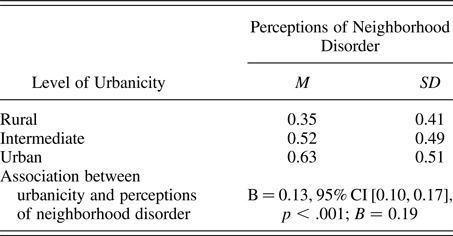
Table 1 shows the mean levels of perceived neighborhood disorder in urban, intermediate, and rural settings. Consistent with previous research, participants living in urban and intermediate (vs. rural) settings perceived significantly higher levels of neighborhood disorder, B = 0.13, 95% CI [0.10, 0.17], p < .001. In keeping with previous analyses in this cohort using independent reports of neighborhood disorder (Newbury et al., Reference Newbury, Arseneault, Caspi, Moffitt, Odgers and Fisher2016; Newbury, Arseneault, Caspi, et al., Reference Newbury, Arseneault, Caspi, Moffitt, Odgers and Fisher2017), mediation analysis showed that participants’ personal perceptions of neighborhood disorder explained 42% of the effect of the most urban residency at age 18 on adolescent psychotic experiences: total effect of urbanicity on adolescent psychotic experiences, odds ratio (OR) = 1.81, 95% CI [1.29–2.53], p = .001; direct effect of urbanicity, OR = 1.41, 95% CI [1.00, 1.98], p = .049; indirect effect of urbanicity mediated via perceptions of neighborhood disorder, OR = 1.28, 95% CI [1.16, 1.42], p < .001.
Perceptions of neighborhood disorder according to level of urbanicity
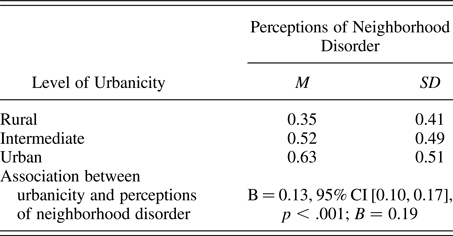
Note: B, unstandardized beta coefficient; B, standardized beta coefficient, which indicates the unit standard deviation change in perceptions of neighborhood disorder given 1 SD change in urbanicity. Standardized betas provide exactly the same point estimates as correlation coefficients and may be interpreted as correlations, with a score of +1.0 indicating a 100% positive correlation. Beta (B) regression coefficients account for the nonindependence of twin observations.
Is the association between perceptions of neighborhood disorder and adolescent psychotic experiences robust to neighborhood-, family-, and individual-level confounders?
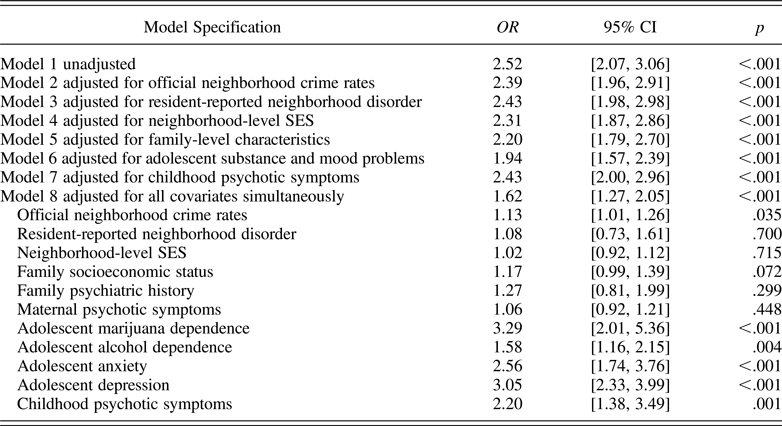
Model 1 in Table 2 shows that psychotic experiences were significantly more common among adolescents who perceived higher levels of neighborhood disorder (i.e., physical and social signs of threat, such as vandalism, gang activity and burglaries) in their immediate neighborhood, OR = 2.52, 95% CI [2.07, 3.06], p < .001. This association was slightly attenuated but remained highly significant (all ps < .001) after considering official neighborhood crime rates (Model 2); resident-reported neighborhood disorder (Model 3); neighborhood-level SES (Model 4); family-level characteristics including SES, psychiatric history, and maternal psychotic symptoms (Model 5); adolescent substance and mood problems, including marijuana dependence, alcohol dependence, anxiety, and depression (Model 6); childhood psychotic symptoms at age 12 (Model 7); as well as after considering all potential confounders simultaneously (Model 8), OR = 1.62, 95% CI [1.27, 2.05], p < .001.
The unadjusted and adjusted association of perceptions of neighborhood disorder with adolescent psychotic experiences
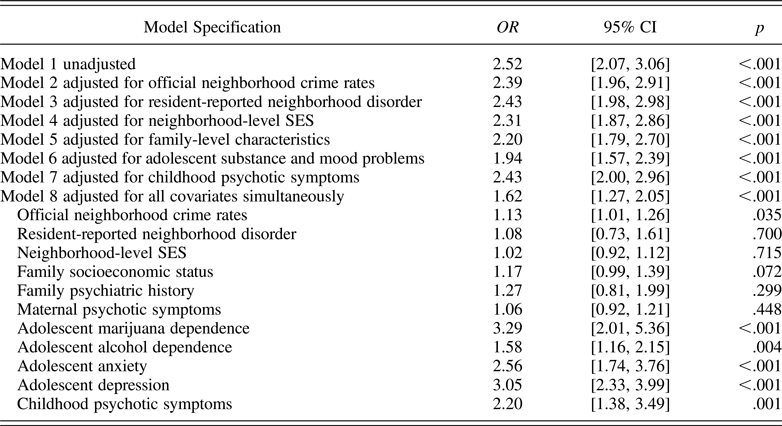
Note: OR, odds ratio from ordinal logistic regression; SES, socioeconomic status. Model 1 is the unadjusted association between adolescents’ perceptions of neighborhood disorder and adolescent psychotic experiences. Model 2 is the adjusted for official neighborhood crime rates. Model 3 is adjusted for resident-reported neighborhood disorder. Model 4 is adjusted for neighborhood-level SES. Model 5 is adjusted for family-level characteristics (family SES, family psychiatric history, and maternal psychotic symptoms). Model 6 is adjusted for adolescent substance and mood problems (marijuana dependence, alcohol dependence, anxiety, and depression). Model 7 is adjusted for childhood psychotic symptoms at age 12. Model 8 is adjusted simultaneously for all covariates. All analyses account for the nonindependence of twin observations.
As an additional control step, we investigated whether participants who perceived higher levels of neighborhood disorder than their co-twin were also more likely to score higher for adolescent psychotic experiences. The co-twin control design controls both the predictor and the outcome for within-family environmental influences and partially for genetic influences. By restricting analyses to the 80.3% of twin pairs who lived together at age 18, this analysis also holds the actual neighborhood conditions constant by design, thus providing a more stringent test of whether perceived levels of neighborhood disorder are independently associated with adolescent psychotic experiences. Among twin pairs living together, twins who perceived a higher level of neighborhood disorder than their co-twin were also significantly more likely to report more psychotic experiences than their co-twin, OR = 1.34, 95% CI [1.05, 1.82], p = .036. This effect is smaller than that yielded for the entire sample from regression models of the association between perceived neighborhood disorder and adolescent psychotic experiences, adjusted OR = 1.62, 95% CI [1.27, 2.05], p < .001. Nevertheless, the statistically significant associations in both the regression and co-twin control models demonstrates that perceptions of neighborhood disorder were independently associated with adolescent psychotic experiences, net of a range of measured and unmeasured genetic, individual-level, and family-level potential confounders.
What is the temporality of the association between early psychotic phenomena and perceptions of neighborhood disorder?
Consistent with the association between perceptions of neighborhood disorder and adolescent psychotic experiences at age 18, children's own perceptions that their neighborhoods were unsafe were significantly associated with childhood psychotic symptoms at age 12, unadjusted OR = 2.88, 95% CI [1.88, 4.44], p < .001. These earlier age 12 measures of psychotic symptoms and perceived neighborhood conditions were used to investigate the temporality of the association between early psychotic phenomena and perceptions of neighborhood disorder.
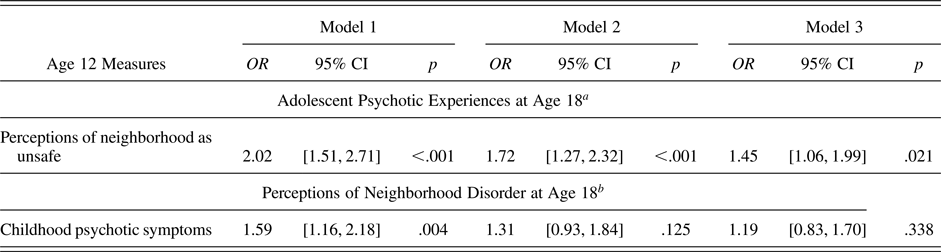
Model 1 in Table 3 shows that participants who had perceived their neighborhoods as unsafe at age 12 were significantly more likely to report adolescent psychotic experiences at age 18, even after taking into account earlier childhood psychotic symptoms at age 12, OR = 2.02, 95% CI [1.51, 2.71], p < .001. The association between children's perceptions of neighborhood unsafety and adolescent psychotic experiences remained significant after considering perceptions of neighborhood disorder at age 18 (Model 2), as well as after considering other potential confounders listed under Table 3 (Model 3). Model 1 in Table 3 also shows that participants who reported childhood psychotic symptoms at age 12 were significantly more likely to perceive their neighborhood as disordered at age 18, even after considering earlier perceptions of neighborhood unsafety at age 12, OR = 1.59, 95% CI [1.16, 2.18], p = .004. However, the association between childhood psychotic symptoms at age 12 and perceptions of neighborhood disorder at age 18 was attenuated to below conventional levels of significance after considering adolescent psychotic experiences at age 18 (Model 2) and other potential confounders (Model 3).
The longitudinal associations of perceptions of neighborhood safety and psychotic symptoms at age 12 with subsequent psychotic experiences and perceptions of neighborhood disorder at age 18
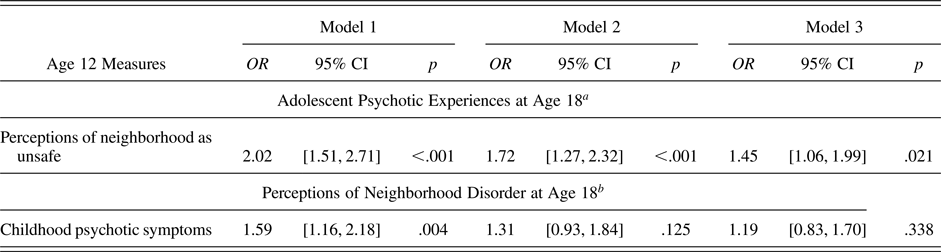
Note: OR, odds ratio from ordinal logistic regression; SES, socioeconomic status. Model 1, the association of childhood perceptions of neighborhood unsafety with adolescent psychotic experiences, was adjusted for childhood psychotic symptoms. The association of childhood psychotic symptoms with perceptions of neighborhood disorder was adjusted for childhood perceptions of neighborhood unsafety. Model 2, the association between perceptions of neighborhood unsafety and adolescent psychotic experiences, was additionally adjusted for perceptions of neighborhood disorder at age 18. The association between childhood psychotic symptoms and perceptions of neighborhood disorder was also adjusted for adolescent psychotic experiences. Model 3 contains both regression models that were also adjusted for resident reports of neighborhood disorder, neighborhood-level SES, family SES, family psychiatric history, maternal psychotic symptoms, and childhood anxiety and depression. All analyses account for the nonindependence of twin observations.
a The association of childhood perceptions of neighborhood unsafety at age 12 with adolescent psychotic experiences at age 18.
b The association of childhood psychotic symptoms at age 12 with perceptions of neighborhood disorder at age 18.
To what extent do genetic versus environmental factors contribute to perceptions of neighborhood disorder and adolescent psychotic experiences?
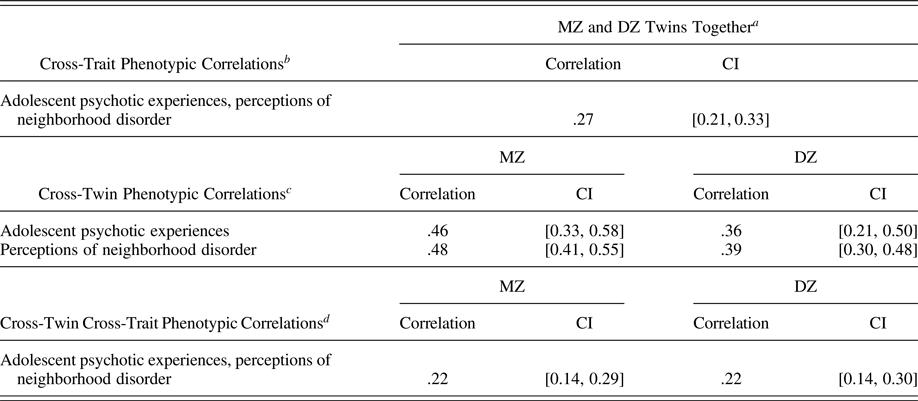
Using the classical twin design and maximum-likelihood estimation in OpenMx, we further examined the genetic and environmental contributions to adolescent psychotic experiences and participants’ perceptions of neighborhood disorder at age 18 (note: analyses were again restricted to the 80.3% of participants who lived with their co-twin at age 18, to ensure that twins were reporting on the same neighborhoods and therefore only perceptions of neighborhoods varied between twin pairs). Table 4 shows the cross-trait, cross-twin, and cross-twin cross-trait phenotypic correlations of adolescent psychotic experiences and perceptions of neighborhood disorder, stratified by zygosity. Consistent with the logistic regression results for the entire sample in Table 2, Table 4 shows that there was a significant cross-trait correlation between adolescent psychotic experiences and perceptions of neighborhood disorder for the 80.3% of participants who lived with their co-twin, r = .27, 95% CI [0.21, 0.33].
Cross-trait, cross-twin, and cross-twin cross-trait phenotypic correlations of and between adolescent psychotic experiences and perceptions neighborhood disorder
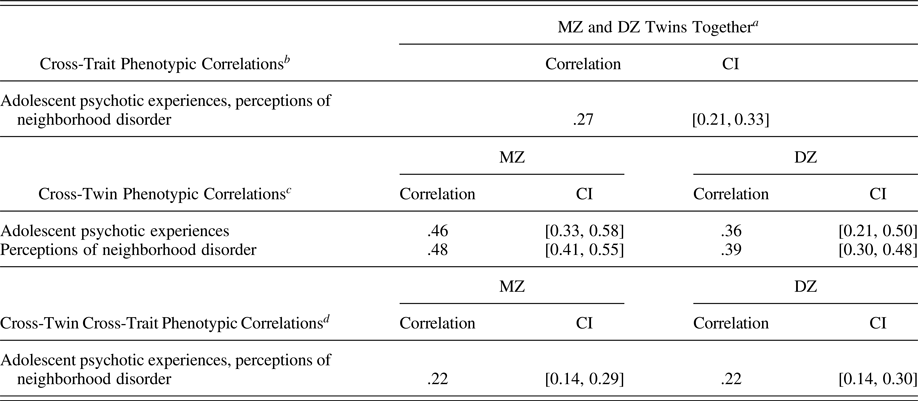
Note: MZ, monozygotic (identical) twins; DZ, dizygotic (fraternal) twins.
a All phenotypic correlation analyses in Table 4 were conducted on the subsample of twins who lived together with their co-twin at age 18 (80.3%).
b The phenotypic correlation in the entire analysis sample between adolescent psychotic experiences and adolescents’ perceptions of neighborhood disorder in the immediate neighborhood.
c The phenotypic correlation between twins for adolescent psychotic experiences and perceptions of neighborhood disorder among MZ versus DZ twins. Cross-twin phenotypic correlations were also calculated for MZ males (MZm), DZ males (DZm), MZ females (MZ), and DZ females (DZf) separately to check for potential sex differences. (These cross-twin phenotypic correlations were calculated in STATA 14.2 without confidence intervals because of low numbers of female twin pairs concordant for three or more psychotic experiences when stratified by sex.) Phenotypic correlations (all ps < .05) did not differ substantially by sex. For neighborhood disorder: MZm = 0.47, DZm = 0.43, MZf = 0.48, and DZf, 0.35; for adolescent psychotic experiences: MZm = 0.41, DZm = 0.27, MZf = 0.52, and DZf = 0.46.
d The correlation of Trait 1 in Twin 1 with Trait 2 in Twin 2 among MZ versus DZ twins.
Cross-twin phenotypic correlations for adolescent psychotic experiences suggested some genetic contributions because MZ twin correlations (r = .46) were slightly larger than DZ twin correlations (r = .36); common environmental contributions (C) were also indicated because DZ correlations were greater than half that of MZ correlations; and unique environmental contributions were also indicated because MZ correlations were less than unity (Table 4). For perceptions of neighborhood disorder, cross-twin phenotypic correlations again suggested genetic contributions because MZ correlations (r = .48) were slightly greater than DZ correlations (r = .39); common environmental contributions (C) were indicated because DZ correlations were greater than half that of MZ correlations; and unique environmental contributions were indicated because MZ correlations were less than unity (cross-twin phenotypic correlations did not vary substantially between males and females; see Table 4 footnotes); therefore, subsequent analyses were conducted on both sexes together).
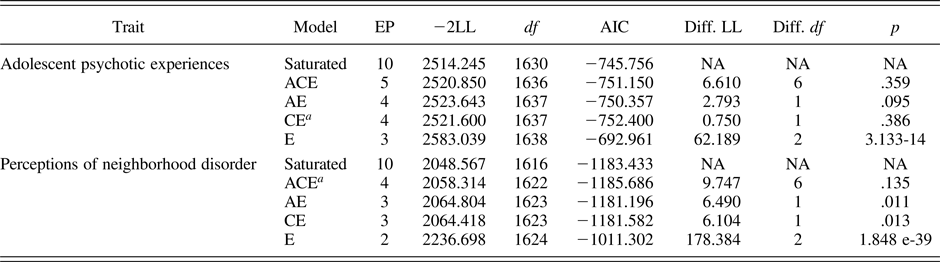
ACE estimates from univariate model fitting were consistent with the cross-twin correlations. For adolescent psychotic experiences, observed variance was mostly explained by unique environmental (55%) and common environmental (28%) factors, with genetic factors explaining a small proportion of the observed variance (17%). For perceptions of neighborhood disorder, observed variance was explained by unique environmental (50%), common environmental (24%), as well as genetic (26%) factors. Table 5 displays the fit statistics for the ACE model and nested models (AE, CE, and E). Given that the full ACE model was the best fitting model for perceptions of neighborhood disorder, we present the results from the full ACE bivariate model.
Fit statistics of submodels (ACE, AE, CE, E) compared to the saturated univariate model for adolescent psychotic experiences and perceptions of neighborhood disorder
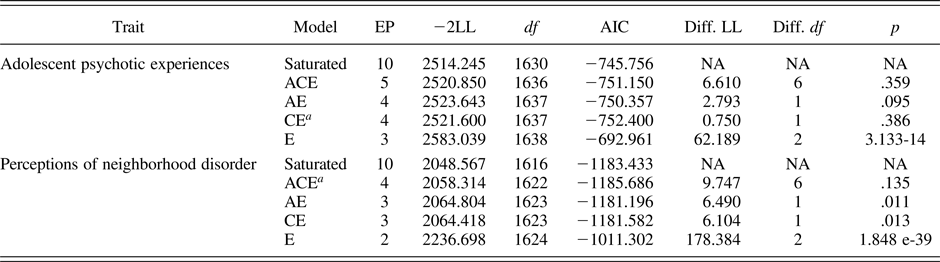
Note: ACE, full model testing genetic, common, and unique environmental influences compared to the saturated model; AE, model testing genetic and unique environmental influences compared to the ACE model; CE, model testing common and unique environmental influences compared to the ACE model; E, model testing unique environmental influences compared to the ACE model; EP, estimated parameters; –2LL, –2 log likelihood; AIC, Akaike information criterion (lower values indicate a better fitting model); Diff., difference; NA, not applicable.
a Best fitting model.
To what extent do overlapping genetic versus environmental factors contribute to the covariance between adolescent psychotic experiences and perceptions of neighborhood disorder?
The cross-twin cross-trait correlations in Table 4 give an indication of the genetic, common environmental, and unique environmental sources of phenotypic correlation between adolescent psychotic experiences and perceptions of neighborhood disorder. Modest positive cross-twin cross-trait correlations between adolescent psychotic experiences and perceptions of neighborhood disorder were apparent. Correlations did not differ by zygosity, giving an initial indication that overlapping genes did not account for the phenotypic correlations.
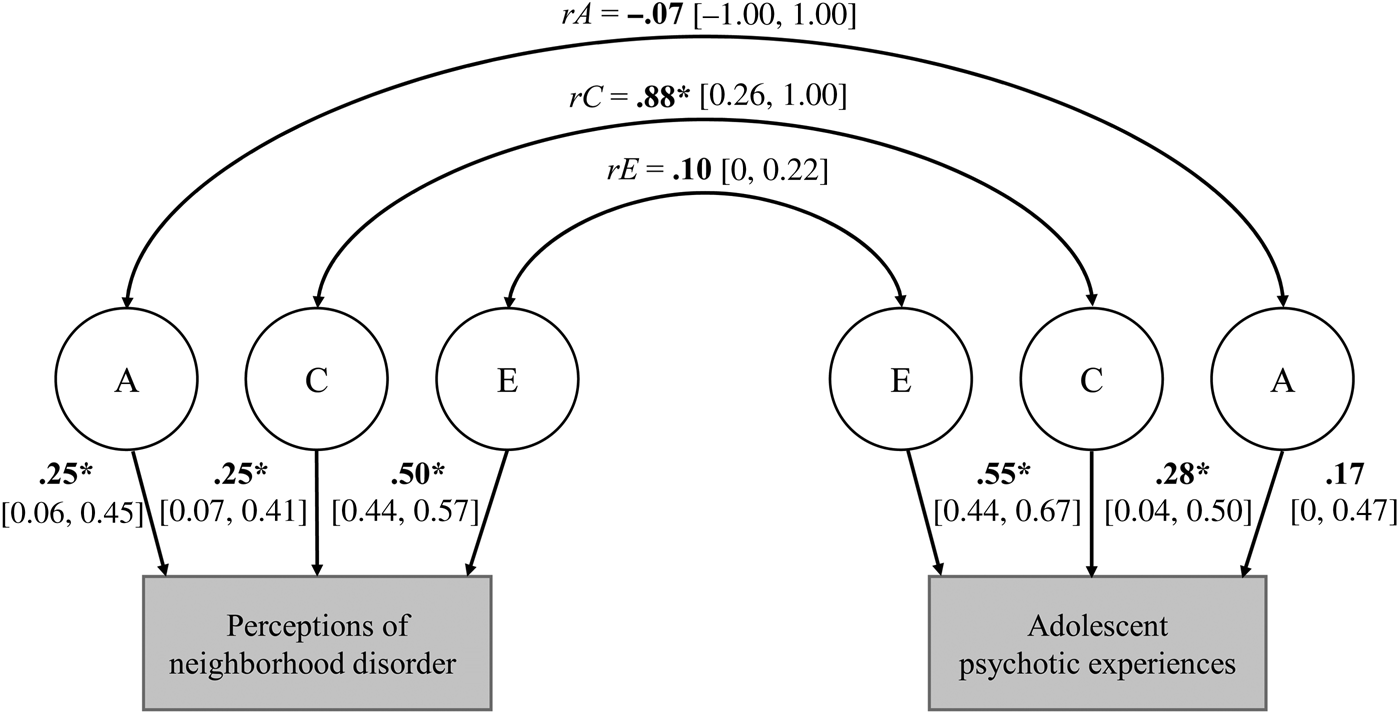
This was supported by results from the cross-twin cross-trait bivariate model, which is presented in a pathway diagram in Figure 1. (Note that ACE estimates for perceptions of neighborhood disorder from the bivariate model, i.e., A = 0.25, C = 0.25, differ slightly from those described above from the univariate model, i.e., A = 0.26, C = 0.24, because the bivariate model contains more information. However, confidence intervals for these estimates overlap.) The phenotypic correlation between adolescent psychotic experiences and perceptions of neighborhood disorder was mostly explained by a large significant correlation between common environmental influences (rC = .88), whereas A and E influences were not significantly correlated between traits. That is, a large proportion of the environmental influences that made twin siblings more similar in terms of their perceptions of neighborhood disorder also made twin siblings more similar in terms of their psychotic experiences.
ACE estimates and ACE correlations from cross-twin cross-trait (bivariate) model. A, additive genetic influences; E, unique environmental influences; rA, rC, and rE, genetic, common environmental, and unique environmental sources of correlation between phenotypes. The common (C) environmental contributions to variance in perception of neighborhood disorder, C = 0.25, CI [0.07, 0.41], were significantly correlated with the common environmental contributions to variance in adolescent psychotic experiences, C = 0.28, CI [0.04, 0.50], yielding a large significant environmental correlation between perceptions of neighborhood disorder and adolescent psychotic experiences of 0.88, CI [0.26, 1.00]. *p < .05.

Discussion
This study used a multilevel, longitudinal, and genetically sensitive design to investigate the association between individuals’ own perceptions of threatening neighborhood conditions and psychotic experiences during adolescence. Analyses revealed three main findings. First, adolescents’ personal perceptions of neighborhood disorder statistically explained 42% of the effect of the most urban residency on adolescent psychotic experiences. Second, adolescents who perceived higher levels of disorder in their immediate neighborhoods at age 18 (such as vandalism, gang activity, and burglaries) were over 60% more likely to report psychotic experiences compared to individuals who perceived their neighborhoods to be safer and less threatening, even after considering a wide range of potential neighborhood-, family-, and individual-level confounders. Third, the phenotypic correlation between adolescent psychotic experiences and perceptions of neighborhood disorder at age 18 was mostly explained by overlapping common environmental factors.
The present study's mediation findings are consistent with previous analyses in this cohort showing that threatening and adverse neighborhood conditions (as independently rated by mothers and residents) statistically explain up to half of the effect of urbanicity during upbringing on psychotic phenomena in childhood and adolescence (Newbury et al., Reference Newbury, Arseneault, Caspi, Moffitt, Odgers and Fisher2016; Newbury, Arseneault, Caspi, et al., Reference Newbury, Arseneault, Caspi, Moffitt, Odgers and Fisher2017). Our findings are also in keeping with those from recent studies documenting higher rates of psychotic phenomena, psychosis proneness, and psychotic disorder among children, adolescents, and young adults living in regions with higher fragmentation, disorder, and crime as rated by independent or objective sources (Bhavsar et al., Reference Bhavsar, Boydell, Murray and Power2014; Kirkbride et al., Reference Kirkbride, Stochl, Zimbron, Crane, Metastasio, Aguilar and Jones2015; Newbury et al., Reference Newbury, Arseneault, Caspi, Moffitt, Odgers and Fisher2016; Newbury Arseneault, Caspi, et al., Reference Newbury, Arseneault, Caspi, Moffitt, Odgers and Fisher2017; Wilson et al., Reference Wilson, Smith, Thompson, Demro, Kline, Bussell and Schiffman2016). Here we identify a potential role for personal perceptions of threatening neighborhood conditions in early psychotic phenomena. That is, the association between adverse neighborhood conditions and early expressions of psychosis is detectable at the level of the eye of the beholder. This is consistent with psychological theories and empirical studies of psychosis etiology that emphasize the key role played by negative beliefs about the world and other people, hostile attributions of the intentions of others, and threat anticipation (An et al., Reference An, Kang, Park, Kim, Lee and Lee2010; Appiah-Kusi et al., Reference Appiah-Kusi, Fisher, Petros, Wilson, Mondelli, Garety and Bhattacharyya2017; Fowler et al., Reference Fowler, Freeman, Smith, Kuipers, Bebbington, Bashforth and Dunn2006; Freeman, Reference Freeman2016; Garety, Bebbington, Fowler, Freeman, & Kuipers, Reference Garety, Bebbington, Fowler, Freeman and Kuipers2007; Noone et al., Reference Noone, Ames, Hassanali, Browning, Bracegirdle, Corrigall and Maddox2015) in the development of psychotic experiences, such as paranoia; together with a broader literature suggesting that subjective perceptions of early life adversity are associated with mental health problems over and above more objective reports of adversity exposure (Brown et al., Reference Brown, Berenson and Cohen2005; Reuben et al., Reference Reuben, Moffitt, Caspi, Belsky, Harrington, Schroeder and Danese2016; Widom & Morris, Reference Widom and Morris1997; Widom et al., Reference Widom, Weiler and Cottler1999).
Our adjustment for a range of potential confounders indicated that the association between personal perceptions of neighborhood disorder and adolescent psychotic experiences was (a) above and beyond the effect of objectively/independently measured levels of threat in the neighborhood (associations were not explained by official neighborhood crime rates or resident-reports of neighborhood disorder); (b) not due to poverty (associations were not explained by neighborhood-level SES); (c) not explained by the composition of families living in disordered neighborhoods (associations were not explained by family SES or family history of psychiatric problems); (d) not attributable solely to substance intoxication or mood-congruent recall bias (associations were not explained by adolescent marijuana dependence, alcohol dependence, anxiety or depression); and (e) not explained by earlier childhood psychotic symptoms that might simultaneously influence participants’ subsequent perceptions of neighborhood disorder and their risk for adolescent psychotic experiences. Therefore, this association was impressively robust to a wide range of factors that typically confound such relationships. Co-twin control analyses demonstrated that the association between perceived neighborhood disorder and adolescent psychotic experiences was attenuated but remained significant after holding the family environment and neighborhood conditions (and partially genetic influences) constant by design. This approach provides strong evidence that personal perceptions of neighborhood disorder were associated with adolescent psychotic experiences above and beyond variation in the actual neighborhood conditions.
In addition, there was tentative evidence of a bidirectional relationship between perceptions of threatening neighborhood conditions and early psychotic phenomena. Individuals who had perceived their neighborhood as unsafe during childhood were subsequently more likely to have psychotic experiences during adolescence: this was not due to earlier psychotic symptoms in childhood, contemporaneous perceptions of neighborhood disorder at age 18, or a range of other potential neighborhood-, family-, and individual-level confounders. Individuals who reported psychotic symptoms at age 12 were also more likely to subsequently perceive their neighborhoods as more disordered at age 18, though this appeared to be explained by adolescent psychotic experiences at age 18 and other confounders. We could speculate that personal perceptions of threat in the neighborhood tend to precede the onset of early psychotic phenomena, rather than vice versa. However, given that psychotic experiences involve altered perceptions of reality such as threat detection biases and persecutory delusions (Freeman et al., Reference Freeman, Garety, Kuipers, Fowler and Bebbington2002; Garety et al., Reference Garety, Kuipers, Fowler, Freeman and Bebbington2001), it is likely that the true relationship between adolescent psychotic experiences and perceptions of neighborhood conditions is bidirectional. Psychotic experiences might intensify perceptions of neighborhood disorder, and perceptions of neighborhood disorder might exacerbate psychotic experiences.
We hypothesized that the overlap between adolescent psychotic experiences and perceptions of neighborhood disorder could be due to shared genetic factors. That is, some of the same genetic contributions to psychotic experiences could also contribute to perceptions of threatening neighborhood conditions. This hypothesis was not supported. Genetic contributions to adolescent psychotic experiences did not appear to contribute to perceptions of neighborhood disorder in this sample. Instead, common environmental factors were implicated. These environmental factors contributed to increased similarity between twin siblings in terms of both their perceptions of neighborhood disorder and their psychotic experiences. This contrasts with emerging research showing that putative environmental risk factors for psychotic experiences, such as stressful life events (Shakoor et al., Reference Shakoor, Zavos, Haworth, McGuire, Cardno, Freeman and Ronald2016) and neighborhood-level deprivation (Sariaslan et al., Reference Sariaslan, Fazel, D'Onofrio, Långström, Larsson, Bergen and Lichtenstein2016), are associated with psychotic experiences due partly to overlapping genetic influences. One obvious environmental exposure shared between twin pairs, which could influence both adolescent psychotic experiences and perceptions of neighborhood disorder, is actual levels of neighborhood disorder. That is, threatening conditions such as vandalism, gang activity, and burglaries in the neighborhood could simultaneously influence adolescents’ perceptions of neighborhood disorder and their experience of psychotic phenomena. However, a number of alternative candidates for the overlapping common environmental influences are possible. For example, parental attitudes or family environments characterized by suspicion and fearfulness could simultaneously promote psychotic experiences and perceptions of high neighborhood disorder among offspring, though in this sample the phenotypic and longitudinal associations were not explained by family psychiatric history or maternal psychotic symptoms. In addition, findings from the co-twin control analysis (which yielded a smaller though significant association compared to the full sample) highlight that family-wide and neighborhood-level influences did not completely explain the effect of perceived neighborhood disorder on adolescent psychotic experiences. Taken together, these findings suggests that both actual (i.e., family-level) and perceived (i.e., individual-level) neighborhood conditions contributed to risk for adolescent psychotic experiences.
Considering all the findings together: that perceptions of threatening neighborhood conditions explained part of the effect of urbanicity on adolescent psychotic experiences; were not confounded by numerous potential neighborhood-, family-, and individual-level factors; and overlapped with psychotic experiences due to environmental (rather than genetic) influences, the present study provides initial evidence implicating perceptions of disordered neighborhood conditions in the etiology of adolescent psychotic experiences. These findings are consistent with leading aetiological models of psychosis. Growing evidence implicates psychosocial stress in the emergence of psychotic phenomena, whereby chronic, acute, and daily-life stressors (e.g., urban living, crime victimization, and noisy neighbors) might promote and exacerbate psychotic phenomena. Biological and psychological mechanisms have been suggested. Chronic and acute stressors during upbringing are thought to disrupt the biological stress response (Tarullo & Gunnar, Reference Tarullo and Gunnar2006; Walker, Mittal, & Tessner, Reference Walker, Mittal and Tessner2008), and in turn disrupt dopaminergic activity (van Winkel, Stefanis, & Myin-Germeys, Reference van Winkel, Stefanis and Myin-Germeys2008). The dopaminergic system plays a key role in the brain's attribution of salience to stimuli, and excess dopamine activity is currently the strongest biological explanation for the positive symptoms of psychosis (Howes, McCutcheon, Owen, & Murray, Reference Howes, McCutcheon, Owen and Murray2017; Kapur, Reference Kapur2003; van Winkel et al., Reference van Winkel, Stefanis and Myin-Germeys2008). From an adolescent's perspective, residing in and navigating a threatening neighborhood environment could also promote or reinforce maladaptive cognitive styles such as paranoia and threat detection biases. This proposed mechanism is consistent with studies showing that the severity of persecutory delusions, anxiety, paranoia, and hallucinations among adults with schizophrenia is immediately exacerbated after brief exposure to crowded urban environments (Ellett et al., Reference Ellett, Freeman and Garety2008; Freeman et al., Reference Freeman, Emsley, Dunn, Fowler, Bebbington, Kuipers and Garety2014). The potential bidirectional relationship between perceptions of adverse neighborhood conditions and adolescent psychotic experiences is also consistent with the phenotypic overlap documented between psychosis and stress sensitivity and stress reactivity (Collip et al., Reference Collip, Nicolson, Lardinois, Lataster, van Os and Myin-Germeys2011; Myin-Germeys, Delespaul, & van Os, Reference Myin-Germeys, Delespaul and van Os2005; Myin-Germeys, van Os, Schwartz, Stone, & Delespaul, Reference Myin-Germeys, van Os, Schwartz, Stone and Delespaul2001). It is reasonable to assume that adolescents who are experiencing psychotic phenomena might be more sensitive to stressful or threatening exposures in the neighborhood.
Strengths and limitations
Combining multilevel, longitudinal and genetically sensitive methods, this study was able to examine the association between perceptions of neighborhood adversity and adolescent psychotic experiences while considering a range of potential confounders including genetic influences. Nonetheless, we acknowledge several limitations. First, our self-report measure of adolescent psychotic experiences reflected the methodology widely used in the psychosis-prodrome research field. It is possible, however, that this self-report measure captured genuine experiences (e.g., being followed by a stranger) as well as psychotic phenomena (e.g., being followed by a spy). This may have led to the fairly low additive genetic estimate for adolescent psychotic experiences in this sample (17%), which is lower than that typically reported from twin analyses of more strictly defined early psychotic phenomena (Polanczyk et al., Reference Polanczyk, Moffitt, Arseneault, Cannon, Ambler, Keefe and Caspi2010; Ronald, Reference Ronald2015; Zavos et al., Reference Zavos, Freeman, Haworth, McGuire, Plomin, Cardno and Ronald2014). Second, the absence of overlapping genetic influences between psychotic experiences and perceptions of neighborhood disorder could also be due to the young age of the E-Risk participants. At age 18, the study individuals would have had minimal choice in the type of the neighborhood they lived in compared to later in adulthood. It will be important to investigate the genetic and environmental contributions to the association between perceived neighborhood conditions and psychotic experiences later in adulthood, when individuals become more active in choosing their neighborhood environments. Furthermore, studies of adult twins living apart could investigate the genetic and environmental contributions to actual (i.e., objectively measured) neighborhood conditions as well. Third, we must interpret the longitudinal associations between perceptions of neighborhood conditions and psychotic phenomena with caution, because the age 12 measures were on binary scales measuring only neighborhood safety and the presence of at least one psychotic symptom so did not capture as much variance as the age 18 measures. Thus, we tentatively suggest that the association between perceived neighborhood adversity and psychotic phenomena is likely to be bidirectional.
Looking forward, multidisciplinary research examining the interplay between neighborhood conditions, genetic and environmental risk, and neurological and cognitive biomarkers during development is needed to establish the nature of the association between perceived neighborhood conditions and adolescent psychotic experiences. There is evidence, for example, that adults with urban versus rural upbringing differ in their neurocognitive reactivity to social stress (Haddad et al., Reference Haddad, Schäfer, Streit, Lederbogen, Grimm, Wüst and Meyer-Lindenberg2015; Lederbogen et al., Reference Lederbogen, Kirsch, Haddad, Streit, Tost, Schuch and Meyer-Lindenberg2011), though little is known about the potential effects of adverse neighborhood conditions on the adolescent brain. Furthermore, future research is needed to establish whether the association between perceptions of threat and psychotic experiences is specific to neighborhood conditions, or whether this association extends to other domains such as school and work environments and social interactions.
Conclusions
Notwithstanding its limitations, the present study has clinical and public health implications. Our findings add to growing evidence that threatening and adverse neighborhood conditions during upbringing increase risk for early psychotic phenomena. This highlights potential opportunities for preventative interventions. On the one hand, our findings suggest that early interventions for psychosis (and mental health problems more generally) could reach particularly high-risk groups if targeted toward adolescents living in threatening and adverse neighborhood conditions. Given the potential bidirectional relationship between psychotic experiences and perceptions of threatening neighborhood conditions, psychological therapies could incorporate strategies to help young people understand whether their perceptions of threat in the neighborhood are rational, or whether these perceptions are contributing unnecessarily to a cycle of stress, fear, and psychotic experiences. On the other hand, recent findings from this team (Newbury et al., Reference Newbury, Arseneault, Caspi, Moffitt, Odgers and Fisher2016; Newbury, Arseneault, Caspi, et al., Reference Newbury, Arseneault, Caspi, Moffitt, Odgers and Fisher2017; Odgers, Donley, Caspi, Bates, & Moffitt, Reference Odgers, Donley, Caspi, Bates and Moffitt2015) and others (Bhavsar et al., Reference Bhavsar, Boydell, Murray and Power2014; Goldman-Mellor et al., Reference Goldman-Mellor, Margerison-Zilko, Allen and Cerdá2016; Kirkbride et al., Reference Kirkbride, Stochl, Zimbron, Crane, Metastasio, Aguilar and Jones2015; Polling et al., Reference Polling, Khondoker, Hatch and Hotopf2014; Wilson et al., Reference Wilson, Smith, Thompson, Demro, Kline, Bussell and Schiffman2016) suggest a need to address whether wider physical and social environmental conditions can be improved for the benefit of young people's mental health. Within two or three decades, 70% of the world's population will live in cities (Dye, Reference Dye2008). This figure already exceeds 80% in many developed nations, including Great Britain. It is therefore likely that, as communities become more crowded and societies become more unequal (UNICEF, 2012), the neighborhoods in which young people are born and raised will become more adverse and more fragmented. We suggest that public health and urban planning initiatives aimed at increasing the safety and supportiveness (both actual and perceived) of urban communities could benefit the mental health of young people and improve mental health trajectories for a large section of society over the life course.
Supplementary Material
To view the supplementary material for this article, please visit https://doi.org/10.1017/S0954579417001420.