Introduction
An estimated 75–80% of smokers who attempt to quit will relapse within six months of initiating abstinence (Zhou et al., Reference Zhou, Nonnemaker, Sherrill, Gilsenan, Coste and West2009). Predictors of smoking quit attempts and relapse include demographic, psychological, biological and behavioural factors (Hyland et al., Reference Hyland, Li, Bauer, Giovino, Steger and Cummings2004; Vangeli, Stapleton, Smit, Borland, & West, Reference Vangeli, Stapleton, Smit, Borland and West2011). Sleep disturbance is emerging as a potential neurobiological factor in smoking relapse (Brower & Perron, Reference Brower and Perron2010; Peters, Fucito, Novosad, Toll, & O'Malley, Reference Peters, Fucito, Novosad, Toll and O'Malley2011). In this randomised pilot study we evaluated the effects of a standard smoking counselling intervention in comparison with counselling enhanced with cognitive-behavioural therapy for insomnia on smoking and sleep outcomes.
Compared to non-smokers, smokers are at increased risk for insomnia and poor sleep quality (Jaehne et al., Reference Jaehne, Unbehaun, Feige, Lutz, Batra and Riemann2012; Riedel, Durrence, Lichstein, Taylor, & Bush, Reference Riedel, Durrence, Lichstein, Taylor and Bush2004; Wetter & Young, Reference Wetter and Young1994). Among smokers, insomnia may be primary or secondary to other conditions such as depression (Ford & Kamerow, Reference Ford and Kamerow1989) or nicotine dependence (Wetter & Young, Reference Wetter and Young1994). As a stimulant, nicotine lengthens sleep latency and decreases total sleep duration, particularly during deeper sleep stages (Phillips & Danner, Reference Phillips and Danner1995; Soldatos, Kales, Scharf, Bixler, & Kales, Reference Soldatos, Kales, Scharf, Bixler and Kales1980; Wetter & Young, Reference Wetter and Young1994; Zhang, Samet, Caffo, & Punjabi, Reference Zhang, Samet, Caffo and Punjabi2006). Nicotine withdrawal also fragments sleep resulting in daytime sleepiness, impaired cognitive functioning and dysphoric mood (Fortier-Brochu, Beaulieu-Bonneau, Ivers, & Morin, Reference Fortier-Brochu, Beaulieu-Bonneau, Ivers and Morin2012; Hughes, Reference Hughes2007; Wetter & Young, Reference Wetter and Young1994). These symptoms may account for many smokers’ reports of awakening at night to smoke (Scharf, Dunbar, & Shiffman, Reference Scharf, Dunbar and Shiffman2008). In turn, smoking upon waking may have stimulating effects that further disrupt smokers’ sleep (Wetter & Young, Reference Wetter and Young1994).
Sleep disturbance prior to quitting smoking and during nicotine withdrawal predicts smoking cessation failure (Augustson et al., Reference Augustson, Wanke, Rogers, Bergen, Chatterjee and Synder2008; Boutou et al., Reference Boutou, Tsiata, Pataka, Kontou, Pitsiou and Argyropoulou2008). Likewise, awakening during the night to smoke, a potential marker of nicotine dependence, also increases the risk for smoking relapse (Bover, Foulds, Steinberg, Richardson, & Marcella, Reference Bover, Foulds, Steinberg, Richardson and Marcella2008; Foulds et al., Reference Foulds, Gandhi, Steinberg, Richardson, Williams, Burke and Rhoads2006; Scharf et al., Reference Scharf, Dunbar and Shiffman2008). Preliminary research suggests that smokers who report both awakening at night to smoke and sleep disturbance are less successful at quitting smoking (Peters et al., Reference Peters, Fucito, Novosad, Toll and O'Malley2011).
Quitting smoking requires substantial self-control (Chiou, Wu, & Chang, Reference Chiou, Wu and Chang2013) defined as overriding impulses and resisting temptations to maximise one's long-term goals (Baumeister, Vohs, DeWall, & Zhang, Reference Baumeister, Vohs, DeWall and Zhang2007). For this reason, smokers are often advised to prepare for a quit attempt (rather than quit abruptly) by avoiding smoking triggers, keeping busy, changing routines and practicing good self-care (CDC, 2011; Fiore, Jaen, Baker, et al., Reference Fiore, Jaen, Baker, Bailey, Benowitz and Curry2008), of which sleep is a vital component.
The intention of this study was to assess the feasibility and preliminary efficacy of integrating a sleep intervention [i.e., cognitive-behavioural therapy for insomnia (CBT-I)] into smoking cessation counselling for smokers with insomnia (CBT-I+SC). CBT-I is a highly effective treatment for insomnia and has been shown to be as successful as pharmacological sleep interventions (e.g., sedative hypnotics), and its effects have been shown to be more durable (Morin, Reference Morin2004; Morin et al., Reference Morin, Bootzin, Buysse, Edinger, Espie and Lichstein2006; Smith et al., Reference Smith, Perlis, Park, Smith, Pennington, Giles and Buysse2002). We tested whether an integrated intervention would result in greater quit rates than smoking counselling alone (SC). We also investigated whether CBT-I+SC would yield greater improvements in sleep efficiency (i.e., the ratio of time spent asleep to the amount of time spent in bed) than SC.
Method
Participants
Participants were recruited through newspaper advertisements, flyers posted in the community, notices on our website, and mailings to health care providers. Advertisements indicated that the purpose of the study was to test smoking cessation treatment for smokers with sleep problems. To be eligible, participants had to: (1) smoke five cigarettes per year for at least one year (verified by breath carbon monoxide levels of >10ppm), (2) report current DSM-IV symptoms of insomnia (based on clinical interview), (3) report at least six occasions within the past month of sleep latency or waking after sleep onset >30 minutes, (4) be between the ages of 18 and 75, and (5) be able to read English and complete assessments. Exclusion criteria included: (1) medical/psychiatric conditions contraindicated for CBT-I (seizure disorders, severe excessive daytime sleepiness defined as Epworth Scale Score (Johns, Reference Johns1991) of >18, bipolar disorder), (2) lifestyle factors that would interfere with CBT-I efficacy (current night or rotating shift work, proposed travel across ≥2 time zones), (3) current serious and/or unstable physical disease, (4) new psychiatric illness and/or psychotropic medication within the past 3 months, (5) current DSM-IV diagnosis of drug dependence other than nicotine, (6) use of tobacco products other than nicotine, (7) intention to use varenicline or bupropion during study participation, (8) co-morbid sleep apnoea or restless leg syndrome, or (9) females who were pregnant, lactating, or unwilling to use a reliable method of birth control due to the potential risk of harm of nicotine transdermal patch therapy in pregnancy/lactation.
Measures
All measures were paper-and-pencil based. At intake, potential participants completed the Fagerström Test for Nicotine Dependence (FTND; (Heatherton, Kozlowski, Frecker, & Fagerström, Reference Heatherton, Kozlowski, Frecker and Fagerström1991), psychosis screen and mood and substance use disorders sections of the Structured Clinical Interview for DSM-IV Axis I Disorders (SCID; (First, Spitzer, Gibbon, & Williams, Reference First, Spitzer, Gibbon and Williams2002), and the Berlin Questionnaire, a 10-item screening tool for sleep apnoea syndrome (Netzer, Stoohs, Netzer, Clark, & Strohl, Reference Netzer, Stoohs, Netzer, Clark and Strohl1999). Following intake, all participants monitored their sleep using daily Pittsburgh Sleep Diaries (PSD; (Monk et al., Reference Monk, Reynolds, Kupfer, Buysse, Coble and Hayes1994), which is valid relative to polysomnography, for two weeks prior to starting treatment to evaluate daytime sleep-related behaviours (e.g., use of caffeine, exercise) and quantitative characteristics of nocturnal sleep.
Measures administered at all time points (intake, treatment and follow-up) included the Insomnia Severity Index (ISI; (Bastien, Vallieres, & Morin, Reference Bastien, Vallieres and Morin2001) and Pittsburgh Sleep Quality Index (PSQI; (Buysse, Reynolds, Monk, Berman, & Kupfer, Reference Buysse, Reynolds, Monk, Berman and Kupfer1989), both of which are reliable, valid tools for assessing insomnia symptoms and detecting “good” versus “poor” sleepers as well as smoking frequency and quantity using the reliable and well-validated timeline follow-back methods (Brown et al., Reference Brown, Burgess, Sales, Whiteley, Evans and Miller1998). All participants resumed sleep monitoring using daily diaries during the last two weeks of treatment.
After each counselling session, participants completed a session report to assess their: (1) satisfaction with the overall session (1 = very poor to 5 = best session), perceptions of the helpfulness of the session (1 = worse off to 5 = very helpful), and (3) perceptions of how well their study therapist understood them (1 = misunderstood to 5 = understood very well); at treatment termination, participants rated how helpful counselling was in facilitating smoking cessation using a scale (1 = not at all to 5 = extremely). Participants submitted session reports to a research assistant and were informed that their ratings would not be shared with their counsellor.
The primary smoking outcomes were the likelihood of achieving 7-day point prevalence smoking abstinence (defined as no smoking at all in the previous 7 days) at the end of treatment and research follow-up. Point prevalence abstinence (defined as no smoking, not even a puff, for 7 days; coded: 1 = yes, 0 = no) was biochemically confirmed with breath carbon monoxide (CO) levels <10 ppm (SRNT, 2002). Participants who dropped out were conservatively classified as relapsed to their baseline smoking level, which is the standard in the field of nicotine and tobacco research (West, Hajek, Stead, & Stapleton, Reference West, Hajek, Stead and Stapleton2005). Number of days to relapse was defined as the number of days until the first of seven consecutive days of smoking. The primary sleep outcome was self-reported sleep efficiency at Week 4 (day before quit date) on the PSQI. We also conducted exploratory analyses of PSQI self-reported total sleep duration and perceived sleep quality and ISI insomnia symptoms. Medication adherence was monitored with a count of returned nicotine patches at each post-quit appointment.
Procedures
This study was a two-condition randomised controlled pilot study conducted with treatment-seeking smokers who reported insomnia. Participants were randomised between 9 February 2011 and 6 December 2011, and the last follow-up appointment was completed on 30 March 2012. Prospective participants were screened by telephone and at a subsequent in-person intake appointment. Following screening, participants were randomised to one of two treatment conditions over 10 weeks: (1) cognitive-behavioural therapy for insomnia (CBT-I) + smoking cessation counselling (CBT-I+SC) or (2) smoking cessation counselling alone (SC) with randomisation stratified by sex using an allocation sequence established before study enrollment began. The Institutional Review Board of Yale School of Medicine approved this trial.
Participants were not informed of treatment condition assignment. Research and counselling staff involved in the delivery of the intervention were not informed of the study hypotheses. Two weeks after intake, eligible participants started treatment. Prior to their first treatment appointment, participants in both conditions monitored their sleep using daily sleep diaries and brought these to their first counselling session. To enhance adherence, participants were compensated for returning their diaries ($20 for the 2 weeks prior to intake; $30 for the last 2 weeks of treatment). During the 4-week pre-quit phase of the study (Weeks 0–3), participants attended weekly appointments to receive individual smoking counselling and complete research assessments. During this time, only participants in the CBT-I+SC condition continued sleep monitoring using daily diaries.
At the week 4 visit (day before quit attempt), all participants received a 2-week supply of nicotine patches, information and advice about taking the medication, and instructions to return their unused patches (or empty patch envelopes) at each session. Participants who reported smoking ≥10 cigarettes/day at the session before the scheduled quit date were provided with 21mg patches; participants smoking <10 cigarettes/day were provided with 14 mg patches. Participants remained on their starting nicotine patch dose for the 6-week time period. Within three days of the scheduled quit date, the study therapist contacted participants by phone to assess their experience quitting and using the nicotine patch.
During the 6-week post-quit phase (Weeks 4–10), participants were offered bi-weekly counselling and research appointments, additional supplies of nicotine patches and brief phone contact with a study therapist. Participants in the CBT-I+SC condition monitored their sleep during this entire post-quit period to facilitate treatment planning; they were not compensated for completing diaries during this time. For the last 2 weeks (Weeks 9–10), participants in the SC condition resumed monitoring their sleep using daily diaries; participants in both conditions were compensated for completing diaries for Weeks 9–10. Four weeks after completing treatment, participants completed a final research follow-up appointment.
Counselling Condition
Five counsellors provided either CBT-I+SC or SC separately in each condition. All counsellors had smoking cessation counselling experience, those in the CBT-I+SC condition also had expertise in CBT. All therapists completed additional protocol training. Provision of counselling was manualised (American Lung Association, 2013; Perlis, Jungquist, Smith, & Posner, Reference Perlis, Jungquist, Smith and Posner2005; Strecher, Rimer, & Monaco, Reference Strecher, Rimer and Monaco1989), sessions were audiotaped, and weekly supervision provided by one of the authors (LMF) to promote fidelity.
The smoking cessation portion of both conditions was adapted from the American Lung Association Freedom from Smoking® programme (American Lung Association, 2013; Strecher et al., Reference Strecher, Rimer and Monaco1989) and emphasised: (1) motivation and confidence to quit smoking, (2) quit plan, (3) stimulus control, (4) coping skills to manage urges and withdrawal and (5) relapse prevention.
The CBT-I portion incorporated cognitive, behavioural and psycho-educational strategies to target perpetuating insomnia factors (Morin & Espie, Reference Morin and Espie2003), including distorted beliefs about sleep, smoking, quitting and unrealistic night-time worries. Behavioural strategies included stimulus control (keeping a consistent sleep-wake schedule, re-establishing sleep cues) sleep restriction and relaxation. Sleep restriction focused on limiting time spent awake in bed to improve sleep efficiency. Participants were prescribed a bedtime that was gradually increased until optimal sleep efficiency was achieved (i.e., asleep ≥85% of time spent in bed defined as total hours asleep/total hours in bed x 100%). Relaxation involved a 15-minute, within-session progressive muscle relaxation exercise using a standardised relaxation script. Participants were provided with an audio recording of the exercise to practice in their own time. Sleep hygiene education focused on establishing good sleep habits (e.g., creating a sleep-conducive environment; limiting caffeine). All strategies were covered prior to the scheduled quit date to provide time for sleep improvement. Post-quit sessions reviewed this material and emphasised sleep relapse prevention.
Steps were undertaken to enhance the face validity of both groups. The first session of both conditions included an overview of: (1) insomnia, (2) the associations among smoking, smoking cessation and sleep problems, (3) and the effect of insomnia/sleep problems on smoking cessation success. All participants were advised that quitting smoking would help their sleep, regardless of the cause of their insomnia and to remove their nicotine patch at night if it impacted negatively on their sleep (no participants reported removing the patch at night due to negative patch effects on sleep).
Statistical Analyses
T-tests and chi-squared tests were used to evaluate potential condition differences at baseline. Primary analyses focused on the likelihood of achieving smoking abstinence and secondary analyses examined sleep outcomes. Sex, a stratification variable, was added as a covariate to models assessing outcomes. To examine the predictive role of counselling condition we conducted Fisher's exact tests on quit status (7-day point prevalence abstinence) at the end of treatment and research follow-up. Analyses of variance were used to compare conditions on number of days to relapse, sleep outcomes at Week 4 (i.e., efficiency, duration, quality, insomnia symptoms), number of sessions attended, nicotine patch adherence, and treatment termination and session ratings. For analyses of sleep outcomes, baseline sleep scores were added as covariates to models.
Results
Participants, Feasibility, Acceptability
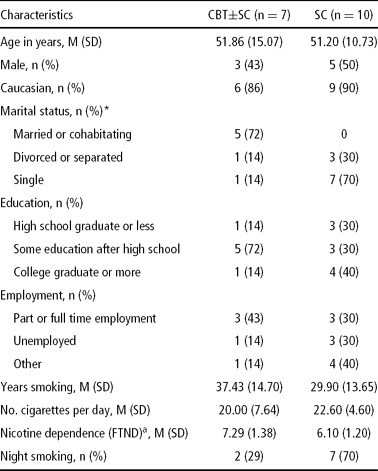
Twenty-eight smokers attended an in-person intake appointment. Four were excluded for medical reasons and one was excluded for limited English comprehension. Of the remaining 23 eligible individuals, 4 chose not to enrol. Nineteen participants were randomised to either CBT-I+ SC (n = 9) or SC (n = 10); 17 participants attended the first treatment session, which was balanced by sex (eight men, nine women). This subsample was primarily Caucasian (90%), had a mean age of 51.47 (12.25) years, and smoked an average of 21.53 (5.96) cigarettes per day for a mean of 33.00 (14.16) years. Participant demographic and clinical characteristics at baseline are displayed in Table 1. Scores on the ISI and PQSI were characteristic of moderately severe insomnia symptoms, short sleep duration and poor sleep quality. The two conditions were equivalent at baseline on all demographic, smoking and sleep variables except for marital status. The majority of SC participants were single whereas the majority of CBT-I+SC participants were married or cohabitating [χ2 = 10.29, p = .04].
Pre-treatment characteristics of participants by condition

Note. *p <.05; a: FTND = Fagerström Test for Nicotine Dependence.
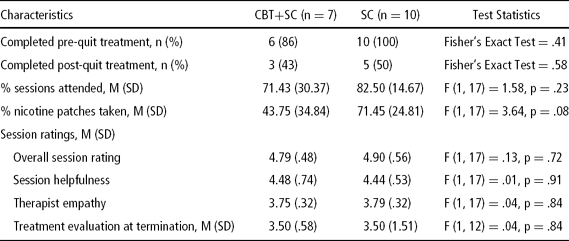
Participants in both counselling conditions rated treatment positively (see Table 2). Likewise, session attendance was high across both conditions at 78%. The overall treatment completion rate (defined as attending the last treatment session at Week 10), however, was modest at 47% and did not differ by condition. Among all participants, all but one completed the entire pre-quit treatment phase (94%) by attending the first five counselling sessions. Treatment completers did not significantly differ from dropouts on demographic, smoking or sleep variables. There was a non-significant trend toward participants assigned to SC having greater nicotine patch adherence than those assigned to CBT-I+SC.
Adherence and treatment satisfaction by condition
Note. Termination evaluation limited to 12 participants who attended final counselling session at Week 10.
Preliminary Efficacy Findings
Smoking cessation. Table 3 presents smoking outcomes by condition. The likelihood of achieving point prevalence smoking abstinence at the end of treatment [18%; 3/17] and follow-up [6%; 1/17] was low across both conditions. Participants enrolled in CBT-I+SC exhibited a somewhat slower time to relapse than SC participants (13 vs. 10 days). This effect was not statistically significant, but had an effect size in the medium range.
Smoking cessation outcomes by condition
Note. 7-day PPA = Point Prevalence Abstinence (no smoking, not even a puff, for 7 days). Effect sizes for continuous outcomes calculated as the mean differences between the CBT-I+SC and SC conditions divided by the pooled standard deviation (Cohen, Reference Cohen1998). Effect sizes for dichotomous smoking outcomes calculated first as an odds ratio that was then transformed to d using a Cox transformation (Sánchez-Meca, Marín-Martínez, & Chacón-Moscoso, Reference Sánchez-Meca, Marín-Martínez and Chacón-Moscoso2003). A Hedges’ correction corrected for sample size bias (Hedges, Reference Hedges1981).
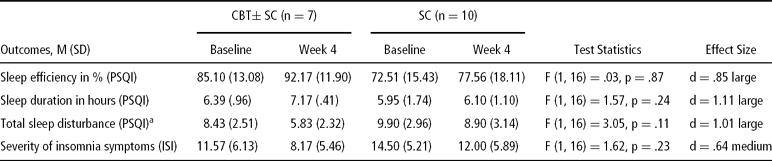
Sleep. As shown in Table 4, participants enrolled in CBT-I+SC reported better sleep efficiency and sleep quality, longer sleep duration and fewer insomnia symptoms at Week 4 than participants enrolled in SC. Again, while effects were not statistically significant, estimated effect sizes were in the medium to large range. Regardless of condition assignment, sleep outcomes at Week 4 were not associated with the likelihood of achieving smoking abstinence.
Sleep efficiency, duration, quality and insomnia symptoms at baseline and week 4 (day before quit date)
Note. Effect sizes for continuous outcomes calculated as the mean differences between the CBT-I+SC and SC conditions divided by the pooled standard deviation (Cohen, Reference Cohen1998). A Hedges’ correction corrected for sample size bias (Hedges, Reference Hedges1981). a: Scores ≥5 characteristic of ‘poor’ sleep
Discussion
To our knowledge, this is the first study of an integrated sleep and smoking behavioural intervention for smokers with insomnia. We examined whether providing specific strategies to improve sleep along with standard smoking cessation counselling would improve smoking quit rates in this population. Although limited by the small sample size, the integrated treatment (i.e., CBT-I+SC) resulted in improvements in some sleep indicators, compared with standard smoking counselling. These effects sizes are consistent with other cognitive-behavioural trials for insomnia (Morin et al., Reference Morin, Bootzin, Buysse, Edinger, Espie and Lichstein2006) and highlight the potential promise of this intervention for treating insomnia in smokers. There was less benefit from the integrated treatment for smoking cessation. Though the integrated treatment was associated with longer time to relapse than standard smoking counselling, it did not yield better smoking quit rates. Moreover, improvements in sleep were not associated with the likelihood of achieving smoking abstinence. These findings confirm prior research that sleep disturbed smokers have substantial difficulty quitting smoking (Augustson et al., Reference Augustson, Wanke, Rogers, Bergen, Chatterjee and Synder2008; Boutou et al., Reference Boutou, Tsiata, Pataka, Kontou, Pitsiou and Argyropoulou2008; Peters et al., Reference Peters, Fucito, Novosad, Toll and O'Malley2011). The interpretation of these results, however, is limited by the small sample size.
Both interventions were rated highly by participants and all but one participant attended the five pre-quit date counselling sessions (i.e., when sleep strategies were introduced and implemented in the CBT-I+SC condition). Thus, our preliminary results suggest that adding sleep content to smoking cessation treatment is acceptable to smokers with insomnia. Limited efficacy and post-quit treatment retention, however, suggest that our particular model of integrated care may have obstacles with this population. Regardless of condition, half of the participants dropped out of treatment after the scheduled quit date. Extending the pre-quit phase to allow time for sleep improvements may have reduced motivation to quit smoking. Few participants, however, reported a decrease in motivation from baseline to quit date.
Smokers with insomnia may benefit from flexible quit dates and more intensive smoking pharmacotherapy treatment. Clinical trials of NRT and varenicline show that gradual smoking cessation while on medication (i.e., allowing for smoking reduction and flexibility to delay quitting until later in treatment) is just as effective as abrupt cessation through a scheduled quit date (Hughes, Solomon, Livingston, Callas, & Peters, Reference Hughes, Solomon, Livingston, Callas and Peters2010; Rennard et al., Reference Rennard, Hughes, Cinciripini, Kralikova, Raupach and Arteaga2012; Shiffman, Ferguson, & Strahs, Reference Shiffman, Ferguson and Strahs2009). Many smokers, particularly those who smoke heavily, also prefer flexible reduction to abrupt cessation (Hughes, Callas, & Peters, Reference Hughes, Callas and Peters2007; Shiffman et al., Reference Shiffman, Hughes, Ferguson, Pillitteri, Gitchell and Burton2007). Thus, having flexible quit dates and/or starting nicotine patch therapy in advance of the quit date may better facilitate treatment retention and maximise CBT-I+SC efficacy. Likewise, smokers with insomnia may have higher nicotine dependence scores that warrant more intensive pharmacotherapy treatment such as dual nicotine replacement therapy (Piper et al., Reference Piper, Smith, Schlam, Fiore, Jorenby, Fraser and Baker2009). Future studies should investigate alternate smoking cessation paradigms alone and in conjunction with sleep interventions for smokers with insomnia.
We investigated an integrated model of care as opposed to a sequential treatment model in which individuals receive treatment for one problem at a time (Mueser, Noordsy, Drake, & Fox, Reference Mueser, Noordsy, Drake and Fox2003). A disadvantage of integrated models is that it may be difficult to treat adequately both issues concurrently. Improving sleep in CBT-I+SC may have limited the smoking cessation portion of treatment. On the other hand, sequential models do not account for the interactive nature of dual disorders such that the untreated problem may continue to worsen the treated problem. Participants in SC reported poor sleep outcomes and limited success quitting smoking. More research on sequential versus integrated models of care for smoking cessation and sleep is warranted.
This investigation had several advantages. We tested a novel, integrated treatment for smokers with insomnia, utilised a randomised design, and standardised the provision of counselling through the use of manuals and close therapist supervision. Study limitations should also be noted. The sample size was very small; effect size estimates from pilot studies should be interpreted cautiously (Kraemer, Mintz, Noda, Tinklenberg, & Yesavage, Reference Kraemer, Mintz, Noda, Tinklenberg and Yesavage2006). We assessed sleep outcomes using subjective methods. Medication adherence was based on participant self-report. Smokers in the CBT-I condition reported adequate sleep efficiency at baseline but had moderately severe insomnia symptoms, short sleep duration and poor sleep quality, which may differ from the sleep complaints among individuals who derive the most benefit from CBT-I. The difference in marital status between conditions may have affected sleep outcomes.
Sleep disturbance, particularly insomnia, is common among smokers and a predictor of smoking cessation failure (Augustson et al., Reference Augustson, Wanke, Rogers, Bergen, Chatterjee and Synder2008; Boutou et al., Reference Boutou, Tsiata, Pataka, Kontou, Pitsiou and Argyropoulou2008; Brower & Perron, Reference Brower and Perron2010; Peters et al., Reference Peters, Fucito, Novosad, Toll and O'Malley2011). Cognitive-behavioural therapy for insomnia shows promise for treating insomnia among smokers but it remains to be determined whether improving sleep in this population actually facilitates quitting smoking. A better understanding of the mechanisms by which insomnia promotes smoking relapse is important for targeting and tailoring smoking cessation interventions for individuals with insomnia.
Acknowledgements
We would like to thank Stephanie S. O'Malley, PhD and Bruce J. Rounsaville, MD for their assistance with study design; Kelly S. DeMartini, PhD, Erica N. Peters, PhD, Xoli Redmond, PsyD, LaTrice Montgomery, PhD, Susan Neveu, Elaine LaVelle, MS, Denise M. Romano, FAM, and Corey R. Roos, BA for their assistance with the provision of counselling and study implementation; and Ralitza Gueorguieva, PhD for her statistical support.
Financial support
This research was supported by grants from the National Institutes of Health: P50DA009241 (KMC), K23AA020000 (LMF), P20NR014126 (NSR), and KL2TR000140 (NSR), and by the State of Connecticut, Department of Mental Health and Addiction Services.
Conflict of interest
Dr Toll has received investigator initiated funding from Pfizer. All other authors report no conflicts of interest.
Ethical standards
The Institutional Review Board of Yale School of Medicine approved this trial. The authors assert that all procedures contributing to this work comply with the ethical standards of the relevant national and institutional committees on human experimentation and with the Helsinki Declaration of 1975, as revised in 2008.