





Introduction
The stratigraphic sequence of sediments in Biśnik Cave is one of the longest from Central European sites. In an up to 10-m thick set of sediments, 22 horizons were distinguished, covered the last ∼350 kyr (Cyrek et al. Reference Cyrek, Socha, Stefaniak, Madeyska, Mirosław-Grabowska, Sudoł and Czyżewski2010). So long period of a relatively complete stratigraphic record is unique in Polish geology, even if the recording sediments sequence is not fully continuous and contains some hiatuses. The extraordinary abundance of archaeological and paleontological finds makes this locality so unique in the Eurasian scale (Cyrek et al. Reference Cyrek, Mirosław-Grabowska, Stefaniak and Socha2009, Reference Cyrek, Socha, Stefaniak, Madeyska, Mirosław-Grabowska, Sudoł and Czyżewski2010; Krajcarz and Cyrek Reference Krajcarz and Cyrek2011; Krajcarz and Madeyska Reference Krajcarz, Madeyska, Cyrek, Czyżewski and Krajcarz2012; Krajcarz et al. Reference Krajcarz, Gola and Cyrek2010; Mirosław-Grabowska Reference Mirosław-Grabowska1998, Reference Mirosław-Grabowska2002a, Reference Mirosław-Grabowska and Cyrek2002b). There are subjects of numerous studies, which together make it possible to reconstruct the dynamic changes that have taken place during this time. An indispensable tool in this type of analysis and reconstruction is direct dating, which allows you to place a given event or remain at a specific time. The juxtaposition of various methods of direct and indirect dating allowed us to verify the current state of knowledge and clarify the hitherto unclear issues. The main subject of this paper is summary of the current state of knowledge and confronting the results obtained from different methods. The new radiocarbon dating of the 7–5 layers that have been poorly recognized so far has allowed them to be shifted in time and showed that they are older than previously thought.
Site
Biśnik Cave (50°25’35”N 19°39’56”E; 406–410 m a.s.l.) is a multi-layered site, located in the central part of Kraków-Częstochowa Upland (Cyrek et al. Reference Cyrek, Socha, Stefaniak, Madeyska, Mirosław-Grabowska, Sudoł and Czyżewski2010; Kowalski Reference Kowalski1951). The site is known long ago and was excavated between 1991–2019. The cave is formed by several interconnected chambers and rock shelters, originally almost filled with deposits. The layers in the locality are numbered downwards, and covered timespan of the last ∼350 kyr (Cyrek et al. Reference Cyrek, Socha, Stefaniak, Madeyska, Mirosław-Grabowska, Sudoł and Czyżewski2010; Krajcarz Reference Krajcarz, Cyrek, Czyżewski and Krajcarz2012; Krajcarz et al. Reference Krajcarz, Bosák, Šlechta, Pruner, Komar, Dresler and Madeyska2014a; Marciszak et al. Reference Marciszak, Krajcarz, Krajcarz and Stefaniak2011a, Reference Marciszak, Socha, Nadachowski and Stefaniak2011b, Reference Marciszak, Schouwenburg, Lipecki, Talamo, Shpansky, Malikov and Gornig2019a, Reference Marciszak, Schouwenburg, Lipecki, Talamo, Shpansky, Malikov and Gornig2019b; Stefaniak et al. Reference Stefaniak, Ratajczak, Kotowski, Kozłowska and Mackiewicz2020). Artefacts and bone marks documented frequent human presence and settlement of the locality from the Middle Palaeolithic (Cyrek et al. Reference Cyrek, Socha, Stefaniak, Madeyska, Mirosław-Grabowska, Sudoł and Czyżewski2010, Reference Cyrek, Sudoł, Czyżewski, Osipowicz and Grelowska2014; Krajcarz and Cyrek Reference Krajcarz and Cyrek2011; Krajcarz et al. Reference Krajcarz, Bosák, Šlechta, Pruner, Komar, Dresler and Madeyska2014a; Cyrek Reference Cyrek2021). Known so far fauna consists 104 bird and 144 mammal species, dated in the range MIS 10/9-1 (Bocheński et al. Reference Bocheński, Bocheński and Tomek2012; Cyrek et al. Reference Cyrek, Socha, Stefaniak, Madeyska, Mirosław-Grabowska, Sudoł and Czyżewski2010; Gąsiorowski et al. Reference Gąsiorowski, Hercman and Socha2014; Klimowicz et al. Reference Klimowicz, Nadachowski, Lemanik and Socha2016; Krajcarz and Krajcarz Reference Krajcarz and Krajcarz2013, Reference Krajcarz and Krajcarz2019; Krajcarz et al. Reference Krajcarz, Gola and Cyrek2010, Reference Krajcarz, Bosák, Šlechta, Pruner, Komar, Dresler and Madeyska2014a, Reference Krajcarz, Krajcarz and Marciszak2014b, Reference Klimowicz, Nadachowski, Lemanik and Socha2016; Marciszak Reference Marciszak2012, Reference Marciszak2014; Marciszak & Lipecki, Reference Marciszak and Lipecki2021; Marciszak and Socha Reference Marciszak and Socha2014; Marciszak and Stefaniak Reference Marciszak and Stefaniak2010; Marciszak et al. Reference Marciszak, Krajcarz, Krajcarz and Stefaniak2011a, Reference Marciszak, Socha, Nadachowski and Stefaniak2011b, Reference Marciszak, Schouwenburg and Darga2014, Reference Marciszak, Schouwenburg, Gornig, Lipecki and Mackiewicz2019a, Reference Marciszak, Schouwenburg, Lipecki, Talamo, Shpansky, Malikov and Gornigb, Reference Marciszak, Kropczyk and Lipecki2021a, Reference Marciszak, Lipecki, Pawłowska, Jakubowski, Ratajczak-Skrzatek and Nadachowski2021b; Mazza et al. Reference Mazza, Stefaniak, Capalbo, Cyrek, Czyżewski, Kotowski, Orłowska, Marciszak, Ratajczak-Skrzatek, Savorelli and Sudoł-Procyk2021; Piskorska and Stefaniak Reference Piskorska and Stefaniak2014; Piskorska et al. Reference Piskorska, Stefaniak, Krajcarz and Krajcarz2015; Rzebik-Kowalska Reference Rzebik-Kowalska2009; Socha Reference Socha2009, Reference Socha2014; Stefaniak Reference Stefaniak2015; Stefaniak and Marciszak Reference Stefaniak and Marciszak2009; Stefaniak et al. Reference Stefaniak, Ratajczak, Kotowski, Kozłowska and Mackiewicz2020; Tomek et al. Reference Tomek, Bocheński, Socha and Stefaniak2012; Van Asperen and Stefaniak Reference Asperen and Stefaniak2011).
Methodology
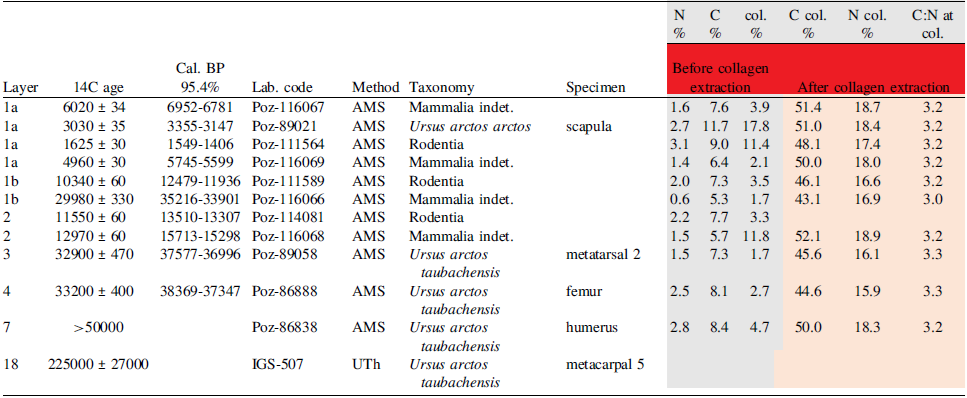
The new 11 radiocarbon dates (AMS) were made in Poznań Radiocarbon Laboratory (Table 1), following their pre-treatment protocol for the extraction of collagen (Longin Reference Longin1971; Piotrowska and Goslar Reference Piotrowska and Goslar2002). Before extraction, degree of collagen degradation is checked by measuring content of nitrogen and carbon in bone, using analyser Flash EA 1112 Series (ThermoScientific). The samples are regarded suitable for collagen dating, if nitrogen content in bone is not lower than 0.6%, and ratio C/N is not higher than 5 (Brock et al. Reference Brock, Wood, Higham, Ditchfield, Bayliss and Ramsey2012; Guiry and Szpak Reference Guiry and Szpak2020). Suitable bones are crushed mechanically to granulation <0.3 mm, the bone powder is then treated with 2M HCl (room temp., 20 min), and 0.1M NaOH (room temp., 1 hr). After each step of treatment, the sample is centrifuged and the residuum is collected. Extraction of collagen is processed in HCl (pH = 3, 80 °C, 10 hr), and after centrifugation, residuum is removed. The extracted collagen is then ultra-filtered on pre-cleaned Vivaspin 15 MWCO 30 kD filters. Quality of the collagen is ultimately assessed basing on C/N atomic ratio (interval of acceptance: 2.7–3.5) and collagen extraction yield (acceptance threshold: 0.5%). On demand, carbon and nitrogen stable isotopic composition of the collagen can be determined (Bronk Ramsey et al. Reference Bronk Ramsey, Higham, Bowles and Hedges2004). All new dates were calibrated using program IntCal20, according to Reimer et al. (Reference Reimer, Austin, Bard, Bayliss, Blackwell, Bronk Ramsey, Butzin, Cheng, Edwards, Friedrich, Grootes, Guilderson, Hajdas, Heaton, Hogg, Hughen, Kromer, Manning, Muscheler, Palmer, Pearson, van der Plicht, Reimer, Scott, Southon, Turney, Wacker, Adolphi, Büntgen, Capano, Fahrni, Fogtmann-Schulz, Friedrich, Köhler, Kudsk, Miyake, Olsen, Reining, Sakamoto, Sookdeo and Talamo2020).
New radiocarbon and uranium-thorium dates from Biśnik Cave. The table reports,, and collagen quality indicators (total nitrogen and carbon contents, and collagen yields). Calibrations were performed using the appropriate IntCal20 calibration curve (Reimer et al. Reference Reimer, Austin, Bard, Bayliss, Blackwell, Bronk Ramsey, Butzin, Cheng, Edwards, Friedrich, Grootes, Guilderson, Hajdas, Heaton, Hogg, Hughen, Kromer, Manning, Muscheler, Palmer, Pearson, van der Plicht, Reimer, Scott, Southon, Turney, Wacker, Adolphi, Büntgen, Capano, Fahrni, Fogtmann-Schulz, Friedrich, Köhler, Kudsk, Miyake, Olsen, Reining, Sakamoto, Sookdeo and Talamo2020) in OxCal 4.5 (Ramsey 2009). Abbreviations and table captions: layer – particular layers from Biśnik Cave, numbered increasing from the bottom to the surface, 14C age - uncalibrated radiocarbon ages (1⁴C BP ± 1σ), cal. BP 95.4% - calibrated age ranges at 95.4% probability (cal. BP), lab. code - laboratory codes, method – dating method, AMS - Accelerator Mass Spectrometry (AMS) radiocarbon dating method measuring carbon-14 content up to ∼ 50 kyr, UTh - Uranium-Thorium dating, determines the age of calcium carbonate (CaCo3) by measuring the ratio of radioactive daughter isotopes (like 230Th) to their parent isotopes (like 234U or 238U) up to ∼ 500 kyr, taxonomy - taxonomic determination of the remains that were used in dating, specimen - skeletal elements analysed, N % - N percentage measured in the raw bone, represent elemental composition measured on bulk bone before extraction, C % - C percentage measured in the raw bone, represent elemental composition measured on bulk bone before extraction, col. % - collagen percentage measured in the raw bone, C col. % - C percentage measured after collagen extraction, N col. % - N percentage measured after collagen extraction, C/N at col. - the C:N content measured after collagen extraction.

Table 1. Long description
The table presents radiocarbon dates and collagen quality indicators from Bisnik Cave. It includes 18 rows and 14 columns. The columns are Layer, 14C age, Cal. BP 95.4%, Lab. code, Method, Taxonomy, Specimen, N %, C %, col. %, C col. %, N col. %, and C:N at col. The rows list specific data points for each layer, including 14C age with its uncertainty, calibrated age ranges, laboratory codes, dating methods, taxonomic determinations, specimen types, and various percentages related to nitrogen and carbon content before and after collagen extraction. Notable trends include varying nitrogen and carbon percentages across different layers and specimens, with specific acceptance criteria for suitable collagen dating.
Results
Obtained results of numerical dating are coherent, and older layers usually gave older dates (Supplemental Appendix; Table 1). We do not used a series of 15 UTh dates made by Hercman and Górka (Reference Hercman, Górka and Cyrek2002), since most of them are not reliable and do not fit neither other dates nor to correlated ages based on climatostratigraphy. During that time UTh was not a well-established dating method and faced many difficulties. Published TL dates (Supplemental Appendix 1; Cyrek et al. Reference Cyrek, Mirosław-Grabowska, Stefaniak and Socha2009, Reference Cyrek, Socha, Stefaniak, Madeyska, Mirosław-Grabowska, Sudoł and Czyżewski2010) correspond well with the new dating and climatostratigraphic scheme. The only exceptions are layers 19 and 15, which according to Krajcarz et al. (Reference Krajcarz, Bosák, Šlechta, Pruner, Komar, Dresler and Madeyska2014a) seem to be too old.
Undoubtedly Holocene age of the layer 1a was confirmed by 4 AMS dates, which calibrated age ranged between ∼6.9–1.4 kyr. The presence of Neolithic and younger like Middle Ages artifacts (Cyrek Reference Cyrek2021; Cyrek et al. Reference Cyrek, Socha, Stefaniak, Madeyska, Mirosław-Grabowska, Sudoł and Czyżewski2010) and lack of Late Pleistocene faunal elements additionally confirmed this attribution. Layer 1b, in the light of AMS dates previously attributed also to the Holocene (Cyrek et al. Reference Cyrek, Socha, Stefaniak, Madeyska, Mirosław-Grabowska, Sudoł and Czyżewski2010; Mirosław-Grabowska Reference Mirosław-Grabowska2002a, Reference Mirosław-Grabowska and Cyrek2002b), should be correlated rather to the Late Pleistocene, mostly with MIS 2. Ultimately, the uppermost part may represent the earliest part of the Holocene (Supplemental Appendix; Table 1). Similarly, the age of the latest part of MIS 2 and the earliest part of MIS 1 was obtained for layer 1 (Gąsiorowski et al. Reference Gąsiorowski, Hercman and Socha2014). An apparent discrepancy exists between the OSL and AMS dates for layers 1, 1a and 1b, where the OSL dates are much older than the AMS dates. It should be mentioned however, that the OSL method was used to date the grains of sediments, which may be older than the bone deposited later into the sediment.
For layer 2 two dates showed variable values, and their calibrated age ranged between 15.7–13.3 kyr cal BP. In general overview, this layer was accumulated between 25–15 kyr. Such considerable variation may testify to the admixture of this layer. It is especially since paleontological material noted dominance of Late Pleistocene species, with a slight admixture of Holocene elements. Two AMS dates assigned layers 4–3 to the late part of MIS 3 (38.4–37.0 kyr cal BP). The TL dates showed similar values and ranged between 58-25 kyr (Supplemental Appendix; Cyrek et al. Reference Cyrek, Mirosław-Grabowska, Stefaniak and Socha2009, Reference Cyrek, Socha, Stefaniak, Madeyska, Mirosław-Grabowska, Sudoł and Czyżewski2010). Layers 7–5 were accumulated in several phases, with layer 6–5 related to ∼ 60–40 kyr. Layer 7 seems to be of the range of the method, and the new AMS date obtained for this layer was also older than 50 kyr. The OSL and TL dates from sediments suggested an age between 70–60 kyr for the layer 7. All three layers, 7, 6 and 5 are also regarded as the coolest in the whole profile, which was confirmed by paleoecological analysis (Marciszak and Socha Reference Marciszak and Socha2014; Socha Reference Socha2009, Reference Socha2014). Also, remains of many species e.g. Canis lupus spelaeus or Ursus arctos taubachensis Rode, 1935 reached those layers maximum size, according to the Bergman rule. The OSL, TL and UTh dates indicate that layer 8 was dated on 80–70 kyr, layers 10–9 on 100–80 kyr, and layers 12–11 were dated on 115–90 kyr (Supplemental Appendix; Krajcarz et al. Reference Krajcarz, Bosák, Šlechta, Pruner, Komar, Dresler and Madeyska2014a).
Some earlier papers e.g. Mirosław-Grabowska (Reference Mirosław-Grabowska1998, Reference Mirosław-Grabowska2002a, Reference Mirosław-Grabowska and Cyrek2002b), Cyrek et al. (Reference Cyrek, Socha, Stefaniak, Madeyska, Mirosław-Grabowska, Sudoł and Czyżewski2010) related layer 13–12 to the Eemian, even if position of these deposits dated on the last interglacial are still highly disputed problem (Cyrek et al. Reference Cyrek, Socha, Stefaniak, Madeyska, Mirosław-Grabowska, Sudoł and Czyżewski2010; Krajcarz et al. Reference Krajcarz, Bosák, Šlechta, Pruner, Komar, Dresler and Madeyska2014a). Recently layer 13 and some part of layer 14 was assigned to MIS 5e, while the rest part of layer 14 and upper part of layer 15 is correlated with MIS 6 (Krajcarz et al. Reference Krajcarz, Bosák, Šlechta, Pruner, Komar, Dresler and Madeyska2014a; Marciszak et al. Reference Marciszak, Kropczyk and Lipecki2021a, Reference Marciszak and Lipecki2021b). Older papers e.g. Hercman and Gorka (Reference Hercman, Górka and Cyrek2002), or Cyrek et al. (Reference Cyrek, Mirosław-Grabowska, Stefaniak and Socha2009, Reference Cyrek, Socha, Stefaniak, Madeyska, Mirosław-Grabowska, Sudoł and Czyżewski2010) correlated lower part of layer 15. According to Gąsiorowski et al. (Reference Gąsiorowski, Hercman and Socha2014) and Krajcarz et al. (Reference Krajcarz, Bosák, Šlechta, Pruner, Komar, Dresler and Madeyska2014a) these results are not reliable in the light of OSL and UTh dating results, which indicated an age between 170–130 kyr (MIS 6) (Supplemental Appendix 1). In contrast with these dates stated data obtained from biochronological analysis, like those from abundant material of speleoid bears. The morphodynamic analysis showed evolutionary level comparable with bears dated on MIS 7, like those from Hunas (Hilpert Reference Hilpert2005), and lower to those from MIS 6. The age of layers 16, 17 and 18 was generally correlated with MIS 7, with the lower part of layer 18 might be assigned to late MIS 8, a was obtained from biochronological analysis and some TL dates (Supplemental Appendix). The dating of layer 18 on MIS 7 was recently also additionally confirmed by one UTh date from bone of U. a. taubachensis, which gave an age of 225 ± 27 kyr.
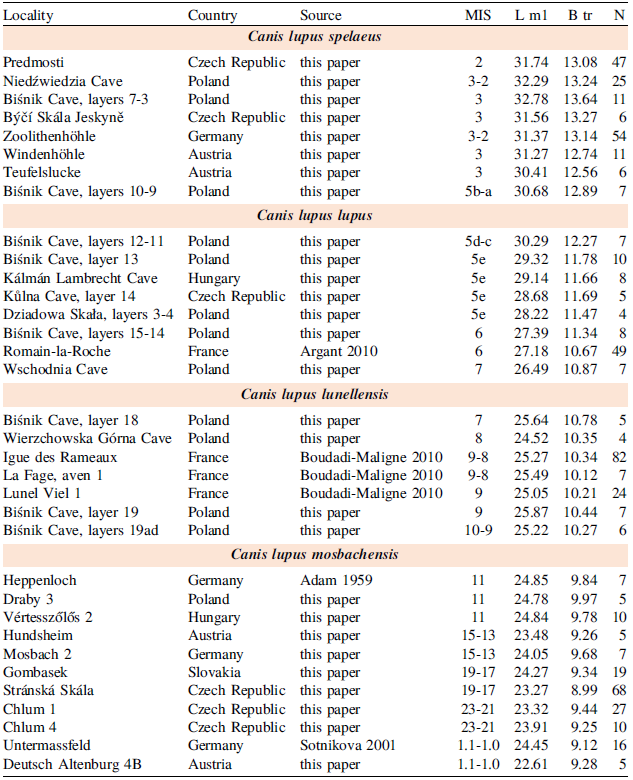
Layer 19 was also assigned to MIS 7 by Krajcarz and Cyrek (Reference Krajcarz and Cyrek2011), while complex layers of 19ad was correlated with MIS 8. Received TL dates showed much older age (MIS 15-12) than this obtained from biochronological analysis (MIS 9, and probably some part of MIS 10). The frequent, deningeroid bears represented advanced form, evolutionary higher evolved, than those from MSI 11, known from e.g. from Za Hájovnou Cave (Musil Reference Musil2014; Wagner Reference Wagner2014) or Draby. Analysis of wolf and lion material from Biśnik Cave showed, that immense individuals of Panthera spelaea fossilis from layer 19ad of this site morphometrically related to the period dated on MIS 11-9 (Figure 1; Marciszak et al. Reference Marciszak, Schouwenburg, Gornig, Lipecki and Mackiewicz2019a). They represent form more evolved than those from MIS 15-12, known, among others from Mauer, Mosbach 2, Château or Południowa Cave. Also, other carnivores confirmed dating these layers on MIS 9, and partially maybe also on MIS 10 (Figure 1, Table 2).
Graph showing the relationship between the m1 mean length (L m1) and the trigonid mean breadth (B tr m1) in Canis lupus evolutionary lineage. For references see Table 2.

The mean values of the m1 length (L m1) and the trigonid breadth (B tr m1) in Canis lupus evolutionary lineage. For references see the Materials and Methods section.

Table 2. Long description
The table presents data on the mean values of the m1 length (L m1) and trigonid breadth (B tr m1) in the evolutionary lineage of Canis lupus. It includes information from various localities across different countries, with data sourced from specific papers. The table is organized into several groups based on the species or subspecies of Canis lupus, including Canis lupus spelaeus, Canis lupus lupus, Canis lupus lunellensis, and Canis lupus mosbachensis. Each row lists the locality, country, source, Marine Isotope Stage (MIS), L m1 value, B tr value, and a numerical value (N). The table has 10 columns: Locality, Country, Source, MIS, L m1, B tr, and N. The data is presented row-wise, with each row corresponding to a specific locality and its associated measurements. Notable trends or comparisons are not explicitly summarized here but can be observed by examining the values across different localities and species groups.
In layers 19ad of Biśnik Cave we do not have mid Middle Pleistocene faunal elements, known from other Central European sites. Species like Lycaon lycaonoides Kretzoi, 1938, Canis lupus mosbachensis Soergel, 1925, Gulo gulo schlosseri Kormos, 1914, Martes vetus Kretzoi, 1942, Mustela strandi Kormos, 1934, Mustela palerminea Petényi, 1864, Mustela praenivalis Kormos, 1934, Acinonyx pardinensis Croizet and Jobert, 1828 or Pachycrocuta brevirostris Gervais, 1850, are missing here (Figure 2). Instead, we have forms like a gracile and small wolf Canis lupus lunellensis Bonifay, 1971, very characteristic faunal element of MIS 10–8 in Europe, robust Cuon alpinus priscus Thenius, 1954, small Gulo gulo gulo Linnaeus, 1758, large and robust Martes martes martes Linnaeus, 1758, Mustela erminea aestiva Kerr, 1792 and Mustela nivalis boccamela Bechstein, 1800, which morphology still hold some primitive features (Marciszak Reference Marciszak2012; Marciszak and Socha Reference Marciszak and Socha2014; Marciszak et al. Reference Marciszak, Kropczyk and Lipecki2021a, Reference Marciszak, Lipecki, Pawłowska, Jakubowski, Ratajczak-Skrzatek and Nadachowski2021b).
Reconstructed chronology of some carnivores from Biśnik Cave and some closely related forms. The red lines refer to the occurrence of the ancient species of the Early Pleistocene origin. Black lines refer to the more recent species of the mid-late Middle Pleistocene origin, belonged to the core of the extant carnivore fauna. Carnivores found in Biśnik Cave are marked in yellow. The blue bar indicates the most probable chronology of the Biśnik Cave.

Also, analysis of faunal lists of other mammals, like insectivores, rodents or ungulates supported this assignation. Among rodents so far, any ancient species from genus Pliomys were found, also Arvicola species is represented by Arvicola amphibious, not by Arvicola mosbachensis Schmidtgen, 1911 (Berto et al. Reference Berto, Nadachowski, Pereswiet-Soltan, Lemanik and Kot2021; Socha Reference Socha2014). Among ungulates, characteristic for this period is occurrence of a large red deer Cervus elaphus spelaeus Owen, 1846, an early Megaloceros giganteus antecendens Berckhemer, 1937 and/or Megaloceros giganteus germaniae Pohlig, 1892, Cervalces sp. and Capreolus capreolus priscus Soergel, 1914 (Croitor et al. Reference Croitor, Stefaniak, Pawłowska, Ridush, Wojtal and Stach2014; Stefaniak et al. Reference Stefaniak, Ratajczak, Kotowski, Kozłowska and Mackiewicz2020; van der Made et al. Reference Made, Marciszak and Stefaniak2014). Most of these forms do not occur in the younger layers or evolve into other, younger chronosubspecies. Scare material of Panthera gombaszoegensis or Cervalces sp. was interpreted as one of the latest, relics occurrences of both species (Marciszak Reference Marciszak2014; Stefaniak Reference Stefaniak2015; Stefaniak et al. Reference Stefaniak, Ratajczak, Kotowski, Kozłowska and Mackiewicz2020; Marciszak & Lipecki, Reference Marciszak and Lipecki2021, Reference Marciszak, Lipecki, Pawłowska, Jakubowski, Ratajczak-Skrzatek and Nadachowski2021b). Krajcarz et al. (Reference Krajcarz, Bosák, Šlechta, Pruner, Komar, Dresler and Madeyska2014a) claimed that the age of layers complex 19ad is difficult to establish. The OSL dates indicate that the accumulation had to represent younger episode at ∼370–280 kyr. It cannot be however entirely ruled out, that the re-deposited sediments could be also much older. So far, the mandible of ancient, small polecat Mustela stromeri Kormos, 1934 from layer 20 is the only Early Pleistocene of even Pliocene faunal element recorded from Biśnik Cave. But this accidental find cannot of course give any reliable data about the stratigraphy of the site.
Conclusions
A set of new AMS and UTh dates contributed to a more precise stratigraphic model for the complex sequence of sediments in Biśnik Cave, when compared with previous interpretations. The profile of this site is well-stratified, with some hiatuses, with sign of re-deposition. Our new dates generally agree with those obtained by previous authors, where particular layers are dated as follows: (a) 1a is younger than 15 kyr, (b) 1b, 1 and 2 are dated on 25–15 kyr, (c) layers 4–3 are dated on 40–35 kyr, (d) layers 7–5 on 70–40 kyr, where layer 7 is the first and the uppermost strata in the whole profile out of the radiocarbon method, (e) layer 8 was dated on 80–70 kyr, layers 10–9 on 100–80 kyr, and layers 12–11 were dated on 115–90 kyr, (f) layer 13 and upper part of layer 14 was assigned to MIS 5e, while the lower part of layer 14 and upper part of layer 15 is correlated with MIS 6; (g) lower part of layer 15 and layers 16, 17 and 18 were dated on MIS 7 (one UTh date of an age of 225 ± 27 kyr confirmed assignation layer 18 to MIS 7), (h) layer 19 was also assigned to MIS 7/8, and complex layers of 19ad was correlated with MIS 9/10. Dates received from different dating methods (AMS, UTh, OSL, and TL) are confirmed also by data obtained from the biostratigraphic analysis. Only the maximum age of the lowermost sediments are still debatable. The whole, exceptionally abundant fauna, documented last ∼350 kyr, roughly between MIS 10/9-1. Among mammals, ancient species, early and mid-Middle Pleistocene faunal markers are absent. The new re-examination of chronology and fauna shed new light on the history of Biśnik fauna.
Supplementary material
To view supplementary material for this article, please visit https://doi.org/10.1017/RDC.2026.10243
Acknowledgments
This research was financed by institutional subsidies for the activities of the University of Wrocław, grant 2026, research Activity (501), discipline 73: biological sciences, MPK 2599280000. It was also supported by an internal grant no. BPIDUB.4610.6.2021.KP.A. entitled “The Middle Pleistocene Revolution - How the modern theriofauna of Eurasia was developed” as part of the program “Inicjatywa Doskonałości-Uczelnia Badawcza (IDUB)” from the Faculty of Biological Sciences, University of Wrocław awarded to Adrian Marciszak. This study was also supported by the National Science Centre, Poland, grant No. 2016/20/S/ST10/00163.



 Open access

