Introduction
The Asian corn borer, Ostrinia furnacalis Guenée (Lepidoptera; Crambidae), a moth in the Crambidae family, is one of the most destructive pests affecting maize crops worldwide (Guo et al., Reference Guo, Qi and He2019; Nafus and Schreiner, Reference Nafus and Schreiner1991; Song et al., Reference Song, Yang and Li2023). Due to its capacity to cause significant damage to maize yields, O. furnacalis has long been the subject of extensive study, especially regarding its development, feeding habits, and interactions with host plants (Duan et al., Reference Duan, Zhu and Wang2021; Li and Zhang, Reference Li and Zhang2023; Nafus and Schreiner, Reference Nafus and Schreiner1991). However, certain aspects of its life cycle remain understudied, one of which is the formation of pupal arrangements that have been described as pupal ‘rings.’ This phenomenon, characterised by unique configurations of pupae linked by their ends to form patterns such as pairs, triangles, or quadrilaterals, has not been explored in the context of this species, leaving a critical gap in our understanding of its ecology and physiology. Investigating this unexplored aspect could yield valuable insights into the species’ behaviour, providing opportunities for more ecologically based pest control strategies.
Pupal formation is a critical phase in the development of insects, marking the transition from larval to adult stages (Kaneko, Reference Kaneko2010; Liu et al., Reference Liu, Gong and Li2010; Patočka and Turčáni, Reference Patočka and Turčáni2023). The behaviour exhibited during pupation can significantly influence survival and reproductive success. In the case of O. furnacalis, an intriguing pattern of pupal arrangement has been observed, wherein pupae form patterns such as pairs, triangles, or quadrilateral shapes, with pupae attached to one another at their ends. These patterns differ from traditional descriptions of pupal rings and could suggest a complex interaction between environmental and physiological factors. While pupal aggregation behaviour has been documented in various insects, the specific formation of such linked pupal patterns in O. furnacalis remains largely unexplored (Beltramí et al., Reference Beltramí, Medina-Muñoz and Arce2010; Roberge et al., Reference Roberge, Fréchette and Labrie2016).
Previous research on O. furnacalis has mainly concentrated on its development, reproduction, and interactions with maize plants, leaving a significant gap in the understandingof the factors influencing its pupation behaviour (Abbas et al., Reference Abbas, Alam, Abbas, Abbas, Ali, Schilthuizen, Romano and Zhao2024; Alam et al., Reference Alam, Abbas and Hafeez2025; Guo et al., Reference Guo, Guo and He2017; Kojima et al., Reference Kojima, Fujii and Suwa2010; Zhang et al., Reference Zhang, Coates and Ge2015). Studies on other species have linked similar phenomena to environmental factors such as larval density, temperature, and physiological maturity (Alam et al., Reference Alam, Abbas and Ali2024, Reference Alam, Abbas and Hafeez2025). It is known that such conditions can alter insect behaviour and morphology, potentially affecting pupation patterns. However, no comprehensive study has yet examined the causes and conditions under which these unique pupal linkages occur in O. furnacalis.
The novelty of this research lies in its focus on the environmental and physiological factors that influence the formation of pupal linkages in O. furnacalis. This study hypothesises that larval density, temperature, and the developmental stage and sex of larvae play significant roles in triggering these linked pupal patterns. By investigating these variables in controlled environments, this research aims to provide new insights into the ecological and physiological underpinnings of this phenomenon. The patterns observed may be adaptive behaviours, potentially offering survival advantages by influencing pupation success and facilitating communication or cooperation among larvae.
Furthermore, this study could have important implications for pest management strategies (Koštál, Reference Koštál2006; Nguyen et al., Reference Nguyen, Ponton and Than2019). If specific environmental conditions or physiological states influence the formation of linked pupae, it may be possible to manipulate these factors to disrupt the pupation process or regulate O. furnacalis populations. For example, disrupting the environmental conditions conducive to these linked pupal formations could be a novel strategy to reduce pest populations (Chen et al., Reference Chen, Duan and Wang2024; Hiraga, Reference Hiraga2006; Khaliq, Reference Khaliq2014). Additionally, the formation of these patterns could indicate complex communication mechanisms among larvae, which may be exploited for pest control purposes. Understanding whether these pupal patterns are a form of cooperative behaviour or a response to environmental pressures could open new pathways for ecological pest management techniques (Gao et al., Reference Gao, Zhang and Wu2022; Jindra, Reference Jindra2019; Wang et al., Reference Wang, Si and Zhang2021).
This research is aimed to fill a critical gap in the knowledge of O. furnacalis pupation behaviour. By investigating the ecological and physiological factors that influence pupal formation, this study will offer new insights into the behavioural mechanisms of this pest species. Furthermore, it will contribute to the growing body of literature on the ecological significance of insect behaviours and their implications for sustainable pest management. By understanding the mechanisms behind pupal linkage, pest management practices can be tailored to target specific behaviours, offering a more eco-friendly approach to controlling O. furnacalis populations in agricultural systems.
Materials and methods
Insect
Ostrinia furnacalis Guenée (Lepidoptera; Crambidae), the initial colony of which was purchased from Henan Keyun Biological Co., Ltd., was reared under laboratory conditions (28 ± 2 °C, 40 ± 10% relative humidity, 16 L:8 D). The insects were raised on an artificial diet consisting of 60 g corn flour, 60 g soybean flour, 36 g yeast powder, 30 g glucose, 2 g vitamin C, 2 g sorbic acid, and 8 g agar powder (Alam et al., Reference Alam, Abbas and Ali2024, Reference Alam, Abbas and Hafeez2025).
Sex identification of O. furnacalis larvae and pupae
The fifth instar larvae of O. furnacalis were selected for morphological observation under an anatomical mirror (Belona® BL-TS2040). If the genital Herold’s gland of the ninth ventral segment showed a black diamond patch, it was recorded as a male; otherwise, it should be a female. The terminal of the pupa was observed as well. If the ninth ventral segment had a tuberculate, it was recorded as a male; if the eighth ventral segment had a short slit, it was noted as a female (Zhang et al., 2023).
Pairing of artificial and natural populations
A total of 30 larvae of known sex (15 males and 15 females) were selected for the experiment. They were placed in a plastic box (11 × 5 cm) and reared on either an artificial diet or corn-stalks. Each experimental set was repeated 10 times. Upon pupation, the number of pupal rings formed was recorded for each group.
Pairing of the fifth instar larvae
A group of 30 larvae (15 males and 15 females) with identified gender were randomly selected and fed in a Petri dish with a diameter of 9 cm. Their pairing in the dish was observed. If two or more of them were found to pupate together, the pupae were removed and their gender composition was recorded. Each group was repeated 10 times.
Effect of arena on pupal ring formation
Three groups of larvae were used and 30 larvae (15 males and 15 females) with the same maturity and sex were in each individual group. The larvae in each group were reared in a Petri dish of 6, 9, or 12 cm, respectively, at a temperature of 28 ± 2 °C. Their pairing conditions were observed, and the number of paired and unpaired larvae as well as the sex composition after pupation were recorded, repeated 10 times in each group.
Effect of temperature on pupal ring formation
Three groups of larvae were used and 30 larvae were in each individual group (15 males and 15 females) and reared in a (diameter: 9 cm) Petri dish in an insulated box where a temperature controller was used to keep the temperature at 22 ± 2 °C, 25 ± 2 °C, or 28 ± 2 °C, and their pairing and gender composition after pupation were recorded. For each individual temperature, the treatment was performed 10 times.
Effect of larval maturity on pupal ring formation
The fifth instar larvae with a definite sex were selected and kept at 28 ± 2 °C. The fifth instar larvae within 3 days after peeling, mature larvae, and pre-pupae were selected respectively, and they were paired according to different development stages and were fed in a Petri dish (diameter 9 cm). Three groups were treated differently to observe their pairing and gender composition after pupation. Each group was repeated 10 times.
Effect of larval sex on pupal ring formation
The fifth instar larvae with the same maturity and determined sex were selected at a temperature of 28 ± 2 °C and divided into male group, female group, and mixed group, with 30 larvae in each group (male group: all 30 larvae were male, female group: all 30 female larvae, and mixed group: 15 males and 15 females). Each group was fed in Petri dishes (diameter 9 cm). The paired condition was observed, and the numbers of paired and unpaired worms were recorded. Each group was repeated 10 times.
Data analyses
A t-test was performed to reveal whether the number of rings performed on an artificial diet would be significantly different from zero value of those individuals tested on corn-stalks. The ringing performance of fifth instar larvae as per gender was examined for females and males as a function of the number of rings being performed using the cor() function from the stats package with default methodology. For the same dataset, the percentage of genders participating in the ringing performance was compared using the prop.test() function of the stats package with default settings to reveal whether the probability of ringing participation was equal between genders. The rest of data were modelled using a generalised linear model (GLM) with Poisson distribution for count data and a GLM model with quasibinomial distribution for proportional data (Dunn and Smyth, Reference Dunn and Smyth2018; Faraway, Reference Faraway2016). The multiple comparison tests were performed using the glht() function from package multcomp. All statistical assessments were performed in R (v4.4.2) using the integrated developmental environment, RStudio (v2024.12.1) (R Development Core Team, 2024). All figures were generated with facilities of the ggplot2 package exploiting facilitations from other packages like ggpubr, tidyr, dplyr, rvg, and office (Wickham et al., Reference Wickham, Chang, Henry, Pedersen, Takahashi, Wilke, Woo, Yutani, Dunnington and van den Brand2024).
Results
Diet effect
Our initial approach asking whether O. furnacalis would exhibit a different tendency of ringing formation showed that it only performed ringing formation when maintained on an artificial diet, with being significantly different than zero value of ringing performance on corn-stalk (t = 3.54, df = 18, P = 0.0024, fig. 1).
Ring performance of Ostrinia furnacalis maintained at either an artificial diet or corn-stalk. The double asterisks demonstrate the significance level of t-test (**P < 0.01).

Ringing performance fifth instar larvae as per gender
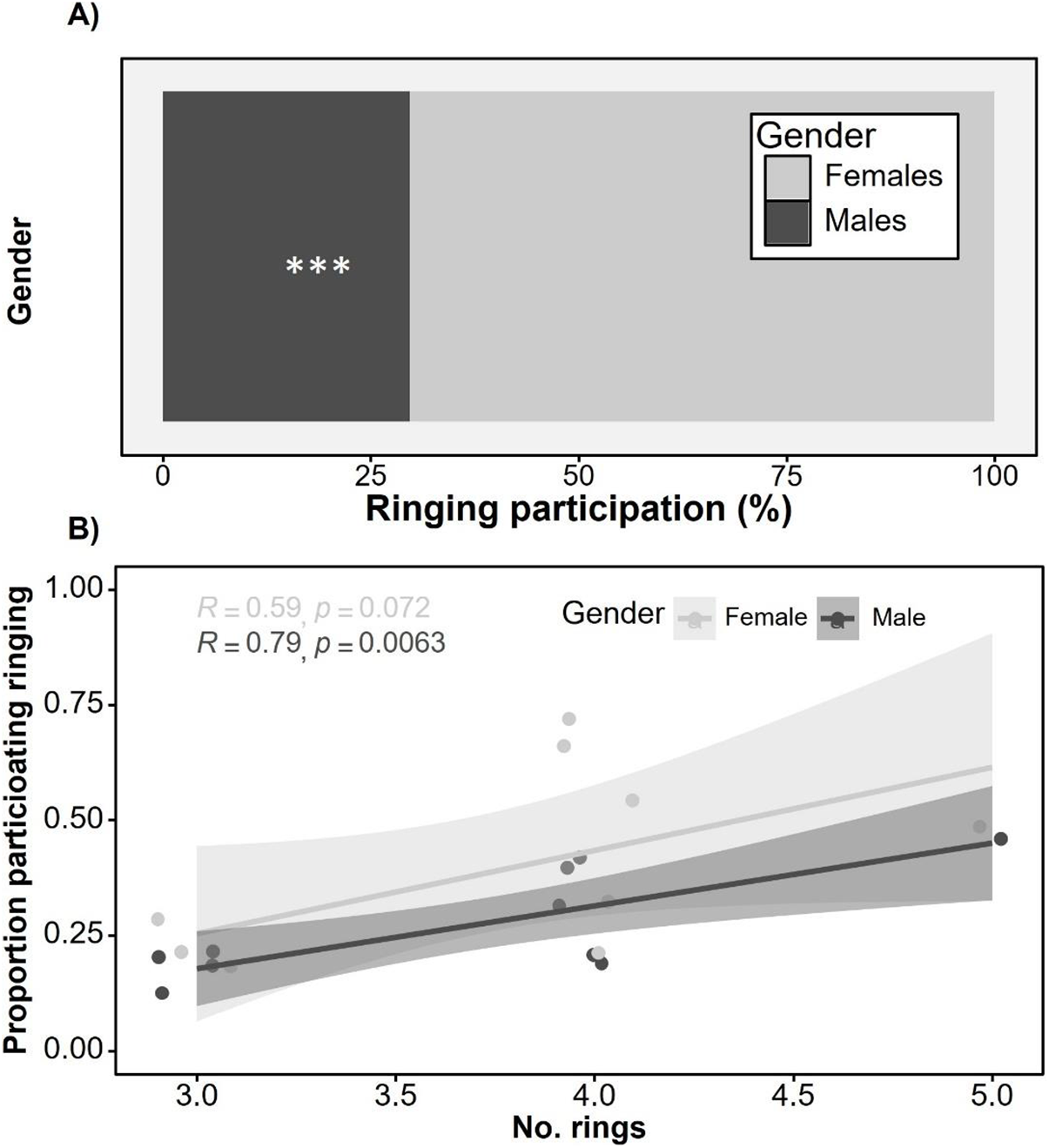
The participation of genders at the fifth instar larval stage to ringing formation revealed that females exhibited a higher tendency of participation (χ2 = 164.11, df = 1, P < 0.001, fig. 2A). The proportion of males participating in the ringing performance was significantly dependent on the number of rings formed (R = 0.79, P = 0.006), while that of females was not (R = 0.59, P = 0.072, fig. 2B).
The proportion of genders participating in the ringing performance (A) and the relationship between the proportion of genders participating in the ringing performance as a function of the number of rings (B). The triple asterisks on panel A indicate the significance level between the participation of both genders (***P < 0.001).

Arena effect
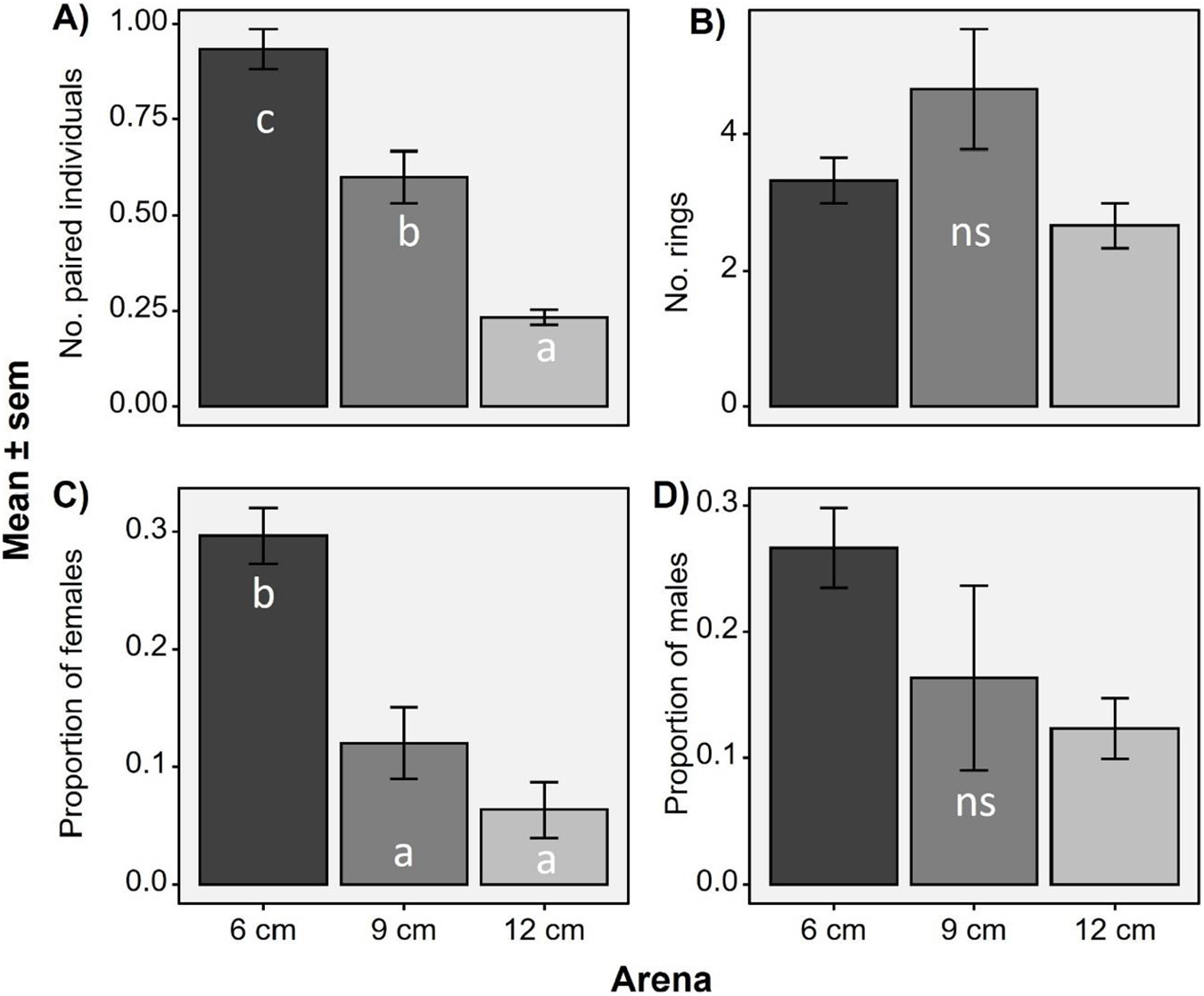
Testing the participation of O. furnacalis in different arenas, the number of insects participated (paired) significantly decreased as the arena size was increased (χ2 = 52.10, df = 2, P < 0.001, fig. 3A, fig. 4A). The proportion of females participating in the ringing performance was significantly affected by maintenance arena, which led to a higher value in 6 cm arena than other tested arenas, 9 cm and 12 cm (χ2 = 31.18, df = 1, P < 0.001, fig. 3C, fig. 4C). However, the number of rings (χ2 = 1.72, df = 2, P = 0.423, fig. 3B, fig. 4B) and proportion of males participating in the ringing performance (χ2 = 4.29, df = 2, P = 0.117, fig. 3D, fig. 4D) did not differ between the groups tested in arenas with different sizes.
The number of Ostrinia furnacalis individuals participating in the ringing performance (A), the number of rings formed (B), and the proportion of females (C) and males (D) who participated in the ringing performance in different arenas. Different lower cases on panels A and C depict the differences between tested groups in different arenas as a function of multiple comparison tests, while ns on panels B and D represent non-significant arena effects.

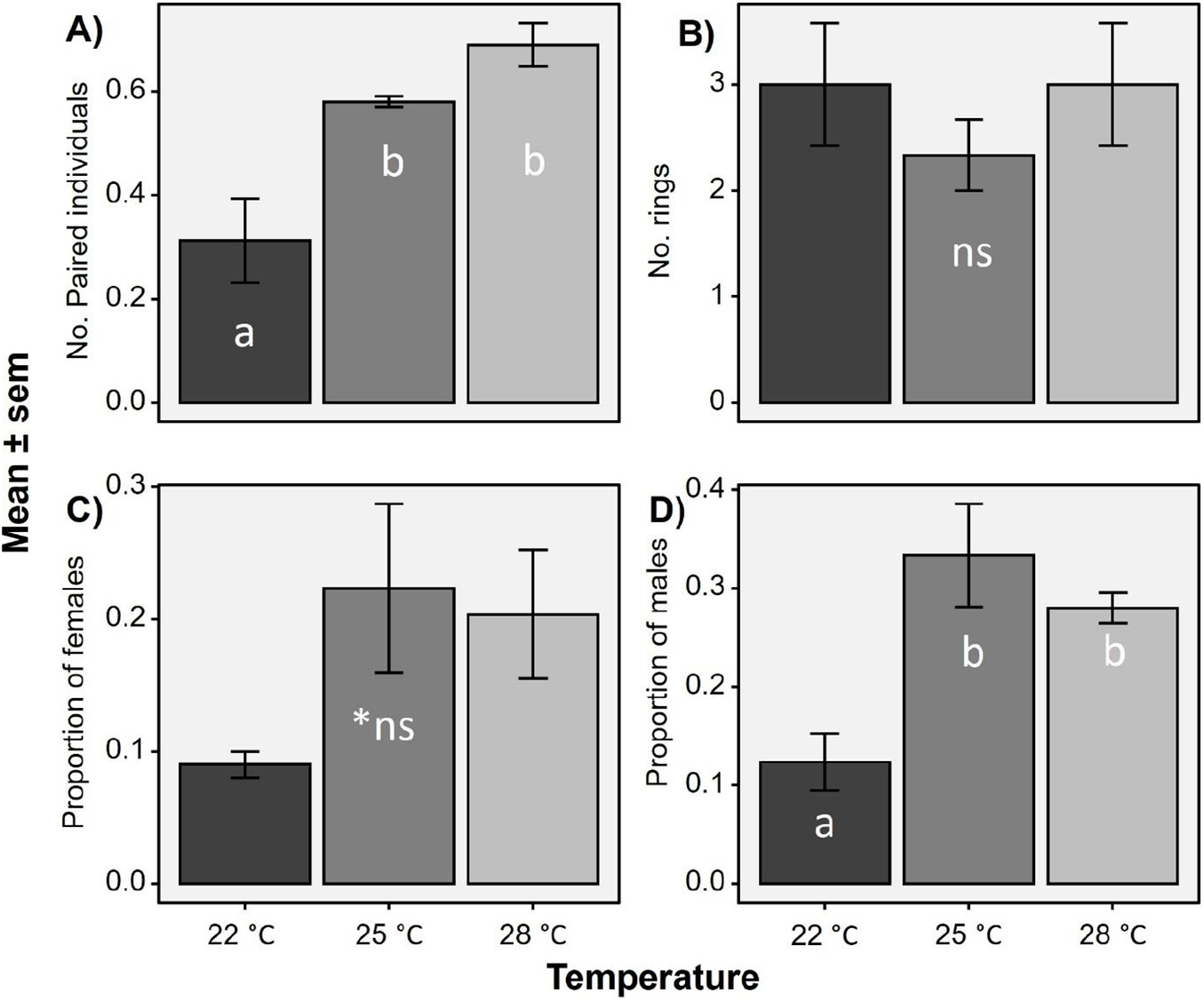
The number of Ostrinia furnacalis individuals participating in the ringing performance (A), the number of rings formed (B), and the proportion of females (C) and males (D) who participated in the ringing performance under different temperature treatments. Different lower cases on panels A and D depict the differences between tested groups in different arenas as a function of multiple comparison tests, while ns on panels B and C represents non-significant temperature effects. The effect of temperature on the proportion of females participating in the ringing performance was significant, while multiple comparison tests did not differentiate the results (*ns on panel C).

Temperature effect
Temperature effect on the individuals of O. furnacalis participating in the ringing performance (χ2 = 23.68, df = 2, P < 0.001, fig. 4A), the proportion of females participating in the ringing performance (χ2 = 6.08, df = 2, P = 0.048, fig. 4C), and the proportion of males participating in the ringing performance (χ2 = 19.48, df = 2, P < 0.001, fig. 4D) were statistically significant with significantly lower incidences being recorded at 22 °C than 25 °C and 28 °C treatments, except that the multiple comparison tests were not in agreement with model outputs for the proportion of females participating in the ringing performance and yielded non-significant differences. The number of rings formed was not affected by temperature treatments (χ2 = 0.33, df = 2, P = 0.848, fig. 4B).
Effect of mixed participation
The proportion of pairing individuals did not significantly differ for females between sole (only females) and mixed (females + males) tests (χ2 = 2.14, df = 1, P = 0.144, fig. 5A), while it differed significantly for males between mixed (male + female) and sole (only males) tests (χ2 = 11.07, df = 1, P < 0.001, fig. 5B).
The proportion of individuals of Ostrinia furnacalis participating in the ringing performance as a function of gender-based participation types which were tested either as mixed population (females + males) or sole (females or males). The comparisons were performed for females (A) and males (B) separately. The annotation ‘ns’ on the panel A means there was not any significant treatment effect, while the triple asterisks on panel B means the treatment effect was statistically significant (***P < 0.001).

Discussion
This study provides insights into the environmental and physiological factors influencing the formation of pupal rings in O. furnacalis. Our results demonstrate that pupal rings are exclusively formed when larvae are reared on an artificial diet, suggesting a strong dietary influence. Additionally, the participation in ring formation was significantly influenced by gender, with females exhibiting a higher tendency to participate. Furthermore, the size of the rearing arena and temperature conditions significantly affected the incidence of ring formation, with smaller arenas and higher temperatures promoting higher participation. Lastly, sex composition in larval groups played a role, as males in mixed groups exhibited a greater tendency for ring formation than those reared solely with other males.
The effect of diet on pupal ring formation was striking, as larvae raised on corn-stalks exhibited no ring formation, while those maintained on an artificial diet displayed significant participation. This suggests that the nutritional composition or physical properties of the artificial diet may facilitate the behavioural interactions leading to ring formation. The presence of specific nutrients or moisture content in the artificial diet could be enhancing larval aggregation or developmental synchrony, warranting further investigation.
Our findings on gender-based differences in ring formation revealed that females were more likely to participate in the process. The strong correlation between the number of rings formed and the proportion of male participation suggests that males are more responsive to group dynamics, potentially due to competitive or social interactions (Kappeler et al., Reference Kappeler, Benhaiem and Fichtel2023; Procter et al., Reference Procter, Moore and Miller2012). This highlights the potential influence of sex-specific behaviours on larval aggregation and pupation strategies (Boomsma et al., Reference Boomsma, Baer and Heinze2005; Lindstedt et al., Reference Lindstedt, Murphy and Mappes2019; Morimoto et al., Reference Morimoto, Nguyen and Dinh2019; Kappeler et al., Reference Kappeler, Benhaiem and Fichtel2023).
The arena effect showed that the incidence of ring formation was significantly reduced as the rearing space increased. This finding suggests that limited space may encourage closer interactions among larvae, promoting aggregation behaviour (Buhl and Rogers, Reference Buhl and Rogers2016; Deneubourg et al., Reference Deneubourg, Lioni and Detrain2002; Qian, Reference Qian2024). Interestingly, the reduction in participation was more pronounced among females in larger arenas, implying that females may require closer contact to engage in ring formation (Hodin, Reference Hodin2009; Otaki, Reference Otaki2020). However, the total number of rings formed remained unaffected, indicating that while space influences participation, it does not necessarily alter the final outcome of ring formation.
Temperature also had a significant impact on ring formation, with participation rates decreasing at lower temperatures (22 °C) compared to 25 °C and 28 °C (Hiraga, Reference Hiraga2006; Keena and Moore, Reference Keena and Moore2010; Tautz et al., Reference Tautz, Maier and Groh2003). This suggests that higher temperatures may enhance metabolic activity, leading to increased movement and interaction among larvae, thereby promoting ring formation (Chen et al., Reference Chen, Tang and Song2019; González‐Tokman et al., Reference González‐Tokman, Córdoba‐Aguilar and Dáttilo2020; Li et al., Reference Li, Zhou and Wu2023; Zhou et al., Reference Zhou, Liu and Han2018). However, the number of rings formed remained unchanged across temperature treatments, indicating that while temperature influences participation, it does not dictate the structural organisation of pupation rings.
The effect of mixed versus single-sex groups on ring formation revealed that male larvae in mixed-sex groups exhibited significantly higher participation than those in male-only groups. This suggests that the presence of females may act as a social or chemical cue stimulating male aggregation behaviour (Ayasse et al., Reference Ayasse, Paxton and Tengö2001; Billeter and Wolfner, Reference Billeter and Wolfner2018). Conversely, female participation was not significantly influenced by the presence of males, indicating that female engagement in ring formation is likely independent of male influence.
While this study provides valuable insights into the factors influencing pupal ring formation, it has some limitations. The experiments were conducted under controlled laboratory conditions, which may not fully capture the complexity of natural environments. Factors such as microbial interactions, humidity fluctuations, or predator presence in field settings may further modulate ring formation behaviour. Additionally, while we identified significant associations between diet, temperature, arena size, and sex composition with ring formation, the underlying physiological or neurobiological mechanisms remain unclear. Future research should explore the biochemical and hormonal mechanisms driving this aggregation behaviour. Investigations into the role of pheromonal signalling, nutritional composition, and genetic factors would provide deeper insights into the regulatory processes governing pupal ring formation. Additionally, field-based studies are necessary to validate whether these laboratory findings translate to natural settings, improving our understanding of how environmental variables shape the developmental strategies of O. furnacalis.
In conclusion, this study highlights the significant role of diet, gender, space availability, temperature, and larval group composition in influencing pupal ring formation in O. furnacalis. These findings contribute to our understanding of insect developmental behaviours and provide a foundation for future studies aimed at elucidating the underlying mechanisms driving this phenomenon.
Author contributions
W.H.: Conceptualisation, Methodology, Writing – original draft, and Data collection; R.Z.C.: Conceptualisation, Funding, Supervision, Resources, Project administration, and Writing – review and editing; S.A.: Conceptualisation and Methodology; H.J.: Writing – review and editing; D.H.: Writing – review and editing; F.X.: Writing – review and editing and Resources; A.A.: Writing – review and editing; H.A.G.: Writing – review and editing; K.A.K.: Writing – review and editing; J.A.: Writing – review and editing and Data analysis; and A.T.: Writing – review and editing and Data analysis.
Acknowledgements
The authors extend their appreciation to the Deanship of Research and Graduate Studies at King Khalid University, Large Research Group Project (RGP2/535/45).
Financial support
This work was supported by the Ministry of Science and Technology of China (2022YFD1500701).
Competing interests
The authors declare no conflict of interest.
Data availability statement
Data are available upon reasonable request.
Ethical approval
Not applicable.