Researchers seeking to understand the impact of early adversity on trajectories of psychopathology have increasingly utilized multiple levels of analyses to capture risk and resilience processes in both biological and behavioral strata (Cicchetti & Blender, Reference Cicchetti and Blender2004). In particular, depression is a multifaceted phenomenon that affects not only behavioral and affective systems but also cognition, interpersonal processes, and biological systems including neurobiological and neuroendocrinological processes. Understanding the complex framework within which each of these pathways connects and contributes to the development of depression is a challenge that calls for research designs that utilize multiple assessment methods at different levels of analyses. Moreover, experiences that occur in childhood may initiate developmental cascades that contribute to long-term outcomes. The link between early childhood adversity and alterations in neurobiological and neuroendocrinological processes has been well established in the literature (Cicchetti & Rogosch, Reference Cicchetti and Rogosch2001; Heim, Plotsky, & Nemeroff, Reference Heim, Plotsky and Nemeroff2004; Tyrka, Burgers, Philip, Price, & Carpenter, Reference Tyrka, Burgers, Philip, Price and Carpenter2013). However, less attention has been paid to how these alterations intersect with proximal experiences, especially recent stressful events. The current study examines how early adverse experiences modify the relationship between recent episodic stress and both cortisol regulation and depression.
Childhood Adversity (CA) and Stress Sensitization
Research suggests that CA predicts increased depressive reactivity to life stress in a process termed stress sensitization. A number of studies have shown that a history of CA lowers the threshold of stressor severity required to trigger a depressive episode (Espejo et al., Reference Espejo, Hammen, Connolly, Brennan, Najman and Bor2007; Hammen, Henry, & Daley, Reference Hammen, Henry and Daley2000; Harkness, Bruce, & Lumley, Reference Harkness, Bruce and Lumley2006; La Rocque, Harkness, & Bagby, Reference La Rocque, Harkness and Bagby2014; Rudolph & Flynn, Reference Rudolph and Flynn2007) and predicts stronger associations between proximal stressors and depression and other negative outcomes (Kim et al., Reference Kim, Martins, Shmulewitz, Santaella, Wall, Keyes and Hasin2014; McLaughlin, Conron, Koenen, & Gilman, Reference McLaughlin, Conron, Koenen and Gilman2010; Shapero et al., Reference Shapero, Black, Liu, Klugman, Bender, Abramson and Alloy2014; Starr, Hammen, Conway, Raposa, & Brennan, Reference Starr, Hammen, Conway, Raposa and Brennan2014). Although there are multiple plausible mechanisms linking CA to stress sensitization (e.g., Szyf, McGowan, & Meaney, Reference Szyf, McGowan and Meaney2008), one likely pathway is via disruption of hypothalamus–pituitary–adrenal (HPA) axis development (Heim, Newport, Mletzko, Miller, & Nemeroff, Reference Heim, Newport, Mletzko, Miller and Nemeroff2008; McEwen, Reference McEwen1998).
Overview of HPA Axis and Stress Regulation
The HPA axis is a major part of the biological stress response that prepares the body to optimally respond to threat. Cortisol, the hormonal end product of the HPA axis, is often used to index HPA axis functioning. Cortisol affects multiple bodily systems, including immune functioning, energy metabolism, and neurobiological circuits (Heim & Nemeroff, Reference Heim and Nemeroff2001; Raison & Miller, Reference Raison and Miller2003); consequently, abnormalities in cortisol regulation have been linked to a wide variety of clinical and physical health problems, including depression (Chida & Steptoe, Reference Chida and Steptoe2009).
The cortisol awakening response (CAR)
Although numerous indicators of HPA axis functioning have been examined in the literature (for a review, see Granger et al., Reference Granger, Fortunato, Beltzer, Virag, Bright and Out2012), one particularly relevant to depression (and the focus of the present study) is the CAR. In addition to being released in response to environmental threat (De Kloet, Reference De Kloet2004), cortisol secretion follows a typical daily pattern, with peak concentration levels in the morning followed by declining levels throughout the day, reaching nadir at bedtime (e.g., Adam & Kumari, Reference Adam and Kumari2009; Pruessner et al., Reference Pruessner, Wolf, Hellhammer, Buske-Kirschbaum, von Auer, Jobst and Kirschbaum1997). The CAR is an elevation of approximately 50%–156% in cortisol secretion that occurs approximately 30–45 min postawakening (Clow, Thorn, Evans, & Hucklebridge, Reference Clow, Thorn, Evans and Hucklebridge2004). It is thought to be distinct from daily, or diurnal, cortisol secretion (Wilhelm, Born, Kudielka, Schlotz, & Wust, Reference Wilhelm, Born, Kudielka, Schlotz and Wust2007). Although its exact function is uncertain, it has been suggested that the CAR represents the marshaling of resources to deal with the stress of the day (Chida & Steptoe, Reference Chida and Steptoe2009; Fries, Dettenborn, & Kirschbaum, Reference Fries, Dettenborn and Kirschbaum2009; Powell & Schlotz, Reference Powell and Schlotz2012). In line with this, the “boost” hypothesis posits that the CAR serves a short-term adaptive function by mobilizing the body's resources (via influencing metabolic processes) to help meet perceived daily demands (Adam, Reference Adam2006; Fries, Hesse, Hellhammer, & Hellhammer, Reference Fries, Hesse, Hellhammer and Hellhammer2005).
Alterations in the size of the CAR are thought to reflect dysregulation in the functioning of the HPA axis and have been implicated in negative clinical and health outcomes, including depression (Adam et al., Reference Adam, Doane, Zinbarg, Mineka, Craske and Griffith2010; Chida & Steptoe, Reference Chida and Steptoe2009). Two recent prospective analyses of the same adolescent sample indicated that a greater than average CAR predicted onsets of major depression (Adam et al., Reference Adam, Doane, Zinbarg, Mineka, Craske and Griffith2010; Vrshek-Schallhorn et al., Reference Vrshek-Schallhorn, Doane, Mineka, Zinbarg, Craske and Adam2013); other studies suggest that elevated waking cortisol in at-risk individuals prospectively predicts depression (Goodyer, Bacon, Ban, Croudace, & Herbert, Reference Goodyer, Bacon, Ban, Croudace and Herbert2009; Goodyer, Herbert, Tamplin, & Altham, Reference Goodyer, Herbert, Tamplin and Altham2000; Halligan, Herbert, Goodyer, & Murray, Reference Halligan, Herbert, Goodyer and Murray2007; Harris et al., Reference Harris, Borsanyi, Messari, Stanford, Cleary, Shiers and Herbert2000). In addition, loneliness and internalizing symptoms have also been associated with a greater CAR (Doane & Adam, Reference Doane and Adam2010; Saridjan et al., Reference Saridjan, Velders, Jaddoe, Hofman, Verhulst and Tiemeier2014; Saxbe, Reference Saxbe2008). However, existing literature also shows that a smaller than average CAR can reflect burnout and other health problems (Chida & Steptoe, Reference Chida and Steptoe2009) and has also been associated with various negative outcomes, including trait loneliness, internalizing symptoms, posttraumatic stress disorder (PTSD), rumination, and fatigue (Gartland, O'Connor, Lawton, & Bristow, Reference Gartland, O'Connor, Lawton and Bristow2014; Keeshin, Strawn, Out, Granger, & Putnam, Reference Keeshin, Strawn, Out, Granger and Putnam2014; Kuehner, Holzhauer, & Huffziger, Reference Kuehner, Holzhauer and Huffziger2007; McGinnis, Lopez-Duran, Martinez-Torteya, Abelson, & Muzik, Reference McGinnis, Lopez-Duran, Martinez-Torteya, Abelson and Muzik2016; Sladek & Doane, Reference Sladek and Doane2015). Thus, it appears that dysregulation in the CAR is associated with risk for depression and related problems, although the exact nature of this relationship may be complex and methodologically dependent (see Stalder et al., Reference Stalder, Kirschbaum, Kudielka, Adam, Pruessner, Wust and Clow2016), requiring further elucidation.
CA and cortisol regulation
HPA axis activation may be adaptive in the short term by allowing the body to manage the stressor at hand. However, chronic HPA axis activation due to repeated exposure to stressors during vulnerable developmental periods may lead to sustained alterations in HPA axis functioning and related neural structures and corresponding problems with stress regulation. Aligning with this model, a large number of studies have linked negative childhood experiences to cortisol dysregulation (Cicchetti & Rogosch, Reference Cicchetti and Rogosch2012; Heim et al., Reference Heim, Newport, Mletzko, Miller and Nemeroff2008; McCrory, De Brito, & Viding, Reference McCrory, De Brito and Viding2010; Tarullo & Gunnar, Reference Tarullo and Gunnar2006; Trickett, Negriff, Ji, & Peckins, Reference Trickett, Negriff, Ji and Peckins2011).
Central to research examining the impact of CA on the HPA axis is the examination of allostasis, or the body's response to changes in the environment, including response to stressors. Allostasis involves many biological mechanisms that help an organism respond to threat, such as elevations and return to homeostasis in heart rate, breathing, and cortisol secretion. However, repeated stress exposure during critical periods of development may lead to allostatic load or a breakdown in the allostatic system (McEwen & Seeman, Reference McEwen and Seeman1999).
Although cortisol elevations occur in response to environmental stress, over time this pattern may change, such that the HPA axis inadequately responds to the presence of environmental stressors, leading to negative health outcomes including psychopathology (McEwen, Reference McEwen2004). In accordance with this pattern, meta-analytic findings indicate that time since stressor onset is negatively correlated with HPA axis activity (Miller, Chen, & Zhou, Reference Miller, Chen and Zhou2007). This suggests that stress exposure leads to hypercortisolism initially, but over time, in response to prolonged HPA axis activation as a result of chronically stressful conditions, hypocortisolism develops (e.g., Gunnar & Fisher, Reference Gunnar and Fisher2006; Miller et al., Reference Miller, Chen and Zhou2007; Tarullo & Gunnar, Reference Tarullo and Gunnar2006).
Consistent with this model, and looking at the CAR specifically, CA has been associated with both greater than average CAR (Engert, Efanov, Dedovic, Dagher, & Pruessner, Reference Engert, Efanov, Dedovic, Dagher and Pruessner2011; Gonzalez, Jenkins, Steiner, & Fleming, Reference Gonzalez, Jenkins, Steiner and Fleming2009; Lu, Gao, Huang, Li, & Xu, Reference Lu, Gao, Huang, Li and Xu2016; Lu et al., Reference Lu, Gao, Wei, Wu, Liao, Ding and Li2013) and smaller than average CAR (Meinlschmidt & Heim, Reference Meinlschmidt and Heim2005; Quevedo, Johnson, Loman, LaFavor, & Gunnar, Reference Quevedo, Johnson, Loman, LaFavor and Gunnar2012). The disparate findings can likely be partially attributed to methodological and demographic variables (e.g., pubertal development, CAR calculation method, and the type, timing, and severity of early adversity; Chida & Steptoe, Reference Chida and Steptoe2009; Gustafsson, Anckarsäter, Lichtenstein, Nelson, & Gustafsson, Reference Gustafsson, Anckarsäter, Lichtenstein, Nelson and Gustafsson2010; Miller et al., Reference Miller, Chen and Zhou2007; Quevedo et al., Reference Quevedo, Johnson, Loman, LaFavor and Gunnar2012). However, the variation in findings may also reflect legitimate complexities of HPA axis functioning. This may include the existence of untested moderators, such as the presence of recent stressors. Nevertheless, no studies have examined the interactive effect of CA and proximal episodic stress in the prediction of the CAR. The current study addresses this gap.
CA as a moderator of the association between recent episodic stress and the CAR
If the CAR represents an adaptive mechanism for managing stressful contexts, one would expect that among those with optimal HPA axis functioning, the CAR would be positively correlated with recent significant life stressors. Stressful life events predict continued hassles in daily life (Wagner, Compas, & Howell, Reference Wagner, Compas and Howell1988), and an elevated CAR may allow for recruitment of resources necessary to cope with ongoing demands and promote allostasis (McEwen, Reference McEwen1998), potentially protecting against negative outcomes such as depression. Recent life stress is associated with elevations in the CAR (see Chida & Steptoe, Reference Chida and Steptoe2009, for a meta-analysis) and other markers of diurnal cortisol activity (Stroud, Chen, Doane, & Granger, Reference Stroud, Chen, Doane and Granger2016). However, it is possible that exposure to childhood adversities could disrupt this process. A developmental history of repeated activation of the HPA axis may lead to increased allostatic load, which could be reflected in inadequate responding (i.e., decreased CAR) to stressful contexts (as denoted by high recent episodic stress; McEwen, Reference McEwen2004). This may in turn leave adolescents with fewer metabolic resources to manage the aftermath of these recent stressors, making them more vulnerable to depression. It has been hypothesized that youths who develop hypocortisolism in response to chronic stress exposure may be less able to adapt to future stressors (Cicchetti & Rogosch, Reference Cicchetti and Rogosch2012), potentially accounting for stress sensitization effects. Building on these ideas, the current study examines whether CA moderates the association between recent episodic stress and (a) the CAR, and (b) depressive symptoms.
Sensitization to independent versus dependent stressors
The effect of environmental stress on the HPA axis appears to be contingent upon the qualitative nature of the stressors (Miller et al., Reference Miller, Chen and Zhou2007; Stroud et al., Reference Stroud, Chen, Doane and Granger2016). For example, the literature on naturalistic life stress draws a crucial distinction between independent and dependent stressors (Hammen, Reference Hammen2005). Independent stressors are fateful events outside of the individual's control (e.g., death of loved one or sudden loss of parental employment), whereas dependent stressors are events to which the individual has at least partially contributed (e.g., interpersonal conflict or academic failure). Thus, event independence can be considered a marker of the controllability of naturalistic events. The controllability of stress has been identified as an important dimension likely to influence HPA axis response (Dickerson & Kemeny, Reference Dickerson and Kemeny2004; Miller et al., Reference Miller, Chen and Zhou2007). In laboratory studies, uncontrollable stressors provoke a more pronounced HPA axis response (Dickerson & Kemeny, Reference Dickerson and Kemeny2004), perhaps because a lack of control makes acute stress inherently more threatening. However, experiencing more persistent uncontrollable stressors, including naturalistic stressors that are more personally and persistently impactful than laboratory stressors, may instead lead to a blunting of cortisol responses (Miller et al., Reference Miller, Chen and Zhou2007), perhaps aligning with withdrawn and learned helplessness behaviors associated with depression. In contrast, controllable stressors (such as dependent events) may lead to an increase in cortisol production to mobilize metabolic resources for coping.
A history of CA may be particularly relevant in moderating the influence of uncontrollable, independent stressors on the HPA axis. Childhood adversities are themselves inherently more likely to be uncontrollable experiences, as from a developmental standpoint, children typically lack autonomy over many aspects of their environment (Harkness et al., Reference Harkness, Alavi, Monroe, Slavich, Gotlib and Bagby2010). Independent proximal stressors may be reminiscent of these negative childhood experiences.
Consequently, children with a long history of such experiences may be more attuned to the uncontrollable nature of independent stressors, and more likely to disengage both emotionally (through increased depression) and physiologically (by failing to deploy metabolic resources for coping).
Some evidence suggests that early adversity may predict sensitization to independent, but not dependent, events, although evidence is mixed. At least two studies have shown that adolescents with a history of maltreatment require a lower threshold of independent (but not dependent) stress to trigger a depressive episode (Harkness et al., Reference Harkness, Bruce and Lumley2006; La Rocque et al., Reference La Rocque, Harkness and Bagby2014). Another study showed that independent (but not dependent) events interacted with childhood maltreatment to predict alcohol consumption among women (Young-Wolff, Kendler, & Prescott, Reference Young-Wolff, Kendler and Prescott2012). In contrast, Shapero et al. (Reference Shapero, Black, Liu, Klugman, Bender, Abramson and Alloy2014) found that childhood emotional abuse predicted stronger associations between stress and depressive symptom increases only for dependent events, and an additional study found that event independence did not influence stress sensitivity patterns (Oldehinkel, Ormel, Verhulst, & Nederhof, Reference Oldehinkel, Ormel, Verhulst and Nederhof2014). Further, in addition to CA, research suggests that depression history also sensitizes individuals to stressors (with less severe stressors required to trigger recurrences vs. first onsets; e.g., Monroe & Harkness, Reference Monroe and Harkness2005; Post, Reference Post1992), and that form of stress sensitization also appears to be stronger for independent versus dependent stressors (Stroud, Davila, Hammen, & Vrshek-Schallhorn, Reference Stroud, Davila, Hammen and Vrshek-Schallhorn2011). However, few studies have examined the discrepant impact of independent versus dependent stressors on cortisol regulation. In one exception, in a sample of early adolescent girls, Stroud et al. (Reference Stroud, Chen, Doane and Granger2016) found that independent, but not dependent, stressors predicted level of latent trait cortisol, after adjusting for. However, no studies to our knowledge have examined the CAR specifically in association with independent versus dependent stress or assessed cortisol regulation in response to dependent versus independent stressors as moderated by CA. To address this gap in the literature, we examined whether CA moderated the association between independent versus dependent stressors and (a) the CAR and (b) depressive symptoms.
Developmental Considerations
Adolescence is likely a critical period to consider these research questions given increasing biological changes and environmental challenges. Early adolescence is characterized by changes in adrenocortical functioning, including increases in basal cortisol levels and cortisol reactivity to stress (Gunnar, Wewerka, Frenn, Long, & Griggs, Reference Gunnar, Wewerka, Frenn, Long and Griggs2009; Shirtcliff et al., Reference Shirtcliff, Allison, Armstrong, Slattery, Kalin and Essex2012). This period is also accompanied by increased autonomy seeking and conflict with parents, reduced support in school environment, and greater motivation for peer acceptance and romantic experiences (Collins, Reference Collins, Montemayor and Adams1990, Reference Collins2003; Seidman, Allen, Aber, Mitchell, & Feinman, Reference Seidman, Allen, Aber, Mitchell and Feinman1994). Moreover, associations between HPA axis activity and environmental stress differ according to gender, age, and pubertal status (Gunnar et al., Reference Gunnar, Wewerka, Frenn, Long and Griggs2009; Pendry & Adam, Reference Pendry and Adam2007). These factors may heighten adolescents' reactivity to proximal stressors, resulting in a surge in onset of depressive symptoms and disorders in adolescence (Birmaher et al., Reference Birmaher, Ryan, Williamson, Brent, Kaufman, Dahl and Nelson1996; Hankin et al., Reference Hankin, Abramson, Moffitt, Silva, McGee and Angell1998; Kessler, Avenevoli, & Ries Merikangas, Reference Kessler, Avenevoli and Ries Merikangas2001; Lewinsohn, Hops, Roberts, Seeley, & Andrews, Reference Lewinsohn, Hops, Roberts, Seeley and Andrews1993). As such, CA has been associated with lower severity of proximal episodic stress prior to depression onset in adolescence (Harkness et al., Reference Harkness, Bruce and Lumley2006; Shrout et al., Reference Shrout, Link, Dohrenwend, Skodol, Stueve and Mirotznik1989). In contrast, its effect on subsequent stress reactivity in prepubertal youth and adults (Bifulco, Brown, Moran, Ball, & Campbell, Reference Bifulco, Brown, Moran, Ball and Campbell1998; Kendler, Kuhn, & Prescott, Reference Kendler, Kuhn and Prescott2004; McLaughlin et al., Reference McLaughlin, Conron, Koenen and Gilman2010; Slavich, Monroe, & Gotlib, Reference Slavich, Monroe and Gotlib2011) has been variable across studies. In a recent study, La Rocque et al. (Reference La Rocque, Harkness and Bagby2014) directly compared the relation of CA and stress sensitization across developmental periods and found that childhood maltreatment was associated with heightened sensitization to proximal stressors in adolescence, but not adulthood. Moreover, this relation was specific to independent stressors, aligning with our hypotheses. These results suggest that adolescence might be a sensitive period during which youth with a history of adversity are most sensitive to stress, but do not consider neurobiological mechanisms that may explain this association. The current study extends such findings by investigating how HPA axis functioning, and more specifically the CAR, may relate to increased sensitization to stressors in adolescents with a history of CA.
The Present Study
We examined the associations between CA, recent episodic stress, and neuroendocrinological and emotional outcomes in a sample of adolescents recruited from the community. Specifically, our hypotheses were as follows: (a) CA will moderate the association between recent episodic stress and the CAR, (b) this moderation effect will be particularly strong for independent episodic stressors, (c) CA will intensify the association between episodic stress and depression, and (d) this moderation effect will again be particularly robust for independent stressors. CA and recent episodic stressors were both assessed using gold-standard objective stress interviews coded using contextual threat methods (Harkness & Monroe, Reference Harkness and Monroe2016; Monroe, Reference Monroe2008). CA was assessed as a cumulative index of major adverse events occurring over the adolescents' lifetime (excluding the prior year), and episodic stress was assessed as a sum of past-year stressors, both in line with the notion that continued, repeated exposure to stress (as opposed to exposure to a single major event) result in greater allostatic load (Evans, Reference Evans2003; Evans, Kim, Ting, Tesher, & Shannis, Reference Evans, Kim, Ting, Tesher and Shannis2007; Lupien et al., Reference Lupien, Ouellet-Morin, Hupbach, Tu, Buss, Walker and McEwen2006).
Method
Participants
The full sample included 241 adolescents aged 14–17 years (M age = 15.90 years, SD = 1.09; 54% female) who participated with their primary caregiver. Adolescents were excluded from the study if there was evidence of pervasive developmental disorder, a prior diagnosis of bipolar or psychotic disorder, and any major physical or neurological disorder. Exclusion criteria also included English reading or language difficulties and prior participation of another household member in the study. In addition, to participate in the cortisol component of the study, adolescents could not be using any steroid-based medications, be currently pregnant, or have an endocrine disorder. Twelve participants were ineligible to participate in cortisol collection, but were permitted to participate in other study procedures.
Participants were recruited from a midsized metropolitan area in the Northeast United States. To obtain a sufficiently sized sample, we utilized multiple recruitment methods. First, 134 families (50.6%) were recruited using advertisements posted online and in the community and distributed to participating families. Special attention was given to posting flyers in socioeconomically diverse areas of the community. Second, 97 families (40.2%) were recruited using a commercial mailing list. These candidates were randomly drawn from a commercial mailing list of families identified by a survey-marketing firm as having a child in the eligible age range. Commercial mailing lists have been established as a cost-effective recruitment method that yields samples demographically comparable to random digit dialing (Wilson, Starr, Taylor, & Dal Grande, Reference Wilson, Starr, Taylor and Dal Grande1999), and have previously been used to examine internalizing disorder risk in adolescent samples (Foti, Kotov, Klein, & Hajcak, Reference Foti, Kotov, Klein and Hajcak2011). Selected families were sent a letter to provide initial details about the study, followed by phone calls from study staff to give more detailed information about the study. Third, a small number of participants (n = 10, 4.1%) were recruited using ResearchMatch, a national health volunteer registry containing a large population of volunteers who have consented to be contacted by researchers about health studies. There were no differences across recruitment method on gender, age, or racial ethnic group. However, adolescents recruited via advertisements were more likely to receive subsidized lunch at school than those recruited through alternate methods (χ2 = 10.50, p = .005). Study procedures were approved by the University of Rochester Research Subjects Review Board.
The full sample included 130 girls and 111 boysFootnote 1 (age range = 14.00–17.97). Participants identified the following racial/ethnic backgrounds: 73.9% White, 12.2% Black, 4.1% Asian, 7.1% multiracial, 2.1% other or no race reported, and 0.4% Native American. In addition, 9.1% identified as Hispanic or Latino. The median parent-reported annual family income was $80,000–$89,999. In addition, 24.1% of parents reported that their child received free or reduced-price lunch at school (an index of economic hardship). For the majority of families, the participating parent was the biological mother (87.6%); the remaining families participated with a biological father (8.7%) or other guardian (3.7%).
Measures
Depressive symptoms
Adolescents' current symptoms of major depressive disorder (MDD) were assessed using the Schedule for Affective Disorders and Schizophrenia for School-Aged Children—Present and Lifetime version (Kaufman et al., Reference Kaufman, Birmaher, Brent, Rao, Flynn, Moreci and Ryan1997), which is a semistructured diagnostic interview that has demonstrated strong validity and reliability. Consistent with prior work (e.g., Rao, Daley, & Hammen, Reference Rao, Daley and Hammen2000; Starr et al., Reference Starr, Davila, Stroud, Li, Yoneda, Hershenberg and Miller2012), to capture both major depression and subsyndromal symptoms of the disorder, trained interviewers rated the disorder dimensionally on a 5-point scale: 0 = no symptoms, 1 = mild symptoms, 2 = moderate, subthreshold symptoms, 3 = DSM-IV criteria met, 4 = DSM-IV criteria met with high severity. To assess interrater reliability, 20% of the audiotaped interviews were rated by a second coder blinded to initial ratings, with 100% reliability. To capture self-reported depression severity, adolescents also completed the 21-item Beck Depression Inventory—II (BDI; Beck, Steer, & Brown, Reference Beck, Seer and Brown1996), a widely used self-report measure of depressive symptoms with strong psychometric properties. The 21 BDI items are rated from 0 to 3 and assess affective and somatic symptoms of depression. The Cronbach α value was 0.88.
Episodic stress
Episodic stressors were assessed using the UCLA Life Stress Interview (Hammen, Reference Hammen1991), a semistructured interview developed to assess life stress in different domains. Acute or episodic life stressors over the past 12 months were assessed in six domains: close friendships, peer relationships, romantic relationships, family relationships, academic functioning, and behavioral functioning. For each event, interviewers elicited information about the surrounding context, including relevant circumstances, duration, prior experience with similar events, and available resources. An objective negative impact rating for each event was then obtained by a trained team of coders, based on the degree of impact on a typical individual within the context of the event. In cases where both parent and child nominated the same event, information from both respondents was integrated. Negative impact was rated on a scale from 1 = no negative impact to 5 = extremely severe impact. The team also rated independence of each event, which was dichotomized as dependent versus independent. A second team of coders, blinded to the original ratings, rated a subset of events with excellent reliability, interclass correlation (ICC) = 0.87. Severity scores were summed (excluding “nonevents,” rated as 1) to obtain indices of total episodic stress, total independent stress, and total dependent stress.
CA
A modified version of the Youth Life Stress Interview (Rudolph & Flynn, Reference Rudolph and Flynn2007; Rudolph et al., Reference Rudolph, Hammen, Burge, Lindberg, Herzberg and Daley2000) was administered to parents to assess adolescents' level of CA. Trained interviewers asked a series of questions to assess the adolescent's exposure to negative life events and circumstances across their entire lifetime, excluding events within the past year to distinguish from recent stressors. Probes assess potential exposure to particularly stressful or negative events and circumstances (e.g., death of a close family member or friend, separation from parents, parental conflict or separation, chronic physical illness of family members, period of significant financial difficulties, and chaotic family living circumstances). Using the same probes as those used for episodic stressors on the Life Stress Interview, the interviewer then elicited objective information surrounding the event, including context and relevant circumstances that can modify the impact of the event. A team of coders then rated the negative impact on the same scale of 1 = no negative impact to 5 = extremely severe impact, accounting for contextual factors.
Participants reported an average of 4.56 events (range = 0–13). Ratings for all lifetime events were summed to achieve an overall lifetime adversity score, excluding nonevents (those rated as 1). Reliability using independent raters yielded an ICC of 0.97.
Pubertal development
The Pubertal Development Scale (Petersen, Crockett, Richards, & Boxer, Reference Petersen, Crockett, Richards and Boxer1988) was administered for inclusion as a covariate in cortisol analyses. The Pubertal Development Scale is a self-report scale with four questions (responses ranging from 1 = has not yet begun to 4 = seems completed) assessing growth, skin changes, and body hair. Life Stress Interview girls were asked two additional questions about breast development and whether they had begun menstruating (1 = no and 2 = yes). Boys were asked two questions about changes in facial hair and voice. Responses were averaged across all items to yield an overall pubertal development scale score. For the menstruation item, a response of no was coded as 1 and a response of yes was coded as 4.
Procedure
Participating youth and their parents or guardians provided consent/assent, after which they were separately interviewed and completed a battery of questionnaires. Families were paid $160 for participation in all study procedures and entered into raffles to encourage compliance.
Cortisol
At the end of their laboratory visit, participants were given materials to collect salivary cortisol from their home. Families were given detailed verbal and written instructions on how to collect ambulatory saliva samples, and were provided with a website link with additional written instructions and a video demonstrating all procedures. Study staff and all instructional materials heavily emphasized the importance of accurate timing and reporting. Participants were instructed to collect ambulatory salivary cortisol samples four times a day for 2 consecutive days. Sample collection days were timed between Tuesday and Thursday because of well-established findings suggesting substantial differences in morning cortisol on Mondays (Kelly, Young, Sweeting, Fischer, & West, Reference Kelly, Young, Sweeting, Fischer and West2008) and on weekends (Schlotz, Hellhammer, Schulz, & Stone, Reference Schlotz, Hellhammer, Schulz and Stone2004; Friday is often included as a weekend in cortisol research; see Broderick, Arnold, Kudielka, & Kirschbaum, Reference Broderick, Arnold, Kudielka and Kirschbaum2004). Participants collected samples immediately after waking (“before you get out of bed, right after you open your eyes”), 30 min after waking, 60 min after waking, and 12 hr after waking on 2 consecutive weekdays (the final sample of the day was not used in the current analyses). Because toothpaste and certain foods and drinks can degrade or dilute salivary cortisol, adolescents were asked to refrain from brushing teeth, eating, and drinking for 30 min prior to collecting each sample (Kudielka, Hawkley, Adam, & Cacioppo, Reference Kudielka, Hawkley, Adam and Cacioppo2007). However, to accommodate school preparations, some flexibility was required around the timing of the third sample. If participants had to eat, drink, or brush teeth within the first 60 min of waking, they were asked to do so immediately after completing the second sample, and then delay the third sample to 30 min after completing those activities.
Samples were collected using Salivette® Cortisol (Sarstedt Inc.) synthetic swabs designed explicitly for determination of cortisol from saliva. To collect each sample, participants placed a swab from the container in their mouth, and let it collect saliva until it was saturated.
Participants then indicated whether they ate, drank, brushed their teeth, or participated in vigorous activity in the 30 min before each sample. Participants also indicated their waking time and how many hours they slept, and female participants provided information on their menstrual cycle. Completed samples and information forms were mailed to the lab, where samples were stored at –20 °C. Of the original sample of 241, 12 were excluded from cortisol procedures for medical reasons, and 18 declined to participate in cortisol procedures or failed to return samples, leaving 211 participants with samples that were assayed. Samples were shipped to Dresden, Germany, where they were assayed for cortisol using time-resolved immunoassay with fluorescence detection (dissociation-enhanced lanthanide fluorescence immunoassay; Dressendörfer, Kirschbaum, Rohde, Stahl, & Strasburger, Reference Dressendörfer, Kirschbaum, Rohde, Stahl and Strasburger1992). The laboratory conducting the assays has reported intra- and interassay coefficients of variance below 12%.
Electronic MEMS® caps recorded the time and date that each bottle containing Salivettes was opened for a randomly selected 28 of the 211 participants (13.3%) in order to check that accurate time reporting occurred (to encourage compliance, all participants were told there was a chance they would be monitored, as suggested by Adam & Kumari, Reference Adam and Kumari2009). Data were downloaded using MEMS software (PowerView, Version 3.5.2). The timing and sample intervals that the participants reported collecting the samples closely corresponded to the MEMS data. For the critical interval between Samples 1 (awakening) and 2 (30 min postawakening), the MEMS-recorded time intervals deviated from self-reported time intervals by an average of only 2.63 min (average MEMS-recorded interval = 31.94 min), and 96% of MEMS-based intervals were within 7 min of the self-reported interval. Similar accuracy was found for the Sample 2 to Sample 3 interval.
The CAR was calculated using area under the curve (AUC) analyses with respect to ground (AUCg) and increase (AUCi; Pruessner, Kirschbaum, Meinlschmid, & Hellhammer, Reference Pruessner, Kirschbaum, Meinlschmid and Hellhammer2003). AUC is a trapezoidal formula frequently used in endocrinological research because it provides a single variable to comprise information contained in repeated measures over time (Pruessner et al., Reference Pruessner, Kirschbaum, Meinlschmid and Hellhammer2003). AUCg measures overall cortisol secretion by assessing differences of measurements from the ground, or 0, and AUCi focuses on change over time with reference to the first value, or baseline sample (Sample 1 [S1]). AUCi and S1 are the most commonly used outcome variables in CAR research, because AUCi includes the change over time from baseline, and S1 is waking time cortisol and has been shown to be related to clinical and health outcomes apart from the curve of the CAR (Stalder et al., Reference Stalder, Kirschbaum, Kudielka, Adam, Pruessner, Wust and Clow2016). Therefore, these were the focus of the current analyses.
Mean CAR AUCi and S1 were calculated across 2 days of sampling. Two days is not enough to capture within-person variability, and therefore the outcomes were collapsed across the 2 days (Segerstrom, Sephton, & Westgate, Reference Segerstrom, Sephton and Westgate2017). Both variables were Winsorized to 3 SD to correct for outliers (two data points for AUCi, three for S1).
CAR calculations are extremely sensitive to variability in sampling. Therefore, careful measures were taken to exclude values that might not accurately represent the CAR. Eleven out of 211 participants (5.2%) were missing cortisol values and were excluded from CAR AUCi analyses. Of those 11, 5 had waking cortisol values and were included in S1 analyses for a total of 6 participants with missing data (2.8%). Some participants were missing data only on 1 day of sampling. This led to an elimination of 8 days of CAR sampling out of 422 (1.9%), but 4 of these days were usable for S1 calculations so only 4 days were eliminated from these analyses (0.9%). We also eliminated days when vigorous activity was reported prior to morning samples, which led to the removal of an additional 4 days from CAR analyses.
Timing is an important issue in CAR sampling. If the timing was off for more than 10 min between the waking and +30 sample, the day of sampling was eliminated. If the timing was off for more than 10 min between the +30 and the +60 sample, we noted this and examined the effects in analyses using a dummy variable (“TimingOFF”). If the timing was off for greater than 30 min between the second and third samples, the day of sampling was eliminated. This resulted in 24 days of sampling eliminated out of 422 (5.7%) for the CAR AUCi. Cortisol values at each sampling time were Winsorized to correct for extreme outliers (>3 SD; 5 data points for waking, 2 for +30 min, and 5 for + 60 min). After all data cleaning procedures, the final sample size was 196, which was used for all CAR analyses (N = 205 for S1 analyses). For non–cortisol-related analyses, the full sample size of 241 was used.
There were no differences between the cortisol sample and the 45 participants excluded from cortisol analyses on age, gender, or MDD symptoms, but participants in the cortisol sample showed lower BDI scores and were more likely to be White (ps < .05).
Results
Bivariate correlations and main effects
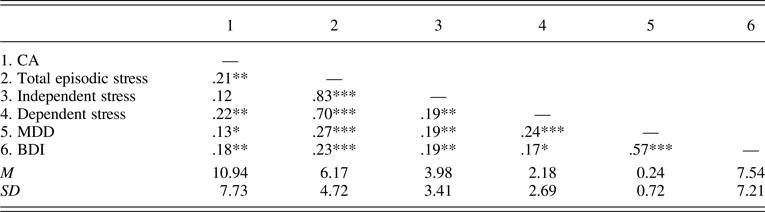
All analyses were conducted in IBM SPSS 24. Bivariate correlations among behavioral study variables are presented in Table 1. As shown there, all CA and episodic stress variables were significantly, positively correlated with each other (ps < .05), apart from CA and independent stress, which were only marginally correlated (p = .059). In addition, CA and all episodic stress variables were significantly correlated with current depressive symptoms. Significance of correlations was unchanged when controlling for sex, age, and race.
Bivariate correlations and descriptive data for behavioral study variables
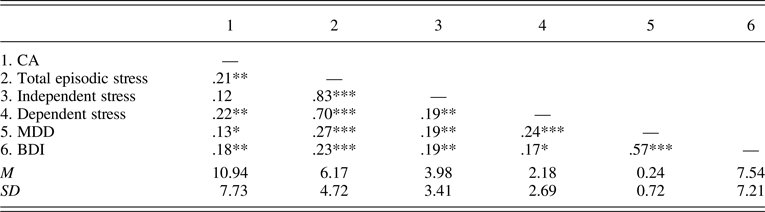
Note: CA, childhood adversity; MDD, major depressive disorder symptoms; BDI, Beck Depression Inventory.
To examine main effects of stress variables on the CAR, we conducted linear regression analyses, controlling for biobehavioral correlates. Consistent with our interaction models (see below), these models included the following covariates: sex, pubertal stage, follicular stage of menstrual cycle (boys were coded 0), hours slept the night before, and wake time (averaged across the 2 days of sampling). After accounting for these covariates, none of the study variables significantly predicted the CAR AUCi, including CA (b = 1.99, SE = 2.33, p = .393), total episodic stress severity (b = 472, SE = 3.76, p = .901), total independent severity (b = 1.93, SE = 5.21, p = .712), or total dependent severity (b = –1.59, SE = 6.49, p = .806). The CAR AUCi was also not significantly related to current self-reported depressive symptoms (b = –4.24, SE = 2.67, p = .113) and interview-assessed MDD symptoms (b = –37.05, SE = 23.76, p = .121). Additional covariates (including age, race, birth control use, the TimingOFF dummy varaible, and reports of eating or drinking during the 30 min prior to their morning saliva samples) were nonsignificant in models, and their inclusion did not impact results. We also examined the association between S1 cortisol and CA, episodic stress, dependent stress, independent stress, and depressive symptoms, controlling for key covariates, and found no significant associations (all ps > .05).
Episodic Stress × CA, predicting CAR
All interaction models were conducted using PROCESS macros for SPSS (Hayes, Reference Hayes2013). Our main outcome of interest was the CAR using the AUCi calculation method. In initial models, we included the following demographic and biobehavioral covariates: sex, age, race (dummy coded as White vs. non-White), follicular stage of menstrual cycle (boys were coded 0), current use of hormonal birth control, hours slept the night before, and wake time (averaged across 2 sample days), whether the day of cortisol sampling was a school day, the TimingOFF dummy code (averaged across 2 days), and reports of eating or drinking during the 30 min prior to their morning saliva samples (averaged across samples). To simplify models, we dropped highly nonsignificant covariates (ps > .15). Following this decision rule, the following covariates were retained: sex, pubertal status, follicular stage, wake time, and total sleep time.
An identical set of covariates emerged as significant across all interaction models with CAR AUCi as the outcome. This allowed us to use the same set of predictors across models, facilitating model comparison. Note that adding any of the excluded covariates did not substantially impact results.
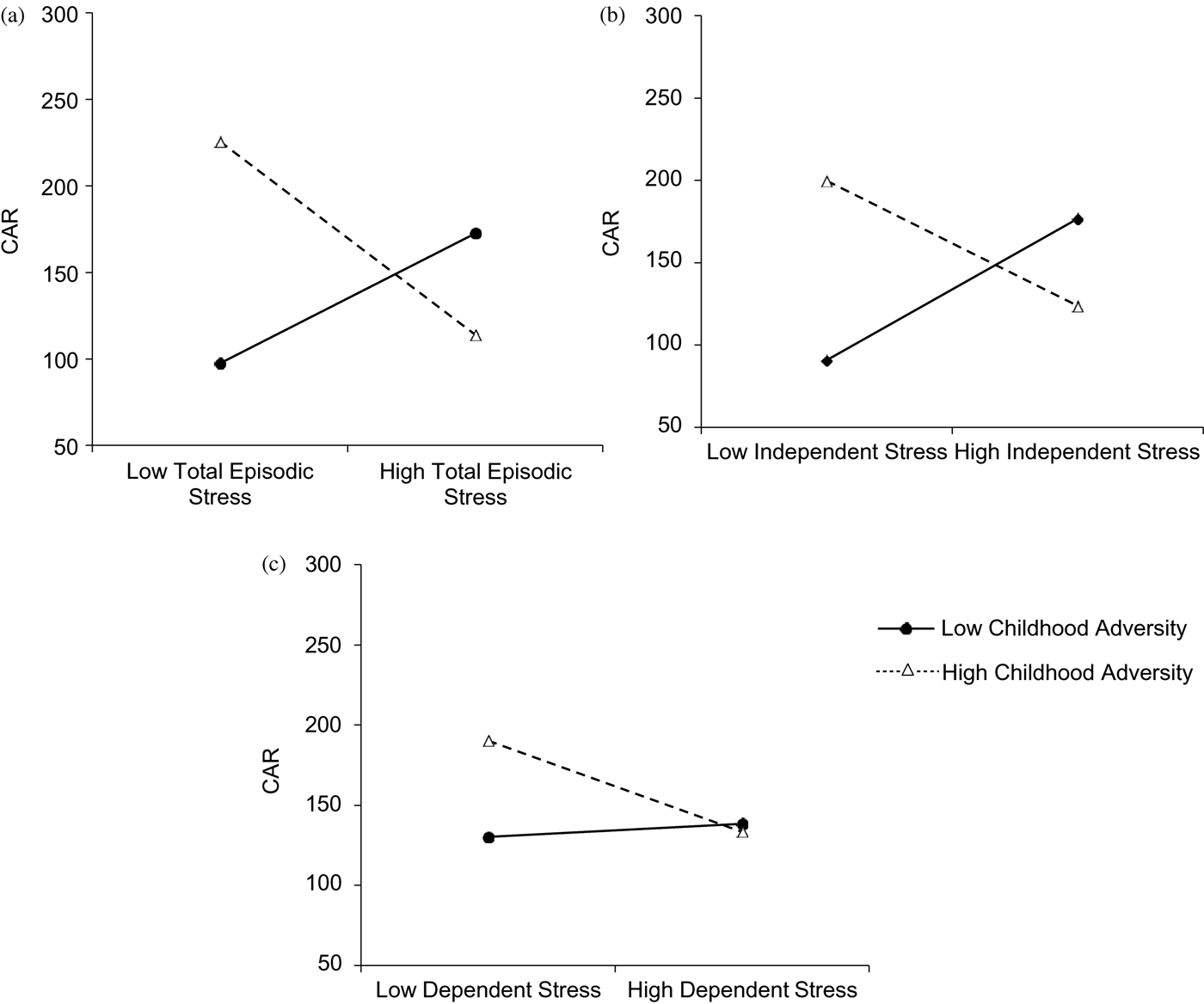
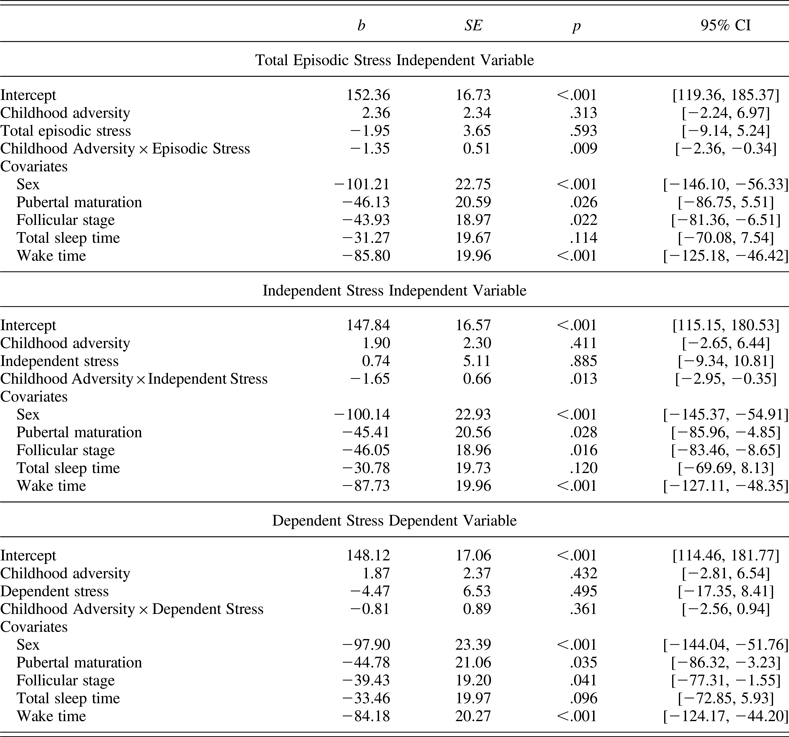
We first tested the interaction between CA and overall episodic stress, predicting the CAR. We constructed a model including the main effects of CA and total episodic stress severity (both mean-centered) and their interaction, plus the covariates. Results are presented in Table 2. The interaction term was significant (p = .009). We decomposed the significant interaction by conducting simple slope tests at 1 SD above and below the mean of CA. At low levels of CA, there was a positive trending association between recent episodic stress and the CAR (b = 8.00, SE = 5.11, p = .119), 95% confidence interval (CI) [–2.09, 18.09]. At mean levels of adversity, the association was nonsignificant (b = –1.95, SE = 3.65, p = .59). In contrast, at high levels of CA, recent episodic stress significantly predicted lower levels of CAR, b = –11.90, SE = 5.38, p = .028, 95% CI [–22.52, –1.28]. This interaction is illustrated in Figure 1a. We used the Johnson–Neyman technique to determine region of significance; episodic stress predicted significantly decreased CAR at α = 0.05 when CA scores were above the 78th percentile of our sample.
The cortisol awakening response (CAR) as predicted by (a) overall, (b) independent, and (c) dependent episodic stress, at high and low levels of childhood adversity. The CAR was calculated as the area under the curve with respect to increase. Note that the interactions for (a) and (b) are significant (ps < .05), but the interaction for (c) is nonsignificant.

Moderation of the association between total, independent, and dependent episodic stress and the cortisol awakening response by childhood adversity
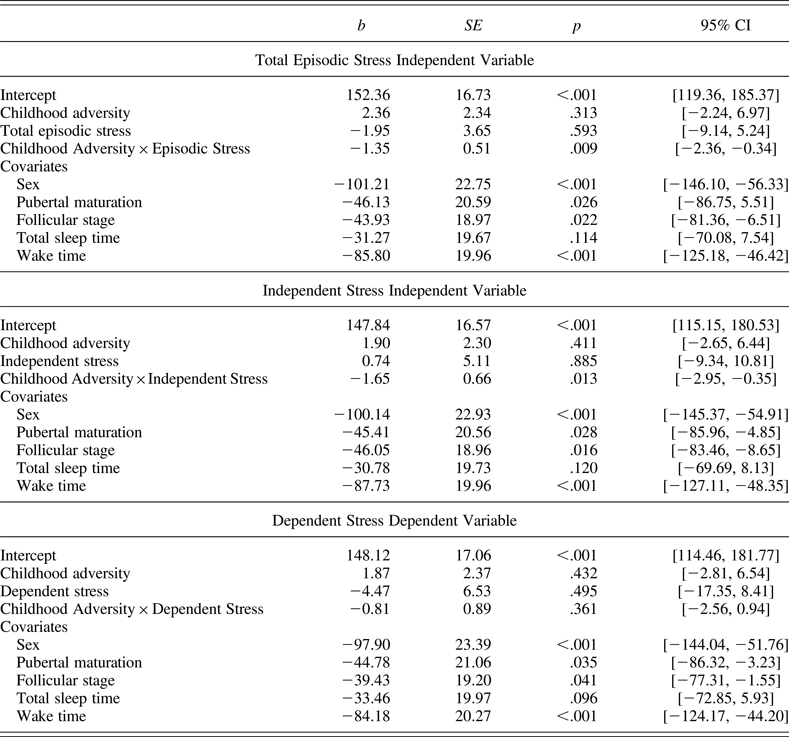
Note: N = 196. CA, childhood adversity. CA and stress variables were mean centered. Covariates were standardized to facilitate intercept interpretability. Cortisol awakening response was calculated as the area
To examine whether this interaction held for dependent versus independent stress, we separately conducted models using total dependent stress severity and total independent stress severity as independent variables, moderated by CA. Models were analogous to the previous model, with identical covariates included. The Dependent Stress × CA interaction was not significant (p = .361). In contrast, the Independent Stress × CA effect, predicting the CAR, was significant (p = .013). At low levels of CA, there was a marginally significant, positive association between recent independent stress and CAR, b = 12.89, SE = 7.01, p = .068, 95% CI [–0.95, 26.72]. At mean levels of adversity, there was no association between independent stress and the CAR (b = 0.74, SE = 5.11, p = .885). In contrast, at high levels of CA, the association between recent independent stressors and CAR trended negative, b = –11.41, SE = 7.08, p = .109, 95% CI [–25.37, 2.56]. Region of significance analyses suggested independent stress significantly predicted increased CAR when adversity was below the 5th percentile, and predicted decreased CAR when adversity was above 91st percentile. Figure 1b and c illustrate these findings.
We also tested all of the above interactions with S1 (waking) cortisol as the outcome. There were no significant interactions between CA and episodic stress (including total, independent, and dependent stress) predicting S1 cortisol (all ps > .05).
Episodic Stress × CA, predicting depressive symptoms
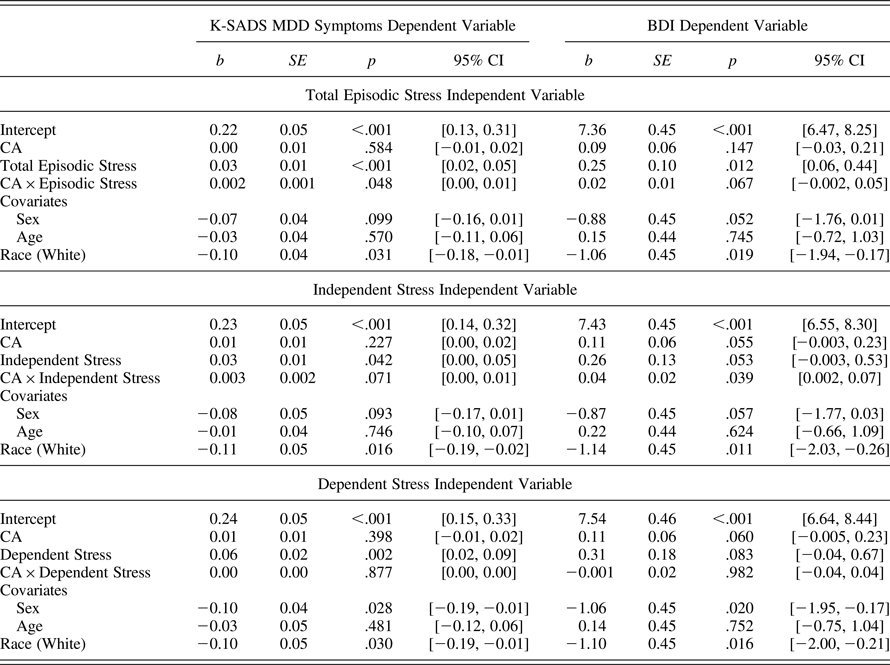
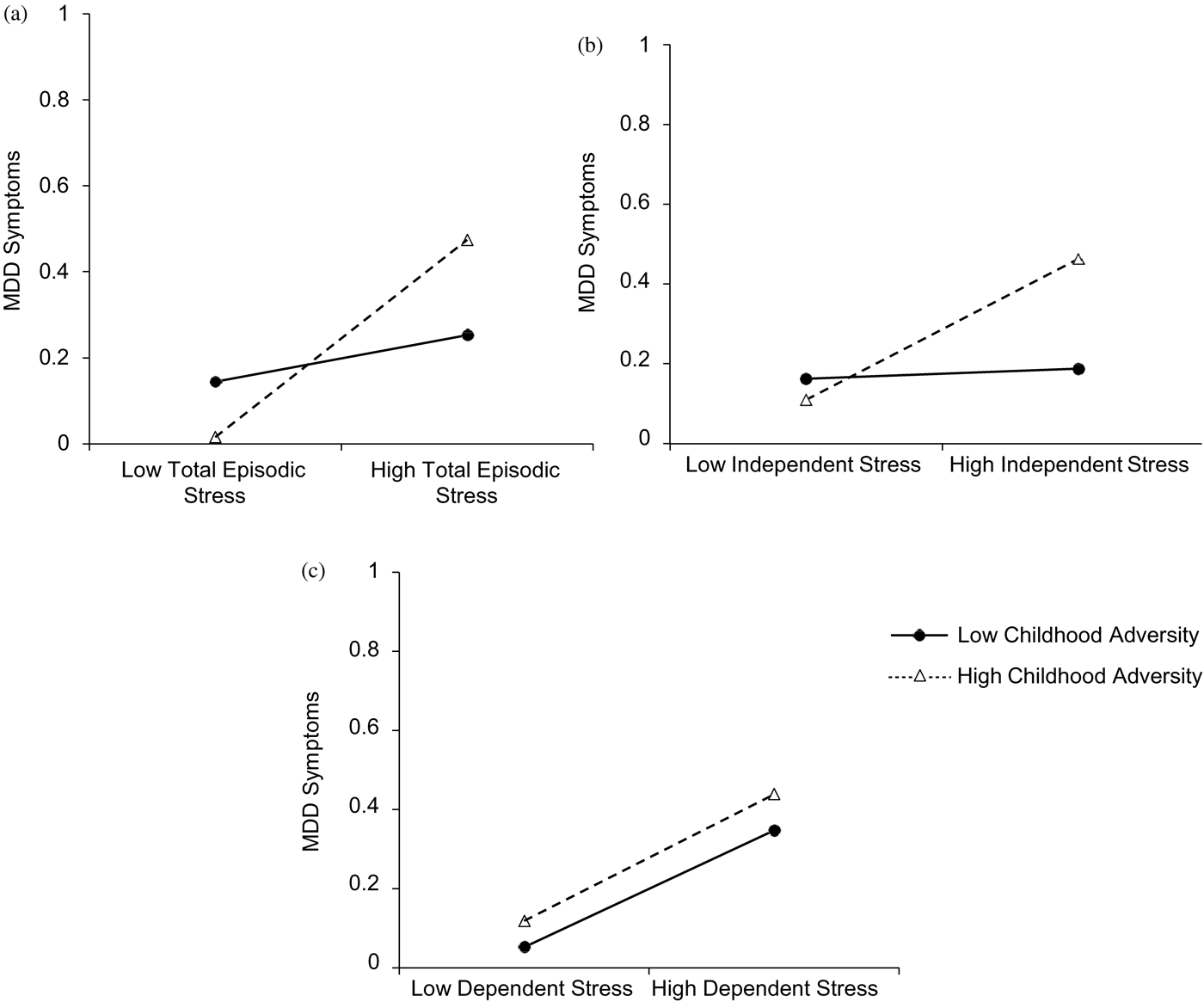
We next examined interaction models with interview-assessed MDD symptoms as the outcome. Main effects for episodic stress variables and CA were entered along with their interaction. Demographic variables (sex, Caucasian race, and age) were entered as covariates. The results are provided in Table 3. Looking at overall episodic stress, the interaction term was significant (p = .048). Recent episodic stressors did not significantly predict MDD symptoms at low levels of CA, b = 0.02, SE = 0.01, p = .273, 95% CI [–0.01, 0.04], but did predict higher symptoms at mean, b = 0.03, SE = 0.01, p < .001, 95% CI [0.01, 0.05] and high, b = 0.05, SE = 0.01, p < .001, 95% CI [0.03, 0.08], levels of adversity. Region of significance analysis indicated that episodic stress significantly predicted MDD when CA was above the 31st percentile.
Moderation of the association between total, independent, and dependent episodic stress and depressive symptoms by childhood adversity
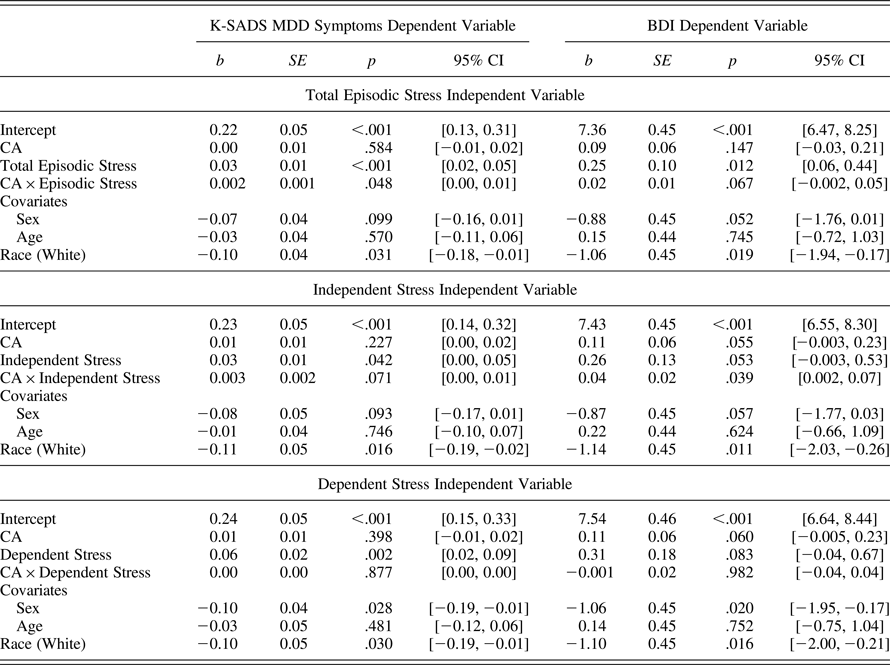
Note: N = 241. CA, childhood adversity. CA and stress variables were mean centered. Covariates were standardized to facilitate intercept interpretability. K-SADS, Kiddie Schedule for Affective Disorders and Schizophrenia (Kaufman et al., Reference Kaufman, Birmaher, Brent, Rao, Flynn, Moreci and Ryan1997); MDD, major depressive disorder (dimensionally coded); BDI, Beck Depression Inventory
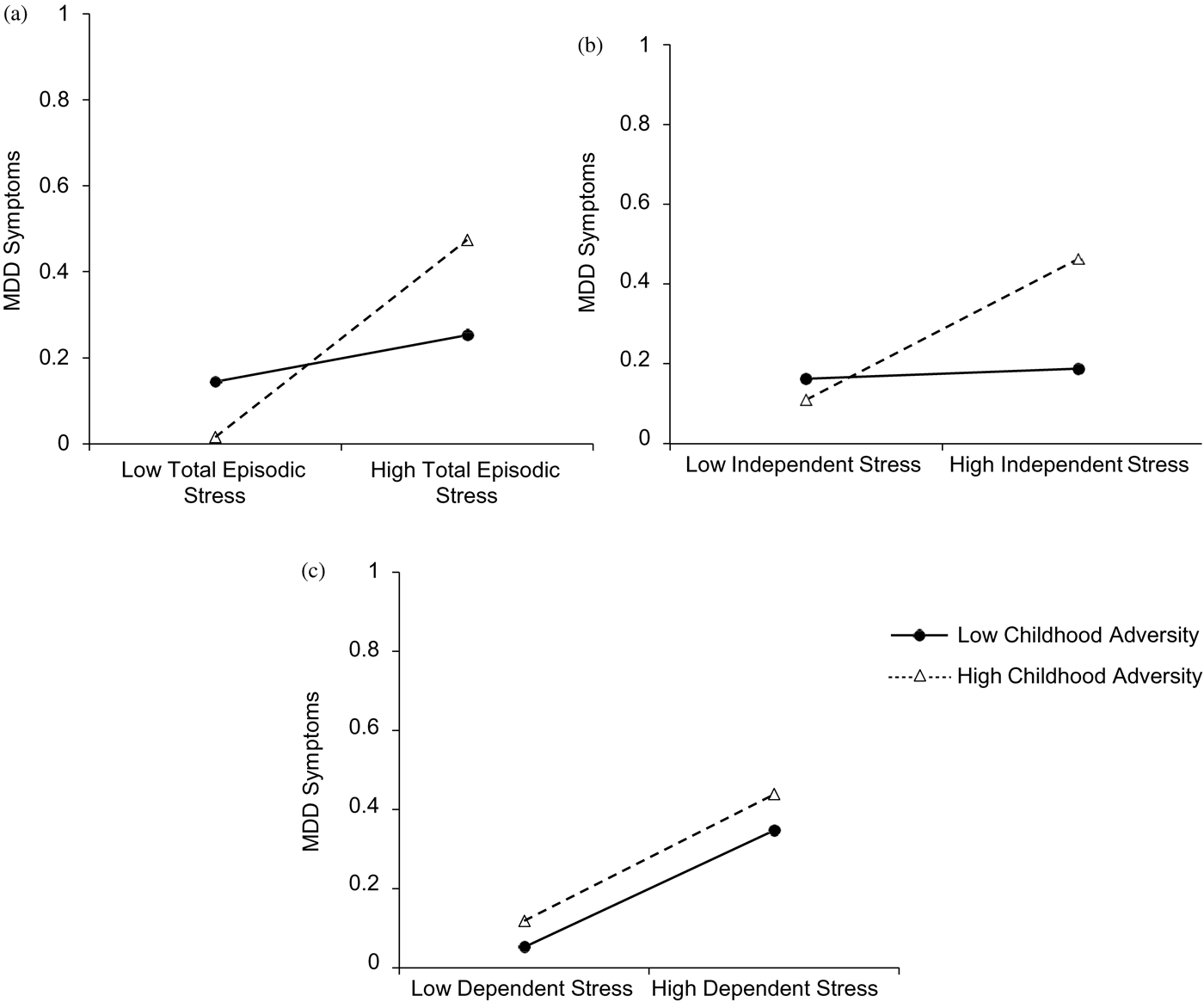
Next, we separately examined dependent and independent stress, revealing a pattern analogous to that observed for the CAR. Specifically, CA did not moderate the association between dependent stress and MDD symptoms (p = .661). As illustrated in Figure 2b, the association between dependent stress and MDD symptoms was significant at both high and low levels of CA. In contrast, when independent stress was entered as the independent variable, the interaction term approached significance b = 0.003, SE = 0.001, p = .071, 95% CI [0.00, 0.01]. Aligning with expectations, the association between independent stress did not predict MDD symptoms at low levels of CA, b = 0.00, SE = 0.02, p = .845, 95% CI [–0.03, 0.04], but significantly predicted MDD symptoms at mean, b = 0.03, SE = 0.01, p = .042, 95% CI [0.001, 0.054], and high levels of CA, b = 0.05, SE = 0.02, p = .005, 95% CI [0.02, 0.09]. Figure 2c illustrates this interaction. Johnson–Neyman analyses indicated that independent stress predicted depressive symptoms at above the 56th percentile of CA. Thus, for both CAR and depressive symptom outcomes, CA moderates the effects of independent but not dependent episodic stressors.
Symptoms of major depressive disorder as predicted by (a) overall, (b) independent, and (c) dependent episodic stress, at high and low levels of childhood adversity.
As an added test of this moderation finding, we retested these interaction models with self-reported depressive symptoms (BDI) as the outcome in place of interview-assessed depression. The pattern of results was identical (Table 3). Examining overall episodic stress, the interaction term was marginally significant, b = 0.02, SE = 0.01, p = .067, 95% CI [0.00, 0.05]. At low levels of CA, recent episodic stressors did not significantly predict BDI, b = 0.07, SE = 0.14, p = .606, 95% CI [–20, 0.35], but at high levels of CA, recent episodic stress strongly predicted BDI, b = 0.42, SE = 0.13, p = .002, 95% CI [0.16, 0.69], although this decomposition must be interpreted with caution given the marginal significance of the interaction term. Next, consistent with previously reported results, there was no significant interaction between dependent stress and CA, predicting BDI, b = 0.00, SE = 0.02, p = .982, 95% CI [–0.04, 0.04]. Finally, again aligning with previous findings, the independent Episodic Stress × CA Effect was significant (p = .039). Conforming with expectations, the association between independent stress did not predict depressive symptoms at low levels of CA, b = –0.01, SE = 0.19, p = .959, 95% CI [–0.39, 0.37], but significantly predicted depressive symptoms at high levels of CA, b = 0.53, SE = 0.18, p = .003, 95% CI [0.18, 0.89].
Discussion
The current study adds to a growing body of evidence supporting the stress sensitization model, showing that exposure to adversity over the course of childhood modifies the effects of continued exposure to stressful contexts later in development. Guided by a multiple levels of analysis approach, we found two intriguingly parallel sets of findings focused on two distinct outcomes, one neuroendocrinological (the CAR) and one behavioral (depressive symptoms).
Higher levels of CA predicted significantly altered associations between recent episodic stress and the CAR. Second, CA intensified the association between episodic stress and depressive symptoms. For both outcomes, stress sensitization effects were significant for independent but not dependent stress.
These parallel sets of findings may suggest that one way in which CA gets “under the skin” is by disrupting HPA axis functioning, consistent with the allostatic load framework (McEwen, Reference McEwen1998). Repeated activation of the HPA axis during childhood may culminate in allostatic load, and persistent exposure to excess cortisol during pivotal stages of development may alter neural circuits associated with the HPA axis (Heim et al., Reference Heim, Newport, Mletzko, Miller and Nemeroff2008), leading to sustained abnormalities in cortisol regulation. Looking at our specific pattern of results, among those with low levels of CA, there was a trend toward a positive association between recent episodic stress and CAR. We speculate that this may be indicative of optimal HPA axis functioning: recent episodic stressors signal to the adolescent that he or she may encounter continued challenges in the upcoming day, and the body mounts an increased CAR to marshal metabolic resources to cope with these expected challenges (Adam, Hawkley, Kudielka, & Cacioppo, Reference Adam, Hawkley, Kudielka and Cacioppo2006). In turn, the adolescent is protected from negative outcomes such as depression (in line with our finding that recent episodic stress is nonpredictive of depressive outcomes among those with low CA). Among those with high CA, however, this process may break down, as evidenced by a negative correlation between recent episodic stress and CAR, and a corresponding increased association between episodic stress and depression.
It is worth noting that although we found that CA predicted a negative association between episodic stress and the CAR, our results do not suggest a pervasive pattern of hypocortisolism (with respect to the CAR) among those with high levels of CA; there was no significant main effect of CA on the CAR. As illustrated in Figure 1a, at low levels of episodic stress, those with high CA showed significantly larger CARs than did those with low CA. This may suggest that youth with high CA experience elevated CARs regardless of the absence of recent stress (consistent with the stress autonomy model; see Monroe & Harkness, Reference Monroe and Harkness2005), potentially wasting metabolic resources. Alternatively, it may be that these youth have a very low threshold of recent stress for an elevated CAR (consistent with the stress sensitization model; see Monroe & Harkness, Reference Monroe and Harkness2005). Our analyses cannot distinguish between these possibilities; however, it is clear that the elevations in the CAR associated with CA vanish in the presence of episodic stress, corresponding with an increase in depression risk. Our findings may help reconcile seemingly inconsistent findings that link CA and depression to both smaller than average and larger than average CARs, as differences in recent episodic stress may alter these associations. It should also be noted, however, that these differences in findings are also likely a result of other factors, including methodological and demographic variations across studies (Chida & Steptoe, Reference Chida and Steptoe2009; Gustafsson et al., Reference Gustafsson, Anckarsäter, Lichtenstein, Nelson and Gustafsson2010; Miller et al., Reference Miller, Chen and Zhou2007; Quevedo et al., Reference Quevedo, Johnson, Loman, LaFavor and Gunnar2012). Clearly, HPA axis functioning is remarkably complicated, and far more research will be needed to fully understand its many nuances.
We also examined whether effects were found for independent (uncontrollable, fateful) versus dependent (controllable, self-generated) stress. Although previous findings have varied, we expected stronger effects for independent stress because of the preponderance of studies that have suggested that stress sensitization effects are specific to independent stress (Harkness et al., Reference Harkness, Bruce and Lumley2006). Here, we found that the interaction between CA and episodic stress was significant for independent stress, and not for dependent stress, in the prediction of both the CAR and depression. However, a visual inspection of the results (see Figures 1 and 2) adds a wrinkle to our interpretation. It appears that adolescents with low CA are protected against depressive symptoms following independent stress, but not dependent stress. All youth showed elevated depressive symptoms following dependent stress regardless of their CA level. This finding corresponds to a parallel result for the CAR: for adolescents with low adversity, high levels of recent independent stress predicted a higher CAR, while CAR was not influenced by level of recent dependent stress regardless of adversity level. In other words, youth with low CA were sensitive to dependent stress only, whereas youth with high CA were sensitive to both kinds of stress, as indicated by both outcomes.
In line with the hypothesized model we presented above, it is possible that adolescents with low adversity histories have a larger CAR following recent independent stress, and that this larger CAR protects them against negative emotional consequences by summoning metabolic resources to fuel coping efforts. However, this protective process appears to only occur for fateful, uncontrollable stress, and not for self-generated stress. It is not completely clear why this would be the case. Perhaps adolescents with low CA are less likely to engage in self-blame following independent events, allowing them to better focus on coping efforts. Moreover, an important developmental task of adolescence is to build greater autonomy from parental control, and high levels of self-generated stress may indicate that this process is going poorly. For example, common dependent stressors included peer-related events such as bullying, friendship losses, or romantic dissolutions. Given the high developmental salience of peer experiences (e.g., Hartup, Reference Hartup1996), stress in this domain may be problematic for all teens, regardless of CA history.
However, these ideas are fairly speculative, and more research is decidedly needed. It is also worth noting that independence was coded based on objective characteristics of the event, which may not exactly correspond with the adolescent's perception of the controllability of the event. More research should examine how subjective appraisals of event controllability affect cortisol secretion, above and beyond objective controllability.
A central tenet of developmental psychopathology is multifinality, or the acknowledgment that singular risk processes often result in divergent outcomes (Cicchetti & Rogosch, Reference Cicchetti and Rogosch1996). Although we have largely focused our discussion on depression, our results may be relevant to the development of other outcomes. Researchers have observed stress sensitization processes in the prediction of a wide range of disorders and problems other than depression, including alcohol consumption, episode recurrence in bipolar disorder, PTSD, and anxiety disorders (Dienes, Hammen, Henry, Cohen, & Daley, Reference Dienes, Hammen, Henry, Cohen and Daley2006; McLaughlin et al., Reference McLaughlin, Conron, Koenen and Gilman2010; Young-Wolff et al., Reference Young-Wolff, Kendler and Prescott2012). In addition, cortisol dysregulation is associated with multiple forms of psychopathology other than depression, including PTSD, anxiety disorders, disruptive behavior disorders, and substance abuse (e.g., Adam et al., Reference Adam, Vrshek-Schallhorn, Kendall, Mineka, Zinbarg and Craske2014; Delahanty, Raimonde, Spoonster, & Cullado, Reference Delahanty, Raimonde, Spoonster and Cullado2003; McBurnett, Lahey, Rathouz, & Loeber, Reference McBurnett, Lahey, Rathouz and Loeber2000; Moss, Vanyukov, & Martin).
Future research should examine whether cortisol dysregulation serves as a common pathway linking stress sensitization to multiple disorders. If so, stress sensitization processes via HPA axis disruptions may serve as a transdiagnostic process that partially explains high comorbidity across different forms of psychopathology.
Although in this study we examined the role of HPA axis alterations in stress sensitization and depression, CA has been shown to lead to alterations in other pathways that may interact with later stressful contexts in predicting depression. Studies on epigenetic processes have provided strong evidence that early experiences have the potential to alter gene expression, including RNA modification and DNA methylation (Heijmans et al., Reference Heijmans, Tobi, Stein, Putter, Blauw, Susser and Lumey2004, Reference Heijmans, Tobi, Stein, Putter, Blauw, Susser and Lumey2008; Heim & Binder, Reference Heim and Binder2012; Szyf et al., Reference Szyf, McGowan and Meaney2008). For example, one study of adolescents found that high levels of parental stress during the child's early life is associated with higher levels of methylation (Essex et al., Reference Essex, Thomas Boyce, Hertzman, Lam, Armstrong, Neumann and Kobor2013). Differential methylation profiles in stress-related genes have also been found for depressed versus nondepressed individuals, and are associated with altered stress reactivity (Fuchikami et al., Reference Fuchikami, Morinobu, Segawa, Okamoto, Yamawaki, Ozaki and Tsuchiyama2011; Oberlander et al., Reference Oberlander, Weinberg, Papsdorf, Grunau, Misri and Devlin2008; Unternaehrer et al., Reference Unternaehrer, Luers, Mill, Dempster, Meyer, Staehli and Meinlschmidt2012). These findings suggest another potential pathway through which early stress may lead to differential responses to proximal stress in individuals at risk for depression. In addition, findings from neuroimaging studies suggest that early CA may impair frontal brain regions critical for the development of inhibitory control and affective regulation (Carrion, Weems, Richert, Hoffman, & Reiss, Reference Carrion, Weems, Richert, Hoffman and Reiss2010; Veer et al., Reference Veer, Oei, Spinhoven, van Buchem, Elzinga and Rombouts2012). These neuroanatomical alterations are consistent with the large body of literature suggesting that children who have experienced early adversity exhibit impaired cognitive function, including problems with working memory, attention, and executive function (Hart & Rubia, Reference Hart and Rubia2012; Pechtel & Pizzagalli, Reference Pechtel and Pizzagalli2011). These neural changes may contribute to the development of information-processing biases that amplify the effect of stressors later in development. An examination of these alternate pathways to stress sensitization will be important to more clearly elucidate the process by which early adversity leads to increased risk for depression.
This study should be evaluated in the context of several important limitations. The study was cross-sectional. Longitudinal data would allow us to more directly test cascading effects of CA on HPA axis disruptions and, in turn, depression. As a result of the cross-sectional design, assessment of CA relied on retrospection, which may have introduced recall biases. In addition, because of time constraints, assessment of CA relied exclusively on parental report. On the one hand, parents may be more accurate reporters of events that occurred during early childhood, but on the other hand, there may be some adverse events that occurred outside of their awareness. In addition, our sample was recruited from the community, and consequently rates of current MDD were fairly low. Likewise, the majority of childhood adversities reported in our study represented significant but relatively commonplace stressors (e.g., grandparent death, parental divorce, and serious family illness). Much of the previous research on stress sensitization has focused on severe adversities where the child's safety is threatened, such as maltreatment, and although previous research has documented that more common adversities also predict stress sensitization (e.g., Hammen et al., Reference Hammen, Henry and Daley2000), there is also abundant evidence showing that effects on HPA axis functioning differ depending on the nature of the early adversity (Miller et al., Reference Miller, Chen and Zhou2007). Future research should determine whether results can be replicated in high-risk samples with higher rates of severe adversity such as maltreatment.
In addition, because of resource constraints, we utilized electronic compliance monitoring caps on only a subset of participants, and thus, compliance with cortisol sampling procedures cannot be verified in the majority of our participants. Within the subset who used monitoring caps, the intervals between their self-reported times and their electronically recorded times were comparable, suggesting reasonably good compliance, but tracking compliance of all participants would have allowed us to more precisely assess sample timing (e.g., Stalder et al., Reference Stalder, Kirschbaum, Kudielka, Adam, Pruessner, Wust and Clow2016).
Instead, we strongly emphasized to our participants the importance of collecting saliva immediately upon awakening, and relied on them to accurately do so. Issues with compliance are likely endemic to adolescent samples (Halpern, Whitsel, Wagner, & Harris, Reference Halpern, Whitsel, Wagner and Harris2012), in part because teenagers typically have demanding early morning schedules (e.g., preparing for school) that may conflict with sampling procedures. Given the importance of timing in properly capturing the CAR (Stalder et al., Reference Stalder, Kirschbaum, Kudielka, Adam, Pruessner, Wust and Clow2016), replication is needed.
These study limitations are balanced by important strengths. CAR was assessed using three data points (at awakening and 30 and 60 min postawakening), which is ideal for determining the CAR as it allows AUCi calculation and increases the chances of capturing peak cortisol secretion (Stalder et al., Reference Stalder, Kirschbaum, Kudielka, Adam, Pruessner, Wust and Clow2016). This practice is particularly unusual in adolescent samples of this size (see Chida & Steptoe, Reference Chida and Steptoe2009). We also assessed both CA and proximal episodic stress, occurring naturalistically in adolescents' lives, using gold-standard objective interviews that were team coded using the contextual threat method. This labor-intensive approach to the assessment of environmental stress has been shown to reduce bias related to cognitive vulnerability and more effectively predict outcomes, compared to more widely used checklists (Hammen, Reference Hammen2005; McQuaid, Monroe, Roberts, Kupfer, & Frank, Reference McQuaid, Monroe, Roberts, Kupfer and Frank2000).
This study examined two levels of analysis (behavioral and neuroendocrinological), while also studying interactive effects of stressors occurring across multiple developmental stages. To delve further into the complexities of risk and resilience, future researchers should examine additional levels of analysis. For example, some evidence suggests that genetic vulnerability increases vulnerability to stress sensitization processes. Starr et al. (Reference Starr, Hammen, Conway, Raposa and Brennan2014) found evidence for a Gene × Environment × Environment effect, where early adversity intensified the association between proximal stress and depression among those with risk alleles in the serotonin transporter linked polymorphic region (5-HTTLPR) or corticotropin releasing hormone receptor 1 (CRHR1) polymorphisms (see Grabe et al., Reference Grabe, Schwahn, Mahler, Schulz, Spitzer, Fenske and Freyberger2012). One plausible mechanism for this effect is that genetic risk confers neural plasticity and sensitivity to environmental input, which makes youth more vulnerable to disruptions in HPA axis development by CA exposure. HPA axis dysregulation persists across the life span, leaving the youth poorly equipped to manage later proximal stress. However, the role of HPA axis dysregulation in this Gene × Environment × Environment model has never been directly tested. Future research should examine whether current findings are further moderated by genetic risk, particularly by serotonergic and HPA axis-related genes.
Additional research should examine the impact of neural structures. Ample research has demonstrated that exposure to CA has detrimental effects on the development and plasticity of brain structures implicated in stress response and regulation, such as the hippocampus as well as other structures including areas of the prefrontal cortex (Gunnar & Nelson, Reference Gunnar and Nelson1994). Elevated cortisol and glucocorticoid levels have been shown to be associated with dampened hippocampal reactivity as well as reduced hippocampal and prefrontal cortical volume following exposure to early life stress (Carrion, Weems, & Reiss, Reference Carrion, Weems and Reiss2007; Carrion et al., Reference Carrion, Weems, Richert, Hoffman and Reiss2010; Teicher et al., Reference Teicher, Andersen, Polcari, Anderson, Navalta and Kim2003).
It is important that these structures are critically involved in HPA system regulation (see Dedovic, Duchesne, Andrews, Engert, & Pruessner, Reference Dedovic, Duchesne, Andrews, Engert and Pruessner2009; Diorio, Viau, & Meaney, Reference Diorio, Viau and Meaney1993; Jacobson & Sapolsky, Reference Jacobson and Sapolsky1991). Thus, understanding of the interplay between early stress associated alterations in neurobiological development and subsequent stressors is critical in disentangling the complex relationship between early stress exposure, proximal stress, and depression.
Finally, in addition to biological levels of analysis, researchers should consider broader, contextual factors that might impact the interactive effect of CA and proximal stress on cortisol regulation. For example, neighborhood effects may moderate findings. Research has previously demonstrated direct effects of neighborhood disadvantage on cortisol regulation (Rudolph et al., Reference Rudolph, Gary S., Stuart, Glass, Marques, Duncko and Merikangas2014). Neighborhood disadvantage also moderates risk and resilience processes among maltreated youth (Jaffee, Caspi, Moffitt, Polo-Tomás, & Taylor, Reference Jaffee, Caspi, Moffitt, Polo-Tomás and Taylor2007). It is also possible that neighborhood disadvantage itself constitutes a proximal stressor, to which those with higher CA are sensitized via HPA axis dysregulation.
Fortunately, neuroendocrine abnormalities related to CA are far from immutable; evidence suggests that cortisol regulation can be normalized through prevention and intervention programs (Cicchetti, Rogosch, Toth, & Sturge-Apple, Reference Cicchetti, Rogosch, Toth and Sturge-Apple2011; Fisher, Gunnar, Chamberlain, & Reid, Reference Fisher, Gunnar, Chamberlain and Reid2000), which may protect against negative outcomes. More precise understanding of the complex, interwoven biological and behavioral consequences of CA may lead to more effective treatments that promote resilience in at-risk youth.