


Introduction
Little is known about the prevalence, content, characteristics, and appraisals of pain-related images. Cognitions have been assessed in those in pain (Helmes and Goburdhun, Reference Helmes and Goburdhun2007; Philips, Reference Philips1989) but neither study distinguished between verbally expressed thoughts and mental imagery. During the last decade, pain research has usefully studied cognitive processes (Eccleston, Crombez, Aldrich and Stannard, Reference Eccleston, Crombez, Aldrich and Stannard1997; Eccleston, Reference Eccleston2001; Aldrich, Eccleston and Crombez, Reference Aldrich, Eccleston and Crombez2000; Sullivan, Bishop and Pivik, Reference Sullivan, Bishop and Pivik1995) but these studies have not differentiated between different types of cognitive responses to pain (thoughts vs. images).
Potter (Reference Potter2007) investigated images of the pain experience itself in participants who attended a clinic for chronic pain problems. She asked patients if they had mental images or pictures of their pain. Some examples of the images reported are: “I have an image of an electric short circuit running down my leg”; “very sharp jagged teeth searing into my neck like the jaws of a shark”. The data were collected by a postal questionnaire that was returned by 24% of the 350 sample. Given the low return rate and selection confined to chronic sufferers, the base rate of this type of cognition in pain sufferers remains unknown. In addition, the postal questionnaire requested information solely about the images of the pain itself. Other images associated with, but not of, pain were not investigated.
In their treatment manual on cognitive therapy for chronic pain, Winterowd, Beck and Gruener (Reference Winterowd, Beck and Gruener2003) described four different images reported by sufferers: images of pain itself (e.g. image of the spine as a cracking rigid tree trunk), images of oneself in pain (e.g. image of oneself as a frail elderly person), images related to other people's interaction with the sufferer (e.g. image of oneself alone and isolated), and images of a future with pain (e.g. image of oneself in a wheel-chair). There is a need to clarify the base rate and characteristics of these different types of images in pain sufferers.
Vlaeyen and Linton (Reference Vlaeyen and Linton2000) set out a pain model in which imagery/thoughts are given a central role in the evolution of chronic pain problems. More recently, Jamani and Clyde (Reference Jamani and Clyde2008) contributed a stimulating discussion of the way in which imagery cognitions can contribute to the cycle of pain-related fear in chronic pain. Some examples of pain imagery from their clinical observations were included: “I see myself in a wheel-chair in 5 years time”; “My pain is a gapping wound on my spine”. They proposed a revision of the Vlaeyen and Linton's pain model postulating that pain experience can generate images and thoughts that promote fear and safety behaviours.
Intrusive imagery is an acknowledged consequence of trauma, and a symptom of Post-Traumatic Stress Disorder (DSM-4:309.81, American Psychiatric Association, 1994). However, imagery associated with pain problems have only been considered when PTSD is diagnosed. The base rates of this type of cognition in a pain sample, without trauma, are not known.
The rather limited attention to images associated with pain problems stands in contrast to the fruitful developments with respect to imagery in anxiety disorders and depression. Over the last decade, interest in the role of imagery has been growing (Hackmann and Holmes, Reference Hackmann and Holmes2004; Holmes and Mathews, Reference Holmes and Mathews2005; Holmes, Arntz and Smucker, Reference Holmes, Arntz and Smucker2007; Holmes and Mattews, Reference Holmes and Mathews2010) and has made a significant contribution to the understanding and treatment of many psychological problems (agoraphobia: Day, Holmes and Hackmann, Reference Day, Holmes and Hackmann2004; OCD: Speckens, Hackmann, Ehlers and Cuthbert, Reference Speckens, Hackmann, Ehlers and Cuthbert2007; Rachman, Reference Rachman2007; specific phobia: Pratt, Cooper and Hackmann, Reference Pratt, Cooper and Hackmann2004; PTSD: Hackmann, Ehlers, Speckens and Clark, Reference Hackmann and Holmes2004; depression: Brewin et al., Reference Brewin, Wheatley, Patel, Fearon, Hackmann and Wells2009; social phobia: Wild, Hackmann and Clark, Reference Wild, Hackmann and Clark2007). Rescripting of images has become an important addition to CBT approaches (Holmes et al., Reference Holmes, Arntz and Smucker2007; Hunt and Fenton, Reference Hunt and Fenton2007).
Cognitive-behavioral approaches are used in Pain Management Clinics and the modification of negative catastrophic thought cognitions is an important element of the treatment (Philips and Rachman, Reference Philips and Rachman1996; Morley, Eccleston and Williams, Reference Morley, Eccleston and Williams1999). Imagery has been used in treatment to help alleviate pain through increased relaxation and/or distraction (Winterowd et. al., Reference Winterowd, Beck and Gruener2003). However, the modification of images associated with pain remains to be explored. CBT for pain has yet to work systematically with images provoked by pain, and the thoughts/beliefs that are associated with these images.
The present research had three aims. First, it aimed to establish the prevalence and characteristics of mental imagery in a pain sample attending a physical rehabilitation center. Second, it evaluated the potency of participants’ most disturbing image (the Index image) assessed by changes in emotions, cognitions, behaviour, and pain experience. Finally, it evaluated the extent to which symptoms of trauma might influences image occurrence, content and potency.
Method
Design
There were two stages to the study. In the first, a pilot study, procedures for obtaining information about pain related imagery were tested and refined. In the second, data were collected in a systematic experimental design in which participants responded to an interview, completed self-report scales and participated in a VIE procedure (Voluntary Image Exposure).
Participants
Participants were recruited from individuals attending an occupational program of 8-10 weeks at an Occupational Rehabilitation Center whose purpose is to reduce physical disabilities and promote a return to work. The clients of the center are almost exclusively referred by a Workers Compensation Board or insurance companies that provide disability compensation. These sources refer only those people whom they feel will be returning to work after the program of supervised exercise and work-hardening. People with psychological problems (i.e. alcoholism, drug dependence, post-traumatic stress disorder, anxiety disorders) are referred to specialized clinics.
An initial approach was made by the staff of the Center. Attendees were asked if they wished to volunteer and participate in a study “about thinking, when in pain”. Those with brain damage or inadequate English were excluded. In the pilot study there were 107 participants; in the main study, there were 59 participants.
Ethical aspects
All participants were informed that the research study was voluntary, and unrelated to compensation claims or treatment at the Rehab center. They were fully informed of the research aims and signed a consent form to be interviewed for approximately 30-40 minutes. Ethical approval of the research (pilot survey and experimental study) was provided by the University of British Columbia Behavioural/Psychological Ethics Committee. Information on each participant was coded and kept confidential.
Data collection
Semi-structured interview. An interview was developed in the pilot stage of this research (see details of the pilot study below) but was tightened and improved for this study (interview available from the author).
VIE procedure. Participants were asked to “see” their Index images and, while doing so, to answer questions about them.
Self-report rating scales
The analogue scales (established to be necessary at the pilot stage) used scales from 0 (none) to 10 (maximum levels) of anxiety, sadness, anger, happiness, and calm. The cognitive scales of believed threat and physical and/or emotional fragility (defined as easily broken, weak) were assessed using analogue scales from 0 (no belief) to 10 (maximum belief/conviction). The pain scale used was from 0 (no pain) to 10 (unendurable pain).
Self-report assessment scales
Given the time constraints of the Rehab Center, short self-report assessments were selected to keep the complete interview within a 30-40 minute period.
The PCL-C (PTSD Checklist) is a short self-report measure of DSM-IV symptoms of Post-Traumatic Stress Disorder (Lang and Stein, Reference Lang and Stein2005; Ruggiero, Del, Scotti and Rabalais, Reference Ruggiero, Del, Scotti and Rabalais2003). It was selected for its short administration (2-5 minute), established sensitivity, specificity and predictive values. It assesses symptom intensity but does not provide a diagnosis of PTSD. Blanchard, Jones-Alexander, Buckley and Forneris (Reference Blanchard, Jones-Alexander, Buckley and Forneris1996) reported that a cut-off criterion of over 44 is most efficient. However, given the overlapping symptomatology of pain and post-traumatic stress disorder on three specific items on this scale (e.g. sleep disturbance, irritability and concentration difficulties) a more conservative cut-off of 50 for pain sufferers was suggested by Andrykowski, Cordova, Studts and Miller (Reference Andrykowski, Cordova, Studts and Miller1998) and was used in this study.
Depression Anxiety and Positive Outlook Scale (DAPOS; Pincus, Rusu and Santos, Reference Pincus, Rusu and Santos2008) is designed to measure mood in pain populations without contamination from somatic items. Somatic symptoms overlap with pain symptoms and can distort assessment of anxiety and depression in a pain population as they may result in inflated scores. This measurement instrument has excellent internal consistency, responsiveness and construct validity with pain sufferers (Taylor, Lovibond, Nicholas, Cayley and Wilson, Reference Taylor, Lovibond, Nicholas, Cayley and Wilson2005). It is a short, self-administered instrument that takes 2-4 minutes.
Pilot study
During the initial pilot, the participants were interviewed and the best method of obtaining the information on imagery and Index image content was explored. Image accessibility emerged as an important issue. It was found that considerable care needed to be taken with the initial request for information on mental images associated with pain. Enquiries about image presence had to be carefully worded. The terms “mental image” or “image” were not used unless they were spontaneously introduced by the participants because these concepts were found (in a pilot sample) to provoke avoidance of discussion by a number individuals. Some participants became angry, asserting that they were not “imagining” their pain problem. This is a common sensitivity among chronic pain sufferers when concerned about diagnosis of pain/disability and corresponding availability of assistance and benefits.
To clarify the presence and content of any mental imagery, two open-ended questions were used. (The first question was used merely as a smooth transition into an enquiry about imagery. The replies to this first question were not analyzed in this study.)
Q1: “People experiencing pain think about many things. Tell me about some of the thoughts that keep coming back into your mind when you are in pain.” Once their thoughts had been noted, the key question for this study was asked.
Q2: “Do you also sometimes see picture thoughts? Thoughts which you picture to yourself when you are in pain? . . . that pop in to your mind when you are in pain?” [An alternative question was used if the participants appeared not to understand the initial question: “Do you visualize your thoughts when in pain? Tell me some of your picture thoughts associated with pain that pop in to your mind when you are in pain.”]
Frequently the occurrence of imagery was not reported initially by participants but once the type of cognition was clarified (if necessary with an example: seeing a pink elephant), imagery reports were obtained. Participants were given time to consider the questions, as the phenomenon of image cognitions appeared novel to them. Few participants made a distinction between thoughts and mental images prior to the interview. Only visual images were investigated in this study.
Once the image(s) had been recorded, the participants were asked which of their images they felt was the most powerful/disturbing. This became the “Index” image that was used exclusively for the subsequent questions regarding characteristics and effects of the image.
Main study
Procedure
Participants first engaged in a semi-structured interview that had three sections:
(1) The first section obtained basic demographic and clinically relevant descriptive data (age, gender, primary pain location, pain duration, average pain levels, cause of pain, litigation status).
(2) Participants then rated their current levels of emotion (anxiety, anger, sadness, happiness and calm), cognitions (believed threat and fragility) and pain, on the analogue scales described above.
(3) Finally, image presence was determined and if present the characteristics of the Index image were assessed (frequency, similarity, persistence and clarity of image).
Once the Index image had been fully described, respondents were asked about image meaning: “What does this picture mean to you, your future or your life?” In addition to their report of image meaning, they were provided with a choice of meaning categories: physical disability, catastrophe past, present or future, loss of control, death, dependence, unhappiness. Participants were asked to choose the most appropriate category. Finally, meaning themes were derived from the responses to the open-ended question concerning image meaning. The categories used were: negative self appraisals, future catastrophe, past catastrophe (trauma/mishap), physical/anatomical details of pain/injury. These were chosen to best categorize the responses of participants and to minimize overlaps in meaning. The inter-rater reliability of the allocation to these categories (by the researcher and an independent assessor) showed agreement of 95%. Any differences were discussed and agreement gained.
The relationship of their image to memories was undertaken using categories from which participants could choose: causative accident, other past accident(s), work situation, family situation, physical symptoms, and other past events.
VIE procedure
The second section of the interview established the characteristics of the imagery using a Voluntary Image Exposure procedure. Participants, who reported index images, were asked to form the image and then answer questions about them. They could do so with eyes open or closed. All formed their index image within seconds of the request, and were able to answer questions about image characteristics as well as their emotions, pain and behavioural response to the image, using the analogue scales described above. The behavioural response to the index image was assessed by calculating the percentage who reported trying to stop/resist the image and their success at doing so (0-10 = complete success). In addition, they were asked to select from a number of categorical behavioural responses (formulated in the pilot study) to their index image: divert/distract, avoid/blank out, convert picture, talk to self, other idiosyncratic methods.
Self-report assessments
Finally, at the end of the interview, participants completed the PCL-C (PTSD checklist), and the DAPOS.
Data analysis
Descriptive statistics were used to assess the participant's demographic status, pain, and image characteristics. To assess image potencies, pre-post comparisons (t-tests) were conducted on VIE data for all the dependent measures (emotions, cognitions, behaviour, and pain). Chronic/acute pain groups were compared on image potencies using t-test statistics. Imagery potency was assessed in the low/no trauma and high trauma groups (based on the PCL-C scale) by a 2×2 ANOVA.
Results
Characteristics of sample
Most (88%) reported pain onset directly linked to a work related accident, while 8.5% reported a MVA. Average pain levels in the preceding 2 weeks (0-10 scale, where 10 = unendurable pain) were estimated as 4.99 (SD = 1.67) and peak pain was estimated at 7.1 (SD = 2.1). The chronicity of their current pain problem was 37.4 weeks (SD = 2.97), thus providing both acute and chronic sufferers (chronic>24weeks) for this study. Litigation was on-going for only 5 of 59 participants, 90% being funded by Workers Compensation or ICBC (Motor Vehicle Insurance Company).
The mean age of the participants was 45.6 (SD = 10.5), with 67.8% males and 32.2% females, matching the intake proportions of the Rehabilitation Center. Most (88%) reported pain onset directly linked to a work-related accident, while 8.5% reported a motor vehicle accident.
Image prevalence and characteristics
None of the sample had complained or raised the problem of intrusive distressing imagery during the intake evaluation undertaken by the Rehab.Center. In the initial part of each interview, participants were asked about their thoughts when in pain. It was noteworthy that the pain thoughts were easily, quickly and unemotionally disclosed. The descriptions were general and without personal or idiosyncratic content (such as: when will I ever get better?). However, participants found the pain images difficult to articulate, and they were frequently accompanied by high levels of emotional response (i.e. tears, weeping, loss of eye-contact, flushing). The images were replete with personal details.
The majority (78%) of the sample of 59 participants in the experimental study reported experiencing one or more images when they were in pain. The average number of images reported was 2.47 (range 1-6). All participants reporting index images (n = 44) were able to describe their index image. They were encouraged to give as much detail as possible about the image's sensory characteristics (visual, tactile, auditory, olfactory, and associated somatic sensations).
In response to an open-ended question, participants found it difficult to articulate a single or predominant meaning of their index image. Few had considered meaning prior to the question being asked by the investigator. The result was frequently a number of answers with respect to image meaning. Presenting them with a discrete number of meaning categories to choose from also had limitations. Often more than one category was chosen, as in the following example.
“I see myself sitting alone in my wheelchair. I am old and unable to care for myself”. When asked about the meaning of her image, the 35-year old women replied it meant she would be a burden to her children in the future. Presented with a number of meaning categories, she chose five: future catastrophe, physical disability, absence of control, unhappiness, and dependence.
In addition to the open-ended and categorical approaches to defining image meaning, the experimenter classified participant responses into the predominant categories. Nearly 1/4 (23%) gave negative self-appraisals (i.e. “I am a loser”). A future catastrophe was described by 28.2% and a past catastrophe (accident or other past trauma) was described by 12.8%.
The index images were classified with respect to perspective: Field (through one's own eyes), Observer (watching oneself), or variable. Over half (54.5%) of the participants reported Field images and 31.8% reported that they were “watching” themselves.
The relation of the image to past memories was assessed using categories: 34.1% reported the image was connected to their memory of the causative accident that had led to their pain problem; 18.2% felt the image came from memories of family worries, and 13.6% identified memories of their work situation. As can be seen in the examples below, this classification does not do justice to the complexities and details of many of the reported images.
– “I see my mother needing me. She is upset and I can not help. She can't get out of a dark dungeon”. (classified by participant as: Memories of family concern/worries)
– “My body is crying, and I feel it. I can't move and it is solid and tight. Others look at me wanting to help . . . their eyes look at me”. (classified by participant as: Memories –idiosyncratic)
– “I see the ugly faces of the irresponsible management . . . the unethical things they are doing. . .the threats and intimidation. The pictures open like an umbrella”. (classified by participant as: Memories of work situation)
– “I see an old woman with a cane. . .curved over. I look under her hood –it is ME!” (image of a women in her 20s) (classified by participant as Memories – idiosyncratic)
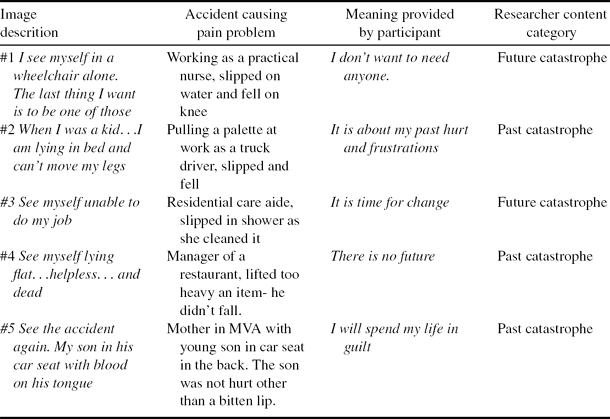
Additional examples of the classifications are illustrated in Table 1, which also provides details of the causative accident. The causal event is not always present in the image. The past event may have occurred sometime before, even a memory from childhood 40 years earlier (see case #2 above). One catastrophic event (causal accident) appears not infrequently to lead to memories/images of a previous trauma event (again see case #2 above). Catastrophic consequences (not experienced by the participant) may be elaborated in the memory of the causative accident (#4 above). Catastrophic future worries may also be visualized (#3). Only the last one (#5) is a more traditional post-traumatic stress disorder image – a flashback to the causative accident. This group of examples is included to illustrate the complexity of the image content, memory, and trauma phenomenon.
Classification of images, including image description, causes of injury, reported meaning (open-ended question), and researcher categorical meaning category

Participants assessed a number of characteristics of their index image. Analogue ratings of the image clarity (0–10 where 10 = crystal clear) were high (mean 8.02, (SD = 2.1). The image was reported to occur frequently: 34% selected the category “a few times a day” and 50% selected “a few times per week”. Each occurrence of the image was rated 8.4 (SD = 1.5) in similarity of content on a 0–10 scale (10 = exactly the same). Image persistence on each occasion was reported to be “seconds” for 68.2% and “minutes” for 31.8%. Some participants reported intentionally holding the image in their minds and examining it. This may explain the persistence for some images for longer periods (minutes).
In summary, imagery was found to be a common even if “unobserved” form of cognition in these pain sufferers. When assessing their index image, participants reported frequent, clear, brief and unchanging content. The appraisal of the image meaning proved complex. Participants appeared perplexed, and endorsed a number of meaning categories. However, categorization of meaning statements showed that the majority were focused upon negative self-appraisal and predicted catastrophe.
Image potency
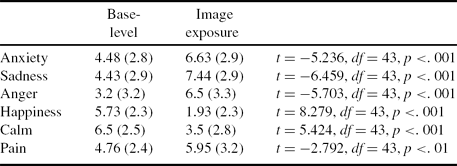
Given that most of the respondents reported more than one image, only the most powerful/distressing (index image) was used to assess imagery potency using the VIE procedure. Table 2 shows the base levels (pre-image discussion) on each of the analogue scales compared with the levels reported during exposure to the index image.
Baseline levels of emotion, and pain, and levels during image exposure: mean (SD) levels on analogue scales (0-10) prior to and during the VIE procedure

All of the changes from baseline to image exposure were significantly different on all measures: anxiety, anger, sadness, and pain increased; happiness and calm decreased. The negative emotions increased, and positive emotions significantly decreased. The change scores were not significantly related to image perspective. Perceived fragility (physical and emotional) defined as “easily broken or weak” was assessed pre and during exposure to the index image. The average level reported on analogue scales of 0-10 pre-exposure was 4.86 (SD = 2.9).This level rose to 7.23 (SD = 2.8) while seeing the index image. This increase in believed fragility is significant (t = −5.134, df = 42, p<.000).
The behavioural response to the index image was assessed by providing a number of possible behavioural reactions encountered in the pilot study. Of the 44 with image reports, 68.2 % reported trying to stop or resist the index image. Their average success in stopping/resisting the image was estimated at 7.55 (SD = 1.34) on an analogue scale of 0-10 where 10 = complete success. When asked to select their most effective behavioural method (from categories complied after a pilot survey), 40 % chose divert/distract themselves, 13.6 % reported image changing/converting. Two examples of this behavioural response are: “I just think of my grandchildren's faces!” and “I think of happy times with my wife.”
In addition, a number of beliefs about the image and its significance were assessed using analogue scales (0-10 where 10 = total belief). These was undertaken after VIE to the index image.
(a) Belief that the image makes the events more likely to occur in the future.
(b) Belief that the image means bad luck in the future.
(c) Belief that repeatedly having the image makes one responsible if the event occurs in the future.
(d) Belief that the image reduces energy/motivation to cope with the pain problem.
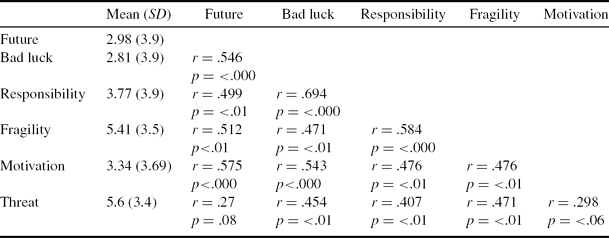
These beliefs were significantly correlated with each other. A factor analysis revealed a one factor solution accounting for 63.73% of the variance.
In summary, an exposure procedure (Voluntary Image Exposure) was found to be an effective way to assess the potency of the index image. The index image was emotionally potent with significant changes occurring during the voluntary exposure to the image. Positive emotions declined and negative emotions increased during the index image. Retrospective reports of the most common behaviour in face of the index image showed stopping/resisting to be the favoured method, and to be a successful way of achieving the image cessation on many occasions of image intrusion. Finally, a cluster of cognitive beliefs concerning the index image meaning was assessed post exposure. The beliefs were found to be highly correlated (see Table 3).
Mean (SD) of each of the cognitions assessed post-exposure to the index image using analogue scales (0-10), and the inter-correlations of these cognitions

Imagery and pain
Pain levels were increased by forming the index image. Pain levels pre- and during image exposure are shown in Table 2. The shift in pain during exposure to the index image was significant, providing evidence of the remarkable potency of the index image to elevate pain.
The changes in pain levels with VIE were not significantly related to pain chronicity. In order to determine whether chronicity affected image presence, the group was divided into an acute and chronic pain group (<24 weeks (acute) n = 21, and >24 weeks (chronic) n = 23). Chronic and acute pain sufferers did not differ with respect to the number of images reported. None of the correlations of pain chronicity and the emotional change scores were significant. There was no suggestion that chronicity of the pain problem was related to the emotional potency of the image. Finally, the chronicity of the pain problem was not related to change in pain with the index image exposure. However, pain levels reached during image exposure were significantly higher for chronic sufferers than for acute sufferers: mean 4.93 (acute); 6.89 (chronic): t = −2.12, df = 42, p < 05).
Trauma symptomatology and imagery
The mean level of trauma symptoms was 43.7 (SD = 17.27), well below the conservative cut-off (of 50) for pain sufferers with PTSD recommended (Andykowski et al., Reference Andrykowski, Cordova, Studts and Miller1998). There were significant correlations between PCL-C scores and Anxiety (r = .736, p < .000) and Depression (r = .85, p < .000). The content of the index images was evaluated to see to what extent they were traumatic flashbacks to the original accident. Only 34% were categorized by the participants as involving the causative accident, hence 2/3 of the index images were not trauma images.
To assess the relation between PTSD symptoms and experiences related to imagery index, two sub-groups of n = 15 were formed on the basis of PCL-C scores (PCL-C < 40: low/no trauma symptoms and PCL-C > 60: high trauma symptoms). The high trauma symptom group had significantly higher levels of both Anxiety and Depression (both at p<.001)
The high trauma group reported an average of 3.87 (SD = 1.64) images, while the low/no trauma symptom group reported 2.5 (SD = 1.2), a difference that is significant (F = 7.02, df = 1, 29, p = .013). The high trauma symptom group reported significantly more frequent occurrences of their index image (Chi Square = 11.76, df = 1, p = .001); 73% of the high trauma symptom group reported that their index trauma occurred a few times/day opposed to 12.5% of the no/low trauma group). There was no difference between the groups (p >.05) with respect to the index image perspective (observer vs. participant), or image clarity.
Differences in image potency in the VIE procedure between the two groups were investigated by means of a 2 (groups) x 2 (baseline vs. exposure) ANOVA . The trauma group reported significantly higher levels of anxiety, anger, fragility and pain both at baseline and during image exposure. There were no interaction effects except in the case of sadness (F(1, 29) = 8.87, p = .006) where the increase in sadness was significantly larger for the no-trauma group. This probably represents a ceiling effect as the trauma group had higher base-line activity on sadness. Finally, differences on the cognitive measures (bad luck, responsibility, fragility and motivation, threat and future) were investigated by means of t-tests and in each case were significantly higher (p = <001) in the high trauma symptom group.
In summary, the PCL-C suggests that most participants were not suffering from Post-traumatic Stress Disorder. Consistent with this, the majority of index images reported did not involve the precipitating accident, However, those who exhibited a higher level of trauma symptoms (as well as higher anxiety and depression) reported more distressing images and the index images of this group occurred more frequently, were more potent (emotionally and cognitively), and produced larger increments in pain experience than in the low/no trauma symptom group.
Discussion
(1) Consistent with the growing recognition of the importance of imagery and cognitive appraisal in many psychological disorders, the present study focuses on the importance of pain related images. Pain-related imagery is prevalent but often “unobserved” in pain sufferers.
Even though the majority of the participants had images associated with their pain, very few of them could initially distinguish between thoughts and images. They were, however, able to access and discuss the characteristics of their images when requested to do so. Often participants would start by saying “no” to an enquiry about image occurrence, but further questions about visualized thoughts resulted in reports of this type of cognition, and of its frequent occurrence. Avoiding the term “image” proved important because many pain sufferers are sensitive to any suggestion that their pain is “in their heads” or imagined, and resent the implied criticism of their pain complaints.
The base rate of image experience proved to be remarkably high with the majority of participants reporting one or more distressing images. This result is of particular interest as the sample came from an Occupational Rehabilitation Center rather than a specialized pain clinic. People with significant psychological problems or diagnosed PTSD had been excluded from the Center in order to have a population best able to benefit from a physiotherapeutic and occupational return-to-work program. In addition, none of the participants had reported or complained of these images or their effects at their intake conferences at the Rehabilitation Center. In fact, several participants were unaware that they were experiencing pain-related images. The images were “unobserved” cognitive triggers or accompaniments of their pain. However, the results of this research show that mental imagery is a frequent, brief, repetitive, intrusive and unchanging (in content) cognitive accompaniment of pain experience.
(2) Using a Voluntary Image Exposure procedure, the potency of index images was established. Index images could be easily and quickly formed by participants. The effects upon emotions, cognitions, behaviour and pain were easily estimated on analogue scales. This method allowed the evaluation of the effects of the image using participants as their own controls, and avoided retrospective and generalized assessments. A remarkable increase in negative emotion was evoked (anxiety, sadness and anger) by the images; reports of calmness and happiness reduced. Many participants became emotionally distressed within moments of considering their image and expressed amazement at their own reactions.
In addition to the emotional effects, index images are cognitively potent in a number of ways. Participants believed themselves to be more fragile, more likely to experience further bad luck or ill effects in the future and to be more threatened. These beliefs were highly correlated. The extent to which the repeated disturbing images can lead to or are associated with the development of negative beliefs (cognitive bias) needs investigation. (Carroll, Reference Carroll1978; Sherman, Cialdini, Schwartzman and Reynolds, Reference Sherman, Cialdini, Schwartzman and Reynolds1985; Shafran and Rachman, Reference Shafran and Rachman2004). It is not surprising that participants reported high ratings on threat, given the content of these associated beliefs about their images. Fragility appears to be a useful cognitive variable to keep in mind when working with pain imagery. In future work it might be wise to separate physical and emotional fragility and to relate these to the useful concept of mental defeat introduced to pain studies by Tang, Salkovskis and Hanna (Reference Tang, Salkovskis and Hanna2007).
The effect of the index images upon behaviour was also evaluated. Participants reported their favoured response to their index images was using distraction to stop/resist the image. The efficacy of this behavioural response was reported to be high. However, the frequency of image occurrence (84% reported the index image occurring few times a week or more frequently) suggests that the strategy does not prevent the image returning. To what extent resisting/stopping the image simultaneously detoxifies the image is not known. However, it is possible that rather than detoxifying the image, resisting/stopping the image increases the frequency of their return, as occurs with other avoidance and safety-seeking behaviours (Tang, Salkovskis, Poplavekaya, et al., Reference Tang, Salkovskis, Poplavekaya, Wright, Hana and Hester2007). As in trauma, suppression of distressing pain images may retard or prevent processing and resolution (Ehlers, Hackmann and Michael, Reference Ehlers, Hackmann and Michael2004). This similarity of trauma and pain imagery is worthy of further study.
(3) It is remarkable that a short induction of a distressing image (cognition) is not only emotionally potent but also leads to increments in the pain experienced. The effects of psychological factors upon pain levels are well established (Turk and Rudy, Reference Turk and Rudy1992), and this research provides a simple and clear demonstration of the relationship.
Interestingly, neither image prevalence nor image emotional potency was related to the chronicity of the pain problem. But index images of chronic pain sufferers provoked significantly larger pain reactions to those of acute pain sufferers. This suggests that chronic pain sufferers are more reactive to mental imagery. The relationship of image potency and extent of belief in the meanings/appraisals of the image needs to be studied in future research. It is likely that the appraisals of negative images that provoke pain are a critical aspect of chronic pain evolution by increasing image potencies. Chronic sufferers are predicted to have stronger catastrophic beliefs concerning their index images. Cognitive reappraisal and rescripting approaches may be especially helpful in the treatment of people with chronic pain problems.
(4) It seems probable that index images gain their potency from the appraisals made of them by a sufferer. An example illustrates this point: A man of 45 who had started having pain after a work-related accident reported this recurrent and distressing image: he saw himself observing his two young children playing in their garden. They are playing happily below him as he is looking out the kitchen window watching them. The content of the image appears benign but the effect on him as he “saw” the image was an intense increase of negative emotions, and a sharp exacerbation of his pain. This effect is better understood when one considers his appraisal of the meaning of this index image: “I am a failure as a father. . .I can't play with my children. I am a loser.”
In this research, the clarification of the meaning of an image proved difficult in a single session .Using open ended questions led to multiple meanings that could not be satisfactorily quantified. Providing participants with categories to choose from with respect to image meaning resulted in a number of categories being selected. Researcher analysis of meaning statements provided support for the hypothesis that the majority of the index images focus upon depressing/threatening appraisals of self, and of the future. Clarification of the relationship between image potency and appraisal needs further research. It may require a treatment context with several sessions to obtain better appraisal estimates.
(5) The occurrence of distressing images and their evident emotional potency raises the possibility that the mental images in pain sufferers are merely symptoms (or residual symptoms) of PTSD. This type of cognition is a well documented in trauma responses. In this study, 96.5% of the participants reported a specific accident leading to their pain problems but few would be considered traumatic accidents. Although PTSD sufferers were excluded from the referrals to the Center, trauma symptomatology was assessed psychometrically in this study and related to the image potency.
The results confirm the efficiency of the exclusionary criteria used at the Rehabilitation Center. The sample is on average below the clinical cut-off for PTSD on the PCL-C. However, the standard deviation is large and a subgroup was evident with trauma symptomatology sufficient to classify them as having PTSD. In this subgroup, anxiety and depression levels were significantly higher than in the group without trauma, as would be predicted. In addition, distressing imagery was more common in this group. The images are significantly more emotionally potent and cause significantly more pain. Finally, the cognitive effects are larger with participants reporting their images to be more threatening, weakening and likely to lead to future difficulties and dangers. The latter makes it possible that trauma significantly affects image appraisal. Normal and common imagery accompanying pain may be made more toxic by the meanings and interpretations made of them by traumatized individuals.
The causative accident was seen as an upsetting and intrusive image by a small proportion of participants. This residual symptom may not be associated with a PTSD diagnosis but may nonetheless occur and/or be provoked by pain experience. If this is true, one would predict that the disappearance of the image would parallel the reduction in pain and disability. Certainly a number of participants spoke of their images reducing in frequency and potency as they found their problem subsiding with their improvement during their attendance at the Rehabilitation Center.
(6) A number of implications for treatment of pain sufferers can be drawn from this study:
(a) VIE will be a useful addition to assessment of pain sufferers and could also provide a powerful addition to cognitive-behavioural interventions. It allows sufferers to experience, within seconds, a phenomenon about which they are learning (i.e. non-physical exacerbation of pain experience). In addition, pain increments from imagery could be useful for demonstrating the potency of various management strategies (e.g. attention focus, relaxation, rescripting). Finally, imagery appraisal, while viewing their index images, may provide a fast track to core values and/or appraisal distortions that are usefully focused upon in CBT (see #4 case above).
(b) Cognitive-behavioural approaches to the treatment of chronic pain include a focus upon catastrophic and negative thoughts (Philips and Rachman, Reference Philips and Rachman1996, Morley et al., Reference Morley, Eccleston and Williams1999; Winterowd et al., Reference Winterowd, Beck and Gruener2003). Image potency and appraisal have not yet been integrated into CBT methods of working with pain. In light of the present findings, it is worth considering incorporating the analysis and modification of pain related images, both because of their emotional potency and their observed effect on pain experience.
(c) Image rescripting is currently being studied in the treatment of a number of psychological problems (Hackmann et al., Reference Hackmann, Ehlers, Speckens and Clark2004). The results are most encouraging and support the view that imagery rescripting can have remarkable and enduring effects. This method may have useful application to imagery of pain sufferers. Interestingly, a small group of the participants in this study reported having developed a method of stopping/resisting the disturbing images by “changing or converting” them and making them less upsetting. This appears to be an example of naturally developing rescripting strategies within a pain group.
The extent that sensory rescripting reduces emotional potency, cognitive bias and pain exacerbation can be evaluated using the VIE procedure. In addition, investigations of the effects of rescripting in the short and long-term may well enhance the psychological management of chronic pain.
Limitations and recommendations
(a) The timeline since injury/pain onset is relevant when sampling imagery. In this research, participants were collected at a clinic as they became available for an interview. This led to participants being interviewed at different times in their recovery/chronic pain problem. Many reported changes in the images over time that related to pain level changes and time passing since the injury. Image potency would seem to decline with clinical improvement. Image memories may also be less accessible and reliable as time passes and/or pain decrements occur. A longitudinal study following pain onset should clarify this phenomenon.
(b) Open-ended questions on the significance or meaning of the images are problematic. Participants appeared to be considering the presence and meaning for the first time, and many reported “. . .maybe it is due to this. . .or. . .maybe to that. . .” They often gave a number of possible suggestions with overlapping themes. Using categorical variables proved ineffective given the overlapping and multiple themes implied by the idiosyncratic image description. The assessment of appraisal is a complex task and one that may not be feasible in an interview format. This study relied on the effects of image exposure (emotional, pain, cognitive and behaviour) as an indirect evaluation of image meaning. The wider categories of index image meaning give general ideas about meaning content but inevitably lose the highly personal appraisal details. Future research will need to evaluate more direct methods of clarifying image appraisals. The assessment of belief level in the reported meaning of the image (to self, others or the future) appears a useful approach and one that proved effective in the research of Brewin et al. (Reference Brewin, Wheatley, Patel, Fearon, Hackmann and Wells2009). In addition, defining meaning over a number of cognitive therapy sessions may be a more reliable and valid approach than attempting to do so in a one session semi-structured interview, as was attempted in this study.
(c) VIE proved to be a useful procedure to assess the effects of imagery. The effects could be assessed as they occurred and did not depend upon retrospective recall and memory. In addition, the need for participants to average responses to different images, or attempt to remember reactions is circumvented. VIE is a promising method for evaluating the effects of images that may prove useful for studying imagery in other disorders.
A limitation of this method is important to keep in mind. The analogue judgments made by participants can be limited by ceiling effects. This was demonstrated with respect to sadness estimates in this research. Change scores pre and during VIE will be dulled and limited by this phenomenon. If basal (onset) levels are high, there is less possibility of detecting change. The level reached with image exposure however has proved a useful index in this study.
(d) These results have many implications for both clinical research, and treatment of pain sufferers. Research is needed on ways in which to reduce and change pain image potency. It is not clear if potency changes are reliable. It would be interesting to assess the extent to which each occurrence of the index image repeatedly produces the emotional effects demonstrated in the VIE procedure. Some participants reported that emotional effects continued after their interviews, even though the image was no longer present and they returned to their Rehabilitation program. Despite the frequent occurrence of index images, the emotional incrementing effects of imagery may not be recognized, as the mental images are “unobserved” cognitions.
The importance of relating image appraisal to behavioural avoidance, emotional responses, mental defeat, and cognitive biases remain fruitful areas for pain research. More time and attention has been given to behaviour change than to cognitive change in clinical treatment of pain sufferers. The role of imagery associated with pain is new territory, and raises the possibility that management methods can be enriched if image potency and appraisal is studied in pain treatments. Incorporating the assessment, reappraisal, and rescripting of mental imagery into pain management clinics is likely to prove a valuable addition to clinical procedures.
Acknowledgements
Thanks to Dr Ann Hackmann and Dr S. Rachman for their useful comments and discussion, and Dr Michael Papsdorf who helped with the statistics. I am particularly grateful to the staff of the Rehabilitation Clinic, especially Dr D. Samson for facilitating data collection.



Comments
No Comments have been published for this article.