Introduction
This paper is about the labor relations involved in the production of holidays in holiday villages in Turkey in the 2000s. Turkey earns a large portion of its tourism income as a destination for cheap sun-sand-sea (3-S) holidaysFootnote 1 owing to its 8,000 kilometer coastline. Post-1980 economic liberalization reoriented Turkish tourism planning toward investing in mass tourism and it became highly dependent on international tourists and on international tour operatorsFootnote 2 for income generation.
Holiday villages (i.e. resort hotels), as huge accommodation organizations and employers that remain active for around seven months and bring together various hospitality services under one roof, were instrumental for this reorientation. Holiday villages as sites of mass production of leisure services are large-scale modern workplaces that employ a large workforce who are required to cater to the expectations of the customers as to efficiency and empathy.Footnote 3
This article focuses on labor control in holiday villages and argues that despite their large scale, modern outlook, use of information and communications technologies (ICT), and production of intimate “high-touch”Footnote 4 services through emotional and aesthetic labor,Footnote 5 simple forms of labor control are in use in holiday villages. Based on field research in two holiday villages where I conducted participant observation and employee interviews, I suggest that simple forms of control, including close monitoring of workers and arbitrariness of managerial decisions, were introduced as an important managerial tool in the name of labor flexibility, on one hand, and in order to impose loyalty, maintain efficiency, and consolidate organizational bureaucracy on the other. I further suggest that this coincided with the developments in the Turkish tourism market in the 2000s, especially the introduction of the all-inclusive system (AIS) as a result of intensification of competition and changes in labor legislation.Footnote 6
The article first explains simple control from a labor process perspective. Then it discusses the holiday village as a workplace and describes the features of hospitality service work. Then it analyzes the various dimensions of simple control at two holiday villages located in the southern coast of Turkey based on ethnographic findings that bring together participant observation and in-depth employee interviews. It concludes by linking simple labor control in the hospitality sector to the wider economic and political context.
Labor control
Labor control can be defined as “the ability of capitalists and/or managers to obtain desired work behavior from workers,”Footnote 7 following labor process analysis (LPA) originating in Braverman’s work,Footnote 8 which was inspired by Karl Marx’s Capital. LPA analyzes the antagonistic relations between capital and labor, and emphasizes that due to the insecurity of the outcome in the labor process – indeterminacy of labor powerFootnote 9 – control is central to a capitalist organization having its hired workers accomplish tasks in a defined time and manner. However, workers respond in various ways to managerial control for limiting or eliminating worker autonomy to ensure unrestricted production for capital.Footnote 10
Edwards originally defined three main forms of labor control in the manufacturing industry, developing historically in a linear fashion: simple, technical, and bureaucratic.Footnote 11 Since then, the study of workplace controlFootnote 12 has been enriched by contributions that focus on work life in the service sector and the development of technology. Emotional labor,Footnote 13 normative control or control by culture,Footnote 14 and the role of ICTFootnote 15 have been analyzed in these novel studies.
Reed suggests that regimes of workplace control consist of a “complex and dynamic configuration of mechanisms and practices” and are inevitably embedded within the general power relationships in a society that inform economic, institutional, organizational, and thus employment outcomes.Footnote 16 In contrast to Edwards, he acknowledges that the new organizations rely on “hybridized control regimes” that selectively incorporate complementary and competing control logics.Footnote 17 The hybrid workplace control model combines objective statistical information, bureaucratic value and behavioral standards, and normative measures to raise worker commitment rather than relying on a certain mode at a specific setting.Footnote 18
Although labor control in modern organizations is considered to rest on hybrid mechanisms, this article draws attention to the employment of simple forms of control not in smaller but in large-scale modern organizations due to increasing market pressures. Simple forms of control are associated with the fiercely competing small-scale manufacturers of the nineteenth century.Footnote 19 In this form, power is exercised arbitrarily by the bosses and/or managers who use sanctions and incentives and intervene in the labor process, “often to exhort workers, bully and threaten them, reward good performance, hire and fire on the spot, favor loyal workers, and generally act as despots, benevolent or otherwise.”Footnote 20 Edwards explains that the “direct and immediate tyranny”Footnote 21 of the capitalist evolved into the “petty tyranny” of foremen as firms grew complicated while increasing competition pushed manufacturers to extract more labor from workers who were threatened with the “reserve army” if they did not comply.Footnote 22 Later, through structural forms of control that were incorporated in the physical and social structure of production (i.e. the technical and bureaucratic), control became more formal, institutional, and covert.Footnote 23
Burawoy similarly analyzes the stages of managerial control from despotic to hegemonic regimes, associating the transitions with the autonomy of the reproduction of labor power.Footnote 24 Under the despotic regimes – what Marx called market despotism – of the nineteenth century of liberal, post-intervening states such autonomy was low and workers were subject to arbitrary decisions as a factor of the unregulated interfirm competition. Under the hegemonic regimes, state intervention, welfare institutions, and strong union representation enhanced the autonomy of the reproduction of labor power while regulation of interfirm and interclass conflict solved the problem of underconsumption in the twentieth century. Workers were empowered and enriched, and management sought their consent, but this created the base for another profitability crisis.Footnote 25 According to Burawoy, international competition under globalization erodes the powers that labor earned during the hegemonic period. As capital mobility increases, “hegemonic regimes are developing a despotic face.”Footnote 26
Following Burawoy, Padmanabhan suggests that the intensified competition compels firms to reduce wages, increase flexibility, and ignore environmental standards in a “race to the bottom.”Footnote 27 He states that Burawoy’s new despotism becomes more widespread in the periphery under the dynamic of global capital meeting local capital and local cheap labor, often provided by a vulnerable, feminizing workforce.Footnote 28 Some scholars suggest that due to competition in product markets firms impose despotic control on workers and curb worker autonomy, given the erosion of labor’s powers.Footnote 29 Post-1980 neoliberal policies have been responsible for the weakening of unions and collective labor and the creation of flexible labor markets and economic insecurity.Footnote 30 It is in this context that simple/despotic control is a tool for management under market pressure and imposed over weakened labor.
The global tourism industry accounts for 10 percent of global employment with a 25 percent share in all new jobs created between 2014 and 2019,Footnote 31 and is a first step for many young people into the labor market. The industry contributes to global labor mobility as well as offering possibilities for managerial and technological innovations.Footnote 32 It is a sector, however, where a large number of low-skilled, low-paid jobs persist. Therefore, it is important to analyze the labor relations in order to understand the prevailing poor working conditions in this competitive and labor-intensive industry, which offers insights in terms of workers’ well-being and the future of work.
Labor in the tourism sector
Recent critical work suggests that tourism literature has only superficially dealt with the themes of tourism as an element of capital accumulation, hospitality work, and tourism and hospitality workers.Footnote 33 Labor-intensive hospitality work is often seasonal and migratory, employing part-time, low-skilled, and casualized laborFootnote 34 and does not promise structured career paths and career development.Footnote 35 There is strong presence of young people, women, and migrant labor of different ethnic backgrounds.Footnote 36 In the industry, the majority of workers struggle with poor financial conditions and perceive the degradation of their work.Footnote 37
As in any other business, tourism work is gendered,Footnote 38 and women are part of the diverse workforce in this global industry.Footnote 39 Their efforts often remain invisible, as in the case of room attendants in hotels.Footnote 40 Labor flexibility in hotel and catering jobs also has a gender dimension;Footnote 41 finding immigrant women in cleaning jobs has become common in the neoliberal era.Footnote 42
Tour operators, especially those few big groups in Europe, are the key players who developed and promoted the AIS. The use of AIS augments their ability to control the market and exert pressures on accommodation providers for reducing prices.Footnote 43 A recent study finds out that hoteliers, becoming dependent on the tour operators for occupancy and income, tend to cut costs in response to such pressure and this in turn decreases the quality of the service.Footnote 44 In the AIS customers prepay for a package of services offered in the holiday villages, including all three meals of the day, soft drinks, and various experiences. Vacationing on a tight budget, customers do not leave the resorts in destinations where they do not stay long.Footnote 45
Besides its benefits in terms of occupancy levels, the AIS has been a matter of controversy for promoting overconsumption and creating environmental problems and regional inequalities.Footnote 46 The AIS promotes seasonal tourism relying on temporary migrant staff over which unsociable, irregular, and long working hours are imposed, resulting in deskilling, income loss, and high employee turnover.Footnote 47 Moreover, a large portion of the tourists’ expenditures stays in the tourists’ country of origin.Footnote 48
Development and labor relations in the tourism sector in Turkey
Turkey made considerable advances in terms of both arrivals and tourism income from 1982 onwards. From 1963 to 2007, Turkey’s share of world tourism revenue had increased from 0.06 percent of $10.8 billion to 2.2 percent of $856 billion, while the number of arrivals increased to 2.45 percent of 903 million tourists worldwide.Footnote 49 In terms of tourism development Turkey is part of the wider Mediterranean region where a mass tourism market emerged from the late 1950s and integrated Spain, Italy, the former Yugoslavia and the Greek islands, as well as Malta and Cyprus.Footnote 50 Turkey and later North African destinations along with other destinations in the western Mediterranean became competitors in this mass tourism market dominated by the tour operators. Tourism destinations emerging elsewhere in the world and the ensuing competition, however, caused a gradual decline in the market share of Mediterranean destinations.Footnote 51
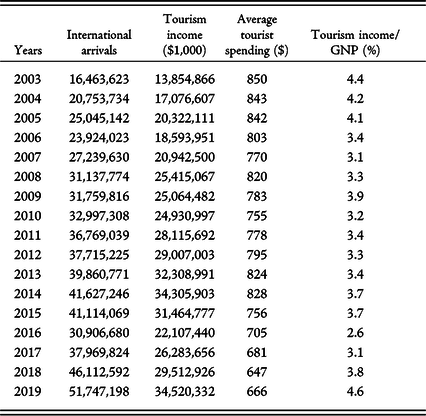
Mass tourism development in Turkey coincided with the maturation of the export-oriented economic model instituted after the 1980 military coup. This development was encouraged through laws and “incentives provided to private entrepreneurs who in return undertook fixed investment in hotels, holiday villages, yacht ports, entertainment and retail centers” along the southern coasts of Turkey.Footnote 52 Serving mostly international tourists through prepaid package tours, the holiday villages should be regarded part of mass tourism with their strong bed supply entrusted with earning foreign currency within the new economic model to improve the balance of payments (Table 1).Footnote 53
International arrivals, tourism income, average tourist spending, and share in gross national product (GNP)

Source: Turkish Ministry of Culture and Tourism. “Tourism Income and Expenses.” 2020. https://yigm.ktb.gov.tr/TR-9851/turizm-istatistikleri.html.
The workforce employed in the Turkish tourism industry consisted mostly of former villagers who were proletarianizedFootnote 54 – transformed from being independent agricultural producers into wage laborers – as a result of exposure to global capital. Aykaç analyzes the diversification of economic activities and income of agrarian households through integration into the tourism industry. She states that proletarianization was a continuing process in which women also became wage earners outside the household but continued to shoulder the work at home.Footnote 55
There is a gap in the Turkish tourism literature with no study adapting LPA to tourism work. The literature has covered tourism’s impact on the increase in inequality between regions and classes, and on problems in tourism employment, education, and training.Footnote 56 Women are employed,Footnote 57 but they are underrepresented at 27.3 percent, below even the national employment rate of 29.8 percent for women. This is expected to rise to 36.5 percent by 2023.Footnote 58 Perceptions of tourism employees have been documented,Footnote 59 but there has been little elaboration on the problems of immigrant workersFootnote 60 and the activities of trade unions.Footnote 61
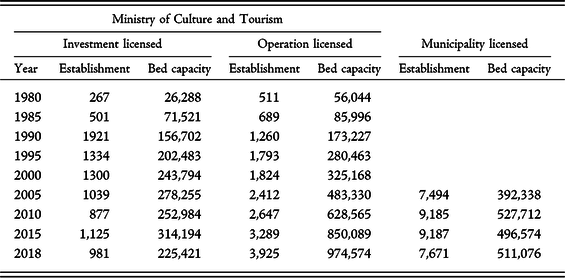
Local capital dominates Turkish tourism businessFootnote 62 and a majority of the large-scale hospitality establishments on the southern coast of Turkey operates on the basis of the AIS.Footnote 63 This was not the case before the 2000s. The rising competition in the 1990s after the brief blow of the Gulf War (1990–1) to Turkish tourism pushed the firms to look for new marketing strategies. As a result, Turkish entrepreneurs adopted the AIS utilized by southern European countries for capital concentration from the mid-1990s onwards.Footnote 64 As demand rose againFootnote 65 more hotels were constructed applying the AIS, and as the number of hotels and their bed capacity increased (Table 2) interfirm competition intensified. In Turkey, as the AIS became dominant from early 2000s onwards the tour operators put downward pressure on prices, directing tourist flows across various destinations with high number of bed supplies. Occupancy levels and income increased definitely, but adoption of AIS in Turkey has been a matter of controversy regarding socio-spatial segregation, local development, regional inequality, environmental degradation, seasonal employment, and low levels of profitability.Footnote 66
Bed capacity

Source: Turkish Ministry of Culture and Tourism. “Tourism Certified Establishments.” 2019. https://yigm.ktb.gov.tr/TR-9860/turizm-belgeli-tesisler.html.
In the global value chain of tourism production, holiday villages are highly dependent on international tour operators such as Alltours, Tui, Thomas Cook, and others in order to sell their AIS packages. Using their stronger bargaining power tour operators take advantage of pressuring firms into competing with each other to procure more services on site for lower prices. Hotels try to reach deals with these tour operators before the season starts, and according to the occupancy rates bargaining continues during the season. By 2001 Turkey was ranked seventeenth in terms of international arrivals and thirteenth for tourism receipts. Apparently AIS helped Turkey to rise from seventeenth to sixth position in terms of international arrivals within ten years and increase tourism income.Footnote 67 However, its rank in terms of tourism income decreased from a top-nine position in 2008 to twelfth in 2012 and fourteenth in 2018,Footnote 68 suggesting a decrease in profit levels due to increasing competition with the AIS.
Methodology
This article is based on the findings of ethnographic research in two holiday villages on Turkey’s southern coast in summer 2012 and a revisit in the summer of 2013, as part of my doctoral research on the hospitality labor process, covering the period between 1980 and 2012. It consisted of participant observation and sixty-six recorded in-depth interviews with both line workers and managers from various service departments. I call these holiday villages Escape and Dreams. At Escape I formally interviewed nine female and seventeen male employees (fifteen workers and eleven managers) while at Dreams I interviewed fourteen female and twenty-six male employees (twenty-five workers and fifteen managers). Managers included some of the department heads and middle-level managers. Besides formal interviews, I had numerous informal chats with workers and managers and took notes of them along with my observations. Participant observation included my stay as a guest at Escape and my formal employment as a guest relations (GR) representative for two months at Dreams.
Through my fieldwork in two holiday villages I was able to observe two sides of the service theatre: as a service receiver at Escape and as a service provider at Dreams. It gave me the possibility to compare and contrast managerial practices and worker responses because Escape was a resort with full AIS accommodation whereas Dreams – with full board plus accommodation – only started to apply it a couple of years ago and only partially. It gave an insight as to the organizational transformation from one type to another.
Escape was located in Manavgat in Antalya province and Dreams was located in Fethiye in Muğla province. Functioning between April and October, they employed 700 and 500 workers, respectively, and served 2,000 customers per day in the high season. Around a third of the workers were housed in the dorms on campus, spatially segregated from customers’ rooms. Dreams, where I was employed, was a partially unionized workplace (excluding front-line workers) while entertainment, landscape gardening, laundry, maintenance, and security jobs were partially subcontracted. Escape applied the AIS with neither a union nor a subcontractor present onsite. Dreams first applied a full board and then a full board plus model, gradually resembling the AIS. Dreams also offered the AIS only to its customers booking its rooms with Thomas Cook, which was handled as a secret but rather inattentively. Both hotels, like many older large-scale firms in the accommodation business, initially applied a half-board system in the 1990s before the competition intensified. This was a time when there were functioning internal markets and career opportunities with clear rules of conduct and promotion as well as better remuneration due to higher tips.
Workers worked for a seven-month season with an enforced unpaid vacation until the next season rolled around. At each season’s end employers suspended worker contracts, as is usual in hospitality work in Turkey, and reactivated them the next season. Such seasonality was the reason for workers’ insecurity and increasing indebtedness to banks and relatives as well as their low bargaining power in the workplace. At Escape the venue grew steadily from its launch in 1993 with the construction of new buildings, rooms, and facilities. In the 2000s the number of rooms increased from 450 to 650, and a waterpark was built to serve families with children. Such a waterpark has also been constructed at Dreams in recent years, replacing a petting zoo. At Dreams the capacity has not changed since 1994 (it is also around 650 rooms) and its market share remained stable until 2007, according to the managers. This year Dreams’ new hotel investment in Antalya started to go down with the probable impact of the global crisis, putting financial pressure on the Fethiye branch.
The workers and managers I interviewed commonly called the holiday village a “factory without chimneys.” With intensive and relentless work routines, holiday villages point to routinization of service. In this assembly line type of service production many products and services became standardized, with little room for customization despite lip service to customer choice and sovereignty. The AIS contributed to the process of industrialization and routinization that reduced the skill content of the tasks and created a gap between effort and remuneration. Although the findings of my fieldwork in two holiday villages is not based on a representative sample, because these resort hotels offer services that are representative of 3-S tourism in the southern coast of Turkey it can be argued that the findings have some validity for many AIS hotels.
Elements of simple control in the two holiday villages
As discussed above, simple control refers to labor control mechanisms that rely on personal, arbitrary use of power by those who are in charge. In holiday villages the people in charge were the general manager (GM) and managers and supervisors down the hierarchy. The owners of the hotels also occasionally intervened and they frequently spent time in the holiday village as a family. The elements of simple control in these two holiday villages were arbitrary, personal rule from the managers regarding task assignment, rewards, and punishments that included verbal and physical violence, registration of overtime payments, promotion decisions, close monitoring of workers both at and away from work, clique formation that was also informed by hemşehrilik networks (those made up of people from the same hometown), and the management’s references.
It is possible to argue that simple control always existed as part of the labor regime because of the capital structure of many tourism firms in Turkey, which are mostly local and family owned. Both Escape and Dreams are family owned and family members are present on their boards of trustees. Formerly active in other sectors, both families entered tourism business in the early 1990s when it was profitable due to a lack of supply. The younger generation of these families grew up engaged in the management of the tourism business established by their parents rather than just leaving the matters to a GM alone.
It is my argument, however, that this mode of control has made a comeback in a time of increasing competition. In the interviews, long-time employees and managers stated that they had formerly more initiative that resembled “responsible autonomy” and closer contact with the customers as well as better remuneration and career prospects.
Despite the continuity in the capital structure of the Turkish tourism firms, interviews point to a change in terms of labor control methods. In the past decade, simple control of labor has become more accentuated due to increasing competition under the impact of the AIS, dependence on tour operators, labor market conditions, wage levels, decreasing career opportunities, and changing skill composition of the tasks. As such, the use of simple control methods points to an organizational transition. As wages/tips decreased it became harder to find skilled labor, and the owners did not want to employ skilled labor given the routinization of many tasks that had formerly been customized for relatively lower numbers of well-to-do customers. The managerial perception of the decrease in tasks’ skill composition and workers’ skills translated into lower trust in the workforce. This means that the managers felt the need to closely monitor the workers and intervene in work processes, resulting in conflicts, erosion of worker commitment, reduction in worker satisfaction, and eventually their leaving. This may be preferable to the capitalist in the short run for purposes of labor supply flexibility and cutting costs.
Close monitoring and interventions
At Escape, workers and mid-level managers regarded the GM as too harsh, acting arbitrarily and rudely. Additionally, workers complained about supervisors, who did not treat them well and pressured them with a heavy workload. The younger generation of the owners at Escape intervened with respect to the distribution of work tasks and remunerations on a frequent if not daily basis. In my interview with this harsh GM, who had been in this position for the past eight years, he stated that he maintained a delicate balance at a time when the owners of the enterprise were intervening more than before. However, he did not detail the compromises and bargains between himself and the owners. I did not have the chance to interview the GM at Dreams, who was an expatriate, to ask about this delicate balance. Escape’s male ex-maître d’hôtel (MdH) was disturbed when he saw entrepreneur family members often advising the GM on how to distribute tasks among the workforce in his division without knowing facts on the shop floor. He stated that such interventions made matters worse in the race against time. Work was barely completed by the reduced workforce that matched the entrepreneur family’s expectations. The family determined the limits of hotel’s budget as a whole and who would head certain departments. Thus, more personnel would not be forthcoming despite the need. This need could not even be spoken of. The author personally witnessed one of the younger family members asking the human resources (HR) office for the wage reports of the entertainment workers.
The GM at Escape often yelled at and rebuked the workers and managers. He closely monitored many operations himself, including the main meals and even the cleaning of certain zones in the premises. Interviews with veteran mid-level managers revealed that they had differing opinions about how work should be carried out, silently disagreeing with one another and with the GM. But they all agreed that things had changed since the introduction of all-inclusive packages. The male sous-chef complained, for example, that the GM sometimes intervened in the preparation of food: “The man [GM] comes and checks the amount of oil in rice. He [GM] told me to add more, but I warned him that customers could have diarrhea from this.” The male restaurant service supervisor was troubled about worn-out dishes and glasses being broken: “It is very normal that 10 percent of the kitchenware goes broken every year as things get worn out, but he does not listen.” The GM did not acknowledge the excuse and held him responsible for the losses. The dinnerware was not restocked that summer and the supervisor shouldered continuing rebukes. Asked whether managing necessitates being tough, in his rather patrimonial-style answer the GM stressed that even in families toughness could be necessary:
Tuning for balance at work necessitates some power applied in order to break people’s resistance against doing their work within the standards. You bring them back to the standards. This hurts, and for some it hurts more. Yet, this is a cordial toughness (tatlı sert) that people like, otherwise you lose track of the whole thing. But sometimes you go beyond the lines. If you are fastidious then you have to be tough.
Many of these interviewees opining on the GM felt rather uncomfortable about the level of toughness. They did not feel free to express themselves thoroughly on the matter. Yet, they could talk about incidents whereby the GM yelled and swore at employees, something that did not take place infrequently. Only a few praised the GM’s toughness that they believed resulted in disciplined and subtle work. These few considered him to be an exterior eye looking at the operation with the eyes of the customers. Employees and departmental heads could not see the things the way he saw them because they were absorbed in the routine. The GM himself was busy and stressed with occupancy and sales levels, which were reported to him instantly on his office computer. Meanwhile, in order to realize preseason expectations and prepare for the next season he met with tour operators and local agents. This was how his performance was evaluated by the board of trustees: getting the numbers right. Such a tough and arbitrary attitude went down the hierarchy in all departments.
In the kitchen, for example, lower-level chefs complained about the harsh attitude of two brothers, the executive chef and the master sous-chef, who created their own micro “foremen’s empire.”Footnote 69 Bullying, swearing, and even physical violence by chefs was common. Metin, a male demi-chef, gave details of such physical insults to him and to other pages that were slapped for the flimsiest excuse: “Pages in the kitchen often get a slap for fetching the wrong type of spoon or pan, making too much noise or quarrelling with colleagues or when they make a joke to have some fun.” He said that such harsh treatment was confusing and could eventually drive people to seriously harm one another with the sharp tools available in the kitchen. “I don’t know what to think and how to feel. One moment they are very friendly and the other they behave as if I am their enemy.” This was alarming. Frequent yelling and rebukes also existed in other divisions, but not direct physical violence as in Escape’s kitchen.
The chef brothers had created an informal clique of personnel both in the kitchen and other divisions, made up mostly of people from their hometown of origin (hemşehri). Clique members were favored with respect to the distribution of tasks, meaning that they worked on less strenuous tasks compared to others and hoped for some sort of employment security. In return they were loyal, committed, and spied on behalf of the manager or supervisor in question, gathering vital information on what was said, discussed, and planned among the workforce. Nevertheless, an increasing workload was inevitable for the clique members too. One female interviewee in the scullery, Handan, claimed that over the past couple years the workload had increased tremendously; the other day she had felt terrible, uneasy, and panicked because she feared that the work would not be finished on time. When I offered the word “stress,” she said yes, she felt stress, stating that working in tourism had become difficult. Handan generally worked very hard: “I work hard and with pleasure. I am a distant relative of Serhat (the executive chef) so I cannot let him down.”
As this reveals, managers controlled the workforce partly through creating cliques among the workers. Generally, but not necessarily, the cliques consisted of workers that came from the same village or town as the manager. At both workplaces, such hemşehrilik networks gave some protection and bargaining power to workers. Indeed, it was more effective in cases when in the network the hemşehri was an already established long-time manager at the workplace. It is important to note that the clique members were favored with respect to the distribution of tasks, meaning that they worked less strenuously compared to others and hoped for some sort of employment security. At Dreams, for example, Sevinç, an experienced female former housekeeping worker, stated that those favored by managers were given less tiring tasks: “If you are close to them [managers] they will send you to clean rooms and common areas that are close to the office, and then you come back earlier and have a longer in the air-conditioned office room.” In her own case she fell out of favor when she refused to do an unrelated task for the wife of the boss. Later she had hernia and had to quit when she was expecting an offer of a supervisory position. Housekeeping tasks were physically very demanding with high risks to health. In the hot and humid weather working within close proximity, completing tasks earlier, and resting in the air-conditioned office a bit longer made a difference. In return for such petty rewards in-clique workers remained loyal, committed, and at times spied on behalf of management when asked. They gathered information on what was said, discussed, and planned among the workforce.
There were other similar cliques competing to remove and replace existing supervisors through “coups.” The ex-MdH at Escape explained that after the replacement of a supervisor, the new supervisor would be offered a reduced wage. The discretion enjoyed at the position would also be lower: “She/he cannot remain in that position very long, either. Someone else will replace him/her and their career in tourism will end.” The MdH actually complained about a general loss of skills: “We are always racing against time since we have a lack of personnel. Those employed do not know how things are in tourism. I am myself an educator, but due to lack of time we are pushing these kids on a battlefield without properly training them.” The managers, however, claimed they could not trust personnel who did not have the necessary qualifications to provide customer service. Even those who were tourism majors at universities were not trusted fully since they did not understand all-inclusive service thoroughly, they said. This was another dimension to the resurgence of simple control, paving the way for the close monitoring of personnel by supervisors who did not trust these workers.
What mattered was that this mechanism ran according to close personal monitoring and the arbitrary rule of department managers side by side with the bureaucracy of hotel management. This included bullying, swearing, and even physical violence as mentioned above. As such, the arbitrariness created many quarrels in the workplace, especially between the younger single male personnel and managers. Some of these younger workers left the workplace if tensions persisted and looked for employment elsewhere. They could succeed in finding employment depending on the strength of their network, on the one hand, and the tightness of the labor market in that particular week or month, on the other.
The restaurant service supervisors were mobile in the dining hall and frequently visited the posts of the service workers. Muharrem, the male headwaiter in the main restaurant at Escape, explained his personal method of control frankly:
I visit their posts very often and inspect closely. Here are the captains that I trained. I visit their posts, but less frequently. I always keep an eye on work and gaze at the workers. I get close to workers, watching them closely during service. And I approach them to make friends.
Intending to make friends with the workers is arguably an attempt to extend his control over them beyond working hours. Through this he even tried to scrutinize discussions among young personnel during their time off, which the author experienced first hand. While the author was talking to two female and two male restaurant workers after their work time at the worker’s cafeteria the headwaiter came by and asked how they were doing. The workers immediately excused themselves. The female workers with whom I could not talk on that occasion were very disturbed by his rude attitude, slang language, and frequent yelling and rebukes during the meetings. They were willing to give more details about such an attitude, but were prevented from doing so by the headwaiter and his captains. As suggested, cliques close to managers created fear among workers, giving them the sense that they were being listened to and watched all the time.
Close monitoring was also the case at reception, where a more educated labor force was employed. The employees were generally computer-literate students or graduates. The male front office manager at Escape, Hakan said:
See how my office is located facing the reception desk? I have my eyes on the reception team all the time. I can easily see whether workers were committed to and passionate about their job and tasks and whether they smile at customers and behave properly.
Another advantage of being close to workers was that when he sensed that there was a complication beyond a receptionist’s skills, he would intervene immediately before the issue became troubling. “I treat the young personnel here as if we are friends and try to play the role of an elder brother when I feel that they need such a figure.” Emine, the female housekeeping manager at Escape stated:
I yell at them all the time since they make me crazy, even the most experienced maids. How can they do such mistakes? I know they are not robots manufactured to work all their lives at Escape. They have a life, their families. So I rebuke them the whole day and just before they leave I gather them together and thank them and praise their work so that they show up the next morning.
Close monitoring, a harsh attitude, and showing a degree of friendship or brotherliness, which would expand managerial intervention into the private sphere as well as allow closer monitoring even after work on campus, were aspects of simple control at Escape. At Dreams the front office supervisor observed the workflow from a back office that was separated from the front by a glass door. Managers interviewed at Dreams also admitted to monitoring personnel closely. They refrained from building friendships and preferred to keep their distance from workers, however, but maintained a relaxed method of communication. This being the case, restaurant service workers complained of being rebuked at times for slack service. The author, being employed in the GR unit, experienced occasional rebukes from the rooms division manager, who was a polite and intelligent person. Yet she often patrolled the campus to observe how her personnel in all divisions performed. She would appear at moments and in places that no one would expect. And if this was inconvenient for service then she complained and rebuked. The experienced GR personnel would then talk to her at length, making apologies for all, and reassuring them that mistakes would not be repeated. Of course, workers did things that management perceived as mistakes.
Rewards and punishments
Arbitrariness functioned together with a larger mechanism of incentives and punishments. As mentioned above, the arbitrary assigning of tasks could be a reward or a punishment to favored or in-clique workers. Similarly, workers regarded the assignment of workstations on campus as well as scheduling a weekly day off as rewards and punishments. Such assignment and scheduling also followed no preset rules. For example, GR personnel never liked to work at the information desk because of the feeling of isolation from others and lack of action at that station. Some restaurant personnel wanted to be on show on certain days – that is, preparing things before the customers – and not be backstage. There was only one day off in hospitality work and at times even that was cancelled due to the intensity of the work. In the normal flow of work, however, the day of the day off was very crucial since workers who were friends wanted to spend their weekly holiday together. Some workers had to be in town or with their families on a particular date. When the scheduling did not meet their expectations they were sad and vulnerable because they could not socialize with their closer friends and wasted precious time. Management knew about such worker fragilities and used the tool of scheduling accordingly, sometimes as a reward and sometimes as a punishment, as mentioned by Wood in his discussion of flexible discipline where what he calls “schedule gifts” obscure control despite giving managers arbitrary power over workers’ work–life balance and “a potentially powerful despotic means of ensuring general control.”Footnote 70 A reduction or increase in working hours has a direct impact on the material gains of workers in Wood’s case. In holiday villages, workers had to be on good terms with managers and show devotion at work to have their day off on a day that they could spend with their friends outside the campus and have fun.
Overall, what Wood discusses in terms of “scheduling gifts” also held true for holiday village workers in the sense that workers were expected to have good personal relations with their supervisors if they hoped to prolong their employment through the low season. In a bureaucratic structure, managers would decide on such matters based on specific objective criteria. But workers suggested that the decisions were not taken objectively, but based on personal relations and networks. So if a worker had to remain longer at work and be called the next season, she/he had to approach the manager of the division, showing extra work and loyalty. There were very few who could remain after the high season except the core employees that included mostly senior managers and their assistants along with certain chefs and technical personnel.
Overtime payment was another issue dealt with arbitrarily, causing confrontations between workers and the HR office. The HR manager said that responsibility for recording and reporting overtime belonged to supervisors and managers. Workers themselves did not always note their daily overtime work. The limits of overtime work were vague – not legally, but primarily because workers were neither sufficiently organized to track such matters nor to raise their voices in the face of violations of their rights for fear of losing their employment. A few managers, such as Emine, the housekeeping manager at Escape, did record overtime, while others were not much concerned with the matter: “The GM does not like me because I bring the issue up. They don’t want to pay much.” The GM did not favor the regular payment of overtime work, as both Emine and ex-MdH explained in interviews. Not paying overtime helped the GM to stay within his budget while exploiting labor, being able to report profits to the board of trustees.
Promotion decisions were subject to managerial arbitrariness and were used as a loyalty-building measure. Managers made the decisions that were eventually approved by the GM. Few promotions took place during my visit. Nonetheless, the promise and dream of promotion was important for keeping certain personnel on hand or for inviting and transferring workers from other enterprises. Arda, a male barman, was made such a promise by the supervisor of the special restaurants at Escape. He explained that in his third month he was given the new title, but that he would not remain with the firm the following season because of the low quality of service he encountered. On the author’s first week two workers resigned, to the author’s knowledge because of such arbitrariness in promotions. In one case the GM rejected the promotion decision taken by the manager. In the other the worker was very disappointed after experiencing a small pay rise of fifty Turkish lira attached to the promotion. At Dreams, before the author’s arrival Yağız, an experienced male GR representative, had been promoted to the position of shift leader and a couple of weeks later demoted due to differing evaluations of his work performance among managers. He was bitter at his boss, but kept working without losing his motivation.
Promotion decisions were once structured through written and oral exams, that is, through preset rules. At Dreams this was a crucial means for retaining enthusiastic personnel. This practice has died out in recent years, however, and receiving a promotion became difficult for the majority of workers. Gizem, a low-ranking female chef, stated that there was also a gender dimension to the issue. Given the same level of skill, effort, learning curve, and enthusiasm, a male rival would be promoted ahead of her. At both Escape and Dreams female personnel from reception, the kitchen, and entertainment complained about such discrimination in promotion decisions to the advantage of male personnel. Gizem said: “I actually quit this job and applied to another firm, but after spending a night in their dorms I came back.”
Decisions regarding the prolongation of employment through the low season, promotion, and registration of overtime work were taken arbitrarily based on personal or hemşehri relations rather than preset rules. These were more means for loyalty-building than recognition of skill and seniority. Özgür, the male assistant HR manager at Dreams, pointed to the need to develop clear rules and procedures for the recruitment, hiring, and promotion of personnel. Without these, he added, everything would continue to look unorganized, and as such it was hard for HR to justify differing wages. Indeed, the department had recently started to intervene in the recruitment and hiring of workers by conducting its own interviews, which caused tension with other departments. This pointed to the centralization of management in contrast to earlier devolution.
Finally, the references of managers were vitally important for personnel leaving to search for a position in another hospitality firm. Although there are many holiday villages and hundreds of hotels, the hospitality industry is still a small community in which owners and managers know each other and rely on each other’s references about workers. The hospitality firms took notice of the references to ensure that the incoming worker would be a “good worker” in the sense Edwards’ used the term,Footnote 71 not causing the authorities problems. These helped managers maintain a power base within the holiday villages and in the hospitality subsector.
At Dreams simple control was not aggressive but still powerful. It existed despite a strong corporate culture and other structural elements of control that had been established. Supervisors and managers also continually monitored workers whether in their divisions or not. This monitoring was not so overt, and was subtle compared to that at Escape. Workers knew or thought that managers shared views and observations about them, especially regarding their manners during both working and non-working hours. For example, the GR supervisor shared her observations on her team. She said that observing, selecting, and eliminating workers was necessary to form a more harmonious group the following season. She was not pleased by the composition of the team in summer 2012. She occasionally took advice from the experienced rooms division manager who made her own observations of the team as mentioned above. While these managers did not seem to sit around watching over people, they made detailed observations about the efficiency of the work done and about workers’ manners during their service, although they did not intervene in the actual work directly. Yağız, the experienced GR representative, helped the author understand early on that there were unwritten rules in the workplace and that workers were monitored all the time, especially those in direct contact with customers. Thinking that they were being monitored compelled workers to be careful about their manners. Managers distributed the tasks, but more importantly influenced the pacing and styling of the work as a way of screening out workers for good performance. Some workers thus might not be recalled for the next season, or if a more suitable candidate became available they could be laid off mid-season.
The arbitrary and coercive rule has the potential to cause conflict between management and labor. Edwards suggests that simple control under hired bosses opens the way for the petty tyranny of managers – hence workplace conflict.Footnote 72 Although such conflict and related developments are hardly in capital’s interest, in the short run they contribute to efficiency and labor supply flexibility. In the holiday villages workers quit jobs in the face of such tyranny without compensation or incentives to stay. Occasionally personnel in holiday villages left or were laid off on the pretext that they violated workplace harmony or defied orders. Of course, for those who left on their own the firm had no legal responsibility for compensation. Those who were laid off after their two-month probation and those who were laid off after six months of employment were convinced by supervisors not to take the case to court.Footnote 73 Their compensation was good references from their managers that laid-off workers would need in their search for work in other firms. If the workers insisted, they would have only negative commentary. That is, firms dissuaded workers from bringing the issue to court with the threat of unemployment, at least for a time.
Labor supply flexibility benefits firms competing in volatile markets with fluctuating customer demand. Being able to reduce and increase the number of workers according to that demand is crucial for these firms to remain in business. Although not public, I was shown (but could not get a copy of) weekly and monthly charts comparing the number of workers and labor costs with the level of room occupancy. This arguably suggests that holiday villages aimed at a just-in-time staffing strategy for just-in-time service production.Footnote 74 This meant that they wanted to have the right amount of labor corresponding to work that sustained efficiency and the firms’ profitability. Accordingly, at times of increasing market pressure, when flexible labor contracts were not flexible enough for the entrepreneurs and the normative control devices of human resource management failed to create worker commitment,Footnote 75 the arbitrary, coercive rule of the GM and managers emerged as a tool to provide efficiency and labor flexibility. In the holiday villages, flexibility through simple control was a device to reduce labor costs – adjusting the number of workers and labor efficiency according to demand and creating loyalty to the company.
Conclusion
This article argues that despite the modern outlook of the hospitality workplaces as developed capitalist organizations applying ICT and employing emotional and aesthetic labor to produce and provide service, including “high-touch” relations and experiences, simple forms of labor control still exist. I observed that close monitoring, arbitrariness in task assignments, and rewards and punishments around the issues of overtime work, promotion decisions, and schedule arrangements, as well as creating cliques within the workforce, were major elements of this type of control in holiday villages. Physical and verbal violence, especially at Escape, was noteworthy. Although the two holiday villages visited used a hybridized labor control mode that integrated various elements of bureaucratic, technical, and normative control modes, as indicated in literature, management used simple forms of control for certain specific ends in a certain period.
My fieldwork indicates that elements of simple control have become accentuated in recent years. The 2000s were the years when AIS became dominant in a market that attracted more actors into the tourism business, who then increased the room supply with further construction of hotels while existing actors enlarged their capacity. Use of the AIS as a marketing strategy intensified the competition in a market with fluctuating demand while international tour operators used their increasing bargaining power to put pressure the firms to procure more services for lower prices. This put downward pressure on profits to which firms responded by lowering their costs.
This low-cost strategy intensified work. Worker satisfaction and motivation dropped lower with resulting low commitment to work, the profession, and the firm. The AIS made some of the earlier hospitality skills redundant, hence entrepreneurs’ unwillingness to pay high wages for routine, low-skilled tasks resulting in a lack of skilled personnel to serve customers despite their motto of high-quality service work. This was the setting in which holiday village management used elements of simple control in an effort to control labor while at the same time having labor supply flexibility to match the levels of occupancy with the levels of efficiency and profitability.
The two holiday villages were not workplaces without conflict of interest between capital and labor. In the face of various control modes and work design, workers valued being organized to improve their employment and working conditions. Moreover, especially experienced personnel were well aware of the decreasing quality of service and were certain that AIS should not continue.
The general weakening of the trade unions in Turkey under the Islamist Justice and Development Party (Adalet ve Kalkınma Partisi, AKP) governments was, however, a major setback in workers’ endeavor for improving tourism service and their employment conditions. The workers did not receive the support that the tourism entrepreneurs have been receiving. Indeed, Turkey has not signed International Labour Organization Convention number 172 on the amelioration of working conditions, training, and career prospects in “hotels, restaurants and similar establishments” for the past three decades. Amendments by the long-ruling AKP to laws on collective bargaining and trade unions raised new thresholds and impediments to workers’ unity, solidarity, and security. Currently, membership of unions is low, and new amendments further curb the representative power of unions and their mandate to carry out collective bargaining processes in all sectors of the economy.Footnote 76 Overall, the construction of too many hotels along the coasts of Turkey to be operated within AIS not only destroyed the natural beauty and vacation quality for customers but crucially intensified competition to the detriment of working conditions, skill acquisition and career prospects, and income earnings of the workers whose chances for union activism and collective bargaining declined drastically.