INTRODUCTION
Factors underlying parasite specificity and differences in infection dynamics among alternative host species are in the core of evolutionary ecology of host–parasite interactions, but still poorly understood in natural systems (Poulin, Reference Poulin2007; Poulin et al. Reference Poulin, Krasnov and Mouillot2011). Definition of parasite specificity is generally multifaceted, including not only the number of host species infected, but also their relative importance in maintaining the parasite populations (Poulin et al. Reference Poulin, Krasnov and Mouillot2011). Indeed, one parasite species may show infections across a range of sympatric host species (e.g. Valtonen et al. Reference Valtonen, Pulkkinen, Poulin and Julkunen2001, Reference Valtonen, Holmes, Aronen and Rautalahti2003; Rellstab et al. Reference Rellstab, Louhi, Karvonen and Jokela2011), while one or few of the hosts typically are responsible for majority of transmission and thus most important for the parasite life cycle (Streicker et al. Reference Streicker, Fenton and Pedersen2013). This can result in parasite adaptations towards those hosts, which can be seen, for example, as higher rate of parasite development, or higher susceptibility or magnitude of exposure among the hosts. Experimental infections are generally needed to separate the effects of susceptibility and exposure underlying different infection profiles among alternative host species (Poulin and Keeney, Reference Poulin and Keeney2008; Detwiler and Minchella, Reference Detwiler and Minchella2009), but knowledge of the spatiotemporal scales in which these operate in the wild is limited.
Complex parasite life cycles typically include at least one stage where an infected intermediate host has to be ingested by the next host for successful transmission. Due to uncertainty of such events, some trophically transmitted parasites are known to alter the phenotype or behaviour of their intermediate host to increase the probability of transmission to the next host (Rothschild, Reference Rothschild1962; Holmes and Bethel, Reference Holmes, Bethel, Canning and Wright1972; reviewed by Moore, Reference Moore2002). Indeed, parasite-induced changes in host phenotype have been shown to predispose hosts to increased predation in a range of systems (e.g. Bethel and Holmes, Reference Bethel and Holmes1974; Moore, Reference Moore1983; Lafferty and Morris, Reference Lafferty and Morris1996; Seppälä et al. Reference Seppälä, Karvonen and Valtonen2005, Reference Seppälä, Karvonen and Valtonen2008; Lagrue et al. Reference Lagrue, Kaldonski, Perrot-Minnot, Motreuil and Bollache2007). However, variation in manipulation between alternative host species of a parasite has received less attention (e.g. Lagrue et al. Reference Lagrue, Kaldonski, Perrot-Minnot, Motreuil and Bollache2007; de Bekker et al. Reference de Bekker, Quevillon, Smith, Fleming, Ghosh, Patterson and Hughes2014; Hernandez and Fredensborg, Reference Hernandez and Fredensborg2015), while this is important for understanding the relative roles of these species in maintaining the parasite population. Here, we investigated spatiotemporal patterns of infection, specificity and host manipulation in the trematode Australapatemon sp. infecting two sympatric species of leeches, Erpobdella octoculata and Helobdella stagnalis.
Leeches (Hirudinea) represent a widely distributed and abundant group of aquatic invertebrates. Some species are parasitic, but a higher number of species are free-living omnivores, scavengers and predators, preying and feeding on other invertebrates and detritus. Erpobdella octoculata and H. stagnalis belong to the most widely distributed leeches in lentic and lotic water bodies in Europe (Murphy and Learner, Reference Murphy and Learner1982a , Reference Murphy and Learner b ; Kutschera and Wirtz, Reference Kutschera and Wirtz2001; Kutschera, Reference Kutschera2003). They are important components of freshwater ecosystems (Kutschera and Wirtz, Reference Kutschera and Wirtz2001), functioning both as prey and predators with a wide variety of feeding strategies from macrophagous predators to opportunistic fluid suckers and scavengers (Kutschera, Reference Kutschera2003). On the other hand, leeches of E. octoculata are preferred food items of anatid ducks (Kufel, Reference Kufel1974/1975). The two leech species regularly co-occur in sympatry, usually side by side under the same stones (Young et al. Reference Young, Seaby and Martin1995; Kutschera and Wirtz, Reference Kutschera and Wirtz2001). Life histories (Spelling and Young, Reference Spelling and Young1987) and strategies of feeding (Kutschera and Wirtz, Reference Kutschera and Wirtz2001; Marklund et al. Reference Marklund, Blindow and Hargeby2001; Kutschera, Reference Kutschera2003) of the species are similar, but they differ in size (E. octoculata is larger than H. stagnalis) and in parental care [H. stagnalis carries its offspring for several weeks, whereas E. octoculata provides very little care after laying the cocoons (e.g. Kutschera and Wirtz, Reference Kutschera and Wirtz2001)].
Leeches are also known to act as second intermediate hosts for cyathocotylid (Cyathocotyle Mühling, 1896) and strigeid trematodes (Australapatemon Szidat, 1928, Cotylurus Szidat, 1928) (Spelling and Young, Reference Spelling and Young1986a , Reference Spelling and Young b ; Niewiadomska, Reference Niewiadomska, Gibson, Jones and Bray2002a , Reference Niewiadomska, Gibson, Jones and Bray b ). Here, we focus on infection of leeches by Australapatemon sp., recently recorded as larval form (cercaria) from snails in the present study system (Faltýnková et al. Reference Faltýnková, Niewiadomska, Santos and Valtonen2007). The life cycle of the representatives of the genus Australapatemon includes pulmonate or prosobranch snails as the first intermediate hosts, aquatic leeches as the second intermediate hosts, and ducks (Anatidae) as definitive hosts (Faltýnková et al. Reference Faltýnková, Niewiadomska, Santos and Valtonen2007; Drago and Lunaschi, Reference Drago and Lunaschi2010). Cercariae are produced within the snails through asexual reproduction and are released to water to infect the leeches where they develop to the second larval stage, metacercaria. Metacercariae encyst in the tissue of the leeches and are transmitted to ducks through ingestion. While the general suitability of both E. octoculata and H. stagnalis as hosts for Australapatemon has been confirmed experimentally (McCarthy, Reference McCarthy1990), interspecific differences in spatiotemporal patterns of natural infection, susceptibility to infection and effects of infection on the host are unknown.
We first determined differences in infection abundance between E. octoculata and H. stagnalis by conducting spatially and temporally structured sampling of the host populations. We were particularly interested to see if differences in infection between the leech species could arise in narrow spatial scales, corresponding to our previous results on other trematode species in the same system (see Faltýnková et al. Reference Faltýnková, Valtonen and Karvonen2008). Second, we experimentally exposed the leech species to Australapatemon sp. infection to see to what extent possible differences in infection observed in the wild could be explained by interspecific differences in exposure and susceptibility. Third, we investigated the behaviour of infected and uninfected leeches of the two species to see if the parasite could change their behaviour in a manner suggesting enhanced transmission to the definitive host. We also analysed if the magnitude of possible changes in host behaviour were associated with parasite abundance, which could give some indication whether the changes were induced actively by the parasites or caused by side-effects of increasing parasite numbers.
MATERIALS AND METHODS
Sampling and processing of the leeches
Leeches were sampled from three locations in the large oligotrophic Lake Konnevesi (area 113 km2, mean depth 13 m, maximum depth 56 m), Central Finland. One of the locations (‘shore’: 62°36′59·60″N, 26°20′57·31″E) was close to the shoreline with a depth of 0·5 m and a bottom substrate of sand and small stones. Two other locations (‘offshore 1’: 62°37′00·35″N, 26°20′59·26″E; ‘offshore 2’: 62°36′59·70″N, 26°21′00·35″E) were ca. 45 m offshore and ca. 30 m apart, forming a triangle with the shoreline location. The offshore locations had a water depth of 2–5 m and a soft bottom substrate. Individuals of both E. octoculata (Linnaeus, 1758) (Erpobdellidae) and H. stagnalis (Linnaeus, 1758) (Glossiphoniidae) were sampled monthly from May to September 2008 by taking detritus/sediment samples with a bottom dredge from the two offshore locations and sieving them, or handpicked under stones at the shoreline location. Although the sampling design was not quantitative, roughly similar sampling effort was conducted each time. Samples were brought to the laboratory where leeches were picked using forceps. The abundance of the metacercariae of Australapatemon sp. (Digenea, Strigeidae) was determined from live specimens by compressing each leech gently between two glass plates under a stereomicroscope. This procedure did not compromise their survival. The metacercariae of Australapatemon sp. were identified using the available literature (Vojtek et al. Reference Vojtek, Opravilová and Vojtková1967; Sudarikov et al. Reference Sudarikov, Shigin, Kurochkin, Lomakin, Stenko and Yurlova2002), and their identity was confirmed experimentally (see below) by infecting leeches with cercariae of Australapatemon sp. (see Faltýnková et al. Reference Faltýnková, Niewiadomska, Santos and Valtonen2007, Reference Faltýnková, Valtonen and Karvonen2008 for descriptions).
Leeches collected in June–August were held individually in small containers (200 mL) at 20 °C for exposure and behavioural trials (see below) and fed ad libitum with crushed aquatic invertebrates collected from the lake. A small stone was added into each container as a hiding place for the leeches and the water was changed every second day. For identification, samples of metacercariae and surrounding cysts were isolated from the parenchyma of several specimens of both leech species and measured for length and width (μm) live under light microscope. Attempts to excyst the metacercariae mechanically were unsuccessful. Differences in parasite abundance between the leech species, sampling months and locations were analysed using non-parametric Mann–Whitney U-test and Kruskall–Wallis test as the analysis-of-variance (ANOVA) requirements were not met. Differences in size of the metacercariae and cysts were analysed using ANOVA with leech species and infection type (natural/experimental) as factors, and parasite abundance as a covariate. For this purpose, statistically non-independent measurements of multiple parasite specimens from an individual leech were averaged.
Experimental exposure
Specificity of Australapatemon sp. to E. octoculata and H. stagnalis was studied in mid-July by experimentally exposing 10 individuals of each leech species to the parasite cercariae. These included five previously infected and five uninfected individuals of E. octoculata, and four previously infected and six uninfected individuals of H. stagnalis. Infection status and the initial parasite abundance were determined from live specimens as described above. Ten individuals of each species served as unexposed controls from which the number of possible developing infections, undetectable at the time of exposure, was later determined. Parasite cercariae were extracted from four naturally infected prosobranch snails Valvata macrostoma Mörch, 1864 (for description and seasonal dynamics see Faltýnková et al. Reference Faltýnková, Niewiadomska, Santos and Valtonen2007, Reference Faltýnková, Valtonen and Karvonen2008) collected from the same location as the leeches. Individual exposures of the leeches were conducted in plastic cups containing 30 mL of lake water. Ten parasite cercariae were introduced to each leech for 3 h after which the water was filled up to 120 mL. To ensure sufficient level of infection, exposures were conducted on three consecutive days totalling 30 cercariae for each leech. After the exposure, the exposed leeches and the controls were kept individually in 20 °C and fed ad libitum as described earlier. Development of infections was followed on days 25, 35 and 56 post-exposure from live specimens as described above and the numbers of fully developed and developing infections were counted. All animals were dissected at day 56 and samples of the metacercariae and the surrounding cysts were measured for length and width (μm) live under a light microscope. In cases of individuals with earlier infections, abundance resulting from the exposures was calculated by subtracting the initial parasite abundance. The data were analysed using ANOVA with leech species and previous infection status (uninfected/infected) as fixed factors. Parasite development (proportion of fully developed infections, arcsine-transformed) was compared between the host species using ANOVA with species and examination time (days post-exposure) as factors.
Behavioural experiments
Fifty-four infected and 36 uninfected E. octoculata, and 20 infected and 19 uninfected H. stagnalis of similar size collected from the lake in June–August were used in the behavioural observations conducted in 12–14 August. Leeches that had previously been determined for infection abundance and development of the metacercariae were placed individually in plastic cups with 120 mL of lake water. Small stones of similar size, shape and colour were placed on the bottom of each cup to provide a shelter for the leech. Cups were illuminated from above using a 12:12 h light–dark rhythm. During the light period, hiding behaviour of each leech was recorded every 30 min during two consecutive days so that a total of 41 observations were made from all specimens. Four categories were used: (1) animal totally hidden under the stone; (2) swimming in the water column; (3) creeping on the stone or on the wall of the container; (4) lying motionless on the stone, container wall or on the bottom, or being hidden only partly under the stone but still visible to the observer. The observer was blind to the infection status of the leeches. Categories 2–4 were subsequently combined for the purpose of the statistical analysis to represent ‘exposed’ condition of the leeches, which was compared to the ‘hidden’ condition (category 1). Data were analysed separately for the leech species using ANOVA with sampling month (June, July and August) and infection status (infected, uninfected) as fixed factors, and the proportion of time individual leeches were exposed (arcsine-transformed) as a response variable.
In addition, a total of 55 individuals (35 infected, 20 uninfected) of E. octoculata collected in July and 66 individuals (30 infected, 36 uninfected) collected in August were monitored for explorative behaviour individually on a Petri dish (diameter 8 cm) with 0·75 mL of water. The dish was placed on a white paper with a grid and the leeches were allowed to settle for 2 min after transfer. The number of lines crossed by each individual was then counted during the next 2 min. The water was changed and the dish was properly washed after each trial. Data were analysed using ANOVA with sampling month (July, August) and infection status (infected, uninfected) as factors. Trials of explorative behaviour in H. stagnalis were unsuccessful because most individuals were reluctant to move.
RESULTS
Morphology of the metacercariae
Description: Metacercaria of tetracotyle type; cysts of variable shape (rounded, oval or pyriform), cyst wall of two layers, inner thin, compact; outer thick, transparent, with several layers. Forebody cup-shaped, hindbody shorter than forebody. Internal organs obscured by refractive granules in excretory system. Oral sucker rounded, sub-terminal. Pseudosuckers antero-lateral, narrow. Ventral sucker sub-globular, pre-equatorial, of similar size as oral sucker. Pharynx oval; intestine not observed. Holdfast organ large, transversely oval, in hindbody, contiguous with ventral sucker. Excretory system complex, filled with refractive granules of variable size.
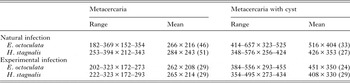
The metacercariae fit well to the genus Australapatemon Szidat, 1928 in shape and size of cyst with a thick wall, the distinction of fore- and hindbody, the presence of narrow pseudosuckers and a large Holdfast organ characteristic for this genus (Vojtek et al. Reference Vojtek, Opravilová and Vojtková1967; Sudarikov et al. Reference Sudarikov, Shigin, Kurochkin, Lomakin, Stenko and Yurlova2002). Metacercariae from E. octoculata and H. stagnalis were identical, and metacercariae obtained from the experimental exposure of leeches to cercariae of Australapatemon sp. (identified in Faltýnková et al. Reference Faltýnková, Niewiadomska, Santos and Valtonen2007) were identical to those recovered from natural infections in shape and dimensions of cysts and internal morphology (Table 1). Metacercariae were located in parenchyma and musculature of leeches in all parts of the body.
Dimensions of the metacercariae of Australapatemon sp. (trematode body without cyst) and metacercariae with cyst (length × width, μm) obtained from natural and experimental infections of leeches Erpobdella octoculata and Helobdella stagnalis. Numbers in parentheses indicate numbers of specimens

Metacercarial body length was strongly correlated with body width (Pearson correlation: r = 0·916, P < 0·001; leech species and natural and experimental infections combined) and cyst length was correlated with cyst width (r = 0·859, P < 0·001). Therefore, only the length measures were used in the statistical analysis. Average length of the metacercariae was significantly greater in natural infection compared with experimental infection in both leech species [ANOVA on log-transformed data: F 1,21 = 6·390, P = 0·020 (infection type); F 1,21 = 0·490, P = 0·492 (species); F 1,21 = 0·730, P = 0·403 (infection type × species); F 1,21 = 7·849, P = 0·011 (parasite abundance as a covariate)]. A similar difference between the natural and experimental infection was also observed in cyst length (ANOVA on log-transformed data: F 1,19 = 4·429, P = 0·049). However, in this case the species also differed, so that the cysts surrounding the metacercariae in E. octoculata were larger than those in H. stagnalis [F 1,19 = 11·566, P = 0·003 (species); F 1,19 = 0·621, P = 0·440 (infection type × species)].
Spatiotemporal patterns of infection
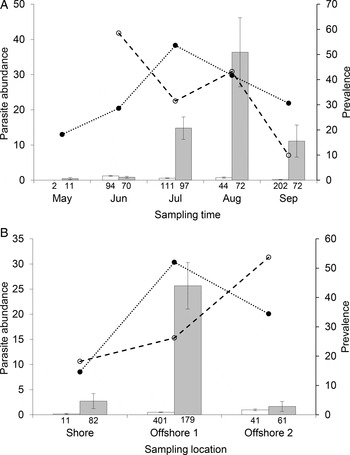
Prevalence of infection was 18·2–53·6% in E. octoculata and 9·9–58·5% (May sample was excluded because of low sample size) in H. stagnalis, depending on the sampling month (Fig. 1). Overall, prevalence was not different between the species (logistic regression: Score = 0·980, P = 0·332), but differed among the sampling months (Wald = 38·657, P < 0·001) and between the species depending on the month (Wald = 39·285, P < 0·001). There was a significant difference in the abundance of Australapatemon sp. between the leech species (Mann-Whitney U-test: Z = 4·521, P < 0·001) so that the abundance in E. octoculata was approximately 28-times higher than in H. stagnalis (sampling months combined; Fig. 1). The parasite abundance changed also with season in both leech species [Kruskall–Wallis: χ 2 = 19·884, d.f. = 4, P = 0·001 (E. octoculata); χ 2 = 82·609, d.f. = 4, P < 0·001 (H. stagnalis)] reaching the peak in August in E. octoculata (mean = 36·35 ± 9·81) and in June in H. stagnalis (mean = 1·23 ± 0·15; Fig. 1).
Prevalence and mean abundance (±s.e.) of Australapatemon sp. in leeches H. stagnalis (open dots and bars, respectively) and E. octoculata (filled dots and bars, respectively) according to sampling month (A) and sampling location (B). Numbers below the bars indicate number of individuals.

Among the sampling sites, parasite prevalence was highest in the two offshore sites, ranging between 34·3–52·0% and 26·2–53·7% in E. octoculata and H. stagnalis, respectively (Fig. 1). Corresponding prevalences in the shore location were 14·6 and 18·2%. Again, there was no overall difference in prevalence between the species (logistic regression: Score = 0·005, P = 0·946), but there was a difference among the sampling locations (Wald = 13·102, P = 0·001) and between the species depending on the location (Wald = 38·975, P < 0·001). The parasite abundance was also different between the sampling sites in both leech species [Kruskall–Wallis: χ 2 = 39·641, d.f. = 2, P < 0·001 (E. octoculata); χ 2 = 14·057, d.f. = 2, P = 0·001 (H. stagnalis)], so that the highest abundances were recorded in the two offshore sites (Fig. 1). The spatial differences in infection among the locations were also consistent across the sampling months. For example, mean parasite abundance (±s.e.) in E. octoculata in July-September was 1·5 ± 1·5–4·00 ± 2·6, 27·7 ± 5·6–90·3 ± 22·4 and 1·7 ± 1·2–1·8 ± 0·9, at shore, offshore 1 and offshore 2 locations, respectively. There was no difference in mortality between infected and uninfected leeches in the laboratory (logistic regression: score = 0·005, P = 0·941 (infection); score = 1·224, P = 0·269 (infection × species)), while the overall mortality of E. octoculata was higher than that of H. stagnalis (Wald = 30·574, P < 0·001).
Experimental exposure
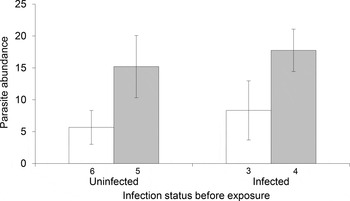
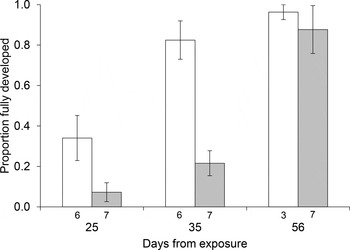
In the experimental Australapatemon sp. exposure of the leeches, two specimens had deviant abundance exceeding 30 parasites per leech suggesting an error in the exposure dose in these specific cases. These individuals were subsequently excluded from the data leaving a total of 18 leeches for the analysis. The mean parasite abundance in E. octoculata was 2·5 times higher than that in H. stagnalis (ANOVA: F 1,14 = 5·585, P = 0·033), suggesting higher susceptibility of E. octoculata to infection (Fig. 2). One individual of E. octoculata and four individuals of H. stagnalis remained uninfected following the exposure. The initial infection status of the leeches (infected/uninfected) had no effect on the infection abundance [F 1,14 = 0·423, P = 0·526 (initial infection); F 1,14 = 0·000, P = 0·989 (species × initial infection)]. Only one developing parasite was later detected in the unexposed control leeches indicating that the level of undetected background infection at the time of exposure was negligible for the result of the experiment. Following the exposure, metacercarial development was significantly faster in H. stagnalis compared with E. octoculata [ANOVA on the proportion of fully-developed metacercariae (arcsine-transformed): F 1,30 = 13·462, P = 0·001 (species); F 2,30 = 25·381, P < 0·001 (time); F 2,30 = 3·287, P = 0·051 (species × time); Fig. 3].
Mean abundance (±s.e.) of Australapatemon sp. in previously uninfected and infected leeches of H. stagnalis (open bars) and E. octoculata (filled bars) following an experimental exposure to the parasite. Numbers below the bars indicate number of individuals.

Mean proportion (±s.e.) of fully developed Australapatemon sp. metacercariae in leeches of H. stagnalis (open bars) and E. octoculata (filled bars) in relation to days from an experimental exposure to the parasite. Numbers below the bars indicate number of individuals.

Behaviour experiments
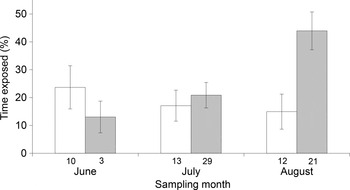
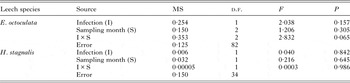
Two individuals of E. octoculata and one individual of H. stagnalis died in the beginning of the experiment and were excluded from the data. Mean abundance (±s.e.) of infection in E. octoculata in the behavioural trials was 1·33 ± 0·33, 24·38 ± 5·44 and 56·48 ± 18·41 in June, July and August, respectively, corresponding to the rise in parasite abundance in the wild (Fig. 1). The mean proportion of developing, unencysted metacercariae at the same time was 0%, 13·0 ± 0·04% and 1·6 ± 0·02%, respectively. The corresponding abundance in H. stagnalis was 1·80 ± 0·29 in July and 2·00 ± 0·60 in August. There tended to be a significant interaction between the infection status (infected/uninfected) and month explaining the hiding behaviour of E. octoculata (Table 2). This was because the infected individuals spent significantly more time exposed in August compared with uninfected leeches (t-test on arcsine-transformed data: t 31 = 3·207, P = 0·003; Fig. 4). However, the proportion of time spent exposed in August (range 2·4–95·1%) was not correlated with the parasite abundance (Pearson's correlation: r = 0·176, P = 0·445). Proportion of time exposed was not different between the sampling months in the uninfected individuals of E. octoculata (one-way ANOVA on arcsine-transformed data: F 2,32 = 0·451, P = 0·641). There was no difference in behaviour between uninfected and infected H. stagnalis (Table 2) or overall between the host species (F 1,113 = 0·163, P = 0·688).
Mean proportion of time (±s.e.) spent outside the shelter in behavioural trials conducted with uninfected individuals of E. octoculata (open bars) and those infected with Australapatemon sp. (filled bars) collected in June-August. Numbers below the bars indicate number of individuals.

Results of ANOVA on proportion of time exposed in infected and uninfected leeches of Erpobdella octoculata and Helobdella stagnalis collected from Lake Konnevesi in June–August. Infection status and sampling month were used as fixed factors

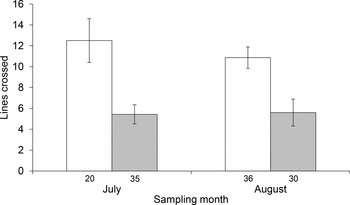
Exploration of the uninfected individuals of E. octoculata was significantly higher compared with infected conspecifics (ANOVA: F 1,117 = 23·48, P < 0·001; Fig. 5). However, exploration was not different between the sampling months [F 1,117 = 0·332, P = 0·565 (month); F 1,117 = 0·506, P = 0·478 (infection status × month)]. Exploration of the infected individuals was also not correlated with the parasite abundance (Pearson correlation: r = −0·004, P = 0·976).
Mean number of lines crossed (±s.e.) in exploration trials conducted with uninfected individuals of E. octoculata (open bars) and those infected with Australapatemon sp. (grey bars). Numbers below the bars indicate number of individuals.

DISCUSSION
Questions regarding parasite specificity among alternative host species in transmission and the spatial and temporal scales in which these operate are important for host–parasite ecology and evolution. However, factors explaining differences in parasite infection, susceptibility to infection and behavioural manipulation by parasites among alternative host species are generally poorly known. Here, we examined spatiotemporal dynamics of infection, host susceptibility and parasite-induced changes in host behaviour in a previously unexplored host–parasite system of Australapatemon sp. infecting two sympatric species of leeches, E. octoculata and H. stagnalis. Overall, we found significant differences in spatiotemporal patterns of infection, susceptibility to infection, rate of metacercarial development, and effects of the parasite on host between the leech species, suggesting that one of the species, E. octoculata, serves as the main transmission route for the parasite to the definitive host. This was also supported by the indirect evidence suggesting stronger responses of E. octoculata against the infection. Interestingly, the marked differences in patterns of infection between the host species were evident in a narrow spatial scale, suggesting fine-tuned interactions between susceptibility and exposure in generating the differences between these sympatric host species.
Trematode infections generally show strong spatial and temporal variation within host populations (Jokela and Lively, Reference Jokela and Lively1995; Granovitch et al. Reference Granovitch, Sergievsky and Sokolova2000; Karvonen et al. Reference Karvonen, Seppälä and Valtonen2004, Reference Karvonen, Cheng and Valtonen2005; Skírnisson et al. Reference Skírnisson, Galaktionov and Kozminsky2004; Byers et al. Reference Byers, Blakeslee, Linder, Cooper and Maguire2008; Faltýnková et al. Reference Faltýnková, Valtonen and Karvonen2008), which may be related to spatial aggregation of infected intermediate or definitive hosts, or to seasonal responses of cercarial emission to ambient temperature. In the present study, we found that infections of Australapatemon sp. were strongly seasonal with the highest abundances observed in July-August. This concurs with the highest prevalence of Australapatemon sp. infection in the first intermediate host, V. macrostoma (Faltýnková et al. Reference Faltýnková, Valtonen and Karvonen2008) and also with dynamics of other trematode species in this system (Karvonen et al. Reference Karvonen, Seppälä and Valtonen2004; Faltýnková et al. Reference Faltýnková, Karvonen and Valtonen2011). The most plausible explanation for these coinciding trematode dynamics is water temperature favourable for transmission. However, we also noted a marked decrease in abundance of Australapatemon sp. in leeches towards September, which was unexpected given that these parasites should accumulate in hosts over time. It is possible that this was caused by higher predation risk or mortality among the infected leeches (see below), or because older and presumably more heavily infected individuals were replaced by younger ones following the life history of the leeches (Elliot, Reference Elliot1973; Murphy and Learner, Reference Murphy and Learner1982a , Reference Murphy and Learner b ).
Apart from seasonality, parasite abundance also showed strong and consistent spatial variation among the sites particularly in E. octoculata. This suggests a narrow distribution of infected snails and a local pattern of infection of the leeches with limited movement of individuals between the locations. This is in accordance with the small-scale differences in trematode infections in the intermediate snail host V. macrostoma in this system (see Faltýnková et al. Reference Faltýnková, Valtonen and Karvonen2008). Although the sampling locations (depths) of that study are not directly comparable to the present one, these results suggest small-scale transmission of the parasite from birds to snails to leeches while the larger-scale patterns of infection, for example, at the scale of the entire lake, need further work. Moreover, while our sampling design was not quantitative regarding abundance of the leeches, the higher sample sizes in the offshore 1 location (Fig. 1) nevertheless suggest concentration of leeches with high infection abundance within a narrow space. Whether such infection ‘hot-spots’ result in higher transmission to definitive hosts compared to more uniform or random distribution of infected leeches, however, is unknown.
In addition to the spatial and temporal variation in infection, we observed a marked difference in the parasite abundance between the leech species in the wild with E. octoculata harbouring, on average, 28-times higher abundances compared with H. stagnalis. In general, differences in infections among individuals or populations arise because of variation in susceptibility and/or exposure (Combes, Reference Combes2001; Poulin, Reference Poulin2007). Following an experimental exposure, we found that both species were susceptible to infection, which concurs with earlier findings on Australapatemon (McCarthy, Reference McCarthy1990). However, individuals of E. octoculata were roughly 2·5-times more susceptible to infection compared to H. stagnalis, although we were able to infect only a limited number of individuals due to low yield of cercariae from the V. macrostoma snails. This suggests that the similar but larger difference in infection observed in the wild (see above) may not be explained by susceptibility alone. Indeed, this suggests a larger role of interspecific differences in parasite exposure, which could be related to factors such as interspecific differences in size or behaviour of the leeches, or details of cercarial host finding. The exact mechanism how this works between these sympatric host species in such a small spatial scale, however, is currently unclear.
We also found that the cysts surrounding the parasite metacercariae were significantly larger in E. octoculata compared to those in H. stagnalis, while there was no difference in size of the metacercariae between the host species. This was also consistent both in natural and experimental infections, while the overall smaller size of the metacercariae and cysts in the latter was likely due to their younger age. It is possible that the larger cyst size could reflect higher response of E. octoculata against the infection if new cyst layers are produced by the host to encapsulate the parasite (see Galaktionov and Dobrovolskiy, Reference Galaktionov and Dobrovolskiy2003). In addition, this may also include multiple layers from the parasite to protect itself from the host (Galaktionov and Dobrovolskiy, Reference Galaktionov and Dobrovolskiy2003), while details of these processes in this system need further work. This could further emphasise the important role of E. octoculata in transmission of Australapatemon: effective host responses may be needed to mitigate effects of high infection abundances observed in the wild. Slower developmental rate of the metacercariae in E. octoculata could also imply stronger host responses. Overall, in terms of transmission, it would be important to know if and how host responses shape metacercarial growth and subsequent infectivity to the final host.
Several parasite species are known to manipulate the phenotype of their host (e.g. Bethel and Holmes, Reference Bethel and Holmes1974; Lafferty and Morris, Reference Lafferty and Morris1996; Lagrue et al. Reference Lagrue, Kaldonski, Perrot-Minnot, Motreuil and Bollache2007; Seppälä et al. Reference Seppälä, Karvonen and Valtonen2008). This is particularly common in complex parasite life cycles, which typically include at least one stage of trophic transmission between hosts. Such manipulation can take place through changes in host appearance or behaviour, which make them more vulnerable to predation. We found that infected E. octoculata spent significantly more time outside the shelter, thus being more exposed than uninfected conspecifics. Infected individuals were also less explorative, which could reflect their impaired ability to seek shelter in an open environment. Both of these processes could potentially increase their susceptibility to predation from avian definitive hosts such as dabbling ducks or diving ducks that readily feed on leeches (Kufel, Reference Kufel1974/1975). Although the definitive host species of these parasites is yet unknown in this system, species of the Anatidae like the common goldeneye (Bucephala clangula), which relies on vision while searching for prey underwater (Lisney et al. Reference Lisney, Stecyk, Kolominsky, Schmidt, Corfield, Iwaniuk and Wylie2013 and references therein), are frequently observed at the study site (A. Karvonen, personal observation) and could be a potential host. Interestingly, the time exposed was not correlated with the parasite abundance in E. octoculata. This suggests that the increase in time exposed from June to August was not caused by the increasing parasite abundance, but could be related to other factors, such as parasite development (see also Benesh et al. Reference Benesh, Hasu, Seppälä and Valtonen2009 for seasonality in host manipulation). In general, host manipulation should commence when parasites have reached infectivity to the next host, which in some cases can result in conflict in manipulation between fully developed parasites actively manipulating the host and developing parasites of the same species aiming to reduce manipulation (e.g. Sparkes et al. Reference Sparkes, Wright, Renwick, Weil, Talkington and Milhalyov2004; Dianne et al. Reference Dianne, Rigaud, Leger, Motreuil, Bauer and Perrot-Minnot2010; Hafer and Milinski, Reference Hafer and Milinski2015). While our results are consistent with the idea of manipulation commencing when most parasites had reached full development (proportion of developed metacercariae increased from July to August), experimental infections and behavioural trials are needed to determine the details of altered host behaviour in this system.
The lack of association between parasite abundance and behaviour in E. octoculata also suggest that the absence of behavioural changes in H. stagnalis is not necessarily caused by the lower parasite abundance in this species. It is possible that transmission of Australapatemon mainly through E. octoculata has led to adaptation in the parasite for this particular host species when mechanisms underlying host manipulation in the primary host species are not functional in another species. We nevertheless observed a decrease in parasite abundance in both leech species towards autumn, which might suggest higher predation towards infected individuals, particularly in E. octoculata where the decrease was more pronounced. Such a decrease could also be caused by natural population dynamics of the leeches (Elliot, Reference Elliot1973; Murphy and Learner, Reference Murphy and Learner1982a , Reference Murphy and Learner b ), or by parasite-induced mortality, while the latter is not supported by the non-significant difference in mortality between infected and uninfected leeches in the laboratory. It should be noted that some animals collected in June-July were kept in the laboratory for some weeks before the behavioural experiments. However, this was unlikely to affect their behaviour as the changes were observed only in the infected individuals while there was no change in the behaviour of the uninfected control leeches treated the same way.
To conclude, we used a combination of different measures of parasite performance such as parasite abundance in the wild, rate of development, anticipated host responses against infection, and host manipulation by parasites, to study infection dynamics of Australapatemon sp. between alternative hosts. We found significant differences in patterns of infection, susceptibility and behaviour in sympatric species of leeches, supporting E. octoculata being the main route of transmission for Australapatemon sp. in this system. The narrow spatiotemporal scale in which these operate also supports earlier findings of local dynamics in parasite species composition and community structure (Faltýnková et al. Reference Faltýnková, Valtonen and Karvonen2008) and suggests that similar fine-scale local processes may function in parasite transmission between hosts.
ACKNOWLEDGEMENTS
We thank the staff of the Konnevesi Research Station for practical help in sampling of the leeches.
FINANCIAL SUPPORT
The study was supported by the University of Jyväskylä, Faculty of Mathematics and Science (A.F. in 2007–2009), grants from the Academy of Finland (A.K., 263864 and 292736), and the Institute of Parasitology, Biology Centre of Czech Academy of Sciences (RVO 60077344).