Medical and surgical advances have led to a dramatic decrease in mortality among newborns and children with congenital cardiac disease, with the vast majority of patients surviving to adulthood.1 Successful treatment, however, depends not only on increased length of survival, but also on the quality of life. Quality of life in adults with congenital cardiac disease has been increasingly examined, and some have shown it to be altered.2–5 Determinants of quality of life are largely unknown in these patients, and correlations between quality of life and physical state have been shown to be poor. Quality of life in patients deemed surgically cured has, surprisingly, not been different from quality of life in patients considered to have had palliative surgery, except for patients with inoperable conditions.3 In this context, it appears important to identify factors that have an impact on health related quality of life in order further to improve the care of the growing population of adults with congenital cardiac malformations.
Atrial tachyarrhythmias, and sinus nodal dysfunction requiring insertion of a pacemaker, are frequent late complications in these patients, and are associated with a decreased exercise tolerance.6–8 In other groups of patients, atrial tachyarrhythmias have been shown to decrease the quality of life.9 Furthermore, catheter ablation of atrial arrhythmias late after surgical repair appears to improve the quality of life.10 We hypothesized, therefore, that brady- and tachyarrhythmias are important determinants of quality of life in adults with congenitally malformed hearts. The aim of our study was to assess prospectively the relation between quality of life and atrial tachyarrhythmias, and/or sinus nodal dysfunction requiring insertion of a pacemaker, in patients with congenitally malformed hearts. A secondary objective was to analyse the impact of haemodynamics and exercise capacity in patients late after atrial redirection for transposition, exposed to progressive degradation of the systemic ventricular function late after the operation, as well as to compare quality of life in patients following palliative versus curative surgery.
Methods
Populations studied
Adults with transposition who had undergone atrial redirection by the Mustard or Senning procedures, and adults with tetralogy of Fallot who had had complete surgical repair, were identified from the database of the Swiss Cardiovascular Center, Bern, and were contacted to be enrolled in the study. The study was approved by the local ethical committee, and written informed consent was obtained from each patient. Patients with learning disabilities, or those living far from the hospital, were excluded from the study.
Clinical parameters
All patients were requested to answer the RAND-36 questionnaire. The RAND-36 questionnaire has been described before, and is commonly used to assess health-related quality of life.11, 12 Briefly, it is based on 36 items divided into eight domains, including physical functioning, role functioning physical, bodily pain, general health perceptions, vitality, social functioning, role functioning emotional, and mental health. Scores range from 0 to 100, with higher scores indicating better subjective health states.11, 12 Scores achieved by age-matched controls in the general population are available for comparison.13 Cardiac rhythm was documented by the 12-lead electrocardiogram, and was assessed retrospectively by collecting information from medical records, and by interviewing the patients and their primary care physician. Electrocardiographic documentation was requested to establish the diagnosis of atrial flutter or atrial fibrillation. In addition, patients with transposition underwent 24-hour ambulatory monitoring, symptom-limited exercise testing, and transthoracic Doppler echocardiography.
Echocardiography
All echocardiographic studies assessed for systemic ventricular function, and atrioventricular valvar regurgitation. The evaluation of ventricular function was based on expert visual assessment, supplemented by objective measurements, including ventricular diameter and planimetry, fractional shortening, and doppler tissue imaging techniques.
Statistical analysis
Results are expressed as mean and standard deviations unless indicated otherwise. Comparisons between two groups with and without arrhythmias, or with palliative versus curative surgery, were made with the unpaired two-tailed Student's t-test, Mann-Whitney U-test, and Chi squared test where appropriate. Comparisons between three groups, for quality of life in patients with and without arrhythmias, as well as in normal controls, were analysed using ANOVA. Multiple regression analysis was performed for each quality of life domain using linear models and including variables univariately associated with low quality of life, in addition to predetermined covariates deemed important, such as age, gender, relevant atrioventricular valvar regurgitation, and impaired systolic ventricular function. A p value of less than 0.05 was considered significant. Statistical calculations were performed using StatView for Windows version 4.57 and SAS statistical software Version 8.
Results
Characteristics of the patients
Of 49 patients with transposition contacted, 32 were included in the study, and of 67 patients with tetralogy of Fallot contacted, 35 were included in the study. Overall median age of the patients was 25 years, ranging between 16 and 62 years. Of the patients with transposition, 22% had undergone a Senning procedure, whereas 78% had undergone the Mustard operation.
Quality of life for patients with and without arrhythmias
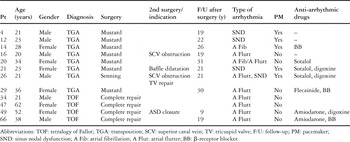
Of all the patients, 18%, including 8 patients with transposition, making up 25% of this group, and 4 patients with tetralogy of Fallot, accounting for 11% of the latter group, had developed clinically relevant tachy- and bradyarrhythmias (Table 1). Of these, 5 patients had developed symptomatic sinus nodal dysfunction requiring the implantation of a pacemaker. Paroxysmal or persistent intra-atrial reentrant tachycardias were found in 9 patients, and 2 of these also had paroxysmal atrial fibrillation. There was no patient with ventricular arrhythmias. Patients with tachyarrhythmias, or those needing a pacemaker, were not significantly older than those without arrhythmias. The mean age at surgery had been similar in both groups. In Figure 1, we show the average scores for quality of life according to the presence of arrhythmias, as well as the scores for the age-matched normative controls. Compared to patients without arrhythmias, and to a normal population, patients with arrhythmias had an impaired quality of life in all 8 domains assessed, with scores 22 to 51 percent lower than in the patients without arrhythmias. The difference was statistically significant for all 8 domains explored.
Table 1. Characteristics of the patients with brady- or tachyarrhythmias.


Figure 1. Scores for quality of life in adults late after surgical repair of congenitally malformed hearts according to presence or absence of arrhythmias, and compared to healthy controls. *p less than 0.01.
Quality of life in patients after palliative versus curative surgery
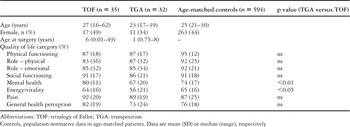
When compared to patients with tetralogy of Fallot, deemed to have had curative surgery, the patients with transposition had slightly poorer scores in the domains exploring energy or vitality, and mental health (Table 2). No significant differences were found for the other 6 domains tested.
Table 2. Comparison of clinical characteristics and quality of life scores between patients with transposition as opposed to those with tetralogy; values of a normal population are given as reference.

Subgroup analysis of patients with transposition
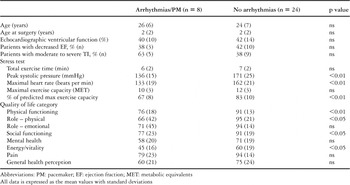
A further analysis was performed in patients with transposition to assess whether an impairment of the function of the systemic ventricle was also associated with lower scores for quality of life. Table 3 summarizes the characteristics of the subgroup of patients late after atrial redirection with and without arrhythmias. Scores for quality of life tended to be lower in all dimensions tested, but this difference reached statistical significance only for the physical functioning, social functioning, role limitations due to physical problems, and vitality. The difference in the other domains did not reach a statistically significant level. Parameters univariately associated with atrial arrhythmias included maximal heart rate, and peak systolic blood pressure during stress testing, as well as the percentage of predicted exercise capacity. Echocardiographic characteristics were similar in both groups.
Table 3. Clinical characteristics of patients late after atrial redirection operation for transposition according to the presence or absence of arrhythmias.

Correlation of quality of life measurements with exercise capacity and echocardiographic data
Maximal exercise capacity was significantly correlated with physical functioning, with an r value of 0.51, physical role, with an r value of 0.59, emotional role, with an r value of 0.46, general health perception, with an r value of 0.50, and bodily pain, with an r value of 0.51.
When compared to patients without relevant atrioventricular valvar regurgitation, the patients with moderate-to-severe atrioventricular valvar regurgitation had significantly lower scores in the dimensions for general health perception, at 61 versus 82% respectively, and physical role, at 69 versus 100%, respectively. No significant differences were found when comparing scores of patients with and without severe impairment of systolic function of the systemic ventricle.
Multivariable logistic regression analysis
For the whole group, arrhythmias were associated with low scores in all 8 domains, with a p value lower than 0.01. In the patients with transposition, the association between arrhythmias and lower scores did not remain statistically significant after adjustment for covariates. Lower scores in the domains of physical functioning, physical role, and general health perception were significantly correlated with lower exercise capacity.
Discussion
The main finding of our study is that, in young adults with congenitally malformed hearts, intermittent or permanent atrial tachyarrhythmias, and/or severe bradycardia requiring insertion of a pacemaker, is associated with a severe impairment of health-related quality of life. Not only the physical dimensions, but also the emotional and social aspects were affected, our patients having either transposition or tetralogy of Fallot.
Multiple logistic regression analysis showed that the associations were independent from age and gender. In the subgroup of patients with transposition, however, the association between impaired quality of life and arrhythmias was not independent from other covariates, including maximal exercise capacity and tricuspid valvar regurgitation. Thus, impairment of quality of life may be due to functional limitation rather than to the arrhythmias. Indeed, arrhythmias may be related to a progressive haemodynamic deterioration, as suggested by Gatzoulis et al.,14 and the interplay between arrhythmias and poor functional status is complex.6, 15 Still, arrhythmias are an important marker of an impaired quality of life, and such patients need intensified care. Conversely, when the patients with arrhythmias are excluded from the analysis, adults with complex congenital cardiac malformations have scores for quality of life that are comparable to those of the general population.
Our study also confirms the surprising observation by Lane et al.3 that quality of life in patients deemed surgically cured is not or only minimally different from quality of life in patients considered to have had palliative surgery. Quality of life in the group with complete repair of tetralogy of Fallot was expected to be better than for those patients studied late after an atrial redirection operation, the latter being exposed to progressive impairment of ventricular function. Scores related to mental health, and energy or vitality, were slightly lower in patients with transposition compared to those with tetralogy of Fallot. The differences in scores between these two groups, nonetheless, are minimal compared to the differences observed when comparing patients with and without arrhythmias.
Limitations of the study
Almost half of the patients we approached declined to be enrolled in the study, and there is no information available on their quality of life and physical state. Our findings, therefore, may not be representative of the overall population. Despite this limitation, we have shown that, in the absence of arrhythmias, quality of life is preserved in adults late after palliative or curative repair of congenital cardiac disease, and that differences in quality of life in patients deemed surgically cured versus those undergoing palliative surgery are minimal. Atrial tachyarrhythmias, and/or sinus nodal dysfunction requiring insertion of a pacemaker, nonetheless, were associated with impaired quality of life. In patients with transposition, the effect of arrhythmias on the quality of life could not be dissociated from a possible effect of impaired exercise tolerance or tricuspid valvar regurgitation.
Acknowledgments
Dr Delacretaz was supported by a grant from the Swiss National Research Foundation (632-066101).