1. Introduction
Probably one of the most challenging issues in the context of multiple language acquisition is the role played by prior linguistic knowledge on the acquisition of a third or additional language (henceforth, TLA). The study that will be presented here contributes to this line of investigation, by looking at the interaction of various languages in the mind of the multilingual learner as a result of simultaneous activation.
1.1 Co-activation and information blending in TLA
A key concern in TLA is the co-activation or simultaneous activation of some or all the languages of the multilingual learner (see reviews in De Angelis, Reference De Angelis2007; Hammarberg, Reference Hammarberg2009; Leung, Reference Leung2009; Ringbom, Reference Ringbom2007; also the empirical evidence put together in Cenoz, Hufeisen & Jessner, Reference Cenoz, Hufeisen and Jessner2001, Reference Cenoz, Hufeisen and Jessner2003). Cross-language activation and competition in their turn foster the establishment of interlingual connections between lexical items in the mind of bilinguals and multilinguals (Dechert, Reference Dechert2006; Dechert & Raupach, Reference Dechert and Raupach1989; Paradis, Reference Paradis1993). These connections are defined as associative chains across languages, and they ultimately form a network of interlinguistic links underlying each level of linguistic structure (Paradis, Reference Paradis1985). On the assumption that the subsystems of the multilingual lexicon are interlinked (Abunuwara, Reference Abunuwara1992; Herwig, Reference Herwig2001; Mägiste, Reference Mägiste and Vaid1986; Paradis, Reference Paradis1985, Reference Paradis1993; Schönpflug, Reference Schönpflug2000, Reference Schönpflug2003), interlingual connections need to be understood in terms of connectivity between them (Abunuwara, Reference Abunuwara1992; Herwig, Reference Herwig2001). These subsystems are lexical–conceptual structure (i.e. semantic and pragmatic information), predicate–argument structure (i.e. arguments of the verb in terms of its subcategorization frame and their thematic roles), and morphological realisation patterns (i.e. word order, case, agreement, tense/aspect marking) (Barsalou, Reference Barsalou1992; Boas, Reference Boas2003; Bolonyai, Reference Bolonyai1998; Jackendoff, Reference Jackendoff1987; Reference Jackendoff1990; Levin & Rappaport Hovav, Reference Levin, Rappaport Hovav, Maienborn, von Heusinger and Portner2011; Myers-Scotton & Jake, Reference Myers-Scotton and Jake1995, Reference Myers-Scotton and Jake2000; Pustejovsky, Reference Pustejovsky1995; Sharwood Smith, Reference Sharwood Smith, Everaert, Lentz, de Mulder, Nilsen and Zondervan2010; Talmy, Reference Talmy and Shopen1985).
Research on interlingual connections in TLA suggests that the languages of a multilingual are intertwined, and interconnected at a lexical level at the beginning of the acquisition process (De Bot, Reference De Bot2004; Herwig, Reference Herwig2001; Wei, Reference Wei2006). This is precisely the case in the low-proficiency learners of the present study (see Section 3.1). Supportive evidence for this kind of interlingual connection has been found in a number of studies (e.g. Abunuwara, Reference Abunuwara1992; Herwig, Reference Herwig2001; Mägiste, Reference Mägiste1979, Reference Mägiste1985, Reference Mägiste1986; Ringbom, Reference Ringbom, Nickels and Nehls1982; Schönpflug, Reference Schönpflug2000, Reference Schönpflug2003; Shanon, Reference Shanon1991), especially during the processing of lexical items that appear to be similar across languages (Chen & Leung, Reference Chen and Leung1989; De Groot & Hoeks, Reference De Groot and Hoeks1995; Kroll & Stewart, Reference Kroll and Stewart1994; Mägiste, Reference Mägiste1979, Reference Mägiste1985). Moreover, the case for associative chains and interlingual connections across languages is strengthened by the fact that the evidence reported comes from studies that use a variety of instruments (e.g. Stroop interference tests, translation tasks, acceptability judgements).
According to these studies, the activation of the background languages L1 or the L2Footnote 1 is higher than that of the target language (TL) due to learners’ reliance on connections between words in one of the background languages and the TL. These connections are particularly evident at times when learners try to understand and produce words in the L3, while they are struggling to retrieve a given word. In this sense, one of the most obvious linguistic manifestations of cross-language activation is the convergence or blending of information from two or more of the languages of the multilingual. Crucially, linguistic material can be integrated in various ways, a case in point being that of blending, which involves the mixing of linguistic material from different language systems in word construction attempts (Poulisse, Reference Poulisse2000; Poulisse & Bongaerts, Reference Poulisse and Bongaerts1994; Ringbom, Reference Ringbom1987).
Blends are occurrences of intra-word mixing (or intra-word switching in the literature on code-switching), that may be motivated by social, contextual, situational or pragmatic reasons. In the field of TLA (and also SLA), the focus is on crosslinguistic influence (CLI), and a fruitful area of inquiry relates to the roles played by each of the learner's background languages in word construction attempts when three or more languages come into play. Hence, in TLA, the term “blend” is commonly employed in a broader sense to refer to non-words where lexemes and morphemes from the L1, L2s and L3 are combined in different ways and directions (Bouvy, Reference Bouvy2000; Christen & Näf, Reference Christen, Näf, Adamzik and Christen2001; De Angelis & Selinker, Reference De Angelis and Selinker2001; Dewaele, Reference Dewaele1998, Sikogukira, Reference Sikogukira1993; Singleton, Reference Singleton1987; Tremblay, Reference Tremblay2004).
In spite of this broader use, Ringbom (Reference Ringbom1987, Reference Ringbom2001, Reference Ringbom2007) proposed a comprehensive taxonomy of blending that highlights the process underlying the occurrence of particular types of language interaction, of which he identifies three main types, i.e. hybrids, relexifications and blends (Ringbom, Reference Ringbom2007, p. 82). In this taxonomy, a hybrid is defined as a form consisting of morphemes from both the L1 or L2 and the L3 (example (1)). On the other hand, relexifications (example (2)) are forms in the L1 or L2 that are morphologically adapted to the L3. Finally, the use of the term “blend”, despite denoting cases of information blending comparable to that in hybrids, is restricted to forms where an L1 or L2 ending is inserted into an L3 word (see also Gabryś-Barker, Reference Gabryś-Barker2006; Poulisse & Bongaerts, Reference Poulisse and Bongaerts1994). Therefore, one may distinguish the blending in (3)–(6) below from hybrids such as he cwame “he came” (Dutch kwam “came” and English came) or elchother “each other” (Dutch elkaar “each other” and English each other), discussed in Poulisse (Reference Poulisse2000) and Poulisse and Bongaerts (Reference Poulisse and Bongaerts1994).
-
(1) All these wooden golves must be cleaned.
Swedish golv “floor” (singular and plural), English plural ending (-e)s
-
(2) I couldn't speak about allthing with them.
Swedish allting “everything”, English everything
-
(3) I was much pigger after the walking out.
Swedish pigg “refreshed”, English comparative ending -er
The empirical evidence on L1–L2–L3 blending from several studies in TLA seems to point to the L2 as the preferred supplier languageFootnote 2 as regards word construction attempts in L3 (Bardel & Lindqvist, Reference Bardel, Lindqvist, Chini, Desideri, Favilla and Pallotti2007; Bouvy, Reference Bouvy2000; Christen & Näf, Reference Christen, Näf, Adamzik and Christen2001; De Angelis & Selinker, Reference De Angelis and Selinker2001; Dewaele, Reference Dewaele1998; Gabryś-Barker, Reference Gabryś-Barker2006; Ringbom, Reference Ringbom1987; Singleton, Reference Singleton1987), as will be discussed below. Indeed, the term “morphological interlanguage transfer” (De Angelis & Selinker, Reference De Angelis and Selinker2001) has been coined specifically to describe the distinctive interaction and blending that occurs between two non-native languages. The authors define it as “the production of interlanguage forms in which a free or bound non-target morpheme is mixed with a different free or bound target morpheme to form an approximated target language word” (p. 43). Examples (4)–(6) below, taken from De Angelis and Selinker (Reference De Angelis and Selinker2001, p. 53), illustrate blending involving two non-native languages in adult English-speaking learners.
-
(4) aiud arono
L1 English “helped”, L2 Spanish ayudaron, L3 Italian aiutarono
-
(5) isol ada
L1 English “isolated”, L2 Spanish aislada, L3 Italian isolata
-
(6) ucc ido
L1 English “killed”, L2 Spanish past participle bound morpheme -ido, L3 Italian ucciso
These examples show the activation and blending of stems (example (4)) and bound morphemes (examples (5) and (6)) from L2 Spanish with stems and morphemes in L3 Italian. This interlanguage production pinpoints the possibility of information blending between the target language (L3) and another, non-intended one (L2). Moreover, it is supportive of the importance of interlingual connections between non-native languages.
Dewaele (Reference Dewaele1998) investigated two groups of Dutch learners who were studying French at university and differed in the status this language had in their linguistic repertoires. For one of the groups, French was an L3, and for the other it was an L2. The learners in the two groups were found to make different choices regarding the supplier language in their word construction attempts. While learners with L2 French resorted to their L1 Dutch, the preferred choice of the learners with L3 French was their L2 English (see (7) and (8)). A substantial amount of interaction between the L2 English and the L3 French resulted in forms whose first half is provided by a lemmaFootnote 3 belonging to one language and the middle part and/or the ending corresponding to the other language.
-
(7) imprinter
L2 English print, L3 French imprimer “print”
-
(8) orgle
L1 Dutch orgel “organ”, L2 French orgue “organ”
Other studies have found similar results regarding this kind of interaction and the primacy of the L2, albeit relying on distinct language combinations, especially with L1 Hungarian–L2 German–L3 English adults (Clyne & Mocnay, Reference Clyne, Mocnay, Bührig and Matras1999), and L1 Dutch–L2 German–L3 English (Clyne & Cain, Reference Clyne, Cain, Hirschfelder, Schell and Schrutka-Rechenstamm2000). The same effects have also been observed where these languages had been acquired in a different chronological order both with L1 French–L2 Dutch–L3 German children (Dauven-van Knippenberg, Reference Dauven-van Knippenberg1996) and with L1 German–L2 English/French–L3 Dutch adults (De Vriendt, Reference De Vriendt1972). In Norwegian adult learners of L3 Swedish, Herwig (Reference Herwig2001) identified L2 German as the most readily accessible language during a written translation task, and thus as the main supplier language. Similar results were also obtained by Gabryś-Barker (Reference Gabryś-Barker2006, p. 161) in her study of L1 Portuguese–L2 English–L3 German adults, although for the most part only the languages involved in the L1–L3 or L2–L3 translation tasks were activated. Unfortunately, the extent to which blending occurred cannot be ascertained for the last study because the author did not offer any quantification of her data.
Bouvy (Reference Bouvy2000) analyzed the L3 written English of Belgian business administration students, whose L1 was French, and whose L2 was either German or Dutch. It turned out that only the L2s were supplier languages in word construction attempts, with lexemes and morphemes from the L3 and the L2s combining in different ways. In contrast, the L1 seemed to be apparently blocked as no trace of it was found in the corpus, of which the kind of word construction attempts under investigation here represented a 7% of the total amount of occurrences of CLI.
The same kind of L1 blocking has also been attested in oral production. A case study by Bardel and Lindqvist (Reference Bardel, Lindqvist, Chini, Desideri, Favilla and Pallotti2007) inquired into the influence of L1 Swedish along with the prior non-native languages English, French and Spanish on Italian. Again, no trace was found of L1 Swedish, in contrast to the influence of the other languages. However, the pattern of influence was not homogeneous across the prior non-native languages due to the predominance of French, a language the learner was highly proficient in. This pattern is interesting because, from a language proximity perspective, one might have expected Spanish to be the supplier language given the strong similarities between Spanish and Italian (although Spanish, Italian and French are all Romance languages). It may have been influenced by the fact that the learner was not very proficient in Spanish, which probably prevented it from becoming a supplier language in the creation of new words. Undeniably, the proficiency factor plays a role, but its precise nature is not clear (see also Tremblay, Reference Tremblay2004; Sánchez, Reference Sánchez2014). Thus, if the non-native language the learner was most proficient in was in fact most relevant as a supplier language, then English would have been the most likely candidate, which was not the case.
Interlingual connections between non-native Romance languages have also been documented elsewhere. Singleton (Reference Singleton1987) investigated the influence of L1 English and prior non-native languages (Irish, Latin and Spanish) on the French oral production of a university student. The results indicate an unambiguous preference for Spanish over the other languages, in sharp contrast to the absence of influence from Irish and Latin. However, the participant's proficiency in the non-native languages was unbalanced, as he was advanced in Spanish but hardly literate in the other two languages. Moreover, while these languages had been learnt in secondary school, Spanish was the language acquired most recently and partially through naturalistic exposure. Hence, it may come as no surprise that Spanish was found to be the main supplier language.
It is worth pointing out that a great deal of CLI and blending in TLA is caused by the activation of information contained in the three subsystems of lexical structure referred to above (De Angelis & Selinker, Reference De Angelis and Selinker2001; Dewaele, Reference Dewaele1998; Ecke & Hall, Reference Ecke and Hall2000; Hall, Newbrand, Ecke, Sperr, Marchand & Hayes, Reference Hall, Newbrand, Ecke, Sperr, Marchand and Hayes2009; Hammarberg, Reference Hammarberg2001, Reference Hammarberg2009; Wei, Reference Wei2006; Williams & Hammarberg, Reference Williams and Hammarberg1998). Accordingly, the activation of linguistic knowledge from prior background languages has an effect both on the lexeme and the lemma of a given lexical item (e.g. Hammarberg, Reference Hammarberg2001, Reference Hammarberg2009; Williams & Hammarberg, Reference Williams and Hammarberg1998). The core of this argument is that information in lemmas that belong to the TL is activated in parallel with that in a language other than the TL (Ecke, Reference Ecke2003; Ecke & Hall, Reference Ecke and Hall1998, Reference Bouvy2000; Hall & Ecke, Reference Hall and Ecke2003; Hall et al., Reference Hall, Newbrand, Ecke, Sperr, Marchand and Hayes2009; Wei, Reference Wei2006).
In sum, the studies reviewed in this section point towards L2/L3 co-activation in TLA, which brings about blending in the mind of the multilingual learner. The evidence at our disposal is based on data collected at a single point in time, which can provide only a partial view of what is actually going on when interlanguage develops. Consequently, the lack of empirical evidence on the progression of L2 activation and of the kind of interaction taking place between the L2 and the L3 as a result of blending calls for a systematic study. Moreover, the population investigated in these studies is mostly adult, while less work has been done with younger learners and adolescents, with the exception of a study by Sánchez (Reference Sánchez2003, Reference Sánchez2012), which investigated 11- and 13-year-olds with the same language combination as in the present study. For these reasons it seems profitable to bridge this gap by studying whether the L2 activates to the same extent in children (where there is often concurrent acquisition of the L2 and the L3), and whether non-native language interaction is alike at different ages.
The current section has discussed critical issues in proposals that apply to blending in word construction attempts in general, and to the role that the prior linguistic knowledge of the L1 and other background languages plays in these attempts. The next section is concerned with verbal forms, and reviews the relatively small amount of research on blending reported in the literature on simultaneous first language acquisition that specifically addresses verbal forms.
1.2 Blending in verbal forms
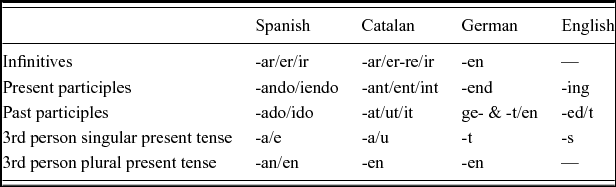
In reviewing the empirical evidence concerning the blending of verbal forms, the most important consideration from a theoretical perspective has to do with representational and processing mechanisms of inflected word forms, in this case the verbal forms under investigation. Before delving into these, it is necessary to contextualize the study. Table 1 presents the inflectional paradigms of Spanish, Catalan, German and English, summarizing the specific inflectional morphemes that each of these languages uses to mark the 3rd person singular and plural (present tense), the infinitive, the present participle and the past participle.
Inflectional paradigms of Spanish, Catalan, German and English.

Spanish and Catalan are morphologically rich languages, as is German, though to a lesser extent. In contrast, English is a morphologically poor language, and uses essentially three suffixes (-s, -ed, -ing). The Romance languages use various suffixes in the formation of each of the inflectional forms provided in Table 1, which are typologically similar to each other. German is the only language of the four that uses a prefix and a suffix to form the past participle. Moreover, both German and English use a consonant to mark 3rd person singular, in contrast to the vowels in Spanish and Catalan.
It is worth highlighting that word construction attempts involving verbal forms are assumed to be grounded on a process of “overregularization” (Clahsen, Aveledo & Roca, Reference Clahsen, Aveledo and Roca2002). As a consequence of this overregularization, a great deal of incorrect morpheme usage, above all with irregular verbs, results from the overextension of default affixation rules. This is due, in part, to the separate storage of lexical and grammatical information, as demonstrated in the literature on bilingual memory (e.g. De Bot & Schreuder, Reference De Bot, Schreuder, Schreuder and Weltens1993; Dijkstra, Reference Dijkstra2003; Levelt, Reference Levelt1989; Poulisse & Bongaerts, Reference Poulisse and Bongaerts1994) and in studies on morphological development (e.g. Clahsen et al., Reference Clahsen, Aveledo and Roca2002; Pinker & Prince, Reference Pinker and Prince1992). The main implication of this idea is that the lexeme/stem and the inflectional morphology of the verb are dissociated, that is, they have separate representational systems (Clahsen et al., Reference Clahsen, Aveledo and Roca2002; Myers-Scotton & Jake, Reference Myers-Scotton and Jake2000). As a result, they can be accessed separately, which allows the separate manipulation of stems and inflectional endings (Clahsen et al., Reference Clahsen, Aveledo and Roca2002, p. 615). In turn, this opens up the possibility that different languages may affect different types of verbal information.
There are few empirical studies of verbal blending within TLA, with the exception of Bouvy (Reference Bouvy2000). The field of simultaneous first language acquisition, however, has provided abundant evidence from various language pairings, for instance Italian–French (Müller & Hulk, Reference Müller and Hulk2001), French–Dutch (Hulk & Van der Linden, Reference Hulk, Van der Linden, Kellerman, Weltens and Bongaerts1996), German–Italian (e.g. Müller, Cantone, Kupisch & Schmitz, Reference Müller, Cantone, Kupisch and Schmitz2002), English–Dutch (De Houwer, Reference De Houwer1997), Swedish–Finnish (Huss, Reference Huss1991) and Swedish–French or Swedish–Italian (Bernardini & Schlyter, Reference Bernardini and Schlyter2004). With relevance to the present study, work on blends involving verbal forms in the combination German–English has been reported in various studies by Gawlitzek-Maiwald and by Tracy, whose findings are discussed in the following paragraphs (Gawlitzek-Maiwald, Reference Gawlitzek-Maiwald and Döpke2000, Reference Gawlitzek-Maiwald2001; Gawlitzek-Maiwald & Tracy, Reference Gawlitzek-Maiwald and Tracy1996; Tracy, Reference Tracy1996; Tracy & Gawlitzek-Maiwald, Reference Tracy and Gawlitzek-Maiwald2005).
The following examples (9)–(13) are adapted from Tracy (Reference Tracy1996), Gawlitzek-Maiwald (Reference Gawlitzek-Maiwald2001) and Gawlitzek-Maiwald & Tracy (Reference Gawlitzek-Maiwald and Tracy1996). They illustrate the interaction of English and German, and the linguistic manifestation of such interaction in blended verbal forms (compare with English–Dutch in De Houwer, Reference De Houwer1997). The learners’ ages are indicated in brackets, and the blended forms appear in bold. The data examined by these authors provide confirmation of blending in verbal forms in the German–English language pairing.
Gawlitzek-Maiwald (Reference Gawlitzek-Maiwald2001) reports word construction attempts such as goen “we go” (example (9) below), which is a mixture of the English lexeme go and the German morpheme -en (1st person plural as in gehen “we go”). This type of blending is informative of the sort of language interaction that is at work during the processing of these word construction attempts. In (9)–(13), the verb combines an English stem with inflectional morphemes of the two languages, in particular the German prefix ge- for the formation of past participles, and the English suffix -ed, as in (10)–(13).
-
(9) we goen shopping (3.1 years)
“we go shopping”
-
(10) Ich habe gemade you much better (2.4 years)
“I have made you much better”
-
(11) Kiwi . . . du hast gebuyed them? (2.3 years)
“Kiwi . . . you have bought them?”
-
(12) Ich hab geclimbed up (2.4 years)
“I have climbed up”
-
(13) aber ich habe gethinke des (3.7 years)
“but I have thought this”
In addition, these examples also reveal that co-activation involves equivalents that are “often, though not exclusively, phonologically and semantically similar items” (Tracy & Gawlitzek-Maiwald, Reference Tracy and Gawlitzek-Maiwald2005, p. 50, emphasis added). Thus, the stem of the word construction attempt in (12) is climb in English, while its translation equivalent in German is hinaufsteigen, which is formally and phonetically fairly dissimilar. The same is true of buy, the German for which is kaufen (example (11)), and to a lesser extent also of think (German denken, example (13)).
2. Research questions
The present study follows on from the research sketched in the Literature Review, addressing some of the empirical gaps outlined in Sections 1.1 and 1.2. It expands the scope of prior investigation by looking at the evolution over time of L2/L3 blending within the first 200 hours of instruction in the L3. The study is guided by two research questions that inquire into the role that the simultaneous activation of one or more previously known language(s) plays on the occurrence of blending. The first research question (RQ1) asks about the kind of background language interaction that leads to information blending. The second question (RQ2) aims at ascertaining how the level of activation of the background languages is readjusted over time, and what the consequences of this readjustment are for blending. In the absence of previous research on blending involving verbal forms in TLA, no strong prediction can be made. Nonetheless, in light of the literature reviewed in Sections 1.1 and 1.2, it may be reasonable to expect the learners’ two non-native languages (L2 German and L3 English) to activate in parallel. The activation of the L2 may further be expected to prevent the activation of the L1s (Spanish and Catalan) and to lead to L2/L3 blending.
The research questions are as follows:
-
RQ1: Do background languages (L1s Spanish/Catalan, L2 German) activate in parallel with L3 English during word construction attempts involving verbal forms in this language? If so, which is the source language of blending?
-
RQ2: How do background language activation and blending evolve over time with increasing age and input?
3. Method
3.1 Participants
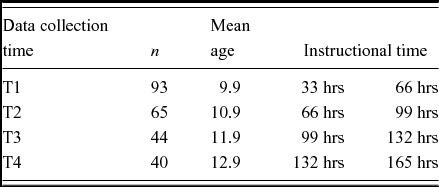
In order to answer these research questions, 93 learners of L3 English were recruited and followed longitudinally over the course of four years. Table 2 presents background information about the participants.
Overview of the participants.

The learners were native speakers of Spanish and Catalan; that is to say, they were simultaneous bilinguals, even though they used these languages to different degrees in their everyday lives. Moreover, they had received language and content instruction in these languages from the very beginning of their schooling. For them, English was not the first but the second foreign language, as they had also been learning German since the age of 6, starting in Grade 1 in primary school.
They were learning the L2 German in a programme that combined language learning and contents. Thus, around half of the school subjects, such as history, geography and arts, were taught in German, in addition to the German language classes, while the other half of subjects were taught either in Spanish or in Catalan, again in addition to designated courses in those languages. Except for occasional extracurricular activities organized by the school, the use of German by these learners was virtually limited to the classroom. This is due to the fact that their parents were native speakers of Spanish and Catalan, who often had little or no knowledge of German. Learners were encouraged to address each of their teachers in his or her language of communication within the classroom, i.e. Spanish in the Spanish language or content classes, German in German language or content classes, etc. They were, however, free to use any language at play time (which was exclusively Spanish or Catalan, as observed by the author throughout the period analyzed). In spite of their concentrated exposure to the L2 German, these learners’ knowledge of German was still fairly limited (Sánchez, Reference Sánchez2009, Reference Sánchez, De Angelis and Dewaele2011a, Reference Sánchez2011b, Reference Sánchez2011c).
The participants had been learning their L3 English as a foreign language since Grade 4 in primary school, when they were 9 years old. The acquisitional setting corresponds to a situation where input was restricted exclusively to curricular exposure at school. That is, learners did not have any extracurricular formal instruction or naturalistic exposure to L3 English outside school prior to or during the data collection. Therefore, the acquisition of the L3 English was taking place in a setting where this language is not present in the wider environment, and it followed a traditional language teaching model within a communication-oriented programme.
Data from these learners were collected during the month of May in four consecutive years starting after their first year of learning English. Two cohorts of learners, who started learning English in consecutive years, were sampled. At the time of the first data collection (T1), learners were on average 9.9 years old. Data were collected a second time (T2) when they were 10.9, and then again at the ages of 11.9 (T3) and 12.9 (T4). Even though the initial number of participants was 93, only data from a subsample of them (n = 40) could be included in the four-year longitudinal analysis. This is because, as learners grew older, some began to take extracurricular lessons or received naturalistic exposure during stays abroad, as indicated in a questionnaire they were administered (see Section 3.2). Such learners were removed from subsequent analyses, which explains the decrease in number of learners across data collection times in Table 2.
The learners had received either 1 or 2 hours of instruction per week at each data collection time, resulting in total exposure times of 33/66 hours at T1, 66/99 hours at T2, 99/132 at T3, and 132/165 hours at T4. The reason for this difference in hours of instruction per week is that data from each age group were collected in two different years. After the first year of data collection, parents had become quite sensitive to language learning and felt that only one hour of instruction per week was insufficient. Their wish encouraged the school to introduce changes in the school curriculum, in such a way that the number of weekly hours was increased to 2 in the case of the learners whose data were collected at T1 in the second year. At each data collection time, though, the learners constitute a single group (as column 2 in this table shows). This is because learners at each T1, T2, T3 and T4 were the same age. More importantly, there were no significant differences related to instructional time, as shown by a Mann–Whitney U test run on the data to ensure comparability of the samples at each data collection time (p = .558 at T1, p = .736 at T2, and p = .406 at T3; at T4 the incidence of blending was rather low, so no inferential statistics is reported). In addition, the statistical tests employed focused on each learner's development over time, and independently of accumulated instructional time (see Sections 3.4 and 4.2).
3.2 Instruments
The data elicitation techniques used at each data collection time were a questionnaire and a written picture story telling task. All potential participants filled out a screening questionnaire, which was based on an already existing model used in sociolinguistic studies, Baker and Prys Jones's (Reference Baker and Prys Jones1998) bilingual questionnaire. The questionnaire was adapted to the multilingual acquisition setting analyzed in the present study. To this end, a set of questions was designed that surveyed the use of the four languages in the linguistic constellation examined here in the learners’ home and family environments. The questionnaire was then validated by the author.
The corpus comprised data elicited using a written narrative based on a story telling task. This task was The Dog Story (Heaton, Reference Heaton1966), which consists of a series of visual stimuli depicted in six pictures (see Appendix). This is one of the tests extensively used by the GRAL Research Group,Footnote 4 for example in the analysis of CLI (Sánchez, Reference Sánchez2011b, Reference Sánchez2011c; Sánchez & Jarvis, Reference Sánchez and Jarvis2008).
3.3 Procedure
The questionnaire and the narrative task were administered in class time, and in the presence of the learners’ teacher and the author. The instructions for the tasks were given in English (the target language), even though requests for clarification in Spanish and/or Catalan were responded to in these languages. The questionnaire was administered to the entire class on all occasions. Learners were allotted 15 minutes to write the narrative depicted in the story. They were not permitted to use dictionaries, nor grammar books or any other reference tools. Learners were explicitly informed that the test would not be graded. They had no time for preparation, but they had the series of pictures in front of them while doing the task.
3.4 Data analysis
The software selected for coding the data and the qualitative analysis was NVivo (www.qsrinternational.com, version 9). The data analysis, which was data-driven, concentrated on the search for thematic and non-thematic verbal forms exhibiting blending. The results of this qualitative analysis were later quantified and submitted to statistical treatment using SPSS (version 18) after noting the raw frequency of the occurrence of blending as a continuous variable.
4. Results
This section presents the results of the study. The answer to RQ1 was confirmatory, in that background language activation was attested during word construction attempts involving verbal forms in L3 English. To be more precise, the language that was found to be activated in parallel with the L3 was the L2. Critically, L2 German was the only source language of blending observed and became the supplier language in the construction of verbal forms. Because no single occurrence of blending involving the L3 English and the L1s Spanish or Catalan was detected in the entire corpus, the remaining part of this section is devoted to the description of L2 German activation and blending (see further details on these learners’ inhibition of L1s Spanish/Catalan in Sánchez, Reference Sánchez2011c).
4.1 Evidence of L2 activation and L2/L3 blending
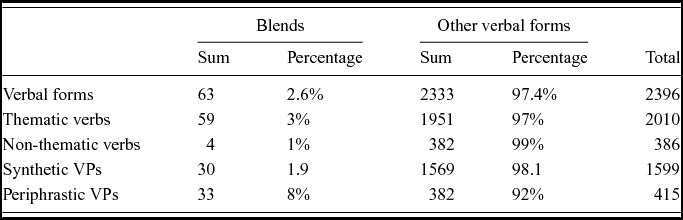
It is important to recall at this point that the uncontrolled nature of the narrative task employed in the elicitation technique did not force learners to use the linguistic feature examined. On the contrary, since target-like forms were expected in completing the task, no blending in verbal forms should have been observed. This section discusses the overall representativeness of L2/L3 blending, starting with an in-depth description of the kinds of verbal blending found in the data. Table 3 shows the raw frequency and percentage of blended and non-blended forms affecting thematic verbs, non-thematic verbs, synthetic verb phrases and periphrastic verb phrases.
Frequency and percentage of blended and non-blended verbal forms.

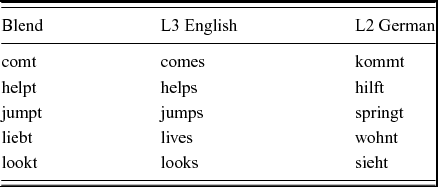
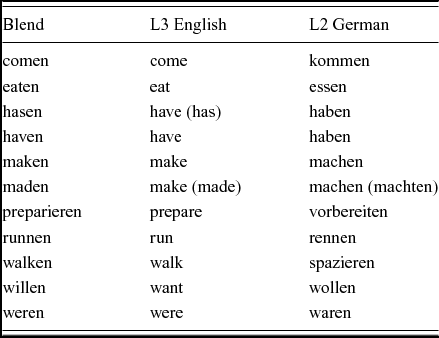
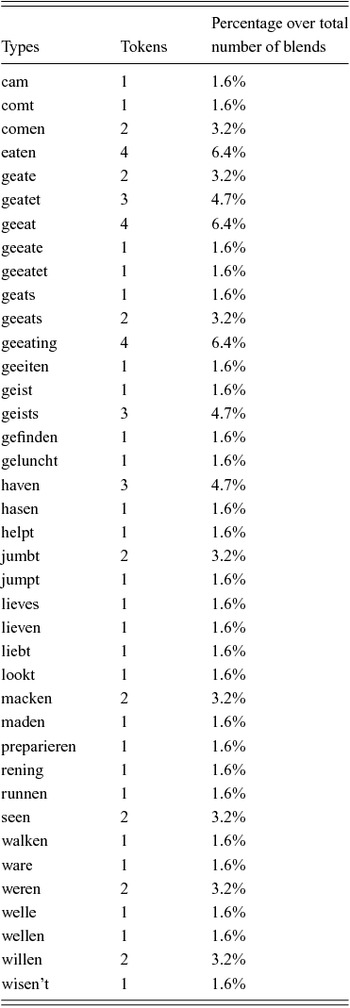
Some of the most recurrent blends in the corpus, which are presented in Tables 4 and 5, appeared in the data as soon as the first evidence of inflection in L3 English is observed (see Section 4.2).
Blends of an L3 English lexeme and the L2 German suffix ‘-t’.

Blends of an L3 English lexeme and the L2 German suffix ‘-en’.

A closer inspection of the blends encountered made it possible to identify a range of subcategories and processes. The most productive type of blend involved a process of suffixation, whereby an English lexeme was combined with a German inflectional morpheme. One of the suffixes was the inflectional morpheme -t, which is the equivalent of the English 3rd person singular -s. This is illustrated in Table 4, which shows how this type of blend affected, first and foremost, thematic verbs in synthetic verb phrases.
Another productive type of blend involved the use of the German inflectional morpheme -en, especially with thematic verbs (see Table 5). This morpheme has various functions (it can mark, for example, infinitive, 1st person plural and 3rd person plural), but there is no one-to-one correspondence with English, which has no surface morpheme for these functions. This was, by far, the most extensively used combination in the entire corpus.
As we can see, a great number of blends affected non-finite verbs, especially infinitives, again in synthetic verb phrases. Nonetheless, it was also observed in non-thematic verbs such as weren “they were” (example (14)) where the German suffix -en, from German waren “they were”, was added to the English past form of the verb to be, were. Another example is the verb to have, where the German suffix -en was added to the English auxiliary has in a construction with a plural subject (hasen “they have”, example (15)), or even to the English infinitive have (haven “to have”, example (16)).
-
(14) When they in the mountain weren
“When they were on the mountain”
-
(15) Sarah and Jim hasen in the mountains gegangen
“Sarah and Jim have gone to the mountains”
-
(16) The children haven the sandwich gemacht
“The children have made the sandwich”
Two occurrences that deserve special consideration in Table 5 are willen “they want” and maden “they made”. The lexeme in the first one does not correspond to the English tense marker will that expresses futurity (examples (17)–(18)). Instead, it expresses volition in a way analogous to the verb want, as can be inferred from the context immediately preceding and following the blend, as in (18). The second one, maden, combines the English inflected verb made with the German suffix –en (example (19)).
-
(17) Pati and Luca willen a piknig machen
“Pati and Luca want to make a picnic”
-
(18) They willen a Picknick eat, but the dog eat the Picknich
“They want to eat the picnic, but the dog ate the picnic”
-
(19) Two Childrens maden the food and “legen” in the basket
“Two children made food and put it in the basket”
The blends in the tables above show that the most noteworthy quality of the suffixation processes is the combination of L2 German suffixes with L3 English lexemes. In other words, L3 English suffixes were not combined with L2 German lexemes, with the exception of (20), where German ren(n)- “run” combines with the English morpheme -ing in the formation of a verb in the present continuous tense. This is particularly interesting because German has no progressive tenses.
-
(20) The dog rening in the berg
“The dog is running on the mountain”
The same patterns were observed with prefixation processes. In addition to the patterns described so far, the kind of blending investigated here often involved a combination of an L3 English lexeme + an L2 German suffix in past participles that included a German prefix as well (i.e. L2 German prefix + L3 English lexeme + L2 German suffix). Examples (21) and (22) show blends formed on the basis of English eat. In (21), the German prefix ge- is added to an English finite form, i.e. the third person singular eats. Similarly, in (22) this prefix is added to the English progressive eating. In (23), gefinden is an infinitive (English find) that combines with the German prefix and suffix for the formation of a past participle.
-
(21) geeats
L3 English eats (3rd person singular present simple)/eaten (past participle), L2 German isst (3rd person singular present simple)/gegessen (past participle)
-
(22) geeating
L3 English eating (progressive)/eaten (past participle), L2 German gegessen (past participle)
-
(23) gefinden
L3 English find (infinitive)/found (past participle), L2 German finden (infinitive)/gefunden (past participle)
On other occasions, the L2 German prefix was added to an uninflected L3 English lexeme as in the bare infinitive eat (example (24)). Alternatively, it was added to an English preterite form like ate (example (25)), or an attempted irregular past participle even if this is misspelt as eiten (example (26)), which from a formal point of view resembles English eaten, while from a phonological point of view it is similar both to eat and to eaten. Moreover, the past participle both in English (eaten) and in German (gegessen) is irregular. In German, it would entail the use of the suffix -en (instead of -(e)t, as in regular verbs). Thus, the suffix in this specific word construction attempt might either correspond to this German irregular past participle, or to an intended participle in English. A similar word construction attempt is observed in geeatet (example (27)), where the same ambiguous explanation of the suffix is plausible. Apart from the suffix used at the end of the word, what matters here is the kind of interlingual connection exhibited in the blending of the L2 German prefix and the L3 English lexeme.
-
(24) geeat
L3 English eat (infinitive)/eaten (past participle), L2 German essen (infinitive)/gegessen (past participle)
-
(25) geeate
L3 English eat (infinitive)/eaten (past participle)/ate (past simple), L2 German essen (infinitive)/gegessen (past participle)/aß (past simple)
-
(26) geeiten
L3 English eat (infinitive)/eaten (past participle), L2 German essen (infinitive)/gegessen (past participle)
-
(27) geeatet
L3 English eat (infinitive)/eaten (past participle)/ate (preterite), L2 German essen (infinitive)/gegessen (past participle)/aß (preterite)
Yet another pattern, not very productive but still present in the data, resulted from the combination of L2 German prefix + L3 English lexeme + L2 German suffix, where learners used an English noun instead of an English verb (example (29)).
Besides the blends illustrated above and in Tables 4 and 5, evidence of information blending was also manifested in hybrids (examples (28) and (29)). In this case, linguistic material from the L2 and the L3 was merged in forms where the morphemes from the two languages could not be separated straightforwardly. These word construction attempts occurred in the data, though to a much lesser extent. Moreover, most of them occurred only once in the corpus, and therefore were excluded from the statistical analyses reported in Section 4.2. The form of wisen’t “don't know” in (28), merges the English negator not with the German wissen (“know” in the third person plural). That is not the only instance where this negator is blended with a German verb. The word construction attempt haben’t in (29) might simply be a misspelt English haven’t, or it may merge the English negator not with the German haben “have” (again, in the third person plural).
-
(28) Paul and Paula look drin, and they wisen’t on te eat is
“Paul and Paula look inside, and they don't know where the food is”
-
(29) The Kinder haben’t the sandwiches geluncht
“The children haven't eaten the sandwiches for lunch”
In addition, most of the examples offered in this section (and also in (31)–(33) below) indicate that blending frequently occurred in clauses that contained OV orders from the L2 German:
-
(30) One day two brothers wellen am picknick walking
“One day two brothers want to go for a picnic”
-
(31) Juan und Maria wollen the piknik eaten
“Juan and Maria want to eat the picnic”
-
(32) The dog hat a picnic geeating!
“The dog has eaten the picnic”
-
(33) what the dog the food geeatet
“that the dog had eaten the food”
The overall rate of verbal blends observed in the entire corpus was 63 (see Table 3). Tables 6–8 below offer a detailed account of their occurrence. Table 6 presents a full inventory of the types of blending observed, along with the raw frequency of each of them (tokens) and the percentage they represent over the total number of blends found.
Type/Token ratio of blends in the corpus.

Distribution of thematic and non-thematic blended verbs.

Distribution of blends across synthetic and periphrastic verb phrases.

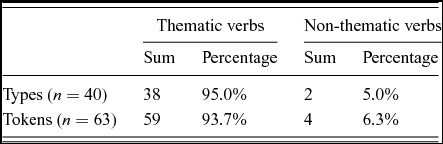
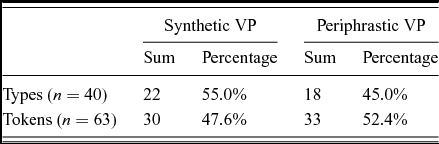
The information in this table is complemented by a description of the type of verb (thematic vs. non-thematic) and verb phrase (synthetic vs. periphrastic) affected by the blend. This information is provided in Tables 7 and 8, respectively. The figures in Table 7 uncover a very clear pattern where blending affects thematic verbs almost exclusively.
The information about the type of verb phrase affected by blends is summarized in Table 8. This table displays a roughly similar distribution of blends across synthetic and periphrastic verb phrases.
The present section has offered a qualitative account of the results by categorizing the types of blends observed in the corpus (RQ1). The next section describes these results from a quantitative perspective.
4.2 Development of L2/L3 blending over time
This section addresses the issue of how the manifestations of L2/L3 blending evolve over time with increasing age and input during the first 200 hours of instruction in the L3 (RQ2). It opens with the quantification of results at each data collection time, and a report of the statistical analyses performed on the data. This is followed by a brief illustration of the most characteristic patterns of blending at different data collection times.
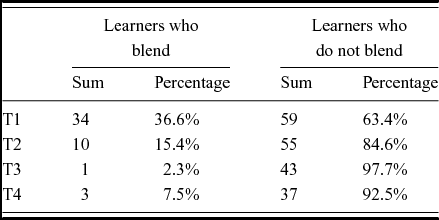
In order to reach a comprehensive view of the picture, it is necessary to note the presence or absence, in categorical terms, of L2/L3 interaction as seen in the number (and percentage) of learners whose interlanguage shows evidence of L2/L3 blending in verbal forms. This is shown in Table 9 for each data collection time, with the highest percentage of learners blending verbal forms at T1. From T1 to T2 the percentage is reduced by more than half, and again decreases sizeably by T3.
Number and percentage of learners who blended at each data collection time.

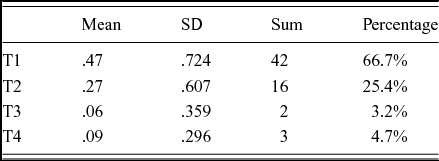
The 63 occurrences of L2/L3 blending found were unequally distributed across data collection times, as can be seen in Table 10. This table presents the descriptive statistics of blends, along with the total number of occurrences and its percentage at each data collection time. As this table indicates, the incidence of blending decreases at each data collection time, although this decrease is non-linear.
Descriptive statistics of verbal L2/L3 blending across data collection times.

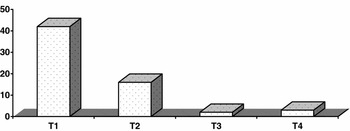
To ascertain whether this decrease was statistically significant across data collection times, a series of paired-samples T-tests were run on the data. The decision to use parametric tests was justified by the corroboration, after running a Kolmogorov–Smirnov test, that the sample was normally distributed (p = .709). Despite the abrupt decrease from T1 to T2, the difference between these two collection times did not reach significance (p = .913). The comparison between T1 and T3 and between T1 and T4, however, was significant (p = .003 and p = .005, respectively). As for T2, the difference between T2 and T3 also turned out to be significant (p = .022), as did the difference between T2 and T4 (p = .033). The incidence of blending at T3 and T4 was rather low, and it was decided not to conduct any statistical test to compare performance at these collection times. The pattern of decrease is represented in Figure 1.
Pattern of decrease of blending across data collection times.

When looking at the progression of blending, the picture that emerges is that blending concentrates at T1. At this time blending was used almost exclusively with thematic verbs, while non-thematic verbs were either omitted (example (34)) or rendered in the L2 German (example (35)). On the few occasions when a non-thematic verb was supplied in the L3 English, it was almost always uninflected (example (36)).
-
(34) Girl and boy mit dog foot and thrinkt geeat
“A girl and boy with a dog eat food and drink”
-
(35) but the dog hat all geeat
“but the dog has eaten everything”
-
(36) The dog have the sandwich, caffee and bread geeatet
“The dog has eaten the sandwich, coffee and bread”
At T2 blending affected periphrastic verb phrases more than synthetic verb phrases, although the latter are still encountered in the data (example (37)). In periphrastic verb phrases the number of omissions diminishes, yet it is rare to find both the thematic and the non-thematic verb rendered in L3 English in its entirety. Hence, in most of the occasions either one or the other (the thematic verb, above all) shows blending (example (38)).
-
(37) In the mountain preparieren the Picknick
“on the mountain, they prepare the picnic”
-
(38) And the dog have the break fest geeat
“And the dog has eaten the breakfast”
The examples discussed so far affect periphrastic verb phrases with a tense auxiliary. Even though largely productive, tense auxiliaries were not the only ones affected, and blending in periphrastic verb phrases involving modal auxiliaries was also observed. These, though, could not be examined at T1 because modals had not emerged yet. Therefore, the presence of blended modal auxiliaries was attested from T2 onwards (examples (39) and (40)).
-
(39) Pati and Luca willen a piknig machen
“Pati and Luca want to make a picnic”
-
(40) They willen a Picknick eat
“They want to eat a picnic”
Finally, by T3 (and also at T4) blending was only residual, but it still affected both synthetic (example (41)) and periphrastic (example (42)) verb phrases.
-
(41) The children weren angry
“The children were angry”
-
(42) The dog has all the sandwiches geate
“The dog has eaten all the sandwiches”
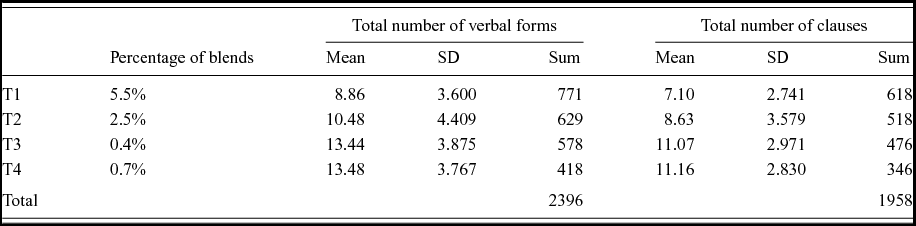
In addition to the longitudinal observation of background language interaction, it is necessary to have an objective perspective of the overall representation of L2/L3 blending over the total number of verbs. Table 11 shows the percentage that blends represent over the total number of verbal forms. For the sake of clarity and understanding, this table also shows the mean, standard deviation and sum of the number of verbal forms and clauses produced by learners at each data collection time. The percentages of blended verbs over the total number of verbal forms are low, and short-lived in the corpus. Furthermore, they are consistent with the information in Table 3 as regards the tendency for blending to decrease with increasing age and input across data collection times, also when the whole pool of verbs used in the narrative task are considered.
Representation of blends over total number of verbal forms and clauses.

This section has addressed the evolution of blending over time shown by the longitudinal development of these learners. The results indicate that blending occurs mostly in less instructed learners, and uncover a pattern of decrease that is not steady and accelerates around the age of 12. The main implications of the results in this and the preceding sections are addressed in Sections 5 and 6.
5. Discussion
The study reported here was motivated by the analysis of the role of background language activation in L3 word construction attempts involving verbal forms. In the language combination examined, RQ1 asked whether any of the background languages would activate during L3 English production, and whether this activation would lead to the blending of information. After that, RQ2 addressed the evolution observed in background language activation and blending over time. The answer to these two questions is discussed in what follows.
The evidence presented in the previous section clearly demonstrates that L2 German was activated during processing and production in L3 English, as seen in the blending of information from these two languages inside verbal forms. Specifically, the search for an L3 English verbal lexical item caused the parallel activation of the corresponding L2 German item alongside, or at least part of it. In particular, the fact that L2 German prefixes and suffixes were added to L3 English bare stems indicates that learners were accessing the number, person, tense and aspect information contained in the L2 lemma. Hence, most blending types encountered in the data consisted of verbal forms where the TL provided the first half of the form (L3 English), and the non-selected but active language provided the second half (L2 German), as in walken “they walk” or runnen “they run”. Occasionally blends show access to lemma representations in the L2 German for base forms and in the L3 English for inflectional forms, as in rening “is running” or lieves “lives”.
This consistent pattern suggests that blending is not a linguistic idiosyncrasy, and it is taken as evidence that L3, L2 (and L1) lemmas can be activated simultaneously. Sometimes such co-activation may result in complex blends such as geeats, geeating, geate or geluncht. Furthermore, the blending behaviour investigated here indicates that when learners are unable to retrieve the morphological information related to agreement or tense marking from lemmas belonging to the TL, they may retrieve this information from lemmas belonging to a language previously learned (in this case, the L2). Because of simultaneous language activation, and if we assume that base forms and inflectional forms have separate lemma representations (as stated in Section 1.2), it could be proposed that learners accessed lemma representations of inflectional forms from the L2 more readily than from the L1 during L3 production. To put it another way, while constructing a verbal form in the L3, there is parallel activation of the L2 and the L3, and this co-activation prompts learners to rely on morphological information attached both to their L3 English and L2 German lemmas.
Nonetheless, co-activation seems to take place only between the L3 and the L2, while leaving the L1 out of the equation. To this speaks not only the interplay between the L2 and the L3 in the data, but also the fact that no blending of the mother tongue and the L3 was observed at any time. Since neither L1 Spanish nor L1 Catalan were activated during production in L3 English, some kind of L1 blocking may be in place. Learners apparently inhibit the L1s but not the L2; however, the question of why the L2 is the only background language activated cannot be answered here. Whether L2 activation is boosted by the effect of L2 status, of (perceived) language relatedness or by a combined effect of both factors is a pressing issue that should be addressed in future research. If the ultimate goal of such research is to attribute L2 activation confidently to one or the other factor, it should incorporate a test specifically designed to measure learners’ perceptions about language relatedness, over and beyond objective typological (dis)similarity.
Crucially, irrespective of the underlying cause for L2 activation, the point at issue is that activation of the non-native languages may be more straightforward than that of the mother tongue, at least in the short term. The present study with older learners and teenagers confirms findings from previous research with adults (Bardel & Lindqvist, Reference Bardel, Lindqvist, Chini, Desideri, Favilla and Pallotti2007; Bouvy, Reference Bouvy2000; Christen & Näf, Reference Christen, Näf, Adamzik and Christen2001; De Angelis & Selinker, Reference De Angelis and Selinker2001; Dewaele, Reference Dewaele1998; Ringbom, Reference Ringbom1987, Reference Ringbom2001; Singleton, Reference Singleton1987); however, it is not possible to compare the findings with other studies of non-adult learners due to a lack of empirical data.
The results also lend support to the specific type of blending in verbal forms that has been observed in simultaneous first language acquisition (Bernardini & Schlyter, Reference Bernardini and Schlyter2004; De Houwer, Reference De Houwer1997; Gawlitzek-Maiwald, Reference Gawlitzek-Maiwald2001; Gawlitzek-Maiwald & Tracy, Reference Gawlitzek-Maiwald and Tracy1996; Hulk & van der Linden, Reference Hulk, Van der Linden, Kellerman, Weltens and Bongaerts1996; Huss, Reference Huss1991; Müller & Hulk, Reference Müller and Hulk2001; Müller et al., Reference Müller, Cantone, Kupisch and Schmitz2002; Tracy, Reference Tracy1996; Tracy & Gawlitzek-Maiwald, Reference Tracy and Gawlitzek-Maiwald2005). In addition, the results hint at the simultaneous activation of lexical items that are non-cognates and that do not necessarily bear great resemblance, as shown in many of the examples in Sections 1 and 4. A case in point are the pairs climb (English) vs. hinaufsteigen “climb” (German) (Tracy & Gawlitzek-Maiwald, Reference Tracy and Gawlitzek-Maiwald2005) from the literature on simultaneous first language acquisition discussed in the Introduction, as well as know vs. wissen “know” and others from the corpus investigated here. This is not to suggest that formal similarity does not play a role, but simply to point out that it is not a sine qua non condition for blending to occur.
The production of blends in this corpus is interpreted as evidence for blending at the lemma level (e.g. De Angelis & Selinker, Reference De Angelis and Selinker2001; De Bot, Reference De Bot2004; Dewaele, Reference Dewaele1998; Hall & Ecke, Reference Hall and Ecke2003). On these grounds it is reasonable to suppose that CLI may originate at the lemma level, strengthening claims from previous studies (Cenoz et al., Reference Cenoz, Hufeisen and Jessner2001, Reference Cenoz, Hufeisen and Jessner2003; Dewaele, Reference Dewaele1998; Hammarberg, Reference Hammarberg2001, Reference Hammarberg2009; Müller-Lancé, Reference Müller-Lancé2003; Wei, Reference Wei2006). Further support for this argument is the high incidence of transferred OV orders also attested in this study, which were found in clauses where the verb shows L2/L3 blending. This results from the activation of prior linguistic information from various interlinked subsystems of the multilingual lexicon, in particular the predicate–argument structure and morphological realisation pattern of L2 lemmas (e.g. Ecke & Hall, Reference Ecke and Hall2000; Hall et al., Reference Hall, Newbrand, Ecke, Sperr, Marchand and Hayes2009; Herwig, Reference Herwig2001; Wei, Reference Wei2006). Conversely, one might hypothesize that these learners start out with preconceived lemma content, but when attempting to construct the corresponding lexeme, they fail to do so and rely instead on L2 German lexemes. This would explain transferred production in thematic verbs as in has the sandwich geeatet “has eaten the sandwich” (example (27)), and in non-thematic verbs, e.g. willen a Picknick eat “want to eat a picnic” (example (40)) or hasen in the mountains gegangen “have gone to the mountains” (example (15)), among others.
As for readjustments in background language activation over time, the data suggest that after approximately 100 hours of instruction in the L3 English, the level of L2 activation is progressively lowered. As a result, the use of the L2 as a supplier language in the construction of verb lexical items also becomes less prevalent. However, this is possible only once learners have reached a minimal knowledge of the L3. At the beginning of the acquisition process, in this case the first 33–66 hours of instruction, learners are confronted with the task to produce messages in a language in which they are not very proficient. While attempting to retrieve the appropriate lexical item from the multilingual lexicon, the recall of a word seems to spread activation to candidates from the L2 that compete for selection (Anderson, Reference Anderson1983; Costa, Caramazza & Sebastián-Gallés, Reference Costa, Caramazza and Sebastián-Gallés2000; Goldrick & Blumstein, Reference Goldrick and Blumstein2006; Kello, Plaut, & MacWhinney, Reference Kello, Plaut and MacWhinney2000; Kroll, Bobb & Wodniecka, Reference Kroll, Bobb and Wodniecka2006; Morsella & Miozzo, Reference Morsella and Miozzo2002; Paradis, Reference Paradis1993).
In the present study, blending that corresponds to this initial stage of the acquisition process is observed at T1. Certainly, most blending is concentrated at the youngest age, which coincides with the onset of L3 acquisition. Likewise, blending at the early stages suggests that while learners do have access to the lemma in the L3 during production, they also seem to have access to the information contained in the L2 lemma, to which they resort in order to construct words. Even though blending was short-lived in the corpus and, in general, not very prolific (the percentage of blending is barely a 6%), it is sizeable enough so as to not be ignored as argued in previous research on cross-language interaction (see also Tracy & Gawlitzek-Maiwald, Reference Tracy and Gawlitzek-Maiwald2005).
At a later stage (i.e. between 66 and 99 hours of instruction in the TL) the activation level of the L2 seemed to experience a dramatic fall, as may be gleaned from the reduction in the amount of blending from 67% to 25%. As a result of this reduction, the levels of activation of the L2 and the L3 became more balanced, and with the stabilization of L3 activation, blends reduced to 4.7% of the total amount of blending observed throughout the whole period investigated. The changes in access to L2 and L3 lemmas and lexemes highlight the need to collect longitudinal data for tracking readjustments in the level of L2 activation. In so doing, one should capture increases and decreases in L2 activation and their impact on speech planning and production in the L3 at this and subsequent stages of acquisition.
6. Conclusions
The present study sheds light on the important role played by background languages during L3 production, in particular at the beginning of L3 acquisition, where interlingual connections, especially between the L2 and the L3, seem to be stronger than at later stages. Further research on language activation at various stages of acquisition and with participants of different ages and language pairings is necessary to corroborate these findings. Moreover, the findings seem to point at CLI at the interface between morphology and syntax, and possibly also to the integration of lexical and syntactic information. A thorough account of this is not within the scope of the present study, but the possibility that CLI at the level of morphology expands to and triggers CLI at other linguistic levels calls for a more exhaustive analysis. Thus, future research would benefit from investigating whether L2 activation and CLI are even or uneven across linguistic levels beyond the word. Future work should also examine whether the amount of input needed to overcome the effect of the L2 is roughly the same at different levels, or whether a longer period of time and a larger exposure to the TL are required for different linguistic levels.
Appendix. The Dog Story