





1 Introduction
Let
$\mathrm {Add}(\omega ,\aleph _\omega )$
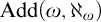 be the poset for adding
$\aleph _{\omega }$
 -many Cohen reals. In
$V^{\mathrm {Add}(\omega ,\aleph _\omega )}$
 , the continuum must be at least
$\aleph _{\omega }$
 . By König’s lemma, the continuum has uncountable cofinality, hence it must be at least
$\aleph _{\omega +1}$
 . One can then ask whether this is different from adding
$\aleph _{\omega +1}$
 -many Cohen reals, i.e., forcing with
$\mathrm {Add}(\omega ,\aleph _{\omega +1})$
 . More precisely, if
$G$
 is
$\mathrm {Add}(\omega ,\aleph _\omega )$
 -generic over
$V$
 , is there an
$H$
 which is
$\mathrm {Add}(\omega ,\aleph _{\omega +1})$
 -generic over
$V$
 such that
$V[G]=V[H]$
 ? The (folklore) answer to this is “No,” and in fact
$V[G]$
 doesn’t even contain a filter which is
$\mathrm {Add}(\omega ,\aleph _{\omega +1})$
 -generic over
$V$
 , Proposition 2.5 below. However, the proof of this is somewhat unsatisfying, as it relies on abstract forcing considerations involving the (uniform) densities of the complete Boolean algebras. It is therefore desirable to exhibit a combinatorial or “mathematical” principle which distinguishes the two models. The purpose of this note is to provide one.
Definition 1.1. Let
$\sigma \leq \theta < \mu < \lambda $
 be cardinals. The statement
$\mathsf {Pr}(\sigma , \theta , \mu , \lambda )$
 states that there is an
$\overline {\mathcal {F}}$
 satisfying the following:
-
(A) $\overline {\mathcal {F}} = \langle {\mathcal {F}}_c : c \in [\lambda ]^\sigma \rangle $
 is a sequence so that for all
$c \in [\lambda ]^\sigma $
we have
${\mathcal {F}}_c \subseteq \mathcal {P}(c)$
.
-
(B) For all $c \in [\lambda ]^\sigma $
we have that
${\mathcal {F}}_c$
has cardinality at most
$\theta $
. -
(C) For every $A \in [\lambda ]^\lambda $
there is a sequence
$ \langle B_i : i < \mu \rangle $
so that-
(a) $A = \bigcup _{i<\mu }B_i$
and -
(b) $B_i \cap c \in \mathcal {F}_c$
for all
$c \in [\lambda ]^\sigma $
and
$i < \mu $
.
-


We will show the following.
Theorem 1.2. Assume
$\mathrm {GCH}$
 . Let
$\mathbb P_0=\mathrm {Add}(\omega ,\aleph _\omega )$
 and let
$\mathbb P_1=\mathrm {Add}(\omega ,\aleph _{\omega +1})$
 . The following hold:
-
(A) For all $n < \omega \ \Vdash _{\mathbb P_0} \mathsf {Pr}(\aleph _n, \aleph _{n+1}, \aleph _\omega , \aleph _{\omega +1}).$
-
(B) For all $n < \omega \ \Vdash _{\mathbb P_1} \neg \mathsf {Pr}(\aleph _n, \aleph _{n+1}, \aleph _\omega , \aleph _{\omega +1}).$


Thus the above says that in particular
$\mathsf {Pr}(\aleph _0, \aleph _1, \aleph _\omega , \aleph _{\omega +1})$
 is the desired principle. In fact Theorem 1.2 holds in more generality—namely we can take
$\mu $
 to be a strong limit cardinal of countable cofinality, and
$\sigma < \mu $
 infinite and we get that adding
$\mu $
 -many Cohen reals forces
$\mathsf {Pr}(\sigma , 2^\sigma , \mu , \mu ^+)$
 while adding
$\mu ^+$
 -many Cohen reals forces
$\neg \mathsf {Pr}(\sigma , 2^\sigma , \mu , \mu ^+)$
 . These two pieces are proved below as Lemmas 3.2 and 4.1, respectively.
The rest of this article is organized as follows. In Section 2, we make some preliminary observations about adding
$\aleph _\omega $
 versus adding
$\aleph _{\omega +1}$
 Cohen reals. In Section 3 we prove the generalization of Item (1) of Theorem 1.2 while in Section 4 we prove the generalization of Item (2) of Theorem 1.2. The article concludes with some questions for further research. Throughout our notation is mostly standard, conforming, e.g., to that of [Reference Jech7] or [Reference Kunen9]. Those texts are referred to for any undefined terms.
2 Some preliminary observations
If
$\kappa $
 is an infinite cardinal, we let
$\mathrm {Add}(\omega ,\kappa )$
 be the poset for adding
$\kappa $
 -many Cohen reals. More precisely,
$\mathrm {Add}(\omega ,\kappa )$
 is the set of finite partial functions
$\kappa \rightharpoonup 2$
 , ordered by reverse inclusion. We will argue that, if
$\kappa <\lambda $
 , then a generic extension of
$V$
 by
$\mathrm {Add}(\omega ,\kappa )$
 does not contain a filter that is
$\mathrm {Add}(\omega ,\lambda )$
 -generic over
$V$
 . This result is folklore but a proof is hard to find in the published literature; we will follow the outline in [Reference Hamkin5].
We collect some facts from the elementary theory of Boolean algebras. If
$\mathbb {B}$
 is a Boolean algebra and
$b\in \mathbb {B}$
 , then
$\mathbb {B}_b=\{c\in \mathbb {B}:c\le b\}$
 , which can be made into a Boolean algebra (with top element
$b$
 ) in an obvious way. We let
$\mathbb {B}^+=\mathbb {B}\setminus \{0\}$
 . If
$\mathbb {A}$
 is a subalgebra of
$\mathbb {B}$
 , then
$\mathbb {A}$
 is said to be a regular subalgebra of
$\mathbb {B}$
 iff for all
$X\subseteq \mathbb {A}$
 , if
$\bigvee ^{\mathbb {A}} X$
 exists, then so does
$\bigvee ^{\mathbb {B}} X$
 and moreover
$\bigvee ^{\mathbb {A}} X=\bigvee ^{\mathbb {B}} A$
 . If
$\mathbb {B}$
 is complete, we will say that
$\mathbb {A}\subseteq \mathbb {B}$
 is a complete subalgebra if it is a regular subalgebra of
$\mathbb {B}$
 that is also complete as a Boolean algebra.
We will need the following cardinal function.
Definition 2.1. If
$\mathbb {B}$
 is a Boolean algebra, we define its density by

where
$D$
 is dense in
$\mathbb {B}$
 iff
$D\subseteq \mathbb {B}^+$
 and for all
$b\in \mathbb {B}^+$
 there exists
$d\in D$
 with
$d\le b$
 .
We say that
$\mathbb {B}$
 has uniform density iff
$d(\mathbb {B})=d(\mathbb {B}_b)$
 for all
$b\in \mathbb {B}^+$
 .
Unlike the topological notion, the Boolean algebraic density is nicely monotone.
Lemma 2.2 (Folklore)
Let
$\mathbb {A}$
 be a complete subalgebra of a complete Boolean algebra
$\mathbb {B}$
 . Then
$d(\mathbb {A})\le d(\mathbb {B})$
 .
Proof. Let
$D\subseteq \mathbb {B}$
 be dense. For
$d\in D$
 , let

We will be done if we can argue that
$\{u_d:d\in D\}$
 is dense in
$\mathbb {A}$
 . So, fix
$a\in \mathbb {A}$
 . By the density of
$D$
 , there exists some
$d\in D$
 with
$d\le a$
 , hence
$u_d\le a$
 .
Lemma 2.3 [Reference Jech6, Lemma 25.5(a)]
Let
$\mathbb {B}$
 and
$\mathbb {C}$
 be complete Boolean algebras. Let
$G$
 and
$H$
 be
$\mathbb {B}$
 and
$\mathbb {C}$
 generic over
$V$
 , respectively, and suppose that
$V[G]=V[H]$
 . Then there exist
$\pi \in V$
 ,
$b\in \mathbb {B,}$
 and
$c\in \mathbb {C}$
 such that
$\pi :\mathbb {B}_b\cong \mathbb {C}_c$
 and
$\pi [\mathbb {B}_b\cap G]=\mathbb {C}_c\cap H$
 .
The Cohen algebra on
$\kappa $
 is
$\mathbb {C}_\kappa :=\mathrm {ro}(\mathrm {Add}(\omega ,\kappa ))$
 , i.e., the Boolean completion of
$\mathrm {Add}(\omega ,\kappa )$
 .
Lemma 2.4. Let
$\kappa $
 be an infinite cardinal. The algebra
$\mathbb {C}_\kappa $
 is homogeneous and has (uniform) density
$\kappa $
 .
Proof. For the homogeneity, see [Reference Koppelberg8, Corollary 12.5]. The uniform density assertion follows from homogeneity and the fact that
$d(\mathbb {C}_\kappa )$
 is also the smallest size of a dense subset of
$\mathrm {Add}(\omega ,\kappa )$
 , which is easily seen to be
$\kappa $
 .
Proposition 2.5 (Folklore)
Let
$\kappa <\lambda $
 be infinite cardinals. In
$V^{\mathrm {Add}(\omega ,\kappa )}$
 there is no
$\mathrm {Add}(\omega ,\lambda )$
 -filter that is generic over
$V$
 .
Proof. Suppose not. Then we can find
$G$
 which is
$\mathbb {C}_\kappa $
 -generic over
$V$
 and
$H$
 which is
$\mathbb {C}_\lambda $
 -generic over
$V$
 such that
$H\in V[G]$
 . Obviously,
$V\subseteq V[H]\subseteq V[G]$
 . By the intermediate model theorem (see [Reference Jech7, Lemma 15.43]), there exists
$\mathbb {B}$
 a complete regular subalgebra of
$\mathbb {C}_\kappa $
 such that
$V[H]=V[G\cap \mathbb {B}]$
 . By Lemma 2.3, there exist
$b\in \mathbb {B}$
 and
$c\in \mathbb {C}_\lambda $
 such that
$\mathbb {B}_b \cong (\mathbb {C}_\lambda )_c$
 (in
$V$
 ). But then, by Lemmas 2.2 and 2.4,

which is a contradiction.
Remark 2.6. If we don’t insist on fixing the ground model, the previous theorem can fail. In other words, it is consistent (modulo large cardinals) that there is a pair of models
$V\subseteq W$
 such that adding few Cohen reals to
$W$
 adds a lot of Cohen reals to
$V$
 (see [Reference Gitik and Golshani3, Reference Gitik and Golshani4]).
Towards a slightly more mathematical distinction between the two models we also observe the following.
Proposition 2.7. Assume
$\mathrm {CH}$
 . Let
$G_0$
 be
$\mathrm {Add}(\omega ,\aleph _\omega )$
 -generic over
$V$
 and let
$G_1$
 be
$\mathrm {Add}(\omega ,\aleph _{\omega +1})$
 -generic over
$V$
 .
-
(A) In $V[G_0]$
there are
$\aleph _1$
-many Borel functions
$\{f_\alpha : \alpha \in \omega _1\}$
and a set of
$\aleph _\omega $
-many reals
$A = \{a_\alpha : \alpha \in \aleph _\omega \}$
, so that the following hold:-
(a) For all $\alpha < \omega _1$
the domain of
$f_\alpha $
is
$[\omega ^\omega ]^\omega $
. -
(b) For every $x \in \omega ^\omega $
there is a
$c \in [\aleph _\omega ]^\omega \cap V$
and an
$\alpha < \omega _1$
so that
$x = f_\alpha (\{a_\xi : \xi \in c\})$
.
-
-
(B) In $V[G_1]$
the following holds: for every
$\aleph _1$
-many Borel functions
$\{f_\alpha : \alpha \in \omega _1\}$
and every set of
$\aleph _\omega $
-many reals
$A = \{a_\alpha : \alpha \in \aleph _\omega \}$
, there is an
$x \in \omega ^\omega $
so that
$x \notin \{f_\alpha (\{a_\xi : \xi \in c\}) : \alpha \in \omega _1\}$
for any
$c \in [\aleph _\omega ]^\omega \cap V$
.




Proof. Each part is a consequence of the ccc. For the first part let
$\{f_\alpha : \alpha \in \omega _1\}$
 be the ground model Borel functions and let
$A = \{a_\alpha : \alpha \in \aleph _\omega \}$
 be the set of Cohen generic reals coming from
$G_0$
 . If
$\dot {x}$
 is a nice name for a real then it is well known, see, e.g., [Reference Zapletal12, Theorem 4.1.2], that there are
$c \in [\aleph _\omega ]^\omega \cap V$
 so that
$\dot {x}$
 is forced to be in
$V[a_\xi : \xi \in c]$
 and in that model there is an
$\alpha < \omega _1$
 so that
$\dot {x}^{G_0} = f_\alpha (\{a_\xi : \xi \in c\})$
 . For the second part, observe that any
$\aleph _\omega $
 -many reals and any
$\aleph _1$
 -many Borel functions were added by
$\aleph _\omega $
 -many of the Cohen reals in
$G_1$
 and hence there is a Cohen real which is generic over an intermediate model containing all of them.
Arguably, Proposition 2.7 provides a more concrete distinction between the
$\mathrm {Add}(\omega ,\aleph _\omega )$
 - and
$\mathrm {Add}(\omega ,\aleph _{\omega +1})$
 -extensions than that offered by Proposition 2.5. However, from our perspective, this is still not fully satisfactory because (A)(b) and (B) in Proposition 2.7 make explicit reference to the ground model
$V$
 , which is meta-mathematical in nature. This should be contrasted with Theorem 1.2, which is purely combinatorial.
We will now sketch why there is no concrete cardinal characteristic separating
$V^{\mathrm {Add}(\omega ,\aleph _\omega )}$
 from
$V^{\mathrm {Add}(\omega ,\aleph _{\omega +1})}$
 . For any unproven assertions in this paragraph, refer to [Reference Blass, Foreman and Kanamori2, Section 11.3]. To start, it’s well known that the first
$\aleph _1$
 -many Cohen reals added will form a (Cohen indestructible) non-meager family, hence
$\mathrm {non}(\mathcal {M})=\aleph _1$
 in both models. Meanwhile, the covering of the meager ideal,
$\mathrm {cov}(\mathcal M)$
 , must be
$2^{\aleph _0} = \aleph _{\omega +1}$
 in both models. For the
$\mathrm {Add}(\omega ,\aleph _{\omega +1})$
 -extension this follows by the regularity of
$\aleph _{\omega +1}$
 . For the
$\mathrm {Add}(\omega ,\aleph _\omega )$
 -extension, we note that by [Reference Bartoszynski, Foreman and Kanamori1, Theorem 5.1],
$\mathrm {cov}(\mathcal M)$
 has uncountable cofinality and hence cannot be
$\aleph _\omega $
 . On the other hand, as
$\mathrm {Add}(\omega ,\aleph _\omega ) \cong \mathrm {Add}(\omega ,\aleph _\omega ) \times \mathrm {Add}(\omega ,\aleph _n)$
 for any
$n < \omega $
 , we obtain that
$\mathrm {cov}(\mathcal M)> \aleph _n$
 for all
$n< \omega $
 . Putting everything together, we see that the cardinals in the Cichoń diagram are the same for both models. Applying the inequalities

we see that all of the aforementioned characteristics agree in both models. By different methods,
$\mathfrak {a}=\mathfrak {g}=\aleph _1$
 in both models.
We conclude this section by making some simple observations about the principle
$\mathsf {Pr}(\sigma , \theta , \mu , \lambda )$
 in an attempt to clarify it and prepare the reader for the arguments in Lemmas 3.2 and 4.1. All of these are easy, as should be obvious to the reader who is clear on what the principle states.
Proposition 2.8. Let
$\sigma \leq \theta \leq \mu \leq \lambda $
 be infinite cardinals.
-
(A) If $\theta = 2^\sigma $
, then
$\mathsf {Pr}(\sigma , \theta , \mu , \lambda )$
is true for any choice of
$\mu $
and
$\lambda $
. -
(B) If $\lambda =\mu ^+$
, the statement
$\mathsf {Pr}(\sigma , \theta , \mu , \lambda )$
is unchanged by allowing in clause (C) of the definition that
$A$
has size
$\leq \lambda $
. -
(C) $\Pr (\sigma ,\theta ,\mu ,\lambda )$
is monotone in
$\theta $
and
$\mu $
. More precisely, if
$\theta _0 \le \theta _1$
or
$\mu _0\le \mu _1$
are infinite cardinals, then
$\Pr (\sigma ,\theta _0,\mu _0,\lambda )$
implies
$\Pr (\sigma ,\theta _1,\mu _1,\lambda )$
.


Proof. For (A) note that if
$\theta = 2^\sigma $
 then letting
$\mathcal F_c := \mathcal {P}(c)$
 satisfies the requirements of the principle.
For (B), note that since
$\sigma \leq \theta $
 we have that for any
$\overline {\mathcal {F}}$
 as in the statement of Definition 1.1 we can define
$\overline {\mathcal {F}}'$
 by
$\mathcal {F}^{\prime }_c := \{\emptyset \}\cup \{\{\alpha \}\mid \alpha \in c\} \cup \mathcal {F}_c$
 and
$\mathcal {F}^{\prime }_c$
 will still have size at most
$\theta $
 . Now for each
$A \subseteq \lambda $
 of size
${<}\lambda $
 , by
$\lambda =\mu ^+$
 we can enumerate
$A$
 (possibly with repetitions) as
$A=\{\alpha _\xi :\xi <\mu \}$
 . Then
$\{\alpha _\xi \}\cap c \in \mathcal {F}^{\prime }_c$
 for any
$c\in [\lambda ]^\sigma $
 .
For (C), any witness to
$\Pr (\sigma ,\theta _0,\mu _0,\lambda )$
 will witness
$\Pr (\sigma ,\theta _1,\mu _0,\lambda )$
 . For the monotonicity in
$\mu $
 , let
$\mathcal {F}$
 witness
$\Pr (\sigma ,\theta _0,\mu _0,\lambda )$
 and note that we may assume without loss of generality that
$\emptyset \in \mathcal {F}_c$
 for every
$c\in [\lambda ]^{\sigma }$
 . Given
$A\in [\lambda ]^\lambda $
 , let
${\langle {B_\xi :\xi <\mu _0}\rangle }$
 witness Definition 1.1(C) and set
$B_\xi =\emptyset $
 for
$\xi \in [\mu _0,\mu _1)$
 . This works.
As a consequence of the above we have the following.
Lemma 2.9. If
$\mathrm {GCH}$
 holds then
$\mathsf {Pr}(\sigma , \theta , \mu , \lambda )$
 holds for every infinite
$\sigma < \theta $
 .
3 Adding few Cohens
In this section we prove the promised generalization of part 1 of Theorem 1.2. First, a definition is given as follows.
Definition 3.1. Let
$\mathbb P$
 be a forcing poset and
$\kappa $
 be a cardinal. We say that
$\mathbb P$
 has the
$\kappa $
 -covering property iff for every
$p\in \mathbb P$
 and every
$\mathbb P$
 -name
$\dot X$
 for a set of ordinals with
$p\Vdash |\dot X|<\kappa $
 , there exists
$q\le p$
 and
$Y$
 with
$|Y|<\kappa $
 and
$q\Vdash \dot X\subseteq \check {Y}$
 .
Clearly, if
$\mathbb P$
 has the
$\kappa $
 -covering property, then forcing with
$\mathbb P$
 preserves
$\kappa $
 . Also, if
$\kappa $
 is regular, then every
$\kappa $
 -cc poset has the
$\kappa $
 -covering property.
In the next lemma, if
$\kappa $
 is a cardinal and we’re working in a generic extension
$V^{\mathbb P}$
 , then the symbol
$|\kappa |$
 refers to the cardinality of
$\kappa $
 as computed in
$V^{\mathbb P}$
 .
Lemma 3.2. Assume
$2^\sigma = \theta < \mu <\lambda $
 . Let
$\mathbb P$
 be a forcing notion that has the
$\sigma ^+$
 -covering property and such that
$\Vdash |\dot G|\le |\mu |$
 . Then
$\Vdash _{\mathbb P} \mathsf {Pr}(|\sigma |, |\theta |, |\mu |, |\lambda |)$
 .
Note that the first part of Theorem 1.2 follows from the above by assuming
$\mathrm {GCH}$
 and subbing in
$(\aleph _n, \aleph _{n+1}, \aleph _\omega , \aleph _{\omega +1})$
 for
$(\sigma , \theta , \mu , \lambda )$
 .
Proof. Fix
$\sigma , \theta , \mu , \lambda ,$
 and
$\mathbb P$
 as in the statement of the theorem. Since
$\mathbb P$
 has the
$\sigma ^+$
 -covering property, there is a name
$\dot \Phi $
 such that the following is forced by
$\mathbb P$
 : “
$\dot \Phi :[\lambda ]^{|\sigma |}\to ([\lambda ]^\sigma )^V$
 and for all
$c\in [\lambda ]^{|\sigma |}$
 ,
$c\subseteq {\dot \Phi }(c)$
 .”
Working in
$V^{\mathbb P}$
 , for each
$c \in [\lambda ]^{|\sigma |}$
 let
$\mathcal {F}_c = \{a\cap c : a \in V \cap \mathcal {P}(\dot {\Phi }(c))\}$
 . Note that for every
$c$
 we have that
$\mathcal {F}_c$
 has cardinality at most
$(2^\sigma )^V = |\theta |$
 and hence
$\overline {\mathcal {F}} = \langle \mathcal {F}_c : c \in [\lambda ]^\sigma \rangle $
 satisfies the first two clauses of Definition 1.1. Back in
$V$
 let
$\dot {\overline {\mathcal {F}}}$
 name this sequence and for each
$\dot {c}$
 let
$\dot {\mathcal {F}}_{\dot {c}}$
 be the name for the associated element. We need to see that the third clause of Definition 1.1 is forced.
Suppose that
$\dot {A}$
 is a
$\mathbb P$
 -name such that
$\Vdash \dot A\subseteq \lambda $
 . For each
$q\in \mathbb P$
 , let
$B_q=\{\xi <\lambda :q\Vdash \xi \in \dot {A}\}$
 . Note that
$\Vdash \dot {A}=\bigcup _{q\in \dot {G}}B_q$
 . Now let
$\dot c$
 be a
$\mathbb P$
 -name for a
$|\sigma |$
 -sized subset of
$\lambda $
 . If
$q\in \mathbb P$
 , then
$\Vdash B_q\cap \dot {c}=B_q\cap \dot {\Phi }(\dot c)\cap \dot {c}\in \dot {\mathcal {F}}_{\dot c}$
 because
$\Vdash \dot {\Phi }(\dot c)\in V$
 .
Remark 3.3. The proof of the previous lemma shows something slightly more general, because it produces a decomposition for each subset of
$\lambda $
 , not just those in
$[|\lambda |]^{|\lambda |}$
 . Also, the decomposition is of size at most
$|\mu |$
 , not exactly
$\mu $
 (to get exactly
$\mu $
 , simply pad with
$\emptyset $
 ’s).
4 Adding many Cohens
Now we prove the failure of the principle after adding
$\mu ^+$
 -many Cohen reals thus complementing Lemma 3.2.
Lemma 4.1. Assume
$\mu $
 is a strong limit cardinal of countable cofinality,
$\sigma < \theta < \mu ,$
 and
$\lambda = \mu ^+$
 . If
$\mathbb P=\mathrm {Add}(\omega ,\lambda )$
 , then
$\Vdash _{\mathbb P} \neg \mathsf {Pr}(\sigma , \theta , \mu , \lambda )$
 .
Proof. We argue by contradiction. By homogeneity of
$\mathbb P$
 , we may assume that
$\Vdash _{\mathbb P} \Pr (\sigma ,\theta ,\mu ,\lambda )$
 . Let
$\dot {\bar {\mathcal {F}}}$
 witness this. We aim to produce a name for a
$\lambda $
 -sized subset of
$\lambda $
 which cannot be decomposed as in Definition 1.1. Actually, we will produce
$\theta ^+$
 many sets and show by contradiction they cannot all be decomposed as we want.
Let
$\dot g$
 be a
$\mathbb P$
 -name for the generic function
$\lambda \to 2$
 . For
$\xi < \theta ^+$
 , let
$\dot {A}_\xi $
 be a name for the set
$\{\alpha <\lambda : \dot {g}(\theta ^+\cdot \alpha + \xi )= 1\}$
 . An easy genericity argument confirms that each
$\dot {A}_\xi $
 is forced to have has size
$\lambda $
 and that they are all distinct.
Since we assume that it is forced that
$\mathsf {Pr}(\sigma , \theta , \mu , \lambda )$
 holds we have names
$\dot {B}_{\xi , i}$
 for
$\xi < \theta ^+$
 and
$i < \mu $
 so that

Definition 1.1(C) holds. Our goal is to find a
$c \in [\lambda ]^\sigma $
 such that
$c\cap B_{\xi , i}$
 are pairwise distinct for
$\theta ^+$
 many pairs
$(\xi , i)$
 . Since each of these must, by definition, be in
$\dot {\overline {\mathcal {F}}}_c$
 , we will contradict the assumption that this set has size at most
$\theta $
 .
To find this set of pairs
$(\xi , i)$
 we will repeatedly thin out the sets we have constructed to get more and more homogeneity. To begin this process, for each
$\xi < \theta ^+$
 and
$\alpha < \lambda $
 we can pick
$(p_{\xi , \alpha }, i_{\xi , \alpha })$
 so that
$i_{\xi ,\alpha } < \mu $
 and
$p_{\xi , \alpha } \Vdash \check {\alpha } \in B_{\xi , i_{\xi , \alpha }}$
 . Note that any such
$p_{\xi , \alpha }$
 forces in particular that
$\check {\alpha } \in \dot {A}_\xi $
 and therefore we have that

Applying the pigeonhole principle judiciously to this situation and further thinning out we can find moreover for each
$\alpha < \lambda $
 a set
$u_\alpha \in [\theta ^+]^{\theta ^+}$
 so that:
-
• the sequence $\vec {i}_\alpha = {\langle {i_{\xi , \alpha } : \xi \in u_\alpha }\rangle }$
is bounded in
$\mu $
; -
• $\langle \mathrm {dom}(p_{\xi , \alpha }) : \xi \in u_\alpha \rangle $
forms a
$\Delta $
-system; -
• $\langle p_{\xi ,\alpha }:\xi \in u_\alpha \rangle $
are pairwise compatible with common intersection
$r_\alpha $
.


Fixing
$\alpha $
 , note that at most finitely many
$\xi \in u_\alpha $
 can have
$\theta ^+\cdot \alpha + \xi \in {\mathrm {dom}}(r_\alpha )$
 . By throwing out these finitely many elements we can assume that

Claim 4.2. There are
$X_* \in [\lambda ]^\lambda $
 ,
$u_* \in [\theta ^+]^{\theta ^+}$
 , and
$\vec {i}_* \in {}^{\theta ^+}\mu $
 so that for every
$\alpha \in X_*$
 we have that
$u_\alpha = u_*$
 and
$\vec {i}_\alpha = \vec {i}_*$
 .
Proof of claim
This is another pigeonhole argument. There are
$(\theta ^+)^{\theta ^+}$
 possibilities for
$u_\alpha $
 and
$(\theta ^+)^{\theta ^+}<\mu <\lambda $
 because
$\mu $
 is strong limit, so there exist
$X\in [\lambda ]^\lambda $
 and
$u_\ast \in [\theta ^+]^{\theta ^+}$
 such that
$u_\alpha =u_\ast $
 for all
$\alpha \in X$
 . Now, if
$\alpha \in X$
 ,
$\vec {i}_\alpha $
 is bounded in
$\mu $
 , so we can find
$\nu _\alpha <\mu $
 such that
$i_{\xi ,\alpha }<\nu _\alpha $
 for all
$\xi \in u_*$
 . Shrinking
$X$
 if necessary, we may find
$\nu <\mu $
 such that
$\nu _\alpha =\nu $
 for all
$\alpha \in X$
 . But now there are
$\nu ^{\theta ^+}<\mu $
 many possibilities for
$\vec {i}_\alpha $
 , so we can now find
$X_\ast \in [X]^\lambda $
 and
$\vec {i}_\ast $
 such that
$\vec {i}_\alpha =\vec {i}$
 for all
$\alpha \in X_\ast $
 .
Next we aim for even more homogeneity. Let
$S:=\{\alpha \in [\mu ,\lambda ):\mathrm {cf}(\alpha )=\theta ^{++}\}$
 . For each
$\delta \in S$
 , set
$\beta _\delta :=\min (X_*\setminus \delta )$
 .
Claim 4.3. For each
$\delta \in S$
 there is a
$\gamma _\delta \in [\mu ,\delta )$
 so that, if
$\xi \in u_{*}$
 , then
$p_{\xi , \beta _\delta } \upharpoonright \delta = p_{\xi , \beta _\delta }\upharpoonright \gamma _\delta $
 .
Proof of claim
By the finiteness of the domains and the fact that
$\delta $
 is a limit ordinal there is always a
$\gamma _{\delta , \xi } < \delta $
 with the property that
$p_{\xi , \beta _\delta } \upharpoonright \delta = p_{\xi , \beta _\delta }\upharpoonright \gamma _{\delta , \xi }$
 . The point is that now since
$\delta $
 has cofinality
$\theta ^{++}$
 and the
$\xi $
 ’s range over a subset of
$\theta ^+$
 there is a
$\gamma _\delta = {\sup }_{\xi \in u_{*}} \gamma _{\delta , \xi } < \delta $
 .
Since
$\delta \mapsto \gamma _\delta $
 is a regressive function on
$S$
 we can find a stationary set
$S_* \subseteq S$
 with the property that for all
$\delta \in S_*$
 we have
$\gamma _\delta = \gamma _*$
 for some fixed
$\gamma _*$
 . Note that
$|\gamma _*| = \mu $
 . Now for each
$\alpha \in S_*$
 consider the function
$\alpha \mapsto {\sup }[\bigcup \{{\mathrm {dom}}(p_{\xi , \beta _\alpha }) : \xi \in u_*\}]$
 . We can find a club
$E$
 bounding this function—i.e., for every
$\alpha \in S_*$
 we have

Let
$X_{**}$
 be the set
$\{\beta _\delta : \delta \in S_* \cap E\}$
 .
Claim 4.4. Let
$\delta ,\varepsilon \in S_\ast \cap E$
 with
$\delta <\varepsilon $
 . If
$\beta _\delta ,\beta _\varepsilon $
 are distinct elements of
$X_{**}$
 then we have that

Proof. Fix
$\xi ,\eta \in u_\ast $
 . By (3),
$\mathrm {dom}(p_{\xi \beta _\delta })\subseteq \varepsilon $
 , hence

where the second equality is by the choice of
$\gamma _*$
 .
Let
$\langle W_n : n < \omega \rangle $
 be a
$\subseteq $
 -increasing sequence of sets of size
${<}\mu $
 so that
$\bigcup _{n < \omega } W_n = \gamma ^*$
 . For
$\delta \in E \cap S_*$
 and
$\xi \in u_*$
 there is an
$n_{\delta , \xi } \in \omega $
 so that

simply by the finiteness of the domains. But this implies that for every
$\delta \in S_* \cap E$
 there is a
$u_{*, \delta } \in [u_*]^{\theta ^+}$
 so that
$n_{\delta , \xi } = n_\delta $
 for some fixed
$n_\delta \in \omega $
 and every
$\xi \in u_{*, \delta }$
 . By a pigeonhole argument, we can find a stationary set
$S_{**} \subseteq S_{*} \cap E$
 , together with
$n\in \omega $
 ,
$u_{**}\in [u_*]^{\theta ^+}$
 and a family
${\langle {p_\xi :\xi \in u_{**}}\rangle }$
 so that, for every
$\delta \in S_{**}$
 , the following hold:
-
• $n_\delta = n$
; -
• $u_{*, \delta } = u_{**}$
; -
• ${\langle {p_{\xi , \beta _\delta } \upharpoonright W_n : \xi \in u_{**}}\rangle } = {\langle {p_\xi : \xi \in u_{**}}\rangle }$
.


Reaching back to the beginning of the proof we can observe that
${\langle {p_\xi : \xi \in u_{**}}\rangle }$
 forms a
$\Delta $
 -system by merit of being a family of restrictions of
$\langle p_{\xi , \alpha } : \xi \in u_*\rangle $
 which was constructed to be a
$\Delta $
 -system. Therefore, we can find a finite set
$y \subseteq W_n$
 and
$p^*$
 so that for distinct
$\xi _1, \xi _2 \in u_{**}$
 we have
${\mathrm {dom}}(p_{\xi _1}) \cap {\mathrm {dom}}(p_{\xi _2}) = y$
 and
$p_{\xi _1} \upharpoonright y = p_{\xi _2} \upharpoonright y = p^*$
 . Let
$c \subseteq \{\beta _\delta : \delta \in S_{**}\}$
 be of size
$\sigma $
 . Let
$\dot {x}_\xi $
 be a name for
$\dot {B}_{\xi , i_\xi } \cap \check {c}$
 . By the assumption on the
$\dot {B}_{\xi , i}$
 ’s and the formulation of Definition 1.1 we must have that
$\Vdash \dot {x}_\xi \in \dot {\overline {\mathcal {F}}}_{\check {c}}$
 for every
$\xi \in u_{**}$
 .
We will now contradict (B) by showing that the following claim holds.
Claim 4.5.
$p^*$
 forces that there is a set
$u_{\dagger } \in [u_{**}]^{\theta ^+}$
 so that
$\dot {x}_{\xi _1} \neq \dot {x}_{\xi _2}$
 for every pair of distinct
$\xi _1, \xi _2 \in u_{\dagger }$
 .
Proof of claim
Let
$\dot {u}_{\dagger }$
 be the name for the set of
$\xi \in u_{**}$
 so that
$p_{\xi } \in \dot {G}$
 . This set is forced by
$p^*$
 to have size
$\theta ^+$
 . To see this, observe that otherwise some
$q \leq p^*$
 forces it to have size at most
$\theta $
 so fix such a
$q$
 and let
$\delta < \theta ^+$
 be an ordinal so that
$q \Vdash \dot {u}_{\dagger } \subseteq u_{**} \cap \delta $
 . Fix an
$\xi \in u_{**}$
 . Since
$q$
 strengthens
$p^*$
 , if
$p_\xi $
 and
$q$
 are incompatible, there is an
$\eta \notin y$
 so that
$p_\xi (\eta )\neq q(\eta )$
 and in particular their domains intersect outside of
$y$
 . Since the domains of the
$p_\xi $
 ’s however form a
$\Delta $
 -system there is at most one such
$\xi $
 for
$\eta \in \mathrm {dom}(q) \setminus y$
 . As
$q$
 has finite domain, there are cofinitely many
$\xi \in u_{**}$
 so that
$p_\xi $
 and
$q$
 are compatible, so in particular there is one such
$\xi $
 with
$\xi>\delta $
 . But now if
$r \leq p_\xi , q$
 then
$r \Vdash \xi \in \dot {u}_{\dagger } \setminus \delta $
 , which is absurd.
Now, towards a contradiction suppose that
$\xi _1 \neq \xi _2 \in u_{**}$
 and let
$p' \leq p^*$
 force that
$\xi _1, \xi _2 \in \dot {u}_{\dagger }$
 but
$\dot x_{\xi _1} = \dot {x}_{\xi _2}$
 . By Claim 4.4, for each
$\zeta \in \mathrm {dom}(p')\setminus \gamma _\ast $
 , there exists at most one
$\beta \in c$
 such that
$\zeta \in \mathrm {dom}(p_{\xi _1,\beta })$
 . Since
$c$
 is infinite and
$\mathrm {dom}(p')$
 is finite, it follows that we can find some
$\beta \in c$
 such that

and

By (1), recall that we have that
$\theta ^+\cdot \beta +\xi _2\in \mathrm {dom}(p_{\xi _2,\beta })$
 . On the other hand, by (2),

and therefore
$\theta ^+\cdot \beta +\xi _2\not \in \mathrm {dom}(p_{\xi _1\beta })$
 . Define

We need to argue that
$r$
 is a condition, the issue being the compatibility of
$p'$
 and
$p_{\xi _1,\beta }$
 . Fix
$\zeta \in \mathrm {dom}(p')\cap \mathrm {dom}(p_{\xi _1,\beta })$
 . By (5),
$\zeta <\gamma ^*$
 , hence
$\zeta \in W_n$
 by (4). But
$p_{\xi _1,\beta }\mathord {\upharpoonright } W_n=p_{\xi _1}$
 and
$p'\Vdash \xi _1\in u_{\dagger }$
 , so
$p'$
 and
$p_{\xi _1}$
 are compatible, therefore
$p_{\xi _1,\beta }(\zeta )=p'(\zeta )$
 , as desired.
We have shown that
$r$
 is a condition extending
$p_{\xi _1, \beta }$
 , so
$r\Vdash \beta \in B_{\xi _1,i_{\xi _1}}$
 by the choice of
$p_{\xi _1,\beta }$
 . On the other hand,
$r\Vdash \beta \notin \dot A_{\xi _2}$
 because
$\langle \theta ^+\cdot \beta + \xi _2, 0\rangle $
 , and therefore
$r\Vdash \beta \notin \dot {B}_{\xi _2, i}$
 for any
$i < \mu $
 . This contradicts the assumption that
$p'$
 forces
$\dot x_{\xi _1} = \dot x_{\xi _2}$
 , thus proving the claim.
By the last claim,
$p^*$
 forces that
$\dot {\overline {\mathcal {F}}}_{\check {c}}$
 has size at least
$\theta ^+$
 , so we have reached our final, promised, contradiction so we are done.
Remark 4.6. In the above we really only needed that
$\mathrm {cf}( \mu ) < \theta ^+$
 to run the argument. Under this assumption, one writes
$\gamma _\ast =\bigcup _{j<\nu } W_j$
 for some regular
$\nu \le \theta $
 . The proof then proceeds the same, mutatis mutandis.
The principle
$\mathsf {Pr}(\sigma , \theta , \mu , \lambda )$
 is similar—though not evidently the same as that considered in [Reference Shelah, Boffa, van Dalen and McAloon10] (see also [Reference Shelah11] for a more complete treatment). In [Reference Shelah, Boffa, van Dalen and McAloon10] principles of this form are shown to imply several mathematical statements involving, e.g., almost free groups. It would be interesting to know whether the same holds here.
Question 4.7. What applications does
$\mathsf {Pr}(\sigma , \theta , \mu , \lambda )$
 have to other types of structures? Does some mathematical consequence of
$\mathsf {Pr}(\sigma , \theta , \lambda , \mu )$
 , for example, some statement about free groups along the lines of what is found in [Reference Shelah, Boffa, van Dalen and McAloon10], serve to distinguish adding
$\aleph _\omega $
 from adding
$\aleph _{\omega +1}$
 -many Cohen reals?
More generally it would be nice to know more about the principle
$\mathsf {Pr}(\sigma , \theta , \mu , \lambda )$
 . On this note we ask the following.
Question 4.8. What consequences more generally does
$\mathsf {Pr} (\sigma , \theta , \mu , \lambda )$
 have for the choices of
$\sigma $
 ,
$\theta $
 ,
$\mu ,$
 and
$\lambda $
 considered in this article? For example, could it be equivalent to some partition principle or its negation?
We note that our analysis above does not allow us to separate these principles when the final coordinate is different. Therefore we ask the following.
Question 4.9. Is it consistent that
$\Pr (\sigma ,\theta ,\mu ,\lambda _0) \wedge \neg \Pr (\sigma ,\theta ,\mu ,\lambda _1)$
 holds for some
$\lambda _0<\lambda _1$
 ?
Finally along these lines we also ask the following question.
Question 4.10. Can
$\Pr $
 exhibit any incompactness? For example, is it consistent that
$\Pr (\aleph _0,\aleph _1,\aleph _2,\aleph _n)$
 holds for every
$n>2$
 but
$\Pr (\aleph _0,\aleph _1,\aleph _2,\aleph _\omega )$
 fails?
Acknowledgments
References like [Sh:950, Th0.2=Ly5] mean that the internal label of Th0.2 is y5 in Sh:950. The reader should note that the version on S. Shelah’s website is usually more up-to-date than the one in arXiv. This is publication number 1270 in Saharon Shelah’s list.
Funding
Research of the second author was partially supported by the Israel Science Foundation (ISF) grant no: 2320/24 (2023-2027). The first author was supported by the Czech Academy of Sciences (RVO 67985840). The research of the third author was funded in whole or in part by the Austrian Science Fund (FWF) grant doi 10.55776/ESP548. For open access purposes, the author has applied a CC BY public copyright license to any author-accepted manuscript version arising from this submission.

 Open access

