Introduction
Autism spectrum disorder (ASD) is, in the fifth edition of the Diagnostic and Statistical Manual of Mental Disorders (DSM-5) (American Psychiatric Association, 2013), defined as a combination of impairments in social communication and interaction and restricted, repetitive patterns of behavior, interests, or activities. Individuals with autism spectrum disorder display a broad spectrum of symptoms and impairments, varying from mild to more severe and restricting. In this article we use ‘autism’ to refer to autism spectrum disorder and to acknowledge that autism is part of human (neuro)diversity (Orsini, Reference Orsini2012).
Historically, and stereotypically, a deficit perspective of people with autism is evident. This perspective encompasses deficits not included in the DSM-5 definition of ASD, such as lacking the capability to form their own communities, lacking the capability of self-reflection, self-awareness, and even other awareness (Yergeau, Reference Yergeau2016). People with autism are frequently characterized as lacking empathy (Komeda et al., Reference Komeda, Kosaka, Saito, Mano, Jung, Fujii, Yanaka, Munesue, Ishitobi, Sato and Okazawa2015; Yergeau, Reference Yergeau2016) and also having a poor personal event memory (Bowler, Gardiner, & Grice, Reference Bowler, Gardiner and Grice2000). As a result, in the words of the autistic scientist Melanie Yergeau (Reference Yergeau2016: 84): ‘My capacity to have capacity was called into question.’
To counterbalance the dominant construction of autism as a deficit, autistic self-advocates proposed an alternative construction of autism in which autism is framed as a form of neurodiversity: the neurology and personhood of autistic people are described through the lens of human diversity (Robertson, Reference Robertson2010; Jaarsma & Welin, Reference Jaarsma and Welin2012; Orsini, Reference Orsini2012; Rosqvist, Brownlow, & O’Dell, Reference Rosqvist, Brownlow and O’Dell2015). The neurodiversity discourse emphasizes the value of neurological difference, thus making space to highlight the strengths and possibilities of being autistic. This perspective shifts the focus from autism as a medical disorder that needs to be cured, to a focus on autism as a socially produced disability, or as a dimension of human diversity. From this viewpoint, services for and support to autistic people are oriented around maximizing people’s quality of life, ensuring that people with autism can access common social goods, such as housing, education, or employment (Savarese & Savarese, Reference Savarese and Savarese2010; Ne’eman, Reference Ne’eman2013), with any needed adaptations.
Recently, the prevalence of ASD diagnosis has risen to 0.6–1.0% of the population (Charman, Reference Charman2002; Baird et al., Reference Baird, Simonoff, Pickles, Chandler, Loucas, Meldrum and Charman2006; Matson & Kozlowski, Reference Matson and Kozlowski2011) and the number of individuals with autism in the workplace has also increased, although exact numbers are unavailable (Schaller & Yang, Reference Schaller and Yang2005; Neely & Hunter, Reference Neely and Hunter2014). A growing number of publications is investigating the benefits and challenges of workplace integration of autistic adults (e.g., Bruyère & Barrington, Reference Bruyère and Barrington2012; Hedley, Uljarević, & Hedley, Reference Hedley, Uljarević and Hedley2017). However, to successfully achieve the acceptance and integration of autistic people into workplaces and society and inform actions needed, we first must understand the perspectives of autistic adults themselves on the relevant issues around autism and barriers to integration (Huws & Jones, Reference Huws and Jones2011). The views and perspectives of autistic individuals are rarely represented and often overlooked in the scientific literature (Milton, Mills, & Pellicano, Reference Milton, Mills and Pellicano2014; Yergeau, Reference Yergeau2016), in decision-making processes that shape their lives (Milton, Mills, & Pellicano, Reference Milton, Mills and Pellicano2014), and in media coverage (Huws & Jones, Reference Huws and Jones2011). The purpose of this article is to begin to break the silence by amplifying the voice of individuals with autism regarding their acceptance and integration into employment and society.
The case study context: Self-advocacy in a consumer-run organization by and for adults on the Autism Spectrum in the Netherlands
The term ‘self-advocacy’ refers to the advocacy individuals with autism do for themselves, whereas the term ‘advocacy’ refers to people, often parents or professionals, speaking on behalf of people with autism (Waltz, Reference Waltz2013; Rosqvist, Brownlow, & O’Dell, Reference Rosqvist, Brownlow and O’Dell2015; Waltz, Van den Bosch, Ebben, Van Hal, & Schippers, Reference Waltz, Van den Bosch, Ebben, Van Hal and Schippers2015). Self-advocacy can take place in many different forms and organizational contexts and is often considered a crucial stage in the development of more inclusive practices and cultures. In the case of self-advocacy by autistic adults, this is a relatively recent phenomenon, as professionals and parents have taken the primary position as speaking for people with autism (Waltz, Reference Waltz2013; Waltz et al., Reference Waltz, Van den Bosch, Ebben, Van Hal and Schippers2015). For this reason, much self-advocacy by people with autism is undertaken within the organizational context of a professional- or parent-led organization.
Self-advocacy is also an important orientation for mental health consumer-run organizations (CROs), which are organizations that are governed, controlled, and staffed by consumers; in this case, people who (have)use(d) mental health care services (Trainor, Shepherd, Boydell, Leff, & Crawford, Reference Trainor, Shepherd, Boydell, Leff and Crawford1997; Brown, Shepherd, Wituk, & Meissen, Reference Brown, Shepherd, Wituk and Meissen2007; Brown, Shepherd, Merkle, Wituk, & Meissen, Reference Brown, Shepherd, Merkle, Wituk and Meissen2008a; Brown, Shepherd, Wituk, & Meissen, Reference Brown, Shepherd, Wituk and Meissen2008b; Salem, Reischl, & Randall, Reference Salem, Reischl and Randall2008; Segal & Hayes, Reference Segal and Hayes2016).Footnote 1 As the slogan ‘Nothing about us, without us’ encapsulates, one of the main characteristics of CROs is that all organizational control and decision-making lies in the hands of consumers. Most CROs are oriented toward self-help, peer support, and self-advocacy. They aim at individual change by empowering participants and organizational change, for instance, by trying to change the practices of mental health care providers, as well as social and/or systemic change, for instance, by advocating for improved housing and employment conditions and promoting respect for diversity (Janzen, Nelson, Hausfather, & Ochocka, Reference Janzen, Nelson, Hausfather and Ochocka2007; Nelson, Janzen, Trainor, & Ochocka, Reference Nelson, Janzen, Trainor and Ochocka2008; Wituk, Vu, Brown, & Meissen, Reference Wituk, Vu, Brown and Meissen2008).
CROs are staffed by consumers, which means that all day-to-day tasks needed to run the organization are performed by consumers, such as administrative tasks, financial tasks such as bookkeeping and applying for grants, or the recruitment of volunteers. The skills needed to manage a CRO have become increasingly complex (Wituk et al., Reference Wituk, Vu, Brown and Meissen2008), and include leadership skills, grant writing skills, or skills for volunteer development. Wituk et al. (Reference Wituk, Vu, Brown and Meissen2008) conclude that ‘Without the skills necessary to manage day-to-day operations, CROs, like other non-profits, are at risk of becoming disorganized, stagnant and even disbanding.’ Contrary to the need for skilled people, most CROs rely heavily on volunteers and have limited or no paid staff (Wituk et al., Reference Wituk, Vu, Brown and Meissen2008).
The case study reported in this article explores the views and perspectives of autistic self-advocates in the Netherlands, who are involved in a CRO called ‘PAS-Nederland.’ PAS-Nederland is an established and successful CRO by and for Persons (adults) on the Autism Spectrum (abbreviated to PAS) in the Netherlands. The selected CRO setting combines providing a workplace to people with autism (although it is unpaid work) with self-advocacy, and thus provides an ideal opportunity to address the research questions such as: ‘What are the perspectives and experiences of autistic self-advocates in the Netherlands involved in PAS or related initiatives regarding (1) autism, (2) (self-)advocacy, and (3) CROs; and what lessons can be learned from these perspectives and experiences regarding acceptance and integration of people with autism into employment and society.’ Moreover, the first author, an adult with autism herself, has deep insight into the organization as well as into issues around autism from a practice-based and experiential perspective, often lacking in the literature.
PAS-Nederland
Along with the development of self-advocacy movements of people with autism in Western societies (Ward & Meyer, Reference Ward and Meyer1999; Chamak, Reference Chamak2008; Belek, Reference Belek2013: 7; Waltz et al., Reference Waltz, Van den Bosch, Ebben, Van Hal and Schippers2015), the movement of adults on the autism spectrum in the Netherlands first emerged in the early 2000s. PAS-Nederland was founded as an informal, unstructured association established by a small group of volunteers, interested in helping similar others (Salem, Reischl, & Randall, Reference Salem, Reischl and Randall2008; Wituk et al., Reference Wituk, Vu, Brown and Meissen2008). Similar to associations of autistic individuals in other countries (Ward & Meyer, Reference Ward and Meyer1999; Bumiller, Reference Bumiller2008; Chamak, Reference Chamak2008; Waltz et al., Reference Waltz, Van den Bosch, Ebben, Van Hal and Schippers2015), a group of activists, including the first author of this paper, initially came into contact with each other through an online mailing list, called the ‘AS-kring.’ Digital communication was soon followed by face-to-face meetings. Since 2001, PAS volunteers have organized several forms of peer contact on a regular basis, including peer contact days and peer support groups. Currently, PAS has over 20 peer support groups and peer contact activities have also expanded to lesbian, gay, bisexual, or transgender people with autism. Peer support can increase the coping skills and quality of life of participants (Solomon, Reference Solomon2004).
Besides peer support and self-help activities, PAS members are involved in self-advocacy activities. For example, the first author and other PAS members were involved in the development of guidelines for diagnostics and treatment of adults with autism spectrum disorder (Kan, Geurts, & Sizoo, Reference Kan, Geurts and Sizoo2013) and a PAS working group aims at improving the housing situation of adults with autism who live independently.
Since 2006, PAS has been a freestanding legal entity (Solomon, Reference Solomon2004) with people with autism as main actors of its governance and administration. The organization has attracted 600 members as of February 2018. Members pay a yearly membership fee. Besides this, PAS receives no other structural funding. As a result, PAS has no paid staff.
Pioneered by PAS, since 2010, several other initiatives of people with autism have emerged in the Netherlands with varying levels of professional and parent involvement and varying ways of organizing. These include foundations, temporary projects, working groups, or councils, for instance, ‘Autspoken’ (http://autspoken.nl/), ‘Autminds’ (http://autminds.nl/), Iets Drinken (https://ietsdrinken.nl/), and several ervaringsraden: councils of experts-by-experience. These groups and initiatives are sometimes part of a larger organization, such as mental health care institutions, and sometimes operate outside these (professional) organizations. In most of these other initiatives, governance and administration is shared with nonautistic people on an equal basis in so-called peer partnerships (Solomon, Reference Solomon2004), or governance and administration is (almost) completely done by nonautistic people, such as professionals and parents.
Although scientific literature in the area of management and organization pays some attention to CROs in general (e.g., Wituk et al., Reference Wituk, Vu, Brown and Meissen2008), so far research on CROs run by autistic people is lacking. Scientific research about autism mainly addresses topics like diagnosis or therapeutic interventions, but research about organizations led by people with autism is scarce. PAS provided us with a unique organizational context dominated by people with autism. Our research project is innovative, because we explored the perspectives and experiences of autistic individuals in this organizational consumer-run context.
Method
Because of our novel research setting, we chose an exploratory case study design based on qualitative research with participatory elements. Exploring a single case in depth is particularly suitable for analyzing new settings (e.g., Mair, Martí, & Ventresca, Reference Mair, Martí and Ventresca2012; Lawrence & Dover, Reference Lawrence and Dover2015) and helps us gain insight into complex or multifaceted social processes and/or organizational practices (Bleijenbergh, Reference Bleijenbergh2013). It allowed us to gain a deeper understanding of the case that can be potentially applicable in other contexts. In qualitative research, transferability of the findings can be enlarged by a thick description (see Findings section), explaining the sampling strategy (see Interviews section) and discussing the findings’ resonance with existing literature (see Discussion section) (Frambach, van der Vleuten, & Durning, Reference Frambach, van der Vleuten and Durning2013). Besides, as Bradbury-Huang (Reference Bradbury-Huang2010) state about gathering local knowledge/case study work: ‘I’d (…) suggest that if more local knowledge can be shared through peer review mechanisms, a new stock of knowledge becomes available to all and the possibility of transferability of knowledge may also grow.’
In participatory qualitative research, the research subjects studied are not only subjects of research, but actively participate in the research process as (co-)researchers and (co-)authors (Bergold & Thomas, Reference Bergold and Thomas2012; Institute of Development Studies, 2018). All participants are considered knowing subjects and can fulfill the role of active researcher (Bergold & Thomas, Reference Bergold and Thomas2012). As a result, there can be ‘a dissolution of the subject-object relationship between the researcher and the researched,’ state Bergold & Thomas (Reference Bergold and Thomas2012).
This research project has some participatory elements. The first author (K.E.v.d.B.) is an autistic self-advocate herself, besides being active as a researcher. She has founded the case studied (PAS), was PAS’s first chair, and was still involved in PAS during this project, although no longer as board member. Furthermore, she is/has been involved in many other autism-related projects as, among others, initiator, (self-)advocate, and (co-)author (Van den Bosch, Reference Van den Bosch2002; Reference Van den Bosch2005; Reference Van den Bosch2015; Waltz et al., Reference Waltz, Van den Bosch, Ebben, Van Hal and Schippers2015). Her prolonged engagement with PAS and related initiatives and organizations provided the rest of the research team with an insider perspective, thus contributing to the depth of understanding of the issues that are explored in this article.
Despite the participatory elements, we do not consider this research as a (full) participatory research project. Although the sixth author (H.E.) identifies herself as an autistic person, and the fifth author (M.W.) and the last author (A.S.) are parents of children with autism; they are neither involved in PAS nor the subject of research in this project. In addition, the research team lacked opportunities to cross check with interviewees and seek feedback from them. None of the interviewees participated in the project in the role of researcher or (co-)author. Because this research still has participatory elements, however, we made sure that the team as a whole balanced personal involvement with emotional distance in collecting and analyzing the data.
Interviews
Our research team held semi-structured interviews with eight autistic people who were involved with autism self-advocacy organizations in the period 1999–2014. Interview data were collected between May and December 2014. Most interviewees are still active as autistic self-advocates at present (2018). The interview data were also used for a related research project about the history of Dutch autism self-advocacy (see Waltz et al., Reference Waltz, Van den Bosch, Ebben, Van Hal and Schippers2015).
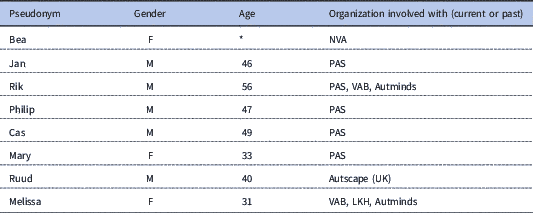
A purposeful sampling process was used in which interviewees were chosen based on predefined criteria (Palinkas, Horwitz, Green, Wisdom, Duan, & Hoagwood, Reference Palinkas, Horwitz, Green, Wisdom, Duan and Hoagwood2015): having autism, being a self-advocate, and being involved in autism (self-)advocacy at board- or staff level. Our group of interviewees included both males and females and spanned ages 31–67. Table 1 illustrates characteristics of interviewees. For privacy reasons, pseudonyms are used for all respondents.
Characteristics of interviewees

*Due to privacy reasons the age of Bea isn’t mentioned
NVA = Nederlandse Vereniging voor Autisme (Dutch National Autistic Society), www.autisme.nl/
PAS = Personen uit het Autisme Spectrum (Persons on the Autism Spectrum), www.pasnederland.nl
VAB = Vanuit Autisme Bekeken (Dutch national workgroup on autism instituted by the Ministry of Health), www.vanuitautismebekeken.nl/
LKH = dr. Leo Kannerhuis (Dutch mental health care institution specialized in autism spectrum disorders, which has an ‘ervaringsraad’: a client council), www.leokannerhuis.nl/
Autminds = Dutch conference by and for autistic people, www.autminds.nl/
Autscape = English conference by and for autistic people, www.autscape.org/
Interviews were conducted in English or Dutch and lasted approximately 1.5 hr. The interviews took place either at the respondents’ house or another location of the respondents’ choice. All interviews were audio-recorded and transcribed. All data were collected in line with the American Psychiatric Association ethical standards; informed consent was obtained in writing.
The interviews were based on a topic list with open questions (see Supplementary Appendix 1). This topic list was made based on relevant themes that emerged from an initial literature review and experiential knowledge of the first author, namely (perspectives on) autism, (self-)advocacy, and CROs/PAS. The list was then discussed within the research team and tested for relevance at the first three interviews. As a result, the interview questions were further specified. Aside from the topics on the topic list, the semi-structured interview format provided space for the interviewees to discuss matters they found important. Member checks were used to improve the internal validity of the results. Data triangulation was achieved by studying additional documents such as newsletters and annual reports on the website of PAS-Nederland (www.pasnederland.nl).
Data analysis
We started with a broad research question: ‘What are the perspectives and experiences of autistic self-advocates in the Netherlands involved in PAS or similar initiatives regarding (1) autism, (2) (self-)advocacy, and (3) CROs.’ According to Bergold & Thomas (Reference Bergold and Thomas2012: 210–211), in participatory research ‘the research questions emerge only gradually during the process of engagement with the research partners’ and ‘can be formulated only vaguely or in general terms before the project begins.’
We analyzed the interview transcripts in several steps, using MAXQDA, qualitative data analysis software that facilitates the analysis of the data. In the first step, we started with open coding: we entered interviews as text files in software, identified meaningful text parts, and coded them thematically on the basis of in vivo words (e.g., Gioia, Corley, & Hamilton, Reference Gioia, Corley and Hamilton2013). Text parts focused on ‘autism,’ ‘(self-)advocacy,’ and ‘CROs.’ Codes were related to, among others, on how our interviewees are perceived as people with autism by themselves and how they think they are seen by others, and what it takes to govern and staff a self-advocacy organization. These codes formed our first-order concepts.
In the second step, we started with selective coding: we re-read and compared the open-coded text parts. By comparing we identified how the coded text parts relate to each other and what they express about the perspectives and experiences of autistic self-advocates. Then we put selective codes to meaningful text parts.
In the third step, we applied axial coding, generating categories that we deemed relevant for the integration of people with autism in work and society. As a result, we produced a set of four second-order themes, which are presented in the Findings section.
Findings
We identified four themes: (1) invisibility, (2) diversity of the autism spectrum, (3) autistic leadership, and (4) collaboration between people with and without autism. We elaborate on each theme and their relationships in the following.
Invisibility of autistic adults
The first theme is invisibility of adults on the autism spectrum. (In)visibility is used in the literal sense: having a more (or less) visible form of autism, and in a metaphorical sense, where ‘invisible’ indicates feeling unseen, dismissed, or discounted.
Some persons with autism, including intellectually disabled autistic children and adults, have a more ‘visible’ form of autism: more severe symptoms or behavior that are easier labeled as abnormal. In contrast, many intellectually able adults with autism are not immediately recognizable as autistic people, and their autism is more invisible.
‘(…) a large group of people, predominantly women, have a sort of ‘invisible autism’– Bea.
Until recently, most attention went to the more ‘visible’ part of the spectrum, for instance in the delivery of services and support. Multiple respondents express their frustration about their invisibility as (female) adults with autism:
‘Damn … are we talking about children [with autism] again! (…) No! We should talk about adults who live intramural and adults who live in society and have problems. That is the group we don’t know anything about. That’s what should be done’ – Jan.
‘What concerns me is that the media continues to present only the worst cases of autism, the people who have a very visible form of autism. That’s a pity. It makes it difficult to get attention for autism that is not so visible’ – Bea.
For our interviewees, all adults with autism, ‘being seen as a full adult’ is important. It is about knowing that adults with autism exist, with their strengths and weaknesses, their ‘normal’ and ‘special’ traits, and that they have their own needs, that are often not seen or acted upon. Employment is, for instance, a topic that is important for adults and not for children with autism.
‘The number of people [with autism] who sits at home on a benefit and who don’t get any further anymore, because they are never challenged anymore. (…)You don’t get an invitation to talk about employment, you are not directed to a course anymore, you don’t get tested anymore. This is something of which I say ‘we need to do something about it’. (…) And because we don’t live in an institution, these issues are not seen or taken up. (…) That’s something of which I think “that can be different”’ – Jan.
To our respondents, who are also active as self-advocates, it is therefore a priority to ask (societal) attention for adults.
‘Adults with autism are often invisible. So, I think it’s important for society to see that adult persons with autism exist.’ Rik. And Jan: ‘The past 5 to 10 years were about discovering that this group exists. (…) The interests of the adults with autism is what will get attention in the next 5 to 10 years (…) and [society needs to] start to think about “What shall we do with that?”.’
Diversity of the autism spectrum
The second theme is diversity of the autism spectrum. There are huge differences between people with autism, which all interviewees mentioned.
‘If you have met one person with autism, you have met one person. And my autism is not Diana’s autism, is not Karins autism’ – Jan.
‘There are so many gradations of autism’ – Melissa.
‘I don’t recognize myself in the image of the ‘Rainman’ autist’ – Jan.
‘A long time ago I worked as the assistant of the headmaster of a school for special education, a school for very hard to raise children, including autistic children, and there I provided support to an autistic boy. I can still see that boy in my mind. But I don’t have what he has’ – Bea.
People with autism not only differ in how autism comes to expression but also differ in what ‘autism’ means to them. Adults with autism have their own ideas and perspectives on fundamental topics such as identity or humanity.
For some people autism is only a part of who they are. Melissa is an example of this:
‘Autism doesn’t define you, just as having blonde hair doesn’t define you.’
For other people, autism does define them. It forms their identity.
‘[Autism is] about personal identity. (…) Autism is about your whole way of being, and your whole interaction style, and your whole thinking style and you know, your whole experience of life really. Autism is after all not just a disability, it’s a way of being as well’ – Ruud.
‘Autism has to do with your identity. You should acknowledge that, because otherwise people do not feel respected or accepted’ – Cas.
Some persons with autism see autism as a variant of the normal human spectrum.
‘You have a spectrum of autism within a spectrum of humanity. Because too often we talk about ‘the autistic spectrum’, and I’m like ‘no, we have a spectrum of humanity, and autism is, is one extreme of that’ – Melissa.
Others express the tension that might exist between being ‘human’ and being ‘an autist.’
Ruud: ‘Autistics are often not seen as full human beings. Something fundamentally human is lacking [in people with autism]: empathy for other people, for example. The ability to have normal social contact, in a certain way. That is all considered as fundamental for being a human. And that would be missing from us. So, then you are not seen as fully human.’ Interviewer: ‘What are you then?’ Ruud: ‘Autist.’
As a result, when supporting people with autism, there cannot be a ‘one size fits all’ approach.
‘What works for some people with autism, might not work for some other people with autism at all’ – Mary.
Autistic leadership
The third theme is autistic leadership.
Adults with autism do not only want to be seen as persons with limitations and who need support but also as powerful persons who are capable of taking initiative, including setting up and managing an entire organization.
What makes PAS special is that it is a CRO: an organization run by and for a group of adults with autism. At PAS all power lies in the hands of the persons with autism (consumer-control). They are the ones who ‘call the shots.’
‘I continue to think it’s really important that something exists where autistics call the shots, and where we can, or at least some of us, can be ourselves and fit in’ – Ruud.
‘PAS brings people [with autism] out of independence, what I think is mature, into contact with each other. (…) Really out of equality connecting people. And not (…) parents, family, professionals, who help people with autism to see each other’ – Mary.
While all interviewees recognize the importance of being ‘consumer-run’, they also mention the difficulties of being a consumer-run organization, especially regarding leadership or coordinative positions.
‘The board is the bottleneck of PAS’ – Cas.
‘I think that certain coordinating qualities, which has also to do with putting a certain structure down, a certain order, there are too little people at PAS who have these qualities. As a result, it soon comes down to one person’ – Mary.
Although all interviewees held a coordination or leadership position themselves, either at PAS or in a comparable setting, they were rather negative about the capacity of (other) people with autism to fulfill coordinative or leadership tasks.
‘To run an organization, to run the union [referring to PAS], on a day-to-day basis requires certain skills and I think, well, people with autism either do not have emotional room for it or lack those skills. They have other qualities, but these [competencies to run a CRO] they have not’ – Mary.
‘Peer contact, that is what [PAS is] really good at. (…) But in practice (…) all skills necessary to organize peer contact and specifically the leadership of it, that’s harder for most people [with autism]’ – Cas.
Lack of leadership qualities can, for some persons, be related to having autism, or it can be due to a lack of experience in leadership roles. People with autism differ in their leadership capabilities, as do neurotypical persons. This links the themes of autistic leadership and diversity.
‘The people [with autism] who came to [a peer contact day] were not really my peers. I was just the leader. I could make social talks, and I know what is important for those people. Actually, I was a kind of a support worker. (…) But that is not what I wanted, so I quit.’ (…) ‘The people that I met (…) well, the limitations they had were of a different dimension. [They had] difficulties with finding words, while my autism is more subtle’ – Cas.
People with autism often lack experience in leadership roles, for instance, in a school, community, or work setting. Leadership skills might not have been taught to people with autism, or they are not supported or rewarded if they take on leadership roles.
Some of the interviewees did have previous experience in a coordinating position in (volunteer) organizations, for instance, Mary. Mary mentions a difference between being a coordinator at PAS and at other settings:
‘Coordinating the PAS-workgroup Autism and Healthcare was very difficult. It is not something that I can’t do, but I found it really hard to make people [with autism] collaborate. I experienced this as different from other settings in which I had a coordinating role’ – Mary.
All interviewees are aware that they are on the more ‘high’-functioning end of the spectrum. As a result, they feel a personal responsibility to act as a role model. Being a role model can be seen as a form of leadership. Several interviewees mention the responsibility they feel to take on this position. But it also points to the diversity of the autism spectrum: not all people with autism are capable of doing so, or in the position to do so.
‘I have a good job. I am an example that autism does not by definition mean ‘problems’. So I feel a responsibility to show [society] that autism is not always a problem’ – Rik.
Acting as a role model (and talking about autism as such) also relates to making autism more visible. The interviewees use words such as ‘reveal’ or ‘conceal’ to express that, according to them, it is important to make autism visible (reveal) instead of camouflaging or concealing it.
‘I see that my role is trying to make it easier for the people who come after me to be open about [autism]’ – Melissa.
‘The general opinion [in health care and support work] is that people with autism can not do this and can not do that. [My support workers] only saw my limitations. (…) But [my autism] is also my strength. (…) There are many people with autism who are not in the position to reveal this. So, I feel myself responsible to act as a leader, to talk about my autism and reveal my autism, and not camouflage it, not conceal it’ – Mary.
Collaboration between people with and without autism
The fourth theme is collaboration. Collaboration between people with autism and people without autism, often parents or professionals and their organizations, can take many different forms. So far, the dominant form is often ‘offering support.’ The person without autism offers support to the person with autism, which often results in an unequal relation (a caregiver–care receiver relation).
Most interviewees recognize that support might be needed, for instance, to make consumer-run initiatives more sustainable.
‘[People on the autism spectrum] set up something, that’s great, but then it has to carry on. And that’s often a difficulty that, people on the spectrum, sometimes they sort of have a bad two months, or they’re so busy they can’t do anything else. So things have to be put in place to prevent good initiatives from just dying an early death’ – Melissa.
However, most respondents have had negative experiences with support from or working together with professionals or parents.
‘On one side I support that PAS can make an appeal on people without an autism diagnosis, and who, at certain crucial points where PAS currently is not succeeding in …euh, putting a good basic structure down, that they can mean something. But the risk is, and that is my ‘But’… how do you prevent that we will be patronized, be mothered by a parent who ‘knows best’? How do you prevent getting into an unequal relationship?’ – Mary
‘I call that ‘fautism’: the false approach to autism. Seeing the person with autism as ill, weak, pitiful and needy. You have autism, so you must be piteous, so you can not do anything, so you don’t get activated anymore’ – Jan.
‘They continuously patronized us a bit. [They did] not give people [with autism] the chance to take responsibility, to take control’ – Cas, about his experiences with the Dutch National Autistic Society (NVA).
‘I think that about 75 to 80 percent of those professionals [who can coach and provide support], they see autism as a limitation, instead of as a quality. (…) They do not see us as equal’ – Cas.
Our interviewees advocate for real collaboration: collaboration on an equal basis.
Equal collaboration involves several aspects: First, it means that people with autism are involved in decision-making and leadership. Adults with autism want to have a ‘place at the table’ to talk about issues that matter to them, such as employment, and they want to be taken seriously, which is articulated in the motto ‘Nothing about us, without us.’
‘The minimum requirement is that the group [of persons with autism] themselves must be involved. And involvement means that they [the adults with autism] are heard and that their wishes are fulfilled. Even while it is a diverse group of people. (…) If you are a minority group, then you easily get the feeling of ‘us’ against ‘them’, so it works probably best if people [with autism] advocate for themselves and do things themselves…’ – Rik.
‘What I see as hardcore lobby work… I want to talk to the Minister. That’s not something that can be realized from one day on another, that is a trajectory of several years (…) That is about gaining mass [and collaborate with other organizations] but in a way that we keep the control and are not put on a sidetrack’ – Jan.
Second, equal collaboration involves appropriate communication including raising awareness, talking with people with autism instead of about them, and listening to people with autism.
People without autism also need to understand autism better.
‘If you look at what we knew about autism 10 years ago and now… The knowledge [about autism] spreads very fast, but apparently it still is difficult to understand [autism]’ – Cas.
In the area of employment, one way of doing that is for advocates and/or leaders with autism to educate employers or business clubs about autism.
‘I think it’s very important to disseminate knowledge and expertise about autism. I would love to pay a visit to business owners to explain to them what autism is (…), what it means for somebody to have autism and if you are willing to hire a person with autism. This presentation should be held by a person with autism as expert-by-experience, because they can connect general information about autism to the personal story. It has to be about my autism, these are my personal experiences and this is what autism means to me’ – Jan.
It is the difference between understanding autism from the outside, and understanding autism from the inside.
‘The NVA [Dutch National Autistic Society] said: ‘We understand autism’. Upon which we [at PAS] said: “We ARE autism”’ – Jan.
People with and without autism should talk to each other, with the aim of mutual learning of how to deal with each other.
‘The world consists for the most part of people without autism and I think that [PAS] as a union should play a role in connecting people with and without autism. Both groups have to learn. We have to learn how to deal with them and they have to learn how to deal with us. If we [people with autism] don’t tell them [people without autism]: ‘You treat me in the wrong way’, then we can continue to discuss within our own group [of people with autism]: ‘Do you also think it’s terrible that you are always treated in this way?’ and then I can say: ‘Yes, indeed, that really is annoying’. But if we don’t say this [as feedback] to [people without autism], if we don’t have the [resulting] clash with the outside world (…) then we deprive ourselves of the opportunity that they [people without autism] find a solution that might help us. (…) If we only focus on ourselves, we deprive them of the opportunity to grow and do something with it’ – Jan.
‘The social environment around people with autism has, especially when these are higher functioning forms of autism, extreme difficulties to estimate the person with autism well, [they can not estimate people with autism well], while they think of themselves that they can. Advocacy is also about explaining to the environment what they actually can not do, or what they do wrong’ – Rik.
This can only work, if the people with autism are actually listened to.
‘We’re not listening to people on the spectrum enough, because they are communicating absolutely fine, it’s just a different language sometimes, or we don’t take the time to listen’ – Melissa.
‘That’s something you have to really, really be aware of, that you’re not….I don’t think it’s so much being ‘used’, but that’s what the result is. Um, and so I’m very much protective of, um, just because they say we work together with Melissa, that doesn’t mean anything apart from that you’re a little bit open to listening. It also doesn’t mean that they’re actually listening. [So my dream is] that people are listened to: parents, and kids, and adults, you know’ – Melissa.
In practice, the perspective of people with autism often differs from those of people without autism. As a result, the views, opinions, and interests of people with and without autism are not always aligned. When this is the case, appropriate communication based on equality becomes particularly important. For adults with autism, it is important that they are still (really) listened to, and seen as equal (adult) partners, when there is a (potential) conflict of interest, for instance, when they propose changes that people without autism do not like or want. Instead of negotiating about the proposals and about what is the best decision in a certain situation, the ‘leadership’ of the person with autism is too often discussed. Having autism becomes an argument to put people with autism, and their input, to the side.
Parents or professionals have very different interests [than people with autism]. [People with autism] need to stand up for themselves and not allow others to make decisions for them, because then they will become marginalized’ – Ruud.
‘That’s the danger that I see very much, that you’re fighting against your own diagnosis. (…) Often our diagnosis is used against us, if we are saying things that other people don’t like’ – Melissa.
Summarizing, our findings reveal the experiences of people with autism regarding having autism, working in a CRO, and also their vision about an inclusive world in which people with autism are welcome, seen as unique persons and collaborated with on an equal level.
Discussion and directions for future research
Based on the analysis of perspectives and experiences of autistic self-advocates, we identified four themes relevant to acceptance and integration of adults with autism into employment and society: (1) invisibility of autistic adults, (2) diversity of the autism spectrum, (3) autistic leadership, and (4) collaboration between people with and without autism. Some practical implications of our findings for the inclusion of people with autism in work and society are discussed.
The first theme, invisibility of autistic adults, relates to the importance of raising awareness about the issues and needs of adults, especially, women with autism. Until recently, attention and support focused on children with autism, and intellectually disabled adults with autism. Although over the years the situation for adults with autism has somewhat improved, data analysis revealed that (in)visibility of intellectually able adults with autism remains an important topic.
People with disabilities are often overlooked, and as a result, underutilized in human resources and employment (Lengnick-Hall, Gaunt, & Kulkarni, Reference Lengnick-Hall, Gaunt and Kulkarni2008; Fujimoto & Härtel, Reference Fujimoto and Härtel2010; Fujimoto, Rentschler, Le, Edwards, & Härtel, Reference Fujimoto, Rentschler, Le., Edwards and Härtel2014; Neely & Hunter, Reference Neely and Hunter2014). Some employees will have an autism diagnosis, but have not disclosed this. Others may not be recognized as autistic persons yet, only being diagnosed after dropping out of work, for instance, in times of organizational change. Research on invisible diversity characteristics, such as sexual orientation, reveals that the decision to disclose is a complex one, and that although disclosure appears to be associated with improved career outcomes, it is not without its risks (cf. Trau & Härtel, Reference Trau and Härtel2007; Trau, Härtel, & Härtel, Reference Trau, Härtel and Härtel2013).
There are a number of practical implications of the invisibility theme. First, based on research on other invisible aspects of diversity (e.g., Trau & Härtel, Reference Trau and Härtel2007; Härtel, Härtel, & Ramburuth, Reference Härtel, Härtel and Ramburuth2017), neurodiversity should be explicitly included in organizational policies and practices relating to diversity and inclusion. Doing so contributes to the overall perception of a diversity open climate (Avery & McKay, Reference Avery and McKay2010), and a neurodiversity open climate specifically, which research shows reduces the rate of destructive conflict and underperformance. Second, accurate knowledge and perceptions of autism should be promoted by providing evidence-based information on neurodiversity generally, and autism specifically, whether through newsletters or as part of employee and leader development programs. Also, positive stories of employees on the spectrum should be shared in organizational communications so that any stigma about autism may be reduced. Third, organizations should try to provide an environment supportive of disclosure so that individual needs can be met. For example, the organization might publicize its inclusive stance toward neurodiversity in newsletters and via its intranet and provide information on who neuro-atypical employees may contact to safely and confidentially disclose their diagnosis and receive the support required to perform their work. Although not including studying people with autism, research indicates that self-disclosure of an invisible identity is associated with higher self-ratings of quality of work life and more positive attitudes toward one’s job and employer (Trau & Härtel, Reference Trau and Härtel2007). Future research needs to investigate the generalizability of these findings.
The diversity theme was brought up by all respondents, indicating the importance to people with autism that the public recognizes the heterogeneity of people on the spectrum, and the perception that this is not common practice yet. For instance, people with autism differ in their skills and preferences with regard to work. Not all persons with autism prefer to work in technical or information and communication technology jobs. But so far, most jobs that are created for people with autism are in the information and communication technology and technical area. Recognizing diversity means recognizing that there is no such thing as ‘jobs for autistic people,’ because it relies on an incorrect stereotype of them. This finding accords with research showing that it is not diversity itself that creates problems, but rather counterproductive responses to it (Härtel & Fujimoto, Reference Härtel and Fujimoto2000). Thus, one practical implication of the diversity theme is the need to foster openness to diversity and perceived dissimilarity at the individual, group, and organizational levels, which is shown to be essential to achieving acceptance and integration of marginalized groups (Härtel & Fujimoto, Reference Härtel and Fujimoto2000). If research on other invisible diversity dimensions extends to the neurodiverse population, another implication of the diversity theme is to ensure a substantial number of autistic employees within an organization, which is associated with higher ratings of psychological safety and inclusion in the organization as well as organizational commitment (Trau & Härtel, Reference Trau and Härtel2007).
The third theme, autistic leadership, highlights the fact that some people with autism can fulfil leadership positions in the workplace. People with autism often develop in an atypical way. Although neurotypical people might follow a standard career pattern where they reach a leadership function around the age of 40, autistic persons often follow a different career path. Some might want a leadership role at a different point in their career. The practical implication of this finding is that educational programs for employees, such as courses or personal development programs, should be open for atypically developing persons, so people with autism (and not only them) can take steps toward growth at their own pace, instead of being excluded because they are too old.
Another practical implication of the leadership theme relates to successful employees with autism acting as public role models. For instance, employees who can openly discuss having autism at work might serve as role models for other employees with autism (or other neurodiverse conditions) who hide their autism, and as a consequence might lack appropriate support. Leadership positions held by people with autism in (self-)advocacy organizations are necessary to influence how money is spent or how autism is explained and represented to the public (Robertson, Reference Robertson2010).
The fourth theme, collaboration, identifies the importance to people with autism of collaborating with people without autism. Autism is not only about being visible; it is about being heard: being talked with and listened to. Thus, it is not just the parents and professionals associated with autistic people who need to perceive that societal awareness of adults with autism is increasing, it is also the people with autism. Talking with people with autism and really listening to their experiences and ideas is essential to the creation of a truly neuro-inclusive labor market. People with and without autism should work together to open up employment, and society in general, for people on the spectrum and to make the necessary changes to make employment accessible for neuro-atypical persons. People with autism should be involved in the development of solutions, according to the motto ‘nothing about us, without us.’
Based on our exploratory findings, new topics emerged that might be the subject of future research. Our findings regarding the invisibility theme raise questions about the possible relation with gender. Are women with autism particularly invisible? Do autistic women camouflage their autism more than autistic men? The association between being (in)visible as a person with autism and power structures could be explored further. When and how are persons with autism invisible? What are the consequences of hiding diagnoses at work? Our findings regarding the diversity theme indicate the need for research identifying the critical elements in fostering openness to neurodiversity at the individual, group, and organizational levels, as well as the key factors associated with people with autism perceiving they are accepted and integrated in the organization. Part of this research stream should address the impact of the perceived number of autistic employees within an organization on autistic people’s self-ratings of psychological safety, inclusion, and organizational commitment. The work of Härtel and colleagues may prove instructive here (e.g., Härtel, Reference Härtel2004; Härtel, Härtel, & Trumble, Reference Härtel, Härtel and Trumble2013; Härtel & O’Connor, Reference Härtel and O’Connor2015).
Our findings regarding the autistic leadership theme revealed the need for more research on autistic leadership across a range of organizations, including CROs. Further research also is needed to explore the relation between autistic leadership and autistic role models. The findings relating to collaboration reveal the need for researching how autistic people’s experiences and ideas can be heard by the nonautistic part of the population, what increases autistic people’s perceptions that societal awareness of adults with autism is increasing, and how employment opportunities can be increased through the collaboration of people with and without autism. Some theoretical frameworks that could guide such research efforts include the diversity justice management model (Fujimoto, Härtel, & Azmat, Reference Fujimoto, Härtel and Azmat2013), the full potential management model (Fujimoto & Härtel, Reference Fujimoto and Härtel2010), the organizational diversity learning framework (Fujimoto & Härtel, Reference Fujimoto and Härtel2017), and the community-oriented inclusion framework (Fujimoto et al., Reference Fujimoto, Rentschler, Le., Edwards and Härtel2014).
In conclusion, our study highlights the need for research on how the management of CROs/self-advocacy organizations led by people with autism can become more sustainable. Our study also highlights the need to research the diversity of views regarding (the construction of) ‘autism’ itself, and how notions of having autism relate to concepts such as identity, humanity, leadership, or the sustainability of CROs. Lastly, our study underscores the importance of putting autistic people at the center of decision-making processes and solutions aimed at improving their outcomes in society generally, and the workplace specifically.
Notes
We are fully aware of the debates about person-first versus identity-first language (e.g., Sinclair, Reference Sinclair1999; Van den Bosch, Reference Van den Bosch2015; Kenny, Hattersley, Molins, Buckley, Povey, & Pellicano, Reference Kenny, Hattersley, Molins, Buckley, Povey and Pellicano2016). In this article we use ‘person with autism’ and ‘autistic person’ interchangeably, although where there is a clearly established preference, we tried to respect that preference.
Supplementary materials
To view supplementary material for this article, please visit https://doi.org/10.1017/jmo.2018.54
About the authors
Karin van den Bosch, MSc., is an independent writer and junior researcher at Disability Studies in the Netherlands. She holds a Master’s degree (MSc.) in Medical Sciences and in Business Administration, with a specialization in Knowledge and Information Management. She has published several nonacademic articles in Dutch magazines, books, and on websites, among others about autism and topics of interest to adults with autism. Email: karinvdbosch@gmail.com
Dr. Anna Krzeminska is an Associate Professor in the Department of Marketing and Management at Macquarie University in Sydney, Senior Research Fellow at the Australian Institute for Business and Economics (AIBE), Research Fellow at the Leuphana University Research Center for Entrepreneurship Evidence, Germany and the co-founding Director of the Queensland Neurodiversity Hub. Anna is an expert in strategic management issues of social impact organizations and manages an international research and industry engagement portfolio in strategic management of social impact. Email: anna.krzeminska@mq.edu.au
Dr. Eun Young (EY) Song is a research associate at the Bartlett School of Construction & Project Management, University College London. She investigates public conformity to social norms and its unintended consequences. Her current research projects examine the ritualism of compliance, gendered innovation adoption, and the role of bystanders in undoing social change. Her work has been featured in Social Forces, Comparative Sociology, Korean Journal of Sociology, and among others. Email: ey.song@ucl.ac.uk
Dr. Lineke van Hal is a senior researcher at the Verwey-Jonker Institute, conducting scientific research on social issues. She is trained as a medical anthropologist and sociologist and focuses in her research on the perspectives and experiences of various stakeholders in order to understand better what happens in practice. She carried out research projects on work and health, youth care, participation, education and inclusion and diversity. Email: LvanHal@verwey-jonker.nl
Dr. Mitzi Waltz is a teacher in Public Health with the Athena Institute, Vrije Universiteit Amsterdam, and a senior researcher at Disability Studies in the Netherlands. She holds a PhD in Media and Cultural Studies/Disability Studies from the University of Sunderland, and is former head of the taught Autism Studies programs at the University of Birmingham and Sheffield Hallam University. Her research career has focused on special and inclusive education, and independent living for adults with autism and other disabilities. Email: m.m.waltz@vu.nl
Hannah Ebben, MA is a PhD student at the Autism Centre at Sheffield Hallam University. With her background in Cultural Studies, she received her MARes in Historical, Literary, and Cultural Studies at Radboud University Nijmegen, The Netherlands, and worked as a Junior Researcher at the Disability Studies in Nederland research group. She is currently writing her thesis called ‘Representing Autism as a Discourse within Ableist Economies of Doubt.’ Email: b5040678@my.shu.ac.uk
Dr. Alice Schippers has a background in interdisciplinary social sciences and is general director of Disability Studies in the Netherlands. She holds a coordinating senior research position at the Disability Studies unit of the Medical Humanities Department of the VU University Medical Centre in Amsterdam. Her research is on living with disabilities with a focus on social inclusion (family), quality of life, and collaborative research. She is vice-chair of the International Association for the Scientific Study of Intellectual and Developmental Disabilities (IASSIDD). Email: alice.schippers@disabilitystudies.nl