Bovine glycomacropeptide (GMP) is a 64 amino acid residue sialylated phosphorylated peptide released from κ-casein by the action of chymosin during cheese making. Chymosin is a proteinase which catalyzes the cleavage between residues 105 (phenylalanine) and 106 (methionine) to generate two fractions, para-κ-casein (residues 1–105) and GMP (106–169) (for review see Abd El-Salam et al., Reference Abd El-Salam, El-Shibiny and Buchheim1996; Brody, Reference Brody2000; Manso and López-Fandiño, Reference Manso and López-Fandiño2004; Thomä-Worringer et al., Reference Thomä-Worringer, Sørensen and López-Fandiño2006; Neelima et al., Reference Neelima, Sharma, Rajput and Mann2013). GMP is soluble in whey, whereas the para-κ-casein is a peptide insoluble in whey, and is found in a coagulated protein fraction. GMP is known to have various biological activities, and is thought to be a potential ingredient for functional foods. GMP, which does not contain aromatic amino acids including phenylalanine, is thought to be suitable for patients suffering from phenylketonuria, a hereditary disorder of phenylalanine metabolism (LaClair et al., Reference LaClair, Ney, MacLeod and Etzel2009). Thus, much interest has been shown in the development of efficient inexpensive methods to isolate GMP from whey.
Ion exchange chromatography is one of the methods used by many researchers (Abd Ed-Salam, Reference Abd El-Salam2006). Saito et al. (Reference Saito, Yamaji and Ito1991) isolated GMP from whey fraction by anion exchange chromatography on diethylaminoethyl (DEAE)-Toyopearl, whereas Léonil and Mollé (Reference Léonil and Mollé1991) purified GMP from whey fraction using Mono-S cation exchange HPLC. Each group of researchers showed GMP preparation with no contaminating amino acids including histidine, arginine, tyrosine and phenylalanine. However, their results of amino acid analysis showed recovery of less than 64 residues/peptide (i.e. 60 and 59 residues/peptide, each calculated from the data of Saito et al. (Reference Saito, Yamaji and Ito1991) and Léonil and Mollé (Reference Léonil and Mollé1991), respectively), suggesting the presence of contaminating amino acids in their purified products. Nakano and Ozimek (Reference Nakano and Ozimek1999) chromatographed non-dialyzable fraction of bovine whey on an anion exchange column of DEAE-Sephacel, and reported that the obtained GMP fraction contained small amounts of contaminating amino acids including phenylalanine, tyrosine, arginine and histidine (each <1 residue/peptide). More recently, we have isolated GMP with undetectable level of phenylalanine, histidine, arginine and tyrosine from bovine whey products by protein precipitation followed by anion exchange chromatography on DEAE-Sephacel (Nakano et al., Reference Nakano, Ozimek and Betti2018). This anion exchanger is, however, not suitable for preparation of food grade GMP. There has been not much information available concerning the use of food grade ion exchange resins for GMP production. Christensen and Holst (Reference Christensen and Holst2014) used ultrafiltration and cation exchange chromatography on a column of Food Grade SP Sepharose Big Beads to prepare 98% purity GMP from whey, which was recovered from the column as unadsorbed product. Outinen et al. (Reference Outinen, Tossavainen, Syväoja and Korhonen1995) chromatographed cheese whey on a column of food grade anion exchange resin (Diaion HPA75) at pH 5.0, and reported that the GMP fraction obtained after chromatography contained considerable amounts of contaminating amino acids including phenylalanine. At pH 5.0, however, whey proteins [e.g. α-lactalbumin and bovine serum albumin having isoelectric point (pI) < 5.0] may be adsorbed to the resin together with GMP having pI < 3.8 (Nakano and Ozimek, Reference Nakano and Ozimek2000). In this regard, re-chromatography of the whey with a lower pH [e.g. 3.0 (Nakano et al., Reference Nakano, Ozimek and Betti2018)] may be of interest for selective separation of GMP.
Chitin is an edible polysaccharide found in shrimp and crab shells (Shahidi et al., Reference Shahidi, Arachchi and Jeon1999) and mushrooms (Hassainia et al., Reference Hassainia, Satha and Boufi2018). It is composed of N-acetylglucosamine and glucosamine, the latter being a minor component (<10%) (Peter, Reference Peter, Steinbȕchel and Marchessault2005). The primary amino group (NH2) of glucosamine may have a potential to bind GMP at an appropriate pH. There is, however, little information available concerning the use of chitin as anion exchanger to adsorb GMP.
Although chitosan, which is prepared by deacetylating chitin, has much higher GMP binding capacity than does chitin (Nakano et al., Reference Nakano, Ikawa and Ozimek2004), it cannot be used as chromatographic support, since it is soluble in acidic solution used for GMP adsorption. It must be treated with chemical cross-linking agent to obtain insoluble adsorbent. Nakano et al. (Reference Nakano, Ikawa and Ozimek2004) reported use of epichlorohydrin-treated chitosan resin to separate GMP from whey. Li et al. (Reference Li, Song, Hein and Wang2010) prepared β-cyclodextrin immobilized chitosan beads cross-linked with 1, 6-hexamethylene diisocyanate for isolation of GMP from whey. These adsorbents are not suitable for production of food grade GMP as they are prepared using toxic chemicals. There are few reports of use of chemically treated insoluble chitosan as a food grade adsorbent.
This study was, therefore, undertaken to determine whether the high purity GMP previously prepared by chromatography on DEAE-Sephacel (Nakano et al., Reference Nakano, Ozimek and Betti2018) (see above) can be isolated from whey fraction by chromatography on food grade anion exchange resins and chitins, and if so to investigate whether there is any difference in GMP binding capacity as well as elution pattern of GMP among the anion exchangers to be examined.
Materials and methods
Materials
A sample of 90% whey protein isolate (WPI) was obtained from Vitarus Nutrition Inc., Abottsford, BC., Canada. A sample of GMP (95% purity according to the supplier's information) was obtained from Davisco Foods International, Inc., Eden Prairie, MN., U.S.A. A soluble portion of this sample (>98% of dry weight, Nakano and Ozimek, Reference Nakano and Ozimek2015) was used for the experiment to estimate maximum amount of GMP recovered from the anion exchange column (see below). Samples of Diaion anion exchange resins HPA75 (functional group: dimethylethanol ammonium) and HPA25L (functional group: trimethyl ammonium) were the products of Mitsubishi Chemicals Corporation, Tokyo, Japan. Dowex 1 × 2 (200–400 mesh) anion exchange resin (functional group: benzyl ammonium), sialic acid (N-acetylneuraminic acid) from Escherichia coli, N-acetylglucosamine and 2-thiobarbituric acid were obtained from Sigma-Aldrich Canada Ltd., Mississaga, ON., Canada. The above anion exchangers were referred to as resin A, resin B and resin C for Diaion HPA75, Diaion HPA25L and Dowex 1, respectively.
Chitin was prepared following the method reported previously (Nakano et al., Reference Nakano, Ikawa and Ozimek2004). A sample of clean dry shrimp shell (218 g) was pulverized using a blender and decalcified using 2000 ml HCl (2 m) at 4°C for 24 h with occasional agitation. The sample was then washed with water and dried at 70°C overnight to obtain 116 g dry matter. This preparation was deproteinized in 1000 ml NaOH (2.5 m) at 21°C for 72 h. Fresh NaOH solution was used in every 24 h. The insoluble residue present was washed with water and dried at 80°C overnight to obtain a final product (52 g), referred to as chitin A, which accounted for 24% of dry shrimp shell. Two samples of commercial chitin (chitin B and chitin C) were obtained, respectively, from two suppliers, TCI America, Portland, OR., U.S.A. and Alfa Aesar, Ward Hill, MA., U.S.A. All chitin samples were powdered to under 60 mesh. To estimate the content of acetyl group in chitin samples, we have determined the content of acetic acid released from chitin and N-acetylglucosamine (the monosaccharide unit of chitin) after acid hydrolysis (see Method described below). The content of acetic acid recovered was similar among the three chitin samples averaging 249 μg/mg dry weight, which was approximately 89% of the content of acetic acid recovered from N-acetylglucosamine (online Supplementary Table S1). This confirms that the degree of acetylation is sufficiently high in these chitin samples. Ash contents (mean ± standard deviation, sd, n = 3) measured were: nd (not detected), 0.40 ± 0.02% and 1.71 ± 0.57% of dry weight in chitin A, chitin B and chitin C, respectively.
Chromatographic isolation of GMP
A suspension prepared by mixing approximately 1 g WPI powder and 20 ml water was heated in a boiling water (98.5°C) for 10 min to coagulate protein. The sample was then cooled to room temperature, and centrifuged using Avanti J-E centrifuge (Beckman Coulter Inc., Brea, CA., U.S.A.) at 15 000 rpm [(maximum 27, 200 g) with JA 25.50 rotor] and 20°C for 20 min to remove protein precipitate. The supernatant obtained was subsequently adjusted to pH 4.6 with 1 m HCl, and the precipitates thus obtained at this pH were removed by centrifugation using the same condition as described above. The supernatant obtained at this stage, which was referred to as soluble whey fraction (SWF), was then adjusted to pH 3.0 with HCl (1 m), and applied to a 1.5 cm × 5.1 cm column of anion exchange resin or chitin equilibrated with acidified water (pH 3.0). After application of sample, the column was washed with 40 to 50 ml of water (pH 3.0). The column was then eluted using a linear gradient formed from 45 ml of water and 45 ml of NaCl (1 m). Elution was further continued with 50 ml of NaCl (2 m). Fractions (~2 ml) were collected at a flow rate of 25–30 ml/h, and monitored for absorbance at 220 nm and for sialic acid. Most of GMP monitored as sialic acid is supposed to be adsorbed on the column and eluted with the NaCl gradient. Fractions containing GMP sialic acid were pooled, dialyzed in water using a 6000–8000 molecular weight cut-off dialysis tube, and then freeze-dried for further studies. This experiment was repeated three times for each anion exchanger to be examined. A freshly packed column was used for each replicate. Saito et al. (Reference Saito, Yamaji and Ito1991) eluted GMP adsorbed on DEAE-Toyopearl using a gradient of 0.02–1.0 m ammonium bicarbonate. In this study, we tested elution of GMP adsorbed on resin B with 0–1 m ammonium bicarbonate gradient. Fractions (~2 ml) collected were monitored for sialic acid, and those containing sialylated GMP were pooled, dialyzed in water and freeze-dried for further studies.
Analytical methods
The content of acetyl group of chitin was estimated by determining the content of acetic acid released from chitin sample by acid hydrolysis. A sample of chitin (~10 mg) was hydrolyzed in 0.5 ml of 6 m HCl at 105°C for 18 h in the presence of nitrogen gas. To this hydrolysate, 1.0 ml water and 0.3 ml internal standard of propionic acid (0.272 g/100 ml) was added, and a portion of the mixture (0.2 μl) was used for the determination of acetic acid by gas chromatography (Nakano et al., Reference Nakano, Ikawa and Ozimek2004). The sialic acid content in column fraction and GMP fraction, and amino acid composition in GMP fraction were analyzed as described previously (Nakano et al., Reference Nakano, Nakano, Ahn and Sim1994, Reference Nakano, Ikawa and Ozimek2004, Reference Nakano, Ozimek and Betti2018). Statistical analysis was carried out using a t-test [GraphPad QuickCalcs] to detect significant difference (P < 0.05) between means of results. An sd was calculated for most of quantitative analytical results with replicate number (n) > 2.
Comparison of GMP binding capacity
In this experiment, the maximum amount of GMP adsorbed and eluted from the anion exchange column, which reflects GMP binding capacity, was estimated mainly following the procedure described elsewhere (Amersham Biosciences, 1999). A 2 ml plastic column (Bio-Lad Poly-Pep column) was packed with anion exchanger (resin or chitin to be examined) by gravity up to the level of 1.8 ml. The content of packed anion exchanger is shown in online Supplementary Table S2. Each column with different anion exchanger was then equilibrated with water adjusted to pH 3.0 with HCl (1 m), and fully loaded by applying commercial sample of GMP (95% purity, Davisco Foods, see Materials) (0.1–0.4 g in 20 ml water) adjusted to pH 3.0 with HCl (1 m). Subsequent to sample application, the column was washed with 40 ml acidified water (pH 3.0), and then eluted with 1 m NaCl. Fractions (~2 ml) collected were monitored for absorbance at 220 nm and for sialic acid. Fractions containing sialylated GMP adsorbed on the column and eluted with 1 m NaCl were pooled, and the portion of pooled sample was used to determine the content of total recovered GMP from the absorbance at 220 nm. The GMP purified from WPI (Land O'Lakes, N, Arden Hills, MN., U.S.A.) with undetectable level of contaminating amino acids (Nakano et al., Reference Nakano, Ozimek and Betti2018) was used as a standard for this assay. This experiment was repeated three times for each anion exchanger. A freshly packed column was used for each replicate.
Results
Preparation of SWF
The SWF obtained after removal of protein precipitates from WPI accounted for average 29.5 ± 0.9% (n = 8) of dry weight of WPI. The protein precipitates obtained by the heat treatment and pH shift to 4.6 accounted for 63.7 ± 2.8% and 6.8 ± 0.9%, respectively.
Chromatography of SWF using food grade anion exchange resins
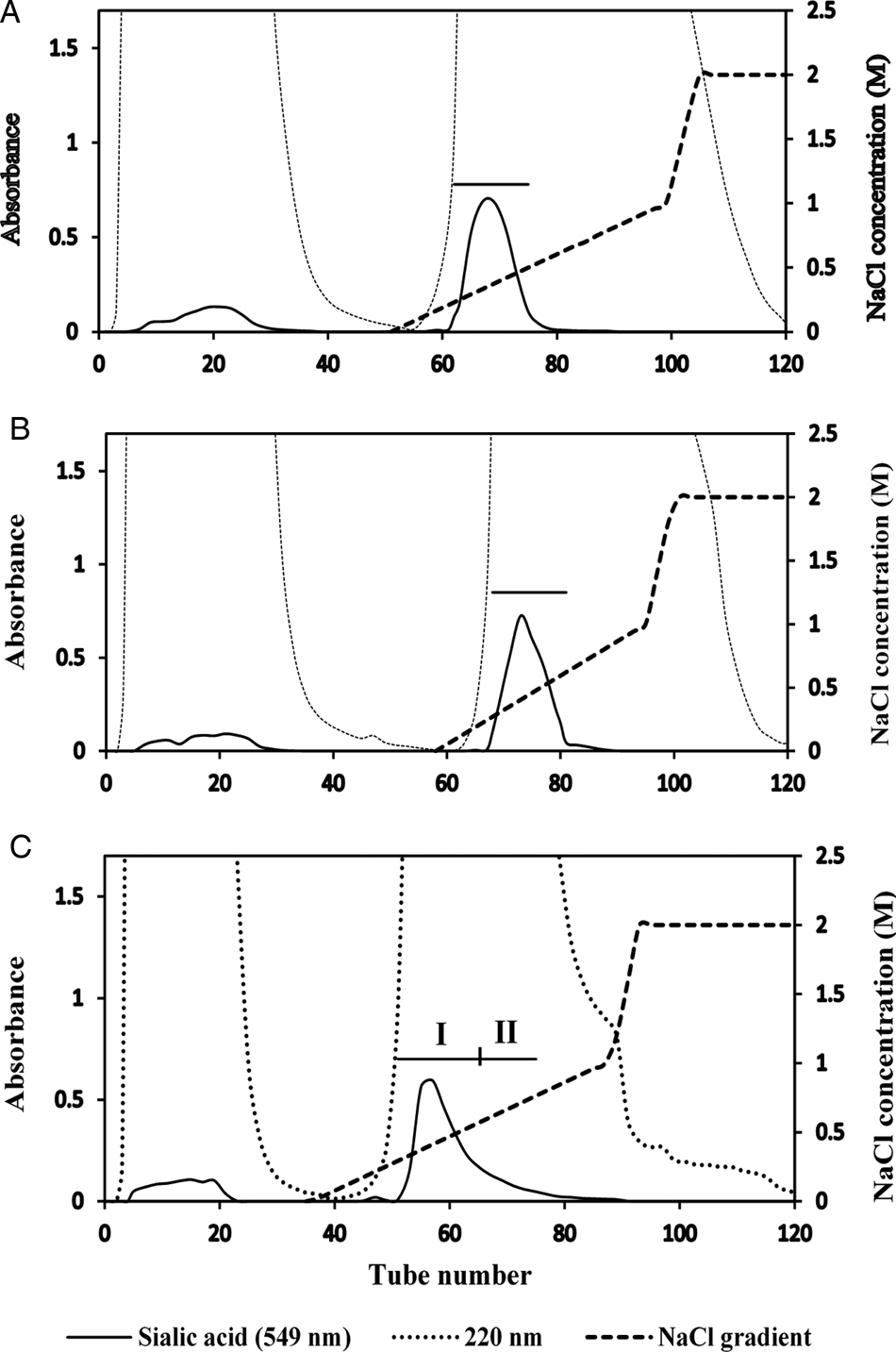
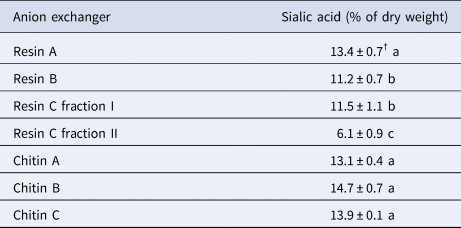
A sample of SWF was then fractionated by chromatography on a column of food grade anion exchange resin A, resin B or resin C. Figure 1 shows chromatogram obtained with each resin. The peak of GMP monitored as sialic acid eluted at 0.2–0.6 m NaCl to give an almost symmetrical peak with resin A (fractions 62–75) or resin B (fractions 68–80), whereas with resin C, most (>80%) of the recovered sialic acid eluted with 0.2–0.6 m NaCl (fractions 52–67, fraction I) but small amount of sialic acid bound more tightly to the resin and eluted at 0.6–1.0 m NaCl (fractions 68–75, fraction II). Thus, the sialic acid peak eluting from resin C (Fig. 1c) was seen to be broader than that eluting from resin A (Fig. 1a) or resin B (Fig. 1b). However, the proportion of sialic acid adsorbed on a column and eluted in a GMP peak was similar among the three resins accounting for average 78% (80.6 ± 3.8%, 76.7 ± 4.9% and 76.7 ± 3.7% for resins A, B and C, respectively) of total recovered sialic acid. The amount of GMP fraction obtained after chromatography was also similar among the resins accounting for average 6.3% (6.3 ± 1.4%, 6.5 ± 1.4% and 6.0 ± 1.3% for resins A, B and C, respectively) of dry weight of WPI. The content of sialic acid was higher (P < 0.05) in GMP fraction from resin A than in that from resin B or resin C (fraction I) with no difference between the latter two, and the lowest (P < 0.05) in GMP fraction from resin C (fraction II) (Table 1).
Chromatography of SWF on food grade anion exchange resin. Fractions (~2 ml) collected were monitored for absorbance at 220 nm and for sialic acid. The horizontal bar denotes the fractions that were pooled for further study. Chromatograms A, B and C show elution patterns of SWF with resin A, resin B and resin C, respectively.

The sialic acid content in GMP fraction

† Mean ± sd, n = 3
a, b, c: Means with different letters are significantly different (P < 0.05).
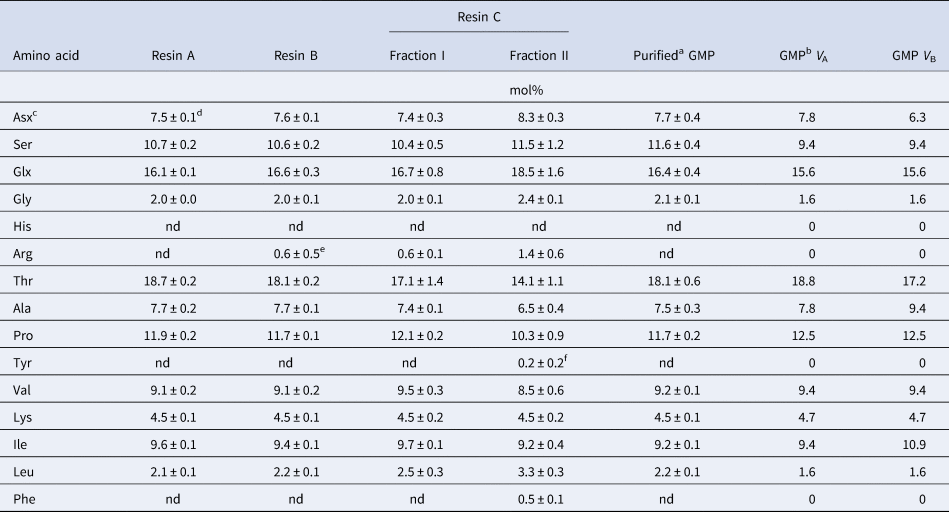
Amino acid analysis (Table 2) showed that the GMP fraction from resin A contained undetectable level of contaminating amino acids including phenylalanine, histidine, arginine and tyrosine. The GMP fraction from resin B contained a small amount (<1 mol%) of arginine with undetectable level of phenylalanine, histidine and tyrosine. For the GMP containing eluates from resin C, amino acid composition was determined in two fractions I and II (Fig. 1c). Fraction I contained small amounts of arginine with undetectable level of phenylalanine, histidine and tyrosine, whereas fraction II contained small amounts of tyrosine and phenylalanine in addition to arginine.
Amino acid composition of GMP fraction from food grade anion exchange column

nd, Not detected.
a Purified GMP reported by Nakano et al. (Reference Nakano, Ozimek and Betti2018).
b Amino acid composition of genetic variant A (VA) or B (VB) is based on its primary structure (Eigel et al., Reference Eigel, Butler, Ernstrom, Farrel, Harwalker, Jeness and Whitney1984).
c Cysteine, methionine and tryptophan were not determined.
d Data are expressed as mean ± sd (n = 3).
e Range: 0–1.0.
f Range: 0–0.3.
Elution of GMP with ammonium bicarbonate gradient on a column of resin B
The GMP sialic acid peak eluted at 0.3–0.7 m ammonium bicarbonate (see online Supplementary Fig. S1). The proportion of GMP sialic acid of total recovered sialic acid was 76.2%, and the amount of recovered GMP accounted for average 4.8% (n = 2) of dry weight of WPI. The amino acid composition of GMP eluted with the ammonium bicarbonate gradient was similar to that of GMP eluted with the NaCl gradient with the exception that arginine found in the GMP eluted with the NaCl gradient was not found in GMP eluted with the ammonium bicarbonate gradient (online Supplementary Table S3).
Chromatography of SWF on chitin columns
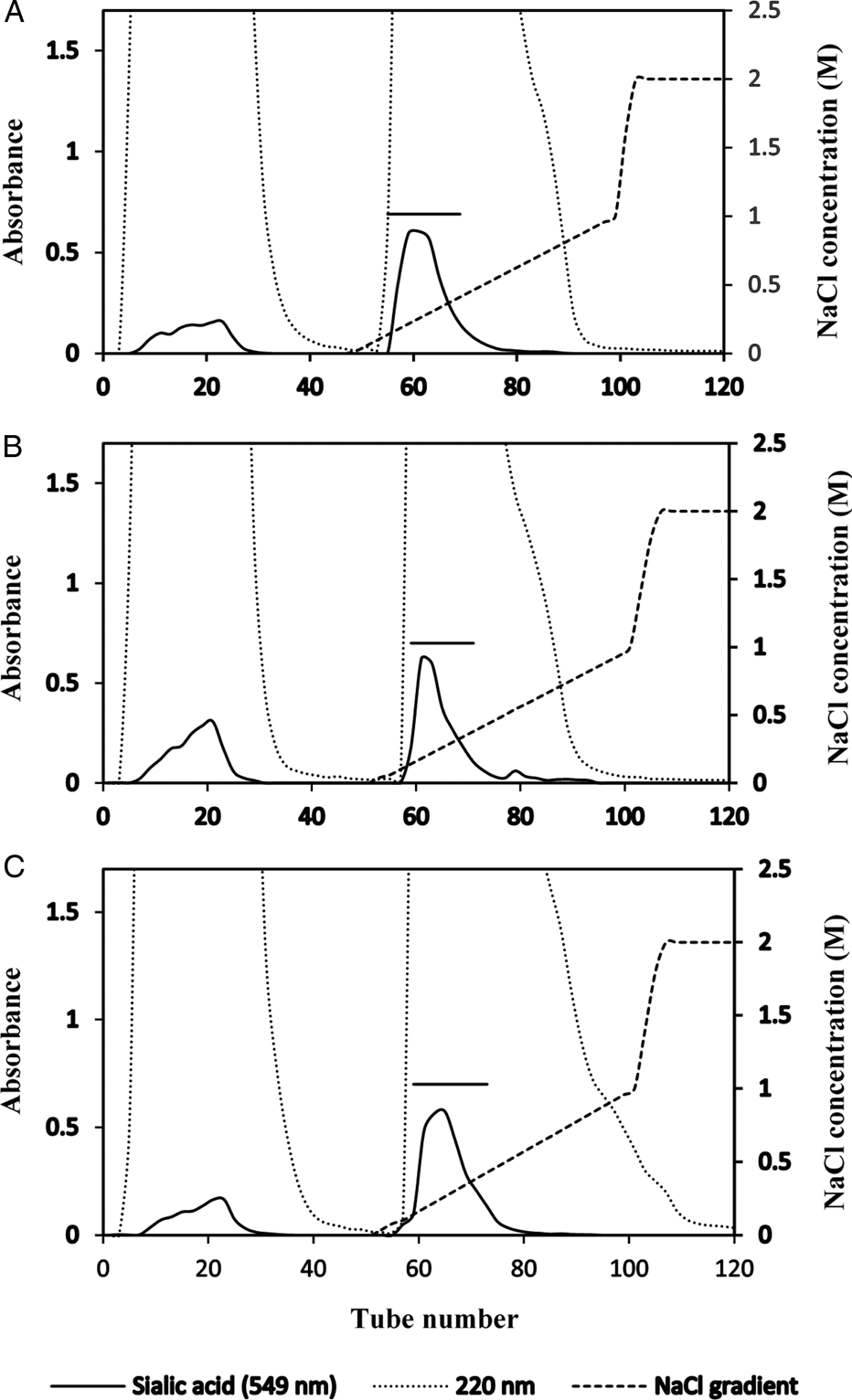
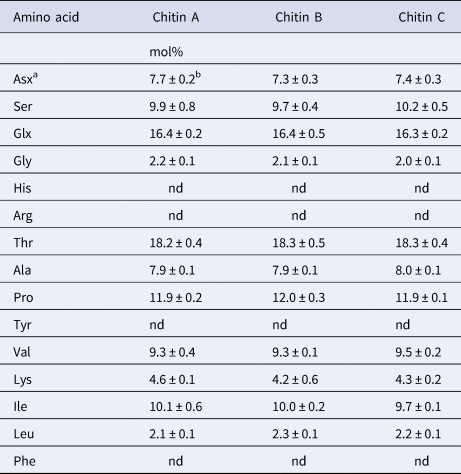
Elution patterns of SWF with chitin columns are given in Figure 2. GMP sialic acid eluted in a single peak at 0.2–0.6 m NaCl with all chitin columns examined. The proportion of GMP sialic acid in total recovered sialic acid was lower (P < 0.05) with chitin B (56.8 ± 4.7%) than with chitin A (74.6 ± 1.2%) or chitin C (74.5 ± 0.2%), but similar (P > 0.05) between chitin A and chitin C. A similar trend was seen among chitin columns in the amount of recovered GMP accounting for 5.3 ± 0.1%, 3.9 ± 0.2% and 5.7 ± 0.1% of dry weight of WPI for chitin A, chitin B and chitin C, respectively. The content of sialic acid was similar among GMP fractions from all chitin columns (Table 1). Amino acid analysis (Table 3) showed that GMP fractions from all chitin columns contained undetectable level of contaminating amino acids including phenylalanine, histidine, arginine and tyrosine.
Chromatography of SWF on a column of chitin. Fractions (~2 ml) collected were monitored for absorbance at 220 nm and for sialic acid. The horizontal bar denotes the fractions that were pooled for further study. Chromatograms A, B and C show elution patterns of SWF with chitin A, chitin B and chitin C, respectively.

Amino acid composition of GMP fraction from chitin column

nd, Not detected.
a Cysteine, methionine and tryptophan were not determined.
b Data are expressed as mean ± sd (n = 3).
Comparison of GMP binding capacity
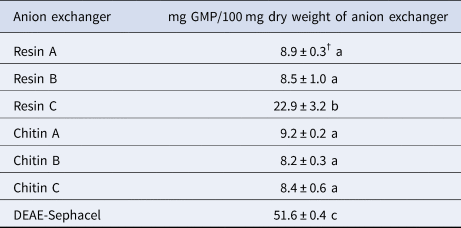
The maximum content of GMP adsorbed and eluted with 1 m NaCl from each anion exchange column is shown in Table 4. The content of recovered GMP was similar (P > 0.05) among the most anion exchangers including resin A, resin B, chitin A, chitin B and chitin C, averaging 8.6 mg/100 mg dry weight of anion exchanger, which is more than twofold lower (P < 0.05) than the corresponding value for resin C. DEAE-Sephacel, a non-food grade anion exchanger previously used for GMP purification (Nakano et al., Reference Nakano, Ozimek and Betti2018), had more than twofold higher content of recovered GMP (P < 0.05) than did resin C.
The maximum content of GMP recovered from 1.8 ml anion exchange column

† Mean ± sd, n = 3
a, b, c: Means with different letters are significantly different (P < 0.05).
Discussion
The proportion of SWF (corresponding to approximately 30% dry weight of WPI) reported in this study is comparable to that of SWF (32%) calculated from the proportion of total protein precipitates in WPI previously reported by Nakano et al. (Reference Nakano, Ozimek and Betti2018). Thus, approximately 70% of protein was removed from WPI by heat and pH shift treatments to obtain SWF, a GMP rich product, and most (~90%) of protein precipitate, which may be called ‘ricotta cheese’, was removed by heat coagulation. Saito et al. (Reference Saito, Yamaji and Ito1991), in their study of GMP purification, precipitated protein by heating whey at 98°C for 1 h followed by precipitation of heat stable protein in 50% (v/v) ethanol. In the present study, we did not use ethanol to further precipitate protein in SWF because we knew from our preliminary study that addition of ethanol to SWF up to 50% (v/v) level resulted in precipitation of considerable amount of GMP (monitored as sialic acid) corresponding to ~50% of total sialic acid in WPI (T. Nakano & M. Betti, unpublished observations).
In this study, we think that GMP were aggregated at pH 3.0, and adsorbed as aggregates (but not monomers) on the anion exchange column during fractionation of SWF. This assumption appears to be consistent with the findings of Nakano and Ozimek (Reference Nakano and Ozimek1998) who examined the size of GMP by gel chromatography on Sephacryl S-200 at pH 7.0 and 3.5, and reported that GMP are aggregated at both pH and that the size of aggregate is not influenced by pH. Adsorption of GMP aggregates may be more advantageous compared to that of disaggregated GMP to obtain a higher yield of purified product. This possibility may be checked by anion exchange chromatography of GMP in the presence of dissociating agent (e.g. 6 m guanidine hydrochloride), in which GMP are disaggregated (Nakano and Ozimek Reference Nakano and Ozimek1998, Reference Nakano and Ozimek2015).
The lower content of recovered GMP observed with chitin B compared to chitin A or chitin C (see above) is probably due to lower density (mg/bed volume) of chitin B matrix (online Supplementary Table S2). If so, chitin B may be associated with lower accessibility to GMP (and thus lower amount of recovered GMP) compared to chitin A or chitin C.
Although in the present study, ammonium bicarbonate in the GMP fraction was removed by dialysis (see the method) and the dialysate obtained was freeze-dried to recover GMP as the final product, the same product is supposed to be obtained by evaporating ammonium bicarbonate by heating (>60°C) (and vacuuming if necessary) without dialysis. The apparently lower content of recovered GMP observed here with the ammonium bicarbonate gradient than with the NaCl gradient (see above) is difficult to explain.
Amino acid composition is one of the important criteria to estimate the purity of GMP. The present study suggests that the high purity GMP with no detectable level of contaminating amino acids including phenylalanine, histidine, arginine and tyrosine, previously prepared using DEAE-Sephacel (Nakano et al., Reference Nakano, Ozimek and Betti2018), can be reproduced from SWF using food grade anion exchange resin A (Table 1), resin B (online Supplementary Table S3) and all chitin columns (Table 3). The sialic acid contents in GMP fractions from resin A and all chitin columns averaging 13.8% of dry weight (Table 1) are close to that found in GMP purified using DEAE-Sephacel (average 14.8% of dry weight, Nakano et al., Reference Nakano, Ozimek and Betti2018). Thus, our procedure including anion exchange chromatography of SWF obtained after removal of protein precipitates from WPI appears to be an efficient method to produce GMP with high purity. Further study is needed to investigate the effects of repeated chromatography on the reproducibility of anion exchange capacity for each adsorbent. This is important to choose adsorbent(s) appropriate for efficient economical production of GMP.
The only published information on separation of GMP by chromatography on food grade anion exchange resin appears to be that of Outinen et al. (Reference Outinen, Tossavainen, Syväoja and Korhonen1995), who fractionated cheese whey using Diaion HPA75 (corresponding to resin A in this study) at pH 5.0, and reported that the GMP fraction they obtained contained significant amounts of contaminating amino acids including phenylalanine, arginine, histidine and tyrosine. The present result with resin A, however, suggests that attempting re-chromatography of their GMP preparation on the same resin at pH 3.0 instead of pH 5.0 makes sense to remove contaminating amino acids.
The present results suggest that the content of GMP recovered from chitin column (close to 9 mg/100 mg chitin) was as high as that of GMP recovered from the column of commercial anion exchanger, resin A or resin B (Table 4). At present, there is little information available concerning the binding of GMP to chitin or resin B. Resin C that showed a higher maximum content of recovered GMP than did resin A, resin B or chitin (Table 4) may be useful for large scale production of GMP. However, amino acid composition data (Table 2) suggest that there may be more contaminating amino acids in GMP fraction from resin C compared to that from other resin or chitin. If this is the case, we suggest re-chromatography of the GMP fraction (from resin C) on the same resin or other anion exchanger to remove contaminating amino acids from it. Nakano et al. (Reference Nakano, Ozimek and Betti2018), in a study of purification of GMP from whey, reported that the GMP fraction obtained by chromatography of WPI on a column of DEAE-Sephacel contained small amount of phenylalanine, and that re-chromatography of the GMP fraction on the same column resulted in elution of GMP with undetectable level of phenylalanine.
If the proportion of NH2 group is increased by deacetylating chitin, the amount of GMP adsorbed on the column will be increased. In our experiment (T. Nakano & M. Betti, unpublished results), we prepared partially deacetylated chitin (PDAC) insoluble in 1.5% (v/v) acetic acid by boiling a sample of chitin A in 28.6% (w/w) NaOH as described by Hisamatsu and Yamada (Reference Hisamatsu and Yamada1989). We then fractionated SWF on a column of PDAC as described above. Results showed that the GMP sialic acid peak was much broader with PDAC (chromatogram not shown) compared to the corresponding peak eluted from chitin A (Fig. 2a). The GMP fraction obtained contained average 8.0% sialic acid by dry weight, and had its amino acid composition showing high variations in the amounts of contaminating amino acids including phenylalanine [mol% = 0.31 ± 0.31, range = nd (non-detectable level) to 0.7].
In conclusion, we have developed a method of purification of GMP with no detectable level of contaminating amino acids including phenylalanine, histidine, arginine and tyrosine from SWF using commercially available food grade anion exchangers, resins A and resin B and all chitin adsorbents. Resin C, which showed higher GMP binding capacity than did other resin or chitin, may be useful for preparation of GMP rich product.
Supplementary material
The supplementary material for this article can be found at https://doi.org/10.1017/S0022029919000918.
Acknowledgments
We thank Mr. Timothy O'Mara, Itochu Chemicals America Inc., New York, for kindly supplying anion exchange resin samples of Diaion HPA75 and Diaion HPA25L for these experiments. This study was supported in part by a grant from the Natural Sciences and Engineering Research Council of Canada.