Myocarditis occurs 3 to 4 weeks following the onset of Kawasaki disease, which coincides with the timing of the acute and subacute phase of the illness.Reference Fujiwara and Hamashima1 Such myocarditis has been shown to cause aberrations in cardiac function.Reference Takahashi2 Recently, several studies have revealed left ventricular diastolic dysfunction in the acute phase of Kawasaki disease.Reference Kurotobi, Kawakami and Shimizu3, Reference Takeuchi, Saji, Takatsuki and Fujiwara4 Generally, in cardiac illnesses, interactions between geometry and function are complex and important. We hypothesized, therefore, that any elevation in the index of left ventricular mass occurring during the acute and subacute phase of Kawasaki disease due to geometric change would be associated with changes in myocardial indexes of diastolic function. Myocardial swelling, which results in an increase in the index of left ventricular mass, can be due to myocardial inflammation caused by myocarditis, or it can be due to general tissue swelling caused by increased vascular permeability, which is the key pathophysiologic feature during the acute phase of Kawaski disease.Reference Terai, Honda, Yasukawa, Higashi, Hamada and Kohno5 The purpose of our study, therefore, was to determine whether increases occurred in the index of left ventricular mass during the acute and subacute phase of Kawasaki disease, and to investigate any relationships between this index and other clinical and echocardiographic variables.
Materials and methods
Subjects
We included in the study 66 patients who were registered at Soonchunhyang University Hospital from March, 2001, through February, 2005, or at Konkuk University Hospital from March, 2005, through November, 2007. For inclusion, the patients needed to fulfill the diagnostic criterions for Kawasaki disease, these being the presence of more than four principal criterions and a duration of fever of more than 4 days,Reference Newburger, Takahashi and Gerber6 to have undergone initial echocardiographic investigation during the acute and subacute phase within 4 weeks after the onset of disease, and to have been investigated echocardiographically during the phase of convalescence lasting from 8 to 12 weeks after the onset of disease. As a control group, we enrolled 57 children of comparable age, ranging from 0.25 to 7.0 years, who had been referred to our hospitals for evaluation of a cardiac murmur during the period of study, and in whom clinical and echocardiographic examinations showed no evidence of cardiac disease. The institutional review boards of the two hospitals approved this retrospective study.
Demographic and laboratory data were surveyed by reviewing medical records. We used 3 models of weighing scales, specifically FA-94H, Fanics, Korea; GL-150, G-TECH, Korea; and FG-150KAL, AND, Korea. Body surface areas were calculated from data for height and weight using the formula of Mosteller.Reference Briars and Bailey7 Pyuria was defined as more than 10 leukocytes per high power microscopic field. Laboratory data were unavailable for 14 patients. The fever resolved spontaneously before clinical examinations could be obtained in 5, and another 9 were transferred from another hospital for echocardiographic examination after the illness had been controlled. In 9 of the patients, the initial echocardiographic study was performed prior to intravenous administration of immunoglobulins.
Echocardiographic examinations
Subjects were prepared for echocardiography by administering a sedative or antipyretic, as required. For the patients, initial echocardiography was done at a mean of 9 days after the onset of the disease, and follow-up echocardiography at a mean of 66.9 days after the onset during the phase of convalescence. All echocardiographic studies were performed by one echocardiographer, and images were obtained using a Hewlett-Packard Sonos 5500 echocardiographic system equipped with an 8 megaherz transducer, or using a Vivid 7 vantage machine equipped with a 7 megaherz transducer. We stored 3 still images, obtained during the phase of end expiration, on magneto-optical discs during each echocardiographic test. Measurements were then performed off-line by another person unaware of identity of the patient or control subject, and measurements were averaged using these sets of 3 still images.
Diastolic and systolic left ventricular dimensions were determined by M-mode echocardiography targeted using the cross-sectional format. Left ventricular mass was calculated using the formula derived by Devereux et al,Reference Devereux and Reichek8 and its index was obtained by dividing the calculated mass by body surface area. Measurements of the coronary arteries were obtained using the method described by de Zorzi et al.Reference de Zorzi, Colan, Gauvreau, Baker, Sundel and Newburger9 Doppler interrogation of the mitral valve was performed according to the standard guidelines issued by Appleton et al.Reference Appleton, Jensen, Hatle and Oh10 The velocity of propagation of left ventricular early diastolic flow was obtained by measuring the slope delineated by the first aliasing velocity from the tip of the mitral valve toward the apex, as described by Garcia et al.Reference Garcia, Thomas and Klein11 To evaluate the reproducibility of measurements of this velocity, we also calculated the percentage precisions.Reference Galderisi, Benjamin and Evans12 We selected randomly 22 colour M-mode Doppler images of left ventricular inflow, values for propagation for each image being determined by one observer on two occasions, to determine intraobserver variability, and by two observers on two occasions, to determine interobserver variability. The precision achieved for the same observer was 5.9%, and between observers was 9.4%.
Statistical analysis
Data is presented as means with standard deviations. All statistical analyses were performed using SAS Version 9.1, and statistical significances were assessed using an α level of 0.05. Chi-square analysis was conducted to determine whether the distribution of genders differed amongst the patients and their controls. Unpaired Student’s t test was used to compare numerical variables between patients and controls, and the paired t test was used to compare echocardiographic data relating to the subacute and acute as opposed to the convalescent phases of the illness. Correlations between the index of left ventricular mass and age, laboratory, and echocardiographic variables were sought using Pearson’s correlation analysis. Correlations between differences in the index, obtained by subtracting the values obtained during the acute and subacute phase from those obtained during the convalescent phase, and differences in body weight obtained in the same manner, were also sought in 45 patients whose body weights were measured using an identical weighing scale during these phases of the illness. Correlations were sought between heart rate and diastolic indexes.
Results
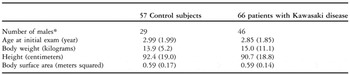
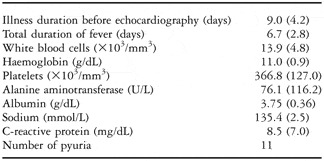
The ratio of males to females was higher amongst the patients, (p = 0.0329 – Table 1), but other demographic and anthropometric data was similar in the patients when compared to their controls. Anthropometric data obtained from the patients during the convalescent phase of the illness was used to calculate body surface areas and differences in body weight. The clinical and laboratory data obtained during the acute and subacute phase is shown in Table 2.
Demographics and anthropometric data.

Values are means with standard deviations. *p < 0.05.
Clinical and laboratory data of children with Kawasaki disease at initial examinations.

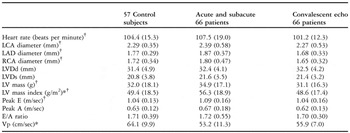
The echocardiographic measurements are shown in Table 3. When comparing the patients with their controls, the index of left ventricular mass during the acute and subacute phase was found to be higher (p = 0.0461), and the velocity of propagation of early diastolic flow to be lower (p < 0.0001) in the patients. When comparing measurements obtained during the acute and subacute phase with those obtained during convalescence, heart rate (p = 0.0309), the diameters of the main stem of the left coronary artery (p = 0.0045), the left anterior interventricular coronary artery (p < 0.0001), the right coronary artery (p = 0.0052), left ventricular mass (p = 0.0020), the index of left ventricular mass (p = 0.0001), and peak E velocity (p = 0.0043) were all found to be lower during the convalescent phase. On comparing data between the patients during convalescence and their controls, no variable, including the index of left ventricular mass (p = 0.8020), showed any significant difference.
Comparisons of echocardiographic data.

Values are means (standard deviations).
*p < 0.05 for the control group versus the acute and subacute examination phase in the patients with Kawasaki disease.
†p < 0.05 for comparisons between study phases in the patients with Kawasaki disease.
Echo: echocardiography; LCA: main stem of left coronary artery; LAD: left anterior interventricular coronary artery; RCA: right coronary artery; LV: left ventricle; LVDd: diastolic LV dimension; LVDs: systolic LV dimension; E: peak early diastolic velocity of mitral inflow; A: peak velocity of diastolic atrial mitral inflow; Vp: velocity of propagation of left ventricular early diastolic flow.
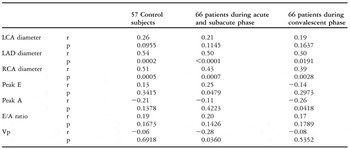
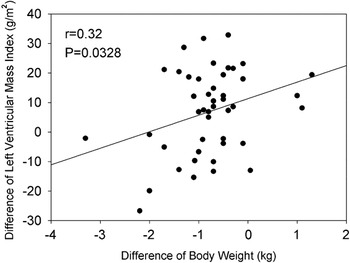
Levels of albumin in the serum (r = −0.33, p = 0.0193) were found to be negatively related, and levels of C-reactive protein (r = 0.29, p = 0.0253) to be positively related, to the index of left ventricular mass during the acute and subacute phase. Analysis for correlations between the index and echocardiographic variables are shown in Table 4. The diameters of the left anterior interventricular and right coronary arteries were positively related to the index in all three data sets. During the subacute and acute phase, peak E velocity was also found to be positively related to the index, while the velocity of propagation of early diastolic flow was negatively related. During convalescence, the peak A velocity became negatively related to the index. Positive relationships were found between the difference in body weight and those between the index (Fig. 1).
Results of analysis of correlations between the index of left ventricular mass and echocardiographic variables.

r: Pearson correlation coefficient; Echo: echocardiography; LCA: main stem of left coronary artery; LAD: left anterior interventricular coronary artery; RCA: right coronary artery; E: peak velocity of early diastolic mitral inflow; A: peak velocity of diastolic atrial mitral inflow; Vp: velocity of propagation of early diastolic left ventricular flow.
Correlation between difference in the index of left ventricular mass, obtained by subtracting the values obtained during the acute and subacute phase from those obtained during the convalescent phase, and difference in body weight obtained in the same manner.

Heart rates were not related to peak E velocity, or to the velocity of propagation of early diastolic flow, in any of the three data sets, but were significantly related to peak A velocity (r = 0.55, p < 0.0001) in the controls, to this value in the patients during the acute and subacute phase (r = 0.46, p = 0.0004) as well as during convalescence (r = 0.41, p = 0.0009), and to the ratio of E to A (r = −0.55, p < 0.0001; r = −0.38, p = 0.0041; r = −0.54, p < 0.0001, respectively).
Discussion
Increased index of left ventricular mass during the subacute and acute phase
We found that the index increased during this phase of Kawasaki disease, but approached the value obtained in the control subjects during the convalescent phase. The index was also related negatively to the level of albumin in the serum during the subacute and acute phase. It is suggestedReference Terai, Honda, Yasukawa, Higashi, Hamada and Kohno5 that vascular leakage may be a key feature of the pathophysiology of Kawasaki disease. Increased vascular leakage can cause hypoalbuminaemia and oedema of tissues. Thus, we considered that the increases in the index noted during the subacute and acute phase could be the result of myocardial swelling, due to generalized swelling of the tissues resulting from increased vascular permeability. This consideration is supported by the significant positive relation found between the differences in the index and those occurring between body weight when measurements in the acute and subacute phase are compared with those obtained during convalescence.
Left ventricular mass index and diastolic indexes
The positive relation between the index of left ventricular mass and the diameters of the left anterior interventricular and right coronary arteries in all three sets of data may have been due to the normal impact of cardiac growth. In this respect, it is noteworthy that coefficients of correlation were greater for the control subjects than for the patients. The noted relationship between heart rate and peak A velocity or E/A ratio may be secondary to either the young age at the onset of the disease compared to a more mature age upon follow-up. As patients with Kawasaki disease are often agitated and fussy during their febrile inflammatory illness, sedation may compensate for this effect as delineated in our methods. Parameters of diastolic function, nonetheless, must be interpreted with caution when performed during a tachycardic state. On the other hand, the index of left ventricular mass is known not to be altered by a faster heart rate.
The velocity of propagation of early diastolic flow is an index of left ventricular relaxation that does not pseudonormalize, and has been shown to be independent of preload in adults.Reference Garcia, Thomas and Klein11, Reference Garcia, Palac, Malenka, Terrell and Plehn13 This measurement has been shown to be a helpful adjunct when assessing diastolic function in children.Reference Border, Michelfelder and Glascock14 In our opinion, the measurement is an easily executable and sensitive index of diastolic function, and thus we measure this value routinely during echocardiographic examinations. Decreases in the value, coupled with increased peak velocity of E, the increased index of left ventricular mass, and their currently noted significant interrelation during the acute and subacute phase of Kawasaki disease, suggest diastolic dysfunction resulting from myocardial swelling.
Limitations
The unbalanced gender distribution could have caused some bias. We also calculated the index of left ventricular mass based on M-mode recordings targeted by cross-sectional interrogation, which requires certain geometric assumptions, and thus, some inaccuracy is inevitable. Other limitations stem from the retrospective design of the study, in that echocardiographic interrogations in five-sixths of the patients were performed after intravenous infusion of immunoglobulins, and initial echocardiography was performed only once during the acute and subacute phase. Because of this, it did not prove possible to distinguish any changes in the index during the acute as opposed to the subacute phase of the illness.
Conclusions
The index of left ventricular mass is increased during the acute and subacute phase of Kawasaki disease, and is associated with altered diastolic indexes. This elevation may be due to generalized myocardial swelling from acute inflammation and increased vascular permeability. In studying cardiac function during the acute and subacute phase of Kawasaki disease, therefore, measurement of the index of left ventricular mass may prove to be a predictor of diastolic function.