

The importance of psychosocial working environment conditions for employees’ health and wellbeing, for organisational development and for sustainable economic development has been highlighted in several Swedish political initiatives (SOU [Official Reports of the Swedish Government], 2009) and European political initiatives in recent years (Black, Reference Black2008; Commission of the European Communities, 2007; European Network for Workplace Health Promotion, 2007; World Health Organization, 2008). According to these initiatives, investment in employee health and psychosocial working conditions can contribute to lower costs associated with sickness absence, improved quality of production and a better organisational image (Commission of the European Communities, 2007). However, despite these actions and related working life projects, work-related ill health and demanding psychosocial working conditions are still common for many occupational groups (Härenstam & MOA Research Group, Reference Härenstam2005; Swedish Work Environment Authority, 2010).
When it comes to different sectors in Swedish working life, the prevalence of sickness absence and sickness presenteeism is higher in public human service organisations than in other sectors (Aronsson & Gustafsson, Reference Aronsson and Gustafsson2005). Also employees in public human service organisations are overrepresented among the long-term sick-listed, and employed women have a notably higher risk for long-term sickness absence than employed men (Lidwall & Marklund, Reference Lidwall and Marklund2006). This trend poses significant challenges. However, while several workplace-based prevention and rehabilitation programs have been carried out in this sector of working life, knowledge on the effects of such programs is limited (Åkerlind, Ljungblad, & Granström, Reference Åkerlind, Ljungblad and Granström2010; Kelloway, Teed, & Kelley, Reference Kelloway, Teed and Kelley2008).
Perspectives
There are several both disparate and overlapping approaches to managing health. However, researchers from different scientific areas point at the importance of an integrated approach concerning both prevention and rehabilitation interventions at both an individual and organisational level. ‘Disability Management’ is an approach that goes beyond traditional vocational rehabilitation due to its focus on prevention of injury as well as return to work assistance following injury, and the importance of using the workplace for interventions at all levels of the organisation (Westmorland & Buys, Reference Westmorland and Buys2002). Trends in individual worker rehabilitation suggest a shift from community-based services to work-placed disability management (Shrey, Reference Shrey1996). Amick et al. (Reference Amick, Habeck, Hunt, Fossel, Chapin, Keller and Katz2000) point at the importance of an integrated approach that incorporates the effects related to safety management and prevention, systems for effectively managing health conditions, and the organisational climate and behaviours that comprise the context of the workplace. A systematic review of disability management interventions found strong evidence supporting the economic merits of multi-sector disability management programs (Tompa, de Oliveira, Dolinschi, & Irvin, Reference Tompa, de Oliveira, Dolinschi and Irvin2008). The study also found moderate evidence for interventions that included an education component, work accommodation offer and multiple contacts with the workplace during rehabilitation processes.
Another approach of relevance is ‘Workplace health management’, which addresses wider perspectives on managing health at work (Shain & Kramer, Reference Shain and Kramer2004). When it comes to health promotion investments, several studies concerning economic effects have been published. However, many of these focus on individual-based interventions such as health and wellness training and lifestyle changes. Research reviews (Aldana, Reference Aldana2001; Pelletier, Reference Pelletier2001) show that such interventions often have positive effects on lowering costs for medical treatment and sickness absence. Also, in a Swedish review of workplace health promotion interventions (Källestål et al., Reference Källestål, Bjurvald, Menckel, Schaerström, Schelp and Unge2004) it was concluded that only a few of the examined articles focused on the organisational level.
According to Aronsson (Reference Aronsson1995), two factors have to be present to achieve success in workplace change projects: (a) employee influence and participation in the change process; and (b) the active support of management. Results from research on areas such as leadership (Yukl, Reference Yukl2009), quality development (Axelsson, Reference Axelsson2000), stress management (Kompier et al., Reference Kompier, Cooper and Geurts2000) and ergonomics (Westgaard & Winkel, Reference Westgaard and Winkel1997) lend support to this two-factor idea. However, there are several other important factors for successful workplace interventions. Two research reviews conclude that the most successful workplace health interventions have focused on broad strategies for maintaining health while also giving attention to special interventions targeted at specific risk groups (Pelletier, Reference Pelletier2001; Reference Pelletier2009). Also, several recent research studies point out that leadership influences psychosocial working conditions, health and well-being among employees. Studies reveal relationships between leadership and, for example, job satisfaction (Ng & Sorensen, Reference Ng and Sorensen2008), sickness absence (Nyberg, Reference Nyberg2009), well-being (Kuoppala, Lamminpää, Liira, & Vaino, Reference Kuoppala, Lamminpää, Liira and Vaino2008), self-rated health (Larsson, Reference Larsson2010; Vinberg, Reference Vinberg2008) and self-rated musculoskeletal pain (Fjell, Österberg, Alexandersson, Karlqvist, & Bildt, Reference Fjell, Österberg, Alexandersson, Karlqvist and Bildt2007). Psychosocial working conditions such as balanced job demands and a high level of job control can be looked upon as mediating factors between leadership behaviours and employee health (Nyberg, Reference Nyberg2009).
In summary, several studies show positive effects of integrated workplace-based prevention and rehabilitation programs. However, many studies are limited by a cross-sectional design and few studies focus on public human service organisations. Therefore, there is a need for more longitudinally oriented studies, especially in public sector dominated workplaces.
Purpose and Research Questions
The earlier described conditions constitute a basis for the study purpose, which is to contribute to knowledge about workplace-based prevention and rehabilitation programs by investigating effects on outcomes concerning employee health, psychosocial working conditions, sickness absence and rehabilitation indicators in public human service organisations. The following research questions were addressed:
1. Which empirical relationships can be found between employee health, stress, psychosocial working conditions, sickness absence and rehabilitation indicators?
2. When different change strategies are applied to workplace-based prevention and rehabilitation programs, can differences be detected concerning the effects on outcome indicators for health, stress, psychosocial working conditions, sickness absence and rehabilitation indicators?
3. What conclusions for the design of workplace-based rehabilitation and prevention programs can be drawn from the answers to the research questions?
Method
The longitudinal panel data reported here is part of a research and development project concerning Swedish public human service workplaces (Vinberg, Larsson, Landstad, & Malmquist, Reference Vinberg, Larsson, Landstad and Malmquist2012). In the present study, 19 workplaces with a population of 311 individuals (41% of all permanently employed persons in one Swedish municipal organisation) participated in a longitudinal study with two measuring points — before (November-December 2006) and after two years (November-December 2008) from the starting point of workplace-based prevention and rehabilitation programs. The sample consisted only of those individuals that had been working at the workplaces during the study period and who completed a questionnaire at both measuring points. This selection made it possible to compare results for the same individual before and after interventions. The workplaces included home care, elderly care and schools in the municipality. Of the 311 employees, 19 were middle managers and 292 were co-workers. Among the middle managers, 14 individuals (74%) were women and the mean age was 49.9 years. Among the co-workers, 243 individuals (83%) were women and the mean age was 47.9 years.
The research design consisted of a combination of quantitative and qualitative methods. The 311 individuals answered an individual questionnaire at two points in time with a 2-year interval (before and after workplace-based prevention and rehabilitation programs were carried out). Also, data on an individual level related to sickness absence, number of sick-cases and rehabilitation indicators were collected from the organisations’ human resource accounting systems at two points in time.
Qualitative data collection consisted of semistructured interviews with middle managers and an examination of documents reviewing content of the workplace-based prevention and rehabilitation programs that had been carried out. The middle managers at the workplaces are subordinate to the senior management but above the operational staff at the workplaces. Based on the interviews and document examination it was possible to divide the workplaces into two groups: (a) one group with what were judged to be high quality workplace-based programs, and (b) one group with what were judged to be low quality workplace-based programs. The high quality workplace-based programs dealt with several extensive prevention and rehabilitation interventions concurrently, the degree of participation by middle managers and employees was high and several arenas were used during development processes. The low quality workplace-based programs had a lower degree of participation by middle managers and employees, were more-expert oriented and dealt with only a few problem areas. This classification is in accordance with our earlier research (Vinberg, Reference Vinberg2008).
Workplace-Based Prevention and Rehabilitation Programs
A wide spectrum of individual and group-based interventions was carried out at 19 participating workplaces. All workplaces participated in general educational interventions described later and also planned and performed workplace-based prevention and rehabilitation interventions. However, these latter interventions varied in comprehensiveness between the workplaces.
All middle managers at the 19 participating workplaces were educated in how to use a model for ‘human resource accounting’ during 2005, and it was implemented at all workplaces from 2006. By using the model, 6 key indicators can be measured on a yearly basis and at an individual and aggregated workplace level:
• sickness absence
• number of sickness absence occasions
• rehabilitation data (number of individuals achieving vocational rehabilitation interventions and number of individuals returning to work after such interventions)
• employee turnover
• health index covering leaders’ and employees’ perceptions of the psychosocial work environment, job characteristics, health and wellbeing.
The results of the key figures at an individual level were summarised and aggregated at a workplace level for each workplace by using the key indicators in November-December 2006, November-December 2007 and November-December 2008, and these were used as a basis for discussions and planning of different workplace-based prevention and rehabilitation programs. However, the level and number of health, working environment and rehabilitation interventions varied among workplaces studied. Some workplaces had participated only in general interventions in the municipality while other workplaces had performed more specific interventions both at an individual and organisational level. Some workplaces used the municipality's human resource managers and staff from the occupational health service as consultants in discussions about different interventions. All middle managers at the workplaces prepared annual ‘health statements’ about important organisational changes, policies related to health, working environment and rehabilitation issues and improvements that had been carried out during the year.
Another extensive intervention was a leader and co-worker development program held during the period October 2006 to November 2007. The leader development program consisted of 6 days of education on two occasions during 2006, which focused on expanding knowledge on group-based communication, vocational rehabilitation and how leaders can positively influence their own and their co-workers’ working conditions. In spring 2007 the leaders participated in an additional day focusing on how to continue with improvement processes at their workplaces. To supplement the middle management program, during the period January to June 2007, co-workers participated in three education and training days focusing on team functioning and how to handle work conflicts. Groups of 8 to 15 co-workers participated in each training session. In total, 764 employees (both permanent and temporary workers) participated.
A third general intervention at the studied workplaces was the implementation of a new work schedule model (Time Care). The model provided a program that gave the employees the option of using a computer-based system to influence the scheduling of their working hours. From November 2007 the model was implemented at workplaces in elderly care and pre-schools. Middle managers and one contact person from participating workplaces received a 2-hour educational session about the system and were thereafter responsible for the implementation of it. The project is still ongoing with an aim to implement the model at all workplaces in the municipality.
Qualitative Methods
In total 19 interviews with middle managers from each participating workplace were conducted. The interviews, guided by a questionnaire consisting of 15 semi-open questions, lasted one to two hours. The questions focused on areas that have been identified in earlier research as important for a health-promoting leadership and for creating health-promoting organisations (Larsson, Reference Larsson2010; Vinberg, Reference Vinberg2006). The questions addressed were prevention and rehabilitation processes at an organisational and individual level, leader behaviours, future plans and visions. Also background data concerning the employees and workplaces were gathered.
Two researchers conducted the interviews. One researcher led the interview, while a second observed and asked complementary questions. The interviews were recorded and then transcribed. Each interview transcript was from 45 to 70 pages in length. Analysis of the transcribed interviews was carried out according to the following steps: several readings were carried out, and then the focus areas of leadership behaviours and workplace-based prevention and rehabilitation programs were used as a basis for a further assessment (Graneheim & Lundman, Reference Graneheim and Lundman2003). This process was carried out separately by each of the authors. The researchers also examined planned and performed workplace prevention and rehabilitation programs by looking at written documentation in the ‘health statements’ from each leader regarding interventions at their workplaces. Finally, consensus discussions were held among the researchers to identify behaviours and prevention and rehabilitation processes.
The researchers categorised the workplaces into two groups: high quality workplace-based program group and low quality workplace-based program group. These categories were based on the interviews and written documentation about interventions. Theoretical aspects concerning a health-promoting leadership (Larsson & Vinberg, Reference Larsson and Vinberg2010; Nyberg, Reference Nyberg2009; Yukl, Reference Yukl2009) and integrative approaches concerning prevention and rehabilitation processes (Amick et al., Reference Amick, Habeck, Hunt, Fossel, Chapin, Keller and Katz2000; Shain & Kramer, Reference Shain and Kramer2004; Vinberg, Reference Vinberg2008) provided a basis for these groupings. Aspects of leadership behaviour were related to strategic and visionary behaviour, communication and information, employees’ responsibilities and authority, learning in organisations, coaching of employees, dialogues in the workplace, humanity and trust, leader's visibility at the workplace and reflective leadership (Larsson & Vinberg, Reference Larsson and Vinberg2010). Aspects concerning prevention and rehabilitation processes included the number of interventions at an individual and organisational level, participation of leaders and employees in these processes and frequent evaluations of employee health, rehabilitation and working conditions at the workplace (Vinberg, Reference Vinberg2008).
From the interview results and the documentation of interventions at each workplace, the researchers valued the degree of different components in a health promoting leadership and the degree of integrated prevention and rehabilitation interventions at an individual and organisational level. The high quality workplace-based program group was characterised by a more developed health-promoting leadership, several health, rehabilitation and working environment interventions and a relatively high degree of participation from leaders and employees during development processes. Concerning health-promoting leadership at least seven of nine leader behaviours presented above (Larsson & Vinberg, Reference Larsson and Vinberg2010) comprised criteria for a high quality workplace program. Other criteria were that working environment interventions included at least five different working environment areas, cooperation with occupational health services and the social insurance office in ongoing vocational rehabilitation processes at an individual level, and that the workplaces had developed organisational routines for vocational rehabilitation and working environment improvements. Also, a criterion was that most of the co-workers and the middle managers participated in planning and implementation of interventions. The low quality workplace-based program group was characterised by a lower degree of health-promoting leadership and participation, and workplaces that dealt with only a few problem areas.
Quantitative Methods
The panel consisted of 311 individuals who responded to a questionnaire at Time 1 (November-December 2006), before workplace-based programs were introduced, and at Time 2 (November-December 2008), after workplace-based programs were carried out. The sample consisted only of those individuals who were working at the workplace during the study period and who answered the questionnaire at both times. The questionnaire contained a total of 12 validated items covering perception of the psychosocial work environment, job characteristics, health and wellbeing, which have been used in several Swedish research studies (Oxenstierna, Widmark, Finnholm, & Elofsson, Reference Oxenstierna, Widmark, Finnholm and Elofsson2008; Vinberg et al., Reference Vinberg, Larsson, Landstad and Malmquist2012). All items were rated on a 7-point scale from 1 (Never) to 7 (Always). Three indexes were developed on the basis of substantive considerations and factor analyses across all items (principal factor analyses with the varimax method). The model was accepted due to the quality values of Kaiser-Maier-Olkin Measure of Sampling Adequacy 0.76, Barletts's Test of Spericity 0.000 and 55.8% explained variance. Internal consistency data was calculated at both measuring points using Cronbach's alpha (α) coefficient showing satisfactory values between 0.63 and 0.77 (Kline, Reference Kline2000).
The Health index (three items) covered how the respondents judged work-related fatigue, back and shoulder pain, and engagement and being alert at work during the last three months. To compute the scores for this variable, sum scores were calculated, allowing a range from 3 to 21. High scores indicated a high level of health. The Stress index contained 3 items related to worry about ability to perform work tasks, small margins of time for work and time pressure. Sum scores here were from 3 to 21 and high scores indicated a low level of stress. The Psychosocial Working Condition index covered 6 items concerning monotonous and interesting work, possibility to decide about work tasks, feedback from leaders, learning at work and team climate at work. To compute the scores for this variable, sum scores were calculated, allowing a range from 6 to 42. High scores indicated a high level of satisfactory psychosocial working conditions.
From the organisation's human resource accounting system it was possible to collect yearly data concerning sickness absence, sick-cases and rehabilitation data for each individual at both measuring points. These indexes concerning sickness absence, sick-cases and rehabilitation were defined in accordance with earlier research (Malmquist, Vinberg, & Larsson, Reference Malmquist, Vinberg and Larsson2007). Sickness absence was defined as (the number of sickness absence hours/the number of working hours) × 100. Sick-cases was defined as the number of sick-cases/the number of working hours. Rehabilitation (inflow) was defined as (the number of sick-cases started after day 29/the number of working hours) × 10,000. The factors 100 and 10,000 are included in the formula to avoid disproportionately small figures that require many decimals (Malmquist et al., Reference Malmquist, Vinberg and Larsson2007). Rehabilitation (return) was defined as the number of returns to work after day 29/the number of sick-cases that have started after day 29. Difference scores were also calculated; for example, ‘Delta health index’ indicates the difference between Health index 2008 and Health index 2006.
Statistical Analyses
Statistical analyses were carried out using SPSS version 18.0. The analyses consisted of comparisons of Time 1 and Time 2 responses of individuals using the previously described indexes. For all used indexes, mean (M), standard deviation (SD) and Cronbach's alpha (α) were calculated for both measuring points (Time 1 and Time 2). As measures were performed for the same individual at Time 1 and Time 2, the t test to measure differences between groups was based on paired samples test.
Spearman's correlation coefficient (rho) was used for measures of associations between changes in employee Health index and changes in stress, psychosocial working condition, sickness absence, sick-cases and rehabilitation data. Comparisons were also made between groups of workplaces and individuals grouped into the two groups: one judged as using high quality workplace-based programs, and the other judged as using low quality workplace-based programs. First, mean changes for all indexes were calculated for individuals within both groups. Second, an independent samples test assuming equal variances was used for comparing differences in indicator mean changes for the two groups.
Results
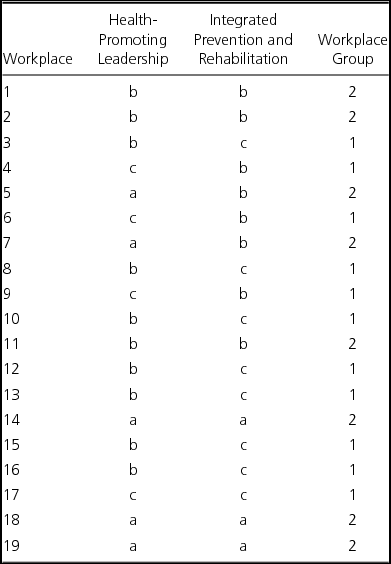
A summary of the qualitative analysis including the earlier described interviews with middle managers and examinations of documentation about workplace-based prevention and rehabilitation programs carried out in the workplaces is presented in Table 1.
Summary of Degree of a Health-Promoting Leadership and Workplace Integrated Prevention and Rehabilitation Interventions in 19 Workplaces
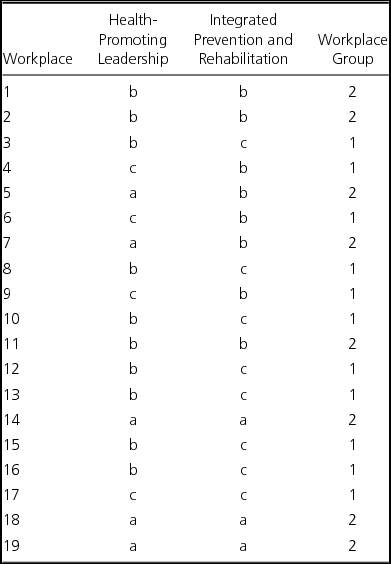
Note: a = denotes a strong degree of connection to studied areas; b = corresponds to a moderately strong degree of connection, and c = corresponds to some or no degree of connection. Workplace group: 1 = low quality workplace-based program group, 2 = high quality workplace-based program group.
The results presented in Table 1 show a relatively large variation between the workplaces studied. A small group of workplaces was judged to have a high degree of a health-promoting leadership and a high degree of integrated prevention and rehabilitation interventions, another group of workplaces had these to a moderate degree, and one group of workplaces had some or no degree of the two forms of intervention considered. According to the degree of a health-promoting leadership and degree of integrated prevention and rehabilitation interventions the workplaces were grouped into one group judged as a low quality workplace-based program group (1), and one group judged as a high quality workplace-based program group (2). Workplaces assessed as having at least a moderate or strong degree of health-promoting leadership and a moderate or strong degree of integrated prevention and rehabilitation interventions were grouped as high quality workplace-based program group. The result of this grouping was that 11 workplaces were classified in the low quality workplace-based program group and 8 workplaces were classified in the high quality workplace-based program group. This grouping of workplaces provided a basis for the quantitative analysis described later in Table 4. The characteristics of the individuals in the final panel were 82% women, mean age 48 years, and 61% employed under a collective labour agreement. Individuals in the groups studied were similar with respect to gender, age and employment types.
The investigation of the ‘health statements’ submitted by the middle managers shows that the interventions at several of the workplaces typically focused on one or a few health, working environment and rehabilitation improvements rather than introducing improvements according to a holistic approach. The dominant interventions were wellness training and physical activity at work, physical working environment improvements with respect to air systems and buildings, investigations from occupational health services, supervision on how to handle clients, working with conflicts in groups, team development days and work with systematic work environment. However, several workplaces categorised in the high quality workplace-based program group used the yearly results from the model for human resource accounting for analyses and planning of interventions with a high degree of involvement from both middle managers and co-workers. These workplaces invested more in interventions concerning psychosocial working conditions such as improvements in work organisation, team development and vocational rehabilitation interventions for individuals on sick-leave or individuals with early stages of ill-health. There was also a more developed cooperation with occupational health services and a more developed health-promoting leadership at these workplaces.
Descriptive Quantitative Analyses
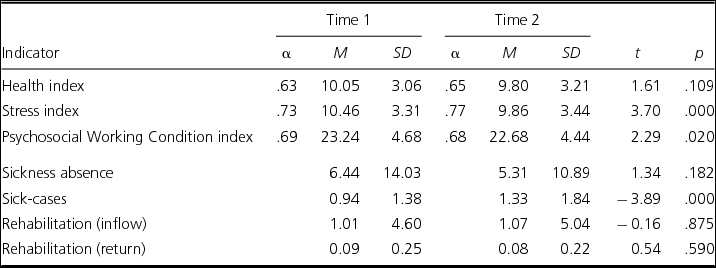
Table 2 shows the reliability coefficients (Cronbach's alpha) and the means (M) and standard deviations (SD) for Time 1 and Time 2 variables (before and after performed workplace-based programs) for the whole study group. High mean values for the indexes of health, stress, psychosocial working conditions and rehabilitation (return) indicate more positive values. Low mean values for the indexes of sickness absence, sick-cases and rehabilitation (inflow) indicate more positive values.
Basic Statistics of the Study Indicators
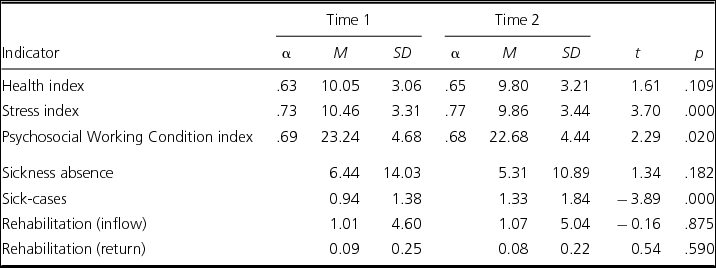
Note: (N = 311); t values and p values indicated for paired sampled test.
The alpha coefficients for the three questionnaire indexes used were between 0.63 and 0.77 in this sample, which is in accordance with accepted levels of reliability coefficients in the social sciences (Kline, Reference Kline2000). The test–retest correlations, ranging from 0.59 to 0.63, showed that the scales for the indexes were fairly stable over time. For the indexes of stress and psychosocial working conditions there were significantly lower values at Time 2. For the Health index there were also lower values at Time 2, but the difference was not significant. For the index concerning sick-cases there was a significant increase, when comparing values at Time 1 and Time 2. For the indexes concerning sickness absence and rehabilitation (inflow and return) the changes were not significant for the whole study group.
Interrelations of Indicators
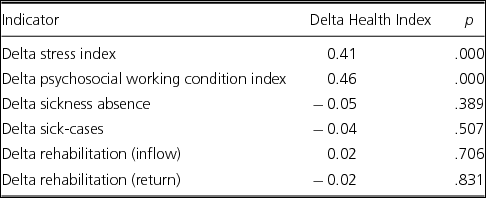
For the entire study group, the relations between changes in the Health index (between 2008 and 2006) and changes in the other used indicators were analysed (see Table 3). There were no significant relations between changes in the Health index and changes in sickness absence, sick-cases and indexes of rehabilitation. However, changes in scores for the Stress index and the Psychosocial Working Conditions index related significantly in the assumed direction with changes in scores on the Health index.
Correlation Coefficients* Between Changes of Health Index and Changes of Indicators for Stress, Psychosocial Working Conditions, Sickness Absence, Sick-Cases and Rehabilitation
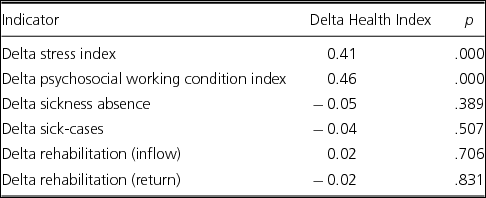
Note: (N = 311); ‘Delta’ denotes the difference between the 2008 and 2006 results.
* Spearman's rho.
Effects of Workplace-Based Programs
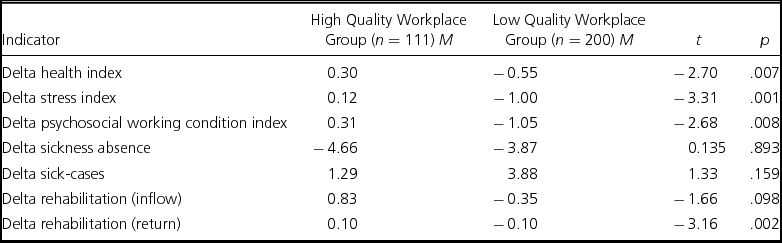
From the interviews and examinations of documents (see Table 1), it was possible to group the workplaces into two groups: low quality quality workplace-based program group and high quality workplace-based program group. In Table 4, changes in the reported questionnaire data, data for sickness absence and rehabilitation are presented for the two groups of workplaces.
Mean Changes in Indicators of Health, Stress, Psychosocial Working Conditions, Sickness Absence, Sick-Cases and Rehabilitation for Two Workplace Groups
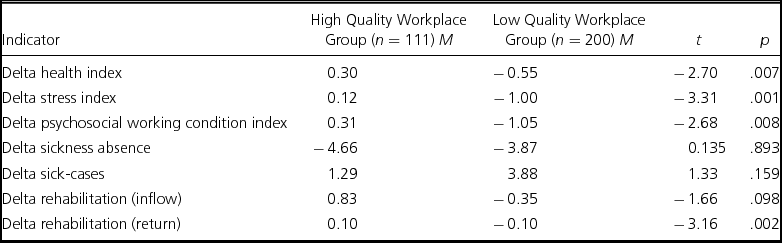
Note: (N = 311); t and p values are indicated for independent samples test, equal variances assumed; ‘Delta’ denotes the difference between the 2008 and 2006 results.
When comparing mean changes in scores on indexes by individuals grouped in the high quality workplace-based program group with individuals grouped in the low quality workplace-based program group, significant differences concerning health, stress, psychosocial working conditions and rehabilitation (return) were revealed. There were more positive mean changes concerning employee-judged health, stress, psychosocial working conditions and rehabilitation (return) in the high quality workplace-based program group, while there was a decrease in scores for these indexes in the low quality workplace-based program group.
Discussion
The purpose of this study was to contribute to knowledge about the effects of workplace-based prevention and rehabilitation programs in public human service organisations. This is of particular importance due to high sickness absence, low degree of self-rated health and demanding psychosocial working conditions in this sector of working life (Aronsson & Gustafsson, Reference Aronsson and Gustafsson2005; Lidwall & Marklund, Reference Lidwall and Marklund2006; Skagert, Dellve, Eklöf, Pousette, & Ahlborg, Reference Skagert, Dellve, Eklöf, Pousette and Ahlborg2008). Also, studies in this research field often focus on larger private organisations and there is a lack of studies with a longitudinal design where qualitative and quantitative methods are combined (Vinberg, Reference Vinberg2006).
The rather strong relationships in the assumed direction between employees’ assessment of changes in health, and changes concerning stress and psychosocial working conditions that resulted are in line with other research studies (de Lange, Taris, Kompier, Houtman, & Bongers, Reference de Lange, Taris, Kompier, Houtman and Bongers2003; Karasek & Theorell, Reference Karasek and Theorell1990). The fact that these relationships are shown when the variables were measured at two points in time indicates possible causality. Another conclusion is that stress and psychosocial working conditions such as the ability to perform work, time margins in work, possibilities for decision-making over work tasks, feedback from leaders and a good team climate at work are of particular importance for employee health in public human service organisations. The study finding of no significant relationships between changes in scores for the Health index and changes concerning sickness absence, the number of sick-cases and rehabilitation indicators are in accordance with research showing that the overlap between concepts of illness (the ill health individuals identify themselves) and sickness absence (related to the social role a person with illness takes or are given) are fairly low (Wikman, Marklund, & Alexanderson, Reference Wikman, Marklund and Alexanderson2005). However, these results open possibilities for further research in this area.
When looking at the effects of the interventions for the group as a whole through a comparison of index mean values at both measuring points there was a significant change for the worse in the two indexes for stress and psychosocial working conditions, and the index for sick-cases. To some extent these results are in line with general trends in Swedish working life during the follow-up period, which have been characterised by deteriorating psychosocial working conditions, insecurity and worry about organisational change (Härenstam & MOA Research Group, Reference Härenstam2005; Swedish Work Environment Authority, 2010). Another explanation can be that small public workplaces have limited resources for carrying out workplace change processes, which in turn affects the quality of such processes. This is in a way supported by results for the study group as a whole; although the workplace-based programs were extensive, several middle managers point at difficulties in translating results from the model for human resource accounting into concrete prevention and rehabilitation measures.
However, when workplaces grouped as having high quality workplace-based programs are compared with workplaces with low quality workplace-based programs, there are significant differences concerning mean changes in scores for the health, stress, psychosocial working conditions and rehabilitation (return) indexes. There are also more improvements in scores for the indexes on sickness absence and sick-cases in the high quality workplace-based program group, although the differences are not significant between the groups. This result could be interpreted to mean that workplaces with more high quality workplace-based programs have ‘balanced’ an otherwise negative development caused by a negative working life trend. If correct, this interpretation then suggests that workplace-based prevention and rehabilitation programs in public human service organisations using a broad change strategy with high levels of participation from both managers and co-workers, and developed leadership behaviour are more effective in improving employee health and psychosocial working conditions. Several researchers from different areas support the idea that more holistic workplace change programs with a high degree of participation from both leaders and co-workers are more effective (Åkerlind et al., Reference Åkerlind, Ljungblad and Granström2010; European Network for Workplace Health Promotion [ENWHP], 2007; Ingelgård & Norrgren, Reference Ingelgård and Norrgren2001; Vinberg, Reference Vinberg2008). Also, the results give some support to the need for integrative approaches concerning prevention and rehabilitation measures (Shain & Kramer, Reference Shain and Kramer2004; Tompa et al., Reference Tompa, de Oliveira, Dolinschi and Irvin2008; Westmorland & Buys, Reference Westmorland and Buys2002).
As mentioned in the introductory section, several researchers point to the importance of a health-promoting leadership for improving employee health and for creating a healthy work organisation. Recent research shows that high relation-oriented leadership is important and that successful leadership behaviour is characterised by a strategic and visionary leader role, infrastructure for communication and information, authority and responsibility among employees, learning culture, cross-functional discussions and dialogues between leaders and employees, plainness and simplicity, humanity and trust, visible leaders and reflective leadership (Larsson & Vinberg, Reference Larsson and Vinberg2010). The results from the interviews with leaders in this study confirm earlier research that shows that being a leader in public human service organisations involves dealing with constantly shrinking resources in the context of ongoing organisational and societal change (Skagert et al., Reference Skagert, Dellve, Eklöf, Pousette and Ahlborg2008). Our opinion is that these specific circumstances in public human service workplaces must be considered in future successful workplace-based prevention and rehabilitation processes in this sector of working life.
Limitations and Strengths
It is important to note that the findings in this study come from a limited sample of small Swedish public human service organisations and that the results should therefore be interpreted with caution. The empirical base needs to be broadened to further investigate the effects of different workplace-based programs to find out more about successful factors and obstacles for such programs. One strength of the study is its longitudinal design, which made it possible to follow the same individual before and after workplace-based programs. A second strength is the combination of qualitative and quantitative measures including both subjective and objective data. However, a weakness is that the grouping of workplaces and individuals into two groups is rather arbitrary. In future research it will be important to more precisely group workplaces according to workplace-based programs and to combine data on employee health and psychosocial working conditions with organisational outcomes concerning, for example, efficiency and quality.
Conclusion
In summary, this study provides evidence concerning positive links between employee ratings of changes in health, and changes in stress and psychosocial working conditions in public human service organisations. The study also indicates that high quality workplace-based prevention and rehabilitation programs with a broad strategy and a high level of manager and co-worker involvement can apply to small public sector workplaces. However, it is important to find out more about how such workplace change processes should be adopted to particular circumstances in these workplaces.
Acknowledgements
Funding sources were IFAU, Institute for Evaluation of Labour Market and Education Policy, Sweden.