The American Psychiatric Association's (APA) Diagnostic and Statistical Manual of Mental Disorders—Fourth Edition, Text Revision (DSM-IV-TR; APA, 2000) states that “DSM-IV is a categorical classification that divides mental disorders into types based on criteria sets with defining features” (APA, 2000, p. xxxi). The diagnostic categories of DSM-IV-TR were developed in the spirit of a traditional medical model that considers mental disorders to be qualitatively distinct conditions, distinct from each other and from normal psychological functioning (Guze & Helzer, Reference Guze, Helzer, Michels and Cavenar1987). The third edition of the APA's diagnostic manual was a significant, innovative shift in classification, in part through its provision of operational diagnostic criterion sets and a multiaxial conceptualization (Kendell, Reference Kendell, Spitzer, Williams and Skodol1983; Klerman, Reference Klerman, Spitzer, Williams and Skodol1983). However, the question of whether mental disorders are discrete clinical conditions or arbitrary distinctions along underlying dimensions of functioning has been a longstanding issue whose importance is increasing with the growing recognition of the limitations of the categorical model (Clark, Reference Clark2007; Krueger, Markon, Patrick, & Iacono, Reference Krueger, Markon, Patrick and Iacono2005; Livesley, Reference Livesley, Phillips, First and Pincus2003; Trull & Durrett, Reference Trull and Durrett2005; Watson, Reference Watson2005; Widiger & Clark, Reference Widiger and Clark2000; Widiger & Edmundson, in press). As expressed by the Vice Chair of the forthcoming DSM-V, “the failure of DSM-III criteria to specifically define individuals with only one disorder served as an alert that the strict neo-Kraepelinian categorical approach to mental disorder diagnoses advocated by Robins and Guze (Reference Robins and Guze1970), Spitzer, Endicott, and Robins (Reference Spitzer, Endicott and Robins1978), and others could have some serious problems” (Regier, Reference Regier, Helzer, Kraemer, Krueger, Wittchen, Sirovatka and Regier2008, p. xxi).
In 1999, a DSM-V Research Planning Conference was held under joint sponsorship of the APA and the National Institute of Mental Health (NIMH), the purpose of which was to set research priorities that would optimally inform future classifications. An impetus for this effort was the frustration with the existing nomenclature (Kupfer, First, & Regier, Reference Kupfer, First, Regier, Kupfer, First and Regier2002, p. xviii).
In the more than 30 years since the introduction of the Feighner criteria by Robins and Guze, which eventually led to DSM-III, the goal of validating these syndromes and discovering common etiologies has remained elusive. Despite many proposed candidates, not one laboratory marker has been found to be specific in identifying any of the DSM-defined syndromes. Epidemiologic and clinical studies have shown extremely high rates of comorbidities among the disorders, undermining the hypothesis that the syndromes represent distinct etiologies. Furthermore, epidemiologic studies have shown a high degree of short-term diagnostic instability for many disorders. With regard to treatment, lack of treatment specificity is the rule rather than the exception.
At this conference, DSM-V Research Planning Work Groups were formed to develop white papers that would set an effective research agenda. The Nomenclature Work Group, charged with addressing fundamental assumptions of the diagnostic system, concluded that it will be “important that consideration be given to advantages and disadvantages of basing part or all of DSM-V on dimensions rather than categories” (Rounsaville et al., Reference Rounsaville, Alarcon, Andrews, Jackson, Kendell, Kendler, Kupfer, First and Regier2002, p. 12). The Nomenclature Work Group recommended in particular that initial efforts toward a dimensional model of classification be conducted with the personality disorders. “If a dimensional system of personality performs well and is acceptable to clinicians, it might then be appropriate to explore dimensional approaches in other domains” (Rounsaville et al., Reference Rounsaville, Alarcon, Andrews, Jackson, Kendell, Kendler, Kupfer, First and Regier2002, p. 13).
The white papers developed by the DSM-V Research Planning Work Groups were followed by a series of international conferences whose purpose was to further enrich the empirical data base in preparation for the eventual development of DSM-V (a description of this conference series can be found at http://www.dsm5.org). The first conference was devoted to shifting personality disorders to a dimensional model of classification (Widiger, Simonsen, Krueger, Livesley, & Verheul, Reference Widiger, Simonsen, Krueger, Livesley and Verheul2005). The final conference was devoted to dimensional approaches across the diagnostic manual, including substance use disorders, major depressive disorder, psychoses, anxiety disorders, and developmental psychopathology, as well as the personality disorders (Helzer et al., Reference Helzer, Kraemer, Krueger, Wittchen, Sirovatka and Regier2008).
The problems of the existing DSM-IV-TR personality disorder diagnostic categories are many, including an excessive diagnostic comorbidity, inadequate coverage, an arbitrary and unstable boundary with normal psychological functioning, heterogeneity among persons sharing the same categorical diagnosis, and an inadequate scientific base. A detailed discussion of these concerns is beyond the scope of this paper, but they have been well discussed elsewhere (Clark, Reference Clark2007; Trull & Durrett, Reference Trull and Durrett2005; Widiger & Trull, Reference Widiger and Trull2007). Of particular focus in the current paper will be one aspect of the scientific base: childhood antecedents. This paper will also go beyond simply critiquing the DSM-IV-TR personality disorder nomenclature for failing to have an adequately developed understanding of childhood antecedents. Presented herein will be an alternative perspective that personality disorders are maladaptive variants of general personality traits, particularly those included within the five-factor model (FFM) of general personality structure. Integrating the classification of personality disorder with the FFM brings to an understanding of the personality disorders a considerable body of scientific research on childhood antecedents.
Childhood Antecedents of DSM-IV-TR Personality Disorders
Robins and Guze (Reference Robins and Guze1970) set forth a widely cited paradigm for the validation of a psychiatric diagnosis, analogous to the construct validation paper of Cronbach and Meehl (Reference Cronbach and Meehl1955) that has been equally influential within psychology. The Robins and Guze paradigm included descriptive data, follow-up, family history, and laboratory studies that would validate the disorder as a distinct clinical syndrome. Notably absent though was any mention of the importance of identifying childhood antecedents. Surprisingly, childhood antecedents have also been largely neglected in subsequent revisions and extensions of the Robins and Guze model for the validation of a psychiatric diagnosis (i.e., Andreasen, Reference Andreasen1995; Kendler, Reference Kendler1980, Reference Kendler1990; Kendell & Jablensky, Reference Kendell and Jablensky2003). Kendler (Reference Kendler1980) did refer to antecedents but confined the suggestion to identifying personality traits antecedent to adult mental disorders.
DSM-IV-TR (APA, 2000) includes an entirely distinct section of the manual devoted to the diagnosis of childhood disorders. This distinction grew out of an historical context of clinical specialization, wherein some clinicians devote their practice and research to disorders of childhood whereas an entirely separate group of clinicians focus on disorders of adulthood (Frances, First, & Pincus, Reference Frances, First and Pincus1995). This organization has contributed to an arbitrary bifurcation in conceptualization and classification of mental disorders across developmental stages, further hampering the study of the longitudinal course of psychopathology (Pine et al., Reference Pine, Alegria, Cook, Costello, Dahl, Koretz, Kupfer, First and Regier2002). The authors of DSM-IV (APA, 1994), therefore, worked toward a more unified classification, breaking down in a couple of instances the arbitrary boundary between childhood and adulthood to achieve a more developmentally informed, life span perspective (Frances et al., Reference Frances, First and Pincus1995). Examples include the decisions to subsume the DSM-III-R (APA, 1987) “childhood” diagnoses of avoidant disorder and overanxious disorder within the more general diagnoses of social phobia and generalized anxiety disorder, respectively (Klein, Tancer, & Werry, Reference Klein, Tancer, Werry, Widiger, Frances, Pincus, Ross, First and Davis1997). Rather than suggest that an avoidant disorder of childhood changes to a new disorder upon reaching the age of 18, DSM-IV (APA, 1994) indicated that the same disorder can be present across the life span but vary in its expression or manifestation because of differences in age and developmental context (Shaffer, Widiger, & Pincus, Reference Shaffer, Widiger, Pincus, Widiger, Frances, PIncus, Ross, First, Davis and Kline1998).
A section of the diagnostic manual where such progress in a life span perspective has not occurred, however, is the personality disorders (Cohen & Crawford, Reference Cohen, Crawford, Bender, Oldham and Skodol2005). Very little is said in DSM-IV-TR on the childhood antecedents for the paranoid, schizoid, schizotypal, borderline, narcissistic, histrionic, avoidant, dependent, and obsessive–compulsive personality disorders, other than a perfunctory note that children or adolescents may have one or more of the features of the respective disorder but yet not go on to develop the disorder in adulthood (APA, 2000). Little is said because little is actually known (Cohen & Crawford, Reference Cohen, Crawford, Bender, Oldham and Skodol2005). Authors of texts and chapters on personality disorders do refer to childhood antecedents (e.g., Ansell & Grilo, Reference Ansell, Grilo, Hersen, Turner and Beidel2007), there are chapters devoted to childhood antecedents of personality disorder (e.g., Cohen, Reference Cohen2008; Johnson et al., Reference Johnson, McGeoch, Caskey, Abhary, Sneed, Bornstein, Hankin and Abela2005) and even a text devoted to the topic (i.e., Freeman & Reinecke, Reference Freeman and Reinecke2007), but this literature is heavily based on clinical experiences and theoretical expectations, and the empirical research is confined largely to retrospective studies (Johnson et al., Reference Johnson, McGeoch, Caskey, Abhary, Sneed, Bornstein, Hankin and Abela2005). The effort to study empirically childhood antecedents of personality disorder has generally been rather scattered, poorly replicated, and lacking a continuous growth for any compelling scientific foundation (Cohen & Crawford, Reference Cohen, Crawford, Bender, Oldham and Skodol2005).
Retrospective studies of childhood antecedents are problematic because they “cannot rule out the alternative hypotheses that the association of childhood adversities with maladaptive personality traits is attributable to recall bias or to preexisting childhood traits that may contribute to the onset of some types of childhood adversities” (Johnson et al., Reference Johnson, McGeoch, Caskey, Abhary, Sneed, Bornstein, Hankin and Abela2005, p. 418). This concern is particularly salient for the study of the childhood antecedents of personality disorders as fundamental to their pathologies are distortions in the perceptions of themselves and other persons. It is often stated that one should not rely on persons with a personality disorder for an accurate description of themselves and their relationships (Westen, Reference Westen1997), yet researchers do rely on retrospective self-report for a description of their parents, their relationship with their parents, and their childhood experiences.
One exception has been the childhood antecedents of antisocial personality disorder (Cohen & Crawford, Reference Cohen, Crawford, Bender, Oldham and Skodol2005), for which there is significant empirical support (Burke, Reference Burke, Freeman and Reinecke2007; Frick & Marsee, Reference Frick, Marsee and Patrick2006; Stoff, Breiling, & Maser, Reference Stoff, Breiling and Maser1997) and for which there is even a childhood variant in DSM-IV-TR: conduct disorder. In fact, this childhood antecedent is considered essential for identifying the adult antisocial personality disorder, as DSM-IV-TR states that in order to diagnose the antisocial personality disorder in adulthood there must be “evidence of conduct disorder … with onset before age 15 years” (APA, 2000, p. 706).
The substantially greater attention given to the study of the childhood antecedents for antisocial personality disorder may reflect to some extent the fact that a childhood antecedent for this disorder was already present within the diagnostic manual. A variant of conduct disorder has been present in all prior editions of the diagnostic manual, and this childhood disorder is a well-validated condition, independent of any interest as a personality disorder antecedent. This potential impetus for childhood antecedents has not been available for most of the other personality disorders.
DSM-III described four additional childhood disorders as possible antecedents for an adult personality disorder, including a diagnosis of childhood avoidant disorder that “predisposes to the development” of avoidant personality disorder (APA, 1980, p. 323), a schizoid disorder that was said to have a “continuity with adult schizoid personality disorder” (p. 61), an identity disorder that was hypothesized to be an “early manifestation” (p. 66) of borderline personality disorder, and an oppositional disorder that has “continuity with adult passive–aggressive personality disorder” (p. 64). Nevertheless, none of these childhood antecedents have persisted through subsequent revisions of the diagnostic manual, as the schizoid and identity disorders were deleted from the childhood disorders section in DSM-III-R (APA, 1987), and avoidant disorder was subsumed by social phobia in DSM-IV (APA, 1994). Oppositional defiant disorder continued into DSM-IV, but passive–aggressive was deleted from the personality disorders section (APA, 1994). Of the five childhood antecedents for personality disorders identified in DSM-III, only one remains: conduct disorder. DSM-IV-TR even carefully warns that personality disorder symptoms “that appear in childhood will often not persist unchanged into adult life” (APA, 2000, p. 687) and a personality disorder diagnosis in childhood is considered allowable only in “relatively unusual instances” (p. 687).
It is possible that the absence of childhood personality disorder variants originates from a reluctance to suggest the presence of a disorder in children that is considered in adulthood to be “an enduring pattern … that is relatively stable over time” (APA, 2000, p. 688), as one would not want to stigmatize a child with a mental disorder diagnosis that is considered to persist throughout much of his or her adult life. However, the potential for harmful stigmatization does not appear to be an adequate explanation for the absence of much scientific research, as there is accumulated scientific foundation for the childhood antecedents of antisocial personality disorder, and this is one of the more socially stigmatizing personality disorder diagnoses (Blackburn, Reference Blackburn2007). Knowledge concerning the childhood antecedents of antisocial personality disorder appears to be simply because of the fact that researchers have, for some time, conducted prospective, longitudinal studies of the antecedents for this disorder (Robins, Reference Robins1978; Zoccolillo, Pickles, Quinton, & Rutter, Reference Zoccolillo, Pickles, Quinton and Rutter1992) but have not done so for the other personality disorders.
“To date, the only long-term personality disorder study beginning in early childhood and assessing personality disorder by early adolescence is the Children in the Community (CIC) study of a randomly selected cohort of about 800 American children first studied at a mean age of 6 and first assessed for all Axis I and Axis II mental disorders at a mean age of 13.5” (Cohen, Reference Cohen2008, p. 478). This is indeed a very impressive data set from which quite a bit of highly informative and intriguing findings have been obtained (Cohen, Crawford, Johnson, & Kasen, Reference Cohen, Crawford, Johnson and Kasen2005). However, even in this instance there are reasons to be circumspect. The personality disorder assessments at ages 13, 16, and 22 were not based on a direct, explicit assessment of personality disorder symptomatology. They were instead based on a rather complicated mix of items obtained from a variety of different measures, a number of them not even concerned with the assessment of personality or personality disorder. For instance, “items were drawn from the following sources: 44 items from the National Institute of Mental Health Diagnostic Interview Schedule for Children (Costello, Edelbrock, Dulcan, & Kalas, Reference Costello, Edelbrock, Dulcan and Kalas1984) … 26 items from the Disorganizing Poverty Interview (Kogan, Smith, & Jenkins, Reference Kogan, Smith and Jenkins1977) … 10 items from the Quality of Life Interview (Cohen, Reference Cohen1986) … and 97 items from two personality disorder inventories that were adapted by us for adolescent respondents” (Bernstein et al., Reference Bernstein, Cohen, Velez, Shwab-Stone, Siever and Shinsato1993, p. 1238). In addition, even with all of these diverse and indirect sources, a complete assessment of the diagnostic criteria for 7 of the 10 personality disorders could not be obtained (i.e., paranoid, histrionic, borderline, avoidant, dependent, obsessive–compulsive, and passive–aggressive). It is difficult enough to assess personality disorders in a reliable and valid manner (Widiger & Samuel, Reference Widiger and Samuel2005), it is even more difficult to assess them within children and adolescents (Shiner, Reference Shiner, Mash and Barkley2007), and in this instance the items used to assess personality disorders in children and adolescents were incomplete and were drawn from measures to assess other conditions and concerns. Of course, one cannot and should not fault this widely recognized, influential, and informative research program for not administering an instrument of assessment that did not exist (and for all practical purposes still does not exist), but how much confidence one can really have in the validity of such assessments of child and adolescent personality disorder is unclear.
FFM of Adult Personality Disorder
An alternative basis for understanding the childhood antecedents of adult personality disorder is obtained through a conceptualization of these personality disorders in terms of general personality structure; more specifically, the FFM. The FFM consists of five broad domains of general personality functioning: neuroticism (or emotional instability), extraversion versus introversion, openness versus closedness, agreeableness versus antagonism, and conscientiousness. The FFM was derived originally through empirical studies of the trait terms within the English language. Language can be understood as a sedimentary deposit of the observations of persons over the thousands of years of the language's development and transformation. The most important domains of personality functioning are those with the most number of trait terms to describe and differentiate the various manifestations and nuances of a respective domain, and the structure of personality is suggested by the empirical relationships among these trait terms. The initial lexical studies with the English language converged well onto a five-factor structure (Ashton & Lee, Reference Ashton and Lee2001). Subsequent lexical studies have been conducted on many additional languages (e.g., German, Dutch, Czech, Polish, Russian, Italian, Spanish, Hebrew, Hungarian, Turkish, Korean, & Filipino), and these have confirmed well the existence of the five broad domains (Ashton & Lee, Reference Ashton and Lee2001; Church, Reference Church2001). The five broad domains have been differentiated into more specific facets or components by Costa and McCrae (Reference Costa and McCrae1992) on the basis of their development of and research with the NEO Personality Inventory—Revised (NEO-PI-R), by far the most commonly used and heavily researched measure of the FFM. For example, they suggest that the six facets underlying the broad domain of agreeableness are trust, straightforwardness, altruism, compliance, modesty, and tender-mindedness.
Studies have also now well documented that all of the DSM-IV-TR personality disorder symptomatology is readily understood as maladaptive variants of the domains and facets of the FFM (O'Connor, Reference O'Connor2002, Reference O'Connor2005; Samuel & Widiger, Reference Samuel and Widiger2008; Saulsman & Page, Reference Saulsman and Page2004; Widiger & Costa, Reference Widiger, Costa, Costa and Widiger2002). Livesley (Reference Livesley and Livesley2001) concluded on the basis of his review that “multiple studies provide convincing evidence that the DSM personality disorders diagnoses show a systematic relationship to the five factors and that all categorical diagnoses of DSM can be accommodated within the five-factor framework” (p. 24). O'Connor (Reference O'Connor2005) supported this conclusion, indicating that “the dimensions that underlie personality disorders can be understood by reference to dimensions that have emerged from research on normal personality” (O'Connor, Reference O'Connor2005, p. 34). Clark (Reference Clark2007) most recently asserted that “the five-factor model (FFM) of personality is widely accepted as representing the higher order structure of both normal and abnormal personality traits” (p. 246).
A description of each of the 10 DSM-IV-TR personality disorders in terms of the 30 facets of the FFM was obtained by Lynam and Widiger (Reference Lynam and Widiger2001) in a survey of researchers, and replicated by Samuel and Widiger (Reference Samuel and Widiger2004) in a subsequent survey of clinicians (the FFM descriptions by the researchers and clinicians converged from .90 for dependent to .97 for antisocial). The FFM conceptualizations of the 10 DSM-IV-TR personality disorders include all of the features already contained within the diagnostic criterion sets, and in many instances go beyond these criterion sets to provide fuller, more comprehensive descriptions of each personality disorder. For example, the FFM includes the traits of DSM-IV-TR antisocial personality disorder (deception, exploitation, aggression, irresponsibility, negligence, rashness, angry hostility, impulsivity, excitement seeking, and assertiveness) and goes beyond DSM-IV-TR to include traits that are unique to the widely popular Psychopathy Checklist—Revised (Hare & Neumann, Reference Hare and Neumann2008), such as glib charm (low self-consciousness), arrogance (low modesty), and lack of empathy (tough-minded callousness). It goes even further to include traits of psychopathy emphasized originally by Cleckley (Reference Cleckley1941) but not included in either the DSM-IV-TR or the psychopathy checklist, such as low anxiousness and low vulnerability or fearlessness (Lynam & Widiger, Reference Lynam and Widiger2007). The FFM has the withdrawal evident in both the avoidant and schizoid personality disorders (i.e., facets of introversion), the anxiousness and self-consciousness that distinguishes the avoidant from the schizoid (i.e., facets of neuroticism), as well as the anhedonia (low positive emotions) that distinguishes the schizoid from the avoidant (Widiger, Reference Widiger, Corzier and Alden2001). The FFM has the intense attachment needs (high warmth of extraversion), the deference (high compliance of agreeableness), and the self-conscious anxiousness of the dependent personality disorder, the perfectionism and workaholism of the obsessive–compulsive (high conscientiousness), and the fragile vulnerability and emotional dysregulation of the borderline.
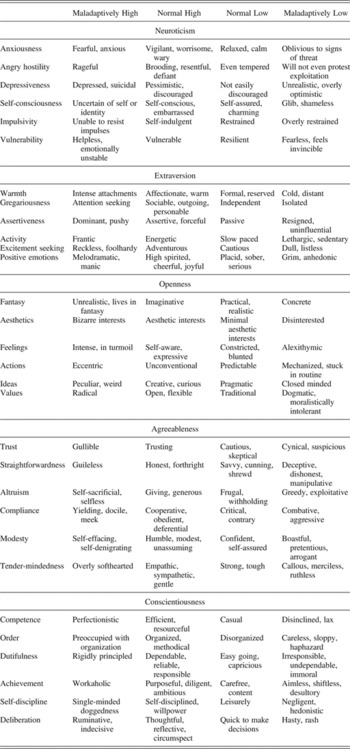
An FFM of personality disorder, however, is not simply an alternative means to describe the diagnostic categories of DSM-IV-TR (Widiger & Trull, Reference Widiger and Trull2007). It is instead an alternative approach to diagnosing personality disorder. Widiger, Costa, and McCrae (Reference Widiger, Costa, McCrae, Costa and Widiger2002) proposed a four-step procedure for the diagnosis of a personality disorder from the perspective of the FFM. The first step is to obtain a hierarchical and multifactorial description of an individual's general personality structure in terms of the five domains and 30 facets of the FFM. The second step is to identify problems in living associated with elevated scores. Table 1 provides a brief description of typical impairments associated with all 60 poles of all 30 facets of the FFM from the Five-Factor Form (FFF), which is an extended version of the FFM Rating Form (Mullins-Sweatt, Jamerson, Samuel, Olson, & Widiger, Reference Mullins-Sweatt, Jamerson, Samuel, Olson and Widiger2006). For example, for the agreeableness facet of trust the maladaptive variants of being trusting is being gullible (high pole) and the maladaptive variant of being cautious or skeptical is being cynical or suspicious (low pole). As indicated in Table 1, the FFF includes normal and abnormal variants of each of the 60 poles of the 30 facets.
Five-Factor Form

The third step of an FFM diagnosis of personality disorder is to determine whether the impairments reach a clinically significant level that would warrant a diagnosis of personality disorder. The fourth step is optional: a quantitative matching of the individual's FFM personality profile to prototypic profiles of diagnostic constructs (e.g., Miller & Lynam Reference Miller and Lynam2003, Trull, Widiger, Lynam, & Costa, Reference Trull, Widiger, Lynam and Costa2003). Further details regarding this four step procedure are provided in Widiger and Trull (Reference Widiger and Trull2007) and Widiger and Mullins-Sweatt (Reference Widiger and Mullins-Sweatt2009).
One benefit of integrating the DSM-IV-TR personality disorder nomenclature with FFM general personality structure is the ability to transfer the substantial body of research that has accumulated for the FFM to the science of personality disorder. Consider, for example, an understanding of a disorder's heritability. Heritability is one of the fundamental components of Robins and Guze's (Reference Robins and Guze1970) model for the validation of a psychiatric diagnostic category. There are data to support the heritability of the DSM-IV-TR personality disorders but, with the exception of the schizotypal, borderline, and antisocial personality disorders, research on the behavior and molecular genetics of personality disorder is surprisingly limited (Cloninger, Reference Cloninger, Oldham, Skodol and Bender2005). Behavior genetic research concerning the seven other personality disorders (e.g., avoidant, dependent, and histrionic) has been so sparse that reviews of the heritability of these personality disorders have actually based much of their conclusions on the behavior genetic research of normal personality traits, implicitly accepting the premise that these personality disorders are actually maladaptive variants of general personality structure (e.g., McGuffin & Thaper, Reference McGuffin and Thapar1992; Nigg & Goldsmith, Reference Nigg and Goldsmith1994).
In contrast, there have been many univariate and multivariate heritability analyses of the personality traits included within the FFM (Bouchard & Loehlin, Reference Bouchard and Loehlin2001). The behavior genetic research has generally supported the validity of the domains and facets of the FFM, including even the FFM structural model as depicted in Table 1. For example, Yamagata et al. (Reference Yamagata, Suzuki, Ando, One, Kijima and Yoshimura2006) conducted multivariate genetic heritability analyses of the NEO-PI-R (Costa & McCrae, Reference Costa and McCrae1992) within three large, independent twin samples from Canada, Germany, and Japan. The purpose of the study was not only to determine the relative contribution of genes and environment, but to determine as well whether the structure of the shared genetic variance was consistent with the phenotypic personality structure. Multivariate genetic analyses extend univariate analyses of a single trait to estimate genetic and environmental influences on the covariation among two or more traits. Genetic and environmental covariation matrices can then be factored to provide information on the inherent genetic structure underlying the phenotypic covariation. They concluded that “both genetic and environmental structure structures were highly congruent with phenoptypic structure, and all three structures were highly congruent across samples” (Yamagata et al., Reference Yamagata, Suzuki, Ando, One, Kijima and Yoshimura2006). “These results suggest that the five factors are ‘genetically crisp’ ” (Yamagata et al., Reference Yamagata, Suzuki, Ando, One, Kijima and Yoshimura2006, p. 994). However, it should be noted that one qualification for the domain of neuroticism was that the facet of angry hostility, although genetically loading primarily on neuroticism, did also load on the genetic factor of antagonism within the German and Japanese samples, and impulsiveness loaded as highly on the genetic factor of conscientiousness as it did for neuroticism within the Canadian and Japanese samples.
In her editorial expansion of the Robins and Guze (Reference Robins and Guze1970) model for the validation of a psychiatric diagnosis, Andreasen (Reference Andreasen1995) emphasized that it was time to go beyond simply behavior genetics to consider underlying neurobiology. It might be difficult, however, to even find researchers attempting to explore the molecular genetics of a DSM-IV-TR personality disorder. The complex syndromes and constellations of maladaptive personality traits of the DSM-IV-TR personality disorders are unlikely to yield meaningful endophenotypes (Jang, Vernon, & Livesley, Reference Jang, Vernon and Livesley2001).
The search for the specific genes of personality functioning has, of course, produced quite mixed results. However, a set of genetically defined primary traits would provide a stronger basis for an etiologically based classification and would facilitate molecular research by providing targets with more homogeneous genetic variance (Livesley, Reference Livesley2005). Yamagata et al. (Reference Yamagata, Suzuki, Ando, One, Kijima and Yoshimura2006) suggested that one implication of their findings “is that molecular genetic studies of personality seeking putative loci would clearly benefit from the use of the NEO-PI-R” (p. 994).
Studies of the heritability of neuroticism have gone beyond simply bivariate and multivariate genetic analyses to explore more precisely molecular genetics. The primary focus of attention has been a linked polymorphic region of the serotonin transporter gene, 5-HTT-LPR. This interest has grown from the finding that serotonergic systems are considered to be integral to emotion regulation, and drugs that are effective in reducing anxiety and depression act largely through the serotonergic system. Two meta-analyses of molecular genetic studies have concluded that there is a meaningfully significant relationship (effect sizes of approximately .20; Cohen, Reference Cohen1988) between neuroticism and short versus long alleles of 5-HTT-LPR, particularly when neuroticism is assessed with the NEO-PI-R (Schinka, Busch, & Robichaux-Keene, Reference Schinka, Busch and Robichaux-Keene2004; Sen, Burmeister, & Ghosh, Reference Sen, Burmeister and Ghosh2004).
Some specific results from and conclusions concerning these meta-analyses, however, have been disputed. A meta-analysis conducted by Munafo et al. (Reference Munafo, Clark, Moore, Payne, Walton and Flint2003) also found support for the association of 5-HTT-LPR with neuroticism, although not as strong (an effect size of only .11; Cohen, Reference Cohen1988). More importantly, perhaps, Munafo, Clark, and Flint (Reference Munafo, Clark and Flint2005a) subsequently explored whether the association was instrument specific and concluded on the basis of their new meta-analysis that the association was confined largely to studies using Cloninger's (Reference Cloninger2000) measure of harm avoidance rather than NEO-PI-R neuroticism, a finding in direct contradiction with the meta-analyses of Schinka et al. (Reference Schinka, Busch and Robichaux-Keene2004) and Sen et al. (Reference Sen, Burmeister and Ghosh2004). The inconsistency appears to reflect disagreements with regard to which studies should be included (e.g., Munafo et al., 2005a, excluded studies with psychiatric samples), how studies should be weighted, and the optimal genetic comparison group. In their most recent meta-analysis, Munafo, Clark, and Flint (Reference Munafo, Clark and Flint2005b) do not dispute the specific findings of Schinka (Reference Schinka2005), concluding that there is “a strong dominant effect of 5-HTT-LPR on NEO neuroticism, and a more modest but nevertheless significant recessive effect on [Cloninger] harm avoidance” (pp. 895–896).
In sum, conceptualizing the DSM-IV-TR personality disorders as maladaptive variants of the domains and facets of the FFM would bring to the field of personality disorder a scientific foundation that is currently sorely lacking (Blashfield & Intoccia, Reference Blashfield and Intoccia2000; Skodol et al., Reference Skodol, Gunderson, Shea, McGlashan, Morey and Sanislow2005). In addition to the research on behavior and molecular genetics there is a considerable body of literature on universality (Allik, Reference Allik2005; Ashton & Lee, Reference Ashton and Lee2001), health psychology (Segerstrom, Reference Segerstrom2000), temporal stability (Roberts & DelVecchio, Reference Roberts and DelVecchio2000) and, most importantly for this review, childhood antecedents (Mervielde, De Clercq, De Fruyt, & Van Leeuwen, Reference Mervielde, De Clercq, De Fruyt and Van Leeuwen2005).
FFM of Child and Adolescent Temperament and Personality
In contrast to the dearth of systematic research on the childhood antecedents of DSM-IV-TR personality disorders, there has been an abundance of research and literature on the temperaments of childhood and adolescence. Temperament involves individual differences that emerge early in life, which include differences in emotional processes, and that have a biological basis (Rothbart & Bates, Reference Rothbart, Bates, Damon, Lerner and Eisenberg2006). There has been a diverse set of models of temperament in childhood, including those of Block and Block (Reference Block, Block and Collins1980), Buss and Plomin (Reference Buss and Plomin1975), Chess and Thomas (Reference Chess and Thomas1996), Derryberry and Rothbart (Reference Derryberry and Rothbart1997), Goldsmith and Campos (Reference Goldsmith, Campos, Emde and Harmon1982), and others. This literature is too vast to cover within this paper, but excellent overviews and integrative summaries have been published (e.g., Rothbart & Bates, Reference Rothbart, Bates, Damon, Lerner and Eisenberg2006; Shiner, Reference Shiner1998).
It is evident that there is a close tie between the temperaments of childhood and adolescence with adult personality structure, both conceptually and empirically (Caspi, Reference Caspi2000; Caspi & Silva, Reference Caspi and Silva1995; De Clercq & De Fruyt, Reference De Clercq and De Fruyt2003, Reference De Clercq and De Fruyt2007; Shiner, Masten, & Roberts, Reference Shiner, Masten and Roberts2003). As expressed by Caspi, Roberts, and Shiner (Reference Caspi, Roberts and Shiner2005), “from the point of view of this emerging developmental science of personality, childhood temperament should be conceptualized with an eye toward adult personality structure, and adult personality should be understood in light of its childhood antecedents” (p. 454). A conceptual integration has been the recent organizations of the temperament literature of Block and Block (Reference Block, Block and Collins1980), Buss and Plomin (Reference Buss and Plomin1975), Chess and Thomas (Reference Chess and Thomas1996), Derryberry and Rothbart (Reference Derryberry and Rothbart1997), Goldsmith and Campos (Reference Goldsmith, Campos, Emde and Harmon1982), and others in terms of the five domains of the FFM (Caspi et al., Reference Caspi, Roberts and Shiner2005; Mervielde, De Clercz, De Fruyt, & Van Leeuwen, Reference Mervielde, De Clercq, De Fruyt and Van Leeuwen2005; Shiner, Reference Shiner1998). As concluded by Shiner (Reference Shiner, Widiger, Simonsen, Sirovatka and Regier2006), “there is now convincing evidence that individual differences in childhood and adolescence share a similar structure to personality as adults, beginning sometime during the preschool years” (p. 112). “At the level of broad traits, this structure includes the Big Five traits of extraversion, neuroticism, conscientiousness, agreeableness, and openness to experience” (Shiner, Reference Shiner, Widiger, Simonsen, Sirovatka and Regier2006, p. 112). Similarly, as expressed by Mervielde et al. (Reference Mervielde, De Clercq, De Fruyt and Van Leeuwen2005), “the review of temperament and variable-centered as well as person-centered approaches to childhood personality leads us to propose five broadband dimensions that capture individual differences in children and adolescents: extraversion, emotional stability, agreeableness, conscientiousness, and openness/intellect” (p. 171).
The underlying or lower order facets of the five domains are not perfectly isomorphic between childhood and adulthood, but the close ties and common organization are very apparent. As suggested by Caspi et al. (Reference Caspi, Roberts and Shiner2005) and Mervielde et al. (Reference Mervielde, De Clercq, De Fruyt and Van Leeuwen2005) extraversion (or positive emotionality) in childhood involves at least four lower order traits of social inhibition or shyness, sociability, dominance, and energy/activity. Neuroticism (or negative affectivity) includes in particular anxious distress (anxiety, guilt, and fear) and irritable distress (anger, frustration, irritability, and hostility). Conscientiousness (or constraint) includes at least six lower order traits of self-control, attention, achievement motivation, orderliness, responsibility, and conventionality. Agreeableness concerns the tendency to be prosocial, considerate, empathic, kind, and helpful (vs. being socially exclusionary, rude, antagonistic, physically aggressive, and relationally aggressive). Openness to experience (or intellect) concerns the disposition to seek stimulation, explore new environments, sensitivity to internal and external sensory stimulation, creativity, and intellectance.
Quite a bit of research supports the validity of the FFM dimensions to describe individual differences in childhood and adolescence (Buyst, De Fruyt, & Mervielde, Reference Buyst, De Fruyt and Mervielde1994; De Fruyt, Mervielde, Hoekstra, & Rolland, Reference De Fruyt, Mervielde, Hoekstra and Rolland2000; Digman, Reference Digman1989; Digman & Inouye, Reference Digman and Inouye1986; Havill, Allen, Halverson, & Kohnstamm, Reference Havill, Allen, Halverson, Kohnstamm, Halverson, Kohnstamm and Martin1994; John, Caspi, Robins, Moffitt, & Stouthamer-Loeber, Reference John, Caspi, Robins, Moffitt and Stouthamer-Loeber1994; Kohnstamm, Halverson, Mervielde, & Havill, Reference Kohnstamm, Halverson, Mervielde and Havill1998). This congruence of the child and adult literature is supported through a variety of sources (Halverson, Kohnstamm, & Martin, Reference Halverson, Kohnstamm and Martin1994), including factor analytic studies of personality questionnaires from parents, teachers, and adolescents (Caspi & Shiner, Reference Caspi, Shiner, Lerner, Eisenberg and Damon2006; Mervielde et al., Reference Mervielde, De Clercq, De Fruyt and Van Leeuwen2005); temperament questionnaire studies (Rothbart & Bates, Reference Rothbart, Bates, Damon, Lerner and Eisenberg2006); and behavioral-task and observational measure studies (Shiner, Reference Shiner1998).
Temporal stability “goes to the heart of how personality traits are conceptualized” (Roberts & DelVecchio, Reference Roberts and DelVecchio2000, p. 3). Roberts and DelVecchio conducted a meta-analysis of the findings of 152 longitudinal studies involving 3,217 test–retest correlations that covered various spans of time from childhood to older age. “The Big Five taxonomy of personality traits (Goldberg, Reference Goldberg1993) was used to organize the personality trait test–retest coefficients into the categories of extraversion, agreeableness, conscientiousness, neuroticism, and openness to experience” (p. 9). They obtained studies that provided temporal stability data from ages 0 to 3, 3 to 6, 6 to 12, 12 to 18, 18 to 22, 22 to 29, 30 to 39, 40 to 49, 50 to 59, and 60 to 73. The unweighted effect sizes showed a clear increasing linear trend across the age ranges (i.e., .35, .44, .46, .39, .54, .52, .49, .59, .74, and .62, respectively). Consistent with general understanding, temporal stability of personality (and temperament) is clearly lower in childhood, but nevertheless of sufficient magnitude to warrant the recognition and assessment of these traits, as well as an appreciation of their eventual integration within adult personality structure. The conclusion of Roberts and DelVecchio (Reference Roberts and DelVecchio2000) was that the FFM “traits are quite consistent over the life course” (p. 20). The traits of extraversion and agreeableness were most consistent, but neuroticism, openness, and conscientiousness were still temporally stable across the life span.
Digman and colleagues (Digman & Inouye, Reference Digman and Inouye1986; Digman & Takemoto-Chock, Reference Digman and Takemoto-Chock1981) reported results from studies in which first-grade and sixth-grade elementary school children were rated by teachers on a number of personality-trait terms. In both studies, factor analyses of the teachers' ratings resulted in five factors consistent with the FFM. Digman and Shmelyov (Reference Digman and Shmelyov1996) recovered the FFM structure from teacher ratings of 8- to 10-year-old Russian children on 60 temperament and personality scales. Goldberg (Reference Goldberg2001) subsequently replicated and extended Digman's findings with new evidence for the FFM using data obtained from six independents samples of teacher-based assessments.
Mervielde, Buyst, and De Fruyt (Reference Mervielde, Buyst and De Fruyt1995) confirmed the validity of the FFM as a model for individual differences among school-age children. They asked teachers to rate 2,240 children, aged 4 to 12 years, on a set of 25 bipolar scales derived from Goldberg's (Reference Goldberg1993) markers for the FFM. Principal component analysis of ratings of kindergarten children (aged 4–6 years) revealed four of the five factors, including a combined conscientiousness/intellect/openness factor. The complete FFM structure emerged from the ratings of primary school children.
Several studies have recovered the FFM structure in childhood and adolescent ratings using scales or item sets that were not constructed as measures of the FFM, and hence provide evidence that “prestructuring” is not a prerequisite for the emergence of the FFM structure (Mervielde et al., Reference Mervielde, De Clercq, De Fruyt and Van Leeuwen2005). Van Lieshout and Haselager (Reference Van Lieshout, Haselager, Halverson, Kohnstamm and Martin1994) showed that the structure of the Dutch version of the California Child Q-Set (CCQ; Block & Block, Reference Block, Block and Collins1980) is similar to the FFM structure. They used a Dutch version of the CCQ in six studies of children ranging in age from 3 to 17 with a variety of respondents, including parents, teachers, best friends, and the participants themselves (in two samples in which the children were of age 11 or older). John et al. (Reference John, Caspi, Robins, Moffitt and Stouthamer-Loeber1994) also confirmed FFM structure within the CCQ with Q-sorts of 350 ethnically diverse 12- to 13-year-old boys. Moreover, they showed significant relationships of the CCQ FFM with socially important criteria such as child psychopathology, juvenile delinquency, and school performance (although two additional factors, irritability–immaturity and positive activity–approach, also appeared).
Kohnstamm et al. (Reference Kohnstamm, Halverson, Mervielde and Havill1998) collected unstructured, oral parental personality descriptions of 2,416 children aged 2 to 12 years as part of a collaborative international research project conducted in Belgium, China, Germany, Greece, Holland, Poland, and the United States. Across countries, 76% to 85% of the parental descriptors were classified as indicators of the FFM. The most frequently used category in each of the seven countries was extraversion. The second most frequent was agreeableness. Openness/intellect varied from 11% in Greece to more than 21% in the United States, even though openness is not that heavily emphasized in temperament research. It is also worth noting that about 33% of the descriptors concerned socially undesirable terms, presaging the presence of adult maladaptive personality traits.
Mervielde and De Fruyt (Reference Mervielde, De Fruyt, Mervielde, Deary, De Fruyt and Ostendorf1999, Reference Mervielde, De Fruyt, De Raad and Perugini2002) constructed the Hierarchical Personality Inventory for Children (HiPIC) based on the Flemish data of Kohnstamm et al. (Reference Kohnstamm, Halverson, Mervielde and Havill1998). This set of more than 9,000 Flemish parental descriptions was organized into 100 clusters covering three age groups: 5 to 7, 8 to 10, and 11 to 13. Three age-specific item sets were developed by writing two to four items per cluster, resulting in three preliminary inventories with 234 to 282 items. Principal component analyses at the item level indicated that, for each age level, the first five principal components tended to group items consistent with the FFM. Because of the substantial overlap in content, the three age-specific item sets were then integrated into one instrument of 144 items measuring individual differences in personality of primary school children (Mervielde & De Fruyt, Reference Mervielde, De Fruyt, Mervielde, Deary, De Fruyt and Ostendorf1999, Reference Mervielde, De Fruyt, De Raad and Perugini2002). The HiPIC five domain scales of conscientiousness, benevolence, extraversion, imagination, and emotional stability align quite well with the FFM domains of conscientiousness, agreeableness, extraversion, openness, and neuroticism, respectively.
The five broad domains of the HiPIC were further differentiated into 18 underlying facets. The factor structure was cross-validated on a sample of 719 twins and siblings rated by both parents (Mervielde & Asendorpf, Reference Mervielde, Asendorpf and Hampson2000). The four conscientiousness facets (achievement motivation, concentration, perseverance, and orderliness) were found to be relatively pure markers of the first principal component of conscientiousness. Egocentrism and irritability were the highest loading facets and the purest markers for benevolence. Compliance, however, loaded on both benevolence and conscientiousness. Dominance and altruism loaded primarily on benevolence with a substantial secondary loading on extraversion. Shyness was the highest loading facet of extraversion, with a moderate loading on emotional stability. Two additional facets of extraversion were optimism and expressiveness (suggestive of positive emotionality). Creativity and curiosity were the defining facets of the imagination factor together with intellect. Finally, emotional stability turned out to be the smallest HiPIC domain, dividing into an anxiety facet and self-confidence.
De Fruyt et al. (Reference De Fruyt, Bartels, Van Leeuwen, De Clerg, Decuyper and Mervielde2006) provided data on the 36-month temporal stability of assessments of the HiPIC domain and facets in a representative community sample of 498 children (ages 7–15) and in an additional sample of 548 siblings and twins (ages 5–14). Parents rated the children on both occasions. The covariance among HiPIC domains was clearly invariant over the 3-year time period for the different age groups, providing evidence for structural stability from childhood to late adolescence. The rank order of the children and adolescents across the 3-year interval was also very stable, with coefficients above .70 for extraversion, imagination, benevolence, and conscientiousness (emotional stability was above .60). With respect to individual level changes, the analysis of individual trait-change patterns indicated that two-thirds (ages 8–9) to three-quarters (ages 6–7) of all the individuals did not show reliable change on any of the FFM dimensions. The genetic–environment decomposition of the trait covariances showed very similar results for extraversion, benevolence, and conscientiousness with 40% to 50% of the covariance across time explained by genetic factors, 0% to 10% by shared environment, and around 50% by nonshared environment. The covariance of emotional instability was largely explained by nonshared environment and to a moderate extent by genetic factors and only 13% by common environment.
Four- to Five-Factor Model of Child, Adolescent, and Adult Personality Disorder
Rather than seek an understanding of the childhood antecedents from studies of personality disorder symptomatology in children and adolescents (Cohen & Crawford, Reference Cohen, Crawford, Bender, Oldham and Skodol2005), it might be more fruitful and may actually be only natural to seek an understanding of the antecedents of the DSM-IV-TR personality disorders from a consideration and study of childhood temperaments (Paris, Reference Paris, Freeman and Reinecke2007; Shiner, Reference Shiner, Mash and Barkley2007). “Childhood and adolescent temperament and personality are probably among the best candidates as general broadband development antecedents for adult personality disorders” (Mervielde et al., Reference Mervielde, De Clercq, De Fruyt and Van Leeuwen2005, p. 1720). It is difficult to imagine adult personality disorders not being based, at least in part, on childhood temperaments (Glenn, Raine, Venables, & Mednick, Reference Glenn, Raine, Venables and Mednick2007; Leve, Kim, & Pears, Reference Leve, Kim and Pears2005). Frankly, if childhood temperaments did not provide an initial foundation or disposition toward the development of an adult personality disorder, what would likely be the genetic foundation for an adult personality disorder?
However, as indicated, the adult outcome of childhood temperaments has not been generally understood to be adult personality disorders. Instead, the focus of the outcome of childhood temperaments has generally been understood to be the development of general personality functioning (Caspi et al., Reference Caspi, Roberts and Shiner2005; Mervield et al., Reference Mervielde, De Clercq, De Fruyt and Van Leeuwen2005; Shiner, Reference Shiner1998). In addition, if the adult outcome of childhood temperament and personality is best understood in terms of the FFM of general personality structure, it would also seem natural to attempt to understand adult personality disorder in terms of this same general personality structure. It would be ironic and perhaps rather incongruous to suggest that the temperaments (and personality traits) of childhood and adolescence lead to or provide a disposition or vulnerability to adult personality disorder, yet then also suggest that these personality disorders cannot themselves be understood as maladaptive variants of these temperaments and traits within adulthood.
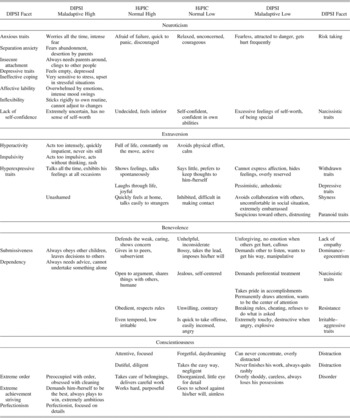
A more explicit integration of the FFM conceptualization of child, adolescent, and adult personality disorder is the development of an FFM of child and adolescent personality disorder by De Clercq, De Fruyt, Van Leeuwen, and Mervielde (Reference De Clercq, De Fruyt, Van Leeuwen and Mervielde2006), analogous to that developed for adulthood by Widiger et al. (Reference Widiger, Costa, McCrae, Costa and Widiger2002). De Clercq et al. suggest that an optimal description of maladaptive personality functioning in childhood would be provided through the identification of the maladaptive variants of the personality traits of childhood, analogous to the identification of the maladaptive personality traits of adulthood being variants of the domains and facets of the FFM. To comprehensively define the domain of personality pathology observable in childhood, the Dimensional Personality Symptom Item Pool (DIPSI; De Clercq & De Fruyt, Reference De Clercq and De Fruyt2003) was constructed in part using a bottom-up approach (De Clercq et al., Reference De Clercq, De Fruyt, Van Leeuwen and Mervielde2006). Maladaptively extreme variants were written for the items already contained within the lexically based personality inventory describing the adaptive range of personality differences described within the HiPIC (Mervielde & De Fruyt, Reference Mervielde, De Fruyt, Mervielde, Deary, De Fruyt and Ostendorf1999, Reference Mervielde, De Fruyt, De Raad and Perugini2002). This resulting item set was further complemented with a top-down approach collecting all relevant descriptors applicable for children that were enclosed in two adult personality disorder instruments: the Structured Clinical Interview for DSM-IV Axis II Disorders (First, Gibbon, Spitzer, Williams, & Benjamin, Reference First, Gibbon, Spitzer and Williams1997) and the Assessment of DSM-IV Personality Disorders (Schotte, De Doncker, Vankerckhoven, Vertommen, & Cosyns, Reference Schotte, De Doncker, Vankerckhoven, Vertommen and Cosyns1998).
The resulting set of items representing a broad range of concrete trait-related descriptors was further analyzed to obtain unidimensional, internally consistent facets of personality pathology relevant to children (De Clercq et al., Reference De Clercq, De Fruyt, Van Leeuwen and Mervielde2006). The empirical procedures resulted in 172 concrete trait-related items, to be rated on a 5-point Likert scale by parents or primary caregivers, further structured into 27 reliable lower level facets that are hierarchically organized in a four-dimensional higher order structure. The four-dimensional structure is consistent with Widiger and Simonsen (Reference Widiger and Simonsen2005), and can be described as disagreeableness (including extreme low-end variants of benevolence such as dominance/egocentrism and irritable/aggressive traits), emotional instability (referring to both anxious and depressive traits, and also including a dependency component), introversion (describing extreme low-end variants of extraversion, such as withdrawn traits and shyness), and compulsivity (including the high extremes of conscientiousness traits such as perfectionism and extreme order). Inconsistent with adult FFM, however, is that some traits of extraversion did load on disagreeableness. These are hyperexpressive traits, hyperactive traits, impulsivity, and risk taking, that were originally written as maladaptive extraversion-based item sets (see De Clercq et al., Reference De Clercq, De Fruyt, Van Leeuwen and Mervielde2006), but empirically loading on the disagreeable factor, possibly because of the disagreeable aspect enclosed within the item content of these extraversion facets.
Table 2 provides a conceptual representation of the primary facet scales of the HiPIC, along with the maladaptive variants as assessed by the DIPSI. It is evident from Table 2 that the DIPSI conceptualization of normal and abnormal personality in childhood and adolescence parallels closely the FFM description within adulthood, as presented by the FFF in Table 1. There are some differences though that warrant discussion. Perhaps most notable is the absence of the domain of openness within the DIPSI. In their effort to find a common ground among alternative dimensional models of adult personality disorder, Widiger and Simonsen (Reference Widiger and Simonsen2005) also proposed a four-factor model rather than an FFM (i.e., emotional dysregulation vs. emotional stability, extraversion vs. introversion, antagonism vs. compliance, and constraint vs. impulsivity), excluding the domain of openness. FFM personality disorder research has often failed to obtain much representation of openness (O'Connor, Reference O'Connor2005; Saulsman & Page, Reference Saulsman and Page2004).
HiPIC and DIPSI normal and abnormal variants of child and adolescent personality structure
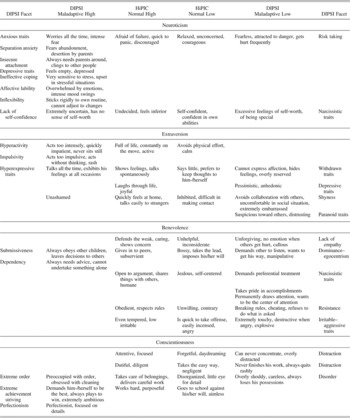
Note: HiPIC, Hierarchical Personality Inventory for Children (Mervielde & De Fruyt, Reference Mervielde, De Fruyt, Mervielde, Deary, De Fruyt and Ostendorf1999); DIPSI, Dimensional Personality Symptom Item Pool (De Clercq & De Fruyt, Reference De Clercq and De Fruyt2003).
The primary reason that a fifth factor of maladaptive openness often fails to appear in adult factor analytic personality disorder research appears to be that the relevant symptomatology is not sufficiently prevalent enough to carry an independent factor, relative to the other four. This was demonstrated empirically by Tackett, Silberschmidt, Krueger, and Sponheim (Reference Tackett, Silberschmidt, Krueger and Sponheim2008), who obtained a fifth factor of personality disorder symptomatology (which they identified as “peculiarity”) when a sufficient representation of cognitive–perceptual aberrations was included. Maladaptive variants of high and low openness may be even less evident in childhood and adolescence. For instance, cognitive–perceptual aberrations (the primary adult personality disorder symptom of openness) are not even included in the DIPSI, and inflexibility is included within the domain of neuroticism.
One study has suggested that cognitive perceptual aberrations (and other schizotypic eccentricities) might even belong outside of the realm of the FFM, defining its own, separate domain of general personality functioning (Watson, Clark, & Chmielewski, Reference Watson, Clark and Chmielewski2008). However, the finding from this study is readily understood as a complementary artifact of overloading a particular domain (Samuel & Widiger, Reference Samuel and Widiger2008). In this study, approximately twice as many measures were included to represent normal and abnormal variants of openness, in comparison to the other domains. Just as a domain of personality functioning will not appear if it does not have adequate representation among the variables submitted to a factor analysis (Tackett et al., Reference Tackett, Silberschmidt, Krueger and Sponheim2008), a domain of personality functioning will likely split if its representation is excessive, relative to the others. In this instance, the opennenss domain split into separate normal and abnormal variants, whereas the normal and abnormal variants remained coupled for the other four domains of the FFM.
In contrast to the study proposing that openness and peculiarity are distinct factors, there is a considerable body of research to suggest that peculiarity, unconventionality, and oddity are maladaptive variants of openness. Tellegen and Waller (Reference Tellegen and Waller1987) originally conceptualized this domain as conventionality versus unconventionality and, consistent with Table 1, included within such attributes as dwelling upon fantasies, having ideas or beliefs that have little basis within reality, or often engaging in activities that are bizarre, deviant, or aberrant. Lee and Asthon (Reference Lee and Ashton2004) similarly include a facet for “unconventionality” within their conceptualization of openness (along with aesthetic appreciation, creativity, and inquisitiveness). Ross, Lutz, and Bailey (Reference Ross, Lutz and Bailey2002) demonstrated empirically that schizotypal magical ideation and cognitive perceptual aberration scales are significantly related to facets of openness to experience. Similarly, a factor analysis of the FFM domains with schizotypal scales found a distinct factor represented by magical ideation, perceptual aberration, and openness (Camisa et al., Reference Camisa, Bockbrader, Lysaker, Rae, Brenner and O'Donnell2005). Parsimony would itself suggest that openness includes a maladaptive variant, consistent with the other four domains but not within the six-factor model of Watson et al. (Reference Watson, Clark and Chmielewski2008).
Other differences worth noting between the DIPSI dimensional model of normal and abnormal personality (Table 2) with the FFM model (Table 1) are the much lower representation of maladaptively low neuroticism and high agreeableness within the DIPSI (De Clercq et al., Reference De Clercq, De Fruyt, Van Leeuwen and Mervielde2006). The absence of much representation of maladaptively low neuroticism should not be too surprising, as this aspect of the FFM is represented by only one personality disorder in adulthood (i.e., psychopathy), and even in this instance many of the relevant traits are not even included within the DSM-IV-TR diagnosis of antisocial personality disorder (i.e., low anxiousness, glib shameless charm, and fearlessness; Lynam & Widiger, Reference Lynam and Widiger2007). The absence of much representation of maladaptively high agreeableness is perhaps of more interest from a developmental perspective, as it is possible that such traits as gullibility, guilelessness, selflessness, and self-effacement are not considered to be particularly undesirable or problematic in children and adolescents.
A more general and related point is that many of the traits within both the DIPSI and the FFF are rather questionably described as being “normal.” It is perhaps confusing, for example, to suggest that it is normal to be worrisome, jittery, and wary (FFF normal high anxiousness) or to be afraid of failure, quick to panic, and discouraged (HiPIC normal high anxiousness). The term “normal” is used in part here to refer to being within a normative (common, typical) range, rather than suggesting that the trait is necessarily adaptive, desirable, or psychologically healthy (Wood, Gosling, & Potter, Reference Wood, Gosling and Potter2007). In most instances, being within the normative range can be understood as being psychologically healthy or socially desirable. However, this is not always necessarily the case. The NEO-PI-R (Costa & McCrae, Reference Costa and McCrae1992) is often described as a measure of normal personality traits but it is perhaps better described as a measure of general personality structure that includes a considerable amount of abnormal, maladaptive, or undesirable personality functioning. Consider, for instance, such NEO-PI-R neuroticism items as “I am easily frightened,” “Sometimes I feel completely worthless,” and “At times I have been so ashamed I just wanted to hide” (Costa & McCrae, Reference Costa and McCrae1992, p. 68). These items are not appreciably different than the items one would find within a measure of maladaptive personality functioning or personality disorder.
Conclusions
One of the fundamental limitations of the DSM-IV-TR categorical model for the classification of personality disorders has been the lack of a strong scientific foundation (Blashfield & Intoccia, Reference Blashfield and Intoccia2000; Skodol et al., Reference Skodol, Gunderson, Shea, McGlashan, Morey and Sanislow2005; Widiger & Trull, Reference Widiger and Trull2007). Despite the development of specific and explicit criterion sets to facilitate the implementation of replicable research (Spitzer, Williams, & Skodol, Reference Spitzer, Williams and Skodol1980), and despite the presence of many self-report inventories and semistructured interviews to facilitate their assessment in clinical research (Widiger & Boyd, in press), very little information has been obtained on the childhood antecedents for most of the DSM-IV-TR personality disorders (Cohen & Crawford, Reference Cohen, Crawford, Bender, Oldham and Skodol2005). What little is known is based on clinical cases, retrospective reports, and follow-up studies with instruments assessing other clinical constructs.
The DSM-IV-TR personality disorders, however, do appear to be well understood as maladaptive variants of the domains and facets of the FFM (Widiger & Mullins-Sweatt, Reference Widiger and Mullins-Sweatt2009; Widiger & Trull, Reference Widiger and Trull2007). Integrating the classification of personality disorder with the dimensional classification of general personality structure will bring to an understanding of the personality disorders a considerable body of scientific research, including an understanding of childhood antecedents. It is evident that the temperaments and traits of childhood do appear to be antecedent to the FFM of adult personality structure (Caspi et al., Reference Caspi, Roberts and Shiner2005), and that the temperament and traits of childhood and adolescent are the likely antecedents of adult personality disorder (Shiner, Reference Shiner, Widiger, Simonsen, Sirovatka and Regier2006, Reference Shiner, Mash and Barkley2007), providing further support for the conceptualization of the adult personality disorders as maladaptive variants of the domains and facets of the FFM (Mervielde et al., Reference Mervielde, De Clercq, De Fruyt and Van Leeuwen2005). Beyond the few differences between the FFF (Table 1) and the DIPSI (Table 2) are the more fundamental commonalities. Both models work from the FFM, identifying abnormal variants of the traits of general personality structure, providing thereby a basis for integrating the classification of abnormal and normal personality functioning across the life span.