INTRODUCTION
Armed conflict results in the disruption and destruction of physical resources, infrastructure and functioning public services, the depletion of human and economic capital, and the collapse of established institutions and organizations (Collier Reference Collier1999). The resulting institutional vacuum creates a general state of insecurity and provides opportunity for unsustainable destruction of common resources, which degrades environmental entitlements (Collier Reference Collier1999; Bohle & Funfgeld Reference Bohle and Funfgeld2007). During the 20th century, violent conflicts in the have affected three-quarters of Asian tropical forests, two-thirds of African tropical forests and one-third of Latin American tropical forests (Jong et al. Reference Jong, Donovan and Abe2005). Years of armed conflict in Rwanda, Mozambique and Ethiopia have severely impacted local resource management practices and national level policies, resulting in institutional vacuums and leading to a serious failure in conservation efforts (Plumptre Reference Plumptre2003; Black et al. Reference Black, Schafer and Watson2005). In Colombia and Nicaragua, the social and environmental effects of the military activities of armed groups have induced severe forest exploitation (Álvarez Reference Alvarez2005; Kaimowitz & Faune Reference Kaimowitz and Faune2003). In the Niger Delta, armed conflict promoted unsustainable human activities that devastated forest resources, leading to a rapid decline in the natural resources and forest cover (Igbatayo Reference Igbatayo2005). In Myanmar, both the military junta and rebel groups have engaged in intensive logging to fund their war effort; such overexploitation may eventually destroy the forest cover (Harbinson Reference Harbinson1992). Similar outcomes have been observed in a number of countries across the world; McNeely (Reference McNeely2003) found that war has led to many negative environmental impacts, including biodiversity, across many biodiverse-rich tropical countries.
In 1995 in Nepal, a Maoist rebel group decided to take up arms seeking a democratic revolution, and launched their ‘people's war’ against the government of Nepal (Upreti Reference Upreti2004; Katel et al. Reference Katel, Paudel, Ojha and Brid2005; Paudel & Katel Reference Paudel and Kattel2006) Over the next few years, the ensuing political turmoil favoured escalation of the Maoist movement, with actions that included extortion, killings and attacks on infrastructure (Banjade & Timsina Reference Banjade and Timsina2005; Baral & Heinen Reference Baral and Heinen2006; Bhurtel & Ali Reference Bhurtel and Ali2006). On the other side, government security forces targeted supposed Maoist activists and their sympathizers. In the last decade, more than 13 000 people from both sides were killed and there was significant internal migration and emigration in response to the conflict, which led to disruptions in the agricultural system, additional environmental stresses and generated leadership vacuums especially at local community levels (ARD 2006; Baral & Heinen Reference Baral and Heinen2006). Because the armed conflict occurred in many rural villages and urban areas, it created enormous impacts in many Nepalese community-based natural resource management systems (Khanal Reference Khanal2006).
By the end of 2008, the Nepali government had handed over 1.1 million hectares of forest to > 13 000 community forest user groups (CFUGs) comprising 1.4 million households. The Community Forestry programme has been acclaimed worldwide for its exemplary success in reclaiming denuded lands through community forestry efforts, regarded as an institutional endowment for local community groups in managing forest resources for their benefit (Webb & Gautam Reference Webb and Gautam2001; Kanel Reference Kanel2004). It had taken many decades of persistent effort by local communities, in coordination with the government and international development agencies, to effect a governance structure of collective action for sustainable management of forests (Varughese Reference Varughese and Ostrom2001; Thoms Reference Thoms2007). However, the Maoist conflict severely impacted the forest governance structure system, as local level community forestry institutions are embedded within governmental organizations, and, by 2005, 40 out of the 92 area forest offices and 190 out of the 696 range posts in the country had been destroyed during incursions (Nepali Reference Nepali2005). This further weakened forest governance, making forest-dependent communities even more vulnerable (Bhattarai Reference Bhattarai, Karki and Seddon2003; Nepali Reference Nepali2005; Baral & Heinen, Reference Baral and Heinen2006). Furthermore, the government placed restrictions on CFUG meetings that impacted community development and forest management activities.
While several studies have investigated the impact of armed conflict on forest conservation outcomes, there has been limited research that assesses how conflict impacts local institutions of management, or whether local institutions may be able to mediate the impact of armed conflict on forest condition. In this article, local forest management or ‘institution’ refers to the de facto or de jure rules or ‘rules in use’ that directly or indirectly influence that an actor must (obligation), must not (prohibition) and may do (permission) to resource management. However, forest institutions do not capture certain institutional aspects embedded in social-cultural characteristics, such as norms, moral values, trust, reciprocity and community traditions (together defined as institutional embeddedness), which affect human behaviour and collective action towards the regulation of resource management (Ostrom Reference Ostrom1990; Dorji Reference Dorji2003). Given the high levels of armed conflict in many of the world's biodiversity-rich forested countries, there is a critical need to explore the interrelationships between armed conflict and local forest management institutions, and the embeddedness of those institutions. Such research requires an interdisciplinary approach, such that qualitative evaluations of institutional strength can be linked with quantitative assessment of resource condition. Finally, since conflict is a dynamic phenomenon, such assessments need to be conducted over multiple points of time, in order to provide a robust assessment of the relationship between armed conflict, institutions, embeddedness and forest change.
This study examines the role played by local institutions in mediating the impacts of the ‘Maoist conflict’ on forest conditions in the small mountainous country of Nepal. We used a longitudinal multi-disciplinary dataset to study the forest-people relationships over time and to assess how these relationships respond to situations of severe armed conflict. Specifically, we endeavoured to address two questions. (1) How does the presence of armed conflict affect local institutions, institutional embeddedness and forest condition? (2) Do institutions and institutional embeddedness support the resilience of community forests under conditions of armed conflict?
The research should further contribute towards assessments of the impact of the decade-long war in Nepal on conditions in community-managed forests and help improve the future governance of local institutions in Nepal and other countries facing similar challenges of natural resource management under conditions of severe armed conflict.
METHODS
Study sites
We collected data from one CFUG in each of seven districts of Nepal, with representation from the hills of Western Development Region, the Terai plains of the Middle Development Region and the plains of the Eastern Development Region of Nepal (Table 1 and Fig. 1). The seven sites ranged in elevation from 195 m to 925 m above sea level, and were covered by tropical deciduous forests dominated by Shorea robusta (Webb & Sah Reference Webb and Sah2003).
Location, forest size, number of forest users and dates of site visits to study sites.

Map of Nepal, with study site locations indicated by black dots. 1 = Barandabhar, 2 = Ludi-Damgade, 3 = Samayamai, 4 = Aahal Danda, 5 = Chandraban, 6 = Bhadkhore, 7 = Thoplebiran.

At each site was at least one forest patch and a group of local people who used the forest resources. Under the state-sponsored programme of community forestry, these forests were formally handed over to local communities in the mid-1990s by the District Forest Office (DFO), a process supported by the 1993 Forest Act and provided for in the 1995 Forest Bylaws. Since the handover, the community forests have been managed by well-defined CFUGs with elected committee officials, who define their own forest management plans and constitutions, with technical support from the DFO (Gautam et al. Reference Gautam, Shivakoti and Webb2004).
Data collection and analysis
We used interdisciplinary methods to collect data on social and biological dimensions. These included household surveys, semi-structured interviews, focus group discussions, participatory rural appraisal techniques and forest mensuration. The data were collected as part of a long-term multi-site research study in Nepal, conducted using common research protocols developed by the International Forestry Resources and Institutions (IFRI) research programme (Banana & Gombya-Ssembajjwe Reference Banana, Gombya-Ssembajjwe, Gibson, McKean and Ostrom2000; Ostrom & Wertime Reference Ostrom, Wertime, Gibson, McKean and Ostrom2000; Nagendra Reference Nagendra2002). The IFRI research protocol is designed to address the roles of both institutional robustness of local forest governance and biological data to systematically study the relationship between forests and institutions using a set of eleven survey instruments that incorporate methodologies and frameworks from the ecological and social sciences (Ostrom & Nagendra Reference Ostrom and Nagendra2007). This programme of data collection has been active in Nepal for over a decade, and several locations had been visited before and during the years of armed conflict. We drew on this extensive socio-institutional data for our research, and supplemented this primary information collected from the field with secondary sources, such as household surveys and reports, including those compiled by district stakeholders.
Each site was visited at two points in time, with between-visit intervals ranging from six to ten years (Table 1). During a month-long period of investigation at each site, we conducted interviews with local residents, especially with official members of user groups, to document oral accounts of conflict history and management issues.
Assessing the intensity of conflict
The intensity of the armed conflict at each site was evaluated after the second visit to each site, just after a peace agreement had been reached. Given the atmosphere of insecurity that persisted, most household respondents were reluctant to answer questions relating to the degree of conflict they had experienced. Therefore, we addressed our questions to local CFUG officials (a total of 105 interviews).
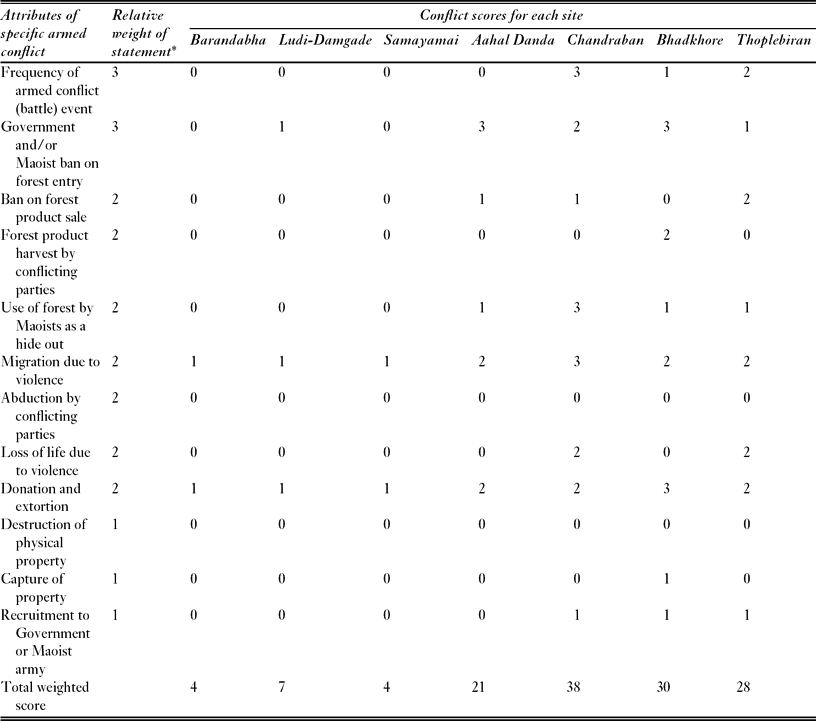
Twelve statements related to different aspects of conflict were discussed with each community. These were (1) frequency of armed conflict events in the CFUG settlements, (2) government and/or Maoist banns on forestry entry, (3) bans on forest product sale, (4) forest product harvest by conflicting parties, (5) Maoist use of forest as a hide out, (6) migration owing to violence, (7) abduction and disappearance induced by combatant parties, (8) loss of life owing to violence, (9) donation and extortion of money, (10) destruction of physical property, (11) capture of property and (12) recruitment to the army to either side. The respondent categorized each statement of conflict according to his/her perception of intensity, with 0 indicating no impact on the CFUG, 1 indicating minor impact, 2 indicating moderate impact, and 3 indicating major impact.
Not all aspects of conflict are of equal importance. Some types of conflict events, such as the loss of life owing to violence, may have a much greater impact compared to other events, such as the capture of property. Thus, we asked the respondents to weight the significance of each aspect of conflict, on a scale of 1–3. The intensity and weight responses were then aggregated into a weighted conflict index (CI),

where, f1 = frequency of respondent indicating first choice, w1 = weight of first choice, fn = frequency of respondent indicating nth choice and wn = weight of nth choice. Based on the final CI, sites were separated into two categories, namely low and high conflict sites.
Forest vegetation assessment
We collected information on forest condition in each community forest. Within each forest we randomly established 30–60 nested circular plots (n = 303 plots). The largest plot had a diameter of 10 m, within which we recorded the species, diameter at breast height (dbh) and height for every tree with a dbh ≥ 10 cm. Within a nested sub-plot of 3 m radius the species, dbh and height were recorded for all saplings with dbh of 2.5–9.9 cm. We focused our analysis of changes in forest condition between two time periods on tree and sapling density, because if the conflict affected forests, it would manifest itself in change in tree density most consistently.
Assessing institutional strength and embeddedness
Several scholars of the commons, including Dietz et al. (Reference Dietz, Ostrom and Stern2003) and Ostrom (Reference Ostrom2005) have indicated that there are a number of parameters that impact the strength of local natural resource management institutions. We evaluated the strength of the local community forest institutions at different sites on the basis of whether institutions had formulated rules to monitor the forest, and, if so, their level of effectiveness and compliance. To assess the strength of local forest institutions, we used data collected from interviews with local CFUG members at each site (n = 210 interviews), and CFUG officials (n = 84). As well as institutional arrangements at the local level, forest resource use is affected by local beliefs, norms, myths and traditions, with levels of adherence dependent on individual trust and reciprocity. We therefore also assessed aspects of institutional embeddedness such as trust and reciprocity. Each index was assigned a value ranging from a maximum of 3 to a minimum of 0, for each site. The following formula was used to calculate the mean score (index value, I).

where f1 = frequency of respondent indicating first choice, fn = frequency of respondent indicating nth choice and N = number of choice.
We evaluated and compared the overall institutional robustness of the seven community-managed forest sites using the scores obtained for each site, before and after the incidence of armed conflict. We used a Kolmogorov-Smirnov test to identify significant changes in the strength of institutional arrangements over time.
Dorji (Reference Dorji2003) has also emphasized the influence of embeddedness in governance of resources in local-level institutional regimes. In addition to institutional arrangements, we assessed the changes in underlying institutional embeddedness criteria such as (1) trust, (2) moral value, (3) reciprocity, (4) interdependence and (5) reputation (Dorji Reference Dorji2003; Hanley et al. Reference Hanley, Orbell, Morikawa, Ostrom and Walker2003; McCabe Reference McCabe, Ostrom and Walker2003; Ostrom Reference Ostrom, Ostrom and Walker2003) in the CFUGs across time using a similar approach to that we used to assess institutional robustness.
RESULTS
Degree of conflict
Based on the final weighted scores of conflict articulated by different user groups, four community forest sites (Aahal Danda, Chandraban, Bhadkhore and Thoplebiran) were categorized as sites experiencing high conflict (Table 2). All of these sites experienced at least one conflict event. Three sites (Ludi-Damgade, Samayamai and Barandabhar) were considered to be low conflict sites.
Conflict scores (0–3) for the seven CFUG study sites. *Respondents were asked to assign a relative weight to each conflict statement, on a scale of 1–3 (see text for details).

Forest vegetation
A Mann-Whitney pair-wise analysis of differences between two periods of time revealed that most of the forests had experienced an increase in both tree and sapling density during the study periods (Table 3). In particular, most of the locations experiencing high conflict had also experienced a significant increase in tree and sapling density over time.
Relative differences in forest condition over period of study for sites with low and high conflict, based on a one-tailed Mann-Whitney U-test of the significance of differences in forest condition between the two time periods (* = significant at p < 0.05).

Institutional strength and embeddedness
In sites with low degree of conflict, the distribution of institutional arrangements between the first and the second visits remained stable over time (Table 4). In contrast, three of the four high-conflict sites exhibited a significant decrease in institutional strength, while one site showed no difference (Table 4). However, institutional embeddedness significantly increased during the period of conflict at all high conflict sites (Table 5), while there were no significant changes at any of the low conflict sites.
Relative difference in institutional arrangements over period of study for sites with low and high conflict, based on results of Kolmogorov-Smirnov test of differences between two time periods.

Relative difference in institutional embeddedness over period of study for sites with low and high conflict, based on results of Kolmogorov-Smirnov test of differences between two time periods.

DISCUSSION
Despite more than a decade of armed conflict, management and protection of forests across these seven community forests continued to have a positive influence on local forest condition. We found no significant relationships between conflict and changes in forest condition; instead vegetation increased significantly in both high and low conflict areas (Spearman's rho: p < 0.01). Other studies have observed that armed conflict creates conditions of uncertainty that cause increased illegal harvest, resulting in the depletion of natural resources (Kaimowitz & Faune Reference Kaimowitz and Faune2003; McNeely Reference McNeely2003; Igbatayo Reference Igbatayo2005; Jong et al. Reference Jong, Donovan and Abe2005; Bohle & Funfgeld, Reference Bohle and Funfgeld2007).
When strong local institutions exist, these may have the capacity to buffer forests from such conditions of increased harvest and depletion (Ostrom Reference Ostrom1990; Gibson et al. Reference Gibson, McKean, Ostrom, Gibson, McKean and Ostrom2000; Agrawal Reference Agrawal2003; Gautam & Shivakoti Reference Gautam and Shivakoti2005; Nagendra et al. Reference Nagendra, Karna and Karmacharya2005; Andersson & Gibson Reference Andersson and Gibson2006; Hayes Reference Hayes2006; Tucker et al. Reference Tucker, Randolph and Castellanos2007). However, we found that, after some years of active armed conflict, institutional arrangements have been weakened in sites experiencing high conflict, whereas they have remained stable in areas of low conflict (Table 4). When institutional arrangements are weakening over time in sites experiencing a high degree of conflict, why is forest condition improving in such sites?
While there are differences in the robustness of institutions in sites experiencing low and high conflict, there are similarly variations in the characteristics indicating institutional embeddedness, such as trust, reciprocity and moral values. Studies focusing solely on institutional arrangements, especially under conditions of conflict, cannot capture certain critical aspects of institutions that govern forest resources and also play a role in determining the success of institutions and outcomes (Fisher Reference Fisher, Enters, Durst and Victor2000; Gibson & Koontz Reference Gibson and Koontz1998; Dorji Reference Dorji2003).
In contrast to the negative impact of conflict on institutional strength, our findings suggest that institutional embeddedness has significantly increased in most of the sites experiencing high conflict, while embeddedness has remained stable in the sites with low levels of conflict. Importantly, those sites with a significant increase in embeddedness are likely to develop increased cooperation and social stewardship among communities, resulting in increased forest vegetation density.
Why and how have embeddedness characteristics in these rural natural-resource dependent communities increased to favour cooperation, while institutional arrangements have been negatively impacted during conditions of armed conflict? Ostrom (Reference Ostrom, Ostrom and Walker2003) discussed how individuals could achieve outcomes that were ‘better than rational’ by creating a context under which reciprocity, reputation and trust help to overcome short-run self-interested ‘rational’ behaviour. Thus, ‘levels of trust and reciprocity and reputations for being trustworthy are positively reinforcing, in turn, affect levels of cooperation and net benefits achieved both by individuals and groups’ (Ostrom Reference Ostrom, Ostrom and Walker2003). Though the decade-long armed conflict has impacted all facets of life in Nepal, the conflict may have helped to bring communities together in times of stress, empowering the voices of poor and marginalized communities, helping them to improve access to community forest resources management, and improving the responsiveness of the local elite or leaders towards their needs. Poor and marginalized communities may have become more vocal and involved in the process of community forest management process owing to the Maoist influence that empowered them (BK et al. Reference BK, Shrestha and Acharya2009).
Similarly, people residing in the same rural communities are likely to share similar characteristics, such as engaging in similar occupations with similar economical status, and exhibit the type of social interactions that facilitate collective decisions (Gibson & Koontz Reference Gibson and Koontz1998). Such interactions enhance interconnected reputations, trust and shared understanding among communities where informal mutual monitoring and sanctions exist (Ostrom Reference Ostrom1990; Gibson & Koontz Reference Gibson and Koontz1998). We found that Nepali communities generally elected to stay in the CFUGs, despite facing difficult situations engendered by armed conflict. Given the quantity of research on this topic, apart from institutional arrangements, we examined the relationship between institutional embeddedness and forest condition. The interdisciplinary research methodology enabled insights into the nature of institutions surviving under conditions of armed conflict supported by the availability of data on conditions both before and after active conflict. However, our conclusions are based on a relatively small number of case studies, and we did not conduct anthropological investigations into the mechanism by which these CFUGs maintained embeddedness as this was outwith the scope of this study. Given the difficulties of working in conflict conditions, and limited access to data prior to active conflict, not all these limitations can be properly addressed, but the study indicates that local institutions may be resilient to conflict insecurity. New frontiers in institutional research may be incorporated with embeddedness to study contexts of armed conflict, insurgency and violence.
CONCLUSIONS
Given that the ecological conditions, property rights systems and social conditions were broadly similar across all sites, the patterns of increasing forest density in both conflict and non-conflict sites may be the combined outcome of long-enduring institutions along with underlying institutional embeddedness owing to shared values, trust and reciprocity. Previous research has reported significant declines in natural resources during the times of active conflict between states and insurgent groups, around the world (Harbinson Reference Harbinson1992; Kaimowitz & Faune Reference Kaimowitz and Faune2003; Álvarez Reference Alvarez2005; Igbatayo Reference Igbatayo2005). Several researchers also found that increased environmental uncertainty owing to active conflict caused increased harvesting (Jager et al. Reference Jager, Janssen and Vlek2002; McNeely Reference McNeely2003). Although a significant number of studies have been conducted and substantial information on community forestry programme has been documented, very little is known about the impact of violence on community forests in Nepal.
While we found that forest communities appear to become more cohesive during times of conflict, further research, possibly using anthropological modes of enquiry, may be required to assess why this happens or to suggest how CFUGs could be motivated to increase characteristics of institutional embeddedness during challenging situations. This study shows that institutional embeddedness mediates the impact of armed conflict on forest condition and we conclude that more attention should be given to embeddedness factors when crafting or strengthening institutional arrangements. These results provide critical insights for the planning and implementation of programmes for sustainable forest management.
ACKNOWLEDGEMENTS
We gratefully acknowledge the financial support provided by a Ford Foundation grant (950–1160–2) awarded to Elinor Ostrom, PI at International Forestry Resources and Institutions, Indiana University, and an Asian Institute of Technology fellowship awarded to Birendra K. Karna. We also acknowledge the support provided by Mukunda Karmacharya, Lila N. Sharma and Dr Ambika Gautam of the Nepal Forest Resources and Institutions research programme. We thank Drs Harini Nagendra and George Varughese and the anonymous referees for their useful comments on earlier drafts of this paper. Special thanks to the villagers and committee members from the seven CFUGs.