


Debates over community power have long focused on a simple, but profound question—who governs: organized interests or mass publics? In local politics, recent scholarship indicates that the public is pivotal (Berkman and Plutzer Reference Berkman and Plutzer2005; Einstein and Kogan Reference Einstein and Kogan2016; Tausanovitch and Warshaw Reference Tausanovitch and Warshaw2014). As one review summarizes, “local policies in the modern era tend to largely reflect the partisan and ideological composition of their electorates” (Warshaw Reference Warshaw2019, 462). Yet other scholars reject this Downsian account of American politics in favor of a Schattschneiderian “policy-focused” perspective, where the answer to “who governs” hinges on the constellation of groups organized around a given policy issue (Dahl Reference Dahl1961; Hacker and Pierson Reference Hacker and Pierson2014; Wilson Reference Wilson1973).Footnote 1 According to today’s Schattschneiderians, it is organized vested interests, not mass publics, that are pivotal in US policy making (Disalvo Reference Disalvo2018; Hacker and Pierson Reference Hacker and Pierson2014; Moe Reference Moe2015), especially in subnational politics (Anzia Reference Anzia2019).
How can we reconcile these two conflicting perspectives? In this paper, we show that the institution of election timing helps clarify when voters or organized interests will be pivotal in city politics. We begin by reevaluating municipal policy responsiveness, estimating it separately for cities that hold on- versus off-cycle elections. Consistent with the Schattschneiderian view, we find that off-cycle elections diminish responsiveness to a city’s median resident. However, off-cycle elections do not render organized interests all-powerful. Instead, we show that such elections weaken responsiveness on policy issues where the political objectives of an active and organized interest deviate from those of the city’s median resident. To illustrate these dynamics empirically, we focus on one important and active group in city politics—public employees—showing that off-cycle municipalities spend more generally and on city workers than would otherwise be preferred by the citizens of politically conservative cities.Footnote 2 Though past work has shown that off-cycle elections advantage organized groups (Anzia Reference Anzia2013), we are the first to show that they can move city policy making “off-center,” diminishing responsiveness to the public. In contrast to prior work (Tausanovitch and Warshaw Reference Tausanovitch and Warshaw2014), this signals that institutions can play a key role in shaping representation in municipal government, an important finding as political science begins to focus more attention on the importance of local politics in the US system of government (e.g., Warshaw Reference Warshaw2019).
Theoretical expectations
Why would off-cycle elections—those held apart from state and federal elections—produce city governments that are less responsive to their citizens? First, off-cycle elections reduce voter turnout by 29 to 37 percentage points (Hajnal Reference Hajnal2010, 177). By encouraging “selective” participation among a narrower subset of citizens who have vested interests in city politics (Berry Reference Berry2009; Oliver and Ha Reference Oliver and Ha2007), off-cycle elections stand to enhance the influence of organized groups (Anzia Reference Anzia2013).Footnote 3 Consequently, we anticipate that the electioneering efforts of such groups—their endorsements, financial support, and mobilization—can be relatively more influential in off-cycle environments. Whereas organized groups mobilize consistently, any potential political opposition (competition) from a city’s mass public is reduced in off-cycle races where marginal voters are less likely to participate (Anzia Reference Anzia2013). In sum, city officials that are elected off cycle—wherein turnout is lower and the electorate is less representative of the community (Kogan, Lavertu, and Peskowitz Reference Kogan, Lavertu and Peskowitz2018)—have less incentive to respond to their median constituent. Moreover, as Anzia (Reference Anzia2012) explains in her theory of when activists and parties should favor having off-cycle elections, better organized local groups will benefit more from off-cycle elections when the median voter in on-cycle elections is unsympathetic to the local interests’ political preferences. Taken together, these incentives should move policy making “off center” (weakening responsiveness) when (1) city officials address issues that are highly relevant to an organized interest in city politics and (2) the preferences of that interest diverge from the preferences held by the city’s mass public.
City employees offer an excellent case for theory testing. They are one of the most active and organized groups in US local politics (Anzia Reference Anzia2021; Sieg and Wang Reference Sieg and Wang2013). Whereas mass publics reliably vary in their tastes and preferences for large government (Tiebout Reference Tiebout1956), public employees have a uniform vested interest in more government spending (Anzia and Moe Reference Anzia and Moe2015, Reference Anzia and Moe2019; Niskanen Reference Niskanen1971) specifically on public workers (Dahlberg and Mörk Reference Dahlberg and Mörk2006; Hyytinen et al. Reference Hyytinen, Saarimaac, Toivanend and Tukiainene2018; Spizman Reference Spizman1980) through a mixture of higher pay and more hiring (Schneider Reference Schneider1989, 254). The potential benefits are quite concentrated and the costs (in terms of revenue and less spending on other programs) are diffuse and often out of the sight of the broader public (Anzia Reference Anzia2021). Moreover, public employees in the vast majority of the cities in our sample already comprise a nontrivial portion of the potential pool of voters and activists. Given their size and unique motivations to pursue concentrated benefits, even those public employees without collective bargaining rights stand to be better organized than their potential competition—individual taxpayers and fiscal conservatives who face collective action problems in fashioning themselves into an organized constituency base. Public employees therefore provide a compelling and straightforward test of our theory—we should find that off-cycle elections enable them to push city fiscal policy “off center” in those communities where the median resident is more conservative and prefers smaller government (i.e., lower taxes, less spending, and fewer public employees).
Research Design
Our empirical analysis uses Tausanovitch and Warshaw’s (Reference Tausanovitch and Warshaw2014) sample of the roughly 1,600 American cities with populations above 20,000. Tausanovitch and Warshaw measure residents’ policy conservatism at the city level, which is estimated by applying multilevel regression with poststratification (MRP) to hundreds of thousands of survey responses to a variety of municipal- and federal-level issue position questions posed to respondents between 2000 and 2011 (Tausanovitch and Warshaw Reference Tausanovitch and Warshaw2013; Reference Tausanovitch and Warshaw2014). Higher scores indicate a more conservative ideology among a city’s local citizenry. We then expanded de Benedictis-Kessner’s (Reference de Benedictis-Kessner2018) dataset of municipal election timing,Footnote 4 classifying cities as “off-cycle” if their municipal elections are not held at the same time as regular elections for national- or state-level offices.
Our dependent variables come from two sources. First, we examine the four policy outcomes from Tausanovitch and Warshaw’s (Reference Tausanovitch and Warshaw2014) analysis: city expenditures per capita, taxes per capita, share of taxes from sales taxes, and a city policy scale where higher values indicate a more conservative set of city environmental/sustainability policies. Second, we use US Census Bureau data on local government spending in 2012 (as provided by Pierson, Hand, and Thompson Reference Pierson, Hand and Thompson2015) to measure outcomes that are the most directly relevant to public employees: per-capita city expenditures on full-time public employee salaries, the number of full-time city employees per capita, and the average full-time employee salary.Footnote 5 Since there is an inherent trade-off between these last two outcomes, we pay particularly close attention to each city’s overall expenditures on full-time salaries, which should be higher regardless of whether public employee groups lobby for higher pay or more hires.
Initial Results
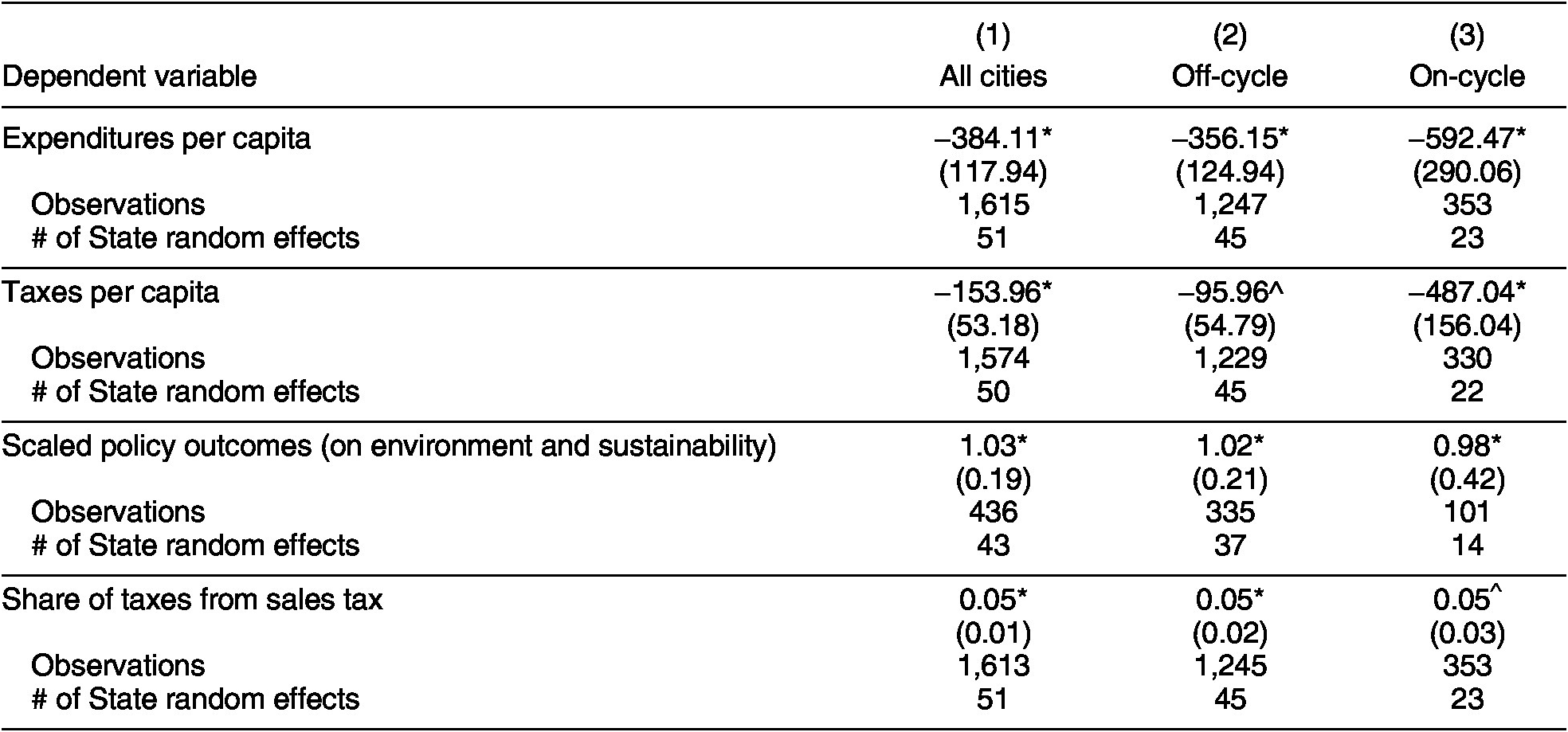
We begin with a series of regressions that directly extend the core finding of Tausanovitch and Warshaw (Reference Tausanovitch and Warshaw2014, Table 2). Our key innovation is to examine whether city responsiveness differs based on when municipal elections are held. In Table 1, we run separate regressions, first for the full sample of cities (column 1) and then for two subsamples: cities with off-cycle elections (column 2) and cities with on-cycle elections (column 3). Here, we show only the estimates for our primary independent variable: Residents’ Policy Conservatism.Footnote 6 The left-hand column of Table 1 displays the specific dependent variable estimated.
Association between Citizens’ Preferences and Expenditures and Taxes by Election Timing

Note: Results show the coefficient on the variable, Residents’ Policy Conservatism, from regressions with state-level random effects, following Table 2 of Tausanovitch and Warshaw (Reference Tausanovitch and Warshaw2014). The dependent variable is indicated in the left column. Standard errors are in parentheses. *p < 0.05, ^ p < 0.10 (two-tailed).
The patterns in these initial results are consistent with our expectations. Column (1) replicates Tausanovitch and Warshaw (Reference Tausanovitch and Warshaw2014), showing that cities with more conservative residents enact more conservative policies. However, this relationship is, as expected, far weaker in cities with off-cycle elections (column 2) than in cities with on-cycle elections (column 3) on the two policy outcomes that are relevant to public employees—per-capita expenditures and taxes. For example, the negative correlation between city expenditures and residents’ conservatism increases 60% in cities with on-cycle elections. With taxes, the negative correlation is five times greater. However, for the other two outcomes, environmental policy and sales tax use, off-cycle elections do not appear to diminish citizen representation; the coefficients are nearly identical in columns 2 and 3. This is expected because overall expenditures and tax rates (to provide revenue for those expenditures) clearly help fulfill city employees’ goals of securing larger budgets for city workers. However, the exact mix of sales taxes or environmental/land-use policies are not directly tied to these goals, and these issues are not similarly constitutive of client politics, where a single well-organized interest group faces little to no organized political opposition (Anzia Reference Anzia2021; Wilson Reference Wilson1973).
Election Timing and Public Employee Interests
We next turn to the fiscal policy outcomes that should matter the most to public employees. Here, we estimate a series of regression models where the explanatory variable of interest is the interaction between a city’s (mass) conservatism and an indicator for off-cycle elections. Additionally, we subject this set of analyses to an even tougher test by following Anzia’s (Reference Anzia2011) approach of including state-level fixed effects to leverage within-state variation in city election timing, ruling out time-invariant state-level confounders.
Endogeneity is a concern if cities that historically adopted on/off-cycle elections did so because they tend to be more/less systematically responsive to their residents. However, the vast majority of cities have not altered their election calendar in the modern political era (Anzia Reference Anzia2013). Moreover, in the appendix, we examine survey data of municipal officials from Butler and Dynes (Reference Butler and Dynes2016) and find no evidence that election timing relates to municipal officials’ beliefs in the importance of adhering to their constituents’ preferences.Footnote 7 We also present several other robustness checks in the appendix that show that our findings are not driven by differences in other types of institutions (e.g., city-manager forms of government, partisan elections) or by variation in the scope of cities’ functional responsibilities.
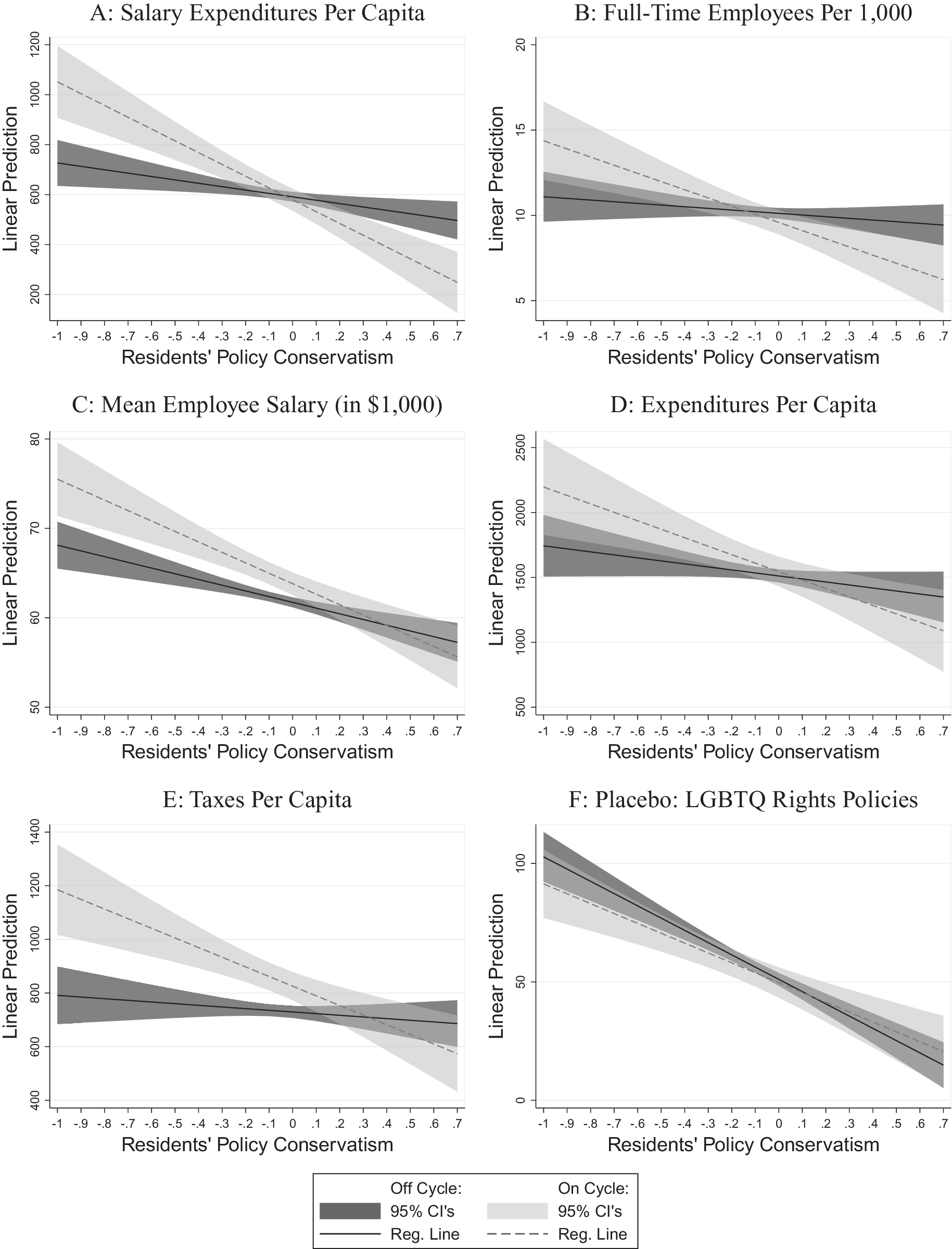
Figure 1 displays the results of our analysis for six separate policy outcomes. In each panel, the black solid lines show the predicted relationship between residents’ policy conservatism and each policy outcome in cities that have off-cycle elections, whereas the gray dashed lines show this relationship among cities with on-cycle elections. The shaded area around each line (dark gray for off cycle and light gray for on cycle) shows 95% confidence intervals.
Election Timing and the Association between Citzens’ Preferences and Policy Outcomes Relevant to Public Employees
Note: This figure shows the relationship between residents’ policy conservatism and several outcomes (within each panel) based on whether the municipalities’ elections are held off-cycle (black line and dark gray CI’s) or on-cycle (gray dashed line and light gray CI’s). See Table A3 in the appendix for full regression results.

Consistent with our theoretical expectations, for the first five outcomes (panels A–E) we find that the negative slope on the relationship between citizens’ preferences and these outcomes increases significantly (p < 0.05) in cities with on-cycle elections. In fact, for three of these outcomes (expenditures, tax rates, and number of full-time employees), the negative relationship is statistically significant (at the 0.05 level) only in cities with on-cycle elections. In other words, in cities with off-cycle elections, there is not a statistically significant difference in expenditures, tax rates, or number of full-time employees between liberal and conservative cities. On the other hand, we can clearly see in Figure 1 that among cities with on-cycle elections, conservative cities have lower taxes and spend less (in general and on public employees) compared with more liberal cities. For example, with expenditures per capita spent on salaries (Panel A), moving one standard deviation below the mean in terms of citizens’ conservatism (SD = 0.26; mean = ‒0.05) to one standard deviation above it predicts a $70 drop in per-capita salary expenditures in cities with off-cycle elections (p < 0.05). But in cities with on-cycle elections, the drop more than doubles to $175 (p < 0.05). As with our initial analysis in Table 1, overall expenditures and taxes per capita decline at a steeper rate in cities with on-cycle elections compared with those with off-cycle ones.
Notably, our findings also show that both conservative and liberal electorates can experience diminished responsiveness in off-cycle settings.Footnote 8 As the black solid lines in panels A–E show, in very liberal cities, governments chosen in off-cycle elections actually spend and tax less than do on-cycle municipalities. How can this be if off-cycle elections uniformly advantage organized interests? Recall that off-cycle elections also reduce turnout among marginal voters. In very liberal cities, this often means that off-cycle elections reduce turnout among large numbers of low-income and racial minority citizens, thereby ensuring that the electorate in off-cycle races is older, wealthier, and whiter—in other words, less representative of the median liberal resident in these cities (Kogan, Lavertu, and Peskowitz Reference Kogan, Lavertu and Peskowitz2018). Although public employees also turn out in these off-cycle races, in very liberal cities they stand to lose sympathetic voters, reducing the overall size of the liberal voting bloc that would ordinarily favor liberal fiscal policies.
Finally, as a placebo test, we examine whether off-cycle elections reduce policy responsiveness on a policy issue that does not pit a numerically large, organized interest group against a city’s mass public (Anzia Reference Anzia2021). Specifically, we examine the relationship between residents’ political conservatism and cities’ LGBTQ policies (panel F of Figure 1) based on the Human Rights Campaign’s 2013 Municipal Equality Index (Warshaw Reference Warshaw2019), where higher values indicate more LGBTQ-friendly policies. As Panel F reveals, off-cycle elections do not, as our theory would predict, dilute city policy responsiveness on LGBTQ rights issues, nor (as shown in the appendix) do they influence whether a city’s mass ideology is predictive of whether that city prohibits employment discrimination based on gender identity. We also find similar results on the scaled policy outcome and share of taxes from sales taxes. (See section C of the online appendix.)
Discussion
In her path-breaking study of election timing, Anzia (Reference Anzia2013) concludes by summarizing the stakes of the debate for American democracy. “At the bottom of all of this,” she explains, “is concern about [political] representation” (206). We agree. Indeed, closer attention to the influence of election timing on the behavior of local governments can help shed light on one of the oldest debates in the discipline concerning “who governs” (Dahl Reference Dahl1961). However, Anzia explains that scholars have not yet answered “whether off-cycle elections … produce [policy] outcomes that are less representative of the whole of the eligible electorate” (Anzia Reference Anzia2013, 207). In this study, we provide evidence that directly addresses this question in city politics, and the stakes are high because most local governments in the US (78% in our sample) are chosen in off-cycle elections.
Though we find that off-cycle city elections can weaken representation, the advantage that off-cycle elections provide to organized groups do not render them omnipotent. Instead, city governments remain responsive when the issue being contested does not involve a large and organized interest advocating for policies that run counter to the preferences of the city’s median resident. Practically speaking, however, because (1) debates over the size of city government are always relevant to the millions of public employees who have a vested interest in jobs and pay (Moe Reference Moe2015) and (2) payrolls consume a large share of the average city’s expenditures, off-cycle elections can have serious ramifications for the tone and direction of political representation cities provide to their residents.Footnote 9
Altogether, our findings have broad implications for American politics. First, they provide new evidence that informs an active and ongoing debate across states about reforming the electoral calendar (National Conference of State Legislatures 2016). Many subnational policy makers have begun to push for consolidated on-cycle elections. These proponents frequently draw attention to cost savings for local governments and the ability to increase voter participation (Anzia Reference Anzia2013). However, our findings suggest that consolidation also stands to enhance and strengthen democratic representation.
Second, this study contributes to a growing emphasis on the dynamics of representation in subnational governments. Though past work questioned whether we should even anticipate policy congruence at the local level (e.g., Peterson Reference Peterson1981), a more recent body of work shows strong evidence that it occurs. Yet, Tausanovitch and Warshaw (Reference Tausanovitch and Warshaw2014) failed to find any evidence that local political institutions influence municipal policy responsiveness. However, missing from their analysis was the institution of election timing. By showing that election timing can affect policy responsiveness, our findings should encourage other scholars to revisit the role of mediating institutions in shaping representation in local government.
More attention to the interaction between institutions and which groups and types of constituents receive better or worse representation as a consequence could be one fruitful direction for future research. For example, if off-cycle elections reduce participation in marginalized communities, does this also reduce substantive representation for racial minorities in local politics in addition to descriptive representation (Hajnal and Trounstine Reference Hajnal and Trounstine2005)? Scholars should also examine whether other organized groups, beyond public employees, are able to use off-cycle elections to push politics off center. Do developer interests in liberal cities, for example, override the mass public’s preferences for affordable housing when elections are off cycle and the developers’ electioneering efforts stand to pack more punch?
Above all, our finding that election timing affects representation highlights the foundational role that organized interests play in American democracy. By showing that off-cycle elections can allow vested interests to push subnational politics “off center” on important fiscal issues that influence the size of government, we contribute to renewed debates about whether voters or groups should be at the center of our understanding of American politics (Anzia and Moe Reference Anzia and Moe2019; Bawn et al. Reference Bawn, Cohen, Karol, Masket, Noel and Zaller2012; Hacker and Pierson Reference Hacker and Pierson2014). Specifically, our work highlights the limitations of the median voter model for understanding the dynamics of political representation in the US, especially in subnational politics where off-cycle elections are pervasive and interest groups are particularly well positioned to influence policy making (Anzia Reference Anzia2019).
SUPPLEMENTARY MATERIALS
To view supplementary material for this article, please visit http://dx.doi.org/10.1017/S000305542100040X.
DATA AVAILABILITY STATEMENT
Research documentation and/or data that support the findings of this study are openly available at the American Political Science Review Dataverse: https://doi.org/10.7910/DVN/QTJGR5.
ACKNOWLEDGMENTS
The authors gratefully acknowledge the excellent research assistance of Brittni Anderson, Kevin Auman, Grant Baldwin, Trenton Borders, David Clove, McKell McIntyre, and Christopher Vazquez. We also wish to thank Sarah Anzia and Chris Warshaw for sharing data and relevant work in progress. We are also thankful for thoughtful comments and suggestions from Ethan Busby, Jay Goodliffe, and seminar participants at the Center for the Study of Elections and Democracy (CSED) at Brigham Young University. Finally, we wish to thank our anonymous reviewers and the editors of the journal. Hartney thanks the Hoover Institution for supporting his research as a W. Glenn Campbell and Rita Ricardo-Campbell National Fellow.
FUNDING STATEMENT
The authors received no financial support for the research, authorship, and/or publication of this article.
CONFLICTS OF INTEREST
The authors declare no ethical issues or conflicts of interest in this research.
ETHICAL STANDARDS
The authors affirm this research did not involve human subjects.




Comments
No Comments have been published for this article.