Past research has consistently demonstrated that tobacco dependence constitutes a major barrier to smoking cessation (Hagimoto et al., Reference Hagimoto, Nakamura, Morita, Masui and Oshima2010; John, Meyer et al., Reference John, Meyer, Hapke, Rumpf and Schumann2004; Vangeli et al., Reference Vangeli, Stapleton, Smit, Borland and West2011). In particular, it has been shown that tobacco dependence results in:
a) Increased smoking cravings (i.e., urgent and uncontrollable urges to smoke; Dunbar et al., Reference Dunbar, Shiffman, Kirchner, Tindle and Scholl2014; Tarantola et al., Reference Tarantola, Heath, Sher and Piasecki2017).
b) Less self-efficacy (i.e., perceived capacities to abstain from smoking; John et al., Reference John, Meyer, Hapke, Rumpf and Schumann2004; Martinez et al., Reference Martinez, Tatum, Glass, Bernath, Ferris, Reynolds and Schnoll2010).
c) Lower motivation to quit (Heather et al., Reference Heather, Best, Kawalek, Field, Lewis, Rotgers, Wiers and Heim2018; Zhou et al., Reference Zhou, Nonnemaker, Sherrill, Gilsenan, Coste and West2009).
While an extensive research has focused on tobacco dependence and its implications on smoking behaviors thus far, only environmental, physiological, pharmacological, or cognitive factors have been examined (see e.g., Racicot et al., Reference Racicot, McGrath, Karp and O’Loughlin2013). In the present research, we proposed to innovatively study tobacco dependence through an identity perspective. More particularly, we aimed to examine whether the deleterious consequences of tobacco dependence involve identity processes that shape self-efficacy, smoking cravings, and motivation to quit.
Smoker Identity and Smoking Behaviors
Numerous studies have established that smoking is related to identity (Shadel & Mermelstein, Reference Shadel and Mermelstein1996; van den Putte et al., Reference Putte, Yzer, Willemsen and Bruijn2009). Smoking may fall within personal identity in the form of a socio-cognitive category to which smokers may refer for defining who they are. As an illustration, research has shown that adolescents are likely to start using tobacco because smoking provides them with a means to differentiate from the others and build their singularity (e.g., Hertel & Mermelstein, Reference Hertel and Mermelstein2016).
Development of a smoker identity, that is, the perception that people have of themselves as smokers, has negative implications on smokers’ behaviors. Indeed, key of many identity models in psychology, such as the social identity theory (Tajfel & Turner, Reference Tajfel, Turner, Austin and Worchel1979), the identity-based motivation model (Oyserman et al., Reference Oyserman, Fryberg and Yoder2007), or the multiple self-aspects framework (McConnell, Reference McConnell2011), is that individuals act in a way to be consistent to their identity and what they deem the specific features of their identity to be characterized by. Accordingly, smokers are likely to maintain smoking behaviors and experience more difficulties in quitting so as to align their behaviors on their smoker identity. This way, research has demonstrated that smoker identity is associated with a lower intention to quit (Høie et al., Reference Høie, Moan and Rise2010; Tombor et al., Reference Tombor, Shahab, Brown and West2013; van den Putte et al., Reference Putte, Yzer, Willemsen and Bruijn2009), increased number of relapses (Buckingham et al., Reference Buckingham, Frings and Albery2013; Tombor et al., Reference Tombor, Shahab, Brown and West2013) and shorter periods of abstinence (Johnson et al., Reference Johnson, Lovato, Maggi, Ratner, Shoveller, Baillie and Kalaw2003; Shadel et al., Reference Shadel, Mermelstein and Borrelli1996). Similarly, antismoking campaigns and smoking cessation programs are less effective among smokers allocating a large part of their self-definition to the smoker identity (e.g., Falomir-Pichastor & Invernizzi, Reference Falomir-Pichastor and Invernizzi1999; Freeman et al., Reference Freeman, Hennessy and Marzullo2001).
We suggested that the negative consequences of tobacco dependence would equally result from a willingness to persevere in the behaviors that are core for smokers’ identity. Indeed, because dependent smokers tend to use tobacco on a regular basis and be often exposed to smoking-related cues, they are thus more likely to incorporate the smoker identity as a key component of their personal self. Beyond that, being a dependent smoker may also reflect a particular identity (or at least a sub-category of the smoker identity), which differs from solely being a smoker (Tombor et al., Reference Tombor, Shahab, Herbec, Neale, Michie and West2015). As a result, tobacco dependence establishes a stable image of oneself as a smoker and, this way, can increase perceptions, evaluations, and behaviors that are in line with such a self-image. Consistent with this idea, past studies have regularly observed a positive correlation between dependence and smoker identity (Dupont et al., Reference Dupont, Tack, Blecha, Reynaud, Benyamina, Amirouche and Aubin2015; Pulvers et al., Reference Pulvers, Scheuermann, Romero, Basora, Luo and Ahluwalia2014).
The Present Research
In this research, we aimed to investigate whether the negative consequences of tobacco dependence on craving, self-efficacy, and motivation to quit, are related to identity concerns. If so, we may expect the effects of tobacco dependence to interact with the extent to which people perceive themselves as a smoker. More specifically, in line with the common notion shared by several social-psychological theories whereby people align their behavior on their most central self-identities, we hypothesized that dependent smokers for whom the smoker identity is strong should report more smoking cravings, but less self-efficacy and motivation to quit than dependent smokers for whom the smoker identity has a shallower importance in their self-concept.
To test these hypotheses, two cross-sectional studies were carried out. In both, tobacco dependence and smoker identity were first measured as independent variables. We then assessed smoking cravings (Study 1) and motivation to quit (Study 2) as dependent variables. We also evaluated self-efficacy in both studies, but different measures were employed. Note that both studies were approved by the ethics committee of our institution and the main measures are provided as a supplemental material (see Appendix). All data concerning this research are openly available at https://osf.io/awmsq/.
STUDY 1
Method
Participants and Procedure
Two hundred and forty smokers voluntarily participated in this study during the year 2016. They were randomly approached on the university campus and were included in this paper-and-pencil study only if they declared being daily smokers and willing to take part in it. Responses of three of them were excluded from the analyses because they reported being under 18. Our final sample size thus included 237 smokers (M Age = 24.32, SD Age = 4.82; 116 women, 121 men)Footnote 1. Once they accepted to take part in the study, they were provided with questionnaires in which there were measures of tobacco dependence, smoker identity, smoking cravings, and self-efficacy. Lastly, they were debriefed and thanked for their participation
Independent Variables
Tobacco dependence
Dependence was measured by using the Cigarette Dependence Scale (CDS–5; Etter, Reference Etter2005). In this scale, there are five items asking smokers, for example, to “rate their addiction to cigarettes on a scale going from 0 to 100” or report “the number of cigarettes they usually smoke per day”. Responses were standardized and averaged to form an overall score of dependence (α = .84). The advantage of using the CDS–5, instead of other measures such as the Fagerström Test for Nicotine Dependence (FTND) for example, is that it has been validated into French (which was the language spoken by our participants) and has been shown to have reliable psychometric properties (e.g., Etter, Reference Etter2005, Reference Etter2008; Etter, Le Houezec, & Perneger, Reference Etter, Le Houezec and Perneger2003).
Smoker identity.
We measured smoker identity with three questions: “Being a smoker is important for you?”; “Do you identify with smokers?”, “Do you really feel as a smoker?” (α = .65; M = 4.23, SD = 1.29). Answer scales ranged from 1 (not at all) to 7 (yes absolutely). These questions were formed by drawing on previous studies addressing smoker identity (e.g., Falomir-Pichastor & Invernizzi, Reference Falomir-Pichastor and Invernizzi1999; Hertel & Mermelstein, Reference Hertel and Mermelstein2016; Shadel & Mermelstein, Reference Shadel and Mermelstein1996) and refer to commonly employed questions in measurement of identity constructs (see Leach et al., Reference Leach, Zomeren, Zebel, Vliek, Pennekamp, Doosje, Ouwerkerk and Spears2008).
Dependent Variables
Smoking craving.
Perception of craving to smoke was measured by using the brief 10-item Questionnaire of Smoking Urges (QSU-brief; Cox, Tiffany, & Christen, Reference Cox, Tiffany and Christen2001; α = .88; M = 2.61, SD = 1.17). Examples of items are “Nothing would be better than smoking a cigarette right now” or “I have a desire for a cigarette right now”. Responses were provided on scales ranging from 1 (not at all) to 7 (yes absolutely).
Self-efficacy.
We measured self-efficacy by using the 12-item Smoking Self-Efficacy Questionnaire (SEQ–12) developed by Etter et al. (Reference Etter, Bergman, Humair and Perneger2000; α = .88; M = 3.07, SD = 1.29). Participants were asked to report, on scales ranging from 1 (not at all) to 7 (yes absolutely), whether they would feel able to abstain from smoking in twelve high-risk situations (e.g., when one is with other smokers).
Additional Measures
In addition to the previous measures, participants were asked to report their age, sex, and professional status. They also had to indicate when they had been started smoking.
Analytical Strategy
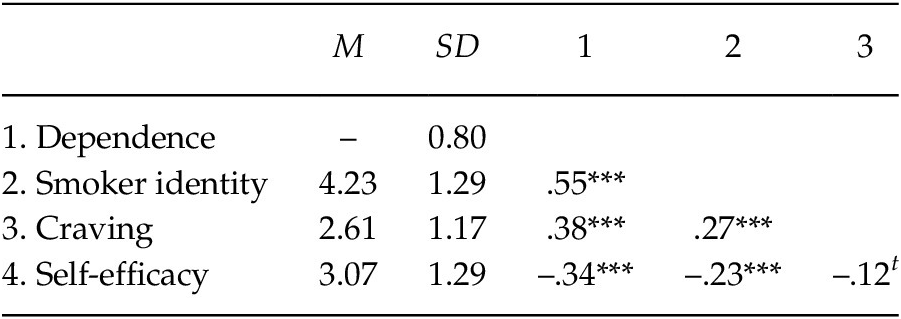
We used hierarchical regression analyses to assess the total variance explained by the overall inclusion of independent variables and their interaction, as well as their unique contribution, on smoking cravings and self-efficacy. In Step 1, we entered dependence and smoker identity, while in Step 2, we additionally included their interaction. For concerns with multicollinearity, both variables were standardized beforehand. SPSS v.26 was used as statistical software to analyze data. Descriptive statistics and bivariate correlations between the variables are provided in Table 1.
Means, Standard Deviations, and Bivariate Correlations (Study 1)

Note. tp < .10. *p < .05. **p < .01.***p < .001.
Results and Discussion
Sample Characteristics
On average, participants reported smoking 10.60 cigarettes per day (SD = 6.91) and being regular smokers for 6.91 years (SD = 4.45). A majority of them were students (N = 190).
Main Analyses
Craving.
The regression analysis revealed a main effect of dependence, β = .37, SE = .11, t = 5.02, p < .001, 95% CI [0.333, 0.762],  $ {\upeta}_p^{{}^2} $ = .10, and the expected interaction between dependence and identity, β = .15, SE = .09, t = 2.408, p = .017, 95% CI [0.038, 0.384],
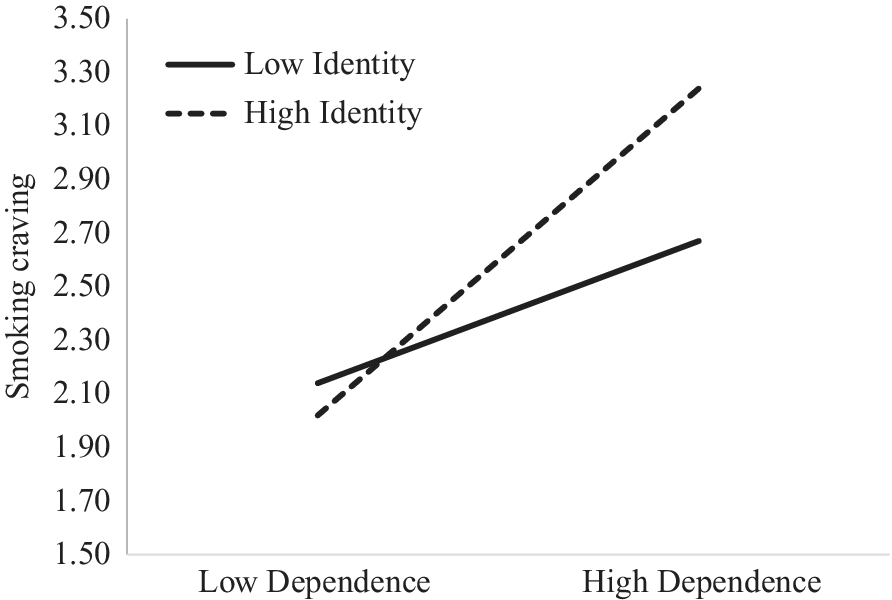
 $ {\upeta}_p^{{}^2} $ = .02. The model including the main effects and interaction product accounted for 15.9% of the total variance, F(3, 233) = 15.91, p < .001. Decompositions of the interaction with dependence at –1SD and +1SD from the mean revealed that smoker identity was positively associated with craving for high-dependent smokers, β = .28, SE = .12, t = 2.66, p = .008, 95% CI [0.084, 0.563],
 $ {\upeta}_p^{{}^2} $ = .03. Among low-dependent smokers, identity had no effect, b = –0.09, p = .415. These results are reproduced in Figure 1.
Smoking Craving as a Function of Tobacco Dependence and Smoker Identity

Self-efficacy.
On self-efficacy, we found a main effect of dependence, β = –.32, SE = .12, t = –4.11, p < .001, 95% CI [–0.743, –0.261],  $ {\upeta}_p^{{}^2} $ = .07, but the interaction was not significant, β = –0.04, p = .590.
Thus, results of Study 1 showed that tobacco dependence and smoker identity interacted in their prediction of smoking cravings. In particular, we found that dependent smokers reported higher craving to smoke when they had a strong rather than weak smoker identity. Nevertheless, similar findings were not observed on self-efficacy.
STUDY 2
Study 2 aimed to specifically examine whether smoker identity is likely to affect the effects of tobacco dependence on motivation to quit. The main hypothesis was that dependent smokers should be less motivated to stop when they declare to possess a strong smoker identity, rather than a low smoker identity. To provide convergent validity to our predictions, in this study, we also included a measure of attitude toward smoking. Study 1 did not confirm our prediction regarding self-efficacy, but perhaps this might be explained by the measure we used (i.e., the SEQ–12). Therefore, in addition to the SEQ–12, in this second study, we also assessed self-efficacy with an alternative measure, which taps more directly into participants’ perceived capacities in giving up smoking.
Method
Participants and Procedure
One hundred and ninety-four smokers participated in this study during the year 2016. They were approached through the crowdsourcing platform FouleFactory (French equivalent of MTurk) and invited to participate in this online study in exchange for money. After being introduced to the study via the FouleFactory website (where members can have access to a variety of studies), only people who self-identified as smokers and were willing to participate took part in the study. Responses of 40 participants were excluded because they either failed to an attention testFootnote 2 (n = 7), did not consent that we use their responses (n = 9), or responded to the whole questionnaire in an unreasonable time (either <~300 or > 3600 seconds; n = 24)Footnote 3. Our final sample size thus included 154 smokers (M Age = 37.64, SD Age = 12.23; 70 women, 84 men)Footnote 4. In contrast with Study 1, this study was conducted online but both procedures remained similar. Besides the measure of smoking cravings which was replaced with assessment of motivation to quit and additional measures of self-efficacy and attitude toward smoking, it comprised of the same measures of tobacco dependence and smoker identity. Data were analyzed as in Study 1.
Independent Variables
Tobacco dependence/Smoker identity.
Dependence (α = .87) and identity (α = .77; M = 4.05, SD = 1.63) were assessed by using the same scales as in Study 1.
Dependent Variables
Motivation to quit.
To assess motivation to quit, we used seven items (e.g., “Are you motivated to stop smoking”, “Do you intend to cut down your level of cigarette use?”, or “Do you intend to definitely stop smoking?”; α = .85; M = 4.42, SD = 1.44). Responses were provided on scales ranging from 1 (not at all) to 7 (yes absolutely).
Self-efficacy.
As in the previous study, we measured self-efficacy with the SEQ–12 (α = .85; M = 3.07, SD = 1.29), along with another 3-item scale directly assessing participants’ perceived capacity to stop smoking (e.g., “Do you feel you are able to quit now?”; α = .65; M = 4.33, SD = 1.12). Responses were given on scales ranging from 1 (not at all) to 7 (yes absolutely).
Additional Measures
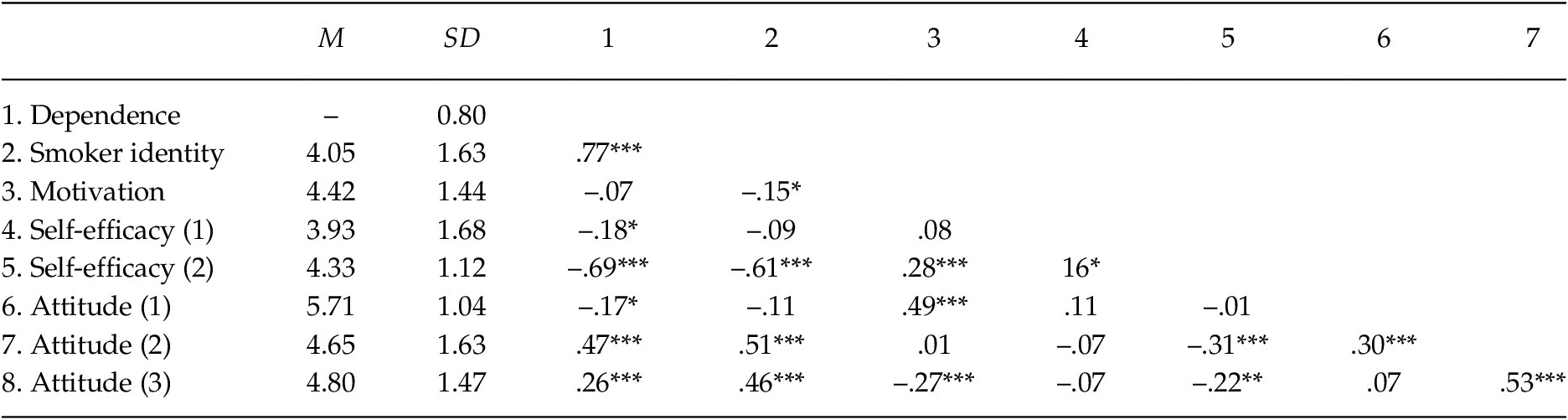
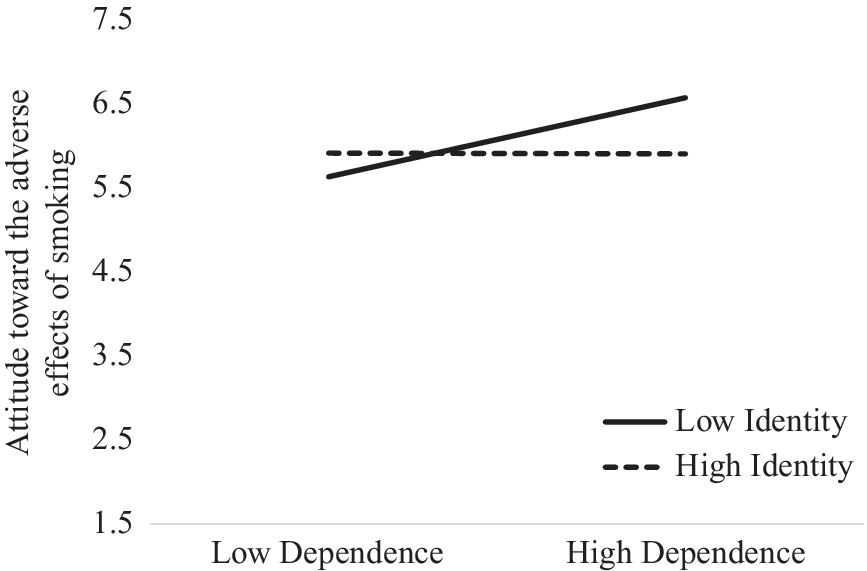
Additionally, we assessed attitude toward smoking through the Attitudes Toward Smoking Scale (ATS–18; Etter et al., Reference Etter, Bergman, Humair and Perneger2000), which is composed of three subscales evaluating the attitude towards the adverse effects of smoking (10 items; α = .82; M = 5.71, SD = 1.04), psychoactive benefits of smoking (4 items; α = .88; M = 4.65, SD = 1.63), and pleasure of smoking (4 items; α = .84; M = 4.80, SD = 1.47). As in Study 1, participants also had to report their age, sex, professional status and when they had been started smoking. For exploratory purposes, participants also indicated the extent to which they intended to use an ecigarette for stopping smoking.Descriptive statistics and bivariate correlations are provided in Table 2.
Means, Standard Deviations, and Bivariate Correlations (Study 2)

Note. Self-efficacy (1) = measured with SEQ–12; Self-efficacy (2) = measured with the alternative 3-items scale; Attitude (1) = attitude toward the adverse effects of smoking; Attitude (2) = attitude toward the psychoactive benefits of smoking; Attitude (3) = attitude toward the pleasure of smoking.
*p < .05. **p < .01. ***p < .001.
Results and Discussion
Sample Characteristics
Most of participants reported smoking between 1 and 10 cigarettes per day (71.6%) and being regular smokers for 16.54 years (SD = 11.10). Most of them declared having low intentions to use an e-cigarette (55.1% were below the medium answer of the scale). A majority of participants declared being employees (N = 126).
Main Analyses
Motivation to quit.
The analysis yielded a main effect of identity, β = –.35, SE = .19, t = –2.71, p = .008, 95% CI [–0.864, –0.135],  $ {\upeta}_p^{{}^2} $ = .05. The Dependence × Identity interaction was also significant, β = –.17, SE = .16, t = –2.068, p = .040, 95% CI [–0.648, –0.015],
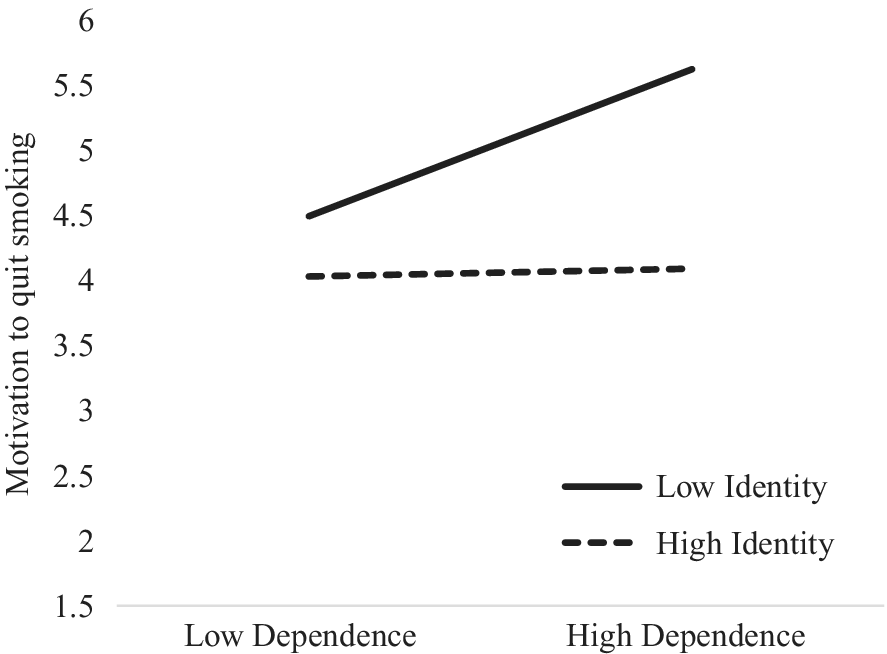
 $ {\upeta}_p^{{}^2} $ = .03. The model including the main effects and interaction product accounted for 4.3% of the total variance, F(3, 150) = 3.27, p = .023. Decompositions of this interaction with dependence at –1SD and +1SD from the mean revealed that identity had a negative effect on motivation among high-dependent smokers, β = –.58, SE = .28, t = –2.99, p = .003, 95% CI [–1.379, –0.282],
 $ {\upeta}_p^{{}^2} $ = .06, such that the more dependent smokers reported a strong smoker identity, the less they were motivated to quit smoking. Among low-dependent smokers, smoker identity had no impact, b = –0.12, p = .415. These results are yielded in Figure 2.
Motivation to Quit Smoking as a Function of Tobacco Dependence and Smoker Identity

Attitude toward smoking.
Analyses showed a main effect of dependence on attitude toward the adverse effects of smoking, β = .26, SE = .14, t = 2.032, p = .044, 95% CI [0.008, 0.570],  $ {\upeta}_p^{{}^2} $ = .03, and main effects of identity on the attitude toward the benefits, β = .37, SE = .18, t = 3.331, p = .001, 95% CI [0.240, 0.941],
 $ {\upeta}_p^{{}^2} $ = .07, and pleasures of smoking, β = .58, SE = .17, t = 4.882, p < .001, 95% CI [0.481, 1.134],
 $ {\upeta}_p^{{}^2} $ = .14. Moreover, we found an interaction effect on the attitude toward the adverse effects of smoking, β = –.23, SE = .10, t = –2.848, p = .005, 95% CI [–0.491, –0.089],
 $ {\upeta}_p^{{}^2} $ = .05. The model including the main effects and interaction product accounted for 6.0% of the total variance, F(3, 150) = 4.24, p = .007. After decomposition of this interaction (see Figure 3), we found that identity was negatively associated to attitude among high-dependent smokers, β = –.42, SE = .18, t = –2.19, p = .030, 95% CI [–0.736, –0.039],
 $ {\upeta}_p^{{}^2} $ = .03. Among low-dependent smokers, smoker identity had no impact, b = 0.21, p = .143.
Attitude toward the Adverse Effects of Smoking as a Function of Tobacco Dependence and Smoker Identity

Self-efficacy.
Neither main nor interaction effects were found regarding self-efficacy measured with the SEQ–12 (all ps > .14). Regarding participants’ perceived capacity to stop smoking, main effects of dependence, β = –.42, SE = .12, t = –4.619, p < .001, 95% CI [–0.810, –0.325],  $ {\upeta}_p^{{}^2} $ = .13, and identity were significant, β = –.35, SE = .10, t = –3.81, p < .001, 95% CI [–0.587, –0.186],
 $ {\upeta}_p^{{}^2} $ = .09. Both dependence and identity were related to a lower self-efficacy. However, the interaction was not significant, β = –.002, p = .971.
Thus, these results provided evidence that tobacco dependence interacted with smoker identity in predicting motivation to quit. More specifically, a lower motivation was observed among smokers high in dependence reporting a high identity, relative to those with a low identity. In addition, the same pattern of results occurred regarding the attitude toward the adverse effects of smoking. However, the predicted interaction was not significant regarding any of the two measures that we used to assess self-efficacy.
General Discussion
The present research sought to inspect the notion that the consequences of tobacco dependence on smoking cravings, self-efficacy, and motivation to quit would be related to identity issues. More specifically, it was expected dependent smokers with a high smoker identity to crave more smoking cigarettes, have a lower perception of self-efficacy, and be less motivated to quit than dependent smokers with a low smoker identity. Across two correlational studies, our findings indicated that smokers who declared to be strongly dependent to tobacco reported more cravings and a lower motivation to quit when the smoker identity was strongly established in their self-concept, as compared to those for whom the smoker identity was not a meaningful part of their self-concept. Additionally, our findings showed a similar impact of identity on the attitude toward the adverse effects of smoking, indicating that dependent smokers displayed more negative attitude toward the idea that smoking can cause aversive effects when they reported having a high rather than low smoker identity. However, contrary to our expectations, self-efficacy was not affected by the dependence by identity interaction.
These findings are consistent with previous research evidencing detrimental consequences of tobacco dependence on smoking behaviors (e.g., John et al., Reference John, Meyer, Hapke, Rumpf and Schumann2004; Vangeli et al., Reference Vangeli, Stapleton, Smit, Borland and West2011), and notably on craving to smoke and motivation to quit (Hagimoto et al., Reference Hagimoto, Nakamura, Morita, Masui and Oshima2010; Tarantola et al., Reference Tarantola, Heath, Sher and Piasecki2017). Yet, with this research, we offered a novel contribution to the extant literature in showing that such consequences are contingent upon how the smoker identity may be established in the smokers’ self-concept, thereby revealing that identity processes might underlie not only tobacco dependence, but also the ways of managing it. Tobacco dependence, as establishing a strong smoker identity that smoker may want to preserve and protect by aligning their behaviors on it, contributes to maintaining smoking habits and refraining from quitting. As such, our findings also gave support to the research emphasizing the negative effects of smoker identity on maintenance of smoking behaviors and failures of quit attempts (Shadel et al., Reference Shadel, Mermelstein and Borrelli1996; Tombor et al., Reference Tombor, Shahab, Brown and West2013; van den Putte et al., Reference Putte, Yzer, Willemsen and Bruijn2009).
This research contained a number of limitations. First and importantly, our studies were both based on a correlational design, which cannot allow concluding on a causal relationship between the examined variables. Only interpretations in terms of an associational relationship are thus possible. To address this issue, future research would merit to examine how dependence is predictive of smoking and quitting behaviors while manipulating the smoker identity (a manipulation of salience of the smoker identity might be of interest). Second, another limitation was that we only included self-reported measures, which may notably be a problem in assessment of dependence and cravings. These may not have been accurately rated by smokers or been distorted for social desirability or self-worth enhancement purposes. Such issues would deserve more attention in future studies and employment of other tools to address them (e.g., non-verbal assessment methods). Third, although this was addressed in Study 2, the Study 1 sample was overrepresented for students and young participants. This imposes limitations in terms of generalization of the present results and would call for replication studies using other populations. Fourth, while we demonstrated that the negative consequences of tobacco dependence on smoking cessation are related to identity processes, we did not directly pin down what these processes are. Future research is thus needed to address this issue. Finally, even though we observed a strong association between self-efficacy and identity, the predicted interaction with tobacco dependence was not significant on self-efficacy, whether assessed with the SEQ–12 or with an alternative and less context-dependent measure. Thus, this may suggest that the negative consequence of tobacco dependence on perception of self-efficacy would not be related to identity processes or perhaps that it would be related to identity processes that were not captured by our measures. For instance, it is plausible that, as we predicted, dependent smokers with a strong smoker identity would have indeed felt a lack of self-efficacy (vs. those with a low identity) but, for defensives purposes (i.e., given that acknowledging that one is not able to abstain may be threatening for smokers’ identity), they might have reported a biased and increased evaluation of their self-efficacy, thus eliminating the effects that we anticipated. Therefore, further research is needed to investigate which specific identity processes might account for the link between tobacco dependence and self-efficacy.
In conclusion, the present work extended the extant literature by providing the first evidence for the existence of identity processes in tobacco dependence and demonstrating that the consequences of dependence become particularly pronounced as the smoker identity gains importance in the smokers’ self. As such, this suggests that tobacco dependence brings to play a strong smoker identity that smokers have to manage and match with their smoking behaviors. As a consequence, the present findings made a convincing argument that it is of strong relevance to further consider and incorporate identity factors and processes into research so as to refine our understanding of tobacco dependence and smoking cessation.
Appendix
Measures used in Study 1 & 2
Tobacco Dependence
1. “Please rate your addiction to cigarettes on a scale going from 0 to 100”.
2. “Please report the number of cigarettes you usually smoke per day”.
3. “How soon after waking up do you usually smoke your first cigarette?”
4. “How hard it would be for you to quit?”
5. “How much do you feel an irresistible urge to smoke after a few hours without smoking?”
Smoker Identity
1. “Being a smoker is important for you?”
2. “Do you identify with smokers?”
3. “Do you really feel as a smoker?”
Smoking Craving
1. “I have a desire for a cigarette right now”.
2. “Nothing would be better than smoking a cigarette right now”.
3. “If it were possible, I probably would smoke now”.
4. “I could control things better right now if I could smoke” .
5. “All I want right now is a cigarette”.
6. “I have an urge for a cigarette”.
7. “A cigarette would taste good now”.
8. “I would do almost anything for a cigarette now”.
9. “Smoking would make me less depressed”.
10. “I am going to smoke as soon as possible”.
Self-efficacy (1)
“Would feel able to abstain from smoking in the following situations:”
1. “When I feel nervous”.
2. “When I feel depressed.”
3. “When I am angry”.
4. “When I feel very anxious”.
5. “When I want to think about a difficult problem”.
6. “When I feel the urge to smoke”.
7. “When having a drink with friends”.
8. “When celebrating something”.
9. “When drinking beers, wine, or other spirits”.
10. “When I am with smokers”.
11. “After a meal”.
12. “When having coffee or tea”.
Self-efficacy (2)
1. “Do you feel you are able to quit now?”
2. “Do you feel you are able to quit one day?”
3. “Do you think your tobacco dependence could prevent you from quitting smoking?”
Motivation to Quit
1. “Are you motivated to stop smoking”
2. “Do you intend to stop quitting soon?”
3. “Do you have a favourable opinion about quitting smoking?”
4. “Do you intend to cut down your level of cigarette use?”
5. “Do you intend to establish an action plan to stop smoking soon?”
6. “Do you intend to definitely stop smoking?”
7. “Are you ready to make efforts for stopping smoking?”
Attitudes toward Smoking
1. “Smoking is extremely harmful”.
2. “Smoking harms my health”.
3. “The smoke from my cigarette leaves an unpleasant odor”.
4. “Smoking gives me very bad breath”.
5. “I spend too much money on cigarettes”.
6. “The smoke from my cigarette is very disturbing to others”.
7. “Passive smoke is dangerous to those around me”.
8. “Smoking is bad for my skin”.
9. “It bothers me to be addicted to cigarettes”.
10. “I’d have more energy if I didn’t smoke”.
11. “A cigarette calms me down when I’m stressed”.
12. “Smoking calms me down when I’m upset”.
13. “A cigarette helps me to cope with difficult situations”.
14. “After a cigarette, I concentrate better”.
15. “I like the gesture of smoking”.
16. “It feels so good to smoke!”
17. “I love smoking”.
18. “I like holding a cigarette between my fingers”.