Left ventricular non-compaction is characterised by a two-layered ventricular cavity with an outer compacted and an inner trabeculated layer.Reference Oechslin, Harrison and Connelly1 Left ventricular non-compaction may be complicated by arrhythmia, cardiac failure, systemic thromboembolism and/or sudden cardiac death. First described by Grant et al in 1926Reference Grant2 in association with congenital heart disease (CHD), subsequent definitions of left ventricular non-compaction actually excluded patients with associated CHD. Apart from a few case reports of co-existent CHD and left ventricular non-compaction, the data regarding prevalence patterns and prognostic significance of left ventricular non-compaction in CHD are sparse.
Left ventricular non-compaction has been observed in conjunction with multiple forms of CHD.Reference Stähli, Gebhard and Biaggi3 Left ventricular non-compaction has also been associated with a plethora of genetic abnormalities, particularly mutations involving the cardiac sarcomere. Similar genetic abnormalities have been associated with some types of CHD, particularly Ebstein’s anomaly.Reference Klaassen, Probst and Oechslin4 Hemodynamic influences may also play a role in the expression of the left ventricular non-compaction phenotype. Case reports of left ventricular non-compaction in CHD with an associated excess ventricular volume load have been publishedReference Myers, Tissot and Cikirikcioglu5,Reference Igarashi, Takase and Satokawa6 but hemodynamic predisposing factors remain poorly understood.
Stahli et al have described an adult left ventricular non-compaction cohort with associated CHD.Reference Stähli, Gebhard and Biaggi3 Left heart obstructive lesions were the most common CHD type in this cohort and a hemodynamic influence in the pathogenesis of left ventricular non-compaction was postulated. Lesion specific prevalence of left ventricular non-compaction, however, could not be assessed in this study. Indeed, the prevalence of left ventricular non-compaction in specific CHD types has not been well studied.
Coarctation of the aorta (coarctation of the aorta) accounts for 5–8% of all CHD and has an incidence of approximately 3 per 10,000 births.Reference Baumgartner, Bonhoeffer and De Groot7 Given that it is a relatively common congenital cardiac lesion in adulthood and has been described in association with left ventricular non-compaction, determining the true prevalence patterns of left ventricular non-compaction in a cohort of coarctation of the aorta patients is important, both in order to understand hemodynamic influences in the pathogenesis of left ventricular non-compaction, and in order to determine any possible prognostic importance for coarctation of the aorta patients.
Cardiac magnetic resonance imaging (MRI) has high spatial resolution, ability to image the left ventricular apex reproducibly and good tissue characterisation abilities. It is thus increasingly used for the diagnosis and follow up evaluation of CHD. Current guidelines suggest cardiac MRI as the preferred modality for comprehensive aortic assessment,Reference Baumgartner, Bonhoeffer and De Groot7 so most patients with coarctation of the aorta presenting to a tertiary adult CHD centre are referred for cardiac MRI. We sought to assess prevalence and patterns of left ventricular non-compaction in adult coarctation of the aorta patients undergoing cardiac MRI and explored the possible effects of abnormal ventricular morphology on ventricular systolic function.
Methods
Patient selection
Repaired coarctation of the aorta patients aged >16 years undergoing cardiac MRI between 2008 and 2014 for clinical evaluation from three tertiary level ACHD centres (Sydney, Brisbane and Nebraska) were retrospectively reviewed. Clinical and demographic data were obtained where possible, including coarctation of the aorta repair strategy and subsequent complications including re-coarctation and aneurysm formation. In patients with serial scans, the most recent comprehensive cardiac MRI scan was analysed. Patients with coarctation of the aorta and associated simple CHD (e.g., bicuspid aortic valve) were included but those with more complex CHD such as those with transposition of the great arteries, cyanotic congenital heart disease or single ventricle physiology were excluded.
The study was conducted with approval from the ethics committees of all three institutions and in accordance with their guidelines.
Cardiac magnetic resonance imaging methods
Cardiac MRI was performed for clinical indications and images were analysed retrospectively. Cardiac MRI was performed on 1.5 T scanners (MAGNETOM Aera, Siemens Healthcare GmbH; Ingenia, Philips Healthcare; Signa Twinspeed, GE Healthcare) using phased array receiver coils during suspended respiration. Balanced steady state free precession (bSSFP) cine images were acquired in vertical long axis (two chamber), horizontal long axis (four chamber) and short axis planes using retrospective ECG gating. (Image parameters: Slice thickness = 8 mm; in-plane spatial resolution 1–1.3 mm2; and temporal resolution = 40 ms).
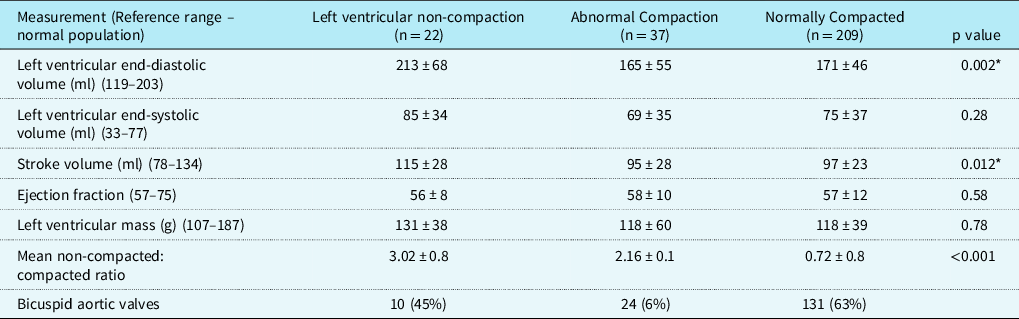
Assessments of left ventricular volumes were performed by manual segmentation of short-axis cine images with endocardial outline at end diastole and end systole (Circle cvi42, Calgary, Canada; OsiriX, Bernex, Switzerland; Medis, Leiden, Netherlands; based on institution). Simpson’s rule was used to calculate end-diastolic and end-systolic volumes for the left ventricular; ejection fraction was calculated from these volumes. Mass was calculated by subtraction of the end-diastolic volume from the total epicardial mass at end-diastole and the derived volume was converted to mass by multiplication with the myocardial density constant 1.05. Reference ranges quoted in Table 1 are derived from normal population of males <60 years.Reference Kawel-Boehm, Maceira and Valsangiacomo-Buechel8
Comparison of Ventricular Volumetric and Functional Data in left ventricular non-compaction versus patients with normal compaction.

Cardiac stroke volumes were quantified in patients by subtracting end-systolic from end-diastolic volumes in patients. Cardiac output was derived as a product of heart rate and stroke volume. Cardiac volumes and masses were indexed to the body surface area.
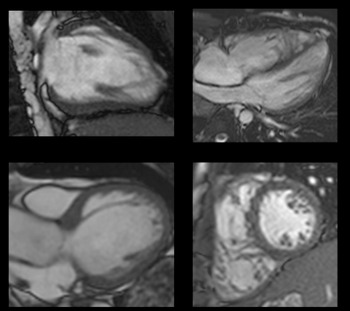
Left ventricular non-compaction was diagnosed using Petersen’s criteriaReference Petersen, Selvanayagam and Wiesmann9 of non-compacted:compacted ratio of >2.3 in the greatest affected segment in a long-axis view. Non-compacted:compacted ratio was measured in each of the three long-axis views and the highest ratio was recorded (see Fig 1). “Abnormal compaction” was defined as the presence of a bilayered structure with a thickened trabeculated layer that did not meet the non-compacted: compacted >2.3 criteria for left ventricular non-compaction (those that would have been otherwise classified as “hypertrabeculated”); with a non-compacted:compacted ratio of >2:1.
Demonstration of left ventricular non-compaction using criteria proposed by Petersen et al – measurement of non-compacted to compacted ratio in worst affected segment (excluding segment 17 of AHA 17-segment cardiac model) on ventricular long-axis views.

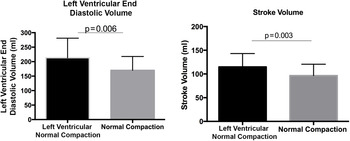
Comparison of left ventricular end-diastolic volumes and stroke volumes in patients with left ventricular non-compaction with those with normal compaction.

Three-dimensional balanced steady-state free precession cine sagittal oblique imaging was performed of the thoracic aorta and aortic dimensions were measured from multiplanar reformatted images, allowing for precise three-dimensional visualisation and quantification. The coarctation index – namely, the ratio between the narrowest segment of the descending aorta at the repair site was compared to the aortic calibre of the descending aorta at the diaphragm and expressed as a ratio. Recoarctation was defined by a ratio <0.7:1.Reference Adamson, Karamlou, Moore, Natal-Hernandez, Tabbutt and Peyvandi10 Hypoplasia of the transverse arch was defined as a transverse arch diameter of <50% of the diameter of the descending aorta.Reference Moulaert, Bruins and Oppenheimer-Dekker11
Statistical methods
Statistical analysis was performed using SPSS software (Version 21, Armonk, NY: IBM Corp). Gaussian distribution was assessed using the Kolmogorov–Smirnov test with a p value of <0.05 considered significant. Ventricular mass, volumes and quantified ratios were treated as continuous variables. Differences between left ventricular non-compaction patients and controls of continuous variables were analysed using independent t-tests and differences between three groups were assessed using analysis of variance methods (ANOVA). Non-parametric tests were used to compare means for variables that were not normally distributed. Differences in categorical variables were assessed using Chi square tests. Correlations between continuous variables were assessed using Pearson’s correlation method. Results were considered significant at a 2-tailed p value of <0.05.
Results
Patient characteristics
A total of 268 patients were studied (63% male) at median age of 26 years (inter-quartile range 21–37 years). Patients recruited from Nebraska were significantly younger compared to the two Australian sites with a median age of 23 (inter-quartile range 18–27) compared to 27 years (S: inter-quartile range 21–37 years) and 29 years (B: inter-quartile range 22–41 years); (p < 0.001). The prevalence of non-compaction in the older Australian population was 7% compared to a prevalence of 11% in patients from Nebraska with no significant statistical difference between the two sites (p = 0.34).
Where this information was known (140 of 268 cases), the initial coarctation repair strategy was end-to end anastomosis in 30 patients, subclavian flap aortoplasty in 38 patients, patch aortoplasty in 40 patients and interposition tube graft repair in 12 patients. Aortic arch stenting repair had been performed in 20 patients. There was no significant association between repair strategy and presence of left ventricular non-compaction (p = 0.98).
Associated congenital heart disease
The prevalence of bicuspid aortic valves was 62% (165 patients) and one patient had a unicuspid aortic valve. Two patients had prosthetic aortic valves and one had had a previous Ross procedure for aortic valve stenosis.
Sixty patients had associated CHD, excluding bicuspid aortic valve. This included ventricular septal defect in 23, atrial septal defect in 6, persistent ductus arteriosus in 5, and anomalous pulmonary venous drainage in 2 patients. Ten patients had associated sub-aortic or supra-aortic stenosis, 9 had mild to moderate hypoplasia of the aortic arch and 8 patients had mitral valve abnormalities including a “cleft mitral valve” or mitral valve prolapse. Persistent left superior vena cava was present in 3 patients. The prevalence of congenital heart disease other than bicuspid valves was low in patients with non-compaction (9%). One patient had a hypoplastic aortic arch and the other had Shone complex with a ventricular septal defect. There was no significant difference in the prevalence of non-bicuspid aortic valve related congenital heart disease comparing patients with non-compaction, abnormal compaction and normal compaction (9 versus 27 versus 21% respectively; p = 0.76).
Prevalence of left ventricular non-compaction and other compaction abnormalities
The prevalence of left ventricular non-compaction in this cohort was 8.2% (22 patients), with a mean end-diastolic non-compacted : compacted ratio of 3.12 ± 0.8. The distribution was involved the left ventricular apex in all 22 patients (100%), mid-ventricle in 11 patients (50%) and basal in 1 patient (5%). A median of 4 (inter-quartile range 3–5) segments of the 17 segment American Heart Association model were involved. The most frequent site was the lateral wall (77%) followed by inferior and anterior wall (64%) involvement. The pattern of a mid to apical inferolateral distribution was most common and occurred in 11 patients, while mid to apical antero-infero-lateral involvement was present in 41%.
Abnormal compaction was present in an additional 14% (37 patients) of the cohort with a mean end-diastolic non-compacted : compacted ratio of 2.16 ± 0.1 and predominantly apical involvement.
Trabeculations arising from the interventricular septum were noted in 117 patients (44%), 103 of whom had no other compaction abnormalities and in 14 with left ventricular non-compaction. Patients with isolated septal trabeculation with no other compaction abnormalities were not included amongst the left ventricular non-compaction cohort, regardless of the non-compacted : compacted ratio at the site of the trabeculation. There was no significant difference in prevalence of septal trabeculations in patients with left ventricular non-compaction compared to those without (p = 0.28). The inter-observer variability on a subset of 21 patients for non-compacted : compacted ratio was assessed using a Bland-Altman analysis which demonstrated a bias of −0.05 and with limits of agreement of the independently measured NC:C ratios between −0.94 and –0.84. Qualitatively, using a cut-off of a ratio of >2.3:1, there was 100% inter-observer agreement within this subset.
There was no significant difference in age among patients with left ventricular non-compaction compared to the cohort without left ventricular non-compaction (31 ± 11 versus 29 ± 12 years, p = 0.65). Patient age at time of cardiac MRI did not correlate with non-compacted : compacted ratio (r = −0.06, p = 0.29).
There was no correlation between the presence of bicuspid aortic valves and left ventricular non-compaction (p = 0.10). Only two patients with left ventricular non-compaction had co-existent CHD other than simple bicuspid aortic valve disease – one with a hypoplastic aortic arch and one with Shone’s complex.
Left ventricular non-compaction – effects on left ventricular volume and function
Indexed left ventricular end-diastolic volumes were higher in the left ventricular non-compaction group (108 ± 32 ml versus 92 ± 22 ml; p = 0.005). Stroke volumes were also significantly higher in the left ventricular non-compaction group (115 ± 28 ml versus 97 ± 24 ml, p = 0.003) (Fig 2). None of the patients with left ventricular non-compaction had significant aortic regurgitation. There were no significant differences in ejection fraction between patients with left ventricular non-compaction and those without (56 ± 8% versus 58 ± 11%; p = 0.46). In patients with left ventricular non-compaction or abnormal compaction, there was no significant correlation between maximal non-compacted : compacted ratio and either indexed left ventricular end-diastolic volume, stroke volume, or ejection fraction (p = 0.75, p = 0.22 and p = 0.91 respectively). Table 1 details differences in ventricular volumes and function in patients with normal compaction and those with non-compaction.
Both left ventricular end-diastolic volumes and left ventricular stroke volumes were significantly higher in the left ventricular non-compaction cohort compared to the abnormally compacted group (left ventricular end-diastolic volume 214 ± 68 ml versus 165 ± 55 ml; p = 0.01 and systolic volume 115 ± 28 ml versus 95 ± 28 ml, p = 0.02). No significant differences in left ventricular end-diastolic volume (165 ± 55 ml versus 171 ± 46 ml; p = 0.52) or stroke volume (95 ± 28 ml versus 97 ± 23 ml; p = 0.68) were noted between patients with abnormal compaction and those with normal compaction.
There were no significant differences in indexed left ventricular mass between patients with left ventricular non-compaction and those with normal compaction (left ventricular mass 131.5 ± 44 versus 121.6 ± 47 g/m2, p = 0.35).
Although pre-operative severity of coarctation prior to repair could not be quantified, re-coarctation was defined by assessing the coarctation index. There was no significant difference in this ratio between patients with left ventricular non-compaction and those without (3 out of 12 non-compacted patients versus 37 patients with normal/abnormal compaction, p = 0.74). Furthermore, no correlation between this ratio and the maximal non-compacted : compacted ratio was evident (r = −0.06, p = 0.34).
Mitral valve
Mitral valve abnormalities were noted in 17 patients with parachute mitral valve in one patient and mitral stenosis in one patient. Mitral valve prolapse was present in six patients, four others had mitral regurgitation with no clear cause, two had a cleft mitral valve, and two had thickened valve leaflets. One patient had a prosthetic mitral valve. There was no correlation between abnormal mitral valve function and left ventricular non-compaction.
Discussion
This is the first systematic study of the prevalence and patterns of left ventricular non-compaction in a large cohort of adult patients with coarctation of the aorta. We report a relatively high prevalence of left ventricular non-compaction (8.2%) in this cohort with the distribution being predominantly apical, followed by involvement of the anterior and lateral walls. In the general population, the prevalence of left ventricular non-compaction ranges from approximately 0.05–0.014%.Reference Oechslin, Harrison and Connelly1,Reference Ritter, Oechslin and Sutsch12 In our patients with repaired coarctation of the aorta, left ventricular non-compaction was associated with significantly higher left ventricular end-diastolic volume and stroke volumes. The presence of co-existent bicuspid aortic valves, age or aortic dimensions did not significantly differ between patients with left ventricular non-compaction and those without left ventricular non-compaction. Abnormal compaction was observed in 23%; however, this did not correlate with increased ventricular volumes or impaired function. Mitral valve abnormalities occurred in 5% of patients.
Although the presence of obstructive left heart disease is the most common congenital abnormality among cohorts of patients with isolated left ventricular non-compaction;Reference Stähli, Gebhard and Biaggi3 the prevalence of non-compaction has never been studied systemically in adult patients with coarctation of the aorta. This group is frequently seen in both specialist and non-specialist CHD settings and undergo cardiac MRI for assessment of post-repair aortic complications. A prevalence of 8.2% in patients with coarctation of the aorta is relevant as these patients have had markedly improved survival in the contemporary eraReference Choudhary, Canniffe and Jackson13 and comprise 5–8% of all CHD patients; therefore complications associated with left ventricular non-compaction such as arrhythmia, cardiac failure, sudden cardiac death and thromboembolic sequelae may add incremental risk over the lifespan of these patients, in addition to the known sequelae of coarctation of the aorta repair.
Oechslin et alReference Oechslin, Harrison and Connelly1 reported coarctation of the aorta as one of the groups of lesions where death occurs at a younger age compared to other forms of CHD. Sudden cardiac death was the diagnosis in all coarctation of the aorta deaths in their cohort, with three of the four patients having had moderate left ventricular systolic dysfunction. The second most common cause of death was progressive congestive heart failure. The clinical sequelae of left ventricular non-compaction in patients with CHD remain unknown. We demonstrate that in our cohort with left ventricular non-compaction, the indexed left ventricular end-diastolic volume was higher, with a resultant higher stroke volume. Ejection fractions did not significantly differ among patients with left ventricular non-compaction and patients with normal compaction, although the presence of a higher end-diastolic volume may indicate a compensatory phase, prior to possible later appearance of systolic dysfunction. Another explanation may relate to pooling of the blood within the myocardial trabeculations resulting in an increased left ventricular end-diastolic volume as well as the increase in the stroke volume. Nevertheless, serial longitudinal data will be most useful in examining this issue further.
Diagnostic criteria for left ventricular non-compaction are numerous; however the absence of a diagnostic “gold standard” criterion adds to the complexity of assessment. The Petersen criteria remain the most widely utilised criteria on cardiac MRI;Reference Petersen, Selvanayagam and Wiesmann9 however, longitudinal data using this criterion did not correlate with adverse long-term outcomes in a cohort of patients with no underlying cardiac disease.Reference Zemrak, Ahlman and Captur14 Whether this information can be generalised to patients with long-standing structural and functional changes remains unknown. There is no data to support specific therapies in left ventricular non-compaction patients beyond conventional management of left ventricular systolic dysfunction. However, patients with coarctation of the aorta who undergo serial multi-modality cross-sectional imaging, a heightened awareness of the association with left ventricular non-compaction and associated clinical complications may lead to increased surveillance for the presence of arrhythmia or cardiac dysfunction and potentially earlier institution of targeted pharmacotherapy.
The mechanism of left ventricular non-compaction in these patients is unknown and may be related to early hemodynamic alterations in left ventricular blood flow related to distal obstruction. Compaction normally occurs at 7–14 weeks post gestation and occurs sequentially from septum to lateral wall and base to apex.Reference Sedmera, Pexieder and Vuillemin15 Presence of abnormal septal trabeculations may suggest an ‘arrest’ in the normal compaction process. Our cohort demonstrated that the distribution of non-compaction was predominantly mid-ventricular to apical and most commonly affected the inferolateral mid to apical segments. Our data does not demonstrate significant differences in the prevalence of concomitant obstructive pathology in patients with non-compaction compared to those with normal compaction; however the numbers are small and the process of compaction may be more complex involving an inter-play of genetic and haemodynamic factors. Furthermore, patients with the most severe end of the spectrum of left-heart obstructive disease (e.g., hypoplastic left heart syndrome) would have been excluded from this adult congenital cohort due to poor childhood survival rates in that era.
Limitations
Selection bias in patient selection is a potential limitation of this study; coarctation of the aorta patients dying in childhood would not have been included in this study of adults, however it is also possible that more symptomatic patients would have been over-represented in these adults followed up at tertiary referral centres. Our study focussed on left ventricular parameters specifically as right ventricular non-compaction is a poorly defined entity and assessing right ventricular volumetric data was not collected in this context. The effect of left heart obstructive disease on right ventricular pathology could be assessed once the entity becomes more well-defined. Other limitations include cross-sectional data from a single time point, and possible small inter-institution variations in the MRI protocols for coarctation of the aorta patients. Our study aimed to assess the structural and functional sequelae of left ventricular non-compaction in coarctation of the aorta patients, however the electrical data regarding arrhythmias would also be important to ascertain. There is vast genetic heterogeneity in associated isolated left ventricular non-compaction including sarcomeric genes, those associated with neuromuscular disease or mitochondrial disease. As a result, there are no systematic genetic panels that would allow further assessment of specific anomalies within this cohort.Reference Captur and Nihoyannopoulos16 As a result, we did not specifically collect details regarding genetic testing within this cohort. Referral to the genetics team was at the discretion of the treating clinician.
Conclusions
Left ventricular non-compaction is relatively common in patients with coarctation of the aorta, with a prevalence of 8.2%. We speculate that early hemodynamic alterations in fetal life may lead to compaction abnormalities. Patients with coarctation of the aorta and left ventricular non-compaction have higher indexed left ventricular end-diastolic volume as well as left ventricular stroke volume, although the mechanism of this is unclear. Serial longitudinal data would likely improve our understanding of the mechanism and sequelae of left ventricular non-compaction in patients with repaired aortic coarctation.
Acknowledgements
Dr Choudhary was funded by a NHMRC and National Heart Foundation Co-funded post-graduate research scholarship (#1055773) for a proportion of the duration of this study.
Conflicts of interest
None.
Supplementary material
To view supplementary material for this article, please visit https://doi.org/10.1017/S104795112100038X