It is well known that speakers adapt their production and comprehension based on their recent linguistic experience. For example, in sentence production, speakers tend to repeat the syntactic structure that they have recently encountered (e.g., Bock, Reference Bock1986). In sentence comprehension, speakers can process a recently encountered structure more rapidly (e.g., Fine et al., Reference Fine, Qian, Jaeger and Jacobs2010; Fine & Jaeger, Reference Fine and Jaeger2013). Such adaptation at the syntactic level is commonly referred to as syntactic adaptation or structural priming (see Pickering & Ferreira, Reference Pickering and Ferreira2008 for a review). Structural priming can be immediate or cumulative. Speakers are more likely to use a syntactic structure if they have encountered that structure in the immediately preceding utterance (immediate priming, e.g., Bock, Reference Bock1986) or have had multiples experiences of it in the context (cumulative priming, e.g., Hwang & Shin, Reference Hwang and Shin2019; Jaeger & Snider, Reference Jaeger and Snider2013; Kaan & Chun, Reference Kaan and Chun2017; Kaschak et al., Reference Kaschak, Loney and Borreggine2006; see Fine & Jaeger, Reference Fine and Jaeger2016; Fine et al., Reference Fine, Jaeger, Farmer and Qian2013 for comprehension).
Structural priming has been suggested to arise from either the transient activation of a recent syntactic structure (residual activation account) or implicit learning of semantic-syntactic mappings (implicit learning account). On the one hand, the residual activation account suggests that a recently encountered syntactic structure is highly activated in memory and the short-term activation increases the probability of reusing that structure compared to the alternative structure (e.g., Dell, Reference Dell1986; Pickering & Branigan, Reference Pickering and Branigan1998). This is especially the case when the same lexical item is used in prime and target (i.e., lexical boost; e.g., Branigan et al., Reference Branigan, Pickering and Cleland2000; Corley & Scheepers, Reference Corley and Scheepers2002; Gries, Reference Gries2005; Pickering & Branigan, Reference Pickering and Branigan1998). The lexical boost is short-lived and occurs only when prime and target are not separated by any intervening trials (Hartsuiker et al., Reference Hartsuiker, Bernolet, Schoonbaert, Speybroeck and Vanderelst2008). The immediate, transient nature of lexical boost fits especially well with the residual activation account.
On the other hand, the implicit learning account suggests that structural priming is not due to the transient activation of a syntactic structure, but long-term changes in weights associated with mappings between message and syntactic representations (e.g., Bock & Griffin, Reference Bock and Griffin2000; Chang et al., Reference Chang, Dell and Bock2006; Jaeger & Snider, Reference Jaeger and Snider2013). Weight changes occur each time a sentence is processed, and each additional experience of a syntactic structure iteratively yields further changes. Thus, each experience of a syntactic structure immediately increases the likelihood of its use (immediate priming), and the effects of multiple experiences accumulate over time (cumulative priming).
Consistent with the implicit learning account, evidence suggests that the effect of structural priming persists and accumulates over time. In contrast to the lexical boost that decays rapidly, structural priming remains undiminished following as many as 10 intervening trials (e.g., Bock & Griffin, Reference Bock and Griffin2000; Hartsuiker et al., Reference Hartsuiker, Bernolet, Schoonbaert, Speybroeck and Vanderelst2008), and the likelihood of using a syntactic structure increases following multiple experiences across trials (e.g., Jaeger & Snider, Reference Jaeger and Snider2013). Given that recall memory for sentence form deteriorates after a single intervening sentence or a 1.5s interval (e.g., Potter & Lombardi, Reference Potter and Lombardi1990), and recognition memory after 7.5s (e.g., Sachs, Reference Sachs1967), these findings suggest that cumulative priming involves long-term memory. The long-term persistent and cumulative effects of structural priming are compatible with the implicit learning account, but not with the residual activation account that attributes structural priming to transient residual activation.
While structural priming is well-documented in first or native (L1) language processing using a range of constructions, there are many open questions about to what extent speakers of a second language (L2) adapt their comprehension and production to recent syntactic experience. The present study investigates how L2 learners adapt L2 language use based on their L2 syntactic experience when the L2 target sentence differs from an L1 structure in terms of verb subcategorization frame and argument structure, and what mechanisms underlie such adaptation.
Previous L2 priming research suggests that L2 learners, like L1 speakers, can adapt their language use in response to immediate and cumulative experience of a syntactic structure. For example, McDonough (Reference McDonough2006) found that L2 learners of English produced more prepositional dative sentences (e.g., the girl gave a book to the boy) immediately after they encountered prepositional dative primes (e.g., the woman showed a dress to the man) than double object dative primes (e.g., the woman showed the man a dress). They also produced more prepositional dative sentences after the priming phase than prior to the priming phase (see Shin & Christianson, Reference Shin and Christianson2012 for similar findings). In a recent study, Kaan and Chun (Reference Kaan and Chun2017) showed that L2 learners of English produced fewer prepositional dative sentences as they encountered more double object dative primes across trials.
Bernolet et al. (Reference Bernolet, Hartsuiker and Pickering2013) suggests that immediate priming is modulated by L2 proficiency (see also Grüter et al., Reference Grüter, Zhu, Jackson, Kaan and Grüter2021; Hartsuiker & Bernolet, Reference Hartsuiker and Bernolet2017; Kim & McDonough, Reference Kim and McDonough2008; Montero-Melis & Jaeger, Reference Montero-Melis and Jaeger2019). While low-proficiency learners showed greater priming when words were repeated between the prime and the target, high-proficiency learners showed a trend towards greater priming without lexical overlap. This is likely because L2 learners initially rely on lexical-specific syntactic representations and later develop more abstract syntactic representations (McDonough, Reference McDonough2006).
The results of these studies suggest that exposure to an individual instance or multiple instances of the L2 target can shift L2 learners’ syntactic knowledge and processing in the direction of the target language, with the effect of exposure modulated by L2 proficiency. Yet previous research has been primarily concerned with priming of structural alternatives that are similar in terms of verb subcategorization frame and argument structure between L1 and L2 (henceforth referred to as similar syntactic structure, e.g., Flett et al., Reference Flett, Branigan and Pickering2013; Kaan & Chun, Reference Kaan and Chun2017; McDonough, Reference McDonough2006; Shin & Christianson, Reference Shin and Christianson2012 for datives; Kim & McDonough, Reference Kim and McDonough2008 for transitives; Trofimovich et al., Reference Trofimovich, McDonough and Neumann2013 for relative clauses; Bernolet et al., Reference Bernolet, Hartsuiker and Pickering2013 for genitives; McDonough & Mackey, Reference McDonough and Mackey2008 for wh-questions). For example, prepositional and double object dative sentences contain dative verbs that take agent, recipient, and theme arguments and have similar argument structures across many languages, despite differences in word order. While the recipient and the theme are assigned to the direct object function in double object datives, the theme is assigned to the direct object function and the goal is assigned to the oblique object function in prepositional datives.
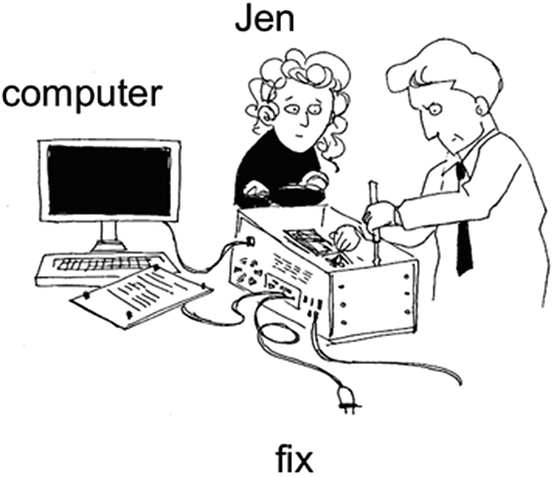
Languages, however, often use a lexical item that differs in verb subcategorization frame and argument structure to convey the same message (henceforth referred to as different syntactic structure). For example, a causative description of Figure 1 in English (1a) employs the causative verb have, which takes a causer and a caused event as arguments. The causer is expressed as the subject (e.g., Jen) and the caused event is expressed as the object (e.g., computer) and the verb (e.g., fixed). By contrast, a causative sentence in Korean (1b) contains a transitive verb (e.g., fix), which takes a causer as the subject (e.g., Jen) and the theme as the object (e.g., computer). Although the use of a causative verb -key hata “have, cause” is grammatically possible in Korean (1c), it is not a natural way of describing a causative event.

Example of a causative event

Because verb subcategorization frame and argument structure specify information about the number of arguments a verb takes, their syntactic expression, and their semantic relation to the verb, they constitute the basis of syntactic knowledge and their acquisition are integral to the acquisition of syntax. Hwang et al. (Reference Hwang, Shin and Hartsuiker2018) provide evidence that differences in verb subcategorization frame and argument structure between L1 and L2 affect L2 learners’ processing of L2 syntactic structure. They found that Korean learners of English accessed their knowledge of Korean during the processing of a causative event in English, even though Korean sentences were not comparable to English sentences and interfered with the processing of English. For example, when asked to decide whether a given sentence matches a depicted event in English, proficient Korean learners of English identified a causative sentence (e.g., Jen had her computer fixed) as a correct description of a causative event (Figure 1). Critically, they also tended to identify an active transitive sentence (e.g., Jen fixed her computer) as an appropriate structure for a causative event.
The findings of Hwang et al. (Reference Hwang, Shin and Hartsuiker2018) suggest that to develop nativelike processing for a different L2 structure, L2 learners have to not only acquire separate syntactic knowledge for an L2 structure (e.g., a verb used in a particular construction, its subcategorization frame and argument structure) but also suppress irrelevant L1 syntactic knowledge, as applying L1 syntax to L2 would result in ungrammatical sentences. When L2 uses a verb with a similar subcategorization frame and argument structure as L1, however, L2 learners can share syntactic information between L1 and L2, and do not have to store and access separate syntactic information for L2 (e.g., Hartsuiker et al., Reference Hartsuiker, Pickering and Veltkamp2004).
This raises the possibility that strategies or mechanisms used for processing and learning of a different L2 structure might not be the same as those used for a similar L2 structure. For example, for a different L2 structure, L2 learners may have difficulty in adapting to the L2 language context due to interference from or suppression of L1 syntax. Yet there has been little consideration of how differences in verb subcategorization frame and argument structure between L1 and L2 affect L2 learners’ adaptation. The present study aims to address the question by investigating how Korean learners of English adapt to immediate and cumulative experience with a causative structure in English. My investigation of the question has the potential to make significant empirical and theoretical contributions to the L2 priming literature. Priming of a causative structure has not been previously demonstrated to the best of my knowledge. Using a novel structure that has not been tested in the priming literature, this study aims to reveal the cognitive mechanisms that underlie processing and learning of a different L2 structure. It will also yield pedagogical implications by demonstrating whether structural priming is beneficial for reducing the interference from L1 and improving L2 learners’ production of a different L2 structure in the short and long term.
My primary goal was to examine whether Korean learners of English show immediate priming and cumulative priming of causative structure. I examined structural priming using a confederate scripting technique, in which a confederate of the experimenter and a participant take turns to describe pictures and match the descriptions to their pictures (e.g., Branigan et al., Reference Branigan, Pickering and Cleland2000). I used the confederate scripting technique to increase the chance of detecting potential priming effects. This is because L2 learners often struggle with production of a different L2 structure (e.g., Tokowicz & MacWhinney, Reference Tokowicz and MacWhinney2005) and priming is larger in interactive dialogue tasks than noninteractive tasks (Pickering & Ferreira, Reference Pickering and Ferreira2008). I also used the same verb between prime and target to enhance potential priming effects.
On each priming trial, Korean learners of English heard a confederate’s prime sentence and decided whether the sentence matched the picture they were viewing. The prime sentence had either an active transitive structure (e.g., the repairman fixed the TV) or a causative structure (e.g., Lisa had her TV fixed). They then described pictures depicting a causative event (e.g., Jen having her computer fixed by a technician).
I investigated to what extent Korean learners adapted their production preferences as a function of the structure of the immediately preceding prime (immediate priming) and the number of structures encountered across trials (cumulative priming). Both the residual activation account and the implicit learning account predict that Korean learners of English would produce more causative sentences immediately following causative primes than active transitive primes. However, only the implicit learning account predicts that Korean learners of English would produce more causative sentences as they encounter more causative primes across trials. Thus, a clear demonstration of cumulative priming effects would provide strong evidence that an implicit learning mechanism underlies processing and learning of an L2 structure that is different from L1.
Given the findings that immediate priming effects were modulated by L2 proficiency (e.g., Bernolet et al., Reference Bernolet, Hartsuiker and Pickering2013), I also investigated how effects of immediate priming and cumulative priming of causative structure were modulated by L2 proficiency. When words were repeated between prime and target as in the current study, Bernolet et al. (Reference Bernolet, Hartsuiker and Pickering2013) observed a negative correlation between priming strength and L2 proficiency, with the effect being stronger for less proficient L2 learners. This is presumably because less proficient L2 learners rely more on lexical repetition for the production of a similar L2 structure than more proficient L2 learners do. If less proficient L2 learners similarly rely more on lexical repetition for the production of a different L2 structure, I predict that effects of immediate priming and cumulative priming would be stronger for less proficient L2 learners.
Although the focus of the study was to examine L2 learners’ adaptation in production, I additionally examined L2 learners’ cumulative adaption in comprehension by analyzing their performance on priming (verification) trials. Evidence suggests that structure priming facilitates comprehension of a syntactic structure in L1 (e.g., Fine et al., Reference Fine, Qian, Jaeger and Jacobs2010; Fine & Jaeger, Reference Fine and Jaeger2013) and L2 (e.g., Nitschke et al., Reference Nitschke, Kidd and Serratrice2010). Yet compared with production, structural priming in comprehension has received relatively little attention. The present study aims to contribute to the current literature concerning structural priming in comprehension and gain a better understanding of L2 learners’ cumulative adaption by comparing how comprehension and production are improved by repeated exposure to a different L2 structure. If repeated exposure to a causative structure improves comprehension of a causative structure, I expect that Korean learners of English would more accurately identify a causative sentence as an appropriate description of a causative event as they had encountered more causative sentences in the preceding trials.
METHOD
PARTICIPANTS
Twenty-two Korean learners of English (13 females and 9 males; mean age = 20.5; range = 18–24) from Dongguk University (Seoul, South Korea) participated in the experiment for KRW10,000 (U.S.$9) per hour. All were late learners of English, who were exposed to English after Korean was fully acquired and for whom Korean remained the dominant language. They reported having at least 6 years of formal instruction in English. All participants were asked to complete an English proficiency test consisting of a cloze passage, with three multiple-choice response options for each blank (e.g., Montrul & Ionin, Reference Montrul and Ionin2009; Shin & Christianson, Reference Shin and Christianson2009). The mean percentage accuracy was 72.9% (SD = 11.1, range = 45–88). A female or a male undergraduate student with English as an L2 acted as confederate.
MATERIALS AND DESIGN
I constructed 14 experimental sets and 46 filler sets. Each set consisted of a verification picture (to be matched with a confederate’s description) and a description picture. For the experimental sets, verification pictures were prime pictures and description pictures were target pictures. The prime and target pictures depicted a causative event (e.g., Figure 1). The pictures were taken from Hwang et al. (Reference Hwang, Shin and Hartsuiker2018). Each prime picture was associated with two prime sentences, an active transitive sentence (e.g., the repairman fixed the TV) and a causative sentence (e.g., Lisa had her TV fixed). The prime pictures always matched a confederate’s descriptions. The target picture depicted the same action as in the prime picture (e.g., fixing), but differed from the prime picture in all other aspects (i.e., causer, agent, and theme of fixing).
The verification and description pictures in the filler sets were similar to experimental pictures in style, but they did not depict a causative event (e.g., a woman coughing, a girl giving a book to a boy). Out of the 46 verification pictures, only 16 matched a confederate’s descriptions. Together with 14 prime pictures in the experimental sets, this resulted in 50% “yes” responses for verification.
All pictures included a verb and nouns to be used in the descriptions. To facilitate the production of a causative sentence, the target pictures always included a verb for the depicted action (e.g., fix), a noun for the theme of the action (e.g., computer), and the name of the causer of the action (e.g., Jen). The locations of the characters (i.e., causer and agent of an action) were counterbalanced across items. I constructed two lists by pairing each prime picture with two prime sentences. Each list was also reversed to control for trial order. The trials were presented in a pseudorandom order, such that all experimental trials were separated by at least one filler trial. Participants were randomly assigned to one of the lists.
PROCEDURE
The participant and the confederate were told that they would play a game in which they would have to describe pictures to each other and verify each other’s descriptions. They were told to describe pictures using the words provided but to add auxiliary verbs and change the form of the verb to form a grammatical sentence. They were instructed to respond to each other’s descriptions by pressing “J” for match and “F” for mismatch. They sat opposite each other with PCs between them and could not see each other’s screen or keyboard responses. Before the main experiment, the participant and the confederate were familiarized with the task in a practice session with four sets of practice trials.
The experiment was set up so that the confederate always took the first turn and described prime pictures. The confederate produced scripted sentences shown on the screen under the guise of describing a picture. The participant viewed a verification picture and decided whether the confederate’s description matched the picture by pressing J or F. Immediately after the response, a beep occurred and the verification picture was replaced by a description picture. Upon hearing the beep, the confederate pressed the spacebar to proceed to the description trial. The participant described the picture with the words provided. After the confederate responded, the participant heard a beep and pressed the spacebar to view the verification picture. The participant’s keyboard responses and speech were recorded. The experiment was run using the experimental software Paradigm and lasted about 30 minutes. After the experiment, participants were verbally asked debriefing questions. They showed no awareness of experimental aim or design, reducing the likelihood that the results were due to conscious modifications of descriptions.
SCORING
The participant’s utterances were transcribed and coded as “active transitive,” “causative,” or “other.” An utterance was coded as “active transitive” if it contained the causer of the action as the subject, followed by the verb and the theme (e.g., Jen fixed her computer). An utterance was coded as “causative” if it contained the causer of the action as the subject, followed by a causative verb have or get, the theme, and the main verb in the past participle form (e.g., Jen had her computer fixed). An utterance was coded as “other” if it contained other nouns than provided (e.g., the technician fixed Jen’s computer) or if it had a structure other than an active transitive and a causative structure (e.g., Jen’s computer was fixed). “Other” responses were excluded from the analysis (15.6%, 48 out of 308 trials). As I was most interested in the structure of responses, utterances that did not contain articles (e.g., Jen fixed computer) or use a correct verb from (e.g., Jen have her computer fixed) were not excluded from the analysis.
ANALYSIS
I analyzed the results using logit mixed effects models (Jaeger, Reference Jaeger2008). All models were calculated using the glmer function from the lme4 package (lme4: version 1.1.7; Bates et al., Reference Bates, Maechler, Bolker and Walker2015). The random effects structure included by-participant and by-item effects. I fitted maximal random effects structure, including main effects and interactions. If the fully maximal model did not converge, I simplified random slope structure until convergence was achieved (Barr et al., Reference Barr, Levy, Scheepers and Tily2013). I report the coefficient for each independent variable and its level of significance for the final model. Coefficients are given in log-odds.
RESULTS
COMPREHENSION (VERIFICATION)
Participants correctly identified active transitive and causative descriptions as corresponding to prime pictures for 94.5% of the time (SD = 8.2; range = 64.3–100). Accuracy was higher for active transitive sentences (97.4%) than causative sentences (91.6%).
I analyzed verification response form (correct = 1, incorrect = 0) as a function of prime structure (sum-coded: active transitive = .5, causative = –.5), number of prior causative primes and proficiency. Number of prior causatives and proficiency were continuous predictors and centered prior to analysis in order to reduce collinearity. The maximal model to converge included by-participant and by-item random intercepts.
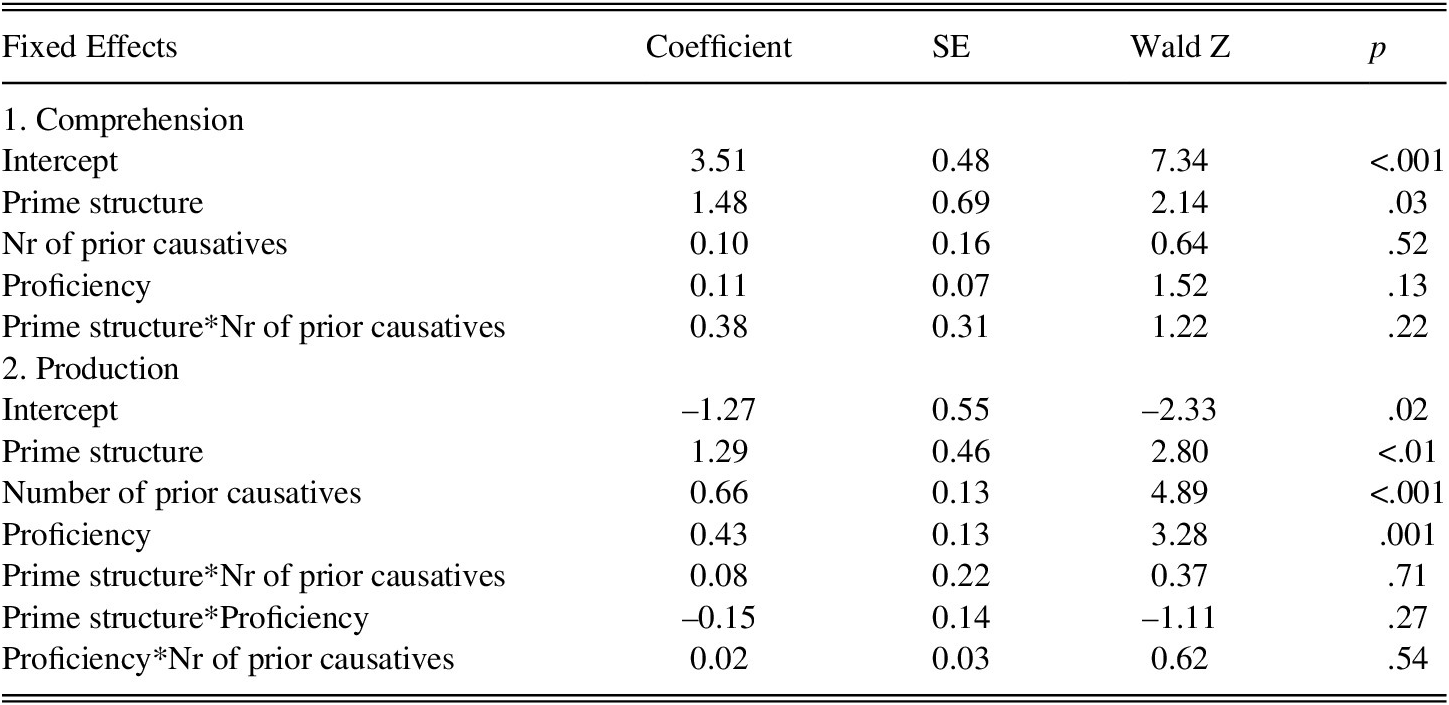
There was a significant effect of prime structure on comprehension, such that accuracy was higher for active transitive sentences than causative sentences. However, there was no effect of number of prior causatives, nor proficiency (Table 1.1). The interaction between prime structure and number of prior causatives was not significant either.
Summary of logit mixed-effect models for comprehension and production

PRODUCTION
Overall, participants produced more active transitive sentences than causative sentences (61.1%, 159 out of 260 trials). Critically, they produced more causative sentences following causative primes (47.4%, 63 out of 133 trials) than active transitive primes (29.9%, 38 out of 127 trials).
I analyzed production responses (causative = 1, active transitive = 0) as a function of prime structure (sum-coded: causative = .5, active transitive = –.5), number of prior causative primes, and proficiency. The maximal model to converge included by-participant and by-item random intercepts.
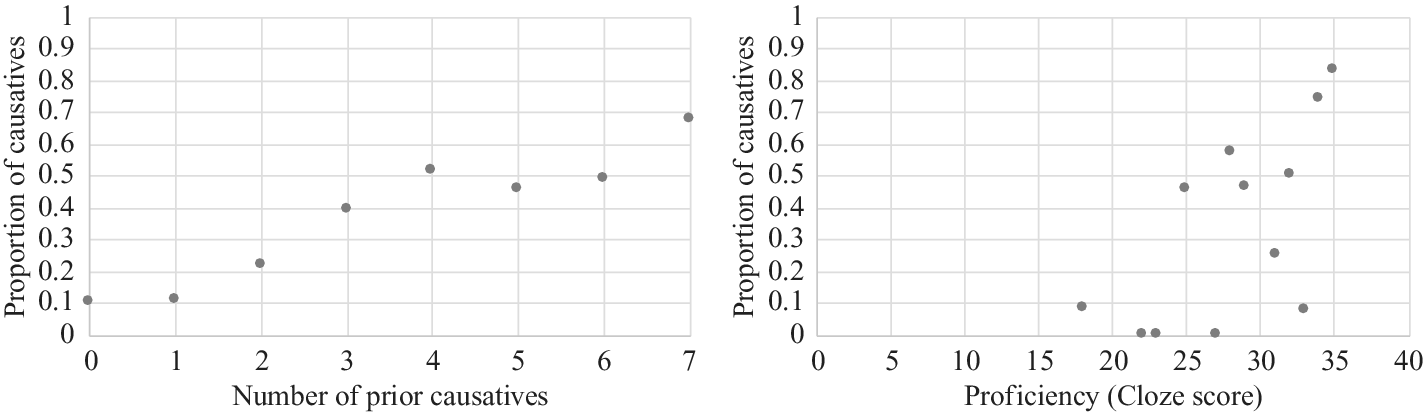
There were significant main effects of prime structure and number of prior causatives (Table 1.2), indicating that participants produced more causative sentences immediately after they encountered causative primes, and when they had encountered more causative primes across trials (Figure 2a). There was also a significant effect of proficiency, such that more proficient L2 learners produced more causative sentences than less proficient L2 learners (Figure 2b). None of the interactions was significant, however.
The proportion of causative responses as a function of number of prior causative primes (a) and English proficiency (b).

DISCUSSION
Research suggests that differences in verb subcategorization frame and argument structure between L1 and L2 affect L2 syntactic processing (e.g., Hwang et al., Reference Hwang, Shin and Hartsuiker2018). Yet previous research on L2 structural priming has been primarily concerned with priming of structural alternatives that are similar in terms of verb subcategorization frame and argument structure between L1 and L2. Little research has been done on how L2 learners adapt their structural preferences when an L2 structure differs from an L1 structure in terms of verb subcategorization frame and argument structure, and what mechanisms are used for the processing of a different L2 structure. The primary goal of the present study was to investigate to what extent L2 learners adapt their production of a different L2 structure as a function of the structure of the immediately preceding trial (immediate priming), the number of structures encountered across trials (cumulative priming), and L2 proficiency.
The results demonstrate that L2 learners are susceptible to both immediate priming and cumulative priming. Korean learners of English produced more causative sentences immediately after they encountered causative primes and when they had encountered more causative primes across trials. Although the immediate priming effect is compatible with both the residual activation account or the implicit learning account, the demonstration of the cumulative priming effect provides support for the implicit learning account, suggesting that an implicit learning mechanism underlies L2 learners’ processing and learning of a different L2 structure. These results are consistent with previous findings for a similar L2 structure, for which L2 learners show significant effects of immediate priming (e.g., McDonough, Reference McDonough2006) and cumulative priming (e.g., Kaan & Chun, Reference Kaan and Chun2017). Thus, the results suggest that L2 learners use similar mechanisms for the processing of cross-linguistically similar and different syntactic L2 structures.
The cumulative priming effect may indicate that structural priming could play an important role in driving L2 development by reducing L1 transfer and promoting the production of the target structure. As can be seen in Figure 2a, Korean learners of English, without any exposure to a causative structure, produced ungrammatical active transitive sentences 90% of the time. After exposure to seven instances of a causative structure, however, they produced active transitive sentences only 30% of the time. Given that the cumulative priming effect is assumed to reflect the operation of an implicit learning mechanism (e.g., Jaeger & Snider, Reference Jaeger and Snider2013) and that structural priming persists over four weeks for young adult speakers (Heyselaar & Segaert, Reference Heyselaar and Segaert2021), the results may suggest that structural priming could facilitate L2 development by promoting L2 learners’ acquisition of and access to the abstract syntactic representation of an L2 structure through implicit learning.
Consistent with previous research (e.g., Bernolet et al., Reference Bernolet, Hartsuiker and Pickering2013), the results of the study further suggest that L2 proficiency plays an important role in L2 learners’ production of a different L2 structure. More proficient Korean learners of English produced more causative sentences. L2 proficiency, however, did not modulate the effects of immediate priming and cumulative priming. In contrast to Bernolet et al.’s (Reference Bernolet, Hartsuiker and Pickering2013) findings that less proficient L2 learners showed greater immediate priming with lexical repetition for a similar L2 structure, the effect of immediate and cumulative priming with lexical repetition did not increase for less proficient L2 learners for the production of a different L2 structure. This could be because less proficient L2 learners have a weaker representation of a different L2 structure and more difficulty in accessing it despite lexical repetition.
Note that the fact that less proficient L2 learners did not exhibit greater priming with lexical repetition than more proficient L2 learners does not mean that they do not benefit from lexical repetition. Given that structural priming is significantly enhanced by lexical overlap (e.g., Pickering & Branigan, Reference Pickering and Branigan1998), less proficient L2 learners are likely to show greater priming for causatives with lexical overlap than without lexical overlap. The current study, however, is not informative about the lexical boost, as it did not manipulate whether prime and target verbs were repeated or not. To refine our understanding of L2 learners’ processing and learning of a different L2 structure, future research may test whether the findings of the current study extend to structural priming without verb repetition, and how structural priming with and without verb repetition is modulated by proficiency.
In contrast to production, I did not find any effect of cumulative exposure and L2 proficiency on comprehension. Verification accuracy of Korean learners of English was not affected by the number of prior causative structures and L2 proficiency. Given the high accuracy rate, this could be due to a ceiling effect. Comprehension could be relatively easier than production in that L2 learners might not have to fully encode morphological or structural features to understand the meaning of an utterance. When producing an utterance, however, L2 learners need to pay close attention and conform to syntactic constraints of the L2 to communicate their intended meaning (e.g., Bock, Reference Bock, Miller and Eimas1995; Swain, Reference Swain, Gass and Madden1985). This difference may make effects of structural priming and L2 proficiency more easily detected in production. Future work may employ more fine-grained or sensitive measures such as time spent reading or verifying sentences to detect effects of structural priming and L2 proficiency in comprehension (see Fine & Jaeger, Reference Fine and Jaeger2016; Fine et al., Reference Fine, Jaeger, Farmer and Qian2013).
A potential caveat to my results is that the data are based on a rather small number of participants. Although the present experiment has sufficient statistical power to detect priming effects, it lacks the statistical power to detect interaction effects between proficiency and priming (Mahowald et al., Reference Mahowald, James, Futrell and Gibson2016). Thus, my failure to find interaction effects between proficiency and priming strength may be due to the lack of statistical power. To assess the reliability of my findings, future research needs to test a larger population.
In sum, my investigation of structural priming of causative structures in Korean learners of English suggests that L2 learners can adapt their production of an L2 structure that is different from L1 based on both the most recent syntactic experience and the cumulative recent syntactic experience. The results provide evidence that an implicit learning mechanism is involved in L2 learners’ processing and learning of a different L2 structure as in processing and learning of a similar L2 structure. The immediate and cumulative priming effects may suggest that structural priming could play an important role in the development of L2 syntactic knowledge by facilitating the activation and production of a different L2 structure, while reducing the influence of L1 syntax.