1. Introduction
The subject of this paper is the use of democratic deliberation in the regeneration of urban villages in China. Initiated, by and under the guidance of, China's Communist Party (CCP), local governments are compelled by law to adopt a deliberative approach to urban regeneration. The proximate reasons are to increase social and political stability, limit social unrest and increase the government's legitimacy (Qin and He, this issue). However, urban village regeneration is an arena in which many social, economic and policy developments in contemporary China converge to which deliberation is expected to provide an answer. From the perspective of central authorities, deliberation is attractive as a substitute for full-fledged electoral democratization. It encourages a small number of institutional changes to ‘give voice to ordinary citizens without jeopardizing the CCP's monopoly on political decision making’ (He and Thøgersen, Reference He and Thøgersen2010: 675). In their seminal paper, He and Warren (Reference He and Warren2011) have coined the term ‘authoritarian deliberation’ for this process. It indicates policy directed deliberation at the local level, under the guidance of Party directives that do not affect central, authoritarian governance structures. This paper shows authoritarian deliberation in action within the setting of urban village regeneration.
He and Warren rightly argue that deliberation emerges in policy situations that exceed the government's problem-solving capacity (He and Warren, Reference He and Warren2011). However, they have little to say about the way deliberation relates to the activities of other policy actors in dynamically complex policy environments or how it contributes to the policy making process. By studying the micro-politics of deliberation in a real-world setting, this paper contributes to a better understanding of the relationship between democratic deliberation and public policy making. Even in the liberal democracies of the West that relationship is tenuous at best (Papadopoulos, Reference Papadopoulos, Parkinson and Mansbridge2012: 126). Harnessed to policy making deliberative arrangements suffer from limited inclusiveness, capture by power elites, problems with democratic accountability, and the failure of deliberative achievements to affect other institutions in the wider policy system (Mansbridge et al., Reference Mansbridge, Chambers, Christiano, Fung, Parkinson, Thompson, Warren, Parkinson and Mansbridge2012: 23; Papadopoulos, Reference Papadopoulos, Parkinson and Mansbridge2012: 146).
Deliberation in the context of urban village regeneration is part of a complex political-administrative system, with many actors whose activities are often not aligned. Although this configuration has authoritarian traits and operates largely without the protection of a strong and well-functioning rule of law, it is not all-sovereign. Deliberation over urban village regeneration consists of different and disparate elements, such as authoritarian rule, command-and-control regulation, corporate project management, public–private arrangements, traditional village deliberation, popular protest, rumors, subterfuge, and playing the system. This system imposes severe limits on the effectiveness of vertical steering. Deliberation originates in, and expresses, authentic Confucian traditions of wise rule and serving the people (He, Reference He2014), but it is usually coopted instrumentally to increase the efficiency of this fragmented governance process, to massage away resistance among citizens, and to legitimize the crackdown on the last holdouts. Deliberation in an authoritarian setting, thus, represents a complex amalgam of motives, traditions, laws and regulations, political actors and institutions, administrative techniques, corporate assessments, and pushback from ordinary citizens. Deliberation in China acts as one element in a large number of techniques of preference formation, decision-making and policy implementation. In this it does not differ in principle from the deliberative systems of the liberal democracies of the West. In each case deliberation fulfills epistemic, ethical, and democratic functions within the larger system of governance (Mansbridge et al., Reference Mansbridge, Chambers, Christiano, Fung, Parkinson, Thompson, Warren, Parkinson and Mansbridge2012: 11). In what ways, under what conditions, and how well it fulfills these functions must be the subject of empirical inquiry. How well deliberation fulfills its systematic functions in the context of authoritarian rule in China is the subject of this paper.
The objective of the paper is to explore the role of democratic deliberation as a political instrument for local administrations in the urban village regeneration process. It looks at the role of Chinese rural regimes (which combines village committee and village party branch) in the regeneration process, as well as the citizens’ reactions to the deliberations led by local regimes. This paper addresses two questions: (1) How does the village deliberation proceed in urban village regeneration? (2) What is the place of deliberation in the larger governance configuration around urban village regeneration? The purpose of this paper is to use detailed field research to inquire into deliberative practices regarding urban village regeneration to advance the theoretical concept of authoritarian deliberation. For this reason, the research design is an in-depth qualitative case study of the regeneration of the Zhengzhou urban village. Data collection included documents, unstructured interviews, and participant observations. Data analysis proceeded along a combination of deductive and inductive, ‘or grounded theory’, analysis (Boyatzis, Reference Boyatzis1998; Charmaz, Reference Charmaz2006). Previous work in this area employs the concepts of ‘authoritarian deliberation’ and ‘deliberative system’ in discussing Chinese deliberation practices. However, little consideration has been given to actors’ purposes, needs and challenges, and to their interactions in the multi-scalar, ‘kaleidoscopic’ Chinese governance system (Keane, Reference Keane2017). In addition, each urban village has its own conditions and characteristics in terms of its geographical, political, social, and economic situation. Thus, we adopted an inductive approach to understand and conceptualize the actors’ actions. For example, on the basis of our observations ‘efficiency as priority’ was suggested to conceptualize the constraints of local government in urban village regeneration that were imposed by regional government. ‘Efficiency as priority’ then explained the various tactics local government used in balancing ‘deliberative’ and ‘authoritarian’ tendencies in conflict solving. In our research concepts such as ‘efficiency as priority,’ ‘rebuilding public trust,’ ‘credits of personal authority,’ ‘participation strike,’ and so on, were developed to explain the subtle and sometimes contradictory practices we encountered in the field. This paper contributes to the literature on deliberative systems, as well as deliberation and policy making in China.
Access to officials is a perennial issue in empirical research on Chinese governance. In the hierarchical culture of public administration in China officials are secure in their official role and have little inclination to talk to outsiders. Moreover, such talk carries risks as incautious statements to researcher might leak and result in sanctions. A defensive attitude is thus the safest strategy. The author overcame this problem through different means. First, he was embedded in local social networks. The mayor of Shangjie District was graduated from the same university and same department with the author. The university gave him access to the mayor and, via the mayor, to other officials. In general, the author found that lower officials were open to discussing the practical obstacles to deliberation with the author. In general, the author emphasized to all participants that, although he is party member, he did not represent any official entity or interest group in this research. The author shared his quotes in this paper (and his doctoral thesis) with officials from local government who approved them. Regarding villagers, the author decided to live for 3 months in a regenerated community. Although he was initially regarded by some villagers as a government official, by emphasizing his independence he was able to gain the villagers’ trust. The purpose of this period of participant observation was to get first-hand access to the villagers’ experiences with deliberation about the regeneration process. In this way, the author was able to participate in various key meetings and talk to many villagers. To protect participants’ identities, names and places have been changed.
The cases of Shangjie District and Q village on which we report in this paper are located in Zhengzhou. Zhengzhou is a developing megacity in the central part of China. Both economically and politically Zhengzhou is not as developed as the giant East-Coast cities. It lacks the advisors and experts who designed deliberation practices like the frequently reported ‘textbook’ Wenling and Zeguo cases. Instead, in managing the urban village regeneration process the local government in Zhengzhou capitalized on traditional village governance practices. Traditional village deliberation combines formal with informal and even non-deliberative action. This approach is common in most parts of China. We argue that the carefully designed East-Coast cases are overrepresented in the literature (Fishkin, Reference Fishkin2018: 196) and that there is dearth of research of un-designed real-world deliberation practices. We think our selection of cases as instances where the legal injunction of governance by deliberation meets every day grass-roots deliberation practices is interesting for two reasons. First, we think this arrangement is representative of the larger number of cases of authoritarian deliberation in the Chinese political system. And, second, we know little about the way that deliberative and non-deliberative elements interact in real-world collective decision-making.
The structure of this paper is as follows: in Section 2 we will describe the economic, political, and regulatory setting of urban villages; in Section 3 we will describe the political-administrative setting of urban village regeneration; in Section 4 we will provide a detailed description of the micro-politics of village deliberation, and in Section 5 we will describe how conflicts over compensation within the scalar Chinese policy system turn urban village regeneration into an unmanageable policy problem. We show how deliberation was subject to strategic considerations and almost faltered on the protests of village residents. In the final section we present our conclusions.
2. Economic policy, urban development, and urban village regeneration
In the last four decades, China has experienced double-digit economic growth accompanied by unprecedented urban expansion and social change. One of the side effects of this urbanization has been the emergence of so-called ‘urban villages’ (Ho and Lin, Reference Ho and Lin2003; Lin and Ho, Reference Lin and Ho2005; Liu et al., Reference Liu, Yang, Wei and Liu2010). Although geographically they are part of a city, administratively and in terms of property rights they have retained their original village structure. They also function as a repository of affordable accommodation for the millions of migrants, who have been attracted by the economic opportunities that the city offers but lack the necessary hukou rights for full social and economic integration. Within China's megacities urban villages are thus a common form of informal settlement. In Chinese public culture, as well as in the national academic discourse, urban villages have a negative reputation, with high population density, poor-quality housing, and allegedly high crime rates (Zhang et al., Reference Zhang, Zhao and Tian2003; Liu et al., Reference Liu, Yang, Wei and Liu2010). However, they often occupy geographically attractive sites within the urban environment with high-potential land values when developed (Hao et al., Reference Hao, Sliuzas and Geerman2011).
For various reasons, local governments have embarked on a program of regenerating urban villages. Initially most of these initiatives were rather heavy handed demolition–redevelopment projects. These early regeneration efforts proved to be controversial as they resulted in resistance by residents (through protests, petitioning, and collective resistance), undesirable side-effects such as large-scale social displacement, housing bubbles, and ghost towns, as well as a perceived loss of legitimacy of national, regional, and local governments. For this reason the Party announced in 2014 a so-called ‘human-oriented New-type Urbanization Policy.’ This new policy formulates two goals for urban village regeneration: the economic and physical development of the site and the integration of the various groups of urban villagers into urban society. To stimulate the involvement of village residents in the regeneration process, the Party stipulated deliberation with village residents as a central instrument in the implementation of the New Type Urbanization Policy.
Local governments, in search of additional revenue and job growth, have long targeted urban villages for profitable regeneration. The background to this was the Party's strategy to use competition between cities as a means to attract domestic and foreign investment. Initially, in the early 1990s, the two major policy instruments in this strategy of internal competition were the revised Planning Act and the so-called Tax-Sharing system. In this arrangement central government only took part of the revenues generated by local government, and left the remainder as the financial resources for local government to seek further development and to pay for public service and the welfare system. This arrangement became a strong incentive for local governments to maximize revenues from land release, including land auctions and land transformation fees. When China formally joined the WTO in 2001 foreign capital was allowed to directly invest in real estate, land market, and other industries out of the ‘special economic zones.’ The result was a significant acceleration of land acquisition by local authorities and subsequent urban expansion.
Urban village regeneration was, thus, a strategy to acquire valuable urban land for purposes of local economic development, a process that was made easier by the negative reputation of urban villages. As said above, initially, this process took the form of ‘demolition and development’ (Zhang, Reference Zhang, Ma and Wu2005). Within the targeted area, all buildings and infrastructure were completely demolished, after which the area was redeveloped following the new planning proposal. The type of redevelopment became increasingly controversial as it led to many undesirable side effects, such as large-scale displacement of residents, housing bubbles, and a growing sense of injustice among residents. One of the drivers of these negative unanticipated consequences is the complex process of property acquisition (land, houses, and infrastructure) that precedes the regeneration. Thus, a policy configuration arises in which village residents, who own the land in the urban village find themselves pitted against local authorities who seek to acquire the land at the lowest possible price. This configuration is further complicated by three additional factors: the traditional collectivist and deliberative decision-making process in villages, the fact that urban village regeneration is organized as a PPI (Private Participation in Infrastructure) arrangement (with private developers doing most of the development work in exchange for a share of the profits), and the asymmetrical power relations between villagers and the local and district authorities.
To obtain the necessary property rights in the areas occupied by urban villages, local governments followed one of the two strategies. The first, and earliest one, is market-based. After the government's endorsement, the private sector was allowed to directly negotiate with the village residents. It had a certain autonomy to amend the compensation for each individual if they felt necessary. To compensate for the loss of rental income from their, largely illegal, additions, villagers were offered compensation in the form of newly build apartments in the reallocation community. To obtain higher compensation packages village residents adopted petitioning as a bargaining strategy. To diffuse the petitions and protests, government and developers increased the compensation ratio, in effect rewarding continued resistance. In some cases, native villagers were able to obtain 10 or more apartments this way. This in turn resulted in overbuilding and the emergence of local housing bubbles.
This arrangement was supported by the expectation that the superior location of the villages and the high-potential market value of the developed property would generate considerable profits (Chung, Reference Chung2009; Hin and Xin, Reference Hin and Xin2011; Lin and De Meulder, Reference Lin and De Meulder2012). However, while these financial projections were largely met in the large East-Coast cities, the profits were much lower in smaller central cities such as Zhengzhou, our case study site. For this reason, developers and construction consortiums began to shy away from the full responsibility for the regeneration process. Instead, the state stepped in and local government, such as in Zhengzhou, took charge of the process of land acquisition, demolition, and reallocation. The aim was to limit the negative consequences of land-centered urbanization and to pursue financially sustainable urban development. However, the negative side effects of the market-driven strategy had become an obstacle in the implementation of the government-led strategy. The villagers’ negotiating skills had raised their expectation of compensation to levels far beyond the government's capacity. To make the strategy financially viable and to create optimal space for revenue-generating and job-creating commercial developments, the government more or less shut down the possibility for village residents to negotiate the size of the compensation package, as we will see (Lu, Reference Lu2015). In the next two sections we will see that village deliberation indeed began to play an important role in the regeneration process, but that in practice it existed in an uneasy relationship with the complex, scalar Chinese government system.
3. The political-administrative context of urban village redevelopment
To attract foreign and domestic investment, China's central government has, since the end of the 1970s, prioritized large infrastructure projects. During these years of economic transformation large engineering projects or fixed asset investment projects have mushroomed throughout the country. To create favorable conditions for such projects and to gain a competitive advantage over other cities project management became the instrument of choice for local governments.
Project management emerged from a generally shared entrepreneurial image of governance. In governance-by-project, management requires that large tasks are broken down into smaller operating procedures which are allocated to different people (or small groups). These persons or groups will have some autonomy to accomplish their task, but they are also held responsible for it. This devolved operating structure is accompanied by a regime of intense monitoring. Project management also introduces efficiency as a dominant value into the practice and discourse of governance. In [author's] interviews with government officials, planners, and village leaders of the urban village regeneration program, efficiency was the first priority. All actors aspired to complete the process as fast as they could, preferably before the deadline. Terms such as ‘time,’ ‘speed,’ and ‘efficiency’ frequently appeared in interviews, government document, and officials’ speeches. We will illustrate how project-based governance operates through the 2010 urban redevelopment in the Shangjie district.
The challenge for the Shangjie district was to create enough vacant land to establish an aircraft factory and a regional airport. The district government was acutely aware that if it could not finish this task within an agreed upon period – in this case seven months – they would lose this development opportunity. To make the desired infrastructure investment possible required many efforts: to acquire a large tract of land to build up the factories and the local airports; to release the land with minimum land-transfer fees; to facilitate development through tax advantages, improve the water and energy supply, and create better transport and housing infrastructure. To provide land for the aircraft enterprise to build their factories and the local airport, it was necessary for the Shangjie District to acquire all urban villages within the industrial development zone. This included the rural land of the villages around the designated area. The provincial government put a lot of pressure upon the Shangjie District government to complete the land acquisition process as fast as possible. According to government meeting records, the Mayor of district commanded that: ‘We need to strictly adhere to the time schedule, to ensure that the demolition work in our district will be completed in 2013. This applies in particular to urban village regeneration projects. The relocation of villagers, the demolition of the old village and other work need to speed up. These works should as much as possible be finished ahead of schedule.’
To promote efficiency, the local government employed various policy instruments. One of the most important one is the creation of a ‘Command Center,’ the headquarter for making decisions about demolition, compensation, and reallocation. According to the local government's working log, the local authority sets up the ‘Command Center of the New-type Community Project’ (19 March 2010). The Command Center exemplifies the permanent tension between authoritarian rule and the decentered, deliberative decision-making process that characterizes the village regeneration process in all its phases. Caught between awareness that the process of demolition, compensation, and reallocation is exceedingly complicated, the all-important dictate of efficiency, and the requirement of a minimum of legitimacy, the Command Center is structured as a platform for collaboration and work coordination. Members of the Command Center were selected by the district government and consist of representatives of relevant departments, street (township) level government, village leaders, planning experts, and design organizations (the public sector, Tongji University Planning Institute for Master plan; and the private sector, Yaxing company for community development). As the land acquisition program is one of the most important tasks of the District government,Footnote 1 the local authority selected one of the deputy mayors of the district as the head of the Command Center.
It is in the working relationships between these parties (the District government, the Command Center, and, as we will see, the Village Committee) that the ambivalences of the intricately and densely scaled Chinese government system – and the processes of deliberation that are inscribed in, and shaped by, its rules, procedures and operating routines – come to the fore (Bächtiger et al., Reference Bächtiger, Niemeyer, Neblo, Steenbergen and Steiner2010: 48). First, in principle, the relationship between the members of the Command Center and district government is cooperative rather than subordinate. Although the district government can in principle overrule the Command Center, the broad composition of the latter, meant to bestow legitimacy on the actions of government, demands that the force of optimal information, and the better argument resolves conflicts between members. Yet, as we will see, the District Government steers the Command Center's activities by imposing a performance and monitoring regime upon it. Second, because of its central and ambiguous role in the regeneration process and the deliberation, negotiation, and bargaining with other parties in which it engages, we need to give special attention to the position of the village committee. According to China's constitution, the villages and village committees are self-governed organizations. They are not the subordinate branches of any level of government. The village leadership (both the head of the Village Committee and the secretary of Village Party Branch) is democratically elected by the villagers, instead of directly nominated by the upper level of government. On the other hand, to ensure the leadership of the party, the hierarchically higher township party branch retains the power of dismissing the secretary of the Village Party Branch on grounds of party discipline. However, the, hierarchically lower, villagers also have the power of dismissing both the secretary of the Village Party Branch and director of the Village Committee through voting in the Village Congress. Under this institutional arrangement, the Village Committee cannot favor one group over another; instead, it occupies an uneasy position between the interests of government and villagers. Therefore, the role of the Village Committee is inherently ambiguous: it represents government to implement policies into the village, and it represents the villagers to protect and argue for their interests. In the larger governance configuration the Village Committee is expected to act as the mediator between government and villagers for the purpose of promoting efficiency.
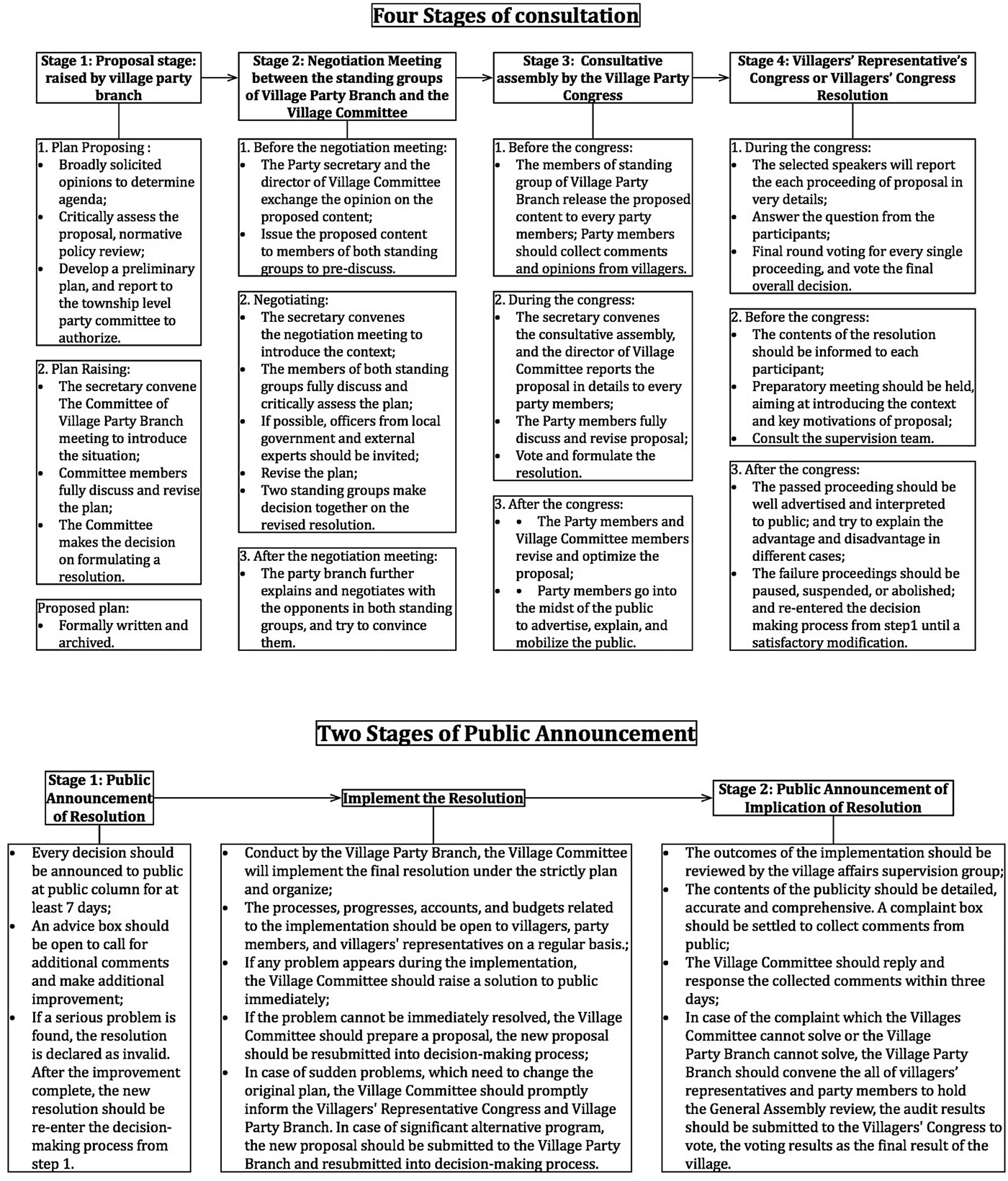
Task targets and monitoring are additional policy instruments in the regeneration process. To guarantee that targets were met, the leadership of the Shangjie District imposed a strict instruction and inspection upon the Command Center. The command center and village committee were given 7 months (May 2011 to January 2012) to get agreement from villagers. At this crucial juncture project-based command and control regime meets traditional village deliberation. Since 2009, the CCP has legally anchored village deliberation in the regeneration process by requiring that a two-thirds majority of villagers endorse any regeneration proposal. It also stipulates that to obtain this outcome the ‘4 + 2’ deliberative decision-making system must be adhered to. The ‘4 + 2’ procedure consists of four stages of deliberation and two stages of public announcement system (si yi liang gongkai). In the first, deliberative, part it stipulates in detail the process of how to make a decision by public deliberation; in the second, announcement, part it prescribes after the decision-making how to ensure the implementation process under the supervision of the public. This institutional arrangement successfully separates the ‘right of proposing’ and ‘right of decision making.’ Figure 1 illustrates the system of village decision making. According to this figure, the village party branch has the right to raise a proposal, and the village congress will make the decision after a deliberative process by voting. The system is carefully calibrated to balance rational communication through Type 1 deliberation between villagers and village authorities, and party influence through the position of the Village Party Branch in the process.Footnote 2
The process of village decision making system (4 + 2 system).

What we observe here is the existence of two parallel governance systems that exist in an uneasy and unstable alliance with each other. On the one hand, we see the project-based command-and control system, that is directly tied into the authoritarian rule of the CCP, and that extends downward into lower levels of government. On the other hand we see the traditional deliberative governance culture of the village that is in fact endorsed by the CCP. To obtain a better understanding of how this deliberative system works in a real-world complex governance situation in which two interests at potentially at loggerheads with each other, we will unpack the course of events in Q village in the Shangjie district.
4. The micro-politics of village deliberation in the Chinese governance system
Since the late 1990s, Q village in the Shangjie district of Zhengzhou started a slow process of urbanization. Government buildings, urban housing, factories, and other urban infrastructures cropped up around the village residential area, gradually absorbing it into the greater Shangjie area. During the urban village formation process villagers lost their farmland and rural incomes without obtaining access – because of a lack of hukou – to the urban welfare system. This necessitated them to seek alternative sources of earnings to augment their insufficient income. With the migration of the rural population into the cities the demand for low-rental accommodation increased. Urban villagers met this demand by, illegally, adding poor-condition low-rent accommodation to their houses to enjoy additional income from rents (Liu et al., Reference Liu, Yang, Wei and Liu2010; Lin and De Meulder, Reference Lin and De Meulder2012). This rental income was relatively generous and stable. As a consequence, instead of developing their labor skills, many village residents operated a cheap rental business and generated considerable profit (He et al., Reference He, Liu, Webster and Wu2009; Liu et al., Reference Liu, Yang, Wei and Liu2010).
Urban village regeneration in Shangjie District began in 2006, later than in most cities in China, or even other districts in Zhengzhou City. Aiming to limit public resistance, to decrease financial pressure, and speed up the acquisition process, the municipal government decided to limit the scale of apartment compensation to a fixed, transparent, and non-negotiable formula. After 2011, after surveying the legal rural homestead size,Footnote 3 the district government decided that the scale of apartment compensation was limited to 1.7 times the authorized legal rural homestead, or 258 m2 per homestead. In principle, the compensation apartments would be built at their original location. To encourage villagers to accept the various development proposals, the village committee acted as a mediator to help the villagers to arrive at an acceptable deal with government and developers.
As stated before, deliberation in the context of urban village regeneration is part of a complex political-administrative system, with many actors whose activities are often not aligned. The 4 + 2 system contains diverse forms of formal and informal deliberations and negotiation. Although some negotiations are tactical, the wider policy system that has emerged around urban village regeneration still retains many deliberative elements. On 12 May 2011, the district government set stage 1 of the 4 + 2 system in motion by sending its officers into the village to collect opinions to outline the regeneration proposal with the party members in the Village Party Branch only. This initial information and consulting initiative gave the district government insight into the village's leadership attitude toward the regeneration proposal. Based on the reactions of the Village Party Branch, the district government drafted a compensation proposal and expanded the consulting through the 4 + 2 decision-making process. That is: the villagers’ representatives, members of the standing groups of the Village Party Branch and the Village Committee were invited to participate in the deliberation. The agenda consisted of one item: to establish a compensation package that is acceptable to the villagers. (We will see that in this case, the goals were lowered to ‘acceptable to the required two-thirds majority.’) The remit of the deliberative process is framed by the legally mandated compensation rules as described above. However, a lot of compensation elements remain that make the difference between an outcome that is deemed fair or unfair by the villagers. Deliberations concerned the new committee's locations, collective enterprise arrangements, villagers’ welfare arrangements, and employment opportunities. Given the pressure to arrive at a quick outcome the District Government had agreed to a compensation in cash for those parts of the homestead that exceeded the in-kind compensation limit of 258 m2. Instead of simply asking ‘agree or disagree,’ this step focused on how to encourage the villagers to draft the proposal, particularly about the details and amount of compensation packages. After the village party cadres and Village Committee representatives agreed on a compensation proposal, the draft was distributed to each household in the village. The representatives of both bodies were asked to collect each villager's reaction and they were required to negotiate with villagers to pass the proposal at village congress; that is, they needed to follow the 4 + 2 system step-by-step.
Under this arrangement, the villagers have access to the deliberation through the following channels: they can express their opinions to their representatives and ask them to deliver their opinions to villager cadres in steps 2 and 3; they can question the result of each step and the village authorities must respond their questions; they can express their argument in the village congress; they can express their opinions, suggestions, or dissenting opinions during the public announcement; they can also accuse and impeach the village authority if they do not implement the proposal strictly. In the end, the compensation proposal was amended several times to reflect the villagers’ positions. The amendments included:
• Cash compensation for homesteads over 258 m2 up to 600 Yuan per m2, the housing is evaluated by mutually agreed criteria.
• The land-use plan of the regenerated area has been amended. The amount of retail space has been increased and the rental incomes of these spaces are distributed to villagers as welfare.
• The collective economies of the village will be registered as a collective-owned company. The formerly collective-owned land will be transferred as state-owned industrial land first, and these lands will be redistributed back to the collective-owned company. The villagers can keep sharing the land rental income as before.
• The district government provides skill training for unemployed villagers.
• All the villagers move out before 1 June 2012.
The final compensation proposal passed the village congress in January 2012 with an 85% majority.
Although this looks like a satisfying outcome for the residents of Q village, we should not lose sight of the constrained nature of the village deliberations. It is commonly understood in Chinese political culture that the individual's interests must yield to the collective's. In the current political climate that often means that individual interests must give way to rapid economic development. In the urban village regeneration process, the ‘collective's’ interest of the district is to establish the general aviation industry group into the industrial development zone. For example, as the government working log records states: ‘On 02/09/2011, the Director of the District People's CongressFootnote 4 gave a speech in X village: “both village cadre and villagers should raise awareness of the importance, arduousness, long-term and complex nature of urban village regeneration and reallocation community construction. Command center and village cadre should mobilize villagers’ initiative and enthusiasm in terms of building a good home.”’ The key target of the Command Center was to persuade the villagers to accept the district's demolition and compensation proposal, and to sign the contract for demolition and compensation. During these 7 months, the leadership of the Shangjie district inspected the Command Center month by month. In practice, this means that in addition to the legally required village deliberations, the District Government directly intervenes in the process. For example, the director of the District People's Congress personally visited the village during the deliberations to deliver the above-mentioned speech. The purpose of the visit was to endorse the Command Center and village committee, and to discourage opponents of the regeneration. He also visited villagers at home to demonstrate his personal sympathy for them. The purpose of this personalized approach is not an open, reciprocal exchange between district leadership and villagers, but to obtain the required two-thirds majority by weakening, albeit in a considerate and respectful manner, the resolve of any opponents who had petitioned against the government's proposals.
The scalar governance system around urban village regeneration can be regarded as a deliberative system, which operates on different spatially and functionally distributed registers of deliberation, negotiation, exhortation, persuasion, and top-down decision-making. The 4 + 2 system within the villages represents genuine, legally protected, deliberation. In addition, we encounter the hastily assembled informal deliberation efforts by District authorities that, with project management, form an integral part of a wider administrative system that is aimed at economic development. These deliberative moments are constrained by the a priori performance goals that are outside of any norm of communicative rationality. In the next section, we will encounter examples of the shadow that the efficiency goal throws over the communicative process when it becomes clear that villagers’ material interests, their grief and anger at past treatment at the hand of the authorities, or their suspicion of financial wrongdoing by authorities, is declared off limits in the communication about compensation. In the case of Q village the village speech and home visits of the District authorities were unable to suppress resistance against the regeneration proposals. To understand why this is, we need to discuss the situation of the village residents in more detail.
5. Accommodating constrained deliberation
Concerned about social stability and under pressure to deliver a positive formal response to the district government (which itself was acting under a 9-month completion goal), the Village Committee and Village Party Branch decided to speed up the village deliberation process. Under the pressure from the Command Center they agreed in the negotiation meeting to merge the villagers’ representative meetings and the Village Party Congress. This amounted to a blurring of village participation and party command in the deliberative 4 + 2 decision-making procedure. During the meeting, the village committee had invited one of the senior officers from the district government to introduce the draft of the regeneration agenda and the compensation package. The senior officer ‘emphasized the importance and significance of the program and the urgency of the decision-making progress’ (source: local government meeting summary). Under the designation ‘condition of urgency,’ the official asked the village party members and villager representatives to bypass the carefully calibrated 4 + 2 deliberation procedure about the compensation package agenda and restrict themselves to collecting the villagers’ comments about it. As one of the party members recalled: ‘Our attitudes are not important for them (Command Center) as they only care about the voting result of the Villager's Congress. They only want some insight into the villagers’ attitude, as they need to sign the compensation contract with villagers. They asked us to keep working on this issue all the time, weekdays and weekends, day and night … Our task was to collect general opinions from the villagers; and to pass the proposal at the villagers’ congress they need to know how to persuade the villagers.’
The result of the first round of opinion collection showed that the compensation package was acceptable. Indeed, almost 70% of the villagers supported the village leaders to proceed with the regeneration process. The opponents were villagers who had informally expanded their house after 2010 and stood to lose the most. The opponents’ resisted fiercely as the loss of income would overturn their livelihoods. However, as the village committee had a sufficiently large majority to pass the vote, they immediately convened the villagers’ congress to vote, and unsurprisingly, the decision to accept the regeneration plan was accepted by a comfortable majority. The size of the majority gave the village leaders strong confidence and they believed they represented the majority.
However, the truncated ‘4 + 2’ decision-making process was interrupted at the public announcement stage, as the opponents of the compensation decision vocally resisted. Those villagers whose livelihood exclusively depended on rental income felt ignored by the village leadership. Their concerns escalated when the village committee formally, in line with the 4 + 2 protocol, announced the 7-day period of public comments on the decision. Instead of declaring the decision invalid, the village leadership more or less ignored the critical feedback. Instead of cautiously handling the collective resistance, the village committee and village party branch reported these issues to the Command Center as ‘an issue that was caused by an unreasonable and conservative minority’ (source: government dairies). According to a villagers’ representative:
‘It was a terrible misjudgment to simply treat them as “minority racketeers,” as it is difficult to avoid “racketeering” when you want to attract a public project in a village… Several years before, we built the water tower to improve the water supply system for our village. We needed to cut down two trees from in front of two families’ houses, as we needed to make more space for construction. Although there is no evidence to prove that these two families owned the trees, they still successfully asked for compensation ΅…΅ Most of time, people think public projects are paid for by the government, and the government is rich enough to pay their “racketeering”… Indeed, we never held a tough attitude to them before the regeneration.’ (Former Villagers’ representative A)
Resistance escalated with the spread of village gossip about the regeneration policy, such as ‘X village gains more money as hundreds villagers petitioned government for higher compensation packages (interview from a villager).’ These rumors encouraged the villagers to participate in a formal petition against the Command Center and the Village Committee as they argued that they requested more compensation to sign the contract. Instead of the village authorities’ public propaganda, the villagers tended to believe the rumors and directly confront the village committee and Command Center. Therefore the first priority of the Command Center and village committee was to clarify the gossips and control the growing complaints about the demolition and compensation proposal draft. They used two trucks with huge speakers to broadcast the policy into villages; meanwhile, they distributed more than 500 posters to explain the policy (source: government dairies). However, these efforts at public announcement were unsuccessful.
One reason for the failure of the public announcement stage was pervasive rumors of corruption at the leadership level. The under-compensated properties and the village leaders’ failure to prevent the government from taking their land were in the minds of the villagers linked the leaders and government officials accepting bribes from the involved enterprises:
‘It began with the town expropriating our land. The government just took it at a low price. The village committee couldn't prevent it so that's when the mess began, when the government began profiting from us ΅…΅ Then the government gave that huge plot of land to build an airport for an aircraft factory. Basically it all went to one company! So the villagers think that my colleagues and I had been defeated by corruption. But the truth is, as a monopoly, the aircraft factory almost only speaks to the provincial level, they did not care about the district government, they just ignored us…’ (Former Party Secretary of Village)
It is against the combined might of several layers of government, the representatives of the party at all these levels, and well-funded and well-connected corporate players, in a situation in which open conflict and protest is barely tolerated, the villagers could only employ the ‘weapons of the weak’ (Scott, Reference Scott1987) by engaging in a participation strike. They refused to participate in any further discussions about the compensation decision. According to a villager (B):
‘We might be tempted to dismiss the Party Secretary's assertion as propaganda, if not for evidence that villagers insisted on participating in decisions about collective land… Instead of participating in the discussion, the villagers put pressure on the leadership by refusing to participate.’
This ‘participation strike’ is itself a feature of the dispersed Chinese deliberation system. Although it rarely makes the headlines, it is well known that Chinese citizens, despite the considerable risk to their freedom and safety, frequently engage in open protest. It might seem perverse to call such protest a form of deliberation, but as Rollo points out, the very act of protesting must be judged by its symbolic meaning in the relational configuration in which its occurs. As he states: ‘Abjuring deliberation is not always an example of “shirking collective responsibilities” but rather, reflects the necessity of breaking “a relationship of domination”’ (Rollo, Reference Rollo2017, 598. Quotes from Warren, Reference Warren2011). By engaging in such drastic acts the villagers drew attention to the lack of legitimacy of the regeneration process, while at the same time the form of their protest is conditioned by the asymmetry in power and resources (Rollo, Reference Rollo2017, 596). In this sense, the citizens’ refusal to further participate expresses their disillusionment and lack of faith in a communicative setup that betrayed its own stated goal. Facing a participation strike, with a considerable number of village residents disillusioned by the expropriation process and low land compensation payments, and in a climate of corruption rumors, the district government and village leadership faced an acute crisis of trust and legitimacy that endangered the targets of the land acquisition project. As a next step, therefore, the Command Center and the village leadership resorted to face-to-face contact. They tried to persuade the opposing villagers through street meetings and door-to-door visiting. Their purpose was once again to weaken the petitioners’ resolve, and ‘convince’ their opponents by explaining the compensation policy and dispelling the corruption rumors. Ten small teams, organized by the village committee engaged in these face-to-face meetings. Initially this government-driven informal deliberation effort faced an uphill battle. Many residents were distrustful of the door-to-door visit, as they felt powerless in their discussions with government officials. Some villagers felt bullied by the local government as they experienced unequal social position, education levels, and personal skills.
‘I can't debate with them, I can't express my opinions, they are much more clever than me… it is difficult for me to state my opinions. I just know I don't like them, and I want more money.’ (Villager H)
However, gradually most villager obtained a basic sense of what they received and what they lost.
‘I was misled by the gossip from other villagers, I thought that I would lose everything. The government staff clarified the situation for me, and I began to support the regeneration. It was not a bad deal. I have moved into this community two years ago, I still think it was a good deal.’ (Villager D)
These door-to-door meetings helped the Command Center to successfully amend the compensation decision. After the collection of positions, they became aware that the opposing villagers worried about their livelihood after they lost their rental income. The government then organized a round table meeting with enterprises nearby and successfully asked them to provide lists of employment opportunities and conditions. After these efforts, almost 85% of the village residents signed the compensation contracts before the start of the demolition. The former village director commented:
‘We finally solved the problem at this stage. It was too hard to persuade the villagers otherwise … I cannot do more for them because the government won't give me any chance. I believed in the existing cases, every village tried to argue something, but I haven't seen any successful cases. The compensation policy never changed.’
6. How deliberative is authoritarian deliberation?
Both in China and the West democratic deliberation is one of the elements of a wider system of governance and public administration. In both cases we observe how a range of actors, first of all national and local administrations, but also corporations, NGOs, third sector organizations and citizen groups, employ deliberative arrangements – perhaps it is more accurate to speak of arrangements with deliberative elements – to harness problems of social, political, and technical complexity. In many of these arrangements, such as interactive government, co-production, citizen panels in the context of New Public Management, or more elitist forms of deliberation in independent regulatory agencies and transnational governance, democratic quality seems a secondary thought (Papadopoulos, Reference Papadopoulos, Parkinson and Mansbridge2012). Most of them create their own problems with regard to participation, inclusion, representation, and accountability. Deliberation has become an instrument in an increasingly varied repertoire of governance instruments.
China is no exception to this trend. Although the Party extends its grip deep into lower levels of government, interdependencies and information asymmetries among government agencies limit the effectiveness of vertical steering. In fact, urban village regeneration as a complex policy challenge reveals the limits of authoritarian rule in a modern national and international context. On the one hand, the Party encounters the same problems of technical, social, and institutional complexity (Dryzek, Reference Dryzek1990: 57–76; Wagenaar, Reference Wagenaar2007), with the ensuing limits on vertical steering, as administrations in democratic countries. On the other hand, the state runs into the moral limits of authoritarian rule. To safeguard internal coherence at acceptable political costs, it needs to maintain a sufficient level of acceptance and compliance among the population. Moreover, even a country steeped in Realpolitik such as China, is too much integrated in the international social and political system, to transgress the boundaries of acceptable suppression of its own population too blatantly. Thus, the central Party relies on the agency of regional and local governments, as well as corporate actors, to realize its ambitious economic development goals. However, no amount of goal setting, monitoring, and (threats of) punishment are enough to overcome problems of discretion, disobedience, resistance, and gaming the system. In addition, citizens, although aware of their exposed social and political position, do not hesitate to express their opinion about decisions that affect their livelihood, health, ethnic identity, or their children's opportunities. Among ordinary people, authorities often carry a suspicion of being prone to corruption, stonewalling, and the cover-up of policy failure. Social media, although censured and restricted, are nevertheless powerful tools in disseminating information and rumors. As a result, many citizens hold a cautious, skeptical view of authorities. Emulating corrupt officials, some citizens try to play the system to their own financial advantage. Others, as the past two decades have shown, are willing to risk arrest, detention, or worse in resisting what they perceive to be unfair and unjust treatment at the hand of officials.
Ironically, the absence of an independent judiciary and the weak, erratic, rule of law act against the Party's interests in this situation. Where the possibility of independent arbitration allows for the resolution of conflicts with the state and curtails arbitrary behavior, the Party has to find other ways to defuse social conflict and gain legitimacy. It is where that deliberation plays an important role. As our case showed, the negotiations and decision-making surrounding urban village regeneration can be construed as an example of Type 2 deliberation.Footnote 5 In the real-word environment of the Chinese hierarchical, scalar governance system, a number of actors, operating under the constraints of a variety of laws, planning deadlines, injunctions from higher levels of government, conflicting interests, the threat of losing a lucrative business opportunity to a competing city, and powerful cultural norms, have to find ways to arrive at a successful outcome. Successful, in this situation is often akin to squaring the circle; the investment must be secured within the self-imposed tight time frame while the residents of the village have to agree with their own displacement. Traditional village deliberation plays a central role in this complex governance field. Within this deliberative system communication is a curious amalgam of genuine deliberation, bone-hard negotiations, entreaties, and appeals to the collective interest. Deliberative process is safeguarded by a legally prescribed elaborate procedure. Only when two-thirds of the villagers approve of the compensation proposal, is the District Government allowed to go ahead with the demolition of the village. Several procedural rules (such as obtaining the initial approval of the Village Party Branch, or the power of appeal in the announcement stage) inject a measure of communicative rationality into the 4 + 2 village deliberation. Nevertheless, a formal procedure is as good as the ethos with which it is enacted, and in this case, the authorities, straining under a tight deadline, approached the village deliberations with a strategic mind-set. Their purpose was to quickly obtain the two-thirds majority, and not bother too much about the dissidents. For this purpose, they managed to persuade the village authorities to curtail the 4 + 2 procedure and portray the dissenters as self-interested schemers. Although a comfortable majority was easily obtained, the tactic nevertheless backfired. The dissenters protested and withdrew their participation in the procedure altogether, forcing the authorities to step in and engage in genuine deliberation.
The case demonstrates a number of things. It shows the considerable capacity for authoritarian behavior of higher authorities in a China's complex, multi-scalar governance system. It shows that deliberation in the real world is at all times vulnerable to be usurped by strategic considerations. However, the case also shows that deliberation is more than just the enactment of (legally mandated) procedure and that it resonates with widespread cultural understandings of how officials ought to relate to citizens (He, Reference He2014). Finally, the example shows that by relying on informal deliberation officials could fall back on traditional relations within villages. (Author's) research demonstrated that the deliberations were effective in terms of opinion collections and conflict resolution, and played a significant role in each stage of the urban village regeneration. These deliberations in urban village regeneration built upon the former village cadres and their credibility and authority within their rural village network. The village committee always plays a leading role in organizing the deliberations. As the organizer and mediator, their credibility and authority were attached to the personal status instead of formal authority.
However, the deliberations in urban village regeneration also show their authoritarian character. This was a severely curtailed form of deliberation in which the authorities held lots of advantages. Asymmetries in power, information, reputation, education level, and communication skill significantly impacted, and at times dominated, the deliberation process. For strategic reasons district government and village committee focused their attention on those participants who showed willingness to compromise, excluding the opponents. This generated a new ‘injustice,’ because the disadvantaged groups faced considerable obstacles to fight for their rights. In addition, although informal actions brought about the sought after efficiency to the governance process, this arrangement brings controversy and risks. It is because these communications always take place in an informal setting, like street or home. Lack of supervision might invite back rooms deals or corruption, and the deliberation process tends to become overshadowed by personal relations threatening the very publicness and appeal to common cause that is a key characteristic of deliberation (He, Reference He2014: 64).
7. Discussion
This paper focused on two main questions concerning the process and place of authoritarian deliberation in a China's complex governance system. From a pessimistic point of view, authoritarian deliberation is exactly what it claims to be: a relatively limited policy instrument that in an overall authoritarian, intrinsically unjust political system is employed by officials in an instrumental way to persuade or compel citizens to accept their decisions and to generate political support. But that view is too one-sided. In all governance systems deliberation fulfills three important functions (Mansbridge et al., Reference Mansbridge, Chambers, Christiano, Fung, Parkinson, Thompson, Warren, Parkinson and Mansbridge2012). The epistemic function of ‘collectively producing understandings, opinions, preferences, and decisions that are based on ‘substantive and meaningful consideration of relevant reasons’ (op. cit., 11). The ethical function of treating citizens and other actors as autonomous agents who are able to contribute substantively and meaningfully to the governance of their society (ibid; Dewey, Reference Dewey1954 [1927]). And democratically, by organizing a diversity of input into the understanding of complex problems and the liberation of the creative forces of society (Lindblom, Reference Lindblom1965; Wagenaar, Reference Wagenaar2011). Our example showed, although on a small and limited scale, and hemmed in by the hierarchically imposed demands of project management, how deliberation in the case of the regeneration of Q village was able to fulfill these three functions. When the authorities decided to listen to disgruntled citizens, the latter, after they had overcome their initial distrust, felt respected and taken seriously. Moreover, authorities were forced to rethink the rigid compensation scheme and came up with a more creative scheme that was responsive to the needs of the residents.
From a systemic point of view, in a situation where the rule of law is weak, the diversity and fragmentation of the Chinese governance system is the best guarantee for the continued use of deliberation as a mode of governance. In the interstices of loosely coupled governance configurations, where political authorities cannot manage the multiplying interdependencies in the governance system, spaces emerge in which deliberation can make a real contribution to collective decision-making. In another part of his study (Author) found, for example, that local officials successfully used deliberative strategies to help villagers make the sometimes difficult adjustment to a more urban life style. Despite their constrained character, deliberative practices, as they proliferate throughout the Chinese governance system, can limit conflict, enhance governance capacity, and produce legitimacy in practical matters of governance (He and Warren, Reference He and Warren2011).
Acknowledgment
This research had financial support from the IJURR Foundation (previously Foundation of Urban and Regional Studies).
Pu Niu is a Ph.D. student in the Department of Urban Studies and Planning at the University of Sheffield. His work focuses on urban planning and urban governance in China, which in particular focus on the public policies around urban regeneration and Chinese New-type Urbanization. His is currently researching on Democratic Deliberation in Urban Village Regeneration in China.
Hendrik Wagenaar was professor at the Department of Urban Studies and Planning at the University of Sheffield and is now senior research fellow at the Policy Institute at King's College London. He publishes in the areas of participatory democracy, prostitution policy, interpretive policy analysis, and practice theory. He is author of Meaning in Action: Interpretation and Dialogue in Policy Analysis (M.E. Sharpe, 2011), and editor of The Seminal Deliberative Policy Analysis (Cambridge University Press, 2003) and Practices of Freedom: Decentered Governance, Conflict and Democratic Participation (Cambridge University Press, 2014). He is also the author of the award-winning ‘Governance, Complexity and Democratic Participation: How citizens and public officials harness the complexities of neighborhood decline,’ American Review of Public Administration (2007). His most recent book Designing Prostitution Policy: Intention and Reality in Regulating the Sex Trade (with Helga Amesberger and Sietske Altink) has been published by Policy Press in April 2017.