Guy (Reference Guy and Labov1980), using t/d deletion in Philadelphia as a test case, evaluated the claim that group norms “recapitulate the generally uniform norms of individuals” (12). He concluded that when enough data are available, the aggregate community constraints on t/d deletion emerge consistently in individuals' performance. While some subsequent literature has revisited this question (Carpenter & Hilliard, Reference Carpenter and Hilliard2005; Meyerhoff & Walker, Reference Meyerhoff and Walker2007) and found some apparent deviation at the speaker level, the recent advent of tools for analyzing large conversational corpora allows a deeper evaluation of the relationship between community patterns and the constraints used by the individual. A large speaker sample combined with robust statistical techniques allows for a more accurate depiction of constraint weights by controlling for all social and linguistic-internal factors.
This paper is an assessment of individual-level constraints on alternation between -in and -ing in Southern U.S. English as spoken in Raleigh, North Carolina, in the context of the community's aggregate patterns. The study of (ING) has a long history (Fischer, Reference Fischer1958; Hazen, Reference Hazen2008; Labov, Reference Labov1966) and the variable shows well-documented constraints (Cofer, Reference Cofer1972; Houston, Reference Houston1985; Labov, Reference Labov2001). In these terms, (ING) bears a strong similarity to t/d deletion (Guy, Reference Guy and Labov1980, Reference Guy1991a, Reference Guy1991b), allowing for testing not only of the consistency of individual internal constraints but also for comparing recent findings on the phonological effects surrounding t/d deletion (Hazen, Reference Hazen2008; Tagliamonte & Temple, Reference Tagliamonte and Temple2005) to those of (ING). Because there has been some suggestion that phonological constraints are truly responsible for the grammatical effects seen in t/d deletion, we can assess whether the same could be true for this variable, as well. Furthermore, looking at the values of speakers' constraint weights in addition to their ordering gives insight to the kinds of variability that may exist at the individual level. While hierarchies of constraints tend to remain stable between individuals (Guy, Reference Guy and Labov1980; Preston, Reference Preston1991), a large-corpus study will reveal whether any variation between speakers is patterned or whether it exists simply as noise in natural data.
I begin with a review of the literature concerning patterns of variation at the individual and community level, situated within new findings surrounding the role of internal grammatical constraints. I follow with an overview of the internal constraints and social factors governing (ING) to illuminate methodological considerations. I then present the results of my analysis of speaker and community patterns in Raleigh and discuss contributions to the understanding of individuals' adherence to observed group patterns and the consistency and strength of grammatical constraints at the individual level.
BACKGROUND
Community patterns, individual constraints, and t/d deletion
Early in the study of language variation, Labov (Reference Labov1969) argued that linguistic constraints governing sociolinguistic variables operated independently of the observed rates of use of the variables. Essentially, whether a speaker uses a given variant 10% or 80% of the time, the distribution of the tokens will reflect the internal constraints governing when and where the variant is more likely to be used. The speakers learn these constraints from the community grammar during language acquisition (Weinreich, Labov, & Herzog, Reference Weinreich, Labov, Herzog, Lehmann and Malkiel1968), thus each individual has the constraints that appear at the aggregate, community level. The distinction between rates and constraints and the notion that the individual reflects community linguistic patterns paved the way for early variable rule analysis (Cedergren & Sankoff, Reference Cedergren and Sankoff1974), allowing for examination of internal constraints in the aggregate as a proxy for individual use.
Delving deeper into the consistency of individual constraints, Guy (Reference Guy and Labov1980) began inquiry into the speaker's relationship to observed community variable rules in order to pinpoint how much speaker constraints actually varied from aggregate patterns. He analyzed speakers' use of t/d deletion, comparing the variable constraint rankings for individuals from Philadelphia to the observed community pattern. In the aggregate, speakers favor t/d deletion more in some grammatical contexts than others; deletion is favored most in monomorphemic contexts, slightly less so in ambiguous past tense verbs, and least of all in past tense regular verbs. Guy found that speakers recapitulated these rankings at the individual level, suggesting that the weights for the variable rule exist for individual speakers, not simply as an artifact of looking at a larger speech community, later terming this idea the “Shared Constraints Hypothesis” (Guy, Reference Guy2004). Guy (Reference Guy and Labov1980) additionally observed the importance of large datasets for the analysis of individuals' behavior in comparison to the community, as large per-speaker token counts corresponded to a greater number of constraints with the expected ranking.
Subsequent studies (Bell, Reference Bell1984; Preston, Reference Preston1991) addressed similar questions surrounding individuals and speech communities, with more focus on the individuals who vary with respect to group patterns. This shift in focus led to more research investigating the interaction between individual style and identity construction and broader linguistic patterning. More recent work (Meyerhoff & Walker, Reference Meyerhoff and Walker2007) reinvestigated individual participation in community constraints, finding coherent group norms with some individual stylistic variation. Hoffman and Walker (Reference Hoffman and Walker2010) reported similar findings of individual conformity to variable rules in their study of multiethnic Toronto Englishes. The second- and third-generation speakers of Toronto ethnolects (i.e., those without direct transfer effects) and British/Irish Canadians show very little variation in their application of the community rules.
Some other work has called into question the claim that individual variation within a community only involves overall levels of variable use, not underlying constraints. Carpenter and Hilliard (Reference Carpenter and Hilliard2005) find that within the largely isolated Roanoke Island African-American community, individuals' alignment with an outside community may shift their use of a given linguistic variable towards that community's internal constraint norms. Clark and Watson (Reference Clark and Watson2013) found some individuals in a smaller town outside of Liverpool maintaining the local norms for internal constraints on /t/ debuccalization, while others adopted a different constraint pattern native to the Liverpool area.
Furthermore, where Guy's (Reference Guy and Labov1980, Reference Guy1991a, Reference Guy1991b) foundational studies found prominent and consistent grammatical constraints on t/d deletion, some recent work questions the grammatical conditioning of the process, suggesting a purely phonological explanation. The strength of grammatical constraints does not hold across different varieties of British English (Tagliamonte & Temple, Reference Tagliamonte and Temple2005), and investigation of other American English varieties (Hazen, Reference Hazen2011) finds grammatical effects to be an epiphenomenal result from lexical items frequently occurring in specific phonological environments. Additionally, the three-way grammatical division governing t/d deletion in Canadian English reduces to a distinction between monomorphemic and past tense forms when phonological context and the strength of a few high frequency words are taken into account (Walker, Reference Walker2012). The concerns raised in some of this research have led some to question the treatment of t/d deletion as a traditional phonological variable rule (Temple, Reference Temple, Celata and Calamai2014), instead suggesting a reframing of the phenomenon as a connected speech process.
Given the variety in findings with regard to individual constraints versus aggregate patterns and the recent reinvestigation of the rules governing t/d deletion, the time seems appropriate for a reinvestigation of how (ING) operates at the individual level, with attention to the long-standing grammatical constraints. To what extent do individuals recapitulate aggregate internal constraints on (ING), and do the values of the weights for these internal constraints vary from person to person?
(ING): Internal and social factors
Various researchers have attempted to trace the origin of the -in variant (Houston, Reference Houston1985, Lass, Reference Lass and Blake1992), going back as far as Old English. Houston (Reference Houston1985) proposed that the -ing/-in distinction resulted when the (-inde) and (-inge) suffixes were merged into one, creating a single (-in) morpheme with alveolar and velar variants. This change allowed for the use of either form in certain lexical category contexts where previously one of the original suffixes would have been more likely (Hazen, Reference Hazen and Brown2006). For instance, in older forms of English, verbal nouns required the (-inge) suffix and verbs the (-inde) suffix, but with the merging of the two, speakers used both the –in and -ing variant for adjectives and nouns, according to Houston's (Reference Houston1985) model. Stemming from that historical distinction, Labov (Reference Labov2001) argued that verbs are most likely to use the -in form, followed by participles, gerunds, nouns, and adjectives, in that order, with gradually decreasing frequency of the -in variant. This hierarchy has been confirmed in studies spanning multiple communities (Hazen, Reference Hazen2008; Roberts, Reference Roberts1994). Some phonological constraints have been noted, specifically a favoring of -in before following alveolar consonants ([t], [d], [n]) and -ing before following velar consonants ([k], [g]) (Cofer, Reference Cofer1972; Houston, Reference Houston1985; Meyerhoff & Schleef, Reference Meyerhoff and Schleef2012; Wagner, Reference Wagner2012). In addition, some researchers have proposed a progressive dissimilation from preceding consonant environments for British varieties (Cofer, Reference Cofer1972), but not all studies find the same significant phonological constraints for either preceding environment (Wagner, Reference Wagner2011) or following environment (Labov, Reference Labov2001). Another common constraint is the categorical use of the -ing variant in monosyllabic (thing, ring) environments and the much greater likelihood of -ing in trisyllabic nominal (anything, everything) environments (Wolfram, Christian, & Center for Applied Linguistics, Reference Wolfram and Christian1976). It is important to note, too, that these environments (e.g., anything, ring) entail lexically separate instances of (ING) from the suffixes used to make gerunds or progressives.
The earliest sociolinguistic investigations of -in/-ing alternation also found socioeconomic correlates. Both Labov (Reference Labov1966) and Shuy, Wolfram, and Riley (Reference Shuy, Wolfram and Riley1968) found higher rates of the -in variant among blue-collar speakers, which gradually gave way to predominance of -ing realizations when moving toward white-collar, higher socioeconomic status (SES) speakers. Some more recent studies have taken different approaches to SES, using either parents' occupational status grouped by job type (Reid, Reference Reid and Trudgill1978) or by measuring interactions between speaker occupation and education and realizations of both (ING) variants (Labov, Reference Labov2001), producing roughly similar findings to the earlier literature.
Likewise, researchers have often found correlations between gender and -in/-ing variation. However, this effect varies in interaction with SES and education. Labov's (Reference Labov1966) early studies showed a higher rate of the -in variant among men in the lower classes, but the trend reversed among middle-class speakers. Gender differences have also been shown to vary by community (Wald & Shopen, Reference Wald, Shopen, Shopen and Williams1985), age (Houston, Reference Houston1985), interlocutor (Wald & Shopen, Reference Wald, Shopen, Shopen and Williams1985), and social situation (Kiesling, Reference Kiesling1998).
Perception and regional variation
Much recent research on (ING) has focused on perception, often finding a correlation between a speaker's use of the -in variant and a listener's perception of that speaker as Southern (Campbell-Kibler, Reference Campbell-Kibler2008). Campbell-Kibler (Reference Campbell-Kibler2008) also found correlations between frequencies of the -in variant and perceived congeniality or level of education, as well as SES (Campbell-Kibler, Reference Campbell-Kibler2007). The findings of these studies as a whole have shown that listeners are aware of and can subconsciously identify the socially salient alternation between -ing and -in and tie the variants into constructions of gender, regional identity, social class, and perceived sexual orientation (Campbell-Kibler, Reference Campbell-Kibler2010), with the individual variants having very different social connotations along these axes. In addition, studies have shown that listeners connect perceptions of an increased frequency of the -in variant with Southern-shifted vowels (Fridland, Reference Fridland2008).
With respect to Southern communities, Labov (Reference Labov2001:90) asserted that “the /in/ form is used almost exclusively in speech, even of the most formal kind,” and little production research is available, save for Houston (Reference Houston1985) with some data from Southern speakers. However, early studies on Appalachian English offer a comparable dialect to use as a model. Wolfram and Christian (Reference Wolfram and Christian1976) found Appalachian speakers use a higher frequency of -in overall, as well as heavily favoring that pronunciation in unstressed environments (as opposed to weak stress environments such as the final syllable of anything). More recently, Hazen (Reference Hazen2008) found that Southern West Virginian speakers use higher overall rates of -in than do northern West Virginians.
(ING) and the study of community grammar
The variable (ING) has not been the subject of any studies that explicitly examine the degree of conformity of individuals to the observed aggregate pattern of variation, but the universality of (ING)'s internal constraints provides an excellent test case for this question. Like t/d deletion in Guy's (Reference Guy and Labov1980) initial investigation into the coherence of individual behavior, -ing/-in alternation is something that everyone does to some degree. And, like t/d deletion, the constraints that govern where and when the variant is used remain mostly consistent between populations. The internal constraints on (ING) have been found at both the morphological and phonological level, mirroring the grammatical distinction between monomorphemes, weak verbs, and strong verbs that has sometimes been found (Guy, Reference Guy and Labov1980, Reference Guy1991a, 1991b), and the strong effect of following phonological context found to govern t/d deletion rates (Guy, Reference Guy1991a, Reference Guy1991b; Hazen, Reference Hazen2011; Tagliamonte & Temple, Reference Tagliamonte and Temple2005). Using (ING) as a variable to test the consistency of individuals' internal constraints in reference to aggregate patterns provides a twofold opportunity. Examining (ING) allows us to test the recent findings concerning the constraints on t/d deletion for another variable, and it allows us to replicate, with a larger dataset, Guy's (Reference Guy and Labov1980) earlier findings about the striking consistency between group constraint patterns and individual usage.
Taking (ING)'s linguistic and social factors into account, I will assess the degree of interspeaker uniformity with regard to the ranking and strength of the internal constraints observed in the aggregate. The consistency of the lexical category constraints on (ING) cross-dialectally provides an opportunity to address the variation present within a community at the individual level. Additionally, if rates of -in in the South are indeed higher, we would expect a community with changing linguistic patterns to lower its overall rates in the direction of a mainstream norm; however, the constraints should remain constant. Looking at a combination of overall rates of -in and lexical category constraints on individuals' usage will provide evidence as to whether individuals maintain internal constraints in light of changing rates, or if weights for certain categories fluctuate as overall usage changes. In addition, the high number of speakers sampled for each generation allows for a reliable exploration of the rate of interspeaker variability in overall rates in addition to internal constraints. Specifically, I address the following questions:
• Following recent findings in t/d deletion (Hazen Reference Hazen2011; Tagliamonte & Temple, Reference Tagliamonte and Temple2005), do grammatical constraints persist in this corpus in light of phonological constraints?
• If these grammatical constraints exist, do individuals show similarity in only their ranking system, or do they show consistency in the value of the weights of these constraints, as well?
• Are there any differences in constraints (ordering and weights) between groups known to pattern differently from one another in overall rates of -in (e.g., age, low/high SES, male/female)?
These questions are ultimately about the notion of shared constraints within a community: their reality, stability, and variability.
Raleigh, North Carolina: Community background
The data used for this study were extracted from a corpus of sociolinguistic interviews conducted since 2008 with residents of Raleigh, North Carolina. Since the 1950s, Raleigh has experienced a great deal of population growth and demographic change. The establishment of Research Triangle Park in the 1950s and a new IBM branch facility in 1965 made Raleigh and the surrounding area a high-growth location for the research and technology industries. Beginning in the 1960s, the Raleigh community received an increasing influx of immigrants from other parts of the United States, largely composed of workers transferred to the new offices in Raleigh.
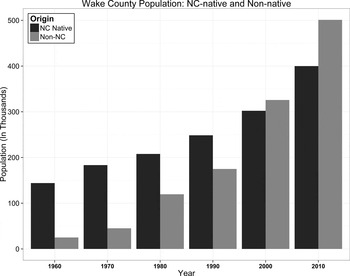
Studies on migration patterns show Raleigh as one of the top 10 destinations for internal migration in the United States (Frey, Reference Frey1995), and census data for Wake County (where Raleigh is located) show the demographic changes in place of origin of residents (Figure 1). By 2010, more residents of Wake County were from outside the state than within the state, underscoring the dramatic effect of immigration on the area (Wolfram & Reaser, Reference Wolfram and Reaser2014). The new migrants brought with them new dialect norms, and subsequent generations had an increasing number of speakers of non-Southern varieties in their networks.
Wake County population: NC-native and non-NC native.

While Raleigh has been shown to exhibit the Southern Vowel Shift (SVS) and other features associated with U.S. Southern varieties (Labov, Ash, & Boberg, Reference Labov, Ash and Boberg2006), contact between Northern and Southern dialects driven by migration from the North has led to a dialect contact situation (Britain, Reference Britain1997; Trudgill, Reference Trudgill1986) and the gradual reversal of Southern-shifted front vowels (Dodsworth & Kohn, Reference Dodsworth and Kohn2012). The levelling process creates a contact variety with vowels oriented toward a more supraregional norm in the speech of the youngest generation. Other studies of contact situations in the U.S. South (Fridland, Reference Fridland2000, Reference Fridland2001) found different rates of change, depending on social variables such as sex, community affiliation, and SES. Fridland (Reference Fridland2000, Reference Fridland2001) found some of the youngest speakers in Nashville are more likely to keep the SVS than others, with a partial or full reversal of the SVS correlating with higher SES and weaker community affiliation.
Because high rates of -in are also considered a feature of Southern varieties (Houston, Reference Houston1985; Labov, Reference Labov2001), lowered rates were expected for younger speakers as well. No literature has addressed contact or change over time with regard to the internal conditioning factors on (ING), but the data in Houston (Reference Houston1985) suggest that the constraints in the South did not differ substantially from other American dialects.
Variable coding procedures
I impressionistically coded words ending in (ING) within the interviews as either -in or -ing. While impressionistic coding does not completely account for all the phonetic variation in production, using the binary distinction does adhere to listeners' perceptual categories, as well as allowing for comparison to earlier studies (Fischer, Reference Fischer1958; Hazen, Reference Hazen2008; Labov, Reference Labov1966; Wald & Shopen, Reference Wald, Shopen, Shopen and Williams1985). I excluded tokens of monosyllabic (ING) (e.g., thing, bring), and secondary-stress (ING) (e.g., everything, anything), due to the different treatment of these types of words noted in Wolfram and Christian (Reference Wolfram and Christian1976). The speakers I coded—even those with categorical or near categorical -in—almost never used -in for secondary-stress tokens and never for monosyllabic tokens, providing further evidence that they operate differently from unstressed (ING). I also did not code any words with word-internal (ING) (e.g., Washington, Weddington) to control for differences in following articulation between word-internal and word-boundary environments. Despite some studies' use of a category for prepositions (Drummond, Reference Drummond2012; Houston, Reference Houston1985), I chose not to include prepositions because only during has unstressed (ING), presenting an obstacle to extricating lexical category constraint patterns from the words themselves. Lastly, I excluded any unstressed (ING) with an attached morpheme (usually plural /s/) for similar reasons. I would note, though, that some speakers did use -in word-internally or with the plural /s/ morpheme attached.
Each token was coded for the word in which it occurred, and for two variables having to do with phonetic environment (Cofer, Reference Cofer1972; Houston, Reference Houston1985; Kendall, Reference Kendall2013): preceding place of articulation (bilabial, coronal, labiodental, velar,Footnote 1 vowel) and following place of articulation (bilabial, coronal, labiodental, velar, vowel, coda). For following place of articulation, coda is defined as a prepausal token. Tokens were also coded for lexical category, as illustrated by the following examples:
Progressive
I was walking downtown yesterday
Participle
Growing up, we lived near there
Gerund
My favorite sport was swimming
Pronoun
Nothing can be as bad as that
Noun
The wedding had great food
Adjective
That's really exciting
I chose this coding system for consistency with some of the constraint patterns in the literature, though each study tends to differ in the specifics of lexical category coding (Drummond, Reference Drummond2012; Hazen, Reference Hazen2008; Houston, Reference Houston1985; Labov, Reference Labov2001), a problem previously noted by Wagner (Reference Wagner2012). Many of these differences stem from the coding of gerunds, as some studies make distinctions between verbal and nominal gerunds (Drummond, Reference Drummond2012), or gerunds and gerund participles (Hazen, Reference Hazen2008). There are also categories (e.g., prepositions, pronouns) included by some studies (Drummond, Reference Drummond2012; Houston, Reference Houston1985), but not others (Labov, Reference Labov2001). Most previous studies do not include a category for pronouns, but Houston (Reference Houston1985) found especially high rates of -in in the South for pronouns.
In addition to lexical category, each token's syntactic category (verb, subject, modifier, direct object, object of the preposition, predicative complement, or discourse marker) was coded. Discourse marker was defined as a set discourse phrase, usually with a pronoun (e.g., or something, something like that).
Data and statistical models
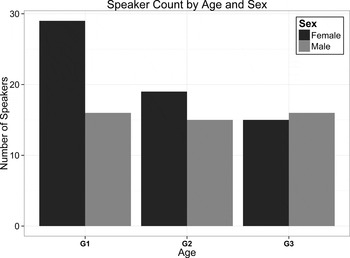
The present study included 109 European American speakers who grew up in the Raleigh area, ranging in year of birth from 1923 to 1993. The speakers were divided into three generation subgroups in addition to year of birth in order to measure overall generational trends: G1 (pre-1950), G2 (1950–1970), and G3 (post-1970). These categories roughly correspond to those who would have passed the critical period of dialect acquisition (Labov, Reference Labov1989, Reference Labov2007) during one of Trudgill's (Reference Trudgill1986) three proposed stages of dialect contact. Given that IBM's movement to the Raleigh area in 1965 spurred much of the early immigration, those speakers classified as G1 should have had little to no peer contact with out-of-state immigrants before graduating high school. Therefore, G1 gives a rough approximation of what dialect norms would have been before contact with out-of-state dialects. G2 attempts to capture the stage of transition, where individuals would have had contact with both traditional Southern varieties and other regional varieties, and the population approaches 50% nonnative North Carolinians. Lastly, G3 speakers grew up in Raleigh during a time when the contact dialect has mostly solidified and replaced the traditional dialect for most speakers, and the population of nonnative North Carolina residents eclipses those who were born in North Carolina (Figure 2).
Speaker counts by age and sex.

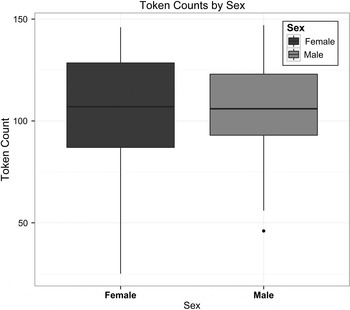
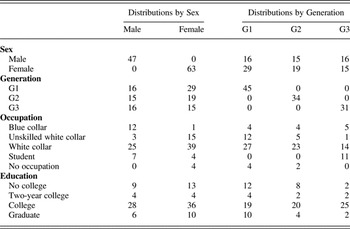
When broken down by generational groups, 45 speakers fall into G1, 34 into G2, and 31 into G3. Though not balanced for sex in each generation, the sample is not heavily skewed in favor of males or females in any of the generational groups. A full table showing distribution of speakers by sex, generation, education, etc. is shown in the appendix (Table 3). For each speaker, I coded tokens of (ING) up to a maximum of 150 per speaker, but the counts were highly variable depending on length of interview. The mean token count for a speaker was 106, resulting in a total of 11,620. Individuals ranged from 25 tokens (an elderly female speaker with a very short interview) to 147 tokens (Figure 3).
Token counts per speaker divided by sex.

I assessed social and internal factors by running generalized mixed-effects models using the lme4 mixed-effects regression package in the R statistical software environment (R Core Team, 2014). To determine the model with the best fit for the data, I compared the models via Akaike information criteria (AIC) comparison to evaluate whether the addition of new variables improved fit over the previous models. In total I ran three groups of models:
Model 1: Internal constraints (lexical category and following place of articulation) + random speaker intercepts
Model 2: Internal constraints + social factors (sex, age, and education) + random speaker intercepts
Model 3: Internal constraints + social factors + random speaker intercepts + random lexical category slopes by speaker
The model 1 group includes lexical category and following place of articulation, the internal constraints on (ING) most often shown in the literature. While I coded for syntactic role of each token, the results were highly collinear with lexical category. For example, tokens that filled the syntactic role of verb also had the lexical category progressive, so both variables could not be included in the same model. When run separately, the only significant predictors within syntactic role were the variables that corresponded to known lexical category constraints, so syntactic role seems to have no effect on speakers' usage of (ING) in this dataset outside of that spurious correlation. I also excluded preceding place of articulation from the model due to the inconsistencies in the literature regarding the effect of that variable on speakers' usage of (ING).
The social factors included in the model 2 group address expected changes in rates of -in by generation as the traditional Southern dialect recedes (age). Additionally, sex and education were included in the model due to previous findings about different overall levels of (ING) based on sex and SES (Houston, Reference Houston1985; Labov, Reference Labov1966; Shuy, Wolfram, & Riley, Reference Shuy, Wolfram and Riley1968). Despite the fact that Raleigh's growth was propelled by the expansion of white-collar industry, the data show no substantial correlation between age and education. Sex and education likewise show very little correlation, eliminating collinearity issues between social factors. While I have speaker data for both education and occupation, the two are highly collinear, which suggests they should not both be included in the model. I chose education over occupation because some of the youngest speakers had not yet graduated college at the time of the interview, so their occupation was classified as “student.” Because the other generations did not have any speakers with that occupation, the inclusion of education entailed less collinearity with generation.
Lastly, model 3 attempts to address any individual variation in lexical category constraints with the addition of random slopes by speaker. The computation of these random slopes also provides a representation of each speaker's constraints to allow for comparison to overall norms.
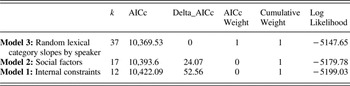
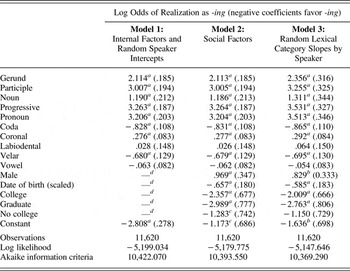
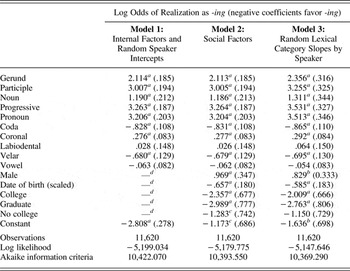
Table 1 shows the AIC value for each of the three models, measuring the degree of model improvement versus other models for the data. The AIC values decrease with the addition of the explanatory variables in models 2 (social factors) and 3 (random lexical category slopes by speaker), which indicates that these variables significantly improve the model's fit to the data. Therefore, I use model 3 in any subsequent analysis unless otherwise noted. Full results for the final models in each of the three groups are shown in the appendix (Table 4).
Model comparison by Akaike information criteria

Note: AICc, Akaike information criteria with correction for small sample sizes.
RESULTS
Model results, phonological effects, and lexical category constraints
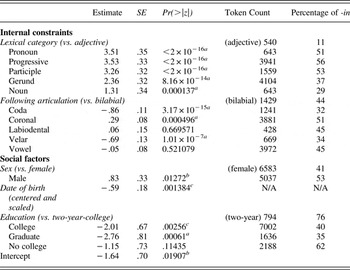
The regression results in Table 2 show the results for internal constraints, with -ing as the reference level for outcome. Even when including random effects, social controls, and phonological factors, lexical category constraints show the most robust effects on -in versus -ing. The ranking of each lexical category follows as expected from Labov (Reference Labov2001) for each category he addresses; progressives rank the highest in likelihood for the -in realization, followed by participles, gerunds, nouns, and lastly adjectives. The added category of pronoun ranks just under progressives, which is slightly inconsistent with Houston (Reference Houston1985) with regard to Southerners' usage regarding that category. However, taking into account the standard error of progressive and pronoun, it seems that speakers may have little difference between these categories.
Results for logistic mixed-effects regression model 3

Notes: ap < .001; bp < .01; cp < .05. N/A, not applicable.
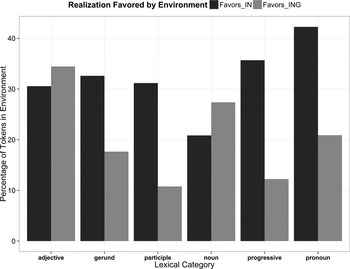
Following place of articulation also shows an effect on speakers' use of -in and -ing, with following coronal articulation increasing the likelihood of -in and following velar or coda increasing the likelihood of -ing. These results are consistent with previous literature (Cofer, Reference Cofer1972; Kendall, Reference Kendall2013; Wagner, Reference Wagner2012) regarding phonetic environment's effect on (ING), and they point to the strength of the grammatical constraints even when taking into account phonological factors. Figure 4 shows the percentage of occurrence of each lexical category in environments favoring either -in or -ing, with neutral environments (vowel, labiodental, bilabial) omitted. Though some lexical categories do occur more often in environments favoring an -in realization in a fashion reminiscent of the findings of t/d deletion (Hazen, Reference Hazen2008; Tagliamonte & Temple, Reference Tagliamonte and Temple2005; Walker, Reference Walker2012), the fact that the grammatical constraints still attain significance when controlling for phonetic environment provides sufficient evidence that (ING) and t/d are not the same phenomenon in this regard. Furthermore, work with this corpus exploring phonological effects, grammatical effects, and frequency (Forrest, Reference Forrest2015) has shown the robust persistence of grammatical constraints even when controlling for these factors.
Phonological environment occurrences by lexical category.

The significant social factors in the model also fall in the expected directions. Sex achieves significance (p = .013), and the coefficient for males supports findings that men are more likely to use -in than are women in many communities. The model also shows a significant decline in -in usage over time, with the youngest speakers (as date of birth increases) significantly less likely to use -in. This retreat from a Southern-associated feature follows the pattern shown for the youngest speakers in Dodsworth and Kohn (Reference Dodsworth and Kohn2012) with regard to Southern-shifted front vowels. Lastly, those with postsecondary education (college and graduate education) show significantly less -in usage than do speakers who attended a two-year institution or those who had no college. This gradation by education is consistent with previous research (Labov, Reference Labov1966, Reference Labov2001; Reid, Reference Reid and Trudgill1978).
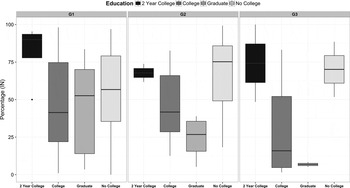
Though the effect of education achieves significance in the regression, looking at differences by generation shows some change over time. Figure 5 shows the percentage of -in for individual speakers grouped by education level and faceted by generation. The rates of -in for speakers with a two-year-college education or no college education show little overlap with speakers possessing postsecondary degrees, except in G1, where all education groups show a wide distribution. Especially with the college and graduate education groups, the data show a distinct downward trend in -in use over time, possibly indicating an increased association between -ing and higher education levels, as opposed to an association with Southernness in general. By the third generation, a wide gap exists between those speakers with a college or higher education and those without. However, the college group, which contains the most speakers in each generation, shows wide variability across all generations.
Percentage of -in by education and age.

The data presented in Figure 5 also present an opportunity to look at the variability in overall rates between generations and social groups. One might expect that interspeaker variation in overall usage of -in or -ing would be high in the intermediary generation, given the changing social norms governing the use of (ING). However, looking at the patterning by education group, G2 appears to have no more variability than the other two generations do; in fact, the widest variation occurs in the oldest speakers in G1.
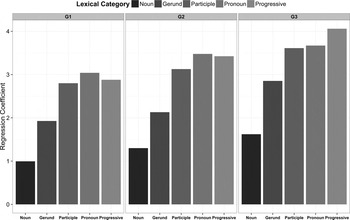
When looking only at percentage of use of -in, we have no evidence yet whether speakers have maintained internal constraints or the overall rates mask altered grammatical factors. The separate constraint hierarchies for lexical category by generation displayed in Figure 6 show what differences in internal constraints exist between age groups, which is especially important in the frame of dialect contact and changing rates of -in versus -ing. Despite changing linguistic norms in the midst of a contact situation, the constraints for each generation remain largely unchanged. The only outlier in this regard is the pronoun category, which likely varies due to token counts and number of words. With everything and anything excluded, only something and nothing fall into the pronoun class, reducing the number of tokens in that category for each speaker and decreasing the reliability of the measurement. The low number of pronouns also presents problems in extricating underlying form from conditioned (ING) realization; some speakers may well have an underlying form of -in for one or both of these words, artificially skewing their rate of -in.
Lexical category hierarchies by generation.

Individual behavior vs. community patterns
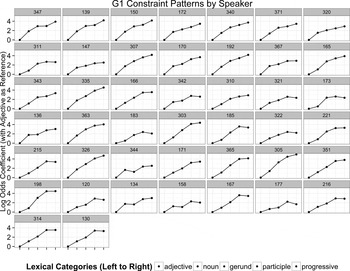
To illustrate how individuals match up with the aggregate patterns, Figure 7 plots the log-odds coefficients for each lexical category with faceting by speaker, to show each individual's constraints while controlling for all factors included in the statistical model. The visual ordering of the constraints follows the same scheme as the bar plots in Figure 6. The graph is limited to one generation in order to control for any differences that might result from the changing dialect norms and rates of -in over time in the Raleigh area. Because of issues with wide variability in pronouns due to low number of words within the class, pronouns were excluded in the visualization of constraint hierarchies. Each speaker is displayed in an individual facet, labeled by number designation, and organized by overall rates of -in; speakers with the lowest rates of -in are in the top-left corner, those with the highest in the bottom-right. If the individuals match the community pattern, we expect each speaker's graph to have a positive slope, increasing from left to right.
G1 hierarchies by speaker.

With regard to the ordering of the constraints on the realization of (ING), we see the relatively high degree of consistency at the individual level that Guy (Reference Guy and Labov1980, Reference Guy2004) predicted for the ordering of constraints; every level follows the order expected from the aggregate hierarchy for the G1 speakers. Most of the variation that exists within factor level ordering is confined to the crossover of progressive and participle, and when looking at the coefficients drawn from the regression for group constraints, it appears that speakers generally treat these two categories as more or less equivalent. What is more interesting is the behavior of the ordering of the noun and gerund categories, with relation to adjectives. In some speakers, gerunds appear as a middle category between nouns and participles/progressives as in speakers 215 and 198 in the left column. However, some speakers treat gerunds at a similar level as participles and progressives (e.g., 347 [gerunds, n = 24; participles, n = 26; progressives, n = 29] and 139 [gerunds, n = 51; participles, n = 16; progressives, n = 15] in the top-left corner) and others have nouns and gerunds roughly aligned (134 [gerunds, n = 38; nouns, n = 19] and 158 [gerunds, n = 27; nouns, n = 9] in the second-to-bottom row). Even taking the standard error drawn from the logistic regression into account, this much variation in the log-odds coefficients for gerunds—to the point where they can either align with the verbal forms or nouns, depending on the speaker—goes well beyond the expectations of what we see at the group level. I would be reluctant to say that individuals do not reflect the community pattern in a general sense, because most speakers do indeed show the expected pattern, but there is some variation at the individual level that differs a good deal from the hierarchy in the aggregate.
The values of the constraint weights also exhibit a good deal of variation from speaker to speaker, though these differences do not seem to be related to the speaker's overall rate of -in. If rates affected constraints in this way, we would expect to see some sort of consistent pattern running from speaker 347 in the top-left corner to speaker 130 in the bottom-right, but no clear differences emerge. One might expect the distribution of factor weights to compress slightly when rates of -in increase to near-categorical, but we see speakers with wide distributions of log-odds coefficients at both low (e.g., 347, 139) and high (e.g., 198, 314) overall rates of -in. Despite the lack of correlation with the rates of use, there still exists a relatively wide degree of variation in the individual log-odds values for lexical categories from speaker to speaker. Progressives/participles universally show the highest coefficient favoring -in, but speakers' individual values range anywhere from a log-odds of 2 to a coefficient of around 5, a substantial difference. Again, in nearly all cases, the speakers preserve the ranking of the constraints, but the wide distribution of log-odds coefficients for each factor level should caution against strong generalizations to the individual for factor weight values. To say that Figure 6, representing the ranking and weights in the aggregate, reflects each individual's pattern shown in Figure 7 would certainly be overstating the case, particularly for weights.
The differences seen in the values of individual constraint weights illustrates why a model with random slopes by speaker improves the fit to the data, since the individual constraint weights show substantial enough variation to warrant some inclusion of their effect into a statistical model. Overall, speakers seem to take care in maintaining the ordering of the lexical category constraints, with the exception of progressives and participles, which may be equivalent categories in the grammar. However, the exact weights for each category vary widely from speaker to speaker with reference to adjectives (the reference level for lexical category in Table 2), meaning that the hierarchy outputted from the regression model for the G1 speakers (Figure 6) only accurately describes some speakers within the corpus, with much wider variation from speaker to speaker that must be captured by a random slope term. The simple inclusion of the standard error coefficients from the regression into a representation of aggregate constraints does show that variation exists, but it would not show those speakers who deviate more strongly from the expected factor weights.
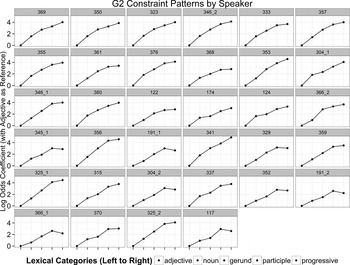
Turning to the issues of changing rates over time in Raleigh, Figure 8 presents the constraint patterns for G2 speakers, which remain very similar to both G1 speakers and the aggregate hierarchy in most respects. The same pattern emerges in G2 that appeared in G1: ordering of constraints remains nearly completely consistent across all speakers, but the weights for each category show wider variation. Again, the gerund category shows the most variation in both weight and relationship to other factors in the hierarchy, but it still remains between nouns and verbal forms for all speakers. In this second generation, we may expect to start seeing some changing of constraint weights due to dialect contact and shifting norms. However, these speakers show no more interspeaker variation than the first generation did with respect to the lexical category hierarchy, despite the transition to lower frequencies of -in by the third generation. If any such variability due to contact did exist, we would expect it to take the form of either a competing pattern or random variability in ranking of categories (Clark & Watson, Reference Clark and Watson2013; Trudgill, Gordon, Lewis, & Maclagan, Reference Trudgill, Gordon, Lewis and Maclagan2000), neither of which appears in the G2 data. In fact, besides a lower number of speakers with near-categorical -in use in the second generation, so little difference exists in the patterns of the speakers that it would be easy to mistake the graph of G2 for that of G1.
G2 hierarchies by speaker.

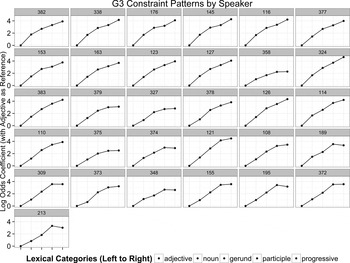
The G3 speakers, as with those of the second generation, show very little change in terms of lexical category hierarchy outside of an overall decrease in the use of –in (Figure 9). Many of the speakers in this youngest age group show hardly any use of -in at all, but their log-odds coefficients for each lexical category show much the same distribution as those of the previous generations. Besides this bias toward lower rates of -in for the youngest generation, we see the same pattern emerge for constraints that speakers of the other two age groups exhibit. The ordering of the factors for the grammatical constraints are maintained between speakers, but the weighting of each category has a much wider degree of variation. We see some speakers with a more compressed distribution of log-odds values (e.g., 358 [total n = 108, 375 [total n = 130]) and some with wider distinctions (e.g., 382 [total n = 130], 338 [total n = 125]), all while maintaining the hierarchy between categories.
G3 hierarchies by speaker.

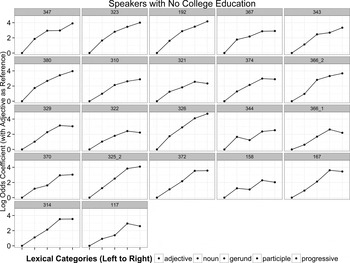
In terms of other social class divisions, namely sex and education level (see Figure 10), individuals show no socially marked difference at the grammar level, only individual variation in constraint weights. The only difference observed between social groups is a favoring of higher or lower rates of -in on average, but the ordering of constraints and the weights for each category follow the same trend as those observed previously—though ordering remains consistent throughout all speakers, weights for individual categories show higher degrees of individual variation. The lack of any significant social grouping for differences in constraint weights suggests that the process observed operates not at the social level, but at the individual grammar level, with each individual showing slight to substantial differences in individual factor weights.
Lexical category constraints for speakers with no college education.

DISCUSSION
These findings fall in line with those of Guy (Reference Guy and Labov1980) concerning t/d deletion, in terms of the maintenance of a hierarchy of grammatical constraints within individuals, but the consistency of specific factor weights between speakers shows substantially more variation. Even when controlling for phonological environment factors, the grammatical constraints operate at the individual level, reproducing the expected ordering of factor levels. Some variation exists between speakers in terms of their ranking of the gerund category, but at no point do gerunds clearly shift places with neighboring lexical categories, instead only showing relative similarity with nouns or participles, respectively. Within the second and third generations of speakers, which one might expect to have higher variability due to the competing norms surrounding those who came of age during demographic changes in Raleigh, individuals show the same consistency with regard to the ordering of lexical category constraints. The homogeneity in constraint rankings holds across social groups, as well, with none of the traditional social factors that affect rates of -in affecting the ordering of internal constraints. This result comes as little surprise, as past studies (Hazen, Reference Hazen2008; Houston, Reference Houston1985; Labov, Reference Labov2001) find stability in (ING)'s internal constraints in a variety of communities. Therefore, without a competing hierarchy of constraints (Clark & Watson, Reference Clark and Watson2013), change in individuals that correlates with social factors would be extremely unlikely.
However, where we do see some variation at the individual level is in the specific weights of the constraints on individual categories, which show a good deal of variability between individuals. The differences in constraint weights seem neither to be conditioned by social factors nor as a result of changing overall rates of -in or -ing. Instead, individuals simply seem to be much more variable than one would expect from a community-level representation of internal constraints, even when taking into account the standard errors given in a regression output. This tendency of speakers to fluctuate from aggregate constraints further underscores the importance of random-effects models and other methods that can control for interspeaker variation when looking at community-level changes, given how prominent a role individual differences seem to play in the strengths of coefficients for (ING) in this community. To some degree, these differences could simply be an artifact of low token counts of certain lexical categories at the individual level. When looking at the naturalistic data for (ING), there are a great deal fewer tokens of nouns and adjectives than there are of other forms, so a paucity of tokens in these categories for some speakers may well affect the resulting log-odds estimates, especially when looking at the cross-level random slope. However, because the variance in log-odds for lexical categories exists across nearly all of the speakers, I am reluctant to explain away these differences as simple noise within the data due to a few outliers. This phenomenon seems to be a feature of individual variation in speaker grammar rather than a result of social evaluation or a statistical artifact, both due to the lack of grouping by salient social variables and the lack of clear outliers creating an artificial trend. I would note that despite the variance in weight values, a reorganization of the hierarchy of internal constraints never truly occurs, even if gerunds move up or down in their relative weight. I suspect any dramatic movement (such as nouns shifting to the level of verbal forms) would actually garner some conscious notice, which helps to keep the constraint hierarchy intact, if not the weights constant.
These results have ramifications for how we present the individual within sociolinguistic theory and how we treat representations of community constraints. The tendency to treat speakers as differing in intercepts but not in slopes for their internal constraints seems to be problematic, given the amount of variance evident in this dataset. Studies that focus on communities should take care to acknowledge the role that individual variation might play in the specific values of constraint weights when constructing a representation of the community as a whole. Put another way, these results seem to confirm one portion of Guy's (Reference Guy2004) hypothesis of shared constraints at the individual level while questioning another. This analysis confirms that speakers do not seem to reorganize the hierarchy of constraints on (ING) in any radical way; even when gerunds change position slightly. Gerunds do not become significantly less likely to have an -in form than nouns do, nor do they become more likely than participles or progressive to favor -in. However, the weights of all categories fluctuate a good deal from speaker to speaker, casting doubt on that aspect of the shared constraints hypothesis. Assuming these results hold for other variables and other datasets, it would be overstating the case to say that an aggregate representation of constraint weight values accurately represents all members of the community; rather, they seem to represent a central tendency of speakers, given enough speakers in a corpus. Ultimately, these community-level representations should be accurate representations of the ordering of constraints, but weight values may need to be evaluated at the individual level for a more accurate picture.
Moving to the changing usage of (ING) in Raleigh, the data suggest a change in the speakers' use of the variable (ING) toward supraregional norms and an overall retreat from -in in the community. In addition to expected class stratification for a contact variable with associated prestige (Labov, Reference Labov1966, Reference Labov2001), apparent sex differences in overall usage hallmark -in as a variable undergoing a change in its social valuation on the linguistic marketplace.
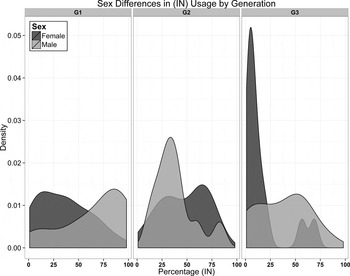
Figure 11 shows a density plot illustrating sex differences in percentage of -in separated by generation. The data shown comes only from speakers who had a college education or higher, to control for class differences. Due to the low number of speakers with two-year-college and no college education levels, showing comparison graphs for those speakers would not be meaningful. In most cases, women have lower rates of -in than do men of the same generation, following previous hypotheses that women tend to lead changes from above (Labov, Reference Labov2001). However, bimodal patterns begin to emerge in the data in later generations, suggesting that (ING) may be moving from a traditionally sex-marked variable to one that has multiple social connotations, perhaps becoming associated with Southern identity as well. In whole, coupled with the strong class effects seen in the model, there is substantial evidence to view (ING) as a new higher-prestige variant. Within that frame, my results look very similar to those of Meyerhoff and Walker (Reference Meyerhoff and Walker2007), save that no speakers show even superficial restructuring of their grammar. While it is impossible within the context of this dataset to identify any lifespan change in these speakers, that may very well have occurred, especially in those speakers who sought (or experienced) upward mobility.
Sex differences in -in usage by generation.

CONCLUSIONS
The results of this study are consistent with the individual cohesion to group ordering of constraints seen in Guy (Reference Guy and Labov1980), Meyerhoff and Walker (Reference Meyerhoff and Walker2007), and Hoffman and Walker (Reference Hoffman and Walker2010), even during a period of dialect contact. The grammatical constraints on (ING) still hold in regression models and in speakers' usage when controlling for phonological environment, showing that grammatical constraints are not epiphenomenal of phonological processes, as has been suggested for t/d deletion (Hazen, Reference Hazen2008; Tagliamonte & Temple, Reference Tagliamonte and Temple2005; Walker, Reference Walker2012). Replicated with a different variable and with a larger corpus of speakers than Guy's original (Reference Guy and Labov1980) study, the differences between individuals are only differences of overall rates, not the changing order of hierarchies.
Though the speakers in my sample all follow the expected ordering of lexical category constraints on (ING), they show a relatively high degree of variation in their weights for individual lexical categories. Despite the substantial differences between generational groups, these differences operate outside the social level governing overall percentages of -in, instead appearing to be features of the individual's grammar. Indeed, variation between individuals crosscuts class, gender, and generation to the point where two speakers with near-identical social characteristics could show very different factor weights. The fact that individuals show divergence from the group norms in terms of specific weights underscores the need for an acknowledgement of individual differences in sociolinguistic studies—either through mixed-effects modeling that includes random speaker slopes or through some other kind of examination of individual data with respect to community data. Admittedly, these sorts of mixed-effects models require both a large amount of data and a great deal of time, but as sociolinguistic corpora grow in tandem with computing power, we have the capability of addressing these issues.
My findings show the similarities between individual and group internal constraints during dialect contact, but I do not address all possible sources of variation in (ING) that may be occurring. Rickford and Price (Reference Rickford and Price2013), building on Rickford and McNair-Knox (Reference Rickford, McNair-Knox, Biber and Finegan1994), show significant age-grading and topic/interlocutor effects on socially salient linguistic variables. Because (ING) operates above the level of consciousness and shows style-shifting effects (Labov, Reference Labov1966, Reference Labov2001), it stands to reason that (ING) would show similar manipulation depending on setting and topic. Especially important in terms of style-shifting is the need for studies to examine individuals' constraint weights in stylistic situations that entail different overall rates of a given sociolinguistic variable. An investigation of this sort would truly sort out whether the differences in weights for certain internal constraints remain constant speaker-internally or if they can be modified at all in different stylistic situations. Further work in this vein may help to illustrate exactly how constraint weights may vary and interact with other social or linguistic factors, and it may also illuminate the interplay between stylistic construction and internal constraints.
In sum, the speakers in the Raleigh corpus are very consistent with regard to the hierarchy of constraints drawn from the community data on (ING), as was the case with t/d deletion for Guy's (Reference Guy and Labov1980, Reference Guy1991a, Reference Guy1991b) speakers, but the data shows much more variability in individual's log-odds weights for specific categories than has been previously suggested. Within the shifting linguistic landscape of dialect contact—and the changing connotations of prestige associated with high usage of -in—speakers still manage to acquire the rules governing the lexical category constraints quite well, but with some individually variable factors. It also stands to reason, then, that other stable variables of this variety would operate in the same fashion even if the community undergoes a change in overall usage of the variable. All of these consequences point toward the existence of the internal constraints governing sociolinguistic variation of this sort in the grammar of the speakers themselves, with the weighting of categories fluctuating at the individual level as long as the ordering of constraints remains unchanged.
Appendix
Full regression table for all models
Speaker distributions by sex and generation