Framework
The early sociological view of urban areas as “melting pots” that assimilate, and level, population differences, has largely given way to more nuanced immigration theories focusing on specific historical migration processes, segregation, and economic or ethnic enclaves within urban areas. The leveling effect of emergent nineteenth- and early-twentieth-century cities on social differences of immigrants was noted by Max Weber (Reference Weber1968) and highlighted by Louis Wirth (Reference Wirth1938), eventually being enshrined in assimilation theory (Glazer and Moynihan Reference Glazer and Moynihan1970; Park and Burgess Reference Park and Burgess1969). However, over time both the American dilemma of racial segregation (Myrdal Reference Myrdal1944) and contemporary migrations to American cities (Portes and Rumbaut Reference Portes and Rumbaut1996) challenged the assimilationist hypothesis.
Many new migration theories emerged to address immigrants in contemporary settings. These theories may also lend understandings to the early, largely European, migration to nineteenth-century cities. Migration systems theory, for example, posits that migration streams affect origins, destinations, and the process of migration such that the circumstances of migration are changed. Migration may continue, or mechanisms may develop that undermine continued migration (de Haas Reference de Haas2010). As the migration history of a place unfolds, sending and receiving communities are both changed in ways that may affect the fortunes of natives of the receiving community, established immigrants, and newly arriving immigrants in different ways. The effects are cumulative, and form the context for feedback mechanisms and further change. This is especially true when considering immigration to newly emergent urban areas that were heavily shaped by immigration including regional and circular migration such as the migration of French Canadians in the northeastern United States. Chain and network mechanisms are also well recognized as defining features of historical migration in the eighteenth and nineteenth centuries. Many immigrants to the Northeast moved on to destinations such as the Ohio River valley as the frontier expanded westward. Networks among immigrants both within and across cities have also been seen as a form of social capital (Massey et al. Reference Massey, Arango, Hugo, Kouaouci, Pellegrino and Tayler1993); members of the group also individually possess human, social, and economic capital (de Haas Reference de Haas2010); and established enclaves or networks can both make the perceived gains of immigration to those in-network more positive and actively facilitate immigration within networks.
In these historical settings, dual-labor markets (Reich et al. Reference Reich, Gordon and Edwards1973) were also almost certainly relevant to emergent urban-industrial cities, with immigrants specifically fulfilling the needs of industry and urbanization for low-paid labor. From the perspective of dual-labor market migration theory (or more generally segmented labor markets), as aspirations of the native born rise, the low-paying jobs needed to produce mass-market goods and fulfill service needs are likely to be filled by external, often international, migration. The native born retain their advantage despite the growth and maturation of the immigrant community (Bonancich Reference Bonancich1972). Native-born individuals with native-born parents would be predicted to do best. Over time, the native-born children of foreign-born parents may achieve higher status, while new immigrants would enter in the bottom rungs, and over time become trapped there. Specific immigrant groups may have benefitted from segmented assimilation, establishing ethnic, occupational enclaves (Portes and Manning Reference Portes, Manning, Olzak and Nagel1986; Waldinger Reference Waldinger1994). For example, early immigrants may capture some advantage (e.g., better jobs) and hold that advantage against later arriving groups. They do better (as a group) as they are more numerous, reach some critical mass, or establish an enclave. Opportunities may be constrained for later immigrants not part of the early group. One group may arrive with more capital of all types (e.g., more education, higher-status occupations, or greater wealth), establish a community, and retain that advantage, which may then advantage later arrivals of the same group. These time of arrival inequalities are furthered by the maturation of early arriving immigrant populations and the individual-level accumulation of resources associated with aging (Atack and Bateman Reference Atack and Bateman1981; Di Matteo Reference Di Matteo1997, Reference Di Matteo2001).
Each of these perspectives on urbanization and immigration has some merit and, in the context of a rapidly growing city, all are operational to some extent (Massey et al. Reference Massey, Arango, Hugo, Kouaouci, Pellegrino and Tayler1993). Each has implications for both the development of immigrant communities within urban centers and the individual-level prospects for migrants. The analytical question in any real city context is the extent to which these different processes sustain or create systems of stratification and privilege that favor or disadvantage arriving immigrant groups. These perspectives can reveal and highlight simultaneous, but different, aspects of the experience and history of immigrant groups within the context of rapidly growing nineteenth-century cities fueled largely by immigration.
In this article, we seek to describe the effects of immigration on ethnic immigrant groups within the emerging nineteenth-century New England city context as reflected in wealth, occupation, and the resulting social space of the two different emerging cities of Holyoke and Northampton.Footnote 1 Unlike large and already established cities of coastal New England, these cities emerged from small populations that experienced explosive growth in population, immigration, industrialization, and urbanization. Immigration shaped the fabric of these emerging cities that, in turn, shaped the fortunes of immigrant groups. While very different from what are referred to as contemporary “emergent cities,” they shared the characteristics of rapid growth, tremendous influence from immigration, and an initial informality of formative and changing social structures.
Our objectives are to characterize evolving immigrant communities in the two towns over substantial growth and transition using the lens of contemporary migration theories to better assess the development of such groups over time. There are many excellent studies of individual wealth accumulation and economic mobility of migrants during this period, including extant and emerging urban centers (e.g., Conley and Galenson Reference Conley and Galenson1998; Di Matteo Reference Di Matteo1997, Reference Di Matteo2001; Ferrie Reference Ferrie2005; Herscovici Reference Herscovici1998; Salisbury Reference Salisbury2014; Thernstrom Reference Thernstrom1973) and analyses of broad-scale immigrant assimilation (e.g., Abramitzky et al. Reference Abramitzky, Bouostan and Eriksson2014). However, our focus on immigrant communities is not to track the fates of individual immigrants but that of emerging immigrant communities within the newly created urban centers. Although many studies fall short of it, a study of individual-level wealth accumulation or inequality would ideally track individuals across immigration paths rather than in a geographically limited sample or urban communities, requiring linked longitudinal individual records. This would seem especially true when immigrant occupational mobility was often associated with migratory movement (Salisbury Reference Salisbury2014). However, there may be limited utility to longitudinal tracking of individual immigrants in the context of newly emergent industrial cities and in understanding urban immigrant community processes where very rapid growth was characterized by both a high rate of individual-level immigration and outmigration over the formative periods considered. Our primary objective is to consider the collective ethnic communities and differences between ethnic groups that emerged in, and characterized, the growth of the two emergent industrial communities of the Northeastern United States. Individual immigrants came, and left, these communities in large numbers, as some engaged in circular migration and some left for destinations such as the Ohio River valley after living in Holyoke or Northampton. In this setting, we expect outmigration and even selection effects. Whether the different waves of immigrant groups occupied distinctive occupational niches, experienced a collective inequality in personal resources within a city, established positions of dominance that shape ethnic city cultures, and so forth are distinct from fortunes of the individual. Indeed, within our communities one mark of individual economic success quite often was to migrate out of the urban centers we study to the “house on the hill” outside of town. Yet, ethnic groups within the urban centers of these cities did come to dominate some occupations, commercial institutions, and political positions of power, over the nineteenth century.
Importantly, the focus of our study on emergent industrial cities that were essentially created or re-created during this period of high immigration is also distinct from studies of immigrants, and immigrant communities, in the large extant cities of the Eastern seaboard, or from those for large US cities in general, in respect to both demographic behaviors and immigrant composition (e.g., Ferrie Reference Ferrie2005; Hareven and Vinovskis, Reference Hareven and Vinovskis1975, Reference Hareven, Vinovskis, Hareven and Vinovskis1978; Herscovici Reference Herscovici1993; Salisbury Reference Salisbury2014; Thernstrom Reference Thernstrom1973) as well as the development of immigrant communities. Emergent, growing middle-sized cities of Massachusetts were quite different from the large established metropolises of the coast. Holyoke, for example, grew from a sparsely populated farm parish to a planned industrial city over the last half of the nineteenth century and is hardly comparable to the context an Irish immigrant might have had in the urban centers of Boston or New York. The same is true of the rapidly growing smaller mixed-market town of Northampton where immigrants were drawn by not only industrial, but also commercial and agricultural opportunities. In emergent communities, ethnic groups and immigrants were substantial, and sometimes dominant majority, populations in day-to-day life, even if they were not the “1 percent” of industrial capitalists who generally held the vast majority of wealth and power in such towns. How these communities of immigrants experienced and shaped the social space of emergent cities is a vast story; our study focuses on one small reflection of that story in investigating these migrant experiences as revealed in linked census and tax records for Holyoke and Northampton over the last half of the nineteenth century.
Setting and Data
Northampton and Holyoke, located in the Connecticut River valley in the western portion of Massachusetts, provide ideal settings to explore migration and wealth in emergent industrial communities of the Northeastern United States. Transnational and regional migration fueled rapid growth in both towns, drawn by growing industry. Both also had fairly extreme levels of inequality, but socioeconomic differences were more in evidence in Holyoke (Leonard et al. Reference Leonard, Beemer and Anderton2012). The two towns, however, had very different historical origins, social structures, and developmental trajectories over the second half of the nineteenth century (Green Reference Green1939; Hautaniemi Reference Hautaniemi2002; Hautaniemi et al. Reference Hautaniemi, Swedlund and Anderton1999; Tercentenary History Committee 1954). And, in turn, each community offered a very different social space into which both the initial and successive waves of nineteenth-century migration, common to all Massachusetts communities, arrived. Northampton was already a mixed-market town and remained so throughout the study period, with more variability in occupations. Holyoke, in contrast, was a newer and more rapidly growing emergent mill town created from a rural parish in the late 1840s and dominated by large enterprises in a few manufacturing industries. Wealth was held in a small number of hands in Holyoke. Even so, a very vibrant economy provided opportunities for in-migrants in the mills or as entrepreneurs, and Holyoke was less affected by economic crises and mill closures over time. Of importance to new immigrants seeking to accumulate wealth and establish themselves, there was less opportunity to buy real estate in Holyoke than in Northampton. Especially in the core urban areas of Holyoke, land was held from early on by large companies who built multifamily tenements and held land vacant, leaving fewer small buildings and single-family residences.
Our data are drawn from an individual-level database of US federal census records from each of the two cities in our study between 1860 and 1910, geographically sampled to focus on the most urban areas, then linked to tax valuation records (beginning in 1860) and death records (from 1850 to 1912) (Hautaniemi et al. Reference Hautaniemi, Anderton and Swedlund2000; Leonard et al. Reference Leonard, Beemer and Anderton2012). Census records provide demographic information such as age, gender, occupation, and nativity that were not available in the tax records, and provides information on those without wealth as well as those with wealth for decades where wealth data were collected (1860, 1870, and 1880). The tax records provide detailed information across the entire study period on personal and real estate wealth for those who appear as wealth holders in the tax records. Important to our study is that a critical period of these communities development occurred during what Williamson and Lindert (Reference Williamson, Lindert and Smith1980) have labeled the “dark age” of inequality when wealth was not collected on the US Census. Merging tax records gives us consistent wealth data over the last half of the nineteenth century. For the overlapping census wealth record of 1860 and 1870, the tax records have been compared to the wealth from census records in our population and others (Leonard et al. Reference Leonard, Beemer and Anderton2012; Steckel and Moehling Reference Steckel and Moehling2001). It should be noted that both tax records and census records during this period were essentially self-reported and not of consistent quality. Data quality was plausibly even more of an issue in small and emergent cities and among highly mobile populations. Taxable personal wealth in our records, for example, includes wealth ranging from cows to billiard tables—a mix of liquid assets, durable capital, and personal and business property. Although fascinating in the detail of what was considered taxable wealth over time, this variability is rendered somewhat less important to our present purposes by the tremendous concentration of wealth and prevalence of impoverishment in these communities, especially Holyoke, over the study period. With roughly 9 of 10 residents reporting no personal wealth, and only a very small fraction holding substantial real estate wealth, for most purposes the simple division over time by those who reported no wealth, or did not have a meaningful and significant real estate holding, is sufficient. As this analysis is targeted to consider occupation and wealth of those who may be in the adult labor force, or heads of working households, we also focus our analysis on males 14 years of age and older.Footnote 2
Immigration, Occupation, and Wealth
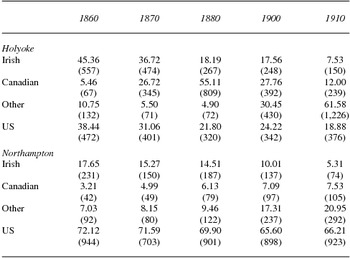
During the study period, Northampton remained a community composed primarily of people born in the United States. Holyoke, by contrast, was a community of ethnic diversity where the US born never represented more than 39 percent of males 14 and older (table 1, see also Hautaniemi Reference Hautaniemi2002; Hautaniemi et al. Reference Hautaniemi, Swedlund and Anderton1999). Both cities show the impact of the three historical, and largely sequential, immigrant waves of the mid-to-late nineteenth century (Irish, French-speaking Canadians, and Eastern Europeans). We use a four-part division of birthplace to proxy ethnicity: US born, Irish born, Canadian born, and those from other foreign countries. The “other” category is, by the turn of the century, predominantly eastern European countries of birth but is more heterogeneous in earlier years, including a mix of mostly northern European countries and the British Isles. In both cities, the Irish immigrants were the first immigrant group to arrive. In Holyoke, successive waves of immigration are more apparent with a distinct peak in Canadian and then other immigrants toward the turn of the century. In Northampton both Canadian and other immigrants rise more steadily across the study period.
Percentage of males 14 and older, by decade and birthplace: Holyoke and Northampton, Massachusetts, 1860–1912 (sample size in parentheses)

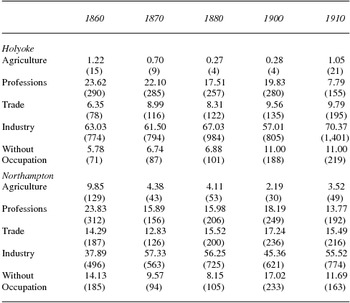
Not surprising for working men in emergent manufacturing cities, the occupational composition of both cities shows that industry was the largest source of employment for males 14 and older during the study period. The breakdown using a classification system developed by Edwin B. Smith for the 1880 US Census report, which groups occupations into agriculture; professional and personal service; trade and transportation; manufacturing, mechanical, and mining; and those without occupation is shown in table 2. Hereafter, we will refer to these groups simply as agriculture, professions, trade, industry, and without occupation.Footnote 3 Holyoke had a larger percentage of the sample population employed in industry at each census compared to Northampton. Conversely, a larger percentage of the Northampton population was employed in trade occupations every year than was the case in Holyoke. The differences in occupational composition also reflect the urban sampling frame. Specifically, the sample space in Holyoke became increasing comprised of large tenements for factory workers during the study period while Northampton lacked similarly dense industrial residential development. The occupational variation in Northampton also reflects the city's position as a mixed-market town and county seat.
Percentage of males 14 and older, by decade and occupation: Holyoke and Northampton, Massachusetts, 1860–1910 (sample size in parentheses)

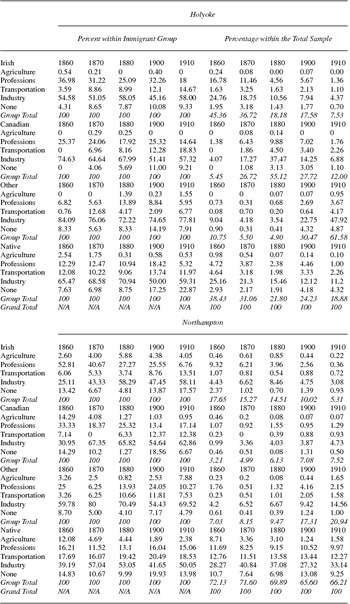
One hypothesis to account for varying fortunes of immigrant communities is that occupational niches became dominated by one group or another over time. Northampton and Holyoke evidence different trends in occupations across ethnic groups over the study period. However, the overwhelming influence of industry as a source of immigrant employment across all groups, over time and across the cities is also clearly evident. The majority of the Irish born in both cities were employed in industry and professions (table 3, e.g., panel one: in 1860 54.58 percent of Irish men in Holyoke worked in industry; panel two: Irish industrial workers comprised 24.76 percent of all men in the study in 1860 Holyoke). Prior to 1900, relatively few were occupied in trade or were without occupation, although both rose over time and account for more than 20 percent of the urban samples in both cities by 1910. Occupations of Canadians were dominated by industry.
Occupational distribution of immigrant groups by decade, males 14+: Holyoke and Northampton, Massachusetts, 1860–1910

There was little shift in the relative position of the occupational groups over time, especially in Holyoke. In Northampton, there was more occupational diversity through 1900. Men born in other foreign countries were the most likely to be employed in industry, with very low employment diversity, tending toward professions rather than trade. Employment for the US born was also dominated by industry. The US born showed the most occupational diversity, with higher levels of employment in the three other occupational categories than immigrant groups. The relative positions of the categories were very stable over time, with professions slightly more important in Holyoke and trade in Northampton. The reaction to the 1900 fall in industry was different in the two cities and for the different ethnic groups. For the Irish and Canadians in Holyoke, professions rose as a proportion of occupations, while other foreign born had a greater proportion without occupation. In Northampton, the Irish and Canadians responded with an increase in those without occupations, while other foreign born responded with a larger share in professions. For some groups, occupations classified to professions may have been a flexible self-employment option when the mills were doing poorly, and men turned back to industrial jobs when they were available.
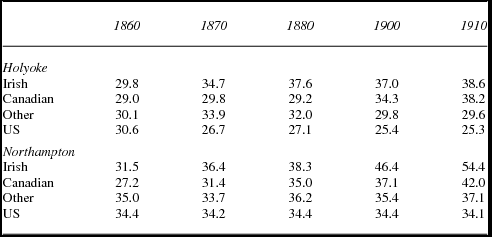
Despite the overwhelming dominance of industry among immigrant occupations, which might suggest a common assimilative experience, the successive waves of immigration into Holyoke and the limited diversification of occupations over time among groups does suggest some enclave effects based on temporal histories of migration. Early immigrants to Holyoke, for example, helped to form the city, and while somewhat diverse, were largely Irish born. Later-arriving Canadian-born immigrants (mostly French speaking) encountered a male workforce that was largely composed of the Irish; employed in the local factories and entrenched in enclaves with attendant services; and maturing as Irish immigration slowed. Canadians soon were a majority of the central urban core of Holyoke, and were also concentrated in industry. The effect of continuing migration can be seen in the initially young age profile of Canadian-born men in comparison with other nativity groups (table 4). While they were also employed in trade and professions, they were less so than the already entrenched Irish (table 3). When immigrants began arriving in numbers from Eastern Europe, they were in much the same situation as the Canadians before them. There was a large, embedded, and maturing ethnic group already in place, augmented by the US-born sons of previous immigrants. In turn, Eastern Europeans came to dominate the central city and manufacturing. However, they were less successful in finding employment outside of industry. This suggests that Irish professionals and tradesmen did seize the early advantage and were able to hold that advantage against later-arriving groups, consistent with histories of the city's ethnic communities (e.g., Green Reference Green1939; Hartford Reference Hartford1990).
Mean age of males 14 and older, by decade and birthplace: Holyoke and Northampton, Massachusetts, 1860–1910

In contrast, early Irish immigrants to Northampton entered a town whose vast majority was US born and where occupations were much more diverse and already dominated by the native population across economic sectors. The Irish were always a small minority in Northampton, had the greatest occupational diversity, and as a group aged rapidly. Canadians also arrived in comparatively small numbers and entered a community that was similar to that the Irish had entered; some were able to establish themselves as tradesmen and professionals. Eastern European arrivals had the most impact on Northampton's ethnic diversity. By the end of the study period, they had replaced the Irish as the major minority and they were the most heavily involved in industry. By 1910, the urban core of Northampton was nearly one-third immigrant. However, the majority of Northampton's adult male population remained US born, although some were the native-born adult sons of earlier immigrants. Immigrant communities, arriving more slowly and in less concentration than in Holyoke, never rose to the political and economic prominence that were achieved in Holyoke.
Inequality
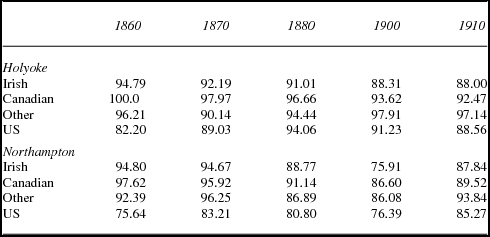
Both Northampton and Holyoke were communities where the majority of adult men were in a precarious financial condition, more so in Holyoke and less so for the US born. The proportion of impoverished men (defined as without any reported taxable personal wealthFootnote 4 ) was very high throughout the study period (table 5; see also Leonard et al. Reference Leonard, Beemer and Anderton2012). Following great inequality evident in 1860 between immigrants and the US born in both Northampton and Holyoke, differences remained pronounced, but less stark, over the decades. Each immigrant group became relatively better off over time. However, in Holyoke, US-born men began the study period with more personal wealth then experienced worsening fortunes with a rise in impoverishment from 1860 until 1880. Of course, the US born include an increase in those seeking employment in the growing cities. Following 1880, impoverishment of US-born males in Holyoke did decline until the end of the study period, but never fell below the levels of 1860. The US-born males in Northampton were also the least impoverished group of males in 1860. While they did not experience a clear trend as did their counterparts in Holyoke, they too ended the study period with less wealth than in 1860.
Percentage of males 14 and older with no personal wealth, by decade and birthplace: Holyoke and Northampton, Massachusetts, 1860–1910

A greater inequality between the two towns is again clearly reflected in the comparatively high and relatively stable levels of impoverishment across different immigrant groups in Holyoke. Holyoke, with such high levels of impoverishment and inequality already, was less affected by financial crises at the turn of the century than Northampton (Green Reference Green1939; Hartford Reference Hartford1990). Although still having lower levels of impoverishment than Holyoke, the percentage without wealth increased across all groups in Northampton between 1900 and 1910 during the fiscal crises. The decrease in wealth during this period corresponds to external economic turmoil and indicates that fortunes in Northampton were more sensitive to external markets and the impact of this effect was broadly distributed across social groups. Many of these groups had more wealth to lose in the first place than in Holyoke. The relative positions of immigrant groups, as well as absolute levels of impoverishment, are not statistically distinguishable between the two cities after the financial crises at the turn of the century.
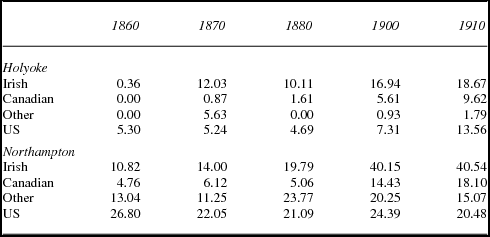
Real estate wealth holding by immigrant group shows patterns nearly inverse of those for impoverishment, with similar differences between the two communities and between US- and foreign-born men (table 6). Each immigrant group could amass real estate wealth at some point after the years of their peak immigration into the towns, except for other foreign-born men between the 1900 to 1910 downturn in Northampton. Earlier immigrant groups to both cities would have found more available housing than later immigrant groups, especially in Holyoke where the lack of housing became an increasing cause of social concern toward the end of the nineteenth century. Both Irish and Canadian immigrants established enclaves in Holyoke (Green Reference Green1939; Hartford Reference Hartford1990). Newly arrived Irish in particular were able to find accommodations in an Irish shanty town, allowing them to accumulate wealth to put toward purchasing more permanent dwellings. Eastern European immigrants arrived at the end of the nineteenth century and were more likely to live in company housing. The Irish community did surprisingly well in both cities, perhaps because opportunities to purchase real estate became constrained over time, particularly in the core urban areas. The Irish group's share of total substantial real estate wealth and percentage of the total population both declined over the study period. However, the Irish generally possessed a larger share of the total substantial real estate wealth than they accounted for in the total population, indicating the Irish community was more successful in gaining real estate wealth than the other immigrant groups.
Percentage of males 14 and older with substantial real estate wealth, by decade and birthplace: Holyoke and Northampton, Massachusetts, 1860–1910

Note: Substantial real estate wealth is defined as the upper 75 percent of real estate wealth for each decade.
Possession of substantial real estate wealth was overall more likely in Northampton than in Holyoke, as might be expected by the dominance of tenement housing in urban Holyoke. Still, in Holyoke, substantial real estate wealth increased over the study period regardless of birthplace (excluding the small sample outlier for other foreign born in 1870). In contrast, while levels of real estate wealth were higher in Northampton, and perhaps because it was more possible to acquire real estate at all, there is more evidence of group differences in real estate wealth. Real estate holdings steadily increased in Northampton only for the Irish and Canadians. For men in the other immigrant category in Northampton, real estate wealth possession fluctuated between 1860 and 1880 before declining over the rest of the study period; while for the US born, the rate of substantial real estate wealth possession remained between 20 and 27 percent. In Northampton, the effects of external markets again resulted in a decrease in substantial real estate holders from 1900 to 1910 for the other immigrant category and US born, while substantial real estate possession increased for all groups in Holyoke during this period.
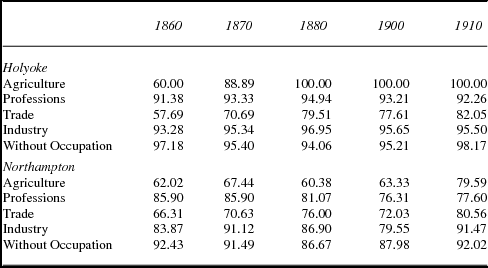
With some evidence of differences in access to different occupations by different groups, it is important to examine the influence of occupational composition on differences in impoverishment and real estate holdings. In Holyoke, individuals employed in trade were the least likely to experience impoverishment (table 7) and over time immigrants had increasing access to trade professions. However, over the study period the percentage impoverished for this occupational group also increased. The rates of impoverishment for men in professions and industry were relatively stable and similar over the entire time frame despite changes in access to these occupations among immigrant groups over time. Those in industry were only slightly more likely than males in professional occupations to be impoverished in any decade. Individuals without occupation also experienced high rates of impoverishment but the heterogeneity of the occupational category makes interpretation more complicated. Included in this category are unemployed individuals, wealthy men with no employment, voluntarily and involuntarily retired men, and cases in which the recorded occupation was illegible. Again, differences in the occupations of different groups were relatively small, but there is evidence of greater US-born involvement in trade occupations in Holyoke and evidence of benefits in access to those occupations.
Percentage of males 14 and older with no personal wealth, by decade and occupation: Holyoke and Northampton, Massachusetts, 1860–1910

In Northampton, men with agricultural occupations, also the smallest occupational category, were the most likely to have personal wealth, except in 1910. Trade occupations experienced a general overall trend of increased impoverishment even as the overall percentage in trade occupations increased and Irish immigrants moved to some degree into trade occupations. In contrast, the situation for those in industry was erratic, indicating that an impact on wealth through employment in these occupations is most likely due to more fluid local market forces in the smaller city rather than a broad category effect. The professions category in Northampton experienced a stable decline in impoverishment, suggesting a consistent benefit for other immigrants (largely Eastern European migrants), increasing in these occupations later in the study period.
Perhaps not surprisingly, a complete lack of personal wealth was nearly universal across occupations in Holyoke. The only exception to high and persistent impoverishment by occupation was in trade, which were largely sales and clerical positions but also included several wealthy merchants. In the earliest decades of settlement, lower levels in this occupational category may reflect the in-migration of entrepreneurs and shopkeepers. Throughout the period, these occupations had the lowest levels of impoverishment, yet with an increasing trend that may reflect an increasingly competitive sector. Overall, the leveling effect of a bureaucratically organized mill town that greeted immigrants was near universal impoverishment. Unlike Holyoke, Northampton's population had considerable variation across occupational categories and lower levels of impoverishment for all occupations. Agriculture and trade had the greatest proportions with personal wealth. This greater variability in occupational wealth persisted throughout the nineteenth century, succumbing only to rising impoverishment across all occupations during economic crises in the early 1900s. Part of the rising impoverishment in agriculture evident in Northampton was likely due to the increasingly urban nature of the population included in the sample area, as large landholding agriculture became increasingly less likely in or near the city center. Mills and industry, although smaller in scale than Holyoke, nonetheless also grew in importance for Northampton's urban economy over this period, which may have both increased sensitivity to economic crises in later decades and abetted in the leveling impoverishment of the population.
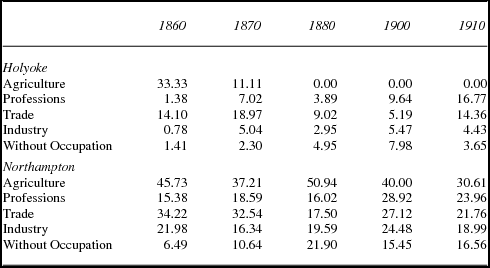
Real estate wealth holdings provide almost a mirror image of the trends in impoverishment in Holyoke, with all occupations gaining wealth during the study period despite dips in substantial real estate holding in 1880 (table 8). Real estate wealth might have been more difficult to omit from reporting and the increase in real estate holdings might also reflect a simple maturation process within the city as more residents acquired residential properties over time, and so forth. Throughout the period, substantial real estate wealth holding was far more likely for most occupations in the mixed market and more slowly growing Northampton than in planned, industrial, and high-growth Holyoke. However, trends in substantial real estate wealth holding for Northampton also show a dramatic narrowing of differences in group fortunes as the city center became larger and more urban with a decline in agricultural wealth holding and a similar decline in the wealth advantages in trade. This trend is reversed in Northampton during the financial crises of the early 1900s and, again, due to the declining agricultural holdings by those in the increasingly urban center of the city. Real estate wealth holding by occupations is overall lower in Holyoke in general and far less variable than in Northampton, reflecting the inequality in property holdings of the planned industrial community of Holyoke and perhaps a greater economic variability in the smaller mixed-market town of Northampton.
Percentage of males 14 and older with substantial real estate wealth, by decade and occupation: Holyoke and Northampton, Massachusetts, 1860–1910

Note: Substantial real estate wealth is defined as the upper 75 percent of real estate wealth for each decade.
Overall, the immigrant group impoverishment data provides evidence supporting all three major perspectives with both a maturation (or assimilation and leveling) trend, evidence for some dual-labor market impacts, and with rather more limited evidence for effects of ethnic enclaves. In Northampton, the impoverishment rates for immigrant groups are relatively close to each other between 1860 and 1880 and, during the same period, distinctly different from the impoverishment rates for US-born males. This would support the application of a dual-labor market framework because all immigrant males appear to be similarly disadvantaged. However, in 1900 the impoverishment rate for Irish males is almost the same as for US-born males, which would support the presence of a maturation or leveling effect for ethnic communities that have been established for a greater period. The similarity in impoverishment for Irish, Canadian, and US-born males by 1910, as well as the shared upward trend of impoverishment between 1900 and 1910 for all groups, further supports a maturation or assimilative effect. In Holyoke, the fact that Irish adult males have a consistently lower rate of impoverishment compared to Canadian males also supports a maturation framework with perhaps some evidence of ethnic enclave advantages from earlier arrival in the town. Furthermore, the higher impoverishment rate between 1880 and 1910 for US-born men in Holyoke compared to Irish men indicates that the US born did not possess a unique benefit regarding personal wealth in the more industrial mill town setting. Only the comparison of impoverishment rates in 1860 shows any support for a dual-labor market in the large and new factory town of Holyoke.
Similarly, in terms of real estate wealth, in Northampton the Irish and Canadians met or exceeded the rate of substantial real estate possession of the US born by 1910 and only other foreign-born men showed a declining trend. The ability of Canadian and Irish males to catch up with the US-born males by end of the study period supports the idea that real estate provided a durable-capital investment and a maturational effect leveling population differences. Yet, the rapid and steep rise in possession of substantial real estate by Irish males between 1880 and 1900 suggests some ethnic differences or advantage from an earlier arrival tempering the longer-term maturational effects. And again, in Holyoke, trends in substantial real estate wealth possession are similar between Irish, Canadian, and US-born males, suggesting the more leveling effects on social inequalities of industrial dominance in the social organization of Holyoke.
The occupational data for impoverishment and real estate wealth suggest that trade occupations were financially beneficial in the earlier part of the study period in both cities. Impoverishment in this group increased over time. But, at least in Holyoke, there was less impoverishment and the real estate wealth was distinctively higher until 1900. These occupations may have provided some escape from the more pronounced impoverishment of manufacturing and other occupations, and there is some evidence of changes in immigrant group access to these professions. Still, impoverishment rates in Northampton show more convergence or leveling between occupational categories over time. By the end of the century, occupational differences were insignificant in Northampton while trade, or even professions, evidence some resistance to the impoverishment that typified manufacturing in Holyoke. To confirm whether immigrant communities made particular use of these occupational advantages in Holyoke requires an examination of interaction effects.
Multivariate Analysis
To address complex effects of period, immigration, occupation, and interactions we conducted a series of multivariate regressions with personal and real estate tax wealth as the dependent variables;Footnote 5 sex, city, decade, and age as design effects; and literacy,Footnote 6 an income score derived from occupational wage averages,Footnote 7 immigrant group, and occupation as the main effects. The population for the regression analyses are employed males 14 years of age and older with a reported occupation. Through this modeling, we hope to assess whether there is evidence for (1) a dual-labor market operating in either community that leads to economic advantages for the US born compared to the foreign born in general; (2) earlier arriving groups gaining and keeping an ethnic enclave advantage over time; (3) an interaction effect with enclaves representing occupational advantages; and (4) maturational assimilation and leveling of economic well-being over time that cuts across immigrant groups and occupations.
Wealth as a dependent variable in a linear regression requires some transformation to address skewed distributions and, especially in this impoverished population, an inflated number of recorded zero wealth values. Personal wealth in our sample ranges from $0 to $223,000 and real estate wealth ranges from $0 to $123,000. Quantile regression or using an inverse hyperbolic sine transformation of the wealth variable are two appropriate means of dealing with the skew in wealth distributions and zero values of wealth resistant to a simple logarithmic transform (Burbidge et al. Reference Burbidge, Magee and Robb1988; Carroll et al. Reference Carroll, Dynan and Krane2003; Friedline et al. Reference Friedline, Masa and Chowa2012; Pence Reference Pence2006). In this study, we chose to use an inverse hyperbolic sine transformation for our wealth variables.
Design Effects
Sex is controlled for in that the sample is restricted to males. Typical of many nineteenth-century resources, women in the sample often lack sufficient data for analysis. Given the fundamental contrast between cities, the theoretical import of that difference, and the complexity of potential interaction effects with city differences, city effects are controlled for by modeling Holyoke and Northampton separately, rather than treating location as a dummy variable in a single set of models. This allows for a richer comparative interpretation of the model effects and fit between the cities. Decade is a categorical variable representing the year in which the census data were gathered, with 1860 as the comparison category. When interpreting decade effects, it is important to recognize that these effects are a design effect that also controls for the increasing urban nature of sampling the central town areas, not simply a temporal trend.
Main Effects
Immigrant group is measured through a set of indicator variables based on country of birth as Irish, Canadian, other, or US born (the comparison category). This classification scheme was designed to reflect the pattern of immigration waves that occurred in the region during the study period.Footnote 8 Literacy is a widely recognized measure of social capital that affects earnings and occupation. To have a consistent measure across censuses literacy was measured as whether a person could read or write in any language and was at least 21 years of age. Of necessity, the comparison category includes both adult illiterates and males 20 and younger.Footnote 9 Literacy was very high in Northampton across the study period, and we have less expectation of a significant effect than in Holyoke, where literacy was more variable. French-speaking Canadian immigrants to New England have been shown to have lower levels of schooling in the first half of the twentieth century than other immigrants, which might be reflected in the literacy variable (MacKinnon and Parent Reference MacKinnon and Parent2012). Years of schooling is not consistently available across the period we study. Occupation is also an indicator of social capital and is measured with a set of indicator variables that classify specific occupations into the four broadly defined categories discussed previously: agriculture, professions, trade, and industry.Footnote 10 Industry was chosen as the comparison because it consistently represents the largest occupational category in both cities and comparison highlights differences from the dominant manufacturing nature of the cities. Because occupational groups do not capture the income variability within general categories, income scores derived from wage medians for specific individual-level occupations within categories are included. Age has historically been correlated with wealth. Especially among populations often arriving as young workers, it is potentially significant with respect to accumulation of wealth. After exploring alternative operationalizations, age is measured as a continuous variable.
Interactions
Two- and three-way interactions were explored for all main effects in the models. The interaction between immigrant group and decade estimates the general trajectories of inequality over time. Prior analyses of the data (Leonard et al. Reference Leonard, Beemer and Anderton2012, Reference Leonard, Robinson, Swedlund and Anderton2015) have suggested this interaction requires nesting within decades to account for the near structural zeros in ethnic groups before their substantial arrival, in order to obtain reliable estimates regarding wealth and wealth effects. Interactions between income score and occupation group were included to look for effects of income differences within occupation groups. The interactions between immigrant and occupation categories may reveal whether immigrant groups used occupations as a means of improving their lot and established occupational enclaves over time, or whether occupations constituted a dual economy favoring US-born men and already assimilated immigrants.Footnote 11 Other interaction effects were explored but only those that achieved significance or with theoretical import to the analysis are included in the final models presented. The effects suggested by different migration theories that are explored in these models are complex and, most importantly, are not mutually exclusive. Modeled regression coefficients are intended to suggest the weight of different variance components that are plausibly explained by central, theorized migration effects, not as a strict test between migration perspectives with exclusive hypotheses.
Wealth Regression Results
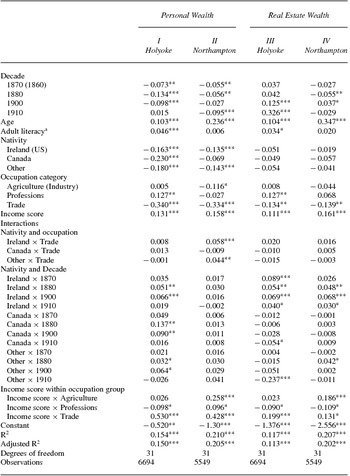
The initial regression model explored included effects of ethnicity nested within year of arrival and explored all other meaningful interactions. As noted in the preceding text, prior studies have shown the nesting of ethnicity is required for robust results given the near structural zero nature of effects before major periods of migration for each ethnic group. The final four regression models with statistically or theoretically significant interactions (table 9) show the effects of group characteristics and important individual-level control factors (age, literacy, income) on reported personal and real estate wealth in both Holyoke and Northampton. In the models of personal wealth (Models I and II), decade effects reveal a curvilinear, or U-shaped, pattern up to the turn of the century with the lowest wealth during 1880. This pattern continues in Holyoke while in Northampton personal wealth took a steep decline after the turn of the century. Controls for age had the expected significant positive impact on wealth in both cities, as did literacy in Holyoke. Literacy had no effect in Northampton, with generally higher levels of population literacy. Each of the immigrant group effects were, not surprisingly, significant and had a negative impact on personal wealth compared to the US born, except for a nonsignificant difference for Canadians in Holyoke.Footnote 12
Multivariate models: personal wealth and real estate wealth, males aged 14 and older: Holyoke and Northampton, Massachusetts, 1860–1912

Note: Standardized beta coefficients are reported. Dependent variable measures of wealth were transformed through inverse hyperbolic sine function. Omitted categories are in parentheses.
a Literacy reported for those 21 and older.
***p < 0.001. **p < 0.01. *p < 0.05.
Turning to occupation main effects, professions was the only occupational group effect that was significant in Holyoke, with a positive impact on personal wealth compared to all others. In Northampton, industry, along with professions, had positive effects on wealth compared to significant negative effects of other occupations. Importantly, contrary to what one might expect if immigrant enclave effects were strong, none of the immigrant and occupation group interactions were significant in Holyoke, suggesting the near universal impoverishment may have nullified any such profession-based advantages. In contrast, in the smaller mixed-market town of Northampton, trade occupations provided a clear advantage to first Irish, and then Eastern European, immigrants. The pattern of immigrant group and decade interactions in Holyoke seems consistent with our earlier research showing a working age and health selection effect favoring immigrant groups in the first decades after their initial arrival and peak immigration events (Leonard et al. Reference Leonard, Beemer and Anderton2012). But, in neither Holyoke nor Northampton is there any evidence for a long-term maturational trend of increasing wealth over time within any immigrant group. Again, however, this characterizes those within the urban immigrant community. At an individual level it is clearly likely that those who were most successful may have simply migrated “up the hill” to more affluent residential areas on the outskirts of the city. In any case, the urban immigrant communities do not appear to have a manifest advantage for those living in the city.
Control for individual income scores in both cities had an expected positive impact on personal wealth. In Holyoke, where occupational effects were generally less, the interaction effects between income score and occupation group are large and significant for trade, suggesting that selected professions within the trades still provided some advantage in individual wealth accumulation, even if the advantage was not present for all of those in the wider occupation category. In Northampton, where occupational effects were more pronounced, including a positive effect among industry occupations, income variability in all other occupations, but especially within trade and agriculture, resulted in additional gains in wealth. Again, even in occupation groups with groupwide disadvantage individual incomes within some specific professions provided wealth advantages.
The complexity of occupational and income interactions is not surprising given the different nature of the two cities over time and the distinction between group mean and individual effects. Yet, what is apparent in this analysis is that wealth gains among newly arriving immigrants were consistent with short-term selection effects and do not evidence any long-term advantage to first-arriving immigrants or particular occupational enclaves that persisted as community-level effects. The greatest differences are those between immigrant groups and the US-born population, which were compatible with a dual-labor market perspective, with immigrants providing lower paid labor across occupational categories in the two towns. Maturational influences over time appear to have worked largely toward the leveling of economic differences among urban immigrant groups rather than sustained group advantages, despite other historical evidence of political or cultural struggles and advantage between immigrant communities (Hartford Reference Hartford1990).
The leveling of economic differences appeared to extend across the gap between immigrants and the US-born population (many of whom were also in-migrants to these specific cities). This finding is not surprising given the rapid growth, relatively homogeneous origins of migrants, tremendous concentration of wealth in few hands, and the substantial assimilative force of industrialization and emergent cities on lower classes at the time. Nonetheless, individuals did manage to exploit certain higher income professions within the broader occupation categories to some advantage even without broad occupational or immigrant group advantage over time.
The same model structure was used to investigate the correlates of real estate wealth (in Models III and IV) for Holyoke and Northampton, respectively. Decade has a generally incremental positive impact on real estate wealth in Holyoke and is roughly similar in Northampton once large agricultural areas in 1860 are excluded from sampling and before the financial crash effects in 1910. This trend would likely be anticipated in what were emerging cities with accruing real estate holdings at an aggregate level and an influx of population settling in urban areas. However, for real estate wealth, the sampling frame focused on urban centers also likely influences decade effects as these cities grew. Controls for age and literacy had similar effects as on personal wealth. However, the coefficients for each immigrant group compared to the US born (as well as other differences between groups) are not significant, revealing no significant patterns of ethnic domination in real estate holdings. Occupational effects on real estate wealth in both cities were largely similar to those on personal wealth, but interactions between immigrant group and occupation were not significant, furthering the impression of minimal immigration or ethnic group effects. Given that significant real estate may represent a more time-distributed accumulated advantage than immediate personal wealth, advantages may be attenuated. Although immigrant interactions with occupation were not significant, in the main effect, Irish-born men, the first arriving immigrant group, were more likely to possess real estate wealth after 1860, suggesting an initial advantage or duration effect of having been a significant group within the community for a longer time. Not surprisingly, controls for income effects are again significant and positive, and the pattern of effects of income variation within occupation categories is largely similar to models of personal wealth.
The findings are suggestive; however, real estate models should also be interpreted with care given the changing and more urban nature of the city-center sample over time. With that caution, it does appear that real estate may have provided a durable capital base for some accumulation of group advantages over time for some immigrants, especially the early arriving Irish, unlike the evidence for short-lived advantages in personal wealth. The relative advantage of Irish immigrants after 1860 in real estate wealth may in part be an enclave effect in the sense of their earlier arrival and entry into real estate investment, an increasingly Irish-occupied central city with native flight from urban areas, or a combination of such effects. This could be a critical difference from the dominant leveling of differences apparent in models of personal wealth, suggesting one source of difference in immigrant advantage. However, it is also possible that extending the sample in time could evidence this initial advantage to the first arrivers was also a fleeting one that was only captured for the Irish in the time frame chosen for analysis. In all other respects, these models generally support the findings from personal wealth models, with little consistent evidence of occupational enclaves or advantage specific to immigrant groups. The suggestion of both models is, primarily, evidence of a dual-market economy dwindling over time in the face of the dominant leveling of group differences in other respects. Ethnic differences in accumulation of real estate wealth over time were very likely a short-lived advantage and part of a longer-term settlement, assimilation, and leveling process.
Conclusions
A rise in individual-level data has certainly fueled greater attention to the study of individual-level fortunes of immigrants throughout the nineteenth century. Yet, harking back to the early Chicago School of Urban ecology (e.g., Burgess, Park, Hughes, Mead, Thomas) there is, perhaps, also a benefit to re-exploring the ecology of urban immigrant communities and the insights that contemporary migration theory has brought forth in understanding the roles ethnic communities may have played in shaping new urban centers of the eighteenth century.
Holyoke and Northampton are only two of many emerging urban settlements throughout the Northeast as immigration and population growth fueled an expansion beyond the large urban cities of the seventeenth century. And, their differences reflect only two common patterns of the cities that were built upon immigration of the eighteenth century, the mixed-market city and the industrial planned settlement. In both cases, Irish immigrants to the Connecticut River valley arrived in a Yankee world, but it was a different social and physical space in the two communities. Wealth inequality was pervasive in both cities, but more so in the much larger, more industrial city of Holyoke. Greater wealth inequality also translated into more universal immiseration. Social inequality in Holyoke was more durable and social structures more bureaucratic. Northampton offered a mixed economy with more opportunity, but was also becoming more industrial while remaining more vulnerable to economic vicissitudes that had their own leveling effects over time. Holyoke was a new town, with little housing, plenty of mill jobs, and opportunities for the professional and service sectors. As it grew, the town maintained a younger population, with continued high levels of immigration. When the Canadian immigration wave arrived, Irish immigration had changed Holyoke. The Irish were well entrenched and the second generation was reaching maturity. The town was growing rapidly in population, but not in area, with dense multifamily dwellings in the center of town. Despite a history of residential segregation, there were few opportunities to establish employment enclaves and fewer to acquire real estate than when the Irish had arrived. The final great wave of immigration from Eastern Europe entered a crowded Holyoke, with established Irish and Canadian populations and widespread tension, amid a series of economic depressions leading to mill closings and lower wages. There is some evidence in the occupational distribution that Eastern Europeans were gaining some traction by 1910, and given time, they may have come to dominate wealth in the urban core, especially as other ethnic groups moved to the less central neighborhoods of the city. However, within the next 20 years, Holyoke had fallen on hard times with the largest mills moving to the US South where lower wages and anti-union sentiment prevailed. The booming economy of Holyoke declined, population growth leveled off, and, despite the limited evidence we find for any wealth advantages prior to the turn of the century, both politics and culture in Holyoke came under a predominantly Irish influence that would continue, almost unchallenged, over most of the twentieth century.
In contrast, the Northampton that the Irish entered in the 1850s and 1860s was already an old Yankee town, with smaller, mixed industries, more small residences, and less well-defined ethnic neighborhoods. When Canadians arrived, the town was still dominated by the native born, as it was when Eastern Europeans arrived decades later. The flexibility of the social space in Northampton initially offered greater possibilities for advancement to arriving immigrants, beginning with the Irish. Yet, after the turn of the century, these advances came abruptly to a halt in the face of hard times and economic crises. Northampton, like Holyoke, experienced an economic retrenchment with a leveling off of population growth and social differences that were emerging from individual fortunes. Northampton, however, had a longer history of mixed-market activities and retained a significant agricultural sector. Canadians and Eastern Europeans would find more opportunity for economic advantage after the turn of the century in these nonindustrial sectors.
During the study period of rapid population growth, immigration, and industrialization in Northampton and Holyoke, the picture that emerges does show evidence of the general leveling of social differences between all groups that has traditionally been viewed as a hallmark of urbanization and immigration during the late nineteenth and early twentieth centuries. However, we also found evidence for some early and persistent dual-labor market advantages to the US born that contributed to the leveling of social differences in a near-universal impoverishment among arriving immigrants and many of the newly arrived US born. However, those who arrived early did began to accumulate real estate wealth. Both occupational differences and income variability within occupations offered individual opportunities for advancement over time, with a new wealth- and income-based stratification counter to the broad leveling of social differences across occupational sectors and immigrant origins.
Understanding the complex social landscape immigrants faced upon and after arrival in these two cities requires a range of effects discussed over the last century of migration and urbanization theories. It is not surprising that nearly all aspects of migration and urban theories would come to play relevant roles in two such heterogeneous cities observed over half a century. It is also not surprising that many of the theories of ethnic enclaves and even dual-labor markets that have been emphasized in studies of contemporary immigrants and were clearly significant in industrially driven communities, would be somewhat less salient than the overall leveling of social differences over the long run that had been emphasized by eighteenth- to early-twentieth-century theorists who witnessed the massive migration of largely European populations into the great emerging new cities of the nineteenth century with the leveling forces of widespread population movement, rapid growth, a new urbanization, and near universal impoverishment in the rise of industrial cities. Despite the clearly apparent divisions of dual labor markets, even perhaps because of the universal immiseration in the extremity of those divisions, and in spite of the lesser enclave advantages that might be found in these newly emergent towns, the same leveling of differences earlier generations found in the great established urban areas of the nineteenth century were also apparent and dominant in our analysis of two newly emerging urban centers of New England.