Introduction
The term happiness is derived from the root word “hap,” which means luck or favorable external circumstances (Paulson et al., Reference Paulson, Azzarelli and McMahon2016). Happiness may be defined in many ways. The Oxford English Dictionary (2020) defines happiness as “the state of being happy, of feeling or showing pleasure, and of being satisfied that something is good.” From a perceptual perspective, happiness is a pleasure. Happiness is also a positive emotion from an affective angle. From a cognitive standpoint, happiness is a global evaluation of life satisfaction (Diener, Reference Diener2006). Happiness can be fortune, an inner state, a pleasure, an emotion, a cognitive evaluation, or a trait. Among researchers, there remains no universal definition for happiness (Medvedev and Landhuis, Reference Medvedev and Landhuis2018).
While many theories of happiness exist, they generally fall into two broad categories: hedonic happiness and eudaimonic happiness. The former emphasizes the pursuit of pleasure and the avoidance of pain as the basic constituents of happiness. It is best represented by the model of subjective well-being with three main components: high levels of positive affect (maximizing pleasure), low levels of negative affect (minimizing pain), and a high degree of life satisfaction (cognitive component) (Diener, Reference Diener2000). Eudaimonic happiness instead proposes that true happiness is achieved by living a virtuous life (Delamothe, Reference Delamothe2005). It has multiple representative models such as psychological well-being, the theory of flow, self-determination theory, the Authentic Happiness model, and the PERMA framework (Csikszentmihalyi, Reference Csikszentmihalyi1990; Ryff and Keyes, Reference Ryff and Keyes1995; Deci and Ryan, Reference Deci and Ryan2000; Seligman, Reference Seligman2011). In the PERMA framework, the five constructs of happiness are positive emotions, engagement, relationships, meaning, and accomplishment (Seligman, Reference Seligman2011).
Although improving quality of life through the prevention and relief of suffering is enshrined in the WHO definition of palliative care, increasing happiness in patients is not explicitly mentioned as a desired goal (WHO, 2002). Dying is frequently seen as an unhappy experience, so much so that an entire branch of psychology, terror management theory, is dedicated to studying the impact of dying on the person experiencing it (Burke et al., Reference Burke, Martens and Faucher2010). Yet, as palliative care physicians, we have witnessed many patients remaining happy despite facing death. Goranson also found that dying people could be surprisingly happy (Goranson et al., Reference Goranson, Ritter and Waytz2017). People who are dying can be far more positive than we expect. Hence, we conducted this qualitative study to explore happiness in palliative care patients. For this study, the “end of life” timeframe refers to patients anticipated to die within 12 months (GMC, 2010).
Methods
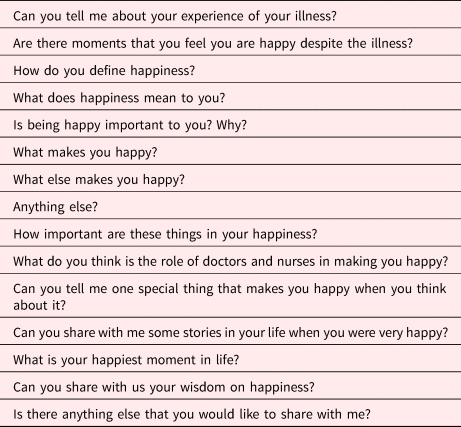
We conducted a qualitative study at the University of Malaya Medical Centre, Kuala Lumpur, Malaysia, from August 2017 to January 2018, with ethical approval from the Medical Research Ethics Committee of the University of Malaya. A convenience sampling method was utilized for purposes of recruitment. Adult patients aged 18 years and above, with stage III or IV cancer, and who were under the care of the palliative care team in the University of Malaya Medical Centre were eligible for inclusion in the study. Patients who were confused or unable to participate in the interview were excluded. A research assistant who was not involved in patient care briefed potential participants on the nature, duration, and implications of the study. Involvement was entirely voluntary with no pressure or coercion applied, and participants were free to withdraw at any stage without consequence. Written informed consent was obtained from willing participants, and a total of 20 patients were recruited to the study. Data collection was performed through voice-recorded semi-structured interviews with open-ended questions on happiness (Table 1). The average interview time was 37 min (range: 20–70 min). The 17 English audio recordings were transcribed verbatim, while three audio files in Chinese were transcribed and subsequently translated into English. Transcription and translation were performed by the principal investigator, who is a palliative care physician, and a research assistant, who is a medical doctor.
Questions in the semi-structured interviews

All transcripts were imported into NVIVO (QSR version 10) for data analysis using the six steps of thematic analysis outlined by Braun and Clarke (Reference Braun and Clarke2006). First, we familiarized ourselves with the data by repetitive reading of all the transcripts. Second, we produced initial codes from the data by identifying segments of data on happiness. Third, we generated potential themes and subthemes through the identification of meaningful patterns across the data. Fourth, the themes and subthemes were reviewed and refined through re-reading of all the collated extracts for each theme and the entire dataset to ensure pattern coherence and thematic validity. Fifth, the themes were named and defined. Sixth, we produced the report with the support of a literature review. The entire process of thematic analysis was done by the principal investigator and the research assistant. The validity of the themes and subthemes was discussed with four other palliative care team members to reach agreement when there were differences in interpretation.
Results
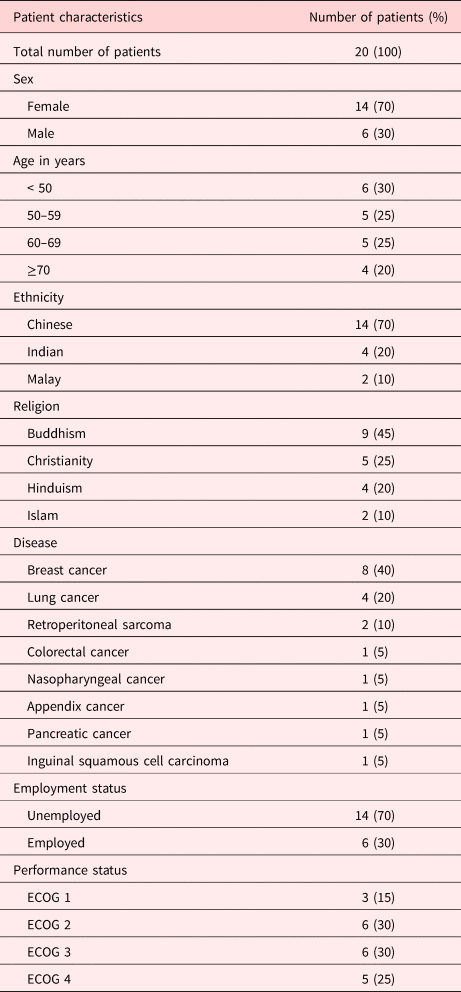
Of the 31 palliative care in-patients screened, 10 were excluded due to reduced consciousness, difficulty in communicating, or both. One patient declined participating due to tiredness. Twenty patients were recruited to the study. The demographic characteristics of the participants are presented in Table 2. After repetitive reading of all the transcripts, coding was done by screening all the data for descriptions of happiness and assigning units of meaning to these descriptions in terms of its immediate denotation, connotation, factors, and experiences. A total of 697 codes of happiness were generated. These codes were categorized into eight themes: the meaning of happiness, connections, mindset, pleasure, health, faith, wealth, and work.
Demographic characteristics

ECOG, Eastern Cooperative Oncology Group.
ECOG 1, restricted in strenuous physical activities; ECOG 2, restricted in work activities; ECOG 3, bed-ridden >50% waking hours; ECOG 4, completely bed-ridden.
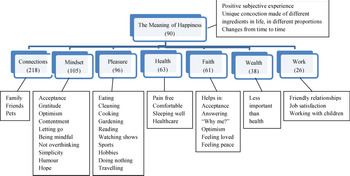
The first theme, the meaning of happiness, was a latent theme identified through the interpretation of the underlying ideas, assumptions, and conceptualizations that arose from the data. The subsequent seven themes were semantic themes identified from the surface meanings of the data not beyond what was explicitly reported by the participants. The connection among the themes is illustrated in the coding tree in Figure 1. (The numbers in the figure represent code frequency) The meaning of happiness was the overarching theme defined by a dynamic combination of the seven happiness domains in different proportions and priority levels, as represented by the seven semantic themes. Regarding data saturation, all eight themes were represented within the first two interviews. These themes are reported with the support of selected quotes from patients.
The coding tree (happiness at the end of life).

The meaning of happiness
The meaning of happiness referred to the way happiness was represented, interpreted, and conveyed by patients. Many patients expressed their happiness in relation to its meaning to them. “Happiness is a very positive emotion.” (Patient 2) “It is a positive feeling, a feeling of joy.” (Patient 4) “Happiness is when you are satisfied with yourself, with everything around you.” (Patient 20) “Everybody wants to be happy. I want to be as happy as possible. So, being happy is definitely very important.” (Patient 4) “Happiness is very important. I think when you are happy you can do a lot of things, a lot more than what you are doing now.” (Patient 20) “Happiness is how you define it, how you look at it… No one can tell you what happiness is. You must find it, you know?” (Patient 16)
Happiness was a unique state that was formed from different strands of life, such as connections, mindset, pleasures, health, faith, wealth, or work with each contributing different proportions to make it up in. “Happiness can be a lot of things. It can take many forms. It can be a pain-free day, a visit from friends, and a nice meal. Helping someone can bring happiness. There are many kinds of happiness.” (Patient 4) “My happiness is about having a good quality of life, and no problem with my health. I have a good job. I have good siblings… I can do anything I want.” (Patient 14) “It's having the time, money and health to do the things you want to do. If you want to buy this, buy. If you want to go there, go. If you want to see this someone, see this someone. If you want to be with these people, be with these people. If you want to eat this, eat. The freedom of just being able to do what you want to do. Of course, must be within reasons.” (Patient 2) “As long as I have food to eat and I can enjoy what I like to eat. I have a house, a roof over my head. I can move around. Then enough, what else do you want?” (Patient 9) “I mean earlier you will be looking outside, what is happiness? You will be looking outside, enjoyment and all that. That is not really happiness. Happiness is like I say, your family bonding, you understand?” (Patient 16) “Happiness to me is when you know above all things, God is true.” (Patient 8) “Life is like going from stage to stage … so when you say happiness, happiness changes, it doesn't stay as one.” (Patient 16) “Like I said, from a child you grow to a toddler, from a toddler to a young person, so as you grow, your thing changes, your priority also grows, you get what I mean? It will definitely change. So, once it changes, you will look for different sources (of happiness).” (Patient 16)
Connections
All patients reported social connections as a crucial element of happiness. Among all social connections, family topped the list. “Happiness is where the family is.” (Patient 16) “Ninety nine percent of my happiness is family. Family is very important. They will give you moral support. They will give you financial support too. Spiritual support also. For me, nothing can replace my family members. They are the only one loyalty in the world.” (Patient 14) “I think family plays a major role. I don't think I can make it this far without the support of my family. Yeah, just having family around, just their presence, is very comforting and soothing, especially when you're in a hospital. It's a foreign place. It's very sterile, you know. Just having someone around is great. On top of that, there are the other things, such as the logistics, the simple things like buying food. The support, when you're too weak to carry things, they carry them for you or push you in the wheelchair. These are all things that family makes it better.” (Patient 4) “Actually this is the perfect time for you to ask me about happiness because before this disease, I don't really know if my children care about me, because you see, they don't really express themselves. So I am not sure, but when they knew about this, about my cancer, they all came together and did so many things for me you know… They all came together and cared about me so much and I know that they love me, so I am very happy.” (Patient 15)
Friends featured second on the list of connections that added to happiness. “Friends are also very important. I think the next most important after family. And some friends are willing to really go the extra mile when you really need it. When you really need something then you realize who are the friends who will step up for you and who are the friends who are not there when you really need them … There was a friend who was willing to drive us down from Kuala Lumpur to Singapore … There were friends who came every day … and there were friends who constantly messaged, and constantly encouraged you. This is a long journey and a little bit of support helps. It helps to know that people still care, that they haven't forgotten about you.” (Patient 4)
A few patients reported that their pets contributed to their happiness. A patient showed a picture and said, “That's my dog. My happiness. My favourite dog. She's so excited when she sees me. This is one of the dogs that I love so much. My house got CCTV. So, on and off I will turn on and look at it and oh, I miss her.” (Patient 18)
Mindset
Most patients demonstrated that having a happy mindset was crucial for happiness during their trying times. Among the contributors to a happy mindset included acceptance, being grateful, focusing on the positive, being appreciative, being contented, letting go, living day by day, not thinking too much, and keeping life simple. “If you are depressed, you only get worse. So I just forget about this and think of the future. Just take life as it is … So we have to accept it.” (Patient 6) “I think happiness is very often a state of mind because you can have two people in the same situation, one can be happy and the other can be unhappy. And I think gratitude is very important. Ok, this thing may not work out, but try to focus on things that are working, you know, focus on the positive. I think this is helpful … I think we forget the good we have.” (Patient 4) “Now, especially now, you'll appreciate happy moments more.” (Patient 2) “Every day extra is a blessing. From now on I will definitely have good days and bad days. I just want to make full use of my good days. Bad days will come. So I'm hoping that the bad days won't be long.” (Patient 11) “Be contented and you will always be happy. Don't always compare what people have and what you don't have. What is that? You can't bring them with you when you die, all of the things you can't bring along with you, no matter how much you like them. So let it go. Let it go then you will be ok. People come and go … no need to be afraid. Live day by day, just be happy, don't have to think so much.” (Patient 9) “Keep life as simple as possible. Do what you can do.” (Patient 18)
Lightheartedness and humor were also described. “They say laughter is the best medicine.” (Patient 10) “So these are events that trigger happiness, but if you are talking about ecstatic happiness in the sense of laughing, I had some of that just now. Some primary school classmates came and we had a chat and started laughing about old times.” (Patient 11) “Yes, I can make a lot of people happy. When I go to work, they all laugh at the things I say. Yea, I'm always joking.” (Patient 20) “Yea, I'm taking morphine and I told them, wooo, I'm a drug addict. They laughed. So, that's the way I crack jokes.” (Patient 20)
Hope was mentioned as well. “Yes, I look forward to every day, because I don't think of what has happened. What has happened I can't do anything about it, I just want to move forward and get the best out of it.” (Patient 7) “Yea, I'm just living for my children only, and for my granddaughters. I hope to see my son get married.” (Patient 10) “Yes, God promises me my time, I look forward to that you know. I just don't want it to be short. Just give me time to do my things, things on my bucket list. That'll make me happy.” (Patient 2)
Pleasure
Most patients talked about engaging in pleasurable activities as part of their happiness. Most were simple pleasures in life that were not costly. “I like to eat Japanese food, Korean food … everything! I like steamboat!” (Patient 19) “I like ice-cream and chocolate.” (Patient 12) “Actually to tell you the truth, I like to clean, wash and do everything myself.” (Patient 20) “I think gardening is a form of therapy. When you see things grow, you are very happy, you know.” (Patient 9) “Cooking! I cook. Sometimes I make chicken rice, or Assam fish, very tasty!” (Patient 12) “Sometimes when you read a book, you forget about yourself.” (Patient 7) “When I'm resting, I watch cooking shows that I like. Travel shows. Cooking shows. I watch YouTubers doing vlogs on travelling.” (Patient 11) “Pool game. Snooker. I play football, futsal and badminton.” (Patient 1) “Buy stuff that I like. Then I will be happy.” (Patient 5) “I like to collect stamps, old coins… those books, you know, all these I collected over the years, but it makes me so happy, you know.” (Patient 15) “Just do nothing, sit at home, watch TV and laze around.” (Patient 2)
Many patients brought up traveling as a source of their happiness. They loved to travel with family or friends to faraway countries to experience different cultures and taste local foods. “I think most of the time I'm happy. But, of course, going for holiday is the happiest. My first trip to Europe was the happiest. Full of excitement.” (Patient 9) “I like Korea. Jeju Island. Jeju Island is the holiday island.” (Patient 12) One patient felt happy when she shared her traveling photos with the researcher during the interview. She said, “I have travelled to many places with my husband … I like nature, so I went to China many times … I like the snow mountain … Mongolia. Last year I went to Tibet, very nice … I went to Hong Kong … This year I plan to go to Switzerland. Next year is Iceland … I went to Greece. I went to Santorini, Mikonos and Athens … I went to Osaka, Kyoto, Tokyo. This one was in Osaka. We made the cup noodle.” (Patient 19) Some patients were happy while reminiscing about pleasurable activities from the past. “When looking back, thinking back, the trips I took, remembering happy things in the past … then I will be happy; those silly things that happened when I was young, the child-like things that we did when we were still children.” (Patient 5)
Health
Most patients highlighted health as a bringer of happiness. “Health is required in the first place, before you find happiness. Without health there is no happiness.” (Patient 15) “I think that health is something we take for granted, until we lose it.” (Patient 4) “If I am able to be pain free, I am happy.” (Patient 2) “Comfort is the most important thing.” (Patient 9) “I will be happy if I can sleep well.” (Patient 2) Although health was important, many patients believed that they could still be happy despite their sickness. This was possible because of their social connections, mindset, simple pleasures, and meaning. When being asked whether one could still be happy despite pain and suffering, a patient answered, “Sure. Why not? That's why I'm telling you, if you are suffering the pain but you have certain people around, your siblings, your best friends, someone you love, you can enjoy your life, right?” (Patient 14) “It is through this suffering, you will find that there's more meaning in life. Your family bonding is there.” (Patient 16) “Regardless of the situation you are in, whether you are sick or well, poor or rich, bad situation of good situation, no matter what situation you are in, if you can find happiness, then it is true happiness.” (Patient 8)
The role of healthcare workers was underlined by some respondents as being essential to achieving optimal health and good symptom control. Being caring, helpful, lighthearted, polite, friendly, and patient were reported as important traits of a good healthcare worker in adding to happiness. “The doctors and nurses play an important role in my happiness because there is one thing I know and that is they are very caring.” (Patient 7) “The doctors and nurses here are very good. When I need to go to the toilet, they will come and help me.” (Patient 19) “They are very important. They are very good. Sometimes they will crack jokes to make us happy. They are not too serious. They speak politely because they know we are in pain.” (Patient 5) “The doctors and nurses are nice. They are like Gods you know. They are like Gods because your life depends on them.” (Patient 10) “They were cheerful and smiling all the time. I noticed that the palliative care team doctors are very patient… To them, patients come first.” (Patient 9)
Faith
All patients talked about faith in happiness. Faith was important for some patients but not all. Faith helped patients accept their situation. It also helped address their difficult questions and enabled them to focus on the positive, and to feel peaceful. “Leave everything to God.” (Patient 9) “I think, one of the first questions, especially when it comes to cancer or any terminal illness, is why me? Was it something I did wrong? Or whatever … there is always a question … and let's say suffering … Why do I have to suffer? Why is life so unfair? That kind of thing. So, faith helps you to go through these very difficult questions.” (Patient 4) “ … like a light for you to follow.” (Patient 6) “He gives me strength. He gives me a lot of kindness. He gives me power … because this is a critical time … only your spiritual … and your belief in God can give you happiness … Look at the positive side.” (Patient 14) Faith also brought happiness in the forms of love and peace. “So, what is true happiness? That is what I can tell you from my point of view … I don't know how but I can't run away from the fact that we must place God first, then you will definitely get a steady joy, love, and peace.” (Patient 8) “Happiness can be a certain emotion that is temporary … peacefulness is something that is longer … even in sadness you can still be peaceful … So, at my stage in my life, I can say that I can still laugh and be happy because I am feeling peaceful … One source of peace is definitely my faith and that is the biggest. Another source is from the support of my family and friends.” (Patient 11)
Wealth
Wealth was mentioned by many participants, but they all agreed that wealth was less important in comparison to health. “Money is not everything but without money you can't do anything.” (Patient 12) “I would say health is more important than wealth, because wealth is, it can always be earned, whereas health, not always.” (Patient 4) “As long as it's enough for me to use and eat, it's not very important, because even if you have a lot of wealth, you can't bring it with you when you die. Can you bring it? Let it go. When people die, they leave with both hands empty.” (Patient 3) “I used to put wealth in the first place, as top priority, but not now. Now I think that health is in the first place whilst wealth is in the second place, because only by having health can we have wealth. So, health is more important.” (Patient 5) “Being happy is the most important. If you are not happy, it will be useless even if you have a lot of money.” (Patient 12)
Work
Few patients talked about work as a basis for happiness alone. More often, happiness arose from cordial relationships with colleagues and customers, job satisfaction, and working with children. “Basically it's my job that makes me very happy.” (Patient 20) “I was teaching in a kindergarten school, and the children make me happy. I really love children. They are so cute … the way they wear dresses … the bag they carry … ” (Patient 7) “So, they will come and buy clothes. It's very happy, you know? Just mingle with them.” (Patient 10) “Previously I was an assistant call centre manager with the YTL group. Yes! 4G! The Company is quite big. I love it. Best experience in my life.” (Patient 14)
Discussion
Our results showed that happiness is possible at the end of life. Happiness can coexist with pain and suffering. Terminally ill patients may experience denial, anger, bargaining, and depression, but they can also embrace happiness, not just mere acceptance (Kübler-Ross, Reference Kübler-Ross1997). When it comes to death and dying, people often envision a journey of fear, pain, and suffering, rather than happiness. This can be due to negativity bias, where people pay stronger attention to things of a negative nature compared with positive ones (Baumeister et al., Reference Baumeister, Bratslavsky and Finkenauer2001; Rozin and Royzman, Reference Rozin and Royzman2001). Our findings, however, indicate that dying is not as terrible and tragic as commonly believed. Dying with a terminal illness can be a positive experience. Therefore, alongside preventing and relieving suffering, promoting happiness may also be a crucial component in improving the quality of life of palliative care patients.
In the Authentic Happiness model, the distinction between the pleasant life (maximizing pleasure and minimizing pain), the good life (exercising strengths and being in the zone), and the meaningful life (exercising strengths at the service of others or something higher than oneself) was described (Seligman, Reference Seligman2011). Many believe that true happiness lies not in pursuing happiness, but in pursuing meaning. Our results showed that finding meaning was not an explicit constituent of happiness. Instead, meaning was embedded implicitly in every theme. It referred to what happiness was to patients. It was often expressed within a mixture of the themes with different degrees of importance. Understanding the meaning of happiness and the degree of importance of each domain may help us to focus on those domains that are significant to individual patient.
Consistent with the 75-year Harvard study that found the single most powerful predictor on happiness was having good social connections, our results showed that social connections were also the most important element of happiness at the end of life (Vaillant, Reference Vaillant2011). Patient happiness was inextricably linked to their family, friends, and even their pets. Family was most important because they were the closest and often the first to help practically, morally, financially, and spiritually. Prior to getting sick, patients looked for pleasure and enjoyment as their chief sources of happiness. Following their diagnosis, many realized family bonds were more important. Spending time with family, doing things together, chatting and laughing made patients happy. Friends were the next most important, especially the friends who cared. One patient said, “A true friend is a double copy of you, someone who understands you and everything.” In addition to person-centred and family-centred care, the delivery of connection-centred care which embraces every connection that matters to patients, may be a more complete model of care.
Besides good connections, having a happy mindset contributed significantly to happiness at the end of life. Instead of thinking negatively about their situations, many patients chose to look at things through a positive lens. They believed happiness and suffering could coexist. They opted to view things differently instead of getting angry with their situation. They were contented, grateful, mindful, easy-going, lighthearted, and hopeful, opting not to compare, blame, regret, overthink, judge, or ask too much. This indicates that happiness is not solely dependent on external situations. Happiness can result from the choice of how we perceive, interpret, and respond to any given set of circumstances. When we are unable to change the circumstances, interventions that focus on reframing a patient's mindset may be helpful.
Although the pursuit of pleasure has been criticized as self-defeating and unworkable by many, our results showed that simple pleasures are an important component of happiness at the end of life (Veenhoven, Reference Veenhoven2003). Eating, reading, gardening, cooking, doing housework, watching television, playing games, exercising, shopping, having hobbies, and excursions with family and friends all contributed to happiness in patients. Interventions that encourage simple pleasures in daily life may be implemented in the palliative care setting to increase happiness in terminally ill patients (Colling and Buettner, Reference Colling and Buettner2002; Nakano et al., Reference Nakano, Sato and Katayama2013). Allowing patients to reflect on their previous travels or discuss traveling plans and wishes may also be beneficial.
Health per se as a form of happiness was often not realized by patients until it was lost. Most patients saw health as a partial determinant of happiness rather than happiness itself. A large prospective study also revealed that poor health could cause unhappiness (Liu et al., Reference Liu, Floud and Pirie2016). According to one patient, there could be no happiness without health. With good health, patients were able to participate in activities that made them happy. To patients, health meant being comfortable, pain-free, able to sleep well, mobile, ambulatory, out of hospital, and able to resume work.
The role of healthcare workers in assisting patients achieve optimal health was emphasized. Above all, the caring attitude of a healthcare worker was paramount. Focusing solely on treating the disease and palliating symptoms was insufficient; treating patients as persons stood out as an overriding priority in caring for patients at the end of life. Attitudes perceived as important in contributing to patients’ happiness included being caring, helpful, lighthearted, polite, friendly, and patient. For caring behavior, smiling and always putting patients first were consistently iterated by patients.
Faith safeguarded patients from unhappiness in many ways. Patients demonstrated their resilience through seeking protection from God, finding peace, knowing God's presence, talking to God, leaving everything to God, focusing on the positive, focusing on being kind and doing good, and living mindfully each day. Some patients believed that when they put God first in everything, God would also put them first. Another believed that religion was important because family and friends could not be around all the time. In knowing God, all other forms of happiness dimmed and became less important. Few mentioned that faith was not important for them because they were not devout in religion or they had not been worshiping enough. One patient said if one was happy, it did not matter what religion people followed.
Current literature on the wealth-happiness relationship concluded that wealthy people tend to be happier than the poor, up to a certain level. Beyond this, increasing wealth does not increase happiness. This is known as the Easterlin paradox (Easterlin et al., Reference Easterlin, McVey and Switek2010). Our results in terminally ill patients indicated that this level was having just enough money to survive, to pay medical bills, and to spend on simple things that make one happy. Work, like wealth, was given the least emphasis in happiness at the end of life. One of the top five regrets of the dying was “I wish I hadn't worked so hard” (Warren, Reference Warren2012).
Compared with the concepts of hedonic and eudaimonic happiness, our results indicated that both hedonism and eudaimonia contributed to patients’ happiness at the end of life. The predominantly hedonic themes were pleasure, health (minimizing pain), wealth (a prerequisite for pleasure), and work (a prerequisite for wealth); while the predominantly eudaimonic themes were connections, mindset, meaning, and faith. From the descriptions of our patients, we recognized a tendency for the degree of importance to shift from the hedonic happiness to eudaimonic happiness as they experienced a terminal illness. There was also a shift from themes that were predominantly situational (external — pleasure, health, wealth, work) to those that were relational (interpersonal — connections) and dispositional (internal — mindset, meaning, faith). This shift could be due to the awareness of their impending death (mortality salience) or the awareness of their relatively unchangeable situations.
Our study has several implications. The eight themes were different from the themes of suffering reported in the literature such as loss of function, burdening of family, unfinished business, hopelessness, and fear of death (Ruijis et al., Reference Ruijis, Kerkhof and van der Wal2012). Hence, the palliation of suffering and the increase of happiness require distinct approaches. The eight themes provided six separate constructs that could be explored and targeted to increase happiness in palliative care patients. Since the meaning of happiness and the degree of importance for each construct were different among patients, healthcare workers play a critical role in conducting an in-depth assessment of the overall meaning and the individual's construct to determine where interventions should be targeted to increase the happiness of patients. When the situation becomes irremediable, we can shift our focus from situational interventions to relational and dispositional interventions.
The study was limited by its small sample size and convenience sampling. The majority of patients was Chinese women with breast cancer. Pediatric patients, noncancer patients, and community patients were not included. Therefore, the findings may not be generalizable to all palliative care patients. We did not have any patients who reported that they did not have any more episodes of happiness after their diagnosis. It is possible that there may have been patients who were suffering to the extent that they could no longer feel happy but were missed at recruitment. Although 45% of patients were Buddhist, many of them referred to God when they talked about faith, suggesting that they might be embracing a mix of Buddhism and Taoism. Alternatively, there could have been the underrepresentation of accounts from true Buddhists in the faith section. Only 25% of patients were completely bed-ridden (ECOG performance status 4), and only few were imminently dying with expected prognosis of hours to days.
Based on our results, we conclude that happiness is possible at the end of life. To increase happiness in palliative care patients, it is crucial to assess the meaning of happiness for each patient and the degree of importance of each happiness domain. Finally, we would like to end this article with a quote from Ajahn Chah (Reference Chah1994), “If your mind is happy, then you are happy anywhere you go.”
Acknowledgment
We express our heartfelt gratitude to all participants.
Conflict of interest
The authors have no conflicts of interest relevant to this article to disclose.
Ethical approval
The study was approved by the Medical Research Ethics Committee of University of Malaya. Participants provided written informed consent after receiving information about the study objectives, the confidential nature of all interviews and protection of anonymity, and that the study was voluntary and they could withdraw at any time.