1. Introduction
Middle Neoproterozoic igneous rocks are widespread in South China (Fig. 1a), but their petrogenesis and tectonic implications are still hotly debated (e.g. Li et al. Reference Li, Li, Kinny and Wang1999, Reference Li, Li, Zhou, Liu and Kinny2002a, Reference Li, Li, Ge, Zhou, Li, Liu and Wingate2003a,Reference Li, Li, Kinny, Wang, Zhang and Zhoub, Reference Li, Li, Sinclair, Li and Carter2006; Li, Li & Li, Reference Li, Qi, Liu, Liang, Tu, Xie and Yang2005; Zhou et al. Reference Zhou, Kennedy, Sun, Malpas and Lesher2002b,Reference Zhou, Yan, Kennedy, Li and Dingc, Reference Zhou, Ma, Yan, Xia, Zhao and Sun2006a,Reference Zhou, Yan, Wang, Xia, Zhao and Sunb; Wang et al. Reference Wang, Zhou, Qiu and Gao2004, Reference Wang, Zhou, Qiu, Zhang, Liu and Zhang2006). Based on similarities between the c. 820 Ma mafic dykes and sills in South China and the coeval, plume-related Gairdner Dyke Swarm in Australia (Zhao, Malcolm & Korsch, Reference Zhao, Malcolm and Korsch1994; Wingate et al. Reference Wingate, Campbell, Compston and Gibson1998), and the presence of same-aged granitic intrusions (Li, Reference Li1999) accompanied by continental-scale doming and unroofing, Li et al. (Reference Li, Li, Kinny and Wang1999) proposed that a c. 825 Ma mantle plume beneath South China triggered the continental rifting and eventually led to the breakup of Rodinia. Recently, these authors further demonstrated that two episodes of widespread bimodal magmatism occurred at c. 830–795 Ma and c. 780–745 Ma, respectively, in South China; these age patterns are similar to those of middle Neoproterozoic bimodal magmatism in numerous other Rodinian continental blocks such as Australia, India, Madagascar, Seychelles, southern Africa and Laurentia (Li et al. Reference Li, Li, Kinny, Wang, Zhang and Zhou2003b and references therein). Such globally widespread magmatism requires a large and sustained heat source, which Li et al. (Reference Li, Li, Kinny, Wang, Zhang and Zhou2003b) suggested as reflecting the presence of a mantle superplume beneath Rodinia that led to the break-up of the supercontinent in the Neoproterozoic. In addition, these workers also argued that the Yangtze and Cathaysia blocks amalgamated to form the coherent South China Block during the Sibao orogenesis at c. 1.1–0.9 Ga (e.g. Li et al. Reference Li, Li, Zhou and Kinny2002b, Reference Li, Li, Sinclair, Li and Carter2006, Reference Li, Wartho, Occhipinti, Zhang, Li, Wang and Bao2007c; Greentree et al. Reference Greentree, Li, Li and Wu2006; Li & Li, Reference Li and Li2003; Ye et al. Reference Ye, Li, Li, Liu and Li2007), thus precluding the occurrence of any 860–740 Ma magmatic arc in the interior of the South China Block.
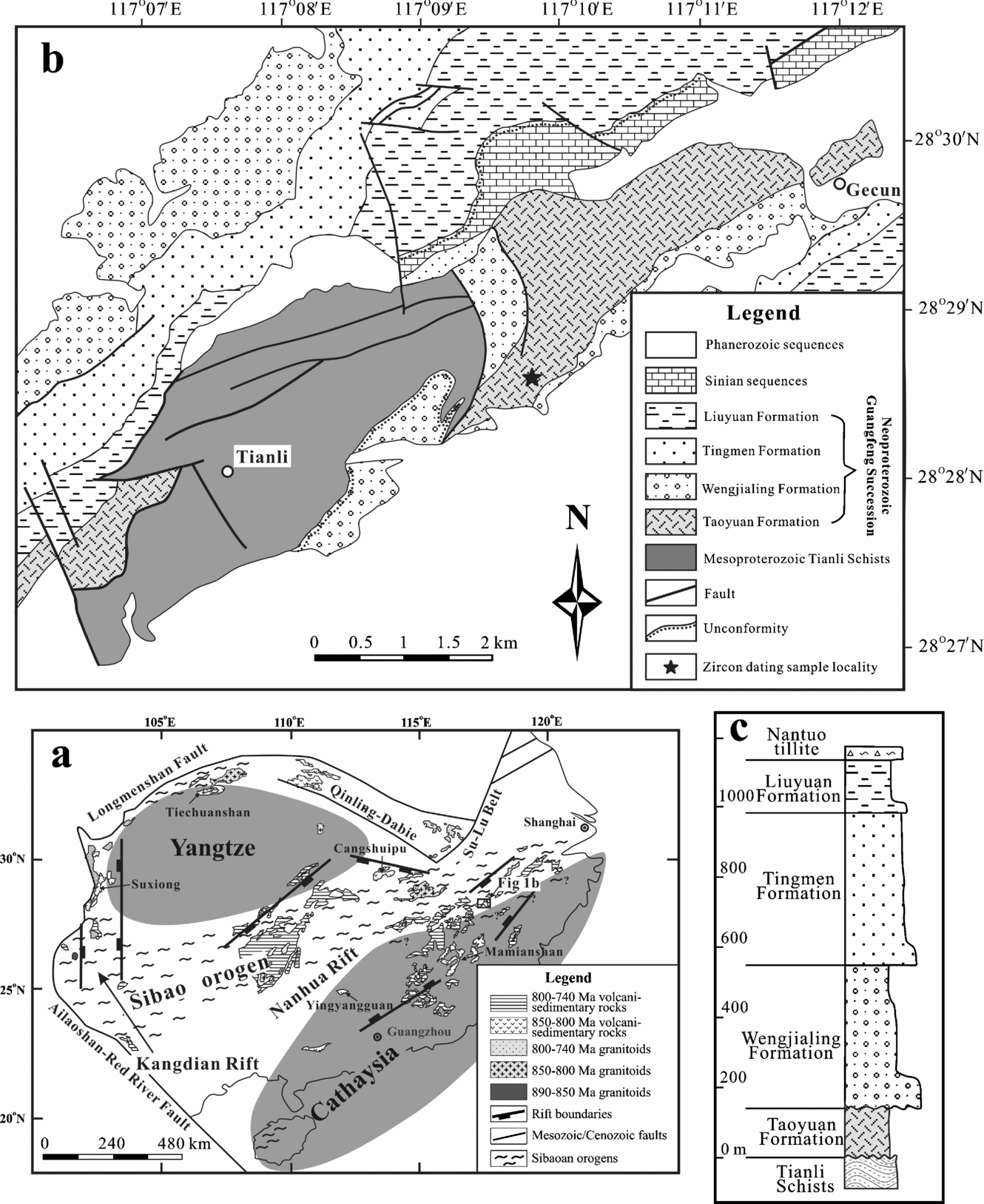
(a) Neoproterozoic rift basin, Sibaoan Orogen and distribution of magmatic rocks in South China (modified after Li et al. Reference Li, Li, Zhou and Kinny2002b, Reference Li, Li, Kinny, Wang, Zhang and Zhou2003b; Wang & Li, Reference Wang and Li2003), (b) Geological map of the Guangfeng region (modified after the 1:50000 geological map), and (c) Neoproterozoic stratigraphic column of Guangfeng region (after Li et al. Reference Li, Wang, Li and Zhang2003c).

Zhou and co-workers (e.g. Zhou et al. Reference Zhou, Kennedy, Sun, Malpas and Lesher2002b, Reference Zhou, Yan, Kennedy, Li and Dingc, Reference Zhou, Ma, Yan, Xia, Zhao and Sun2006a,Reference Zhou, Yan, Wang, Xia, Zhao and Sunb), on the other hand, interpreted the 860–760 Ma magmatic rocks as products of subduction around the Yangtze Block, a part of the South China Block. In their model, the South China Block was either an isolated continent, or was located on the periphery of Rodinia during Neoproterozoic times. Others interpreted some of the c. 820–800 Ma granitic rocks as products related to the continental collision between the Yangtze and Cathaysia blocks or post-collisional extensional collapse (e.g. Wang et al. Reference Wang, Zhou, Qiu, Zhang, Liu and Zhang2006; Wu et al. Reference Wu, Zheng, Wu, Zhao, Zhang, Liu and Wu2006), rather than the products of crustal anatexis caused by conductive heating above a mantle plume (Li et al. Reference Li, Li, Ge, Zhou, Li, Liu and Wingate2003a).
The Neoproterozoic Guangfeng succession is located in the northern margin of the Northern Zhejiang sub-basin, part of the broader Nanhua basin (Fig. 1b) (Wang & Li, Reference Wang and Li2003). The outcrop is a small (about 300 km2) but well-preserved Neoproterozoic volcano-sedimentary succession (Wang & Gao, Reference Wang and Gao2003). Volcanic rocks occur at the bottom of the basin that overlies on the Mesoproterozoic Tianli Schists (Li et al. Reference Li, Wartho, Occhipinti, Zhang, Li, Wang and Bao2007c) with a high-angle unconformity. Therefore, they were formed after the Sibaoan orogenesis. In this paper we report new SHRIMP U–Pb zircon ages and geochemical and Nd isotopic results of the volcanic rocks from the Guangfeng succession, with the aim of characterizing their petrogenesis and tectonic implications.
2. Geological setting and petrography
The South China Block is bounded by the Qinling–Dabie–Sulu orogenic belt to the north, the Longmenshan Fault to the northwest, and the Ailaoshan–Red River Fault to the southwest (Fig. 1a). It is generally believed to have been formed through amalgamation of the Yangtze and Cathaysia blocks. The oldest rocks in the Yangtze Block are the 3.2 to 2.9 Ga Kongling complex (e.g. Qiu et al. Reference Qiu, Gao, McNaughton, Groves and Ling2000; Zhang et al. Reference Zhang, Zheng, Wu, Zhao, Gao and Wu2006a) occurring near the Yangtze Gorge. More recently, Zheng et al. (Reference Zheng, Griffin, O'Reilly, Zheng, Pearson and Pan2006) and Zhang et al. (Reference Zhang, Zheng, Wu, Zhao, Gao and Wu2006b) suggested that the Archaean to Palaeoproterozoic basement is probably widespread beneath the Yangtze Block. The oldest igneous rocks found in the Cathaysia Block are the c. 1.8 Ga granite and metavolcanic rocks (e.g. Li, Reference Li1997; Li & Li, Reference Li and Li2007).
Neoproterozoic igneous rocks are widespread in South China, with most occurring in the Kangdian Rift (a SN-trending failed rift along the western Yangtze Block) and the Nanhua Rift (a broad, NE-trending rift basin between the southern Yangtze and northern Cathaysia blocks, Fig. 1a). They were floored unconformably by strongly deformed, late Mesoproterozoic to early Neoproterozoic successions and c. 825–820 Ma granitoids that were exposed to the surface soon after emplacement due to rapid continental-scale doming and unroofing (Li, et al. Reference Li, Li, Kinny and Wang1999, Reference Li, Li, Ge, Zhou, Li, Liu and Wingate2003a,Reference Li, Li, Kinny, Wang, Zhang and Zhoub; Wang & Li, Reference Wang and Li2003). The Nanhua Rift can be further subdivided into three sub-rift basins, namely the Hunan–Guangxi sub-basin, the Jiangnan Ridge sub-basin and the Northern Zhejiang sub-basin (Wang & Li, Reference Wang and Li2003). The Guangfeng succession is located at the northern margin of the Northern Zhejiang sub-basin along the southeastern margin of the Yangtze Block (Fig. 1a, b).
The Guangfeng succession consists of a basal conglomerate unit and volcanic rocks, and lacustrine, fluvial and littoral marine facies sedimentary rocks (Wang & Gao, Reference Wang and Gao2003; Li et al. Reference Li, Wang, Li and Zhang2003c). It is subdivided into four formations according to the petrological assemblages and sedimentological characteristics (Fig. 1c). They are, from bottom to top: (1) the Taoyuan Formation, consisting predominantly of volcanic and pyroclastic rocks that uncomfortably overlie the Mesoproterozoic Tianli Schists, (2) the Wenjialing Formation, comprising volcanic conglomerate overlying both the Tianli Schists and the Taoyuan Formation volcanic rocks, (3) the Tingmeng Formation, consisting of purplish-red, thick-bedded to massive fluvial feldspathic litharenite, quartz feldspathic litharenite, siltstone and silty mudstone, and (4) the Liuyuan Formation, comprising thick-bedded pebbly quartz-sandstone with well-developed littoral marine cross-beddings. Overlying the Liuyuan Formation is the Nantuo glacial-marine deposits (tillite), which is a Marinoan-aged glaciation event dated at c. 600–630 Ma (Zhou et al. Reference Zhou, Tucker, Xiao, Peng, Yuan and Chen2004). Two unpublished U–Pb ages of c. 820 Ma have previously been quoted for the andesite and rhyolite in the Taoyuan Formation (Zhang, Yan & Yan, Reference Zhang, Yan and Yan1991; Wang & Gao, Reference Wang and Gao2003).
Volcanic rocks in the Taoyuan Formation include basaltic and andesitic rocks at the bottom of the formation, and felsic rocks mainly at the top of the formation, with an estimation of the basalt:andesite:rhyolite ratios being roughly 4:1:5 (Guan & Yu, Reference Guan and Yu1993). The basaltic rocks include porphyritic olivine basalts, which are dark-green in colour, containing sparse plagioclase and olivine phenocrysts, 0.7–1.5 mm in size. The olivine and plagioclase phenocrysts were altered to serpentine and carbonate, respectively. The groundmass of the basaltic rocks is aphanitic to microlitic (0.05–0.08 mm), consisting of oligoclase/andesine, olivine, augite(?) and Fe–Ti oxide with strong carbonation and chloritization alteration. The andesitic rocks are brick-red in colour, containing abundant (30–50%) plagioclase and minor amounts of K-feldspar(?) and pyroxene(?) phenocrysts with variable grain sizes between 0.2 mm and 3 mm. All phenocryst minerals were strongly altered. The groundmass of the andesitic rocks is microlitic, composed predominantly of plagioclase and sparse Fe–Ti oxides, with most minerals being altered (carbonation and chlorization). The felsic rocks are light-grey in colour, containing sparse quartz, plagioclase and K-feldspar phenocrysts. The groundmass of the felsic rocks is aphitic to microlitic with weakly rhyotaxitic structure, consisting of quartz, plagioclase and K-feldspar, and with variable degrees of sericitization.
3. Analytical methods
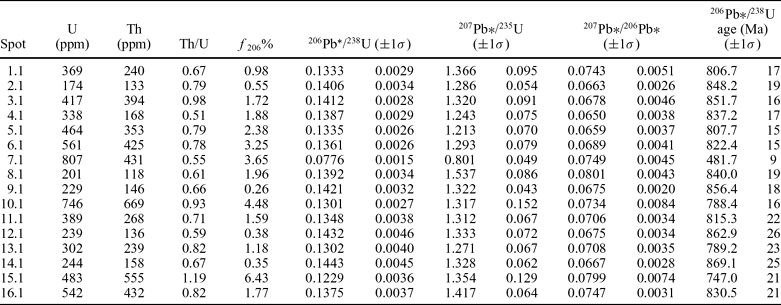
Zircons were separated using standard density and magnetic separation techniques. Zircon grains, together with zircon U–Pb standard TEMORA, were cast in an epoxy mount, which was then polished to section the crystals in half for analysis. Zircons were documented with transmitted and reflected light micrographs and cathodoluminescence (CL) images as a guide to isotopic analytical spot selection and the mount was vacuum-coated with high-purity gold. U–Pb isotopic compositions were analysed by using the SHRIMP II ion microprobe at the Beijing SHRIMP Center, Chinese Academy of Geological Sciences. U–Th–Pb ratios were determined relative to the TEMORA standard zircon with 206Pb/238U=0.0668 corresponding to 417 Ma (Black et al. Reference Black, Kamo, Allen, Aleinikoff, Davis, Korsch and Foudoulis2003), and the absolute abundances were calibrated to the standard zircon SL13. Analyses of the TEMORA standard zircon were interspersed with those of unknown grains, following operating and data processing procedures similar to those described by Williams (Reference Williams1998). Measured compositions were corrected for common Pb using the 204Pb-method, and an average crustal composition (Cumming & Richards, Reference Cumming and Richards1975) appropriate to the age of the mineral was assumed. Uncertainties on individual analyses are reported at the 1σ level, and mean ages for pooled 206Pb/238U results are quoted at the 95% confidence level. U–Pb zircon data are listed in Table 1.
SHRIMP U–Pb zircon data for Guangfeng rhyolite

Data in this table were calculated after 204Pb corrections. The common Pb compositions were estimated from 204Pb counting, assuming an isotopic composition of Broken Hill lead related to surface contamination (Nelson, Reference Nelson1997). All errors are 1 sigma (1σ).
Because the basaltic and andesitic rocks are variably carbonatized, the rock powders were washed using dilute acetic acid to minimize the alteration effect before analyses. Major element oxides and trace elements were determined using a Rigaku ZSK100e XRF on fused glass beads and a Perkin-Elmer Sciex ELAN 6000 ICP-MS, respectively, at the Guangzhou Institute of Geochemistry, Chinese Academy of Sciences. Analytical procedures were similar to those described by Li et al. (Reference Li, Sun, Wei, Liu, Lee and Malpas2000, Reference Li, Qi, Liu, Liang, Tu, Xie and Yang2005). A mixture of 0.5 g powdered samples and 4 g Li2B4O7 was fused as a glass bead for XRF analysis. A loss-on-ignition (LOI) measurement was undertaken on samples of dried rock powder by heating in a pre-ignition silica crucible to 1000°C for one hour and recording the percentage weight loss. Analytical uncertainties of major elements are between 1% and 5%. About 50 milligrams of each powdered sample were dissolved in a high-pressure Teflon bomb for 24 hours using a HF+HNO3 mixture to ensure complete sample digestion. Rh was used as an internal standard to monitor signal drift during counting. The USGS standards BCR-1, BHVO-1, W-2, G-2 and GSP-1 were used for calibrating element concentrations of measured samples. Analytical precision is generally better than 3% for most trace elements.
The Nd fraction was separated by passing through cation columns followed by HDEHP columns. Nd isotopic compositions were determined using a Micromass Isoprobe multi-collector ICP-MS (MC-ICP-MS) at the Guangzhou Institute of Geochemistry. Analytical procedures were similar to those described by Li et al. (Reference Li, Liu, Sun, Li, Liang and Liu2004). Samples were taken up in 2% HNO3, and the aqueous solutions were introduced into the MC-ICPMS using a Meinhard glass nebulizer with an uptake rate of 0.1 ml/minute. The inlet system was washed out for five minutes between analyses using high-purity 5% HNO3, followed by a blank solution of 2% HNO3, from which the sample solutions were prepared. The Isoprobe MC-ICPMS was operated in a static mode, and yielded 143Nd/144Nd=0.512125±11 (2σ) on 14 runs for the Shin Etsu JNdi-1 standard during this study. Measured 143Nd/144Nd ratios were normalized to 146Nd/144Nd=0.7219. The reported 143Nd/144Nd ratios are adjusted relative to the Shin Etsu JNdi-1 standard of 0.512115, corresponding to the La Jolla standard of 0.511860 (Tanaka et al. Reference Tanaka and 19 co-authors2000).
4. Results
4.a. SHRIMP U–Pb zircon age
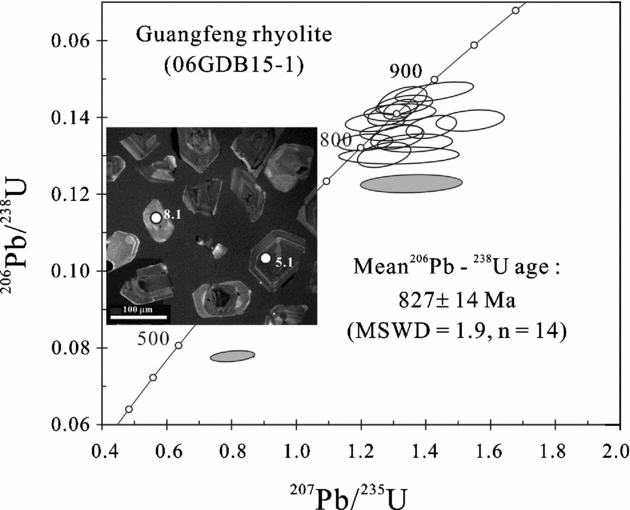
Sample 06GDB15-1 (28°28′35″N; 117°09′50″E) is a rhyolite collected from the top of the Taoyuan Formation at the Shilong Reservoir. Zircon grains from this sample are mostly euhedral, ranging from 50 to 100 μm in length, with length to width ratios of 1:1 to 2:1. They are relatively transparent and colourless, although a few are dark brown and turbid. Euhedral concentric zoning is common in most zircons under CL images and no inherited zircon cores were visible (Fig. 2 inset). Sixteen analyses of 16 zircons were obtained in sets of five scans during a single session (Table 1). They have highly variable abundance of U (174–807 ppm) and Th (118–669 ppm). Th/U ratios vary between 0.51 and 1.19, mostly clustering around 0.5–0.8. Common Pb varies, with f 206 values falling in the range of 0.26% to 6.43%. Apart from two analyses (spots 7.1 and 15.1) that are obviously discordant due to partial loss of radiogenic Pb (Fig. 2), the remaining 14 analyses gave 206Pb/238U ratios indistinguishable within analytical errors, and their weighted mean yields an age of 827±14 Ma (95% confidence interval). This age is interpreted as the best estimate of the formation age of sample 06GDB15-1.
U–Pb zircon concordia diagram for the Guangfeng rhyolite. Inset shows representative zircon CL images. Data not included in the calculated age for the sample are shown as grey-filled symbols.

4.b. Major and trace element geochemistry
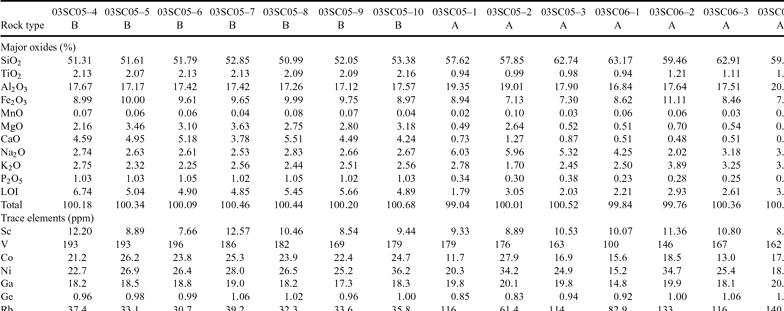
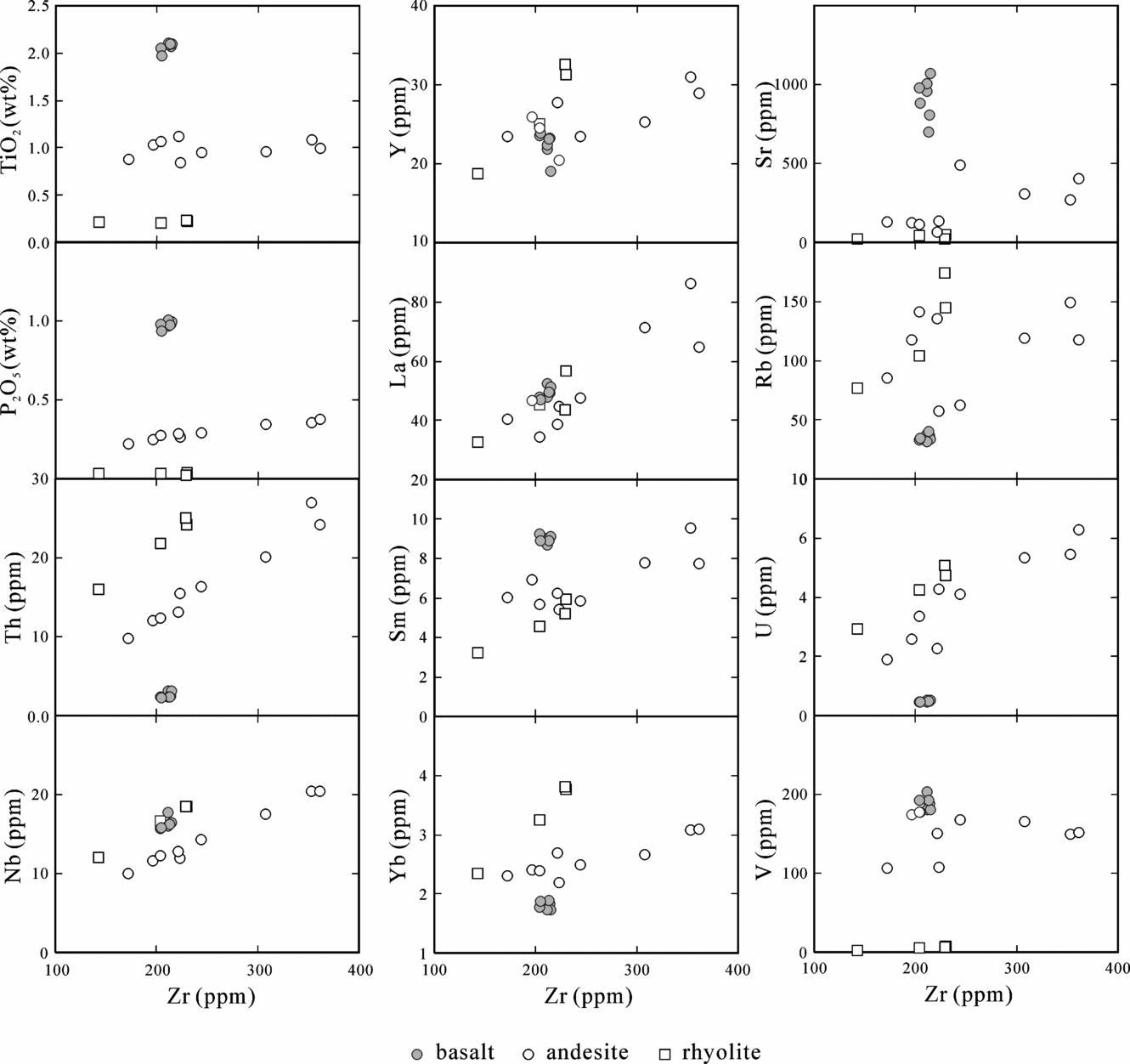
Twenty Guangfeng volcanic rock samples were used for major and trace elements analyses. The results are listed in Table 2. Because all samples underwent varying degrees of alteration which might have modified the contents of mobile components (Romer, Forster & Breitkreuz, Reference Romer, Forster and Breitkreuz2001), the mobility of the major and trace elements needs to be evaluated. In general, zirconium, which is considered to be immobile during low-grade alteration of mafic to intermediate igneous rocks (Gibson et al. Reference Gibson, Kirkpatrick, Emmerman, Schmincke, Pritchard, Okay, Thorpe and Marriner1982), has been plotted against some major and trace elements (Fig. 3). Although the basalts have highest LOI (loss of ignition) values of between 4.85% and 6.74%, the high field-strength elements (HFSE: Nb, Ti, P, Th, Y and V) and rare earth elements (REE) show fairly homogeneous geochemical compositions, indicating that these elements are generally immobile, whereas some large ion lithophile elements (LILE: Sr) and Ni are mobile, as demonstrated by their obvious variations (Fig. 3). Similarly, the HFSE (Ti, P, Nb and Th) and REE show close correlations with Zr for the andesitic and rhyolitic samples, implying that they are generally immobile. On the contrary, the LILE (Sr, Rb), Ni and V are scattered, suggesting that they are probably mobile during alteration. Therefore, mainly the immobile elements, such as HFSE (Ti, P, Nb, Ta, Zr, Hf, Th, V) and REE, are used for further petrogenetic discussions.
Major and trace elements results for Guangfeng volcanic rocks

B – basalt; A – andesite; RH – rhyolite. Total iron as Fe2O3.
TZr=12900/(2.95 + 0.85M + ln(496000/Zrmelt)) (Miller, McDowell & Mapes, Reference Miller, McDowell and Mapes2003), where M=(Na+K+2Ca)/(Al×Si) (Watson & Harrison, Reference Watson and Harrison1983).
TZr (°C) is not calculated for 03SC04-3 due to low M value of 0.5.
Plots of selected major and trace elements versus Zr.

The basaltic rocks are characteristically high in TiO2 (2.07–2.16%), P2O5 (1.02–1.05%), Al2O3 (17.12–17.67%) and Nb/Y ratio of 0.86–0.92, uniform in SiO2 (51–53.4%) and low in MgO (2.2–3.5%), belonging to alkaline basalts. The andesitic rocks, on the other hand, have considerably higher and variable SiO2 (57.6–65.6%), but lower MgO (0.49–0.70%) and TiO2 (0.84–1.21%), except for sample 03SC05-2 which has relatively high MgO (2.64%). The rhyolitic rocks are highly siliceous (SiO2=74.3–76.6%) and peraluminous (A/CNK >1.6). The three groups of volcanic rocks have different evolved trends in most Zr versus major and trace elements plots (Fig. 3, Table 2), especially in Zr v. TiO2, P2O5, Th and Nb plots, suggesting that they are not cogenetic.
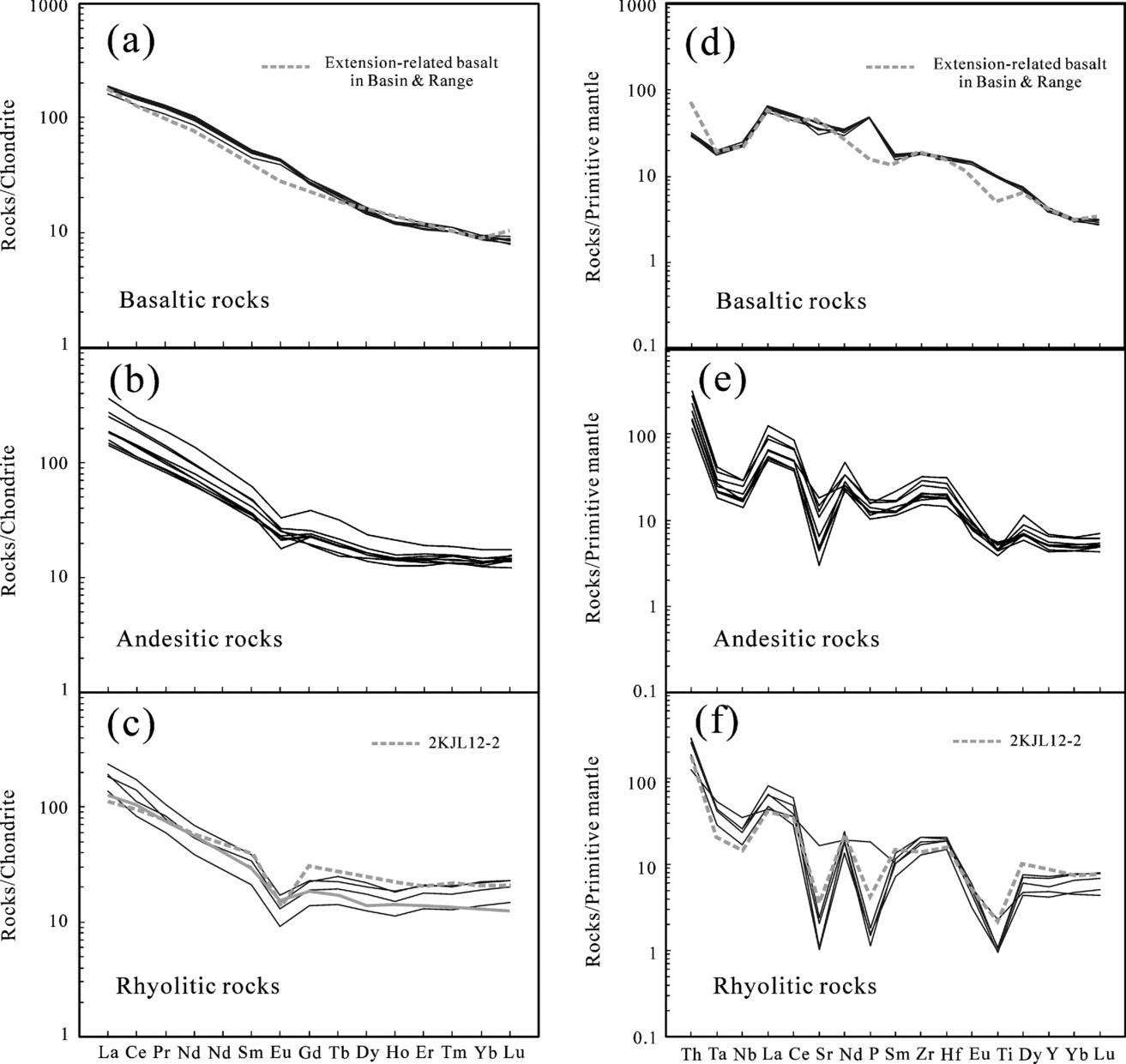
On the chondrite-normalized diagrams (Sun & McDonough, Reference Sun, McDonough, Saunders and Norry1989), all basaltic rocks have uniform and significant LREE-enriched patterns (Fig. 4a) with LaN/YbN=17.6–21.2, and slightly positive Eu anomalies (δEu=1.1–1.2). Contrarily, the andesitic rocks have variable REE abundances and LREE-enriched patterns (Fig. 4b) with moderate Eu negative anomalies (δEu=0.7–0.9). They are characterized by steeply right-inclined LREE patterns (LaN/SmN=4.4–5.8) but gently right-inclined HREE patterns (GdN/YbN=1.5–2.2). The rhyolitic rocks show uniform LREE-enriched and MREE to HREE-flat patterns, with LaN/SmN=5.1–6.0, GdN/YbN ≈ 1.0 and significant Eu negative anomalies (δEu=0.50–0.55) (Fig. 4c). It is noted that their REE patterns are strikingly similar to those of the regional c. 820 Ma peraluminous granitoids from southern Anhui and northern Jiangxi provinces (Li et al. Reference Li, Li, Ge, Zhou, Li, Liu and Wingate2003a; Wu et al. Reference Wu, Zheng, Wu, Zhao, Zhang, Liu and Wu2006).
Chondrite-normalized REE diagrams (a–c) and primitive mantle-normalized trace elements diagrams (d–f). The basalts show REE and trace elements patterns similar to that of the Cenozoic extension-related basalts in the Basin & Range Province, and the rhyolites similar to that of the c. 825 Ma peraluminous granites. Data from Cenozoic basalts in the Basin & Range are after Hawkesworth et al. (Reference Hawkesworth, Turner, Gallagher, Hunter, Bradshaw and Rogers1995). Sample 2KJL12–2 is a c. 820 Ma peraluminous granite in northern Jiangxi (after Li et al. Reference Li, Li, Ge, Zhou, Li, Liu and Wingate2003a). Normalization values are after Sun & McDonough (Reference Sun, McDonough, Saunders and Norry1989).

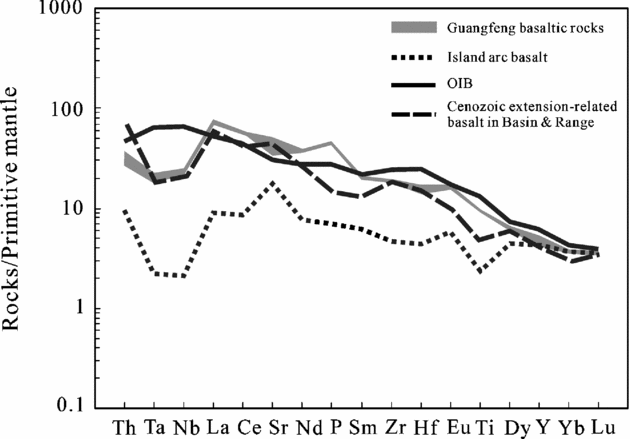
On the primitive mantle-normalized trace element diagrams (Fig. 4d), the basaltic rocks show ‘humped’ patterns characterized by variable enrichments in most incompatible trace elements but depletions in Nb and Ta relative to neighbouring elements, resembling those of the Cenozoic extension-related basalts in the Basin and Range Province (e.g. Hawkesworth et al. Reference Hawkesworth, Turner, Gallagher, Hunter, Bradshaw and Rogers1995). The andesitic rocks are characterized by obvious Nb and Ta depletions relative to La and Th, with Nb/La=0.24–0.36 and Nb/Th=0.87–1.01. Their primitive mantle-normalized trace element patterns resemble that of the average middle crust (Fig. 4e). The rhyolitic rocks have strongly fractional patterns with significant depletions in Nb, Ta, Sr, P and Ti, due to fractional crystallization of plagioclase, apatite and Fe–Ti oxides, or as residual minerals in the source (Fig. 4f). Their patterns are similar to those of the average upper crust and the regional c. 820 Ma peraluminous granitoids (Li et al. Reference Li, Li, Ge, Zhou, Li, Liu and Wingate2003a; Wu et al. Reference Wu, Zheng, Wu, Zhao, Zhang, Liu and Wu2006).
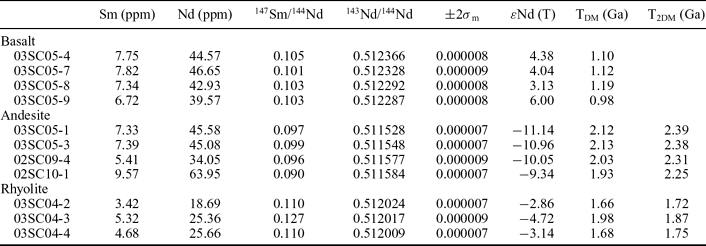
4.c. Nd isotopes
Eleven samples were selected for Nd isotope analyses, including four basaltic rocks, four andesitic rocks and three felsic rocks. The results are listed in Table 3. The three groups of rocks have different Nd isotopic compositions. The basaltic samples have relatively constant 147Sm/144Nd (0.1013–0.1052) and 143Nd/144Nd (0.51229–0.51244) ratios, corresponding to initial ɛNd(T) values of 3.1 to 6.0 and single-stage Nd model ages (TDM) of 1.0–1.2 Ga. The andesitic rocks have significantly lower and uniform 147Sm/144Nd (0.0868–0.0991) and 143Nd/144Nd (0.51152–0.51158) ratios. Thus, they have significantly lower ɛNd(T) values of −9.3 to −11.1 and older two-stage Nd model ages (T2DM) of 2.3–2.4 Ga, suggesting a Palaeoproterozoic/Neoarchaean source for these rocks. The rhyolitic rocks show constant Sm–Nd isotopic compositions, with 147Sm/144Nd=0.1103–0.1268, 143Nd/144Nd=0.51201–0.51202, corresponding to ɛNd(T) values of −2.9 to −4.7 and T2DM ages of 1.7–1.9 Ga, in between those of the associated basaltic and andesitic rocks. The Sm–Nd isotopic compositions of the rhyolites are also comparable with those of the regional c. 820 Ma peraluminous granitoids (Li et al. Reference Li, Li, Ge, Zhou, Li, Liu and Wingate2003a; Wu et al. Reference Wu, Zheng, Wu, Zhao, Zhang, Liu and Wu2006).
Nd isotopic results for Guangfeng volcanic rocks

T=827 Ma, formation age of Guangfeng volcanic rocks. Single- and two-stage Nd model age, TDM and T2DM are calculated using formulas and parameters given by Li et al. (Reference Li, Li, Ge, Zhou, Li, Liu and Wingate2003a).
5. Petrogenesis
5.a. Basaltic rocks
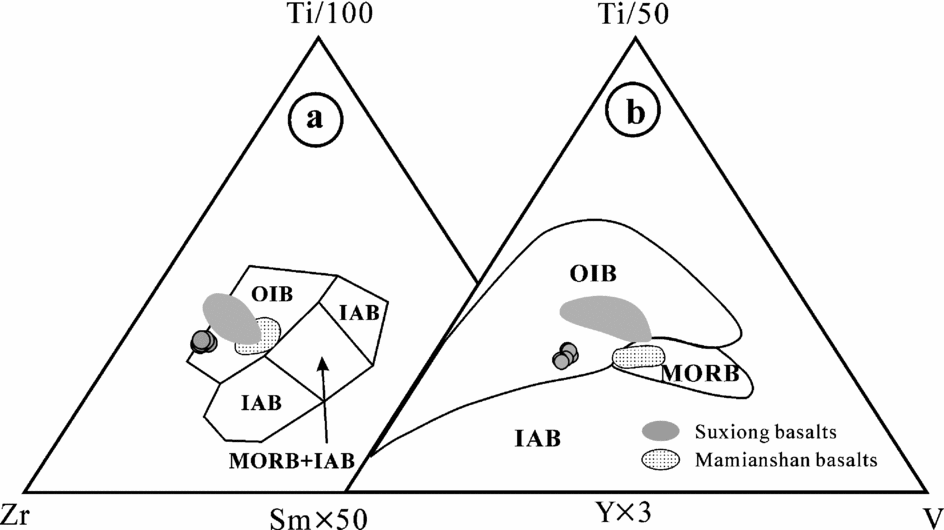
The Guangfeng alkaline basaltic rocks are characterized by high HSFE contents such as Nb=16–18 ppm, Zr=197–207 ppm and TiO2=2.07–2.16%. On the tectonic discrimination diagrams of Ti–Zr–Y (Pearce & Cann, Reference Pearce and Cann1973) and Ti–Sm–V (Vermeesch, Reference Vermeesch2006), they plot exclusively into the OIB field, consistent with the same-aged Suxiong and Mamianshan alkaline basalts from the western Yangtze and northern Cathaysia blocks, respectively (Fig. 5a, b). In addition, the Guangfeng basalts are high in Zr/Y (11–12), exhibiting a broad geochemical similarity to the Cenozoic extension-related basalts in the Basin and Range Province (e.g. Hawkesworth et al. Reference Hawkesworth, Turner, Gallagher, Hunter, Bradshaw and Rogers1995).
Tectonic discrimination diagram of (a) Ti–Zr–Y (Pearce & Cann, Reference Pearce and Cann1973) and (b) Ti–Sm–V (Vermeesch, Reference Vermeesch2006) for the Guangfeng basalts. The coveal Suxiong and Mamianshan basalts are shown for comparison (data after Li et al. Reference Li, Li, Zhou, Liu and Kinny2002a and Li, Li & Li, Reference Li, Li and Li2005). Symbols are as in Figure 3.

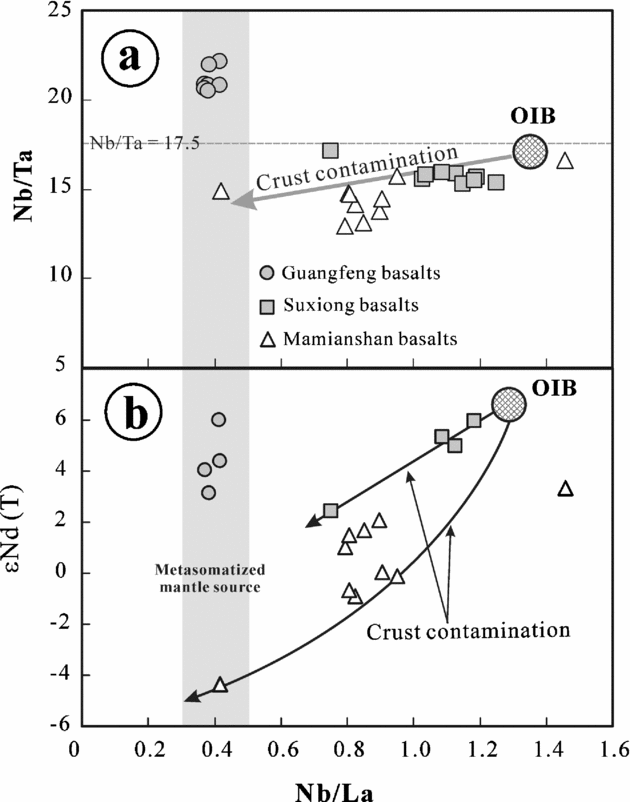
The Guangfeng basalts show clear Nb–Ta negative anomalies (Nb/La=0.37–0.41) (Fig. 4d), an often-quoted ‘diagnostic’ feature of arc basalts, but their geochemical characteristics are significantly different from those of arc basalts (Fig. 6). Depletion in Nb and Ta relative to La and Th in the intraplate basalts could be attributed to different processes including: (1) fractional crystallization of Ti-bearing minerals such as titanomagnetite, (2) contamination by crustal material during ascent of magmas, and (3) inheritance from their mantle source which had been previously metasomatized by subduction-related fluids and/or melts. The Guangfeng basalts are characteristically high in TiO2 (>2.0%) without visible Ti negative anomaly in the primitive mantle-normalized spidergrams (Fig. 4d), precluding significant fractional crystallization of titanomagnetite. It is noted that these basalts have lower Nb/La ratios (0.37–0.41) than those of crustal sources (Nb/La=0.47–0.83: Rudnick & Fountain, Reference Rudnick and Fountain1995). Considering their high-positive εNd(T) values, crustal contamination should have played very minor, if any, roles in the genesis of these basalts. Thus, their depletion in Nb–Ta relative to La and Th is most likely inherited from the mantle source that had been previously metasomatized by subduction-related fluids/melts. The Guangfeng basalts have super-chondritic Nb/Ta ratios of 20.5 to 22.1, inconsistent with same-aged Suxiong and Mamianshan basalts which have Nb/Ta ratios exclusively below 17.5 (Fig. 7a). Because the Nb/Ta ratios of lower to upper crust are in the range of 8.3 to 11.3 (Rudnick & Fountain, Reference Rudnick and Fountain1995), the super-chondritic Nb/Ta ratios of the Guangfeng basalts should have been inherited from the mantle source, rather than caused by the contamination of crustal material. Numerous experimental and geochemical studies indicate that siliceous melts derived from subducted oceanic slab have super-chondritic Nb/Ta ratios due to residual rutile in the source which could significantly fractionate Nb from Ta, whereas the opposite effect was observed for rutile in slab-derived fluids (Green & Pearson, Reference Green and Pearson1987; Brenan et al. Reference Brenan, Shaw, Phinney and Ryerson1994; Keppler, Reference Keppler1996; Stolz et al. Reference Stolz, Jochum, Spettel and Hofmann1996; Münker, Reference Münker1998; Münker et al. Reference Münker, Wörner, Yogodzinski and Churikova2004; Xiong, Adam & Green, Reference Xiong, Adam and Green2005; Xiong et al. Reference Xiong, Xia, Xu, Niu and Xiao2006; Xiong, Reference Xiong2006). Therefore, the Guangfeng basaltic rocks were most likely generated by partial melting of a subcontinental lithospheric mantle source that had been metasomatized by slab-derived melts. Their TDM ages of 1.0–1.2 Ga suggest that the mantle metasomatism might have taken place shortly before their formation, possibly during the c. 1.1–0.9 Ga Sibao orogeny (e.g. Li et al. Reference Li, Li, Zhou and Kinny2002b, Reference Li, Wartho, Occhipinti, Zhang, Li, Wang and Bao2007c; Li & Li, Reference Li and Li2003; Ye et al. Reference Ye, Li, Li, Liu and Li2007).
Comparison of incompatible trace element spider diagrams between the Guangfeng basalts and the average island-arc basalt (McCulloch & Gamble, Reference McCulloch and Gamble1991), OIB (Sun & McDonough, Reference Sun, McDonough, Saunders and Norry1989) and Cenozoic basalt in the Basin and Range Province (Hawkesworth et al. Reference Hawkesworth, Turner, Gallagher, Hunter, Bradshaw and Rogers1995).

Plots of (a) Nb/La v. Nb/Ta and (b) Nb/La v. εNd(T) show that the Guangfeng basalts have super-chondritic Nb/Ta and low Nb/La ratios, suggesting derivation from siliceous melting of a metasomatized mantle source, whereas the same-aged Suxiong and Mamianshan basalts in the western Yangtze and northern Cathaysia blocks, respectively, have sub-chondritic Nb/Ta ratios (<17.5), relative high Nb/La ratios and obvious crustal contamination trends, suggesting that they were derived mainly from OIB-like mantle sources with contamination of crustal materials. Data of the Suxiong and Mamianshan basalts are from from Li et al. (Reference Li, Li, Zhou, Liu and Kinny2002a) and Li, Li & Li (Reference Li, Li and Li2005), respectively.

5.b. Andesitic rocks
Three main viewpoints have been proposed to interpret the origin of andesitic rocks: (1) fractionated crystallization of basaltic rocks derived from mantle peridotite; (2) dehydration partial melting of metabasalts (amphibolites) or metasedimentary rocks in the lower or middle crust by underplating and/or intrusions of hot, mantle-derived magma; and (3) mixing of mantle-derived basaltic magmas with crust-derived felsic melts.
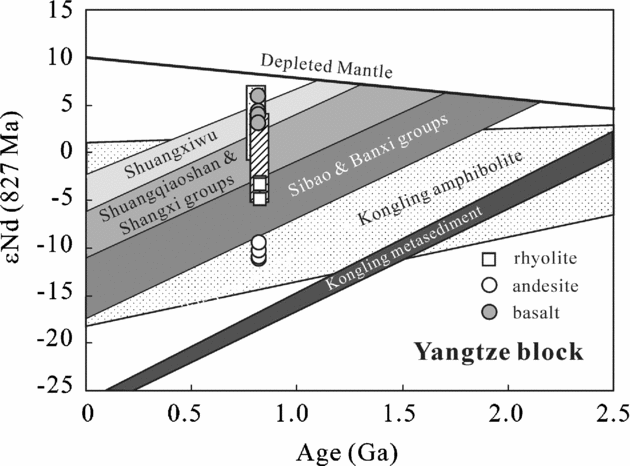
The Guangfeng andesitic rocks have significantly lower ɛNd(T) values (between −9.3 and −11.1) than the associated basaltic rocks which have high positive ɛNd(T) values of 3.1 to 6.0, indicating that the andesitic rocks were unlikely to have originated by simple fractional crystallization of the basaltic parental magmas. The andesites are characterized by a wide range of SiO2 contents (57.62–65.60%) and early Palaeoproterozoic T2DM ages of 2.3–2.4 Ga, suggesting significant involvement of ancient crustal components. Furthermore, their T2DM values are obviously older than most pre-900 Ma metasedimentary rocks in the southeastern margin of the Yangtze Block (e.g. Chen & Jahn, Reference Chen and Jahn1998; Li & McCulloch, Reference Li and McCulloch1996), indicating that there likely exist unexposed ancient crustal rocks (Fig. 8). Such Palaeoproterozoic- to Archaean-aged basement rocks are exposed in the Kongling area of the northern Yangtze Block only (Gao et al. Reference Gao, Ling, Qiu, Zhou, Hartmann and Simon1999; Qiu et al. Reference Qiu, Gao, McNaughton, Groves and Ling2000; Zhang et al. Reference Zhang, Zheng, Wu, Zhao, Gao and Wu2006a,Reference Zhang, Zheng, Wu, Zhao, Gao and Wub), but could be widespread beneath the whole Yangtze Block as well (e.g. Zheng et al. Reference Zheng, Griffin, O'Reilly, Zheng, Pearson and Pan2006; Greentree et al. Reference Greentree, Li, Li and Wu2006). Although the Kongling amphibolites have ɛNd(T) values between 1.5 and −11.93 at 825 Ma, broadly consistent with the ɛNd(T) values of Guangfeng andesites (−9.3 to −11.1), equilibrium partial melting calculations on the basis of the trace elements (Nb and Zr) indicate that it would require about 60–70% melting of the Kongling amphibolites to match the trace element features of the Guangfeng andesites (assuming the residual mineral assemblage is Pl:Cpx:Opx:Mt ≈ 55:30:5:10 and DNb=0.23, DZr=0.11: Beard & Lofgren, Reference Beard and Lofgren1991; Rollinson, Reference Rollinson1993). Such large degrees of melting are inconceivable and inconsistent with the experimental results (SiO2 generally >60% and melting percentage <40% at water-unsaturated dehydration condition: Beard & Lofgren, Reference Beard and Lofgren1991). Therefore, partial melting of the Archaean amphibolites alone is unlikely to have produced the Guangfeng andesite.
Nd isotopic evolution plot of the Guangfeng volcanic rocks. Nd isotopic evolution trends for the Yangtze Block are after Chen & Jahn, (Reference Chen and Jahn1998) and Gao et al. (Reference Gao, Ling, Qiu, Zhou, Hartmann and Simon1999). Small vertical rectangles with dots and stripes indicate the Suxiong and Mamianshan basalts, respectively. Nd isotopic data from the Suxiong and Mamianshan basalts are from Li et al. (Reference Li, Li, Zhou, Liu and Kinny2002a) and Li, Li & Li (Reference Li, Li and Li2005).

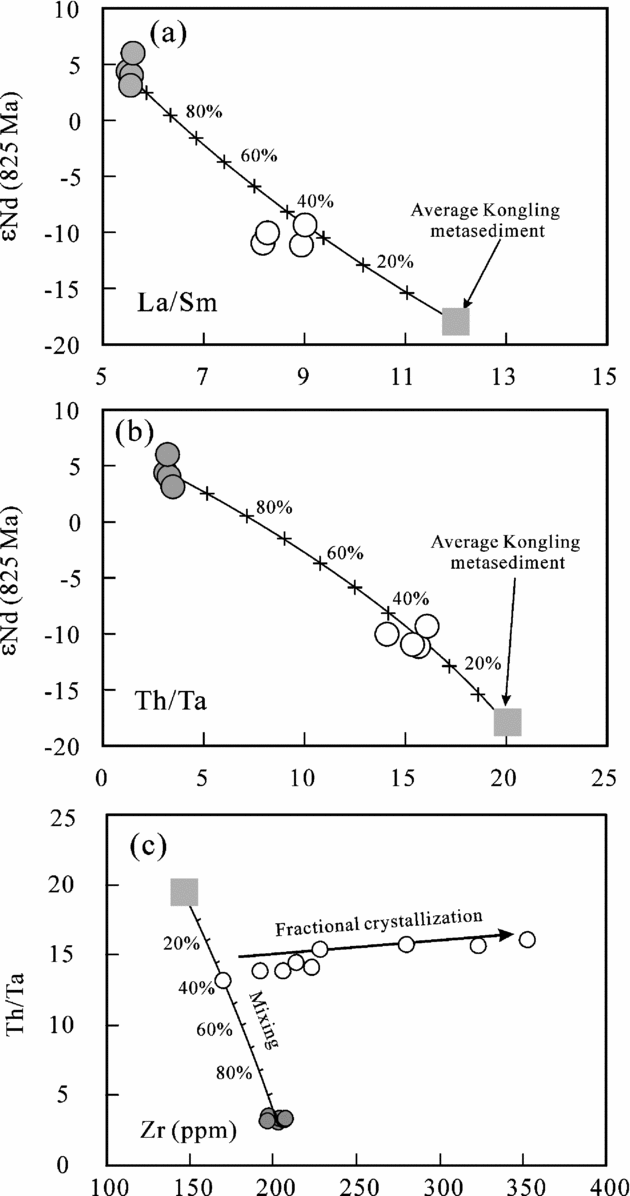
It is noteworthy that the ɛNd(T) values of the Guangfeng andesitic rocks are even lower than those of the associated felsic volcanic rocks (ɛNd(T)=−2.9 to −4.7), indicating that these andesitic rocks could not have been formed by mixing of mantle-derived basaltic magmas and associated felsic melts. However, generation by mixing of basaltic magmas with felsic melts derived from unexposed ancient middle-lower crustal rocks, such as the Kongling metasedimentary rocks (e.g. Gao et al. Reference Gao, Ling, Qiu, Zhou, Hartmann and Simon1999), is possible. Two-component mixing calculations suggest that the Guangfeng andesites could have been formed by mixing of the associated basalts with about 30–40% of the Kongling metasediments (Fig. 9a, b). It is noted that the andesitic rocks have a wide range of SiO2 and their Th/Ta ratios increase slightly with increasing Zr content (Fig. 9c), suggesting strong fractional crystallization. Niobium, Th and REE are positively correlated with Zr (Fig. 3), suggesting that clinopyroxene and plagioclase are predominant minerals involved in fractional crystallization, because the partition coefficients of these elements in clinopyroxene and plagioclase are <1 for the andesitic melts, whereas they are >1 in amphibole (Rollinson, Reference Rollinson1993).
Plots of (a) εNd(T) v. La/Sm, (b) εNd(T) v. Th/Ta and (c) Th/Ta v. Zr, showing two-component mixing modal calculation for the generation of the Guangfeng andesites. The andesites could have been formed by mixing of evolved basalt magmas with about 30–40% felsic melts derived from the Archaean Kongling metasediments (Gao et al. Reference Gao, Ling, Qiu, Zhou, Hartmann and Simon1999), followed by fractional crystallization. Symbols are as in Figure 3.

5.c. Felsic rocks
The Guangfeng rhyolites are peraluminous with A/CNK values of >1.6. They have relatively homogeneous negative ɛNd(T) values of −2.9 to −4.7 and late Palaeoproterozoic T2DM ages of 1.7–1.9 Ga. Overall, their geochemical features are similar to those of the c. 820 Ma peraluminous granitoids in the southern Anhui and northeastern Jiangxi provinces (Li et al. Reference Li, Li, Ge, Zhou, Li, Liu and Wingate2003a; Wu et al. Reference Wu, Zheng, Wu, Zhao, Zhang, Liu and Wu2006), suggesting a predominant contribution from late Palaeoproterozoic to Mesoproterozoic crustal source (Fig. 8). These rocks are high in Zr (148–218 ppm), corresponding to the zircon saturation temperatures (TZr) of between 817 and 862°C (Table 2). In combination with their relatively low Al2O3/TiO2 ratios of <70, the rhyolite rocks were likely generated by high temperature partial melting (Sylvester, Reference Sylvester1998) of metasedimentary rocks caused by hot mantle upwelling, or basaltic magma underplating and/or intrusions during lithospheric thinning in a continental rift environment.
6. Tectonic significance
SHRIMP U–Pb zircon dating results indicate that the Guangfeng volcanic rocks were formed at c. 825 Ma. They are coeval with the widespread Neoproterozoic syn-rift basaltic and felsic volcanic rocks throughout South China, including the 817±5 Ma Tiechuanshan bimodal basalte–dacite/rhyolite in the northwestern Yangtze Block (Ling et al. Reference Ling, Gao, Zhang, Li, Liu and Cheng2003), the 800–810 Ma Suxiong bimodal basalt–dacite/rhyolite along the western margin of the Yangtze Block (Li et al. Reference Li, Li, Zhou, Liu and Kinny2002a), the 819±11 Ma Yingyangguan spilite–keratophyre (Zhou et al. Reference Zhou, Li, Wang, Li and Li2002a), the 814±12 Ma Changshuipu dacitic agglomerate (Wang et al. Reference Wang, Li, Duan, Liu, Song, Li and Gao2003) in southern Yangtze Block, and the 818±9 Ma Mamianshan bimodal volcanic rocks in northern Cathaysia (Li, Li & Li, Reference Li, Li and Li2005). This giant magmatic event was commonly considered to be a result of anorogenic magmatism caused by the c. 825 Ma South China mantle plume that triggered the initial rifting of the supercontinent Rodinia (Li, Reference Li1999; Li et al. Reference Li, Li, Zhou, Liu and Kinny2002a, Reference Li, Li, Ge, Zhou, Li, Liu and Wingate2003a). Moreover, compared with similar-aged anorogenic magmatism recorded in numerous other Rodinian continents, Li et al. (Reference Li, Li, Kinny, Wang, Zhang and Zhou2003b) proposed that a mantle superplume caused the global-scale contemporaneous magmatism at c. 830–740 Ma. In contrast, some other workers speculated that active continental margins existed around the Yangtze Block during middle Neoproterozoic times, and the 860–750 Ma igneous rocks are products related to subduction of oceanic plate and collision between the Yangtze and Cathaysia blocks (e.g. Zhou et al. Reference Zhou, Kennedy, Sun, Malpas and Lesher2002b,Reference Zhou, Yan, Kennedy, Li and Dingc, Reference Zhou, Ma, Yan, Xia, Zhao and Sun2006a,Reference Zhou, Yan, Wang, Xia, Zhao and Sunb; Wang et al. Reference Wang, Zhou, Qiu and Gao2004, Reference Wang, Zhou, Qiu, Zhang, Liu and Zhang2006; Munteanu & Yao, Reference Munteanu and Yao2007). This arc model is mainly based on some ‘arc-like’ geochemical signatures such as depletion of Nb and Ta relative to La and Th, but inconsistent with many aspects of geological observations (e.g. Li et al. Reference Li, Li, Sinclair, Li and Carter2007a,Reference Li, Li, Sinclair, Li and Carterb).
We emphasize that Nb–Ta depletion in some middle Neoproterozoic basalts in South China is mainly attributed to either derivation from the metasomatized mantle sources or contamination by crustal components. Figure 7a and b are plots of Nb/Ta and ɛNd(T) v. Nb/La for three similar-aged (c. 820–800 Ma) alkaline basalts from Suxiong of the western Yangzte Block, Mamianshan of northern Cathaysia and Guangfeng of this study (also see Fig. 1a). Both the Suxiong and Mamianshan basalts display obvious trends between the OIB-type mantle-derived magmas and the crustal components, whereas the Guangfeng basalts are derived dominantly from a metasomatized mantle source. It has been argued that the Suxiong and Mamianshan alkaline basalts are typical products of intracontinental rifting magmatism. Despite showing varying degrees of depletion in Nb and Ta relative to La and Th, the Guangfeng basalts also show a broad geochemical similarity to typical intraplate basalts, similar to other middle Neoproterozoic basalts and dykes in South China that also show Nb and Ta depletions (e.g. Li et al. Reference Li, Li, Ge, Zhou, Li, Liu and Wingate2003a; Ling et al. Reference Ling, Gao, Zhang, Li, Liu and Cheng2003; Lin, Li & Li Reference Lin, Li and Li2007; Zhou et al. Reference Zhou, Li, Ge and Li2007). Intraplate magmatic rocks with Nb and Ta depletion are also seen in other continents (e.g. Harry & Leeman, Reference Harry and Leeman1995; Hawkesworth et al. Reference Hawkesworth, Turner, Gallagher, Hunter, Bradshaw and Rogers1995; Morris, Larson & Hooper, Reference Morris, Larson and Hooper2000; Romer, Forster & Breitkreuz, Reference Romer, Forster and Breitkreuz2001), which are mostly associated with former plate convergence zones. Therefore, depletion of Nb and Ta in basaltic rocks cannot be simplistically used as a definitive indicator for active subduction tectonic settings.
7. Conclusions
SHRIMP U–Pb zircon analysis suggests that the Guangfeng volcanic rocks were erupted at 827±14 Ma, coeval with the early phase of middle Neoproterzoic rift-related igneous rocks in South China and other Rodinia continents. They were generated by partial melting of a slab melt-metasomatized subcontinental lithospheric mantle source in an intracontinental rifting setting. The associated andesites were likely generated by mixing of fractionated basaltic melts with felsic melts derived from the Archaean metasedimentary rocks, followed by fractional crystallization of clinopyroxene and plagioclase. The rhyolites were derived from Mesoproterozoic sedimentary sources at relatively shallow levels. We thus concluded that the Guangfeng volcanic suite is a magmatic response of different levels of continental lithosphere (including lithospheric mantle and the lower–middle to upper crustal levels) to the middle Neoproterozoic intracontinental rifting possibly caused by a mantle plume. These syn-rifting volcanic rocks inherited some ‘arc-like’ geochemical signatures from their sources, consistent with the fact that the Guangfeng rift basin was developed within a former mobile zone.
Acknowledgements
We appreciate the assistance of Y. Liu, X. L. Tu, and X. R. Liang in geochemical and Nd isotopic analyses, and B. Song and H. Tao in SHRIMP U–Pb zircon analyses, J. Wang and C.M. Bao are thanked for help with field work; X.C. Wang is thanked for help with modal calculation. Review comments of Drs M. Sun, Y. F. Zheng and X. L. Wang have been helpful. We particularly thank the editor Dr David Pyle for his detailed and constructive review on an early version of this paper. This work was supported by the Chinese Academy of Sciences (KZCX3-SW-141, 2003-1-2) and NSFC (grants 40421303, 40372040 and 40573016) and ARC Discovery Project grants (DP0450020 and DP0770228). This is TIGeR (The Institute of Geoscience Research) publication no. 69.