Trait impulsivity, which is often expressed in childhood as the hyperactive–impulsive and combined presentations of attention-deficit/hyperactivity disorder (ADHD), confers marked vulnerability to more severe externalizing outcomes in later childhood, adolescence, and adulthood (e.g., Beauchaine, Hinshaw, & Pang, Reference Beauchaine, Hinshaw and Pang2010; Loeber & Keenan, Reference Loeber and Keenan1994; Storebø & Simonsen, Reference Storebø and Simonsen2016). Such outcomes include disruptive behavior disorders, substance use disorders (SUDs), and Cluster B personality disorders (for reviews, see Beauchaine, Reference Beauchaine, Lejuez and Gratz2020a; Beauchaine, Klein, Crowell, Derbidge, & Gatzke-Kopp, Reference Beauchaine, Klein, Crowell, Derbidge and Gatzke-Kopp2009; Beauchaine & McNulty, Reference Beauchaine and McNulty2013). Although many children with ADHD do not progress to more severe externalizing behavior as they mature (Lahey et al., Reference Lahey, Lee, Sibley, Applegate, Molina and Pelham2016), those who do often follow a pathway of sequential comorbidity/continuity through increasingly intractable conduct, including oppositional defiant disorder, conduct disorder (CD), SUDs, and antisocial personality disorder (ASPD) (see Loeber & Hay, Reference Loeber and Hay1997; Moffitt, Reference Moffitt1993; Robins, Reference Robins1966). This progression is most likely when common genetic and neural vulnerabilities to externalizing psychopathology interact with environmental adversities and risk factors over time (Beauchaine & Constantino, Reference Beauchaine and Constantino2017; Dhamija, Tuvblad, & Baker, Reference Dhamija, Tuvblad, Baker, Beauchaine and Hinshaw2017; Gatzke-Kopp et al., Reference Gatzke-Kopp, Beauchaine, Shannon, Chipman, Fleming, Crowell and Aylward2009; Gizer, Otto, & Ellingson, Reference Gizer, Otto, Ellingson, Beauchaine and Hinshaw2017; Plichta & Scheres, Reference Plichta and Scheres2014). Potentiating environments, including those characterized by family dysfunction (e.g., abuse, maltreatment), deviant peer affiliations, and criminal justice system involvement can “pull” genetically and neurally vulnerable children along the externalizing spectrum (Beauchaine & McNulty, Reference Beauchaine and McNulty2013; Beauchaine, Zisner, & Sauder, Reference Beauchaine, Zisner and Sauder2017; Eme, Reference Eme2020). Given common etiological influences, homotypic comorbidity and sequential continuity of externalizing disorders is unsurprising.
In contrast, heterotypic comorbidity, defined by co-occurrence of at least one internalizing and one externalizing disorder, has historically been more difficult to explain. Despite almost no overlap in symptoms, heterotypic comorbidity is observed at rates that far exceed chance, and substantial correlations between broadband internalizing and externalizing factors are observed in structural models of psychopathology among children, adolescents, and adults (Angold, Costello, & Erkanli, Reference Angold, Costello and Erkanli1999; Klein & Riso, Reference Klein, Riso and Costello1993; Krueger & Markon, Reference Krueger and Markon2006; Lahey, Krueger, Rathouz, Waldman, & Zald, Reference Lahey, Krueger, Rathouz, Waldman and Zald2017; McConaughy & Achenbach, Reference McConaughy and Achenbach1994; Tackett et al., Reference Tackett, Lahey, van Hulle, Waldman, Krueger and Rathouz2013; Wilens et al., Reference Wilens, Biederman, Brown, Tanguay, Monuteaux, Blake and Spencer2002). Externalizing disorders also confer risk for depression and suicide later in life (see Beauchaine et al., Reference Beauchaine, Klein, Crowell, Derbidge and Gatzke-Kopp2009; Chronis-Tuscano et al., Reference Chronis-Tuscano, Molina, Pelham, Applegate, Dahlke, Overmyer and Lahey2010; Loth, Drabick, Leibenluft, & Hulvershorn, Reference Loth, Drabick, Leibenluft and Hulvershorn2014; McDonough-Caplan, Klein, & Beauchaine, Reference McDonough-Caplan, Klein and Beauchaine2018). Until recently, heterotypic comorbidities and continuities were poorly understood given that most research was descriptive, with few insights into putative mechanisms (for discussion, see Beauchaine & Cicchetti, Reference Beauchaine and Cicchetti2016).
Transdiagnostic and Differentiating Neuroaffective Mechanisms of Comorbidity
More recent research identifies neuroaffective mechanisms that are transdiagnostic and therefore common to internalizing and externalizing disorders, and neuroaffective mechanisms that distinguish between internalizing and externalizing disorders. Dampened striatal responding while anticipating incentives is observed in ADHD, CD, SUDs, ASPD, unipolar depression, and nonsuicidal self-injury (Forbes et al., Reference Forbes, May, Siegle, Ladouceur, Ryan, Carter and Dahl2006; Holz et al., Reference Holz, Boecker-Schlier, Buchmann, Blomeyer, Jennen-Steinmetz, Baumeister and Laucht2017; Kolla et al., Reference Kolla, Dunlop, Downar, Links, Bagby, Wilson and Meyer2015; Luijten, Schellekens, Kühn, Machielse, & Sescousse, Reference Luijten, Schellekens, Kühn, Machielse and Sescousse2017; Plichta & Scheres, Reference Plichta and Scheres2014; Sauder, Derbidge, & Beauchaine, Reference Sauder, Derbidge and Beauchaine2016; see also Beauchaine & Hinshaw, Reference Beauchaine and Hinshaw2020; Forbes & Dahl, Reference Forbes and Dahl2012; Zisner & Beauchaine, Reference Zisner and Beauchaine2016 for recent reviews). Striatal under-responding, which is determined by both heritable and environmental influences (Birn, Roeber, & Pollak, Reference Birn, Roeber and Pollak2017; Stokes et al., Reference Stokes, Shotbolt, Mehta, Turkheimer, Benecke, Copeland and Howes2012), is a likely mechanism of negative emotionality/affectivity and the anhedonic, irritable mood state that cuts across the internalizing and externalizing spectra (see Beauchaine & Constantino, Reference Beauchaine and Constantino2017; Beauchaine, Klein, Knapton, & Zisner, Reference Beauchaine, Klein, Knapton, Zisner, Quevedo, Carvalho and Zarate2019; Beauchaine & Tackett, Reference Beauchaine and Tackett2020; Laakso et al., Reference Laakso, Wallius, Kajander, Bergman, Eskola, Solin and Hietala2003). Smaller striatal volumes are also observed in both internalizing and externalizing disorders (e.g., Matsuo et al., Reference Matsuo, Rosenberg, Easter, MacMaster, Chen, Nicoletti and Soares2008; Wallace et al., Reference Wallace, White, Robustelli, Sinclair, Hwang, Martin and Blair2014).
In contrast to the transdiagnostic nature of striatal structure and function, amygdala activity and reactivity, which are implicated in punishment sensitivity and both state and trait anxiety (see Gray & McNaughton, Reference Gray and McNaughton2000; Tye et al., Reference Tye, Prakash, Kim, Fenno, Grosenick, Zarabi and Deisseroth2011), differentiate between internalizing and externalizing disorders. Mood and anxiety disorders are characterized by amygdala hyper-reactivity to sad and threatening stimuli (e.g., Gaffrey et al., Reference Gaffrey, Luby, Belden, Hirshberg, Volsch and Barch2011; Phan, Fitzgerald, Nathan, & Tancer, Reference Phan, Fitzgerald, Nathan and Tancer2006), whereas externalizing disorders are characterized by amygdala hypo-reactivity to such stimuli (e.g., Dotterer, Hyde, Swartz, Hariri, & Williamson, Reference Dotterer, Hyde, Swartz, Hariri and Williamson2017; Jones, Laurens, Herba, Barker, & Viding, Reference Jones, Laurens, Herba, Barker and Viding2009). Males with externalizing disorders show blunted amygdala reactivity to empathy-eliciting, fear-eliciting, and threat stimuli, effects that are especially pronounced among boys and men with callous–unemotional and psychopathic traits, who experience distinctly little anxiety (for reviews see Blair, Reference Blair2013; Frick, Ray, Thornton, & Kahn, Reference Frick, Ray, Thornton and Kahn2014). Boys and girls who are diagnosed with CD also show smaller amygdala volumes than age-matched controls (e.g., Fairchild et al., Reference Fairchild, Passamonti, Hurford, Hagan, von dem Hagen, van Goozen and Calder2011; Reference Fairchild, Hagan, Walsh, Passamonti, Calder and Goodyer2013).
Functional Dependencies Among Neural Systems
Although associations between striatal and amygdalar structure and function and both internalizing and externalizing disorders have been studied extensively, almost all research conducted to date has evaluated main effects. This is problematic for at least two reasons. First, functional specificity of the striatum and amygdala are relative, not categorical. For example, the nucleus accumbens (NAcc), a ventral striatal structure, responds to punishment as well as reward, and the amygdala responds to reward as well as punishment (see, e.g., Sauder et al., Reference Sauder, Derbidge and Beauchaine2016; Schultz, Reference Schultz2016). These subcortical regions share functional interconnections via the paraventricular nucleus and the stria terminalis (e.g., Dong, Li, & Kirouac, Reference Dong, Li and Kirouac2017). Both also project to common frontal structures, most notably the anterior cingulate cortex (ACC; see Haber, Reference Haber2016; Toyoda, Li, Wu, Zhao, & Descalzi, Reference Toyoda, Li, Wu, Zhao and Descalzi2011), which is implicated in error monitoring and associative learning of both reward and punishment contingencies. Those who are affected by internalizing psychopathology show strong ACC responses following their own errors during associative learning tasks (Proudfit, Inzlicht, & Mennin, Reference Proudfit, Inzlicht and Mennin2013), whereas those who are affected by externalizing psychopathology show blunted ACC responses (e.g., Gatzke-Kopp et al., Reference Gatzke-Kopp, Beauchaine, Shannon, Chipman, Fleming, Crowell and Aylward2009). These findings are often interpreted in motivational terms (Hajcak & Foti, Reference Hajcak and Foti2008); those who are anxious and therefore vulnerable to internalizing disorders are concerned about making mistakes, whereas those who are impulsive and vulnerable to externalizing disorders often are not.
Second, trait and state impulsivity and anxiety, which are subserved by the striatum and amygdala, respectively, modulate one another in both real-world and laboratory settings. Males with externalizing disorders, most of whom engage in impulsive behaviors, show better responses to behavioral treatments, lower rates of physical aggression, better peer relations, and fewer police contacts if they experience comorbid anxiety (see Beauchaine, Webster-Stratton, & Reid, Reference Beauchaine, Webster-Stratton and Reid2005; Walker et al., Reference Walker, Lahey, Russo, Frick, Christ, McBurnett and Green1991). In the lab, co-occurring trait anxiety is associated with better decision-making on delay discounting tasks among participants with externalizing disorders (Haines et al., Reference Haines, Beauchaine, Galdo, Rogers, Hahn, Pitt and Ahn2020). Thus, both real-world outcomes and lab studies suggest functional dependencies between biobehavioral systems of impulsivity (externalizing) and anxiety (internalizing). Functional dependencies are not captured by main effects but instead must be tested by modeling interactions directly (Beauchaine & Hinshaw, Reference Beauchaine and Hinshaw2020; Haines & Beauchaine, Reference Haines and Beauchaine2020; Corr, Reference Corr2004).
Neural Substrates of Trait Impulsivity and Trait Anxiety: Relevance to RDoC
Evaluating both transdiagnostic and differentiating neural vulnerabilities to internalizing disorders, externalizing disorders, and heterotypic comorbidity is consistent with several Research Domain Criteria (RDoC) tenets (see Beauchaine & Cicchetti, Reference Beauchaine and Cicchetti2016; Cuthbert & Insel, Reference Cuthbert and Insel2013; Sanislow et al., Reference Sanislow, Pine, Quinn, Kozak, Garvey, Heinssen and Cuthbert2010). These include (a) concurrent focus on multiple domains of human function (e.g., positive valence systems, negative valence systems, arousal and regulatory systems), (b) an explicit call to model full spectra of behaviors within each domain rather than restricting analyses to psychopathological samples; and (c) specification of integrative models of neural circuitry and behavior, rather than focusing on either behavior or neural circuitry alone (Cuthbert & Insel, Reference Cuthbert and Insel2013; National Institute of Mental Health, 2021). As we elaborate elsewhere, these RDoC tenets confer certain advantages over traditional approaches to studying psychopathology, but have been underappreciated in the child and adolescent clinical literatures to date (Beauchaine & Hinshaw, Reference Beauchaine and Hinshaw2020).
In this study, we focus on core neural substrates of trait impulsivity (striatum–ACC) and trait anxiety (amygdala–ACC), which map closely onto the positive and negative valence systems of RDoC, respectively (National Institute of Mental Health, 2021). In a previous study (Sauder, Beauchaine, Gatzke-Kopp, Shannon, & Aylward, Reference Sauder, Beauchaine, Gatzke-Kopp, Shannon and Aylward2012), which to our knowledge is the only one of its kind, Internalizing × Externalizing interactions accounted for individual differences in striatal and ACC gray matter volumes. Compared with nonpsychiatric controls, adolescent boys with ADHD and/or CD and comorbid internalizing symptoms showed smaller volumes in both regions than those who reported externalizing psychopathology alone. However, that study was preliminary given a small clinical sample (N = 35) of only boys. Interaction effects are underpowered and sometimes spurious at such sample sizes (see Leon & Heo, Reference Leon and Heo2009), and clinical samples are selective.
We evaluate whether internalizing and externalizing symptoms, expressed in a large representative cohort (the Adolescent Brain Cognitive Development [ABCD] Study, described below), interact to account for striatal, amygdalar, and ACC volumes. The large sample enables us to evaluate these associations transdiagnostically and among girls, who are under-represented in research on externalizing behavior. Few studies have assessed sex differences in mechanisms of externalizing behavior. Those that have suggest moderation by sex of both behavioral expression of trait impulsivity (Beauchaine et al., Reference Beauchaine, Klein, Crowell, Derbidge and Gatzke-Kopp2009), and biological correlates of externalizing behavior (Beauchaine, Hong, & Marsh, Reference Beauchaine, Hong and Marsh2008; Ducharme et al., Reference Ducharme, Hudziak, Botteron, Ganjavi, Lepage and Collins2011). Large samples provide the opportunity to run separate models for girls and boys rather that statistically partialling out (covarying) sex effects, which can obscure sex differences (see McDonough-Caplan et al., Reference McDonough-Caplan, Klein and Beauchaine2018). We hypothesized that Internalizing × Externalizing symptom interactions would account for striatal, amygdalar, and ACC volumes, over and above main effects, consistent with Sauder et al. (Reference Sauder, Beauchaine, Gatzke-Kopp, Shannon and Aylward2012).
Method
Participants
The ABCD study is an ongoing, 21-site longitudinal evaluation of brain development among children, beginning at ages 9–10 years. In Wave 1, ABCD enrolled 11,878 children (see Volkow et al., Reference Volkow, Koob, Croyle, Bianchi, Gordon, Koroshetz and Deeds2018; Barch et al., Reference Barch, Albaugh, Avenevoli, Chang, Clark, Glantz and Alia-Klein2018). Recruitment was primarily school-based, but was supplemented by mailing lists, referrals, and twin registries (Garavan et al., Reference Garavan, Bartsch, Conway, Decastro, Goldstein, Heeringa and Zahs2018). Sampling was representative of the sociodemographic diversity within the US, but with over-sampling of children experiencing early signs of psychopathology (~40%). This enhances power for predicting mental health difficulties into adolescence. Prior to enrollment, children who met criteria for schizophrenia, SUDs, or intellectual disabilities, and those with contraindications for magnetic resonance imaging (MRI) (e.g., braces, pacemakers, other metal objects) were screened out. The study was approved by review boards at each site, and parents and children provided informed consent and assent, respectively. Data reported herein are available through the National Institute of Mental Health data archive, ABCD 2.0.1, released in July 2019.
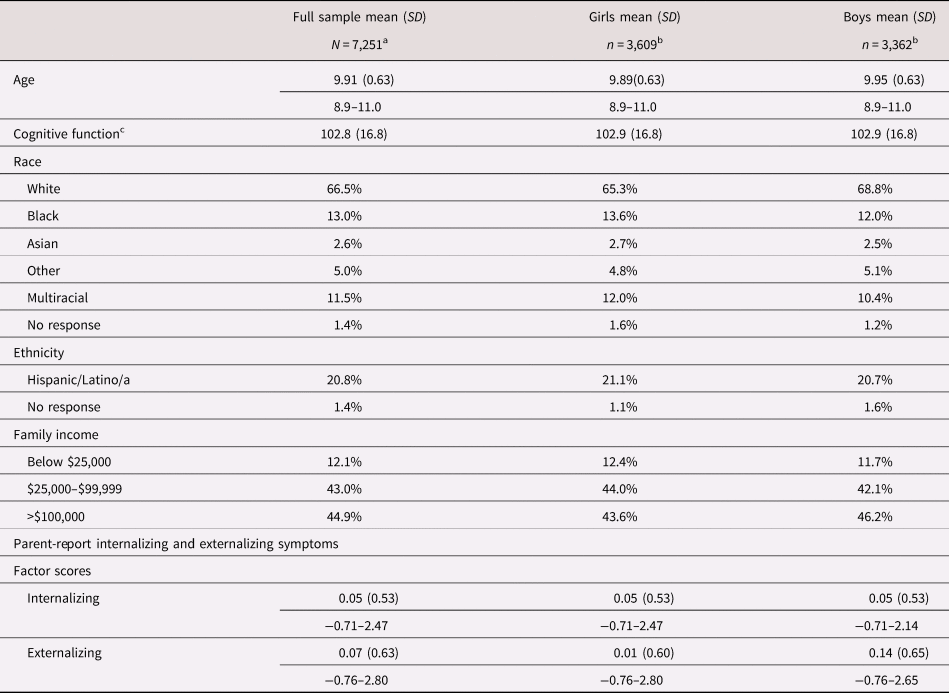
Given our objectives, we excluded participants who met past or current criteria for bipolar disorder (bipolar I, bipolar II, bipolar disorder not otherwise specified; n = 776), psychotic disorders (delusions, hallucinations, schizophrenia, psychotic disorder not otherwise specified; n = 308), other specified neurodevelopmental disorders (autism was not assessed fully; n = 3,138), and/or low cognitive function (National Institutes of Health (NIH) Cognitive Toolbox age-corrected total composite score <70; n = 395). Left-handed children (n = 848) and those with head injuries resulting in loss of consciousness for greater than 30 min (n = 7) were also excluded. Remaining participants who completed a baseline Child Behavior Checklist (CBCL; N = 7,251; mean age = 9.9 years; 52% female) were included in exploratory and confirmatory factor analyses, described below. The race composition (parent-report) was 66.5% White, 13.0% Black, 2.6% Asian, 11.5% Multiracial, and 5.0% other. Parents reported that 20.8% of the sample was Hispanic/Latino/LatinaFootnote 1. PhenX-derived demographics are reported in Table 1. Owing to excessive movement or other quality control concerns, an additional 146 boys and 133 girls were excluded from our multilevel models, presented below. One eligible participant reported “other” or “not reported” for sex and was therefore excluded from analyses of sex effects. Thus, a final sample of N = 6,971 participants was included (see Table 1).
Demographic variables and internalizing and externalizing factor scores

a Sample included in exploratory and confirmatory factor analyses.
b Sample included in multilevel models.
c NIH Toolbox age-corrected total composite score.
Measures
PhenX demographic questionnaire
The PhenX demographic questionnaire is an adapted version of the PhenX Toolkit used to report demographics including race/ethnicity, age, and sex (see Barch et al., Reference Barch, Albaugh, Avenevoli, Chang, Clark, Glantz and Alia-Klein2018; Stover, Harlan, Hammond, Hendershot, & Hamilton, Reference Stover, Harlan, Hammond, Hendershot and Hamilton2010). One parent completed parent-report questionnaires for each child (86% biological mothers, 10% biological fathers, 2% adoptive parent, and 2% other).
Kiddie schedule for affective disorders and schizophrenia (K-SADS), present and lifetime versions
The K-SADS is a semi-structured interview that assesses psychopathology using DSM-5 criteria from both self- and parent-reports (Kaufman et al., Reference Kaufman, Birmaher, Axelson, Perepletchikova, Brent and Ryan2013; Townsend et al., Reference Townsend, Kobak, Kearney, Milham, Andreotti, Escalera and Rice2020). We used parent-reports only to determine eligibility, as self-report was not available for exclusionary diagnoses. Although K-SADS items are typically recorded on four-point scales, ABCD data are restricted to diagnoses (absent vs. present).
Edinburgh handedness inventory
A brief version of the Edinburgh handedness inventory was used (Oldfield, Reference Oldfield1971; Veale, Reference Veale2014). This self-report questionnaire evaluates which hand participants typically use for writing, throwing, using a spoon, and using a toothbrush. Items are rated on 5-point scales (always right hand, usually right, both, usually left, always left), which are summed into a score of right, left, or ambidextrous. Left-handed children were excluded given laterality and volume differences seen in left- versus right-handed individuals in subcortical brain regions (Szabo, Xiong, Lancaster, Rainey, & Fox, Reference Szabo, Xiong, Lancaster, Rainey and Fox2001).
NIH toolbox – cognition battery
The NIH Cognitive Toolbox includes seven tasks that assess various cognitive processes, including attention, working memory, cognitive flexibility, reading ability, processing speed, visuospatial memory, and language abilities (Luciana et al., Reference Luciana, Bjork, Nagel, Barch, Gonzalez, Nixon and Banich2018). Three composite scores are generated (Hodes, Insel, & Landis, Reference Hodes, Insel and Landis2013), which show adequate to excellent reliability (test–retest) and validity among both children and adults (Akshoomoff et al., Reference Akshoomoff, Beaumont, Bauer, Dikmen, Gershon, Mungas and Heaton2013; Heaton et al., Reference Heaton, Akshoomoff, Tulsky, Mungas, Weintraub, Dikmen and Gershon2014). As already noted, we excluded children with age-corrected composite scores <70, which indicate low cognitive function.
Ohio State University traumatic brain injury (TBI) screen – short version
The Ohio State University TBI screen has good test–retest reliability and validity for self-reported TBI (Corrigan & Bogner, Reference Corrigan and Bogner2007). It was adapted for the ABCD study as a parent-report measure of children's histories of brain injuries and concussions (Barch et al., Reference Barch, Albaugh, Avenevoli, Chang, Clark, Glantz and Alia-Klein2018). We excluded children whose parents reported TBI with loss of consciousness for more than 30 min.
Child behavior checklist
The CBCL is a parent-report measure of common internalizing, externalizing, and other behaviors among children and adolescents (Achenbach, Reference Achenbach2009). It is normed nationally by both age and sex. A computerized version was used for ABCD. CBCL scales are ideal for examining dimensional associations between heterotypic symptoms and brain volumes, rather than using categorical diagnoses.
Given our objectives, we performed exploratory and confirmatory factor analyses to validate the latent structure of internalizing and externalizing behavior. Using items from the CBCL internalizing, externalizing, and attention problems scales, we evaluated both two-factor (internalizing, externalizing and inattention combined) and three-factor (internalizing, externalizing, inattention) solutions. Adjudicating between two- and three-factor solutions was important given that inattention often emerges as a separate factor from internalizing and externalizing (Greenbaum & Dedrick, Reference Greenbaum and Dedrick1998). Modeling inattention separately from externalizing was also potentially important given etiological distinctions between the inattentive versus hyperactive–impulsive and combined presentations of ADHD, the latter two of which typically load on externalizing (Lee, Burns, Beauchaine, & Becker, Reference Lee, Burns, Beauchaine and Becker2016; Milich, Balentine, & Lynam, Reference Milich, Balentine and Lynam2001). Among these, inattentive ADHD is differentiated from hyperactive–impulsive and combined ADHD by morphological and functional differences in the very neural structures we evaluate here (Ercan et al., Reference Ercan, Suren, Bacanlı, Yazıcı, Callı, Ardic and Rohde2016; Fair et al., Reference Fair, Nigg, Iyer, Bathula, Mills, Dosenbach and Milham2013).
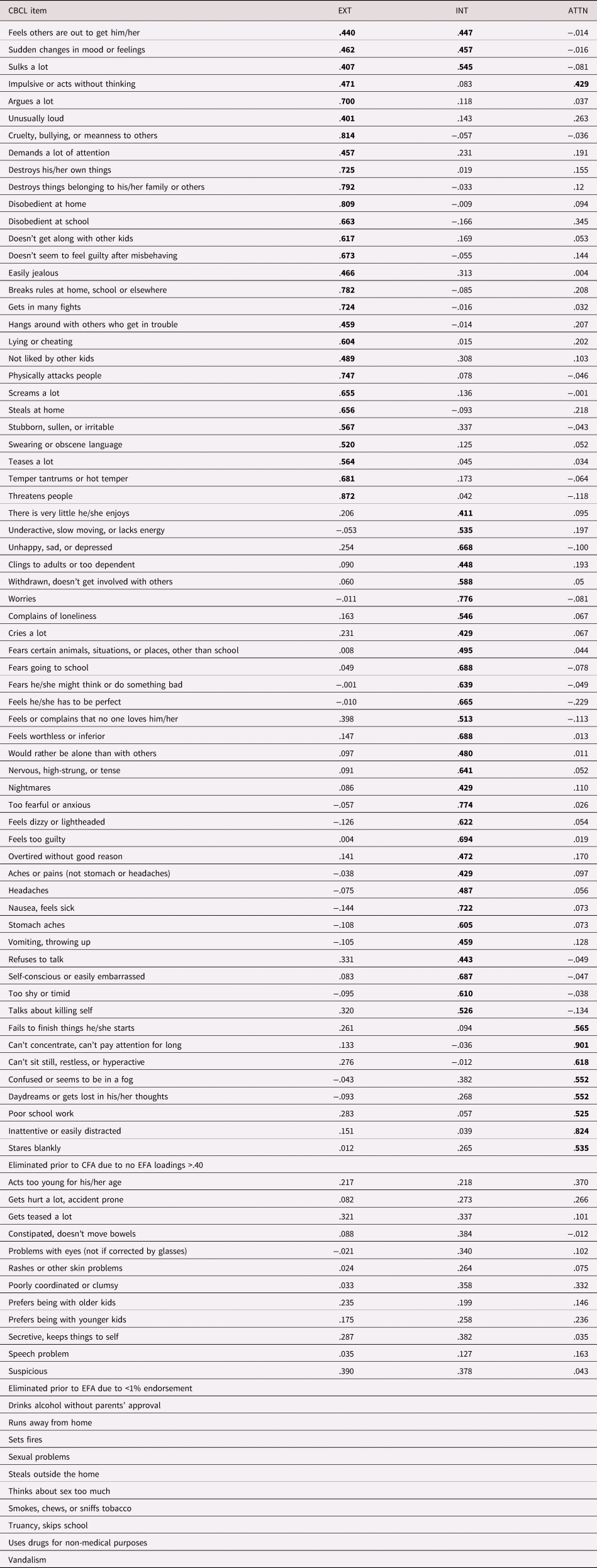
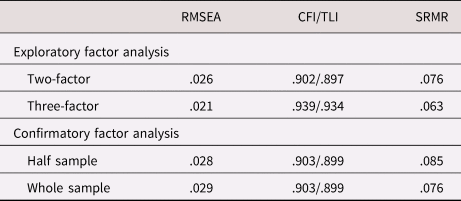
Participants were first randomized into split halves of the sample. We conducted an exploratory factor analysis on one half (n = 3,628) using all CBCL internalizing, externalizing, and inattention items. We eliminated 10 items with less than 1% endorsement (e.g., sets fires, thinks too much about sex; see Table 2). In the two-factor model, all CBCL inattention scale items loaded directly on the externalizing factor, but in the three-factor model, the only inattention scale item that loaded directly on the externalizing factor was impulsivity. The three-factor model yielded slightly better fit than the two-factor model (see Table 3). We therefore retained the three-factor model and conducted a confirmatory factor analysis (internalizing, externalizing, inattention) on the second split-half of the sample (n = 3,623).
Standardized item loadings for three-factor exploratory model
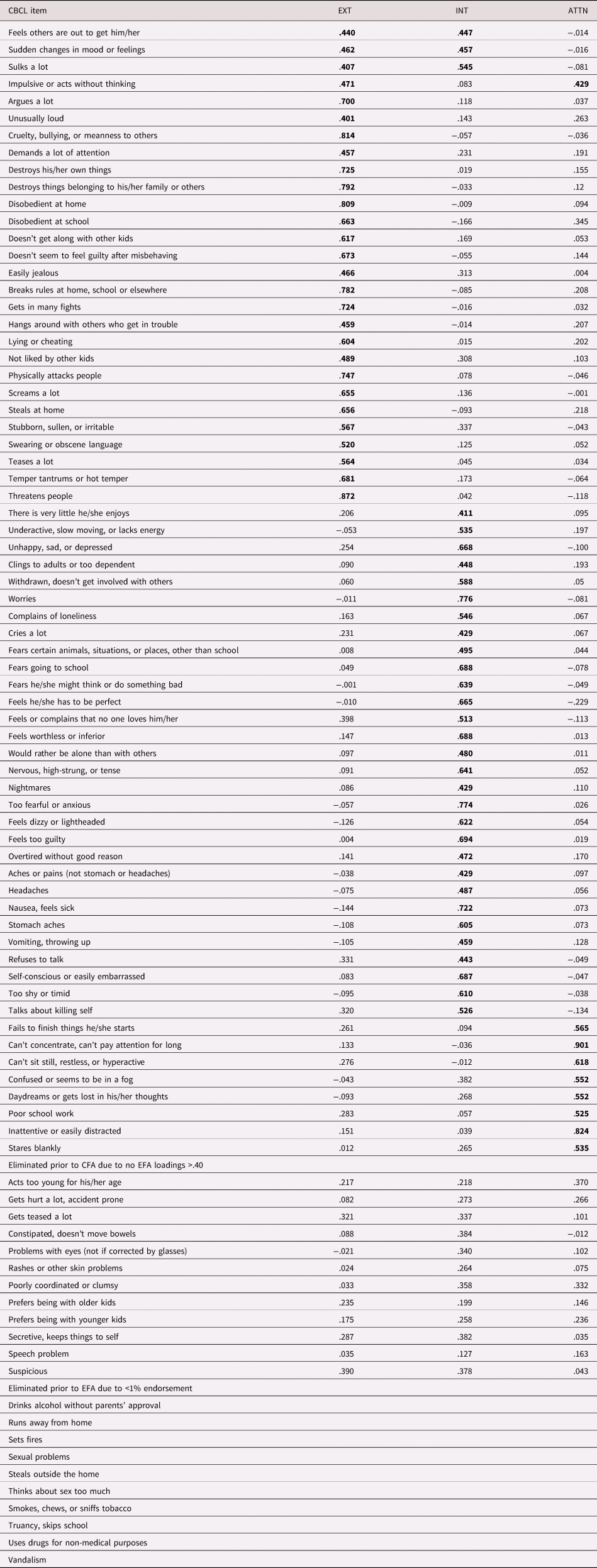
Notes. Values in bold indicate items carried forward for subsequent confirmatory models. CBCL = child behavior checklist. EFA = exploratory factor analysis. CFA = confirmatory factor analysis. EXT = externalizing factor. INT = internalizing factor. ATTN = inattention factor.
Fit indices for exploratory and confirmatory factor models
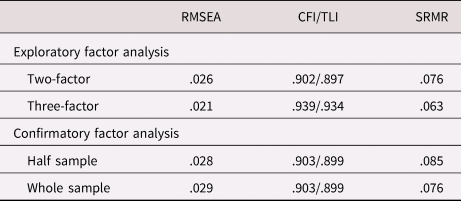
Notes. RMSEA = root mean square error of approximation; CFI = comparative fit index; TFI = Tucker Lewis index. SRMR = standardized root mean square residual.
All items with standardized loadings greater than .40 in the exploratory model (66 items) were included in the confirmatory model (see Table 2). Items with loadings greater than .40 on two higher order factors (n = 4, see Table 2) were included in both factors in the confirmatory models. Fit for the split-half, three-factor confirmatory model was adequate (see Table 3). We therefore applied it to the full sample (N = 7,251) to compute internalizing, externalizing, and inattention factor scores; only internalizing and externalizing scores were included in subsequent analyses. Fit for the sample-wide three-factor confirmatory model was adequate (see Table 3).
Scanning procedures and data acquisition
Participants were scanned at 1 of 21 ABCD sites (Casey et al., Reference Casey, Cannonier, Conley, Cohen, Barch, Heitzeg and Orr2018) using multiband echo planar imaging acquisitions with 1 of 3 types of scanners using multi-channel head coils (3 Tesla Siemens Prisma, General Electric 750, or Philips). Casey et al. (Reference Casey, Cannonier, Conley, Cohen, Barch, Heitzeg and Orr2018) describe scanning parameters used for each scanner type to ensure compatibility. Each participant completed a mock scan with motion training. The order of scans was as follows: localizer, T1-weighted structural image, resting-state functional image, diffusion weighted image, T2-weighted structural image, second resting-state functional image, and three functional MRI behavior tasks (with order randomized across families). Scanning sessions were 90–120 min and completed in 1–2 sessions. If scanning required two sessions, the second scan was completed within 1 week of the first. Complete scanning protocols were conducted for 79% of the ABCD sample. Prospective motion correction for structural MRI T1-weighted images and real-time motion monitoring (fMRI integrated real-time motion monitor) were used so operators could provide feedback to participants or adjust scanning procedures (e.g., skipping final resting-state run). Average motion during rest was 0.22 mm (SD = 0.20 mm).
Image pre-processing and brain segmentation
A standard preprocessing pipeline was used (Hagler et al., Reference Hagler, Hatton, Cornejo, Makowski, Fair, Dick and Watts2019). Prior to processing, research assistants manually examined structural images for severe quality control issues including ghosting, blurring, and/or ringing artifacts. Pre-analysis processing included modality-specific corrections for intensity inhomogeneity (grad warp correction, bias field correction, resampled to isotropic). Participants were excluded from mixed models if any imaging quality control category (motion, intensity inhomogeneity, white matter underestimation, pial overestimation, or magnetic susceptibility artifact) was rated as severe.
Surface-based registration was used to define brain segments of T1-weighted images (1-mm isotropic voxels) using FreeSurfer, version 5.3.0 (Fischl, Reference Fischl2012), which is validated for children (Ghosh et al., Reference Ghosh, Kakunoori, Augustinack, Nieto-Castanon, Kovelman, Gaab and Fischl2010). Cortical regions of interest (ROIs) were based on cortical folding patterns (Fischl, Sereno, Tootell, & Dale, Reference Fischl, Sereno, Tootell and Dale1999) and Bayesian classification rules (Desikan et al., Reference Desikan, Ségonne, Fischl, Quinn, Dickerson, Blacker and Albert2006; Destrieux, Fischl, Dale, & Halgren, Reference Destrieux, Fischl, Dale and Halgren2010). An atlas-based volume segmentation procedure defined subcortical ROIs (Fischl et al., Reference Fischl, Salat, Busa, Albert, Dieterich, Haselgrove and Montillo2002). Processed data and tabulated ROI-based values are available through the National Institute of Mental Health data archive.
Multilevel models
Based on the literature outlined above that identifies common and unique neural substrates of externalizing and internalizing, five ROIs implicated in associative learning (reward and/or extinction) were selected, including the putamen, caudate, and NAcc (all striatal), as well as the amygdala and ACC. Linear mixed models were conducted in RStudio (lme4 and lmerTest packages; Bates, Mächler, Bolker, & Walker, Reference Bates, Mächler, Bolker and Walker2015) for bilateral ROIs to assess associations between volume and internalizing and externalizing symptoms. Family and site number were included as random effects. Internalizing and externalizing factor scores from the sample-wide confirmatory factor analysis are used in all models. An Internalizing × Externalizing interaction term, which tested our primary hypotheses, was included. Age and whole brain volume (without ventricles) were entered in all models as covariates. Each linear mixed model was fit using restricted maximum likelihood estimation, and t-tests with the Kenward–Roger approximation were used to assess significance (Luke, Reference Luke2017). We used the false discovery rate Benjamini–Hochberg procedure to control for multiple comparisons (10 models for each sex).
Given our objective of evaluating sex effects, we ran separate models for girls and boys (see above). This is preferable to including sex as a covariate given correlations between sex and brain volume, and between sex and both internalizing and externalizing psychopathology (Martel, Reference Martel2013). Covarying sex would therefore remove variance of interest (see Beauchaine & Hinshaw, Reference Beauchaine and Hinshaw2020).
Results
Internalizing and externalizing symptoms and subcortical volumes
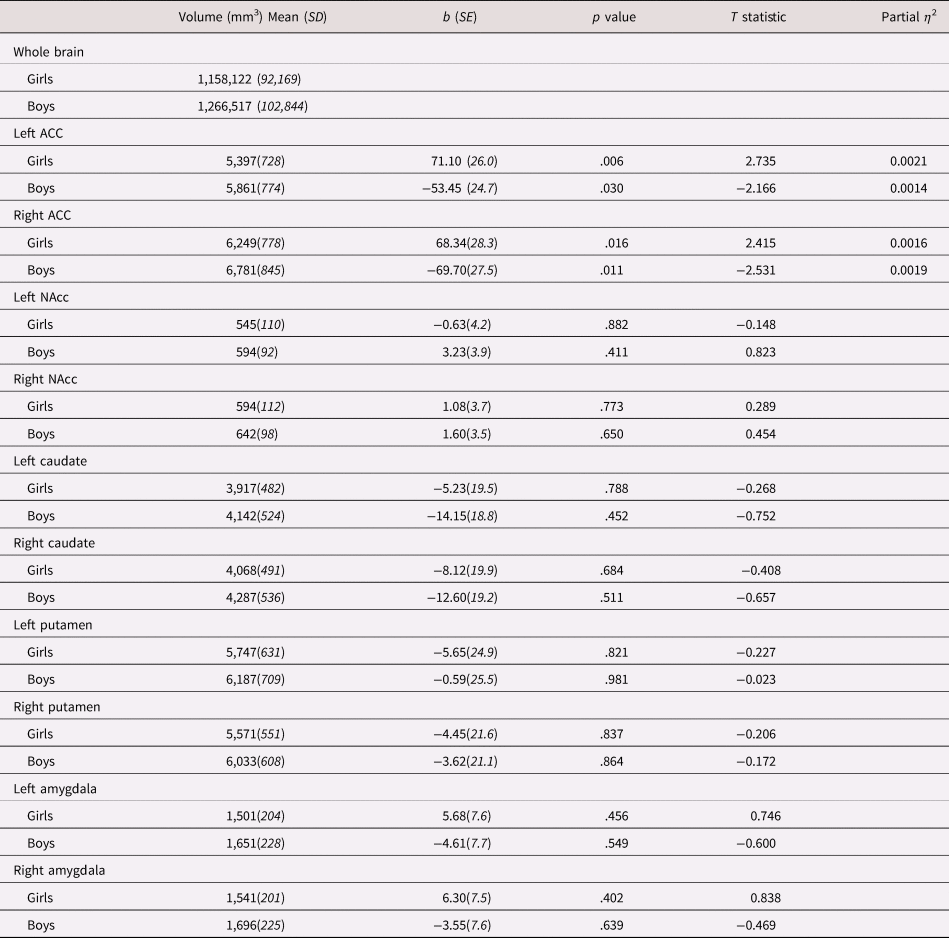
Consistent with previous research, a main effect of externalizing was found for right NAcc volumes among boys, p = .03 (b = −69.17, SE = 3.17, partial η 2 = .0014). Smaller NAcc volumes were associated with more externalizing behavior. However, this finding did not survive correction for multiple comparisons. No other striatal regions were significant for boys, and no main effects for any striatal region were found for girls. No striatum interaction effects were significant for either sex. In addition, no main effects or interaction effects were found for amygdala volumes (see Table 4). These null results are surprising given replicated findings of smaller amygdala volumes in externalizing and larger amygdala volumes in internalizing, as reviewed above. Previous studies, however, have used clinical samples.
Brain volumes associated with heterotopically comorbid symptoms

Notes. Table displays unstandardized regression coefficients (mm3) for Internalizing × Externalizing interaction terms in each multilevel model examining associations between symptoms and brain volume. ACC = anterior cingulate cortex. NAcc = nucleus accumbens.
Internalizing and externalizing symptoms and ACC volumes
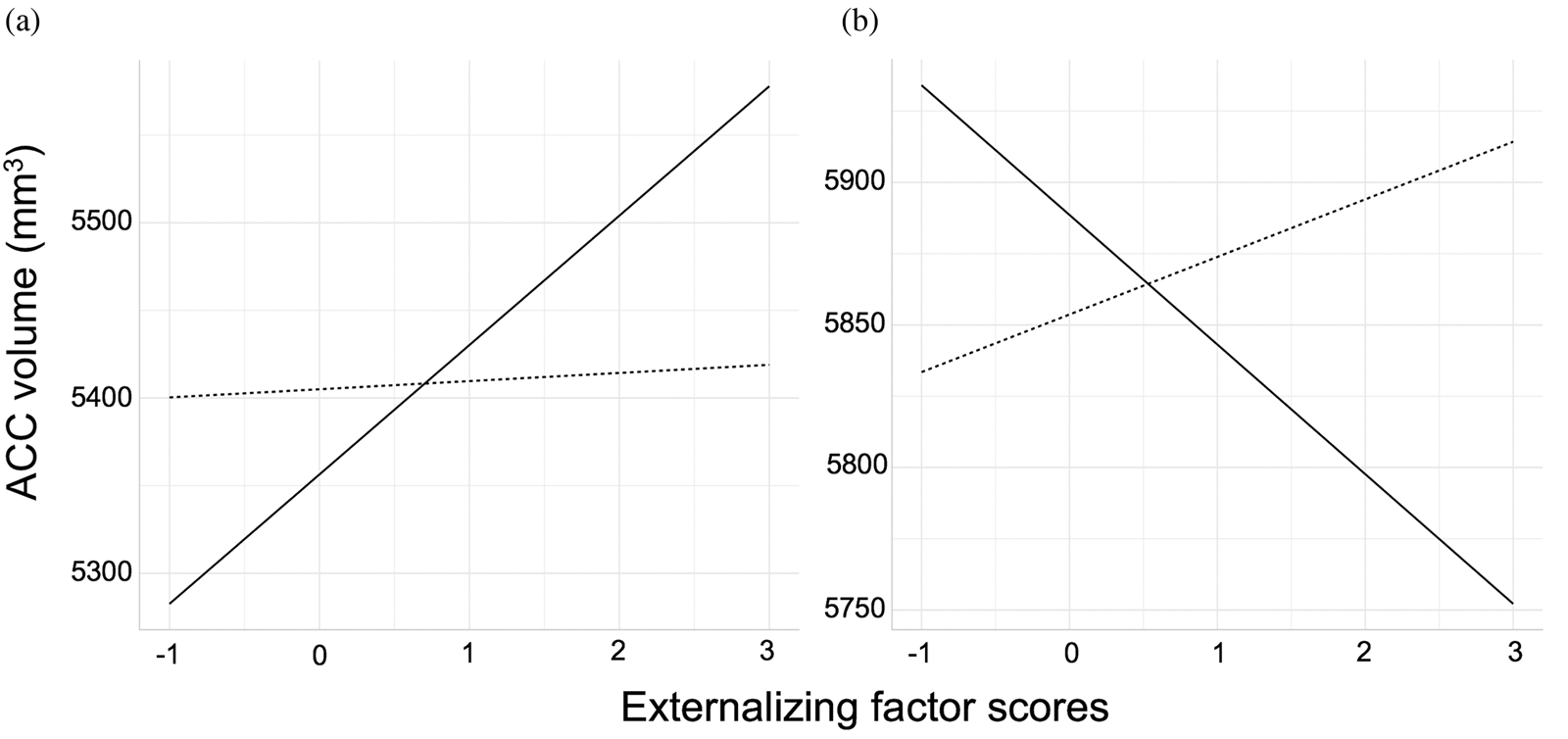
A main effect of internalizing for right ACC volumes was found for boys only, p = .03 (b = −63.70, SE = 30.86, partial η 2 = .0013). Smaller ACC volumes were associated with more internalizing behavior. However, this finding did not survive correction for multiple comparisons. No additional main effects were observed for either sex. Consistent with our primary hypothesis, however, Internalizing × Externalizing symptom interactions were associated with ACC volumes for both sexes (p < .05 in all four models; see Table 4). All four interaction effects survived correction for multiple comparisons (false discovery rate = .2; Efron, Reference Efron2010). As in our previous work with a smaller clinical sample (Sauder et al., Reference Sauder, Beauchaine, Gatzke-Kopp, Shannon and Aylward2012), externalizing symptoms were associated negatively with bilateral ACC volumes for boys who scored high on internalizing symptoms. In contrast, externalizing symptoms were associated positively with bilateral ACC volumes for girls who scored high on internalizing symptoms, (see Figure 1). Thus, comorbid internalizing and externalizing symptoms were associated with smaller ACC volumes among boys, but larger ACC volumes among girls. This sex effect was not expected or predicted.
Two-way interactions depicting relations between externalizing factor scores and anterior cingulate cortex (ACC) volumes for those who score above the median on internalizing symptoms (solid line) and below the median on internalizing symptoms (dashed line). Panel (a) depicts the interaction for girls. Panel (b) shows the interaction for boys.

Discussion
To date, few studies have evaluated neural correlates of heterotypic comorbidity, despite the ubiquity of internalizing–externalizing comorbidity in both research and practice (see Beauchaine & Cicchetti, Reference Beauchaine and Cicchetti2016). This is a problematic oversight given well-characterized functional dependencies between trait impulsivity (externalizing) and trait anxiety (internalizing) in affecting behavior (e.g., Beauchaine & Hinshaw, Reference Beauchaine and Hinshaw2020; Haines & Beauchaine, Reference Haines and Beauchaine2020). As outlined in the introduction of this article, anxiety modulates impulsive behavior in both real-world and laboratory settings, resulting in better decision-making and reduced risk for poor functional outcomes such as criminality (e.g., Haines et al., Reference Haines, Beauchaine, Galdo, Rogers, Hahn, Pitt and Ahn2020; Walker et al., Reference Walker, Lahey, Russo, Frick, Christ, McBurnett and Green1991). In this study, we evaluated associations between heterotypic symptoms and regional brain volumes in the striatum, amygdala, and ACC. These neural structures were chosen given their transdiagnostic (striatum) and differentiating (amygdala, ACC) characteristics with respect to externalizing and internalizing syndromes, respectively.
To our knowledge, only one study has examined associations between heterotypic symptoms and regional brain volumes (Sauder et al., Reference Sauder, Beauchaine, Gatzke-Kopp, Shannon and Aylward2012). In that study, which comprised a small sample of only boys (N = 35), Internalizing × Externalizing symptom interactions were associated with both striatal and ACC gray matter volumes. For boys who scored above the sample median on anxiety/depression, hyperactivity–impulsivity was associated negatively with volumes in both regions. In contrast, brain volumes were unassociated with externalizing behavior for boys who scored below the sample median on anxiety/depression. Our findings replicate the Sauder et al. study for boys, but only in the ACC, not the striatum. In contrast, for girls who scored above the sample median on internalizing, externalizing symptoms predicted larger ACC volumes (see Figure 1). No association between externalizing behavior and ACC volumes was observed for girls who scored below the sample median on internalizing. This opposite pattern of findings for boys versus girls was unexpected, and illustrates why separate analyses by sex are preferable to using sex as a covariate; doing so would almost certainly have obscured the sex effect (for extended discussion see Beauchaine & Hinshaw, Reference Beauchaine and Hinshaw2020).
In addition to the Internalizing × Externalizing interactions for the ACC, an expected main effect was observed linking smaller NAcc volumes to externalizing behavior for boys, consistent with previous research (Wallace et al., Reference Wallace, White, Robustelli, Sinclair, Hwang, Martin and Blair2014). Unexpectedly, however, no other main effects were significant for either the striatum or amygdala, despite well-replicated negative associations for both sexes between (a) striatal volumes and externalizing (e.g., Wallace et al., Reference Wallace, White, Robustelli, Sinclair, Hwang, Martin and Blair2014), (b) striatal volumes and internalizing (e.g., Matsuo et al., Reference Matsuo, Rosenberg, Easter, MacMaster, Chen, Nicoletti and Soares2008), and (c) amygdala volumes and internalizing (e.g., Rosso et al., Reference Rosso, Cintron, Steingard, Renshaw, Young and Yurgelun-Todd2005). Two differences between this study and previous work may account, at least in part, for observed null findings. First, most studies linking subcortical volumes (striatum and amygdala inclusive) to internalizing and externalizing symptoms have used older (primarily adolescent) samples. To the extent that brain–behavior relations solidify across development as environmental risk exposures accrue (see Birn et al., Reference Birn, Roeber and Pollak2017), smaller effect sizes can be expected in younger samples.
Second, almost all previous studies have compared brain volumes between non-psychiatric controls and groups of children, adolescents, or adults with diagnosable psychopathology. In representative samples, biomarkers of impairment observed among small numbers of participants at distributional extremes (e.g., ≥95th percentile) are sometimes swamped by large numbers of participants at normative levels of sample variation (e.g., Shader et al., Reference Shader, Gatzke-Kopp, Crowell, Reid, Thayer, Vasey and Beauchaine2018). This illustrates a potential trade-off between dimensional assessment and contrasted groups designs (McDonough-Caplan et al., Reference McDonough-Caplan, Klein and Beauchaine2018).
Our finding linking larger ACC volumes to higher levels of externalizing behavior for girls who scored above the median on internalizing warrants further investigation. This is the first finding of its kind, and contrasts with our now replicated ACC finding for boys, who show the opposite pattern (i.e., smaller ACC volumes portend more severe externalizing behavior for boys who score high on internalizing). Given the novelty of our ACC finding for girls and the small effect size, we are reluctant to interpret further before future replication. We reiterate, however, the importance of collecting and analyzing data from large samples such as ABCD, so separate models can be constructed for boys versus girls. As we note elsewhere (Yan, Schoppe-Sullivan, & Beauchaine, Reference Yan, Schoppe-Sullivan and Beauchaine2020), mixing boys’ and girls’ scores in single analyses can (a) reduce sensitivity of those analyses for girls’ outcomes given large mean differences between sexes on virtually all externalizing outcomes (Eme, Reference Eme, Beauchaine and Hinshaw2016), and (b) obscure sex effects in analysis of covariance models, especially when effects are in opposite directions such as here (Beauchaine & Hinshaw, Reference Beauchaine and Hinshaw2020). This is particularly important to consider in studies of brain volume. Given that sex correlates substantially with both externalizing scores and intracranial volumes, including boys and girls in a single analysis with sex and intracranial volumes as covariates removes variance of interest when predicting to externalizing behavior. This reduces power to detect sex effects.
It is also important to consider effect sizes. With very large samples, trivial effect sizes can be significant. In such circumstances, it is often unclear whether there are clinical or practical implications of findings. In our models, which are summarized in Table 4, significant findings, including Internalizing × Externalizing interactions, accounted for well under 1% of the variance in regional brain volumes. It is therefore important to state explicitly that striatal and ACC volumes cannot be used for diagnostic purposes, and that our findings may have limited if any practical use. This conclusion is not unique to our study, and instead applies to other subcortical volume findings from ABCD and other large datasets (see Beauchaine, Reference Beauchaine2020b). In summarizing existing findings from the ABCD study, Owens et al. (Reference Owens, Potter, Hyatt, Albaugh, Thompson, Jernigan and Garavan2020) reported a median effect size of .03 (Pearson's r), with an interquartile range of .01–.07 (0.0001–0.005% variance accounted for). These effect sizes are orders of magnitude below the smallest cut-offs historically defined as clinically relevant (see e.g., Atkins, Bedics, McGlinchey, & Beauchaine, Reference Atkins, Bedics, McGlinchey and Beauchaine2005). Owens et al. (Reference Owens, Potter, Hyatt, Albaugh, Thompson, Jernigan and Garavan2020) propose that applying traditional effect size heuristics (Cohen, Reference Cohen1988) to large datasets may be overly restrictive. It is at least equally or more problematic, however, to attribute importance to trivial effect sizes that are significant only in very large samples.
Limitations aside, our study has many strengths. First, we used a large, nationally representative sample. This is essential for testing sex differences that are often obscured in the broader literature, given far fewer girls than boys in most externalizing samples. Second, our analyses were theory-driven. We selected ROIs a priori based on theories of heterotypic comorbidity and evidence of overlapping neural substrates common across the internalizing and externalizing spectra (Zisner & Beauchaine, Reference Zisner and Beauchaine2016; Beauchaine & Constantino, Reference Beauchaine and Constantino2017). It is encouraging that the bilateral ACC volume association with heterotypic symptoms among boys replicated our previous work (Sauder et al., Reference Sauder, Beauchaine, Gatzke-Kopp, Shannon and Aylward2012), and that the finding of a bilateral ACC volume association with heterotypic symptoms among girls survived multiple comparison control. This increases confidence in our findings.
Our study contributes to a growing literature evaluating neural substrates of psychopathology comorbidities among youth (Beauchaine & Cicchetti, Reference Beauchaine and Cicchetti2016; Beauchaine & Cicchetti, Reference Beauchaine and Cicchetti2019). We focus on functional dependencies (i.e., interactions among) heterotypic symptoms and their associations with brain volumes implicated in trait impulsivity, trait anxiety, and associative learning, with direct evaluation of sex effects. Our findings show that ACC volumes are associated with comorbid symptoms for both sexes, but that patterns differ for boys versus girls. Future studies should evaluate association of between heterotypic symptoms and functional neural correlates of psychopathology, and address potential differences in findings across informants (see De Los Reyes & Kazdin, Reference De Los Reyes and Kazdin2005), which have been observed in other ABCD analyses (e.g., Samimy, Schettini, O'Grady, Hinshaw, & Beauchaine, Reference Samimy, Schettini, O'Grady, Hinshaw and Beauchaine2021). Future studies should also evaluate developmental associations between emerging comorbidity and brain structure and function. Although Wave 2 of the ABCD imaging dataset were not available to us for analysis, they were recently released. As noted above, many brain–behavior relations strengthen across the lifespan in response to impinging environments (e.g., Birn et al., Reference Birn, Roeber and Pollak2017). Characterizing specific transactional processes through which neural vulnerabilities and environmental risk and protection operate is the ultimate goal of developmental psychopathology. Our findings are but a preliminary step toward this objective.
Acknowledgments
Data used in the preparation of this article were obtained from the Adolescent Brain Cognitive Development (ABCD) Study (https://abcdstudy.org), which can be accessed via the National Institute of Mental Health data archive. The ABCD Study is supported by the National Institutes of Health and federal partners: U01DA041048, U01DA050989, U01DA051016, U01DA041022, U01DA051018, U01DA051037, U01DA050987, U01DA041174, U01DA041106, U01DA041117, U01DA041028, U01DA041134, U01DA050988, U01DA051039, U01DA041156, U01DA041025, U01DA041120, U01DA051038, U01DA041148, U01DA041093, U01DA041089, U24DA041123, U24DA041147.
Funding Statement
This work was supported was supported by grants UL1TR002733 (TB), K01DA037280 (SW), and R21AA026632 (SW) from the National Institutes of Health.
Conflicts of Interest
None.