Introduction
One of the most exciting prospects for energy storage is the development of solid-state batteries in which the flammable liquid electrolyte is replaced by a solid with extremely high Li-ion conductivity. The ability of computational modeling to accurately predict intrinsic properties of solid electrolytes has made modeling a critical component for understanding the behavior of solid electrolytes and their integration in solid-state batteries.
In this article, we focus on the computational prediction of ionic conductivity, and electrochemical and interfacial stability with electrodes as the key properties for the stable operation of a solid electrolyte. The role of modeling in the development of solid-state conductors has been vital, as experiments often take time to converge on the true intrinsic behavior of a solid electrolyte due to complicating extrinsic effects on conductivity or difficulties in detecting interfacial reactivity. We briefly explain how the complex macroscopic requirements for a solid electrolyte can be turned into computable quantities and demonstrate the effectiveness of modeling in predicting novel conductors.
Design and prediction of novel solid electrolytes
There are several complementary theoretical approaches to obtain information on the ionic conductivity of a crystalline compound. These methods cover many orders of magnitudes of computational resource requirements, from simple topological analysisReference Miara, Ong, Mo, Richards, Park, Lee, Lee and Ceder1 and empirical bond-valence approachesReference Adams2 that can be run in seconds on a single core, to ab initio calculationsReference Deng, Mo and Ong3 that sometimes require more than tens of thousands of CPU hours to obtain converged ionic transport properties on a single material.
Among the various computational methods, first-principles techniques based on density functional theory (DFT), such as ab initio molecular dynamics (AIMD) and nudged elastic band (NEB) calculations, have been widely adopted for the study of ionic transport in ionic conductors due to their high accuracy and transferability in different chemistries without any fitting parameters.
The NEB method can be used to determine the activation barrier for an ion to migrate between two sites.Reference Wang, Richards, Ong, Miara, Kim, Mo and Ceder4 Because of the exponential dependence of the conductivity on the migration barrier, it is the most basic quantity by which to separate fast ion conductors from poor conductors, with the best ion conductors having activation barriers under 200–300 meV. In fast ion conductors where carriers are usually freely available, the NEB migration barrier is often closely related to the measured activation energy for conductivity, once extrinsic conductivity limitations, such as interfacial and grain-boundary problems, have been overcome in experiments.
AIMD simulations model the simultaneous motion of mobile ions in a given structure, hence they capture a more complete and complex picture of ionic motion and can yield a variety of diffusion properties, including both ionic conductivity and activation energy, incorporating thermal effects other than the ionic migration barrier.Reference Deng, Mo and Ong3 While performing an NEB calculation requires knowledge of the ion migration pathway, AIMD can be applied to structures that are more complex without prior assumptions about the diffusion path. The disadvantage of AIMD is that to achieve sufficient ion motion in the short simulation time used, AIMD has to be run at elevated temperatures; room-temperature properties are then obtained by scaling down to room temperature via an Arrhenius expression.
When comparing AIMD and NEB results with experimental data, the calculated ionic conductivity is usually an upper bound, since in experiments the measured ionic conductivity is often limited by a number of extrinsic factors, including the grain-boundary component and less conductive phases in the sample. However, there is a clear record that after experimental optimization of a solid electrolyte, ab initio predicted conductivities and activation energies are usually in good agreement with experiments (see the following section), thus making computations a fast and controlled way to predict novel conductors.
New solid electrolyte prediction and experimental verification
The most common and straightforward way to computationally design new ionic conductors is to chemically modify existing conductors to create new ones by elemental substitutions. For example, DFT calculations have been used to predict possible dopants for lithium garnet, Li7La3Zr2O12,Reference Miara, Richards, Wang and Ceder5 and sodium thiophosphate, Na3PS4,Reference Zhu, Chu, Deng and Ong6,Reference Chu, Kompella, Nguyen, Zhu, Hy, Deng, Meng and Ong7 leading to improved ionic conductivities. Replacing elementary ions in existing compounds, such as Li-for-Ag substitution in Ag-thiophosphatesReference Zhu, Chu and Ong8 and cluster ions (superalkalis and superhalogens) for halogens in lithium-rich antiperovskites,Reference Fang and Jena9 can yield novel compounds with high ionic conductivity. With a general structural prototype of the argyrodites (a silver germanium sulfide mineral with the formula Ag8GeS6), a wide range of possible chemically substituted derivatives has been computationally evaluated and systematically explored.Reference Chen, Maohua and Adams10
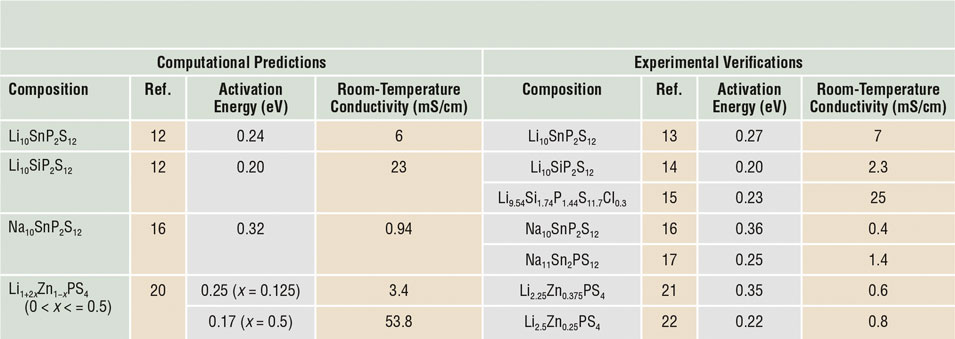
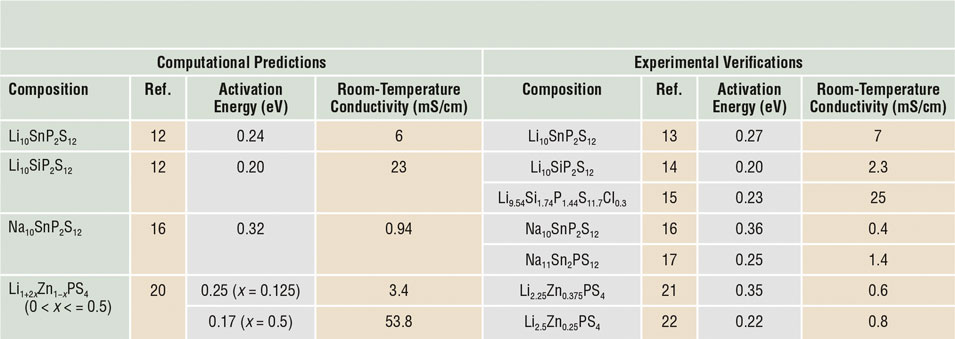
One of the most successful examples in the predictive modeling of solid electrolytes is the prediction of multiple new ionic conductors based on the experimentally discovered superionic conductor Li10GeP2S12 (LGPS).Reference Kamaya, Homma, Yamakawa, Hirayama, Kanno, Yonemura, Kamiyama, Kato, Hama, Kawamoto and Mitsui11 Ong et al. first predictedReference Ong, Mo, Richards, Miara, Lee and Ceder12 Si and Sn substituted Li10SiP2S12 and Li10SnP2S12 with ionic conductivities comparable to that of Li10GeP2S12. The existence of these two new solid electrolytes was confirmed by several experiments using the same and slightly modified compositions.Reference Bron, Johansson, Zick, Schmedt auf der Günne, Dehnen and Roling13–Reference Kato, Hori, Saito, Suzuki, Hirayama, Mitsui, Yonemura, Iba and Kanno15 Subsequently, the Sn version has become commercially available (www.neicorporation.com). Furthermore, the Na counterparts of LGPS, Na10XP2S12 (X = Si, Ge, Sn), have also been predicted by first-principles computation.Reference Richards, Tsujimura, Miara, Wang, Kim, Ong, Uechi, Suzuki and Ceder16 Among these, Na10SnP2S12 has been successfully synthesized with high Na ionic conductivity in the same composition previously noted and slightly modified compositions.Reference Richards, Tsujimura, Miara, Wang, Kim, Ong, Uechi, Suzuki and Ceder16,Reference Zhang, Ramos, Lalère, Assoud, Kaup, Hartman and Nazar17 The obtained experimental bulk conductivities of these superionic conductors in the LGPS family are close to the predicted values (Table I), demonstrating the accuracy and predictive power of ab initio computational methods.
Computationally predicted and experimentally measured ionic transport properties of cation-substituted compounds, X10MP2S12 (X = Li, Na, M = Si, Sn), and newly identified body-centered-cubic-type ionic conductor Li1+2xZn1−xPS4.
The complex relation between structure, composition, and conductivity makes intuition-based design of novel conductors a challenging task. For example, a material that has the potential for high ionic mobility may not show high conductivity, unless it is doped to achieve a reasonable ionic carrier concentration. Analogously, computational screening of possible candidates at a larger scale is not trivial either, even using powerful supercomputers. For example, the Inorganic Crystal Structure Database18 alone has more than 23,000 synthesized compounds that contain Li or Na, all of which in principle would have to be evaluated to search for Li or Na solid electrolytes. Compositional and structural modification of these materials by doping or substitution leads to hundreds of thousands more possibilities. It is an impossible task to calculate the ionic conductivities of all these possible candidates directly using ab initio methods.
The key challenge then is to establish an understanding of the important factors that determine ionic transport in existing ionic conductors, and to develop strategies to efficiently screen for known materials whose use as solid electrolytes may have been overlooked in the past, and to develop design rules to guide discovery of new materials. The approach here is to first understand which structural frameworks can lead to high ionic mobility, and then modify the composition of a material so that free carriers are created which achieve this high mobility.
Structural descriptor for superionic conductivity in solids
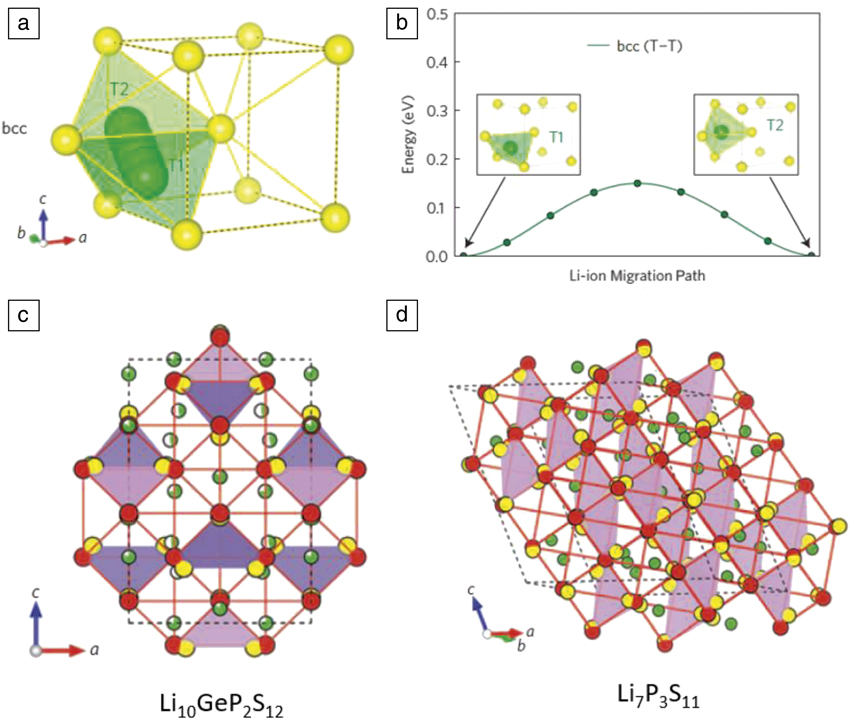
Understanding the factors that govern ionic transport in existing solid electrolytes and allow superionic conductivity in some classes of materials is crucial for the discovery of completely new ionic conductors. By using ab initio modeling of hypothetical anion structures, it has been shown that the body-centered-cubic (bcc) type anion framework is most desirable for achieving high ionic conductivity, as it allows for direct Li hops between adjacent tetrahedral sites (Figure 1a–b).Reference Wang, Richards, Ong, Miara, Kim, Mo and Ceder4 This is in contrast to face-centered-cubic (fcc) and hexagonal close-packed (hcp) frameworks wherein hopping occurs between tetrahedral and octahedral sites so that the site energy difference between these two environments adds to the migration barrier. Structural analysisReference Wang, Richards, Ong, Miara, Kim, Mo and Ceder4 indicates that this bcc anion arrangement is present in several of the most conductive sulfide electrolytes, such as Li10GeP2S12 (and its derivatives) and Li7P3S11, albeit in slightly distorted states (Figure 1c–d). The discovery of structural features governing ionic transport places these Li/Na sulfide electrolytes into a larger family of superionic conductors, including the high conductivity phase of silver iodide (α-AgI), which has a perfect bcc backbone.Reference Hull19
Ionic transport and structural features in Li-ion solid electrolytes. (a) Li-ion migration path and (b) calculated activation energy from one tetrahedral (T1) site to another (T2) in a body-centered-cubic (bcc) S2– lattice. Mapping of the anion sublattice to a bcc framework in crystal structures of two lithium superionic conductors (c) Li10GeP2S12 and (d) Li7P3S11. Li atom (LiS4 tetrahedra), partially occupied Li atom, S atom, PS4 tetrahedra, and GeS4 tetrahedra are colored green, green-white, yellow, purple, and blue, respectively.Reference Wang, Richards, Ong, Miara, Kim, Mo and Ceder4

The bcc structural descriptor can be used as a screening criterion to identify unexplored crystal structures that closely match this framework and have the potential to support fast ion conduction. LiZnPS4, a lithium thiophosphate material identified in one such screening,Reference Wang, Richards, Ong, Miara, Kim, Mo and Ceder4 has an almost perfect bcc S lattice, similar to the LGPS family, but has been overlooked as a potential solid electrolyte in the past. While the stoichiometric structure of this compound has poor ionic conductivity, engineering its composition to introduce interstitial lithium defects enables it to exploit the low migration barrier of the bcc anion structure. The highly defective compositions in this framework, Li1+2xZn1–xPS4 (LZPS, x > 0), have the potential to achieve the largest ionic conductivity of any solid lithium-ion conductor (more than 50 mS/cm at room temperature, when x > = 0.5), though this requires substitution of Li for Zn past the equilibrium solubility limit.Reference Richards, Wang, Miara, Kim and Ceder20 Two research groups recently independently reported the successful synthesis of Li-excess LZPS with high ionic conductivities of up to 0.8 mS/cm.Reference Suzuki, Richards, Wang, Miara, Kim, Jung and Tsujimura21,Reference Kaup, Lalère, Huq, Shyamsunder, Adermann, Hartmann and Nazar22 While relatively high, these experimental conductivities are still much lower than predicted (Table I), most likely due to not fully accessing the targeted defect concentrations and the limitations of cross-grain-boundary transport.
Challenges for new materials prediction: Phase stability or synthesizability
The ability to reliably synthesize predicted material phases is a crucially important component of any novel material design process. Identifying the stable phase and synthesizability of a desired material can be guided by first-principles phase stability calculations. Phase stability calculations using DFT enthalpy energies are in principle limited to T = 0 K, but usually give a good assessment of the phases that can be observed. When the enthalpy of different polymorphs is within a few kT, the entropic contribution to the free energy can trigger crossovers in phase stability between competing phases and polymorphs.Reference Richards, Wang, Miara, Kim and Ceder20,Reference Chu, Nguyen, Hy, Lin, Wang, Xu, Deng, Meng and Ong23,Reference Wang, Richards, Bo, Miara and Ceder24
It is interesting to point out that none of these previously mentioned superionic conductors are thermodynamically stable at 0 K, and many are not in the thermodynamic ground state even at room temperature. While it seems plausible that the configurational disorder on the Li sites that is present in many of these materials both stabilizes them at finite temperature and provides high Li conductivity, no formal link between these two properties has been demonstrated thus far. But given the large configurational and vibrational entropy effects arising from the Li (or Na) site disorder, computational prediction of the phase stability (synthesizability) of new materials will need to rely on the accuracy of finite-temperature thermodynamic calculations.
Interfaces: Electrochemical-mechanical stability and transport
Beyond bulk ionic conductivity, high resistance, and poor stability of the electrode/electrolyte interface are critical issues limiting rate performance and cycling stability in all-solid-state alkali-ion batteries.Reference Kato, Hori, Saito, Suzuki, Hirayama, Mitsui, Yonemura, Iba and Kanno15 These limitations are due to the fact that few solid electrolytes are inherently stable across a wide range of voltages (and alkali chemical potentials) between the two electrodes,Reference Ong, Mo, Richards, Miara, Lee and Ceder12,Reference Mo, Ong and Ceder25–Reference Richards, Miara, Wang, Kim and Ceder27 as well as due to the difficulty in achieving and maintaining conformal contact between electrode and electrolyte when interfacial reactions occur, or when the volume of the cathode changes during cycling.Reference Sharafi, Kazyak, Davis, Yu, Thompson, Siegel, Dasgupta and Sakamoto28,Reference Deng, Wang, Chu, Luo and Ong29 The difficulty in recognizing solid electrolyte breakdown in classic electrochemical experiments has regularly led to the overstatement of the solid electrolyte stability limit,Reference Kamaya, Homma, Yamakawa, Hirayama, Kanno, Yonemura, Kamiyama, Kato, Hama, Kawamoto and Mitsui11 which later has to be revised.Reference Kato, Hori, Saito, Suzuki, Hirayama, Mitsui, Yonemura, Iba and Kanno15 Hence, theory has a particularly important role to play in establishing the limits of stability of novel solid electrolytes.
To provide insights into the chemical reactions that occur at electrode/solid electrolyte interfaces, various first-principles modeling approaches have been developed, to either determine the electrochemical stability of the solid electrolyte or its reactivity with the electrode materials.Reference Tang, Deng, Lin, Wang, Chu, Chen, Zhu, Zheng and Ong30 Pure electrochemical stability requires that the solid electrolyte be stable against Li (or Na) insertion on the anode and extraction of the alkali on the cathode. Since the alkali is by definition mobile in the solid electrolyte and an electron is easily available at the interface with the electrodes (or the carbon in the electrode), it is unlikely that this breakdown mechanism has any kinetic protection, justifying a purely thermodynamic approach.
Ong, Mo, and CederReference Ong, Mo, Richards, Miara, Lee and Ceder12,Reference Mo, Ong and Ceder25 first proposed that the solid electrolyte/electrode equilibrium can be modeled by considering the lithium grand potential phase diagram. A grand potential is the Legendre transform of the free energy, and is the relevant thermodynamic potential when the system to be equilibrated is not compositionally constrained in one or more of the components. This is required to study the stability of the solid electrolyte in contact with a lithium sink (charged cathode) or source (anode), each of which contains lithium at a given chemical potential. In principle, construction of a grand potential requires knowledge of all the phases in a chemical system, which is facilitated by online data resources such as the Materials ProjectReference Jain, Ong, Hautier, Chen, Richards, Dacek, Cholia, Gunter, Skinner, Ceder and Persson31 (materialsproject.org). Subsequently, Richards et al.Reference Richards, Miara, Wang, Kim and Ceder27 extended the formalism to include reactivity with the electrode materials accounting for the possibility of multispecies transfer to form an equilibrium of intermediate phases. The Richards approach assumes that when the solid electrolyte and electrode come in contact, the phases that are most likely to form at the interfaces are the ones with the largest Gibbs free energy driving force, under Li chemical potential conditions set by the applied voltage. In reality, since this interfacial reactivity prediction requires knowledge of the mobility of all species present at the interface, more limited reactions may occur during room-temperature cycling.
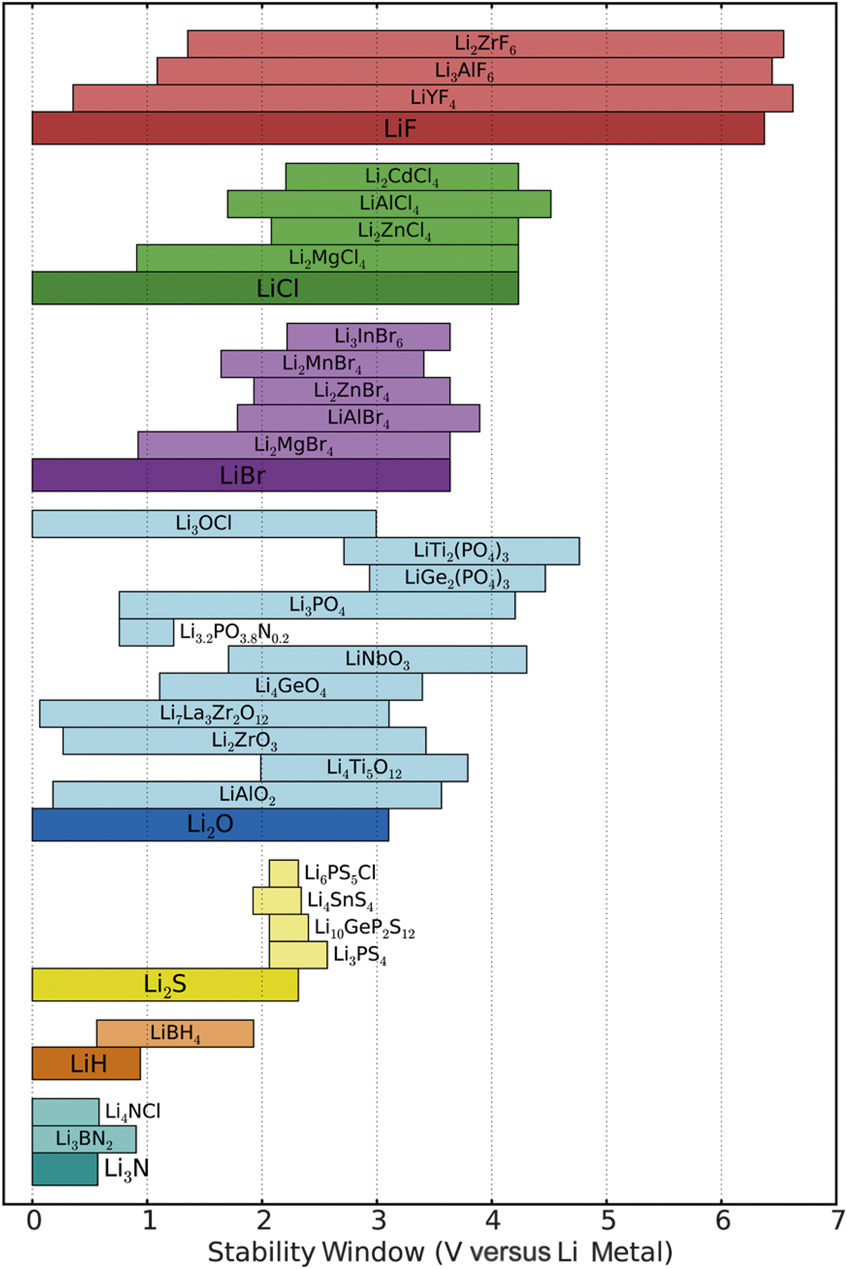
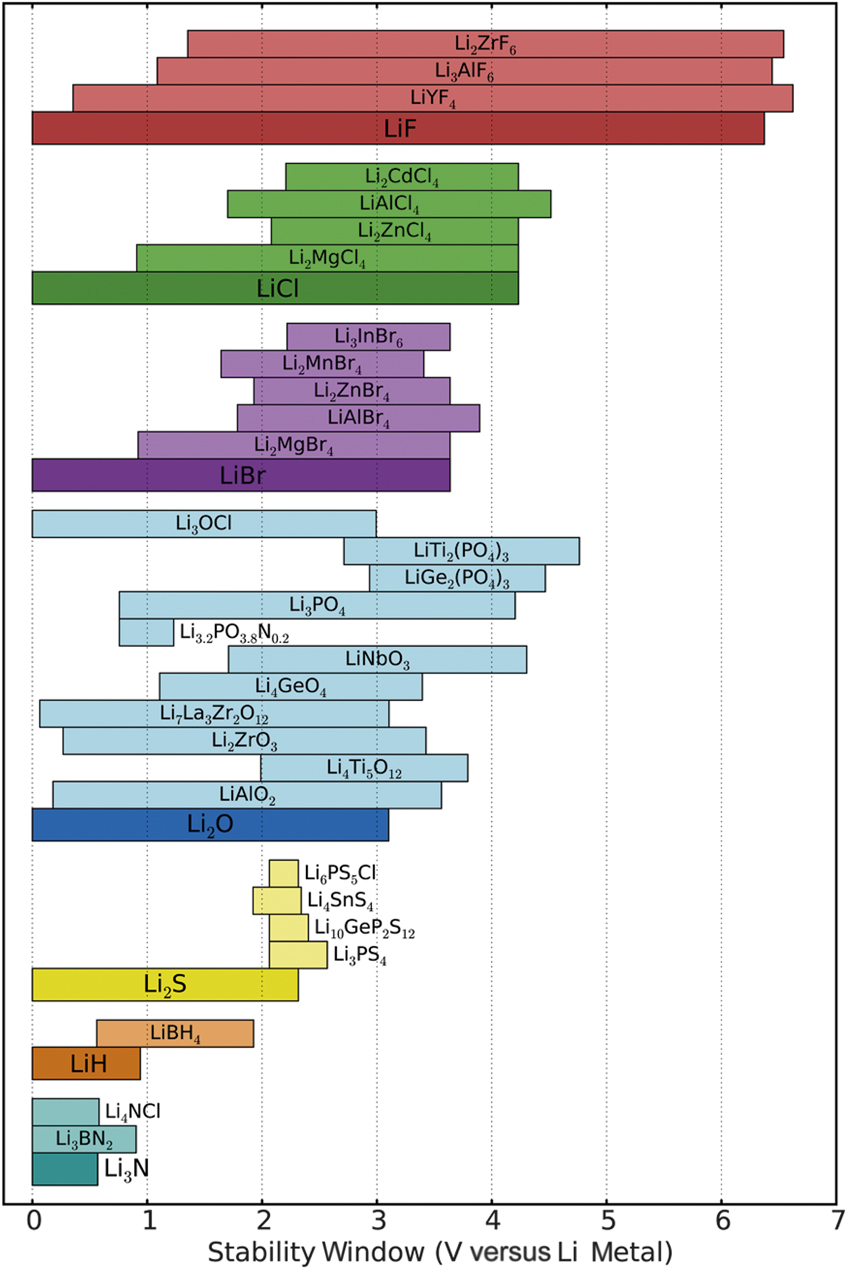
Using these techniques, various researchers have shown that the Li10GeP2S12 family of solid electrolytes, and indeed, most sulfide as well as many oxide solid electrolytes,Reference Zhu, Chu, Deng and Ong6,Reference Chu, Nguyen, Hy, Lin, Wang, Xu, Deng, Meng and Ong23,Reference Zhu, He and Mo26,Reference Richards, Miara, Wang, Kim and Ceder27,Reference Tang, Deng, Lin, Wang, Chu, Chen, Zhu, Zheng and Ong30,Reference Tian, Shi, Richards, Li, Kim, Bo and Ceder32 are inherently unstable against the alkali metal anode and reasonable-voltage cathode materials (Figure 2), and that the interfacial reaction products (and volume change) can be predicted with extensive validation by experimental studies.Reference Miara, Windmüller, Tsai, Richards, Ma, Uhlenbruck, Guillon and Ceder33–Reference Wenzel, Weber, Leichtweiss, Busche, Sann and Janek35 The observed limited stability window of most solid electrolytes is easy to rationalize. On the cathode side, breakdown occurs by Li and electron removal. In the likely scenario that no oxidizable transition metal is present in the solid electrolyte, the electron is extracted from the anion. Hence, the high voltage limit is set by the ease of oxidation of S for sulfide conductors (2–3 V) and of O for oxide conductors (3–4 V). Only when the anion states are pushed down in energy by strong hybridization with another metal (such as P) does the anion electron extraction potential increase.Reference Seo, Lee, Urban, Malik, Kang and Ceder36 However, metals that can provide this hybridization are often reducible at low voltage, setting up competition between anodic and cathodic stability.
Electrochemical stability ranges of various electrolyte materials grouped by anion.Reference Zhu, He and Mo26 Note: V, voltage.
A particularly valuable insight that can be gleaned from the thermodynamic interface reactivity models is that the especially exothermic interfacial reaction energies between thiophosphate solid electrolytes and the common layered transition-metal oxide cathodes (AMO2, where A is an alkali metal and M is a transition metal) are the result of oxygen-exchange reactions resulting in the formation of phosphate from thiophosphates.Reference Richards, Miara, Wang, Kim and Ceder27,Reference Tang, Deng, Lin, Wang, Chu, Chen, Zhu, Zheng and Ong30,Reference Tian, Shi, Richards, Li, Kim, Bo and Ceder32 This can be potentially mitigated by choosing cathode (e.g., phosphate cathodes such as LiFePO4) or solid electrolyte (e.g., oxide solid electrolytes) chemistries to avoid such reactions.
An alternative approach to these thermodynamics approximations is to perform first-principles calculations on explicit interfacial models. For example, Holzwarth et al. have studied the work of adhesion (W ad) and electronic structure of a variety of solid electrolyte/metal anode interfaces,Reference Al-Qawasmeh and Holzwarth37,Reference Lepley and Holzwarth38 and found that most interfaces (e.g., Li3PO4, Li3PS4, Li14P2O3N6, Li7PN4 with Li metal) have negative W ad and are insulating (from partial density of states analysis). Sharafi et al.Reference Sharafi, Kazyak, Davis, Yu, Thompson, Siegel, Dasgupta and Sakamoto28 calculated W ad of the Li/Li2CO3 and Li/Li7La3Zr2O12 interfaces, and showed that common surface contaminants such as Li2CO3 result in poor wettability (low W ad) and high interfacial resistance, which can be mitigated by removing these surface layers through surface conditioning. It should be noted that a common limitation of these studies is that the interface simulations are carried out using 0 K DFT calculations, ignoring longer time-scale interfacial reactions and the effects of finite temperature.
Tang et al.Reference Tang, Deng, Lin, Wang, Chu, Chen, Zhu, Zheng and Ong30 attempted to address this limitation by using AIMD simulations to probe the time evolution of interface models of Na/Na3PS4 and NaxCoO2/Na3PS4 at room temperature. The interfacial products are identified through the evolution of bond radial distribution functions. Though the predicted reaction products from the AIMD simulations are largely similar to those from thermodynamic approximations, Tang et al. discovered that sulfates tend to be formed in the initial reaction between the NaxCoO2 cathode and Na3PS4 solid electrolyte over the phosphates predicted from thermodynamics.
In all explicit interface model simulations, a major limitation is that fairly small interface models with built-in assumptions about initial structure are used, and only fairly short simulation time scales (<100 ps) can be probed. These constraints are due to the relatively high cost and poor scaling of first-principles methods, which are necessary to obtain accurate reactions and electronic structure.
Summary
First-principles modeling of ionic conductivity and interfacial reactivity has been valuable to understand the intrinsic performance and limitations of solid electrolytes for solid-state batteries. Using AIMD, ionic conductivity can be predicted with reasonable accuracy. Thermodynamic models for electrochemical stability and interfacial reactivity have been used to establish the intrinsic voltage limits at which solid electrolytes can operate in solid-state batteries. As the community moves toward new battery designs, computational methods will continue to play important roles in next-generation energy-storage devices.

Gerbrand Ceder is a professor of materials science and engineering at the University of California, Berkeley (UC Berkeley). He obtained his degree in metallurgy and applied materials science from the KU Leuven, Belgium, and his PhD degree from UC Berkeley. His research focuses on computational and experimental materials design. His current interests include the materials genome and machine-learning approaches to materials design and synthesis. He has published more than 400 scientific papers, and holds more than 40 US and foreign patents. He is a member of the US National Academy of Engineering and the Royal Flemish Academy of Belgium for Science and the Arts, and a Fellow of MRS and TMS. Ceder can be reached by email at gceder@berkeley.edu.

Shyue Ping Ong is an associate professor of nanoengineering at the University of California, San Diego. He obtained his PhD degree from the Massachusetts Institute of Technology. He leads the Materials Virtual Lab, a research group dedicated to the interdisciplinary application of materials sciences, information science, and computer science to the study and design of materials. He is a recipient of the US Department of Energy Early Career Research Program Award and the Office of Naval Research Young Investigator Program Award, and has published more than 70 articles. Ong can be reached by email at ongsp@eng.ucsd.edu.

Yan Wang is a senior research scientist at the Advanced Materials Laboratory, Samsung Research America. He received his bachelor’s degree from Tsinghua University, China, and his PhD degree in physics from the Institute of Physics, Chinese Academy of Sciences. Wang was a postdoctoral associate at the Quantum Theory Project, University of Florida, a senior postdoctoral associate at the Massachusetts Institute of Technology (MIT), and the program manager at the Samsung-MIT Center for Materials Design in Energy Applications. His current research interests focus on computational materials design for energy applications including Li-ion, Na-ion, and solid-state batteries. Wang can be reached by email at eric.wangyan@samsung.com or eric.wangyan@gmail.com.