1. Introduction
There is a wide consensus in macroeconomics that distortionary taxes should be smoothed across time and states to improve welfare.Footnote 1 There is a voluminous literature based on the closed economy framework that addresses optimal fiscal policy, for example Lucas and Stokey (Reference Lucas1983), Bohn (Reference Bohn1990), Chari et al. (Reference Chari, Christiano and Kehoe1991), and Benigno and Woodford (Reference Benigno, Woodford, Benigno and Woodford2003). Though not comparable to ample literature in closed economy framework, there are some papers on optimal taxations in open economies (Auray et al. Reference Auray, de Blas and Eyquem2011; Auray et al. Reference Auray, Eyquem and Gomme2018; Benigno and De Paoli, Reference Benigno and De Paoli2010; Chen et al. Reference Chen, Devereux, Shi and Xu2021; Farhi et al. Reference Farhi, Gopinath and Itskhoki2014; Hjortsø, Reference Hjortsø2016; Tang, Reference Tang2020).
International dimension of fiscal policy brings an additional element of the terms of trade externality into play. Since welfare in open economy is influenced by the terms of trade externality associated with economic agent’s purchasing power, the fiscal authority has an incentive to utilize its policy to exploit the externality by affecting the composition of aggregate demand and the production frontiers. For example, a terms of trade appreciation can increase welfare by decreasing the disutility of labor hours at home without an equivalent reduction in the utility of consumption if domestic and foreign goods are not independent.
Benigno and De Paoli (Reference Benigno and De Paoli2010) show that optimal fiscal policy in a small open economy can depart from tax smoothing as long as the intertemporal elasticity of substitution
 $(\sigma ^{-1})$
is not equal to the intratemporal elasticity of substitution
 $(\eta ),$
contrasting with the conventional wisdom on optimal taxations in closed economies. It is well known that policy objectives in the small open economy are isomorphic to the ones in the closed economy if the intertemporal elasticity of substitution equals the intratemporal elasticity of substitution between domestic and foreign goods, that is if
 $\sigma \eta =1$
, that is as long as domestic and foreign goods are independent in utility (Galí and Monacelli, Reference Galí and Monacelli2005; Corsetti et al. Reference Corsetti, Dedola, Leduc, Corsetti, Dedola and Leduc2010). Under this particular preference specification, the wedge between the marginal rate of substitution (MRS) between consumption and leisure and the marginal product of labor (MPL) is time-invariant. Hence, it is optimal to implement a time-invariant taxation or subsidy to offset distortions associated with monopolistic competition in goods market as in Woodford (Reference Woodford2003). Otherwise, optimal fiscal policy departs from tax smoothing and exploits the terms of trade to alleviate time-varying distortions in the open economy.
This paper revisits the discussion on optimal fiscal policy in a small open economy by incorporating habit persistence into the model. A number of studies have found that the dynamic stochastic general equilibrium (DSGE) models with a substantial degree of internal or external habit persistence are successful in reproducing the stylized facts over business cycles. For example, Christiano et al. (Reference Christiano, Eichenbaum and Evans2005) and Smets and Wouters (Reference Smets and Wouters2007) estimate the degree of habit persistence to be 0.65 and 0.71 in a closed economy model, while Adolfson et al. (Reference Adolfson, Laséen, Lindé and Villani2007) find the estimate of the habit persistence to be about 0.65 in an open economy model. In light of the fact that the DSGE models embedded with habit persistence in consumption are successful in improving the explanatory power of the model over business cycles,Footnote 2 the optimal fiscal policy implications in the model with habit persistence warrant a closer look.
If households have habit persistence in consumption, the home country is not insulated from the foreign country for unitary intertemporal and intratemporal elasticity of substitution
 $(\sigma\,{=}\,\eta\,{=}\,1)$
, leaving room for the fiscal authority to use time-varying tax policy to exploits the terms of trade externality in its favor. Irrespective of internal or external habit persistence in consumption, habit persistence which generates a time-varying wedge between the MRS between consumption and labor and the MPL drives a gap between production and expenditure even for the Cole-Obstfeld preference
 $(\sigma =\eta =1)$
. Hence, the fiscal authority should fully take into account the effect of habit persistence on these two wedges in designing optimal fiscal policy.
We will address how habit persistence in consumption aggravates the terms of trade externality and optimal taxes should be varied to replicate the efficient resource allocations. To this end, we abstract from monetary policy considerations by assuming that prices are flexible along the line of Benigno and De Paoli (Reference Benigno and De Paoli2010). Specifically, we set up a small open economy with habit persistence and then examine whether the sufficient condition for tax smoothing to be optimal, that is the condition that
 $\sigma \eta =1$
in the model without habit persistence still holds. We also discuss the dynamic properties of optimal income taxes to replicate the social planner’s resource allocation in the small open economy with habit persistence in consumption.
The main findings of this paper can be summarized as follows. First, optimal labor income taxes are time-varying in the small open economy with habit persistence in consumption, irrespective of inter- and intratemporal elasticity of substitution. The social planner fully considers the effect of habit persistence in consumption on the current and future terms of trade, while households in the market economy take into account their consumption decision on the current terms of trade. This wedge calls for time-varying optimal income tax dependent on the degree of habit persistence. The higher the degree of catching up with the Joneses, the larger the wedge between the MRS between consumption and leisure in the centralized economy and the corresponding MRS in the market economy. Hence, optimal income taxes to deal with the distortions should increase with the degree of external habit persistence, irrespective of the inter- and intratemporal elasticity of substitution. Consumption of households with external habit persistence in consumption who are unconscious of the effect of their decision on the economy drive excessive aggregate fluctuations, while consumption of households with internal habit in consumption who take into account the effect of their decision on the economy entails a moderate aggregate fluctuations.
Second, the standard deviation of optimal labor income tax is likely to increase with the degree of habit persistence. The higher the degree of habit, the more volatile the time-varying wedge between the MRS between consumption and leisure and marginal product of labor, yielding more volatile optimal tax to deal with the time-varying distortions.
Third, the standard deviation of optimal labor income tax shows an inverted U-shape in the degree of trade openness
 $(\theta )$
in the economy with internal habit persistence, irrespective of elasticity of substitution. This contrasts with the time-invariant optimal labor income tax rates to offset the distortions associated with monopolistically competitive firms in a closed economy with internal habit. It is quite intuitive that the largest tax rate volatility is obtained in the intermediate degree of openness since the limit case of the absence of home bias corresponds to
 $\theta \rightarrow 1.$
Fourth, optimal labor income taxes are less volatile in a small open economy than in a closed economy if households are catching up with the Joneses, in contrast with findings of Auray et al. (Reference Auray, de Blas and Eyquem2011) and Benigno and De Paoli (Reference Benigno and De Paoli2010). In the open economy, households who partially buffer themselves against the labor income tax by working less can consume more goods by diverting their demand for goods toward foreign goods to the higher labor income taxation, since the terms of trade appreciates with lower domestic output.
Finally, optimal labor income tax moves countercyclically for a low value of the intratemporal elasticity of substitution, while it moves procyclically for a high value of the intratemporal elasticity of substitution. When the intratemporal elasticity of substitution between home and foreign goods is high, households are more willing to divert their demand for goods toward domestic goods to the positive domestic productivity shock, yielding an excessive and persistent expansion of domestic output in the economy with habit persistence. To restore the efficient allocations by cooling down an excessive aggregate production, the fiscal authority should raise labor income taxes, which results in procyclical labor income tax. However, when households are less willing to substitute domestic goods with foreign goods to an international relative price change, the fiscal authority needs to boost domestic production toward the efficient level to a positive domestic technology shock with a lower labor income tax to exploit the favorable production opportunity.
The remainder of the paper is organized as follows. Section 2 presents a canonical small open economy model with habit persistence and discusses equilibrium conditions. Section 3 addresses optimal fiscal policy in the small open economy with habit persistence. In section 4, a numerical analysis is performed. Section 5 concludes the paper.
2. The model
This section sets up a small open economy model with habit formation applied to open economy. The world is composed of two countries, home
 $(H)$
and foreign
 $(F)$
with population size
 $n$
and
 $1-n$
respectively. In this paper, the small open economy is characterized as a limiting-case approach as in Ester and Monacelli (Reference Ester and Monacelli2008) and Galí and Monacelli (Reference Galí and Monacelli2005). It is assumed that the relative size of domestic economy is negligible relative to the rest of the world, that is
 $n\longrightarrow 0.$
2.1. Households
Abel (Reference Abel1990, Reference Abel1999) and Smets and Wouters (Reference Smets and Wouters2007) specified a simple recursive preference, in which a representative household derives utility from the level of consumption relative to a time-varying subsistence or habit level. In particular, we assume that the utility function of the representative household takes the form:
 \begin{equation} E_{0}\left [ \sum _{t=0}^{\infty }\beta ^{t}\left ( \frac{(C_{t}^{d})^{1-\sigma }}{1-\sigma }-\frac{N_{t}^{1+v}{}}{1+v}\right ) \right ],\,\,0\lt \beta \lt 1, \end{equation}
where
 $\beta$
is the household’s discount factor,
 $E_{0\text{ }}$
denotes the conditional expectations operator on the information available in period
 $0$
, and
 $C_{t}^{d}=C_{t}-bH_{t-1}.$
 $C_{t},$
 $N_{t},\, $
and
 $H_{t}$
represent the household’s consumption for composite goods, work hours, and the time-varying habit level of consumption at time
 $t,$
respectively, and
 $0\leq b\lt 1$
measures the degree of habit persistence. To make the discussion more concrete, a specific consumption index is assumed as follows:
 \begin{equation} C_{t}\equiv \lbrack (1-\theta )^{\frac{1}{\eta }}C_{H,t}{}^{\frac{\eta -1}{\eta }}+\theta ^{\frac{1}{\eta }}C_{F,t}{}^{\frac{\eta -1}{\eta }}]^{\frac{\eta }{\eta -1}}, \end{equation}
where
 $\theta \equiv (1-n)\gamma$
is the share of domestic consumption allocated to imported goods,
 $\gamma$
is the degree of trade openness, and
 $\eta \gt 0$
is the intratemporal elasticity of substitution between domestic and foreign goods. In similar, foreign consumption index is assumed as
 \begin{equation} C_{t}^{\ast }\equiv \lbrack (1-\theta ^{\ast })^{\frac{1}{\eta }}C_{F,t}^{\ast }{}^{\frac{\eta -1}{\eta }}+\theta ^{\ast \frac{1}{\eta }}C_{Ht,}^{\ast }{}^{\frac{\eta -1}{\eta }}]^{\frac{\eta }{\eta -1}}, \end{equation}
where
 $\theta ^{\ast }\equiv n\gamma ^{\ast }.$
To consider home bias in consumption, it is assumed that
 \begin{equation} (1-\theta )\gt \theta ^{\ast }. \end{equation}
Here
 $C_{H,t}$
and
 $C_{F,t}$
are indices of consumption of domestic and foreign goods which are given by the following CES aggregators of the consumed amounts of each type of good:
 \begin{equation} C_{H,t}\equiv \left ( \frac{1}{n}\right ) ^{\frac{1}{\epsilon }}\left ( \int _{0}^{n}C_{H,t}(j)^{\frac{\epsilon -1}{\epsilon }}dj\right ) ^{\frac{\epsilon }{\epsilon -1}},\;C_{F,t}\equiv \left ( \frac{1}{1-n}\right ) ^{\frac{1}{\epsilon }}\left ( \int _{n}^{1}C_{F,t}(j)^{\frac{\epsilon -1}{\epsilon }}dj\right ) ^{\frac{\epsilon }{\epsilon -1}}, \end{equation}
where
 $\epsilon$
measures the elasticity of substitution among goods within each category. In this context, the consumer price index is given by
 \begin{equation} P_{t}\equiv \lbrack \left ( 1-\theta \right ) P_{H,t}^{1-\eta }+\theta P_{F,t}^{1-\eta }]^{\frac{1}{1-\eta }}, \end{equation}
where
 $P_{Ht}$
and
 $P_{Ft}$
denote the price of domestic goods and imported foreign goods in domestic currency unit in period
 $t,$
given by
 \begin{equation} P_{H,t}=\left [ \left ( \frac{1}{n}\right ) \int _{0}^{n}P_{H,t}(j)^{1-\epsilon }dj\right ] ^{\frac{1}{1-\epsilon }},\ \ P_{F,t}=\left [ \left ( \frac{1}{1-n}\right ) \int _{n}^{1}P_{F,t}(j)^{1-\epsilon }dj\right ] ^{\frac{1}{1-\epsilon }}. \end{equation}
The law of one price is assumed to hold:
 $P_{H,t}(j)=\mathcal{S}_{t}P_{H,t}^{\ast }(j)$
and
 $P_{F,t}(j)=\mathcal{S}_{t}P_{F,t}^{\ast }(j)$
for all
 $j,\, $
where
 $\mathcal{S}_{t}$
is the nominal exchange rate in period
 $t$
.
Next,
 $H_{t-1}$
summarizes the influence of past consumption levels on today’s utility. The utility of a representative household depends on the difference between consumption and habit. Two types of habit persistence are considered in this paper. In the case of external habit persistence, the stochastic sequence of habits
 $\{H_{t}\}_{t=0}^{\infty }$
is regarded as exogenous by the household and tied to the stochastic sequence of aggregate consumption
 $\{C_{t}\}_{t=0}^{\infty }$
. That is,
 \begin{equation} H_{t-1}=\widetilde{C}_{t-1}, \end{equation}
where
 $\widetilde{C}_{t-1}$
is aggregate past consumption. In the case of internal habit persistence, it is assumed that
 \begin{equation*} H_{t-1}=C_{t-1}. \end{equation*}
In this specification of habit formation, habit depends on one lag of consumption.
There exists a complete market for state-contingent claims in domestic currency units that are traded internationally. Let
 $B_{t+1}$
denote the payoff in period
 $t+1$
of the portfolio purchased in period
 $t$
and
 $Q_{t,t+1}$
Footnote 3 be the corresponding stochastic discount factor for one-period ahead nominal payoffs in period
 $t.$
At the beginning of each period, the household receives wages
 $(W_{t})$
and profits
 $(\Pi _{t})$
from each firm. The household’s budget constraint is given by
 \begin{equation} C_{t}+E_{t}[Q_{t,t+1}\frac{B_{t+1}}{P_{t}}]\leq \frac{B_{t}}{P_{t}}+\frac{(1-\tau _{t})W_{t}N_{t}}{P_{t}}+\frac{TR_{t}}{P_{t}}+\frac{\Pi _{t}}{P_{t}}, \end{equation}
where
 $\tau _{t}\, $
and
 $TR_{t}$
denote the subsidy/tax rate on labor income
 $\, $
and government lump-sum transfer or taxation given to the domestic household in time
 $t$
.Footnote 4
The optimal allocation of any given domestic expenditure within each category of goods is given by
 \begin{eqnarray} C_{H,t} &=&(1-\theta )\left [ \frac{P_{H,t}}{P_{t}}\right ] ^{-\eta }C_{t}, \nonumber \\ C_{F,t} &=&\theta \left [ \frac{P_{F,t}}{P_{t}}\right ] ^{-\eta }C_{t}, \end{eqnarray}
Similarly, the optimal allocation of any given foreign expenditure within each category of goods is given by
 \begin{eqnarray} C_{H,t}^{\ast } &=&(1-\theta ^{\ast })\left [ \frac{P_{H,t}^{\ast }}{P_{t}^{\ast }}\right ] ^{-\eta }C_{t}^{\ast },\\ C_{F,t}^{\ast } &=&\theta ^{\ast }\left [ \frac{P_{F,t}^{\ast }}{P_{t}^{\ast }}\right ] ^{-\eta }C_{t}^{\ast }, \nonumber \end{eqnarray}
where
 $P_{t}^{\ast },\ P_{F,t}^{\ast },$
and
 $P_{H,t}^{\ast }$
denote the foreign consumer price index and the price of foreign goods and domestic goods in foreign currency unit in period
 $t$
.
2.2. Household’s first order conditions
First order conditions for the household with habit persistence can be summarized as follows.
 \begin{equation} N_{t}^{\nu }{}=MU_{C_{t}}(1-\tau _{t})w_{t}, \end{equation}
 \begin{equation} Q_{t,t+1}=\beta \frac{P_{t}}{P_{t+1}}\frac{MU_{Ct+1}}{MU_{Ct}}, \end{equation}
where
 \begin{equation} MU_{C_{t}}=\left \{ \begin{array}{cc} (C_{t}-b\widetilde{C}_{t-1})^{-\sigma } & \text{for external habit} \\ (C_{t}-bC_{t-1})^{-\sigma }-b\beta E_{t}(C_{t+1}-bC_{t})^{-\sigma } & \text{for internal habit,} \end{array} \right . \end{equation}
and the budget constraint (9). Here
 $w_{t}\equiv \frac{W_{t}}{P_{t}}$
is the real wage in period
 $t$
. Equation (12) relates the marginal disutility of labor supply to the marginal utility of the real wage rate. Equation (13) refers to the intertemporal decision of the household, that is, the decision of bond holdings.
Equation (13) and the efficiency condition for bonds holding corresponding to the foreign household imply that the equilibrium real exchange rate
 $\mathcal{E}_{t}$
is given by
 \begin{equation} \mathcal{E}_{t}=\frac{MU_{C_{t}^{\ast }}}{MU_{C_{t}}}, \end{equation}
where foreign values of the corresponding domestic variables will be denoted by an asterisk (*)
 $.$
In the case of internal habit persistence, the first order conditions imply that the expected future marginal utility of consumption affects the household’s current decisions.
2.3. Domestic firms
A continuum of firms are supposed to produce differentiated goods. Each firm indexed by
 $i\in \lbrack 0,1]$
produces its product with a linear technology
 $Y_{t}(i)=A_{t}N_{t}(i)$
, where
 $A_{t}$
is the home country resident’s technology process at period
 $t$
, and
 $Y_{t}(i)$
and
 $N_{t}(i)$
are the output and total labor input of the
 $i$
th firm, respectively. We assume that the productivity shock follows an
 $AR(1)$
process as
 $\log A_{t}=\log A+\rho _{A}\log A_{t-1}+\epsilon _{A,t},\,\,\,\,\,\,-1\lt \rho _{A}\lt 1,$
where
 $E(\epsilon _{A,t})=0$
and
 $\,\,\xi _{At}$
is i.i.d. over time.
Assuming a perfectly competitive labor market, the firm
 $i$
’s demand for labor is determined by its cost minimization as follows:
 \begin{equation} w_{t}=\mathcal{MC}A_{t}\frac{P_{H,t}}{P_{t}}, \end{equation}
where
 $\mathcal{MC}\equiv \frac{\epsilon -1}{\epsilon }$
is an inverse of domestic firm’s markup in period
 $t$
. Plugging (16) into (12), one can derive a labor market equilibrium condition:
 \begin{equation} \frac{N_{t}^{\nu }}{MU_{C_{t}}}=\mathcal{MC}(1-\tau _{t})A_{t}\frac{P_{H,t}}{P_{t}}. \end{equation}
Next, the CPI-PPI ratio
 $\frac{P_{t}}{P_{Ht}}$
can be expressed in terms of the terms of trade
 $\mathcal{T}_{t}\equiv \frac{P_{F,t}}{P_{H,t}}$
as follows:
 \begin{equation} \frac{P_{t}}{P_{H,t}}=[\left ( 1-\theta \right ) +\theta \mathcal{T}_{t}^{1-\eta }]^{\frac{1}{1-\eta }}\equiv \mathcal{K}(\mathcal{T}_{t}). \end{equation}
The real exchange rate is also linked to the terms of trade through the following expression:
 \begin{equation} \mathcal{E}_{t}=\frac{\mathcal{S}_{t}P_{t}^{\ast }}{P_{t}}=\mathcal{T}_{t}[1-\theta +\theta \mathcal{T}_{t}^{1-\eta }]^{\frac{1}{\eta -1}}\equiv \mathcal{H}(\mathcal{T}_{t}). \end{equation}
The monopolistic competition firms in the domestic product markets set their own price to maximize their profits. The firm’s maximization problem can be written as follows:
 \begin{equation} \max \;\frac{\Lambda _{t}}{P_{t}}[P_{H,t}(i)Y_{t}(i)-W_{t}N_{t}(i)]\} \end{equation}
subject to
 \begin{equation} Y_{t}(i)\leq \left ( \frac{P_{H,t}(i)}{P_{H,t}}\right ) ^{-\epsilon }Y_{t}, \end{equation}
where
 $\Lambda _{t}\equiv MU_{C_{t}}$
and
 $Y_{t}$
is the aggregate world demand for domestic products in period
 $t$
.
Then the newly determined prices at time
 $t$
is given by
 \begin{equation} \frac{W_{t}}{A_{t}P_{H,t}}\left ( \frac{P_{H,t}(i)}{P_{H,t}}\right ) ^{-1}=\mathsf{\mathcal{MC}}^{-1}. \end{equation}
A representative household in the foreign country faces an identical problem to the one outlined above.
2.4. Equilibrium
We will focus on the symmetric equilibrium in which all agents in the same country make the same decisions in what follows. A symmetric equilibrium implies that all domestic and foreign firms set the same prices, and chooses the same demand for labor:
 $P_{H,t}(i)=P_{H,t},\ N_{t}(i)=N_{t},\ P_{F,t}^{\ast }(i)=P_{F,t}^{\ast },\ N_{t}^{\ast }(i)=N_{t}^{\ast },$
and so on for all
 $i$
and
 $t$
.
In a symmetric equilibrium, the price-setting equation (22) is simplified as
 \begin{equation} \frac{N_{t}^{\nu }}{MU_{C_{t}}}=\mathcal{MC}A_{t}\mathcal{K}^{-1}(\mathcal{T}_{t})(1-\tau _{t}). \end{equation}
Assuming symmetric degree of home bias across countries with the negligible relative size of home country as in Galí and Monacelli (Reference Galí and Monacelli2005) and Ester and Monacelli (Reference Ester and Monacelli2008), goods market clearing in home and foreign countries requires that
 \begin{equation} A_{t}N_{t}=(1-\theta )\left ( \frac{P_{H,t}}{P_{t}}\right ) ^{-\eta }C_{t}+\theta \left ( \frac{P_{H,t}^{\ast }}{P_{t}^{\ast }}\right ) ^{-\eta }C_{t}^{\ast }, \end{equation}
 \begin{equation} A_{t}^{\ast }N_{t}^{\ast }=C_{t}^{\ast }. \end{equation}
Net supply of bonds must satisfy
 \begin{equation} B_{t}+B_{t}^{\ast }=0. \end{equation}
The symmetric equilibrium is an allocation of
 $\{C_{t},C_{t}^{\ast },N_{t},N_{t}^{\ast }\}_{t=0}^{\infty },$
a sequence of prices and costate variables for the home and foreign country
 $\{P_{H,t},P_{F,t},P_{t}, P_{F,t}^{\ast },P_{H,t}^{\ast },P_{t}^{\ast }\}_{t=0}^{\infty }\,$
and a sequence of the terms of trade and the real exchange rate
 $\{\mathcal{T}_{t},\,\mathcal{E}_{t}\}_{t=0}^{\infty }$
such that (1) the households decision rules
 $\,$
solve their optimization problem, given the states and the prices; (2) the demands for labor solves each firm’s cost minimization problem and price-setting rules
 $\,$
solve its profit maximization problem, given the states and the prices; (3) each goods market, labor market, and bond market are cleared at the corresponding prices, given the initial conditions for the state variables and the exogenous productivity shock processes
 $\{\,\epsilon _{A,t},\,\epsilon _{A,t}^{\ast }\}_{t=0}^{\infty }$
as well as the fiscal policies
 $\{\tau _{t},\tau _{t}^{\ast }\}_{t=0}^{\infty }$
. Specifically, a symmetric equilibrium conditions consist of (16), (18), (23), (24) with the law of one price
 $P_{F,t}=\mathcal{S}_{t}P_{F,t}^{\ast },\, $
and the corresponding equilibrium conditions in foreign country with the risk-sharing condition, (15), the relation between the terms of trade and the real exchange rate, (19), and the fiscal policies.
3. Optimal tax policy
When households have habit persistence in consumption, their gradual adjustment of consumption generates a wedge between output and consumption in a small open economy even if both the intertemporal and the intratemporal elasticity of substitution equal one.
To find the optimal time-varying tax rate to eliminate completely time-varying distortions associated with habit persistence, we need to solve the social planner’s problem. Let
 $\mathrm{V}(C_{t-1},A_{t},\mathcal{F}_{t})$
represent the value function of the small open economy in the Bellman equation for the optimization problem in period
 $t,$
where
 $\mathcal{F}_{t}$
represents the variables of foreign country in period
 $t$
given: The problem of the social planner who fully takes into account the effect of consumption and work hours on the path of the terms of trade can be formulated as follows:
 \begin{equation*} \mathrm {V}(C_{t-1},A_{t},\mathcal {F}_{t})=\max ._{\{C_{t},N_{t},\mathcal {T}_{t}\}}\left [ \left ( \frac {(C_{t}-bC_{t-1})^{1-\sigma }}{1-\sigma }-\frac {N_{t}^{1+v}{}}{1+v}\right ) +\beta E_{t}\mathrm {V}(C_{t},A_{t+1},\mathcal {F}_{t+1})\right ], \end{equation*}
subject to
 \begin{equation} A_{t}N_{t}=(1-\theta )\mathcal{K}(\mathcal{T}_{t})^{\eta }C_{t}+\theta ^{\ast }\mathcal{T}_{t}^{\eta }C_{t}^{\ast }, \end{equation}
 \begin{equation} \mathcal{H}(\mathcal{T}_{t})=\frac{MU_{C_{t}^{\ast }}}{MU_{C_{t}}}. \end{equation}
3.1. Wedges between MRS and marginal product of labor
The presence of habit persistence in consumption generates undesirable aggregate fluctuations to the efficient productivity shocks in the open economy, calling for fiscal policy to alleviate the negative effect of habit persistence associated with a terms of trade externality.
To look at how the habit persistence generates a time-varying gap between the social planner’s resource allocation and the market equilibrium, consider first the social planner’s optimization conditions in the external habit circumstance. The wedges between the marginal rate of substitution between consumption and labor and the marginal product of labor are given by
 \begin{eqnarray} &&\mathcal{E}_{t}^{-1}\mathcal{T}_{t}N_{t}^{\nu }A_{t}^{-1}MU_{C_{t}}^{-1} \\ &=&\{1-b\widetilde{R}_{t}^{-1}+\sigma \theta \eta bE_{t}[Q_{t,t+1}MU_{C_{t+1}}^{-1}N_{t+1}^{\nu }A_{t+1}^{-1}\mathcal{E}_{t+1}^{-1}\mathcal{T}_{t+1}((1-\theta )C_{t+1}\mathcal{E}_{t+1}^{2(1-\eta )}+\mathcal{E}_{t+1}C_{t+1}^{\ast }) \nonumber \\ &&\times \frac{\mathcal{T}_{t+1}^{\eta -1}(1-\theta \mathcal{E}_{t+1}^{1-\eta })^{-1}}{C_{t+1}-bC_{t}}]\} \nonumber \\ &&\times \{(1-\theta )(\mathcal{E}_{t}^{-1}\mathcal{T}_{t})^{\eta -1}+\sigma \eta \theta \lbrack (1-\theta )C_{t}\mathcal{E}_{t}^{2(1-\eta )}+\mathcal{E} _{t}C_{t}^{\ast }]\times \frac{\mathcal{T}_{t}^{\eta -1}(1-\theta \mathcal{E} _{t}^{1-\eta })^{-1}}{C_{t}-bC_{t-1}}\}^{-1}. \nonumber \end{eqnarray}
Next, the social planner’s optimization conditions in the economy with internal habit persistence imply that the wedges between the marginal rate of substitution between consumption and labor and the marginal product of labor are given by
 \begin{eqnarray} &&1-b\beta E_{t}\frac{MU_{C_{t+1}}}{MU_{C_{t}}} \\ &=&\mathcal{E}_{t}^{-1}\mathcal{T}_{t}N_{t}^{\nu }A_{t}^{-1}MU_{C_{t}}^{-1}\{(1-\theta )(\mathcal{E}_{t}^{-1}\mathcal{T} _{t})^{\eta -1}+\sigma \theta \eta \lbrack (1-\theta )C_{t}\mathcal{E} _{t}^{1-2\eta }+C_{t}^{\ast }] \nonumber \\ &&\times \mathcal{T}_{t}^{\eta -1}(1-\theta \mathcal{E}_{t}^{1-\eta -1}) \frac{\mathcal{E}_{t}}{C_{t}-bC_{t-1}}\}^{-1}-\sigma \theta \eta b\beta E_{t}\{MU_{C_{t}}^{-1}N_{t+1}^{\nu }A_{t+1}^{-1}\mathcal{E}_{t+1}^{-1} \nonumber \\ &&\times \mathcal{T}_{t+1}[(1-\theta )C_{t+1}\mathcal{E}_{t+1}^{1-2\eta }+C_{t+1}^{\ast }]\mathcal{T}_{t+1}^{\eta -1}(1-\theta \mathcal{E} _{t+1}^{1-\eta })^{-1}\times \frac{\mathcal{E}_{t+1}}{C_{t+1}-bC_{t}}\}. \nonumber \end{eqnarray}
Equation (29) and (30) show that the efficient wedge between the MRS between consumption and labor and the marginal product of labor in the social planner’s problem are time-varying. Hence, if there is habit persistence in consumption, the wedges are time-varying, which call for time-varying taxations to improve upon the domestic household’s welfare, irrespective of the value of the intertemporal elasticity of substitution and the intratemporal substitution between home and foreign goods.
To see the effect of habit persistence on the wedge between the MRS and the marginal product of labor, consider the case of no habit persistence
 $(b=0)$
. Then, the social planner’s wedge is given by
 \begin{equation} \mathcal{E}_{t}^{-1}\mathcal{T}_{t}N_{t}^{\nu }A_{t}^{-1}MU_{C_{t}}^{-1}=(1{-}\theta )(\mathcal{E}_{t}^{-1}\mathcal{T} _{t})^{\eta {-}1}{+}\sigma \theta \eta \lbrack (1{-}\theta )C_{t}\mathcal{E} _{t}^{1{-}2\eta }+C_{t}^{\ast }]\mathcal{T}_{t}^{\eta -1}(1{-}\theta \mathcal{E} _{t}^{1{-}\eta })^{-1}\mathcal{E}_{t}C_{t}^{-1}. \end{equation}
If the intertemporal elasticity of substitution equals the intratemporal substitution between home and foreign goods, that is if
 $\sigma ^{-1}=\eta,$
then (31) can be simplified as
 \begin{equation} \mathcal{E}_{t}^{-1}\mathcal{T}_{t}N_{t}^{\nu }A_{t}^{-1}MU_{C_{t}}^{-1}=1-\theta . \end{equation}
Hence, the wedge is time-invariant only if there is no habit persistence and the intertemporal elasticity of substitution equals the intratemporal substitution between home and foreign goods as in Benigno and De Paoli (Reference Benigno and De Paoli2010). Otherwise, the wedges are time-varying, requiring time-varying taxation to improve upon the domestic household’s welfare in the open economy without any habit in consumption.
3.2. Optimal tax policy for unitary elasticity case
We will first consider the benchmark case, that is the case of a unitary inter- and intratemporal elasticity of substitution for an expositional simplicity. Before turning to the effect of habit persistence on the wedge between the social planner’s the MRS between consumption and leisure and the corresponding one in the market economy, we need to keep in mind that the social planner fully takes into account the effect of consumption on the current and future expected terms of trade, while households do not so in the market equilibrium.
3.2.1 Optimal taxation in external habit case
The social planner’s optimization condition in the external habit persistence can be simplified as
 \begin{eqnarray} &&\{(1-b\widetilde{R} _{t}^{-1})+bE_{t}[Q_{t,t+1}A_{t+1}^{-1}(C_{t+1}-bC_{t})N_{t+1}^{\nu } \mathcal{T}_{t+1}^{\theta }{}[\theta \textbf{S}_{t+1}^{-1}+\frac{\theta }{ 1-\theta }\textbf{S}_{t+1}^{\ast -1}]]\} \nonumber \\ &=&A_{t}^{-1}N_{t}^{\nu }E_{t}(C_{t+1}-bC_{t})\mathcal{T}_{t}^{\theta }{}[1-\theta +[\theta \textbf{S}_{t}^{-1}+\frac{\theta }{1-\theta }\textbf{S} _{t}^{\ast -1}]], \end{eqnarray}
where
 $\widetilde{R}_{t}\equiv \lbrack E_{t}(Q_{t,t+1})]^{-1}$
is the riskless one-period real interest rate at time
 $t.\ \textbf{S}_{t}\equiv \frac{C_{t}-bC_{t-1}}{C_{t}}\, $
and
 $\textbf{S}_{t}^{\ast }\equiv \frac{C_{t}^{\ast }-bC_{t-1}^{\ast }}{C_{t}^{\ast }}$
. Inspecting the social planner’s efficiency condition (33) and the price-setting condition in the market equilibrium (23) shows that the social planner fully takes into account the effect of habit persistence in consumption on the path of the terms of trade, while households in the market equilibrium do not so. This difference generates a time-varying wedge between the social planner’s efficiency condition and the one in the market equilibrium, calling for a time-varying optimal tax policy for unitary elasticity of substitution as in proposition 1.
Proposition 1.
The optimal tax on labor income to completely eliminate time-varying distortions associated with external habit for the benchmark model, that is for
 $\sigma =\eta =1,$
equals
 \begin{eqnarray} \tau _{t} &=&1-\mathcal{MC}^{-1}[(1-\theta )+\theta (\textbf{S}_{t}^{-1}+\frac{1}{1-\theta }\textbf{S}_{t}^{\ast -1})]^{-1}\{(1-b\widetilde{R}_{t}^{-1}) \\ &&+\theta bE_{t}[Q_{t,t+1}(1-\tau _{t+1})\mathcal{MC}(\textbf{S}_{t+1}^{-1}+\frac{1}{1-\theta }\textbf{S}_{t+1}^{\ast -1})]\}. \nonumber \end{eqnarray}
Proof. Please refer to the Appendix.
Equation (34) shows how taxes should be set to guarantee the efficiency in the small open economy with external habit in consumption. If there exists no habit, that is
 $b=0$
, then
 $\textbf{S}_{t}=\textbf{S}_{t}^{\ast }=1$
, and the discrepancy between (23) and (33) is time-invariant.
 $\, $
Hence, the required optimal tax rate on labor income to completely eliminate distortions associated with monopoly power in goods market equals
 $\tau _{t}=1-\frac{\epsilon }{\epsilon -1}(1-\theta )$
as in Galí and Monacelli (Reference Galí and Monacelli2005).Footnote 5 That is, the perfect labor income tax smoothing is optimal in a small open economy without habit in consumption when both the intertemporal and intratemporal elasticity of substitution equal one. Furthermore, the real marginal cost which satisfies
 $C_{t}N_{t}^{\nu }A_{t}^{-1}\mathcal{T}_{t}^{\theta }=\mathcal{MC}(1-\tau _{t})=$
 $(1-\theta )\, $
is always constant in the efficient equilibrium of a small open economy without habit for unitary intertemporal and intratemporal elasticity of substitution.
However, proposition 1 shows that the fiscal authority can improve upon the smoothing labor income tax rate regime by implementing time-varying income tax rate in favor of its own country in small open economy with external habit. Note that the optimal tax rate on labor income equals
 $\tau _{t}=1-\mathcal{MC}^{-1}(1-b\widetilde{R}_{t}^{-1})$
when the economy is closed, that is if
 $\theta =0$
. As shown in Jung (Reference Jung2015). the optimal income tax rate moves procyclically in closed economies, since the real interest rate moves countercyclically. However, the optimal tax rate also moves procyclically in open economies, but it is less procyclically than in closed economies because of the interdependence between home and foreign country.
To ensure the steady-state efficiency in a small open economy with external habit, the social planner should implement the labor income tax rate equal to
 \begin{equation} \tau =1-\frac{\epsilon }{\epsilon -1}\frac{(1-b)(1-b\beta )(1-\theta )}{[\theta (1-b\beta )(2-\theta )+(1-\theta )^{2}(1-b)]}. \end{equation}
(35) shows that the optimal steady-state tax rate is positively related to both the degree of externality in consumption
 $(b)$
and the degree of openness
 $(\theta )$
. In the small open economy, the domestic households with external habit in consumption work harder, thereby deteriorating the terms of trade, while the rest of the world does not experience any change of the terms of trade, even if foreign households with external habit work harder. This additional channel resulting from a deterioration of the terms of trade intensifies the negative effect of externality in consumption in the small open economy, because the depreciation of the terms of trade hurts the purchasing power of the domestic households. Hence, the fiscal authority in the small open economy needs to levy a higher tax rate on labor income to offset the additional negative effect of the terms of trade on the economy with external habit.
3.2.2 Optimal taxation in internal habit case
Turning to the internal habit case, the optimization condition of social planner who fully takes into account the effect of consumption and working hours on the path of the terms of trade can be expressed as
 \begin{eqnarray} &&1+\frac{A_{t}^{-1}N_{t}^{\nu }}{1-\theta }\frac{[\theta (1-\theta )\mathcal{T}_{t}^{\theta }{}C_{t}+\theta \mathcal{T}_{t}{}C_{t}^{\ast }]}{\mathcal{T}_{t}^{1-\theta }MU_{C_{t}}}E_{t}[\frac{1}{MU_{C_{t}^{\ast }}}[\frac{1}{(C_{t}-bC_{t-1})^{2}}+\frac{b^{2}\beta }{(C_{t+1}-bC_{t})^{2}}]] \\ &=&MU_{C_{t}}^{-1}A_{t}^{-1}N_{t}^{\nu }(1-\theta )\mathcal{T}_{t}^{\theta }{}+\frac{A_{t-1}^{-1}N_{t-1}^{\nu }}{1-\theta }\frac{[\theta (1-\theta )\mathcal{T}_{t-1}^{\theta }{}C_{t-1}+\theta \mathcal{T}_{t-1}{}C_{t-1}^{\ast }]}{\mathcal{T}_{t-1}^{1-\theta }MU_{C_{t}}}\frac{1}{MU_{C_{t-1}^{\ast }}}\frac{b}{(C_{t}-bC_{t-1})^{2}} \nonumber \\ &&+E_{t}[\frac{A_{t+1}^{-1}N_{t+1}^{\nu }}{1-\theta }\frac{[\theta (1-\theta )\mathcal{T}_{t+1}^{\theta }C_{t+1}+\theta \mathcal{T}_{t+1}{}C_{t+1}^{\ast }]}{\mathcal{T}_{t+1}^{1-\theta }MU_{C_{t}}}\frac{1}{MU_{C_{t+1}^{\ast }}}\frac{b\beta }{(C_{t+1}-bC_{t})^{2}}], \nonumber \end{eqnarray}
While the social planner takes into account the fact that its current decision on current consumption affects both the current and future expected path of terms of trade in the internal habit case, households consider only the effect of their decision on the current terms of trade as in (23). Hence, the wedge between the price-setting rule (23) and the efficiency condition (36) in the social planner’s problem is also time-varying in the internal habit circumstance.
 $\, $
There is room for government to manipulate the terms of trade with fiscal policy to improve the welfare in small open economies with internal habit persistence for a unitary elasticity of substitution.
Proposition 2.
The optimal tax on labor income to completely eliminate time-varying distortions associated with internal habit for the benchmark model, that is for
 $\sigma =\eta =1,$
depends on the current, future expected value of real exchange rate, consumption, and stochastic discount factor.
 \begin{eqnarray} &&\!\!\!\!\!\!\tau _{t}=1-\mathcal{MC}^{-1}\{(1-\theta )+\frac{[\theta (1-\theta )\mathcal{T}_{t}^{\theta }{}C_{t}+\theta \mathcal{T}_{t}C_{t}^{\ast }]}{\mathcal{T}_{t}\mathcal{E}_{t}MU_{C_{t}}(1-\theta )}[\frac{1}{(C_{t}-bC_{t-1})^{2}}+\frac{b^{2}\beta }{(C_{t+1}-bC_{t})^{2}}]\}^{-1} \\ &&\!\!\!\!\!\!\times \{1+b\frac{\mathcal{MC}[\theta (1-\theta )\mathcal{T}_{t-1}^{\theta }{}C_{t-1}+\theta \mathcal{T}_{t-1}{}C_{t-1}^{\ast }](1-\tau _{t-1})}{\mathcal{T}_{t-1}\mathcal{E}_{t-1}MU_{C_{t-1}}(1-\theta )(C_{t}-bC_{t-1})^{2}} \nonumber \\ &&\!\!\!\!\!\!+b\mathcal{MC}E_{t}[Q_{t,t+1}\frac{[\theta (1-\theta )\mathcal{T}_{t+1}{}^{-1}C_{t+1}+\theta \mathcal{T}_{t+1}^{-\theta }C_{t+1}^{\ast }](1-\tau _{t+1})}{\mathcal{T}_{t+1}\mathcal{E}_{t+1}MU_{C_{t+1}}1-\theta (C_{t+1}-bC_{t})^{2}}]\}. \nonumber \end{eqnarray}
Proposition 2 shows that the current optimal tax rate on labor income depends on the deep parameters such as markup, the degree of habit persistence and openness, and the current and future expected real exchange rate in the internal habit persistence environment. Also, the current optimal tax rate on labor income varies positively with the future expected tax rate, because the habit persistence itself affects both the current and future terms of trade.
Before turning to the relationship between the terms of trade and habit, note that the required (time-invariant) taxation subsidy to attain the efficient steady state in the internal habit persistence equals
 \begin{equation} \tau =1-\frac{\epsilon }{\epsilon -1}(1-\theta ). \end{equation}
The optimal steady-state taxation subsidy (38) in the internal habit circumstance starkly contrasts with the one (35) in the external habit circumstance in that the degree of openness matters, but the degree of habit persistence does not matter at all in the internal habit circumstance. This difference reflects the fact that internal habit itself does not distort the steady-state resource allocations as the households with internal habit persistence fully take into account the effect of their current decisions on the future utility. Hence, the time-varying taxation as specified in equation (37) that guarantees the social optimal allocation in a small open economy with internal habit has the same level of steady-state value as the one in the economy without any habit persistence in consumption.
Note that the time-invariant subsidy taxation on labor income equal to
 $1-\frac{\epsilon }{\epsilon -1}(1-\theta )$
leads to time-invariant labor hours in the environments without any habit persistence as in Galí and Monacelli (Reference Galí and Monacelli2005). However, labor hours are time-varying in the small open economy with habit persistence in consumption, because it is optimal for households with habit persistence to gradually adjust their consumption and labor hours to the terms of trade variations. Moreover, as long as households have habit persistence, the real exchange rate channel works on expenditure sides, thereby making a wedge between domestic output and consumption as in (39):
 \begin{equation} Y_{t}=\mathcal{T}_{t}{}^{\theta }C_{t}((1-\theta )+\theta \mathcal{E}_{t}\frac{C_{t}^{\ast }}{C_{t}}). \end{equation}
If households do not have habit persistence in consumption, then the risk-sharing condition implies that
 $\mathcal{E}_{t}=\frac{C_{t}}{C_{t}^{\ast }}$
in unitary elasticity. Under this circumstance, the income effect in the variation of the terms of trade is exactly balanced by the substitution effect. Hence, equation (39) can be written as
 $Y_{t}=\mathcal{T}_{t}{}^{\theta }C_{t},$
implying a balanced trade at all times. However, these two effects are not canceled out as long as households have habit persistence, thereby generating a wedge between domestic output and consumption expenditures, even if the intertemporal elasticity of substitution equals the intratemporal elasticity of substitution.
3.3. Optimal tax policy in non-unitary elasticity case
We will next turn to the optimal tax on labor income in non-unitary elasticity of substitution case which will show clearly the international dimension effect of habit. Needless to say that the optimal tax rate on labor income is time-varying in small open economies with habit persistence for non-unitary elasticity of substitution.
Proposition 3. In the external habit model with non-unitary elasticity of substitution, the optimal tax on labor income to completely eliminate time-varying distortions associated with external habit equals
 \begin{eqnarray*} &&\tau _{t}=1-\frac{(1-\theta \mathcal{E}_{t}^{1-\eta })}{\mathsf{\mathcal{MC}}}\{1-b\widetilde{R}_{t}^{-1}+\theta b\sigma \eta E_{t}[Q_{t,t+1}(1-\tau _{t+1})\mathsf{\mathcal{MC}}[(1-\theta )C_{t+1}\mathcal{E}_{t+1}^{2(1-\eta )} \\ &&+\mathcal{E}_{t+1}C_{t+1}^{\ast }]\times \frac{\mathcal{T}_{t+1}^{\eta -1}(1-\theta \mathcal{E}_{t}^{1-\eta })^{-1}}{C_{t+1}-bC_{t}}]\} \\ &&\times \{(1-\theta )(\mathcal{E}_{t}^{-1}\mathcal{T}_{t})^{\eta -1}(1-\theta \mathcal{E}_{t}^{1-\eta })+\frac{\theta \sigma \eta \lbrack (1-\theta )C_{t}\mathcal{E}_{t}^{2(1-\eta )}+\mathcal{E}_{t}C_{t}^{\ast }]\mathcal{T}_{t}^{\eta -1}}{C_{t}-bC_{t-1}}\}^{-1}. \end{eqnarray*}
Proof. Please refer to the Appendix.
Proposition 4. In the internal habit model with non-unitary elasticity of substitution, the optimal tax on labor income to completely eliminate time-varying distortions associated with internal habit equals
 \begin{eqnarray*} &&\tau _{t}=1-\mathsf{\mathcal{MC}}^{-1}\{[(1-\theta )(\mathcal{E}_{t}^{-1}\mathcal{T}_{t})^{\eta -1}+\sigma \eta \theta \lbrack (1-\theta )C_{t}\mathcal{E}_{t}^{2(1-\eta )}+\mathcal{E}_{t}C_{t}^{\ast }] \\ &&\times \frac{\mathcal{T}_{t}^{\eta -1}\mathcal{E}_{t}(C_{t}-bC_{t-1})^{-\sigma -1}+b^{2}\beta (C_{t+1}-bC_{t})^{-\sigma -1}}{(1-\theta \mathcal{E}_{t}^{1-\eta })MU_{C_{t}^{\ast }}}]\}^{-1} \\ &&\times \{1+\sigma \eta \theta \lbrack (1-\theta )C_{t-1}\mathcal{E}_{t-1}^{2(1-\eta )}+\mathcal{E}_{t-1}C_{t-1}^{\ast }]\mathcal{T}_{t-1}^{\eta -1}(1-\theta \mathcal{E}_{t-1}^{1-\eta })^{-1}(1-\tau _{t-1})\mathsf{\mathcal{MC}} \\ &&\times \frac{b(C_{t}-bC_{t-1})^{-\sigma -1}}{MU_{C_{t}}}+b\sigma \theta \eta \mathsf{\mathcal{MC}}E_{t}[[(1-\theta )C_{t+1}\mathcal{E}_{t+1}^{2(1-\eta )}+\mathcal{E}_{t+1}C_{t+1}^{\ast }] \\ &&\times \frac{Q_{t,t+1}(C_{t+1}-bC_{t})^{\sigma -1}}{MU_{C_{t+1}^{\ast }}}]\} \end{eqnarray*}
Proof. Please refer to the Appendix.
The proposition 3 and 4 show the international dimension effect of habit persistence on the optimal tax on labor income in a small open economy: It depends on the substitutability between home and foreign goods
 $\eta,\, $
the intertemporal elasticity of substitution
 $\sigma,$
and the degree of openness
 $\theta,$
in addition to the monopoly power in goods market
 $\frac{\epsilon }{\epsilon -1}$
and the degree of habit persistence
 $b$
. Since the externality in the terms of trade is prolonged with habit persistence in consumption, the fiscal authority should implement a persistent optimal labor tax, taking into account the future expected real exchange rate and tax rate. That is, in an open economy with habit persistence, the policy incentive driven by the terms of trade externality implies that time-varying taxes should be persistent to fully eliminate distortions associated with time-varying and persistent habit persistence.
When both the intertemporal and intratemporal elasticity of substitution are non-unitary, the time-invariant tax rate on labor income to attain the efficient steady-state in a small open economy with external habit equals
 \begin{equation} \tau =1{-}\frac{\epsilon }{\epsilon {-}1}\frac{(1{-}b\beta )(1{-}b)(1{-}\theta \mathcal{E}^{1{-}\eta })}{(1{-}\theta )(1{-}b)(1{-}\theta \mathcal{E}^{1{-}\eta })(\mathcal{E}^{{-}1}\mathcal{T})^{\eta {-}1}+\sigma \eta \theta \lbrack (1{-}\theta )\mathcal{E}^{2(1{-}\eta )}+\mathcal{E}^{1{-}\frac{1}{\sigma }}]\mathcal{T}^{\eta {-}1}(1{-}b\beta )}, \end{equation}
while the time-invariant tax rate on labor income to attain the efficient steady-state in a small open economy with internal habit equals
 \begin{equation} \tau =1{-}\frac{\epsilon }{\epsilon -1}(1{-}\theta \mathcal{E}^{1-\eta })\{(1{-}\theta )(\mathcal{E}^{-1}\mathcal{T})^{\eta -1}(1-\theta \mathcal{E}^{1-\eta })+\sigma \eta \theta \lbrack (1-\theta )\mathcal{E}^{2(1-\eta )}+\mathcal{E}^{1-\frac{1}{\sigma }}]\mathcal{T}^{\eta -1}\}^{-1}. \end{equation}
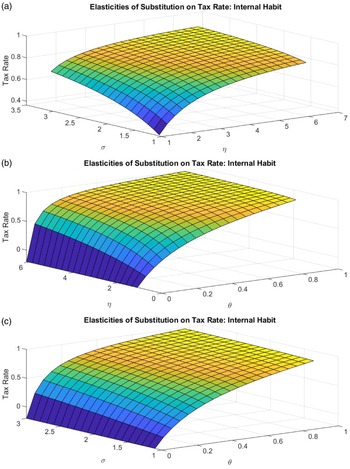
As in the unitary elasticity of substitution, the degree of habit persistence determines the tax rate on labor income to attain the efficient steady-state in an open economy with external habit persistence as in Figure 1, but the degree of habit persistence does not affect the efficient steady-state tax rate in a small open economy with internal habit in the non-unitary elasticity of substitution. This sharp difference between (40) and (41) reflects the fact that the distortions associated with external habit are proportional to the degree of habit persistence, while the internal habit itself does not generate any distortion in the economy when the economy remains in the steady state. Furthermore, (40) and (41) imply that the required optimal steady-state labor income tax rate increases with both the degree of openness
 $(\theta )$
and intratemporal elasticity of substitution between home and foreign goods
 $(\eta )$
as in Figures 1 and 2. The more substitutability between home and foreign goods, the more room the fiscal authority has to use labor income tax rate to manipulate the terms of trade in favor of its own country.
(a) Elasticities of substitution on tax rate; (b) Effects of external habit and intra-elasticity on tax rate; (c) Effects of external habit and IES on tax rate; (d) Effects of external habit and openness on tax rate.

(a) Elasticities of substitution on tax rate: internal habit; (b) Elasticities of substitution on tax rate: internal habit; (c) Elasticities of substitution on tax rate: internal habit.

4. Quantitative evaluation of optimal tax policy
Next, we will turn to a quantitative evaluation of optimal tax policy in small open economies with internal or external habit persistence.
4.1. Parameter values
All parameter values used in this paper are reported in Table 1 which are taken from De Paoli (Reference De Paoli2009), Ester and Monacelli (Reference Ester and Monacelli2008), and Galí and Monacelli (Reference Galí and Monacelli2005). First, we set the intertemporal and intratemporal elasticity of substitution, that is
 $\sigma ^{-1}$
and
 $\eta$
to 1, and the intratemporal elasticity of labor supply
 $\nu ^{-1}$
to 1/3 in the benchmark model. We also set
 $\sigma$
and
 $\eta$
to 4/3 and 3/4 so that
 $\sigma \eta =1$
holds. The intratemporal elasticity between home and foreign goods
 $\eta$
which plays a key role in the dynamic properties of the optimal tax policy and the selected macroeconomic variables in the model is set to values in
 $[0.7,3]$
. We set the subjective discount factor to 1.04
 $^{-1/4},$
which is consistent with an annual real rate of interest of 4 percent as in Prescott (1986). Next, we set the elasticity of substitution among varieties
 $\epsilon$
to 6, implying the average size of markup,
 $\mu$
to be 1.2 as in Galí and Monacelli (Reference Galí and Monacelli2005).
Parameter values

Finally, the exogenous driving process, that is the (log) productivity,
 $a_{t}$
and
 $a_{t}^{\ast }$
is assumed to follow an AR(1) as in De Paoli (Reference De Paoli2009), Ester and Monacelli (Reference Ester and Monacelli2008), and Galí and Monacelli (Reference Galí and Monacelli2005). We consider two cases, that is symmetric and asymmetric exogenous driving processes:
 \begin{eqnarray} &&\left \{ \begin{array}{cc} a_{t}=0.95a_{t-1}+\epsilon _{A,t}, & \ \sigma _{\epsilon }=0.007 \\ a_{t}^{\ast }=0.95a_{t-1}^{\ast }+\epsilon _{A,t}^{\ast }, & \sigma _{\epsilon ^{\ast }}=0.007\end{array}\right . \text{ for symmetric driving process} \\ &&\left \{ \begin{array}{cc} a_{t}=0.66a_{t-1}+\epsilon _{A,t}, & \ \sigma _{\epsilon }=0.007 \\ a_{t}^{\ast }=0.95a_{t-1}^{\ast }+\epsilon _{A,t}^{\ast }, & \sigma _{\epsilon ^{\ast }}=0.0129\end{array}\right . \text{ for asymmetric driving process}. \nonumber \end{eqnarray}
4.2. Tax smoothing and habit persistence
In this subsection, we will explore the optimal volatility of the level of tax relative to output.
In a small open economy with habit persistence, households gradually adjust their consumption path to an exogenous shock, accompanying gradual adjustment of trade balance over time. Households do not take into account the fact that current consumption affects not only the current terms of trade, but also the expected future terms of trade in the open economy with habit persistence in consumption. Hence, this generates a time-varying wedge between the social planner’s MRS between consumption and leisure and the corresponding MRS in the market economy, leaving room for fiscal authority to utilize tax policy quite a while to manipulate the terms of trade, even if
 $\sigma =\eta =1.$
Figure 3 shows the optimal volatility level of taxes and its volatility relative to output for a benchmark model, that is for
 $\sigma =\eta =1$
and
 $\theta =0.4$
as the degree of habit varies. In Figure 3, the solid lines
 $($
"
 $-$
"
 $)$
represent the optimal (relative) volatility of tax rates for a symmetric technological shock process, while the long dashed lines
 $($
"
 $-.$
"
 $)$
represent the volatility for an asymmetric technological shock process.
(a) Standard deviation of tax rate: external habit
 $(\sigma =\eta =1)$
; (b) Standard deviation of tax rate: internal habit
 $(\sigma =\eta =1)$
; (c) Relative standard deviation of tax rate to output: external habit
 $(\sigma =\eta =1)$
; (d) Relative standard deviation of tax rate to output: internal habit
 $(\sigma =\eta =1)$
.

The relative variability of tax rate increases with the degree of internal or external habit, implying that complete tax smoothing is not optimal in a small open economy with habit persistence for a unitary elasticity of substitution as shown in proposition 1 and 2. Domestic and foreign goods are substitutes for a unitary elasticity of substitution if households have habit persistence in consumption. Hence, the fiscal authority has an incentive to appreciate the terms of trade, contracting labor hours and switching consumption of domestic goods toward consumption of foreign goods to a positive domestic productivity shock for a unitary intertemporal and intratemporal elasticity of substitution. The taxation subsidy to attain the efficient steady state in an open economy with internal habit does not depend on the degree of habit persistence; meanwhile the fiscal authority needs to implement income tax rate proportional to the degree of external habit to contract working hours, because households who do not take into account their decision on the economy work excessively to catch up with Joneses, deteriorating the terms of trade and welfare. Hence, the average tax rate should be proportional to the degree of external habit. Moreover, the fiscal authority needs to change income tax rate procyclically in response to the exogenous shock, because it should utilize the terms of trade in favor of its own country to improve the welfare overt time (see Tables 3 and 4). This results in volatile movement of tax rate.
(a) Standard deviation of tax rate: external habit
 $(\sigma =\eta =1)$
; (b) Standard deviation of tax rate: internal habit
 $(\sigma =\eta =1)$
; (c) Relative standard deviation of tax rate to output: external habit
 $(\sigma =\eta =1)$
; (d) Relative standard deviation of tax rate to output: internal habit
 $(\sigma =\eta =1)$
.

Figure 4 shows the optimal volatility level of taxes as well as its volatility relative output volatility for
 $b=0.5$
as the degree of trade openness
 $(\theta )$
varies
 $.$
Note that the volatility of tax rate shows an inverted U-shape in the degree of trade openness in the internal habit circumstance. Keeping in mind the fact that it is optimal for government to implement a time-invariant subsidy to offset the distortions associated with monopolistically competitive firms in a closed economy with internal habit, it is quite intuitive that the largest tax rate volatility is obtained in the intermediate values of openness as the limit case of the absence of home bias corresponds to
 $\theta \rightarrow 1.$
Figure 4 also displays that the volatility of labor income tax rate takes an inverted U-shape in the intermediate degrees of trade openness in the external habit circumstance. At the low degree of openness, the negative effect arising from external habit is partially buffered by the terms of trade movement as households consume foreign goods as well as domestic goods, and the volatility of consumption decreases with degree of openness, calling for less volatile tax rates than the one in closed economies. As the competition between domestic and foreign goods increases with the degree of openness, the volatility of consumption turns upward, calling for more volatile labor tax rates. However, the labor hours moves a little to the exogenous shocks for
 $\theta$
larger than 0.7, where the size of domestic goods production dwindles with the degree of openness. Hence, the volatility of optimal tax rates falls, yielding an inverted U-shape in moderate and high degrees of openness as in Figure 4.
(a) Standard deviation of tax rate: external habit
 $(\sigma =4/3, \eta =3/4)$
; (b) Standard deviation of tax rate: internal habit
 $(\sigma =4/3, \eta =3/4)$
; (c) Relative standard deviation of tax rate to output: external habit
 $(\sigma =4/3, \eta =3/4)$
; (d) Relative standard deviation of tax rate to output: internal habit
 $(\sigma =4/3, \eta =3/4)$
.

(a) Standard deviation of tax rate: external habit
 $(\sigma =4/3, \eta =3/4)$
; (b) Standard deviation of tax rate: internal habit
 $(\sigma =4/3, \eta =3/4)$
; (c) Relative standard deviation of tax rate to output: external habit
 $(\sigma =4/3, \eta =3/4)$
; (d) Relative standard deviation of tax rate to output: internal habit
 $(\sigma =4/3, \eta =3/4)$
.

Figures 5 and 6 show the optimal labor income tax rate for non-unitary elasticity with
 $\sigma \eta =1.$
The (relative) volatility of optimal labor income tax rate takes the same properties as the one for unitary elasticity of substitution.
Moreover, the relative volatility of optimal tax rate in a small open economy with habit persistence critically depends upon the exogenous technological process in the rest of the world. If we take parameter values of productivity shock processes as in Benigno and De Paoli (Reference Benigno and De Paoli2010), and De Paoli (Reference De Paoli2009), that is if the productivity shock processes are asymmetric such that the productivity shock of the rest of the world is more volatile and persistent than the domestic one, then the optimal relative standard deviation of taxes is around 60% of domestic output. This shows that the effect of the optimal fiscal policy is limited in reducing the exaggerated movement of aggregate output in a small open economy in which the size of the country is negligibly small. The more volatile the shocks of the rest of the world, the more volatile the optimal tax rate to minimize the negative effect of the foreign shocks.
In sum, when there is no habit persistence in consumption
 $(b=0)$
, the fiscal policy incentive driven by a terms of trade externality does not exist if both intertemporal and intratemporal elasticity of substitution equal one. However, the substitutability between domestic and foreign goods increases with the degree of habit, making domestic and foreign goods substitutes in the utility for
 $b\gt 0$
, even if
 $\sigma \eta =1$
. Hence, an appreciated real exchange rate, on average, can improve upon the welfare of the households with habit persistence even if
 $\sigma \eta =1$
: The terms of trade appreciation induces lower levels of domestic production and lower consumption of domestic goods, but it leads to larger consumption of foreign goods. Moreover, the optimal tax rate shows an inverted U-shape in both the degree of habit and trade openness.
Dynamic properties of the resource allocations in external habit with optimal tax
 $\textbf{(}\sigma =\ \eta =\ 1,\ \nu =3)$

Note:
 $\tau \, $
is expressed in percentage points and
 $\textit{y},\ \mathcal{E},\mathcal{\ T},$
and
 $\textit{c}$
in levels. The parameter values are
 $\beta =(1.04)^{-1/4},\ \textit{T}$
 $=200,$
and
 $\textit{J}=1000$
.
4.3. Quantitative analysis
In this subsection, we will discuss the effect of habit persistence on resource allocations and the optimal tax rate by employing the second-order approximation methods along the line of Schmitt-Grohe and Uribe (Reference Schmitt-Grohe, Uribe, Gertler and Rogoff2007).
Note that the fiscal authority only needs to minimize distortions associated with consumption and leisure in a closed economy, if there is no habit. Under this circumstance, complete tax smoothing is optimal. This policy prescription still holds in a small open economy only if domestic country is independent from the rest of the world, and there is no habit, that is
 $\sigma \eta =1,$
and
 $b=0$
. If the intertemporal elasticity of substitution equals the intratemporal elasticity of substitution, that is
 $\sigma \eta =1$
and there is no habit
 $(b=0),$
then domestic economy is insular from the rest of the world, implying it is optimal for the fiscal authority to implement a time-invariant taxation subsidy (
 $\tau _{t}=1-\frac{(1-\theta )}{\mathsf{\mathcal{MC}}})$
to attain its first best allocation.
However, if there is habit in consumption (
 $b\gt 0)$
, then domestic and foreign goods are substitutes in the utility, yielding an incentive for the fiscal authority to exploit the terms of trade via fiscal policy to improve upon the welfare. Even if both inter- and intratemporal elasticity of substitution equal one
 $(\sigma =\eta =1)$
, domestic and foreign goods are substitutes in the utility as long as households have habit in consumption. Therefore, there is room for the fiscal authority to improve upon the welfare of the representative household by manipulating the terms of trade with fiscal policy. The fiscal policy of smoothing taxes across states and times is not optimal in open economy with habit persistence even if
 $\sigma =\eta =1$
.
Tables 2–5 present some sampling moments of the selected macroeconomic variables when the fiscal authority implements optimal time-varying tax policy to fully eliminate the distortions associated with habit persistence and monopolistic competition in goods market.
Dynamic properties of the resource allocations in internal habit with optimal tax
 $\textbf{(}\sigma =\ \eta =\ 1,\ \nu =3)$

Note:
 $\tau \, $
is expressed in percentage points and
 $\textit{y},\ \mathcal{T},$
and
 $\textit{c}$
in levels. The parameter values are
 $\beta =(1.04)^{-1/4},\ \textit{T}$
 $=200,$
and
 $\textit{J}=1000$
.
First, note that the tax rate is procyclical for
 $\sigma \eta =1.$
Because home and foreign goods are substitutes in utility for
 $\sigma \eta =1,$
the optimal fiscal policy commands higher tax rate on labor income in the expansionary phase, inducing lower labor hours and domestic consumption goods, but higher foreign consumption goods.
Second, the optimal labor income tax moves countercyclical for low degrees of intratemporal elasticity substitution,
 $\, $
while it moves procyclically for high degrees of intratemporal elasticity substitution. For sufficiently small values of intratemporal elasticity of substitution, there occurs a marginal substitute between domestic and foreign goods to an international relative price change. Under this circumstance, the fiscal authority has an incentive to boost domestic production toward the efficient level to a positive domestic technology shock to exploit the favorable production opportunity. When the substitutability between domestic and foreign goods is high, there occurs a substantial surge to the demand for domestic goods to the positive domestic productivity shock since households are more persistently substitute foreign goods toward domestic goods with a terms of trade depreciation. Hence, the fiscal authority should implement high labor income tax rate to cool down the economy with habit persistence, which generates a procyclical labor income tax rate.
Dynamic properties of the resource allocations in external habit with optimal tax
 $\textbf{(}\sigma =1,\ \nu =3,\ b=0.5)$

Note:
 $\tau \, $
is expressed in percentage points and
 $\textit{y},\ \mathcal{E},\ \mathcal{T},$
and
 $\textit{c}$
in levels. The parameter values are
 $\beta =(1.04)^{-1/4},\ \textit{T}$
 $=200,$
and
 $\textit{J}=1000$
.
Dynamic properties of the resource allocations in internal habit with optimal tax
 $\textbf{(}\sigma =\ 1,\ \nu =3,\ b=0.5)$

Note:
 $\tau \, $
is expressed in percentage points and
 $y,\ \mathcal{E},\ \mathcal{T},$
and
 $c$
in levels. The parameter values are
 $\beta =(1.04)^{-1/4},\ T$
 $=200,$
and
 $J=1000$
.
Finally, the required labor income tax rate to eliminate the distortions associated with habit and monopolistic competition increases with the intratemporal elasticity of substitution. As households are more willing to substitute domestic goods and foreign goods to the international relative price change, the fiscal authority has more room to use labor income tax to improve upon the welfare by manipulate the terms of trade in its favor.Footnote 6
5. Conclusion
In this paper, we have abstracted from monetary policy considerations by assuming that prices are flexible as in Benigno and De Paoli (Reference Benigno and De Paoli2010) and addressed the optimal fiscal policy in a small open economy with habit persistence. Specifically, we have examined whether both unitary intratemporal and intertemporal elasticity of substitution or the equality between the intertemporal elasticity and the intratemporal elasticity of substitution are sufficient conditions for tax smoothing in a small open economy with habit persistence.
The closed economy is not isomorphic to the open economy even if both the intratemporal elasticity of substitution between home and foreign goods and the intertemporal elasticity of substitution in consumption are equal to one when households have habit persistence in consumption. Under this circumstance, there is room for government to manipulate the terms of trade in its favor. Both the required income tax rate and the standard deviation of labor income tax rate increase with the degree of habit, implying that tax smoothing is not optimal for a unitary elasticity of substitution in a small open economy with habit persistence. The volatility of optimal tax rate shows an inverted U-shape in the degree of openness in the internal habit environment, while it is larger in a closed economy than in an open economy in external habit persistence environment.
In the future research, one needs to incorporate the incomplete market and capital into the model to explore the optimal fiscal policy in depth.
Acknowledgments
I appreciate Pierpaolo Benigno, Tack Yun, and participants at the Korea Fiscal Policy Network Workshop for helpful comments. All errors are my own.
Appendix
Proof of Proposition 1
The social problem can be reformulated as follows:
 \begin{eqnarray*} \mathcal{L} &=&E_{t}\sum _{i=0}^{\infty }\beta ^{t+i}\{\left ( \ln (C_{t+i}-bC_{t+i-1})-\frac{N_{t+i}{}^{1+v}}{1+v}\right ) \\ &&+\lambda _{1,t+i}[A_{t+i}N_{t+i}-(1-\theta )\mathcal{T}_{t+i}{}^{\theta }C_{t+i}-\theta \mathcal{T}_{t+i}C_{t+i}^{\ast }] \\ &&+\lambda _{2,t+i}[\mathcal{T}_{t+i}^{1-\theta }-\left ( \frac{C_{t+i}-bC_{t+i-1}}{C_{t+i}^{\ast }-bC_{t+i-1}^{\ast }}\right ) \}. \end{eqnarray*}
The first order conditions are given by
 \begin{eqnarray*} C_{t} &:&\frac{1}{C_{t}-bC_{t-1}}-b\beta E_{t}\left ( \frac{1}{C_{t+1}-bC_{t}}\right ) =\lambda _{1,t}(1-\theta )\mathcal{T}_{t}{}^{\theta } \\ &&+\lambda _{2,t}\frac{1}{C_{t}^{\ast }-bC_{t-1}^{\ast }}-b\beta E_{t}[\lambda _{2,t+1}\frac{1}{C_{t+1}^{\ast }-bC_{t}^{\ast }}], \end{eqnarray*}
 \begin{equation*} N_{t}\,{:}\,-N_{t}{}^{v}+\lambda _{1,t}A_{t}=0, \end{equation*}
 \begin{equation*} \mathcal {T}_{t}\,{:}\,-\lambda _{1,t}[\theta (1-\theta )\mathcal {T}_{t}{}^{\theta -1}C_{t}+\theta C_{t}^{\ast }]+(1-\theta )\lambda _{2,t}\mathcal {T}_{t}^{-\theta }=0, \end{equation*}
and the resource constraints and the market equilibrium real exchange rate.
Hence,
 \begin{equation*} \lambda _{1,t}=A_{t}^{-1}N_{t}^{\nu }, \end{equation*}
 \begin{equation*} \lambda _{2,t}=\frac {A_{t}^{-1}N_{t}^{\nu }}{1-\theta }\frac {[\theta (1-\theta )\mathcal {T}_{t}{}^{\theta -1}C_{t}+\theta C_{t}^{\ast }]}{\mathcal {T}_{t}^{-\theta }}=\frac {A_{t}^{-1}N_{t}^{\nu }}{1-\theta }\frac {[\theta (1-\theta )\mathcal {T}_{t}{}^{\theta }C_{t}+\theta \mathcal {T}_{t}{}C_{t}^{\ast }]}{\left ( \frac {C_{t}-bC_{t-1}}{C_{t}^{\ast }-bC_{t-1}^{\ast }}\right ) }. \end{equation*}
Note that
 $A_{t}N_{t}=(1-\theta )\mathcal{T}_{t}{}^{\theta }C_{t}+\theta \mathcal{T}_{t}{}C_{t}^{\ast }.$
Then, the social planner’s optimality condition can be simplified as
 \begin{eqnarray*} &&\{(1-b\widetilde{R}_{t}^{-1})+bE_{t}[Q_{t,t+1}A_{t+1}^{-1}(C_{t+1}-bC_{t})N_{t+1}^{\nu }\mathcal{T}_{t+1}{}^{\theta }[\theta \textbf{S}_{t+1}^{-1}+\frac{\theta }{1-\theta }\textbf{S}_{t+1}^{\ast -1}]]\} \\ &=&A_{t}^{-1}N_{t}^{\nu }(C_{t+1}-bC_{t})\mathcal{T}_{t}{}^{\theta }[1-\theta +[\theta \textbf{S}_{t}^{-1}+\frac{\theta }{1-\theta }\textbf{S}_{t}^{\ast -1}]]. \end{eqnarray*}
From (23) and (33), the optimal time-varying tax is given by
 \begin{eqnarray*} \tau _{t} &=&1-\mathcal{MC}^{-1}\{(1-\theta )+[\theta \textbf{S}_{t}^{-1}+\frac{\theta }{1-\theta }\textbf{S}_{t}^{\ast -1}]\}^{-1}\{(1-b\widetilde{R}_{t}^{-1}) \\ &&+bE_{t}[Q_{t,t+1}(1-\tau _{t+1})\mathcal{MC}[\theta \textbf{S}_{t+1}+\frac{\theta }{1-\theta }\textbf{S}_{t+1}^{\ast }]]\}. \end{eqnarray*}
Proof of Proposition 2
The social problem can be reformulated as follows:
 \begin{eqnarray*} \mathcal{L} &=&E_{t}\sum _{i=0}^{\infty }\beta ^{t+i}\{\left ( \ln (C_{t+i}-bC_{t+i-1})-\frac{N_{t+i}^{1+v}{}}{1+v}\right ) \\ &&+\lambda _{1,t+i}[A_{t+i}N_{t+i}-(1-\theta )\mathcal{T}_{t+i}^{\theta }{}C_{t+i}-\theta \mathcal{T}_{t+i}C_{t+i}^{\ast }] \\ &&+\lambda _{2,t+i}[\mathcal{T}_{t+i}^{\theta -1}-\left ( \frac{(C_{t+i}-bC_{t+i-1})^{-1}-b\beta (C_{t+i+1}-bC_{t+i})^{-1}}{(C_{t+i}^{\ast }-bC_{t+i-1}^{\ast })^{-1}-b\beta (C_{t+i+1}^{\ast }-bC_{t+i}^{\ast })^{-1}}\right ) \}. \end{eqnarray*}
First order conditions are given by
 \begin{eqnarray*} C_{t} &:&\frac{1}{C_{t}-bC_{t-1}}-b\beta E_{t}\left ( \frac{1}{C_{t+1}-bC_{t}}\right ) \\ &=&\lambda _{1,t}(1-\theta )\mathcal{T}_{t}^{\theta }{}+\lambda _{2,t-1}\frac{1}{\Lambda _{t-1}^{\ast }}\frac{b}{(C_{t}-bC_{t-1})^{2}} \\ &&-\lambda _{2,t}E_{t}[\frac{1}{\Lambda _{t}^{\ast }}[\frac{1}{(C_{t}-bC_{t-1})^{2}}+\frac{b^{2}\beta }{(C_{t+1}-bC_{t})^{2}}]] \\ &&-E_{t}[\lambda _{2,t+1}\frac{1}{\Lambda _{t+1}^{\ast }}\frac{b\beta }{(C_{t+1}-bC_{t})^{2}}], \end{eqnarray*}
 \begin{equation*} N_{t}\,{:}\,-N_{t}{}^{v}+\lambda _{1,t}A_{t}=0, \end{equation*}
 \begin{equation*} \mathcal {T}_{t}\,{:}\,-\lambda _{1,t}[\theta (1-\theta )\mathcal {T}_{t}{}^{\theta -1}C_{t}+\theta C_{t}^{\ast }]+(1-\theta )\lambda _{2,t}\mathcal {T}_{t}^{-\theta }=0, \end{equation*}
and the resource constraints and the market equilibrium real exchange rate. Here
 $\Lambda _{t}$
and
 $\Lambda _{t}^{\ast }$
are the marginal utility of consumption of domestic and foreign households, respectively.
Hence,
 \begin{equation*} \lambda _{1,t}=A_{t}^{-1}N_{t}^{\nu }, \end{equation*}
 \begin{eqnarray*} \lambda _{2,t} &=&\frac{A_{t}^{-1}N_{t}^{\nu }}{1-\theta }\frac{[\theta (1-\theta )\mathcal{T}_{t}{}^{\theta -1}C_{t}+\theta C_{t}^{\ast }]}{\mathcal{T}_{t}^{-\theta }} \\ &=&\frac{A_{t}^{-1}N_{t}^{\nu }}{1-\theta }\frac{[\theta (1-\theta )\mathcal{T}_{t}{}^{\theta }C_{t}+\theta \mathcal{T}_{t}{}C_{t}^{\ast }]}{\mathcal{T}_{t}^{1-\theta }} \end{eqnarray*}
Simplifying the social planner’s optimality conditions leads to
 \begin{eqnarray*} &&1-\mathsf{\mathcal{MC}}\frac{1}{1-\theta }\frac{[\theta (1-\theta )\mathcal{T}_{t-1}^{\theta }{}C_{t-1}+\theta \mathcal{T}_{t-1}{}C_{t-1}^{\ast }]}{\mathcal{T}_{t-1}\mathcal{E}_{t-1}}\frac{(1-\tau _{t-1})}{(C_{t}-bC_{t-1})^{2}} \\ &&+\frac{\mathsf{\mathcal{MC}}}{1-\theta }\frac{[\theta (1-\theta )\mathcal{T}_{t}^{\theta }{}C_{t}+\theta \mathcal{T}_{t}C_{t}^{\ast }](1-\tau _{t})}{\mathcal{T}_{t}\mathcal{E}_{t}\Lambda _{t}}[\frac{1}{(C_{t}-bC_{t-1})^{2}}+\frac{b^{2}\beta }{(C_{t+1}-bC_{t})^{2}}] \\ &&-E_{t}[\frac{Q_{t,t+1}\mathsf{\mathcal{MC}}}{1-\theta }\frac{[\theta (1-\theta )\mathcal{T}_{t+1}^{\theta }{}C_{t+1}+\theta \mathcal{T}_{t+1}C_{t+1}^{\ast }]}{\mathcal{T}_{t+1}\mathcal{E}_{t+1}\Lambda _{t+1}}\frac{b(1-\tau _{t+1})}{(C_{t+1}-bC_{t})^{2}}] \\ &=&\mathsf{\mathcal{MC}}(1-\theta )(1-\tau _{t}). \end{eqnarray*}
 \begin{equation} \frac{N_{t}^{\nu }\mathcal{T}_{t}{}^{\theta }}{MU_{Ct}A_{t}}=\mathcal{MC}(1-\tau _{t}). \end{equation}
Therefore, the comparison of (23) and (36) shows that the optimal time-varying tax is given by
 \begin{eqnarray*} &&\tau _{t}=1-\mathcal{MC}^{-1}\{(1-\theta )+\frac{[\theta (1-\theta )\mathcal{T}_{t}^{\theta }{}C_{t}+\theta \mathcal{T}_{t}C_{t}^{\ast }]}{\mathcal{T}_{t}\mathcal{E}_{t}MU_{C_{t}}(1-\theta )}[\frac{1}{(C_{t}-bC_{t-1})^{2}}+\frac{b^{2}\beta }{(C_{t+1}-bC_{t})^{2}}]\}^{-1} \\ &&\qquad\times \{1+b\frac{\mathcal{MC}[\theta (1-\theta )\mathcal{T}_{t-1}^{\theta }{}C_{t-1}+\theta \mathcal{T}_{t-1}{}C_{t-1}^{\ast }](1-\tau _{t-1})}{\mathcal{T}_{t-1}\mathcal{E}_{t-1}MU_{C_{t-1}}(1-\theta )(C_{t}-bC_{t-1})^{2}} \\ &&\qquad+b\mathcal{MC}E_{t}[Q_{t,t+1}\frac{[\theta (1-\theta )\mathcal{T}_{t+1}{}^{-1}C_{t+1}+\theta \mathcal{T}_{t+1}^{-\theta }C_{t+1}^{\ast }](1-\tau _{t+1})}{\mathcal{T}_{t+1}\mathcal{E}_{t+1}MU_{C_{t+1}}1-\theta (C_{t+1}-bC_{t})^{2}}]\}. \end{eqnarray*}
Proof of Proposition 3
The social problem can be formulated in terms of Lagrangian function as follows:
 \begin{eqnarray*} \mathcal{L} &=&E_{t}\sum _{i=0}^{\infty }\beta ^{t+i}\{\left ( \frac{(C_{t+i}-bC_{t+i-1})^{1-\sigma }}{1-\sigma }-\frac{N_{t+i}{}^{1+v}}{1+v}\right ) \\ &&+\lambda _{1,t+i}[A_{t+i}N_{t+i}-(1-\theta )(1-\theta +\theta \mathcal{T}_{t+i}^{1-\eta }{})^{\frac{\eta }{1-\eta }}C_{t+i}-\theta ^{\ast }\mathcal{T}_{t+i}^{\eta }C_{t+i}^{\ast }] \\ &&+\lambda _{2,t+i}[\mathcal{T}_{t+i}(1-\theta +\theta \mathcal{T}_{t+i}^{1-\eta }{})^{\frac{-1}{1-\eta }}-\frac{(C_{t}-bC_{t-1})^{\sigma }}{(C_{t}^{\ast }-bC_{t-1}^{\ast })^{\sigma }}], \end{eqnarray*}
given the exogenous processes
 $\{A_{t}\}_{t=0}^{\infty }$
and initial values of
 $Y_{-1}.$
The first order conditions are given by
 \begin{eqnarray*} &&(C_{t}-bC_{t-1})^{-\sigma }-b\beta E_{t}(C_{t+1}-bC_{t})^{-\sigma } \\ &=&(1-\theta )\lambda _{1,t}(1-\theta +\theta \mathcal{T}_{t}^{1-\eta }{})^{\frac{\eta }{1-\eta }}+\lambda _{2,t}\frac{\sigma (C_{t}-bC_{t-1})^{\sigma -1}}{(C_{t}^{\ast }-bC_{t-1}^{\ast })^{\sigma }} \\ &&-b\beta E_{t}[\lambda _{2,t+1}\frac{\sigma (C_{t+1}-bC_{t})^{\sigma -1}}{(C_{t+1}^{\ast }-bC_{t}^{\ast })^{\sigma }}], \end{eqnarray*}
 \begin{eqnarray*} &&\lambda _{1,t}[\eta (1-\theta )(1-\theta +\theta \mathcal{T}_{t}^{1-\eta }{})^{\frac{2\eta -1}{1-\eta }}C_{t}\theta \mathcal{T}_{t}^{-\eta }+\theta \eta \mathcal{T}_{t}^{\eta -1}C_{t}^{\ast }] \\ &=&\lambda _{2,t}(1-\theta +\theta \mathcal{T}_{t}^{1-\eta }{})^{\frac{-1}{1-\eta }}(1-\theta \mathcal{E}_{t}^{1-\eta }), \end{eqnarray*}
 \begin{equation*} N_{t}^{\nu }=\lambda _{1,t}A_{t}, \end{equation*}
and the resource constraints and the market equilibrium real exchange rate.
Since
 $\mathcal{E}_{t}=\mathcal{T}_{t}(1-\theta +\theta \mathcal{T}_{t}^{1-\eta }{})^{\frac{-1}{1-\eta }},$
 $(1-\theta +\theta \mathcal{T}_{t}^{1-\eta }{})^{\frac{1}{1-\eta }}=\mathcal{E}_{t}^{-1}\mathcal{T}_{t}.$
Hence
 $,$
 \begin{equation*} \lambda _{2,t}=N_{t}^{\nu }A_{t}^{-1}\eta \theta \lbrack (1-\theta )C_{t}\mathcal {E}_{t}^{1-2\eta }+C_{t}^{\ast }]\mathcal {T}_{t}^{\eta -1}\mathcal {E}_{t}^{-1}\mathcal {T}_{t}(1-\theta \mathcal {E}_{t}^{1-\eta })^{-1.} \end{equation*}
Simplifying the first order conditions leads to
 \begin{eqnarray} &&\mathcal{E}_{t}^{-1}\mathcal{T}_{t}N_{t}^{\nu }A_{t}^{-1}\Lambda _{t}^{-1} \\ &=&\{1-b\widetilde{R}_{t}^{-1}+\sigma \theta \eta bE_{t}[Q_{t,t+1}\Lambda _{t+1}^{-1}N_{t+1}^{\nu }A_{t+1}^{-1}\mathcal{E}_{t+1}^{-1}\mathcal{T}_{t+1}[(1-\theta )C_{t+1}\mathcal{E}_{t+1}^{2(1-\eta )}+\mathcal{E}_{t+1}C_{t+1}^{\ast }] \nonumber \\ &&\times \frac{\mathcal{T}_{t+1}^{\eta -1}(1-\theta \mathcal{E}_{t+1}^{1-\eta })^{-1}}{C_{t+1}-bC_{t}}\} \nonumber \\ &&\times \{(1-\theta )(\mathcal{E}_{t}^{-1}\mathcal{T}_{t})^{\eta -1}+\sigma \eta \theta \lbrack (1-\theta )C_{t}\mathcal{E}_{t}^{2(1-\eta )}+\mathcal{E}_{t}C_{t}^{\ast }]\times \frac{\mathcal{T}_{t}^{\eta -1}(1-\theta \mathcal{E}_{t}^{1-\eta })^{-1}}{C_{t}-bC_{t-1}}\}^{-1}. \nonumber \end{eqnarray}
From (44) and the market equilibrium,
 \begin{equation*} \mathcal {E}_{t}^{-1}\mathcal {T}_{t}N_{t}^{\nu }A_{t}^{-1}\Lambda _{t}^{-1}=(1-\tau _{t})\mathsf {\mathcal {MC}}. \end{equation*}
the optimal time-varying tax rate must satisfy the following condition:
 \begin{eqnarray*} &&(1-\tau _{t})\mathsf{\mathcal{MC}} \\ &=&\{1-b\widetilde{R}_{t}^{-1}+\sigma \theta \eta bE_{t}[Q_{t,t+1}\Lambda _{t+1}^{-1}N_{t+1}^{\nu }A_{t+1}^{-1}\mathcal{E}_{t+1}^{-1}\mathcal{T}_{t+1}[(1-\theta )C_{t+1}\mathcal{E}_{t+1}^{2(1-\eta )} \\ &&+\mathcal{E}_{t+1}C_{t+1}^{\ast }]\times \frac{\mathcal{T}_{t+1}^{\eta -1}(1-\theta \mathcal{E}_{t+1}^{1-\eta })}{C_{t+1}-bC_{t}}]\} \\ &&\times \{(1-\theta )(\mathcal{E}_{t}^{-1}\mathcal{T}_{t})^{\eta -1}+\sigma \theta \eta \lbrack (1-\theta )C_{t}\mathcal{E}_{t}^{2(1-\eta )}+\mathcal{E}_{t}C_{t}^{\ast }]\times \frac{\mathcal{T}_{t}^{\eta -1}(1-\theta \mathcal{E}_{t}^{1-\eta })}{C_{t}-bC_{t-1}}\}^{-1} \end{eqnarray*}
That is,
 \begin{eqnarray*} &&\tau _{t}=1-\mathsf{\mathcal{MC}}^{-1}\{1-b\widetilde{R}_{t}^{-1}+\sigma \theta b\eta E_{t}[Q_{t,t+1}(1-\tau _{t+1})\mathsf{\mathcal{MC}}[(1-\theta )C_{t+1}\mathcal{E}_{t+1}^{2(1-\eta )} \\ &&+\mathcal{E}_{t+1}C_{t+1}^{\ast }]\times \frac{\mathcal{T}_{t+1}^{\eta -1}(1-\theta \mathcal{E}_{t}^{1-\eta })^{-1}}{C_{t+1}-bC_{t}}]\} \\ &&\times \{(1-\theta )(\mathcal{E}_{t}^{-1}\mathcal{T}_{t})^{\eta -1}+\sigma \eta \theta \lbrack (1-\theta )C_{t}\mathcal{E}_{t}^{2(1-\eta )}+\mathcal{E}_{t}C_{t}^{\ast }]\times \frac{\mathcal{T}_{t}^{\eta -1}(1-\theta \mathcal{E}_{t}^{1-\eta })^{-1}}{C_{t}-bC_{t-1}}\}^{-1} \end{eqnarray*}
Or
 \begin{eqnarray*} &&\tau _{t}=1-\mathsf{\mathcal{MC}}^{-1}\{1-b\widetilde{R}_{t}^{-1}+\sigma \theta b\eta E_{t}[Q_{t,t+1}(1-\tau _{t+1})\mathsf{\mathcal{MC}}[(1-\theta )C_{t+1}\mathcal{E}_{t+1}^{2(1-\eta )} \\ &&+\mathcal{E}_{t+1}C_{t+1}^{\ast }]\times \frac{\mathcal{T}_{t+1}^{\eta -1}(1-\theta \mathcal{E}_{t}^{1-\eta })^{-1}}{C_{t+1}-bC_{t}}]\} \\ &&\times \{(1-\theta )(\mathcal{E}_{t}^{-1}\mathcal{T}_{t})^{\eta -1}(1-\theta \mathcal{E}_{t}^{1-\eta })+\frac{\sigma \eta \theta \lbrack (1-\theta )C_{t}\mathcal{E}_{t}^{2(1-\eta )}+\mathcal{E}_{t}C_{t}^{\ast }]\mathcal{T}_{t}^{\eta -1}}{C_{t}-bC_{t-1}}\}^{-1}(1-\theta \mathcal{E}_{t}^{1-\eta }) \end{eqnarray*}
If
 $\sigma \eta =1$
and
 $b=0,$
then
 $(\mathcal{E}_{t}^{-1}\mathcal{T}_{t})^{\eta -1}=1-\theta +\theta \mathcal{T}_{t}^{1-\eta },$
and
 $1-\theta \mathcal{E}_{t}^{1-\eta }=1-\theta \mathcal{T}_{t}^{1-\eta }(1-\theta +\theta \mathcal{T}_{t}^{1-\eta }{})^{-1}=\frac{1-\theta }{1-\theta +\theta \mathcal{T}_{t}^{1-\eta }}$
implies that
 $\tau _{t}=1-\mathsf{\mathcal{MC}}^{-1}(1-\theta ).$
Proof of Proposition 4
The social problem can be formulated in terms of Lagrangian function as follows:
 \begin{eqnarray*} \mathcal{L} &=&E_{t}\sum _{i=0}^{\infty }\beta ^{t+i}\{\left ( \frac{(C_{t+i}-bC_{t+i-1})^{1-\sigma }}{1-\sigma }-\frac{N_{t+i}{}^{1+v}}{1+v}\right ) \\ &&+\lambda _{1,t+i}[A_{t+i}N_{t+i}-(1-\theta )(1-\theta +\theta \mathcal{T}_{t+i}^{1-\eta }{})^{\frac{\eta }{1-\eta }}C_{t+i}-\theta \mathcal{T}_{t+i}^{\eta }C_{t+i}^{\ast }] \\ &&+\lambda _{2,t+i}[\mathcal{T}_{t+i}^{-1}(1-\theta +\theta \mathcal{T}_{t+i}^{1-\eta }{})^{\frac{1}{1-\eta }}-\frac{(C_{t}-bC_{t-1})^{-\sigma }-b\beta (C_{t+1}-bC_{t})^{-\sigma }}{(C_{t}^{\ast }-bC_{t-1}^{\ast })^{-\sigma }-(C_{t+1}^{\ast }-bC_{t}^{\ast })^{-\sigma }}] \end{eqnarray*}
 \begin{equation*} \lambda _{1,t}\,{:}\,A_{t}N_{t}=(1-\theta )(1-\theta +\theta \mathcal {T}_{t+i}^{1-\eta }{})^{\frac {1}{1-\eta }}\mathcal {T}_{t}^{\eta }C_{t}+\theta \mathcal {T}_{t}^{\eta }C_{t}^{\ast }, \end{equation*}
 \begin{equation*} \lambda _{2,t}\,{:}\,\mathcal{T}_{t+i}^{-1}(1-\theta +\theta \mathcal{T}_{t+i}^{1-\eta }{})^{\frac{1}{1-\eta }}-\frac{(C_{t}-bC_{t-1})^{-\sigma }-b\beta (C_{t+1}-bC_{t})^{-\sigma }}{(C_{t}^{\ast }-bC_{t-1}^{\ast })^{-\sigma }-b\beta (C_{t+1}^{\ast }-bC_{t}^{\ast })^{-\sigma }} \end{equation*}
given the exogenous processes
 $\{A_{t}\}_{t=0}^{\infty }$
and initial values of
 $Y_{-1}.$
Let
 $\Lambda _{t}\equiv (C_{t}-bC_{t-1})^{-\sigma }-b\beta E_{t}(C_{t+1}-bC_{t})^{-\sigma },\ \Lambda _{t}^{\ast }\equiv (C_{t}^{\ast }-bC_{t-1}^{\ast })^{-\sigma }-b\beta E_{t}(C_{t+1}^{\ast }-bC_{t}^{\ast })^{-\sigma }.$
First order conditions are given by
 \begin{eqnarray*} C_{t} &:&(C_{t}-bC_{t-1})^{-\sigma }-b\beta E_{t}(C_{t+1}-bC_{t})^{-\sigma } \\ &=&(1-\theta )\lambda _{1,t}(1-\theta +\theta \mathcal{T}_{t}^{1-\eta }{})^{\frac{\eta }{1-\eta }}+\sigma \lambda _{2,t-1}\frac{b(C_{t}-bC_{t-1})^{-\sigma -1}}{\Lambda _{t-1}^{\ast }} \\ &&-\sigma \lambda _{2,t}\frac{(C_{t}-bC_{t-1})^{-\sigma -1}+b^{2}\beta (C_{t+1}-bC_{t})^{-\sigma -1}}{\Lambda _{t}^{\ast }}+b\beta E_{t}[\lambda _{2,t+1}\frac{(C_{t+1}-bC_{t})^{-\sigma -1}}{\Lambda _{t+1}^{\ast }}], \end{eqnarray*}
 \begin{eqnarray*} \mathcal{T}_{t} &:&\lambda _{1,t}[\eta (1-\theta )(1-\theta +\theta \mathcal{T}_{t}^{1-\eta }{})^{\frac{2\eta -1}{1-\eta }}C_{t}\theta \mathcal{T}_{t}^{-\eta }+\theta \eta \mathcal{T}_{t}^{\eta -1}C_{t}^{\ast }] \\ &=&-\lambda _{2,t}\mathcal{E}_{t}^{-1}\mathcal{T}_{t}^{-1}(1-\theta \mathcal{E}_{t}^{1-\eta }), \end{eqnarray*}
 \begin{equation*} N_{t}\,{:}\,N_{t}^{\nu }=\lambda _{1,t}A_{t}, \end{equation*}
and the resource constraints and the market equilibrium real exchange rate.
Simplifying the efficiency conditions leads to
 \begin{eqnarray} 1 &=&(1-\theta )\mathcal{E}_{t}^{-1}\mathcal{T}_{t}N_{t}^{\nu }A_{t}^{-1}\Lambda _{t}^{-1}(\mathcal{E}_{t}^{-1}\mathcal{T}_{t})^{\eta -1} \\ &&-N_{t-1}^{\nu }A_{t-1}^{-1}\eta \theta \lbrack (1-\theta )C_{t-1}\mathcal{E}_{t-1}^{2-2\eta }+\mathcal{E}_{t-1}C_{t-1}^{\ast }]\mathcal{T}_{t-1}^{\eta }(1-\theta \mathcal{E}_{t-1}^{1-\eta })^{-1} \nonumber \\ &&\times \sigma \frac{b(C_{t}-bC_{t-1})^{-\sigma -1}}{\Lambda _{t-1}^{\ast }\Lambda _{t}} \nonumber \\ &&+N_{t}^{\nu }A_{t}^{-1}\eta \theta \lbrack (1-\theta )C_{t}\mathcal{E}_{t}^{2-2\eta }+\mathcal{E}_{t}C_{t}^{\ast }]\mathcal{T}_{t}^{\eta }(1-\theta \mathcal{E}_{t}^{1-\eta })^{-1} \nonumber \\ &&\times \sigma \frac{(C_{t}-bC_{t-1})^{-\sigma -1}+b^{2}\beta (C_{t+1}-bC_{t})^{-\sigma -1}}{\Lambda _{t}^{\ast }\Lambda _{t}} \nonumber \\ &&-b\sigma \beta E_{t}[N_{t+1}^{\nu }A_{t+1}^{-1}\theta \eta \lbrack (1-\theta )C_{t+1}\mathcal{E}_{t+1}^{2-2\eta }+\mathcal{E}_{t+1}C_{t+1}^{\ast }]\mathcal{T}_{t+1}^{\eta }(1-\theta \mathcal{E}_{t+1}^{1-\eta })^{-1} \nonumber \\ &&\times \frac{(C_{t+1}-bC_{t})^{\sigma -1}}{\Lambda _{t+1}^{\ast }\Lambda _{t}}]. \nonumber \end{eqnarray}
Combining (45) and the market equilibrium condition,
 \begin{equation*} \mathcal {E}_{t}^{-1}\mathcal {T}_{t}N_{t}^{\nu }A_{t}^{-1}\Lambda _{t}^{-1}=(1-\tau _{t})\mathsf {\mathcal {MC}}. \end{equation*}
leads to the optimal time-varying tax rate must satisfy the following condition:
 \begin{eqnarray*} &&\tau _{t}=1-\mathsf{\mathcal{MC}}^{-1}[(1-\theta )(\mathcal{E}_{t}^{-1}\mathcal{T}_{t})^{\eta -1}+\sigma \eta \theta \lbrack (1-\theta )C_{t}\mathcal{E}_{t}^{2(1-\eta )}+\mathcal{E}_{t}C_{t}^{\ast }]\mathcal{T}_{t}^{\eta -1}\mathcal{E}_{t}(1-\theta \mathcal{E}_{t}^{1-\eta })^{-1} \\ &&\times \frac{(C_{t}-bC_{t-1})^{-\sigma -1}+b^{2}\beta (C_{t+1}-bC_{t})^{-\sigma -1}}{\Lambda _{t}^{\ast }}]\}^{-1} \\ &&\times \{1+\sigma \eta \theta \lbrack (1-\theta )C_{t-1}\mathcal{E}_{t-1}^{2(1-\eta )}+\mathcal{E}_{t-1}C_{t-1}^{\ast }]\mathcal{T}_{t-1}^{\eta -1}(1-\theta \mathcal{E}_{t-1}^{1-\eta })^{-1}(1-\tau _{t-1})\mathsf{\mathcal{MC}} \\ &&\times \frac{b(C_{t}-bC_{t-1})^{-\sigma -1}}{\Lambda _{t}}+b\sigma \theta \eta E_{t}[[(1-\theta )C_{t+1}\mathcal{E}_{t+1}^{2(1-\eta )}+\mathcal{E}_{t+1}C_{t+1}^{\ast }]\mathcal{T}_{t+1}^{\eta -1}\mathcal{E}_{t+1}(1-\theta \mathcal{E}_{t+1}^{1-\eta })^{-1} \\ &&\times (1-\tau _{t+1})\mathsf{\mathcal{MC}}\frac{Q_{t,t+1}(C_{t+1}-bC_{t})^{\sigma -1}}{\Lambda _{t+1}^{\ast }}]\}. \end{eqnarray*}