Introduction
Attention deficit hyperactivity disorder (ADHD) is a common and impairing childhood neuropsychiatric disorder, with long-term academic and social impairments that may persist into adolescence (Wu & Gau, Reference Wu and Gau2013) and adulthood (Yang et al. Reference Yang, Tai, Yang and Gau2013). The convergent evidence of medication treatment effect (Sharma & Couture, Reference Sharma and Couture2014) clearly suggests that imbalanced dopaminergic and noradrenergic dysregulations contribute to the pathophysiology of ADHD (Del Campo et al. Reference Del Campo, Chamberlain, Sahakian and Robbins2011).
Methylphenidate and atomoxetine are both indicated for treating ADHD, although their primary effects differ in that methylphenidate blocks both the dopamine (DAT) and noradrenaline (NET) transporters (Han & Gu, Reference Han and Gu2006), while atomoxetine has a much higher affinity for NET than for DAT (Simpson & Perry, Reference Simpson and Perry2003). Despite their widespread use, the specific mechanisms mediating their therapeutic effects on human brain functions remain unclear. Comparison of these two medications with partially overlapping pharmacological profiles provides an opportunity to identify therapeutic mechanisms at the level of systems neuroscience.
Previous neurobiological studies have implicated the involvement of sensorimotor regions in the pathogenesis of ADHD. Children with ADHD showed markedly reduced cortical inhibition, which was correlated with deficiencies in motor performance (Gilbert et al. Reference Gilbert, Isaacs, Augusta, Macneil and Mostofsky2011). When performing simple motor tapping, children with ADHD exhibited decreased activation in primary motor cortex relative to controls (Mostofsky et al. Reference Mostofsky, Rimrodt, Schafer, Boyce, Goldberg, Pekar and Denckla2006). In a study of adults with ADHD during paced and unpaced tapping, hypoactivations were found in the sensorimotor timing systems (Valera et al. Reference Valera, Spencer, Zeffiro, Makris, Spencer, Faraone, Biederman and Seidman2010).
Most evidence for cerebral functional change elicited by medications for ADHD comes from single photon emission computerized tomography (SPECT) and positron emission tomography (PET) studies (Dickstein et al. Reference Dickstein, Bannon, Castellanos and Milham2006). The use of SPECT and PET techniques in youth population is, however, constrained by ethical considerations associated with ionizing radiation. Due to the non-invasiveness and a relatively high temporal and spatial resolution, functional magnetic resonance imaging (fMRI) techniques have been widely used to explore the functional abnormalities in ADHD (Paloyelis et al. Reference Paloyelis, Mehta, Kuntsi and Asherson2007).
Task-based fMRI approaches have been applied to study the effects of medications on brain activation in patients with ADHD. During response inhibition tasks, acute administration of methylphenidate was associated with increased activation in the frontostriatal network in children with ADHD (Rubia et al. Reference Rubia, Halari, Cubillo, Mohammad, Brammer and Taylor2009, Reference Rubia, Halari, Cubillo, Smith, Mohammad, Brammer and Taylor2011; Cubillo et al. Reference Cubillo, Smith, Barrett, Giampietro, Brammer, Simmons and Rubia2014b ). Acute administration of atomoxetine was associated with increased activation in the dorsolateral prefrontal cortex (Cubillo et al. Reference Cubillo, Smith, Barrett, Giampietro, Brammer, Simmons and Rubia2014a , Reference Cubillo, Smith, Barrett, Giampietro, Brammer, Simmons and Rubia b ), and decreased activation in the anterior cingulate cortex in children with ADHD (Cubillo et al. Reference Cubillo, Smith, Barrett, Giampietro, Brammer, Simmons and Rubia2014a ). Concerning chronic effects, improvement in ADHD symptomatology was differentially related to increased activation for atomoxetine and decreased activation for methylphenidate in the right inferior frontal gyrus, left anterior cingulate cortex, left supplementary motor area, and bilateral posterior cingulate cortex (Schulz et al. Reference Schulz, Fan, Bedard, Clerkin, Ivanov, Tang, Halperin and Newcorn2012).
Given that intrinsic brain activity unrelated to specific tasks consumes most of the brain's energy economy (Fox & Raichle, Reference Fox and Raichle2007), there may exist an interaction between drug action and intrinsic brain activity. In addition, since resting-state fMRI (RS-fMRI) is conducted without the need of giving explicit instructions to the participants, variability of data due to subtle differences in task compliance and performance is substantially reduced. It is hence paramount to explore the medication effects on the brain function of ADHD children using RS-fMRI techniques. So far, however, few studies have examined the modulations of spontaneous brain activity related to ADHD medications (Schweren et al. Reference Schweren, de Zeeuw and Durston2013). Two RS-fMRI studies examined a local functional connectivity index, i.e. regional homogeneity (ReHo). It is assumed that for a given voxel, its activity is usually correlated to that of its neighbors, and ReHo is used to characterize the degree of local synchronization of spontaneous brain activity (Zang et al. Reference Zang, Jiang, Lu, He and Tian2004). A single dose of methylphenidate (20 mg) increased ReHo in the left middle and superior temporal gyri and decreased ReHo in the left lingual gyrus in healthy men (Zhu et al. Reference Zhu, Gao, Hua, Liu, Deng, Zhang, Jiang and Zang2013). In boys with ADHD, methylphenidate (10 mg) increased ReHo in bilateral ventral prefrontal cortex and cerebellar vermis and decreased ReHo in the right parietal and visual areas (An et al. Reference An, Cao, Cao, Sun, Yang, Zou, Katya, Zang and Wang2013b ). Using arterial spin labeling (ASL) to measure regional cerebral blood flow, the acute administration of methylphenidate (30 mg) v. atomoxetine (60 mg) produced differential effects in thalamus, midbrain, and striatal-cerebellar circuits in healthy adults (Marquand et al. Reference Marquand, O'Daly, De Simoni, Alsop, Maguire, Williams, Zelaya and Mehta2012). These relatively inconsistent results may be explained by methodological heterogeneity, including samples (ADHD patients v. healthy volunteers), age range (children v. adults), medication history (previously medicated v. drug-naive), and imaging measures (ReHo v. ASL).
Beyond the studies mentioned above, there have been no published data regarding long-term medication effects on intrinsic resting brain activity in drug-naive children with ADHD. Medications for ADHD are typically given over extended periods of time, with the maximal behavioral efficacy of methylphenidate and atomoxetine observed at 6 weeks (Biederman et al. Reference Biederman, Mick, Surman, Doyle, Hammerness, Harpold, Dunkel, Dougherty, Aleardi and Spencer2006) and 12 weeks (Montoya et al. Reference Montoya, Hervas, Cardo, Artigas, Mardomingo, Alda, Gastaminza, Garcia-Polavieja, Gilaberte and Escobar2009), respectively. There are likely significant neuropharmacological differences between single-challenge doses of medication and treatment administered over an extended period. The lack of data linking chronic pharmacological actions to therapeutic improvements represents a missed opportunity to understand better how medications work, an essential step towards improving treatments.
Low-frequency fluctuations (LFF) in the resting-state blood oxygen level dependent (BOLD) signal are thought to reflect the spontaneous neural functioning of the brain (Biswal et al. Reference Biswal, Yetkin, Haughton and Hyde1995). The amplitude of LFF (ALFF) is a regional index of the intensity of spontaneous LFF in the BOLD signal (Zang et al. Reference Zang, He, Zhu, Cao, Sui, Liang, Tian, Jiang and Wang2007). Previous studies have shown the clinical relevance of ALFF and ReHo, indicating that the changes in these neuroimaging markers were closely related to the severity of ADHD. For example, in comparison with controls, children with ADHD demonstrated higher ALFF values in the left sensorimotor cortex and lower ALFF values in the right middle frontal gyrus, with significant correlations between executive dysfunction and the peak ALFF in the left sensorimotor cortex and the right middle frontal gyrus (Yang et al. Reference Yang, Wu, Guo, Li, Long, Huang, Chan and Gong2011). The ADHD symptom scores were correlated with the ReHo values in the right cerebellum, dorsal anterior cingulate cortex, and left lingual gyrus in children with ADHD (An et al. Reference An, Cao, Sui, Sun, Zou, Zang and Wang2013a ).
Despite a promising method for detecting spontaneous brain activity, ALFF has been shown significantly higher in some cistern areas (Zang et al. Reference Zang, He, Zhu, Cao, Sui, Liang, Tian, Jiang and Wang2007), probably due to higher physiological noise in these areas. Fractional ALFF (fALFF), the ratio of the amplitude of specific low-frequency oscillations (between 0.1 and 0.01 Hz) to the amplitude of oscillations across the whole detectable frequency range, was developed to suppress non-specific noise associated with ALFF (Zou et al. Reference Zou, Zhu, Yang, Zuo, Long, Cao, Wang and Zang2008). fALFF is more specific for gray matter than ALFF and is more effective at minimizing artifactual contributions of cardiac and respiratory noise (Zuo et al. Reference Zuo, Di Martino, Kelly, Shehzad, Gee, Klein, Castellanos, Biswal and Milham2010). Previous studies demonstrated a significant fALFF increase in bilateral lingual gyrus, the right precentral gyrus, and the left cuneus, and a decrease in bilateral superior and middle frontal gyrus in patients with ADHD (Cheng et al. Reference Cheng, Ji, Zhang and Feng2012). To date, the effects of methylphenidate and atomoxetine on fALFF in children with ADHD have not been examined.
The present study explored regional changes in fALFF and ReHo after treatment for 12 weeks with methylphenidate v. atomoxetine in children with ADHD. Based on earlier neuroimaging studies, we hypothesized that methylphenidate would increase brain activity in the superior temporal gyrus and decrease brain activity in the lingual gyrus. Although no studies to date have examined the effects of atomoxetine on fALFF or ReHo, the high density of norepinephrine transporter in the paracentral lobule and supplementary motor area (Hannestad et al. Reference Hannestad, Gallezot, Planeta-Wilson, Lin, Williams, van Dyck, Malison, Carson and Ding2010) provided a network of regions that we hypothesized would be associated with atomoxetine treatment.
Method
Participants
We recruited 64 eligible drug-naive children who were clinically diagnosed with ADHD according to DSM-IV diagnostic criteria from the Department of Psychiatry, National Taiwan University Hospital (NTUH), Taipei, Taiwan. They and their parents were interviewed with the Chinese version of the Schedule for Affective Disorders and Schizophrenia for School-Age Children – Epidemiological Version (K-SADS-E) by the corresponding author (S.S.G.) to confirm the diagnosis of ADHD and to exclude all other psychiatric disorders.
Participants were excluded if they had a serious medical illness; full-scale IQ score <80; a history of bipolar disorder, psychosis, any substance abuse, or pervasive developmental disorder; depression or anxiety disorders based on the DSM-IV criteria at study entry; a history of seizure or prior electroencephalogram abnormalities related to epilepsy, or if they had ever used any psychotropic medications before the study. Informed consent was obtained after participants and their parents had received detailed information regarding the study purpose and protocol. The informed consent procedures were approved by the Research Ethics Committee at NTUH before study implementation (approved no.: 200903062R; ClinicalTrials.gov number NCT00916851).
After 12 were excluded (see Supplementary Fig. S1 for reasons), 52 children with ADHD, aged 7–17 years (mean age ± s.d. = 10.5 ± 2.4 years, 43 males) were randomly assigned to receive the treatment with either osmotic release oral system methylphenidate (n = 26) or atomoxetine (n = 26) for 12 weeks, determined by a computer-generated randomizing algorithm. All participants began medications the morning after visit 1 with an initial dosage of 18 mg/day methylphenidate or 0.5 mg/kg per day atomoxetine. Drug dosage was titrated at weeks 2, 4, and 8 depending on clinical response and adverse effects (methylphenidate maximum daily dosage 54 mg/day; atomoxetine maximum daily dosage 1.2 mg/kg per day).
Participants were scanned using RS-fMRI at baseline before treatment initiation and at week 12. In order to achieve maximum efficacy, considering the pharmacokinetics of both drugs, participants were requested to take medications as usual in the morning 2–4 h before the second RS-fMRI assessment. Additionally, the ADHD Rating Scale-IV – Parent Version: Investigator-Administered and Scored (ADHDRS-IV) and the Clinical Global Impression – ADHD Severity Scale (CGI-ADHD-S) were assessed by the investigators (C.Y.S. and S.S.G.) at baseline and week 12. Six participants discontinued medications (methylphenidate n = 4, atomoxetine n = 2) after week 2 and did not undergo the second RS-fMRI scan (Supplementary Fig. S1).
Measurements
ADHDRS-IV
The ADHDRS-IV (DuPaul et al. Reference DuPaul, Power, Anastopoulos and Reid1998) is an investigator-based validated 18-item semi-structured interview with the parents about the participants' ADHD symptoms over the past week. Each item, corresponding to one of the 18 DSM-IV ADHD behavioral items, is rated on a 4-point scale (0, never or rarely; 1, sometimes; 2, often; 3, very often). The inattention and hyperactivity/impulsivity subscales are the sum scores of the odd-numbered and the even-numbered items, respectively. The ADHDRS-IV is a reliable and valid instrument to assess ADHD symptom severity (Faries et al. Reference Faries, Yalcin, Harder and Heiligenstein2001) and has been widely used in ADHD treatment studies (Gau et al. Reference Gau, Huang, Soong, Chou, Chou, Shang, Tseng, Allen and Lee2007). For example, in a randomized, double-blind, placebo-controlled clinical trial, the mean total scores of ADHDRS-IV were significantly lower for the atomoxetine group than the placebo group at week 6 (Gau et al. Reference Gau, Huang, Soong, Chou, Chou, Shang, Tseng, Allen and Lee2007). In an open-label, randomized trial of methylphenidate and atomoxetine treatment in children with ADHD, both treatment groups showed significant reductions in the scores of ADHDRS-IV at week 24 (Shang et al. Reference Shang, Pan, Lin, Huang and Gau2015).
CGI-ADHD-S
The CGI-ADHD-S is a single-item rating of the clinician's assessment of the global severity of ADHD symptoms in relation to the clinician's experience with other patients with ADHD. The severity is rated on a 7-point scale (1, normal, not at all ill to 7, among the most extremely ill). The Chinese CGI-ADHD-S has been widely used in ADHD treatment studies in Taiwan (Gau et al. Reference Gau, Huang, Soong, Chou, Chou, Shang, Tseng, Allen and Lee2007; Gau & Shang, Reference Gau and Shang2010b ).
Reaction time (RTI)
Pre-treatment RTI was assessed by the Cambridge Neuropsychological Test Automated Battery (CANTAB), which is a computerized test battery with standardized procedures and solid psychometric properties widely used in Western (Luciana & Nelson, Reference Luciana and Nelson1998) and in Taiwanese (Gau & Shang, Reference Gau and Shang2010a ) studies. The RTI, a simple single-choice task, is designed to measure participants' speed of response to a visual target. A large circle appears in the center of the screen, and a small yellow circle appears in the center of this circle when the participant pushes a button on the handheld device. The participant must then quickly touch the yellow circle on the screen. Two major indices are presented: (1) reaction time: the participant's response latency for releasing the press pad in response to the onset of a stimulus (minimal motor component); and (2) movement time: time taken to touch the stimulus after the press pad had been released (the motor component).
MRI data acquisition
Images were acquired using a 3-T Siemens Tim-Trio scanner with a 32-channel head coil. The imaging parameters were 180 echo planar imaging (EPI) volumes; TR = 2000 ms; TE = 24 ms; flip angle = 90°; field of view (FOV) = 256 × 256 mm2; matrix size = 64 × 64; 34 axial slices acquired in an interleaved descending order; slice thickness = 3 mm; voxel size = 4 × 4 × 3 mm3; imaging plane being parallel to the anterior commissure–posterior commissure (AC–PC) image plane. For spatial normalization, a high-resolution T1-weighted anatomical image was also acquired (MPRAGE, TR = 2000 ms; TE = 2.98 ms; TI = 900 ms; flip angle = 9°; FOV = 256 × 256 mm2; matrix size = 256 × 256; isotropic voxel size = 1 mm).
Data preprocessing
Imaging preprocessing, including slice timing, head motion correction, within-subject registration of RS-fMRI data and T1 images, and spatial normalization, was performed using Statistical Parametric Mapping software (SPM8, http://www.fil.ion. ucl.ac.uk/spm) and Data Processing Assistant for Resting-State fMRI (DPARSF; Yan & Zang, Reference Yan and Zang2010). The first ten volumes of the scanning sessions were removed to allow for scanner calibration and participants' adaptation to the scanning environment. For each subject, the functional images were slice timing corrected and realigned. Several nuisance variables, including linear trend, mean signals from white matter and ventricles, as well as the Friston-24 model motion parameters, were removed from the preprocessed time-courses by multiple linear regression analysis. Individual T1-weighted MPRAGE structural image was co-registered to the mean functional image after realignment using a linear transformation without re-sampling. The transformed structural images were then segmented into gray matter, white matter and cerebrospinal fluid, and generated information for spatial normalization in next step. The Diffeomorphic Anatomical Registration Through Exponentiated Lie algebra (DARTEL) tool was used to compute transformations from individual native space to MNI space, and then applied to functional images and resampled to 3 × 3 × 3 mm3. For fALFF analysis, spatial smoothing with a 4.5 mm full-width at half-maximum (FWHM) Gaussian kernel was applied. For ReHo analysis, temporal filtering (0.01–0.1 Hz) was performed beforehand, while spatial smoothing was performed after ReHo calculation.
Head motion
Head motion was indexed by mean frame-wise displacement (FD) derived with Jenkinson's relative root mean square algorithm (Jenkinson et al. Reference Jenkinson, Bannister, Brady and Smith2002). Mean FD (Jenkinson) was used due to its consideration of voxel-wise differences in motion in its derivation (Yan et al. Reference Yan, Cheung, Kelly, Colcombe, Craddock, Di Martino, Li, Zuo, Castellanos and Milham2013). Participants with mean FD exceeding 1 s.d. above the sample mean (0.25 ± 0.28 mm) were excluded from further analysis. Using this criterion, we excluded eight participants (four in each treatment group), yielding a final sample of 38 participants. The methylphenidate (n = 18) and atomoxetine (n = 20) groups did not differ significantly in mean FD (p = 0.1).
fALFF and ReHo analyses
Analyses of fALFF and ReHo were conducted using DPARSF (Yan & Zang, Reference Yan and Zang2010). Spatial smoothing was performed with a Gaussian kernel of 4.5 mm FWHM before fALFF calculation but after ReHo calculation, as smoothing before ReHo calculation greatly increased the regional similarity (Yan & Zang, Reference Yan and Zang2010). To compute fALFF, the time series of each voxel was transformed to the frequency domain using a Fast Fourier Transform and the power spectrum was obtained. The square root was calculated at each frequency of the power spectrum, and the average square root was computed across 0.01–0.1 Hz at each voxel. The sum of the amplitudes across 0.01–0.1 Hz was divided by the amplitudes across the whole frequency range (0–0.25 Hz). To reduce the global effects of variability across participants, fALFF at each voxel was divided by the global mean fALFF within a brain mask for standardization (Zou et al. Reference Zou, Zhu, Yang, Zuo, Long, Cao, Wang and Zang2008).
Regarding computing the ReHo, individual ReHo maps were generated by calculating the Kendall coefficient of concordance (KCC) of the time series of a given voxel with those of its neighbors (26 voxels) in a voxel-wise way (Zang et al. Reference Zang, Jiang, Lu, He and Tian2004). Afterwards a whole brain mask was used to remove the non-brain tissues. Individual ReHo maps were then standardized by dividing by their own global mean KCC within the whole-brain mask. Then spatial smoothing was performed on the standardized individual ReHo maps with a Gaussian kernel of 4.5 mm FWHM.
Statistical analyses
SAS v. 9.4 (SAS Institute Inc., USA) was used to conduct data analyses. The mean scores and standard deviations were presented for continuous variables and percentage was used for categorical variables for the demographics and baseline assessments. Because of the repeated measures design, we used a linear multi-level model to test the behavioral symptoms measured by the ADHDRS-IV and CGI-ADHD-S at week 12 compared to baseline (week 0). Cohen's d was used to compute effect sizes on the inter-session variance for the comparisons between baseline and week 12, with small, medium, and large effect sizes as Cohen's d 0.2–0.5, 0.5–0.8, and >0.8, respectively.
To investigate the medication effects on fALFF and ReHo changes between the two treatment groups, we performed a two-sample t test on the individual post-treatment minus baseline contrast fALFF and ReHo maps. We included sex and individual mean motion estimates (i.e. mean pre-treatment and post-treatment FD) as nuisance covariates (Yan et al. Reference Yan, Cheung, Kelly, Colcombe, Craddock, Di Martino, Li, Zuo, Castellanos and Milham2013). The significance level was set at p < 0.05, corrected for multiple comparisons using Gaussian Random Field (GRF) theory (minimal Z > 2.3, cluster significance: p < 0.05).
To investigate differential effects of methylphenidate and atomoxetine on ADHD subtypes, we used the full factorial model in SPM8 to investigate a treatment by ADHD subtype interaction for the post-treatment minus pre-treatment changes in fALFF and ReHo. Owing to only one participant with the hyperactive-impulsive subtype in each treatment group, we only included the combined and inattentive subtypes in the subsidiary analysis.
Pearson's correlation (r) analyses were performed between ADHDRS-IV improvement scores and individual post-treatment minus baseline contrast fALFF and ReHo maps in the two treatment groups, including sex, mean pre-treatment and post-treatment FDs as covariates. The resultant correlation maps were set at a threshold of p < 0.05 (GRF corrected). In addition, clusters with significant correlations were identified as regions of interest (ROIs). Mean post-treatment minus baseline fALFF and ReHo values of these ROIs were extracted for further correlation analysis between fALFF and ReHo change and the pre-treatment RTI measures for the two treatment groups.
Results
Sample characteristics at baseline
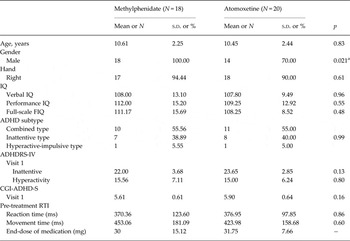
The two treatment groups did not differ significantly in age, IQ, handedness, baseline symptom severity, ADHD subtype, or baseline fALFF and ReHo maps (covaried for sex, mean pre-treatment and post-treatment FDs) (Table 1). However, no female was in the methylphenidate group, while six were in the atomoxetine group (p = 0.021, Table 1).
Demographics, baseline ADHD symptoms, and baseline neuropsychological functions between the methylphenidate group and the atomoxetine group

ADHD, Attention deficit hyperactivity disorder; IQ, intelligence quotient; ADHDRS-IV, ADHD Rating Scale-IV – Parent version: Investigator-Administered and Scored; CGI-ADHD-S, Clinical Global Impression – ADHD Severity Scale; RTI, reaction time.
a p < 0.05.
Clinical improvement
Compared to baseline scores, both methylphenidate and atomoxetine produced statistically significant reductions in ADHDRS-IV and CGI-ADHD-S scores at week 12 with large effect sizes without significant between-group differences (Table 2). No significant adverse effect was reported. In addition, two-way ANOVA identified no significant treatment × subtype interactions in either changes in inattention (p = 0.418) or changes in hyperactivity-impulsivity symptoms (p = 0.999).
Symptom change from baseline to week 12 in the methylphenidate and atomoxetine groups

ADHDRS-IV, ADHD Rating Scale-IV – Parent version: Investigator-Administered and Scored; CGI-ADHD-S, Clinical Global Impression – ADHD Severity Scale.
Correlation of fALFF or ReHo changes with ADHDRS-IV symptom improvement
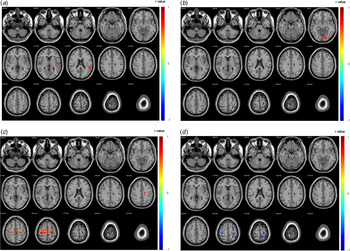
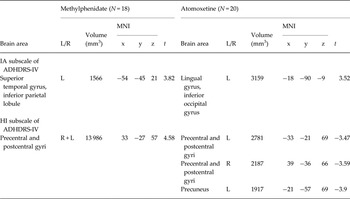
Correlation analyses (Table 3) revealed that improvement on the ADHDRS-IV inattention subscale was correlated with increased fALFF in the left superior temporal gyrus and left inferior parietal lobule for methylphenidate (r = 0.88 at peak voxel, p = 0.000002) (Fig. 1 a), and in the left lingual gyrus and inferior occipital gyrus for atomoxetine (r = 0.76, p = 0.00009, Fig. 1 b). The improvement of ADHDRS-IV hyperactivity/impulsivity subscale was correlated with increased fALFF in the bilateral precentral and postcentral gyri for methylphenidate treatment (r = 0.78, p = 0.0001, Fig. 1 c). By contrast, improvement of the ADHDRS-IV hyperactivity/impulsivity subscale correlated with decreased fALFF in the left precentral and postcentral gyri (r = −0.67, p = 0.001), right precentral and postcentral gyri (r = −0.81, p = 0.00001), and left precuneus (r = −0.82, p = 0.000008) for atomoxetine treatment (Fig. 1 d). Changes in ReHo did not correlate significantly with improvement in ADHDRS-IV inattention or hyperactivity/impulsivity subscale for either medication.
Voxel-wise correlation map. (a) The fALFF change after methylphenidate administration in left superior temporal gyrus and inferior parietal lobule was positively correlated with ADHDRS-IV Inattention (IA) Subscale improvement. (b) The fALFF change after atomoxetine administration in left lingual gyrus and inferior occipital gyrus was positively correlated with ADHDRS-IV IA Subscale improvement. (c) The fALFF change after methylphenidate administration in bilateral precentral and postcentral gyri was positively correlated with ADHDRS-IV Hyperactivity/Impulsivity (HI) Subscale improvement. (d) The fALFF change after atomoxetine administration in bilateral precentral and postcentral gyri and left precuneus was negatively correlated with ADHDRS-IV HI Subscale improvement. Left in the figure indicates the right side of the brain. fALFF, Fractional amplitude of low-frequency fluctuation; ADHDRS-IV, ADHD Rating Scale-IV – Parent version: Investigator-Administered and Scored.

Significant clusters of fALFF change correlated with ADHDRS-IV improvement in the methylphenidate and atomoxetine groups

ADHDRS-IV, ADHD Rating Scale-IV – Parent version: Investigator-Administered and Scored; fALFF, fractional amplitude of low-frequency fluctuation; HI, hyperactivity/impulsivity; IA, inattention; L, left; R, right; MNI, Montreal Neurological Institute.
Correlations between pre-treatment RTI measures and fALFF change
Supplementary Table S1 presents the Pearson's correlations between pre-treatment RTI measures (reaction time and movement time) and fALFF change (the difference between pre- and post-treatment) for the two treatment groups after the age was accounted for in the correlation analysis. For atomoxetine, there was a significant negative correlation between reaction time and fALFF change in the left lingual gyrus and the left inferior occipital gyrus, whereas there were significant positive correlations between movement time and fALFF change in bilateral precentral and postcentral gyri and left precuneus, with a negative correlation between movement time and the fALFF change in the left lingual gyrus and the inferior occipital gyrus. In contrast, pre-treatment RTI measures did not correlate significantly with fALFF change after methylphenidate treatment.
Differential medication effects on neuronal activity
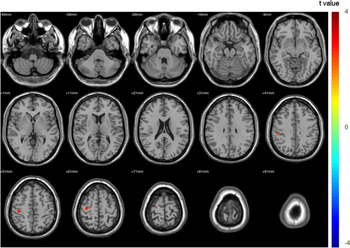
Compared with the atomoxetine group, the methylphenidate group showed significantly increased fALFF in the right precentral and postcentral gyri in the post-treatment minus pre-treatment contrast map (Fig. 2). For fALFF, we identified a significant treatment by subtype interaction in the right precentral gyrus (Supplementary Table S2, Supplementary Fig. S2). For ReHo, we did not identify any significantly differential effect of medications on this intrinsic measure of resting state functional MRI as a function of ADHD subtype.
The cluster showing significant differences in post-treatment minus baseline fractional amplitude of low-frequency fluctuation (fALFF) change between the two treatment groups is located in right precentral and postcentral gyri and consists of 59 voxels (Montreal Neurological Institute coordinates of peak voxel: 39, −24, 45; t = 3.89). Warm colors indicate higher fALFF change in the methylphenidate group than in the atomoxetine group; p < 0.05, Gaussian Random Field-corrected. Left in the figure indicates the right side of the brain.

Discussion
The present study provides the first fALFF evidence of distinct therapeutic mechanisms of methylphenidate and atomoxetine in children with ADHD in addition to the comparable clinically meaningful reduction in clinical symptoms after 12-week treatment. Our principal findings are that inattention improvement was correlated with increased fALFF in the left superior temporal gyrus for methylphenidate, and in the left lingual gyrus and inferior occipital gyrus for atomoxetine. In contrast, hyperactivity/impulsivity improvement was differentially correlated with increased fALFF for methylphenidate and with decreased fALFF for atomoxetine in bilateral precentral and postcentral gyri. We did not detect previously reported medication effects on ReHo (An et al. Reference An, Cao, Cao, Sun, Yang, Zou, Katya, Zang and Wang2013b ; Zhu et al. Reference Zhu, Gao, Hua, Liu, Deng, Zhang, Jiang and Zang2013) for either methylphenidate or atomoxetine. The divergent fALFF effects of these two treatments in association with clinical improvement highlight the importance of adopting an RS-fMRI approach to understanding medication-related changes in intrinsic brain activity in children with ADHD.
Consistent with previous head-to-head studies in Western countries (Kratochvil et al. Reference Kratochvil, Heiligenstein, Dittmann, Spencer, Biederman, Wernicke, Newcorn, Casat, Milton and Michelson2002) and Taiwan (Ni et al. Reference Ni, Lin, Gau, Huang and Yang2013), both methylphenidate and atomoxetine treatments were associated with a clinically meaningful reduction in inattention and hyperactivity/impulsivity symptoms. Symptom severity decreased to ‘mildly-to-moderately ill’ for both treatment groups. In addition, no significant group differences were noted with respect to the changes of the ADHDRS-IV and CGI-ADHD-S ratings, suggesting the similar efficacy of methylphenidate and atomoxetine in reducing symptoms in children with ADHD.
Our findings of fALFF changes in bilateral precentral and postcentral gyri associated with hyperactivity/impulsivity improvement in both groups strongly implicate the sensorimotor systems in the therapeutic reactions of both methylphenidate (Shaw et al. Reference Shaw, Sharp, Morrison, Eckstrand, Greenstein, Clasen, Evans and Rapoport2009; Schulz et al. Reference Schulz, Fan, Bedard, Clerkin, Ivanov, Tang, Halperin and Newcorn2012) and atomoxetine (Schulz et al. Reference Schulz, Fan, Bedard, Clerkin, Ivanov, Tang, Halperin and Newcorn2012) for children with ADHD. Moreover, the opposing effects of these two medications in sensorimotor systems suggest different processes underlie the differential therapeutic mechanisms of methylphenidate and atomoxetine. Such opposite effects were also noted in task-based fMRI studies (Marquand et al. Reference Marquand, De Simoni, O'Daly, Williams, Mourao-Miranda and Mehta2011; Schulz et al. Reference Schulz, Fan, Bedard, Clerkin, Ivanov, Tang, Halperin and Newcorn2012). For example, opposing effects of methylphenidate and atomoxetine on activated and deactivated networks were found in healthy volunteers performing a rewarded working memory task (Marquand et al. Reference Marquand, De Simoni, O'Daly, Williams, Mourao-Miranda and Mehta2011). Differential chronic drug effects in the inferior frontal gyrus, anterior cingulate gyrus, supplementary motor area, and posterior cingulate cortex were observed in children with ADHD during a go/no-go task (Schulz et al. Reference Schulz, Fan, Bedard, Clerkin, Ivanov, Tang, Halperin and Newcorn2012). In these clusters, greater medication benefit on methylphenidate was associated with decreased activation, whereas greater benefit on atomoxetine was associated with increased activation (Schulz et al. Reference Schulz, Fan, Bedard, Clerkin, Ivanov, Tang, Halperin and Newcorn2012). In non-human primates, methylphenidate and atomoxetine both increased neuronal signal-to-noise ratio (SNR), albeit through distinct complementary mechanisms (Gamo et al. Reference Gamo, Wang and Arnsten2010). Specifically, methylphenidate enhanced SNR by suppressing non-specific information, whereas atomoxetine increased the intensity of specific signals (Gamo et al. Reference Gamo, Wang and Arnsten2010). Given the complex indirect links between the fMRI BOLD signal and underlying neural events, further studies are warranted to identify the molecular mechanisms of the differential effects of methylphenidate and atomoxetine on fALFF in the sensorimotor systems.
For methylphenidate, we found that increased fALFF in the left superior temporal gyrus was associated with improvement in inattention. Previous imaging studies have implicated the superior temporal gyrus in the pathogenesis of inattention problems in patients with ADHD (Mulas et al. Reference Mulas, Capilla, Fernandez, Etchepareborda, Campo, Maestu, Fernandez, Castellanos and Ortiz2006). Previous studies showed that a single dose of methylphenidate was associated with increased ReHo in the left superior temporal gyrus in healthy adults (Zhu et al. Reference Zhu, Gao, Hua, Liu, Deng, Zhang, Jiang and Zang2013). We speculate that methylphenidate improves inattention symptoms by altering neuronal information in the superior temporal gyrus which in turn increases fALFF.
The effects of atomoxetine on fALFF in visual cortex highlight a region that tends to be overlooked in ADHD studies (Castellanos & Proal, Reference Castellanos and Proal2012). Structural neuroimaging studies have found significant reduction in gray-matter volume in the occipital lobes in drug-naive adults with ADHD (Ahrendts et al. Reference Ahrendts, Rusch, Wilke, Philipsen, Eickhoff, Glauche, Perlov, Ebert, Hennig and van Elst2011). Children with ADHD showed decreased small-world network nodal efficiency in occipital cortex in a resting-state study (Wang et al. Reference Wang, Zhu, He, Zang, Cao, Zhang, Zhong and Wang2009). Animal studies demonstrated that atomoxetine increased noradrenaline levels in the occipital cortex of rats (Swanson et al. Reference Swanson, Perry, Koch-Krueger, Katner, Svensson and Bymaster2006), and human participants showed significantly greater stop-related BOLD activity in the left inferior and middle occipital regions during atomoxetine treatment compared to placebo (Nandam et al. Reference Nandam, Hester and Bellgrove2014). Occipital cortex interacted with the dorsal attention network to maintain attention (Shulman et al. Reference Shulman, Astafiev, Franke, Pope, Snyder, McAvoy and Corbetta2009) and to suppress attention to irrelevant stimuli (Capotosto et al. Reference Capotosto, Babiloni, Romani and Corbetta2009). Our findings of the link between inattention improvement and increased fALFF in the left lingual and inferior occipital cortex further supported the relevance of posterior brain areas in the pathophysiology of inattentive symptoms in ADHD (Castellanos & Proal, Reference Castellanos and Proal2012).
For the medication-related fALFF changes, we found a significant treatment by ADHD subtype interaction in the right precentral gyrus. Future studies are needed to replicate our findings.
In contrast to fALFF, we did not detect significant regional changes in ReHo after treatment with methylphenidate or atomoxetine. The inconsistency with the findings of previous studies (An et al. Reference An, Cao, Cao, Sun, Yang, Zou, Katya, Zang and Wang2013b ; Zhu et al. Reference Zhu, Gao, Hua, Liu, Deng, Zhang, Jiang and Zang2013) which demonstrated ReHo change after methylphenidate treatment could be accounted for by methodological heterogeneity, including age, gender, recruitment of drug-naive patients and treatment duration. fALFF indexes spontaneous activity at the single-voxel level (Zou et al. Reference Zou, Zhu, Yang, Zuo, Long, Cao, Wang and Zang2008), while ReHo reflects local synchrony of spontaneous activity among neighboring voxels (Zang et al. Reference Zang, Jiang, Lu, He and Tian2004). The characterization of intrinsic brain activity is in its infancy, and studies with larger samples and greater temporal and spatial resolution will be needed to further evaluate the sensitivity of methods to detect pharmacological effects in brain.
The baseline RTI measures complemented the changes in clinical ratings, but only for atomoxetine. After 12-weeks of atomoxetine treatment, children with shorter pre-treatment RTI reaction time, i.e. more attentive responding, had greater increased fALFF in the visual cortex, left lingual gyrus and inferior occipital gyrus. Children with shorter pre-treatment RTI movement time had more decreased fALFF in the sensorimotor cortex, bilateral precentral and postcentral gyri, and left precuneus. Independent replication of these results could facilitate identification of atomoxetine responders via relatively inexpensive reaction time measures (Elliott et al. Reference Elliott, Blasey, Rekshan, Rush, Palmer, Clarke, Kohn, Kaplan and Gordon2014).
Our findings should be interpreted in light of limitations. First, given the moderate sample size, further research with larger sample size is warranted to replicate our results and to extend the generalizability of our results. Second, we study a highly selected medication-naive patient population with minimal psychiatric co-morbidities to avoid confounding by co-morbid disorders and past medication history. Future studies with similar methods need to be carried out in ADHD patients with other psychiatric co-morbid conditions. Third, our findings of medication effects on resting-state brain activity need to be supported by studies incorporating task designs that allow identifying specific neurocognitive processes to clarify the underlying pharmacological mechanisms of medications treating ADHD. Fourth, this study is limited by a relatively wide age range (7–17 years) of the participants. Since brain maturation and development may introduce variability into the medication effects, further studies with a narrower age range are warranted. Fifth, the absence of a placebo arm is another limitation of this study while it is ethically questionable to withhold medication from children with ADHD who have been indicated for pharmacotherapy.
Despite the preceding potential limitations, the present study has the methodological strengths including drug-naive patients, chronic administration of medication, and novel measures of regional resting-state brain activity.
In conclusion, this is the first study using fALFF to investigate differential neural correlates of symptom improvement in drug-naive children with ADHD who are randomized into treatment with methylphenidate or atomoxetine. We find that comparable clinical improvement appears to be mediated by distinct effects of methylphenidate and atomoxetine on intrinsic functional brain architecture. These results provide an initial window into the possible neurophysiological mechanisms of drug response in children with ADHD. In addition, our findings demonstrate the feasibility of using fALFF as a tool to access the medication effect on intrinsic brain activity in individuals with ADHD.
Supplementary material
For supplementary material accompanying this paper visit http://dx.doi.org/10.1017/S0033291716001938.
Acknowledgements
This study was supported by grants NSC96-2628-B-002-069-MY3, NSC98-2314-B-002-051-MY3, and NSC99-2321-B-002-037 from National Science Council (Taiwan) and grants NHRI-EX98-9407PC and NHRI-EX100-0008PI from National Health Research Institute (Taiwan).
Declaration of Interest
None.