Poor premorbid functioning is a central feature of schizophrenia (Kraepelin, Reference Kraepelin1919) and of other psychotic disorders (Tarbox, Brown, & Haas, Reference Tarbox, Brown and Haas2011). Premorbid dysfunction is strongly associated with postonset illness characteristics including severity of negative symptoms, cognitive deficits, motor slowing, and treatment refraction (e.g., Addington, van Mastrigt, & Addington, Reference Addington, van Mastrigt and Addington2003; Haim, Rabinowitz, & Bromet, Reference Haim, Rabinowitz and Bromet2006; Larsen, McGlashan, Johannessen, & Vibe-Hansen, Reference Larsen, McGlashan, Johannessen and Vibe-Hansen1996; Levitt, O'Donnell, McCarley, Nestor, & Shenton, Reference Levitt, O'Donnell, McCarley, Nestor and Shenton1996; Silverstein, Mavrolefteros, & Turnbull, Reference Silverstein, Mavrolefteros and Turnbull2003). Furthermore, a history of poor functioning in childhood and adolescence in nonpsychotic adult relatives of schizophrenia patients (Shapiro et al., Reference Shapiro, Marenco, Spoor, Egan, Weinberger and Gold2009; Walshe et al., Reference Walshe, Taylor, Schulze, Bramon, Frangou and Stahl2007), including monozygotic twins (Picchioni et al., Reference Picchioni, Walshe, Toulopoulou, McDonald, Taylor and Waters-Metenier2010), suggests a genetic component to this association.
Studies of first- and multiple-episode psychotic disorders emphasize the prognostic importance of functioning prior to psychosis onset (Haas, & Sweeney, Reference Haas and Sweeney1992; MacBeth, & Gumley, Reference MacBeth and Gumley2008). “Stable-poor” and “deteriorating” patterns of functioning are associated with earlier age of onset, greater severity and poorer treatment responsiveness of negative symptoms, worse social functioning, greater poverty of movement, greater deficits in verbal fluency and verbal memory, and poorer quality of life (e.g., Addington & Addington, Reference Addington and Addington2005; Haas & Sweeney, Reference Haas and Sweeney1992; Strous et al., Reference Strous, Alvir, Robinson, Gal, Sheitman and Chakos2004). In addition, premorbid social dysfunction is particularly associated with longer duration of untreated psychosis, greater severity of negative symptoms at baseline and at 5-year follow-up, and decreased likelihood of remission of negative symptoms after 5 years (Larsen et al., Reference Larsen, Friis, Haahr, Johannessen, Melle and Opjordsmoen2004; Piskulic, Addington, Auther, & Cornblatt, Reference Piskulic, Addington, Auther and Cornblatt2011; Strous et al., Reference Strous, Alvir, Robinson, Gal, Sheitman and Chakos2004), whereas poor premorbid academic functioning is associated with earlier onset of prodromal symptoms and greater neurocognitive deficits (e.g., working memory and verbal learning; Larsen et al., Reference Larsen, Friis, Haahr, Johannessen, Melle and Opjordsmoen2004; Norman, Malla, Manchanda, & Townsend, Reference Norman, Malla, Manchanda and Townsend2005; Rund et al., Reference Rund, Melle, Friis, Johannessen, Larsen and Midboe2007).
Functioning in Clinical High-Risk (CHR) Individuals
Poor functioning is an important feature of the premorbid period (Tarbox & Pogue-Geile, Reference Tarbox and Pogue-Geile2008) and may also predict conversion to psychosis among individuals identified clinically as high risk for psychosis (Miller et al., Reference Miller, McGlashan, Rosen, Somjee, Markovich and Stein2002; Yung et al., Reference Yung, McGorry, McFarlane, Jackson, Patton and Rakkar1996). Such individuals are at high risk for becoming psychotic (Ruhrmann et al., Reference Ruhrmann, Schultze-Lutter, Salokangas, Heinimaa, Linszen and Dingemans2010; Woods et al., Reference Woods, Addington, Cadenhead, Cannon, Cornblatt and Heinssen2009), yet many do not convert (Addington et al., Reference Addington, Cornblatt, Cadenhead, Cannon, McGlashan and Perkins2011). Improving prediction of which “high-risk” individuals are truly at risk has become an important area of investigation.
At baseline, CHR individuals demonstrate significant deficits in global social and role functioningFootnote 1 compared to normal controls (Addington, Penn, Woods, Addington, & Perkins, Reference Addington, Penn, Woods, Addington and Perkins2008; Corcoran et al., Reference Corcoran, Kimhy, Parrilla-Escobar, Cressman, Stanford and Thompson2011; Cornblatt et al., Reference Cornblatt, Auther, Neidham, Smith, Zinberg and Bearden2007; Pinkham, Penn, Perkins, Graham, & Siegel, Reference Pinkham, Penn, Perkins, Graham and Siegel2007; Woods et al., Reference Woods, Addington, Cadenhead, Cannon, Cornblatt and Heinssen2009). Furthermore, the CHR individuals who convert to psychosis have significantly worse social and/or role functioning compared to nonconverters (Cornblatt et al., Reference Cornblatt, Carrion, Addington, Seidman, Walker and Cannon2011; Dragt et al., Reference Dragt, Nieman, Veltman, Becker, van de Fliert and de Haan2011; Mason et al., Reference Mason, Startup, Halpin, Schall, Conrad and Carr2004; Yung et al., Reference Yung, Phillips, Yuen, Francey, McFarlane and Hallgren2003; Yung, Phillips, Yuen, & McGorry, Reference Yung, Phillips, Yuen and McGorry2004). Functioning at baseline is consistently found to be one of the few predictor variables making a significant contribution to prediction of psychosis independent of prodromal symptoms (Cannon et al., Reference Cannon, Cadenhead, Cornblatt, Woods, Addington and Walker2008; Ruhrmann et al., Reference Ruhrmann, Schultze-Lutter, Salokangas, Heinimaa, Linszen and Dingemans2010; Thompson, Nelson, & Yung, Reference Thompson, Nelson and Yung2011; Velthorst et al., Reference Velthorst, Nieman, Becker, van de Fliert, Dingemans and Klaassen2009).
Developmental change in premorbid functioning has received less attention, but it may also be an important correlate of conversion to psychosis. The PAS (Cannon-Spoor, Potkin, & Wyatt, Reference Cannon-Spoor, Potkin and Wyatt1982) provides separate social and academic maladjustment ratings for childhood, early and late adolescence, and adulthood. Reports from the North American Prodrome Longitudinal Study (NAPLS-I) consortium that use the PAS suggest a pattern of premorbid functional deterioration through late adolescence in CHR individuals (Addington et al., Reference Addington, Penn, Woods, Addington and Perkins2008; Woods et al., Reference Woods, Addington, Cadenhead, Cannon, Cornblatt and Heinssen2009). Furthermore, studies from the Dutch Prediction of Psychosis Study and the Psychological Assistance Service (Carr et al., Reference Carr, Halpin, Lau, O'Brien, Beckmann and Lewin2000) suggest a possible correlation between deterioration of functioning from childhood to early adolescence and transition to psychosis (Dragt et al., Reference Dragt, Nieman, Veltman, Becker, van de Fliert and de Haan2011; Mason et al., Reference Mason, Startup, Halpin, Schall, Conrad and Carr2004).
At this time, the association between premorbid functional development and conversion to psychosis has not been examined directly in CHR youths, and there are no data on development of premorbid functioning in relation to baseline prodromal symptoms. As such, it appears timely to assess prospectively whether premorbid functioning is informative regarding risk of psychosis conversion (MacBeth & Gumley, Reference MacBeth and Gumley2008). To our knowledge, this is the first prospective study of premorbid functional development and prediction of psychosis in CHR individuals.
Method
The data here are from the NAPLS-I consortium, a collaboration of eight NIMH-funded projects prospectively examining psychosis-risk factors. The database has been described previously (Addington et al., Reference Addington, Cadenhead, Cannon, Cornblatt, McGlashan and Perkins2007). The Structured Interview for Psychosis-Risk Syndromes (SIPS) was used to evaluate and monitor psychosis-risk symptoms. Diagnostic agreement with gold standard SIPS diagnoses was in the excellent range (κ > 0.80) at each center (Addington et al., Reference Addington, Cadenhead, Cannon, Cornblatt, McGlashan and Perkins2007). Detailed descriptions of SIPS symptom severity scales and psychometric properties are available (Hawkins et al., Reference Hawkins, McGlashan, Quinlan, Miller, Perkins and Zipursky2004; Lencz, Smith, Auther, Correll, & Cornblatt, Reference Lencz, Smith, Auther, Correll and Cornblatt2004; McGlashan, Walsh, & Woods, Reference McGlashan, Walsh and Woods2010; Miller et al., Reference Miller, McGlashan, Rosen, Somjee, Markovich and Stein2002, Reference Miller, McGlashan, Rosen, Cadenhead, Cannon and Ventura2003). The database was closed to inclusion of follow-up information after September 30, 2006.
Participants
The NAPLS-I study includes data for 860 nonpsychotic individuals enrolled across the eight sites between 1998 and 2005. After clinical referral, 377 individuals across sites met criteria for psychosis-risk syndromes outlined in the SIPS interview (McGlashan et al., Reference McGlashan, Walsh and Woods2010; Woods et al., Reference Woods, Addington, Cadenhead, Cannon, Cornblatt and Heinssen2009). Specifically, one or more of three risk-syndrome criteria had to be met: (a) new onset or recent worsening of subsyndromal (“attenuated”) positive psychotic symptoms, (b) very brief periods of fully psychotic positive symptoms, or (c) deterioration in functioning within the last year and having either schizotypal personality disorder or a first-degree relative with psychosis. Detailed research definitions of the three psychosis-risk syndromes have been published previously (McGlashan et al., Reference McGlashan, Walsh and Woods2010; Miller et al., Reference Miller, McGlashan, Rosen, Somjee, Markovich and Stein2002, Reference Miller, McGlashan, Rosen, Cadenhead, Cannon and Ventura2003). In the literature, this psychosis-risk syndrome population is often referred to as CHR, and that is the convention we follow.
Current study
Participants meeting criteria for a psychosis-risk syndrome (i.e., CHR) were eligible for the current study if SIPS follow-up data were available for a minimum of 6 months and if PAS (Cannon-Spoor et al., Reference Cannon-Spoor, Potkin and Wyatt1982) data were available.
Assessments
Baseline assessments were conducted at each site. Positive, negative, disorganized, and general psychosis-risk symptoms were rated using the Scale of Psychosis-risk Symptoms contained within the SIPS (Hawkins et al., Reference Hawkins, McGlashan, Quinlan, Miller, Perkins and Zipursky2004; Lemos et al., Reference Lemos, Vallina, Fernandez, Ortega, Garcia and Gutierrez2006; Lencz et al., Reference Lencz, Smith, Auther, Correll and Cornblatt2004; McGlashan et al., Reference McGlashan, Walsh and Woods2010; Miller et al., Reference Miller, McGlashan, Rosen, Somjee, Markovich and Stein2002, Reference Miller, McGlashan, Rosen, Cadenhead, Cannon and Ventura2003) for nearly all participants. Comorbid Axis I and II diagnoses were established by structured interview, for example, the Structured Clinical Interview for DSM-IV (First, Spitzer, Gibbon, & Williams, Reference First, Spitzer, Gibbon and Williams1995) and the Structured Interview for DSM-IV Personality Disorders (Zimmerman & Coryell, Reference Zimmerman and Coryell1989), conducted by trained interviewers who met local reliability standards.
Conversion to psychosis
The primary course variable was time from baseline to conversion to psychosis. After baseline assessment, the SIPS was readministered at 6-month intervals for up to 30 months. Conversion to psychosis was defined, according to criteria operationalized in the SIPS, as the presence of positive symptoms of sufficient intensity that are either seriously disorganizing or dangerous, or have been present for at least half the days in a month for at least an hour per day (McGlashan et al., Reference McGlashan, Walsh and Woods2010; Miller et al., Reference Miller, McGlashan, Rosen, Somjee, Markovich and Stein2002, Reference Miller, McGlashan, Rosen, Cadenhead, Cannon and Ventura2003). Cases that were possibly converting were interviewed with the SIPS and a structured diagnostic interview to determine DSM-IV-TR psychotic disorder diagnosis. When potentially converting participants could not be interviewed in person, sites established best estimates of conversion diagnosis based on review of hospital and other medical records and telephone interviews with participants, family members, and members of the treatment team.
Premorbid functioning
The PAS (Brill, Reichenberg, Weiser, & Rabinowicz, Reference Brill, Reichenberg, Weiser and Rabinowicz2008; Cannon-Spoor et al., Reference Cannon-Spoor, Potkin and Wyatt1982) was administered to the participant at the baseline assessment. The PAS is an interview-based rating schedule designed to assess functioning retrospectively, particularly social and academic maladjustment. The PAS has established predictive and concurrent validity (Brill et al., Reference Brill, Reichenberg, Weiser and Rabinowicz2008) and is one of the most widely used measures of premorbid functioning in schizophrenia. Items are interviewer rated on a 7-point scale based on an interview with the patient, with 0 representing freedom from maladjustment and higher ratings representing greater maladjustment. The interview focuses on four periods of development: childhood (age 5–11), early adolescence (age 12–15), late adolescence (age 16–18), and adulthood (age 19 and above). Social functioning items (e.g., withdrawal and peer relationships) are rated for all four age periods. Academic functioning items (scholastic performance, adaptation to school) are rated for childhood through late adolescence. General information, including years of education, occupational history, and independence in living, also is assessed. Total maladjustment ratings are calculated for each developmental period and for overall functioning.
Premorbid adjustment ratings
For the current study, mean PAS ratings were derived for social, academic, and total maladjustment (social and academic ratings combined) for three developmental periods: childhood, early adolescence, and late adolescence. Adult maladjustment was not included in analyses because ratings for that period were only available for 35.2% of the sample, and adult ratings that were available were excluded to minimize overlap with the putative prodromal phase of the disorder. The primary reason for missing adult items was baseline age under 18 years, in which case adult maladjustment ratings were not applicable. The general information PAS ratings also were not utilized in keeping with the developmental emphasis of the hypotheses and concerns of bias against younger participants (Van Mastrigt & Addington, Reference Van Mastrigt and Addington2002).
Analyses
Group demographic comparisons were accomplished using either t tests or chi-square analyses. Identification of demographic characteristics that could potentially confound associations between premorbid functioning and conversion to psychosis was accomplished by first identifying demographic factors that differentiated the conversion and nonconversion groups and then examining these identified demographic variables for correlation with PAS ratings in the full CHR sample. The threshold for significance was adjusted for multiple comparisons. This process was repeated to identify potential confounds to the associations between premorbid maladjustment and baseline prodromal symptoms and between baseline prodromal symptoms and conversion to psychosis.
Cox proportional hazards regression was the primary technique used to examine the associations between premorbid maladjustment ratings and conversion status at follow-up for the social, academic, and total functioning domains. In this method, predictors are modeled in relation to time from baseline to conversion, and noncompleters contribute all available observations to the model up to time of censorship. This approach maximizes sample size and power under conditions in which complete data are not available for all participants. In these analyses, applicable covariates were entered into the model first, followed by predictors of interest.
First, individual contributions of maladjustment at each developmental period to conversion outcome, without accounting for maladjustment at other ages, were examined in separate Cox regression models. Second, standardized maladjustment ratings for childhood, early adolescence, and late adolescence were entered sequentially into a Cox regression model to examine developmental effects on conversion at each age while controlling for maladjustment at prior developmental periods. Accounting for earlier developmental periods in this manner tests the extent to which maladjustment arising in successive developmental periods contributes to prediction of psychosis over and above any existing differences in maladjustment. Models were tested that included one predictor (childhood), two predictors (childhood and early adolescence), and three predictors (childhood, early adolescence, and late adolescence). Omnibus tests were conducted at each step to examine if the addition of a predictor (“step change”) resulted in a model with a better fit to the data than before the predictor was added. Omnibus tests were also performed to examine “overall” fit of each model.
It was expected that some of the younger participants would not have late adolescent data, requiring the three predictor models to be tested in a smaller sample restricted to participants with data for all three developmental periods. Thus, for comparison, child and early adolescent two-predictor models were estimated in both the full and the restricted sample. Given the conservative nature of these analyses, the relative contributions of childhood, early adolescence, and late adolescence to prediction of psychosis were also examined without the imposed developmental sequence using backward stepwise elimination (likelihood-ratio test).
Third, for each significant relation between premorbid maladjustment and conversion, mediation effects of baseline severity of positive and negative prodromal symptoms as assessed on the SIPS (unusual thought content, suspiciousness, grandiose ideas, perceptual abnormalities, disorganized communication, social anhedonia, avolition, [diminished] expression of emotion, experience of emotion and self, [diminished] ideational richness, and occupational functioning) were tested using the approach suggested by Baron and Kenny (Reference Baron and Kenny1986). Evidence of mediation requires loss of significant association between premorbid maladjustment and conversion when accounting for the prodromal symptom, in conjunction with significant association between premorbid maladjustment and the prodromal symptom and between the prodromal symptom and conversion. As such, associations between individual premorbid maladjustment ratings and conversion status were retested for loss of significance when prodromal symptoms were included in the Cox regression model. Next, the effects of premorbid maladjustment ratings on prodromal symptom severity scores were tested using linear regression modeling, and the effects of prodromal symptom scores on conversion status, controlling for premorbid maladjustment, were tested using Cox regression modeling.
Fourth, combined effects of premorbid maladjustment and baseline severity of positive and negative prodromal symptoms on prediction of conversion status were examined for each maladjustment rating and prodromal symptom rating identified as uniquely associated with conversion. Each of these predictors was dichotomized, such that sensitivity and specificity to conversion were maximized as determined by receiver operating characteristic analysis. Each maladjustment rating was paired with each symptom rating to form dichotomized variables indicating individuals who were rated positive on both characteristics versus those with one or zero positive ratings. Individuals who were missing either characteristic were excluded from these analyses. Cox regression analysis was performed to examine the effect of each unique and combined dichotomized predictor on conversion status. Receiver operating characteristic and life table survival analyses were used to calculate positive and negative likelihood ratios and positive and negative predictive values for each predictor.
Results
Sample characteristics
There were 270 CHR individuals who had at least partial PAS data and who were followed in the study for a minimum of 6 months. Seventy-eight of these CHR participants converted to psychosis during the 2.5-year follow-along period.
Demographic and clinical comparisons
Demographic characteristics of the full CHR sample and the conversion and nonconversion groups are presented in Table 1. At a conservative threshold of p < .007 to correct for multiple comparisons, the conversion sample entered the study earlier (mean baseline year: 2001.3 vs. 2002.4; p < .001) than those who did not convert. Reported age of first positive prodromal symptom was available for a subsample of 149 participants. Converters in this subsample (n = 39) reported a later age of positive prodromal symptom onset compared to nonconverters (n = 110; M age = 18.4, SD = 3.7 vs. M age = 16.0, SD = 4.3, respectively; p = .003). In the complete sample, converters and nonconverters did not differ on baseline age, sex, race, baseline education, mother education, or father education.
Demographic characteristics of full, conversion, and nonconversion groups

Note: HS%, percentage with at least a high school level of education; CHR, clinical high risk.
***p < .001. Psychosis conversion > nonconversion.
Baseline mean severity ratings of positive and negative prodromal symptoms for the full CHR sample and the conversion and nonconversion groups are presented in Table 2. At a conservative threshold of p ≤ .005 (given multiple comparisons), the conversion group reported greater severity of suspiciousness (p < .001), disorganized communication (p < .001), social anhedonia (p < .001), and ideational richness (p < .001) compared to nonconverters.
Severity of positive and negative prodromal symptoms at baseline in the full, conversion, and nonconversion groups
Note: All values are means (standard deviations). SIPS, Structured Interview for Psychosis-Risk Syndromes; CHR, clinical high risk.
*p ≤ .05. ***p ≤ .001. Psychosis conversion > nonconversion.
Premorbid maladjustment
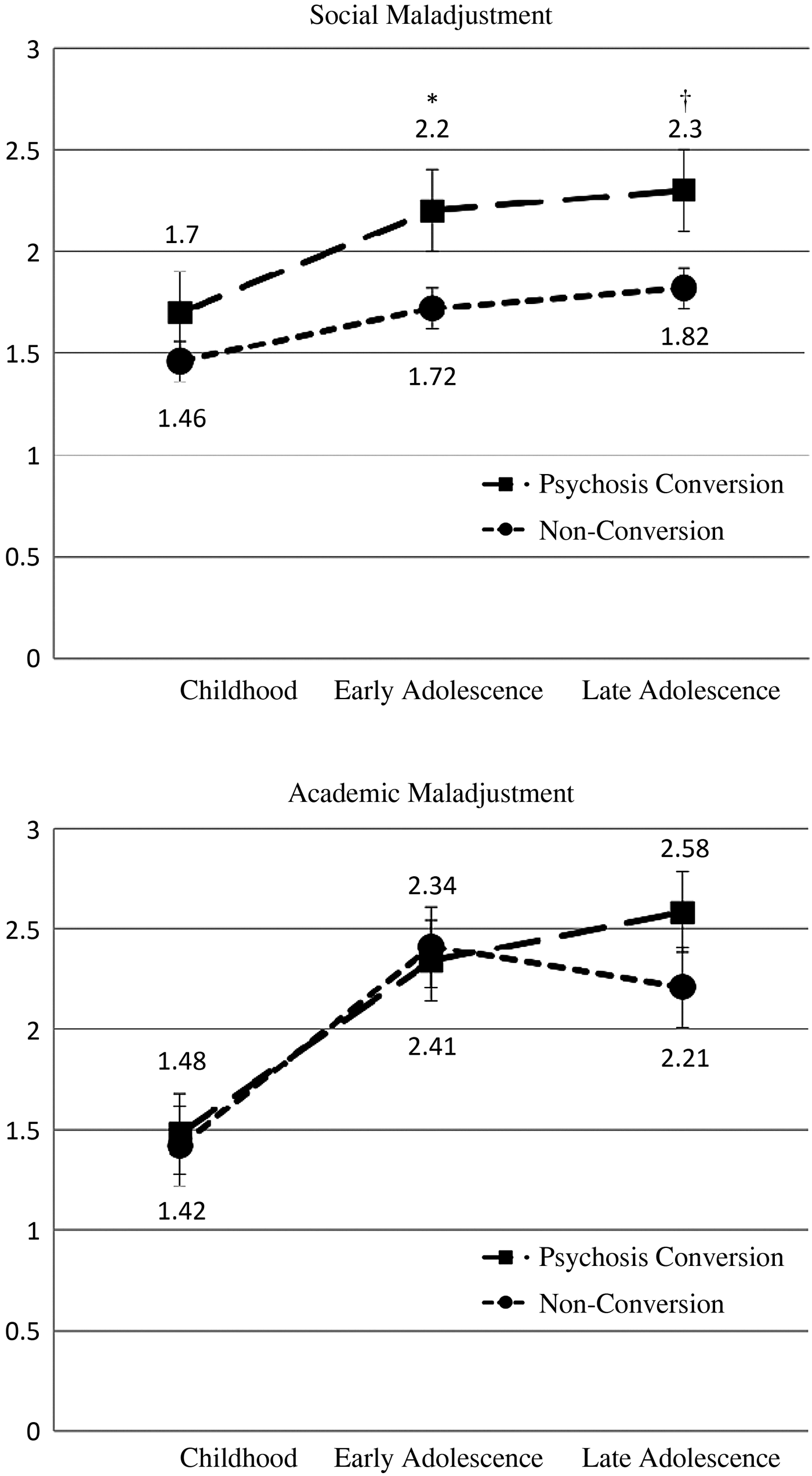
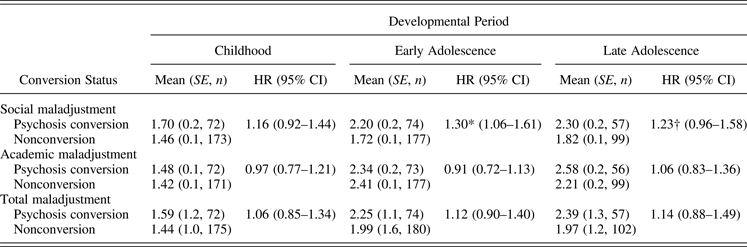
The unadjusted social, academic, and total maladjustment mean PAS ratings for the psychosis conversion and nonconversion groups are presented in Table 3, and social and academic maladjustment across developmental periods is represented in Figure 1. PAS ratings across developmental periods were significantly, positively correlated with each other, and the strength of these associations was similar regardless of domain or conversion status. The correlations in the complete CHR sample ranged across domains as follows: r childhood = .44 versus r early adolescence = .47, r early adolescence = .69 versus r late adolescence = .78, and r childhood = .32 versus r late adolescence = .40. However, diagnostics indicated no significant collinearity among developmental periods for social, academic, or total functioning.
Social and academic maladjustment across development in clinical high-risk (CHR) individuals who converted to psychosis versus nonconverters. Data labels for psychosis conversion are positioned above the data points; labels for nonconversion are below. Values are unadjusted mean Premorbid Adjustment Scale ratings, with higher scores representing greater pathology. Error bars indicate standard error of the mean scores. Cox regression analyses were performed using standardized Premorbid Adjustment Scale ratings. The covariate for academic maladjustment is baseline year. Psychosis conversion > nonconversion: †p ≤ .10, *p ≤ .05.
Premorbid maladjustment ratings and univariate prediction of conversion to psychosis versus nonconversion
Note: Mean values reflect unadjusted Premorbid Adjustment Scale ratings, with higher scores representing greater pathology. Cox regression analyses were performed using standardized Premorbid Adjustment Scale ratings. The covariate for academic and total maladjustment is baseline year. HR, hazard ratio; CI, confidence interval.
†p ≤ .10. *p ≤ .05. Psychosis conversion > nonconversion.
Demographic characteristics and premorbid maladjustment
Full sample
In the full CHR sample, at a significance threshold of p ≤ .007 (given multiple comparisons), male participants had worse social functioning in early (p = .007) and late adolescence (p = .001). Less education at baseline was associated with worse academic adjustment in childhood (p < .001), early adolescence (p < .001), and late adolescence (p = .002), and worse total adjustment in early (p < .001) and late adolescence (p < .001). Younger age at baseline was associated with worse academic and total adjustment in early adolescence (academic, p < .001; total, p = .002). Earlier year of study entry was associated with worse academic and total adjustment in early (academic, p = .004; total, p = .005) and late adolescence (academic, p = .006; total, p = .001). In the subsample of participants with data on age of first positive prodromal symptom, earlier age of symptom onset was associated with worse academic adjustment in childhood (p = .006) and early adolescence (p < .001), and worse total adjustment in early adolescence (p < .001). Race, mother education, and father education were not associated with social, academic, or total adjustment in the full sample.
Conversion sample
Among converters, at a conservative threshold of p ≤ .006, less education at baseline was associated with worse academic adjustment in early (p < .001) and late adolescence (p = .001). Baseline age, age at conversion, age of first positive prodromal symptom, year of study entry, sex, race, mother education, and father education were not associated with social, academic, or total adjustment among converters.
Nonconversion sample
Among nonconverters, at a significance threshold of p ≤ .007, male participants had worse academic functioning in late adolescence (p = .003). Less education at baseline was associated with worse academic adjustment in childhood (p < .001), early adolescence (p < .001), and late adolescence (p = .002), and younger age at baseline was associated with worse academic adjustment in early adolescence (p < .001). Earlier year of study entry was associated with worse academic adjustment in childhood (p = .003) and late adolescence (p = .005). Among participants with data on reported age of first positive prodromal symptom, earlier age of symptom onset was associated with worse academic adjustment in childhood (p = .001) and early adolescence (p < .001), and worse total adjustment in early adolescence (p < .001). Race, mother education, and father education were not associated with social, academic, or total adjustment among nonconverters.
Covariates for premorbid maladjustment and conversion analyses
In the full CHR sample, year of baseline assessment correlated both with conversion status and with academic and total adjustment in early and late adolescence, but it was not correlated with social adjustment at any age. Thus, year of baseline assessment was included as a covariate in all regression analyses testing the association between conversion status and academic or total adjustment unless noted otherwise. Reported age of first positive prodromal symptom correlated both with conversion status and with academic adjustment in childhood and early adolescence and total adjustment in early adolescence, but it was not associated with social adjustment. Given that these data were only available for 55% of the sample, reported age of first positive prodromal symptom was not automatically included as a covariate. In the case of significant associations between academic or total maladjustment and conversion, potential effects of age of positive prodromal symptom onset were examined. No covariates were included in analyses of social maladjustment.
Demographic characteristics and baseline prodromal symptoms
Full sample
In the full CHR sample, at a significance threshold of p ≤ .006, male participants had greater severity of disorganized communication (p < .001). Less education at baseline was associated with worse occupational functioning (p = .003), and earlier year of study entry was associated with greater severity of perceptual abnormalities (p = .005). In the subsample of participants with data on age of first positive prodromal symptom, older age at positive prodromal symptom onset was associated with greater severity of unusual thought content (p = .003). Age at baseline, race, mother education, and father education were not associated with severity of baseline prodromal symptoms in the full sample.
Conversion sample
In the conversion sample, at a conservative threshold of p ≤ .006, male participants had greater severity of disorganized communication (p < .001). Age at baseline, age at conversion, age of first positive prodromal symptom, year of study entry, race, mother education, and father education were not associated with severity of baseline prodromal symptoms among converters.
Nonconversion sample
Among nonconverters, at a significance threshold of p ≤ .006, female participants had greater severity of unusual thought content (p = .005) and perceptual abnormalities (p = .004). Earlier year of study entry was also associated with greater severity of perceptual abnormalities (p = .001). Less education at baseline was associated with worse occupational functioning (p = .004). Lower educational achievement in either parent was associated with greater severity of ideational richness (mother p = .005; father p = .006). Age at baseline, age of first positive prodromal symptom, and race were not associated with severity of baseline prodromal symptoms in the nonconversion sample.
Covariates for prodromal symptom and conversion analyses
In the full CHR sample, year of study entry correlated both with conversion status and with baseline severity of perceptual abnormalities and thus was included as a covariate in regression analyses testing the association between perceptual abnormalities and conversion status. Reported age of first positive prodromal symptom correlated both with conversion status and with severity of unusual thought content, but it was not automatically included as a covariate in regression analyses given that prodrome symptom onset data were only available for 55% of the sample. In the case of significant association between unusual thought content and conversion, potential effects of age of positive prodromal symptom onset were examined.
Covariates for premorbid maladjustment and prodromal symptom analyses
In the full CHR sample, sex was associated with baseline severity of disorganized communication and social maladjustment in early and late adolescence. Number of years of education at baseline was associated with occupational functioning at baseline and with academic adjustment in childhood, early adolescence, and late adolescence, and total adjustment in early and late adolescence. Likewise, year of study entry was associated with baseline severity of perceptual abnormalities and with academic and total adjustment in early and late adolescence. Sex, years of education, and year of study entry were thus included as covariates in relevant analyses.
Among converters, there were no demographic characteristics associated with both prodromal symptom severity and premorbid maladjustment. Among nonconverters, sex was associated with baseline severity of unusual thought content and perceptual abnormalities, and with academic maladjustment in late adolescence. Year of study entry was associated with severity of perceptual abnormalities and with academic maladjustment in childhood and late adolescence. Number of years of education at baseline was associated with occupational functioning and with academic maladjustment in childhood, early adolescence, and late adolescence. Sex, year of study entry, and years of education were thus included as covariates in relevant analyses in the nonconversion sample.
Premorbid maladjustment and prediction of conversion to psychosis
Premorbid maladjustment in independent developmental periods
Table 3 presents the independent effects of social, academic, and total maladjustment at each developmental period on conversion status. Cox regression analyses of social maladjustment at each developmental period indicated that compared to nonconverters, individuals who converted to psychosis were rated significantly higher (greater pathology) on social maladjustment for early adolescence (hazard ratio [HR] = 1.30, p = .014). In contrast, converters and nonconverters did not differ on academic or total maladjustment at any developmental period. The results for academic and total maladjustment did not change if baseline year was excluded from the model.
Progression of premorbid maladjustment across development
Social maladjustment
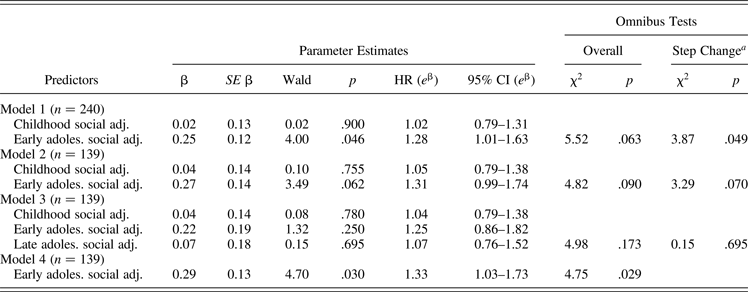
The effects of early and late adolescent functioning on conversion status were examined further by controlling for the effect of maladjustment at previous developmental periods. Accounting for previous developmental periods tests the extent to which additional maladjustment arising in successive developmental periods contributes to prediction of psychosis over and above existing maladjustment. Consistent with univariate analyses, results of multivariate analysis indicated that when accounting for childhood maladjustment, social maladjustment in early adolescence continued to be associated with significantly greater risk of conversion to psychosis relative to “risk” of nonconversion in the full sample (HR = 1.28, Wald χ2 = 4.00, p = .046; Table 4, Model 1). In the restricted sample of participants for whom late adolescent ratings were available (n = 139), social maladjustment in early adolescence was associated at a trend level with risk of conversion to psychosis when controlling for childhood maladjustment (Table 4, Model 2). In this restricted sample, late adolescent social maladjustment did not predict psychosis when controlling for the effects of both childhood and early adolescent maladjustment (Table 4, Model 3). Omnibus testing indicated that the addition of late adolescence (Model 3) did not provide a better fit to the data than the model in which childhood and early adolescence are the only predictors (Model 2). When the relative contributions of childhood, early adolescent, and late adolescent social maladjustment were examined simultaneously in the restricted sample without specifying developmental sequence through stepwise backward elimination (Table 4, Model 4), early adolescent social maladjustment was retained in the model as the only unique predictor of psychosis (HR = 1.33, Wald χ2 = 4.70, p = .030).
Social maladjustment and prediction of conversion to psychosis versus nonconversion
Note: A Cox regression analysis was performed using standardized Premorbid Adjustment Scale ratings. The reference group is nonconversion. Models 1–3, the method is forced entry; Model 4, the method is stepwise backward elimination. HR, hazard ratio; CI, confidence interval.
aThe change from the previous step. For Model 1, this indicates the change from a univariate model with childhood as the only predictor (see Table 3). For Model 3, this indicates the change from Model 2.
Academic maladjustment
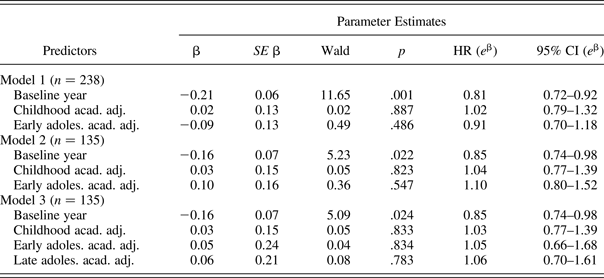
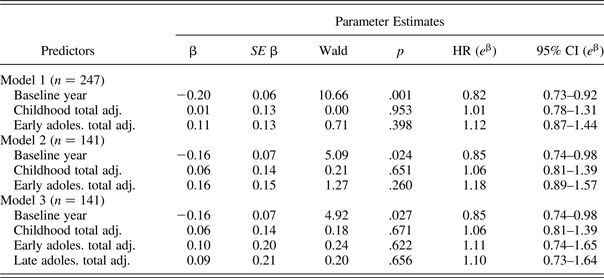
The association between developmental course of academic maladjustment and risk of conversion to psychosis versus nonconversion was examined next. Results of multivariate Cox regression analyses paralleled those of univariate tests and indicated that when accounting for effects of earlier developmental periods, academic functioning in early and late adolescence was not significantly associated with risk of conversion to psychosis relative to nonconversion in the complete sample (Table 5, Model 1) and in the restricted sample of participants for whom late adolescent ratings were available (Table 5, Models 2 and 3). When the relative contributions of childhood, early adolescent, and late adolescent academic maladjustment were examined simultaneously in the restricted sample through stepwise backward elimination, none of the developmental periods were retained in the model. Results for academic maladjustment did not change if baseline year was excluded from these models. Given that none of the models for academic maladjustment were significant, omnibus tests of model fit are not presented in Table 5.
Academic maladjustment and prediction of conversion to psychosis versus nonconversion
Note: The reference group is nonconversion, and the method is forced entry. A Cox regression analysis was performed using standardized Premorbid Adjustment Scale ratings. HR, hazard ratio; CI, confidence interval.
Total maladjustment
Results for total maladjustment were similar to those for academic maladjustment. Consistent with univariate analyses, results of multivariate Cox regression analyses indicated that total maladjustment in early and late adolescence was not associated with risk of conversion when controlling for effects of earlier developmental periods in the complete sample (Table 6, Model 1) and in the restricted sample of participants for whom late adolescent ratings were available (Table 6, Models 2 and 3). When the relative contributions of childhood, early adolescent, and late adolescent total maladjustment were examined through stepwise backward elimination in the restricted sample, none of the developmental periods were retained in the model. Results for total maladjustment did not change if baseline year was excluded from these models. Because none of the models for total maladjustment were significant, omnibus tests of model fit are not presented in Table 6.
Total maladjustment and prediction of conversion to psychosis versus nonconversion
Note: The reference group is nonconversion, and the method is forced entry. A Cox regression analysis was performed using standardized Premorbid Adjustment Scale ratings. HR, hazard ratio; CI, confidence interval.
Effect of baseline prodromal symptoms
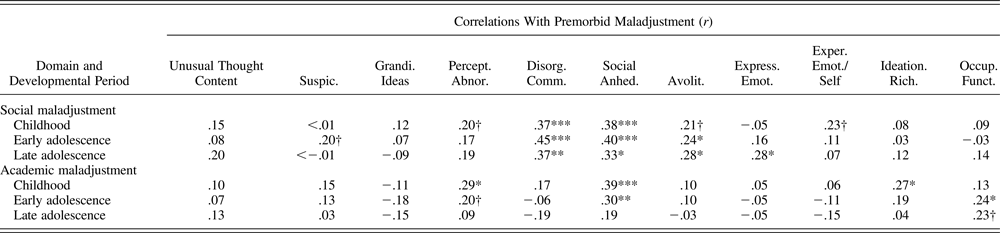
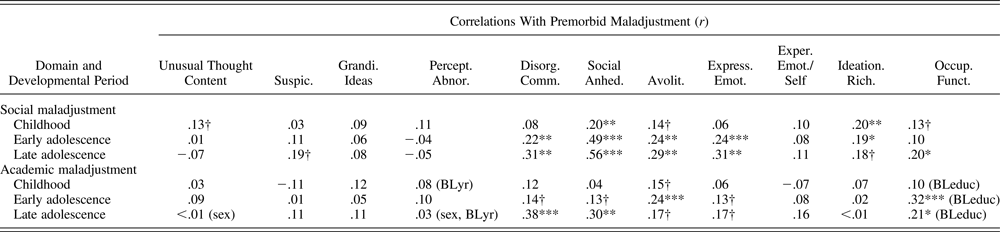
The predictive association between early adolescent social maladjustment and conversion to psychosis was examined further to test the mediation and combined effects of baseline severity of positive prodromal symptoms (unusual thought content, suspiciousness, grandiose ideas, perceptual abnormalities, and disorganized communication) and negative prodromal symptoms (social anhedonia, avolition, [diminished] expression of emotion, experience of emotion and self, [diminished] ideational richness, and occupational functioning) on this association. Correlations between premorbid maladjustment and baseline prodromal symptoms in the conversion and nonconversion samples are provided in Table 7 and Table 8, respectively.
Conversion sample: Premorbid social and academic maladjustment and severity of prodromal symptoms at baseline
Note: The values are Pearson rs. No covariates were used in the analyses.
†p ≤ .10. *p ≤ .05. **p ≤ .01. ***p ≤ .001.
Nonconversion sample: Premorbid social and academic maladjustment and severity of prodromal symptoms at baseline
Note: The values are Pearson rs, and covariates are in parentheses. BLyr, year of baseline assessment; BLeduc, the number of years of education at baseline; sex, 1 = female, 2 = male.
†p ≤ .10. *p ≤ .05. **p ≤ .01. ***p ≤ .001.
Mediation effect
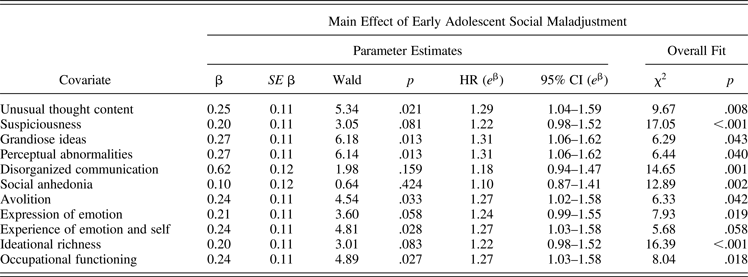
To assess mediation effects of each positive and negative prodromal symptom on the association between early adolescent social maladjustment and conversion status, individual Cox regression models were tested in which the prodromal symptom score was entered first followed by the early adolescent social maladjustment rating. Controlling for prodromal symptom severity in this manner, early adolescent social maladjustment continued to predict conversion status over and above the following symptoms (Table 9): unusual thought content (HR = 1.29, p = .021), grandiose ideas (HR = 1.31, p = .013), perceptual abnormalities (HR = 1.31, p = .013), avolition (HR = 1.27, p = .033), experience of emotion and self (HR = 1.27, p = .028), and occupational functioning (HR = 1.27, p = .027). Conversely, early adolescent social maladjustment no longer predicted conversion when accounting for disorganized communication (p = .159), social anhedonia (p = .424), suspiciousness (p = .081), diminished expression of emotion (p = .058), or diminished ideational richness (p = .083). No significant interaction effects between prodromal symptoms and early adolescent social maladjustment were identified.
Early adolescent social maladjustment and prediction of conversion to psychosis versus nonconversion, controlling for baseline prodromal symptoms
Note: The reference group is nonconversion. A Cox regression analysis was performed using standardized Premorbid Adjustment Scale ratings. The method is forced entry. HR, hazard ratio; CI, confidence interval.
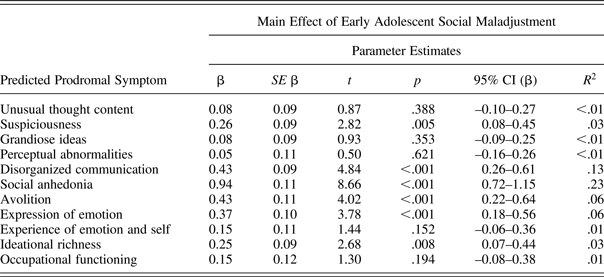
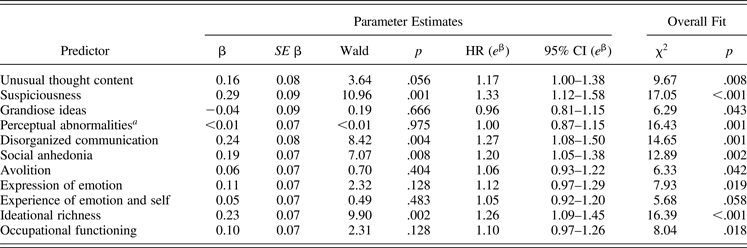
In conjunction with loss of significant association between early adolescent social maladjustment and conversion, evidence of mediation requires significant association between early social maladjustment and the prodromal symptom, and between the prodromal symptom and conversion. As shown in Table 10, linear regression analysis indicated that in the full CHR sample, early adolescent social maladjustment significantly predicted greater baseline severity of disorganized communication (p < .001), social anhedonia (p < .001), suspiciousness (p = .005), diminished expression of emotion (p < .001), and diminished ideational richness (p = .008). Early social maladjustment also was associated with greater severity of avolition at baseline (p < .001). Results for disorganized communication were not altered by excluding sex from the model. Cox regression analyses accounting for early adolescent social maladjustment indicated that disorganized communication (HR = 1.27, p = .004), social anhedonia (HR = 1.20, p = .008), suspiciousness (HR = 1.33, p < .001), and diminished ideational richness (HR = 1.26, p = .002) at baseline each showed a significant effect on conversion status. Diminished expression of emotion did not predict conversion, however (Table 11). Results thus support a significant mediation effect of disorganized communication, social anhedonia, suspiciousness, and diminished ideational richness on the association between early adolescent social maladjustment and conversion to psychosis.
Early adolescent social maladjustment and prediction of baseline prodromal symptoms in the full sample
Note: Linear regression was performed using standardized Premorbid Adjustment Scale ratings. The method is forced entry. The covariate for disorganized communication was sex; otherwise no covariates were used. CI, confidence interval.
Baseline prodromal symptoms and prediction of conversion to psychosis versus nonconversion
Note: The reference group is nonconversion. A Cox regression analysis was performed using standardized Premorbid Adjustment Scale ratings. The method is forced entry. The covariate for all analyses was early adolescent social maladjustment, and the year at baseline was an additional covariate for perceptual abnormalities. HR, hazard ratio; CI, confidence interval.
aThe results for perceptual abnormalities remained nonsignificant when the year at baseline was not included as a covariate.
Combined effect
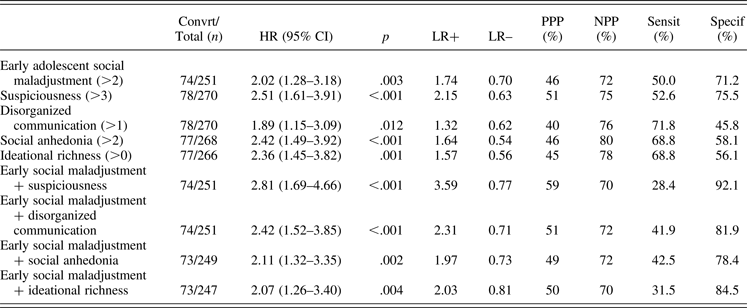
Finally, we examined positive predictive power and specificity of early adolescent social maladjustment as a unique predictor of conversion status and in conjunction with the prodromal symptoms that independently predicted conversion: suspiciousness, disorganized communication, social anhedonia, and diminished ideational richness. As unique predictors, early adolescent social maladjustment and the four prodromal symptoms all demonstrated modest positive predictive power (range = 40%–51%). Among unique predictors, specificity was good for early adolescent social maladjustment and suspiciousness (71.2% and 75.5%, respectively) and modest for the other three. The combination of premorbid early adolescent social maladjustment and baseline suspiciousness predicted conversion with the highest positive predictive power (59%) and specificity (92.1%) of all unique and combined predictors. The association and prediction statistics for early adolescent social maladjustment, suspiciousness, disorganized communication, social anhedonia, and diminished ideational richness as unique predictors, and for early adolescent social maladjustment in combination with each of the four prodromal symptoms, are presented in Table 12.
Association and predictive statistics for unique predictors and combined effects
Note: The reference group is nonconversion. The values in parentheses indicate the lowest threshold for positive test (positive test = 1, negative test = 0). Convrt, conversion sample size; Total, total sample size; HR, hazard ratio from Cox regression analysis; LR+, positive likelihood ratio (sensitivity/1-specificity); LR–, negative likelihood ratio (1-sensitivity/specificity); PPP, positive predictive power; NPP, negative predictive power; Sensit, sensitivity; Specif, specificity.
Discussion
This is the first study to examine the association between developmental course of social, academic, and total maladjustment and conversion to psychosis in a CHR sample. Specific findings are as follows:
• Early adolescent social dysfunction is a significant predictor of conversion to psychosis over and above childhood social maladjustment and independent of the baseline severity of most positive and negative prodromal symptoms.
• Disorganized communication, social anhedonia, suspiciousness, and diminished ideational richness provide the strongest evidence of a mediation effect on the association between early adolescent social functioning and conversion status.
• Early adolescent social maladjustment in conjunction with baseline suspiciousness demonstrates high positive predictive power and high specificity in predicting conversion to psychosis.
• Deterioration of academic and total functioning is observed in this CHR sample, but neither domain predicts conversion to psychosis at any developmental period.
Prediction of conversion to psychosis
Social maladjustment
The current results argue that timing and type (domain) of premorbid functional decline have important prognostic implications for conversion to psychosis in CHR samples, especially social maladjustment in early adolescence. As illustrated in Figure 1, conversion and nonconversion groups reported equivalent social adjustment in childhood. However, individuals who converted to psychosis reported a marked increase in social dysfunction during early adolescence compared to nonconverters. As such, early adolescent social maladjustment was a significant, albeit modest, predictor of conversion status independent of childhood maladjustment (HR range = 1.25–1.33). This is consistent with Dragt et al's (Reference Dragt, Nieman, Veltman, Becker, van de Fliert and de Haan2011) recent examination of individual childhood and early adolescent items on the PAS indicating that “sociability and withdrawal” and “social–sexual aspects” in early adolescence, but not in childhood, significantly predicted conversion in a high-risk sample.
In contrast, nonconverters showed a gradual worsening of social dysfunction across developmental periods, which approached that of converters only by late adolescence. Consequently, social dysfunction associated with entering late adolescence was not a significant predictor of conversion status. The reduced effect of early adolescence with the addition of late adolescence into the developmental model likely reflects the strong positive correlation between early and late adolescent social functioning and perhaps loss of power associated with the smaller size of the restricted sample and the increased complexity of the model.
Role of prodromal symptoms
As described above, poor functioning at baseline (Cornblatt et al., Reference Cornblatt, Auther, Neidham, Smith, Zinberg and Bearden2007) was previously shown to be a sensitive predictor of conversion to psychosis independent of baseline clinical state in NAPLS-I (Cannon, Reference Cannon, Cadenhead, Cornblatt, Woods, Addington and Walker2008; Cornblatt et al., Reference Cornblatt, Carrion, Addington, Seidman, Walker and Cannon2011) and other CHR samples (Dragt et al., Reference Dragt, Nieman, Veltman, Becker, van de Fliert and de Haan2011; Mason et al., Reference Mason, Startup, Halpin, Schall, Conrad and Carr2004; Ruhrmann et al., Reference Ruhrmann, Schultze-Lutter, Salokangas, Heinimaa, Linszen and Dingemans2010; Thompson et al., Reference Thompson, Nelson and Yung2011; Velthorst et al., Reference Velthorst, Nieman, Becker, van de Fliert, Dingemans and Klaassen2009; Yung et al., Reference Yung, Phillips, Yuen, Francey, McFarlane and Hallgren2003, Reference Yung, Phillips, Yuen and McGorry2004). Consistent with these reports, examination of social dysfunction prior to baseline indicated that early adolescent social maladjustment predicted conversion to psychosis independent of the majority of positive and negative prodromal symptoms assessed on the SIPS (HR range = 1.10–1.31). Furthermore, early adolescent social maladjustment predicted greater severity of several baseline prodromal symptoms, four of which in turn predicted conversion to psychosis: suspiciousness, disorganized communication, social anhedonia, and diminished ideational richness. These results fit well with the substantial evidence that poor premorbid social adjustment predicts greater symptom severity at first psychotic episode, particularly negative symptoms, and predicts worse illness course and functional outcome among schizophrenia patients (Larsen et al., Reference Larsen, Friis, Haahr, Johannessen, Melle and Opjordsmoen2004; Piskulic et al., Reference Piskulic, Addington, Auther and Cornblatt2011; Strous et al., Reference Strous, Alvir, Robinson, Gal, Sheitman and Chakos2004). This apparent association over time among premorbid social maladjustment, prodromal symptoms, conversion to psychosis, and illness severity and outcome supports a durable effect of social functioning and is congruent with a developmental conceptualization of schizophrenia and other psychotic disorders.
Identification of developmentally informative markers of psychosis risk is an important step in improving power and specificity of multivariate prediction models. Although not entirely independent of premorbid adjustment, variation in magnitude of mediation contributed by prodromal symptoms of suspiciousness, disorganized communication, social anhedonia, and diminished ideational richness suggests unique sensitivity to developmental pathology of psychotic disorders that, in conjunction with early adolescent social maladjustment, may enhance prediction of psychosis. In the current study, the combination of early adolescent social dysfunction and baseline suspiciousness provided the strongest predictive effect on conversion status (HR = 2.81) and produced the greatest elevation in positive predictive power (59%) and specificity (92.1%) to psychosis conversion compared to social maladjustment alone. Of note, suspiciousness is also observed in relatives of schizophrenia patients, which is consistent with an association between suspiciousness and liability to schizophrenia (although contribution of genes versus shared environment is unclear; Ingraham, Reference Ingraham, Raine, Lencz and Mednick1995; Katsanis, Iacono, & Beiser, Reference Katsanis, Iacono and Beiser1990; Tarbox, Almasy, Gur, Nimgaonkar, & Pogue-Geile, Reference Tarbox, Almasy, Gur, Nimgaonkar and Pogue-Geile2012).
Social dysfunction in early adolescence thus appears to be a critical prognostic indicator of conversion to psychosis among CHR individuals. Furthermore, results are consistent with the idea that premorbid social maladjustment may be an early manifestation of pathological developmental process(es), later signs of which would include prodromal symptoms (e.g., suspiciousness) and eventual psychosis. If so, early adolescence may be a time of heightened neurodevelopmental vulnerability and, correspondingly, a time during which the brain could be particularly responsive to psychosocial and/or pharmacological intervention. Even without a clear neurodevelopmental connection, evidence suggests a strong need for treatments that target functional deficits, and given current findings, interventions targeting social dysfunction would be particularly important. Psychosocial treatments that target social cognitive deficits and poor interpersonal skills have already shown positive results in both recent-onset and chronic schizophrenia patients (e.g., Bellack, Mueser, Gingerich, & Agresta, Reference Bellack, Mueser, Gingerich and Agresta2004; Eack, Pogue-Geile, Greenwald, Hogarty, & Keshavan, Reference Eack, Pogue-Geile, Greenwald, Hogarty and Keshavan2010; Hogarty et al., Reference Hogarty, Flesher, Ulrich, Carter, Greenwald and Pogue-Geile2004; Marder et al., Reference Marder, Wirshing, Mintz, McKenzie, Johnston and Eckman1996; Roberts & Penn, Reference Roberts and Penn2009).
Academic and total maladjustment
Similar to social functioning, academic adjustment showed a pattern of deterioration from childhood to early adolescence in this CHR sample, and in adolescence, ratings for academic maladjustment were generally higher (more pathological) than those for social maladjustment, a finding also reported in patient samples (Allen, Frantom, Strauss, & van Kammen, Reference Allen, Frantom, Strauss and van Kammen2005; Monte, Goulding, & Compton, Reference Monte, Goulding and Compton2008). However, the conversion and nonconversion groups did not differ in severity of academic maladjustment at any developmental period. This is consistent with a prior report that PAS academic items were not associated with psychosis in the Dutch Prediction of Psychosis Study (Dragt et al., Reference Dragt, Nieman, Veltman, Becker, van de Fliert and de Haan2011). These results suggest that deterioration in academic functioning does not predict conversion to psychosis among CHR individuals.Footnote 2
Likewise, deterioration in total adjustment was present in both the conversion and the nonconversion groups, but it did not predict psychosis. Given the notable differences between premorbid social and academic maladjustment, it is possible that sensitivity of “total” maladjustment to conversion outcome may be limited by heterogeneity across these two domains of functioning. Overall, current results indicate that social maladjustment would be a better choice for inclusion in prediction algorithms than would either total or academic maladjustment.
Limitations
The decision to examine conversion to psychosis, rather than conversion to a specific psychotic disorder (e.g., schizophrenia), is common in this area of research. However, potential limitations of using a broader and perhaps more heterogeneous conversion group should be acknowledged. To the extent that psychotic disorders differ in premorbid maladjustment, conversion and nonconversion group differences would tend to be underestimated, making it more difficult to predict conversion to psychosis. If such heterogeneity is a factor, our results may underestimate the sensitivity of premorbid maladjustment to predict conversion. In addition, combining multiple psychotic disorders makes it impossible to compare specific disorders on severity and developmental trajectory of premorbid maladjustment. For example, current evidence is mixed regarding the extent of premorbid dysfunction in psychotic mood disorders and whether poor premorbid functioning is inherent in all “schizophrenia-spectrum” diagnoses or only in schizophrenia. If this were the case here, then results could principally reflect functioning in the subsample of participants who converted to schizophrenia.
Regarding the assessment of premorbid functioning, a frequently cited limitation of the PAS (Cannon-Spoor et al., Reference Cannon-Spoor, Potkin and Wyatt1982) is its retrospective design, although predictive and concurrent validity have been established (Brill et al., Reference Brill, Reichenberg, Weiser and Rabinowicz2008). Use in CHR samples has the advantage of assessing individuals who are close in age to the developmental periods of interest and who are not psychotic, two principal sources of recall bias on the PAS. A related limitation is that, by design, PAS ratings for each age period are made during the same interview. This could influence participant recall, possibly inflating similarities across age periods. If so, the magnitude of change in functioning across developmental periods could be underestimated in this study. Finally, administration instructions for the PAS indicate that maladjustment ratings are to be obtained for the developmental periods up to and excluding onset of psychosis. However, use in CHR samples raises the issue of potential overlap between “premorbid” maladjustment and concurrent “prodromal” symptoms, a distinction not clearly established when the PAS was published. Such an overlap could potentially inflate maladjustment ratings for that developmental period. In the current subsample for which age of prodromal symptom onset was available, 70% of converters reported symptom onset after age 16 versus 39% of nonconverters. In the context of current results, inflation of nonconverters' maladjustment ratings during early adolescence is not a strong concern.
Conclusion
The results of this study argue that severity of premorbid social dysfunction in early adolescence is a significant predictor of conversion to psychosis among CHR youths, independent of childhood social maladjustment and most baseline prodromal symptoms. Results are consistent with the idea that premorbid social maladjustment is an important early manifestation of developmental pathophysiology of psychotic disorders. Based on the current findings, early adolescent social maladjustment may be a particularly good candidate for inclusion in prediction algorithms and could be an important target for early intervention.