Introduction
The person now habitually referred to as Sir Syed was born Syed Ahmad in Delhi in 1817.Footnote 1 In 1847, he published a book in Urdu on Delhi itself, calling it Asar-al-Sanadid (‘The Remnant Signs of Ancient Heroes’). No other book quite like it then existed in either Persian or Urdu. Seven years later, he published another book that was identically named but radically different. How the two texts compare and what lay behind the publications of the two books is what this paper intends to explore.
Asar-al-Sanadid was Syed Ahmad's first major publication, but it was not his first book. He had, by 1847, already published six other books, of which the first dealt with Delhi and History. At the behest of his British superior and patron, Robert N. C. Hamilton, Syed Ahmad compiled in Persian a book of chronological tables (jidwal) about the rulers of Delhi—from Timurlane to Bahadur Shah II, including the non-Timurid, Pathan rulers—and called it Jam-i-Jam (‘Jamshed's Cup’). Completed in April 1839, it was published in 1840, with the author's name given as Munshi Syed Ahmad Khan.Footnote 2 A remark near its end—‘it was completed in six months’—suggests that it was commissioned when both Hamilton and Syed Ahmad were still in Delhi.Footnote 3 At the end of the book, Syed Ahmad lists some nineteen books of history from which he garnered his information; he also claims to have consulted several unnamed manuscripts and people.Footnote 4 Surprisingly, in his entry on Bahadur Shah II, Syed Ahmad, for no obvious reason, gives precise details of the Emperor's annual income—a total of rupees sixteen lakhs and three thousand—and promises to write more in a separate book about him that he says he was working on. There is no record that the book was ever finished, or even started.
The remaining five books offer a wide range of subject matter, but clearly indicate the young author's energy and zeal for writing, and his eclectic interests, despite having had no formal education. His second effort was a procedural manual for the revenue office at Agra. It aimed to streamline the office's work, particularly with reference to the land settlement programme then in progress. The third book, written in Agra, was a summary of civil laws. While posted at Fatehpur Sikri, Syed Ahmad published three small books: a brief account of the Prophet's life, much in line with the ‘reformist’ ideas of the Waliullahi tradition; a translation of a couple of chapters from Shah Abdul Aziz's critique of Shi'i beliefs; and a translation of a small Perso-Arabic treatise on mechanical devices for lifting heavy objects.Footnote 5 Of these, one should be noted here, for its success might have first suggested to Syed Ahmad that writing and publishing books could be monetarily gainful: it was his third book—a summary of the civil laws that every Munsif was expected to be competent in. The book proved very popular when, in 1840, an obligatory competitive test was declared for all government appointments. Syed Ahmad soon published the book, adding his brother's name as co-author, and called it Intikhab-al-Akhawain (‘Selected by Two Brothers’). Though the exact date of its publication is not known, the book was reportedly an instant hit. Hali writes, ‘The book was so useful to the applicants [for Munsifi] it was quickly reprinted all over the province. People much benefited from it, and many a candidate became a Munsif thanks to that book alone’.Footnote 6
Asar-al-Sanadid (1847)
Asar-al-Sanadid (1847)—henceforward referred to as Asar-1—consists of a substantial preface, followed by the main text in four chapters, illustrated with more than 100 sketches. Additionally, it contains four taqariz, or praising statements, by four of the most distinguished citizens of Delhi, who were considerably older than the author but who genuinely admired his youthful energy and intellect.Footnote 7
Syed Ahmad begins the book with a verse from ‘Urfi—The ornamentations still left on the ruined walls and gates are the remnant signs of Persia's ancient heroes—that sets the tone of the book, and also provides its title.Footnote 8 He then writes an old-fashioned preface, in which, after praising God and the Prophet, he declares that he had long-held a desire to write a book about ‘the buildings in and around Shahjahanabad, the Red Fort, and about the people of the city and their ways’, but was not allowed to do so by ‘the turning Heavens and cruel Time’. However, now that the book was done, he held a particular hope for it:
It is a unique source of edification and a witness to the world's impermanence. A negligent person would read this book and gain in caution, while a wise man would read it and become wiser.Footnote 9
This impulse to edify the reader is expressed here over fifteen lines; it finds expression repeatedly in the main text too.
Next comes the dedication of the book to Sir Thomas Theophilus Metcalfe (1795–1853), the British Resident in Delhi, written in Urdu prose and Persian verse and spread over four pages. It forms the longest section in the preface. For comparison, we might note that Allah and his Prophet, earlier, had received a mere six lines of prose. The preface closes with the self-confident author asking the reader to do justice to the book, and bear in mind the hard work the author had put into it. It ends with another Persian verse: ‘Grab a pen and write a page like me, only then would you know the pains I took’.
The first chapter of Asar-1 describes the buildings outside the walled city; the second, the Fort and the structures within it; the third, the walled city of Shahjahanabad; and the fourth, ‘Dilli’ and the people of ‘Dilli.’ Arguably, while Shahjahanabad and its suburbs were physically distinct, for Syed Ahmad they were also subsumed within a single entity called ‘Dilli,’ which was culturally more potent than its component parts. His organization of the chapters, therefore, makes perfect sense. Starting from the furthest point south of Shahjahanabad, he moves closer to the city; upon reaching its wall, he goes around it and describes the few notable structures north of the city. Only then does he enter the walled city, where he first visits the Red Fort to offer his respects. When he turns to the city itself, Syed Ahmad first describes the canal that ran through much of the walled city and only then turns to the Jama’ Masjid, pivotal to the rest of the chapter. His choice shows how critically important the restoration of the old canal had been to the people of Delhi.Footnote 10
Using the three gates of the great mosque as separate starting points, Syed Ahmad proceeds to explore the city itself. He ventures out from one gate, describes the historical buildings in that direction, then returns to the mosque to start out from another gate. The three excursions, plus a few diversions, complete his accounting of the major buildings of the city. In the process, Syed Ahmad also gives us glimpses of what habitually took place at some of the sites. For example, at the start of each excursion, he lingers at the particular gate and lists, not only the exact number of the steps leading down from it, but also the human activities that distinguished one gate from another for any ‘dilliwala’. The South Gate has its trinket-sellers (bisati), faluda-makers, kabab-sellers, and poultry-dealers. The East Gate is where cloth-hawkers sit and bird-sellers gather. While the North Gate not only has its own kababis (kebab-sellers), it is the place to find storytellers and jugglers. Likewise, after detailing the glories of the royal mosque, Syed Ahmad feels it necessary to point out, with obvious pleasure, a far humbler structure close by—the shop of Ghazi, the grain-roaster (bhaRbhunja). One can see how the primarily objective antiquarian of the first two chapters, begins to give way in the third to a more subjective dilliwala that Syed Ahmad very much was at the time.
That enthusiastic dilliwala stands tall and unabashed in the fourth and final chapter entitled ‘Describing Dilli and its people’. He quickly lists the several cities of Delhi, ending with Shahjahanabad, and adds a note on the latter's ‘water and air.’ He also quotes extensively from Amir Khusrau's paean to India and Delhi. One may, therefore, rightly conclude that for Syed Ahmad, in Asar-1, Indarparastha, Kilokhari, Tughlaqabad, and even Shahjahanabad are small spatial entities that are distinguished from each other by chronology and physical details, while ‘Dilli’ refers to something much larger—it encompasses all the small entities and remains unbound to any time. More importantly, Dilli is a habitat, and absolutely integral to it are its people and their multi-faceted lives. And so it is that after conceding that most of the wells in the city had turned brackish and the water in Jamuna was hardly better, and that heat, humidity, and dirt plagued the city, Syed Ahmad cheerfully concludes:
Nevertheless, the climate (ab-o-hawa) of this place is a thousand times better compared to other cities. There is no ailment that is peculiar to it. All the local people, by God's grace, are attractive, fair-complexioned, and handsome (acche acche gore ciTTe khubsurat khubsurat), who fully display their beauty when they are young.Footnote 11
Naturally their language, as he quickly points out, is also exceptional. The concluding paragraph of the introduction deserves to be quoted in full.
Though some would think that what I have said about the people of this city was out of a love for my birthplace, but fair and just people, upon reading the entire book, will conclude that my words are free of excess and hyperbole. The inhabitants of this place are in truth of a kind not perhaps found anywhere else. Every person here possesses thousands of virtues and lakhs of talents. Everyone is devoted to learning, and spends his time in scholarship. Their virtues are too numerous to enumerate; their forbearance and benevolence, and their affection for their friends cannot be measured. You will not find even a trace of malice or jealousy in any of them. . .. Yes, there are also here some young men who are overly free in their ways and habits. And yes—as Sa'di wrote, ‘We know what happens when youth arrives’—the same young men spend their hours in frivolous pastimes and absurd games of love. Even so, they do what they do with a sense of modesty. ‘They hunt, but from behind hides.’ And that is not insignificant. There are of course thousands of other young men who are simple and good, and who, even in the full bloom of their youth, reject foolish pursuits, and lead exemplary lives of moderation and propriety.’Footnote 12
The rest of the chapter is essentially a short tazkira or biographical dictionary. It lists some 117 men whom Syed Ahmad held in the highest regard, and whom he had either personally met or seen.Footnote 13 His choice of categories and the order in which he lists them are worth noting. The nine categories, and the number of people mentioned in each, are as follows: (1) twenty-one Sufi masters (masha'ikh); (2) nine ‘men of ecstasy’ (majazib); (3) twelve physicians (hukama); (4) twenty-nine religious scholars (‘ulama); (5) five reciters and preservers of the Qur'an (qura aur haffaz); (6) seventeen poets (‘nightingales,’ bulbul-nawayan); (7) eleven calligraphers (khush-nawisan); (8) four artists (musawwiran); and (9) nine musicians (arbab-i-musiqi). In each case, apart from some biographical information, Syed Ahmad also mentions the exceptional qualities of each person in his profession. In the case of the poets and some scholars, he additionally gives samples of their writings, as is always done in a tazkira.
The most striking feature of the book at the time must have been its more than 130 illustrations. Drawn by Faiz Ali Khan and Mirza Shahrukh Beg—both are noted in the fourth chapter—the sketches are attractive and accurate. They are also important for being among the first lithographically produced book illustrations in India, and show how readily Delhi craftsmen of the time took up new techniques and soon excelled in them.
The passion and hard work Syed Ahmad put into the book is evident throughout. Apparently he visited every site and took every measurement himself, a few times using an astrolabe, and often at some risk.Footnote 14 He transcribed inscriptions, and supervised the artists; he gleaned historical information from many books, and then supplemented it with what he could learn from local people. We can safely assume he must have personally supervised the printing of the book too, particularly the illustrations and inscriptions, for the massive book contains surprisingly few misprints.
Who, When, Where, and Why?
Urdu scholarship on Asar-1 has mostly been concerned with the question of its authorship: who actually wrote the book? Was it Syed Ahmad, or his friend Imam Bakhsh Sahba'i? The other issues—when, where, and why it was written—remain mostly unexplored beyond what Hali wrote in Hayat-i-Jawed.
The debate on authorship chiefly arose out of the following statement in Hali's book.
As Sir Syed himself acknowledged, the first edition of Asar-al-Sanadid, whose language is much contrived and ornamented, was written by Maulana Sahba'i. No doubt he too at the time, under the influence of the society, looked down upon plain writing, and for that reason he could not bear to write in his own simple, undecorated prose—it did not amount to much in his eyes then—about the buildings he had so arduously researched and recorded. But soon after the publication of that edition he realized his mistake, and rewrote the book in his own simple, plain, and ‘natural’ style.Footnote 15
Imam Bakhsh Sahba'i was a cherished, older friend of Syed Ahmad. Extremely eclectic in erudition, Sahba'i was also a prolific writer. Most importantly, Sahba'i had a reputation in Delhi for doing ghostwriting.Footnote 16 I have no doubt that most of the Preface, including the panegyrics, was composed by Sahba'i, as was much of the fourth chapter (on the people of Delhi). Their bombast and hyperbole clearly show Sahba'i's hand. The middle chapters, however, contain plenty of internal evidence—personal references, anecdotes and asides—that allows us to conclude that they were substantially drafted by Syed Ahmad himself. Were they then stylistically ‘improved upon’ by his older friend? Perhaps so, but not always or extensively, for the language of the descriptive chapters is not too different from what later became known as Syed Ahmad's trademark ‘plain and simple’ style. In other words, much of Asar-1 emerged out of a truly collaborative effort, and was not composed by Sahbai'i alone.Footnote 17
Hali makes two statements concerning the time and place of the book's composition. According to him, Asar-1 was written in Delhi after Syed Ahmad moved there from Fatehpur in February 1846, following the sudden death of his only brother, Syed Muhammad, who was six years older than Syed Ahmad. Hali also maintains that the writing and publishing of the book took only 18 months.Footnote 18 That would put the book's publication around August or September 1847. The title page of Asar-1 carries a statement that the publication was in accord with a contract signed in September 1846, presumably after the author had made significant progress on the book in the preceding six months.
The matter is complicated by the fact that Asar-1 received a favourable notice in the April 1847 issue of the Qiran-al-Sa'dain, the occasional journal of the Delhi College. The unnamed author was most likely Dr Aloys Sprenger, the college's principal and journal supervisor, who, elsewhere, claimed to have inspired Syed Ahmad to write the book.Footnote 19 Is it possible that this massive and complex book was researched, written and published in barely twelve months by someone who simultaneously worked full-time as the Munsif of Delhi? Not likely, not even with Sahba'i's help.
Fortunately, a rare letter from Syed Ahmad to Henry Elliot, dated 7 September, 1847, has been preserved in the latter's papers at the British Library.Footnote 20 At its end, Syed Ahmad asks Elliot to let him know what sections of Asar-1 he already had (nambar ajza-i kitab-i Asar-al-Sanadid), so that the rest of the book could be sent to him. The remark makes it clear that the individually paginated chapters of the book were published serially and not altogether at one time, and that the note in the Qiran-al-Sa'dain referred only to what had appeared by April 1847. It also establishes that all the chapters were finally in print in September 1847, and were available separately. A letter from Ghalib to his friend Syed Rajab Ali ‘Arastu Jah,’ dated 5 December, 1847, adds an important detail, that the book on sale consisted of three volumes.Footnote 21 Hali, therefore, was right in reporting that the book was completed and published within eighteen months after February 1846. But was he also right in suggesting that the book was started only after that date?
While concentrated, organized work on Asar-1—field trips with the two artists, collaboration in writing with Sahba'i—could have started only after Syed Ahmad moved to Delhi in February 1846, I believe the book originated elsewhere—in Fatehpur Sikri. Syed Ahmad had spent three years—1839 through 1841—in Agra before being posted to Fatehpur, from where he continued to visit friends in Agra every week. He thus never lacked access to books and well-informed company that were essential to his project, and could easily have drafted some of the historical portions there.
Akbar's abandoned capital was likely also to be the place where the book's title and its edifying impulse came to Syed Ahmad.Footnote 22 The desolate ruins spread across the hill of Sikri must have starkly reminded him of the devastated shahr-i-kuhna or the Old City of Delhi.Footnote 23 Syed Ahmad's residence at Fatehpur Sikri was Akbar's khwabgah, the Emperor's bedchamber. It is the only building that still retains traces of the original murals. One can easily imagine him looking at the dimly visible paintings and thinking of the Emperor who had commissioned them, and who once had his most private moments—with wives and scholars alike—in that room. Given Syed Ahmad's intellectual background, how could he not but recall the almost proverbial verse by ‘Urfi? It is not without significance that Syed Ahmad retained the verse and the title, even when he changed almost everything else in the later version of the book (henceforward referred to as Asar-2).
If I argue that Asar-1 was initiated by the strong feelings of nostalgia and melancholy generated by the ruins at Sikri and their close similarity to the ruins of the ‘Old City’ surrounding Shahjahanabad, I do not rule out the monetary motivation suggested by Hali. Syed Ahmad needed additional income in 1846 to support his extended family. But, in that case, we must also ask: how could Syed Ahmad expect to make money from a book like Asar-1?
Urdu publishers in 1847 did not pay royalties; in fact, authors often had to buy several copies themselves in order to get a book published. At best, the author received one complimentary copy of the book by right (haqq-al-tasnif).Footnote 24 That is why two curious notes on each of the two covers deserve attention. The note in Asar-1 reads: ‘[Published] in accordance with the contract dated September 21, 1846’. Since Syed Ahmad actually or nominally owned his late brother's press and newspaper, the contract must have been with the printer, whose name—Abdul Ghafur—appears underneath.Footnote 25 Abdul Ghafur must have cheated Syed Ahmad by not disclosing to him correctly the number of copies he printed and sold. That will explain the blunt note in Asar-2: ‘Any copy without the author's seal should be considered stolen goods’.
But what if Abdul Ghafur had behaved differently? Was Asar-1 a realistic monetary venture? It was massive; it contained numerous illustrations; it must have been a costly book. Ghalib's diwan, one-third the size of Asar-1's first chapter, cost six annas in 1861, and that was too much for most people.Footnote 26 So why did Syed Ahmad, a shrewd enough person, think that he could make money out of a prohibitively expensive book?
A quantum change in Urdu book production took place in the 1840s when lithography rapidly spread across North India. Its simple technology readily accommodated the calligraphers already available everywhere. Overnight, booksellers turned into printers and publishers. Equally significantly, lithography came to North India when two new concepts involving books were taking firm hold there under government auspices: ‘Public Instruction’ and ‘Competitive Examinations’. The first required that officially prescribed textbooks should be made available in large numbers; the second engendered preparatory manuals or ‘keys’ that aspirants to government jobs could quickly study or memorize. Both had a seller's market in Urdu in North India. By 1847 quite a few people were making money by publishing the right kind of books. In fact, a few years earlier, Syed Ahmad had seen several publishers make good money out of one of his own earliest books, Intikhab-al-Akhawain, without sharing any of it with him.Footnote 27
Asar-1, taken as whole, does not belong to either category; if anything, it is a curious conglomerate. One part forms a short history of Delhi; a bigger chunk forms a uniquely illustrated guide to the monuments of Delhi and its surrounding area; while the remaining third, the final chapter, can be read as a tazkira, or memoir, of the notables of the time, complete with samples of their writings. But if one bears in mind that it came out over one year, as individually paginated separate chapters, one may make better sense of Syed Ahmad's project.Footnote 28 One may safely speculate that Syed Ahmad, ambitious as he was, had seemingly sought to retain the old market—the Indian readers of Urdu—while attempting to capture two emerging new markets: the colonial officers who read Urdu, and European visitors and sightseers in Delhi.Footnote 29
Syed Ahmad was well aware of the interest of colonial officers in India's history and ancient monuments. His first book was written at the behest of a British judge. He and his brother had purchased manuscripts and made copies of old historical texts for British officers.Footnote 30 While in Agra, he could have seen or heard about the two Persian books, written on Agra and its monuments, that a British officer had expressly commissioned twenty years earlier.Footnote 31 Furthermore, as the highest-ranking representative of the government at Fatehpur Sikri, Syed Ahmad must have had occasion to guide foreign visitors around the abandoned imperial buildings, and to answer their questions.Footnote 32
Here it may be useful to say something about Delhi as a town for tourists. Over the first three decades of the nineteenth century the walled city was transformed both physically and demographically.Footnote 33 It had also emerged as a major attraction for foreign sightseers, whose favourite shopping site was the revived ‘Chandni Chowk’.
Emma Roberts, who visited the city in the 1830s, noted something out of the ordinary about the new Chandni Chowk.
The shops are crowded with all sorts of European products and manufactures, and many of them display signboards, on which the names and occupations of the inhabitants are emblazoned in Roman characters—a novel circumstance in a native city. The introduction of this useful custom is attributed to Burruddeen Khan, an ingenious person patronized by the reigning emperor, Akbar the second. This accomplished artist is celebrated for his seal-engravings. . ..Footnote 34 The English placards have a very curious appearance, mingled with the striped purdahs or curtains . . . which shade the windows.Footnote 35
Not only were there shop signs in English, there were also English traders and entrepreneurs in Delhi catering to the tourist trade. Emma Roberts mentions one such woman, who had local artists paint pictures of Delhi's famous buildings on small pieces of ivory. These were then ‘set in gold and worn as necklaces, or sent as presents by the fair portions of the European community’.Footnote 36 Also available in the market were playing cards that carried a portrait of the Emperor Akbar Shah.
For the foreign tourists, the must-see places outside Shahjahanabad were the Qutub Minar, the tombs of Humayun and Safdar Jang, and the Jantar Mantar. The more venturesome also visited Tughluqabad and the shrine of Hazrat Nizamuddin. The latter was a special attraction on account of the divers at the nearby Baoli.Footnote 37 Within Shahjahanabad, the big attractions were the Jama’ Masjid, the Red Fort, and the Emperor himself, who readily enjoyed an important source of income from foreign visitors. A royal audience cost an ordinary visitor four gold coins, that is if he did not wish to receive a ‘robe of honour’ or khil'at—which added another four sovereigns.Footnote 38
The fact that Asar-1 was so lavishly illustrated—thus made unduly costly—strongly suggests that Syed Ahmad's major targets could have been the abundant number of would-be historians among the British officials in Delhi and Agra and what we now call ‘the tourist trade’—after all his printer, Abdul Ghafur, or someone else, did make enough money out of Syed Ahmad's Asar-1 project to make him think he had been cheated.Footnote 39
So how was this uniquely and ambitiously conceived book received in 1847?
Many in the ruling circle took favourable notice of the book. The journal Qiran-al-Sa'dain, published by Delhi College under the supervision of its principal, Dr Aloys Sprenger, remarked: ‘This book is excellent and is of great importance to the Society that has been founded at Delhi for the furtherance of researches into the old buildings of the past’.Footnote 40 The famous administrator and historian, Henry M. Elliot, thought sufficiently well of it. In a short note, written in 1849, on Syed Ahmad's first book, Jam-i-Jam, he made the following comment on Asar-1:
The author [of Jam-i-Jam] is Munshi Saiyid Ahmad Khan, Munsif of Delhi, who has also written and lithographed at Dehli a very good description of the remarkable buildings of that capital, accompanied with lithographed representations of them.Footnote 41
And Arthur Austin Roberts, a ranking officer in Delhi, thought so highly of it that he took a copy of it to England, where he presented it to the Royal Asiatic Society. But the ardently-wooed Thomas Theophilus Metcalfe must have severely disappointed Syed Ahmad.Footnote 42 No record has been found of Metcalfe's personal or official reaction to the book. In fact, Metcalfe seems to have made no effort to acknowledge the book, insofar as he failed even to obtain for Syed Ahmad full membership of the just-founded Archaeological Society of Delhi, of which Metcalfe himself was President.Footnote 43
Three Earlier Accounts of Delhi
Christian Troll, near the conclusion of a most informative essay, writes that ‘the first edition of Asar-al-Sanadid was written and conceived in the manner of earlier topographical and biographical writing in Persian’, but refers to only one book.Footnote 44 Irfan Habib agrees with Troll only with regard to the biographical accounts in the final chapter; he flatly states that there was no earlier tradition in Persian of a book about old buildings and their inscriptions.Footnote 45 My own limited search also failed to find any publication in the greater Indo-Persian tradition that was fully comparable with Asar-1, except the one that Troll mentions—Sair-al-Manazil by Mirza Sangin Beg, discussed below. But a consideration of two other books that precede Asar-1 in time, and which make some attempt to describe Delhi, may help us to better understand Syed Ahmad's authorial ambitions in 1847.
One of the two books is Zainul Abidin Shirwani's Bustan-al-Siyahat (‘Garden of Voyaging’) written in Persian and completed in Shiraz between 1833 and 1834, when the author was 54 years old.Footnote 46 A massive book, running to 700 folio-size pages, it details the various cities the author visited or learned about during his extensive travels that began when he was seventeen. It is mainly a topographical account, but it also contains much in the way of autobiography and learned discourse.
Shirwani, who arrived in India around 1800, claims to have spent eight years moving around the country. He mentions more than forty Indian cities in his book, indicating those that he personally visited and those that he only heard about but considered noteworthy.Footnote 47 His account of Delhi, where he spent ten months, reads:
Concerning Dihli. . .it's also called Dilli. As told in the books of the Hindus, its walls in the First Age (daura-i-awwal) were made of red ruby, in the Second of emerald, in the Third of red gold, and in the Fourth of steel. Then, as the ways and habits of the people changed the walls also changed; now they are made of bricks and stones. In the Fourth Age, a mighty king named Dihli built a city and named it after himself. Making it his capital, he resided there for long. After that it continuously remained the abode of powerful Rajas (rajaha) and Rays (rayan). After the emergence of the Exalted People, Muslim kings also made it their capital. They built so many buildings and such grand palaces that one can neither enumerate nor describe them today, even though the buildings were ravaged several times in the past. When Shahjahan, son of Jahangir, built the city anew, he named it after himself. It is now called Shahjahanabad. Under the Gurgani kings its population so increased that the city came to be 12 farsakhs long and six wide. But ever since Nadir Shah Afshar and Ahmad Shah Afghan came here, the city has fallen into bad shape. At present it contains nearly 100,000 houses, most of them beautifully built of bricks and having two or three stories. Of these, some 10,000 are such that the least of them must have cost two thousand tumans. Then there are a thousand houses of nobles and princes that must have cost three million (si-sad hazar) tumans each. There are elegant mosques, fine Sufi hospices, attractive markets with overflowing shops, delightful gardens and orchards, and countless tombs of saints and kings. The city lies in the third clime (iqlim); its air is warm and gentle; it gets its water from wells and a river; and its soil is equally desirable. A major river flows nearby. Coming from the north, from the mountains of Kashmir, the river passes the city on its north and enters the region of Purab; there it joins with the river Ganges, and after crossing Bengal falls into the sea. Delhi stands on a plain, and huge open expanses surround it in every direction.
The imperial fort lies to the east of the city and beside the river itself. As God is my witness, such a fort has rarely been seen or heard of in the world. Its ramparts are made of carved stones of the colour of sumac berries, and each stone is approximately a yard and a half long. There are many fine buildings within the walls, made of marble and decorated with designs contrived from many-hued stones. When [its builders] wished to make a design they first carved [the design] in the marble, and then set in place colourful stones such as cornelian, turquoise, and many others. Their work is so fine that what is merely a design appears like the real thing. There is a garden within the fort; it is small in size but grand in sight. This humble person understands that [the Emperor] spent one hundred crore rupees on the fort and the buildings in it, [including] the audience chamber, the small garden, and the garden behind the fort. And one crore equals one hundred lakhs, and each lakh equals one hundred thousand rupees, while each rupee consists of two and one-half mithqal of silver—and God knows best.
The region was for long the capital of sultans. Among them were the slaves of Ghur, the sultans of Khilj, the Qutlugh shahs, the Khizkhanis, the Lodis, the Syuris, and the Timurids. I have written about them in detail in my book, Riyaz-al-Siyahat. Because these grand kings showed favours on men of superior talent, raised armies, trained nobles, and made the needy happy with their generosity, people came to the area from most regions of the inhabited world. They arrived, found favor, married, and settled down, particularly those from Iran, Turan, Khwarizm, Badakhshan, Turkistan, Turkey (Rum), Syria, Arabia and Europe (firang). They left their homes to find well-pleasing lives under these kings’ benevolence. Verily, the beauty of the people of that region takes many shapes. Mostly they are of a ‘salty’ complexion and proportionally bodied. [Verse:] ‘No youth is without a tang in all of Hind; it's as if God had washed them all with brine.’ The writer stayed in that city for ten months, interacting with the nobles and Sufis and people of every sect and group, and established friendly ties with its notable men. About some of the latter I have written in my book Hada'iq-al-Siyahat.Footnote 48
The intellectual concerns that Shirwani and Syed Ahmad seem to share as they describe a city may be listed as follows:
• The location of a place within a clime, the physical appearance of its land, and the quality of its air and water;
• the physical appearance of its people;
• the physical appearance of the built city, and its lack or abundance of prosperity;
• and some notice of its notable residents.
The second book is also in Persian, but is written by an Indian Muslim—of the same age, incidentally, as Shirwani—who visited Delhi near the end of 1814 but who wrote about it in 1831. Maulavi Abdul Qadir (1780–1849) was a learned man from Rampur, who worked in the British administration in various capacities. Among his more than a dozen books is an autobiography entitled Waqai’-i-Abdul Qadir Khani that contains an account of his trip.Footnote 49 It may be read as an index to what an Indian Muslim visitor to Delhi in the early nineteenth century considered significant to see, and then to recall more than a decade later. Significantly, Abdul Qadir had intellectual interests similar to those of Syed Ahmad; his education included music and astronomy, and he too was equally attracted to scholastics and mysticism.
Abdul Qadir starts by giving a very brief history of Delhi—mentioning Mahabharata and Rajatarangini as his sources—dividing it into Hindu and Muslim periods. He adds that he had earlier composed an account of all the kings of Delhi, from Yudhishtra to Shah Alam II, in ‘a sixteen-page pamphlet (hasht warqi risala)’, but didn't have it with him to reproduce in the book. One may safely assume that, like Syed Ahmad's Jam-i-Jam eighteen years later, it too was written to satisfy some British officer's curiosity.
Abdul Qadir next describes the presentation protocol at the Red Fort, and explains some of the Urdu words and phrases peculiar, in his opinion, to the residents of the Fort. As for the buildings in the Fort, Abdul Qadir makes only one remark: ‘they are as lovely as a fairy-faced beauty’. Next he lists the buildings that ‘people go to see’. These include, in addition to the Red Fort, the Kotla of Firozshah, the Jama’ Masjid and two other mosques, two madrassas, fifteen graves of Sufi saints and scholars, the tombs of Humayun and Safdarjung, Jantar Mantar, Hauz-i-Shamsi, the Iron Pillar, and the baoli at Nizamuddin. The Qutub Minar, surprisingly, gets only a passing reference: ‘The grave of Qutbuddin Bakhtiyar Kaki is situated near the tower which is visible from Hapur towards the Jamuna’.
While the buildings are described in an offhand manner, Abdul Qadir turns quite eloquent when he describes the notable people he met or learned about during his stay. His comments follow a seemingly random order, and describe eleven Muslim scholars, six Sufi masters, and seven Urdu poets. Also included in that section are notes on true and false Sufis, Urdu language and the differences in that regard between Delhi and Lucknow, and the proper use of Arabic and Persian words in Urdu, together with very brief notices of Akbar Shah II, four princes, and eight prominent Muslim residents of Delhi, including Syed Ahmad's maternal uncle. Then follow longer notes on two physicians,Footnote 50 four Hindu scholars, and six musicians, ending with brief explanations of some musical terms.
Evidently, for Abdul Qadir too, Delhi was not just a site of antiquities and past glory but also a place made significant by its residents.Footnote 51 Unlike Syed Ahmad, he puts the ‘Ulama before the Sufis, and subsequently also includes four non-Muslim men of learning—something that Syed Ahmad does not do’.Footnote 52 Abdul Qadir's skepticism concerning Hindu beliefs is also more subdued than that of Syed Ahmad. Though Abdul Qadir lists many more buildings ‘that people go to see’ than does Shirwani, his descriptions are extremely brief. Architectural and historical details do not matter to him. Nor does he draw edifying conclusions. In fact, most of the buildings he mentions are classifiable as functioning sites; people visit them not merely to see them but to obtain some spiritual benefit.
Far from being a curious antiquarian like Syed Ahmad, Abdul Qadir is often dismissive of antiquities. Consider his note on Kotla Firoz Shah:
A famous place, it contains a pillar. People say the pillar is cut of a single stone, but its height and thickness deny the claim—no one can raise such a big stone and make it stand erect. And were it carved out of a rocky outcrop (pahaR) [now hidden beneath], then that too is beyond belief.Footnote 53
Syed Ahmad, in contrast, writes knowledgeably and at length about the Kotla. For example, he tries to calculate a date for its construction and relates many local stories associated with it. He also offers a translation of the inscription on the pillar, naming its language ‘The Shastri’.Footnote 54
Abdul Qadir, however, appears more informed than Syed Ahmad about Hindu myths and legends, and is more aggressive in pushing forward what he considers to be logical concepts. A good example would be his comments on the famous Iron Pillar at the Qutub. He first narrates the story about Raja Pithaura, who was told by his Brahmins to plant the pillar so deeply that it would penetrate the head of the mythical snake on which rested the earth. Then he adds:
A strange story it is. The earth, according to the Hindus, rests on a snake's head. In which case, the pillar must be bigger than either the diameter of the earth [if the earth is round] or its diagonal length [if the earth is rectangular], and the two differ only slightly. It follows then that the width of the pillar must be from China to the lands in the West. Secondly, how could the Brahmins dare to do such a thing when in the twelfth skanda of the Bhagwata—a heavenly book for them—it is declared that kingship over Delhi would shift from the Hindus to some other people? Further, according to the story of Raja Janmajaya, who used to kill all snakes, magic shall not be effective in the kaljug. It declares that [in that age] Mahadeva will so fiercely cast to the wind all magical spells that no one would be able to put together their words again. Then there are those who say the pillar is one of the weapons used in the battle between Duryodhana and Yudhishtra; much later someone brought and set it up here. Ignoring the incredible powers ascribed to those warriors—similarly unbelievable things are found in the histories of all people—there is still another matter to bear in mind. Why would a Muslim sultan set up here a useless weapon of the Hindus? And if it were the Hindus who did it, why didn't the pillar become an object of worship for them? For if the Hindus [supposedly] gave up the worship [in the past] fearing the Muslims, they should have commenced it again after the latter's power declined.Footnote 55
The story of Rai Pithaura is narrated at greater length in Asar-1, where Syed Ahmad gives the pillar four full pages, and makes a point of its exact height—‘22 feet and 6 inches’—by personally measuring it twice, once with a yardstick, then again with an astrolabe.Footnote 56 But the two explanations he offers for the tower's construction are more interesting for our purposes. They reveal how different his thinking was at the time, not only from Abdul Qadir's but also from his own only a few years later—it still accommodated some space to the supernatural.
Syed Ahmad begins by rejecting the suggestion that the pillar was built by Sultan Mu'izuddin as the needle of a sundial. It was built much earlier, he argues, because it is inscribed with indecipherable ancient writings. He, however, allows that its original purpose could have been just that, and that the Sultan might have preserved the pillar to serve the same purpose in the mosque and also to display Islam's glory (shaukat-i-islam).
Next Syed Ahmad narrates the Rai Pithaura story, and adds,
I find only this story closer to truth. My readers may consider it only a fantastic tale (fasana), but those who study history and know astrology will surely recall that in ancient times wise men and astrologers often constructed things of that nature. When something happened to the thing they made, it foretold a greater event that soon followed, for example the replacement of one imperial rule by another. We find such matters described in reliable books of history. Consequently, it wouldn't be surprising if the Brahmins [of Pithaura] built something of that nature.Footnote 57
Mirza Sangin Beg's Sair-al-Manazil, written in Persian, is the book that is most comparable with Asar-1.Footnote 58 About the author we know only that he was also called ‘Sangi Beg’, and that his father's name was Ali Akbar Beg. Most likely he was in the private employ of Sir Charles Theophilus Metcalfe (1785–1846), twice resident at Delhi, who, according to Beg, asked him to write a book about Delhi and then generously rewarded him. The precise date of the book's composition has not been established; at best, it was started around 1818 and completed by 1821, or soon after.Footnote 59
Beg appears to be reasonably educated in Arabic and Persian, and shows some talent for writing simple, descriptive Persian prose. His knowledge of histories and inscriptions, by his own admission, was quite limited, and so he sought help elsewhere.
I made my researches concerning many of the buildings and inscriptions with the help of Nawab Shamsud-daulah Zulfiqarul-Mulk Mirza Mahmud Khan Bahadur. . .an Iranian born in Iran, and a rare and unique person. He has read a great many books of history, and possesses an amazing memory.Footnote 60
The contents of Sair-al-Manazil are arranged in an interesting manner. First, under the heading ‘An account (ahwal) of Delhi’, comes a brief history of Delhi's kings. Next, under the heading ‘An account of the establishment of the capital, Shahjahanabad, and the construction of the Blessed Fort, comes an even briefer account of various measurements and costs concerning the city and the Fort. Then, using the Delhi Gate of the Fort as his starting point, Beg ventures inside and describes its buildings. He then turns to the city of Dehli itself, and basically walks the reader through its various streets and lanes, using a number of key sites as his starting and ending points. Done with the walled city, he similarly uses a few of its gates as new starting points for walks into the surrounding areas, while maintaining his focus on Shahjahanabad.
More than anything, Sair-al-Manazil is about a city throbbing with life, written by a person with a remarkably expansive view of Shahjahanabad as a habitat. It details at length the city's various markets, and informs us where different goods are sold, and various trades practiced. It is as much a general directory of the city as a treatise on its historical buildings. As Beg guides us to some monument, he carefully points out police outposts and homes of the city's notables—Hindu, Muslim, and British—not neglecting the homes of a few famous courtesans. His historical comments, on the other hand, are uneven in length and detail; very often the text of some inscription provides all the information. To put the matter differently, while a historian would find Syed Ahmad's book very useful, any novelist seeking to bring to life the Delhi of the 1820s would find in Sangin Beg a more valuable ‘helpmate’.
Did Syed Ahmad use Sair-al-Manazil in the writing of Asar-1? The answer must be in the negative. Given the shared subjects of the two books—Delhi and its monuments—superficial similarities are easily found; however, in organization, quality and quantity of historical information, and personally observed measurements and details, they vastly differ—the later book being far superior. The originality of Asar-1 becomes the more evident when we note Syed Ahmad's frequent remarks about the provenance of some architectural detail, or the attention he pays to epigraphy in every instance. Sharif Husain Qasimi points out another major difference. ‘Both books’, he writes,
contain numerous inscriptions copied from various buildings. Some of them are only in Sair-al-Manazil; others are exclusive to Asar-al-Sanadid. There are, however, many more inscriptions included in Sair-al-Manazil than in Asar-al-Sanadid.Footnote 61
Had Syed Ahmad actually seen the earlier work he could not have failed to include all its inscriptions in his own book.
It should be clear from the above that the three earlier writers and Syed Ahmad of Asar-1 strongly share at least one principle in writing: any description of a city must include some of its residents. With reference to Delhi, Shirwani limits himself to two persons and some general remarks, while Abdul Qadir introduces us to many more men, and at greater length. Sangin Beg does not give biographies, but by pointing out their homes he lets his reader know the names of the men and women who contributed to the making of his Delhi. Syed Ahmad's effort is the most expansive of the four—an entire chapter devoted to the notables of his Delhi, written in the manner of a traditional tazkira.
Asar-al-Sanadid (1854)
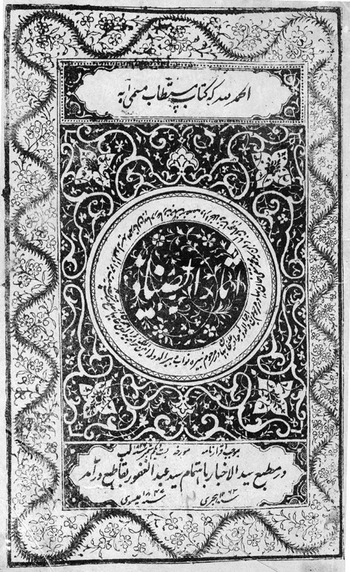
The second edition of Asar-al-Sanadid—henceforward ‘Asar-2’—came out in 1854.Footnote 62 How different a book it was, is evident from the title page. The cover of Asar-1 (Figure 1) is adorned with elaborate arabesque, and its language exclusively Persian.Footnote 63 The author's name, titles, and genealogy are laid out in full:
Jawwad-al-Daulah Sayyid Ahmad Khan Bahadur ‘Arif Jang, Munsif at the Dar-al-Khilafa Shahjahanabad, son of the late Sayyid Muhammad Muttaqi Khan Bahadur [who was the] son of the late Jawwad-al-Daulah Jawwad Ali Khan Bahadur, [and] grandson of Nawab Dabir-al-Daulah Amin-al-Mulk Khwaja Fariduddin Ahmad Khan Bahadur Muslih Jang.
Cover of Asar-1

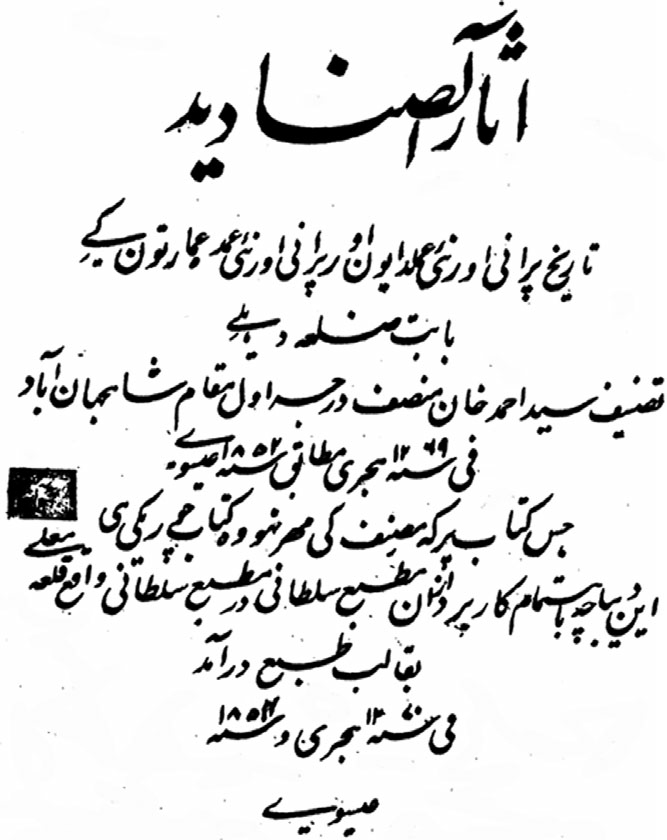
In contrast, the title page of Asar-2 is quite plain (Figure 2); there are no curlicues and arabesque.Footnote 64 The information offered by the author is in Urdu, and that added by the printer in Persian. And the author is listed simply as ‘Syed Ahmad Khan, Munsif, Darja-i-Awwal, at Shahjahanabad’.Footnote 65
Cover of Asar-2

Asar-2 further surprises by turning out to be a bilingual book; its back cover makes for a second title page in English, after which come a brief preface and a short essay, both also in English.Footnote 66 The full English title reads: Asar-oos-Sunnadeed, A History of Old and New Rules, or Governments, and of Old and New Buildings in the District of Delhi. The awkward, ‘Old and New Rules, or Governments’, is clearly a translation of the crisper Urdu: nai aur purani ‘amaldariyon.Footnote 67 Additionally, the English preface turns out to be a severely abbreviated version of the original Urdu preface, while the essay, entitled ‘A Brief Account of the Minaret which Stands at Kootub’, appears to be an English summary of the paper that Syed Ahmad reportedly read in January 1853 at a meeting of the Archaeological Society of Delhi.Footnote 68
Most significantly, neither title page makes a reference to Asar-1 of 1847; on the contrary, both strongly imply that the author composed the book in 1852. No doubt, the distinction between an edition and a printing was not then known in Urdu, as is still generally the case. But in this instance, I believe, Syed Ahmad, through both omission and commission, strongly wished to separate Asar-2 from Asar-1. That wish becomes more explicit in the prefaceFootnote 69 where, after acknowledging that there was an earlier book (pahli kitab), Syed Ahmad repeatedly asserts that what he was publishing in ‘this book’ was new and quite different from what was written in ‘that book.’
The title page of Asar-2 also states the book's nature, making it clear that it is a ‘history’ (tarikh), and not a mere ‘account’ (ahwal), as Asar-1 was stated to be in its preface, and it is a history of new and old governments or authorities (‘amaldari), as opposed to being a chronicle of kings. Furthermore, the spatial boundaries of that history are defined in the new administrative idiom, ‘the district of Delhi’ (zila’ dihli), and not as Shahjahanabad, ‘Dar-al-Khilafa,’ or just plain Dihli or Dilli. These changes alert us to a significant shift over five years in Syed Ahmad's perspective on political legitimacy and authority pertaining to Delhi.
By then, apparently, Syed Ahmad firmly believed that the entity ‘whose command prevailed’ was more important in life and historiography alike than any symbolic Emperor.Footnote 70 His list of Delhi's rulers in Asar-2 accommodates, from 1803 onward, British sovereigns alongside the Mughal kings. We find George III and William IV side by side with Akbar Shah II and Bahadur Shah II. More revealingly, in the chronological listing of the monuments of Delhi where he also mentions the reigning king of the time, Syed Ahmad excludes the Mughals after 1803. As a result, we not only have ‘Skinner's Church’ described as built during the reign of George IV, we also have Bahadur Shah's ‘Zafar Mahal’ dated to the reign of Queen Victoria.
Syed Ahmad begins the preface of Asar-2 by again quoting ‘Urfi's verse, then he praises God and the Prophet. The sentiments are heartfelt; they also manifest his new thinking. He praises God, not in the conventional manner of Asar-1—‘Praise be to the Creator, who with one word “Kun” [Be] created eighteen thousand worlds, and who will return them to oblivion after they put on thousands upon thousands of colourful displays'—but in a personal and specific manner:
Praise be to God, who blessed Man with such gifts as eyes and ears and intelligence and speech, so that Man could act after hearing all and seeing all, and after full consideration of the matter. And thus, enabled by God, Man discovers things that are totally amazing.
In his praise of the Prophet, Syed Ahmad includes a mention of the Prophet's descendents and companions—a more common and inclusive practice than the one he had followed in Asar-1, where he had mentioned the Prophet alone. Apparently, between 1846 and 1852—the period in which he is reported to have strenuously improved his knowledge of canonical texts—much had also changed in Syed Ahmad's thinking concerning issues of faith and knowledge.
Commencing the actual prefatory remarks, Syed Ahmad first gives his name, leaving out the titles he had received from Bahadur Shah, and the names of his father and two grandfathers, retaining the titles they had received from the Mughals. Then he declares that he had written ‘in 1263 AH/1846 AD, a book containing an account (hal) of the structures in the District of Delhi.’ He next mentions two Englishmen: Arthur Austin Roberts, Collector and Magistrate, who took ‘that book’ to England and presented it to the Royal Asiatic Society, ‘whose members liked it greatly,’ and Colonel Saxson, a member of the Court of Directors in London, who wished the book was available in English. ‘When [Mr. Roberts] returned from England’, Syed Ahmad continues,
he started translating it with this humble person's participation (shirkat).Footnote 71 It then occurred to me that it would be excellent if the book was composed anew in a much better manner, and if all the faults that had found their way in the first book (pahli kitab) were altogether removed. All praise to Allah, for He has fulfilled my wish; this book has been completed in the manner my heart had desired. It is better than the first book in many matters.
Syed Ahmad then lists the improvements as follows (and see Appendix 1):Footnote 72
1. Chapter One of this book was not in the earlier book. It contains a brief description of how India came to be populated, then describes briefly India's earlier and later governments (‘amaldari).
2. Chapter Two of the first book contained the description of the Fort at Shahjahanabad alone. The second chapter of this book contains not only a superior description of that fort, it describes also all the forts and cities that were built at this place from the earliest days of its settlement.
3. The contents of the first and third chapters of the earlier book have been combined to form the third chapter of this book. In fact, newly discovered information about certain buildings augments the contents.
4. The previous book had two shortcomings: firstly, [the author had not yet learned] the true history of some of the older buildings; and secondly, some of the notes and descriptions (bayan-i-halat) contained a few errors. These faults have now been corrected.
5. The descriptive accounts of buildings in the earlier book were discursive (mutafarriq) and disorganized; now they are carefully arranged according to the year of the building's construction.
6. The accounts in the first book were presented without indicating their sources. In the present book, most such statements carry on the margin the name of the book from which they are derived.
7. One excellent thing in the present book is that every existent inscription on an ancient building is reproduced here in its actual shape and style (asli qat’ aur asli khat).Footnote 73
Next, but in no particular order, Syed Ahmad lists his 39 source books, starting with the Old Testament and ending with the history by Abul-Fida. In between come such assorted texts as the Markandaya Purana, his own Silsilat-al-Muluk, Abul Fazl's A'in-i-Akbari, a book called Rajawali, and a book simply referred to as Jugrafia (Geography)—most likely the textbook of that name used at Delhi College. Also included are two English journals—Syed Ahmad calls them kitab (book)—the Journal of the Archaeological Society of Bengal, and the Journal of the Royal Asiatic Society of Great Britain and Ireland.
The preface concludes with Syed Ahmad thanking three British officials. The first two are the afore-mentioned Colonel Saxson and Mr Roberts, whose
appreciation and patronage of worthy people (qadr-dani aur ra'is-parwari) made it possible for the author to write a book that is a source of honour to him, a means for an obscure name to gain permanence.
The third name is of Edward Thomas, the well-known numismatist and historian, who was then the Sessions Judge at Delhi, ‘whose help (madad), support (i'anat), magnanimity (‘ali-himmati), and appreciation alone made possible the book's publication and the spread of its benefits far and wide.’Footnote 74
While the preface of Asar-2 indicates at length how Asar-2 was superior to Asar-1, it neglects to mention of those aspects or portions of the latter that were totally excised in Asar-2. The exclusions are both substantial and significant.
• In Asar-2 Syed Ahmad makes no claim that the book was the fulfillment of an old desire, or that its purpose was to edify the reader and make him aware of the final fate of the mighty in this world—something he had repeatedly dwelt upon in Asar-1.
• There is no mention now of Thomas Theophilus Metcalfe. In fact, Asar-2 is not dedicated to anyone. Syed Ahmad thanks certain people for their appreciation and kindness, but their patronage is not explicitly sought.
• No taqriz or paean is included in Asar-2; the book is to be judged on its own merit.
• Asar-2 contains no illustrations; its monuments and sites are now discrete moments in a chronological history that is composed with words alone. Nothing in the main text entertains the reader's eye or gives him respite from the author's pursuit of a chronology.Footnote 75 Even the inscriptions are removed to a separate appendix at the end.
• Asar-2 does not have the fourth chapter of Asar-1 that praised the virtues of Delhi's climate and the beauty of its people. In fact, the pages of Asar-2 are devoid of any mention of a person who could be said to define Delhi for the author as a city filled with humanity and creativity. Delhi of Asar-2 is not a habitat but only a site of antiquities.
• Most of the contemporary lore included in Asar-1 finds no place in Asar-2. Instead, emphasis is given to what is supported by ancient texts. For example, the detailed account of the Qutub Minar in Asar-2 is sufficiently evocative of its grandeur, but leaves out this amusing aside of Asar-1: ‘People have had the following experience several times. They climbed to the top of the tower, and then, when they returned to the ground they discovered that it had rained. Only then did they realize—God almighty!—the tower was higher than the clouds’.Footnote 76
And when a rare piece of local lore is included in Asar-2, Syed Ahmad seems to clean it up a bit. The dryly academic note on the Iron Pillar at the Qutub in Asar-2 ends with the following remark: ‘Young men try to encircle the pillar with their arms; in doing so they play a game in which the one who succeeds is considered a legitimate child of his parents, and he who fails is deemed illegitimate’.Footnote 77 In comparison, the note in Asar-1 includes this charming anecdote:
I was sitting near the pillar writing my notes when suddenly several young and beautiful women arrived, and tried to encircle the pillar [with their arms in that manner]. By chance, they all succeeded except the prettiest among them. Her companions started teasing her, so much so that she was about to burst into tears. Meanwhile I was quietly sketching and writing notes. God alone knows what the women thought of me, that I was a mullah perhaps, or a spell-caster, or perhaps an attendant at the [nearby] shrine. In any case, they turned to me and asked, ‘Miyanji, isn't it true that anyone whose arms fail to encircle the pillar must be of illegitimate birth?’ I laughed in my heart, and told myself, ‘Now here is a task fit for a Munsif.’ Then I said to the women, ‘What you say is true for those who are above the age of twenty. Tell me if you're that old, for only then can I say anything further.’ Since none was that old, they all burst into laughter and went away, and I returned to my own work.’ [As the poet says,] ‘When everyone sets out at dawn to do the mundane chores, those who are burdened with love trek to the beloved's door.’ Now look at the sketch, and think of God's glory.Footnote 78
Earlier in the same note in Asar-2, Syed Ahmad cuts his descriptive remarks in half, calls the legend about Rai Pithaura and his Brahmins totally erroneous (bilkul ghalat), and instead offers explanations that bristle with a new kind of scholarship. He approvingly quotes James Prinsep from the Journal of the Archaeological Society of Bengal, but then disagrees with a part of Prinsep's proposition on the basis of something in the Journal of the Royal Asiatic Society. He uses for authority A'in-i-Akbari and Rajawali, and confidently refers to his own Silsilat-al-Muluk. The joyous spirit of a participant observer evident in the above anecdote in Asar-1is gone in Asar-2, replaced by the dry-as-dust tones of a detached historian.
A great deal, obviously, had changed in the period between Asar-1 and Asar-2 both in Syed Ahmad's thinking and in his authorial ambitions as a historian. Three more comparisons of passages in Asar-1 and Asar-2 may help to identify some of those changes more precisely.
The two notes on ‘Lal Bangla’ (‘Red Bungalow’)
Asar-1:
Near [the tomb of Syed Abid] there is a structure called the Lal Bangla. [Figure 3] I couldn't find its story in any book of history, but what I heard from the Emperor (huzur-i-wala) is as follows. ‘In the time of Nasiruddin Muhammad Humayun Badshah, before he went to Iran, a tomb was built here for one of his wives. Then, during the time of Hazrat Firdaus Manzil, i.e. Shah Alam Badshah, [Shah Alam's] mother, Lal Kunwar, was buried here next to the earlier grave and under the smaller dome. Since then, this structure has been known as the Lal Bangla. Then, when his beloved daughter Begum Jan, who was betrothed to Mirza Makkhu, passed away, she too was buried here, under the other dome. And that is when the [surrounding] complex was also built.’ By that account, the complex is nearly seventy years old. Since then several other members of the Timurid family have been buried here. There are graves here of Mirza Sultan Pervez, Mirza Dara Bakht, the brother of the heir-apparent, Mirza Da'ud, Nawab Fatehabadi [Begum], Mirza Bulaqi, and some wives of the Emperor. The two fine structures are built of red sandstone. The two small, screened structures built in the courtyard are the graves of Nawab Fatehabadi [Begum] and Mirza Bulaqi; they were built in the present reign.Footnote 79
Asar-2:
Close to the Old Fort stands the tomb of Lal Kunwar, the mother of Shah Alam. He built it approximately in 1193 A.H., i.e. 1779 A.D. The smaller dome marks the grave of Lal Kunwar; the bigger dome covers the grave of Shah Alam's daughter, Begum Jan. The two domed structures and the [surrounding] colonnades are entirely made of red sandstone. Whether for that reason, or due to Lal Kunwar's grave here, this structure is known as the Lal Bangla. There are now in it other graves too; they belong to [members of] the Family of Timur. The two screened graves in the courtyard—one of Nawab Fatehabadi Begum, and the other of Mirza Bulaqi—are more recent, and were built by Emperor Bahadur Shah II.Footnote 80
Lal Bangla, near the tomb of Syed Abid

While the first note has a more colloquial tone, the second sounds quite brisk and businesslike. All the necessary information is neatly presented, what is left out is its royal source. The omission becomes the more significant when we note the trouble Syed Ahmad otherwise takes to indicate his sources in Asar-2.
Syed Ahmad's relations with Bahadur Shah were never the most even. Syed Ahmad's father, Syed Muttaqi, had been close to Bahadur Shah's father, Akbar Shah II, who wished to make another son his heir. Bahadur Shah inherited the throne in 1837 only because the British enforced their own rule of primogeniture. When, a year later, Syed Muttaqi died, whatever land he had received from Akbar Shah was not renewed in favour of his sons. However, in his very first book, Jam-i-Jam (1840), Syed Ahmad gives unusual details of Bahadur Shah's annual income, then adds that he was in the process of writing a history of the Emperor.Footnote 81 The details must have come from Hakim Ahsanullah Khan, who arranged such projects on the Emperor's behalf. The Hakim was a good friend of Syed Ahmad's family—he gets fulsome praise in the fourth chapter of Asar-1—and the projected book could have been a scheme between him and Syed Ahmad to generate some income for the family. As mentioned earlier, the Hakim was instrumental in 1842 in getting Syed Ahmad his grandfather's title.Footnote 82 The ceremony suggests that either the book was presented or substantial progress on it was brought to the Emperor's attention, but one finds no mention of such a book in any of Syed Ahmad's biographies.Footnote 83 Most likely it was not even started.
Syed Ahmad treats Bahadur Shah rather shabbily even in Asar-1. The Emperor is not mentioned in the preface—the conventional place; he gets a brief tribute, almost as an afterthought, only at the end of the chapter on the Red Fort.Footnote 84 Much worse, Syed Ahmad does not include the Emperor, whose poetic name (takhallus) was Zafar, among the notable poets of Delhi listed in Chapter Four. Heaping further insult, Syed Ahmad then places Shaikh Ibrahim Zauq—he was Zafar's mentor (ustad) in poetry—at the sixteenth place in his list of seventeen poets, putting a few lesser-known poets ahead of him. Was it Syed Ahmad's way of retaliating against the Emperor for some slight or betrayal? Was it an expression of his contempt for the people of the Fort in general, a view some of his senior friends also held?Footnote 85
Bahadur Shah, for his part, was by no means neglectful of history; he very much wanted to secure a place in it. Three years after the publication of Asar-1, Bahadur Shah commissioned Ghalib—through the same Hakim Ahsanullah Khan—to write a history of the Timurids in India, bestowing on Ghalib three titles and a salary of six hundred rupees per annum.Footnote 86 Ghalib, however, took five years to finish the first slim volume, entitled Mihr-i-Nimroz (‘The Midday Sun’), and had not started on the second volume when the uprising of 1857 ended it all.
The two notes on ‘Lal Diggi’ (‘Red Tank’)
Asar-1:
Underneath the Fort and facing the Khas Bazar, at the spot where the Gulabi Garden used to be in an earlier time, the felicitous British Government has constructed a font of benefit that puts to shame even the sun and the moon. This water tank is constructed entirely of red sandstone. At its four corners stand four extended terraces with guard-screens, and steps go down [to the water] on the two sides of its width. This font of benefit was built in compliance to the immutable command of Lord Ellenbrough Bahadur, the eminent Nawab whose feet use the heavens as their stirrups (nawab-i-‘ali-janab-i-falak-rikab), and cost close to fifty thousand rupees. In its length it is 500 feet, and in width 150 feet. The elegance and refinement of such a structure cannot be put in words and must be seen, but some [impression] might be gained by looking at the attached sketch.Footnote 87
Asar-2:
In the city of Shahjahanabad, below the Fort and facing the Khas Bazar, is this tank (hauz), built in 1263 Hijri, i.e. 1846 Isawi, as commanded by Lord Ellenbrough Bahadur. It is constructed entirely of red sandstone, and has, at its four corners, extended terraces with guard-screens. Steps go down [to the water] on the two sides of its width. The tank is 500 feet long and 150 feet wide, and always filled with water that comes from the canal. Since the construction of this tank several wells [in the neighbourhood] have turned sweet, thus providing much comfort to people.Footnote 88
The verbosity of the first note is replaced in the second with brevity; the latter is also precise in the matter of dates. Both changes are the rule throughout Asar-2. The second note is also noticeably short on complimentary expressions, even with reference to the British Governor General. These stylistic changes may reflect a desire on Syed Ahmad's part to put into practice what he was learning from the English texts he was getting acquainted with through translations; they may also reflect an enhanced sense of self-confidence and a consequent loss of the obsequiousness toward the British that he (and Sahba'i) showed in Asar-1.
The two notes on ‘Kalika’
In Asar-1, Syed Ahmad devotes three separate sections, consisting of six pages of text and two full-page drawings, to Kalika, an important Hindu religious site. Here is the main section in the first book.Footnote 89
Asar-1:
Mandir Kalika. This temple is situated six kos south of Shahjahanabad within the boundaries of the village Bahapur. It is a major place of worship for the Hindus. Though the beliefs of the Hindus are beyond human comprehension, I present here what I learned about the temple as understood in their religion. (He then gives a full account of the Devi legend.) Whoever comes here, first performs a full prostration and circumambulation then makes an offering of his choice. Subsequently, he receives the prasad from the temple. When I arrived to get a sketch done of the temple, the pandas gave me the prasad consisting of batasa, raisins, and almonds. I took it helplessly, fearing that otherwise they might not let me go inside to make a drawing. I also made an effort to please them. [As the Persian verse goes,] ‘I imitated him and became a kafir for a few days. I read the Zend texts and became a Brahmin.’ Earlier the place did not attract many worshippers, but now people place much faith in it. The priests tell them this tall tale that if anyone were to offer his hands, feet or tongue to the Devi she would return the same to him on the third day. Its priests have vowed to keep a lamp lit with ghee, day and night, for eternity. They call it the Devi's Flame (jot). Maharaj Sindhia had earlier given in mu'afi [i.e. tax free] the village of Bahapur to this temple. [When the village was later taken away] the temple received one hundred rupees annually. Now it gets nothing. The priests subsist on the offerings, and do some farming. . .. [Thousands of people come to its six-monthly fairs,] and suffer much hardship due to a shortage of water. There is only one well, and it takes a rope 95 arms-length long to reach the water which is only knee-high. Someone had built two tanks, but now they lie un-repaired and dry.Footnote 90
In Asar-2, the much-abbreviated account comes to only two pages.Footnote 91 The two temples are not discussed separately or at any length, but details are given of the actual ceremonies performed there.Footnote 92 In Asar-1, the date for the temple's construction was given as ‘Sammat 1821 Fasli’, just the way Syed Ahmad found it in an inscription on a guarding wall. In Asar-2, however, he gives the same date with a historian's flourish of scholarship: ‘Sammat 1821 Bikramajit, i.e. 1178 Hijri, i.e. 1764 Isawi’. The legend of the Devi is again narrated, but this time it comes with a reference on the margin to the Markandaya Purana. Every statement, however, is made in an objective manner; there are no snide remarks. All personal references are gone, as is any reference to what was contemporary at the temple—its loss of land grant in the new land settlement; the dry tanks; the lack of water in the well; the suffering of the pilgrims that went unheeded. These omissions do not indicate, in my view, some diffidence on Syed Ahmad's part vis-à-vis his British superiors; they more likely reflect a desire to be seen by them as an objective historian or antiquarian.
Conclusions
In my view, both Asar-1 and Asar-2 emerged out of the same objective context: the presence of foreigners in Delhi, and their increasing demand for historical information about the city. Some of the foreigners came as tourists and stayed only a few days, while others, for professional reasons, resided a few years. A great many of them took more than a casual interest in Delhi's antiquities; they sought histories to satisfy their curiosity, and mementoes that suited their taste. Most importantly, the foreigners had the funds to make the production of both items attractive to many natives of Delhi. Some of them also had the status and authority to command such productions, and offer incentives other than a monetary gain.
Asar-1, however, was not entirely a command performance. It was as much a labour of love as an attempt by its author to make some money, gain recognition as a historian, and be admitted to an inner circle of his superiors. Syed Ahmad may have had a confused notion of his expected audience, but in Asar-1 he clearly wished to present Delhi to his readers primarily on his own terms, a Delhi that was inseparable from his own lived experience. Syed Ahmad, in Asar-1, could not restrict Delhi to lifeless monuments; any narrative of Delhi, in his view at the time, had to include the people he cherished and considered integral to any definition of the city. That is why his Delhi includes not only Dihli and Shahjahanabad but also ‘Dilli,’ which was to him a place and a way to think of people, and to which he devoted a whole chapter. His wish to share with others something precious and personal also included an urge to edify, to make his readers draw some moral lesson. The personal nature of the book is reflected in its frequent chatty tone; the many asides and digressions reveal the man and his times in an unselfconscious manner that is often quite charming. The author's formidable command of ‘facts and figures’ does not scare us, for he is not loath to share with us a few fantasies too. We find his company comfortable, for much of the time he comes through like an ideal dilliwala: we can as confidently ask him about the builder of Jama’ Masjid as for the best place for kebabs near it.
Asar-2, on the other hand, has very much the feel of a command performance. Its abbreviated, dryly factual descriptions reflect the presumed preferences of its hoped-for English translators. Likewise, the governing principle of its organization is chronology, the same as in English books of history, whereas the organizing principle in Asar-1 was space. Chronology became a major issue when Syed Ahmad and Arthur Austin Roberts attempted to translate Asar-1. Roberts found it lax or deficient in that respect; as a result, Syed Ahmad had first to write a small book called Silsilat-al-Muluk (‘Chain of Kings’), which listed the names and dates of all the rulers of Delhi from ancient times to his day.Footnote 93Asar-2 is usually noted by Urdu scholars for what they regard as its plain, less formal language, but actually its prose is severely formal compared with the prose of Asar-1. The narrative flow in Asar-2 is rarely broken by an aside or digression; it relentlessly goes on in pursuit of historical facts, particularly those that could be referred back to old texts. The author of Asar-2 comes across as a somewhat stolid historian, who wishes to communicate only what he knows and not any sense of excitement and discovery.Footnote 94 On the other hand, the author of Asar-2 is never obsequious; in fact, he appears much more assured of himself than he was in Asar-1. The self-confidence does not come merely from having access to English books and journals, it also reflects the author's growing conviction, as expressed in the preface, that Man has a God-given ability to use all his faculties and thus ‘discover things that totally amaze’.Footnote 95
Syed Ahmad never disowned Asar-1; nor did he stop its reprints. Munshi Newal Kishore, for one, reprinted it in full in 1876, when Syed Ahmad was still very much active.Footnote 96 As for Asar-2, Hali informs us that it too failed to bring any monetary gain to Syed Ahmad, and most of its copies got destroyed in the rebellion of 1857. However, it brought Syed Ahmad the wider fame and recognition that he well deserved, and appears to have sought. Within a few years of its publication, Asar-2 reached the desk of Garcin de Tassy in Paris, who published a French translation in 1861.Footnote 97 Three years later, the Royal Asiatic Society of Great Britain and Ireland made Syed Ahmad an Honorary Fellow.Footnote 98 By then, however, he had practically abandoned both Delhi and History, and instead set himself well on the trajectory that led him to create a history of his own at Aligarh and elsewhere.Footnote 99
Appendix 1
The seven points, called ‘additions and ameliorations’, are presented in the English preface as follows:Footnote 100
1st The first chapter of this Edition is a new addition altogether (which the first Edition did not contain), and contains a brief History of the first population of all India—and particulars respecting the Capital or Seat of Empire, during the old and new reigns.
2nd The second chapter of the first Edition contained only an account of the Fort built by Shah Jehan. But the 2nd Edition contains, a full account of that fort, as well as of all the Fortresses erected ever since the City of Delhi was first populated.
3rd What the 1st and 3rd chapters of the 1st Edition contained—are to be found, in the 3rd chapter of the 2nd Edition, together with additional particulars respecting the old Buildings.
4th In the 1st Edition, there were 2 faults, viz. one was this—that particulars respecting some of the old Buildings were not then satisfactorily ascertained—and 2ndly some errors existed in their description. The necessary corrections &c: are however made in the 2nd Edition.
5th In the first Edition, the description of the Buildings was given promiscuously; but in the new or 2nd Edition, the dates of the Buildings are regularly given.
6th In the first Edition it was [not] inserted from where the particulars were obtained or gathered. But on the margin of the present Edition—the Historical Books are quoted.
7th This new Edition contains another thing of great moment, viz.—The Inscriptions found on the Buildings are copied and inserted in the Edition in their very original form.