INTRODUCTION
ATP diphosphohydrolase (EC 3.6.1.5), also known as apyrase, or nucleoside triphosphate diphosphohydrolase (NTPDase), has been characterized in plants, mammals, bacteria, fungi and parasites (Handa and Guidotti, Reference Handa and Guidotti1996; Vasconcelos et al. Reference Vasconcelos, Ferreira, Carvalho, Souza, Kettlun, Mancilla, Valenzuela and Verjovski-Almeida1996; Gendron et al. Reference Gendron, Benrezzak, Krugh, Kong, Weisman and Beaudoin2002). These ubiquitous enzymes share several common features, such as ability to hydrolyse di- and triphosphate nucleosides upon bivalent metal ion activation, and are members of the ATP diphosphohydrolase family, which includes proteins that are related in sequence, sharing 5 apyrase-conserved regions (ACRs) (Handa and Guidotti, Reference Handa and Guidotti1996; Vasconcelos et al. Reference Vasconcelos, Ferreira, Carvalho, Souza, Kettlun, Mancilla, Valenzuela and Verjovski-Almeida1996; Gendron et al. Reference Gendron, Benrezzak, Krugh, Kong, Weisman and Beaudoin2002). The mammalian NTPDase family is the most extensively studied and includes 6 membrane-bound enzymes – NTPDases 1–4, 7 and 8, and 2 soluble species, – NTPDases 5 and 6, all of them involved in several physiological processes that include modulation of signals mediated by cell-surface purinergic receptors (Gendron et al. Reference Gendron, Benrezzak, Krugh, Kong, Weisman and Beaudoin2002; Murphy-Piedmonte et al. Reference Murphy-Piedmonte, Crawford and Kirley2005).
ATP diphosphohydrolase activity has been characterized in parasites such as Toxoplasma gondii, Schistosoma mansoni, Leishmania (L.) amazonensis, Trichomonas vaginalis and Trypanosoma cruzi (Bermudes et al. Reference Bermudes, Peck, Afifi, Beckers and Joiner1994; Vasconcelos et al. Reference Vasconcelos, Ferreira, Carvalho, Souza, Kettlun, Mancilla, Valenzuela and Verjovski-Almeida1996; Coimbra et al. Reference Coimbra, Gonçalves Da Costa, Corte-Real, Freitas, Durão, Souza, Santos and Vasconcelos2002; Tasca et al. Reference Tasca, Bonan, De Carli and Sarkis2004; Fietto et al. Reference Fietto, Demarco, Nascimento, Castro, Carvalho, De Souza, Bahia, Alves and Verjovski-Almeida2004). The first description of this protein family is recent (Handa and Guidotti, Reference Handa and Guidotti1996; Vasconcelos et al. Reference Vasconcelos, Ferreira, Carvalho, Souza, Kettlun, Mancilla, Valenzuela and Verjovski-Almeida1996), and from pathogenic parasites, only T. gondii, T. cruzi and S. mansoni NTPDase-coding genes have been reported (Bermudes et al. Reference Bermudes, Peck, Afifi, Beckers and Joiner1994; Fietto et al. Reference Fietto, Demarco, Nascimento, Castro, Carvalho, De Souza, Bahia, Alves and Verjovski-Almeida2004; Levano-Garcia et al. Reference Levano-Garcia, Mortara, Verjovski-Almeida and DeMarco2007). Analyses of the National Center for Biotechnology Information (NCBI) databases using known sequences of NTPDases revealed homologue putative proteins in the genomes of the S. japonicum, Plasmodium falciparum, L. major, L. infantum and L. braziliensis parasites. In parasites, the ATP diphosphohydrolase activity is associated with the purine recuperation and/or to their protective mechanism towards the host organism, which involves ATP or ADP, such as platelet activation cytotoxicity and cytolytic T-lymphocyte reactivity (Bermudes et al. Reference Bermudes, Peck, Afifi, Beckers and Joiner1994; Vasconcelos et al. Reference Vasconcelos, Ferreira, Carvalho, Souza, Kettlun, Mancilla, Valenzuela and Verjovski-Almeida1996; Coimbra et al. Reference Coimbra, Gonçalves Da Costa, Corte-Real, Freitas, Durão, Souza, Santos and Vasconcelos2002; Tasca et al. Reference Tasca, Bonan, De Carli and Sarkis2004; Fietto et al. Reference Fietto, Demarco, Nascimento, Castro, Carvalho, De Souza, Bahia, Alves and Verjovski-Almeida2004).
Potato apyrase was one of the first proteins of the ATP diphosphohydrolase family to be purified (Traverso-Cori et al. Reference Traverso-Cori, Chaimovich and Cori1965), and their isoforms are obtained using conventional methods, at a high grade of purity, assuring significance and reproducibility in pharmacological and immunological assays (Kettlun et al. Reference Kettlun, Urra, Leyton, Valenzuela, Mancilla and Traverso-Cori1992; Vasconcelos et al. Reference Vasconcelos, Ferreira, Carvalho, Souza, Kettlun, Mancilla, Valenzuela and Verjovski-Almeida1996; Faria-Pinto et al. Reference Faria-Pinto, Meirelles, Lenzi, Mota, Penido, Coelho and Vasconcelos2004; Penido et al. Reference Penido, Resende, Vianello, Bordin, Jacinto, Dias, Montesano, Nelson, Coelho and Vasconcelos2007). Studies in our laboratory showed that rabbit polyclonal antibodies against different potato apyrase isoforms have strong cross-immunoreactivity with native ATP diphosphohydrolase isoforms isolated from either S. mansoni egg and worm (Vasconcelos et al. Reference Vasconcelos, Ferreira, Carvalho, Souza, Kettlun, Mancilla, Valenzuela and Verjovski-Almeida1996; Faria-Pinto et al. Reference Faria-Pinto, Meirelles, Lenzi, Mota, Penido, Coelho and Vasconcelos2004), or L. (L.) amazonensis (Coimbra et al. Reference Coimbra, Gonçalves Da Costa, Costa, Giarola, Soares, Fessel, Ferreira, Souza, Abreu-Silva and Vasconcelos2008) and L. (V.) braziliensis (unpublished data) promastigotes, suggesting that these proteins share epitopes. These data were confirmed by immunoprecipitation assays, since antibodies against different potato apyrase isoforms, isolated from distinct varieties of the Solanum tuberosum, immobilized on Sepharose-Protein A depleted the ATPase and ADPase activities from these detergent-solubilized samples (Vasconcelos et al. Reference Vasconcelos, Ferreira, Carvalho, Souza, Kettlun, Mancilla, Valenzuela and Verjovski-Almeida1996; Coimbra et al. Reference Coimbra, Gonçalves Da Costa, Costa, Giarola, Soares, Fessel, Ferreira, Souza, Abreu-Silva and Vasconcelos2008). Furthermore, sera from experimentally S. mansoni or L. (L.) amazonensis infected-mice show cross-immunoreactivity with potato apyrase, suggesting the presence of conserved epitopes and the antigenicity of the parasite isoforms (Faria-Pinto et al. Reference Faria-Pinto, Meirelles, Lenzi, Mota, Penido, Coelho and Vasconcelos2004; Coimbra et al. Reference Coimbra, Gonçalves Da Costa, Costa, Giarola, Soares, Fessel, Ferreira, Souza, Abreu-Silva and Vasconcelos2008).
Due to the previous evidence of cross-immunoreactivity, in this study we performed an analysis of the structural relationship between these enzymes, the putative 3-dimensional structures of soluble potato apyrase, S. mansoni SmATPDase 2 and Leishmania braziliensis NDPase using molecular modelling, putative epitope availability, and their evolutionary relations to other NTPDase family members. Moreover, we analysed the antibody reactivity against the conserved domains using potato apyrase or parasite preparations as antigen, and sera obtained from patients with American cutaneous leishmaniasis, schistosomiasis or Chagas disease.
MATERIALS AND METHODS
In silico analyses, molecular model construction and epitope prediction
Comparison of the S. tuberosum, S. mansoni and Leishmania apyrases in the Swiss-Prot database was carried out using the Fasta3. Sequence alignments were produced with T-Coffee (Notredame et al. Reference Notredame, Higgins and Heringa2000), and manipulated and hand-edited with Jalview (http://www.ebi.ac.uk/Vmichele/jalview/). Jalview was also used to determine the 4 maximally diverse representatives of each family. This alignment was utilized to produce a phylogenetic tree, which was evaluated by Tree view program. The best templates for potato apyrase and SmATPDase 2 or L. braziliensis NDPase model construction were determined by threading methods, using Bio-info meta server (http://bioinfo.pl/meta/), as the structures of (PDB file 1T6C), determined by X-ray diffraction that shared around 52% and 37% identity, respectively, in an un-gapped alignment with potato apyrase. Using this template, the models were constructed using Modeller 8.0 (Sali and Blundell, Reference Sali and Blundell1993; Sanchez and Sali, Reference Sanchez and Sali1997). Prosa II (Sippl, Reference Sippl1993) and Swiss-PdbViewer program (Guex and Peitsch, Reference Guex and Peitsch1997) were used to choose the model showing the most favourable packing and solvent exposure characteristics. Procheck (Laskowski et al. Reference Laskowski, MacArthur, Moss and Thornton1993) was used for additional analysis of stereochemical quality. Low prosa II scores and high procheck g factors characterize high-quality models.
The B cell epitopes from linear amino acid sequences of the potato apyrase, and from L. braziliensis NDPase, S. mansoni SmATPDase 2 or T. cruzi NTPDase 1 were analysed using ABCpred (www.imtech.res.in/raghava/abcpred/ABCmethod.html). The predicted B cell epitopes are ranked according to their score (Saha and Raghava, Reference Saha and Raghava2006), and in this work only the peptides with score >0·8 were considered with high probability to be epitopes. These amino acid sequences were also scanned using an appropriate algorithm (www.imtech.res.in/raghava/propred/definations.html) that can predict, after scanning all 9-mer windows starting with a hydrophobic residue on a protein sequence, those that have the potential ability to bind with high affinity one or more (promiscuous sequences) out of 51 different HLA-DR molecules (Singh and Raghava, Reference Singh and Raghava2001).
Patients
Sera were selected from patients collected from endemic areas. Patients with American cutaneous leishmaniasis (ACL; n=21) were diagnosed by positive parasitological examination and Montenegro skin test, and polymerase chain reaction, using as standard the DNA obtained from Leishmania (V.) braziliensis promastigote forms, strains MHOM/BR/1975/M2903, as previously described (Marques et al. Reference Marques, Volpini, Genaro, Mayrink and Romanha2001). Patients confirmed with schistosomiasis (n=31) were diagnosed by 3 stool samples examined for S. mansoni eggs according to the Kato-Katz method. Patients with indeterminate or cardiac clinical forms of Chagas disease (n=30) were diagnosed by indirect immunofluorescence, ELISA and indirect haemagglutination assays for Trypanosoma cruzi (Gomes et al. Reference Gomes, Bahia-Oliveira, Rocha, Busek, Teixeira, Silva and Correa-Oliveira2005). As a control, 10 selected sera from healthy individuals from non-endemic areas for these diseases, and without any other parasitic disease, were also tested. The study protocols complied with the regulations of the Brazilian National Council of Research in Humans and were approved by the Ethical Committee for Human Research of Centro de Pesquisas Rene Rachou (CPqRR), Belo Horizonte, Minas Gerais, Brazil, under protocols CEPSH/CPqRR 06/2001 and 04/2005, for Chagas disease and schistosomiasis, respectively. For leishmaniasis, the project was approved by the Ethical Committee for Human Research of the Universidade Federal de Alfenas, Alfenas, MG, Brazil, under process no. 141/2006.
Antibody analyses by enzyme-linked immunosorbent assays (ELISA)
Potato apyrase was purified from a commercial strain of Solanum tuberosum, and used as coating antigen by ELISA as previously described (Kettlun et al. Reference Kettlun, Urra, Leyton, Valenzuela, Mancilla and Traverso-Cori1992; Faria-Pinto et al. Reference Faria-Pinto, Meirelles, Lenzi, Mota, Penido, Coelho and Vasconcelos2004). Potato apyrase (0·5 μg/well in 0·1 m NaHCO3, pH 9·6) was absorbed overnight onto flat-bottomed Immunolon microtitre plates. Following a blocking step (0·3% Tween-20, 5% nonfat dry milk, 0·15 m phosphate buffer solution, pH 7·2), sera diluted 1:200 from healthy individuals or from patients with schistosomiasis mansoni (n=31), American cutaneous leishmaniasis (n=21), and Chagas disease (n=30) were tested in duplicate, in 3 different experiments. Leishmania (V.) braziliensis promastigotes (MHOM/BR/1975/M2903 strain) homogenized (Pedras et al. Reference Pedras, Orsini, Castro, Passos and Rabello2003), soluble egg antigen (SEA) or worm adult (SWAP) antigen from S. mansoni (Makarova et al. Reference Makarova, Goes, Marcatto, Leite and Goes2003) and epimastigote-derived antigens from Y strain T. cruzi (Gomes et al. Reference Gomes, Bahia-Oliveira, Rocha, Busek, Teixeira, Silva and Correa-Oliveira2005) were used as positive references, under the same experimental conditions. Antibodies bound to the antigen-plate were detected using peroxidase-conjugated antibodies to anti-IgG and anti-IgM human specific immunoglobulin (Sigma; St Louis, MO; PharMingen, San Diego, CA, USA), and OPD/H2O2 as substrate. The subsequent colour reaction was read at 492 nm on a microplate reader (Molecular Devices Corp., Menlo Park, CA, USA).
Statistical analyses
For comparative analysis of antibody reactivities, ELISA units were calculated as the mean of optical density (OD; 492 nm) values of each duplicate serum sample from each patient divided by the mean of the optical density of sera from healthy individuals (n=10) plus 2 standard deviations [OD of each sample/(XOD control+2 s.d.)]. The mean of the OD of serum samples from these selected healthy individuals plus 2 standard deviations correspond to an ELISA unit value of 1. Therefore, values greater than this cut-off level were considered to be seropositive. GraphPad Prism Software (version 4) was used for statistical analysis. The median and the 95% confidence interval of the ELISA units were calculated, and the data were analysed using the Mann-Whitney test to compare 2 groups, or Kruskal-Wallis test to compare 3 groups. P values <0·05 were considered significant.
RESULTS
In silico analyses
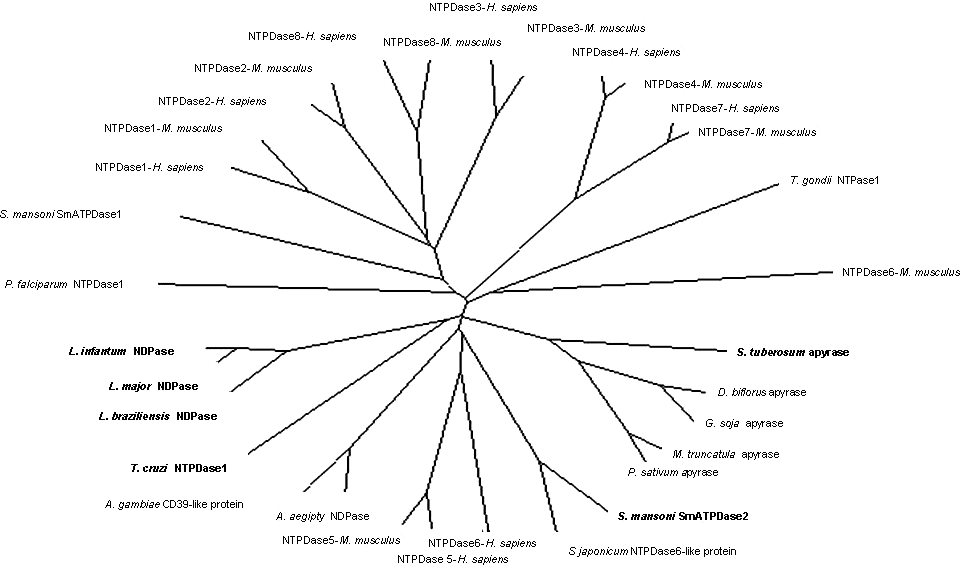
The alignment of 32 members of the ATP diphosphohydrolase family was performed, and included mammalian, helminth and protozoan parasites, mosquitoes and plant proteins, found in the National Center for Biotechnology Information (NCBI) database. Phylogenetic analysis (Fig. 1) shows 2 main branches, indicating 2 different evolutionary pathways. The first is clearly composed of membrane-associated human NTPDases 1–4, 7–8, mouse NTPDases 1–4 and 6–8, S. mansoni SmATPDase 1, P. falciparum NTPDase 1 and T. gondii NTPase 1. The second is composed of human and mouse NTPDases 5 and human NTPDase 6, plant apyrases, S. mansoni SmATPDase 2, S. japonicum NTPDase6-like protein and Leishmania NDPases, showing a closer structural relation between them. The proteins with higher homology with potato apyrase were the Leishmania NDPases (30–33% identity and 45–46% similarity over 401 to 408 amino acids), followed by S. mansoni SmATPDase 2 (28% identity and 43% similarity over 433 amino acids). Lower identity was found for T. cruzi NTPDase 1 (27% identity and 43% similarity over 430 amino acids).
Phylogenetic tree of several ATP diphosphohydrolases from different organisms. This tree was constructed using T-Coffee, excluding positions with gaps. GeneBank Accession numbers of the sequences are: Solanum tuberosum apyrase, P80595; Dolichos biflorus apyrase, AF156781; Glycine soja apyrase, AAG32959; Medicago truncatula apyrase, AAO23007; Pisum sativum apyrase, BAB85978; Schistosoma mansoni SmATPDase2, DQ868522; Schistosoma japonicum NTPDase6-like protein, AAW26231; NTPDase6-Homo sapiens, AAP92131; NTPDase5-Homo sapiens, NP_001240; NTPDase5-Mus musculus; NP_001021385; Aedes aegipty NDPase, EAT42846; Anopheles gambiae CD39-like protein, XP_320057; Trypanosoma cruzi NTPDase1, AAS75599; Leishmania braziliensis NDPase, CAM42020; Leishmania major NDPase, CAJ03227; Leishmania infantum NDPase, CAM66723; Plasmodium falciparum NTPDase1, XP_00138471; Schistosoma mansoni SmATPDase1, AAP94734; NTPDase1-Homo sapiens, NP_001767; NTPDase1-Mus musculus, AAAH11278; NTPDase2-Homo sapiens, NP_982293; NTPDase2-Mus musculus, O55026; NTPDase8-Homo sapiens, AAR04374; NTPDase8-Mus musculus, NP_082369; NTPDase3-Homo sapiens, NP_001239; NTPDase3-Mus musculus, NP_848791; NTPDase4-Homo sapiens, NP_004892; NTPDase4-Mus musculus, NP_080450; NTPDase7-Homo sapiens, NP_065087; NTPDase7-Mus musculus, NP_444333; Toxoplasma gondii NTPase1, Q27893; NTPDase6-Mus musculus; NP_742115.

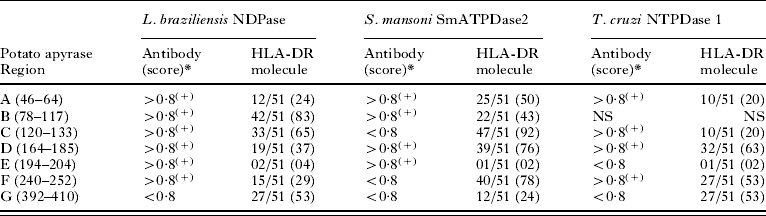
The highest identity between potato apyrase and Leishmanias NDPases (50–82·4%) or SmATPDase 2 (41–70%) were found in the A, B, C, D, E, F and G regions (Table 1), that are shown in grey columns in Fig. 2. The Regions A, C, D and E include the characteristic conserved domains of the ATP diphosphohydrolase family, the ACR1, ACR2, ACR3 and ACR4, respectively (Fig. 2). No significant immunological identity was observed in the linear amino acid sequence of the region corresponding to ACR5 (Fig. 2). Peptides found in both Regions A and D from L. braziliensis NDPase, S. mansoni SmATPDase 2 and T. cruzi NTPDase 1 show a high score (>0·8) for antibody binding (Fig. 2 and Table 1). In Region C, only L. braziliensis and T. cruzi proteins have peptides with high score (>0·8) for reactivity by antibodies. Analysis of Region E suggests that it may be a domain containing epitopes in L. braziliensis NDPase or S. mansoni SmATPDase 2 (Fig. 2 and Table 1). In addition, with the exception of Region E, that includes the ACR 4, all the others were predicted as promiscuous, since they have nanomeric peptides predicted to bind 10 (20%) to 47 (92%) of 51 different human leukocyte antigen (HLA)-DR alleles used in this matrix-based algorithm and, therefore, theoretically have a high probability to induce a T cell immune response (Fig. 2 and Table 1).
Primary structure alignment of potato, parasites and mammalian ATP diphosphohydrolases. All conserved regions (A–G) of the amino acid sequences are indicated by dark lines, and the conserved regions from apyrase family (ACRs) by vertical boxes. The identical amino acid residues to potato apyrase are shown as grey columns. The initial hydrophobic amino acid residue of a nanomeric peptide that has potential ability to bind HLA-DR molecules is shown in black and the other amino acid residues of each are in bold. The peptides that bind antibody with high score are in horizontal boxes. Grey cylinders correspond to α-helices and arrows to β-sheets. Horizontal lines indicate where portions of the sequence were omitted in this figure. GeneBank Accession numbers of the amino acid sequences are indicated in Fig. 1, plus Leishmania braziliensis GDPase, CAM37219; L. major GDPase, Q4HK3 and L. infantum GDPase, CAM66031.

Theoretical prediction of peptides that are either antibody epitopes or are capable of binding HLA-DR alleles, within the parasite NTPDase domains shared with potato apyrase
(The number of HLA-DR molecules that bind nanomeric peptide from the parasite protein is relative to the 51 alleles analysed, and the percentage is shown in parentheses.)

* Peptides with score >0·8(+) within the domain have higher probability as epitopes.
NS, no significant identity with potato apyrase.
The Region F, but not G, in L. braziliensis NDPase and T. cruzi NTPDase 1 has high score as potential antibody-binding region (>0·8; Fig. 2 and Table 1). These regions did not bind antibodies in SmATPDase 2 according to prediction (Fig. 2 and Table 1). For all the parasite proteins, Regions F and G have promiscuous peptides capable to bind HLA-DR molecules (Fig. 2 and Table 1). Regions F and G are not characteristics of the ATP diphosphohydrolase family and also share identity with soluble NTPDases 5 and 6, and/or human membrane associated NTPDase 1 (Fig. 2).
On the other hand, Region B from L. braziliensis NDPase (50% identity and 57% similarity over 38 amino acids) or SmATPDase 2 (48% identity and 67% similarity over 37 amino acids) shows high identity with potato apyrase in the absence of gaps (Fig. 2). Furthermore, it has a high score to bind antibodies (>0·8) and several promiscuous peptides capable of binding to HLA-DR molecules used in this matrix-based algorithm (Fig. 2 and Table 1). This Region B from potato apyrase is also shared with S. japonicum, L. infantum or L. major putative NDPases (Fig. 2), and with other plant apyrase isoforms found in GeneBank (data not shown). Interestingly, it shows lower identity with either soluble NTPDases 5 and 6 (32–40%) or membrane-associated NTPDase 1 (20%) counterparts, and no significant similarity was found with T. cruzi NTPDase1, suggesting that this particular amino acid sequence is shared between the plant apyrases and those of Leishmania and Schistosoma isoforms.
The modelled structures of isolated either potato apyrase in different angles (Fig. S1A and Fig. S2A), L. braziliensis NDPase (Fig. S1B) or S. mansoni SmATPDase 2 (Fig. S2B), and in junction (Fig. S1C and Fig. S2C) are shown in the supplementary figures in the Online version only. The models consist of a mixed 5-stranded-sheet with the second strand in an anti-parallel position to the rest. The connections between strand 1 and 4 and between strand 4 and 5 contain helical segments, all on the same side of the sheet. The connections are significantly longer in the C-terminal domain than in the N-terminal domain. Accordingly, 5 R-helices are present in the C-terminal domain and only 2 in the N-terminal domain (Fig. S1A or Fig. S2A, Fig. S1B and Fig. S2B, Online only).
It is interesting to note the high level of homology that exists between the predicted 3-dimensional structures of potato apyrase and either L. braziliensis NDPase or SmATPDase 2, and the coincident localization of the regions shown in Fig. 2. As observed in the models, these regions are exposed and possibly able to bind antibodies (Fig. S1A or Fig. S2A, Fig. S1B and Fig. S2B, Online only). For better clarification of the structural relationship between these proteins, the ACR regions in both L. braziliensis NDPase (Fig. S1B, Online only) and SmATPDase 2 (Fig. S2B, Online only) were marked in red, and white arrows were added to indicate specific antigenic loops to both models. Furthermore, the 3 other regions indicated in this paper, B, F and G (Fig. 2 and Table 1), were detached by other colour tonalities in potato apyrase (blue, Fig. S1A and Fig. S2A, Online only), L. braziliensis NDPase (brown; Fig. S1B, Online only) or SmATPDase 2 (green; Fig. S2B, Online only), and were adequately denominated. Therefore, antigenic loops are shown as conserved functional regions, suggesting a clear association between structure and antigenicity.
Antibody levels against potato apyrase
IgG and IgM antibody levels were quantified in diluted serum samples 1:200 from patients with American cutaneous leishmaniasis (ACL), schistosomiasis or Chagas diseases, using potato apyrase as coating antigen in ELISA. The IgG antibody level against potato apyrase in serum samples from ACL (O.D.=0·227±0·082; P<0·001) and schistosomiasis (O.D.=0·161±0·086; P<0·05) patients, but not from Chagas disease patients (O.D.=0·126±0·038), was significantly higher than that found in healthy individuals (O.D.=0·094±0·020; control). The IgM antibody level against potato apyrase was similar between infected patient and healthy individual groups (control). IgG and IgM antibody levels of these serum samples diluted 1:200 were also evaluated against either the L. (V.) braziliensis promastigote preparation (Lb), derived antigens from T. cruzi epimastigote (Epi) or soluble egg (SEA) and adult worm (SWAP) antigens obtained from S. mansoni. In ACL patients, no significant difference was observed when their IgM or IgG antibody levels against Lb were compared to the respective control (healthy individuals). In schistosomiasis patients, the IgG or IgM antibody levels against SEA and SWAP showed values significantly higher (P<0·001) than those found in controls. In serum samples from Chagas disease patients, IgG, but not IgM antibody, against the T. cruzi epimastigote preparation showed a value significantly (P<0·001) higher than that found in controls (data not shown).
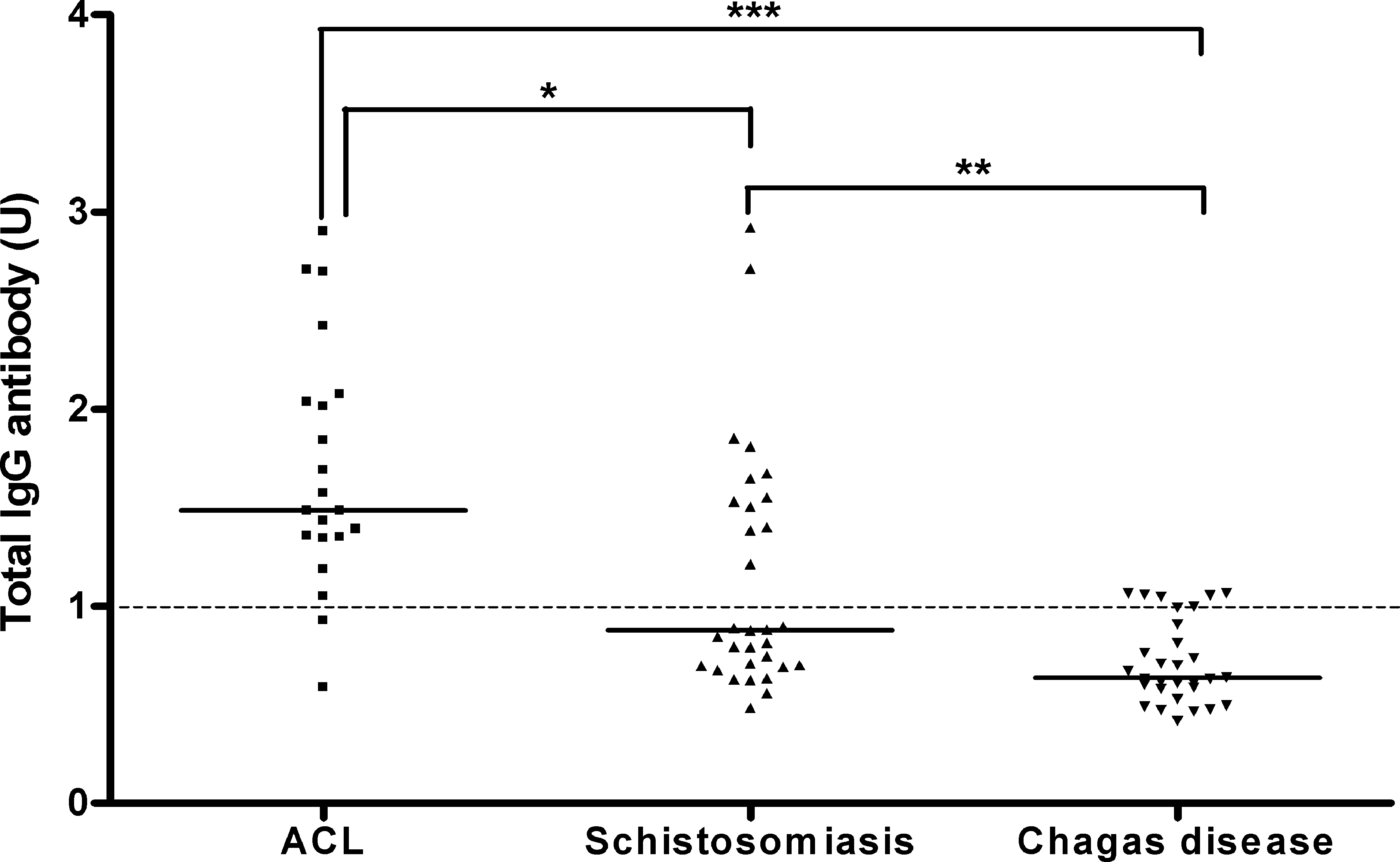
The results were then calculated as ELISA units. Medians, maximum and minimum values are shown in Figs 3 and 4. Significantly higher IgG antibody reactivity was found in sera from ACL patients (median 1·485), when compared to those from either schistosomiasis (median 0·879; P<0·05) or Chagas disease (median 0·637; P<0·001) patient groups. Sera from Chagas disease patients had low IgG antibody reactivity against potato apyrase, significantly (P<0·01) lower than that found in schistosomiasis patients (Fig. 3).
Serum IgG antibody reactivity against potato apyrase in ACL, schistosomiasis and Chagas disease patient groups. The IgG antibody reactivity was determined by ELISA, using potato apyrase as coating antigen and serum diluted 1:200. Antibody levels are expressed as ELISA units (U). The horizontal line represents the cutoff value. The statistical significance of group differences was determined using Kruskal-Wallis test. P values are <0·05*, <0·01** and <0·001***.

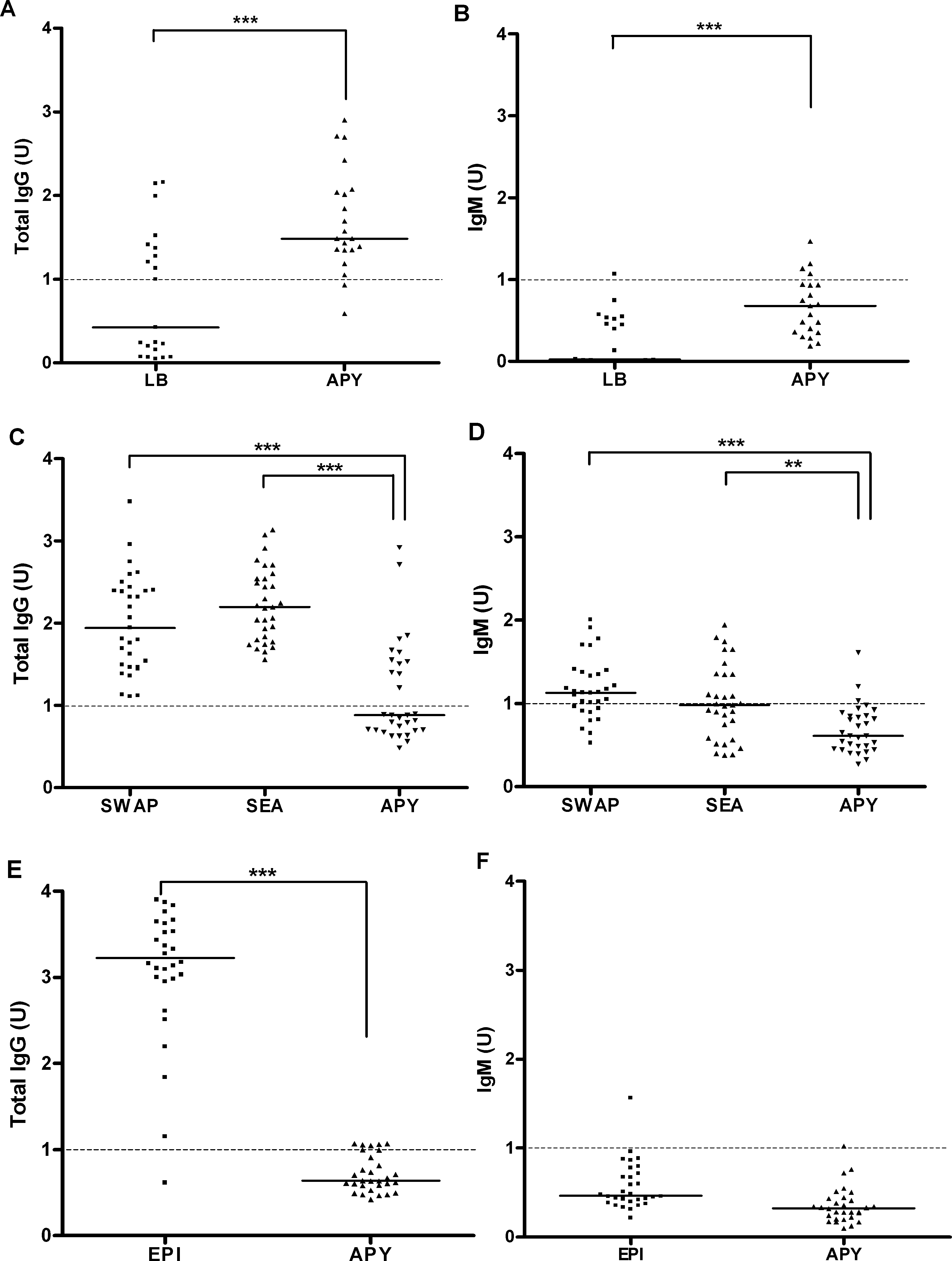
IgG and IgM antibody reactivities against potato apyrase found in serum diluted 1:200 from ACL patients were compared to that against the L. (V.) braziliensis promastigote preparation (Fig. 4 A and B). It was observed that the IgG reactivity against the potato apyrase (median 1·485) was significantly (P<0·001) higher than that observed for the parasite preparation (A, median 0·424). Curiously, the seropositivity analyses showed that 43% (n=9) and 90% (n=19) of the 21 ACL patients were reactive with the parasite preparation or potato apyrase respectively, suggesting that this shared epitope is highly effective in ACL patients (Fig. 4 A). On the other hand, IgM antibody reactivity was low with either the parasite preparation (median 0·020) or potato apyrase (B, median 0·678). Antibodies from only 1 (5%) patient reacted with the parasite preparation, while antibodies from 4 (19%) individuals reacted with potato apyrase (Fig. 4 B).
Comparative IgG or IgM antibody reactivity against different antigens. The IgG (A, C, E) or IgM (B, D, F) antibody reactivity was determined by ELISA, using potato apyrase (APY) as coating antigen and serum samples (diluted 1:200) from American cutaneous leishmaniasis (A, B), schistosomiasis (C, D) or Chagas disease (E, F) patients. The IgG or IgM antibody reactivity of serum samples was also determined using as coating the antigenic preparations of Leishmania (V.) braziliensis promastigote (LB), soluble adult worm (SWAP), egg (SEA) or Trypanosoma cruzi epimastigote (EPI). Antibody levels are expressed as ELISA units (U). The horizontal line represents the cut-off value. The statistical significance of group differences was determined using Mann-Whitney or Kruskal-Wallis test. P values are <0·01** and <0·001***.

Soluble egg (SEA) and adult worm (SWAP) antigens obtained from S. mansoni were also used for comparative analyses of the IgG and IgM antibody reactivities from patients with schistosomiasis (Fig. 4 C and D). The sera diluted 1:200 from schistosomiasis patients showed a high and similar IgG antibody reactivity against both SWAP (median 1·942) and SEA (median 2·197), with 100% seropositivity for both preparations and was significantly higher (P<0·001) than that observed when potato apyrase was used as antigen (Fig. 4 C; median 0·879). In schistosomiasis, the IgG antibody reactivity against potato apyrase was observed in 39% (12/31) of the patients (Fig. 4 C). The IgM antibody reactivity against either SWAP (median 1·126; 68% seropositivity) or SEA (median 0·979; 42% seropositivity) showed similar results, and was significantly higher than that observed against potato apyrase (Fig. 4 D; median 0·610). In schistosomiasis, 10% (3/31) of the patients showed IgM antibody reactivity against potato apyrase (Fig. 4 D).
In addition, the IgG and IgM antibody reactivities against T. cruzi epimastigote derived antigens and potato apyrase were also evaluated (Fig. 4 E and F). The IgG seropositivity analyses showed that 97% (n=29) of the 30 Chagas disease patients were strongly reactive with the parasite preparation (median 3·224), while only 17% (n=5) of them showed a low and positive reactivity with potato apyrase, slightly above the threshold of 1 (Fig. 4 E; median 0·637). IgM antibody reactivity was low with either the parasite preparation (median 0·465) or potato apyrase (Fig. 4 F; median 0·323), and antibodies from only 1 (3%) patient reacted to these antigens (Fig. 4 F).
DISCUSSION
By evaluation of the cross-immunoreactivity with potato apyrase, we showed the possible occurrence of conserved domains as functional regions in parasite ATP diphosphohydrolases and the associated antigenicity of these proteins in human parasitic diseases. Two groups of ATP diphosphohydrolase isoforms were identified by phylogenetic analysis, which showed independent branches indicating 2 main different evolutionary pathways, possibly due to ancient divergence. Our results reveal that there is a closer relationship between potato apyrase, L. braziliensis NDPase and S. mansoni SmATPDase 2 in the primary amino acid sequences, which show particular regions of high identity among them. Putative 3-dimensional models generated by us suggest that these regions may be exposed and available for antibody binding. In addition, prediction of MHC Class-II binding peptides in L. braziliensis NDPase and S. mansoni SmATPDase 2 showed regions, also shared with potato apyrase, with a high probability of eliciting a regulatory T cell immune response. Recently, we observed that potato apyrase stimulates in vitro the production of significant amounts of Th1 and Th2 cytokines by immune cells of S. mansoni-infected mice, suggesting that this hypothesis could be explored in humans (unpublished data). Hosts and parasites have co-evolved over thousands of years, and in mammals these parasites live for years using a wide range of mechanisms to evade and manipulate the host's immune response (Requena et al. Reference Requena, Alonso and Soto2000; Dunne and Cooke, Reference Dunne and Cooke2005). It is possible that specific ATP diphosphohydrolase regions were conserved between the different parasite species so far studied, and possibly in others. It may be related to the success of the parasitism, through host molecular mimicry and/or disease immunomodulation.
Our results suggest that these structural homologies occur, since ATP diphosphohydrolase epitopes of the parasite, shared with potato apyrase, are promptly recognized by IgGs from patients with different diseases, as observed in the ELISAs where this vegetable protein was utilized as antigen. Higher reactivity was found in the ACL patient group, followed by antibodies from individuals with schistosomiasis. These results concur with the sequence alignments, which showed higher identity between potato apyrase and L. braziliensis NDPase. Region B from these parasites is of particular interest, since it has lower homology with mammalian proteins and could be responsible for the antibody reactivity described here. In previous work we demonstrated by immunocytochemistry and confocal microscopy that rabbit polyclonal antibodies to potato apyrase recognize ATP diphosphohydrolase isoforms from S. mansoni egg, but not the mammalian NTPDases, suggesting the presence of unique motifs shared between the parasite and the vegetable protein, and that autoantibodies are not induced by potato apyrase immunization (Faria-Pinto et al. Reference Faria-Pinto, Meirelles, Lenzi, Mota, Penido, Coelho and Vasconcelos2006).
Regions A, C, D and E, which include the characteristic conserved domains of the ATP diphosphohydrolase family (Handa and Guidotti, Reference Handa and Guidotti1996; Vasconcelos et al. Reference Vasconcelos, Ferreira, Carvalho, Souza, Kettlun, Mancilla, Valenzuela and Verjovski-Almeida1996) are potentially able to bind antibodies and/or HLA-DR molecules, which could induce an autoimmune response or elicit a regulatory T cell response. These regions, as well as Regions F and G, have high homology with human NTPDases. It is possible that self epitopes contained in these domains are unable to induce immune responses. On the other hand, it is interesting to note that 5 patients with Chagas disease have IgG seropositivity for potato apyrase. The Region B of the potato apyrase, shared with L. (V.) braziliensis NDPase or S. mansoni SmATPDase 2, did not have significant identity with T. cruzi NTPDase. Since the antibody epitopes and HLA-DR predictions show regions in T. cruzi NTPDase shared with potato apyrase, potentially capable of inducing humoral and cellular immune responses, we believe that this low immune response should not be neglected. We believe that further investigations of larger populations will allow us to determine whether HLA type is correlated with the reactivity to apyrase and the development of the parasitic diseases here discussed. The highly distinct humoral immune response profiles of IgG antibodies from patients with ACL, schistosomiasis or Chagas disease, associated with parasite life-cycles, suggest also that these antigens are processed and presented to effector cells from the host immune system by different pathways. Since T. cruzi and Leishmania have antigens associated with autoimmune responses (Requena et al. Reference Requena, Alonso and Soto2000), the regions from parasite proteins identified in this work may be interesting targets for further investigation of their role on the immune response against the parasite infection.
Soluble egg (SEA) and adult worm (SWAP) antigens from S. mansoni, L. (V.) braziliensis promastigotes and T. cruzi epimastigote preparations are in some instances used in epidemiological studies (Makarova et al. Reference Makarova, Goes, Marcatto, Leite and Goes2003; Pedras et al. Reference Pedras, Orsini, Castro, Passos and Rabello2003; Gomes et al. Reference Gomes, Bahia-Oliveira, Rocha, Busek, Teixeira, Silva and Correa-Oliveira2005; Marques et al. Reference Marques, Volpini, Machado-Coelho, Machado-Pinto, da Costa, Mayrink, Genaro and Romanha2006). Crude antigens are valuable for detection of general patterns in infected populations but, for comparative studies, use of serological surveys on single antigens permit a better definition not only of the humoral response but also of an analysis of the role of the antigen in inducing an effective cellular response (Mutapi, Reference Mutapi2001). Furthermore, effective cross-immunity between different Leishmania species and the identification of shared and species-specific antigens could be useful for formulation of an anti-leishmanial vaccine (Kedzierski et al. Reference Kedzierski, Zhu and Handman2006), and diagnostic methods among other investigational areas. Therefore, we consider that further studies of both parasite and potato apyrase domains indicated in this work, obtained by peptide synthesis or by cloning and heterologous expression, will allow comparison between the different infectious diseases and studies on the immunodominance of these epitopes. These domains could be relevant as molecular markers for the study of infected populations, or for the development of vaccines, and these experiments are being carried out in our laboratory.
This work was supported in part by grants from the Fundação de Amparo à Pesquisa do Estado de Minas Gerais (FAPEMIG), Conselho Nacional de Desenvolvimento Científico e Tecnológico (CNPq) and Universidade Católica de Brasília. P. Faria-Pinto and F. A. Soares-Rezende are recipients of Doctoral and Master Degree's Fellowships from the CPqRR/FIOCRUZ/Belo Horizonte/MG and UFJF, respectively. A. M. Molica was the recipient of a fellowship from the BIC/UFJF. We would like to acknowledge Dr John Kusel (University of Glasgow, Scotland) for reviewing the manuscript.