Introduction
Organic farming is a holistic and ecologically sound production system that enhances agroecosystem health through improved biodiversity, strengthened biological cycles and increased soil biological activity, thereby supporting long-term agricultural sustainability (Aulakh et al., Reference Aulakh, Sidhu, Nara, Singh and Singh2022; Reganold et al., Reference Reganold and Wachter2016). By avoiding synthetic fertilisers and pesticides and adopting the practices such as crop rotation, residue recycling, green manuring and use of bio-inputs, organic farming reduces environmental degradation and the carbon footprint of agriculture (Azam and Shaheen, Reference Azam and Shaheen2019; Singh et al., Reference Singh, Kaur, Bhullar, Singh and Sharma2024). In India, the Indo-Gangetic Plain is a major food-producing region, but prolonged intensive chemical-based agriculture has led to soil and water contamination, posing risks to environmental and human health (Aryal et al., Reference Aryal, Jat, Sapkota, Khatri-Chhetri, Kassie, Rahut and Maharjan2018; Shah and Parveen, Reference Shah and Parveen2020). Despite its environmental benefits, organic farming often faces lower productivity, primarily due to limited development and use of crop varieties adapted to organic conditions (Sharma et al., Reference Sharma, Choudhary, Yadav and Jain2018). In the absence of chemical inputs, varietal selection becomes crucial for achieving yield stability, nutrient-use efficiency and resistance to biotic and abiotic stresses, particularly in crops such as Basmati rice, where harnessing genetic diversity is key to sustaining productivity under organic management (Revilla et al., Reference Revilla, Landa, Rodríguez, Romay and Malvar2008).
Basmati rice, globally renowned for its long and slender grains, possesses unique quality attributes that distinguish it from the other rice varieties. These include its characteristic length, distinct aroma, exquisite taste, delicate texture, appealing shape and chemical composition, all of which contribute to its premium market value (Siddiq et al., Reference Siddiq, Vemireddy and Nagaraju2012). Often celebrated as the ‘Queen’ of rice, Basmati is considered a cultural and economic asset of the Indo-Gangetic plains. Its exceptional organoleptic qualities have earned it a distinguished position in the international markets, where it continues to be one of India’s most important agricultural exports. As per APEDA (2025), Basmati rice exports from India reached 6.06 million tonnes worth USD 5.94 billion in 2024–2025, reflecting a substantial increase over 2022–2023 (4.56 million tonnes; USD 4.79 billion), driven by strong demand from Middle East and EU markets. This not only underscores its economic importance but also highlights its potential as a flagship commodity for promoting the organic farming in India.
The cultivation of Basmati rice under the organic conditions presents a compelling opportunity, particularly in the northwestern regions of India where the basmati rice-wheat cropping system is widely practised by the organic farmers (Aulakh and Gill, Reference Aulakh and Gill2013). The suitability of Basmati rice to organic management stems from its relatively lower nutrient requirements, which can effectively be met through organic nutrient sources, especially green manuring (Ditzler et al., Reference Ditzler, Breland, Francis, Chakraborty, Singh, Srivastava, Eyhorn, Groot, Six and Decock2018; Kumawat et al., Reference Kumawat, Kumar, Shivay, Yadav, Sadhukhan, Gawdiya, Ali, Madhu, Kumar, Rashmi and Jat2024). Green manuring involves the deliberate incorporation of the fresh, green biomass into the soil with multiple agronomic and ecological benefits. Its primary functions include enhancing the soil organic matter, improving the soil structure, curbing the nutrient losses (particularly nitrogen), supplying the nitrogen to the subsequent crops, reducing the soil erosion and ultimately contributing to the higher crop yields (Greenland, Reference Greenland and Greenland1997). Moreover, the green manuring provides a low-cost, environmentally friendly alternative to the synthetic nitrogen fertilisers, whose rising costs have become a burden on the farming communities (Kumar et al., Reference Kumar, Mahajan, Srivastava and Sinha2014). By enriching the soil fertility and sustaining productivity, green manuring has been recognised as a cost-effective and efficient technology to optimise the agricultural performance under the organic production systems (Bana and Pant, Reference Bana and Pant2000).
To date, a substantial amount of research has been carried out to explore the yield performance, growth traits and quality attributes of the basmati and other aromatic rice varieties under the organic farming systems across the different agro-climatic regions of India (Kesh and Khan, Reference Kesh and Khan2023; Nehra, Reference Nehra2012; Paul, Reference Paul2016). However, while these studies collectively highlight the promise of organic basmati rice, the varietal selection still continues to be one of the most decisive factors influencing the crop performance. Additionally, the direct extrapolation of these literature findings to the Punjab’s agro-ecological conditions requires careful consideration. Punjab, being a major rice-producing state, faces unique challenges such as declining water resources, soil fertility concerns and vulnerability to the climatic fluctuations. Thus, while studies from Haryana, Sikkim, West Bengal and other regions provide valuable insights, the adaptive trials and systematic varietal evaluations under the Punjab’s specific conditions are indispensable. Such efforts would not only help in identifying the most suitable basmati varieties for the organic cultivation in Punjab but would also contribute to ensure the long-term stability of yields, maintaining grain quality standards and safeguarding the socio-economic well-being of rice farmers in the region.
In view of the above facts, the present study was undertaken with the primary objective of evaluating the performance of different Basmati rice varieties under the organic cultivation systems in Punjab, with a focus on growth, yield and economic viability. Specifically, the study aimed to assess the variability in yield-attributing characters such as effective tillers, grains per panicle, 1000-grain weight, grain yield, straw yield and harvest index across the ten selected Basmati varieties grown under the organic management during the Kharif seasons of the 2020 and 2021. In addition, the study sought to examine the adaptability of both traditional and improved varieties to the organic nutrient and pest management practices, thereby identifying those genotypes best suited for the low-input and eco-friendly farming conditions. An economic analysis was also conducted to compare the gross returns, net returns and the benefit-cost ratios of the varieties, with the ultimate goal of providing region-specific recommendations for the varietal selection that can enhance the sustainability, yield stability and profitability of the organic Basmati rice cultivation in Punjab under the changing climatic conditions.
Materials and methods
Experimental site and climate
A field experiment was conducted during the kharif seasons of 2020 and 2021 at the Research Farm of the School of Organic Farming, Punjab Agricultural University, Ludhiana, Punjab, situated in the Indo-Gangetic plains of the northwest India. The experimental site is geographically located at 30°54′ N and 75°48′ E, with an elevation of 247 m above the mean sea level, which represents the typical agro-ecological conditions of the central Punjab. This location is well known for the cultivation of Basmati rice under both conventional and the organic systems, making it an ideal site for varietal evaluation under the organic management. The climate of the region is characterised as sub-tropical and semi-arid, with the distinct seasonal variations. The summer season extends from March to June, during which temperatures often rise above 40 °C, accompanied by the hot and dry winds locally known as ‘loo’. The monsoon season begins in the latter half of June and continues until the September, contributing the majority of the annual rainfall. This period is marked by the high relative humidity and the cloudy conditions, which create a favourable environment for the rice cultivation but may also promote the incidence of certain pests and diseases. The winter months, spanning from October to February, are generally cool and dry, with the minimum temperatures frequently dropping below 5 °C in December and January. The long-term average annual rainfall of the study area is approximately 750 mm, with more than 75 % of the precipitation occurring during the monsoon months (June–September). However, the distribution of rainfall is highly erratic both spatially and temporally, which significantly influences the soil moisture availability and the crop growth. Daily weather parameters including maximum and minimum temperatures and rainfall during the crop growth period recorded from the meteorological observatory located 1.5 km away from the experimental site is given on monthly/weekly bases in Figure 1.
Weekly weather data during crop seasons (2020 and 2021).

Soil characteristics and analysis
The soil of the experimental site was classified as loamy sand, being neutral in reaction with a pH of 7.3, non-saline with an electrical conductivity (EC) of 0.31 dS/m and low in soil organic carbon (0.49 %). The available nitrogen content was low (194 kg/ha), whereas the available phosphorus (17.3 kg/ha) and potassium (158 kg/ha) were in the medium range. Soil samples were collected from a depth of 0–15 cm, which corresponds to the plough layer, before the start of the experiment. Samples were air-dried, ground and sieved before the laboratory analysis. Soil pH was determined using an electrode pH meter (Jackson, Reference Jackson1967), and EC was measured using a solubridge conductivity meter (Jackson, Reference Jackson1967). Organic carbon was analysed using Walkley and Black’s rapid titration method (Piper, Reference Piper1966). Available nitrogen was estimated using the modified alkaline potassium permanganate method (Subbiah and Asija, Reference Subbiah and Asija1956). Available phosphorus was determined by the 0.5 N sodium bicarbonate extractable P method (Olsen et al., Reference Olsen, Cole, Waternade and Dean1954). Available potassium was determined using the ammonium acetate extraction followed by the flame photometer reading (Jackson, Reference Jackson1967).
Experimental design and varieties
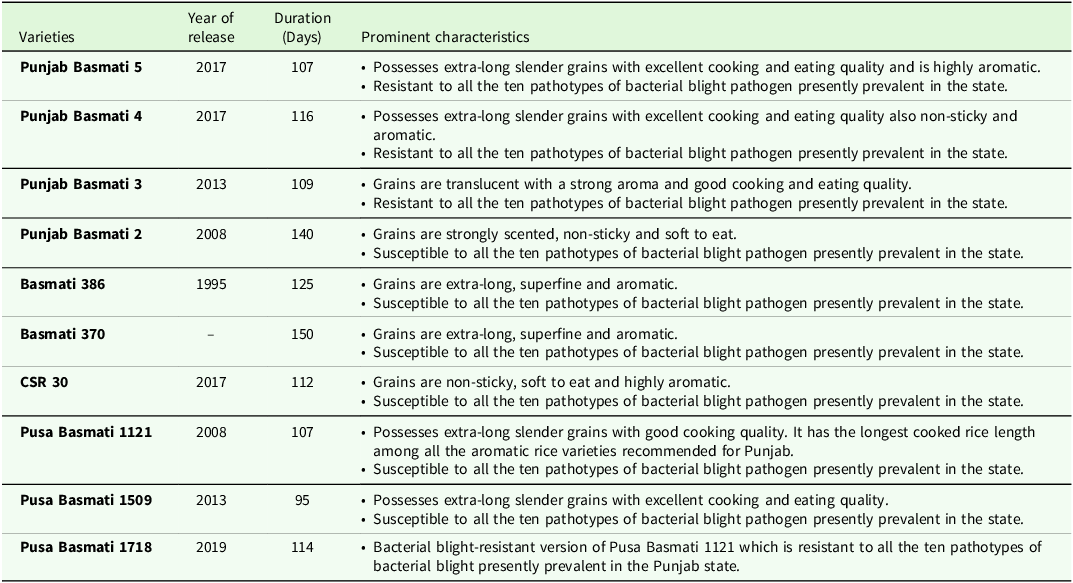
The experiment was laid out in a randomised complete block design (RCBD) with ten treatments (varieties) and three replications. Each plot was allotted randomly within a block, and blocking was used to control field variability across the replications. The experimental treatments consisted of ten Basmati rice varieties representing both traditional and improved types: Punjab Basmati 5, Punjab Basmati 4, Punjab Basmati 3, Punjab Basmati 2, Basmati 386, Basmati 370, CSR 30, Pusa Basmati 1121, Pusa Basmati 1509 and Pusa Basmati 1718. These varieties were selected because they differ in their genetic background, yield potential, grain quality and maturity duration, thereby providing a wide range of performance under the organic cultivation conditions. The traditional varieties such as Basmati 370 and Basmati 386 are known for their superior aroma and grain quality but have a relatively lower yield, while the newly developed varieties like Pusa Basmati 1121, Pusa Basmati 1509 and Pusa Basmati 1718 are high-yielding and widely adopted by the farmers. The Punjab Basmati series developed by Punjab Agricultural University represents regionally adapted varieties with a balance between the grain quality and productivity. The detailed morphological and agronomic characteristics of these varieties are provided in the Table 1. All the varieties were cultivated under the organic management practices as per the standards of the National Programme for Organic Production (NPOP) (APEDA 2023). The organic nutrient and pest management practices employed in the production of these Basmati rice varieties are outlined in the Table 2.
Varieties of basmati rice and their traits

Nutrient and pest management practices used in organic farming of basmati rice

DAS: Days after sowing.
Crop establishment and management
The experimental field was prepared for Basmati rice cultivation by incorporating an in situ green manure crop of sunhemp (Crotalaria juncea L.), which was grown and incorporated at 45–55 days after sowing. Nutrient management was based on green manuring with sunhemp and foliar application of cow urine. This approach was considered sufficient to sustain soil fertility and crop productivity because Basmati rice varieties have relatively low nitrogen requirements, ranging from 0.021 to 0.062 t N/ha. Green manuring with sunhemp alone supplied approximately 0.06–0.07 t N/ha through biological nitrogen fixation and biomass incorporation (Aulakh and Gill, Reference Aulakh and Gill2013), which is sufficient to meet the nitrogen demand of Basmati (Aulakh et al., Reference Aulakh, Kaur, Walia, Gill, Sharma and Buttar2016). In addition, three foliar sprays of cow urine were applied at 15-day intervals starting from 50 days after sowing (DAS) at a total rate of 125 l/ha. Cow urine contains nitrogen along with micronutrients and growth-promoting substances, which further supplemented crop nutrition (Ambigalakshmi et al., Reference Ambigalakshmi, Raghavi, Yogha Sri and Indianraj2023). Therefore, the combined use of green manuring and cow urine was sufficient to maintain soil fertility and support satisfactory crop performance under the conditions of this experiment. Field preparation was carried out manually using spades, followed by puddling and levelling operations to ensure the uniform transplanting and water distribution across the plots. The nursery of Basmati rice was raised during the second fortnight of June, with sowing dates of June 25, 2020, and June 17, 2021, respectively. These sowing dates were selected to strictly fall within the recommended nursery sowing window for Basmati rice in Punjab, which is the second fortnight of June, as per state agronomic guidelines. The slight variation in nursery sowing dates between the two experimental years was not treatment-induced but rather a deliberate adjustment to prevailing year-specific weather conditions, particularly the onset of monsoon rainfall, temperature regime and soil moisture availability, to ensure uniform seedling emergence and healthy nursery establishment under organic management. Importantly, the same nursery sowing date was followed for all Basmati rice varieties within a given year, thereby eliminating sowing date as a confounding factor among varieties. Thus, sowing time was treated as a year-specific environmental factor rather than an experimental variable. The seedlings were raised using organically produced seeds, and uniform organic nutrient management practices were followed during the nursery stage across all varieties and years.
The transplanting of the seedlings was done during the second fortnight of July, i.e., on July 25, 2020, and July 17, 2021, maintaining a consistent seedling age across years and varieties. The variation in transplanting dates was a direct consequence of the adjusted nursery sowing dates and was necessary to synchronise transplanting with optimal field conditions, including adequate soil moisture and favourable weather. All varieties were transplanted on the same date within each year, ensuring that transplanting time did not introduce variability among varietal treatments. Healthy seedlings of 25–30 days’ age were transplanted manually in the well-puddled fields at a planting density of 33 hills/m2 (20 × 15 cm), with one to two seedlings per hill to ensure the optimum plant population and the uniform crop stand. Weed management was carried out primarily through the cultural practices. The water ponding was maintained in the fields for 20 days after transplanting (DAT) to suppress the weed emergence. Any escaped weeds were removed manually at the later growth stages, eliminating the need for synthetic herbicides and ensuring compliance with the organic farming standards. Insect-pest management was carried out using Tricho-cards and neem-based pesticides, as detailed in the Table 2. The different Basmati rice varieties were harvested at their respective physiological maturity stages to ensure accurate yield estimation. Harvesting was carried out manually and grains were threshed, cleaned and dried before recording the yield data.
Data analysis
Yield and yield-attributing parameters were recorded at maturity to assess varietal performance. The parameters included the number of effective tillers/m2 (panicle-bearing tillers), number of grains/panicle, 1000-grain weight (g), grain yield (tonnes/ha), straw yield (tonnes/ha) and total biomass (tonnes/ha). To ensure the accuracy, five randomly selected plants per plot were used for recording the effective tillers/m2 and grains/panicle. The grain yield and straw yield were calculated on a per-hectare basis after harvesting, threshing, cleaning and drying the produce from each experimental plot. Grain yield was expressed at 18% moisture content whereas straw yield and total biomass were expressed on a dry weight basis. The total biomass was obtained as the sum of the grain and straw yield. The harvest index (HI) was computed to evaluate the efficiency of biomass partitioning into the economic yield, using the following formula (Donald and Hamblin, Reference Donald and Hamblin1976) with both economic yield and biological yield expressed on a dry weight basis:
 ${\rm{Harvest}}\;{\rm{Index}}\;\left( \% \right)\;{\rm{ = }}\;{{\;{\rm{Economic}}\;{\rm{yield}}\;({\rm{tonnes/ha}})} \over {{\rm{Biological}}\;{\rm{yield}}\;({\rm{tonnes/ha}})}} \times {\rm{100}}\;\;$
Economic analysis
The economic feasibility of the Basmati rice cultivation under the organic management was assessed based on the prevailing market prices of inputs and outputs during the respective crop seasons. Input costs (seed, fertilisers/organic inputs, plant protection, labour, machinery, irrigation, etc.) were based on local market rates. Output value was computed using the Minimum Support Price (MSP) or the average mandi price at harvest. All values are expressed in INR per ha. (Anonymous, 2021). The gross returns were calculated from the value of grain and straw yield, while the net returns were obtained by subtracting the total cost of cultivation from the gross returns. The benefit-cost ratio (B:C ratio) was estimated using net returns and cost of cultivation using the formula:
 ${\rm{B}}:{\rm{C}}\;{\rm{ratio}} = {{{\rm{Net}}\;{\rm{returns}}} \over {{\rm{Cost}}\;{\rm{of}}\;{\rm{cultivation}}}}$
Statistical analysis
The experimental data on the yield and yield-attributing traits were subjected to the analysis of variance (ANOVA) using the General Linear Model (GLM) procedure in R Studio (v 4.2.2). The effect of varietal treatments was considered fixed, while block effects were treated as random. Post-hoc analysis was carried out through the mean separation using the Tukey’s Honest Significant Difference (HSD) test at a 5 % probability level (P = 0.05) to identify the statistical differences among the varieties after significant ANOVA results. The statistical model used for the analysis was:
 ${Y_i} = {\rm{\mu }} + {{\rm{\tau }}_i} + {{\rm{\beta }}_j} + {{\rm{\varepsilon }}_{ij}}$
where Yi is the response variable i.e., yield of i th variety, μ is the overall mean, τ i is the effect of i th variety, β j is the effect of j th block and ϵ ij is the random error.
Results
Plant height
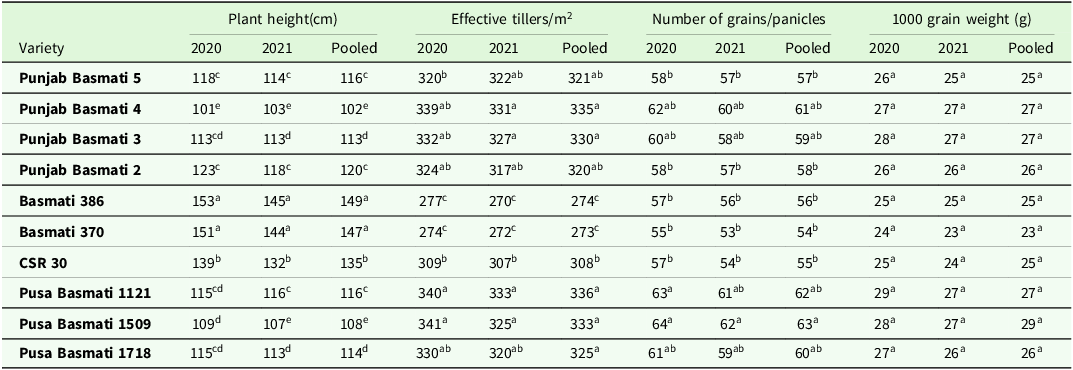
The variety Basmati 386 was the tallest at maturity during 2020, 2021 and on pooled basis (153.4, 145.2 and 149.3 cm, respectively) (Table 3). This was followed by Basmati 370 and CSR 30, which also exhibited comparatively greater plant heights. These results indicate that traditional varieties such as Basmati 386 and Basmati 370 possess inherently higher plant height potential compared to other tested varieties of Basmati rice. On the other hand, semi-dwarf varieties included in the study, such as Pusa Basmati 1121, Pusa Basmati 1509 and Punjab Basmati series, maintained a relatively shorter plant height.
Growth and yield attributes of basmati rice varieties grown under organic farming

Means within the same column followed by different lowercase letters (a, b, c, d) differ significantly at P ≤ 0.05 according to Tukey’s Honest Significant Difference (HSD) test.
Effective tillers
Significant varietal differences were observed in the number of effective tillers/m2 across the two years of experimentation (Table 3). During 2020, the highest number of effective tillers was recorded in Pusa Basmati 1509, which was statistically at par with Pusa Basmati 1121, Pusa Basmati 1718, Punjab Basmati 4, Punjab Basmati 3 and Punjab Basmati 2, but significantly higher than the remaining varieties. In 2021, however, Pusa Basmati 1121 outperformed other varieties by recording the maximum number of effective tillers, remaining statistically on par with the Punjab Basmati 4 and Punjab Basmati 3, but significantly higher than all other tested varieties. When the data were pooled across both the years, Pusa Basmati 1121 consistently maintained the highest number of effective tillers/m2, which was statistically comparable to the Pusa Basmati 1509, Pusa Basmati 1718, Punjab Basmati 4, Punjab Basmati 3 and Punjab Basmati 2, but significantly superior to the other Basmati rice varieties evaluated.
Number of grains per panicle
Significant differences among varieties were observed in terms of the number of grains per panicle (Table 3). Across both the years, the highest number of grains per panicle was recorded in Pusa Basmati 1509, which remained statistically on par with Pusa Basmati 1121, Pusa Basmati 1718, Punjab Basmati 4 and Punjab Basmati 3. This suggests that these improved Basmati varieties possess better reproductive efficiency, resulting in higher grain-bearing capacity per panicle compared to traditional tall varieties such as Basmati 386 and Basmati 370.
1000-grain weight
The 1000-grain weight (g) varied from 23.3 to 27.8 g during both years of experimentation (Table 3), showing clear varietal differences. When data from both years were pooled, Pusa Basmati 1509 had the highest 1000-grain weight, which was statistically comparable to Pusa Basmati 1121, Pusa Basmati 1718, Punjab Basmati 5, Punjab Basmati 4, Punjab Basmati 3 and Punjab Basmati 2. This indicates that these varieties possess relatively bolder grains, which is an inherent genetic trait (Figure 2). On the other hand, traditional varieties such as Basmati 386 and Basmati 370 exhibited comparatively lower grain weights, which can be attributed to their slender grain type and genetic limitations in grain filling (Figure 2).
Comparative seed morphology of different basmati cultivar.

Yields and harvest index
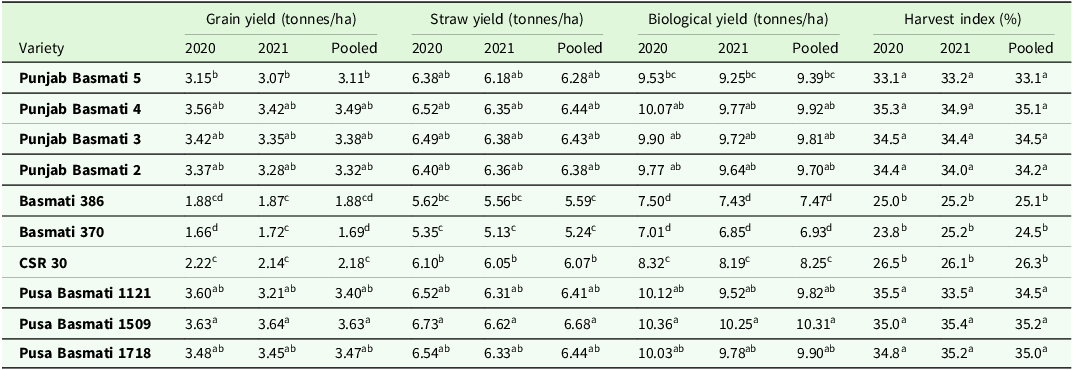
Considerable variation was observed in the grain yield of different varieties under organic management. Grain yield ranged from 1.66 to 3.63 tonnes/ha, reflecting a wide variation of 54.3 % among the tested varieties (Table 4). Among the varieties, Pusa Basmati 1509 resulted in significantly higher grain yield, with values of 3.63, 3.64 and 3.63 tonnes/ha during 2020, 2021 and on pooled basis, respectively. It was statistically at par with Pusa Basmati 1718, Pusa Basmati 1121 and Punjab Basmati 4, 3 and 2 (Figure 3). In contrast, Basmati 370 consistently produced the lowest grain yields (1.66, 1.72 and 1.69 tonnes/ha in 2020, 2021 and pooled basis, respectively), highlighting the lower yield potential of traditional tall varieties under the organic conditions. When total productivity was considered, Pusa Basmati 1509 again demonstrated significantly higher values, with straw yields of 6.73, 6.62 and 6.68 tonnes/ha in 2020, 2021 and pooled data, respectively. This performance was statistically comparable to Pusa Basmati 1718, Pusa Basmati 1121 and Punjab Basmati 5, 4, 3 and 2, confirming the superior yield potential of these varieties across years. Considerable variation was also observed in the biological yield of different Basmati rice varieties under organic management. Biological yield ranged from 6.93 to 10.31 tonnes/ha, indicating a wide variability among the tested varieties (Table 4). Among the varieties, Pusa Basmati 1509 recorded the highest biological yield with values of 10.36, 10.25 and 10.31 tonnes/ha during 2020, 2021 and on pooled basis, respectively. It was statistically at par with Pusa Basmati 1718, Pusa Basmati 1121, Punjab Basmati 4 and Punjab Basmati 3, reflecting their superior biomass production potential under organic conditions. Whereas, the traditional tall varieties Basmati 370 and Basmati 386 consistently produced significantly lower biological yield, with pooled values of 6.93 and 7.47 tonnes/ha, respectively. The harvest index (HI), which indicates the efficiency of partitioning assimilates into grain, also varied among varieties (Table 4). In 2020, Pusa Basmati 1121 exhibited the highest HI (35.5 %), whereas in 2021 and on pooled basis, Pusa Basmati 1509 outperformed all others, achieving the maximum HI.
Grain yield, straw yield and harvest index of basmati rice varieties under organic farming

Means within the same column followed by the different small letters show that there are significant differences at P < 0.05.
Grain, biological yield and Net returns (net profit) of basmati rice under Organic farming (pooled mean of two years).

Economics
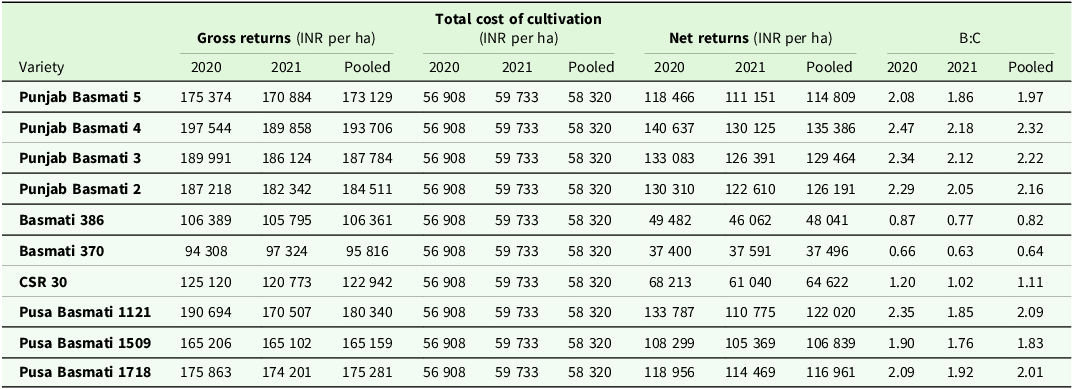
Significant differences were observed among the varieties with respect to gross returns, net returns and the benefit: cost ratio (B:C ratio) (Table 5; Figure 3). The highest grain yield was recorded with Pusa Basmati 1509; however, the highest gross returns, net returns and B:C ratio were attained with the Punjab Basmati 4, followed closely by the Punjab Basmati 3. This disparity arises because the Punjab Basmati varieties fetch a premium price in the market compared to Pusa Basmati 1509, thereby compensating for the relatively lower grain yields. In contrast, although Pusa Basmati 1509 demonstrated higher productivity, its relatively lower market price reduced its comparative economic benefit.
Economics of basmati rice varieties under organic farming

Soil health
The data reveal a gradual improvement in soil organic carbon (SOC) and available macronutrients under organic management practices using green manuring with sunhemp (Crotalaria juncea L.). Soil organic carbon increased from 0.49 % in the initial soil status to 0.51 and 0.54 %, respectively in 2020 and 2021. Available nitrogen showed a consistent increase from 194 kg/ha initially to 207 and 223 kg/ha, respectively in 2020 and 2021. A similar increasing trend was observed for available phosphorus, which increased from 17.3 to 18.1 and 18.8 kg/ha, and for available potassium, which improved from 158 to 160 and 165 kg/ha during the respective years.
Discussion
Plant height is a primary indicator of crop growth and development, which is largely influenced by the genetic makeup of a cultivar but also affected by the agronomic practices and environmental conditions (Jeuffroy et al., Reference Jeuffroy, Casadebaig, Debaeke, Loyce and Meynard2014). It is considered a crucial agronomic trait as it reflects the overall vegetative growth of the plant and has direct implications for crop management, yield potential and overall crop performance. Varieties with taller stature generally accumulate more biomass and contribute significantly to straw yield, while medium- to semi-dwarf varieties are often preferred in intensive cultivation systems because of their better lodging resistance and higher harvest index. The taller stature of varieties such as Basmati 386 and Basmati 370 may be attributed to their longer vegetative growth period and greater internodal elongation, which allow them to achieve higher height as compared to modern, semi-dwarf Basmati varieties (Anonymous, 2021). Although this characteristic contributes positively to biomass production and straw yield, it also increases the risk of lodging, particularly under heavy rainfall or strong wind conditions (Singh et al., Reference Singh, Gopala Krishnan, Singh, Mohapatra, Prabhu, Singh, Sharma, Nagarajan, Vinod, Singh, Singh, Chander, Atwal, Seth, Singh, Ellur, Singh, Anand, Khanna, Yadav, Goel, Singh, Shikari, Singh and Marathi2011).
In contrast to taller varieties, the semi-dwarf varieties are less prone to lodging and are therefore more manageable under both organic and the conventional systems. These results highlight that plant height differences are strongly variety-specific, reflecting the genetic potential of traditional versus improved Basmati cultivars. While tall varieties continue to play an important role in niche markets due to their quality traits, so the medium-statured and semi-dwarf varieties, many of which have inherited quality traits from traditional Basmati germplasm and offer practical advantages in terms of stability, management, quality traits introgressed from traditional varieties and suitability under organic farming conditions (Singh et al., Reference Singh, Singh, Mohapatra, Krishnan and Ellur2018).
The number of effective tillers (panicle-bearing tillers) per unit area is one of the most crucial yield-determining factors in the Basmati rice, as it directly contributes to the number of panicles and ultimately grain yield. Effective tillering capacity reflects the ability of a variety to utilise resources efficiently and sustain productive tillers up to maturity (Mmbando, Reference Mmbando2025). Hence, varieties producing a greater number of effective tillers are generally expected to give a higher yield under the similar management conditions. These findings clearly demonstrate the superior tillering ability of the improved Basmati varieties, particularly Pusa Basmati 1121 and Pusa Basmati 1509, which are known for their high yield potential under diverse growing conditions (Anonymous, 2021).
The higher tiller production in Pusa Basmati 1121 and Pusa Basmati varieties may be attributed to their better genetic potential for tillering, efficient utilisation of nutrients under organic management and adaptability to prevailing climatic conditions. In contrast, the traditional tall varieties such as Basmati 386 and Basmati 370 exhibited fewer effective tillers, which restricts their yield potential despite their tall stature and high biomass. These results underline that effective tiller production is variety-specific, and improved semi-dwarf varieties with superior tillering ability, such as Pusa Basmati 1121 and Pusa Basmati 1509, offer significant advantages in terms of higher grain yield under the organic farming systems compared to the traditional Basmati varieties (Kesh and Khan, Reference Kesh and Khan2023; Singh et al., Reference Singh, Singh, Mohapatra, Krishnan and Ellur2018).
The number of grains per panicle is a key yield-attributing trait in rice, as it directly contributes to the final grain yield. It is influenced not only by the genetic potential of the variety but also by the crop management practices, nutrient availability and environmental factors during the reproductive phase (Chakravorty and Ghosh, Reference Chakravorty and Ghosh2014). Varieties with a higher number of well-filled grains per panicle are generally associated with higher productivity, provided that the other yield components such as tiller number and grain weight are also favourable. The superior performance of Pusa Basmati 1509 and Pusa Basmati 1121 in terms of grains per panicle may be attributed to their inherent genetic potential for a larger sink size and more efficient assimilate partitioning during the grain-filling phase (Singh et al., Reference Singh, Singh, Mohapatra, Krishnan and Ellur2018).
Moreover, the incorporation of green manuring crops, such as sunhemp in this experiment, likely contributed to better nutrient availability, which has been shown to positively influence yield-related parameters including effective tillers, panicle weight, panicle length and number of grains per panicle (Pooniya and Shivay, Reference Pooniya and Shivay2011). It further suggests that nutrient availability, particularly nitrogen, was available in sufficient amounts for all the varieties whether the requirement was more or less. Thus, the high-yielding varieties may have utilised the nitrogen more efficiently than the traditional basmati varieties (Danish et al., Reference Danish, Singh, Singh and Jat2025). In addition, these results indicate that modern semi-dwarf Basmati varieties not only exhibit the superior tillering ability but also produce a greater number of grains per panicle, thereby enhancing their yield potential under the organic farming systems. The findings also highlight the combined role of genetic makeup and organic nutrient management in maximising the reproductive efficiency of Basmati rice.
The 1000-grain weight is an important yield-contributing parameter that reflects the boldness and size of the grains. It is primarily governed by the genetic constitution of a variety, although it can also be influenced by nutrient availability, environmental conditions during grain filling and overall crop management practices (Huang et al., Reference Huang, Jiang, Zheng, Wang, Wang, Huang and Hong2013; Nan et al., Reference Nan, Feng, Wang, Zhang, Wang, Liu, Yuan, Jiang and Lin2018). A higher 1000-grain weight generally contributes to the higher grain yield provided that other components such as the number of effective tillers and grains per panicle are also favourable.
The superiority of Pusa Basmati 1509 in terms of 1000-grain weight reflects its genetic advantage for producing bold grains, which contributes positively to its higher market acceptability and the consumer preference. Similarly, the Punjab Basmati series also showed good performance for this trait, ensuring consistency in their grain size and weight. In contrast, the traditional varieties such as Basmati 386 and Basmati 370 exhibited comparatively lower grain weights due to their slender grain type and perhaps the limited grain-filling capacity. These results suggest that modern Basmati varieties like Pusa Basmati 1509, Pusa Basmati 1121 and Punjab Basmati series combine higher grain weight with the superior tillering and grain-bearing capacity, thereby offering a yield advantage under the organic management. The trait of bold grains further enhances their economic and market value, making them more attractive for both farmers and the consumers.
The cumulative effect of growth and yield-attributing characters is ultimately expressed in grain yield, which is of prime economic importance in Basmati rice cultivation (Shakya, Reference Shakya2024). The higher yield performance of Pusa Basmati 1509, along with the Pusa Basmati 1718, Pusa Basmati 1121 and Punjab Basmati series, can be attributed to their superior tillering ability and higher number of grains per panicle, which translated into greater grain productivity. Similar variations in grain yield among Basmati varieties under the organic farming have also been reported by Yadav et al. (Reference Yadav, Sharma, Choudhary, Jain and Jat2020). Furthermore, Singh et al. (Reference Singh, Gupta, Nanda, Sharma, Singh and Bisarya2017) observed a significant improvement in the yield attributes and grain yield in both coarse and fine rice varieties under organic farming, indicating the potential of organic practices to sustain productivity.
The higher biological yield of improved varieties may be attributed to their better genetic potential for tillering and straw production, resulting in greater total biomass accumulation (Manjunath et al., Reference Manjunath, Mahajan, Ramesh and Singh2016; Takai, Reference Takai2024). The variation in biological yield among Basmati rice varieties under organic management was mainly governed by effective tiller production rather than plant height. The high biological yield recorded for Pusa Basmati 1509, Pusa Basmati 1121, Punjab Basmati 4, Punjab Basmati 3 and Pusa Basmati 1718 was associated with their higher number of effective tillers (330–336/m2 on pooled basis). Whereas, traditional tall varieties Basmati 370 and Basmati 386, despite attaining greater plant height, produced fewer effective tillers (273–274/m2), resulting in a lower biological yield. This indicates that higher tillering ability, rather than plant height, is the key determinant of biomass production under organic conditions, favouring improved semi-dwarf Basmati varieties (Kalaitzidis et al., Reference Kalaitzidis, Kadoglidou, Mylonas, Ghoghoberidze, Ninou and Katsantonis2025; Kaur et al., Reference Kaur, Gill, Singh and Sandhu2024).
The higher harvest index (HI) recorded in Pusa Basmati 1509 indicates that this variety not only produced greater biomass but also partitioned a higher proportion of it towards grain yield, thereby enhancing the overall productivity. Such efficiency of assimilate partitioning is crucial under organic systems where external nutrient inputs are limited. The role of green manuring in sustaining yield performance was also evident in the study. Green manure crops, such as sunhemp, provided a substantial source of easily decomposable organic matter and nutrients. Under Punjab conditions, Aulakh et al. (Reference Aulakh, Khera, Doran, Singh and Singh2000) reported that green manuring in rice was equivalent to applying 120 kg N/ha through urea in terms of yield and also contributed to the nutrient requirements of the succeeding wheat crop. Singh and Shivay (Reference Singh and Shivay2016) similarly highlighted the beneficial role of green manuring in enhancing growth, yield-attributing traits and grain yield of rice through improved soil fertility and nutrient supply.
The results indicate that economic returns in Basmati rice are influenced more by market price than by yield alone (Singh et al., Reference Singh, Kaur, Arora and Kingra2024). Although Pusa Basmati 1509 produced the highest grain yield, Punjab Basmati 4 and Punjab Basmati 3 recorded superior gross returns, net returns and B:C ratio due to their premium market price, which compensated for a relatively lower yield. This highlights that in quality-sensitive crops like Basmati rice, varieties with strong consumer preference and higher price realisation often outperform high-yielding varieties in terms of profitability (Singh et al., Reference Singh, Singh, Mohapatra, Krishnan and Ellur2018). Similar observations have been reported earlier, where premium-priced traditional or region-specific Basmati varieties generated higher net returns despite moderate productivity (Mahajan et al., Reference Mahajan, Matloob, Singh, Singh and Chauhan2018; Singh et al., Reference Singh, Kaur, Arora and Kingra2024).
These findings from the present study reinforce that Pusa Basmati 1509, Pusa Basmati 1718 and Pusa Basmati 1121, along with Punjab Basmati series, combine high yield potential with favourable harvest index under organic management. The integration of green manuring further enhances soil health and nutrient availability, thereby contributing to sustainable productivity of Basmati rice in the Indo-Gangetic plains. Green manuring is the second most common practice, used by 56.8 % of farmers during Kharif season. Farmers generally prefer both sunhemp (Crotalaria juncea) and dhaincha (Sesbania aculeata) as per availability of seed due to higher dry matter production, less infestation of insect pests and easy seed production (Walia et al., Reference Walia, Sidhu, Aulakh and Kumar2025).
Organic and natural farming is a sustainable farming model recognised globally. India ranks 1st in terms of total number of organic producers (2.5 million) worldwide, was more than 50 % of the total number of organic food producers in the world and ranks 2th in terms of the total area (4.7 Mha) under organic farming, which increased by 74 % from 2021 to 2022 (Willer et al., Reference Willer and Schlatter2024). In Punjab, organic farming has grown due to health concerns, environmental awareness and increased demand driven by rising purchasing power. Farmers are shifting to organic practices to meet demand and address these issues (Walia et al., Reference Walia, Sidhu, Aulakh and Kumar2025).
The observed improvement of soil organic carbon (SOC) and available nutrients can be attributed to the continuous adoption of organic management practices (Kumar et al., Reference Kumar, Sindhu, Sidhu and Aulakh2024). Incorporation of sunhemp biomass adds substantial organic matter, which enhances soil microbial activity and improves nutrient cycling. The increase in available nitrogen is mainly due to biological nitrogen fixation by sunhemp and subsequent mineralisation following its incorporation into the soil. Improvements in available phosphorus and potassium may be associated with enhanced microbial-mediated solubilisation and reduced fixation under higher organic carbon levels (Mahey et al., Reference Mahey, Sharma, Singh, Rampal and Kaushik2024). Overall, these results demonstrate that green manuring with sunhemp is an effective strategy for improving soil fertility and sustaining soil health under organic farming systems (Aulakh et al., Reference Aulakh, Kaur, Walia, Gill, Sharma and Buttar2016).
Conclusion
The study demonstrates the suitability of Pusa Basmati 1509, Pusa Basmati 1718 and Punjab Basmati 5 for the organic cultivation in Punjab owing to their superior yield performance and adaptability. Punjab Basmati 4 and 3, despite having a slightly lower yield, achieved higher profitability due to the premium market prices. Incorporation of green manures, particularly sunhemp, played a pivotal role in sustaining the soil fertility and enhancing the yield traits. These results underscore that integrating improved Basmati cultivars with organic nutrient management can enhance both productivity and economic viability of rice production in the Indo-Gangetic plains. Future research should focus on long-term, multi-location evaluations of these varieties under organic and natural farming systems to assess yield stability, soil health dynamics and climate resilience, along with optimisation of green manuring strategies and strengthening market and value-chain linkages to enhance adoption and scalability of organic Basmati rice production.
Author contributions
A.S. Sidhu, C.S. Aulakh and S.S. Walia were involved in conceptualisation and methodology; A.S. Sidhu and S.S. Bhullar were involved in data acquisition; A.S. Sidhu, N. Kumar and S.S. Bhullar were involved in data analysis; N. Kumar was involved in writing - original draft preparation; A.S. Sidhu, C.S. Aulakh and S.S. Walia were involved in writing - review and editing.
Funding statement
No funding received.
Competing interests
The authors declare there are no conflicts of interest.
Ethical standards
Not applicable.