Introduction
Writing about what he calls the Abu Ghraib effect – ‘a kind of moral blindness […] that allows [the US public and the amateur photographers at Abu Ghraib] to ignore, or even to justify, however partially or provisionally, the facts of degradation and brutality manifest in the pictures’ – art historian Stephen Eisenman argues that ‘there is simply no alternative’ to paying careful attention to the photographs if one wishes to ‘uncover and thereby weaken’ this very effect. This requires, according to Eisenman, ‘to understand them as images located in a long history of images’.Footnote 1 If ‘careful attention’ is meant to include carefully watching these images – and how would it otherwise be possible to understand them in the context of the history of images? – then his colleague, Horst Bredekamp, would disagree. Deliberately to watch an image of a crime is, according to Bredekamp, an act of complicity if the crime had been committed in the first place in order to produce images of it; if victims are humiliated and tortured in front of a camera for the purpose of the production of images then the viewer, simply by watching these images, becomes an accomplice of the perpetrators.Footnote 2 Thus, if, as Eisenman seems to argue, one has no choice but to regard the Abu Ghraib images then, according to Bredekamp, there also would not seem to be an alternative to becoming involved, as a viewer, in the crimes committed at Abu Ghraib.Footnote 3 Now it can be argued that these photographs were not intended for public consumption and wide dissemination.Footnote 4 However, they were circulated on a limited scale: for private consumption, as souvenirs for friends and loved ones at home – a family album of sorts. Moreover, they were disseminated world-wide, irrespective of the photographers' intentions, largely uncontrolled and uncontrollable. This argument can be extended to cover also the attacks of 11 September 2001: one of the reasons for choosing the World Trade Center would appear to have been that it could almost be taken for granted that someone would capture the attacks in images and that these images would then be disseminated and watched worldwide.Footnote 5 Does this mean that by simply watching the photographs or the video footage of the attacks, the viewers inadvertently join hands with Al-Qaeda?
Interlude
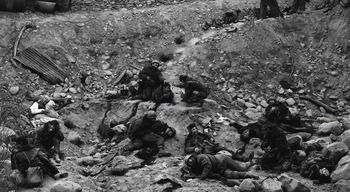
The picture presents a hallucinatory scene in which soldiers who have just been killed on the battlefield are re-animated, engaging with each other in what the artist describes as a ‘dialogue of the dead’. […] Each figure or group seems to respond differently to the experience of death and reanimation. The three soldiers clowning with their own wounds provide a note of macabre levity.Footnote 6
Jeff Wall, ‘Dead Troops Talk (A vision after the ambush of a Red Army patrol, near Moqor, Afghanistan, winter 1986)’, 1992, reproduced with permission of Jeff Wall Studio.

Disinterested pleasure
These issues – and many more including the causal relationship between uncovering and weakening the Abu Ghraib effect optimistically established by Eisenman – directly lead to the core of recent debates on visual representations in general and war photography in particular. These debates are addressing the critical questions of responsibility and involvement when taking, publishing, circulating and viewing images of war, famine and other forms of human suffering. Early supporters of photography hoped that it could help prevent wars by simply bringing ‘home to us the terrible reality and earnestness of war’.Footnote 7 Critics of war photography display a much more sceptical attitude insisting that ‘the image of war is not communicable’Footnote 8 but criticism of photography also seems to reflect some degree of disillusion arguably resulting from exaggerated hopes pinned to the democratising and emancipatory potential of photographs claimed in early writings on photography. Critics often seem to assess photographs in relation to what they ought to be able to deliver, not in relation to what they actually can deliver – which is not very much. As John Szarkowski argues with respect to Matthew Brady's American Civil War photographs and the much larger body of photographic work documenting World War II, ‘neither explained, without extensive captioning, what was happening’.Footnote 9 Thus, photographs cannot give the viewers the assurance that they might like to be given and ‘pictures alone cannot make for us the discriminations that we might like to make’.Footnote 10
In their book on photojournalistic icons, Robert Hariman and John Louis Lucaites discuss such iconic photographs as Dorothea Lange's ‘Migrant Mother’ (1936) and Nick Ut's ‘Accidental Napalm’ (1972), the social processes through which these photographs became to be regarded as icons and their operation within US public culture. They argue that the ‘daily stream of photojournalistic images […] defines the public through an act of common spectatorship’.Footnote 11 The individual viewer can powerfully respond to an image, not as an individual but only as a member of the discursively organised public and as a part of a potential collective action in response to the image. Thus, in a culture dominated by images, the public would not be a public, and the individual, being powerful only within the framework and as a part of discursive-collective action, could not exert much political influence without viewing images – most of the time individually but, as a member of the public, at the same time also collectively. The act of viewing constitutes the public as a part of which – and only as a part of which – the individual might exert political power. From this point of view it would seem to be mandatory for individuals to look because not looking would position them outside the realm of the political and thus deprive them of the possibility to act politically.
This is all very well as far as it goes but does it go far enough? Can the possibility to act politically qua viewer be translated into an adequate response to images of human suffering? Indeed, the impossibility of responding adequately to such images is a staple topic in criticism of photography rendering the viewer's subject position when viewing images of human suffering very problematic indeed. Criticism of photography comes in a variety of forms, not all of which can be covered in this article. In the context of war photography, such criticism is most often derived from photography's alleged aestheticising or desensitising potentialities with the latter frequently said to emerge from the former.Footnote 12 Aestheticisation, in this context, refers to photographs of human suffering that, due to their formal structure or to what in a given situation is, culturally conditioned, understood as beauty or both, are assumed to offer ‘disinterested pleasure’ to the viewer, abstract from the sources of the depicted suffering and the conditions under which it occurred and obscure the ‘meaning and implications’ of suffering ‘while being used as resources for gratification’.Footnote 13 Such images are said to depoliticise the viewers by directing their attention from the depicted conditions of suffering to the quality of the image and the beauty of that what it depicts. It is often assumed that there is a causal nexus between an image's formal structure and beauty on the one hand and the viewer's lack of critical engagement with its subject on the other hand. It is also supposed that, owing to photography's material-mechanical way of producing images and its ‘deeply problematic’ relationship to ‘any prior reality’Footnote 14 aesthetic representations of suffering in photographs are more problematic than similar representations in paintings or etchings. For example, Caravaggio's ‘Beheading of Saint John the Baptist’ and Edouard Manet's series of paintings on the execution of emperor Maximilian, Jacques Callot's ‘Les Misères et les Malheurs de la Guerre’ and Francisco de Goya's ‘Los Desastres de la Guerra’, all of which are undoubtedly brilliant in their formal structure, are often referred to as works of art that, as Susan Sontag has put it with respect to Goya's work, ‘move the viewer close to the horror’ of war and that ‘awaken, shock, wound the viewer’Footnote 15 without normally being accused of aestheticisation and desensitivisation.
The underlying supposition is that less aestheticised approaches to photography would automatically or necessarily avoid the viewers' depoliticisation and increase their degree of empathy and response. However, blurred, unfocused and grainy photographs that do not seem to appeal to the viewer primarily owing to their formal structure and beauty are also aesthetic because ‘representation stylises’,Footnote 16 thus it aestheticises: anti-aesthetics are also aesthetics and representation cannot not aestheticise. Furthermore, non-aestheticised representations of human suffering in general and of people in pain in particular would also have to cope with the basic non-representability of pain in wordsFootnote 17 and imagesFootnote 18 and thus with the non-representability of that what is often alleged to stimulate the viewers' sympathy and empathy in the first place.Footnote 19
Interlude
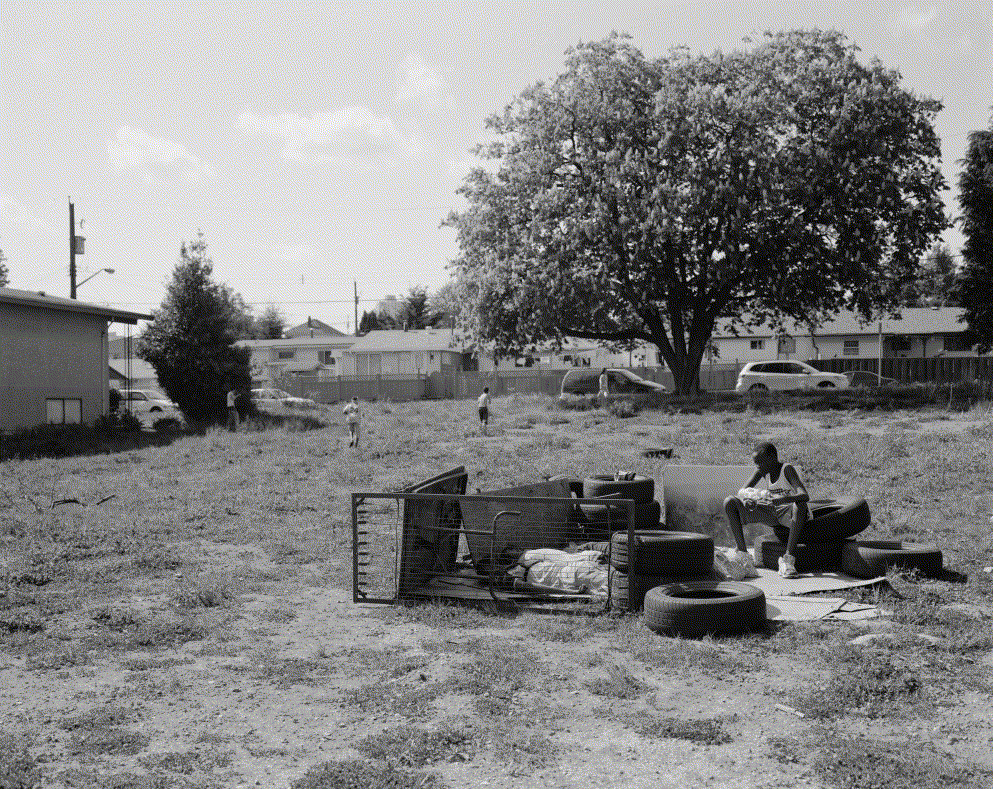
It is a big black and white photograph of boys playing on a sinister stretch of wasteland on the edge of what could be virtually any city in the world. A kid in the foreground sits amid a pile of waste objects, looking down. You don't immediately notice what he is looking at – a row of three human bodies, half-hidden by the scrap enclosure. The shock is complicated when you notice the grin on one ‘dead’ soldier's face.Footnote 20
Jeff Wall, ‘War Game’, 2007, reproduced with permission of Jeff Wall Studio.
Helplessness and hopelessness
Separate from but linked with invocations of aestheticisation, it is often claimed that photographs have a ‘dulling, if not desensitising’ effect.Footnote 21 Processes of technological, political and moral habituation are identified through which people are said to lose their willingness ‘to regularly confront visual depictions of atrocity’: ‘people may feel so helpless from seeing repetitive shots of horror that they do not want to see more than they are already seeing’.Footnote 22 Are processes of habituation exclusive to images? Are readers of written accounts of human suffering not equally or similarly prone to reaching a point beyond which they do not want to proceed, read, think and know? In any case, the public response to the publication of the Abu Ghraib photographs shows that people are not as anaesthetised by images of human suffering as they are often accused of being. Helplessness (and the recognition of one's own moral failure) as a result of not having been able to prevent human suffering might be translated into hopelessness regarding the chances to prevent future suffering but, as Sharon Sliwinski suggests, a ‘photograph of suffering presents both: hopelessness and therefore possibility of hope’.Footnote 23 That hope exists still does not mean that it is possible to respond appropriately to images of human suffering. Jenny Edkins, referring to Jacques Derrida's work, argues that responding to individual cases of human suffering necessarily means betraying all the other cases of human suffering that would equally be deserving of support. Discussing photographs of prisoners in the Tuol Sleng Museum of Genocide Crimes in Phnom Penh, Edkins argues that each of the photographs, confronting the viewer with the ‘absolute singularity […] of thousands of others’, ‘commands a response’ yet ‘no response is adequate for the situation’.Footnote 24 Likewise, Sliwinski argues that the response to an image of human suffering ‘can never, of course, be adequate to the initial call’:
The helplessness and horror of bearing witness to suffering brings with it the demand for a response, and yet one's response to photographs can do nothing to alleviate the suffering depicted.Footnote 25
This is an exceedingly ambitious and, therefore, debilitating understanding of an adequate response. It is also flawed in the light of what has been said above regarding common spectatorship, that is, the possibility as an individual to act politically as a part of the public. The sum of the necessarily inadequate individual responses may ultimately form an adequate response of individuals as parts of the discursively-visually constructed public. Furthermore, what is to be regarded as ‘adequate’ ultimately depends on who we are. Responding to news from Abu Ghraib, for example, Colombian artist Fernando Botero responded by painting Abu Ghraib.Footnote 26 Did these paintings do anything to alleviate the depicted suffering? Probably not; were they nevertheless an adequate response? Probably yes.Footnote 27 Equally important is the claim that images of human suffering effectively depoliticise the depicted scene as a result of which the viewers will find it very difficult to form a public because their attention is diverted away from the depicted scene to ‘the general human condition’:
As we look at [violent war photographs], the moment of the other's suffering engulfs us. We are filled with either despair or indignation. […] In both cases, the issue of the war which has caused that moment is effectively depoliticised. The picture becomes evidence of the general human condition. It accuses nobody and everybody.Footnote 28
If the viewers have no option other than despair or indignation (are these really the only two options?)Footnote 29 would exposing them to images of extreme forms of human suffering and thereby to a problem (how to respond adequately to such images?) to which there is no solution not seem to be equivalent to committing an act of violence against the viewers? Not only the photographer's subjects would then appear to be ‘victims of the camera’Footnote 30 but also the viewers. Yet at the same time the viewers, in Sliwinski's words referring to Sontag's early work on photography, join hands with the photographers in that they ‘[s]imply by looking […] voyeuristically encourage whatever is going on to keep happening’.Footnote 31 In such cases as the photographs taken in Abu Ghraib, taken not by professional photographers documenting acts of torture but by the torturers themselves (although, ultimately, this is largely irrelevant in the present context) ‘the faces of the tortured stare out at us in a moment not only of fear and pain but also of shame, as we, by looking, prolong the shaming’.Footnote 32 While this assessment is true on one level, it ignores that images always operate on different levels at the same time. On the one hand they seem to prolong a subject's victimisation by both fixing situations of suffering and immobilising a human subject as a victim. On the other hand, they also undermine reductionist victimisation by showing that this human subject is much more than a victim, for example, a human being with whom we, the viewers, have something albeit not everything in common. Images, therefore, are important vehicles which help us recognise one another as human beings by visualising the ‘commonalities of being human’.Footnote 33 It can still be said that exposed, in pain, to our look, people endure suffering, ‘a second suffering’, as long as we are looking and as long as the images of their suffering are being circulated; we, as viewers, contribute to their exploitation and ‘theft of their subjectivity’: ‘Looking at their pain is, in this sense, a secondary exploitation’.Footnote 34
From this it would seem to follow that the viewers have to insist on their right not to look if they do not wish to contribute to the exploitation of the photographer's subject and the perpetuation of both the subject's suffering and the conditions depicted in the image. However, not looking also puts them in a difficult and equally unfavourable position outside the discursively constructed public; yet, as has been argued above, only as part of this very public could they hope to respond to the conditions shown in the image. Both options, looking and not looking, then seem to result in the same dilemma: the viewer has to respond but cannot; looking exposes him or her to unsolvable moral dilemmas but not looking does neither answer the core question of how to respond adequately nor would it seem to be a morally acceptable position towards the suffering and pain of others. Still, it is important to be aware that looking follows an individual's choice to look: the option of not looking normally exists but once an individual has decided to become a viewer, viewing has to be translated into a sense of one's own responsibility for and involvement in the depicted scene and the conditions from which it emerged. Mark Reinhardt, referring to the work of the philosopher Stanley Cavell, argues that viewers adequately respond to an image of human suffering if they acknowledge their implication in that what is being shown in the image.Footnote 35 Essentially, the issue is one of acknowledging the relationship between oneself and the depicted other including, arguably, acknowledgement of the other's not-so-otherness without, however, conflating one's own perception of the depiction of an other's pain with the other's physical and mental experience of pain.
A flash is all we have: Alfredo Jaar
During the turmoil after the elections in Kenya at the end of 2007 and again in connection with unrest in the Congo in November 2008, the Rwandan/Tutsi genocide of 1994 was often alluded to as a warning of what could possibly also happen in Kenya and The Congo. Regardless of a quite substantial body of scholarly, autobiographical and journalistic work on the Rwandan/Tutsi genocide,Footnote 36 the mass killings of both members of the Tutsi minority and Hutu oppositionists as well as the killing of UN peace keepers have largely escaped from the collective memory of the discipline of International Relations although, or perhaps because, the Rwandan/Tutsi genocide produced some of the most horrific images in the recent history of photojournalism. Appalled by the lack of political and public response to the mass killings the Chilean artist Alfredo Jaar started in 1994 to make thematic the Rwandan/Tutsi genocide in The Rwanda Project 1994–2000.Footnote 37 Like James Nachtwey's work, ‘Jaar's offers a kind of indictment’Footnote 38 but his approach could hardly be more different from Nachtwey's. The following discussion of Jaar's artwork aims to show how artists, in collaboration with their audiences, are able if not to solve then to circumvent the looking/not looking dilemma and to increase the audience's awareness of its own responsibility without exposing it to the moral dilemmas of looking/not looking described above.
In his first project ‘Signs of Life’, realised with Carlos Vásquez in August 1994, Jaar sent 200 tourist postcards celebrating the beauty of the country from Rwanda to friends and colleagues. He added notes on the reverse simply and poignantly reminding the recipients that, for example,
JYAMIYA MUHAWENIMAWA
IS STILL ALIVE!
EMMANUEL RUCOGOZA
IS STILL ALIVE!
CARITAS NAMAZURU
IS STILL ALIVE!
By using postcards, Jaar not only engaged with Africa's frequent reduction to a tourist destination and its exposure to the tourist gaze. He also critically commented on one of the most sarcastic comments reportedly made by the columnist Simon Hoggart to explain Western inactivity in response to the Rwandan genocide: ‘Nobody you know has ever been on holiday to Rwanda’.Footnote 39 At the same time, Jaar does not relieve the postcards' recipients from their responsibility: just that selected people are still alive does not mean that they are not suffering. The number of the survivals acknowledged on the postcards, while rendering possible the recipients' identification with an individual survivor rather than being paralysed by the sheer overall number of victims, pales in comparison with those who perished. The shortness and seeming simplicity of the messages contrasted with media representations and political statements on Rwanda where many words were used – and some words were carefully avoidedFootnote 40 – in order to defend and legitimate Western inactivity.
In his second project, realised in Malmö, Sweden, in November 1994, Jaar positioned 40 light-boxes all over the city. These light-boxes, however, did not display one or some of the 3000 photographs he had taken in Rwanda but just the word RWANDA to indicate that the photographer's gaze, rather than always reflecting ‘an act of disappearance anticipated through substitution’Footnote 41 often ‘arrives too late’Footnote 42 and retrospectively documents disappearances and absences, silences and gaps. Just as in Malmö, Jaar, in ‘Real Pictures’, exhibited for the first time in January 1995, found it impossible to show his own photographs to the public. Rather he hid 60 photographs in black linen boxes on top of which written descriptions of the image inside were silk-screened thus again emphasising the impossibility to show what had happened in Rwanda. In the ‘Slide + Sound Piece’ of March 1995, Jaar accompanied the exhibition of ‘Real Pictures’ (that is, no visible pictures) with a slide show consisting of text (for example, dedications to people he had met in Rwanda, the number of deaths, quotations from writers and poets, and quotations from news reports) and music and sound, again insisting on photography's insufficiency when dealing with the Rwandan/Tutsi genocide. ‘Let There Be Light’ in June 1995 consisted of ten light-boxes displaying Rwandan place names largely unheard of in the West – Cyahinda, Kigali, Butare, Mibirizi, Gikongoro, Amahoro, Cyangugu, Rukara, Shangi and Kibungo – made of light and illuminating the viewers' faces. In addition, one light-box showed in sequence at selected intervals four different images of two boys standing with their backs to the viewers, embracing while looking at… The viewers do not see it just as they did not want to see the genocide when it took place.
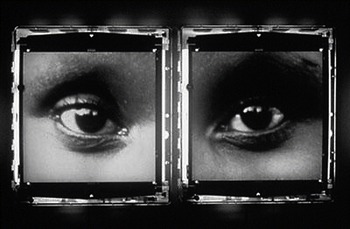
Finally and most importantly in the present context, Jaar's installation ‘The Eyes of Gutete Emerita’, first shown in June 1996, consisted of two light boxes placed side by side in an otherwise empty room with black walls, illuminated only by the light emanating from the boxes showing, for most of the time, text:
The first panel is shown for 45 seconds, the second panel is shown for 30 seconds and the third panel is shown for 15 seconds. In the fourth panel, shown only for a very brief moment, the eyes of Gutete Emerita are shown, disappear and the first panel starts again.Footnote 43 Indeed, a ‘flash is all we have’.Footnote 44 A similar version, made specifically for the artist's website, presents in panels one and two different texts:

Panel 4 then shows the eyes of Gutete Emerita but now the timing of viewing the artwork depends exclusively on the viewer. In another version, shown for the first time in February 1996, the viewer is confronted with a million 35mm slides piled on a huge light-table all of which are showing the eyes of Gutete Emerita: one million deaths, one million slides.Footnote 46 In a third version, shown for the first time in June 1996, the viewers are confronted with and look at their own faces in a mirror: when they expect to see the eyes of Gutete Emerita the only thing they see is their own eyes, thus collapsing the distance between them and Gutete Emerita.
Alfredo Jaar, ‘The Eyes of Gutete Emerita’, 1996, reproduced with permission of Alfredo Jaar Studio, New York.

Discussing ‘The Eyes of Gutete Emerita’, Reinhardt argues that artists can make the viewers contemplate their own connections to and involvement in the depicted scene by not showing what the viewers expect to be shown.Footnote 47 This would seem to be an inverted logic when compared with the standard practice in photojournalism during the 20th century of pushing the boundaries of what is being shown further and further. In Jaar's artwork, the viewers do not see the suffering but only eyes that are said to have seen the suffering (and obviously there is no way for the viewers to know whether these eyes are indeed Gutete Emerita's eyes or someone else's; nor can they verify her tragic story). Jaar's artwork haunts the viewer, not because it shows images depicting brutality but because it alludes visually to brutality only by implication. Thus, images do not necessarily haunt their viewers because they are brutal.Footnote 48 By refusing to show scenes of extreme suffering that were obviously available in Rwanda and photographically documented in abundance, Jaar deviates from the prevailing representational style in photojournalistic accounts of Africa in general and Rwanda in particular. It is precisely the
corpses clogging the Kagera river, bloated and bleached white, collected like driftwood at the base of a falls; dismembered bodies scattered in a churchyard, under a glowing white statue of Christ the Savior, lifting his arms in benediction; and the gray squalor of the refugee camps, with emaciated children turning their huge eyes into the camerasFootnote 49
that Jaar has found impossible, not to take photographs of but to show. He thus refuses to participate in the visual exploitation of the victims and the dissemination of atrocity photographs. He does not contribute to what Sontag has called the world's ‘saturat[ion], no, hyper-saturat[ion] with [atrocity] images’ that is said to ‘have a diminishing effect: we become callous’.Footnote 50 Regardless of whether one agrees with this assessment or not – Sontag herself articulates some scepticism about the statement's appropriateness and asks for evidence ‘that photographs have a diminishing impact, that our culture of spectatorship neutralises the moral force of photographs of atrocities’Footnote 51 – complacency and callousness can hardly result from viewing Jaar's installations. Nor does Jaar expose the viewers of his artwork to the looking/not looking dilemma; he thus renders possible their engagement, not only with the artwork but also with their own involvement in the conditions depicted in the artwork. After all, the Western governments that decided not to get involved in the Rwandan/Tutsi genocide were all democratically legitimated and the Western publics do not seem to have exerted strong pressure on their governments to intervene. Finally, in ‘Field, road, cloud’ Jaar does present, in 1997, three large photographs: a green field of tea, a dirt road illuminated by sunlight, and a white cloud framed by blue sky. While these photographs seem to resonate with the tourist postcards Jaar used in ‘Signs of Life’, he connects them with the memories of the genocide by adding geographical sketches of where the photographs had been taken: the cloud is above Ntarama church, that is, the place where Gutete Emerita witnessed the murder of her husband and sons.
While the photographs from the Vietnam War are said to have ‘brought home uncomfortable truths that people had long had reason to suspect but which did not need to be confronted as long as they remained unproven’,Footnote 52 Alfredo Jaar's Rwanda artwork brings home and makes people confront uncomfortable truths by not showing what they either had long had reason to suspect or what they already knew. By focusing on a very small selection of photographs and by textually implying the existence of (more) photographs, Jaar avoids the typical viewers' response to exhibitions showing too many photographs, namely, to ‘move on’.Footnote 53 Geoff Dyer, describing Ed Clark's photograph ‘Going Home’, writes that ‘as soon as we are moved by it we are ready to move on’Footnote 54 but in the case of ‘The Eyes of Gutete Emerita’ we – or at least some of us; the use of the word ‘we’ in connection with photography is always problematic just as is the use of such words as ‘the audience’ and ‘the viewer’ – are ready to move back to the first panel, unable to move on, frustrated by the brief encounter with Gutete Emerita's eyes and curious to see more (while simultaneously being afraid of seeing more). By breaking with the standard style of representing Africa, by
refusing to meet [the viewers'] expectations, by showing not the acts of violence but eyes that witnessed so much of it, The Eyes of Gutete Emerita engages the limits of representation in situations of extremity – and not as an abstract philosophical question but as one in which viewers of the work are implicated. Viewers are prompted to place their imagined or wished for or feared images against those we are typically shown and against the simple, haunting, image Jaar provides.Footnote 55
Obviously, there is no guarantee that the viewers in fact respond to Jaar's installation by acknowledging their involvement in that which the artwork thematises. They might impatiently turn away, frustrated perhaps, angry perhaps, annoyed, even ‘physically ill at the sight of Gutete Emerita's eyes’.Footnote 56 Still, Jaar's installation would seem to be a way, not to solve but to circumnavigate the problem of looking/not looking. This requires a joint effort of artist and viewer: by directing the viewers' attention to human suffering that, however, is depicted only by implication, Jaar does not expose them to the moral dilemma of becoming involved in a crime by looking at a picture of it while at the same time not being able not to look if they do not want to exclude themselves from the public as a part of which – and only as a part of which – they could hope to respond politically.
Conclusion: Dead troops don't talk, dead kids don't smile
As the above interludes discussing two Jeff Wall photographs indicate, Alfredo Jaar's work is not the only possible way to circumvent the looking/not looking dilemma. While Jaar does not show what the viewers expect to see, Wall breaks with patterns of representation and expectation by using irony and black humour and, by so doing, expands the limits of representation. Violating and expanding these limits have always been essential ingredients of war photographs that can often be understood as ‘picture[s] that shouldn't be shown of an event that shouldn't have happened’: ‘Girls should not be shown stripped bare in public; civilians should not be bombed’.Footnote 57 Children should not be soldiers. ‘Dead Troops Talk (A vision after the ambush of a Red Army patrol, near Moqor, Afghanistan, winter 1986)’ violates photojournalism's traditional credo according to which war photographs should be taken by photographers on the spot and document what ‘really’ happened but Wall is not a photojournalist. He argues that ‘[w]hat an artist could do with photography wasn't bounded by the documentary impulse’.Footnote 58 His large photographs, many of which are transparencies in light-boxes, are meant to be exhibited in museums and galleries; his ‘near-documentary’Footnote 59 works are carefully staged and designed, in part reproductions of scenes he observed in the ‘real’ world, re-enacted in the studio with the help of professional and non-professional actors, emulating real-life scenes but, like every representation, constructing something new.
As ironic images, both ‘War Game’ and ‘Dead Troops Talk (A vision after the ambush of a Red Army patrol, near Moqor, Afghanistan, winter 1986)’ also violate other conventions of war photography. After all, the one thing war photography is not is ironic. The two works are shocking because they show not only what could have happened or what might happen; every viewer knows that such things do happen regularly on battlefields and in backyards – except that dead kids do not smile and ‘[d]ead soldiers don't talk. Here they do.’Footnote 60 And why should they not? After all, as Wall argues, black humour is a perfectly plausible reaction to the absurd circumstances they find themselves in.Footnote 61 ‘These dead are supremely uninterested in the living: in those who took their lives; in witnesses – and in us.’Footnote 62 And why should they be interested in us? After all, what do they have to expect from us? Like Rwanda, the Western public has never been particularly interested in Afghanistan and the victims of its many wars. And the discipline of International Relations is not particularly interested in the everyday violence of and the war games played in the backyards of our cities. If Wall's joking and smiling dead move us, we move on. The viewers, however, might not be moved by Wall's installation but shocked, and they might be shocked, not by the violence of the scene – which is quite substantial in the case of ‘Dead Troops Talk (A vision after the ambush of a Red Army patrol, near Moqor, Afghanistan, winter 1986)’ – but rather by its implausibility and its characters' nonchalant approach to their wounds, their mutilations and their deaths. Like every shock effect, this one, too, has to be absorbed by what Walter Benjamin, with reference to film, has called ‘heightened presence of mind’Footnote 63 enabling the viewer, perhaps, to interrogate self-reflexively his or her own subject position when viewing images that (seem to) depict human suffering. At the same time, as ironic fabrications constructed with the help of performers they do not expose the viewers to the moral dilemmas connected with the taking, publishing, circulating and viewing of images of human suffering developed above. As such, Wall's work – like Jaar's – is an invitation to engagement that does not simultaneously make such an engagement impossible by exposing the viewer to the looking/not looking dilemma. Importantly, it does not ridicule the real victims of real wars and other forms of human suffering.