


Introduction
Lack of replicability in science is the failure to reproduce the same results of existing scientific studies (Open Science Collaboration 2015). The problem has been systematically studied in fields, such as psychology, where replication rates can be as low as 25–50% (Open Science Collaboration 2015; Camerer et al. Reference Camerer, Dreber, Holzmeister, Ho, Huber, Johannesson, Kirchler, Nave, Nosek, Pfeiffer, Altmejd, Buttrick, Chan, Chen, Forsell, Gampa, Heikensten, Hummer, Imai, Isaksson, Manfredi, Rose, Wagenmakers and Wu2018). There are several reasons for this reduced level of replicability, including the use of questionable research practices (e.g. p-hacking or HARKing), lack of transparency in the research process, and publication biases toward positive findings (Open Science Collaboration 2015; Camerer et al. Reference Camerer, Dreber, Holzmeister, Ho, Huber, Johannesson, Kirchler, Nave, Nosek, Pfeiffer, Altmejd, Buttrick, Chan, Chen, Forsell, Gampa, Heikensten, Hummer, Imai, Isaksson, Manfredi, Rose, Wagenmakers and Wu2018; Frias-Navarro et al. Reference Frias-Navarro, Pascual-Llobell, Pascual-Soler, Perezgonzalez and Berrios-Riquelme2020). In the field of animal behaviour and welfare, studies may further suffer from low replicability due to different testing conditions (e.g. breeds, environments, individual characteristics), different methodological approaches (e.g. variations in ethograms), and/or relatively restricted sample sizes, all of which may contribute to low external validity, uncertain statistical outcomes, and/or poor generalisability (for related points in the area of animal cognition research, see Farrar et al. Reference Farrar, Boeckle and Clayton2020).
Researchers have recently implemented several individual and structural changes to improve internal validity, such as pre-registration and systematic double-blind procedures for data coding and analysis (see Thibault et al. Reference Thibault, Amaral, Argolo, Bandrowski, Davidson and Drude2023). These practices aim to improve transparency, reduce questionable research practices, and increase the reliability of scientific findings. Another major advancement has been the establishment of large-scale scientific collaborations, bringing together multiple research centres and facilities worldwide. In these large-scale collaborations, researchers establish a shared set of concepts and definitions, develop identical research protocols, collect data on individual sites, and pool data for analysis while taking into consideration the key steps to ensure internal validity (see points above). This so-called Big Team Science (hereafter BTS) approach enables the generation of large high-quality datasets with increased heterogeneity and higher power of the corresponding analysis, allowing researchers to obtain more reliable estimates and explicitly account for variation in the behaviours studied, thus improving both replicability and generalisability (Baumgartner et al. Reference Baumgartner, Alessandroni, Byers-Heinlein, Frank, Hamlin, Soderstrom, Voelkel, Willer, Yuen and Coles2023; Forscher et al. Reference Forscher, Wagenmakers, Coles, Silan, Dutra, Basnight-Brown and IJzerman2023; Alessandroni et al. Reference Alessandroni, Altschul, Bazhydai, Byers-Heinlein, Elsherif, Gjoneska, Huber, Mazza, Miller, Nawroth, Pronizius, Qadri, Šlipogor, Soderstrom, Stevens, Visser, Williams, Zettersten and Prétôt2024). This is especially important in comparative studies, because these approaches reduce spurious differences and better capture the multiple factors that may contribute to explaining variation in responses (Forscher et al. Reference Forscher, Wagenmakers, Coles, Silan, Dutra, Basnight-Brown and IJzerman2023, Alessandroni et al. Reference Alessandroni, Altschul, Bazhydai, Byers-Heinlein, Elsherif, Gjoneska, Huber, Mazza, Miller, Nawroth, Pronizius, Qadri, Šlipogor, Soderstrom, Stevens, Visser, Williams, Zettersten and Prétôt2024). Inspired by BTS approaches in human psychological research, such as ManyLabs (Klein et al. Reference Klein, Ratliff, Vianello, Adams, Bahník, Bernstein, Bocian, Brandt, Brooks, Brumbaugh, Cemalcilar, Chandler, Cheong, Davis, Devos, Eisner, Frankowska, Furrow, Galliani, Hasselman, Hicks, Hovermale, Hunt, Huntsinger, IJzerman, John, Joy-Gaba, Barry Kappes, Krueger, Kurtz, Levitan, Mallett, Morris, Nelson, Nier, Packard, Pilati, Rutchick, Schmidt, Skorinko, Smith, Steiner, Storbeck, Van Swol, Thompson, Van ‘T Veer, Ann Vaughn, Vranka, Wichman, Woodzicka and Nosek2014) and ManyBabies (Klein et al. Reference Klein, Ratliff, Vianello, Adams, Bahník, Bernstein, Bocian, Brandt, Brooks, Brumbaugh, Cemalcilar, Chandler, Cheong, Davis, Devos, Eisner, Frankowska, Furrow, Galliani, Hasselman, Hicks, Hovermale, Hunt, Huntsinger, IJzerman, John, Joy-Gaba, Barry Kappes, Krueger, Kurtz, Levitan, Mallett, Morris, Nelson, Nier, Packard, Pilati, Rutchick, Schmidt, Skorinko, Smith, Steiner, Storbeck, Van Swol, Thompson, Van ‘T Veer, Ann Vaughn, Vranka, Wichman, Woodzicka and Nosek2014), other initiatives focused on behaviour and cognition in non-human animals have also emerged to enhance reproducibility and applicability in their respective fields. These include ManyPrimates (ManyPrimates et al. Reference Altschul, Beran, Bohn, Call, DeTroy, Duguid, Egelkamp, Fichtel, Fischer, Flessert, Hanus, Haun, Haux, Hernandez-Aguilar, Herrmann, Hopper, Joly, Kano, Keupp, Melis, Motes Rodrigo, Ross, Sánchez-Amaro, Sato, Schmitt, Schweinfurth, Seed, Taylor, Völter, Warren and Watzek2019), ManyBirds (Lambert et al. Reference Lambert, Farrar, Garcia-Pelegrin, Reber and Miller2022), ManyDogs (ManyDogs Project et al. Reference ManyDogs Project, Alberghina, Bray, Buchsbaum, Byosiere, Espinosa, Gnanadesikan, Guran, Hare, Horschler, Huber, Kuhlmeier, MacLean, Pelgrim, Perez, Ravid-Schurr, Rothkoff, Sexton, Silver and Stevens2023), ManyZoos (Barrett et al. Reference Barrett, Clark, Freeman, Williams and O’Connor2025), ManyFishes (Prétôt et al. Reference Prétôt, Agrillo, Bluck, Cabrera-Álvarez, Héjja-Brichard, Irwin, Klinke, Lucon-Xiccato, Newport, Segev and Yeager2025), ManyOtters (https://manyotters.github.io/), ManyPigs (https://www.manypigs.com/) and ManyManys (Alessandroni et al. Reference Alessandroni, Altschul, Bazhydai, Byers-Heinlein, Elsherif, Gjoneska, Huber, Mazza, Miller, Nawroth, Pronizius, Qadri, Šlipogor, Soderstrom, Stevens, Visser, Williams, Zettersten and Prétôt2024, Reference Alessandroni, Altschul, Baumgartner, Bazhydai, Brosnan, Byers-Heinlein, Call, Chittka, Elsherif, Espinosa, Freeman, Gjoneska, Güntürkün, Huber, Krasheninnikova, Mazza, Miller, Moreau, Nawroth, Pronizius, Ruiz-Fernández, Schwing, Šlipogor, Visser, Vonk, Yeager, Zettersten and Prétôt2025).
Societal concern for the treatment of animals has increased, driven by growing awareness of welfare problems in intensive production systems produced by animal welfare research. Historically, due to ethical concerns about the care and treatment of animals under human management (Fraser et al. Reference Fraser, Weary, Pajor and Milligan1997), animal welfare research took an early focus on alleviating pain and suffering (reflected in formal frameworks, such as the Five Freedoms; Brambell Reference Brambell1965). The field has more recently explicitly embraced the study and facilitation of positive welfare states (Boissy et al. Reference Boissy, Manteuffel, Jensen, Moe, Spruijt, Keeling, Winckler, Forkman, Dimitrov, Langbein, Bakken, Veissier and Aubert2007; Mellor & Beausoleil Reference Mellor and Beausoleil2015), of which focus on the affective component of animals’ sensory and perceptual worlds becomes particularly relevant (Nielsen Reference Nielsen2018).
Here, then, is where BTS approaches are particularly valuable for the scientific study of animal behaviour and welfare. First, they can bring together many scientists to establish consensus positions on definitions or concepts within the field at the start of the research process, so that sites can collaboratively establish standardised protocols, increasing the consistency of methods across research sites (Forscher et al. Reference Forscher, Wagenmakers, Coles, Silan, Dutra, Basnight-Brown and IJzerman2023; Alessandroni et al. Reference Alessandroni, Altschul, Bazhydai, Byers-Heinlein, Elsherif, Gjoneska, Huber, Mazza, Miller, Nawroth, Pronizius, Qadri, Šlipogor, Soderstrom, Stevens, Visser, Williams, Zettersten and Prétôt2024). Moreover, by harnessing research collaborators across multiple sites, BTS approaches increase not only the number of animals included in the research but also the diversity of animals studied (e.g. species, breeds, previous experiences), ultimately facilitating the inclusion of research sites and animals that, on their own, could not contribute data impactful enough to be published. Thus, this approach enables researchers, as a collective group, to answer questions and collect substantially larger sample sizes than one research team could gather alone and independently (Bensky et al. Reference Bensky, Gosling and Sinn2013; Baumgartner et al. Reference Baumgartner, Alessandroni, Byers-Heinlein, Frank, Hamlin, Soderstrom, Voelkel, Willer, Yuen and Coles2023). However, despite the potential advantages, there is currently no systematic and structured implementation of BTS approaches to tackle comparable challenges in farm animal behaviour and welfare research (Faverjon et al. Reference Faverjon, Bernstein, Grütter, Nathues, Nathues, Sarasua, Sterchi, Vargas and Berezowski2019). This horizon article introduces a new BTS initiative, the ManyGoats initiative (hereafter ‘ManyGoats’). To this end, we discuss the potential benefits and challenges involved with BTS approaches that specifically pertain to farm animal behaviour and welfare research, review the characteristics of previous goat behaviour and welfare research, and introduce the aims and scope of the ManyGoats initiative.
Benefits and challenges of multi-site studies in farm animal welfare research
Multi-site farm animal welfare studies, as is the case for a BTS approach, offer both significant benefits and challenges. While multi-site studies increase the generalisability and robustness of findings by incorporating different environments, management practices, and genetic backgrounds, they also introduce logistical and methodological complexities. Several benefits and challenges focusing on BTS approaches in general (Forscher et al. Reference Forscher, Wagenmakers, Coles, Silan, Dutra, Basnight-Brown and IJzerman2023) and in specific fields (e.g. comparative psychology; Alessandroni et al. Reference Alessandroni, Altschul, Baumgartner, Bazhydai, Brosnan, Byers-Heinlein, Call, Chittka, Elsherif, Espinosa, Freeman, Gjoneska, Güntürkün, Huber, Krasheninnikova, Mazza, Miller, Moreau, Nawroth, Pronizius, Ruiz-Fernández, Schwing, Šlipogor, Visser, Vonk, Yeager, Zettersten and Prétôt2025) have been previously addressed.
Here, we provide a discussion that focuses on two dimensions: first, the benefits and challenges of BTS in animal welfare research regarding both the specific study population as well as potential 3Rs implementation. Second, we consider the relationship between BTS approaches to animal welfare research per se and their potential for policy implementation. While we acknowledge some overlap and potential synergies between these dimensions, we emphasise that their distinct aims warrant separate discussions.
Welfare of the studied animal population
BTS benefits: Better adherence to and implementation of the 3Rs
We posit that a BTS approach might promote stronger researcher adherence to the 3Rs’ principles, particularly those of reduction and refinement (Russell & Burch Reference Russell and Burch1960; Würbel Reference Würbel2017). For example, although BTS approaches deploy test protocols over multiple sites (in the short-term involving more animals), a single coordinated effort to pursue a specific research question may simultaneously reduce the occurrence of uncoordinated, individual and potentially underpowered attempts to answer welfare-related questions that may fail to answer the question. Additionally, it may minimise the need for single labs to repeat experiments several times, reducing the total number of individuals exposed to aversive treatments or suboptimal control conditions in the long-term (e.g. Voelkl et al. Reference Voelkl, Vogt, Sena and Würbel2018 for laboratory animals). Theoretically, larger datasets generated from such approaches could also be later reused to pursue additional research questions without the need to test additional animals. Further, determination of optimal sample sizes could be cross-validated by members, optimising the chance that results of the experiment are robust, of high external validity, and at the same time, only the minimum number of animals required to answer the research question are used.
With respect to refinement, by harnessing a diverse set of research expertise to inform the design of study protocols, a BTS approach is, in theory, likelier than siloed efforts by individual research groups to identify and use methods that adhere to current best practices regarding the welfare of research animals, and to innovate new and widely applicable welfare-friendly methods. In other words, more minds coming together from different training backgrounds and experience in different facilities may contribute to greater refinement of animal use in the research process. While this is not a unique characteristic of BTS, such approaches, like other large collaborative efforts, share the benefit of bringing a broader diversity of expertise and perspectives to bear on study design and implementation.
BTS challenges during study planning: Reduction and refinement (3Rs) vs statistical power
The balance between reduction/refinement and study power is especially crucial when research involves subjecting animals to aversive welfare conditions (Eggel & Würbel Reference Eggel and Würbel2021). To achieve both ethical and scientific rigour, accurate information is needed from pilot studies, previous research, and their reported effect sizes, especially if a BTS project has the potential to induce harm or stress to animals exposed to specific test or control conditions. If this is the case, clear and upfront discussions are necessary to determine what effect size of a particular treatment might be considered welfare-relevant and how all involved labs can contribute to refinement measures, ensuring that studies are both adequately powered and aligned with ethical principles. It should be recognised that some research questions regarding farmed species in a specific region or context may not be appropriately addressed via a BTS approach, though it is still relevant and important to address and improve upon their specific welfare concerns.
BTS challenges during data collection: Limited flexibility to adapt the study protocol to site-specific conditions or limitations
Welfare policies vary across husbandry contexts and especially across institutions, countries and regions (von Keyserlingk & Hötzel Reference von Keyserlingk and Hötzel2015). This may not only limit the potential global impact of BTS studies but also complicate the practical implementation of their outcomes (Hårstad Reference Hårstad2024). For instance, conducting a study on goat disbudding or castration may be unjustifiable in regions where this practice is outlawed. Additionally, different animal ethics committees may impose different requirements with regard to animal husbandry or specific aspects of experiments. The diversity of research labs can further complicate matters, as differing national regulations can lead to misalignment among researchers’ goals and make it challenging to identify common ground for policy-relevant research questions. Since the same protocol must be applied across a variety of husbandry contexts worldwide, researchers at individual sites may be unable to modify it to accommodate site- or regional-specific limitations. Therefore, research questions should be shaped through diverse perspectives, and study protocols should be designed with flexibility and inclusivity in mind.
Impacts on animal welfare research and policy
BTS benefits: Diverse research teams foster innovation and provide synergies
The networking component of BTS approaches should not be overlooked. By connecting research teams across disciplines and regions, BTS fosters innovation and enhances research quality (Stahl et al. Reference Stahl, Maznevski, Voigt and Jonsen2010). Although spatial proximity is an important factor driving innovation by knowledge spill-over (Läpple et al. Reference Läpple, Renwick, Cullinan and Thorne2016), BTS has the potential to overcome geographical borders by connecting a large number of researchers from all over the world via digital technologies, thus significantly contributing to knowledge distribution and innovation. Capacity building and knowledge networks are particularly crucial in the field of animal welfare, which is still relatively young, heavily interdisciplinary, and carries significant ethical implications (Sandøe et al. Reference Sandøe, Christiansen and Appleby2003). Since research in this field involves sentient beings, ensuring methodological rigour and accuracy is essential to uphold ethical standards and maximise impact. Furthermore, the development of shared strategies and common outcomes helps to minimise unproductive competition, where the priority may be to claim ownership rather than to advance the best ideas. Initiatives such as BTS exemplify effective collaboration and promote the adoption of improved practices. Overall, fostering collaboration and reducing counterproductive competition may contribute to a more constructive and efficient working environment, ultimately benefiting animal welfare in the long term.
BTS benefits: Improved policy development
Policy recommendations require rigorous, high-powered studies to effectively improve animal welfare in husbandry settings (LeBel et al. Reference LeBel, Campbell and Loving2017). By employing BTS approaches in animal welfare research, we have the potential to improve research quality and external validity, thereby increasing the likelihood of influencing policy and making a meaningful impact on animal welfare standards and regulations. BTS approaches offer numerous benefits to data quality, including a stronger theoretical framework, a larger sample size, and greater heterogeneity in samples. A robust theoretical framework, supported by knowledge dissemination and capacity building, fosters more comprehensive and well-informed research. Larger sample sizes, in turn, improve the ability to detect small or medium effect sizes — an important advantage, as even minor improvements can significantly enhance welfare given the vast number of animals housed worldwide. Additionally, BTS supports the ability to acknowledge and include diverse husbandry systems and breeds that are often underrepresented in the literature, increasing external validity and ensuring that findings are more broadly applicable. Indeed, high levels of environmental standardisation, as is common, for example, in laboratory experiments, have been demonstrated to lower the reproducibility of the experiments (Richter et al. Reference Richter, Garner and Würbel2009).
Further, the influence of science on policymakers is shaped not only by the quality of research but also by the collective engagement of multiple voices addressing the same issue. A BTS approach can coordinate efforts and amplify the impact of research findings through a unified set of voices. Collectively, we anticipate that these characteristics of BTS applied to the farm animal welfare context will not only safeguard the detection of true and generalisable effects but also improve their translation from research to practice by informing policy development.
BTS challenges during interpretation and translation into policy: Trade-off between standardisation and heterogeneity
A decrease in standardisation could introduce excessive or biased heterogeneity, particularly in on-farm research, where certain standardisations may not be practical (Bushby et al. Reference Bushby, Friel, Goold, Gray, Smith and Collins2018). For example, specific breeds may be exclusively used in extensive farming systems, limiting the generalisability of findings across different production settings. Results from highly heterogeneous research may also be considered over-generalised if applied to create policy or best practice recommendations for animal welfare around the world. Indeed, farmers are often resistant to what is considered a “one size fits all” policy because of the context-specific nature of farming systems (e.g. Balzani & Hanlon Reference Balzani and Hanlon2020). If the research includes data from systems similar to their own, this resistance might be mitigated, but it may not fully resolve their concerns.
Snapshot review of study contexts in goat behaviour and welfare research
It is within this context that we now turn to how BTS approaches may be applied to the study of goats. The ManyGoats initiative focuses on goats as a model species given their established role in farm animal behaviour and welfare research (Battini et al. Reference Battini, Vieira, Barbieri, Ajuda, Stilwell and Mattiello2014; Nawroth Reference Nawroth2017; Nawroth et al. Reference Nawroth, Langbein, Coulon, Gabor, Oesterwind, Benz-Schwarzburg and von Borell2019) and their global significance as a key livestock species, with an estimated population of around 1.1 billion animals worldwide (‘FAOSTAT’ 2023).
As in many other livestock species, research on goat behaviour and welfare has evolved from broad animal welfare frameworks (e.g. the Five Freedoms and Five Domains models) focused primarily on the prevention of suffering by understanding species-specific behaviour. More recently, research has sought a deeper understanding of goats as socially and cognitively complex animals, alongside increasing attention to the promotion of positive welfare states. Studies have demonstrated that goats form stable social hierarchies, recognise conspecifics, and exhibit advanced cognitive abilities, including problem-solving skills (Deutsch et al. Reference Deutsch, Langbein and Nawroth2025). Moreover, both positive and negative emotional states in goats can be assessed through physiological and behavioural indicators (Briefer et al. Reference Briefer, Tettamanti and McElligott2015). Research on housing and management has further highlighted the need for species-appropriate environmental features, adequate space provision at feeding areas, and positive human-animal interactions for improving welfare outcomes (Boivin & Braastad Reference Boivin and Braastad1996; Aschwanden et al. Reference Aschwanden, Gygax, Wechsler and Keil2009, Battini et al. Reference Battini, Vieira, Barbieri, Ajuda, Stilwell and Mattiello2014; Nordmann et al. Reference Nordmann, Barth, Futschik, Palme and Waiblinger2015).
Worldwide, goats are kept in various contexts (e.g. in farms, zoos, or sanctuaries) and are bred for a range of different production outputs (meat, dairy, wool). This diversity in use and context suggests that husbandry or management recommendations derived from individual studies may fall short as, like many other behaviour studies, the majority of behaviour and welfare studies in goats are likely conducted in single-site and single-breed contexts.
To address these considerations, we conducted a brief, snapshot scoping review to assess the general study and population characteristics of goat behaviour and welfare research. Although our focus is on studies involving goats, we encourage researchers working with other farm animal species to systematically evaluate potential sample population biases, as their consequences on the generalisation of study outcomes are likely to be similar across species.
The initial literature search was performed by one author (OS) on Scopus and Web of Science on 27th February 2024 using the following search queries:
Web Of Science
TI = goat$ AND (welfare OR cognit* OR behav* OR “human-animal interaction$” OR “human-animal relationship$” OR emot* OR pain assessment OR vocal* OR “facial expression$” OR social OR stress OR communicat*) AND NOT (“cold stress” OR “heat stress” OR “oxidative stress” OR “gene”)
OR
AB = goat$ AND (welfare OR cognit* OR behav* OR “human-animal interaction$” OR “human-animal relationship$” OR emot* OR pain assessment OR vocal* OR “facial expression$” OR social OR stress OR communicat*) AND NOT (“cold stress” OR “heat stress” OR “oxidative stress” OR “gene”).
Scopus
TITLE-ABS-KEY (goat$ AND [cognit* OR behav* OR welfare OR “human-animal relationship$” OR “human-animal interaction$” OR emotion$ OR “pain assessment$” OR vocal* OR “facial expression$” OR social OR stress OR communicat*) AND NOT (“gene” OR “heat stress” OR “cold stress” OR “oxidative stress”]) AND PUBYEAR > 2013 AND PUBYEAR < 2025 AND (LIMIT-TO [DOCTYPE, “ar”]) AND (LIMIT-TO [SUBJAREA, “AGRI”] OR LIMIT-TO [SUBJAREA, “VETE”] OR LIMIT-TO [SUBJAREA, “NEUR”]) AND (LIMIT-TO [LANGUAGE, “English”]).
Search summary
We limited the search to articles published between 2014 and 2024, in English, in the fields of Agriculture, Biology, Veterinary Sciences and Neurology. We only selected full papers reporting empirical studies published in peer-reviewed journals (i.e. no review or conference papers). We included studies on both domesticated and wild goats.
The search yielded 1,369 records (Scopus: 607 records; Web of Science: 762 records) from which OS deleted duplicate (n = 486) and irrelevant records (n = 265), leaving 618 records in the final dataset. OS screened all the titles and deemed records to be irrelevant if they focused on genetics, human behaviour (e.g. meat consumption acceptance, farmer perception) or exclusively productivity parameters (e.g. milk yield). The records were then split equally across eight coders (MBa, MBe, SC, JD, CR-B, OS, JMT, SW) who manually eliminated records that were not relevant for this scoping review (i.e. articles that did not contain at least one behavioural parameter as an outcome variable; n = 403), leaving 215 records from which to extract data. The same eight coders then extracted data on general study and population characteristics. General study characteristics included the following: number of test sites, sample size (total number of animals used), husbandry contexts (“Animal-assisted therapy”, “Commercial farm”, “Pet”, “Research farm”, “Sanctuary”, “Zoo”, “Not reported”), and location (country in which experiment was performed). Study population characteristics included: sex of the study subjects (“Males only”, “Females only”, “Both males and females”, “Not reported”), age category of study subjects (“Adult” [i.e. animals of 13 months or older], “Young” [i.e. animals up to 12 months of age], “Mother-offspring”, “Mixed ages”, “Not reported”), and breeds used (number and name of the breed or crossbreed). In studies using sheep and goats, only the goat subjects were considered for the results. The full dataset containing the extracted data is available here: https://osf.io/jr3df/.
Snapshot review: General study characteristics
The vast majority of studies (85% of 215) were conducted at only one site, while 15% were conducted at two or more sites (Figure 1). The multi-site studies ranged from two to sixty sites, with most of the multi-site studies being conducted on commercial farms. Most studies (63%) used less than 40 animals in their sample (Figure 1). Studies using over 100 animals (14%) were usually on-farm studies focused on welfare assessment. Most were conducted either in (commercial) farm settings (44%) or research facilities (i.e. university/institution research farm; 41%), a few were performed at sanctuaries (4%) and zoos (1%), and 9% did not report the husbandry context in which the experimental work was done (Figure 1). No studies included samples of pet goats or goats used in animal-assisted interventions. Research was most commonly based in Mexico (12%), Brazil (10%) and Germany (10%) (Figure 2).
General characteristics description of studies on goat behaviour and welfare included in a snapshot review (n = 215): ‘Number of sites’, ‘Sample size’ (total number of animals used) and ‘Husbandry context’ of the studies. Data are expressed as percentages of studies in each category within a characteristic.

World map showing the number of studies of goat behaviour and welfare (n = 215 total) performed per country according to the criteria extracted from the snapshot review.

Snapshot review: Study population
More than half of the studies (55%) used female goats only, a quarter used both sexes (25%), 10% used males only, and 10% did not report the sex of the animals used (Figure 3). Most studies involved only adult animals (i.e. animals equal to or older than 13 months old; 46%) and young animals (i.e. animals up to 12 months old; 24%; Figure 3). Mother-offspring studies (4%) and mixed-age studies (6%) were relatively uncommon. In 43 studies (20%), the age of the subjects was not clearly stated.
Description of the population characteristics of studies on goat behaviour and welfare included in a snapshot review (n = 215): ‘Sex’, ‘Age category’ (where “adults” = individuals 13 months or older), and ‘Number of breeds’ of the subjects used. Data are expressed as percentages of studies in each category, within a characteristic.

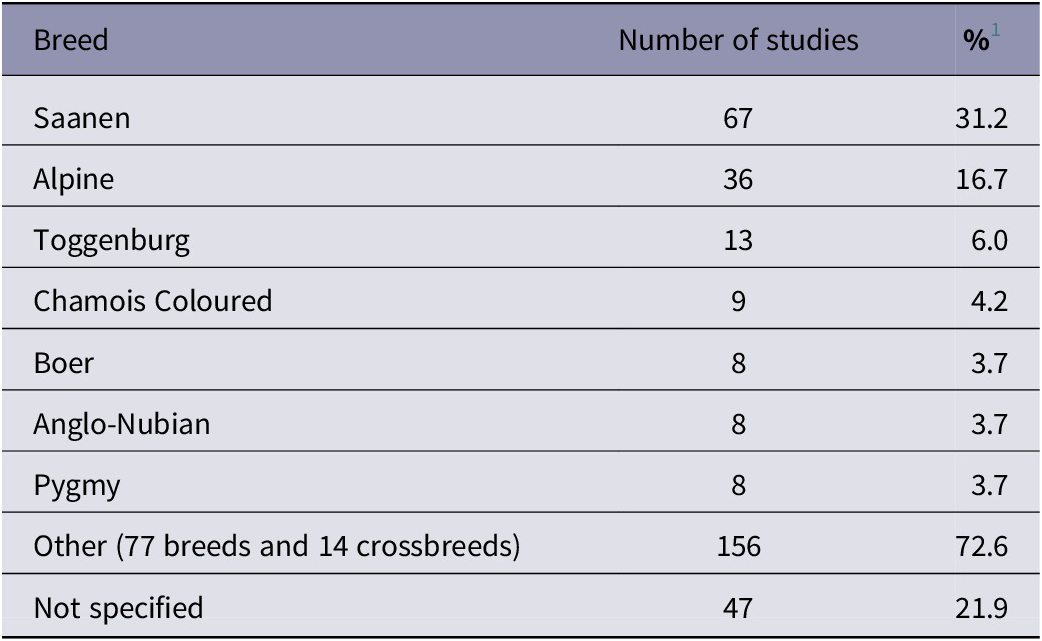
Most studies (61.3%) used only one breed of goats, 11.2% used two breeds, and 16.3% used more than two breeds (range: 3–11; Figure 3). The number of breeds used was not reported in 11.2% of the studies. The specific breed or crossbreed was not specified in 22% of the studies (i.e. 47 out of the 215 studies). A total of 102 breeds and crossbreeds were mentioned across the remaining 168 studies. The most common breeds used were Saanen (and local variations of the Saanen breed; 31.2%) and Alpine (16.7%; Table 1).
Main goat breeds used in studies included in a snapshot review of goat behaviour and welfare (n = 215)

Table 1. Long description
The table consists of three columns: Breed, Number of studies, and percent super 1.
* Saanen: 67 studies, 31.2 percent.
* Alpine: 36 studies, 16.7 percent.
* Toggenburg: 13 studies, 6.0 percent.
* Chamois Coloured: 9 studies, 4.2 percent.
* Boer: 8 studies, 3.7 percent.
* Anglo-Nubian: 8 studies, 3.7 percent.
* Pygmy: 8 studies, 3.7 percent.
* Other (77 breeds and 14 crossbreeds): 156 studies, 72.6 percent.
* Not specified: 47 studies, 21.9 percent.
A footnote marked 1 states: As some studies used multiple breeds and crossbreeds, the total percentage exceeds 100 percent.
1 As some studies used multiple breeds and crossbreeds, the total percentage exceeds 100%.
It is worth mentioning that a proportion of the studies did not report important information such as sex (10%), breed (25%) and age (20%) or the number of animals used (7%). As the number of studies that do not report study subject or characteristics should be close to zero from a transparency and reproducibility perspective, a stronger adherence to reporting guidelines, such as ARRIVE, is warranted for the field of goat behaviour and welfare (Percie Du Sert et al. Reference Percie Du Sert, Hurst, Ahluwalia, Alam, Avey, Baker, Browne, Clark, Cuthill, Dirnagl, Emerson, Garner, Holgate, Howells, Karp, Lazic, Lidster, MacCallum, Macleod, Pearl, Petersen, Rawle, Reynolds, Rooney, Sena, Silberberg, Steckler and Würbel2020).
Overall, these results highlight several biases within the field of goat behaviour and welfare research: most studies were conducted at a single site (often located geographically in Europe or the Americas, which geographically only represent about 5% of the worldwide goat population; ‘FAOSTAT’ 2023), on single breeds (mostly Saanen or Alpine), and with fewer than 40, mostly female adult, animals. This hinders the generalisability of research findings, and it is evident that approaches to heterogenising samples are urgently needed to address this problem. From this perspective, the implementation of multi-site studies to include more breeds and individuals appears to be a challenging yet powerful tool to reduce current biases in the study of goat behaviour and welfare.
Introducing Big Team Science to goat behaviour and welfare research: The ManyGoats initiative
Building on the success of similar BTS initiatives in animal behaviour research, we launched the ManyGoats initiative. ManyGoats brings together an international team of experts on goat behaviour and welfare, with the aim to enhance external validity, generalisability and robustness of findings in the study of goats, as well as widen accessibility of goat research.
Our approach involves: (i) implementing identical experimental protocols to simultaneously test a high number of individual goats across many different facilities and husbandry contexts around the world; and (ii) promoting increased research efficiency and quality via our knowledge-sharing network. Aligned with Open Science principles (Vicente-Saez & Martinez-Fuentes Reference Vicente-Saez and Martinez-Fuentes2018; Muñoz-Tamayo et al. Reference Muñoz-Tamayo, Nielsen, Gagaoua, Gondret, Krause, Morgavi, Olsson, Pastell, Taghipoor, Tedeschi, Veissier and Nawroth2022), we prioritise transparency, inclusivity, and accessibility. This includes pre-registering study protocols, pre-printing and publishing results via Open Access, and depositing data in publicly available repositories (Muñoz-Tamayo et al. Reference Muñoz-Tamayo, Nielsen, Gagaoua, Gondret, Krause, Morgavi, Olsson, Pastell, Taghipoor, Tedeschi, Veissier and Nawroth2022).
ManyGoats currently comprises more than 35 researchers across five continents, with ongoing efforts to expand participation (with poster presentations at international conferences, such as UFAW [now Science for Animal Welfare] and ISAE, as well as a homepage with further information [https://www.themanygoatsproject.com]), particularly among researchers in major goat-producing regions. Our team brings together expertise in goat behaviour and welfare, statistical modelling and animal ethics. This diversity brings a secondary benefit to the members of ManyGoats, and especially to early-career researchers, who can gain the opportunity to work with more established researchers and develop their scientific and leadership skills.
Our code of conduct includes the following: First, we foster an inclusive and collaborative research environment in which researchers from diverse backgrounds can work together, merging their different expertise. Second, we prioritise the welfare and ethical treatment of our study subjects, aiming to reduce stress and discomfort during experimental procedures as much as possible, and favouring positive rewards over aversive stimuli. Third, we commit to the highest standards of scientific integrity, using standardised pre-registered protocols that increase external validity and generalisability. We aim to ensure accuracy and transparency throughout data collection and analysis and actively work to minimise biases in reporting and interpreting findings. For example, we prioritise blinding by assigning different team members to collect and anonymise data, while others independently analyse it, thereby ensuring that our findings remain objective and unbiased. Fourth, we adhere to the principles of Open Science and data transparency, making our study protocols and data publicly available, and publishing our research Open Access. Fifth, we commit to ethical data management, storing videos of our experiments in multiple copies, to ensure that data are available long-term, with privacy protected, to third parties and/or to address other research questions. Sixth, we aim to share our findings with the general public in a clear and accessible way, being accurate and responsible in our claims, but also making scientific knowledge easy to understand for non-experts. By participating in the ManyGoats initiative, researchers agree to abide by this code of conduct.
Our first proof of concept study, ManyGoats1 (ManyGoats et al. Reference Manygoats, Battini, Berthelot, Daros, Freeman, Nawroth, Neave, Ventura and Zobel2024), will explore how different human attentional states influence goats’ avoidance distance across diverse settings. At the same time, it will test whether our infrastructure, protocols, and data tools are ready to support large-scale collaborative research.
Animal welfare implications and conclusion
Applying BTS (Big Team Science) approaches to farm animal behaviour and welfare research has the potential to improve the way studies in this field are conducted, resulting in more ethical, generalisable and robust findings. In this context, we introduce the ManyGoats initiative, which aims to implement BTS methods in goat behaviour and welfare research. Although applying BTS approaches to animal welfare studies presents several challenges, it is a vital step towards improving animal welfare in practice. By generating generalisable findings, or at least findings that can be clearly applied to a variety of specific contexts of goat management and use, this approach can help to bridge the gap between research and real-world welfare improvements. Ultimately, it will support the development of evidence-based welfare standards and policy.
Data availability statement
All data have been made available via an OSF repository: https://osf.io/jr3df/.
Acknowledgements
We would like to thank the ‘ManyMembers’ of ManyPrimates, ManyDogs, and ManyManys for their numerous informal discussions, email exchanges, and constructive feedback on setting up and managing BTS initiatives. RD was supported by The National Council for Scientific and Technological Development (CNPq) through the grant number 315556/2023-4.
Competing interests
None.



 Open access

